Ten strategic communication lessons from the Alasdair Thompson fiasco

Today has been a remarkable day. Rarely do we see such an epic failure of communication as we have seen from Alasdair Thompson. Because these events have played out mostly in public, they also present an unusually transparent example.

What follows is ten specific strategic communication lessons which are clearly evident from these events. My analysis isn’t political — I have political and ideological views on this matter, and I intend to write these up after some reflection, but the purpose here is to look at things dispassionately and pragmatically and consider what was done wrong, and what might have been done differently. They are framed quite generically and can be pretty widely applied. This is a long post, so I’ve hidden most of it below the fold.

Everything here is presented on an “in my opinion, for what it’s worth” basis, and should under no circumstances be interpreted as reflecting the views of my employer, or anyone other than me personally.

Continue reading “Ten strategic communication lessons from the Alasdair Thompson fiasco”

John Key spanking behind closed doors

A few days ago the DomPost ran on p2 a generally positive story about John Key’s parenting which contained, without comment, the follow paragraph:

“Apparently it’s called planking but I don’t know – if we hadn’t changed the law, it would have rapidly moved to spanking,” [John Key] joked in a speech to the Parents Inc fathers’ breakfast in Wellington yesterday.

It struck me at the time that it was a joke at odds with the image of Key publicly taking credit for brokering the passage of the legislation. Of course it wasn’t a public joke, it was to an an entirely friendly audience pulled together by Parents Inc[1], of men paying $59 a head to hear Key, Gordon Tiejtens, and others and “enjoying the fellowship of other men”. This is reminiscent of Key joking about Tuhoe being cannibals, again Key showing a reactionary conservative face to an appreciative audience behind closed doors.

Perhaps I shouldn’t be surprised, perhaps John Key’s public/private image contrast is no more than we can hope for. But shouldn’t the media be looking out for and commenting on this? If he’d told an equivalent joke about beating his wife, having sex with a 15 year old, or snorting cocaine, would the media have taken the time to point out the contrast?


[1] Parents Inc, a conservative Christian organisation, lobbied against the repeal of section 59, and has since had National appoint its Executive Officer to a term as a Family Commissioner and, more recently, had $2.4million of untendered contract awarded to it.

NZPA no more

Fairfax has killed the New Zealand Press Association, after more than 130 years of service providing straightforward, unsensational, generally independent bread-and-butter journalism to news outlets around the country. I’ve no heart to give a lecture on the importance of the role the agency played or the circumstances of its demise, so just read Karl du Fresne’s excellent backgrounder to this move, written last year. If you want an approximation of my views on the matter, reread some of my recent commentary on the NZ media — particularly the bits where I argue for competition through diversity — and then imagine a future without anyone to do the ‘heavy lifting’ of day-to-day news reporting, as Patrick Gower put it earlier today.

But I want to say a few things about the future. The fact is that something like the NZPA — some primary source for raw news — is needed. Press releases will continue to fulfil the role that they always have, and one immediate consequence of the end of NZPA is that journalists will now have to comprehend, research and rewrite PRs themselves or — depressingly — just publish them more or less verbatim. Either way, that means a decline in news quality and more churnalism.

So the media execs behind this decision who, in Danyl’s perceptive words, “probably don’t realise quite what they’ve destroyed” know this to an extent — they know at least that the stories have to come from somewhere. I assume that they are aiming to leverage the endless horizon of social media, which has the considerable advantage of being free. Twitter, I fear, will be the major replacement for NZPA in the immediate New Zealand context. Journalists already do this to an extent — probably a greater extent than they should. While social media is important, and its role in news production is a live topic worthy of considerable discussion, it’s not any sort of substitute for a rigorous newsmaking system.

For another thing, Fairfax is an Australian company. As well as owning a large chunk of the New Zealand newspaper market (and enthusiastically presenting syndicated Australian content in its titles here), it is almost-half owner of the Australian Associated Press, a newswire service whose core business is rather like that of the NZPA (though AAP has in recent years expanded its role). If the gap in the New Zealand media market is sufficient that remaining independent content-provision agencies — such as Scoop and BusinessDesk — are unable to comprehensively fill it, it seems likely that AAP will do so. Given the pressure already exerted by overseas — and particularly Australian — newsmaking imperatives on our media ecology in New Zealand, I can’t see AAP’s potential involvement as anything but deleterious.

L

Disclosure: I work for Media Monitors, which competes with AAP in the Australian market (though not in the provision of wire content). The views expressed here are very emphatically my own.

Like a fox?

Lynn at The Standard has a nothing to see here sort of post about how the Darren Hughes scandal isn’t important. True to form, he misses the fact that that the ‘Labour footsoldiers’ for whom he claims the scandal is an irrelevant distraction are the least-important players in this particular game. What matters is the public, and in that regard the views of the media and the ‘beltway creatures’ matter plenty. So while he might be right that it’s a beat-up and there’s nothing in it, that doesn’t really matter — if Labour treats this as a matter of ‘business as usual’ the results will be deservedly catastrophic.

But one thing which struck me while watching the news coverage of the Dunedin stand-ups before and after the front bench meeting today: he looks happy and confident and genuinely at ease; even effusive. As some wag on twitter said: “Phil, leave some kool-aid for the rest of the caucus!” Looks like he did, because the front bench response of solidarity also looks like it’s for real. If you watch it with the sound off, it’s the very model of a party holding a unified front.

The trouble is that what Goff is saying — that his leadership is stronger now than it was before the Hughes scandal broke — is totally barking mad. It simply doesn’t make any actual logical sense that it would be, that it could be. My instinct is that the fact the caucus and the advisers are letting him bark in this way indicates an utter dereliction of duty on the part of the advisers, and a complete lack of political nerve and sense on the part of the caucus. But, as I argued the other day, as bad as Labour is, I don’t think they’re that far gone. So maybe there’s an explanation other than mass political psychosis: maybe he’s banking on this strategy being just barking mad enough to work. This response, for all its other failings, does hint at the Machiavellian characteristic of virtù which I/S (I believe correctly) diagnosed as lacking in Phil Goff’s leadership. It is nothing if not audacious. It is certainly not a ‘business as usual’ response.

So maybe he’s hoping to catch the government on the hop by simply pretending his situation isn’t as dire as it is and hoping that the pretence is infectious. Perhaps it’s actually not pretence; perhaps he really does have that support. Perhaps he’s relying on people ignoring the waffly words and inept deeds and simply taking their cues from the appearance of functionality which Labour is trying to present.

This might not be as far-fetched as it sounds: Lynn does make a good point that people don’t pay close attention to the details; and it’s an old trick to watch political TV appearances with the sound off to get a feel for how a naïve viewer might perceive it and to look more closely at the underlying messages about the political actors and organisations which appear in them.* This sort of presentation of functionality is also a pretty good indicator of eventual success: Drew Westen documents cases where random voters could predict with reasonable accuracy the outcomes of political contests by watching brief segments of silent footage and simply observing the political actors’ nonverbal cues.**

So are they crazy like a fox? Yeah, nah, I don’t really believe it either. The hell I know. Good luck to Phil, and all of them, because they’re going to need it.

So, setting aside the conventional wisdom that Labour is just marching into an electoral abyss, what are your theories as to what they’re up to at present? Wackier the better.

L

* There’s a bit of this sort of analysis done on US political events, such as Sarah Palin’s blood libel speech — see here for example. Though not really the same thing, it’s also worth you googling “breath libel”. Scary.
** I’ve lent my copy of The Political Brain to someone, so I can’t substantiate this at the moment, sorry.

Off the hook

On Red Alert, Clare Curran has a hapless pro-forma whinge about the standard of media coverage in New Zealand vis-a-vis in the UK, where a quarter million people are presently engaging in running battles with police; compared with here, where the media are obsessed with Darren Hughes.

Excuse me if I sound like a broken record, but the fundamental issue here isn’t exactly uncharted territory, and the fact that Clare has a lower opinion of the media than I do should make it easier to accept my advice, which is this: If you want the media to talk about something, Clare, give them a reason to talk about it. Make a stink, cause a scene, do something which makes not talking about it impossible. As a quote attributed to Benjamin Franklin says: write a book, or do something worth writing a book about.

If you don’t give the media a compelling reason to care, don’t be surprised if they don’t. If you don’t provide them with something powerful to cover, they’ll go with scandal and innuendo every time. In the fable of the scorpion and the frog, the scorpion stings the frog. Why? To do so is in its nature. Frogs, while unable to prevent scorpions from stinging, would at least be wise to deny them the opportunity.

With that in mind, some of the following in this case might also have helped:

  • Have frontbench MPs not do stupid stuff which appeals to the public (not the media) sense of scandalous voyeurism;
  • Have your party leader do more than the absolute minimum possible in response to said scandal;
  • In doing more than the absolute minimum, have the party leader respond in just one move rather than in several successive ineffectual steps which maximise the coverage across several news cycles, including a weekend leading into a Parliamentary recess when political news is going to be thin on the ground anyway;
  • Ensure the party president is sufficiently apprised of said scandal that he finds out about it by some means other than reading the papers;
  • Even in the incredibly unlikely event that you can’t do the preceding, at least have your party leader and president sit down together for long enough to agree on a unified position, so as not to give credence to rumours of a leadership challenge.

It’s not that Labour didn’t give the media something to cover, so the media covered the Darren Hughes scandal by default: it’s that Labour gave the media the Darren Hughes scandal to cover, covered in juicy scandal juice, and then didn’t give them anything more compelling to cover instead. (As if there is something more compelling than a sexual investigation into a male frontbench MP’s alleged dalliance with a teenaged male youth MP in the house of the deputy leader after a Parliamentary function, which was covered up for two weeks by the party leader.)

Let me be crystal clear: the issue here is not about right and wrong, or about justice. Perhaps it should be, but electoral politics is not about what should be; it’s about what is. If you choose to privilege ‘justice’ over ‘politics’, as Phil Goff claimed on Q+A this morning, there’s a political cost to doing so; a political cost which, while it might be regrettable, isn’t something to whinge about. After all: if you made the choice you’re presumably better off than if you’d chosen differently. To behave as if it were otherwise, and to blame the media for their role in exacting that price is to blame the scorpion for having a sting in its tail.

Anyone to whom this dynamic isn’t clear has no business running strategy for a Sunday book club, much less a political party which aspires to government. As long as Labour continue to fail at this, one of the most basic tasks of politics, the phone will remain off the hook.

L

Shame on the Herald

… for trying to run game on New Zealand, scaremongering the Foreshore and Seabed hÄ«koi:

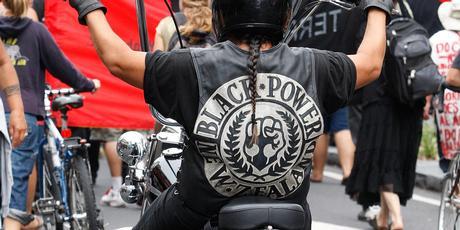
That was on page four of the dead tree edition, and online here, under the headline “Opponents put up roadblocks to bill”. Use of this outrageously unrepresentative photo makes a number of unjustified implications which aren’t present in Claire Trevett’s generally factual and balanced article. These include:

  • Most obviously, the suggestion that the marchers are gang members, with the implication of violence and public menace that creates, despite the fact that the march was peaceful having been mentioned in the opening sentence of Trevett’s article;
  • Creation of a general equivalence between Māori protesters and gang members, with all the racism that implies;
  • The suggestion that opponents of the foreshore and seabed legislation are acting on a separatist “black power” imperative, when the article makes clear that the opponents mentioned in the headline are an ideological grab-bag consisting of the ACT and Green parties, and Hone Harawira;
  • The suggestion that the marchers are literally blocking roads, when the article makes clear that the roadblocks referred to in the headline are metaphorical, and little more than the usual sort of procedural delaying tactics employed in Parliament to drag out the progress of a bill — in this case until next week, when the hÄ«koi reaches Wellington.

The core message of this choice of photo to accompany what is mostly a story about the trivial frustrations of a government trying to pass an unpopular law is this: Māori radicals and gangs are forcibly blocking this law, and they will block you from the beach as well.

It would be absurd if it wasn’t so offensively misleading.

(via Pascal’s bookie)

L

Put it out of its misery

After defending New Zealand’s broadcast news media in recent weeks, and bemoaning the lack of funding for public service broadcasting in particular, TVNZ has tonight hit rock-bottom. The so-called national broadcaster has been comprehensively shamed by TV3, and in the battle for news credibility it has capitulated having barely fired a shot.

John Campbell announced the Sendai Earthquake live on Campbell Live, and TV3 interrupted its broadcast of the high-rating Glee with micro-bulletins (leading the ad breaks) not long afterwards, and eventually ditched the show altogether to show live coverage from Japan’s English-language NHK network. TV One, in contrast, let MasterChef play to the end before switching to NHK. The digital-only channel TVNZ7 was also broadcasting coverage from NHK.

Both commercial channels continued to play ads, but other than that, did a pretty good job of balancing raw foreign coverage, context provided by their local presenters, and important updates for New Zealanders (tsunami alert status, etc.). And then, after broadcasting quake coverage for about an hour, One switched back to its regular programming, showing “Pineapple Dance Studios”, a reality TV show about “the larger-than-life exploits” of the dancers at said London studio. TVNZ’s other channel, TV2, was broadcasting American Idol. At some point (I haven’t been watching it) TVNZ 7 switched back to its regular programming: a book show of some sort. TV3, apparently without a second thought, cancelled the rest of its scheduled programming, and continues to carry the NHK feed, interspersed with relevant original content, including reports from New Zealand expats in Japan.

The contrast could not be more stark: while both One and TV3 remain general-purpose TV channels with a bolt-on news component, TV3 thinks of itself as and actually behaves like a bona fide news outlet, while for all its big talk TVNZ has revealed itself to be just another vehicle for empty escapism. TV3 demonstrated considerably better newscasting chops than TVNZ during the Canterbury earthquake of 22 February, but the comparison was unfair because TVNZ’s live broadcast infrastructure was more or less destroyed in the earthquake, so they had considerably less capacity to respond, for reasons outside their control. It is true that, given the volume of disaster coverage we have had recently, there is a need for an escapist bolt-hole — not least, for the traumatised survivors of the Canterbury earthquakes. But that’s what TV2 and American Idol are for. Make no mistake: given our current disaster awareness, the relatively strong links between New Zealand and Japan — including the presence of Japanese USAR teams still in Christchurch — that country’s broad and deep experience of coping with events such as these, and the fact that the tsunami waves are predicted to submerge entire islands in the Pacific, including, presumably some of our protectorates — this is of legitimate news interest to New Zealanders. It is apparently the largest earthquake recorded in Japan in the past century, and one of the ten largest earthquakes ever recorded. By any meaningful metric it is an important news story worthy of our attention.

At the heart of my defence of public service broadcasting lately has been the argument that public service broadcaster raise the bar of competition, forcing commercial broadcasters to sharpen their game. To quote myself (from a comment on Red Alert the other day):

The British broadcast media are very good indeed, and the main reason for this is the BBC. Yes, the BBC itself makes up a lot of the broadcast media environment there, but more importantly, it forces commercial competitors to compete with something other than lowest-common-denominator mass-market ratings. The same dynamic exists in the two other major media markets with strong and well-provisioned PSBs: Canada and Australia, where the CBC and ABC respectively set an enormously high standard for commercial competitors to meet. This is one of the major roles of public service broadcasting, especially in news: to set a high bar for competition.
If you want to solve the problems within New Zealand’s media environment, if you want to raise the bar: make the commercial media outlets compete with something that hasn’t been gutted and hamstrung. Fund TVNZ and Radio NZ properly, give it freedom to hire and retain the best people, buy the best content, and generally do what it does, and let the others work to match them. Everyone wins.

To give just one tiny example of how this might have worked: TV3 may have reconsidered its decision to air advertisements for fast food and outboard motors between shots of buildings and fleeing vehicles being swept away by ten metre waves, if there had been a viable ad-free newscast in competition with it. To give another: perhaps, if there was some competition prepared to put up the NHK feed overnight for those whose family members and friends are in Japan, TV3 might not have cut to Sports Tonight after Nightline had aired. But there wasn’t any competition. When governments underfund public service broadcasters or hamstring them by imposing the contradictory roles of a public service mandate and the need to return a profit to the consolidated fund, both roles are weakened. We get the worst of both worlds: as taxpayers, we pay public money to fund public service broadcasting, provision of which is undermined by the channel’s need to remain obedient to market imperatives, and in exchange for putting up with ads we end up with a pale imitation of a commercial broadcaster as well. One News — and to an even greater extent TVNZ 7 — supposedly a dedicated ‘factual content’ channel — disgraced themselves and failed New Zealanders tonight. The tagline “New Zealand’s news. Anywhere. Anytime” should perhaps be revised to “Anywhere. Anytime. Except when there’s third-rate reality programming to air instead.”

TVNZ, by waving the white flag tonight, has demonstrated that it’s all but worthless as a public service broadcaster. The market is doing its job for it. If the government isn’t going to fund it well enough to turn it into a proper public service broadcaster, they might as well sell it, if they can find anyone who’ll pay anything for it. If they can’t, perhaps they can just take it out behind the shed and put it out of its misery.

L

Triangulating News Sources.

One of the simple yet key concepts in intelligence gathering is triangulation: try to receive information from at least three independent sources about a given subject or target in order to avoid selection bias, erroneous reporting, disinformation or content manipulation. It is the mark of the intelligence professional that s/he avoids making value judgements or offering assessments until source triangulation has confirmed the accuracy or veracity of reporting from the field or in intelligence streams provided by informants, contract assets, liaison partners and open sources.

I write this not as a preamble to a discussion about how the NZSIS does not do this as a matter of course. Instead, I mention triangulation because it is a principle that seems to me to be a requirement for news-gathering in the present media context. Let me briefly explain why.

I am about to return permanently to NZ after a 3.5 year sojourn in a small SE Asian state. Although the country I am about to leave is authoritarian and places restrictions on freedoms of speech and association, it has a fairly lively media community that includes cable providers that offer a variety of news channels from around the world. As a result, I have had the luxury of watching news channels from Australia (ABC), Russia (RT), China (CCTV in English), the UK (BBC and Sky), the US (Fox and CNN), the Singapore-based Asia News Channel, and a host on Malaysian and Indonesian outlets (which I do not understand but whose images demonstrate their emphasis). I read the local paper (the Straits Times), which even if a government-supportive outlet has very good coverage of Asian news and offers insight into the mindset of the regime and society. I spend way too much time digesting a variety of on-line news providers, ranging from the NZ Herald, Stuff and Scoop to the NYT, Washington Post, Miami Herald, Buenos Aires Herald, La Prensa, Clarin (Argentina), A Folha do Sao Paulo (Brazil) , El Mercurio and La Segunda (Chile), Gramna (Cuba), The Guardian and Independent (UK), the International Herald Tribune, Economist, Christian Science Monitor and various sports outlets. The range is indicative of who I am and where my interests lie. The only major video outlet I cannot watch is al-Jazeera because it is prohibited in my country of residence over fears that it will incite the minority Malay population. So I link to it on-line via third parties.

The variety in representation of the same events is amazing. I often sit in utter wonder at the different takes RT, CCTV and al-Jazeera have on subjects such as the Middle East uprisings when compared to CNN, the BBC, Sky or the ranting chickenhawks on Faux News. Sometimes it is as if I am moving through parallel universes, and my only lament is that I cannot do a multiple split screen in real time to see all of the alternative takes simultaneously. What is unmentionable on US channels is front and centre for the Russians and al-Jazeera. The CCVT propaganda gets its counter in Channel News Asia. I am overwhelmed by choice when forming opinions about current events.

That brings me to my only concern in returning to NZ: the lack of variety in news provision. Although Stratos is an excellent provider of alternative views, as is Maori TV (I am not sure if Triangle TV is still on air), and there is plenty of the usual US and UK news channels on Sky cable, the hard fact is that in NZ there is a paucity of choice when it comes to news gathering. Although I can still use web surfing to access alternative sources of information, the problem of limited choice in news gathering is acute for those who do not have access to cable TV or computers with internet connections (i.e. the underclass). Couple this with the idiocy and vapid “human interest” stories that occupy a large part of NZ newscasts and you get a situation ripe for content manipulation by corporate broadcasters and government, whose line on a range of issues often dovetail in very neat ways. For example, little mainstream coverage has been devoted to the upcoming Urewera 18 trials (held in front of a judge rather than a jury and held in Auckland rather than closer to the site of the raids or the places where most of the defendants live, nearly 4 years after the raids were carried out), which follow one of the more outrageous abuses of anti-terrorism legislation and police authority in recent years. The story is highly important for anyone interested in civil liberties, due process, judicial independence, Maori sovereignty, social and political activism, and the nature of democracy itself. But it is nearly invisible in the corporate media.

That is why I return to NZ with my one concern: the difficulties in maintaining good triangulation in news gathering. It says a lot about NZ’s media culture that I have more choice here in the authoritarian red dot than I do in Aotearoa. Some might argue that is a function of market size, but the hard fact is that where I currently live has almost exactly the same population numbers as NZ in a much smaller land mass, with similar GDP and education levels, and equal if not more access to news sources even though all cable TV and internet provision is in the hands of two state-controlled monopolies. Hence the answer for the lack of choice in news-gathering in NZ either lies outside the market or rests on a particularly Kiwi media market dynamic that prefers ignorance over choice and spoon-feeding over triangulation. Which is it?

The three cities of Christchurch

As local context and in contrast to my recent posts on the media response to the Christchurch earthquake, you must read this arresting report from Christchurch resident Peter Hyde. It is long, but the following facts are crucial:

There are THREE cities in Christchurch right now, not one.
RESCUE CITY is inside the four main avenues, and it is cordoned off. That means almost all our knowledge of it comes from media, and man is it a honey-pot for them!
It’s given us understandably-incessant tales and images of injury, tragedy, loss, broken iconic buildings, heroism, sacrifice, leadership and gratifying international response. It’s extremely television-friendly.
My quake experience started there, but actually almost nobody lives in Rescue City. The resources and attention which are seemingly being poured into it right now are NOT addressing the most urgent post-quake needs of the population of Christchurch.
SHOWER CITY is any part of Christchurch where you can take a hot shower, because you have electricity and running water and mostly-working sewer lines. By latest estimates, that’s about 65% of the city — much of it out west.
In that part of Christchurch, weary and stressed people are getting on with life — though some may be wondering if they still have a job. And a few of them with energy and time to spare are wondering if they can do more to help the rest of the city.
The media naturally lives in Shower City, and they talk almost exclusively to the business leaders and the Rescue City leadership who also inhabit it.
REFUGEE CITY is the rest of Christchurch — mainly the eastern suburbs, though there are pockets elsewhere. It includes perhaps 50,000 to 100,000 people, though a more-mobile chunk of them may have self-evacuated by now.
Only half of those who remain in Refugee City have power, and almost NONE have running water. Many have been living on their own resources, and their neighbours’, for over a week now.
That means that batteries have run down, gas (if they had any to start with) has run out, other supplies are low or gone. Roads are often very bad – and a lot of those from the poorer suburbs have no transport anyway.
Their houses may or may not be intact. Their streets may be clear, broken, or full of silt. Or sewage. There are no showers. Or ways to wash clothes. Or to wash dishes. Or to heat the “must boil” water that is available — assuming they can make it to the nearest water truck, day after day. No refrigeration. No working toilets, and precious few portaloos. No face masks to defend against the blown silt.
They have no internet either, and usually no phones. And their radio batteries are dead or dying. The papers — if you can get one — are rapidly dated, and usually far too general in their coverage. It really doesn’t help someone without a car in Aranui to know that Fisher and Paykel are providing free laundries in Kaiapoi!
All the above means the locals have few resources, little information, and no “voice” either. It’s remarkably hard to call talkback radio – or your local politician — or emergency services — when your landline is out and your cellphone battery is dead. Or when it maybe has JUST enough charge to stay on hold for 5 minutes – but not 20! – when calling the sole government helpline.
The media flies over, drives past and dips into Refugee City, usually at the main welfare or water points. But they don’t cover it that much. From my observations, the officials – those who are making decisions about the relief effort – seem to do likewise.
[…]
IN THESE POWERLESS SUBURBS, THE OFFICIAL RESPONSE IS FAR FROM ENOUGH. Especially in terms of the fundamentals.

It continues at considerable length, and I urge you to read it all, particularly the bit which tells you what you can do to make a difference.

Edit: There is another similarly grim comment from Puddleglum at The Standard:

I’ve spent the last few days shovelling silt in the east of Christchurch. My nephew who had helped dig a friend out of his house in Bexley on Saturday has been over more of the eastern suburbs. Basically, it gets exponentially worse the further east from the central city you go.
These people are already angry, stressed, dismissive of the reactions of most authorities and doggedly trying to do it themselves – yet, as the poster notes, they had the fewest resources to begin with. It’s heartbreaking. Bitter jokes punctuate emotionally strained comments about ‘you just have to go on’, ‘what else can you do?’, ‘THEY won’t help’. They did really appreciate the volunteer ‘diggers’, though.

Read the whole thing.

I’m on deadline and short on time, but my initial response is as follows.

The response is not blind to class or social station. Of course it’s not; as early as last Wednesday I was seeing tweets from people in what is now Shower City saying “we’re doing it hard, but those poor areas down the line haven’t got anything”. This is a feature of disaster responses everywhere. Of course, those suburbs hardest-hit are those suburbs hardest-hit. But what’s really problematic is intersectionality: live in a hard-hit suburb and you’re poor? Tough for you.

I suspect the problem is not so much exploitation as it is ignorance, both wilful and otherwise; by both officials and others. Referring back to the discussions of exploitation on my previous posts, it might be that the residents of Refugee City would welcome a horde of snooping cameras, as long as they could be assured that the footage they captured would stimulate a greater and better-targeted response.

The media has a responsibility to tell this story, as much as it does to relay the uplifting narratives of solidarity and community resilience from Rescue and Shower Cities. A week on from the event, it should not fall to an insomniac resident of Refugee City who is fortunate enough to have the electricity, technical means, personal wherewithal and social networks to tell this story as if it is some sort of revelation. That is the job of the professionals. We should already know all of this.

In their meagre defence, I have heard some media outlets asking questions such as these. A reporter (from TV3) asked Bob Parker yesterday, after the fanfare resulting from the discovery of the time capsule, whether it was good enough that Aranui still didn’t have toilets. (His reply was not good enough — that the response had been very good overall — and the journalist did not push him.) They toured Aranui yesterday, talking with the residents and broadcasting their concerns — lack of facilities, lack of attention, breakdown of the rule of law. Breakdown of the rule of law. People fleeing their homes because, at twilight, groups of people roam around casing houses for burglary.

The media must report this, and in some cases it has: but ultimately it is for the government to undertake a response which mitigates against this inequitably-distributed misery. And a government who is reportedly considering policy changes which will weigh heavily upon lower-income New Zealanders would be well-advised to look after those citizens’ response.

As they say: the whole world’s watching.

L

(Thanks to Emma Hart for bringing this to my attention.)

One man’s terrorist…

Via Thomas Beagle, the following astonishing story:

In Libya, an unlikely hero of a youth-led revolution
BENGHAZI, LIBYA – Mehdi Mohammed Zeyo was the most unlikely of revolutionary heroes. The bespectacled 49-year-old worked in the supplies department of the state-owned oil company. He was a diabetic with two teenage daughters.
But something snapped inside him as a youth-led uprising in Libya against the government of Moammar Gaddafi quickly turned bloody.
[…]
On the morning of Feb. 20, he walked down the stairs of his apartment building with a gas canister hoisted on his shoulder, witnesses said. He put two canisters inside his trunk of his car, along with a tin can full of gunpowder. Driving toward the base, he flashed the victory sign to the young men protesting outside and hit the gas pedal.
Gaddafi’s security forces sprayed his black car with bullets, setting off a powerful explosion, witnesses said. The blast tore a hole in the base’s front gate, allowing scores of young protesters and soldiers who had defected to stream inside. That night, the opposition won the battle for the base, and for Benghazi, as Gaddafi’s forces retreated.
[…]
Zeyo had left a will listing the debts he owed so that they could be paid, but Hafidh said the community and the company where Zeyo worked would take care of his family. On Zeyo’s desk Monday was a printed piece of paper pasted to the computer screen.
“We are from God and we return to God,” it said.
At home, his wife put her head down.
“We had no sons to carry on his name. But this is how God works, and now his name is written in history,” she said.

That was published in the Washington Post, and syndicated to the front page of the international news section of today’s Dominion Post. Read the whole thing, it’s worth your time.

Then try to re-imagine this story if the protagonist was an uneducated working-class youth from the Palestinian Occupied Territories, rural Afghanistan or the Iran-Iraq borderlands.

L