
This is a powerful, classic, somewhat disturbing image of Norway gunman Anders Behring Breivik:

Marred by very badly chosen mouseover text.
L
This is a powerful, classic, somewhat disturbing image of Norway gunman Anders Behring Breivik:
Marred by very badly chosen mouseover text.
L
Ayn Rand’s Atlas Shrugged isn’t a work with universal appeal, but it interests me as a work of propaganda. It is a powerful text, and one that has had an enduring influence on Western politics. While my disdain for Objectivism and the sanity of most of its adherents is pretty well documented, I do, at least to an extent, get the appeal.
There are some things that were inevitably going to be bad about the recent movie adaptation Atlas Shrugged: Part I, the first in a trilogy: the utopian pseudo-philosophy at its core; unlovable heroes and pantomime villains; the absurdity of a mysterious stranger going about making zillionaires offers they can’t refuse to leave it all behind, and so on. This is all the usual stuff of Atlas Shrugged criticism and while fair enough, it’s not really pertinent to criticism of the movie, because the movie couldn’t have been made authentically without it. (The question of whether it should have been made authentically at all is another one; I think it should.) So this review isn’t a critique of the novel, or Rand’s philosophy; it’s a critique of the film.
There’s a scene early on in the story where Paul Larkin, a business-courtier of sorts, counsels Hank Rearden about the importance of public opinion. The movie plays it pretty straight and is much shorter than the novel text, so the dialogue is transcribed here:
Larkin: You’re not very popular, Hank.
Rearden: I haven’t had any complaints from my customers.
Larkin: That’s not what I mean. You know what you should do? You ought to get yourself a good press agent, to sell you to the public.
Rearden: It’s my metal I’m selling, not me.
Larkin: But you don’t want the public against you. Public opinion can mean a lot.
Rearden: As far as I can tell it doesn’t mean a damned thing one way or another.
Larkin: The press is against you.
Rearden: They have time to waste. I don’t.
This theme — to hell with what the peasants think, only quality matters — it central to Rand’s work, and the filmmakers here have taken it entirely to heart. They have made a film that is almost incomprehensible to those who aren’t familiar with Rand’s text, presumably on the premise that anyone who matters will know the story already, or will be able to divine the work’s innate and self-evident quality for themselves.* The result is a simplistic, primary retelling of Atlas Shrugged: a film without cinematic appeal or narrative cohesion, and that doesn’t effectively convey Rand’s milieu, her ideas, or her ideology, and consequentially fails to live up to her vision.
The first and most immediately evident failure is that the film is talky to a fault. Before it was released I expressed concerns that a production team of Objectivist True Believers would lack the necessary courage to take the red pen to the hallowed text. This fear has been fully borne out. What works on the page — and what worked on the page in the 1950s — does not always work on-screen. The iron law of the moving picture is show me, don’t tell me, and it is not unfaithful to cut an author’s prose to suit the needs of a new medium. Yet it seems every cut, every edit (and of course there are many; it’s a long book) has been made reluctantly.
Seriously: as Hank and Dagny retire to their rooms after celebrating the John Galt Line’s maiden run, we don’t need Hank to confide in a stage-whisper to Dagny that he wants to kiss her, or for her to say “what’s stopping you?”. Earlier, after about 40 minutes of wondering when the hell the movie is going to start, we got a brief conversation about dessert, banana or chocolate? In other cases Rand’s phraseology intrudes: the introduction of John Galt — the first meaningful piece of dialogue in the film — comes almost verbatim from the novel: he introduces himself as “someone who knows what it’s like to work for himself, and not let others feed off the profits of his energy”. Come again? Rand’s hackneyed ideological tropes (“Anti Dog Eat Dog Act” &c) are retained without the benefit of the novel’s context, in which they make sense. The screenplay manages to fail both the tasks of good exposition: convey a vivid sense of milieu, and do so efficiently and with congruence. While you could argue it sets the scene, it’s still not entirely clear what that scene is, or why so many words were needed to set it.
Casting and direction is poor, as is to be expected from a first-time director possessed of sufficient (and archetypically-Randian) hubris to cast himself as John Galt. There is an utter dearth of chemistry between the characters; the actors do a mostly serviceable job, but they are given precious little to work with. Rand’s heroes are notable for their severity, but also for their passion, and while the emotional top-note of severity is overplayed, the undertone of passion for the most part just fails to cut through. There are, in this film based on a very emotionally-intense novel, about four moments of genuine emotional intensity. The first is about half-way through, when Ellis Wyatt shouts at Dagny in her office. It is a jarring moment, and not in a good way — the first moment in the film where anyone on-scene is speaking above a low conversational tone, and is totally off-register. It comes out of nowhere — in the novel, again, it was cushioned by exposition — and confuses the relationships between the characters. This is a particular problem in a film where it is already unclear who are supposed to be the “good guys” and who the “bad” (again, a lack of effective exposition).
At other times, despite remaining slavishly faithful to Rand’s dialogue, the film alters the register of a scene so utterly that it is unrecognisable. The sex scene between Hank and Dagny is one of the central events of the first part of the novel: two kindred spirits, having previously thought themselves alone in the world, consummating their relationship with violent intensity. Her “highest achievement”, Dagny calls it, in the novel; in the film we are treated to a slow-motion desaturated montage of soft fades, arched backs and half-open mouths. Its only redeeming feature is its brevity. I mentioned that there were about four moments of genuinely intense emotion in the film: this was not one of them. Going to such lengths to retain Rand’s words while neglecting to retain the tone and sense of her narrative is penny-wise and pound-foolish, as far as authenticity goes.
Deeper than the failure of narrative, though, is the film’s failure to deliver its ideological payload. The expression of Rand’s ideology is garbled, the narrative itself is poorly explicated. Nor is it carried by structure, or image or performance, or anything, really. Signature scenes that conveyed this material vividly and at tiresome length in the novel are all but absent — such as the encounter with Hugh Akston, which becomes a trivial footnote in a weird road-trip montage — while other aspects, such as Rearden’s sell-down and the implementation of various acts and regulations, are bogged down in irrelevant technical detail. We learn a lot about the structure of the steel and railroad industries in Rand’s America, but very little about why these things matter to the story.
So although the filmmakers have remained quite true to the text this is not a film that is true to Rand’s vision. It’s barely a film — it’s more like an illustrated audiobook, badly abridged. Rand was a screenwriter whose work was produced on Broadway; someone who understood drama, who wanted Clint Eastwood and Farrah Fawcett to play the leads in the movie of Atlas Shrugged. She worked to have it produced twice, as a film, and then as an eight-hour miniseries; both failed. At the time of her death she was (re)writing the screenplay herself. She had great ambitions for the movie. As an ideologue and a propagandist she knew and understood deeply the power of words and images, of ideas and argumentation, to move people, and for all their faults her novels — or this one, at least — did that.
Film’s use as a propaganda medium was by no means alien to her. Early Soviet Russia had the best-developed ideological film tradition of its time, and Rand was also said to have caught what Lev Kuleshov referred to as “Americanitis”, infatuation with America, from watching the Hollywood films that so eloquently portrayed the bourgeois individualism of American life. The films of the Soviet tradition in which she grew up, no less than those of the classical Hollywood system in which Rand later worked, were profoundly cinematic works, used quite purposively to convey ideological material in every cut, every frame, every note. It was not a tradition of simplistic, literal narrative adaptations, but works of political art in their own right.
Like the exponents of Soviet montage, Rand tirelessly inferred ideological symbolism into arbitrary works of art. She was not afraid to challenge readers, to shock or outrage them. For all it may be nominally faithful to the text, this film fails to use the aesthetic tools of the medium to convey its message. It fails to challenge, or shock, or outrage. It fails to do anything, really. This movie of a novel about the primacy of action over inaction, preoccupied with the most immense mechanical and ideological forces, literally about the engines that drive humanity, is shamefully static.
The film’s dearth of cinematic character means that not only has it failed to make money (an Objectivist KPI), but it also fails to fulfil the purpose of an ideological text: to engage, to inspire, to move people. Other than those for whom the text is sacred, who overlook the faults of the adaptation out of fawning affection for the source material, nobody is watching Atlas Shrugged: Part I; there were no queues, there is no buzz. At a time of deep and divisive public debate about the nature of the relationships between business and government, between the state and the individual, at a time when Rand’s latter-day apostles are so fond of declaring that her work has never been more relevant, and that her ideas are enjoying a renaissance, there isn’t even any outrage about this film. In this regard it is no better than the preachy Bible films, full of hollow, lazy sentimentality, that get replayed to captive audiences of bored children every Easter and Christmas. The Gospel According to St Matthew this ain’t.
For all I disagree with her philosophy, Rand’s novel deserved better. As noted, her work is packed with references to the expression of ideology and exaltation in the everyday — in the structure of a building, a person’s voice or bearing; or most notoriously, in their approach to sex. This film is no such expression of any innate excellence. Echoing the conversation between Hank Rearden and Paul Larkin, a motif of Atlas Shrugged is frequent reference to the composer Richard Halley, one of the “strikers”, whose work is described as so profound that it is misunderstood and mocked by the ordinary workaday folks, the leeches and moochers and second-handers, and by the time they come around to appreciating it Halley has decided they are not worthy.** Objectivists certainly consider Halley’s work as being analogous to Rand’s, and I get the sense that the principals of Atlas Shrugged: Part I fancy themselves as having created such a work — one that can only be properly appreciated by those of a nobler character. That they, as Galtian Ãœbermenschen, would succeed where everyone else had failed by sheer force of will, and in spite of the doubts and limitations placed upon them by the second-handers. Their conceit could hardly be greater.
Perhaps those of us who are not Objectivists should be grateful; Atlas Shrugged made to Eisenstein, DeMille, Capra or Pasolini’s standards would be a mighty work of propaganda indeed.
L
* Fitting irony: this review also assumes readers are familiar with the story.
** This is a serious business within Objectivism: the arguments as to whether Halley’s fictional music is best represented by Rachmaninov or Mussorgsky are quite something.
I recently tore into Chris Trotter’s argument that polls are deployed to promote a “spiral of silence”, to demoralise those holding non-majority views, and to deter them from political speech and action. I stand by that post, and I still don’t think the argument holds in the general case, but this morning I think we saw an example where polling data was used in just such a way.
National campaign chair Steven Joyce appeared on Morning Report defending the party’s handling of the “teapot tapes” strategy. Joyce came to his Morning Report interview armed with overnight polling data that he says shows 81% of people are sick of the coverage of the teapot tapes, only 13% think the issue is a big deal, and that some in the media ought to take a long, hard look at themselves. Russell Brown covers the topic in more detail; this post began as a comment there).
Leaving aside questions about the veracity of these figures (they could be utterly fabricated and we’d be none the wiser; Bomber reckons they’re bollocks), this actually is a case of a politician deploying polling data to send a message, not only to the media, but to the public: If you care about this you’re out of touch, disconnected, in the minority, obsessed with trivia, and you ought to be ashamed of yourselves. While I disagree with his assessment, what’s more interesting is how he framed that assessment: as a normative argument about what election campaigns ought to be about, and what “real New Zealanders” care about; echoing John Key’s “issues that really matter” rhetoric, which is precisely what all the National supporters I’m in touch with have been saying: nothing to see here, it’s a sideshow, can we get back to the substance, and all that.
Which is pretty ironic given that the Nats have done extremely well for most of the preceding five years by staying the hell away from policy arguments wherever possible. It’s a pretty remarkable position from a National party whose strategic success has been largely founded on a ruthless commitment to campaign realism, expressed by avoiding “noble” pursuits such as the robust policy focus and appearances in the hard-news media in favour of what is effective — personality and brand-focused campaigns, point-scoring, agenda domination, and routine appearances in sympathetic forums, for example. It’s even more remarkable since Joyce himself has been the architect of this strategy since the 2008 campaign.
So I am cynical about National’s sudden love for the “real issues”. They have touched on them before — the election-year launch of the privatisation policy that I wrote about in February is the best recent example — but this has hardly been their preferred route. What seems more likely is the “spiral of silence” imperative — marginalise, shame and heap scorn upon those who genuinely see a substantial public interest in the way the teapot tapes episode has played out, not out of a prurient interest in the contents of those tapes but because — as Danyl notes, it “keys into a huge range of really substantive issues: the Prime Minister’s integrity; media ethics; surveillance”. This deployment of normally-secret polling data — probably collected for this exact purpose using carefully-framed questions — seems like an attempt to bully into silence those who aren’t willing to ignore an unprecedented breakdown in the relationship between the Prime Minister and the media, and a nearly-unprecedented glimpse into the internal workings and political culture of the National party and its leader.
It has had the desired effect on other political parties — Phil Goff and Peter Dunne have sung from the same songsheet today, leaving only Winston Peters to reap the electoral harvest from these events. Given that, it is not unlikely that it would have a similar effect on voters, especially in Epsom. Of course, there may not be an electoral harvest; the polling data might be accurate and it may genuinely be perceived as a “Bowen Triangle” sideshow. I don’t think so, but then, I would say that.
Update: Since writing this, Fairfax has released a poll of their own that suggests the public are over the teapot tapes. Its numbers are considerably more ambivalent than those released by Steven Joyce, however; the strongest result was for the obviously-correct proposition that politicians should be able to discuss controversial topics privately (63%). On this basis Matthew Hooton is now praising the strategy as “genius”. It’s also important to realise that this isn’t a pure popularity contest, but a balance of complex factors — the intensity of sentiment on either side matters. As Danyl remarked in the Public Address thread, “If 4% of National supporters switch their vote over to Winston Peters on the basis of this affair, then that’s a strategic catastrophe for Joyce’s party, no matter what the other 96% do.” There’s no indication that this has happened, of course, but there’s no really definitive indication of the fallout from these events at all. The Herald on Sunday tomorrow will be fascinating.
L
Chris Trotter suggests that frequent and heavily-publicised polls favour the right and result in a self-fulfilling prophecy, depressing support for the left. Bomber Bradbury has made similar arguments in the past.
There are two parts to this: first, the question of whether polls are inaccurate vis-a-vis the actual views of the electorate, and if so whether they do in fact favour the right; and second, whether this, on its own, has a substantive impact on actual real-world support.

I am aware of no robust research on this topic in the NZ context (which isn’t to say that it doesn’t exist; although if it did I’d expect the many proponents of this line of argument to be citing it all day long.) So to kick off, let me concede that if there was a significant ideological bias to the polls it certainly could have an impact on voter behaviour. But I suspect any impact would be more complicated than the simple “low showing for a party causes low turnout and/or low support” reading of the “spiral of silence” model Chris cites (which is nevertheless a useful model). For one thing, it’s not clear that the impact is very strong in case of a secret ballot; also, the argument doesn’t take into account New Zealanders’ oft-cited peeriness about single-party majority governments in the wake of Muldoon, Lange and Bolger which could have a moderating effect, and it doesn’t take into consideration the usual “narrowing” that occurs in the latter stages of an election campaign as wavering voters begin to make up their minds. So I doubt the size of this effect on Labour’s polling at least; any shift should not be large, and certainly not sufficient to change the election outcome. However where NZ First is concerned it’s different — a percentage point or two makes all the difference in the world there, and whether NZ First returns to parliament or not rests on the collective spirit of Winston’s faithful. Assuming they still make up fiveish per cent of the voting population they must not waver, and must cast their votes together regardless of what they are told about the polls. If they fail to do so NZ First is out, and all those votes are wasted, and that is certainly an outcome that could result from widespread reporting of polls that show NZ First under the threshold (and one that could change the election outcome).
Note, however, that all that is contingent on those polls showing NZ First to be under the threshold actually being wrong. I’m not persuaded of this, and I’m also dubious about the contention that polls favour the right. As Bomber is fond of pointing out, the polls run in the leadup to the Auckland Supercity election favoured John Banks, while in the election Len Brown won handsomely. That’s important to remember, but it’s only one data point so I’m hesitant to draw meaningful conclusions from it, and if it’s evidence of anything, it’s against the simple reading of the “Spiral of Silence” thesis, according to which Brown’s demoralised supporters should have stayed home.
There is also some evidence out of the US to suggest that landline-only polls favour the Republican party over the Democrats (when compared to polling samples that include cellphones). It’s not clear is that this trend is also in effect in New Zealand. Based on no data, I think it has some influence, but our situation here differs in important ways; most notably, we have more than two parties so variance of this sort is more dilute and less zero-sum. And the likely effect would be ambivalent — if landline-only polls tend to exclude the young and the poor and tech-savvy urban liberals, they should overstate support for NZ First, not understate it.
The matter of bias isn’t readily testable because, as an Australian poll analyst put it recently when looking at bias between pollsters in that market, “we just don’t have elections every week to determine the true state of public opinion“.* There is also evidence to suggest that people’s voting behaviour differs in important ways from how they answer opinion polls. So we need to rely on other forms of measurement; proxies being measured against proxies. There are focus-groups, vox pop interviews and 75c text-polls and coffee-bean polls, and the Horizon poll with its radically different weighting system, but I see no firm grounds to believe any of these would be any more reliable than the major phone poll companies. One very strong point in favour of the usual sort of phone-based opinion polling is that it has remained more or less methodologically consistent for a very long time. This gives us extremely large, continuous datasets that we can plot against real-world events including policy releases, major speeches, current events and elections. In this regard they are much like audience/circulation ratings in the media. The utility of these well-established systems isn’t that they have no flaws — they certainly do, and much of the criticism is valid — it’s that they have a reasonably well-known set of flaws that are consistent over time, and we can use the historical record to make inferences about the present day (too few people, I think, are actually doing this, but that’s a different matter). By contrast other systems — Horizon, in particular — are less well-known, and serious questions need to be asked about the quality of their results. They’re worth watching, but they are not as yet a substitute for what we already have.
Returning to the argument. So if the polls systematically favour the right, and if they do so in such a way as doesn’t also favour NZ First’s older, wealthier and more conservative demographic, and if the extent of that bias is significant enough to have a significant zero-sum election night impact despite all the confounding variables of voter behaviour, then Chris might be right.
But that’s a lot of ifs, and a claim as bold as “polling companies and the media steal elections from the left” demands extremely robust evidence to be given credence. I’m open to the argument, but what we have here isn’t evidence, much less the robust kind; it’s supposition, and what’s more it’s supposition derived from partisan loyalty. The argument is unfalsifiable — if the election does deliver a substantial defeat to Labour and NZ First they will take that as proof-positive that they were right all along and the voters were robbed; if it doesn’t no doubt they will cheer those who battled valiantly and overcame the oppressive regime imposed by the forces of evil. In this regard the argument is nearly indistinguishable from that made in 2008 by the Free Speech Coalition who, despite their howls about Stalinist restrictions on political marketing, managed to help their political representatives to a handy win.
My view of Chris and Bomber’s general line of argument is that it’s more of the usual excuse-making and blame-shifting that I see from lefties who can’t bear that their tribe is staring down the barrel of a(nother) heavy defeat. It’s an attempt to make the evil media cabal responsible for poor performance, and to minimise the effect of weak leadership, institutional incompetence, lacklustre campaign and — in Peters’ case — public self-immolation during the last term. It’s a myth; something to keep the faithful warm at night, in the absence of actual victory. Myths certainly have a kernel of essential truth, but they should not be mistaken for evidence. Moreover, as regards Chris’ concerns about the election accurately reflecting voters’ wishes; these would have more credibility if his own history of respecting the solemn integrity of electoral politics was itself less one-eyed. He thunders:
hundreds-of-thousands of New Zealanders will not only be perfectly entitled to say “bugger the pollstersâ€, but they will also be entirely justified in asserting that the election has been stolen from them
This would ring less hollow if, following the 2005 election, he had not so cravenly excused the Labour party’s own admitted breach of electoral law as being “acceptable corruption” inasmuch as it served the greater ideological purpose of preventing National from being elected. Given that history, his complaints about polling and media conduct look like nothing more than an appeal to ideological tribalism with a bright red smear of electoral integrity lipstick on.
And yet, he has a strong point: if NZ First’s share of the party vote on November 26 comes in fractionally below the 5% threshold, democracy will have been poorly served in 2011, as it was in 2008. My personal views of that party aside, as a matter of natural justice anyone commanding a twentieth of the vote should be entitled to roughly a twentieth of the representation in Parliament. But however unsexy it might be, the solution to this isn’t injustice to attack the pollsters or the media. The argument isn’t supported by the evidence; even if it was nobody’s going to change on Chris and Bomber’s say-so, and we all saw what happened to the Clark government’s regulatory overreach. The pragmatic response here is to work towards reducing or removing the electoral threshold so as to ensure that natural justice is served and variance is less likely to simply exclude a party from representation, and to turn back to the process of returning political rigour to the political left by building competence, vision and leadership so it can succeed despite the obstacles before it. Less myth, more reality.
L
* Pollytics’ analysis plots polling companies against each other, measuring each pollster’s bias from the other polling companies. David Winter has had a go at doing something similar for the NZ context, though he has much less data to work with. While interesting, it’s important to reiterate that none of this addresses the concerns about poll accuracy vis-a-vis the electorate.)
National’s initial Stop/Go TV ad is a pretty good one. Clean, to the point, not bogged down in detail but jampacked with symbolism:
Toby Manhire, writing on The Listener‘s excellent new website, has already done the analysis so I’ll quote him:
Red STOP Labour sign-guy looks a bit tense, uncomfortable, slouchily off-centre. His fist is closed, zip sloppily undone, and look at the state of those shoes.
He looks like he might just call in sick tomorrow because he feels like it, even though the country’s economy will suffer, while he just lies around, stuffing his face all day.
Green-blue GO National sign-guy looks comfortable but focused. Shoes are good. Sensible. He’s a little unshaven, but that’s because he’s a bit like the All Blacks, don’t you think? Like John Key is a bit like the All Blacks.
Check out the clouds, too. Fluffy, familiar things above Green-blue GO sign-guy; grey, foreboding, riskier bastards above that Red STOP man.
It can be no coincidence, what’s more, that the shadow GO Blue Green GO sign GO the All Blacks sign guy casts a shadow pointing where? The centre, people, the centre of the road.
But hang on a moment. The symbolism of a lazy Labourite and a clean-cut Tory is laid on a bit thick — and the scruffy old Labour guy looks just a tiny bit “ethnic”, if you know what I mean. Moreover the whole Stop/Go metaphor is a bit trite — trite enough that it was the basis for a satirical diary piece by David Slack in December last year:
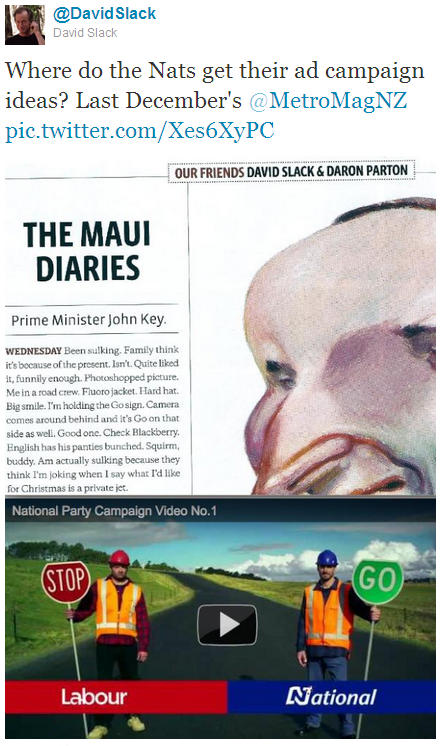
And If you think about how traffic control actually works, the metaphor has coherence problems. Last night, Anna Hodge tweeted the following observation, which in hindsight seems so obvious:
Also, does National understand road works? Or fairness? You need sign-holding dudes with both GO *and* STOP to keep traffic flowing.
Um, quite. For some to go, others must stop (at least until we get reef-fish-inspired traffic management systems.)
Anna’s tweet generated a bunch of responses as the narrative of the ad began to unravel. Mine was that if you’re at the front of the queue, only the GO sign matters; others were about the size of your SUV, the increase in inequality between north- and south-bound traffic flows, and the fact that Stop and Go signs are the same sign, just viewed from different angles.
Aaron Hicks remarked that the STOP sign at road works means that there’s actually work going on, a point you’d have thought might be clear to a government undertaking such an aggressive roading policy. And did the green of the go sign hint at a National alliance with the Greens? But they’ve spent the last decade and a half telling us that the Greens’ green means stop so green is basically red, and now their own green (not even a Blue-green!) means go?
The more you think about it, the more tangled and incoherent the narrative gets. And yet for all its flaws the ad works. It relies on people not thinking too hard about it — upon audiences swallowing whole the top-level symbolic material Toby described, making what Stuart Hall called a hegemonic reading of the text. In Hall’s model the second audience position is a ‘negotiated’ reading — such as Toby’s analysis itself, which recognises the hegemonic aspects of the discourse but doesn’t necessarily accept them, and the third position is ‘contrary’; consciously reading against the text’s hegemonic meaning — what Anna did, as did those of us who responded to her observation.
A lesson from this is that reading a tightly-encoded text counter-hegemonically is hard work. Audiences are not sponges or “sheeple”; they will often take a negotiated position, but in general such a position doesn’t prevent the text from having some impact. This illustrates a point of strategy that my regular readers must be bored tears with by now: you can’t rebut a text like this head-on with wonkish facts and figures. Dry details about Labour’s record and plans on economic progress wouldn’t make a blind bit of difference to the effectiveness of this particular ad, for two reasons: first because the hegemonic material doesn’t lodge in the head, it lodges in the guts (it’s truthiness, not truth); and second because such a rebuttal implicitly accepts the framing of the original text, and that framing is half the payload. But subverting the paradigm, man, that’s where the action is.
I’m not suggesting a comprehensive strategy to counter the National party campaign could be composed around a response to one 15-second ad, but if a counter-strategy was to be composed, that’s how you’d do it. Don’t berate people for accepting the hegemonic position, or for negotiating: find ways to make them see it in a different light.
L
Here’s a thing I don’t get. Lefty partisans (in New Zealand and elsewhere) are overwhelmingly convinced that the Main Stream Media is:
The right believes much the same, just with a different polarity.
And yet, despite these deeply-held beliefs, partisans on both sides react with shock and dismay whenever the terrible old Emm Ess Emm lives up to these expectations. They wail and they gnash their teeth, but they don’t adopt (and don’t require their political representatives to adopt) strategies to deny the Emm Ess Emm the opportunity to fulfil this brief, or to force it into “responsible coverage” mode, and they refuse to acknowledge any responsibility for giving the Emm Ess Emm exactly what it needs to do exactly what it does.
Seriously. As a political movement, the more you believe all of that list — and in general, the lower your opinion of the media — the more you should be obsessed with ensuring that your strategy is freaking watertight so you don’t fall foul of it. Moreover, if you believe the last point (that it’s hastening the end of the world) you should be all the more committed to getting into power so as to implement reforms that will change this state of affairs.
But enthusiastic adherence to these beliefs correlates strongly with a poor understanding of the function of the media and how it works in reality. So those most exercised by the media’s obvious bias against their team are those least able to remedy it. Because they don’t understand the system, they tend to misdiagnose the problem. Having misunderstood the problem they are unable to respond strategically, and the typical result is inchoate fury.
L
Labour seems to believe that it’s easier to seek forgiveness than permission. With the missing figures in the Press Debate, they’ve sought forgiveness for failing to perform on the night, with predictable effect, and yesterday on the wireless with Paul Henry, Labour’s finance spokesperson David Cunliffe remarked about Police minister Judith Collins that if she were the last woman on earth “the species would probably become extinct”. That’s a couple of pretty big steps beyond the usual (and also unjustified) fat jokes about Gerry Brownlee and others, and it’s the sort of behaviour we’d expect in Berlusconi’s Italy, from some of the viler denizens of the lunatic fringe, or perhaps from Paul Henry himself — but it is not conduct becoming a former minister and possible Prime Minister-in-waiting.
I anticipate we’ll see a cringing apology today or tomorrow once the media cycle gets hold of it, but it’s too late — the damage is already done. Some lefties will inevitably claim that having a bit of “mongrel” is crucial to win back “Waitakere Man” (more on this later), or will point to examples of comparable outrage on the other side, but again, it doesn’t matter: Labour is dead in the water if it holds itself to the standards of the rabid right, and this reeks of desperation more than it does of strategy. As Pablo wrote recently, negative campaigning isn’t always a losing strategy, but it has to be done right — and this isn’t. [Edit to add: this sort of behaviour also negates a tactical advantage of being able to criticise Key for his media engagements, such as with Tony Veitch.]
As Labour partisans take great delight in reminding me, I have no knowledge of the inside of Labour’s organisation, and all my Kremlinology about its dysfunction is based on near-obsessive observation of what public evidence is on display. With that caveat, let me advance a thesis: Goff is actually coping pretty well with the campaign so far, but Cunliffe is not. After all, Goff’s only major failure has been an inability to produce costings for the fiscal policy — Cunliffe’s portfolio. Goff, as leader, bears ultimate responsibility for not demanding a better performance from his finance spokesperson, but since Goff has enough on his plate as it is, producing those numbers was surely a responsibility delegated to Cunliffe and his people, and they did not do so. Whether we interpret Cunliffe’s outburst about Collins as (charitably) cracking under pressure or (less charitably) the mask of civility slipping, it looks like he’s feeling the heat more than Goff who is performing better than most people expected (and knows it).
Just a final word about Waitakere Man. Yesterday Stuff.co.nz ran a wee video package they called the bloke test in which journalists asked Key and Goff the same set of questions in order to measure their purported blokiness. This has been widely derided (mostly by the same people who think Labour is running good strategy) as an exercise in vapid idiocy, but that’s not so. Just as much as we have a right to demand political and institutional competence from our leaders, we have a right to judge them on their instinctive, bedrock responses; and this was a case where two leaders were asked a series of unpredictable personal questions and expected to answer them off-the-cuff.
While its utility in measuring “blokiness” is highly dubious, this exchange contained a lot of other information about how the leaders respond to pressure, to humour, their attitudes towards social transgression and their place in society and a sense of who they “really” are. In a representative democracy where voters can be expected to have neither the time nor the expertise to become proficient in every policy field that impacts them, they rely on other indicators to determine who is more likely to make appropriate decisions in their stead. I’ll leave the interpretation of who “won” the Waitakere Man test as political rorschach, but suffice it to say that anyone who thinks this sort of thing is irrelevant trivia needs remedial classes in voter behaviour.
L
I’ve been absent for a while, and am still pretty busy but will endeavour to write more often through the election cycle.
This post is just to correct a misunderstanding that persists in some circles about the debate between John Key and Phil Goff, hosted by The Press in Christchurch (highlights here). The conventional wisdom, with which I agree, is that Goff performed very strongly through the first half (re Christchurch), and into the second half (on more general topics) up until the point at which Key challenged him on Labour’s costing, at which point he lost it because he simply couldn’t rebut the allegation that there was a $14 billion deficit hole in Labour’s policy platform. Labourites, however, have complained that this was unfair, that Key’s numbers were made up, that Goff couldn’t produce figures that hadn’t been properly worked out, or that nobody watches the debates anyhow so it doesn’t matter. These claims might be right; some of them certainly are. But it doesn’t make a blind bit of difference: the task was to win the debate, and Goff did not win the debate.
This is the point, though: it doesn’t matter if a leader’s debate is watched by only 100 people if as one of those people is the political editor of a major news outlet.
Winning a leader’s debate in itself doesn’t change people’s minds. Few people watch them, and most who do have already made up their minds and will interpret even the most epic fails as wins (go back and read the Daily Kos response to the ‘Dean Scream’; or for a more immediate example, see John Pagani). There’s a bunch of research been done on this, and the headline finding is that debates have a significant influence only on the politically naïve. For the most part, leader’s debates are about arousing the true believers and persuading the pundits, who will then report the outcome of the debate, which in turn provides signals to the voters about who has advantage, momentum, mad chops, political competence, and so on — including but not limited to who has the better policies. By failing to show John Key (and the rest of the nation) the money, Goff lost the debate, which puts him on the losing side in terms of all those factors — compounding an existing and well-documented leadership deficit. It doesn’t matter if he’s right — if he can’t demonstrate he’s right we’re entitled to believe he’s not. It’s not as if Key shut him down — he was afforded very generous opportunities to make his case, and he failed (or refused) to do so.
What has happened with the “$14 billion” over the past 48 hours is the system working as intended, filtering our presumptive leaders for basic political and institutional competence. Because we are entitled to demand basic political and institutional competence from our leaders. Not only that, we should demand it; and the fact that people — Labour activists in particular — have not demanded it this past 3 years is part of why we’re looking at another three years of John Key as PM.
John (and Jordan Carter, the MPs, Phil himself) and others who have picked apart Key’s back-of-the-envelope figures, insisted that it was more responsible to check and recheck the PREFU numbers before saying anything miss the point of a debate — it’s about winning under the hot lights of the public glare, not about being technically correct in the cool light of the following Friday. You have to be right enough that you don’t look as if you won on false pretences, but the task is to win, and to maintain the momentum of the campaign, the aura of leadership.
Goff failed. Barring some massive set of exigencies, that’s probably the election.
L
Some say that reality TV is a stained-glass window on society. In the US the concept began with the show “Cops,” now in its gadzillionth year. It gave rise to the Survivor and Amazing Race series, singing and dancing shows, celebrity this and that, cooking disasters of various sorts, adventure and survival programs, motorcycle and automobile customizers, the antics of sexual deviants, cheaters and lumpenproletiarians of various ethnicities (e.g. “Jersey Shore”), Bridezillas and vapid Housewives from various places, dumb and dumber idiots doing an assortment of Darwin Award misadventures, animal attacks, plus a variety other examinations of the detritus of US life. However, the recent turn in reality programming offers a dark reflection of the economic malaise gripping the country.
In recent months the reality concept has focused on the impact of economic misery, albeit from a tangental angle. The most popular shows, led by those on a channel called “True TV–not reality, but actuality”–are those that cover the flow-on effects of econonic hardship. These are led by several shows about vehicle repossession agents, but also include shows dedicated to pawn shops, gun dealers, auctioneers, hoarders and down on their luck gold prospectors. The television angle is not on the economic condition of the participants but on the behavioural effects produced by the consequences of personal economic misfortune: fights, tears, breakdowns and other human drama. Like watching train wrecks, these shows cater to morbid interest and pervese delight in other’s misfortune, which may say something about the state of US social cohesion. I confess to finding some of those involved strangely fascinating, and there is some dark humor involved, but my overall sense is that these shows are a bit too close to the truth to be entirely easy to watch.Â
I am not sure what to make of all this, but it could do conservative US policy makers some good to watch these shows, simply for them to see, should they wish to, the human face of the negative impact of the feral economic policies of the last decade.
NB: I am winding up my tour in the US this week, and other than one mention of the US-Russia game have seen and heard zero in the US media  about the RWC. What I did read is thatWayne Mapp said that the SAS was “sort of” involved in the latest terrorism incident in Kabul. Note to “Dr.” Mapp: that is  like being “sort of” pregnant.
Otherwise, and in spite of the RWC, it will be great to be home.
A short while ago we were treated to the spectacle of a Royal Westminster wedding, a royal tour of Canada and the US, then another lesser royal wedding. The UK and colonial media went crazy with 24/7 coverage of the fairy tale personae involved, and the image conveyed was of stability and continuity in British foundational politics. Â All was well in the Realm.
In the months since the first royal celebration things have grown dimmer. There is the hacking scandal in which politicians and the police appear to be complicit in the illegal tapping of private information by media corporations (primarily but not exclusively Murdoch-owned assets). Added to this sign of elite criminal coziness, now there is a police shooting followed by wildcat riots that represent criminal opportunism rather than outrage about the death itself. The UK media are swamped with reporters, police spokespersons and politicians all chanting in unison about the “mindless thuggery” and criminality of the youth who are widening the scope of violence beyond Tottenham and London itself.
The official emphasis on criminality cannot hide a number of things that depict a reality that s a far cry from royal bliss. The youth involved, while criminally opportunistic in their looting and vandalism, are a mix of ethnicities, but all seeming of working class or unemployed status (On TV I actually saw some young Hassidic Jews amongst the rioters in Tottenham). Some may have participated in earlier demonstrations and rioting about restrictions on access to higher education and the cost of basic services. They appear to be coordinated–in yet another tweeter and smart phone fashion–enough to stay a step ahead of the thinly stretched British Police. The fire service is not attending to full alarm fires because of fears for their security and the Police cannot predict when the next smash, burn and grab will happen. The mob is ahead of the Man, and the mob is angry.
So far the British government has declined to send in the army even though suggestions have been made that they have very robust anti-riot capabilities in Northern Ireland. The language used to justify that non-action is precious: the government states that it does not deploy such hard assets on British soil. So the riot police in London chase rioters using shields, helmets, horses and batons while the British Army uses armoured personnel carriers, water cannon trucks and live ammunition to keep the peace in Belfast and beyond. Some Imperial habits are hard to break, even though the Empire is long gone and its post-colonial consequences have come home to roost in the capital itself.
The hard fact is that the criminality of the rioters is a political act whether or not those involved or the government and corporate media would like to admit it. At a time when the PM, Police Commissioner, Mayor of London, and assorted other leading officials were on vacation in places like Ibiza, Tuscany and Milos, the youth now on riotous display swelter in the housing estates where unemployment, racial separatism, ethnic conflict and everyday economic insecurity are rife. Like their counterparts in any number of less developed countries, they can see up close the material lifestyles and commodity consumption of the royals, celebrities, sportsmen and corporate elites, but do not have (and likely will never have) the means of access to them. Worse yet, they live in a world where the institutional framework is stacked against them, leading to the violent turn inwards when the opportunity presents itself. The Police response is to ask parents to lock up their children.
Be it Marx, Luxemburg, Lenin, Guevara, Marighella, Ayman al-Zawahari, or Muqtada al-Sadr, revolutionaries understand the potential of the criminal mass engaged in collective violence. Lumpenproletarians are the street vanguard who, however unconsciously, help to bring social contradictions to a head and expose the weakness of the elite response and the inherent fragility (sclerosis?) of the status quo as a whole. Where instigated or abetted by politically conscious cadres (and there is some evidence of this at play here), their actions are designed to accelerate the organic crisis of the State, in which economic, social and political cleavages overlap and congeal into compound fractures not resolvable by force, reform-mongering or after-the-fact piecemeal pacification. Given the ongoing repercussions of the 2008 recession and the increasingly global debt crisis, and no matter how they are disguised by ethnic and religious division, the structural foundations for a larger class war in the UK may be fixing in place.
This does not mean that the British government will not be able to quell the disturbances this time around. But what these riots may be is a dress rehearsal for more to come, perhaps in conjunction with the Olympics next year, where militant planners accelerate the pace, focus and intensity of mass collective violence at a time when the British elite are exposed to global scrutiny and their security resources are already working at full capacity. That raises the issue of whether the official approach to rioters will shift to the more lethal Northern Irish “solution” set, and whether those charged with adopting a more lethal approach will have the ideological conviction to respond in such a way to the actions of fellow citizens rather than foreigners (I note that it will be possible for the official narrative  to scapegoat “outsiders” drawn from minority ethnic communities that hold non-Western beliefs, but even that may fail to overcome foot soldier or beat police reluctance to turn their weapons on their own).
In any event, we should see the riots for what they really are: an expression of mass subordinate discontent and disaffection, the product of profound alienation, expressed through collective criminal violence operating in seemingly opportunistic and decentralised fashion in the face of official incompetence or lack of will. That, by most reasoning, is a good sign of a pre-revolutionary situation, one that has the potential to become more of an existential threat to the status quo should tactical guidance and coherent ideological justification be given to it. After all, if what we are experiencing is a crisis of capitalism in the liberal democratic world, then it was only a matter of time before superstructural conditions and precipitating events would combine into a violent rejection of the system as given in countries in which the societal contradictions were most apparent. Be it in Greece, in France, in Spain or now in the UK, should these contradictions continue to fester and combine, it will not be Tea Party-type clones that will lead the insurrectionary charge, nor will they be as polite.
PS: Before Red Dave and other ideologically militant readers opine that I am belatedly joining their ranks, let me state that I do not see this as the beginning of a global revolution or necessarily of one in the UK. It is a pre-revolutionary moment, which means that the UK government still has the ability to engage in divide-and-conquer, selective application of force and reform-mongering tactics (along the lines I mentioned with regard to the Arab uprisings in an earlier  post dedicated to them). There is a fair bit of ground to cover before the Arab Spring gives way to a Red European summer.