
… as none is necessary.
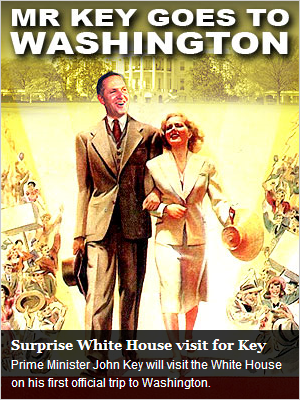
Attached to this article in Stuff’s splash spot.
L
When I was in NZ in February-March, after a year away from the country, I was alarmed by the deterioration of what passed for news in the MSM. This was a continuation of a long-term trend that I have called the “Australianisation” of NZ news coverage, something that Lew and I talked about when we had lunch during my time in Wellington. But the gross decline over the last year was what disturbed me. Whereas the front pages of the major newspapers and lead segments of the major TV and radio news shows used to contain world and national stories of real import, by the time I arrived back in country in early 2010 even those were occupied by celebrity news, scandal and other so-called “human interest” rubbish that catered to the most purient, salacious aspects of public interest. There is war, famine, corruption, epidemics, natural disasters, corporate sleaze, international intrigue and host of other pressing news on any given day, but what is served up in the NZ media is pablum in which wardrobe malfunctions compete with drunken/drugged socialite antics and sex tapes for headlines. I blame Rupert Murdoch for the lot of it, because like PT Barnum and the Roman Emperors, he realised that by catering to the basest of human instincts and desires, media empires can be built. All you have to do is provide a carnival that diverts mass attention from the realities surrounding them, add a few creature conforts via sweepstakes and sponsor tie-ins and prizes, and voila!–you have both bread and cricuses for the masses. Worse yet, this media approach is something that very conveniently dovetails with the interests of political and corporate elites who would prefer to pursue their interests unencumbered by press or public scrutiny.
Which is why I do not lament the demise of the Sunrise program. Not withstanding the fact that all “Australianised” morning shows are much puffery with little substance, that particular example was strinkingly moronic. Forget the tired use of yet another blond female to handle the “soft” stories. Forget the organ grinder monkey act that passed for weather reporting. Forget the blokey rugby/cricket dude and or leggy former netballer who read sports. All of that is par for the course and shared by the risible Breakfast show as well.
No, what set Sunrise apart was the sheer rubbish that it passed off as stories, the sheer inanity of the commentary, and, with few exceptions, the sheer ignorance of the presenters of anything other than their own personae. For Pete sake, they even had a dog as a regular on the show, in an apparent effort to a) appeal to animal lovers; or b) appear more friendly/approchable/likeable. Crikey, it was bad.
Mind you, Breakfast is hardly better. But at least it first segment still contains some real news taken from sources other than its own radio affliliate (although in-house reporting has been cut back dramatically while reliance on newsfeeds from the BBC, CBS, ABC has increased, so perhaps the Mediaworks approach will eventually become the standard at TVNZ). But after 7:20 AM or so, save for the top and bottom of the hour news bulletins, the show deteriorates markedly, and after 8AM it might as well be called Sesame Street for adults. What I find particularly offensive with both of the morning shows on TV is that the content gets dumber as the morning progresses, and judging from the adverts, that is because the producers apparently believe that housewives are the main audience after 8AM, and housewives do not think much when watching a television show. Go figure.
The proof that vapidity has seeped deeply into the public consciousness is provided by the response to the announcement that Sunrise was cancelled. With very few exceptions, be it on talkback radio, newspaper reader comments, blogs or Facebook, most of the reaction pro and con is about the talking heads/presenters and their perceived “chemistry” or lack thereof when compared with the buffoon/giggles act playing over at the competitor during the same time slot. Barely a word is mentioned about the lack of real substance in the show, or of the sheer idiocy that it passed off as news on a daily basis. Heck, if they needed that brick in human guise known as Rick Giles to increase their ratings, then it is clear that the writing was on the wall.
I fail to understand why a news content-driven morning TV show cannot succeed in NZ. There are successful news radio shows at that time of day, and while the presenter(s) is/are often a media personality as well, their status is made by their being able to discuss news and current events in something approaching a rational and informed manner (I exclude Michael Laws and Leighton Smith from this category, although neither of them can touch John Banks when it comes to on-air hubris combined with ignorance). So why cannot that happen on TV? Could it be that the TV-watching public are, uh, less intellectually endowed than the radio-listening public? Cannot one be both?
At first it seemed like TV3 might decide to get serious and provide a real alternative to the morning carnival side show at TVNZ. But noooooooo. Sunrise is to be replaced with reruns of Magnum PI, Frasier, Everybody Loves Raymond and Campbell Live (which has gone from hard-hitting to ethically questionable rabble rousing and scandal mongering). @#$% Me!
The goods news is that, having departed the Land of the Vacuous and Insipid Morning Shows, I do not have to watch this fare. The bad news is that in my current location there is more real news to choose from on radio and TV, but beyond that the situation is not much better. Heck, if you think “American Idol” is bad, then take a look at “Asian Idol” (or any number of other reality show rip-offs).
Best then, that I read a book or a “real” newspaper while having my morning tea.
In the USA, the Spotted Owl evokes the spectre of trivial busybody environmentalism. This species has been extremely well propagandised by the forestry lobby and other anti-environmentalists as a symbol for “putting other species ahead of humanity”. But it is not so in New Zealand (although there is Powelliphanta augusta). For a hint of what the public response to Gerry Brownlee’s plan to mine Schedule 4 of the conservation estate could be like, look no further than the firestorm which has erupted over the YouTube video showing Norwegians shooting protected native birds, among other things.

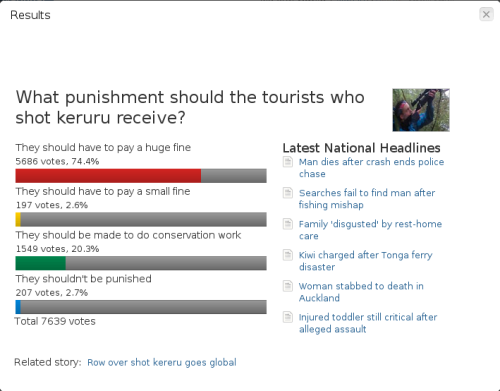
This has been a pretty persistent story. It’s been at or close to the top of the Stuff “most read” list for going on three days now; at the time of writing, it’s #1. It’s third on the NZ Herald website’s NZ section. It was in almost every dead-trees paper with a national news focus in the country on Friday. It’s featured prominently on One and 3 News (and consequently RadioLIVE), Radio NZ National, Newstalk ZB, and is at present the third-placed story on English-language Norwegian news website News and Views from Norway and has made Norwegian-language mainstream news there too, as well as action from Norway’s own environmental agencies. It’s drawn outraged official comment from DoC and the Conservation Minister; but notably not (as far as I can see) from the Minister of Tourism. There are 400-plus infuriated comments on the original YouTube clip, and 300-plus on the Fish’n’Hunt Forum, the oldest and most popular NZ internet site for discussion of hunting and fishing topics. Stuff.co.nz has a poll up, and the results are quite clear, for what they’re worth:
This outpouring of righteous fury has not come about because of the death of a few birds. None of the species shot by these hunters are so close to extinction that the loss of an isolated handful of individuals will critically harm the population. The reason for the response is that this sort of thing offends us deeply and personally. It is antithetical to who we are as New Zealanders, and it is as if a little part of each of us dies with those birds.
I wrote a few days ago that the task for the opposition, for conservationists and those who love the land and its wildlife was to relegate mining Schedule 4 to the “political too-hard basket”. More specifically, that task for those people — and for the 74% of (notoriously reactionary) Stuff respondents for whom these events are a grave injury — is to see the proposal to mine Schedule 4 as the same thing on a much greater scale, which it ultimately is, and to respond in kind.
Update 30 March: A vivid event like the one discussed above often primes the media and public to pay closer attention to similar events which previously might not have been newsworthy. Dog attacks are a case in point. So it is with this case: the release and eventual death of a weka, hardly endangered but well-loved, from Hagley Park, is now news.
L
Given that in 20 months’ time, we’ll be able to watch the All Blacks get thrashed on four different free-to-air channels simultaneously, why can’t we watch the All Whites get thrashed by Mexico on even one channel today?
L
 After some reflection and consideration of the pretty well-made arguments against my last post on Sensing Murder, I now have a bit more understanding of and sympathy for the position of those who are so infuriated and offended (thanks, Tony, Keir, Andrew and others). While I still think the difference between psychics and other sorts of entertainers is one of degree rather than kind, I accept that it’s a pretty big difference of degree, and that matters.
I wonder if there’s a correlation between those who object most strenuously to shows like Sensing Murder and those who generally bemoan the falling standards of entertainment and current affairs, and particularly the rise and proliferation of reality TV formats, and the consequent “realitisation”, if I may coin the term, of other genres. I’m thinking, here, of shows like Lost, which started out basically as a fictional version of Survivor; and 24, which is basically a video game in serialised form; the talking-head rent-a-quote instant-experts which predominate in news and current affairs programming; and the reality-esque coverage of media heroes and antiheroes like Clayton Weatherston and David Bain.
I reckon there would be, and I reckon that no small portion of the reason people hate on Sensing Murder so much is because it represents the most egregious example of this trend toward manufactured verité — in entertainment, in real life, and in how real life is presented to us. In this, it’s just another example of “resisting the decline” of society, which happens to an extent every generation.
I should hasten to add that I think it’s important that the decline be resisted — but by the same token I think it’s important that the reasons for resisting it be clearly stated and understood. But here’s another thing: while there is undeniably a great deal of dreck in the reality TV ouvre, and a significant amount of bland mediocrity, has the move genuinely brought nothing of value? The most venerated examples of the reality genre — Survivor for one; Idol and so on for another — have given zillions of people a great deal of pleasure, and now form a pretty central part of our* culture. I have a particularly soft spot for Survivor since it’s essentially just a big ball o’ political, social and psychological theory implemented in a handy ritualised narrative form.
In case you think I’m a trendy hipster libertine, I do personally disdain a huge amount of pop-culture — but not to the extent that I wish its absence on others who are into that sort of thing. That’s where I draw the line with Sensing Murder: let those who have been duped of money or faith complain to the small claims tribunal, or Fair Go, or the Advertising Standards Board, or the Commerce Commission. Let those who dislike the programme turn it off, and voice their disapproval to TVNZ and the show’s producers. Let those who object to public money being spent on it, and to the Police becoming involved in it make their objections known strongly, but let it all be done in the knowledge that some folk want it anyway and are willing to pay for it, even if it is all faked (and, deep down, they know it).
Last generation’s trash is this generation’s treasure; and vice versa. So it has ever been. This is part of what it is to live in a liberal society. Is it not?
L
* Permit me this generalisation, since I don’t want to write, nor (I am sure) do you want to read, yet another awkward definition of the “self” in this context.
Poneke has another post up about Sensing Murder. Just for the record, I agree with the core argument of the post, and its somewhat famous predecessor. It should come as no shock to most of you that I also agree that the worst bit is that some journalists and current affairs directors treat them as newsworthy — but that’s the newsmakers’ failure, not the psychics’.
But here’s a comment from Falafulu Fisi I think could use a little unpacking:
People earn money for a living by being honest and hard work.
Business men are successful by being brilliant in running their businesses.
Paranormal practitioners (psychics etc,…) earn money via people’s stupidities and gullibility’s. They can become rich of course. Put them into the real world to try and earn an honest living they would be the laziest and incompetent wherever they are.
And in response, this from Klytemnestra:
I would have to disagree somewhat with Falafu Fisi. Excluding those cranks who actually believe they can talk to the dead, these ‘psychics’ are really quite successful business people. Getting rich by exploiting niche markets with false services no one really needs; this is a feat worthy of a degree of respect, even if they are repugnant in every other way.
Contra both of them, I’d argue that their “honest living” isn’t as psychics, or necessarily as providers of false services; it’s as entertainers. After all, those who actually use those “services” are a tiny fraction of those who consume the televised or stage-managed product which results. I also don’t accept Poneke’s suggestion that these consumers necessarily believe they have psychic powers — after all, it doesn’t follow that people who watch vampire movies actually believe in vampires. But even if they did, it ultimately doesn’t matter: taking advantage of peoples’ credulity isn’t wrong in and of itself, and for doing it these folk don’t deserve any more — and in general considerably less — criticism than financial advisers, real estate agents and talk radio hosts. They give a great many people who want such things something to watch of an evening, and something to believe in and make them feel all warm and fuzzy inside. In this regard it’s little different from — say — soap operas or romantic comedies. There’s a fair argument that it’s ghoulish, and perhaps hurtful to the real people involved, but in this regard it’s little different from — say — the cheesier end of TV current affairs or other reality programming.
Even if you don’t personally see any value in it, that’s an honest living, wouldn’t you agree?
L
NZ Herald website’s lead story:
Telecom spokesman Mark Watts says this morning’s 111 emergency calls system failure “shouldn’t have happened” and is “a bad look” after the company’s recent repeated XT failures.
My emphasis. This illustrates that Telecom views the failure of an essential service — the only genuinely essential service they provide — as an image problem rather than a matter of public safety. Don’t get me wrong — it is an image problem, and a colossal one at that, and the fact that this fault was apparently unrelated to the ongoing XT failures underlines the brittleness of the country’s telecommunications infrastructure and undermines Telecom’s brand even more than it already has been. But treating it as an image problem for the company rather than a real problem for the country is the surest way of turning it into an even more serious image problem. You see what people are made of when they come under prolonged duress. Telecom’s senior staff are starting to crack.
Not that NZ Police communications are much better, with Inspector Karen Wilson saying that the Police were “unaware” of any cases where the need for emergency services had gone unmet. Well, they would be unaware, wouldn’t they? Given that the system for making them aware was nonfunctional.
This line (“Police are unaware …”) has become the NatRad bulletin lead, which means Telecom’s PR failure is reflecting on the Police, who bear no blame here. (Though, in fairness to Inspector Wilson, her remarks were a response to a suitably incensed Philippa Tolley, who first used the word “unaware”.) Still, better for the Police to more strongly emphasise the fact that they would be unaware due to Telecom’s failure, but that coping regardless was their responsibility.
It might be worth turning this into an ongoing series. There’s no shortage of material.
Update: By Checkpoint time, Mark Watts had changed his establishing point to “not a good thing”, which is much better, for just one word different. But his talking points were clearly thus:
For their part, the Police have their act a bit more together, with Superintendent Andy McGregor emphasising the importance of public confidence in the system and Telecom’s failure to ensure it.
L
I’m snowed in with work today (as I was yesterday), hence lack of commentary on the speeches and such.
But thanks to Simon Sweetman, I know that the mighty Gil Scott-Heron has released his first album in a decade and a half, titled I’m New Here. And it’s good. The Guardian is streaming the whole thing. Go and listen to it.
L
I often find myself thinking of a saying which I’ve seen variously described as Arabian, African and Chinese, but which I’m pretty sure every culture has in its own version:
At the hearth: me against my brothers. In the house, me and my brothers against our cousins. In the village: me, my brothers and our cousins against our neighbors. Outside: me, my brothers, our cousins and our neighbors against the world.
Michael Laws and the formerly-divided Wanganui District Council have unanimously condemned the adoption by media (TVNZ, Radio NZ and other outsiders) of the standard MÄori pronunciation of “Fonganui”, while quietly endorsing the new “Whanganui” spelling as an official alternative. In an expression of the last phrase of the proverb above, the council also resolved to “work with local MÄori leaders to draw up a guideline for national media and organisations as to how the city should be pronounced.”
Quite apart from being an almost unprecedented — and very welcome — indication of goodwill from Laws and his settler-majority council toward tangata whenua, this also marks a subtle shift away from the bombastic demagoguery of the h debate to a sort of diplomacy, perhaps a realisation that civil society solutions to complex political identity problems come about by education and negotiation; they require change by consent. This was the fundamental difference between the pro-h and anti-h arguments in the great h debate of oh-nine: the anti-h position was presriptive, insisting that it had to be a “Wanganui” for everyone with no tolerance for dissent. The pro-h position was about recognition, insisting that “Whanganui” be acknowledged as having preeminence, but not enforcing this usage in an absolute fashion.
But ultimately (although Laws and the council may not have gotten this point) pronunciation is a different question. Pronunciation and dialect in MÄori remains an expression of a speaker’s rangatiratanga. MÄori was, and to a large extent remains a dialectic language where howyou say something provides important context about who you are and what you’re saying — a concept somewhat unfamiliar to many PÄkehÄ New Zealanders who are used to a reasonably homogeneous accent, but one which will be very familiar to anyone familiar with the USA or the UK. This is why you’ll hear MÄori from elsewhere in the country pronouncing it “Fonganui” without much objection from Whanganui MÄori, and why you’ll hear Whanganui MÄori pronouncing “Whakatane” as “Wakatane”, as well as “wÄnau” or “ware” or “wakarongo mai”, and while it may draw sniggers from speakers of other dialects, it is generally recognised as a manifestation of Whanganuitanga to speak this way. For their part the Whanganui (and Taranaki*) MÄori are proud of their dialect much as Texans or Geordies are. Tariana Turia, in speeches, has described just such situations, such as when visiting relatives from the Tongariro region, the children teased her for poor pronunciation. Far from being ashamed by this, it was a small source of pride for her and a matter of her own mana and Whanganuitanga, a recognition of the small differences between relations which throw the much more important commonalities into sharp relief.
All this is a somewhat roundabout way of saying that, while it’s wonderful that Laws and the council have seen the need to ally with their cousins and neighbours against the world, and moreover have (apparently) seen the need to do so in a diplomatic and non-coercive manner, this is a battle they simply may not win because there is an important distinction between standing on your own mana and trying to force others to adopt your ways, requiring them to sacrifice their own mana in doing so.
L
* MÄori Language Commissioner Ruakere Hond is leading the campaign to promote the Taranaki dialect.
In some regards this is my favourite time of year: when the news starts again. It’s day two, and Sean Plunket’s already excoriating Gerry Brownlee for failing to ensure security of electricity supply to the upper North Island. Seems Gerry was expecting a few softballs to start with: he was woefully unprepared, said the circumstances were “clear to him” and his ultimate comeback was to whine that the public were only “seeing one side of the story”.
Well, yes. Those who suffered from the outage will give their side of the story. If you’re the Energy Minister, or a senior executive of Transpower or one of the other agencies responsible for maintaining those lines and enforcing the Public Works Act (over the objections of landowners) then it’s your job to get the other half of the story out there. You can’t expect your opponents to do it for you, and you’ve nobody to blame but yourselves if it doesn’t emerge.
Blame-shifting and complaining that “it’s not fair” aren’t the sole domain of the Left, after all. When they’re all you can do, it’s a sure sign you need to work on your act.
L