Brief thoughts

No time for anything substantive, but here are a few thoughts, in no particular order:

  • This ad for the Aussie Greens, made by Republic of Everyone for the ABC’s election campaign showThe Gruen Nation, is political-symbolic advertising done right. George Darroch tipped me off to it and describes it as “a political-emotional cluster bomb”, which is about right. It frames up some current issues in an explicitly normative, socially aspirational fashion by posing a set of questions which essentially answer themselves. It presents these issues — particularly gay marriage and boat people — in a way which permits cross-ideological consensus, opening the door to support from Coalition-supporting classical liberals. It’s so good the party itself wants to run the ad on TV, and I would too.

  • If the Climate Science Coalition wants science decided by the courts, rather than by scientists, then they’re welcome to open that door. It speaks volumes about their relationship to science; as a chap on Morning Report said this morning, neither judges nor lawyers can make this determination; if they have scientific experts who can legitimately challenge the record, let’s see them do so. But I have one proviso: They must be bound by the court’s findings. If the court rules, as I expect them to do, that there’s nothing wrong with the NIWA record, then I expect the CSC to take their lumps with good grace. But I expect instead to hear shrill shrieks about activist judges and political-ideological conspiracies. By the same token, of course, if the courts rule against NIWA then I expect the same, and will want to hear some answers from them. Science welcomes scrutiny.
  • KiwiRail continues to fail horribly, this time citing ‘unexpected complications’. The only thing ‘unexpected’, as far as I can tell, is that they’re advising commuiters of the problems in advance now, rather than days after the fact. Just another reason I’m thrilled to be working from home at the moment.

L

Shameless Self-Promotion Alert.

For those who may be interested, I am interviewed on the TVNZ news analysis show fronted by Russell Brown, Media 7, tonight on the subject of wikileaks. Although only parts of the interview will be aired, Russell will put the entire conversation up on the Media 7 web site (or perhaps on Public Address). The discussants on tonight’s taping are Selwyn Manning from the independent news aggregator  Scoop and investigative reporter Jon Stephenson (who is the most knowledgeable Kiwi journalist when it comes to Afghanistan).  There is some serious brain power between them. Both are hard news gathers who eschew the official spin, both are very critical thinkers about issues of public policy, both have taken on both the government and mainstream media versions of important news, and both know how to string a few paragraphs together (which is more than can be said for many in the so-called journalism fraternity). In other words, the offer great value in terms of insight and analysis, which is what I believe was Russell’s hope when conceiving the show. Hence, I commend it to you if you are not already familiar with it.

Send for The Wolf

(Hoping, but without any confidence, that this will be my last post on the Carter debacle).

About six weeks ago Brian Edwards observed that Labour was its own worst enemy as far as the Chris Carter debacle went. As usual, he was dead right then, and that advice is still right now, with one rather chilling update: the incompetence which saw the parliamentary Labour party keep putting Carter and his misdeeds back on the media agenda at a time when they ought to have been making mileage at the government’s expense is shared by the wider party organisation. The Dom-Post this morning indicate some vagueness about Carter’s future status in the party, while two items on Morning Report (both audio) clearly indicate that Carter’s expulsion from the party on 7 August is far from assured, and that this debacle is likely to carry on well beyond that meeting.

For one thing, August 7 is already too late. Chris Carter, and by extension the Labour party’s rusted-on uselessness and venality, has now been a central topic of domestic political news for at least four of the past eight weeks, and has been utterly dominant throughout fully two of those weeks. A government can’t buy coverage like that, but Labour have packaged it up with a little red bow and delivered it to them post-paid. With the latest events, Carter’s expulsion from the party and a campaign to refocus the political media agenda on more substantive topics — like the mining backdown, 90-day bill, ACC reforms and National Standards — ought to have been undertaken with urgency. This need not rule out adherence to the principles of “natural justice” to which Andrew Little refers; these are compatible with a swift and decisive resolution in a healthy organisation with robust organisational structures, strong networks of competent people, and a shared commitment to the wellbeing of the party.

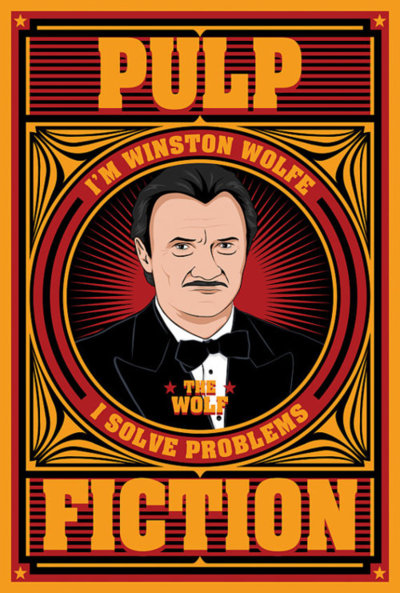
This is not really a matter of the public interest except inasmuch as Labour permits it to be. Labour needs a fixer, like Pulp Fiction‘s Winston Wolfe — an independent, dispassionate individual whose only interest is in resolving the issue quickly and quietly, and who has the mandate, ability and authority to get the damned job done. They needed to cauterise this wound back in June, and the need to do so now is all the more urgent. Further delay risks infection. That they have failed or refused to engage such a fixer shows an absence of nerve on the part of both the parliamentary and the organisational leadership and suggests that modern Labour is not, in fact, a healthy organisation with robust organisational structures, strong networks of competent people, and a shared commitment to the wellbeing of the party. And that is a matter of the public interest, because a strong opposition is fundamental to democracy and the health of the country.

Edit: I should add, if it’s not abundantly clear from the content of this post, that I disagree with Brian’s apparent endorsement (in his latest on the topic) of a “compassionate” response by Labour. While I have sympathy for Carter’s position, withstanding public and media criticism, however unjustified, without going off the deep end is a requirement of the job. In the words of a great (and recently returned!) former All Black captain: it’s not tiddlywinks. It may well be down to a choice between Carter’s wellbeing or that of the party, but Carter chose to throw himself upon the wheel, and whatever wounds he suffers as a consequence I consider to be self-inflicted.

L

Hello tworld!

With the arrival of my second child, my time just got more valuable. When better to engage in a medium which brutally enforces parsimony?

(You can now follow me on twitter. No guarantees as to coherence. Yes, the message above did take me ages to cut to 140 characters.)

L

Firearms, no debate

I generally agree with r0b’s reasoning on the police need — or lack — for firearms. This is a mostly-empty moral panic.

But how things have changed for Greg O’Connor of the Police Association. This from 1 June 2009:

Mr O’Connor, who is currently studying policing in Scandinavia, did not support all police carrying guns but said the matter had to be looked at. […] “We said the debate should take place outside the emotion of Len Snee’s death and it’s disappointing to see that now there’s not going to be any debate there needs to be.”

A year ago Greg O’Connor was careful to frame the Police Association response in this way. He repeatedly said he didn’t want to arm all officers, he just wanted “a debate”, and one which would take place in the cold light of reason rather than as a knee-jerk in the aftermath of a police shooting. That’s a mature and responsible position. But even though the debate has not really occurred in the intervening year, his position has congealed — or perhaps he now just feels more at liberty to express it — into “all guns, all the time”.

What’s changed in the past year? The agenda has changed, that’s all: how firearms are framed in the public discourse about policing. Any time a firearm is used — regardless of the outcome — it’s a big media deal. Recent events such as the Urewera Terra raids of October 2007, the retrial of David Bain, the story of a large number of dogs being “massacred” using a firearm, and of course a number of police shootings have imprinted the prominence of firearms as public menace on the public consciousness. This has progressed alongside a police and crime-reporting discourse which has as its basic theme the notion that our plucky boys and girls in blue are under constant attack from all sides. Contrary to O’Connor’s noble aim, there has been no meaningful debate about arming police. This fact suits his arm-the-cops purposes, and it’s now clear that those cries for a debate, and the appearance of a debate within the Police, were made with the primary purpose of simply keeping the issue primed and on the public agenda. It’s lurked there, undebated, for a while, and with these most recent events it’s moving rather rapidly closer to actually happening. That’s a dangerous way to set policy.

Although I accept this is a contentious position, I generally believe that we need to trust the operational discretion and instincts of frontline police staff, as long as we have tough and independent disciplinary oversight as to their policy, and conduct in implementing that policy. On this basis, I’m not categorically opposed to the notion of police vehicles containing a lock-box with firearms in it, which police can use in accordance with firm and well-documented policy in light of the tactical circumstances in which they find themselves. But I would say that this isn’t very different to the current status quo, and the use of firearms must not be left to the sole discretion of an individual officer. The deployment policy and tactical decisions to deploy must be matters for which police command can be held accountable, for which the police as an organisation are responsible.

But what I’m more interested in is a public debate on this, and other policing matters. We really need one.

L

Faces not for radio

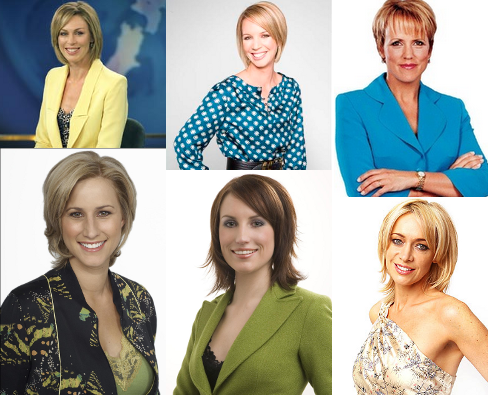
A post by Janet Wilson expresses a general conspiracy theory I’ve held for a long time about why radio news is usually better than TV news: because the people are chosen for different qualities. To an extent the “beauty bias” is present in every field, and of course, even in news it is simplistic — there are a host of other factors to do with resourcing, format, training and so on. As in almost all fields — and for the same sorts of reasons — these pressures weigh much more heavily on women journalists than on men, and consequently the aesthetic homogeneity of NZ’s top female TV presenters is striking:

What Janet calls “tits and teeth” selection really matters: people instinctively trust attractive people more than unattractive people (as long as they’re not too attractive), and broadcast news is all about projecting authority and trustworthiness via a predominantly visual medium. Dress and bearing are also relevant — as is voice, which is even more important in radio. But those things can, to a much greater extent, be worked on or around.

So TV news is biased in favour of attractiveness. In general, a presenter’s job is to present — their newsgathering, interviewing and editorial skills are backgrounded to a considerable degree. So this bias isn’t entirely unjustified for presenters, but the problem is that it’s also clearly evident in the journalistic ranks from which presenters are drawn. While it does not exclude journalistic quality the beauty bias does weight against it. Because the jump from reporter to presenter is a crucial part of a broadcast journalist’s career arc, and being unwilling — or unable — to fit the pattern is an explicit and well-known limitation to advancement, it likely dissuades people who might otherwise make outstanding broadcast journalists — which society desperately needs — from entering the profession. As Janet notes, the bias also selects against experience, because while men tend to become “distinguished” as they age (strengthening their gravitas) women do not, and those who don’t retain their youthful dash paradoxically become less favoured as their screen experience increases.

A case in point on this last point has lately been evident in the most trivial forum: Breakfast, on TV One. My wife, at home with our daughter, remarked on the greater capacity of One News anchor Wendy Petrie to deal with co-host Paul Henry’s soft-gonzo screen persona while she covered for Pippa Wetzell recently: a sort of dismissive indulgence, as if of a poorly-behaved child on his birthday. The customary pairing is a classic mismatch: Henry dominates the studio while Wetzell — herself a quality presenter, as we occasionally see when Henry is absent — is often forced into the role of slightly-embarrassed fall-gal. Petrie, with close to a decade’s primetime hard-news presenting experience under her belt, is out of Henry’s league and she knows it.

Of course, she herself has the beauty bias on her side. But the question is: how long does she have left? And how many other talents have we lost — or never found — due to the dire ravages of crow’s feet, a poor hairdo, a few additional kilos, or a mismatched outfit?

(Thanks to Naly D for the link to Janet’s article.)

L

PS: I’d like to endorse Nicola Kean’s campaign to go to Columbia Journalism School, as others are doing. Go and vote for her, and perhaps she’ll do better than another well-known graduate from these parts.

Incidentally: The Gruen Nation

While I’m on the topic of Australian politics, the news that the team behind ABC’s The Gruen Transfer will be producing a series of episodes on the upcoming federal election campaign, during the campaign.

For those who’re not familiar with it, the show is named for Victor Gruen, the architect who designed the now-ubiquitous shopping mall to disorient patrons and sap them of their agency — at which moment the “Gruen transfer” is said to have taken place. It’s a frank weekly look at the nuts and bolts, tricks and traps of advertising, fronted by comedians, tricksters and advertisers themselves and you can watch it on the ABC website.

Of course, the techniques employed to sell soap or soft drink or summer holidays can be and often are equally applied to politics — the howls of those who would rather pretend it were otherwise, that politics is somehow different notwithstanding. So during the campaign is the very best time to air such a look at how the same techniques apply to political marketing. Well done ABC. I’d love to see such a thing here. This is the machinery at the sharp end of democratic consent-manufacture.

(And for interest, here’s a long article about Gruen and mall design from The New Yorker.)

L

Depicting Julia Gillard

I’ll be watching with interest the characterisation — and caricaturisation — of Australia’s new PM, especially as compared to Helen Clark. Some of you might be aware that I once wrote a research paper on the characterisation of Clark by John Banks and Lindsay Perigo in talk radio during 2007. I was informed at the time that, via the usual academic networks, a copy made its way from Victoria University of Wellington to someone at the Australian National University in Canberra who had contacts within the then-Deputy Leader’s office, and that Gillard had read it with some interest. I’m not sure how true that is, but I do know she took a keen interest in Helen Clark’s public image, likely with this very eventuality in mind, so it isn’t altogether implausible.

The Clark-Gillard comparison is a natural one, due partly to geographical and temporal proximity; but also due to genuine similarities between their politics, manner and ascent to power. The comparisons have been highly ambivalent. The usual slanderers have already begun spreading the same ludicrous assertions that Gillard, like Clark, is a closet lesbian, on the grounds that she hasn’t had children and is more apparently bolshy than her husband. Apparently very deep in the closet, since she’s come out against gay marriage. (But then, she would, wouldn’t she?)

Peter Cresswell described her as Helen Clark with lipstick, which I guess is negative as to her politics but positive as to her perceived femininity, notwithstanding that Clark did in fact wear lipstick herself. Auckland University’s Jennifer Curtin pointed out some comparisons as to the two women’s assumption of their roles, though I can’t help but think she must have a more nuanced and complex position on the topic than was suitable for an AAP statement:

“They’ve both started off on the left but moved kind of to the centre of their party,” she said. They both appear to be hard workers, good speakers and have made similar choices in selecting their political allies and portfolios – opting to avoid women’s policies specifically. “If they represent women they do it in a more mainstream kind of way,” Curtin said.

Clark’s biographer Brian Edwards, speaking on ABC Radio National, outlined the similarities in more detail:

Well there are extraordinary similarities. I’ve been reading some of the reports about Julia Gillard in the papers here in New Zealand, and it’s absolutely uncanny, and what we’ve just heard is also true, that from the start, Helen Clark was a professional politician, she was absolutely focused, her intention I guess, long term, was to be prime minister, and she would do everything possible to do that. And if you look at the two women, as I say, the similarities are remarkable. Both unmarried, both decided, clearly, that being a politician and aiming to be prime minister did not go with having children, that was the decision, a positive decision which Helen Clark made, she and her partner, Peter Davis. Helen in fact, never wanted to get married and was actually more or less pushed into it by the Labour Party, and wept on her wedding day, which was relatively unusual. She was an atheist, she received some of the same sort of criticisms that I gather Julia Gillard has received in your country for her voice, she had a strong Kiwi accent, a rather deep voice; for her looks, people didn’t like the look of her hair, they didn’t like the look of her teeth; she was accused of being a lesbian, primarily by her opponents admittedly in those early days, and had an extraordinarily hard struggle to make it at all.
And these were all things that a man would not expect to happen at all in politics. None of those things would have come up if the man was a bachelor or was married or didn’t have any children, or any of those other things.

Clark fought these attacks, in part, by recourse to a “makeover” in mid-2005, when she appeared on the cover of women’s magazines — notably Woman’s Weekly — more heavily made up, more softly and sympathetically portrayed and generally appealing more directly to women, and to men who, if they had to be led by a sheila, wanted to be led by a real sheila. This was probably crucial to her winning the 2005 election. Gillard, The Australian tells us today, already has a similar glossy campaign well underway. It’s a good move. (Anyone who wants to call it fake or staged or a cheap trick or blatant media sycophancy to make such an appeal had better first recall John Key’s appearance on Gone Fishin’ (audio), and accompanying article by host Graeme Sinclair in — you guessed it — Woman’s Weekly. Incidentally, if anyone has or can find a copy of the video of that Gone Fishin’ episode, I’d love to see it. I missed it at the time.)

Other Gillard comparisons have also been made: to Margaret Thatcher (as Clark before her was), and to British Labour’s present acting leader Harriet Harman. In contrast with Jennifer Curtin’s observation that neither Clark nor Gillard emphasise their femininity in policy terms, The New Statesman‘s Alyssa MacDonald argues that the public treatment of Harman illustrates that it’s still not politically viable to be an overtly feminist female leader, even in 2010:

Both come from legal backgrounds, hold multiple political posts, have strong union connections, speak with distinctive voices and are always politically “on”. But while Gillard is popular and respected, Harman is often, very unfairly, spoken of as hectoring, dowdy and not very bright. Even before Gordon Brown’s departure, her chances of becoming Labour leader were the same as the number of forthcoming Harman biographies: zero.
Politically, there’s a glaring difference between Gillard and Harman. One has fought consistently for a feminist agenda, while the other has approached her political career with individualistic ambition. Not to do Gillard down — she’s very good at her job and she deserves her success — but her premiership isn’t necessarily any more of a great lunge forward for women than Margaret Thatcher’s was thirty years ago.
Meanwhile, Harman’s drive to push issues such as rape laws and the Equality Bill into the spotlight has undoubtedly been good for British women — and a huge contibuting factor to her unlovely public image.
Gillard’s success is still a symbolic step forward, signalling that the presence of women in Australian politics has become normal. And it looks likely to be good news for the country as a whole. But it’s not as if Australian women now have a Harman at the top to look out for their interests.

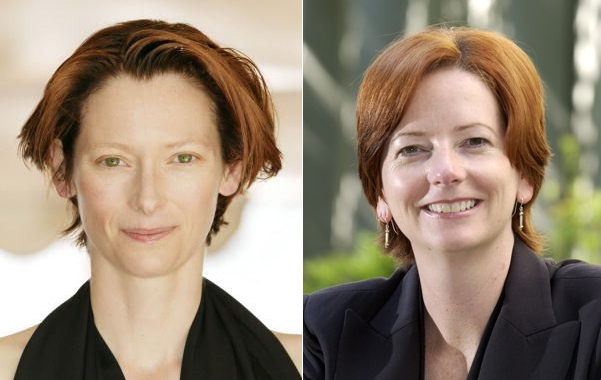
As MacDonald notes, Gillard is much more favourably-portrayed than Harman (and I would add, than Clark was at any point during her leadership). I think a lot of this is down to the “lipstick” to which PC refers: a metaphorical sort of lipstick which speaks to a particular notion of femininity, like the kind which Sarah Palin made famous. For one thing, Gillard’s attractiveness has been emphasised by the favourable comparison to Scottish actress Tilda Swinton:

This distinctive visage, the “bricklayer” voice to which Brian Edwards alluded, and her speaking style have been welcomed by the Australian media and satirical communities, who found Rudd “almost irritatingly bland”, according to editorial cartoonist Bill Leak. This from an article, also in today’s Australian on the topic:

Gillard’s wealth of striking anatomical attributes is almost too much of a good thing, says Cathy Wilcox of The Sydney Morning Herald and The Sun Herald. “She’s got so many features that if you just go for one, it isn’t enough. The challenge is how to get all those things in there without her head being enormous.”
Since Gillard took power, editorial artists have been studying her face with the obsessiveness of a lover, poring over photos and freeze-framing the TV to parse her every angle and expression.
Australia’s first female Prime Minister, seen through their eyes, has a “striking head of hair”, “incredibly beautiful skin”, eyes that manage to be simultaneously “squinty” and “big and distinctively shaped”, “chubby cheeks” with “pronounced cheekbones” and a mouth that “sits small and low” above “a small chin that tucks into an incredibly long neck”. Not even her earlobes escape attention.
And who else but an artist would notice that the new PM has “a reasonably ample bottom in relation to her head”?
But there is one facial feature in particular about which they all rhapsodise: Gillard’s “pointy”, “assertive”, “wonderful” nose. A nose, as Leak puts it, “that looks like you could chop wood with it”.
Fiona Katauskas, freelance cartoonist and producer of the Talking Pictures segment on the ABC’s Insiders, says Gillard’s nose is a defining feature that artists can utilise to express her character, just as the jutting lower-lip of former PM John Howard came to represent his determination, or obstinacy.
“I will take a punt and say Gillard’s nose will become the equivalent of Howard’s lip,” she says.

What’s interesting about all this is that, unlike most of the discussion of Clark and Harman’s appearance, it is robust but not unkind. Gillard’s relatively warm reception is being put down to her status as Australia’s first female PM, and I think there’s some legitimacy to that view; a genuine preparedness to “give her a go” tinged by a fear that bagging her too early would come off as sexist. We’ll see how long that persists, and how long her distinctiveness — of appearance, manner, and political character — is portrayed as quirky and endearing rather than bizarre and threatening.

L

Of Llamas and Lamas

Public advisory, especially for DPF:

Llama


Lama


And to bring the post back around to the topic of Chinese authoritarianism and responses thereto, with a bonus llama connection: The Song of the Grass-Mud Horse made a splash a year or so ago, as a protest against the Chinese government’s internet “harmony” policy. The video is below (and contains necessary obscenity):

This graphically illustrates a point that shouldn’t need to be mentioned, but often does, and of which I was not fully conscious until I spent some time in China: for all that they are propagandised as such in the West, the Chinese are not simply mute automata struggling under the heel of their dictators. The public sphere, however constrained it might be by our standards, exists — and the diversity of views aired in it is increasing, not decreasing.

L