Comparative value versus comparative worth.

Recent NACTFirst government assaults on female pay equity, public sector employment, labour regulations and other worker’s rights (to say nothing of trying to roll back Maori Treaty rights and enshrine the primacy of property right in NZ law), got me to thinking about how we measure value and worth in society. I tend to think of society being made of contributors and freeloaders. Contributors add value to their communities, be they large or small. They can be paid or unpaid, employed or volunteers, able-bodied or disabled. To me, these people are of high value and therefore of high worth. Freeloaders, on the other hand, are those who ride on the backs of others’ contributions. They can be criminals or hedge fund managers, financial advisors and consultants, rightwing bloggers and conspiracy theorists, gossip columnists or politicians. They do not create value in or for society. They appropriate worth when they can by appraising and selling themselves for more than their real value.

To be clear, this measure is not about surplus value in production and by whom it is appropriated. It is about the relationship between real value and actual worth, which may or may not be related.

Three illustrations of the spurious relationship of value and worth come to mind. There is an old saying in Latin America that a great bargain is to buy a person for their real value and then sell them for what they say they are worth. On another front, someone I know runs a financial advisory service where he caters to what he initially called “high value people.” When it was pointed out to him that he was conflating material worth with human value, he changed his firm’s logo but we have not had a good relationship since (he caters to clients with disposable investment assets of USD 10 million or more, including professional athletes). In a similar but opposite vein, my late mother, an organic intellectual if there ever was one, used to say that our wage scales are completely upside down. We should pay rubbish collectors and sewer cleaners the highest salaries and pay professional athletes and entertainers the minimum wage. Her reasoning was that athletes and entertainers provide some value to society but will receive many more benefits, material and otherwise, from the public adulation that they engender, and they will receive these benefits long after their active careers are done. Their material worth far exceeds their social value.

Conversely, those who do what in India is considered Untouchable work are essential to the good functioning of modern society and in fact critical to maintaining public health and well-being. Because of the nature of their work and the negative exposures involved in it, their careers are short and often brutish. And yet in modern society the reverse is true when it comes to their value and worth. They are paid far less (as a measure of worth) than their actual value to society. Why is that? Even if we factor in things like education, entrepreneurship and other intervening variables and admit for the existence of objectively fair measures of value and worth (and by this I do not mean the stupid comparisons of nurses and teachers versus cops and firefighter’s pay or any other gendered work comparisons), it seems that oftentimes the relationship between actual societal value and perceived worth is perversely skewed in inversely proportional ways.

That brings me back to the secondary teacher’s strike this past week. Although I left academia over a decade ago before the academic Taylorists turned universities into scholastic sweatshops whose focus is on revenue generation rather than intellectual advancement, and who believe that Science, Technology, Engineering and Mathematics (now sometimes replaced by “Economics and Management” as the back end of the “STEM” mantra) should be the sole focus of university research and teaching (eliminating the Arts and Social Sciences), I maintain contacts with a number of academics who have managed to keep their jobs and still pursue the life of the mind while teaching within the limits of current Taylorist curriculum paradigms and business models.

One of these contacts has just been made redundant by the NZ university to which they are affiliated (which is in the process of dismantling its social science programs while still recruiting students for admission in to them), so is considering turning to secondary school teaching as a new career path. They are also thinking about working in a policy analyst role, including in a parliamentary or political party setting. As part of the research and preparation process for that transition, and in light of the current stand-off between the government and secondary teacher’s union about cost-of-living (COLA) wage increases, they reached out to fellow colleagues who do research on related subjects in order to get a comparative idea of wages in those career fields. Although there are a number of interesting facts that came from the materials that my contact received that are worth discussing at another time, this one was shared with me. It involves the comparative base remuneration of backbench MPs and the upper end of teacher’s pay scales.
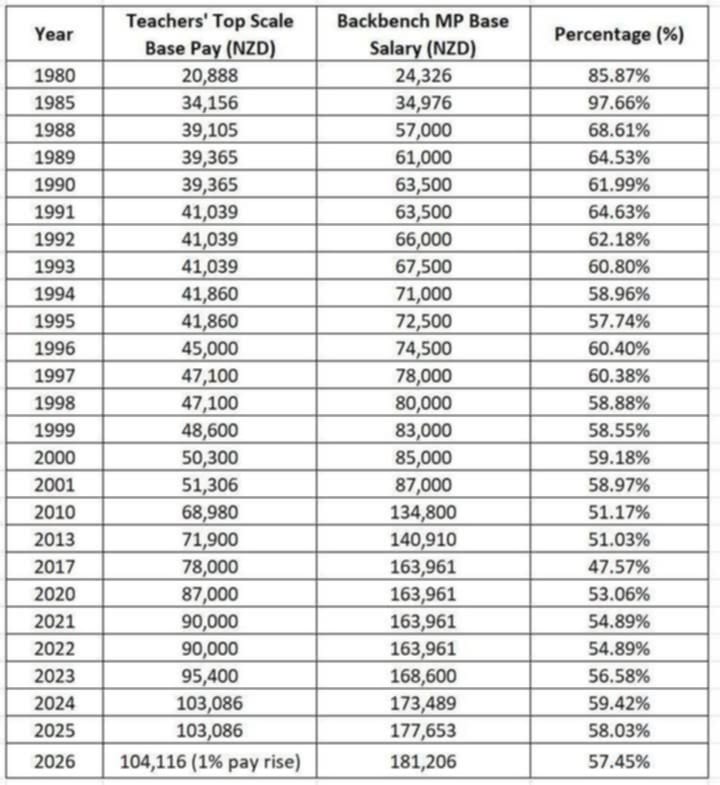
The data begs some questions. Who brings more value to NZ society, MPs or teachers? How is their value measured? What is worth more to NZ society, politicians or teachers? How is their (comparative) worth measured? Comparatively speaking, in terms of their contributions to NZ society, who is valued more and who is worth more? More broadly, is there a relationship between value and worth in NZ?

As for the specifics of the chart. Why is is the worth of backbench MPs (as measured in wages) significantly higher than that of the most experienced and well paid teachers? Since MPs also receive non-wage benefits such as accomodation and travel allowances and are often “comped” by lobbyists and other interlocutors in the form of meals and other incidentals, why is the wage gap between them and the most experienced teachers so significant? As for work equivalence, it can be argued that both MPs and teachers work long hours beyond their assigned time in class or in the parliament debating chamber, and both sacrifice family life and other leisure pursuits in order to do so. Both have formal work hours and yet engage in much informal work (say, coaching sports teams or participating in civic groups). Both MPs and teachers have invested much time and resources into their own educations and qualifications as well as through practical experience. So why the difference in worth if their value to society is similar if not equal? Or is their value not equal and hence their worth simply reflects the difference?

That last question is key. Does NZ society value MPs more than teachers and thus pay them more as a measure of their worth? Admitting for a degree of autonomy in setting institutional wage standards, are the average parliamentarians worth that much more than the most experienced teachers? Is their comparative worth–and that of teachers–based on any measure of value?

Perhaps there is a market-based answer to the question such as “politicians are rare gems that are hard to find while teachers are a dime a dozen because they are like pebbles on a beach, etc.” But even if this were true, perhaps scarcity of a resource is not a true measure of value. Memecoins such as $TRUMP may be worth much (+USD8.36/coin with a market cap of over USD 1.6 billion) but do they have any intrinsic or tangible value?

I will leave it for readers to ponder these questions and the more general question about the relationship of social value and material worth. However, one thing should be clear. Only when that relationship is defined and put into practice can we begin to speak of working towards a fair and equitable democratic capitalist society.
A culture of cruelty.

In February I wrote a post about “the politics of cruelty” in which I highlighted the mean-spirited commonalities of recently elected rightwing governments in the US, NZ, Italy and other democracies. In this post I shall expand on them with reference to some of the authoritarian features that I researched and wrote about when I was a young academic.

In the 1980s and early 1990s when I wrote about Argentine and South American authoritarianism, I borrowed the phrase “cultura del miedo” (culture of fear) from Juan Corradi, Guillermo O’Donnell, Norberto Lechner and others to characterise the social anomaly that exists in a country ruled by a state terror regime like the “Proceso de Reorganizacion Nacional” in Argentina from 1976 to 1983. In those circumstances individual psycho-pathologies are often rooted in the pervasive feelings of dread, vulnerability and hopelessness brought about by the regime’s use of death squads, disappearances and other violent authoritarian measures to enforce public compliance with their edicts. That pervasive sense of fear extends to collective life, something that was and is a deliberate objective of authoritarians because it produces a sense of survivalist alienation and social atomisation in the body politic, thereby disrupting basic horizontal bonds between and within groups in civil society (you can see one of my essays that uses this concept here: https://www.jstor.org/stable/2111080).

In recent years and especially since Trump’s re-election in the US, Javier Milei’s election in Argentina and the election of the right wing “chaos coalition” in NZ, I see an extension of this concept in what I will call the culture of cruelty. A culture of cruelty is one in which social groups and organisations, including governments, engage in particularly cruel behaviour in order to punish, humiliate and revel in the plight of others, particularly political opponents and scapegoated social out-groups. We only need to think of Trump’s deportation policies and the behaviour of his immigration Gestapo, ICE, to see the culture of cruelty at work. We can see it is the DOGE chainsaw approach to public sector employment and federal regulations. We can see it at MAGA rallies. It is personalised in the behaviour of Trump advisors like Stephen Miller, Karoline Leavitt and Tom Homan, who show utter contempt for the suffering their policies have caused and in fact appear to relish being able to rub in the fact that they can act with apparent impunity due to the weakness of the courts and congressional or partisan complicity. 

In fact, the “culture of impunity” is another characteristic of authoritarianism that I and others wrote about three decades go, and it goes hand-in-hand with the culture of fear because it is the feeling of impunity that leads dictatorships to use wanton repression as an instrument of subjugation of the popular will. In other words, the culture of regime impunity leads to the imposition of a culture of fear in society. That is what is at work, to various degrees, under Trump, Milei, the evil clown circus currently ruling NZ (especially in the ACT and NZ First parties) and in other former liberal democracies today.

This culture is mean-spirited and malicious. In many instances it is fuelled by hatred of “others,” be they immigrants, indigenous people, people of colour or different faiths, those who are sexually “deviant” from “traditional” norms (i.e. non-binary) and others who do not conform to a given set of social mores or expectations or are simply easy scapegoats given public attitudes. It is facilitated by the increased vulgarisation of social discourse and erosion of societal norms regarding behaviour and civic exchange, now megaphoned and accentuated by social media. It is cruelty for cruelty’s sake, and uses cruelty as a punishment, as an intimidation tactic and as a dark reminder of what is possible when one is targeted for any number of perceived transgressions

Cruelty can be physical, mental, emotional, social or any combination of them because its impact is not confined to just one dimension or aspect of human existence. It is “unusual” in that its objective is to cause disproportionate anxiety, anguish, stress and suffering to targeted people and groups beyond whatever duress might (or might not) be warranted under the circumstances. The term “scarred for life” is an accurate depiction of the broader long-term effects that cruelty can have on the human subject. And when it comes to public policy or social exchange among groups, that is exactly what perpetrators hope to achieve via its use: it psychologically traumatises people and groups in the moment as well as their individual and collective memories, something that renders asunder the social fabric into which they were previously woven.

As is the case with torture (which is inherently cruel), social and political cruelty works. Not so much as an instrument to induce cooperation from those otherwise disposed not to give it, but as a disincentive, revenge or retribution tool against them.

I could write more about the subject but this is not the place to do so. However, I hope that the notion is clear. We are now in an era where the culture and politics of cruelty have become integral features of democratic politics in at least some Western societies (I will leave aside for the moment the fear that exists in countries ruled by authoritarian regimes like those in Russia, China or Nicaragua). And if the cultures of impunity that have led to the imposition of these growing cultures of cruelty and fear in Western societies continues unchecked, then another social pathology will follow–the reaping or harvesting of fear (“cosecha del miedo,” in O’Donnell’s words) in the form of a legacy of damaged people and institutions resultant from the practice.

Should that happen, then democracy as a social construct and a method of governance will never be the same.

The Israel/Palestinian metastasis.

In the weeks after the October 7 Hamas attacks on Southern Israel I wrote about the possible 2nd, 3rd and even 4th order effects of the conflict. These included the possibility of new fronts being opened in the West Bank (with Hamas), Golan Heights (with Syria), Northern Israel/Southern Lebanon (with Hezbollah), with the Yemeni Houthis (at sea and in the air) and with Iran (now directly) all of which seemed a fair possibility back then and most of which have indeed eventuated. Israel has needed allies to help fend off some of the widening attacks, while Palestinians have had to place themselves at the mercy of the international community for humanitarian aid because Israel will spare them little of it while prosecuting what for all intents and purposes is a scorched earth war policy in Gaza. Other than Iran and its proxies/allies, no one is coming to the military rescue of Hamas or Palestinians in general. In other words, it is now a one-sided meting out of punishment on a largely defenseless population.

What I did not envision is what is happening on campuses in the US and around the world nearly seven months after the Hamas attack. The ensuring conflict has become a lightening rod and trigger not just for those disgusted by the events in Gaza but also for those who espouse a number of other grievances, including climate change, racism, global inequality, imperialism and colonialism, political corruption and even capitalism itself. In response, the Right labels them all “radicalised” commies and terrorist lovers because that is an easy way to introduce culture war themes into the mix rather than debate the complexities of what is happening in the Eastern Mediterranean. Apparently the war on Gaza is less about Israel and Palestine and more about a host of other (not all unrelated) things. The moment of friction that I wrote about recently has now come to American academe.

This has turned campus protests (and the coverage of them) into partisan events, with rightwing entities backing pro-Israeli demonstrators and leftwing and progressive forces, including those in the Democratic Party in the US, siding with the pro-Palestinian side. The protests include non-students as well as students, confirming what I wrote in the last post about outside agitators and infiltrators using the opportunity to advance their own agendas (which often go beyond the Israel/Palestine conflict). This includes Antifa and the old Occupy Wall Street crowd, now resurrecting old peeves (some well justified then and now) on the back of the Palestinian cause. For the US Right it is another way of showing how Democrats are soft on crime and Joe Biden is a doddering old fool while demonstrating that, like Republican Governors Abbot of Texas and DeSantis of Florida have done, you show strength by ordering cops to bash in heads of people wearing masks and keffiyeh–but not those waving Israel flags.

Unfortunately, this has lifted the scab on long-festering hatreds in many societies, including the US. Long dormant anti-semitism has been inflamed by Israel’s actions in Gaza, which however heinous the October 7 Hamas attacks were, are grossly disproportionate to them (including using starvation as a weapon), and are therefore a form of collective punishment that, if not genocidal in the strictest sense of the term, certainly seems to have ethnic cleansing as a purpose. Conversely, Islamophobia has been resurrected by the Political Right, including conservative Christians and Jews and an assortment of rightwing media outlets and political organisations. In the pro-Palestine protests there are now people who believe that the main problem are Jews rather than Zionists or the the State of Israel’s actions. In the pro-Israel camp there are people who believe the root cause of the conflict is Islam, Arabs or the both combined. Primordial hatreds have been resurrected and brought to the fray, which now encompasses pre-modern, modern and post-modern fault lines covering a broad spectrum of divisive issues.

Then there are those who are not quite sure who to hate more. Take for example representative Marjorie Taylor Green (R-GA), who believes that all Muslims are potential terrorists and therefore should be deported from the US and Europe, but who on the other hand, when it comes to “the” Jews, well, there is that problem of their space lasers causing forest fires….

This is why I refer to this evolution as a metastasis of the conflict. It is malign in nature and it is spreading well beyond the original boundaries of the conflict qua disease. The pro-Palestinian protestors have degenerated in some places into glorification of Hamas’s atrocities and a Holocaust denying Jew hate fest. Likewise but in mirror fashion, pro-Israeli demonstrations rejoice at the civilian death toll in Gaza, paint all Muslims/Arabs as savages and call for their extermination as such. Neither is really interested in a legitimate “debate,” and both are using protests to stake antithetical claims. That is not good and does nothing to change minds, much less advance any peaceful resolution or long-term solution to the impasse in the Levant.

My alma mater, the University of Chicago, appears to have struck a good balance by allowing an encampment to be established on the central university mall but not on footpaths or in front of buildings. The university makes a distinction between free expression versus disruption, drawing the line when the former is used to justify the latter. It seems to be working so far, as the protests are loud but constrained when compared to other universities. That being said, MAGA frat boys have tried to storm the encampment, only to be repelled by the U Chicago police (as a private university U Chicago has its own accredited police force dating back to the 1960s). The rightwing frat guys have a history of racist antics and in this case appear to be less interested in supporting Israel than in scoring physical points against woke “commies.”

Other places that I have taught at, including the University of Arizona and University of South Florida, have descended into chaos, including the use of rubber bullets and tear gas to roust pro-Palestinian crowds. As for the University of Auckland, where I also taught, Students for Justice in Palestine (they dropped the “Peace” from their name a while ago) abandoned their attempts to set up an encampment when the University informed them that as a registered university club they would be in violation of university policy regarding club rules if they did so and therefore become liable for suspension, etc. They still have the freedom to conduct peaceful protests outside the main library on a daily basis, which is what they have agreed to do.

That is somewhat ironic– student protesters accepting the orders of their institutional masters when it comes to how to behave. Ah, the kiwi way! But where are the old “Minto” types of direct action these days? (Minto himself was down in Christchurch yesterday protesting National’s support for Israel, so at least that old dog still has some bark left in him). Is it true that today’s generation of NZ leftist activists have gone a bit soft? It is not for me to say since I am just a Trotteresque keyboarding observer these days, but the starch seems to have gone out of the current protester’s shirts when it comes to Israel and Palestine. On the other hand, when it comes to vaccinations, government mandates, Qanon and the Deep State, those on the NZ Right have shown in March 2022 how far they are willing to go in order to prove their points (and mettle). In fact now that I have mentioned them, given the attitudes of many on the NZ Right when it comes to Jews and Muslims, where might they stand when it comes to the Middle East? Perhaps Kyle Chapman or one of the Counterspin or Action Zealandia weirdos can enlighten us.

Let’s be clear on this. The Right demonstrate over matters that they feel affects them personally (like vaccines and mandates), but not over matters of solidarity with or concern for others. Their protests are about infringements on themselves, not on infringements not he rights of others. The Left, such as those involved in the student protests, demonstrate out of humanitarian concern for people that they do not even know, but whose basic humanity is under lethal siege. To be sure, there are the bad-intentioned actors among them who bring other agendas into the mix, but the motivations for Right versus Left protests are often quite different in origin.

That brings up a larger issue. Are not protests supposed to be disruptive? Much is said about the Vietnam War protests but what about the freedom marches in the US South that brought about the civil rights movement and eventually the Civil Rights Act? Were they not disruptive? What about the Springbok Tour protests? Did no good came from their disruptions? How about the Stonewall protests, which opened the way for gay rights in the US? What about general strikes? Are they not disruptive but have served to improve wage and working conditions for a multitude of employees? This the fundamental question that needs to be asked.

Instead, riot porn is the clickbait of the day.

That makes the coverage of the student protests pretty shabby. More emphasis is placed on the protection of property and supposed public order (even though the violence that has occurred has been confined to campuses) rather than on the original cause and the motivations of others now involved in the unfolding events. More time is spent on political blame-gaming than on considering whether divestment from companies doing business, especially military business, in or with Israel is a reasonable demand given what is unfolding in Gaza. In fact, few Western media outlets appear to have asked the basic question as to whether it is ethical for corporations, and the US and other governments for that matter, to do business with and sell weapons to Israel while it reduces the Gaza Strip to rubble. And when they do, the answer is always the same–“but what about Iran and the terrorists?”

In any event, I use the US examples as illustrative of the fact that the Israel/Palestine conflict has galvanised as well as polarised world opinion, creating an ideological vortex into which a number of causes and actors have been sucked into. This may well have a tornado-like effect on several political landscapes, including in Israel but especially in the US this election year, where not only the presidency and Congress undergo elections but also a multitude of State and local governments as well. How the protests evolve and end–if they do before November–may be critical to those election outcomes.

More broadly, the Israel/Palestine conflict is a malignant scabrous wound that may not be cauterised any time soon. In fact, regardless of the outcome of the war on the ground, it is doubtful that Israel will recover much diplomatic goodwill other than from its Western backers and the Arab oligarchies that side with it against Iran. Much like Russia with its invasion of Ukraine, the question Israelis have to ask themselves is “will we be better off for having prosecuted this war they way that we have?” If the answer is anything other than “yes” (and that would be delusional), then they have already lost. Israel’s supporters abroad need to understand this basic fact.

As I have written before, hypocrisy is the currency of diplomacy. But when governments like those of NZ, Australia, the UK and US mute their criticism of Israel with their “whataboutism” comparisons with Hamas and Iran, they lose all moral ground for chastising other States for their treatment of subject populations. Because in some liberal democracies, for all the talk about supporting a “rules-based” international order, when it comes to Israel the rules are made to be broken.

The student protests are a reminder of that.

The boy is home.

It a remarkable turn of events my son is home 8 days after surgery. The contrast with his September surgical and post-operation experience is stark: what too 5-7 days in September (removal of most IVs and draining tubes, catheter, getting up to walk and use the loo, diminishing of painkillers on demand) now happened in just 2-3 days. His final drain was removed on Sunday and his final IV yesterday. His last chest X-ray was clear. He was then discharged last night. I am truly staggered at the contrast in recoveries and it is only now that we realise how close we came to a disaster last spring.

So four surgeries (two open chest) in 5.5. months later, we now have a basis for hope. Although his energy levels are still low–he feel asleep in the car during the hour+ drive from the city to our homestead, something that he has not done since he was five–the colour is back in his skin and he is already talking about going back to school. We will ease him into that with a visit on Friday, but it looks like the worst is over. He has a few tears in his left lung where it adhered to his inner chest wall when deflated, and his phrenic nerve may have been nicked during the procedure to remove the cystic mass enveloping it, but his diaphragm is working, his lung is inflating and both the tears and nerve should heal in time. Again, the whole process has been a study in contrasts.

It was interesting to see people from all walks of life in the wards. Some clearly have had a rough go of it. I found it refreshing that even though the rules specified just two visitors per patient at a time, the nurses were relaxed about extended family visitors circulating through. The general ward has a steel drum and xylophone available for anyone to use, and because the weekend was brilliant the instruments were moved out to a big veranda overlooking the helicopter pad. The kid in the next room had abut 25 members of his whanau out there lounging under makeshift tents made from bedsheets (the sun was blazing), playing music on the instruments and basically offering not only support to the child patient but also to his parents. In that sense it reminded me of Irish or Italian (my heritage) wakes–attendees are not only there for the departed, but for those that they leave behind. In this case the child is the priority and alive, but the family support extends well beyond the bedridden. When it comes to family values, let’s just say that some folk know how to walk the walk.

Needless to say we owe a deep debt of gratitude to the Starship staff. During the seven day stay my son was in the heart ward, the general surgery ward, the paediatric ICU as well as the cardiac operating theatre and recovery room. Every step along the way the doctors, nurses, counsellors, psychologists and ward orderlies were there to help. That even extended to a multidisciplinary effort to help the kid deal with his fear of the very painful removal of the deep drains at the bottom of his mainline scar and in between his left side ribs. Between the anaesthetists, surgeons and play specialists, he had a much better experience this time around and emerged as a free boy unencumbered by his tubes or the drip trolley.

As a bonus my son spent the last three days in a single room opening onto that wide veranda overlooking the helicopter pad. He not only got to watch the choppers come and go, which allowed us to discuss the various models involved and to speculate on the patients and how crews worked in difficult circumstances for the betterment of others. But he also got to play the xylophone and make friends with some resident pigeons on the veranda, two of which he named “Bob” and “Uncle.” I am a bird fancier and the kid has followed in my footsteps in that regard, plus we have birds at home, so he quickly became buddies with the feathered residents, to the point that he was feeding them out of hand and they were perching on his arm by the time he left. To be honest, the best use of hospital food turned out to be when taming the resident birds.

We have all come out the experience much wiser in many regards, and completely thankful for the skills and compassion of others. I extend that thanks to all of you who offered your support as well. Now back to normalcy!

Shoutout to Starship.

My son returned home this week after spending two weeks at Starship undergoing major surgery. It was dicey for a while, as he had a lemon-sized tumor removed from his anterior sternum that was putting pressure on his heart and lungs and which had extended out onto his upper left rib cage. It turns out that he had a mediastinal multilocular thymic cyst, most likely congenital and therefore present since his birth. Normally they atrophy and are absorbed by the age of three, but in his case it apparently kept growing. He was asymptomatic until this past May, when he developed shoulder pain and shortness of breath. After several misdiagnoses and a change of GPs he was referred to Starship in late September, where chest X-rays showed a large mass. Things accelerated from there. It turns out that the shoulder pain was referred pain and common with chest tumors–but one has to know what to look for and the original GPs did not.

Multilocular thymic cysts are extremely rare but fortunately most often benign. There are more tests to be done and even the possibility of further surgery to remove remnants of the mass from his ribs, but the hope is that now that the large hard mass has been removed the rest will stop growing and wither or can respond to drug therapy or some other form of non-surgical intervention. What is amazing is that my son’s left lung had collapsed at some point in the past–maybe even a year ago–but he had continued to play soccer, ride his bike and run cross-country until his symptoms appeared in May. He finally had to stop sports in July while we looked for an answer.

In any event, he is on the mend even if not entirely out of the woods yet. The prognosis is good for the long-term. He is now pleased at his ability to breath and move about pain-free (other than from the chest and drain wounds), He thought that the shoulder pain was just from over-doing it on the monkey bars and that it was normal to be short of breath after exertion. And well one would be on both counts when operating on one lung and a compressed heart.

I wanted to use this post to publicly thanks the medical staff at Starship for saving his life and for the world-class quality of the attention that my son received, both during the surgeries (he had two), during four days in paediatric cardiac ICU and during the remainder of his time on the cardiac paediatric ward (he was there because of the open chest surgery, not his heart per se, because cardiac surgical teams are the best versed in matters of chest surgery recovery). Everything about Starship was first rate, especially the surgical care from the moment the mass was detected to the ongoing post-operative recovery here at home, where the team has called us to check on him and outline a schedule for follow-ups. Above their skills as surgeons, anaesthetists and paediatric nurses, what sets the Starship staff apart if their incredible level of compassion and empathy for their patients as well as their patient’s whanau. My son was on the upper end of the paediatric age group (ten) but the way in which the staff interacted with toddlers and newborns was, from my family and I could see, absolutely wonderful.

If there is an institution to which a charitable contribution can be made, I recommend Starship Hospital simply because it provides world class care and, among all the other worthy causes that can be supported, it is uniquely able to provide an actual physical future for those who otherwise would have none.

A Forced Pause.

Unfortunately I will need to take a bit of time off from this blog. After months of misdiagnoses and a change in GPs, my precious son is in Starship Hospital about to have major surgery. He already has had one invasive procedure and the big one comes tomorrow. It is absolutely heart-breaking to see him asleep on the table surrounded by surgeons and hooked up to tubes. He is in a lot of pain but is trying to be strong even though he, his mom and I are all frightened by what might happen in the worst case. We are doing our best to reassure him but fear sometimes get the better of mum and I.

If you can spare a thought for the Pablo clan, it will be appreciated. We feel that although we have confidence in the medical team at Starship, we need all the help that we can get.

Thanks.

Flashback Friday: Before paths diverged.

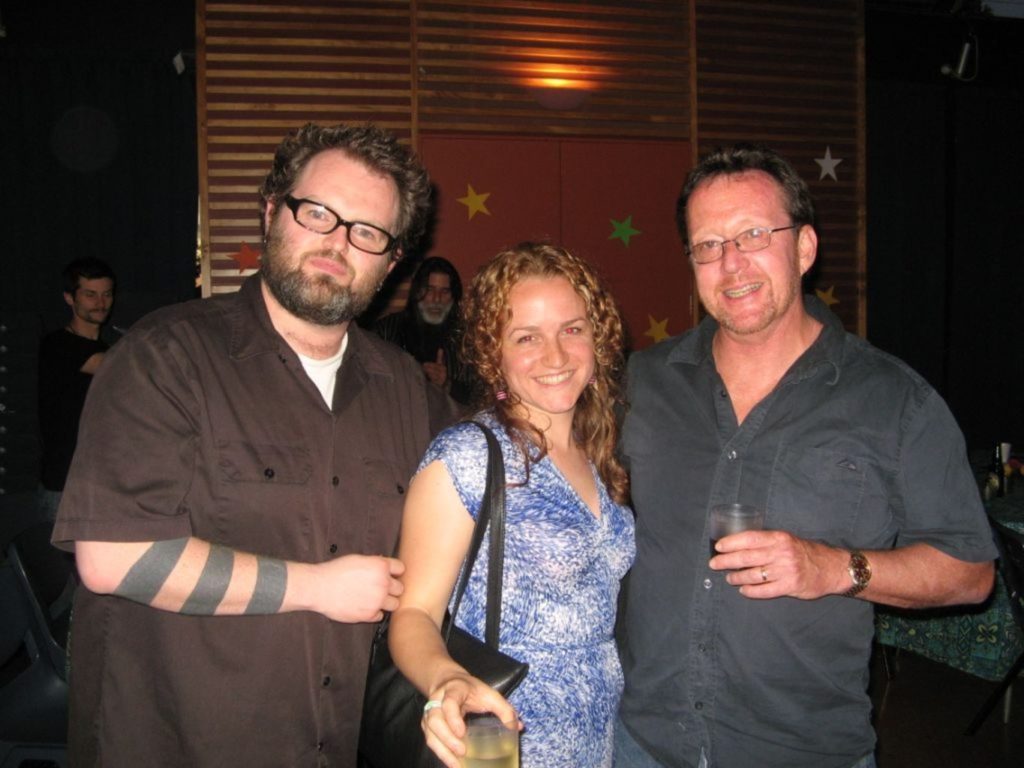
This picture was taken at an end of year celebration hosted in the early 2000s by the Green Party at a trade union hall on Great North Road. In it are three individuals whose paths crossed at that moment in time. One is a university lecturer. One is a university student who was a Green Party activist at the time. One is a young political commentator/stirrer/gadfly. At the time of the photo the three were connected by the fact that the student was in the professor’s class on Revolutions and Insurgencies and the commentator sat in on the class as well as interview the professor from time to time on political subjects. All were supporters of the Green Party at the time (the Donald, Fitzsimons, Tansczos, Bradford, Locke years when it was truly a “watermelon” party).

/

The young guy was on the rise in media circles, the young activist was idealistic, energetic and enthusiastic in promoting environmental causes, and the academic was known more for his love of triathlons than anything else.

Flash forward twenty years. Who are they and what are they doing now?

A word on post-neoliberalism.

I recently read a critique of the market-oriented economic theory known as “neoliberalism” and decided to add some of my thoughts about it in a series of short messages on a social media platform dedicated to providing an outlet for short messaging. I have decided to expand upon those messages and provide a slightly more fleshed out appraisal here.

“Neoliberalism” has gone from being a monetarist theory first mentioned in academic circles about the primacy of finance capital in the pyramid of global capitalism to a school of economic thought based on that theory, to a type of economic policy (via the Washington consensus) promoted by international financial institutions to national governments, to a broad public policy framework grounded in privatisation, low taxation and reduction of public services, to a social philosophy based on reified individualism and decontextualised notions of freedom of choice. Instilled in two generations over the last 35-40 years, it has redefined notions of citizenship, collective and individual rights and responsibilities (and the relationship between them) in liberal democracies, either long-standing or those that emerged from authoritarian rule in the period 1980-2000.

That was Milton Friedman’s ultimate goal: to replace societies of rent-seekers under public sector macro-managing welfare states with a society of self-interested maximizers of opportunities in an environment marked by a greatly reduced state presence and unfettered competition in all social (economic, cultural, political) markets. It may not have been full Ayn Rand in ideological genesis but the social philosophy behind neoliberalism owes a considerable debt to it.

What emerged instead was societies increasingly marked by survivalist alienation rooted in feral capitalism tied to authoritarian-minded (or simply authoritarian) neo-populist politics that pay lip service to but do not provide for the common good–and which do not adhere to the original neoliberal concept in theory or in practice. Survivalist alienation is (however inadvertently) encouraged and compounded by a number of pre- and post-modern identifications and beliefs, including racism, xenophobia, homophobia and social media enabled conspiracy theories regarding the nature of governance and the proper (“traditional” versus non-traditional) social order. This produces what might be called social atomisation, a pathology whereby individuals retreat from horizontal solidarity networks and organisations (like unions and volunteer service and community agencies) in order to improve their material, political and/or cultural lot at the expense of the collective interest. As two sides of neoliberal society, survivalist alienation and social atomisation go hand-in-hand because one is the product of the other.

That is the reality that right-wingers refuse to acknowledge and which the Left must address if it wants to serve the public good. The social malaise that infects NZ and many other formally cohesive democratic societies is more ideological than anything else. It therefore must be treated as such (as the root cause) rather than as a product of the symptoms that it displays (such as gun violence and other anti-social behaviours tied to pathologies of income inequality such as child poverty and homelessness).

As is now clear to most, neoliberalism is dead in any of the permutations mentioned above. And yet NZ is one of the few remaining democratic countries where it is still given any credence. Whether it be out of wilful blindness or cynical opportunism, business elites and their political marionettes continue to blather about the efficiencies of the market even after the Covid pandemic has cruelly exposed the deficiencies and inequalities of global capitalism constructed on such things as “just in time production” and “debt leveraged financing” (when it comes to business practices) and “race to the bottom” when it comes wages (from a labour market perspective).

I shall end this brief by starting at the beginning by way of an anecdote. As I was trying to explain “trickle down” economic theory to an undergraduate class in political economy, a student shouted from the back seats of the lecture hall “from where I sit, it sure sounds more like the “piss on us” theory.

I could not argue with that view then and I can’t argue with it now. Except today things are much worse because the purine taint is not limited to an economic theory that has run its course, but is pervasive in the fabric of post-neoliberal societies. Time for a deep clean.

PS: For those with the inclination, here is something I wrote two decades ago on roughly the same theme but with a different angle. Unfortunately it is paywalled but the first page is open and will allow readers a sense of where I was going with it.

A test of civil society.

The CV-19 (COVID) pandemic has seen the imposition of a government ordered national quarantine and the promulgation of a series of measures designed to spread the burden of pain and soften the economic blow on the most strategically important and most vulnerable sectors of society. The national narrative is framed as a public health versus economic well-being argument, with the logic of infectious disease experts being that we need to accept short term pain in the form of social deprivation and loss of income in order to achieve long term societal gain once the infection has run it course. However, some business leaders argue that a prolonged shut-down of the productive apparatus will cause irreparable harm to the national economy out of proportion to the health risks posed by the pandemic, and thereby set back the country’s development by twenty years or more.

The lockdown is a classic test of the age old philosophical question behind the notion of the “tragedy of the commons:” Should we pursue the collective good by accepting self-sacrifice in the face of an invisible threat and uncertain common pay-off, or do we pursue immediate self-interest and opportunism rather than accept material and lifestyle losses amid the same uncertainties and invisible rewards? Needless to say, it is not a straight dichotomy of choice, but the poles of the dilemma are clear.

Another thing to consider is a principle that will have to be invoked if the disease spreads beyond the ability of the national health system to handle it by exceeding bed and ventilator capacity as well as the required amount of medical personnel due to CV-19 related attrition: lifeboat ethics. If the pandemic surpasses that threshold, then life and death decisions will have to be made using a triage system. Who lives and who dies will then become a public policy as well as moral-ethical issue, and it is doubtful that either government officials or medical professionals want to be placed in a position of deciding who gets pitched out of the boat. So, in a very real sense, the decisions made with regard to the tragedy of the commons have serious follow up effects on society as a whole.

One thing that has not been mentioned too much in discussions about the pandemic and the responses to it is the serious strain that it is placing on civil society. Much is said about “resilience” and being nice to each other in these times of “social distancing” (again, a misnomer given that it is a physical distancing of individuals in pursuit of a common social good). But there are enough instances of hoarding, price-gouging, profiteering–including by major supermarket chains–and selfish lifestyle behaviour to question whether the horizontal solidarity bonds that are considered to be the fabric of democratic civil society are in fact as strongly woven as was once assumed.

There is also the impact of thirty years of market economics on the social division of labour that is the structural foundation of civil society. Along with the mass entrance of women into the workforce came the need for nanny, baby-sitter and daycare networks, some of which were corporatised but many of which were not. Many of these have been disrupted by the self-isolation edict, to which can be added the shuttering of social and sports clubs, arts and reading societies, political and cultural organisations and most all other forms of voluntary social organisation. Critical services that rely on volunteers remain so rural fire parties, search and rescue teams, the coastguard and some surf lifesaving clubs are allowed to respond to callouts and maintain training standards. But by and large the major seams of civil society have been pulled apart by the lockdown order.

This is not intentional. The government wants the public to resume normal activities once the all clear is given. It simply does not know when that may be and it simply cannot spend resources on sustaining much of civil society’s infrastructure when there are more pressing concerns in play. The question is whether civil society in NZ and other liberal democracies is self-reproducing under conditions of temporary yet medium-termed isolation. The Italians hold concerts from their balconies, the Brazilians bang pots in protest against their demagogic populist leader, Argentines serenade medical and emergency workers from rooftops and windows. There is a range of solidarity gestures being expressed throughout the world but the deeper issue is whether, beneath the surface solidarity, civil society can survive under the strain of social atomisation.

I use the last term very guardedly. The reason is because during the state terror experiments to which I was exposed in Latin America, the goal of the terrorist state was to atomise the collective subject, reducing people to self-isolating, inwards-looking individuals who stripped themselves of their horizontal social bonds and collective identities in order to reduce the chances that they became victims of the terrorists in uniforms and grey suits. The operative term was “no te metas” (do not get involved), and it became a characteristic of society during those times. At its peak, this led to what the political scientist Guillermo O’Donnell labeled the “infantilisation” of society, whereby atomised and subjugated individuals lived with very real fears and nightmares in circumstances that were beyond their control. Their retreat into isolation was a defence against the evil that surrounded them. Today, the threat may not be evil but it is real and pervasive, as is the turn towards isolation.

I am not suggesting that there is any strong parallel between state terrorism in Latin America and the lockdown impositions of democratic governments in the present age. The motivations of the former were punitive, disciplinary and murderous. The motivations of the latter are protective and prophylactic.

What I am saying, however, is that the consequences for civil society may be roughly comparable. Many Latin American societies took years to reconstitute civil society networks after the dictatorial interludes, although it is clear that, at least when compared to advanced liberal democracies, the strength of democratic norms and values was relatively weak in pretty much all of them with the exception of Uruguay and Costa Rica. Yet, in places like NZ, democratic norms and values have been steadily eroded over the last thirty years, particularly in their collective, horizontal dimension.

The reason is ideological: after three decades of imposed transmission, market-driven logics vulgarly lumped together as “neoliberalism” are now a dominant normative as well as structural trait in NZ society. The country has many, if not more hyper-individualistic self-interested maximisers of opportunities in the population as it does those with a commonweal solidarity orientation. Lumpenproletarians populate both the socioeconomic elite as much as they do the subaltern, marginalised classes. Greed is seen by many as a virtue, not a vice, and empathy is seen as a weakness rather than a strength.

The ideological strength of the market-oriented outlook is seen in business responses to the pandemic. In NZ many want bailouts from a government that they otherwise despise. Many are attempting to opportunistically gain from shortages and desperation, in what has become known as “disaster capitalism.” Some try to cheat workers out of their government-provided wage relief allowances, while others simply show staff the door. Arguments about keeping the economy afloat with State subsides compete with arguments about infectious disease spread even though objectively the situation at hand is first a public health problem and secondly a private financial concern.

The importance of civil society for democracy is outlined by another political scientist, Robert Putnam, in a 2000 book titled “Bowling Alone.” In it he uses the loss of civic virtue in the US (in the 1990s) as a negative example of why civil society provides the substantive underpinning of the political-institutional superstructure of liberal democracies. Putnam argues that decreases in membership in voluntary societies, community associations , fraternal organisations, etc. is directly related to lower voter turnouts, public apathy, political disenchantment and increased alienation and anomaly in society. This loss of what he calls “social capital” is also more a product of the hyper-individualisation of leisure pursuits via television, the internet (before smart phones!) and “virtual reality helmets” (gaming) rather than demographic changes such as suburbanisation, casualisation of work, extension of working hours and the general constraints on “disposable” time that would be otherwise given to civic activities as a result of all of the above.

The danger posed by the loss of social capital and civic virtue is that it removes the rich tapestry of community norms, more and practices that provide the social foundation of democratic governance. Absent a robust civil society as a sounding board and feedback mechanism that checks politician’s baser impulses, democratic governance begins to incrementally “harden” towards authoritarianism driven by technocratic solutions to efficiency- rather than equality-based objectives.

The current government appears to be aware of this and has incrementally tried to recover some of the empathy and solidarity in NZ society with its focus on well-being as a policy and social objective. But it could not have foreseen what the pandemic would require in terms of response, especially not the disruptive impact of self-isolation on the fabric of civil society.

It is here where the test of civil society takes place. Either it is self-reproducing as an ideological construct based on norms and values rooted in collective empathy and solidarity, or it will wither and die as a material construct without that ideological underpinning. When confronting this test, the question for NZ and other liberal democracies is simple: is civil society truly the core of the social order or is it a hollow shell?

Given the divided responses to this particular tragedy of the commons, it is hard for me to tell.