Some comments on NZ politics.

I had some time on my hands the past few days so spent more attention than usual consuming news about NZ domestic politics. My interests tend to lie further afield, but recent government assaults on Maori rights, women’s pay equity, constitutional neutrality, environmental, health and safety regulations, equitable taxation policy, state sector employment, Labour’s pandemic response and assorted other lesser insults have drawn me, perhaps like a moth to flame, to seek some illumination on the local political scene. These are a few tidbits that I took away this week., translated into social media posts.

  1. Chloe Swarbrick’s remarks about the government’s cowardice on the issue of Palestinian statehood in the wake of Israeli actions in Gaza.:

First all, Swarbrick is correct. If only six coalition MPs had some moral-ethical courage, then NZ could join the majority of the international community, including three of the 5 Eyes partners, in condemning Israel’s collective punishment of all Palestinians for the sins of Hamas on October 7, 2023, including the IDF’s use of ethnic cleansing and mass starvation as a means to that end. For that she was told to apologise by the Speaker (and National MP) for using the phrase “if six…members had a spine” and when she did not, ordered to leave the debating chamber. and later “named.” This is my comment on social media: “Peters, Jones and Seymour voice ugly boorish insults against their opponents (including racist taunts) and are allowed to remain in the House. Swarbrick correctly points out the spineless behaviour of government MPs regarding Gaza and gets thrown out. So much for Speaker impartiality” (referencing routine remarks made by the NZ First and Act leaders).

Also, as an aside to the particulars of this case, I should note that in light of prior history by Brownlee and other conservative MPs when it comes to progressive female members, there is a whiff of misogyny in the ruling. As a relative said to me (paraphrased here), male MPs can be loud, rude, condescending and bombastic when speaking to the House, but women cannot get angry or raise their voices even in defense of universal values. Now, I realise that Brownlee fashions himself as “old school” when it comes to parliamentary ethics and protocols, but if these boy’s club unwritten rules are part of the “old school” way of doing parliamentary politics, I say that he and others of his ilk need to be woken from their Rip Van Winkle stupor and shown the door.

By way of a broader backdrop, we should be clear that for all of its talk about foreign policy independence and having stood up to the US and its Anglophone allies with the 1985 non-nuclear declaration, NZ is a diplomatic follower, not a leader. It waits until other States make a move or show initiative on sticky international issues or events, then coattails on whatever seems most beneficial over the short-term. It pays lip service to international rules and norms but sniffs the wind when foreign policy smoke is in the air.

This syndrome has been accentuated in recent decades, particularly by National-led governments, and is now at rock bottom when it comes to NZ supination to other’s interests. The governing coalition’s current lack of resolve when it comes to denouncing the Palestinian catastrophe and upholding the right to Palestinian self-determination can be attributed to slavish obsequiousness to the US (Trump) position on the matter, perhaps abetted by the influence of the NZ Israeli lobby. Whatever ulterior ends the coalition of chaos may think that this approach may serve vis a vis the bilateral relationship with the US, they are sorely mistaken. NZ is just another squirrel looking for that elusive US nut.

2) On the decision to remove Maori words from schoolbooks :

I wrote “a main tool of cultural erasure is to remove all public references in a language other than that of the dominant social group. The CCP does it to the Uyghurs in the PRC. The excuse for doing so is usually to promote assimilation and social cohesion. The real motive is darker.”

I could go on about the attempts to erase indigenous languages and dialects in the public sphere is a host of places, particularly in Latin America, the region I am most familiar with, but also in Canada, the US, Africa and parts of the Pacific. The practice was so common in the colonial past that some linguists have written about the cultural genocide that follows erasing of a native language. When ti comes to identity and cultural preservation, language (and words) matter.

What is also remarkable is that it is well accepted that, rather than “confusing” in the Education Minister’s words, learning other languages at an early age promotes brain development and complex thought. Defending the removal of Maori words from children’s books is therefore doubly retrograde: it is the first step of an attempt at cultural erasure (at least in the public space), bookending similar attempts to remove te reo from public buildings and signage; and it is counter-productive (and counter-factual) as a pedagogical approach. Shame on Erica Stanford and her acolytes! And if a few Maori words are confusing, why not remove all non-English words from school books? Sacre bleu!

3) On the refusal of former Labour Ministers to front up to a public hearing of the Royal Common of Inquiry into the Pandemic Response:

“Why front up to a kangaroo court when the kangaroo judges are the political opposition? Especially after providing written answers to documented questions supplied by the kangaroos about events long in the public domain? Smacks of an ex-post political beat-up best avoided.” The fact that the Inquiry was instigated by ACT and NZ First as a partisan bludgeon after listening to conspiracy theorists and anti-vaxxers appears lost on the corporate media (partisan media like Plunket, Bridges and Hoskings just megaphone the anti-Labour lines). In fact, Labour should be pushing back harder at the political instigators, for example by questioning how they came to get involved in the witch hunt after actively supporting Labour’s pandemic response at the time, and who feeds them their talking points.

4) On a serving NZDF member is standing trial for espionage.

“The espionage charge against a serving NZ soldier is remarkable. The defendant is accused of working for, at the behest, or on behalf of a foreign State. Many questions arise from soldier’s court martial/trial. 1st: Which State? 2nd: what motive(s)? 3rd: what was compromised?”

Charging an active duty NZDF member with spying is remarkable because that charge–espionage– is only brought if the accused is suspected of working as a covert foreign agent. It does not refer to any domestic interlocutor., patron or client. I seem to recall at the time of the arrest that the soldier was detained for having objectionable material, presumably extremist literature (the military does not court martial people for having porn unless it is of the illegal variety). The soldier was also said to have links to right wing white supremacist groups. So it would be premature and very possibly wrong to finger the PRC as the puppet master (as the usual suspect). Given its other dark activities in NZ, Russia is a possibility. Or some other State. What should be clear is that it would not be an ally of the NZDF like the US, UK, Australia, Canada, France or other countries that routinely share higher-level intelligence with the NZDF (say, on operations, deployments, capabilities and tactics) that the soldier could not easily access unless s/he was in a military intelligence billet.

There could be a mix of motives involved, including money, sex and ideology. The counter-intelligence aspects of uncovering the suspected spy are also worth considering. In that light the trial should be interesting and revelatory, assuming that coverage is not effectively shut down for reasons of national security (yeah, right).

Should it be your inclination, feel free to weigh in within the KP rules of discourse.


The Green’s Identity Bubble Problem.

The scurrilous attacks on Benjamin Doyle, a list Green MP, over his supposed inappropriate behaviour towards children has dominated headlines and social media this past week, led by frothing Rightwing agitators clutching their pearls and fanning the flames of moral panic over pedophiles and and perverts. Winston Peter decided that it would be good to amplify the defamatory claims from his perch as Deputy Prime Minister and Party Leader, relying on rhetorical questions (where is the media?) and innuendo to megaphone the venomous narrative while avoiding legal liability for defamation. The pile-on is despicable.

Besides the obvious partisan basis for the attacks on Doyle and the Green Party co-leaders for defending (in somewhat pedantic and condescending terms) their colleague, the Rightwinger’s alarm about what I will call “the kiss”–a chaste lip-to-lip “smooch” between father and very young son–betrays deep-seated heterosexual repression that is Barry Crump-ish in nature. It avoids the fact that in many cultures men kiss their children on the lips well into pubescence and that men and boys hug and kiss each other and even hold hands in public. I grew up in Argentina, and if one looks at how the World Cup champions celebrate their victories you will see a lot of male kissing and father-child lip-kissing going on and no-one thinks to impute untoward sexual intent to any of it. Not all countries are populated by repressed, insecure, heterosexual misogynistic transphobes.

The attacks on Doyle also could well be linked to the ongoing smears levelled against Golriz Ghahraman, the former Green MP who was convicted for shoplifting after an intense months-long public vilification campaign carried out in and echoed by the media and led by notorious Dirty Politics-adjacent actors. It turns out that Ghahraman’s brief detention in a supermarket earlier this year in what was initially described as another shop-lifing attempt was in fact an orchestrated set-up by malicious security guards with dubious connections to the police and social media personalities. The whole thing was a beat up, as are the Doyle accusations, done in part by the same crowd of Rightwing “usual suspects.” Truth be told, the guys–always guys–who disparage her the most seem to be the type of guys that she is not interested in, especially middle aged to elderly Pakeha male public figures. In summary: they hate her because she will never have them (and who knows how many have tried? Someone should ask Sean Plunkett or David Seymour about that because they carry on about her like spurned suitors).

That having been said, the Greens do have a big problem, and it is not just the non-conformist (some would say “weird” or “odd”) lifestyles of some of their members. It is not about their Morris dancing or their lifestyles per se, but about who they select and the way in which they get into parliament. As my former colleague here at KP Lew and other have written on social media in the past few days, the Greens problem is one of candidate vetting, not candidate lifestyles. In fact, I mentioned this concern previously ( a decade or so ago!) when Haley Holt of television fame was placed on the candidate list in a top ten spot. She did not get elected or make list selection due to the Green Party vote that year, but in retrospect she looks positively middle-of-the-road when compared to some of her recent successors!

As I see it, the Greens spend too much time living in an alternative identity bubble, trying to tick as many rainbow and alternative lifestyle boxes as is possible (Doyle claims to be a “pansexual,” something that can lead to many interpretations and in the case of the Right-wingers, the worst possible ones. He confirmed their worst thoughts by using language with sexual undertones in his private social media posts that included the photos of his son). I have heard that they wanted to add polyamory to their electoral platforms, which even Barry Crump may have found a bit rich if he was not in charge of the action. These are not the types of candidate and policy that appeal to the voting majority, and even under MMP that matters for coalition-building purposes.

To be clear: being “odd,” “weird” or “alternative” is not a crime and should not be treated as such (as happened with Doyle). But having those traits can prove detrimental to the Party’s overall fortunes, especially when opponents seize on them to hype their “deviancy” and other supposed criminal behaviour. In the words of the late French sociologist Robert Michels (in a book titled Political Parties), the first duty of an organization is to protect itself.

After all, being transgressive is not always a virtue in politics, especially in an era where culture wars about alternative lifestyles and non-conformity to “traditional” social norms is a cornerstone of Rightwing political agendas. In such an ideological climate, perhaps it is better to put other (non-identity based) policy concerns before identity (and here I respect the Greens stance on the Israel-Palestine conflict, which from a social justice standpoint is well within their purview even it opens them to charges of anti-Semitism either directly or via association while other parties equivocate and quibble about NZ’s position).

The Greens seem to have moved from being an environmental party with a social-democratic policy agenda under Jeanette Fitzsimmons, Sue Bradford, Keith Locke and Ron Donald to keffiyeh-wearing alternative social justice urbanite identitarians who, from an outside-the-beltway perspective such as mine, occasionally hug a tree, stop a logging truck or swim around like dolphins in sheltered coves before re-assembling at the nearest barista shop for mocha latte soy milk cappuccino-fueled social policy strategy sessions with other black-clad or tie-dyed and multi-pierced plural pronoun individuals who think very highly of themselves and stay up way too late at night, to the point that their countenances are as parlous as their personalities.

I am joking of course, and one hopes that the woke can take a joke on this one. Because this piss-take is not equivalent to the hate-speech supporting sociopaths in the Free Speech Union. The joke is not about letting harm be done to the multiple varieties of identitarians; it is about goofing on their self-absorbed lack of serious purpose and self-awareness, and why this does not make for good candidate and policy selection.

I do so in order to make a point. The Greens were episodically effective when they were watermelons–red on the inside and green on the outside. They were fairly effective as “teals”–blue on the inside and green on the outside. But other than people like Chloe Swarbrick, who is in fact a smart and effective politician, and perhaps Steve Abel as an environmental purist, the Green Party has become a hodgepodge of virtue signalling identitarian grievance and defence. It is increasingly not relatable to anything other than those in their identity bubbles and while individuals like Swarbrick may be able to carry the party on her election coattails, they appear to be enmeshed in a self-inflicted political death spiral due to the character of their caucus. Think of the MPs that the Greens have lost in recent years outside of the electoral cycle and who they have been replaced with. Think of the dramas associated with these departures and the behaviour of some of those still sitting on their benches. With some exceptions, they come across as unserious people pursuing unpopular agendas. No wonder they are seen as easy pickings for bullying political hyenas like Peters and Shane Jones.

Contrast that with Te Pati Maori (TPM). Whatever you want to say about them, TPM clearly know how to vet and select people who conform to their unified policy agenda. Their agenda may seem like a lot of symbolic politics without substance and with some buffoonery thrown in, and there may be some dodgy connections between them and people like John Tamihere and his Waipareira Trust (sort of along the lines of ACT and the tobacco lobby or NZ1st and the fishing and mining lobbies) but two things stand out in contrast to the Greens: 1) the TPM “bubble” is activist and united at its ethnic and ideological core (including a class line), not an disparate assortment of identitarians representing different socially marginalised groups; 2) party discipline is strong. The feet follow the head and the head knows what the feet are doing in the long march ahead.

It will be interesting to see how the Greens do in the next elections. I have a feeling that the gains that they have made in recent years will be reversed even if a Labour-led coalition is elected. I am also curious to see how TPM does, because it seems to be targeting Labour’s left and Maori flanks with its more militant and confrontational appeals. For the moment, however, and again repudiating the reprehensible attacks on Doyle, Ghahraman, Tamatha Paul and Ricardo Mendez-March (the latter for for being foreign-born), the main problem for the Green Party is that it is self-inflicted because of a lack of proper candidate selection criteria and process as well as candidate education as to what is expected of them (including their use of social media and other aspects of their personal behaviour) and how they will be treated by their opponents and media.

Benjamin Doyle haČ™ gone to ground under an apparent barrage of death threats and has suspended the social media account that led to them. But such after-the-fact actions do not remedy what was an avoidable controversy in the first place. All that was needed was some good sense, a modicum of decorum, and a candidate selection process that is based not so much on ticking off identity boxes as it is about electing and/or listing serious people with a common policy agenda that transcends post-modern identity politics while retaining a common social justice focus that is centred in and on environmental politics with a (waged) class orientation.

After all, as the saying goes, politics is the art of the possible. What the Greens have been doing as of late is quite the opposite.

Political societies and economic preferences.

Much discussion has been held over the Regulatory Standards Bill (RSB), the latest in a series of rightwing attempts to enshrine into law pro-market precepts such as the primacy of private property ownership. Underneath the good governance and economic efficiency gobbledegook language of the Bill is a desire to strip back regulations in order to give capitalists of various stripes more latitude of action.

The RSB is interesting for two reasons. One, it is the type of omnibus bill that is designed to supersede other legislation in the policy enforcement chain. It is a “mother of all laws” or foundational stone type of legislation that its proponents hope will serve as a basis for future legislative reforms and policy-making and to which all existing laws must be retro-fitted. Although it varies in its NZ specifics, it emulates the “Ley Omnibus” (later named “Ley Bases” (Base Law) pushed through by Argentine president Javier Milei last year, which basically allows for the dismantling of the Argentine State bureaucracy, reform of labor and environmental laws, slashes the public budget, and opens the economy to foreign investment.

As a result, although the inflation rate has been drastically reduced and some foreign investors have taken interest in the Argentine economy, the poverty rate now reaches nearly 60 percent, health indicators (and facilities) have cratered, pension and social welfare plans have been decimated, unemployment and crime have risen, and basic public services are on life support (including power and water provision in some areas). Despite these deleterious effects, Milei’s “chainsaw” approach has been celebrated by the ACT Party, sponsor of the RSB and its predecessors, so here again we see an example of NZ politicians borrowing concepts from similarly-minded foreign governments.

They are not alone: the incoming Trump administration’s Project 2025 and Project 47 copy aspects of Hungarian president Viktor Orban’s authoritarian-minded constitutional reforms (since it centralises power in the Executive Branch and restricts civil liberties and opposition rights). More ominously, because it is an omnibus bill that redraws the NZ constitutional map in a preferred image, it echoes the Nazi “Empowerment Law” that Hitler pushed through in the German parliament after the was named Chancellor in 1933, albeit without the repressive powers later confirmed upon him. As in the case with Milei and his Base Law (and Hitler at the beginning of his legislative campaign), the RSB depends on securing a slim parliamentary majority in order to to pass into law.

What is important to note is that such omnibus legislation is most often used in democracies by authoritarian-minded politicians who are afraid that they cannot get their policy reforms passed and accepted otherwise. It is a soft form of constitutional coup whereby the “rules of the game” are stacked via legislative reform in favour of a specific set of interests, not the public good. It is a “soft” type of coup because it uses lawful/constitutional means to achieve its ends. In a perverse way it is a sign of weakness that its proponents do so, as if they know that their preferred policy prescriptions will be rejected by the electorate in the absence of an overarching law forcing the public to follow them.

To be clear, here the focus is on omnibus or foundational laws, not more specifically drawn laws that follow from them. For example, commercial and environmental law cover aspects of social and economic life but are not “foundational” in the sense that they do not provide cornerstone underpinnings to civil and criminal law, which in turn address detailed and specific rights and obligations regarding various aspects of social life, including enforcement of those rights and obligations by an independent judiciary. “Penalties under the law” refer to this level secondary of judicial oversight, which in turn is governed by foundational principles enshrined in omnibus legislation (which is the province of constitutional law).

There is a second, more fundamental problem with this approach. It involves the distinction between political society and economic society and why they should not be intertwined.

Political societies are aggregations of people within given physical boundaries who agree upon or are forced to accept certain universally-binding rules regarding representation, leadership and collective decision-making. Because NZ is the subject of this post, we shall leave aside for the moment various authoritarian political communities. As a liberal democracy, NZ has a form of rule based on majority contingent consent to the system as given, formally expressed through elections but more granularly in the everyday actions of voters who accept their positions in the social order. People go to work, play, attend school, have relationships and generally comport themselves as members of society in accordance with commonly accepted notions of acceptable behaviour (e.g., “live and let live,” “due onto others as one would do onto oneself,” respect difference and the rules of the road, etc.). But that majority consent to any given democratic rule is contingent on public expectations being met, both materially as well as politically. Political and economic societies are formed to address (and shape) those expectations.

Economic societies are aggregations of people operating within a given productive structure, making things and generating surpluses from their labor and labor-saving inventions while exchanging goods and services. “Homo economicus” is non-political. S/he maximises economic opportunities in order to pursue material interests. The ways of doing so are many and can involve collective as well as individual effort, which is often determined by the type and modalities of production (industrial, agricultural, mixed, etc.) and the material goods being pursued.

Vulgar structuralist thought holds that the type of economic society determines what type of civil and political society emerge from it. To this day, proponents of things like (neo)modernisation theory adhere to this belief. But such views offer a simplistic read on the interplay between economic and non-economic factors, so claims such as “free markets lead to democracy,” and ” political parties are the political equivalent of economic agents in the productive process” are overdrawn at best. A more nuanced take is that civil and political life may have a grounding in economic life but are not reducible to or epiphenomena of it. In some instances, say in the cultural sphere, human behaviour is not a surface reflection of an underlying economic reality or framework.

Political society is about collective governance and civil engagement. In democracies it involves a “legal” agreement, compact, or contract about the way in which the political order should be governed, which involves ostensibly neutral institutions and processes, As such, it can co-exist with a number of economic arrangements and is not inherently linked to any one. For example, over the years democracy has coexisted comfortably with varieties of capitalism and socialism. Authoritarianism has also co-existed with capitalism and socialism. The particular combination of economic framework and governance structure defines specific variants of regime type: NZ is a “liberal” democracy because it is based on a capitalist economic foundation (first settler colonialist, now primary good export, real estate ownership and services dependent production). North Korea is a Stalinist country because it combines one-party authoritarian rule with State control of the mixed industrial/agrarian economy.

What this means is that laws in a democracy are basically a means of adjudicating disputes, avoiding collective conflicts and regulating individual and collective behaviour regardless of economic status (think of the “justice is blind” adage). Ideally, they should be agnostic or neutral with regard to economic preferences because it is possible that future generations of voters will elect to support different types of economic arrangements that they believe suit their collective and individual material interests better than current schemes.

But that is not what has happened. In NZ and elsewhere in liberal democracies, things like private property rights have been enshrined in law and thereby protected by the State. The evolution of this marriage of political and economic societies is complex but the bottom line is that NZ is a capitalist society governed by a democratic capitalist State that enforces the primacy of capital above all other things. To be sure, much lip service is given to civil liberties, human rights, equality before the law, even adherence to the principles of Te Tiriti o Waitangi. But the foundation of the modern NZ State is not based on a contract between interested parties such as the agents who signed the Treaty, or on respect for the rule of law per se, but on the structural dependence of NZ society on capitalism. The role of the NZ State is to help resolve the contradictions that inevitably emergence in a political system where a minority of voters control major parts of the productive apparatus but rely on the labour of others (wage labour) in order to generate the material surpluses (profits) that allow them to exercise (indirect) political as well as (direct) economic control in NZ society.

The RSB seeks to further deepen that structural dependence of NZ society on capital by giving certain capitalist fractions more leeway in the conduct of their self-interested affairs. When fully implemented it will atomise wage-labor both in and out of production while consolidating specific types of capitalist structural control. In that light the RSB codifies the State’s role (or non-role) in facilitating capitalists’ (aka businesses) self-interested pursuit of profit. From then on self-interested maximisers of opportunities, individual and corporate, will seek comparative advantages in the deregulated marketplace.

The problem, again, is that enshrining a specific set of economic preferences or biases in a political charter interferes with voter’s freedom of choice when it comes to their own economic interests and desires. Depending on their circumstances and structural location in the productive apparatus, not everyone may be a fan of capitalism or accept the primacy of private property rights. Some may even prefer socialism, however that is defined. Prioritizing and facilitating the pursuit of specific economic preferences contravenes the commonweal (public interest) basis of democratic political charters such as that governing Aotearoa. Instead, it rigs the societal “game” in fair of a select few.

Other, more astute minds have already voiced their opposition to the RSB on a variety of grounds. Here the point is to remind readers of why omnibus bills are inherently anti-democratic even if they are legally constitutional, and why democratic political society is distinct from and should remain “above” economic society however construed. The former deals with universal values and interests; the latter involves specific sectorial interests and their material objectives in a system structurally based on the pursuit of profit. Although they may be overlapped in fact because of NZ’s history of structural dependence on capital, the public good is best served when the political/legal framework is agnostic or neutral when it comes to sectorial interests. That is what democratic collective bargaining systems are for and why political lobbying needs to be tightly regulated. Instead, the RSB seeks to tilt the game board in the direction of a specific set of interests, not the public interest at large.

Alas, although it is not meant to be, the rightwing NZ economic and political twain have met, and the outcome is the RSB. For the reasons outlined above, that is why it should be opposed.

US military-industrial-sports complex.

A US friend of mine wrote on social media about attending a Homecoming football game at her niece’s Red State university. Although the referees stunk and her team lost, my friend said that she enjoyed her visit, especially the halftime show that featured a tribute to veterans (it is approaching Veterans Day in the US). Because I have a self-righteous contrarian streak, I commented on her post by asking when did glorification of militarism and (by extension) war-mongering became a fixture US sports? I suggested that maybe it came from US military service academies (West Point, the Naval Academy and Air Force Academy) and somehow leaked into other sports institutions sometime after WW2. Not surprisingly given that my friend is a very patriotic and polite American, she declined to answer.

What I would have said to her had she answered is that I asked because cultural historians and sociologists have noted that although all liberal democracies have military ceremonies, displays, celebrations and commemorations on significant national dates and public holidays such as Anzac Day and Bastille Day, only the US has military displays at private sporting events from Little League to the professional level pretty much every week. American football, baseball, basketball, automobile racing (NASCAR is a patriotism fetishist’s delight), soccer, ice hockey, volleyball, lacrosse–these and more all regularly feature tributes to the military, with some including static and moving exhibits of death machines in the forms of warplane fly-overs, paratroop drops, assorted artillery gun salutes and even the occasional tank. Remember, this is not July 4th, Veterans Day or Memorial Day, which are genuine national holidays celebrated publicly with displays of patriotism, parades, picnics, pomp and circumstance even if the original, more sombre reason for them was about victory, sacrifice and service to the country, not the military per se.

So why and how did sports get turned into an adjunct to US militarism? Beyond the constant invocations of “fighting for freedom” (I guess “fighting for imperialism and “making the world more safe for Yanks” does not have quite the same ring to them), what normalised this practice?

Here is my hunch. At some point in the last half century a PR genius in the Department of Defense (DoD) realised that combining sports, especially “manly” contact sports, with militaristic displays and tributes framed as patriotic commemorations was a natural recruitment tool for the armed forces. The US military is already allowed to recruit in high schools and universities (some private schools refuse them but all public institutions receiving federal funding of any sort must allow military recruiters on campus). But sports, especially big-ticket sports like college and professional football, is a type of social glue that binds American society in a way that pretty much everything else does not. Race, class, religion, geographic location, now even gender–all bow before the alter of sports, with stadiums being the secular churches in which people congregate for common purpose. If you want to make friends and influence people by participating in the ritual, a sporting event is a good place to start.

(I use “American” here well aware that is is an appropriation of a continental name common to all of the Western Hemisphere simply because it has become normalised as a way to identify people from the US).

Partnering with sports is therefore way for the US military to get deeply involved in a core aspect of US society–the glue that holds together its social cohesion–by becoming an integral part not only of its sporting culture but also of its national identity. That perhaps is where US militarism is reproduced at its most basic level. If you can get people to adopt a certain favourable (and non-critical) mindset and predisposition regarding the military and its role in US society through sports, you pave the way for ideological reproduction of a military-aligned perspective. That in turn makes recruitment easier but also makes it easier to sell rationales for aggressive foreign polices, large military budgets and ultimately, war-mongering as a foreign policy tool. You can see the results in a number of popular culture artefacts: marching bands, camouflage apparel, guns, more guns and assorted accessories for guns (like bump stocks, silencers and extended magazines) in case the zombie finally arrive from south of the border, “tactical gear,” militarised local police forces, etc, to say nothing of the names of numerous sports teams themselves. You see it in the media, especially among conservative outlets. You see it in language, such as in the overuse of the word “heroes” to describe anyone who has served. You see it in oversized flags with Vietnam Era POW-MIA logos at car and gun dealerships, in the retail discounts offered to active duty service members and veterans and in the veneration of the military in churches. Militarism (I shall refrain from calling it military fetishism) permeates every aspect of US social life, and sports is at its core. I am not saying that there are no legitimate spinoffs and benefits from exposure to military culture and technologies, but in the US sometimes the crossover is a bit too much.

This occurs in spite of the fact that US in recent decades has not been particularly successful in war. For every victory in Granada, Panama or Gulf War One and in spite of overwhelming advantages in weaponry (courtesy of those enormous military budgets), most recent US expeditionary wars have ended in stalemates and withdrawal–sometimes chaotic–in places like Vietnam, Afghanistan and Iraq, as well as in a number of “low intensity conflicts” such as those in Niger, Somalia, and 1980s Lebanon. In fact, the US has been continuously at war, big or small, for the better part of my existence, and yet the world is arguably more dangerous today for the US than it was before it became the world’s policeman. Where is the national interest cost/benefit value in this?

That is where what former general and President Dwight “Ike” Eisenhower’s phrase enters the frame: “military-industrial complex.” Ike warned about the emerging military-industrial complex in the 1950s, arguing that it was leading to distortions in foreign policy, particularly those associated with militarism for profit. Needless to say he was shouting into the dark because the beast that he was looking at then is now a Godzilla that through lobbying controls the Federal Executive and Legislative branches as well as those of most if not all states and even local districts. From the United Fruit Company’s backing of coups in Central America in the 1950s and 60s things have evolved into a conglomerate of blood-soaked profiteers ranging from Blackwater in the 1990s ((now rebranded and decentralised under shell fronts) to assorted outfits supplying staples, fuel, transportation, close personal protection, anti-piracy squads and even Halloween costumes to the troops deployed abroad. Godzilla is now too big too fail.

Godzilla is also very smart. By marrying the military-industrial complex to the sports-military complex it has created the prefect vehicle for the profitable reproduction of a permanent militarist outlook as a cornerstone of US society. I’ll say it again, bloodshed is profitable and if sports is means for the military-industrial complex to profit, it has found a welcome partner. It is therefore not surprising that sports moguls and big entertainment companies, including dodgy outfits like those that control cage fighting and staged wrestling competitions, have partnered with the armed services in order for both to sell their “product.” The arrangement works well for the synergistic (some might say “symbiotic”) enhancement of their bottom lines.

So what we have in the US is a military-industrial-sports complex that serves as an ideological and material war-mongering reproduction machine. Only in America!

And now, a digression.

I had my “Ike moment” in 1994 when the Zapatistas staged an uprising in Chiapas Province, Mexico. Initially overwhelmed by the guerrilla assaults, the Mexican Army sent an urgent request for helicopter gunships, armoured personnel carriers and special operations troops. This, in spite fo the fact that up and until that moment Mexico styled itself to be a leader of the non-aligned movement, one of the “old school” revolutionary regimes dating to the early 20th century and regularly gave the US the finger in international forums. Its authorities were not very cooperative when it came to the illegal drug trade, something that made some of them rich, made more of them dead, and which made all of them regret their indifference down the road.

Well as it turns out on January 1, 1994 I just happened to be the regional policy analyst for the InterAmerican region in the Office of the Secretary of Defense (OSD) and got called into my office to consider the request before sending it up the chain of command on the way to the White House. I explained to a group of formidable civilian and military leaders (some of whom I still admire), that a rebellion/revolt like that of the Zapatistas (known by the acronym EZLN in Spanish and led by the much vaunted “Comandante Marcos”) was rooted in socio-economic inequality and broken government promises, not some global Marxist conspiracy. It was a symptom, not a cause of instability and therefore could not be solved via US military intervention (or any use of force, for that matter). I advised against agreeing to the request and instead recommended that the Mexicans tend to their internal affairs by listening to the EZLN demands and proposing a negotiated solution. After all, they were on the right side of history, only sought was was promised to the peasantry in the 1930s, and had no means or intentions of expanding their armed activities to make revolution at the national level.

Historical Note: The EZLN were acting on historical campesino (peasant) grievances about having their communal (State-owned) land holdings (known as ejidos) taken over by large private land owning entities in spite the promise made by the post-revolutionary government of Lazaro Cardenas in the 1930s. After years of dispossessions and usurpation by Cardenas’s political heirs working hand in glove with landed agricultural elites, Maoist and Guevara-inspired guerrilla forces emerged in the 1980s and finally began the forcible reclamation project on New Year’s Day 1994. Talk about starting that year with a bang!

My comments to the Pentagon brass fell on deaf ears. To their credit the uniforms in the room were more sympathetic to my view than were my civilian counterparts, but the overall response was silence. A day or so later I was passed an interagency memo signed off by the NSC, CIA, NSA, JCS, Treasury, my bosses in OSD, the department of the Army and various other lesser agencies authorising a limited provision of the requested items subject to the condition that they “respect all national and International humanitarian conventions and the laws of war.”

Yeah, right. I may not have known it at the time, but a Yanqui Tui ad was in the making.

I was young and stroppy at the time so in response I fired off an interagency reply denouncing the decision, pointing out the few of those who signed off had expertise In Mexican history history and affairs, much less the history of Chiapas (the poorest state in Mexico) or the nature of the rebellion, and some did not even speak or read Spanish. I received no replies and the project was approved.

A few days later I was summoned for a private lunch by a very senior DoD official. That was unusual because a mid-level C ring analyst like me did not usually get a 1-on-1 invitation to meet with an E ring heavyweight (the Pentagon is divided into five rings running five stories high and five deep on each side, connected by internal corridors and with the service branches controlling three sides of the Pentagon and the Office of the Secretary of Defence for which I worked controlling the side that faces the Potomac River from the West. With the best views and largest offices, the E ring was where the civilian big boys and girls played. Among a lot of source on the building, see: https://www.britannica.com/topic/Pentagon)

The official complimented me on my knowledge of the region, the detail and energy that I brought to my job and the good work that I had done while serving in OSD/DoD. But he suggested that when my initial term expired I should return to academia and eventually write (once my security clearance lapsed) about my experiences there (subject to review and approval by DoD compliance mechanisms). Since I was hoping to extend my tenure in OSD I asked if the memo had something to do with his suggestion, to which he replied “yes.” I said that I thought that my job was to protect the US best interests in Latin America, balancing hard reality with as much idealism on human rights etc. as could be mustered under the circumstances (remember this was in the first couple of years of the first Clinton administration, when the US was pushing a so-called “Cooperative Security” doctrine based on confidence and security-building measures (CSBMs) as a replacement for Cold War “collective security” agreements based on credible counter-force). Since the Cold War had ended, part of my remit was to write the Latin American component of the new doctrine given the changed realities in my area of responsibility (Latin America and the Caribbean, which at the time meant that narco-trafficking and guerrilla warfare were the main concerns). His reply was to say “yes, that is true and commendable but you must understand that in this city corporate interests prevail.”

I left a short while after that conversation and a couple of years later emigrated to NZ. In the 25 years since then I have never once been asked by anyone in NZ government, academia, and the private sector about my experiences in that role, although when I was an academic I did illustrate to my students objective examples of foreign and security policy problems based on those experiences.

Instead, after 9/11 I got branded by the NZ (and now foreign) media as a security or terrorism “expert” when it fact those were just routine aspects–but not all of–what I did at OSD (TBH, I cringe when I am referred to as a security expert because those are people who install and maintain home and commercial alarm systems. And since terrorism “expertise” has become a cottage industry since 9/11, mostly directed at Islamicists (including in NZ), I would prefer to not be associated with those that currently embrace the label. Remember: terrorism is a tactic in unconventional, irregular and hybrid warfare (and sometimes even in conventional warfare if the laws of war are deliberately violated, as has been seen in recent times), but not an end in itself. Focusing on it is to consequently misses the forest for the trees (much like the US approach to the Zapatistas), something that just might have contributed to NZ being caught off-guard by the March 15 rightwing extremist terrorist attack in Xchurch. Just saying.

I will simply end this anecdotal sidebar by noting that even if the US sports-military-industrial complex does not deliver ” victory” in recent times, in the days when I associated with them the special and covert operations communities, with much more limited and specific mandates, did a very good job at solving problems for the US when nothing else could.

And as far as I know none of those that I worked with back then were recruited via sports.

Media Link: AVFA on post-colonial blowback.

Selwyn Manning and I discuss varieties of post colonial blowback and the implications its has for the rise of the Global South. Counties discussed include Palestine/Israel, France/New Caledonia, England/India, apartheid/post-apartheid South Africa and post-colonial New Zealand. It is a bit of a ramble but it raises some infrequently discussed points. You can find the episode here.

A NZ Identity Crisis?

Some time ago a veteran journalist interviewed me about “foundational myths” and why the US and NZ were different in that regard (by “veteran” I mean a journalist who does research on stories and has some background in the fields pertinent to them, which are then used to write in-depth reports). Although I am not an expert on foundational myths, he had seen something that I had written back then and, having just returned from a trip to the US, his interest in the subject was piqued so he decided to give me a call. We did a compare/contrast exercise that he wrote up for a conservative news outlet.

I was reminded of that exercise by recent events involving ACT Party challenges to the Treaty and the Waitangi Tribunal settlement process. It occurred to me that not only does the Treaty (te Tiriti) serve as a foundational charter for NZ, it is also from whence NZ’s foundational myth comes from. This is not a criticism, just a personal observation, and there clearly is much more to a foundational myth than a grounding in a political contract between indigenous peoples and colonialists. I believe that foundational myths, especially those that are subject to different interpretations, are important for national unification and self-identity because the very differences in “reads” offer a broader canvas upon which to paint a picture of a nation’s collective identity. These myths do not have to be completely true or factually based–after all, they are myths–but are justified and considered worthwhile because they serve the larger purpose of speaking to a polity’s common aspirations, collective history and shared ideals.

As a child I was socialised in contexts that included the foundational myths of Argentina and the US. Both were originally crafted by dominant groups that among other things justified the status quo that they benefitted from, and to which over time other groups were assimilated in whole or in part (if at all). Both myths were symbolised in national anthems replete with words of heroism and sacrifice. Both glorified the constitutions to which pledges of allegiance were sworn (yes, even as kids!). Both myths were perpetrated by dominant groups whose positions of power were born out of conquest. The myths became a type of indelible water mark on my psyche even though, as I grew older, I came to see them for what they were: ideological devices designed to promote a unification narrative rather than objectively present actual historical events (for example, in both Argentina and the US. the “conquest of the West” is celebrated as part of their respective foundational myths even though the treatment of indigenous peoples in both was often barbaric and therefore whitewashed in most instances until very recently).

New Zealand has a different historical trajectory because the Treaty is a different type of foundational charter that is closer to a pure social contract between very distinct groups rather than a compact between relatively homogenous elites. Hence the Treaty creates the basis for a different type of foundational myth, one that is arguably closer to the historical truth than those of Argentina and the US. For one thing, it is not born of conquest. Consequently it is different in that it is not one coherent story imposed by dominant group interpretation, but instead includes several (often competing or opposing) takes on a common starting point (including events leading up to it) and its subsequent legacy. Over time the myth behind the Treaty has slowly seeped into the popular as well as the political collective conscience, creating a cultural amalgam that is considered the essence of what it is to be “kiwi,” be it Pakeha or Maori, Pacifika or Asian in genealogy. This has happened over generations of ethnic engagement and intermixing and is a process that is far from complete. Of course people retain their ancestral identities, some more so than others, but the inexorable march of time forges an intergenerational progression towards a common yet flexible identity in which the foundational myth embodied in the Treaty is seen as the “grand unifier” of a heterogenous assortment of distinct ethnographic groups who share a specifically common Antipodian history. The myth is malleable and subject to interpretation by various parties, but its core unifying properties are very much like those of other countries.

It is that unity that David Seymour’s racist attacks on the Treaty are aimed at. Foreign influenced and funded by well-monied rightwing outlets with international reach, Seymour’s is a type of white supremacist revanchism designed to roll back social gains made by traditionally subordinate groups under the guise of promoting “individualism” and freedom of choice. But what it really is, is an attempt to reassert white capitalist cultural, economic, political and social supremacy on everyone else, and to do that it must destroy NZ’s foundational myth by attacking and dismantling the Treaty using the argument that rather than a cooptation device designed to secure intergenerational social peace, it has created a race-based hierarchy in which Maori are granted privileges unavailable to everyone else. It is an odious project at its core, odious because it is hateful in intent and therefore hate-worthy as an approach to social issues.

Seymour is aided in his project by political opportunists in National and NZ First who cater to what used to be the fringes of NZ society–anti-vaccination groups, conspiracy theorists and, most central of all, racists. He is abetted by a clickbait-focused media that, unlike the veteran that interviewed me, ignores or chooses not to explore the deeper background behind the ACT Party manoeuvres, including its funding and logistical ties to various rightwing astroturf organisations. Between them, what should be a subject of alarm–a frontal assault on the foundational charter and the myths that have been ideologically constructed upon it–have become mainstreamed as merely critical reappraisals of rights and responsibilities emanating from the Treaty and the tribunal settlement process.

That is disingenuous in the extreme. The Waitangi Tribunal settlement process is of itself a critical appraisal of rights and responsibilities conferred by the Treaty as well as the modes of redress for past injustices committed. And as mentioned, it is a cooptation mechanism designed to secure and reproduce social peace along lines promoted by the NZ foundational myth.

In his repugnant actions, Seymour and his acolytes are not only attacking the foundational charter and the foundational myth that is its ideological superstructure. They are questioning what it is to be a New Zealander. For them, the preferred Kiwi identity is white capitalist supremacist, rugby-playing and agrarian in its foundations (this, despite taking money from non-European business interests). Others may opt for social democratic indigenous reassertion and still others may prefer the cultural amalgam that I mentioned earlier. As it turns out, this questioning of Kiwi identity may be a good thing because, if a referendum is held and the proposal to review the Treaty is resoundingly rejected, it could serve to marginalise the likes of Seymour and his band of racist pimply-faced incels (even if they have some political cover via ACT’s party vote and its female representatives, and are provided platforms and money by influential patrons). ACT’s heart is dark, and that darkness needs to be exposed.

So perhaps there is some good in undergoing the exercise of questioning what constitutes a “NZ identity” or what it means to be a “kiwi.” On the other hand, if the assault on te Tiriti continues it could fracture the consensus on NZ’s foundational charter and its surrounding foundational myth and thereby open the door to a crisis of identity when it comes to defining what it means to be a child of the land of the long white cloud.

That would not be good, and yet that is what is exactly what Seymour and company are pushing for. Or as Hillary Clinton said when referring to the MAGA Morons, he and his crew are truly deplorable.

War Fever, War Mongering or War Fetish?

The US has for long been known for its societal glorification of the military, a trait that covers popular culture, public and private institutions, sports and even the arts and literature. Manifestations of this include military flyovers at sporting events, military marches at parades, military honour guards at graduation and retirement ceremonies, Hollywood and interactive game productions about US wars and military prowess, active and retired military discounts for many goods and services, a 3 million-odd military troop size, high school and college military training units and rhetorical veneration of veterans on days of national significance. It is also the home of the military-industrial complex, which even if now just one such apparatus in a global network of arms manufactures, merchants, buyers and dealers, remains a centrepiece of the US economy and, as former President and 5 star general Dwight Eisenhower said at his Presidential farewell address in1961, an inherent threat to democracy because of its pervasive influence on public policy. That is as true today as much if not more than it was back then.

I mention this because recent US media coverage of the Ruso-Ukrainian, Hamas-Israel and Houthi-US/UK conflicts appears to show more than the influence of the military-industrial complex or the ideological glorification of the military as a US institution. It appears to depict a case of war fever or worse yet, war fetishism.

US cable news seem fixated on the weapons and support platforms being used against various adversaries. Tomahawk cruise missiles, Bradley fighting vehicles, Predator and Reaper drones, F-18s, attack submarines, aircraft carriers, frigates, destroyers, air- and surface-to- surface ballistic missiles–these and more are discussed at great length and detail by an assortment of (usually ex military) talking heads. Explosive tonnages are weighed, circular error probables are measured, delivery distances calculated, enemy killed are estimated. it makes for great theatre for those whose idea of entertainment leans that way. It generates eyeballs on screens and clicks on apps. The same is true, albeit in less visceral form, in the so-called “legacy” (print-turned-to digital) media such as newspapers. The logic of US corporate media is consistent: wars showcase US technological product and prowess. They are good for business, employment and US self-esteem.

Two things are notable about this coverage. The first is that much air time and column inches are devoted to the technologies involved in the architecture of death-dealing. Relatively little is devoted to the consequences of what these technologies do because the focus is on the former, not the latter. What attention is paid to human suffering is dwarfed by the focus on complex machines and lethal delivery systems, and even then the attention to human suffering is skewed in sympathetic favour towards what the US considers to be the “good guys” in any armed confrontation. In addition, relatively little attention is paid to second and third-order implications of any given conflict, so that, for example, escalation of the Hamas-Israel and Houthi-US/UK belligerencies is simply mentioned as a possibility rather than mapped out as an increasingly probability given the interests and actors at play. In fact, relatively balanced presentations of why these conflicts have occurred is subordinated to editorialising in favour of one side or another depending on US government positions vis a vis the conflicts in question.

Worse yet, over time the US government and its compliant public just move from one enemy to another. Once it was and now again it is Russian authoritarians. But there have also been Colombian drug cartels, military-nationalist regimes with swarthy-looking leaders in the Middle East (but not repressive Sunni oligarchies), post-revolutionary Iranians, al-Qaeda/ISIS, some but not other Latin American despots, the Taliban, the PRC, various African warlords–there is never a shortage of bad guys to go after. The US public uncritically laps it up because to them the constant re-framing of the enemy does not matter. What matters is the machines, the violent action and that the US kick some a**, somewhere, anywhere.

What is even more interesting is that all this coverage ignores the fact that the US, for all of its technological prowess, has a decidedly mixed record when it comes to war. However glossed over by semi-orderly retreats (“withdrawals” in the US parlance), the US lost in Vietnam, Iraq and Afghanistan over the last 50 years of nearly non-stop fighting. It won in Gulf War One (“Shock and Awe”), Grenada and Panama, but lost over 200 Marines, sailors and army soldiers in an ill-fated intervention in Lebanon in 1983, thereby paving the way for the rise of Hezbollah as a significant actor in Lebanese and regional politics. It clashes with Iran regularly and has little to show for it other than rallying Shiites around the world to the Iranian cause. It invaded Iraq on a pretext after 9/11, succeeded in ousting Saddam Hussein, but also created the intellectual and operational core of ISIS (which was organised by former Baathist officers in the Sunni Triangle as a resistance force and morphed into a broader ethno-religious movement with the objective of establishing a Caliphate in Mesopotamia and the Levant). Hundreds of US troops have fought and died in all sorts of undeclared “small wars,” from Somalia to Niger, Colombia to the Philippines and very rarely did the outcomes advance US interests or its reputation (both as a international power as well as a war-fighting culture). In the end, technological advantages were not decisive in all instances and did not lead to better diplomatic outcomes or more peace even where they did succeed. Yet the obsession with the machinery of death continues.

Perhaps it is because US society has a technological obsession, one that translates into finding ways for machines to replace humans in every walk of life, including the kinetic kill chain in war. If that is true (that US society prioritizes technological solutions to human as well as natural problems), then the larger question is whether what we see in US media coverage of conflict is evidence of war fever, evidence of war fetishism or just another instance of good ole’ fashioned war-mongering.

War fever can be characterised as a temporary state of individual and collective bloodlust caused by a desire for vengeance, righteous anger, opportunistic greed, genuine or perceived grievance or sociopathic or psychopathic arousal. It can work for good or work for evil depending on its causes, because the motivation is immediate and the objective is to vanquish by force a perceived enemy that is the immediate problem. When the enemy is vanquished, the fever breaks and people return to normal (non-bellicose) lives because, to use another medical analogy, the war boil has been lanced.

War fetishism, on the other hand, is a form of idolatry. It is obsessively fixated on war as an object of adoration. It idolizes soldiers as heroes and weapons as technological marvels. It worships the modalities of combat and the death delivery infrastructure used in them. It reifies the machines and canonizes the “good guys” who use them, even if the good guys are killing civilians in foreign lands where they are unwelcome. It wraps engagement in war in patriotic, ethnic, religious or historical symbolism, often stringing them together in a narrative of heroism and sacrifice, good versus evil, light versus darkness. The narrative in support of war is fluid and endless. Enemies come and go. They are a war-mongering cloak because the obsession is with the machinery of death and its application wherever it can be, not the (often morally, ethically and practically thin) justifications for its use.

Think of it this way. Does the US public, especially in Red States and in the MAGA crowd, really care about or even know what freedom of navigation is? Do they have a notion of what the Houthis are and why they are considered “rebels?” Or is the US public interest more about dealing violence to brown-skinned, non-Christian challengers (“terrorists!”) who defy and resist US directives in their part of the world? Again, the popular focus is on the ways in which organised violence is meted out to designated bad guys, not understanding why they are fighting, much less why the US has chosen them to be the latest in a long procession of bad guys.

(Brief historical aside by way of context: the Houthis are Shiites indigenous to Yemen but long-ruled by Sunni Saudi Arabian-backed clients. Once they rebelled they became pawns in a proxy war between Iran and Saudi Arabia and were subjected to numerous Saudi Arabian war crimes using US weapons).

In that light, war-mongering is just a sub-set of war fetishism. It is nothing more than (often opportunistic) ideological or practical peddling of justifications for going to war. When the two types of justification combine, say in the advertising of so-called “defense” manufacturers in the US (“defending freedom!”), the result is an effective propaganda blanket for purveyors of death of either stripe. It is a means to an end, but not a cause or effect.

By this criteria, the US is a war fetishist society. Not everyone in the US of course, but certainly the majority, who may not even know that they are because the fact of constant (even if passive) war-worship is an all-encompassing (yet seldom admitted) part of everyday life. This does not excuse the murderous behaviour of any number of armed actors around the world, but it does bring into light how the US has cultivated an authoritarian ethos regarding the use of violence abroad that is antithetical to the very notion of peace and prosperity for all that it was supposedly founded on. Add to that the militarisation of US domestic security forces and the unconstrained gun culture that pervades significant parts of US society, and the dangers to the US as a democratic polity are laid bare.

Houston, we got a problem.

Further thoughts about a couple of things near and far.

My son is back home recovering well. There are some more serious sequels to come, but for the moment we will enjoy the end of year respite and welcome in what we hope is a better 2024 even with the knowledge that he is not out of the woods yet.

I remain unhappy with much of the coverage of the Hamas-Israel conflict in NZ, so threw some thoughts together on the consultancy social media account. They are just sketches designed as food for thought rather than deep analysis. I have fleshed them out a bit here.

First. What does it take for Israel to be labelled a “pariah State” and subjected to international sanctions? North Korea, Iran and Myanmar have all been branded as such and sanctioned because of their behavior (seeking nukes, human rights abuses). So what is the threshold for Israel? Or is it because it is “of” or backed by the West (specifically, the US) that it gets a longer definitional rope? I realise that there is not specific criteria for why and when a State is designated as a pariah and sanctions invoked (which themselves are not uniform or standard in nature), but surely Israel has moved into that territory. Or not?

On the other side, when it comes to those who attacked Israel on October 7, note their differences. Islamic Jihad is a religious extremist movement that pursues holy war against non-believers, Jews in particular. Hamas are an ethno-nationalist movement with some religious extremist elements that seeks to reclaim traditional lands lost to Israel. Their alliance is tactical more than strategic because their objectives overlap over the short-term but differ over the long term. They have common patrons (Iran/Russia), allies (Hezbollah/Houthis/Iraqi militias/Syria) and enemies (Israel/US/ West/Sunni oligarchies) but should not be seen as being a single entity.

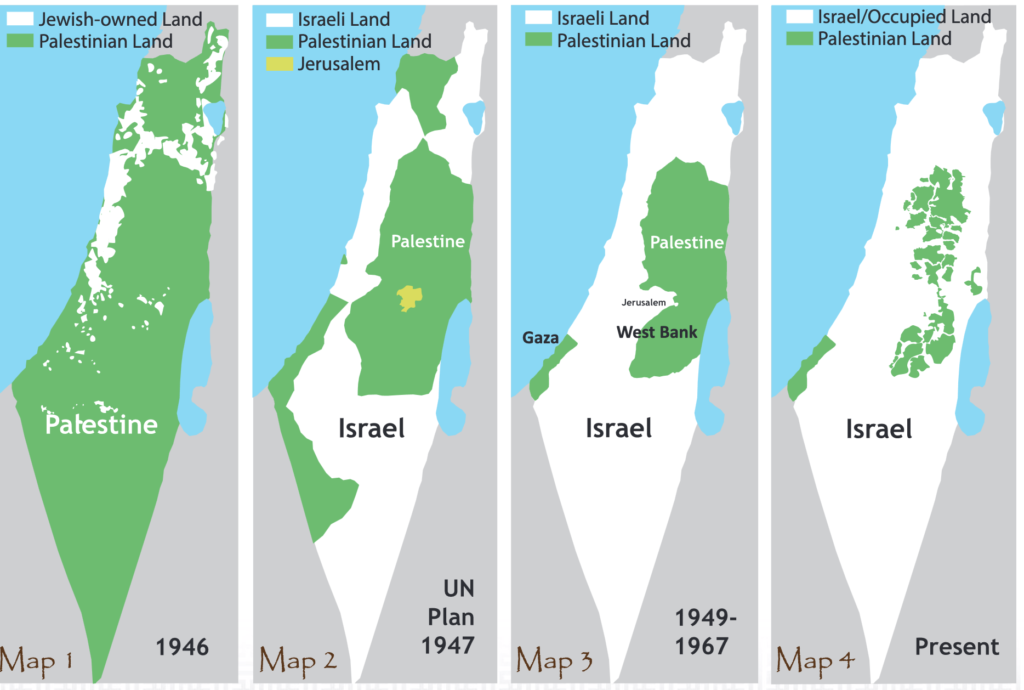
The difference is important because Western corporate media tend to treat islamic Jihad and Hamas as a single organization, which implies a unified command, control, communications and intelligence-gathering (C3I) hierarchy. Although there is certainly a degree of coordination of weapons and intelligence transfers between them and their allies and integration of operational units such as what occurred on October 7, the leadership structures of the organisations differ as well as their long term objectives. More specifically, it is my read that Islamic Jihad desires a holy war and the establishment of a Caliphate in the Levant and larger Middle East, whereas Hamas wishes to reclaim what has historically been known as Palestine (hence the phrase “from the river to the sea,” demarcating the territory between the River Jordan and the Mediterranean from the Lebanese/Israel/Syria border to the Red Sea). This well-known map shows the area of claim and what has happened to it since 1946.

The fact that Islamic Jihad and Hamas have different long-term objectives means that they are potentially divisible when it comes to both military approaches as well as diplomatic negotiating strategies.They and their patrons will resist the latter as a divide and conquer approach, and they will be correct in interpreting the situation as such. But for the larger set of interlocutors trying to achieve a solution to the current status quo impasse and endless cycle of violence, separating the approach to Islamic Jihad from that towards Hamas makes sense. Remember that Hamas wants to replace the Palestinian Authority as the main agent of the Palestinian people and has strong support in the West Bank in that regard (the Palestinian Authority is headquartered in the West Bank but is totally subject to Israeli edicts and controls). Islamic Jihad would prefer to see the current conflict broaden into a regional war out of which a new Caliphate will emerge from the ashes. The Houthi attacks on shipping in the Red Sea and Shiite militia attacks on US bases in Iraq are part of that effort.

Remember that Islamic Jihad and its allies do not need to win any major war in order to prevail (they militarily cannot). But their efforts have already caught the attention of the Arab “street,” where restive populations see the indifference or complicity of their oligarchical leaders when it comes to Israel as further proof that they are Western puppets. The idea is to expose who the real Masters are, undermine their Arab servants and promote jihad on a regional, grassroots level. it may seem like a pipe dream to those of us far from the streets of places like Cairo, Amman, Tangiers or Riyadh, but if and when anger takes to the streets of such places, then the outcomes are by no means certain when it comes to regime status quo stability.

It does not appear that Islamic Jihad will accept territorial concessions in order to achieve peace, as its project is larger than removing Israel and Jews from the Levant. Hamas, on the other hand, is arguably more nationalist than religious in nature, which means that the ideological focus is on specific ancestral territory rather than on religious orientation (even if Jews make for convenient historical scapegoats). It is also something that is obliquely seen in the fact that although Palestinians are largely Sunni Muslim in religious identification, Hamas’s main support come from Shiite Hezbollah in Lebanon, Shiite Iran and the Shiite Alawite (Assad) regime in Syria. These patrons and allies well understand that the Palestinians are much like the Kurds further to the East, claiming ancestral homelands that have long since been carved up by foreign occupiers (not just European colonialists) and who for many historical reasons are reviled by their co-religious neighbours (hence the refusal to grant or cede territory for either a Kurdish or Palestinian homeland by Sunni-majority regional neighbours or the acceptance of Palestinian refugee flows from the current conflict by these same States).

We must also factor in that both Hamas and Islamic Jihad have factions within them, including political and military wings, (comparatively) moderates and militants, pragmatists versus “idealists” in their ranks. Islamic Jihad has a more unified political-military command (which makes it vulnerable) even when using a decentralised guerrilla military strategy), while Hamas has separated its political and military wings while trying to professionalize its fighters. In any case, harder or easier, these divides can be exploited if the will is there. Conversely, if the divisions are self-recognised and there is a unity of spirit against an immediate foe n face of the odds, they can be mitigated even under the stresses of overwhelming kinetic assault.

In the end, Islamic Jihad is an existential threat to the Middle Eastern status quo because it, like ISIS and Al-Qaeda, want to overthrow the established order even if its current capability to do so is minimal and dependent on the help of others. Hamas is a stronger irregular warfare actor as well as an ideological movement in the local and international imagination because of its territorial focus, so does not pose as much a threat to the broader regional order other than the fact that it’s success could encourage similar insurrectionary movements in the near elsewhere.

Many difficulties exist on the other side of the road to elusive peace in Palestine. Israel will have to cede occupied territory for Hamas to even be approachable regarding negotiations, but what with the combination of recent orthodox Jewish immigrants from the US, Russia and elsewhere fuelling the settler movement, and with the Netanyahu government leaning hard right as a result of the conservative religious extremists in his cabinet, leading to the Israeli government arming of settlers and protecting them with military units, that is clearly not an option any time soon if ever. Israelis are hinting at the Sinai Peninsula as a place to re-settle Palestinians, but Egypt wants no part of that, nor for that matter do the Palestinians themselves. So the first thing that will need to happen is for the Israeli government to change and for it to abandon its settler policies. Again, this seems like a very high mountain to climb.

Another obstacle is that Netanyahu and his supporters may see the situation as a window of opportunity. They may liken the move to eradicate Hamas from Gaza and drive its population out of the Strip as being akin to the Six Day 1967 War in which Israel stripped Jordan of the West Bank, Syria of the Golan Heights and Egypt of the Sinai Peninsula and Gaza Strip. Moreover, given the surprise of the October 7 Hamas attack this year, it is clear that Netanyahu does not want to be seen as Golda Meir during the Yom Kippur (or Ramandan) War of 1973, when Israel was caught unprepared for an attack on October 6 by Egypt and Syria, leading to large early losses for the Israeli Defense Forces (IDF). Even though Israel ultimately won that war in 20 days, Prime Minister Meir was castigated for the lack of preparedness or forewarning and her coalition lost a majority in the legislative election the next year, resulting in her resignation. Netanyahu is acutely aware of her fate as well of the actions he took that helped facilitate Hamas launching its attack (like ignoring intelligence warnings and re-deploying active duty troops from the Gaza border to protect illegal settlers in the occupied West Bank). He knows that politically he is a dead man walking unless he comes up with something spectacular.

In his mind and that of his supporters and colleagues, seizing Gaza may be just that. Since there is no credible international deterrent levelled against Israel and a lack of enforcement capacity to stop its prosecution of the war even if there was a consensus that it has gone too far with its collective punishment/ethnic cleansing campaign in Gaza, Netanyahu makes the plight of the Gazans a UN refugee problem while the IDF consolidates its physical control of the territory. That allows him to “eliminate” Hamas (and many innocents) as a physical entity in the Strip, opening the door for Israeli occupation and settlement. If that is the case, he may well overcome domestic anger at his pre-war actions and seeming disregard for Israeli hostages and instead ride a wave of nationalist sentiment to another term in office.

Should that happen, the shrinking map of Palestine shown above will have to updated yet again.

A handful of observations.

I have opined regularly about the Hamas-Israel war over on the social media platform owned by that reactionary billionaire, but other than the preceding post have opted to not address the subject directly here at KP. However, the amount of misunderstanding, disinformation and misinformation circulating around that unhappy state of affairs prompts me to write here to offer some clarifications.

First: Asymmetric warfare is not just military conflict between unequally matched armed belligerents. It involves ideological, political, economic and cultural asymmetries as well. Stronger actors emphasise their immediate “hard” advantages, weaker actors emphasise soft long-term tools.Stronger actors focus on the immediate battlefield impact of kinetic mass in order to set the stage for favourable conflict resolution. Weaker actors focus on attrition of the enemy’s will and its broader support base in order to shape public opinion about a prolonged stalemate.

Second: War crimes and crimes against humanity are not defined by method of injury (knife, gun, missile, bomb, rape, torture) or the proximity of perpetrators to victims at the moment those crimes are committed. They are defined by who is targeted, collectively and individually. After that, the scope and scale of the crimes are measured by the amount of victims involved, remembering that war crimes and crimes against humanity can be committed against individuals and small groups.

Third: Seeing fault on both sides of the Hamas-Israel conflict means not excusing criminal behaviour by either. Nor does it ignore historical grievances and injustices involving each side that led to the current conflict. Focus on the comparative scale of atrocities does not alter the underlying reality of crimes against humanity committed by both sides. We must recognise historical and current wrongs before conflict resolution can be achieved, and compromises from each party will be required for a durable peace to be secured.

Fourth: Stating the obvious yet again. One can support Israel without being a Zionist. One can support Palestinians without supporting Hamas. One can see merit in the arguments of both sides with regard to the historical record. But one can never justify or condone the commission of war crimes and crimes against humanity by either side for any reason. Doing so is morally bankrupt. Doing so to score political points against partisan rivals in places like NZ, US, UK or OZ is reprehensible.

Fifth: The Hamas-Israel conflict ripped a scab and the pus of anti-Semitism and Islamophobia has oozed out on global scale. Bigots and racists on both sides see it as an opportunity to vent primordial hatreds in order to widen the divide between communities instead of pursuing peace.

Sixth: Proposing that the Palestinian Authority (PA) take control of Gaza once the IDF “cleansing” has ended is unrealistic. The PA (and its dominant Fatah Party) is a corrupt lapdog of the Israelis and their Western patrons that lost a fair election to Hamas in 2006 and then refused to accept the results. Hamas has ruled Gaza since ousting Fatah in an armed conflict after the 2006 elections. Both Hamas and Fatah have political and military wings. Fatah is secular and Hamas is Islamicist. Hamas is authoritarian but provides public goods and services to Gazans in exchange for public acceptance of their rule. The PA is a semi-authoritarian gerontocracy that is not supported by many Palestinians in the West Bank or Gaza. Making it the replacement for Hamas will just prolong the conflict, not end it. For that to happen Hamas must be accepted as a legitimate representative of Palestinian interests, upon which a focus on its political wing can help bring them to a bargaining table with the PA and other interested parties. Refusing to acknowledge Hamas is short-sighted and plays to their militant armed wing, not peace. This is called “dealing with reality.” Hamas may be unpleasant, just like the Kim regime in North Korea or the Netanyahu govt in Israel, but it is a participant in Palestinian politics and beyond. It will not go away even if its armed wing is decimated. The PA cannot replace it.

Seventh: Hamas’s tactics have so far worked: Sucker the IDF into over-reacting to the initial Hamas attacks by collectively punishing all Gazans, thereby swaying global opinion against Israel; establish itself as the primary defender of Palestinian interests rather than the toothless Palestinian Authority; broaden the conflict into multiple fronts involving a number of supportive actors (eg. Shiite militias in Iraq, Hezbollah in Lebanon, the Assad regime in Syria) that will test the will of Israeli allies to escalate further; foment unrest on the Arab street. None of this justifies its crimes against humanity, but speaks to how the framing of the conflict has moved from a largely pro-Israel to a pro-Palestinian response even in countries with strong official ties to Israel. Whatever the immediate military outcome, there appears to be a potential for a redrawing of geopolitical fault lines as a result, something that Israel, the US and other Western states may see as being in their favour but which in reality could well be not. In particular, the post-colonial Global South is not following the Western lead. That opens space for other actors–the PRC, Russia, Iran and other anti-Western govts–to exercise influence and leverage on the South as a result. Israel and its patrons need to look at the bigger long term play as they calculate their short-term responses.

Eighth: Given the role of armed guerrilla group Irgun and its then leader Menachem Begin (later Israeli Prime Minister) in the 1946 bombing of the King David Hotel in Jerusalem (91 dead), the killing of 254 Palestinians in the village of Dir Yassin and establishment of the state of Israel in 1948 (where the Irgun was integrated into the Israeli Defense Forces), it is rich of Israel to label Hamas as an illegal “terrorist organization” when it knows that Hamas has political and military wings that copy what Irgun did 75 years ago. No moral superiority here. To be clear: this is about hypocrisy when framing the conflict. It does not absolve Hamas or Israel for war crime/crimes against humanity, but it does point to the commonalities between their origins as political movements that use terrorism as a tactic in sectarian war.

Ninth: In exchange for Hamas’s release of 50 women and children hostages, Israel will release 150 women and children prisoners from detention centres (under the 1:3 exchange ratio). Most of these women and children have been arrested and detained without charge in the West Bank after October 7 while resisting Israeli security forces and settler efforts to displace them from their homes and lands. That shows cynical deliberation on Israel’s part. The exchange, in other words, it is a straight hostage swap.

There are more comments along these lines on that social media platform but these seem to be the ones that, in my mind at least, help frame the objective reality of what is going on. readers are welcome to (politely) disagree or add to the discussion.

Bully Pulpits and the Politics of Nastiness.

Teddy Roosevelt coined the phrase “bully pulpit” to describe the US presidency given the position that the country occupied in world affairs. He saw it as a tremendous platform for promoting political, diplomatic, social and economic interests and agendas. Over time the phrase has been broadened to include a wider range of positions of authority and institutional platforms from which to amplify and project views and projects on a range of public and private policy issues. This can include people and agencies involved in popular culture as well as politics and business affairs, sometimes in overlapped fashion (think Elon Musk).

In years past I discounted the weight of the US presidential bully pulpit. I saw it as being more relevant to US domestic politics than foreign policy and international affairs. As a child of Latin America I did not see its influence on my daily life nor on the behaviour of local politicians even if the US was the elephant in the room when it came to Latin American politics in general and economic and security affairs in particular. Even after moving to NZ as an adult, the bully pulpit of the US presidency was to my mind more of a historical anachronism or abstract than a reality of contemporary diplomatic relations or social exchange. For all the US talk about being a “leader of the free world,” “shining house on the hill,” “world’s greatest democracy” and all that other blather, I never got the impression that a US president could use the office to project his particular vision or brand onto the international, multicultural stage. That includes charismatic presidents like Barak Obama and Ronald Reagan (as much as I hated that guy).

To be sure, the US has interests that it projects onto the world stage, but the notion that a US president could use his office to promote a global vision beyond the usual rhetoric of freedom and democracy seemed far-fetched because if nothing else, most of those type of platitudes fell on cynical if not deaf ears. For me, the bully pulpit was just a domestic soapbox.

This notwithstanding, the US has always been a bastion of cultural as well political imperialism, exporting its culture and social mores world-wide along with its economic interests, be it from Coca Cola and KFC to rap, death metal and jazz music. The synergies of economic, political and cultural imperialism are well known so nothing else need be said here other than that I used to teach about this phenomenon, noting how local societies incorporate, adopt and adapt cultural artefacts in their own style according to their native mores and narratives, often with a dominant group versus subordinate group (often ethnic minority) twist added to the mix (e.g., people of colour in the developing world have adopted rap while European descendents have adopted pop-rock, among other things). One only need think of NZ’s hip hop scene to see the process at work.

Now, I see bully pulpit and cultural imperialism being combined in a most pernicious way as manifested in the person of Donald Trump. Trump embodies what I call the politics of nastiness, and he has used the US presidency as a bully pulpit to project his vulgar full spectrum neo-fascist bigotry world-wide. At first I thought of Trump as someone who tore the scab off of racism, xenophobia and crude low brow money-grubbing in the US. But after four years of his presidency and the sequels to it, I realise that his long moment in public life has served as an invitation to and license for others around the world to follow his approach to political and social discourse. The core of this approach is to appeal to the lowest common denominator in the basest of terms, seeking to appeal to the darkest of instincts and deepest ignorance extant in a given political community. This is the politics of nastiness, and the nasty has reached NZ.

It is well known that National has been for some time looking to US rightwing spin doctors for campaign guidance and narratives (crime! waste! taxes!), but now Winston First and ACT’s David Seymour have decided to go full US conspiracy theory (Winston: globalists! mandates!) and pseudo-libertarian racist (David: free speech! bureaucrats! Treaty separatists!). The tone of politics in NZ has gotten cruder (see: Chris Bishop, Judith Collins) and more personal (e.g. treatment of Kiri Allen). The corporate media has clearly decided to go full Murdoch in approach (with a few exceptions duly noted) by stirring partisan and racial division and polemics, focusing on personal foibles and conflicts rather than platforms/proposals and going for “gotcha” moments rather than offering dispassion analyses of the policy platforms of the respective parties.

This is Trump politics 101, and it is nasty.

NZ is not alone in this. From Bolsonaro in Brazil, to Dutarte in the Philippines, to Orban In Hungary, to Milei in Argentina to Modi in India, rightwing populists have adopted nasty politics as the core weapon in their political quiver, demonising competitors and personalising attacks on their opponents in order to get them to capitulate rather than concede and to be destroyed rather than defeated. Besides their embrace of nasty politics, what binds them together and to Trump is that they all profess to be defending “traditional” values and social structures against the supposed (and imaginary) threats posed by “progressivism,” “woke” politics and the growing presence of long suppressed (and oppressed) groups in their respective societies.

In NZ it is not only mainstream politicians who have seen the opportunity of emulating Trump. The Wellington protest riots saw a number of Trump, MAGA and Confederacy references amongst the agitators. The likes of Sue Grey, Liz Gunn, Brian Tamaki and Leighton Baker openly spout conspiracist lunacy and self-serving opportunist populist tropes. The overall effect is that the scab has truly been ripped off and the extremist infection has now spread throughout NZ’s political culture. There is a violent element in it that NZ security authorities continue to be reluctant to fully address, and it is the tail that wags the rightwing minor party dogs, if not National itself.

In summary: Trump is a cultural imperialist phenomenon that has used the US presidential bully pulpit to export his style of nasty politics world-wide. For all their talk about centrism, it is evident that the right side of NZ’s political spectrum has been heavily influenced by the Trump effect. Voters need to be cognisant of that not only when deciding who to elect, but when considering the prospects of how the potential “coalition of chaos” (ACT, National, NZ First) will approach governing once installed. Mutatis mutandis, the model for that approach could well be Trump.

Things could get nasty.