
Its the end of days for me in one sense, but perhaps the beginning of something new in a few months or so. More details on the latter prospect as it develops.
You can’t mess with the messers
[Note: Idiot/Savant stole my initial title for this post — word for word! — forcing me to get more creative. The definitive version is here. Not sure about the video, though.]
Education minister Anne Tolley has tacitly threatened to go nuclear on primary principals who refuse to comply with National Standards directives, or who speak out against them. In a speech to the Principals’ Federation conference in Queenstown today, she said:
It’s much quicker [contacting me with concerns] and you will get results, rather than going to the media and making threats, which is just politicking, and achieves little.
And while we’re on that subject, you are pretty unique among public servants who can speak freely in the media. May I remind you that I made representations to make sure that continues.
However – no public servants have ever been granted the privilege of picking and choosing which Government laws they choose to administer. Lawyers, accountants and all the other professionals working in Ministries can offer opinions. But it’s the Government that makes policy decisions.
Now, there’s an implication here that the minister might retract her “representations” to make sure that the rights of teachers to speak freely are preserved, but there’s nothing to this. Any move to constrain teachers’ views or their expression would immediately draw furious and justified denunciations of the government for politicising and propagandising the education system, such as no liberal political movement could withstand.
In the final analysis she’s 100% correct about the government setting policy and the sector implementing it. By way of remedy, the ministry can take over the running of a school which fails to implement education policies adequately, and Trevor Mallard suggests the ERO has already started heavying truculent schools to set an example to others.
 But it is an empty threat. For one thing, you can’t play the bossy schoolmarm with schoolteachers and principals — they wrote the book on it, and know all the tricks of the game, having put up with them from students for their entire professional lives. Not to mention that, as career educators they have far more invested in the quality of their education system than a minister who’s only been in the job two years and could be gone in the next cabinet reshuffle.
More crucially, though, the minister is up against old-fashioned collective action: a heavily unionised workforce which knows it is indispensable and irreplaceable. So what happens if it’s not just one school? What happens if it’s a dozen, or a hundred, or almost all the primary schools in the greater Auckland area, or the schools of two National heartland electorate regions at either end of the country, or as much as 94% of the sector overall?
Later in the speech, Tolley said:
I’ll say it again – we are going to get this right, for the students, and for their parents.
But when push comes to shove, National Standards simply cannot be implemented by fiat. Teachers, directed by principals, are those who must undertake the implementation of the policy. While I cite them reluctantly because I don’t entirely agree, it’s somewhat like what the Randians are saying about Obama’s response to the BP oil spill: no amount of threat or bluster can provide any additional incentive to progress a cleanup whose failure or undue delay will spell a certain end to the company. No matter how you slice it, there are not enough Ministry of Education staff members, non-unionised part-time relievers or teachers who are happy with National Standards as proposed to do the complex and important work of assessing all the students who need to be assessed; cataloguing, moderating and communicating those assessments to parents and the ministry in a coherent manner. This is ignoring the fact that you can’t simply parachute a compliant teacher or apparatchik into an unfamiliar classroom and have them do it with any legitimacy. The teachers who stand up in front of that class of kids day-in and day-out are the only ones who can properly assess them, and they know it.
The sector also knows it’s in the right. Educators’ opposition to National Standards is neither ideological nor capricious, and they have have consistently levelled principled and pragmatic arguments against only the proposed implementation of the policy, backed by the best local and international experts in the field. They support assessment standards in principle, and have repeatedly suggested reasonable alternatives to the proposed implementation. The problem isn’t with their willingness to work with the minister; it’s that the minister isn’t interested in working with the sector.
So ultimately one of two things will happen: one side or the other will compromise sufficiently for the issue to progress, or the minister will be faced either with backing down in abject failure or sacking a significant proportion of the education workforce, with the consequent failure of the policy by default, not to mention a massive outcry from parents who’re forced to take time off work because their kids can’t go to school (and from their bosses, and bank managers, and almost everyone else). There’s no better way to bring the country to its knees.
Tangentially, this situation illustrates a branding risk I’ve been meaning to post on for a while: if you name a policy initiative after your party or some other core bit of your identity, you had better be damned sure you can get it through to full implementation without a hitch, lest its failure tarnish your good brand. Quite apart from any concerns with the policy, his National government has failed to do so with its National Standards. Not only is the policy programme and its attempted implementation against the wishes of the only people who can implement it a catastrophic mistake, but its naming looks like a spectacular failure as well. If it’s not pulled out of the fire soon, in future, all National’s political enemies will have to do to score a point is recount some of the more embarrassing events of this episode and say “these are National’s Standards”. It’s already happening — I’ve seen that very sentence used at Red Alert, for instance, regarding something unrelated to education reform. Instant conversion of a wonkish policy criticism to a gut-level identity observation which will resonate with the folk who just wanted their kids to go to school, those who wanted nothing more than to teach them as best they could, and ultimately the kids themselves. For this reason, my instinct is that the long-term damage to National’s brand and electability on this matter will become too high a price to pay for the perceived win over the sector, and those with a more strategic view of National’s situation will require that the wound be cauterised. Although it’s a backdown, over the long term this will be good for the party. More importantly, it will be good for the country.
L
In other news, 50% of teachers are below average
30 per cent of teachers need to lift their game – Key.
Honestly. Anyone who thinks this is a meaningful statement needs remedial numeracy work themselves.
L
Great prospects
Hat tipped to Paul McBeth for this one.
As one side engages in some tentative but hugely premature triumphalism, and the other side points the accusatory finger, a sleeping giant awakes. This man — our Nixon, in whom we apparently see ourselves as we really are — has rekindled the fire which once consumed the hearts and minds of the nation (and the knickers of untold women old enough to know better) and thrown himself with renewed fervour into the task of “getting his old job back”.
Thanks either to wicked humour or outright shamelessness on the part of Auckland University political science staff, Winston Peters has been granted the unlikeliest of springboards to launch his 2010 campaign to return to the Beehive in 2011: a lecture to (presumably first year) political science students on the MMP political system. Of course, if they’d wanted a serious lecture on the topic, any number of graduate (and even some of the more geeky undergraduate) students could have done it, but the choice of Winnie was inspired because, instead of just telling these young things the dry facts and functions of the system — let’s face it, they can learn that from a book or even wikipedia.* But here’s a chance for them to learn how the system works in actual fact, from someone who has used it to screw others and been screwed himself, and to learn all that from someone who, just coincidentally, is in a position to demonstrate that no matter how down and out a politician might seem, under MMP he’s only one voter in twenty away from the marble floors, dark wood and green leather benches which house our democratic institutions.
The speech itself is the saga of the heroic battlers who guided the noble, fragile MMP system through the minefields of bureaucracy, persevering despite the “inner cabal cherishing hidden agendas” intent upon bringing about its premature demise. Those heroic battlers were represented by New Zealand First, epitomising the “traditional values of New Zealand politics”; “capitalism with a kind, responsible face”; the “long established social contract of caring for the young and the old and those who were down on their luck through no fault of their own”; a strong, honest party which was forced into coalition with National, although even then the dirty hacks in the media failed to correctly report these facts.
It’s a wonderful story, a fabulous creation myth, and if you’ve listened to Winston’s speeches over the years, none of it will be foreign to you.
But the speech dwells upon the darker, more recent history of MMP, and particularly its perversion by the forces of separatism. This initially seems odd for a speech which praises MMP, but it makes perfect sense when you consider the wider narrative: you can’t rescue something which isn’t in trouble, and the wider narrative is, naturally enough, that Winston is here to rescue New Zealand from MMP and the separatists — blue and brown — who have overtaken it. This is done, in true Winstonian style, with a masterful play on words:
You’ve all heard or seen the British comedy TV show “the two Ronnies†– well we have our own comedy show starring the “two Honesâ€. Hone, of course, is Maori for John – and the two “Hones†don’t give a “Heke†about who they insult on Waitangi Day.
If you listen closely, you might almost be able to hear the sound of undergraduates giggling nervously, and more quietly but present nevertheless, the sound of confused and frustrated battlers who don’t see what they stand to gain out of any of the current political orthodoxy starting to think “you know, Winston wasn’t so bad after all.”
So, Winston is back. For the record, I still don’t think he’s got the winnings of an election in him without the endorsement of an existing player, and I think it’s better than even money that he would drag any endorser down with him. His credibility is shot to hell, and this is a naked attempt to reach out to a Labour party who have just begun to put a little historical distance between themselves and him, but it will be very tempting for a Labour party struggling to connect with the electorate. If we as a nation are very, very unfortunate, Labour’s failure to reinvent themselves and the illusory success among some of the usual suspects of the “blue collars, red necks” experiment last year — notably not repeated in this week’s speech — will cause them to reach out for the one thing they lack: a political leader who understands narrative, who possesses emotional intelligence and political cunning in spades, who knows how to let an audience know who he is and what he stands for, and make them trust him (sometimes despite all the facts), and who has a ready-made constituency of disgruntled battlers who feel (rightly or wrongly) that the system doesn’t work for them.
Please, let it not come to that.
L
* Incidentally, it may come as a surprise to some of you that these dry facts and procedural details were the reason I dropped out of PoliSci in my first year, and studied Film instead (before realising that it all came back to politics anyway).
Plagarism and Double Standards.
I was not going to post on the Witi Ihimaera plagarism scandal, having commented under my own name on another blog that covered the matter. But as I compare my summary dismissal for writing a rude email to an unqualified and underperforming student with the lack of even a cursory reprimand for his theft of intellectual property, and then find out that apparently it is not the first time that Mr. Ihimaera has appropriated someone else’s work as his own, I find myself wondering if indeed there is a double standard at play when it comes to our respective treatment by my former employer. Let me explain why, but first point to the one consistency in the handling of both cases.
The University has, as part of its collective contract with the union representing academic staff, a series of procedures and regulations that have to be followed before an academic staff member can be dismissed for serious misconduct. This includes receiving a formal complaint detailing the misconduct, attempting to mediate the matter using the offices of the Ombudsman, handling the matter within the department, issuing two formal written warnings before dismissal is sought…the requirements are pretty detailed and in fact were made even more so after my dismissal precisely because of the controversy surrounding it. Perhaps Mr. Ihimaera is not a member of the union so other procedures were followed, but that usually mitigates against favorable resolution for the employee.
In my case none of the internal procedures were honoured other than as a facade. No formal written complaint was ever made against me, but without getting my side of the story the Ombuds(person) immediately brought the issue to the attention of my department HOD, who without saying a word to me passed it on to the Dean, who after consulting with the student as to what should be done held a series of brief meetings with me and a union rep in which he shrugged off my apologies and assurances, ignored the fact I had no prior formal warnings, and sent me packing. In fact, he and his HR advisors attempted to use a couple of unrelated events from the past (an argument with a former HOD about managerial practices and an email disagreement with a colleague about a grad student who failed to attend a class) to argue that prior warnings had been given. Those were later found to be irrelevant by the ERA.
In Mr. Ihimaera’s case it appears that, upon hearing that news of the plagarism was about to go public, the University rapidly pushed through an “investigation” of the matter apparently involving his HOD, the new Dean of Arts (who was not the Dean the fired me) and Mr. Ihimaera. No disciplinary board with colleagues outside of the HoD and Dean was apparently convened. Mr. Itimaera  gave apologies and assurances, and the case was closed.
What is consistent in both cases is that the lengthy rules and procedures for handling discipline cases involving academics were circumvented, in his case favourably to him and in my case not. This galls me not because I think that Mr. Ihimaera should be fired–I do not, and think that both of us should have received a final written reprimand about our respective transgressions–but because the University argued that I was fired because of the damage I did to its reputation. This line of argument continued after the dismissal was found to be unjustified, then into the settlement agreement by which formal reinstatement meant no actual reinstatement. But what about my reputation? Not only did the leaked email wind up on the front page of the national newspaper and then went global, but the University did nothing to prevent its release or demand its withdrawal when a student newspaper under its authority first published it (even though leaking the email was a violation of the email policy under which I was ostensibly fired). Moreover, the University knew well what the impact of the dismissal would be. As the Dean who fired me said to the ERA, “in a reputation-based business like academia, summary dismissal essentially means the end of a career.” In my case that seems to be proving true, and perhaps it was that knowledge that made for lighter treatment for Mr. Ihimaera–but I suspect not, simply because his association with academia was one of mutual convenience rather than professional necessity.
My major question is, if what I did was so injurious to the University reputation, what about Mr. Ihimaera’s plagarism? Plagarism is the single worst thing that an academic can do. Working in a genre such as historical fiction does not excuse the lifting of other’s words. Plus, being housed within an academic institution means adhering to its requirements on original work, so he was, in fact, more duty bound than independent writers in that regard. Students get failed and often expelled for plagarism. Academic staff get demoted or fired for plagarism. And Mr Ihimaera did not even merit a reprimand? Now, it seems that the case gets worse, as others have come forth to claim that Mr. Ihimaera has plagarised in his previous work. If so, and if the University knew about those previous incidents, then its absolution of the latest episode is even more alarming.
The University and Mr. Ihimaera say that his plagarism was “inadvertent” and thus excusable. Even if that were true–and it stretches credulity to think that a famous author would not know the difference between his own words and sentence structure and those of others– standard guidelines on plagarism, including those specifically used and distributed by the University to students and staff, state that inadvertent or unknowing plagarism is no excuse for it. It is the author’s responsibility to ensure his/her work is original and properly cited, and the crosses all academic fields and intellectual genres.
Some have claimed that because Mr. Ihimaera is Maori, famous and gay, he got off lightly. I initially thought that was ludicrous and that there were other mitigating circumstances at play. But the more I learn about the case and think about the differences in our treatment, the more I wonder as to why those differences. Certainly universal institutional standards need to be upheld over and above the specific identity and interests of any individual. That is what the University claimed in my case. Yet, was what I did worse than plagarism? Did my email to an individual student cause more damage to the University than the discovery by a book reviewer in a national magazine of the as of then unattributed passages in Mr. Ihimaera’s latest book? How can he not even receive a reprimand, and how can the University claim that in both cases its standard rules and procedures were followed to the letter?
The real shame is that it is not my actions or Mr. Ihimaera’s that have tainted the reputation of the University. Instead, it is playing loose with the rules and attempts to “spin” both stories in a way that gives the illusion of procedures being properly followed that sullies the brand. That has a negative impact not only on the managerial cadre that are the perpetrators of the double standard but also the staff, alumni, current and prospective students who share association with the University name. Yet, instead of being ashamed and contrite, University managers continue to obfuscate and bluster, refusing to reveal how their “investigation” of the Ihimaera case was conducted citing privacy concerns (concerns they were not so concerned about when my email went public). Â It appears that management are blissfully unaware that the ship is sinking beneath them or else are confident that no matter what they do, they will not be held to account by anyone other than themselves. Since the taxpayers ultimately pay the salaries of all involved, that should be a matter of public interest.
Does New Zealand have Public Intellectuals?
One thing that is striking about the tone of contemporary public policy debates in NZ is the absence of intellectuals. Although various academics are trotted out by the media to give sound bites and opinion based on their supposed “expertise” in given subject areas, they otherwise do not loom large in the national conversation on issues of policy. Likewise, activists and partisans of various stripes make their views known on a number of fronts, but their contributions are notable more for their zeal than their intellectual weight. So, what happened to NZ’s public intellectuals, or perhaps better said, has there ever been a real tradition of public intellectuals in Aotearoa?
I ask this because as a relative newcomer to the country (arrived in 1997), I may have witnessed the passing from the public eye of the final generation of public intellectuals. People like Andrew Sharp, Bruce Jesson, Barry Gustafson (who is retired by active), Michael King–their likes are no longer seen in policy debates, and there does not appear to be another generation of intellectuals emerging to replace them. Moreover, due to my ignorance of NZ intellectual history, I remain unsure if theirs was the only generation of scholars who had an impact on public life, or if they are the final generation in a tradition that extends back to pre-colonial days.
To be sure, the likes of Jane Kelsey, Brian Easton (who, if from that previous generation is still alive and involved in contemporary debates), Gareth Morgan, Ranginui Walker, Sandra Coney, Ian Wedde, perhaps Chris Trotter (who is prolific if not consistent in his views) continue to agitate for their causes. Various bloggers have made their mark on public discourse, and Maori luminaries interject their insights into discussions of tangata whenua and tino rangatiratanga. But it appears that there is an anti-intellectual bias deeply ingrained in NZ society, one that has its origins in the much celebrated egalitarian ethos of the country, but which is now reinforced by the corporate media disposition to sell teenage pop fodder, “infotainment,” culturally vacuous “reality” shows and sports instead of providing even a minimum of in-depth news, analysis and debate. Although there are evening and weekend segments dedicated to public affairs on major media outlets and plenty of talkback options in which opinions are voiced, those that feature them are dominated by policy dilettantes or, worse yet, journalists, society celebrities or ex-politicians talking to each other (in a version of the Fox News syndrome of mutual self-promotion via staged interviews on personality-driven shows). There is even an academic version of this, in which individuals who are purported experts in “media studies” are brought out to pontificate on how media covers politics and social issues. No need to consult those that actual work in these subject areas–all that is required for public consumption is someone who looks at how the media covers how sociologists, economists and political scientists track issues of policy.  That is enough to make definitive judgements on the matters of the day. Add to this the fact that many media guest talking heads are paid for their appearances, or if not, wish to keep their mugs on the society pages, and what passes for informed public scrutiny of policy cause and consequence is nothing more than a collection of glib retorts and one-liners. This is the media equivalent of comfort food.
The pandering syndrome has infected the political classes. Personal image and party “brand” is more important than substance. Market research drives approaches to policy. And nowhere is their an intellectual in sight to serve as critic and conscience of society. Instead, “opinionaters” from all parts of the political spectrum pass shallow retrospective judgement on matters of import, and in the measure that they do so they rapidly fade from the front lines of  the degraded public debates. Small wonder that political debates often tend towards the banal and trivial.
I am therefore curious as to whether there has ever been a robust tradition of public intellectuals in NZ, and if so, why has it all but disappeared? The 2007 book Speaking Truth to Power (Auckland University Press) decried the dearth of public intellectuals, and the situation appears to have gotten worse since then (good reviews of the book can be found here: Â http://www.listener.co.nz/issue/3493/artsbooks/8641/that_thinking_feeling.html;Â and here: http://www.stuff.co.nz/sunday-star-times/features/feature-archive/163908/Smart-thinking-NZs-public-intellectuals).>>Sorry, I am having trouble placing the links in shorter format<<
The word “intellectual” itself has become a focus for ridicule and derision, and professions in which intellectual labour is the norm are denigrated as the province of losers who otherwise could not get a “real” job (hence the tired saw that “those that do, do, and those than don’t, teach”). This is odd because in other societies intellectual labour is valued intrinsically, and in NZ there has been at least rhetorical championing of the move towards a higher level of public discourse. What happened to the “knowledge economy” and the effort to turn NZ into a value-added, innovation-based manufacturing platform? Is there no role for public intellectuals in that project, to say nothing of more lofty efforts to argue and impart a normative as well as positive theoretical framework for the ongoing betterment of Kiwi society? Are intellectuals indeed just pointy-headed bludgers ruminating about how many angels can fit on the end of a pin from the obscurity of their ivory towers and smoke-filled staff rooms? Or is there something amiss in the larger society that denies them a public role?
I shall leave the answers to you.
Young and free
It seems that Australia is considering a measure which would give 16 and 17 year-olds the right to vote in federal elections.
There are some aspects of Australia’s political system which make this sort of measure perhaps less controversial than in NZ. Australia’s electoral system is more complex than NZ’s; there are many more levels of representation, with two chambers at federal and state level (excluding Queensland); the right being proposed only extends to federal elections, not to state elections which are arguably more important to local electors; and it is a right to vote in a country where adult electors are required to vote. In a sense, proferring the opportunity to vote to those young’uns who consider themselves sufficiently informed and engaged to do so could limit cases of people being thrown into the deep end of compulsory voting in a complex system without a clue.
Politically, this was poison in NZ not so long ago, with most of the vitriol directed at Sue Bradford (who sponsored the Civics Education and Voting Age Bill), and the Greens’ secret conspiracy to take over the country.
But wait a minute, didn’t that bill include civics education? Wouldn’t that make NZ’s electorate more aware of and engaged with political systems and norms? While those with an ideological barrow to push would deride the teaching of civics as a propaganda exercise wherever it didn’t take their particular viewpoint, it is perfectly possible to teach the broad strands of political history, principles of government and representation and the bones of the major ideologies in a non-partisan manner – not an unbiased manner, mind; in a manner which makes the presence of bias clear and obvious enough for students to go and educate themselves. As far as I’m concerned, civics education and democracy should go hand in hand – and civics education and compulsory voting must go together. As it stands, we rely exclusively on the media to give us the information we need to be free and self-governing – without any sort of formal idea about what it means to be free and self-governing, or any critical tools to judge whether we are, or whether the information we get is sufficient to that end.
So, while I’m unconvinced that 16 and 17 year-olds should vote, the idea of them voting with a civics education is frankly less frightening than the idea of adults voting without one.
L
Keeping the weak ill-educated, isolated and unskilled
Adult Community Education serves two key purposes: reducing poverty and building strong skilled adults active within their communities. The National government is drastically cutting it, consigning people to lives trapped in poverty and weakening communities.Â
The cuts are both deep and vicious, school ACE funding is being cut by 80% from 2010, tertiary ACE funding from 2011, and inflation indexing goes from both, and the funding to help providers develop community education vanished overnight.
National has been banging on about “moroccan cooking courses” and describing them as “hobby courses”, but the reality is very different. Firstly a quick look at any ACE provider will show a very different picture of courses from the one Anne Tolley would like to paint. My local school provider, for instance, is teaching first aid, assertiveness, anger management, effective communication, and how to teach adults – all valuable, all losing funding in 2010.
Secondly, hands on life skills courses are an effective bridge back into education. Within my extended family and network of friends I can think of several people who’ve taken a first easy step back into education through a “hobby” course, found that they could succeed in education and taken another course, and blossomed from there. A concrete example: bike maintenance -> communication skills -> effective writing -> interview preparation -> a brand new job and career. By removing the bridging courses National are consigning a whole raft of people to on-going poverty and no access to education.
Thirdly, we suffer from relatively weak communities in New Zealand: individuals are isolated, people want to help others but don’t know how, community organisations are underfunded, under resourced and lack structural skills. Community Education has been one of the more effective mechanisms for addressing this, not only do they build relationships and create community facilities and meeting places, but they also teach the skills that effective community organisations need.
Anne Tolley, by butchering the Community Education sector, has acted both to keep the weak ill-educated, isolated and unskilled, and to undermine the community organisations that try to help them.
Hope springs eternal
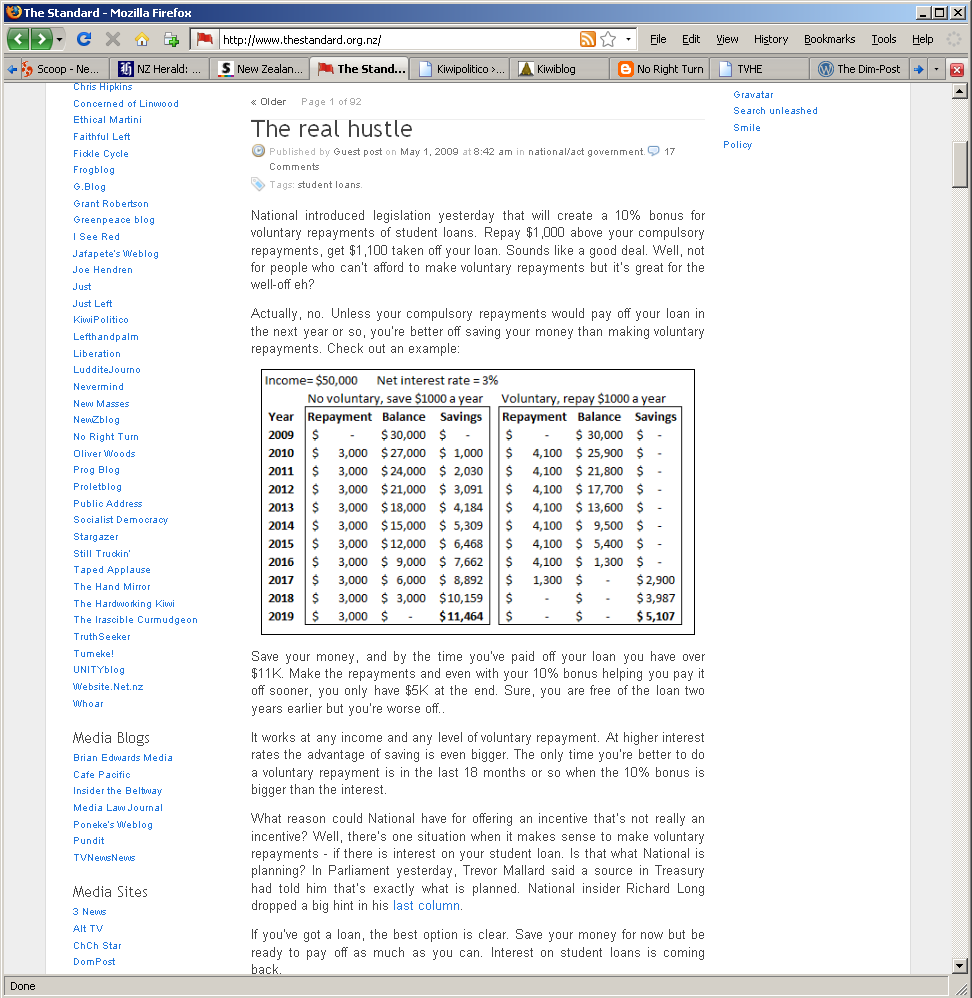
Over at The Standard the aptly-titled Mathemagician has been snapped trying to pull a rabbit out of a hat to prove that the government’s student loan carrot is in fact a stick.
This is fundamentally the problem with True Believers – they’re so committed to an ideological position (in this case, that National are trying to rip everyone off) that they’re credulous to the point of naïvete. Skeptic founder Michael Shermer lists this as one of the five core reasons Why People Believe Weird Things in his book of the same name: if it suits people’s worldview to believe something, they don’t bother to examine it too closely for fear they might prove themselves wrong.
The most cursory bit of critical thinking about this topic ought to have revealed it was all smoke and mirrors, but there wasn’t even that – in this sense it’s sort of like Schneier’s Law, viz:
Any person can invent a security system so clever that he or she can’t imagine a way of breaking it.
Since they’ve deleted the old table showing the original calculation, here’s a screenshot. Good work, Pat.
L
Identity politics behind school stabbing?
An article in the Herald gives a clue in favour of what I suspected: that there might be more to the assault by an Avondale College student on teacher David Warren than meets the eye. A few bullet-points below:
- Warren was a Japanese-language teacher with a brusque and sometimes offensive manner, who allegedly joked about the Republic of Korea. His attacker
was new to NZ and likely unfamiliar with our wayshad apparently been here for two years and at Avondale College all of 2008. - Korean students (and I’ve taught hundreds) are quite strongly inculcated to respect and admire teachers. It’s part of their Confucian socialisation. I simply can’t imagine one attacking a teacher, or even speaking rudely to a teacher they don’t know very well indeed, much less while in a foreign country.
- Probably the only thing stronger than this is the Korean sense of national pride. If the two things came into conflict, it would have to be a grave insult indeed to result in this sort of response.
- Koreans have an abiding hatred of the Japanese, founded (among other things) on the crushing occupation they suffered through the first half of the 20th Century and not helped by a) pervasive anti-Japanese propaganda at home and b) continual denial by the Japanese of any imperial wrongdoing (not unlike their attitude to China and elsewhere).
- If a joke was made in the context of the Japanese language, which Koreans were forced to adopt, learn, and use, even to the point of taking Japanese names (not unlike how MÄori was here, though more brutal) about Korea, then I can certainly see it being grave enough.
- Students are speaking anonymously about the case for fear of expulsion – WTF? Why does the school get to impose this sort of constraint?
- Avondale College Principal Brent Lewis claims to know nothing of the sort, contradicted by his own staff and pupils. I detect arse-covering.
- I can’t find any reference to the incident on Korean English-language news sources, but if there emerges a sniff that this may be a matter of national identity, it could turn into a Big Freaking Deal. Especially with Lee Myung-bak here to gladhand and the chance of a Free Trade Agreement being floated. Talk about bad timing. Update: exexpat notes below that Korean-language media have picked it up, with the nationalism line intact.
None of this is to excuse the student’s attack, of course. But it doesn’t look like a random bit o’ violence to me.
Update: The attacker has been named, and a bunch of the details seem to be disputed, see here. I’ve amended the post to remove details which seem to be incorrect.
Disclaimer: Can I be completely explicit for people who are too suspicious to believe or too stupid to read the statement above (which I almost didn’t put in because I thought it was bleeding obvious): I am not trying to blame Warren or defend Chung – I am trying to consider the dynamic in play here. If you attempt to call this into question or engage in any such behaviour yourself, expect to be soundly ridiculed. You might note I’ve tagged this post hate crimes.
L