The Chaotic Reaction.

I recently gave a public lecture that addressed the question of how to make sense of the current state of international disorder. The sponsors of the talk know some of my writing and media comments about various aspects of international relations and foreign affairs, so they asked me to try and frame the picture for a group of smart non-experts. I decided to do so by noting the sources of the disorder and the three general responses to what, as I noted in the earlier post about A Return to Nature, is a moment of global chaos.

The current moment of chaos has its origins in the 2008 financial crisis, COVID, Donald Trump’s ascendence and Putin’s invasion. The 2008 financial crisis demonstrated the inherent fragility and biases of Western institutions that underpinned the so-called liberal international order. The more international entities were tied into Western financial circles, the more they lost when the artificially heated (via things like sub-prime lending) markets crashed. On the other hand, entities that were lesser tied into Western financial circles, including Asian banks, suffered less from the crisis. A lesson was learned there, one that rippled across increasingly skeptical views of the full range of institutions that underpinned the liberal international system.

COVID accelerated public skepticism about the role of science, international and national government responses to public health crises, and the balance between individual rights and collective responsibilities in modern societies. Although some countries like NZ managed to mitigate the negative impact of COVID in largely successful ways, even then the trade-offs involved in terms of freedom of movement, economic security and bodily autonomy have been widely debated and, sadly, largely detrimental to public faith in democracy. In other countries (such as the UK and US), gross government incompetence only served to confuse and sour the public on government, full stop. For their part authoritarian states simply clamped down on public discussion of whatever measures they undertook, so the public in many places is none the wiser for having experienced the pandemic.

Donald Trump’s appearance on the political scene was the both the culmination of and a catalyst for a trend towards rightwing authoritarian populism in erstwhile liberal democracies, and has had a major ripple effect the world over. In fact, it is safe to say that Trump will be the seminal figure of the 21st century, for better or worse (I vote worse) unless some other sociopathic bullying narcissist learns from him and doubles down on his governing approach in the latter half of this century.

Russia’s 2022 invasion of Ukraine followed a pattern of increasing unilateral military “diplomacy” that violated international norms and disregarded legal strictures. The PRC’s actions in the South China Sea, Israel’s behaviour in Gaza and the West Bank, the Syrian civil war, Russia’s previous incursions in Georgia and Crimea all paved the way for the invasion of Ukraine.The bottom line to all of these actions is two-fold: no one had the capability to enforce the liberal international rules as given regarding conflict initiation, and therefore actors who had the capabilities to do so engaged in rules violations with relative impunity. International sanctions and condemnations, it turns out, are not enough.

In light of that and the moment of chaos that is now the post-liberal global state of affairs, three responses have emerged.

Going it alone: America First Disruptors.

The core idea comes from Chaos Theory, which sees opportunity in disorder. Those who are prepared for the moment can seize it. It champions agency (of actors) and events (COVID, revolutions, coups) in the way Machievelli wrote about virtu (agency as a virtue) and fortuna (fortune or luck in the form of external events). Only the US and PRC have the ability to “go it alone” in today’s global system based other respective resource bases, but China has chosen a different path (see below). So the US has opted to go it alone with Trump playing the role of great disruptor. It suits his management style as described in biographies and interviews, so fits comfortably as an approach to governance.

As it turns out, the father of neoliberalism, Milton Friedman, was an adherent of Chaos Theory. He believed that a big crisis, such as the Chilean coup d’état of September 11, 1973, created a vacuum into which disruptors can pour new ideas and policies. Trump is now the theory’s foremost exponent, but to varying degrees Xi, Putin, Modi, Milei, Bukele and Netanyahu also see themselves as great disruptors willing to use the moment of international disorder to their advantage. Trump and his advisors saw the liberal international order as strait jacket on US power, and in its demise see opportunity for the imposition of US hegemony on a global scale. For them, the old adages about might makes right, law of the jungle and dog eat dog can now apply. But in order to do so on the world stage dominated by strong-willed and often authoritarian competitors, domestic authoritarianism must be employed to impose the Disruptor’s will and demonstrate resolve to foreign interlocutors. This helps explain why the Trump administration is engaging a militarised response to immigration and urban crime fighting at home. For him the issue is simple: hurting democratic norms at home proves his willingness to impose US dominance abroad in unilateral pursuit of its interests.

The potential problem for this approach is one of incompetent over-reach: at some point the effort to impose unilateral authoritarian solutions may backfire and produce a blowback from negatively affected parties and their allies.

In term of employing chaos theory, US can be seen as the as sun, with Israel, Argentina and El Salvador in its orbit. In each case national leaders are pushing the boundaries of acceptable government behaviour because of their association with and backing by the Trump administration. Whether this will hold over the long-term is a risky bet.

Liberal reformism.

In this approach the goal is to redeem liberal internationalism by emphasising democratic values and regulated market capitalism. The idea is to broaden and reform the liberal institutional structure in order to accomodate non-Anglo-Saxon European representation in global institutions like the World Bank and IMF. In other words, the approach is trying to maintain an updated liberal order by becoming fairer. The move is European-led with non-European and post-colonial actors now on board such as Japan, Canada, ROK South Korea,, NZ and Australia. The trouble with this approach is its hypocrisy, lack of enforcement powers and domestic polarization undermining consensus on its basic premises (about the preferability of democracy and regulated markets). Security of this system is still tied to the US-centric order but weakening as countries peel off from US on the question of Israel/Palestine. A fundamental premise of the liberal order, that of tying trade and security between market democracies, is now under siege and will continue to be so as long as the US persists with its go it alone strategy.

Global South Constructivism/Institutionalism.

Here the response to the moment of crisis is to develop parallel institutional networks led by the BRICS bloc of nations that are based on interests (prosperity), not values. These interests increasingly focus on developing and maintaining technology hubs where none existed before (say, Qatar and the UAE), and tcreating parallel institutional networks developed to replace the Western-dominated post-World War Two liberal institutional order. The idea behind this approach is that economic integration will be followed by South-South security linkages (but are not there yet). Since demographic change points to the world’s population increasingly concentrated in and technologies migrating to previously under-developed regions of the Global South, the belief is that the trends favour the post-colonial world, not the Western colonisers.

The PRC-led Belt and Road Initiative largely financed by the Chinese Development Bank (now lending more money than the World Bank) and recent Shanghai Cooperation Organisation meetings are the biggest manifestation of this approach, with the incorporation of Arab oligarchies, Iran and Indonesia into the BRICS signalling a major broadening of the South network. In this the US go-it-alone approach acts as a trigger or catalyst for action, with Trump’s approach to the Ruso-Ukrainian conflict also serving as a get out of jail card for Putin as the South shifts from neutrality to support for Russia in the midst of a growing tariff war on the part of the US and most everyone else (except places like Russia, oddly enough). For many, the economic war led by the US is far more existential than the physical war waged by Russia in Ukraine and many have chosen sides, however discretely, accordingly.

This is just a short outline of the responses to the moment of international crisis, drafted as notes for a public lecture rather than a full analysis of the phenomenon. I shall leave it for readers to ponder whether the classifications are correct or whether they need to be replaced, modified or additions made. The basic idea is that we have moved from a unipolar international system to an emerging multi-polar order comprised of actors and constellations of actors with increasingly high technology orientations (“technophiles” creating “technopoles”) that transcend and in fact challenge traditional Western dominance of international institutional norms and agencies.

The time is ripe to seize the moment.
Comparative value versus comparative worth.

Recent NACTFirst government assaults on female pay equity, public sector employment, labour regulations and other worker’s rights (to say nothing of trying to roll back Maori Treaty rights and enshrine the primacy of property right in NZ law), got me to thinking about how we measure value and worth in society. I tend to think of society being made of contributors and freeloaders. Contributors add value to their communities, be they large or small. They can be paid or unpaid, employed or volunteers, able-bodied or disabled. To me, these people are of high value and therefore of high worth. Freeloaders, on the other hand, are those who ride on the backs of others’ contributions. They can be criminals or hedge fund managers, financial advisors and consultants, rightwing bloggers and conspiracy theorists, gossip columnists or politicians. They do not create value in or for society. They appropriate worth when they can by appraising and selling themselves for more than their real value.

To be clear, this measure is not about surplus value in production and by whom it is appropriated. It is about the relationship between real value and actual worth, which may or may not be related.

Three illustrations of the spurious relationship of value and worth come to mind. There is an old saying in Latin America that a great bargain is to buy a person for their real value and then sell them for what they say they are worth. On another front, someone I know runs a financial advisory service where he caters to what he initially called “high value people.” When it was pointed out to him that he was conflating material worth with human value, he changed his firm’s logo but we have not had a good relationship since (he caters to clients with disposable investment assets of USD 10 million or more, including professional athletes). In a similar but opposite vein, my late mother, an organic intellectual if there ever was one, used to say that our wage scales are completely upside down. We should pay rubbish collectors and sewer cleaners the highest salaries and pay professional athletes and entertainers the minimum wage. Her reasoning was that athletes and entertainers provide some value to society but will receive many more benefits, material and otherwise, from the public adulation that they engender, and they will receive these benefits long after their active careers are done. Their material worth far exceeds their social value.

Conversely, those who do what in India is considered Untouchable work are essential to the good functioning of modern society and in fact critical to maintaining public health and well-being. Because of the nature of their work and the negative exposures involved in it, their careers are short and often brutish. And yet in modern society the reverse is true when it comes to their value and worth. They are paid far less (as a measure of worth) than their actual value to society. Why is that? Even if we factor in things like education, entrepreneurship and other intervening variables and admit for the existence of objectively fair measures of value and worth (and by this I do not mean the stupid comparisons of nurses and teachers versus cops and firefighter’s pay or any other gendered work comparisons), it seems that oftentimes the relationship between actual societal value and perceived worth is perversely skewed in inversely proportional ways.

That brings me back to the secondary teacher’s strike this past week. Although I left academia over a decade ago before the academic Taylorists turned universities into scholastic sweatshops whose focus is on revenue generation rather than intellectual advancement, and who believe that Science, Technology, Engineering and Mathematics (now sometimes replaced by “Economics and Management” as the back end of the “STEM” mantra) should be the sole focus of university research and teaching (eliminating the Arts and Social Sciences), I maintain contacts with a number of academics who have managed to keep their jobs and still pursue the life of the mind while teaching within the limits of current Taylorist curriculum paradigms and business models.

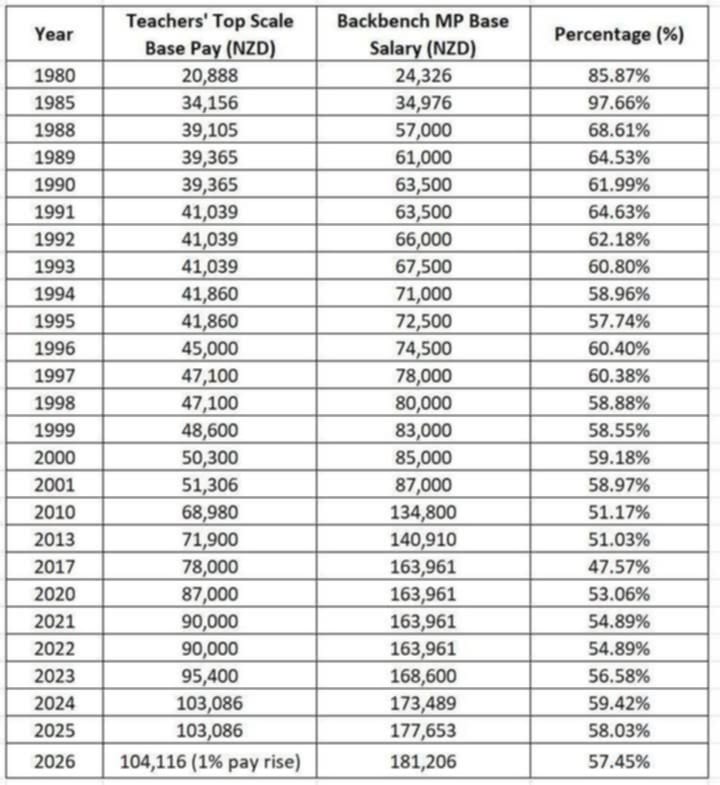
One of these contacts has just been made redundant by the NZ university to which they are affiliated (which is in the process of dismantling its social science programs while still recruiting students for admission in to them), so is considering turning to secondary school teaching as a new career path. They are also thinking about working in a policy analyst role, including in a parliamentary or political party setting. As part of the research and preparation process for that transition, and in light of the current stand-off between the government and secondary teacher’s union about cost-of-living (COLA) wage increases, they reached out to fellow colleagues who do research on related subjects in order to get a comparative idea of wages in those career fields. Although there are a number of interesting facts that came from the materials that my contact received that are worth discussing at another time, this one was shared with me. It involves the comparative base remuneration of backbench MPs and the upper end of teacher’s pay scales.

The data begs some questions. Who brings more value to NZ society, MPs or teachers? How is their value measured? What is worth more to NZ society, politicians or teachers? How is their (comparative) worth measured? Comparatively speaking, in terms of their contributions to NZ society, who is valued more and who is worth more? More broadly, is there a relationship between value and worth in NZ?

As for the specifics of the chart. Why is is the worth of backbench MPs (as measured in wages) significantly higher than that of the most experienced and well paid teachers? Since MPs also receive non-wage benefits such as accomodation and travel allowances and are often “comped” by lobbyists and other interlocutors in the form of meals and other incidentals, why is the wage gap between them and the most experienced teachers so significant? As for work equivalence, it can be argued that both MPs and teachers work long hours beyond their assigned time in class or in the parliament debating chamber, and both sacrifice family life and other leisure pursuits in order to do so. Both have formal work hours and yet engage in much informal work (say, coaching sports teams or participating in civic groups). Both MPs and teachers have invested much time and resources into their own educations and qualifications as well as through practical experience. So why the difference in worth if their value to society is similar if not equal? Or is their value not equal and hence their worth simply reflects the difference?

That last question is key. Does NZ society value MPs more than teachers and thus pay them more as a measure of their worth? Admitting for a degree of autonomy in setting institutional wage standards, are the average parliamentarians worth that much more than the most experienced teachers? Is their comparative worth–and that of teachers–based on any measure of value?

Perhaps there is a market-based answer to the question such as “politicians are rare gems that are hard to find while teachers are a dime a dozen because they are like pebbles on a beach, etc.” But even if this were true, perhaps scarcity of a resource is not a true measure of value. Memecoins such as $TRUMP may be worth much (+USD8.36/coin with a market cap of over USD 1.6 billion) but do they have any intrinsic or tangible value?

I will leave it for readers to ponder these questions and the more general question about the relationship of social value and material worth. However, one thing should be clear. Only when that relationship is defined and put into practice can we begin to speak of working towards a fair and equitable democratic capitalist society.

The Comparative Notebook on Trump’s Tariffs.

The ever brilliant Kate Nicholls has kindly agreed to allow me to re-publish her substack offering some under-examined backdrop to Trump’s tariff madness. The essay is not meant to be a full scholarly article but instead an insight into the thinking (if that is the correct word) behind the current moment of trade madness. However unpleasant, there is a method to it, and there is a twist to how it may be applied today.

The link is here. It is well worth the read.

A Return to a US Gilded Age?

I have been trying to figure out the logic of Trump’s tariff policies and apparent desire for a global trade war. Although he does not appear to comprehend that tariffs are a tax on consumers in the country doing the tariffing, I can (sort of) understand that he may think that this is a good way to protect US manufacturing and employment. But because the evidence that tariffs wind up hurting domestic consumers and do not necessarily bring back manufacturing, farming or employment in those or other sectors, I found myself somewhat mystified as to why Trump is determined to push them through.

I realise that he is using them as a form of leverage to obtain concessions in non-trade areas like illicit drug interdiction and immigration. But he seems to want to go further than forcing neighbouring countries to tighten their border controls in exchange of a lifting of tariffs or reduction in the amount of them (both in terms of reducing tariff costs–say from 25 percent to 10 percent–as well as the range of goods subject to tariffs). He truly does appear think that tariffs are good for the US, all evidence to the contrary.

Because of his intellectual limitations (remember my empty vessel argument of a couple of weeks ago), I then thought about his economic advisors and how they may see the issue. Here is where I think I have found the answer to Trump’s obsession with tariffs. It has to do with the so-called Gilded Age.

Readers may recall Trump speaking of president William McKinley and the “Gilded Age” when the US was prosperous, expanding and turning into the global superpower that it eventually became. He even restored the name “Mount McKinley” to the mountain in Alaska known as Denali by indigenous people and has otherwise extolled the virtues of the 25th US president even though McKinley was assassinated while in office in 1901 (Vice President Teddy Roosevelt succeeded him). As it turns out at least one person (an anarchist) was not happy with his policies. Yet it seems that Trump seeks to return to a new US Gilded Age in light of what he and his advisors see as the failure of capitalist globalisation.

Needless to say, there have been global trade systems since ancient times. Notions of Riccardian and competitive advantage were eventually developed around them to explain and justify the commonweal benefits of global trade. This accelerated with the technology-driven globalisation of production, consumption and exchange that emerged as of the 1990s and grew exponentially in the following two and a half decades. While all economic boats would be lifted by this rising tide, the argument went, the expansion in trade was expected to benefit the US the most because it was the core of the global capitalist system, including finance, advanced manufacturing, information and high-tech services, logistics and even value-added primary good extraction.

For its adherents, the post-Bretton Woods moment was the US’s oyster and free trade under standardised monetary exchange conditions was considered to be so universally positive that theories (known as “neo-modernization” theories after the original 1950s variants) were advanced that posited that joining global systems of trade would lead to rising middle classes and eventually democracies in poorer authoritarian countries that adopted the export-import logic and other development models such as the so-called “Washington Consensus.” The Consensus (by industrialised nation’s finance ministers of the time) married neoliberal domestic economic theories based on the primacy of finance capital in determining a country’s investment opportunities in a macroeconomic environment characterised by the reduction of the State’s role as both manager and direct producer of national goods and services, on the one hand, with an abject faith in the invisible hand dynamics at play when national markets were opened up to unfettered foreign competition.

As it turns out, things did not go as planned. Rather than benefit the most as the core of the globalised system of trade, the US saw significant declines in domestic manufacturing, mining and other extractive enterprises as well as a number of value-added business sectors (textiles, shoes, ship-building) when US firms migrated abroad in pursuit of cheaper labour and supply chain inputs. Even service sectors saw business move abroad–think of off-shore call and computer service centres–something that in the aggregate saw the economic decline of the so-called Industrial Age-originated “Rust Belt,” growth of increasingly precarious labor markets and the rise of a host of social pathologies associated with that decline (the book Hillbilly Elegy by JD Vance sums them up pretty well even if it is a fictionalised account of his own life story pre-politics).

Put bluntly, instead of being at the top of the globalized pile, when it came to many US domestic businesses, profits were prioritised over patriotism, they moved their businesses abroad and the benefits of globalisation went to them (in terms of re-patriated profits), not their former employees and the communities that depended on their livelihoods. When it comes to free trade and open markets, businesses acted as capitalists first, and that made them globalists rather than nationalists.

The bottom line is that while the US remains the core of the global economy, the location of where globalisation impacted negatively the most within the US and the perception of its general decline as a result is a strong component of the economic nationalist discourse that propels the modern US Right. From Pat Buchanan to Rand Paul to Steve Bannon, US economic nationalists see US decline as rooted in two main things: 1) the migration of industries away from the Heartland to foreign countries which do not adhere to the overly restrictive environmental, labor, welfare and taxation standards of the US; and 2) the “woke” cultural transitions associated with granting equal rights to everyone regardless of merit while opening admission to immigrants from foreign cultures that are inherently anti-Western in orientation and yet upon which the US was increasingly dependent for both skilled and unskilled labor.

This is where economic nationalists on Trump’s staff like Peter Navarro come in. It is he and his colleagues that put the thought of the McKinley Gilded Age into Trump’s otherwise adderal-addled head. For them, a global trade war suits the US because as the biggest economic bully on the block, others will fold their cards before it has to. The belief is that although there will be short-term pain in the US domestic economy, eventually foreign countries and businesses will, for their own political as well as economic reasons, bend a knee and comply with US demands on trade and non-trade issues. Some manufacturing and other businesses may return to the US but even if they just adjust their bilateral export pricing and other trade measures in line with US demands, the view is that the US will eventually win and ultimately prosper because the advantages it has when it comes to complex economies of scale.

We need to underscore that many trade globalisation supporters did not see the US as necessarily benefitting more than others under the modern trade framework. Instead, they saw all nations receiving some benefit in excess of what they would accrue if they did not join the network, and within that “limited gains” perspective the US would still do well even if it lost uncompetitive businesses to foreign markets that held comparative and competitive advantages like lower wages and costs and proximity of raw materials, rising educational standards etc. They believed that the US would simply specialise in higher-end production and services that used advanced technologies and value-added capital goods while continuing to domestically supply most consumer non-durables like food staples and the like.

This is different than what the economic nationalists envisioned, and whereas the globalist economic vision is an integral part of the liberal internationalist perspective and institutional order codified in the likes of the IMF, WTO and World Bank, economic nationalists see the entire combine as inimical to US economic supremacy and hence an existential macroeconomic threat that increased US economic dependency on the whims of others such as the PRC and EU. Where globalists see trade interdependence and mutual benefit, economic nationalists see trade dependency and economic vulnerability The latter is the dominant rationale in the White House at the moment.

With Navarro and other economic nationalists back in the West Wing and the liberal international order in disarray for more than just economic reasons, the in-house consensus is that the time is ripe to push for another Gilded Age on the back of a tariff-based national economic restructuring. Coupled with a new version of gunboat diplomacy and carrying a foreign policy Big Stick, Trump is offered as the champion of and vehicle for that metamorphosis.

The trouble is that US capitalism today is not the capitalism of a century ago, nor is the nature of its connections to a globalized capitalist world with multiple centres of economic gravity. Think of the Middle East, the Arab oil oligarchies and their sovereign hedge funds. Think of the reach of the PRC’s Belt and Road initiative. Think of the rise of the Global South and emergence of the BRICS as an economic bloc. All of this suggests that while Trump may see himself as McKinley bringing in a new US Gilded Age, he is just a real-time protagonist in his economic advisor’s pipe dreams. What may have worked at the turn of the 20th century in terms of tariffs benefiting the US is unlikely to work in the early 21st century, at least not in the measure envisioned. So even if some countries cave to US demands on a host of issues, the chances of the US “winning” a truly global trade war seem long at best, and even if the US “wins” the economic contest, the political costs of subjecting the US electorate to consumer price hikes and supply chain disruption through the 2026 Congressional midterm elections and 2028 presidential vote may spell serious trouble for Trump, MAGA and the GOP regardless of who may or may not succeed him. The political fallout of the tariff moves, in other words, may yield negative dividends even if it is “successful” because the short-term economic pain that Musk and Trump talk about as necessary may not be tolerable for many voters, including those in Red States.

If that is the case, all the tariff-led economic gilding project may just turn into political rust.

Voting as a multi-order process of choice.

Recent elections around the world got me to thinking about voting. At a broad level, voting involves processes and choices. Embedded in both are the logics that go into “sincere” versus “tactical” voting. “Sincere” voting is usually a matter of preferred choice, specifically of a candidate or outcome. Simply put, a person votes for their preferred option. But what about “lesser evil” or “second best” choices? Are they “sincere”? Rather than a matter of genuine sincerity of choice, the general demarcation separating “sincere” voting from “tactical” voting is not so much the motive for choice or the specific choices involved but the all or nothing of the process–it is the final selection point before an elected entity or outcome is confirmed. In other words, sincere choices are end choices, regardless of the logics by which they are made.

This allows us to distinguish between elections as a process versus elections as choices between options. Until the last vote is counted in the final round of voting, everything is tactical even if choices for individuals are sincere in the moment.

Under Mixed Member Proportionate (MMP) electoral systems like that in NZ voters do tactical voting all of the time. They consider the relationship between party and candidate votes and choose accordingly. Sometimes voters go with a straight party-candidate vote but other times they split votes between party and candidates. That depends on how they view specific party chances in inter-party competition, the electorate candidate in relation to their party, that candidate in relation to the electorate voting history (does she stand a chance?), and the merits of other candidates in a given electorate. Much of this assessment is done unconsciously in the moment of choice but in any event the voter’s calculation is multi-level and relative in nature.

A vote is tactical when we vote for a candidate or party or coalition or ballot option with the shadow of the future in mind, as far as we can foresee it. We may do so for defensive as well as win-seeking reasons, like what happened in France this past week, where the Left removed competing candidates in a number of electorates in order to improve the chances of designated “unity” candidates defeating rightwing opponents in the second round of parliamentary elections. That was done in order to help defeat the serious possibility of a rightwing victory in the second round parliamentary elections after the first round saw the Right win a significant plurality of the vote. The tactic of limiting inter-Left competition was defensive in nature rather than a “go for the win” effort because all involved understood the costs of allowing a rightwing victory and put their immediate preferences (and differences) aside in order to confront the common threat.

When it comes to tactical voting people may also vote for lesser evils rather than preferred options because the context in which voting occurs may advise them to do so. Voters may simply have to choose between otherwise distasteful candidates or options. In multiple round voting it is the process as much as the immediate outcomes that motivate voters in the first instance, as they are seeking to do something now in order to set up a better sincere choice option in the future. Think of the US primary system, where party candidates are selected not just for their merits but also with an eye towards their “electability” in the general elections. A candidate with lesser ideological purity or Party credentials may win in the selection round because primary voters feel that s/he is more likely to be elected in a general election where sincere choices are made.

On the other side of the coin, as a campaign strategy, what Labour recently did in the UK when it flooded electorates with candidates, even in Tory strongholds where it traditionally had zero chance of competing, was a “throw it at the wall and see what sticks” first-order approach. Labour put up slates of candidates who in many cases have little to no experience in politics and who were in a number of instances sent as electoral cannon fodder into historically secure Conservative electorates. Labour strategists banked on the belief that public disgruntlement with the Conservatives would spill over into Labour winning at least some traditionally Tory seats, and in that they were successful. But this was just the first order outcome. The second order outcome is how these candidates-turned-MPs will perform given their lack of experience. Some will do well but if enough turn out to be incompetent or worse, then Labour runs the risk of incurring a voter backlash against it in just one electoral cycle. That is the second-order problem of the “throw at the wall” candidate selection tactic: good for the short-run, but a bit uncertain over the longer term.

For his part, French President Macron has ruled out working with the largest of the Left parties (“France Unbowed”) in the coalition that came first in the second round of the French parliamentary elections thanks to the defensive unity candidate first order manoeuvres, so is now trying to carve away smaller Left parties from the Left coalition so they can form a majority coalition with his Centrists. He apparently has promised the Prime Minister’s job to a Left candidate if they agree to his terms (in France the president selects the PM). But if he cannot do this, then France will be in political gridlock through and beyond the Olympics. So his first order tactical gambit of calling snap elections and forming a defensive alliance against the Rightists worked, but now the second order consequences embedded in the process must be confronted and resolved less the otherwise unwelcome triumph of the Right become reality.

In Iran the reformist Pezeshkian won the run-off election against a conservative hard-liner. The latter could be seen as a “continuist” following the approach of his dead predecessor (recently killed in a helicopter crash), whereas Pezeshkian seeks a thaw in Iran’s foreign relations with the West and a relaxation of restrictions on social freedoms at home. But since the Council of Elders and the Ayatollah Khamenei are the real power brokers in Iran, perhaps they allowed Pezeshkian to run (they did not allow any other reformist to do so) in order to gauge public sentiment and/or use the elections as an escape value that eases social pressures on the regime by allowing the electorate to institutionally vent its views. Think of it as an Iranian political pressure cooker, with the electorate permitted to let off pent-up steam during the election process.

The first round of that vote only brought 40 percent of the electorate to the polls, but the second round brought in 53 percent. Beyond the narrowing of the field of candidates in the second round, the turnout and strong majority vote for Pezeshkian demonstrates the apparent need for some reform-mongering when it comes to policy making. This is a strong signal that the Elders must consider if they are to keep a lid on things. They have been sent a message about what the public wants in public policy, especially (judging from field reports) about social mores and behaviours. But what about the hard-liners? They have the guns, are not going away and are ill-disposed towards Pezeshkian’s proposals.. So the second order question is to reform monger or not and if so, how much is too much? Again, it is a process, and the choice of Pezeshkian is a first-order means towards a perhaps necessary but uncertain end.

In the US the Biden question is not only should he stay or should he go, but also how and when? Sooner or later? At the convention or before? Does he designate an heir if he goes (presumably Vice President Harris) or does he throw it open to a short-list of previously vetted candidates? The James Carville opinion piece in the New York Times was an interesting proposition, with its geographically organized Town Halls acting as an extended job interview process for designated candidates. And the George Clooney op-ed in the same newspaper pretty much spells out why Biden has moved from being an asset to a liability for the Democrats. Here too there is a process as well as the individual to consider, something that must converge into an electable platform that can defeat Trump. So the first order choice is about Biden staying or going, the second order choice is about when and how to replace him and the third order choice is about the agenda and team needed to defeat Trump. With those three parts of the process resolved, a sincere choice can be presented to the electorate in November.

This is about more than Joe Biden. In a democracy people serve their party in the first instance, the party serves the country in the second instance and the country serves the nation in the last instance (“country” being a political entity with territorial boundaries codified in the notion of “State” and “nation” being a political society or culture legally represented by a country). For the Democrats the issue is not just about choice of a presidential candidate in light of Biden’s perceived limitations (age, fragility, cognitive decline), but about the institutional process by which their candidate choice is made. The process is time-sensitive given the upcoming Election date, so the choices must be soon and facilitated by the institutional process. It remains to be seen if Biden and other Democrats fully understand the difference between his fortunes and those of the party–and the country itself, but if they do, then the process of candidate selection is as important as the candidates themselves.

Again, I am no voting behaviour expert (too much bean-counting and tea leaf-reading for me), so please take this very incomplete and shallow sketch as a a preliminary rumination about choice and process in voting. I will leave for another day discussion of certain hard realities about voting in practice–things like voter suppression, gerrymandering, redistricting, incumbent advantage, campaign finance laws and loopholes, polling, etc.–as well as the use of game theoretic and AI models as predictive tools in voting analysis. That is best left to those who focus on such things. But having said that I do think that recent elections offer an opportunity to ponder the process as well as the choices that democratic elections involve. Hence this note.

Author’s Postscript: This essay serves as the basis of my remarks for the “A View from Afar” podcast of July 14, 2024.

Media Link: Post-pandemic economics and the rise of national populism” on “A View from Afar.”

On this edition of AVFA Selwyn Manning and I discuss post-pandemic economics and the rise of national populism. It seems that a post-pandemic turn to more nationalist economic policies may have encouraged the rise of populists who use xenophobia and bigotry as a partisan tool by adding non-economic fear-mongering and scapegoating to the necessity of shifting to more inwards-looking structural reform. You can find the show here.

Social Media Link: 36th Parallel on South America’s “Strategic Paradox.”

I was asked to write a commissioned essay for a special issue on Latin America of a NZ international affairs magazine. I was told by the editor I could write on a specific subject of my choice. I decided to write about what I see as South America’s “Strategic Paradox:” increased overall (macroeconomic) regional prosperity largely brought about by the growth in trade with the PRC (rather than with the US or EU) did not translate into increased domestic social equality, security and stability (as most Western developmental economists and sociologists would believe). Instead, increasing income inequalities caused by limited domestic job growth, few wage improvements and negligible distribution of tax revenues from the expanding import-export sector exacerbated social tensions, leading to more domestic insecurity. To this is added an assortment of pathologies such as public and private sector corruption and negative collaterals like environmental degradation in the emerging primary goods sector (such as in lithium extraction). All of this is set against the backdrop of increasing US hostility to the PRC presence in the region, which it sees as a growing security threat that must be countered.

The result is that South America may be more prosperous than ever in aggregate terms (say, GDP per capita), but it is not more peaceful, stable or secure as a result. My conclusion is that with a few notable exceptions it is a lack of good corporate and public governance that explains the paradox. Meanwhile the great power rivalry in the region has taken on a pernicious dynamic of its own that if left unmitigated will only add fuel to the fire.

Unfortunately, the editor, who is not a political scientist or international relations specialist (she says that she specialises in propaganda and authoritarianism, although from her limited bibliography she shows little knowledge of the extensive literature on each!) decided that the essay was too generalised and lacking in data to be publishable as is (after asking me to limit the essay to 3500 words and write it for a general, not specialist audience). She challenged my mention of the ongoing use of the Monroe Doctrine by US security officials, even though I provided citations for both data and comments when pertinent (15 in all, including Congressional testimony from US military officials and data from the Economic Commission Latin America (ECLA)). I got the distinct impression that she wanted a puff piece, got a critical analysis instead, and decided to condescendingly ask for unreasonable revisions in order to reject the piece without seriously reading it. In other words, she did not like it, but not because of its lack of scholarship but because it did meet her expected editorial slant. In fact. from her tone it appears that she had no idea who I am before she commissioned the essay and then assumed that I am some ignoramus when it comes to discussing South American politics, geopolitics and social dynamics. Y bueno, que le vas a hacer?

The good part of this story is that since I am not paid for the work, am not an academic who needs it on my c.v. for promotion purposes, and have a couple of social media platforms on which to publish and disseminate it without editorial interference from uninformed non-specialists, I told her that I would not do as told, would not do the demanded revisions and instead would publish the piece elsewhere.

KP is one such elsewhere: https://36th-parallel.com/2024/01/05/south-americas-strategic-paradox/

Tell me what you think about it.

” A View from Afar” returns.

On Thursday May 11, 2023 at 12PM (noon) NZ time/8PM Wed 10th May US East Coast time/1AM Thursday London time/8 AM Thursday Singapore time and 10AM Thursday Sydney time, the A View from Afar podcast will resume broadcasting. Selwyn Manning and I will discuss the AUKUS agreement and its implications for New Zealand and the fallout from the Discord classified material leaks as well as global affairs from a South Pacific perspective.

The show is interactive so tune in and join us!

Media Link: AVFA on Latin America.

In the latest episode of AVFA Selwyn Manning and I discuss the evolution of Latin American politics and macroeconomic policy since the 1970s as well as US-Latin American relations during that time period. We use recent elections and the 2022 Summit of the Americas as anchor points.

A word on post-neoliberalism.

I recently read a critique of the market-oriented economic theory known as “neoliberalism” and decided to add some of my thoughts about it in a series of short messages on a social media platform dedicated to providing an outlet for short messaging. I have decided to expand upon those messages and provide a slightly more fleshed out appraisal here.

“Neoliberalism” has gone from being a monetarist theory first mentioned in academic circles about the primacy of finance capital in the pyramid of global capitalism to a school of economic thought based on that theory, to a type of economic policy (via the Washington consensus) promoted by international financial institutions to national governments, to a broad public policy framework grounded in privatisation, low taxation and reduction of public services, to a social philosophy based on reified individualism and decontextualised notions of freedom of choice. Instilled in two generations over the last 35-40 years, it has redefined notions of citizenship, collective and individual rights and responsibilities (and the relationship between them) in liberal democracies, either long-standing or those that emerged from authoritarian rule in the period 1980-2000.

That was Milton Friedman’s ultimate goal: to replace societies of rent-seekers under public sector macro-managing welfare states with a society of self-interested maximizers of opportunities in an environment marked by a greatly reduced state presence and unfettered competition in all social (economic, cultural, political) markets. It may not have been full Ayn Rand in ideological genesis but the social philosophy behind neoliberalism owes a considerable debt to it.

What emerged instead was societies increasingly marked by survivalist alienation rooted in feral capitalism tied to authoritarian-minded (or simply authoritarian) neo-populist politics that pay lip service to but do not provide for the common good–and which do not adhere to the original neoliberal concept in theory or in practice. Survivalist alienation is (however inadvertently) encouraged and compounded by a number of pre- and post-modern identifications and beliefs, including racism, xenophobia, homophobia and social media enabled conspiracy theories regarding the nature of governance and the proper (“traditional” versus non-traditional) social order. This produces what might be called social atomisation, a pathology whereby individuals retreat from horizontal solidarity networks and organisations (like unions and volunteer service and community agencies) in order to improve their material, political and/or cultural lot at the expense of the collective interest. As two sides of neoliberal society, survivalist alienation and social atomisation go hand-in-hand because one is the product of the other.

That is the reality that right-wingers refuse to acknowledge and which the Left must address if it wants to serve the public good. The social malaise that infects NZ and many other formally cohesive democratic societies is more ideological than anything else. It therefore must be treated as such (as the root cause) rather than as a product of the symptoms that it displays (such as gun violence and other anti-social behaviours tied to pathologies of income inequality such as child poverty and homelessness).

As is now clear to most, neoliberalism is dead in any of the permutations mentioned above. And yet NZ is one of the few remaining democratic countries where it is still given any credence. Whether it be out of wilful blindness or cynical opportunism, business elites and their political marionettes continue to blather about the efficiencies of the market even after the Covid pandemic has cruelly exposed the deficiencies and inequalities of global capitalism constructed on such things as “just in time production” and “debt leveraged financing” (when it comes to business practices) and “race to the bottom” when it comes wages (from a labour market perspective).

I shall end this brief by starting at the beginning by way of an anecdote. As I was trying to explain “trickle down” economic theory to an undergraduate class in political economy, a student shouted from the back seats of the lecture hall “from where I sit, it sure sounds more like the “piss on us” theory.

I could not argue with that view then and I can’t argue with it now. Except today things are much worse because the purine taint is not limited to an economic theory that has run its course, but is pervasive in the fabric of post-neoliberal societies. Time for a deep clean.

PS: For those with the inclination, here is something I wrote two decades ago on roughly the same theme but with a different angle. Unfortunately it is paywalled but the first page is open and will allow readers a sense of where I was going with it.