
Courtesy of Rob Taylor back in Karekare, here is a link to an interesting article about the rise of a neo- or proto-fascist movement in the US. Although I have some quibbles with the structural as well as some of the political aspects of the argument (at least in comparison with the original (European) versions of fascism), the article is nevertheless worth a read. To me the trend is not just evident in the US, but in the rise of right-wing movements in Asia, Europe (and to a lesser extent Latin America) as well. For NZ readers interested in the quality of Kiwi democracy, the question is whether the trend is now evident at home, and if so, what are the means of forestalling it from developing further.
Putin the scribbler
In contrast to last week’s vanity shots of Vladimir Putin, an illustration that you don’t get anywhere in the Russian political-security complex by writing down your thoughts on bits of paper.
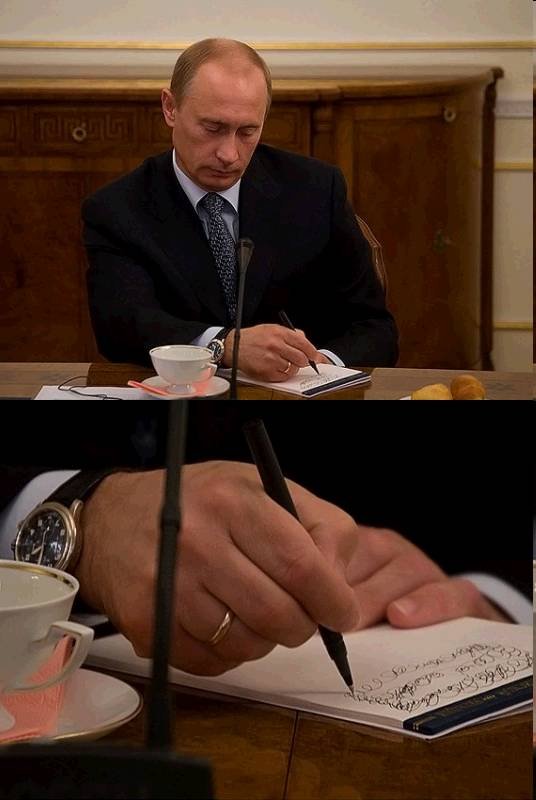
Or by looking idle.
(Thanks to AG for the pic.)
L
Blog Link: On conceptualising democracy in Aotearoa.
For those who may be interested, I have updated, expanded and integrated the deconstructing democracy posts into a single essay that is this month’s “A Word from Afar” column over at Scoop.
Thanks to John Ward Knox for prompting me to turn the “Deconstructing Democracy” series into one read.
The SIS thinks that Jane Kelsey is a threat to national security.
 I read with interest that the SIS keeps a file on Jane Kelsey, apparently dating back almost 20 years. I am not a close friend of Jane but  know both her academic and activist work as well as some of her arguments with the SIS and Privacy Commission about her file (which will not be released to her, even in redacted form). Jane apparently came to the attention of the SIS because she was part of a Filipino solidarity group in the early 1990s and later because of her anti-APEC and anti-neoliberal activities (both of which have subsequently been vindicated in fact). I admire Jane because she is a person of conviction, and because she is staunch in the face of official intimidation. Deborah Manning is another such person. Were that there be many others of such character in New Zealand, but alas, especially amongst the male population, there are comparatively few in my estimation.
Putting aside the gender implications of Kiwi bullying and cowardice, the bottom line is as follows: the SIS is either lying or stonewalling on what Jane Kelsey’s file contains, and the so-called Privacy Commissioner is either an SIS toady or hopelessly ignorant of the issues at stake. Either way, this is another blow against Kiwi democracy. Truth be told,  the demolition of Kiwi civil liberties–particularly the right to privacy–was accentuated rather than diminished under  the Fifth Labour government, something the Key regime has happily continued.
If Jane Kelsey is a national security threat than I am Osama bin Laden, Anita is Ayman al-Zawahiri and Lew is, well…Lew.  We are all accomplices in critiquing the way NZ governments’ operate. If Jane has a file, then anyone who has voiced a public opinion against the government  could have a file. That is because for the last decade or so, dissent has been incrementally criminalised, and the definition of criminality is left to the government of the moment and its sycophants in the security bureaucracy. Hence anything oppositional can be grounds for snooping. That is how the SIS justifies its existence. Just ask Tame Iti or Valerie Morse.
Remember this small fact: being a pain in the rear of the security apparatus because of one’s vocal criticism of government policy, or being a critic of the SIS or the Police itself, does not constitute a threat to national security per se. If it does, that is all the more reason for the SIS or Police to release the evidence justifying claims that is the case. In Jane Kelsey’s case, her requests for release of her file have been met with bureaucratic obfuscation rather than transparency even though the SIS has all but admitted that nothing she has done constitutes a threat to national security. So, one might ask, why the obstruction on “national security grounds?” Although I have an idea why the SIS and Privacy Commissioner are hiding behind the skirt of “national security,” there are broader issues for civil liberties at stake that are worth considering here.
With that in mind I urge any reader who has expressed a dissonant, much  less dissident voice with regards to the way the NZ government and its security agencies operate, to make an official request for  your files. That is because it turns out the the extent of domestic espionage is far beyond what most Kiwis expect to be reasonable, and the SIS is utterly unaccountable for doing so. By this I mean that any dissident, right or left wing, is a potential target of covert monitoring and thus has a probable reason to make an OIA claim. I do not mean just the fringes of the Left-Right continuum, but anything in between: if you piss off the government of the moment or attack the SIS /Police on ethical or practical grounds, you can well be subject to “investigation” on the grounds that you constitute a threat to national security. It is all justified by the empowering legislation that was passed in  the last 15 years, including clauses that justify spying on New Zealand citizens who constitute “threats to  economic security” (which means that anyone opposed to governmental macroeconomic policy might as well be Osama in the opinion of the SIS). So, because she opposes neoliberalism and the APEC “free trade” doctrine, Jane Kelsey is the economic equivalent of a jihadi as far as the SIS is concerned.
That having been said, ask and you shall not receive. If Jane’s campaign is any indication, these  taxpayer-funded security bludgers feel no need to answer the silly requests of the people who pay their salaries. But should you insist, the SIS can be contacted www.nzsis.govt.nz.
Remember that you have to make an OIA (Official Information Act) request, and you should be as precise as possible when specifying the activities that you consider would have “warranted” SIS opening a file on you (of course, even asking that question could “warrant” the SIS opening a file on you).
Please ask Director Warren Tucker for a personal response in your OIA, and tell him that “Pablo” sent you. He knows who I am.
PS: The post has been updated twice to correct typos and clarify some sentences.
I voted Yes today
It is a sunny Wellington spring day; I walked past crocuses and the beginning of daffodils to get my ballot paper, and past trees starting to show their spring growth to post it.
I voted yes because I believe smacking children is wrong.
I voted yes because I want to reaffirm that the Christian right do not speak for me. Many many (many) Christians in New Zealand believe, as I do, that smacking is wrong.
I voted yes because countless people gained the signatures of 300,000 voters to give me the opportunity to say out loud what I believe.
I voted yes because I want to live in a country where children are hugged, held, comforted, and raised to be non-violent adults.
I voted yes because I love.
Allowing people a voice
Sam speaks out publicly about the fact that ACC payments for counselling do not cover the full cost of each counselling session and victims of crime like Sam are left to scrape together the difference. What information should Nick Smith be able to release about Sam’s circumstances? Should that include that Sam, who was sexually abused by a female caregiver when he was a child, insists on seeing a male counsellor, and in his small town there is only one appropriately qualified male counsellor and his rates are higher than average?
Chris is on the sickness benefit and speaks out publicly about the fact MSD won’t help with the high transport costs of getting to specialist appointments. What information should Paula Bennett be able to release about Chris? Should that include the fact that since Chris’ last psychotic episode, in which she threatened to stab her nieces and nephew, she has moved out of her sister’s home near the specialist and back to her parents who live in a semi-rural area with no public transport?
Moana, who has a full time job, speaks to the select committee considering leave provisions about the hardship that compulsory christmas closedowns cause non-custodial parents and talks about her employer requiring a three week closedown. What information should Moana’s employer be able to release? Should that include the fact that Moana’s leave situation is atypical in that workplace and is due her taking extended leave earlier in the year to attend a residential alcohol programme and using annual leave to have supervised contact with her children whose father moved them out of town when her violence and drinking became dangerous?
Sam, Chris and Moana should feel safe speaking publicly about those issues of government policy. None are lying, none are misrepresenting their own situation, each is raising a genuine issue of policy. For each the disclosure of their personal circumstances could cause significant shame, damage to relationships and support networks, and provide a huge disincentive to speaking publicly.
Being a democracy is about more than giving everyone a vote, it’s about allowing everyone a voice.
[This post was originally a comment in reply to jcuknz in this thread.]
A Two Level Game In Afghanistan
News of the NZSAS’s imminent departure to Afghanistan, on its fourth deployment since 2001 but first since 2005, has occasioned a fair bit of commentary in the media. A Herald poll shows public opinion evenly divided on the issue. A broad swathe of Right and Left wing isolationists and pacifists oppose the move. Many believe it is just a sop thrown to US imperialism in order to curry favour. Others think it is about gas pipelines and Halliburton profits. The rationale for sending troops to Afghanistan has become muddled by American pronouncements that NZ should do so as a type of insurance in the event it is attacked, or as a down payment on an eventual bilateral FTA. John Key has not helped matters by stating that he does not want the SAS to undertake so-called “mentoring” roles for the Afghan Army because it is too dangerous (as if what they otherwise would be doing is not), and that he would like to withdraw the NZDF Provincial Reconstruction Team (PRT) in Bamiyan province because it costs too much to maintain (this in spite of its widely recognised success as a “hearts and minds” operation that is the essence of international peace-keeping and nation-building missions such as the ISAF mission in Afghanistan). Â He further clouds the issue by invoking the Jakarta and Mumbai bombings as reasons for the NZSAS deployment, even if the bombings had zero connection to events on the ground in Afghanistan (although I admit the possibility that some of those involved in the bombings may have attended Taleban protected al-Qaeda training camps in Afghanistan or the Pakistani tribal regions in the last decade or so). In making these utterances Mr. Key displays an apparent lack of understanding of what is really at stake in this dangerous game.
I have already posted here on the subject (see the Archive, especially here and here), and in recent days have tried to explicate further in the dedicated comments threads in places like Tumeke and Kiwiblog. Yet the rationale for why I believe that sending the NZSAS to and keeping the PRT in Afghanistan is justified appears to be lost in the general discussion. So let me phrase things in a different way, for purposes of clarification: what is going on in Afghanistan is a two-level game.
One one level there is the original ISAF mission. That mission was and is to deny al-Qaeda cadres and militant Taleban safe havens inside Afghanistan so that they do not pose a threat to the local population and cannot use Afghan territory to stage cross-border assaults on Pakistan and other neighbouring Central Asian republics. The concern with the militant Taleban, as opposed to their more “moderate” counterparts (read: nationalist or tribal), is that they have greater ambitions than re-gaining political control of Afghanistan. Instead, the militant Taleban and their al-Qaeda allies seeks to establish a Caliphate throughout Central Asia and beyond. They particularly want to gain control of nuclear-armed Pakistan, but even that is just a short-to-medium term goal. They have, in other words, imperialist ambitions of their own. These ambitions are not only opposed by the US, UN, and NATO. They are opposed by China, Russia, India and all Asian states that see the ripple effect extending towards them. In fact, they are opposed by virtually all of the international community with the exception of failed states such as Somailia and the Sudan (which have now become the new locus of al-Qaeda activity).
Worried about the repercussive effects that a Taleban victory in Afghanistan would have throughout Central Asia, the NATO-led, UN sanctioned ISAF mission has been successful at eliminating al-Qaeda as a military threat in the country, and is essentially now engaged in a grand scale pincer movement along with the Pakistani military that is designed to push Taleban on both sides of the common border into geographically defined kill zones from which they cannot escape. In parallel, ISAF and UN-led civilian assistance groups are attempting to engage moderate Taleban elements in order to establish a durable cease-fire that will permit the second level of the game to be played.
The second level game is oriented towards establishing a moderate Islamic regime with centralised authority over Afghanistan, one that will balance secular rights with religious freedoms and traditional privileges in accordance with the Universal Declaration on Human Rights. This a minimalist construction of the game; that is, it pretends to go no further than what is stated. It does not imply that the objective is to establish a secular democracy in the country. It does not pretend that centralised authority will mean central government monopoly of organised violence in the tribal hinterlands. It does not propose the blanket elimination of traditional forms of authority or social mores. Instead, it merely seeks to create the structural and political conditions for the establishment of peace, a peace that in turn will deny Islamic extremists the fertile territory for recruitment and sanctuary. It involves promoting electoral forms of political contestation, but more importantly, it pursues infrastructural development, to include educational, health and nutritional programs as well as the civil-military engineering projects required for their implementation and expansion.
To be sure, endemic corruption, the Karzai regime’s limited legitimacy outside of Kabul, the persistence of the opium trade, the ongoing presence of warlord-dominated fiefdoms, and the abject primitivism of many parts of the country make the second game seemingly impossible to achieve, and greatly complicate the achievement of the first game. Yet just because other foreign incursions have been defeated does not necessarily mean that this one is inevitably doomed to fail. For one thing, this is an international effort, not the expansionist project of a single imperial state. For another, because of its developmental and humanitarian focus, it does have a fair bit of internal support as well as that of neighbouring countries, factors that did not obtain in previous instances of occupation.
These two games are now being played out simultaneously, in overlapped fashion. The first is needed for the second to be successful (i.e., the combat work of such as the NZSAS is needed for PRTs to be successful). Yet the second is needed for the first to advance sufficiently so that an “exit strategy” is feasible. That will take a long time, at a minimum at least another five years and probably more. Any upgrade or renewal of the NZDF commitment to Afghanistan must take account of this fact.
Thus, when considering the “why” of NZ’s deployment of troops to Afghanistan, the debate should focus on the two levels of the ISAF “game,” and whether NZ has a stake in either. I have already stated that I believe that there are moral and practical reasons why NZ should, as an international citizen, contribute to the ISAF mission on both levels. Others disagree on either or both counts. Â The main point, however, is that Mr. Key and his advisors in the MoD and MFAT develop a clear and comprehensible rationale for why NZ should put its soldiers at risk in Afghanistan, which in turn is as much a function of informed public interest as it is of diplomatic necessity.
Uncitizens
A lot of self-described liberals or libertarians are arguing that the extent of peoples’ membership in society should be determined by their economic contribution to it, and a few, ignorant of reality, are even arguing that their membership in society is determined by their economic contribution.
People like Peter Cresswell, who asks “What gives bludgers a right to privacy?” The answer, of course, is that they have the same rights as anyone else. Peter, citing an imaginary selection of rights which apparently does not include any right to privacy, argues that the beneficiaries’ rights impinge upon his, and theirs should give way. Beneficiaries, to him, are uncitizens.
People like Cactus Kate, who reverses the rallying cry of the American Revolution to read “no representation without taxation” under the delusion that its meaning persists unchanged. She argues that franchise should be restricted to those over the age of 25, except where they earn $60,000 per annum or more. With reference to the current case, she restates the common refrain that “the taxpayer is paying for their lifestyle therefore should have knowledge when the beneficiary is whinging about benefits paid to them”, which essentially translates to “beneficiaries don’t have rights to privacy”, per PC. Beneficiaries, and those under 25, and the poor, are uncitizens to Kate.
People like David Farrar, who makes the same argument that, because the information concerns welfare, the people in question have reduced rights to privacy; but realising the paucity of that stance, goes on to rationalise it with ever-decreasing logical circles. I needn’t even specify the depths to which the KBR have sunk on this issue; so much for David’s moderation policy.
People like Bill Ralston, who argues that when one screws with the media bull, one gets the horns, and when one reveals any details to the media about one’s case, it’s open slather. For Bill, it’s not beneficiaries who are uncitizens – it’s ‘people who speak to the media’ who have reduced rights. I wonder if he realises the chilling effect of this could do him out of a job.
People like jcuknz in the comments here who, to be fair, is only repeating what he’s read elsewhere.
People like the callers to Paul Holmes’ and Michael Laws’ talkback shows this morning, who think their right to know trumps another’s right to have their personal information remain private.
People like Matthew Hooton who, like Ralston, thinks that by going to the media the women in question waived their rights to privacy but, paradoxically, who also thinks that people going to the media with personal information should sign a privacy waiver to prevent disputes such as this. Hooton also has the gall to refer to the information control methods of Soviet Russia in criticising their actions – not, mind you, the government’s punitive use of personal information for political purposes, which bears a much stronger resemblance to the authoritarian methods of the Soviets.
Far from being liberal, or libertarian, these arguments belong to oligarchs. Far from the liberal creed of holding the rights of all people to be self-evident, these explicitly call for rights to be attached to wealth or some other form of privilege. They believe that people who are dependent on the state ought to be at the mercy of the state. It is perhaps no surprise that it is these people whose rhetoric and iconography is littered with terms and images like “slave of the state” – for that is what they imagine being otherwise than independently wealthy should be. These are people who would restrict participation in democracy to economic status – who pays the piper calls the tune, and who pays tax may vote, presumably in corresponding measure.
These people are just as bad and foolish as the doctrinaire Marxists who argue that nothing matters other than what is strictly material. Their argument is the one which holds that, if a group of people share a meal, it’s not relevant where they eat, what they eat, what they drink with it, who chooses, what they talk about during dinner, what concessions are made for the purpose of sharing – the only things which matter to them is who pays for the meal and how much it costs.
That is a bare and miserly sort of humanity. Other things matter. A person’s a person, no matter how small.
L
A note to Paula Bennett, her cabinet colleagues, and their staff
On this blog it is likely that, from time to time, the authors and commenters will criticise government policy, speeches, and political tactics.
We would like to reassert that this is neither explicit nor implicit consent to release any private information about the authors or commenters that is held by any government agency, minister’s office, local government organisation, political party, or any other person, organisation or agency.
For the purposes of clarification this non-consent includes, but is not limited to, the following information:
- benefit status or history;
- family status or history;
- ACC status or history;
- health status or history – including information held by DHBs, PHOs, central government agencies and private providers whether directly or indirectly contracted by the state;
- interactions with justice or law enforcement – including complaints, interviews, interactions, documents supplied;
- employment status or history;
- any grants applied for or received; and
- tax payments, status or history.
In addition we would like to restate that posting or commenting here does not give implicit or explicit consent for any private information held about any author or commenter to be used for a purpose other than the purpose for which is was supplied. This non-consent includes, but is not limited to, the reuse of personal information for political purposes.
[Update after r0b’s comment – any other blogger or author of any internet or other commentary or correspondence critical of the government is welcome to reproduce this with or without alteration]
Guidelines on a website are not advice
I’m not a big-city lawyer either, but Paula Bennett might have done well to consult one here.
In response to a parliamentary question from Charles Chauvel asking whether she’d taken advice as to whether the two women whose details she revealed after they questioned the government’s decision to cut the Training Incentive Allowance could be deemed to have given consent for the rest of their details to be released by going to the medias. Her answer was, more or less, “I looked at the guidelines that were on the Privacy Commissioner’s website” and a wee bit of misdirection about the previous Labour government.
The guidelines specify that a minister “need only believe, on reasonable grounds, that the individual has authorised the disclosure”, and later admitting that she did not make enquiries of “her officials or anyone else” as to the details she released. Without checking precedent or taking legal or policy advice, how can she claim “reasonable grounds” for implicit consent from a few brief and specific quotes in the Herald on Sunday?
The problem her stance raises – and perhaps the very reason for her taking it – is its chilling effect on political speech. If anyone who is dependent on the government for any part of their income (or other services) is liable to have the details of their cases made public for criticising the department upon which they rely, then that department is very effectively insulated from criticism. Being insulated from criticism means not being held to account for failings, and not being held to account for failings leads to a culture of impunity, a central plank of National’s election campaign against the former government.
I expect there will be a few smart privacy lawyers who’ll offer their services to the two women in question for a nominal fee, and the government would do very well to sharpen up. This is political gold for the opposition if the minister does not immediately back down and offer mea culpas of some sort. If the Prime Minister is required to pick sides, this is an important juncture for the government. She didn’t take advice. She can’t know what reasonable grounds are. Being a cabinet minister requires high standards of conduct and certainty. An employer would never get away with ‘I checked the website and then fired him’. If this goes to court, it won’t matter who wins or loses the case – the government will lose a bit of its shine, and so will its beleaguered Minister of Social Development.
There are good threads about this at the Dim Post.
Edit: Eddie has done some further digging to nail this down, too.
Edit 2: Woah, simultaneous linkage. There is no cabal, really.
Edit 3: It occurs to me that this is a political n00b’s monkey-see-monkey-do response to the Burgess case, where Labour and the media released some but not all details, and National used the remainder of the details to invalidate the political points being made. The differences with this case are that someone’s property holdings are a matter of public record, not information held by the government; and even if they were, property holdings are directly relevant (implied consent clearly applies) since the issue at hand hinged on the Burgesses losing their house, a matter which they brought into the public sphere.
I reckon Bennett saw what a big win the government had with the Burgess case, figured she’d do the same with this case, and overreached. Schoolgirl mistake. But I think it’s giving far too much credit to call this a rope-a-dope by Labour.
L