Chávez backs Gaddafi?

Via The Egonomist, on twitter, the news that Venezuelan president Hugo Chávez has apparently expressed support, on twitter, for Muammar Gaddafi, whose mercenaries and loyalists are presently butchering Libya’s citizens.

The tweet, in Spanish, is as follows:

Vamos Canciller Nicolás: dales otra lección a esa ultraderecha pitiyanqui! Viva Libia y su Independencia! Kadafi enfrenta una guerra civil!!

My Spanish is no good (Pablo can no doubt translate), but it seems to largely match the following, from the Al Jazeera English live-blog:

4:27am: Hugo Chavez, the Venezuelan president, has backed Muammar Gaddafi on Twitter.
Chavez twitted:
“Gaddafi is facing a civil war. Long live Libya. Long live the independence of Libya.”

Without an understanding of the context this looks like a plain statement of fact: after all, Gaddafi is facing what looks very much like a civil war. But in light of Gaddafi’s recent speeches (and that of his son), which framed the uprising as a civil war started by malcontents, rather than as an expression of the Libyan peoples’ will; and urged loyalists to defend Libya from its internal enemies, the implication of Chávez’ message is pretty clear. He accepts Gaddafi’s framing wholesale; equates Gaddafi with his country and action against Gaddafi as action against Libya, just as the dictator himself did.

Gaddafi’s deep links to and close relationship with the Venezuelan leadership are well-documented. But one other factor suggests that the Venezuelan leadership buys the line that the unrest is not a response to Gaddafi’s oppression and the uprisings in nearby countries, but the work of foreign imperialists. Chávez’ reference to “Canciller Nicolás” presumably refers to Nicolás Maduro, mentioned shortly afterwards in the AJE thread:

5:01am: Venezuela’s top diplomat on Thursday echoed Fidel Castro’s accusation that Washington is fomenting unrest in Libya to justify an invasion to seize North African nation’s oil reserves.
Nicolas Maduro, the Venezuelan Foreign Minister said:
They are creating conditions to justify an invasion of Libya.

All this is pretty speculative. It’s sourced from twitter, a medium not well known for its clarity, and being hours old it’s still yet to be properly analysed or verified. So it may all be a great misunderstanding. No doubt Chávez will explain himself in due course. But the information does emerge from Chávez’ verified, official twitter account; it does echo previous anti-imperialist positions taken by the Venezuelan leader, and it generally seems to ring true.

It seems — and I think — that Hugo Chávez, the modern, popular, democratic socialist leader who was supposed to be different to all the murderous authoritarians who preceded him, has just come out in solidarity with one of the most murderous authoritarians yet left, defending the slaughter of his people for having the temerity to demand control of their nation.

I will be happy to be proven wrong. But if that’s revealed to be true in coming days, it’ll be your move, Chávez apologists.

L

The Penny Drops.

No matter how much electoral trapping and facade “democratic” niceties it may want to put on it, authoritarian rule is ultimately based on force. It is a limited or non-competitive form of political domination that uses the threat or deployment of organized violence in order to maintain its status quo. In times of peace the threat of force recedes into the background and is only used discretely and sporadically against those who persist in challenging the regime’s legitimacy and authority. In times of challenge and duress, it comes to the fore and is used en masse.

Amid all the optimism about what the wave of protests mean for the Middle East, this fact seems to have been lost. Even the US government initially seemed to think that by it demanding that ME regimes show “restraint” and move to democratise, they inevitably would. This type of neo-imperial hubris demonstrates a lack of understanding of authoritarian dynamics as well as of its own limited influence in fostering foreign regime change short of war. The bottom line is that so long as an authoritarian regime can retain the loyalty of the repressive apparatuses and these are united and determined in quelling protest, then it will prevail against its opposition even if it engages in cosmetic reforms.

That has now become evident in the latest evolution of the ME protests. In Bahrain and Libya the autocrats have decided to take a hard-line on protests, resulting in deaths and injuries to dozens. Jordan has followed suit, albeit with less deadly force. Weaker than the other three, the Yemeni regime has had a more difficult time marshaling its forces against demonstrators, but is now doing so.  In Egypt and Tunisia after the deposal of the executive despots, the military has adopted a more inflexible position regarding protests. In Algeria, rival power factions use armed demonstrations as inter-elite negotiating tools even as they agree to jointly repress anything that appears to be an independent vehicle for expression of dissent. The authoritarian penny has dropped.

The tipping point has come in Baihran. Situated on a island off of Saudi Arabia but with close sea proximity to Iran, a former Iranian possession with a 70 percent lower class Shiia population now ruled by a Sunni Arab absolute monarchy, home port to the US 5th fleet that maintains a carrier task force in the Persian Gulf and Arabian Sea at all times (in no small part because these contain the sea lanes through which most ME oil passes through, to say nothing of the geo-strategic logics at play), an unchecked Shiia uprising there is seen as a grave threat to the entire Sunni world (Saudi Arabia itself has a 20 percent Shiia population). Fears of Iranian influence in resident Shiia protests have focused the attention of the Gulf states as well as their Arab neighbours, and the larger geopolitical consequences of internal protests coupled with a more assertive Iranian presence in the region (exemplified by the sending of a small Iranian naval task force through the Suez Canal on its way to a port visit in Syria, the symbolism of which is not lost on anyone), have convinced Arab leaders that they must first revert to the authoritarian bottom line before any serious discussion of reform can begin.

As for the Iranians, they have demonstrated quite clearly that they have no qualms about violently putting down protests that they consider to be seditious and orchestrated from abroad. The regime attitude was captured this week by Iranian Majlis (parliament) speaker Ali Larijani, who to a cheering gallery of pro-regime legislators called for the execution of opposition leaders linked to the latest protests. Methinks reform is a ways off in Iran.

No wonder then, that the US and other Western powers have modified their rhetoric in recent days and called for “restraint” without coupling that with calls for “democracy” in the Gulf. As I have attempted to explain in the series of previous posts, when the choice becomes one of “turbulence” versus stability, and turbulence is caused by internal protest overlapped on regional geopolitical maneuvering, then interest in democratic reform takes a back seat to reassertion of national authoritarian control that upholds the regional balance of power.

All of which means we can expect more blood to flow in the streets until the protests are suppressed, and that the Western response will be much public hand-wringing and lamentation coupled with a private sigh of relief.

The “transitions” diachronology.

I decided to package my posts about events in the Middle East in chronological order as they appeared, add an introduction and summary by way of framing the discussion, and send it to the nice folk at Scoop to use as this month’s Word from Afar column. By and large, I think that it holds together pretty well in light of events. It is a pity that I could not add some of the interesting discussion in the threads that followed the posts (since the essay was already at the upper word limit for an op-ed), but I did keep them in mind as I did the edit and added the bracketing material. In any case, the test of whether my analysis is right or wrong will play out over the next few months, and I have no doubts that KP readers will hold me to account in either event.

The Other Learning Curve.

Media coverage of events in Egypt and the rest of the Middle East display a willful ignorance of the realities on the ground. It is one thing for the participants in the Egyptian and Tunisian demonstrations to see themselves at the vanguard of a revolutionary moment. They are, after all, immediately involved in the process, and have felt the intensity of the moment with visceral awareness. But because they are the participants, many do not have the objective distance required to see the bigger picture at play.

Foreign governments have utilised the moment to pursue their own agendas in the Middle East: witness the US calls for demonstrations in Iran to be allowed to proceed unimpeded and Iranian calls for more uprisings in the Sunni Arab world, both of which clearly have geopolitical motives beyond support for democracy (if even that). Media outlets may see themselves not so much as disinterested reporters of events as accelerators of the revolutionary sweep. By constantly calling events “revolutionary” and emphasising the new and apparently “uncontrollable” networking possibilities of social media, the media make themselves protagonists in their own stories, in a meta replication of the micro reporting of events on the ground. First-person accounts of the likes of Anderson Cooper are designed to give personal “feel” to “real time” reporting even if it is consumed in immediate minutia rather than the bigger picture. This is a variant on embedded journalism–now it is the crowds rather than military units into which reporters are seconded. More broadly, traditional print and visual media run stories about the role of Facebook and Twitter while interjecting their own opinions about the impact of the new media. In effect, the media are more than participant observers–they attempt to be shapers not only of opinions but of the events themselves.

It is understandable that those involved in the demonstrations see themselves as revolutionaries and it is laudable, in some measure, that corporate media outlets want to contribute to the revolutionary momentum, such as it is. But there is another side to the story, one that involves interests and actors with objectives that are directly the opposite of the “revolutionaries.” That is the dark side of the crisis learning curve.

Across the Middle East and elsewhere, authoritarian leaders have received a wake up call about ignoring popular discontent. But what they have learned does not necessarily mean that they will give up their autocratic ways and open up their political systems in a democratic, much less revolutionary direction. To the contrary. What they have learned is that they must get out in front of incipient or embryonic protests by using a mixture of inducements and constraints (carrots and sticks, if you will), that allow them to reform-monger around the edges of their rule but which do not, as Gramsci noted long ago, “touch the essential” of the regime–to wit, its economic foundations, class base and power distribution.

Already, the response to demonstrations and protests in Iran, Yemen, Bahrain, Syria, Jordan and, in the wake of Ben Ali’s exile, Tunisia, has been a mix of selective repression and preemptive reform. The repressive aspect is designed to prevent large scale mass mobilisations that require mass-scale repression. Instead, via the selective targeting of would-be protest leaders, the monitoring and censoring of social media networks, restrictions and controls on movement, to include access to food, health care and other public goods, authoritarians hope to pre-emptively decapitate the opposition before it is well organised. Let us remember that at its height the Egyptian protests amounted to 300,000 people in a country of 80 million, so the selective targeting of incipient leaders, to include more than their mere arrest and detention, sends a chilling message to all but the most hard-core opponents of the regime. Since most disaffected people are more interested in immediate things such a more employment, lower or stable food prices, reducing crime and having regular access to everyday public services rather than revolutionary regime change, they will see selective repression for what it is: the use of force against those who would directly challenge “the essential” for goals that are not immediate but ethereal. For the majority uninterested or unwilling to challenge the essential, avoiding being a target becomes a major concern. Individual fear of persecution, in effect, becomes a debilitating constraint on collective action.

For the carrot and stick approach to work, the repressive apparatuses of the state must remain loyal to the regime. But something else must occur as well. There must also be inducements offered that mitigate public anger. That requires the offering of concessions regarding political participation, which can be granted via cooptation into existing political structures or the incorporation of new ones. More importantly, immediate material concerns need to be addressed in order soften the context in which discussions of political reform are engaged. The more material concerns are immediately satisfied, the more amenable to regime initiatives the population will be, which in turn will impact on the political opposition’s strategy and demands. It will also help isolate the hardline elements in the opposition from the majority, thereby making the former easier to repressively target while reinforcing the context in which “reasonable” opposition demands will be heard.

Confronted by such a mix of incentives and disincentives, it will be hard for the non-militant majority–who are rationally risk adverse, as are we all–to not abandon support for radical regime change in favour of a more reformist option.

This is what Middle Eastern autocrats are contemplating at the moment. It is not about democratic opening but about controlled manipulation of popular unrest to ensure continuation, even if in changed garb, of the status quo. To this can be added one other factor in their favour: the attitude of the international community.

For all the rhetoric about democracy, freedom and human rights, the international community as a whole (by that I mean nation-states, international organisations and private transnational actors) abhor two things–power vacuums and instability. If the prospect of democratisation in the Middle East brings with it the risk of radicalisation and the destabilisation of the regional balance of power, which in turn raises the potential for war, then the international community, albeit behind a veil of crocodile tears, will quietly work to ensure that the status quo is preserved in one form or another. Individually and collectively it will publicly speak about freedom and quietly work for accommodation. And if that fails and conflicts become violent (particularly if they are fueled by foreign sponsors or irregular transnational actors), it may preferentially side with the forces of repression rather than change. That may not be a nice or ethically superior choice, but for the powers that be in the Middle East and beyond, it is the only choice, made out of self-interested necessity.

Why a putsch is not a revolution.

Some definitional clarification is in order when viewing events in Egypt. A coup is the overthrow of a regime by the military. A putsch is the involuntary removal of government leaders within an extant regime. Neither is a revolution, even if occurring within the context of mass protest. Thus what has occurred (so far) in Egypt is neither revolutionary or a coup. It is a putsch carried out within a context of social unrest and mass mobilisation. It is a forced internal reconfiguration of the military-dominated regime that has been in power one way or another for over thirty years, and it has been carried out precisely to maintain the regime in the face of popular protests that centred on Hosni Mubarak but which do not challenge the military’s primacy in Egyptian politics.

The removal of an individual in a military putsch is NOT a democratic revolution, even if the masses rejoice. It is an internal transfer of power that may or may not lead to regime liberalization, which itself does not imply a genuine move towards democracy. It will be interesting to see if internal reconfiguration of the Egyptian regime leads to significant reform over the long term. Foreign pressure will not play a decisive role in the military calculations on whether to reform, retrench or repress. That will be a function of inter-elite bargaining and the organisational strength and practical demands of the opposition. But one thing is sure: due to issues of corporate self-interest and professional autonomy, the Egyptian military has no interest in exercising long-term control over the governmental apparatus. Instead, its interest lies in overseeing the conditions leading to the September 2011 elections, with the primary objective being maintenance of social stability, resumed economic growth and geopolitical continuity no matter who wins the presidency and parliamentary majority.

That is the bottom line of the Egyptian “transition.”

Political rights and economic rights.

Recent discussions have reminded me of the relationship between economic and political rights, and the varying interpretations of it. For orthodox Marxists economic rights supersede political rights for two reasons: 1) without an equitable material distribution of resources political rights mean nothing; and 2) with an equitable material distribution of resources there is no need for political rights.  In this view “politics” is either a status quo instrument of domination that conforms the masses to the requirements of production in a system dominated by private interests, or is a means of revolutionary challenge to that status quo. In neither case is it an end of itself. Subsequent Leninist, Stalinist and Maoist interpretations all concur with this view.

Socialists see economic rights as taking precedence over but not superseding political rights. Here the view is that economic rights are more important than political rights but the latter are needed to ensure the just distribution of material resources in a society. Even if imposed by dictatorial fiat, the maintenance of economic rights requires popular participation in the decision-making process surrounding the collective allocation of resources. That is a matter of political rights.

Social democrats see political rights preceeding economic rights. Here the priority is on gaining political rights first in order to subsequently secure economic rights to the material benefits of production. Since they see political rights as a universal good, they recognise the rights of non-socialists in the political arena, which means operating from a position of structurally-conditioned disadvantage within capitalist societies. The emphasis thus shifts from control of production to redistrubution of surpluses (via taxation and state involvement in the social relations of production, mostly).

The Right has its own interpretations of the relationship. Libertarians place the emphasis on political rights (e.g. the right to do as they please so long as it harms no other) and, in the most extreme version, do not believe in economic “rights.”  Beyond that, the Right gets a bit fuzzy. Some free-marketeers assume the precedence of economic rights over political rights, so long as the rights conferred are market-driven in  nature (i.e., the “right” to make a buck without government interference). Other conservatives see political rights trumping economic rights (e.g. “no taxation without representation” or the right to mandate morality on a collective scale). The Right notion of economic rights differs from the Left notion, as it is not about material redistribution but about unfettered access to and freedom within an economic system controlled by private interests. Likewise, the Right view of political rights is more about freedom of choice and expression rather than about vehicles of collective redress and representation.

Showing my colours, I subscribe to the view that political rights are required for economic rights to obtain. The formation of unions, the extension of suffrage, the recognition of indigenous claims, the redress of past injustices, the acceptance of  universal “human” rights and the very ability to speak truth to power and challenge the status quo or elements of it all hinge on the prior granting of legal authority, or at least recognition, to do so. That is a political act, and legal recognition is the certification of political rights. That makes the move to secure political rights the precondition for the eventual recognition of other rights, to include those of an economic nature.

This is the hidden factor in transitions from authoritarian rule. The transition is most fundamentally marked by the extension of political rights to previously excluded groups, who in turn use the opportunity to agitate for previously unobtainable economic rights. The more the extension of political rights is achieved by force and economic rights redefined as a result, the more revolutionary the character of the regime change. The more negotiated the extension of political and economic rights, the more reformist the change will be.

This is just a broad sketch and not meant to be a definitive pronouncement. Readers are welcome to add their own intepretations as they see fit (within the bounds of civility, of course).

Underclass Redux


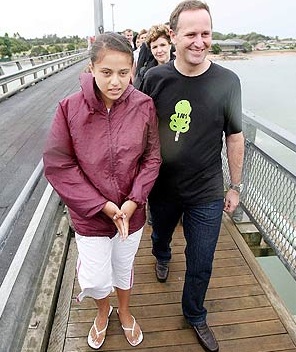
Campbell Live tonight returned to McGehan Close (see the report, by Tony Field, here). This street in Mt Albert — on the boundary of Helen Clark’s and Phil Goff’s electorates — was visited by then-opposition leader John Key before Waitangi weekend 2007 for a particularly cynical stunt. This was Key’s first big symbolic play as leader of the opposition, and it was a hum-dinger. He had already singled out the residents of this street in that year’s State of the Nation address at a whitebread rugby club in faraway Christchurch, branding them archetypal members of the New Zealand ‘underclass’, and the visit saw him glad-handing and patronising a bunch of poor brown people who’d already been used as shot in the National party propaganda cannons.

The purpose of the speech, and visit, was to install one of the core planks of the National party narrative about the Clark government — that it was at best unconcerned with the plight of said underclass; and at worst, actively cultivated such a demographic, which would be permanently dependent on Labour’s welfare policies and would therefore be a permanent source of electoral support for the Labour party. (So the ‘bribing the bludgers to breed’ theme goes, rarely uttered by anyone with authority in public but a commonplace among the usual proxies; check almost any General Debate thread on Kiwiblog from around that time for instance.) This is absurd in more ways than it’s feasible to explain here, so I won’t bother. Let’s just leave it at ‘the underclass doesn’t really vote’.

Nevertheless, the visit was a roaring success. Key, bearing smiles and gifts and wearing a tiki t-shirt, charmed the residents of McGehan Close and evidently persuaded them both of his party’s goodwill toward them and of its social and economic plan to lift them from their grim circumstances. The event culminated in Key taking 12 year-old Aroha to the Waitangi Day celebrations — a move full of potent symbolism, even if it was seen to be somewhat exploitative. Drawn out over a full week of coverage (at the time a rare commodity for Key, who had replaced Don Brash as leader just before the Christmas break) this was a highly successful stunt and should have been an early warning of Key’s great talent for making cheesy set-piece events ‘work’ and feel human. The sentiment he evoked in the people of McGehan Close was certainly real.

It’s just a pity the ‘ambitious’, ‘aspirational’ policy programme Key promised them wasn’t.

Joan Nathan, Aroha’s mother, remains on the DPB (having been let go from her hastily-arranged job working for National MP Jackie Blue) and struggles more than ever to cope, now with a sixth child. Aroha, now 16, is living in the care of Child, Youth and Family, which Joan says is the best thing for her, since she is unable to provide a decent life for her daughter. Nathan and others, although they believed in and voted for Key, are now disenchanted and universally express the sentiment that the government’s policies favour the rich, not the poor, and that they haven’t been helped one iota by the change of government; in fact, things have gotten worse. Not much of this is different than it was this time last year, when the Sunday Star Times visited the Close.

So far, so obvious, you might say — and it is; indeed this sort of outcome was very widely predicted at the time. But this is important because it is as strong a counter-narrative as exists for the opposition in this election year. It reframes Key as a faker, a charlatan, an opportunist who’ll exploit whatever circumstances will advantage him, without loyalty or the willingness or ability to follow through on his word; as someone whose focus is on boardroom issues rather than on peoples’ wellbeing. Discussing and reading around the topic on twitter this evening I’ve seen considerable criticism of this Campbell Live story as a cheap human-interest stunt, as opportunistic and exploitative (or moreso) than the original event. I couldn’t agree less. It is a clear, unambiguous example of an investigative journalist simply revisiting a story where much was promised, and measuring it against what has actually happened. This is crucial to its narrative value: these events reframe Key by measuring his own defining stunt — his signature trick — against the objective reality of lived experience. Theory and rhetoric versus real people, living in the real world governed by the policy built from that theory and rhetoric. It is a reality check in its purest form.

There are disadvantages to this narrative line, also, and the virulent responses to the Campbell Live report this evening — I believe I saw presenter Rachel Smalley shudder a little whilst reading some of them out — hint at them. One is the obvious suggestion that Joan Nathan and the other residents of McGehan Close could have done better for themselves, but have chosen not to; the victim-blaming routinely visited upon the poor by the less-poor. A more serious and related line of critique is that there’s a recession on, and everyone’s hurting. Or that it’s only been three years, and change takes time.

But hang on a minute — wasn’t the point of the whole point of electing a Key-led National government to take advantage of the resulting step-change which would boost economic growth, job growth, provide better opportunities, an end to welfare dependency, safer communities and a general increase in general socio-economic mobility and wellbeing? Key made all these promises quite explicitly, not just in person to the residents of McGehan Close, but to the whole nation throughout the campaign and at almost every opportunity since. There are no jobs. There are no higher wages, and without these things you can’t exactly buy shares in SOEs. There is no greater social mobility. The ‘underclass’, as exploitatively defined by Key, still exists.

Having failed McGehan Close, John Key has failed all of us. Quite apart from the fact that we were all promised these things, or things like them, and by and large have yet to receive them, a central theme of the ‘underclass’ policy argument was that by lifting people out of poverty and bringing then into the ‘overclass’ (? — this shows just how meaningless ‘underclass’ is except as a propaganda term), the government would make society better for everyone. This is a noble goal, and one I agree with in its idealistic entirety. I think you would go a long way to find someone in a position of any political credibility who’d publicly disagree with it. The first order of business for any opposition should be to hold John Key to those promises, and demand of Key the wealthier, more mobile, and socially healthier society we were promised.

But the most vicious response will be the one which the initial stunt in 2007 was meant to evoke — the notion that the ‘underclass’ are breeding in order to get more welfare from the Labour party. The core of this line of reasoning, if I may call it that, will be attacks on Nathan herself as a mother, having had a sixth baby and having had Aroha, the subject of the initial stunt, removed from her care. The attacks will be highly personalised, racist and gendered, and they will be lashed closely to Labour party policy and doctrine. But, assuming a competent and spirited opposition, that’s ok — the National party aren’t in opposition, 18 months out from an election; they’re in government in election year. Having been elected on a moderate, sympathetic platform with strong support from women and Māori, and looking to consolidate that platform into a strong and honestly-won mandate means that the government no longer has such freedom to dog-whistle. Particularly given that an opposition counter-narrative would cast doubt on all those sympathetic characteristics, the resort to the divisive tactics of 2008, such as trying to wedge ‘hard-working kiwis’ against the ‘underclass’, and so on, would be extremely risky for the government.

In light of my last post, perhaps it is a little glib to assume a competent and spirited opposition, and in perfect truth I don’t really think Labour has this fight in them (although Grant Robertson saw the Campbell Live piece and seems to have had a similar response to mine, which is heartening). But it is an argument waiting to be had, and one which must be had sooner or later. The boundaries are drawn up; media interest is already piqued, and this is a bread-and-butter social and economic justice issue for Labour. There’s a wealth of symbolic material and slogans to employ — ‘reality check’ and ‘by failing McGehan Close Key has failed us all’ are two they can have for free, and if a Labour party can’t base a campaign around ‘underclass‘ then they’re not worthy of the name.

Time to engage.

L

Hard rain’s a-gonna fall


The past week has illustrated in clear terms the New Zealand Labour party’s decline as an effective opposition party. In the opening moments of election year 2011, John Key has stepped up to demonstrate the full extent of the National government’s apparent impunity. He has done this in three ways.

First, by fronting Morning Report, Nine to Noon, Campbell Live and other tier-1 hard-news media to outline his intention to partially privatise SOEs. Privatisation, since the Fourth Labour Government, has been a ‘third rail’ issue; one the NZ left is unequivocally opposed to. By going into bat for privatisation personally, and in considerable policy detail, Key confounded criticism which has been (justly) levelled at him throughout the electoral term so far that he often refuses to show up on hard media, while continuing to keep regular spots in soft formats like Breakfast, and on less rigorous media such as Newstalk ZB. He also invested his own (considerable) political capital in the enterprise, making privatisation a matter of his own judgement and credibility.

Second, he sought out and is revelling in the controversy caused by his “Liz Hurley is hot” stunt, undertaken on Radio Sport with convicted back-breaker Tony Veitch. In political terms, the first bit was no meaningful risk; Key has played the ‘frankly, I’m a red-blooded Kiwi bloke’ card several times before, always to good effect, and most notably when he informed a press scrum he’d had a vasectomy. The decision to undertake an interview with the disgraced Veitch was a considerably more risky proposition because of the nature of Veitch’s offending against his partner, combined with the subject matter of their conversation, and the fact that Key’s political appeal to women has been considerably stronger than previous National leaders. This seems clearly calculated to demonstrate what he can get away with; and the gamble has in fact paid off so well that Phil Goff today felt compelled to follow suit, suggesting a slightly sad “me too, me too” narrative.

The third of Key’s big moves was today’s dual announcement that the election would be held on 26 November, 10 months away and following the Rugby World Cup; and that he would not consider a coalition arrangement which included Winston Peters. Coupled with ruling out working with Hone Harawira outside his present constraints in the māori party, this declaration will provide considerable reassurance to National’s traditional base, and will scotch any possibility of wavering conservatives casting a hopeful vote for Winston Peters as an each-way bet. It is a risky proposition, though — Peters remains a redoubtable political force, and it is not beyond possibility that he returns to parliament. However I think Key has read the electorate well; he knows that while a small number of people love Peters, and a small number loathe him, many of those in the middle are vaguely distrustful of him. As Danyl points out, he’s managed to link Peters to Goff in a way which emphasises both leaders’ worst attributes: Peters’ polarising tendency, and the general unease and disdain with which voters view Goff. The decision to call the election so early is also bold. It means relinquishing the incumbent advantage of being able to control the electoral agenda; being able to determine when ‘government as usual’ ceases and ‘campaign season’ begins. This is an intangible but valuable benefit, and it has been traded off against another piece of reassurance: the sense that Key and his government are “playing it straight” with the New Zealand public; that they intend to run an open and forthright campaign and to seek an honest mandate for their second term. The choice of election date isn’t entirely selfless, of course — the All Blacks are odds-on favourites to win the Rugby World Cup, and even if they don’t, the tournament, its pageantry and excitement and revenue boost will bifurcate the campaign. The traditional campaign period will mostly be drowned out by this event, save for the last few frantic weeks.

In most election years, swapping agenda-setting rights for a “playing it straight” feeling would be a poor tradeoff. In most election years, a sexist stunt with a known and publicly reviled wife-beater would be a poor start. In most election years, running a campaign based on privatisation would simply be a non-starter. While the paragraphs above read somewhat like breathless praise of Key’s status as a political playa, that’s not my intent. I think he’s good, but mostly John Key just knows what he can get away with. The reason he can get away with all of these things is because there is no credible opposition to prevent him from doing so. Anyone half-decent can look sharp when playing against amateurs.

It has been Labour’s job to prevent the government from reaching the state of near-impunity they now enjoy, and their failure to do so means there is now a real danger that Key will get the genuine and sweeping mandate he seeks. To a considerable extent they were doomed in the task of preventing this from the outset, because they didn’t think it was possible that he’d ever achieve it. Clark Labour throughout 2008 fundamentally misunderestimated Key, writing him off as a bumbling lightweight, and this was a crucial error. Since well before the election — this example is from July 2008 — I’ve been arguing to anyone who’ll listen that instead of taking easy pot shots at Key based on his weaknesses, any critique should focus on his strengths. Quoting myself, from the above:

Key’s strengths [per the Herald bio], which enabled him to succeed as a currency trader: Decisiveness. Determination. Patience. Ice-cold calm under fire. Willingness to risk it all. Ability to follow through. Remorselessness.
If you want to attack John Key, draw attention to what might happen under a Key government. Given his history, he’s not some motley fool who won’t make sweeping changes – he hasn’t gotten where he is today by being timid. I think he has the wherewithal to roll out a sweeping programme of political and social change the like of which we haven’t seen since Lange, but I think that, unlike Lange, he won’t get cold feet. If you don’t like Key’s politics, I suggest you begin thinking about what might happen if the guy is given the power he seeks.

The delusion that John Key is a hapless fool who’s somehow mysteriously gotten his hands on the reins of power remains very much alive within New Zealand lefties; this was the tired old line I got spun as recently as this afternoon, by one of the internet’s best-known Labourites (with a nice dollop of ‘if you don’t praise Labour, you’re a rightie’ for good measure).

But this tendency to misjudge and underestimate Key is only part of the problem. Denizens of The Standard aside, anyone within the loop who has a modicum of reason has figured out that Key is not the lightweight he was — quite willingly — framed as. But now the narrative is set: it’s That Nice Man John Key, who drinks beer out of the bottle while tending the barbecue with Prince Harry, and thinks Liz Hurley is hot. They don’t have a credible counter-narrative, but they have to say something against the health cuts, education cuts, tax cuts, ACC cuts, pending privatisation and so on — and so they fall back on their usual tired old cliches, which, while superficially looking like what an opposition is supposed to do, lack cohesion and run counter to the established wisdom about Key and his government — wisdom laid down, in the first place, by the Labour party in its 2008 campaign.

The lack of narrative cohesion is so dire that the party claims that privatisation of SOEs is repugnant to the voting public of New Zealand; and almost simultaneously puts out a press release saying that it’s a cynical ploy to “cling to power”. The manifest incompatibility of these two propositions — cynically promoting an unpopular policy to retain power — speaks for itself.

If the inability to construct a viable narrative is symptomatic of a wider lack of ideas and direction within Labour. Election-year spin aside, their policy offering is weak as well. Their big blockbuster kicking-off-election-year policy of a $5000 tax-free zone was big enough to draw plenty of criticism about cost and targeting (including from people like Brian Easton), but timid enough that nobody was made to sit up and take notice for any other reason (sidenote: when Brian Easton, John Shewan, Chris Trotter and I all oppose something, I think you can be pretty sure it’s not a winner).

This is just the most recent example of what we’ve seen throughout the past two years: Labour’s vision, and its execution, simply aren’t up to scratch. I have no internal knowledge of the Labour party, and I don’t know whose fault this is. I guess the leadership blames the strategists, the strategists blame the policy wonks, the policy wonks blame the spin-doctors and the spin-doctors blame the MSMâ„¢. All that’s just excuse-making for losers. There are no socially-just power-redistribution schemes in politics, and if there were they would be rorted. There is no fair. The job of being in opposition is to win despite the odds being stacked against you; to do and say things worthy of the news media’s time, worthy of the government’s concern, and worthy of the electorate’s endorsement. If you’re not doing that, you’re not up to the task.

As the title implies, the political weather this election year is not going to be a warm drizzle. John Key wants a mandate; he wants a strong and broad mandate which will permit him to wreak widespread social, economic and political changes upon New Zealand’s landscape, and he is prepared to put a lot on the line to gain it. He is playing for keeps, and my instinct is that an opposition who couldn’t keep pace with ‘smile and wave’ is going to be crushed by the rampant beast which is currently girding for war. What’s more, by all accounts Key is actually, genuinely coming to the New Zealand electorate with a transparent policy offering in good faith, keeping his promise that nothing would be privatised without his first having sought a mandate to do so, which robs Labour of their strongest symbolic weapon: the “by stealth” bit of their catchcry “privatisation by stealth”. Time will tell if this holds, but at present the Key government is doing exactly what it says on the box. Labour can’t claim they haven’t known about this all along. Privatisation has been the bogeyman about which they’ve been warning the New Zealand public for at least a decade, which makes the incoherence of their recent response all the more unforgivable. That National would consider running an election campaign on this cornerstone issue, loathed and feared by so many New Zealanders, is surprising. That they can expect to do so without trying to get their agenda through on the sly is shocking. That they reasonably expect to do all that and win is unthinkable. Let there be no doubt: if Key wins this election on these grounds, it is because Labour, by failing to adequately discharge their role as a competent opposition, have permitted him to do so.

Perhaps it is not too late. Perhaps Key has overplayed his hand; perhaps Goff has a secret weapon. Perhaps a young Turk is fixing to roll Goff and his cadres and make a break for it. I do not think any of these are likely. So it may be that the one good electoral thing to emerge from 2011 is a heavy and humbling loss which would see the Labour party reduced to a meagre husk. An exodus of the lively and creative thinkers of the party to another vehicle; or the enforced retirement of the deadwood responsible for the present state of affairs; or both would clear the way for a thoroughgoing rejuvenation of the movement’s principles and its praxis and its personnel. While it would be cold comfort to the generation of New Zealanders who will bear the brunt of the Key government’s second and third-term policies, it would be a crucial and long overdue lesson in political hubris, never to be forgotten, and infinitely preferable to another narrow loss and the moribund hope that next time it’ll be different.

L

Hard-liners and soft-liners in the construction of post-authoritarian regimes.

Recent discussions here at KP have revealed some misunderstandings of what constitutes a “revolution” and what the prospects for democracy are after an authoritarian regime collapse or withdrawal. Specifically, there appears to be some confusion in the minds of some readers as to the difference between revolutions and revolts, uprisings, coups d’etat and other forms of regime change. Most worrisome, there appears to be a belief, apparently shared by many in the Western Press, that revolutions are intrinsically good things and lead to democracy. Although I have tried to dispel some of these notions in the commentary about other posts, let me address the issue directly and explain some dynamics of regime change that impact on the direction of said change and the prospects of democracy after the collapse or withdrawal of an authoritarian regime.

First of all, let it be clear: Revolutions are not just a transfer of political power. They are a form of mass collective violence mobilized against a political regime and its repressive apparatus that results in the overthrow of that regime and  its replacement with a new political, social and economic order. Second, no revolution in the 20th century led to democracy as a direct result. Ever. What revolutions do is replace one authoritarian regime with another. This is due in part to the fact that what it takes to be a successful revolutionary leader is ruthless determination, ideological zealotry, supreme organizational, strategic and tactical skills in both the armed and propaganda fields, and an unwillingness to compromise in pursuit of victory. That is not the stuff that genuine democrats are made of. In fact, the very traits that make for good democratic leadership are anathema to revolutionary leaders. Hence, if one has a preferential bias in favour of democracy, then revolutions are not the best way to achieve it. If one is less interested in democratic outcomes and more interested in imposing a preferred social construct, then revolutions are the best way to achieve that end.

The other major reason why revolutions lead to authoritarian outcomes is because the defeated authoritarian regime has allies and supporters inside and outside the country that will continue to attempt to block revolutionary reforms after the change in power. These counter-revolutionary forces include former opposition factions that do not share the militant revolutionary goals even though they participated in a tactical alliance with hard-liners against the ancien regime. Confronted by a more radical agenda for change than they anticipated or are prepared to accept, such moderate opposition factions tend to switch sides and propose a moderate counter-revolutionary platform that only serves to strengthen the resolve of the revolutionary hard-liners.

Needless to say, for a revolution to be successful the opposition must be organised and have mass support, while the old regime must suffer decisive internal fractures, especially within its security forces and in the relationship between the repressive apparatuses and the regime elite. So long as there is ideological unity and corporate discipline within the armed forces and other security agencies and the regime elite retain the loyalty of those specialised in the management of organised violence, then no amount of external pressure will topple it. This is true even if some regime leaders are sacrificed to appease public discontent and cooptive reforms or concessions are offered to mollify specific grievances and induce opposition acceptance of the “new” regime (which itself is a divide-and-conquer tactic used on the opposition that allows to the regime to more clearly target intransigent factions within the former). As part of this, a leadership coup or putsch may occur in which despised individuals are replaced by more nondescript or less tainted people who are nevertheless committed members of the ruling elite.

Thus, revolutions are neither always progressive or democratic, as the Iranian Revolution demonstrates. For those interested in seeing a democratic outcome to situations of authoritarian regime crisis amid popular unrest, there is actually a baseline formula that needs to obtain, and it falls far short of revolution. Let me explain.

Authoritarian regimes and their oppositions can be broadly divided into hard-line and soft-line (militant  and moderate) factions. Hard-liners in the regime are usually the political leadership and those directly engaged in acts of repression during its tenure (which can extend down to street level police, paramilitary thugs, intelligence agents and, if complicit, elements of the military itself). Soft-line elements of the authoritarian regime are those who benefited from it but who did not have visible decision-making roles and those uninvolved in repression, as well as the minority few who genuinely worked from the inside to promote reform.

Hard-liners in the opposition are ideological militants and those who suffered directly at the hands of the authoritarian regime. Their suffering can be physical or economic and their numbers depend on how repressive and criminal the regime was in its dealings with political opponents and non-allied economic and social agents. For the hard-line opposition, the thirst is for revenge, not reconciliation. On the other hand, soft-liners in the opposition are all those who, while having a dislike for the authoritarian elite, did not suffer directly at its hands. For them, the issue is not so much revenge as it is change.

The formula for a democratic transition stemming from authoritarian collapse or withdrawal is simple. If hard-liners dominate both the authoritarian elite and the opposition, the prospects for a democratic outcome are negligible and civil war is probable. If hard-liners dominate the regime and soft-liners dominate the opposition, then regime continuity with minor reforms is the likely outcome. If soft-liners dominate the regime and hard-liners dominate the opposition, the reforms will be more significant but regime continuity will most likely occur simply because of the fear of retribution amongst the regime elite and its supporters when confronted with a hard-line opposition victory.

The only situation is which a transition to democracy is a potential outcome is one where soft-liners dominate in both the regime and opposition. The trouble for these actors is that they must fend off and eventually subordinate their hard-line counterparts while at the same time negotiating the terms and conditions for a transfer of power to openly elected authority. That is a very delicate matter that involves, among other things, an “ethical compromise” whereby both sides agree not to prosecute most of those responsible for state atrocities or insurrectionary violence (in other words, although some notorious figures may be offered up as sacrificial lambs by both sides, the bulk of those involved in human rights abuses and non-state terrorism will walk free). The examples of the Southern Cone of Latin America, Central America and South Africa are illustrative in this regard. If anything, prosecution of human rights violators must wait until the new regime is more or less consolidated in its institutional structure and in the transparent application of universal law. That can take decades.

Hard-liners on both sides will see the soft-liner negotiations for what they are and move to denounce them as sell-outs and lackeys. The more secret the negotiations between the soft-liners on each side the more the minority hard-liners will resort to obstructionist and provocative tactics to thwart any agreement. This can involve internecine as well as partisan bloodshed. The more the hard-liners can thwart soft-liner agreement, the less likely it will be that a peaceful transition of power to a democratically-elected authority will occur.

The strategic position of the country in question will impact on the influence of external actors. In strategically inconsequential countries, external actors will be less inclined to involve themselves in domestic crises and will prefer to observe an internal resolution so long as it does not impact on their national or material interests. Conversely, in countries that have strategic import or geopolitical significance, the more likely it is that external actors, acting individually or in consort, will involve themselves in efforts to shape the outcome. For them, expending diplomatic capital is necessary because of the stakes involved, especially when a transition outcome could have deleterious repercussive effects on regional or international stability.

And that, in sum, is why democratic outcomes of popular revolts against authoritarian regimes are less probable than many hope for. Besides the non-democratic outcome of genuine revolutions involving the overthrow of an authoritarian elite, the dynamics of regime extrication and replacement are such that the more likely outcome of a transition short of revolutionary overthrow is authoritarian regime restoration under different guise, limited democratisation with ongoing authoritarian elite veto power, authoritarian reaffirmation or high-or low-level civil war.

Best to keep that in mind when observing recent events in the Middle East.

Expecting too much from the Tunisian crisis.

The lack of understanding of what the Tunisian political crisis represents has been alarmingly evident in the media coverage of it. Journalists have said such inanities as “until a couple of days ago Tunisia was a beacon of stability in the region…” and raised the possibility of a so-called ripple effect spreading from Tunis to other North African states. They have called the popular uprising against the ousted president Ben Ali the “Jasmine Revolution,” thereby demonstrating their profound ignorance of what a revolution really is. The truth is that Tunesia was a small powder keg waiting to blow but no one wanted to state the obvious about it, and when it did blow the reaction has been to over-estimate its magnitude and repercussive effects. 

Let me dispel some of these misrepresentations. First, the uprising in Tunisia is not a revolution. A revolution is an overthrow of the state by a mass-based, ideologically-driven and collectively organised armed resistance movement that results in parametric change in the political, economic and social institutions governing society. In Tunisia what occurred was sometimes violent popular demonstrations against an unpopular and corrupt long-serving despot which precipitated an inter-elite crisis that resulted in the exile of Mr. Ben Ali, his family and close allies. The regime did not fall, the military has re-gained control of the streets and the protests have not coalesced into an organised, focused, counter-hegemonic opposition that poses itself as an alternate sovereign and has the capacity to engage in a war of maneuver against the repressive apparatuses of the state. All the demonstrations and protests have done is allow the Tunisian regime the opportunity to reform-monger in order to placate popular discontent while shifting the focus of blame on the disgraced former president. The “opposition,” such as it is, has no plan for taking control of the reigns of state, has no program for governing, and is in fact mostly made up of jobless youth aimlessly venting their rage at symbols of power rather than constructively organising am effective counter to it. Given those facts it is naively optimistic to expect that the crisis will result in major change of a democratic sort. It may be the impetus for a political opening, but it is no guarantee of it.

As for the “ripple effect” of the purported “Jasmine Revolution.” Undoubtedly the Arab street has taken notice of the Tunisian crisis and oppositions in places like Egypt, Algeria, Jordan, Morocco and Libya have been encouraged by the events in Tunis. But the elites in these countries have also taken notice and have no doubt shared information with each other on the nature and threat posed by their respective domestic oppositions. Largely disorganised and ideologically heterogeneous, Arab oppositions also often have overt Islamicist tendencies in incipient leadership positions (and in some cases, like Algeria, an active Islamicist armed resistance tied to al-Qaeda), something that will prompt Western backing for the political status quo in these countries even if they go about re-shuffling their own leadership cadres as a result of the warning provided by the Tunisian crisis. Where these oppositions do have an organisational core, it is more often than not undemocratic in nature and, in the case of Islamicists, explicitly opposed to democracy and supportive of a return to theocratic rule (in states that by and large have worked hard to promote a measure of institutional secularism that coexists with religious hierarchies operating in parallel spheres of influence).

Then there is the lesson of other so-called “colour revolutions” such as the Orange Revolution in the Ukraine, Rose Revolution in Georgia and Tulip Revolution in Kyrygyzstan. These have resulted not in democracy in these states but in the emergence of electoral authoritarian regimes that, if better than the former Soviet republics that they replaced and certainly more pre-Western in nature,  do not come close to offering the full measure of voice, representation, transparency and accountability that their adherents so fervently hoped for during the heady days of street protests that ushered in regime change in each.

Thus a sober assessment of the Tunisian crisis should see it for what it is: a wake up call to the Tunisian and other Arab political elites that ignoring simmering popular discontent and failure to engage in macroeconomic and socio-political reforms will ultimately cause tensions to boil over, and such popular boil-overs pose the risk of regime change if well-organised and supported in the face of regime paralysis. It also means that just because a regime is pro-Western does not mean that a blind eye should be cast on its excesses and exclusions, if for no other reason than doing so will encourage the type of leadership behaviour that gives ideological ammunition to extremists who otherwise would not gain the support of the majority.

For Arab oppositions, the lessons are also clear. “Spontaneous” revolts may garner media attention, but nothing substitutes for ideological consistency, collective organisation and the cultivation of mass appeal in preparation for the moment when what Rosa Luxemburg called the “mass strike” is to be launched. And that, of course, is exactly what the Arab political elites are already keenly focused on preventing with the aid and assistance of their Western counterparts, all under the guise of the so-called “war on terrorism.” Even so, the intelligence failures, particularly by the French and the US, to even remotely predict the unrest in Tunisia speaks volumes about Western lack of understanding of the real dynamics on the ground in North Africa. I mean, how hard is it to assess that a long-lived, openly despotic kleptocracy with repressive contempt for its own citizens would engender popular resentment against it, especially with unemployment levels running at 15 percent of the adult population and more than 20 percent for males under the age of 30? Or does being “pro-Western” absolve such regimes of all sins? Is this what passes for “stability” in the myopic eyes of the Western press and diplomatic corps, or is the mere lack of an organised opposition that gives such regimes a mantle of legitimacy they neither deserve or have in practice? In other words, does the absence of a viable opposition by default grant authoritarian regimes legitimacy (at least in the eyes of the West if not their own people)?

This is not to say that all opposition is futile. To the contrary. But incipient democracy movements in these countries need to refine their message into a clear ideological counter to the status quo, seek to establish broad based constituencies based upon coherent platforms for policy reform, and look to each other as well as viable interlocutors in the West so as to jointly press for substantive reform of their respective political systems while deflecting accusations of ideological extremism and inflexible militancy. Until they do so they will be seen as a rabble rousing mob rather than as a viable political alternative.

That is why the Tunisian crisis, while significant for both its domestic and regional implications, is more of a false hope than a first step in the democratisation of North Africa. For the latter to happen both elite and popular attitudes towards governance will need to change, and nothing in the character of regional oppositions or the tone of their approach to organised resistance, to say nothing of government responses to popular discontent, indicates that is about to happen anytime soon regardless of the immediate impact of the winter of Tunisian discontent.