John Key’s re-election strategy: letchery, fantasy and condoning spousal abuse.

John Key either has very poor PR advice, is grossly insensitive or has some darkness in his heart, to say nothing of his small head, when it comes to women. I am less concerned by his choice of words when describing models and actresses that he lusts after. It might have been better for the Prime Minister to refer to the objects of his sexual fantasies as “attractive” or “pretty” rather than using the adolescent term “hot.” But getting a bit horn doggish on a blokey sports talkback show is not the worst of sins.

A slightly worse sin is to reveal admiration for a sports star because he makes “heaps of money” and gets some “fringe benefits” on the side. Talk about revealing your core values! For the PM, money grubbing–admittedly driven by unique talent– and serial adultery–which did not have much to do with talent of one sort or another–are positive traits worth coveting. Crikey! But that is just his shallow venality surfacing, not a mortal sin.

What is a far more serious matter is his apparent condoning of spouse abuse, as exemplified by the poster-boy for putting ass-kickings on women, Mr. Tony Veitch. Not only did Mr. Key agree to sit down for an interview with Tony the Tough Guy on his radio sports show, which legitimates Veitch in areas far outside the blokey sports-minded demographic. Mr. Key has now agreed to do regular spots on Mr. Veitch’s show. If one interview legitimates Mr. Veitch, then subsequent regular interviews symbolically condones what he did.

It was bad enough that a sports radio outlet would see fit to re-hire a spouse abuser who escaped jail time because he paid off the victim and wept crocodile tears at a series of staged press events. Here we have the PM of New Zealand, who should be fully aware of the intimacies of the abuse case as well as the allegations of drug use and other anti-social behaviour by Mr. Veitch, agreeing to grace his show on a regular basis. This, at a time when Mr. Key has terminated at least one guest spot with another radio news show focused on hard news rather than rugby, cricket and league. What is the message Mr. Key is trying to convey here, and on what assumptions does that message rest?

Is it his assumption that most Kiwis think Veitch is a good bloke and he was hard done by the back-talking wench? Is it his assumption that Mr. Veitch did wrong but it was a minor transgression? Is its his assumption that the NZ public do not care any longer what Mr. Veitch did and bygones are bygones? Is it his assumption that sporty blokes at best do not care or at worst condone Mr. Veitch’s behavior, and in an election year connecting with that crowd by engaging in some good-natured letching will increase Mr. Key’s chances of re-election? What, exactly, is the rationale that says that it is OK for the PM to grant privileged regular interviews to an unrepentant spouse-basher while canceling similar interviews with other news shows?

And what message is Mr Key trying to convey here? That he is a sporty bloke? That he is a sporty bloke who sees nothing wrong in the occasional bitch-slapping along with letching, adultery and money grubbing? That he is a sporty bloke who does not give a darn about the high incidence of spousal (and child) abuse in the country he leads? That he is sporty bloke that simply does not care if he objectifies women and symbolically condones spouse-bashing? That he is a sporty bloke who is insensitive to women’s concerns about being objectified and victimised in their own homes as well as in the streets? Or is his message simply that in the run-up to elections catering to the lowest of the low is acceptable? What next, a guest spot with Mongel Mob, Black Power or Headhunter media outlets? After all, they are also sporty blokes who know something about how to treat uppity women.

Maybe I am just a prude. Perhaps it is perfectly acceptable for the PM of an advanced liberal democracy that is not Italy to see nothing wrong in publicly letching, to express admiration for greed and adultery, and who symbolically condones spousal abuse by voluntarily and preferentially associating with a spouse-beating coward who happens to be a celebrity. But if that seems a  bit untoward for a PM (or anyone else), then he and his PR minders need to be made aware of that fact. Boycotting advertisers who buy time on Vietch’s show when it features the Key interview is one way to convey that message. More importantly, and specifically for those women and other decent people who do not condone such behavior and who crossed over to National in the last election, the best way to deliver the message is to do so on November 26, at the ballot box. Of course, it if could get a clue, Labour might make a point of pointing out to the electorate Mr. Key’s apparent lack of regard for the feelings of his female constituency or any others who might think that engaging in egregious sexual innuendo with a spouse abuser is not fitting behaviour for a sitting Prime Minister (or anyone else with a modicum of sensitivity to the issues involved).

After all, not all of us are sporty blokes.

Playing the denial and diversion game (with updated link).

In the aftermath of the Tucson shooting, it has been unsurprising but nevertheless amazing at how the US media Right and other conservatives have rushed to deny any linkage between the shooting and the political climate of the moment. Even some of the usually smart contrarian commentators here at KP have been quick to join the chorus claiming that this attack was just the work of a lone nutter. But let it be clear: even if the killer has clear psychological issues, he chose a political target rather–as in the case of other mass killings by mentally disturbed individuals in the US in recent times–random strangers or family members. For that reason alone, the Tucson massacre is a politically-motivated crime regardless of the Right trying to deny it, and the proof of that is the federal indictments against Mr. Loughner.

Confronted with the obvious–that the vicious political discourse of recent times, a discourse rabidly promoted by conservative media outlets, internet commentators and political demagogues, has set the stage for an inevitable act of armed violence on the part of someone who shares, however partially and incoherently, the world view of the reactionary Right–the media Right and its political acolytes have turned to the tried and true tactic of deny and divert.

First, they deny that the shooting was a political act but instead was just an act of lunacy. These are the same media types who immediately saw world Jihadism behind the rampage conducted by Major Nidal Malik Hasan at Fort Hood. They are the same people who describe murderous anti-abortionists as people of conviction led astray by the strength of  their beliefs, and who claim that the Oklahoma City bombing was conducted by some loser social misfits. The flatly refuse to acknowledge the context in which these attacks occurred, and they flatly refuse to accept their share of responsibility for fomenting an atmosphere of partisan hate and violence. In a country that has seen its popular culture debased and vulgarised to the point that gratuitous violence is a mainstay of popular entertainment and an attitude of insolent disrespect has become a norm in inter-personal exchange, such incendiary posturing does nothing more than provide an accelerant for those who are already disposed to act out in violent ways. And yet, the cowards in the media Right claim they had nothing to do with the events in Tucson.

Instead, they and their political allies have adopted the tactic of diverting and deflecting criticism towards the “liberal” press and politicians who they claim have attempted to make political capital out of the tragedy. They have attempted to equate Left liberal acts of civil disobedience, peaceful resistance and direct action with the shooting and previous Right wing threats of armed violence and actual acts of such (in the infamous list of purported Left wing acts of violence posted by a notorious Right wing blogger there is not a single image of anyone with a firearm, much less of anyone shooting or killing in pursuit of their beliefs. In fact, among the supposed comparable acts listed by that blogger are recordings of people laying down in the front of weapons trains in protest of war. Can that really be considered morally equivalent to a mass shooting? Only in the fevered mind of a Right wing apologist).

Reactionary attention has centred on the comments of Pima Country Sheriff Clarence Dupnik, who has held the job for 30 years based upon regular re-election as a Democrat (in a county that is majority Democratic in an otherwise Republican state). In his first press conference after the shootings Sheriff Dupnik denounced the climate of hate and atmosphere of bigotry that has descended on Arizona and the country in general. The Right went ballistic at his  mention of this patent fact, accusing him of partisanship, jeopardizing the case and failing in his duties to prevent the shooting because Laughner was known to the police prior to the event (ignoring the fact that his department is hamstrung by mental health and civil rights laws that prevent it from arresting individuals in cases short of domestic violence where reported threat behaviour is not materially imminent). In other words, in spite of the Right’s attempts to smear him, Sheriff Dupnik well knows of what he speaks, because it is his office that has to confront the daily consequences of loose gun laws an anti-immigrant sentiment in a county that extends down to the Mexican border. Put succinctly, Sheriff Dupnik stated the truth. For that public service, he has been pilloried by the Right wing media frothers.

Regardless of whether Mr. Loughner was indirectly or directly inspired by hate speech and the venom directed at the federal government and “liberals” by Right wing political-media networks, the simple point is the obvious point that Sheriff Dupnik was making: the increasingly public language of hate and divisiveness was the backdrop against which he carried out his rampage. He chose a political target. His intent was political assassination. His was, in sum, a political act, however deranged he may be. And that act was carried out against a “liberal” Democrat in the US federal government who has repeatedly been, along with others of her ideological persuasion, the direct recipients of the hyper partisan vitriol emanating from the mouths of the fear and hate-mongering Right.

No amount of denial, diversion and obfuscation can detract from that fact.

UPDATE: Frank Rich does a good job of summarising the situation.

As the gun smoke clears, the Right run for cover.

As someone who once lived in the area of Tucson where the politically motivated shooting of US Representative Gabrielle Giffords and 19 others occurred, I have something of a personal connection to the event. I shopped in the strip mall where the attack took place and still have friends in Tucson who I visit when possible. Were I still living at my last address there,  Giffords would have been my Representative. I am well aware of Arizona political culture and the issues that divide it, and know something about its gun laws as well. Thus I am not surprised one iota that an assassination attempt on a “liberal” Democrat would happen in Arizona, although it is somewhat surprising that it happened in Tucson, which is a liberal college town oasis in an otherwise vast political landscape of new and old right-wing conservatism.

Unsurprisingly, as soon as news of the shootings hit the airwaves left-leaning commentators blamed right-wingers for inciting the killer while GOP leaders, Tea Party representatives and the populist demagogues in the media all moved quickly to put distance between themselves and the gunman even though the latter professed beliefs that were very much in concert with the thrust of the Tea Party message as well as those of earlier conservative fringe movements. In fact, some in the rightwing media suggested that the Left has its own violent extremists so the table is balanced on that score.

To which I ask: when was the last time a Left activist in the US attempted to kill a politician? Lee Harvey Oswald was less a committed Stalinist during his time in the USSR and more of a social outcast looking for a belief system to cling to (I shall defer from bringing in Mafia-related and other conspiracy theories at this point). John Hinkley’s attack on Ronald Reagan does not count as he was motivated by the demons in his head, and the attacks on Gerald Ford by members of Charles Manson’s gang in the mid-1970s were equally devoid of political content. But as recently as 2009 a right wing extremist, apparently egged on by the commentary of talkshow rabble rousers, killed abortionist George Tiller outside his church. This has followed a series of attacks carried out by right wing militants that include the Oklahoma City bombing and repeated attacks across the country on abortion clinics. Minutemen and other self-professed right wing militias have demonstrated a penchant for violence against others. The Unibomber was motivated by a mix of left and right views. Islamicists operate according to a profoundly conservative belief system. Anti-Castro Cuban nationalists have committed acts of domestic and international terrorism (including the bombing of a Cuban airliner) in pursuit of their conservative goals.

In contrast, Earth First! and the Animal Liberation Front have lefty ideals and destroy property but do not kill people. Anti-trade protestors and anarchists have run riot in Seattle and DC but mostly gotten (some might say well-deserved) police beatings and tear gassed for their efforts. Puerto Rican nationalists have disrupted Congress and planted bombs but killed no one. Thus it would seem that contrary to the claim that the US Left has its fair share of murderous extremists, not since the days of the SLA, Weatherman and Black Panthers has there been a deadly attack carried out by Left militants on political targets. During that same time period, in contrast, the right wing fringe has claimed dozens of victims, of which those in Tucson are the latest. Truth be told, this is only the latest in a long history of right wing assassination attempts on “liberal” political targets that are seen as “communists,” “socialists,” Trilateral Commission and World Government surrender monkeys, atheists or some unholy combination of all of the above. Just as the John Birch Society had its fair share of armed extremists, so now it appears that modern US conservative movements attract a similar element to their ranks. 

To put a not-so-fine point on it: be it as lone wolves or as part of a criminal conspiracy, it is the fringes of the US Right where most political violence comes from. Even if in most cases the extremists involved exhibited signs of mental illness (as in this case), in the modern US it is right-wing militants who disproportionately get murderous. That could be due to the lack of appeal for calls for working class “revolution” in a country founded on the sanctity of individual liberties and property rights, but one would think that would make Leftist militants more rather than less prone to violence against those political figures that attract their ire. Instead, it is the reverse.

Rather than debate the question of how complicit, implicitly or explicitly, the Tea Party, GOP, Sarah Palin and conservative media have been in the Tucson attack, let me offer a simple formula that outlines the context in which it occurred (and will occur again). Note that this “formula” is exclusive to the US but can be altered, mutatis mutandis,  to apply to other countries as well:

Loose gun control laws+availability of semi-automatic weapons+polarised politics+venomous hate mongering political rhetoric in media and in election campaigns+rapid demographic change+economic crisis+ eroding social cohesion and solidarity+deranged or otherwise sociopathic personality disorders+precipitating event (personal or political)=likelihood of an armed attack on a perceived “traitor” by someone espousing militant ideological views.

In the contemporary US, this formula suggests that the attack in Tucson is neither unique or a once-off, and in fact points to a condition of ongoing anomie that barring a major change in both the structural and superstructural causal factors listed above, will lead to more such events in the near to medium future. Rather than the content of any one ideology or creed, it is the combination of factors that makes for the murderous enemy within, and no amount of blame-fixing and scapegoating of “foreign” beliefs detract from that fundamental fact.

PS: for those interested in a more immediate look at the tragedy, take a gander at my old home town newspaper: http://azstarnet.com/

UPDATE: As if on cue a NZ version of the unhinged reactionary chickenhawk faction weighs in, with a link to this post: http://truebluenz.wordpress.com/2011/01/11/it-is-not-about-loughner-or-palin-its-about-the-republic/

Priceless.

Playing us for suckers.

John Key has announced that changes to the SIS enabling laws that will expand its powers of surveillance of cell phones and computers as well as its use of electronic tracking devices will be pushed through parliament before the Rugby World Cup. He claims it is necessary to do so because “many world leaders” will be visiting during the RWC and appropriate security measures must be in place that require changes to the 41 year old SIS charter. The Privacy Commission advised for a three year review of the pertinent laws but was ignored.

This is the second time that Mr. Key has used the RWC to justify a modification of a security measure, the first being the withdrawal of the NZSAS from Afghanistan in 2011 because they are needed for duty at the RWC. Just as it is ludicrous to believe that NZ’s most elite troops would be used as guards or stand-bys for a sporting event held in Aotearoa, it is also an insult to the NZ public intelligence to claim that the RWC is the reason for the law changes that expand the SIS powers of search and surveillance.

The changes are actually just another continuation of the steady expansion of the NZ security apparatus over the last ten years. It runs in parallel with the proposed Search and Surveillance Bill, which gives wiretapping and eavesdropping authority to a range of local and national agencies that have nothing to do with security. Each year the SIS budget increases, as does its personnel. Police intelligence has also increased in numbers and seen its role expanded. The question is, first, what threats exist now that require such an expansion of the coercive powers of the State?  Are these threats of such a magnitude that basic civil liberties must be curtailed in the purported interest of national security? If so, why are they not publicly identified and enumerated so as to raise public awareness of them? If not, why, in an age of public bureaucracy down-sizing and privatisation, is the repressive apparatus growing, especially in its internal dimension?

Truth be told, all claims about terrorists notwithstanding, from where I sit there appears to be very little in the way of new, imminent and developed threats that constitute a clear and present danger to NZ national security so as to justify the continued expansion of the repressive apparatus at the expense of civil liberties.

We will never hear an answer to the questions I have just posed because John Key says that “it is not in the public interest” for hearings on the proposed changes be open to scrutiny. Instead, submissions on the proposed changes will be open to the public but the hearings on them held in private because–you guessed it–it was “not in the interests of national security” for the hearings to be heard openly. In sum: for John Key, the public logic is that for the sake of a one-off athletic event that is limited to a handful of former rugby-playing Commonwealth countries and some joiners (unlike more universal competitions like the World Cup, the Olympics or Commonwealth Games), the entire fabric of (mostly domestic) intelligence-gathering must be expanded and domestic liberties further curtailed.

One wonders what National’s  private logic is.

What are Mr. Key and his pipe dream team smoking that he can bald-faced say such utter nonsense and expect the NZ to be so gullible as to believe him? Or is the NZ public that stupid that it will believe that these proposed law changes are needed to protect visiting world leaders at the RWC and are so sensitive that their merits cannot be debated openly? Does he think that Kiwis do not care about legislation that curtails their basic rights, or that they believe that it is best to allow the government to just push through tougher ‘anti-crime” laws without public debate?

It could well be the case that the proposed changes are due to the fact that advances in telecommunications have allowed criminal and extremist groups to transfer funds and send instructions more easily and securely in and out of NZ. It could well be that criminal and extremists groups are scheming and plotting in NZ, and the proposed law changes will allow the SIS to better counter them. But that should be publicly explained and justified, not considered privately within the confines of the Parliamentary Security and Intelligence Committee, which is comprised of a grand total of 5 people and in which the government has the majority.

The bottom line is that the proposed legislation has nothing to do with the RWC and all to do with an ongoing expansion of the State’s powers of coercion at a time when its ideological apparatuses are increasingly failing to reproduce mass consent to the elite’s preferred ideological project. Having supported the equation of dissent with terrorism while in Opposition during the 5th Labour government, National is keen to ramrod more encroachments on basic rights in pursuit of the challenged elite project. Having eroded the right to organise and collectively defend worker’s interests while opening up the country to a variety of investors, yet having its hopes for asset sales to foreigners  and de-regulated mining on public lands thwarted by public resistance, National has turned to the old canard of “security” to dupe the public into giving up more rights to the State.

Raising the spectre of security threats provides a convenient cloak for the assertion of State powers of control and punishment on all those who challenge it, criminal or benign. That is why Mr. Key wants hearings on the proposed changes to be held behind closed doors, because if they were made public then open challenges can be made to the justifications for an expansion of SIS powers as well as the underlying reasons for them.

Mr. Key and his minions must be resisted as the closet authoritarians that they are.  In democracy. law changes need to receive a full and open airing, it is changes to security and intelligence laws that threaten the fundamental rights that lie at the heart of democratic society. The proposed changes are one such instance, which makes it too important a matter to be left to the privacy of the Parliamentary Security and Intelligence Committee in the run-up to the RWC. Mr Key cannot have it both ways: either he believes in democratic accountability when it it comes to national security matters and its impact on fundamental rights and restrictions on them, or he believes in elite perogative, to include the issue of balancing of security and rights.

The only way to find out is to force him to choose, and for that to happen requires an Opposition that understands–surprise, surprise– that political advantage can often be gained by standing on principle. One can only hope that is now is such a moment of realisation for Labour, even if it means turning on the monster that it created nearly ten years ago.

Hang ’em high

Labour Supercity candidate Daljit Singh, standing for election to the Otara-Papatoetoe Local Board, has been revealed as one of those charged with voting fraud-related offences. As Idiot/Savant says, it’s awful that this information didn’t come out earlier so that he could be punished electorally as well as judicially, but this is part of the price we pay for a robust justice system.

However, the fact that Singh has avoided his due scrutiny thus far (and, farcically, may yet be duly elected to the board) makes strict attention to his case all the more important, and places a heavier burden on those who are associated with him –and in particular on the Labour party whom he represents — to respond swiftly and decisively to divorce themselves from Singh and his alleged misdeeds. This must take cognisance of the fact that he has not yet been convicted of anything and it may be conditional and hypothetical, but if Labour have learned anything at all from the Taito Phillip Field scandal, it’s that a lesser test than ‘convicted in a criminal court’ must apply with regard to such matters.

In the interim Singh’s erstwhile allies must assess the evidence and base their response on judgements as to its veracity, but the moment his guilt is admitted or proven, they must be the first to call for his (figurative) hanging; because they stood to benefit from his fraud, they must condemn it all the more loudly. Singh and Labour’s enemies can be relied upon to do so; his allies must also. Andrew Little has initially done so, and this is heartening. IrishBill at The Standard, as an allied third party, has done likewise.

It is also perfectly legitimate to draw links between Singh and others’ alleged wrongdoing and Labour’s own fundamental standards and character, since candidates by definition represent the party. While one rotten apple does not (as many will certainly argue) imply a party of inveterate crooks, this latest incident on top of the Field affair, Labour’s steadfast support for Winston Peters through the Owen Glenn donation scandal, and continuing perverse behaviour by Chris Carter (I could list more examples) do certainly speak to crucial failures of judgement when it comes to the party’s selection and endorsement of both candidates and allies. If the rumoured pecadilloes of Richard Worth, the overt bigotry and criminal background of David Garrett, and the blundering damfoolishness of Melissa Lee (there are more examples here also) can be said to illustrate the character of the ACT and National parties (and I believe they can) then the same must surely hold true for Labour. Whatever speaks to character speaks to the heart and soul of a political movement, and by this standard Singh’s implication in voter fraud, if proven, will be a lifelong stain on the party which admitted and endorsed him.

And if anyone so much as breathes words like courageous corruption in apologia for Singh and whoever else, hoist them by the same rope. Democracy’s ends are only as good as the weakest part of its means.

L

Countering threats as a growth industry.

News that the US has a network of over one thousand agencies employing more than 800,000 people involved in counter-terrorism efforts comes as no surprise. The post 9/11 reaction to the threat of armed Islamicist extremism by the US government was as visceral as it was knee-jerk, with a blanket call put out to increase every aspect of the country’s counter-terrorism capability. From intelligence gathering to emergency response and everything in between, counter-terrorism agencies proliferated from the local to the state to the federal level, as did the number of private firms engaged in direct counter-terrorism efforts as well as support roles.

But there are problems with this expansion, and it is not just the waste of resources associated with the duplication of functions and overlapping of roles that comes with it. Nor are the problems confined to the US. Let me list a few.

Around the world concerns about terrorism has seen the expansion of government security apparatuses dedicated to fighting it. Intelligence agencies, police forces and the military of virtually all Western states, to say nothing of those in the Sunni Arab world, Africa, Asia and the Antipodes, have increased the amount of resources directed towards countering potential terrorist threats (South America is the exception to the rule because traditional inter-state rivalries and the lack of Islamicist grievances in the region have led authorities to focus attention elsewhere). In New Zealand, for example, both the Combined Threat Assessment Group (an inter-agency combine that analyses intelligence flows and threat assessments from such as the SIS, Police, NZDF, MoD, Immigration, Customs and Foreign Affairs) and the Counter Terrorism Tactical Assault Group (CTTAG, a combined military and police specialist unit trained to respond to terrorist incidents) were created after 9/11. Similar agencies now litter the state security landscape throughout the world.

Along with the proliferation of agencies comes increases in their funding and personnel, and more perniciously, the scope of their responsibilities. Again, in New Zealand this is evident in the Terrorism Suppression Act (TSA), which is modeled on similar legislation in the UK and US and which gives broad powers to the government to infringe on basic civil liberties in its efforts to detect and stop suspected terrorism-related activities on NZ soil. The same goes for the Search and Surveillance bill now before parliament. In the US the so-called Patriot Act, which is still in force, grants US security agencies broad powers of arrest and detention on the mere suspicion of terrorism-linked behaviour. The expansion in both the number and legal authority of counter-terrorism agencies has been facilitated by politicians who, in an effort to not look weak on the issue of terrorism, approve budgetary increases and laws that fuel the growth of the counter-terrorism industry. In the post 9/11 rush to promote security, only a few brave politicians have attempted to resist the trampling of civil rights that the expansion of the security apparatus inevitably entails.

Besides the obvious problems that come with the “squeezing” of civil society by the security state (since the expansion of the state’s counter-terrorism powers come at the direct expense of the right to privacy and presumption of innocence), there is another downside that needs to be considered: the construction of threats in order to justify the existence of counter-terrorism networks. What is more, this phenomena extends beyond government security agencies and into private enterprise and academia.

In order to justify their existence, security agencies have to be able to identify and counter threats. In some countries the threats are real, as is the need to thwart them. But in much of the world the threat of terrorism is no more than it was in the 1990s, 1980s or 1970s. One such place is NZ. In these countries security agencies have a bureaucratic self-interest in identifying “threats,” because if there are no new threats then the rationale for their role and resource expansion goes out the window. Thus in 2005 the NZSIS identified “home grown jihadis” as the gravest security threat to NZ. A year later it dropped all reference to local Islamic extremists and highlighted foreign espionage networks operating on NZ soil. The following years have seen it highlight foreign-based computer hacking and industrial espionage as sources of concern. Each year appears to bring with it a new threat, even as the others are quietly dropped from annual reports.

Along with state security agencies conjuring up or exaggerating threats, so has an army of private security firms, including open source intelligence providers, security guard outfits and private military corporations sprung up to take advantage of the post 9/11 climate of fear. They bandwagon with state security agencies to emphasize the dangers of terrorism and other threats so as to nurture a client base for their services. The infamous Blackwater (now known as XE) private military corporation is an example of a “one-stop” private contractor that has its own intelligence, airborne, naval and ground units ready to serve both public and private clients for handsome fees (one of their latest ventures is in anti-piracy operations).  Thousands of other such firms now dot the global security landscape, all emphasizing the dangers of  the threat environment in the pursuit of profit. Not only does this industry work neatly with state security agencies’ agendas, but it further squeezes civil society in the measure that its surveillance capabilities and quasi-police powers increase as well.

Even academia is not immune from this trend. Over the last decade “counter-terrorism” centres have sprung up in dozens of universities world-wide. They receive their funding from governments, hold conferences, and churn out reports, books, even specialised journals that are dedicated to the subject (including “Perspectives on Terrorism” and “Terrorism and Political Violence,” although my favorite journal along these lines is “Small Wars and Insurgencies”). Here too the push is on to identify threats so as to justify continued funding. Places like Nanyang Technological University in Singapore, home of the S. Rajaratnam School of International Studies, have dozens of highly paid researchers working on counter-terrorism and threat analysis projects (including one analyst at RSIS who declared that NZ faced a domestic Islamicist threat without ever having been to the country). Since funding for its facilities and personnel is directly related to its threat analyses, NTU has a vested interest in helping ensure that the perception of the global and regional threat environments is that they are variegated and “dense.” NTU is certainly not alone in pursuing the counter-terrorism dollar–this is a world-wide trend.

And of course, there are the countless terrorism “experts” that have sprung up as analysts and talking heads in the corporate media. No matter how tenuous their qualifications for discussing issues of threat posed by terrorism and irregular warfare groups, these pundits materially benefit from the exposure afforded to them by the sound-bite crowd.

Which brings up the thought for the day. Threats to international and national security do exist and terrorism is real. But pragmatic threat assessment and better use of extant security agencies and criminal law to counter terrorism have been overwhelmed by the urge to manipulate the impression of threats for individual, corporate, bureaucratic or political gain. That in turn has seen a shrinking of the civic space and private sphere in inverse proportion to the expansion of integrated (private-public) national security networks.

When money combines with a climate of fear, impressions of threat can be manipulated (if  not invented) in order to pursue profit or bureaucratic power. Threat manipulation in pursuit of corporate self-interest and the expansion of state security apparatuses poses a serious risk to democratic society. In another life long before 9/11 I participated in actual threat assessment exercises for the US government. The ethos then was to call things as they were, objectively, so as to not allow political agendas or ideological bias to divert resources away from real dangers. Now that logic has been reversed: threat mitigation is seen as a potential source of income and power, with the more threats identified the more resources will be directed towards them by political elites and a fearful public. By that logic, counter-terrorism is the mother of all cash cows, and as NZ prepares to host the Rugby World Cup, we can assume that there will be plenty of interested parties working hard to milk it regardless of the real threat environment in which the tournament is held.

Iti and Bomber: response to “The Big Dog”

Rather than further sidetrack the discussion about police and firearms at The Dim Post, quick answers here to inquiries there by “The Big Dog” as to my views on two topics:

Lew, I’d be interested to know what you think of Tame Iti?

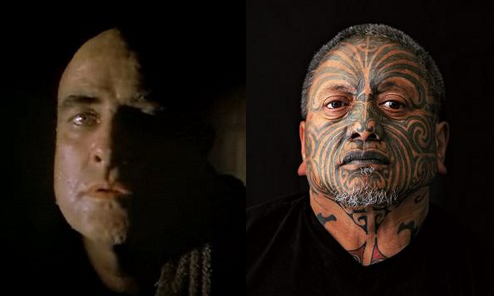
Tame Iti is a convenient symbol of all that whitey wants to fear. Since the events of October 2007 he’s been dressed up as our very own Colonel Kurtz.

Likewise Hone Harawira to an extent; Danyl’s brilliant commentary on this is here. The reality is — to put it very mildly — somewhat different. This isn’t to say that either are utterly blameless, or that this depiction is entirely unwanted; only that their notoriety is rather greater than is really deserved.

Lew, What did you think of Bomber Bradbury’s take?

(Assuming Bomber’s take on police and firearms here.) Bomber distrusts and fears the police, and he has his reasons for doing so. In that context the response is not unreasonable or unusual. While I agree with a lot of what he says in principle, I essentially see police as part of a healthy civil society, not as its enemy, so I ascribe those concerns somewhat less weight. So where Bomber insists on hard restrictions on police powers, I am more content with soft restrictions and strong civilian oversight. It’s an open question as to whether our present oversight is sufficient, though.

Edit: TBD was actually asking for my views on Bomber’s response to the October 2007 Urewera Terra raids. I’ve answered in the comments below.

L

Firearms, no debate

I generally agree with r0b’s reasoning on the police need — or lack — for firearms. This is a mostly-empty moral panic.

But how things have changed for Greg O’Connor of the Police Association. This from 1 June 2009:

Mr O’Connor, who is currently studying policing in Scandinavia, did not support all police carrying guns but said the matter had to be looked at. […] “We said the debate should take place outside the emotion of Len Snee’s death and it’s disappointing to see that now there’s not going to be any debate there needs to be.”

A year ago Greg O’Connor was careful to frame the Police Association response in this way. He repeatedly said he didn’t want to arm all officers, he just wanted “a debate”, and one which would take place in the cold light of reason rather than as a knee-jerk in the aftermath of a police shooting. That’s a mature and responsible position. But even though the debate has not really occurred in the intervening year, his position has congealed — or perhaps he now just feels more at liberty to express it — into “all guns, all the time”.

What’s changed in the past year? The agenda has changed, that’s all: how firearms are framed in the public discourse about policing. Any time a firearm is used — regardless of the outcome — it’s a big media deal. Recent events such as the Urewera Terra raids of October 2007, the retrial of David Bain, the story of a large number of dogs being “massacred” using a firearm, and of course a number of police shootings have imprinted the prominence of firearms as public menace on the public consciousness. This has progressed alongside a police and crime-reporting discourse which has as its basic theme the notion that our plucky boys and girls in blue are under constant attack from all sides. Contrary to O’Connor’s noble aim, there has been no meaningful debate about arming police. This fact suits his arm-the-cops purposes, and it’s now clear that those cries for a debate, and the appearance of a debate within the Police, were made with the primary purpose of simply keeping the issue primed and on the public agenda. It’s lurked there, undebated, for a while, and with these most recent events it’s moving rather rapidly closer to actually happening. That’s a dangerous way to set policy.

Although I accept this is a contentious position, I generally believe that we need to trust the operational discretion and instincts of frontline police staff, as long as we have tough and independent disciplinary oversight as to their policy, and conduct in implementing that policy. On this basis, I’m not categorically opposed to the notion of police vehicles containing a lock-box with firearms in it, which police can use in accordance with firm and well-documented policy in light of the tactical circumstances in which they find themselves. But I would say that this isn’t very different to the current status quo, and the use of firearms must not be left to the sole discretion of an individual officer. The deployment policy and tactical decisions to deploy must be matters for which police command can be held accountable, for which the police as an organisation are responsible.

But what I’m more interested in is a public debate on this, and other policing matters. We really need one.

L

Sleeping dogs

Tim Watkin usually writes good sense, but with the latest post on gun control it’s clear he just doesn’t know his subject. Toughening gun control in NZ is basically a hiding to nothing, both in policy and in symbolic terms. It’s pointless for three main reasons:

  1. We already have pretty sane firearm laws and gun culture which regulate legitimate gun owners, and constrain the sorts of weapons most useful to criminals;
  2. As a country, we own a lot of guns, and they’re important to our way of life and identity, and this importance is the subject of bipartisan political consensus;
  3. We have very low rates of gun-related crime already, and any regulation which would be effective would be very costly, both in financial and political terms.

Just to preface this: I own a hunting rifle, and as a bit of a propaganda geek I’ve paid close attention to gun control as a matter of symbolic politics (alongside abortion, it’s a leading “touchstone” rhetorical issue in US domestic politics). I’ve been watching the way NZ is beginning to develop a (rather amateurish, but effective enough to not be laughable) US-modeled gun-ownership lobby with interest as well. But I’m not one of those “don’t tread on me” gun nuts who thinks bringing a loaded assault rifle to a town hall meeting is a core part of the democratic process. Owning a firearm is useful, but it’s not an absolute right — rather one which must be weighed against other consequences, including those which stem from arming communities. But I object to knee-jerk policy proposals which misoverestimate the problem, won’t solve it in any case, and will come at considerable cost.

What problem?
The most significant objection I have to Tim’s analysis is that he assumes gun crime is a serious enough problem to warrant harsh regulatory consideration; and seems to think that tackling it like the government has “tackled” knife crime is a sensible approach. I reckon both are suspect assumptions.

According to a UN survey from 2000 (the most recent I can easily access), 13% of our homicides (including attempts) were committed with a firearm, at an annual rate of 0.18 per hundred thousand population. That is a rate slightly higher than the UK (0.12 per hundred thousand, with much more strict firearm laws); just over half the rate of Australia (0.31, also with much more strict firearm laws, including a hugely expensive buyback programme undertaken in 1996 with the intention of solving the problem). I don’t think things have changed all that much; in 2009, the year of Jan Molenaar, the figure was 15% of our recorded murders (incl. attempts). You can use the Statistics NZ tools to get data here. You can also compare a bunch of countries’ rates here, but be sure to read the disclaimer. The bottom line is that we have extremely low gun crime rates by world standards, especially given that we have very high gun ownership rates. By far the highest proportion of gun-related deaths in NZ are suicides — I don’t have the numbers to hand but I recall it being above 70%. That’s a consideration, since suicides are usually committed with weapons of opportunity, and a firearm is particularly effective. But this is not the argument being made.

Knives are a much more serious problem, accounting for about twice as many homicides in NZ, and “other weapons” and “manual” which I assume includes unarmed homicides are also generally more common than firearm murders. The government has seen fit to “crack down” on knife crime by trying to prevent youths’ access to knives at the retail level using a voluntary code of practice. This is pure security theatre. Everyone credible knows it won’t make a blind bit of difference because kids don’t go and buy a knife from a shop, they just take one from the kitchen drawer or the toolbox in the garage. Firearms are already much more heavily regulated than this, and as a consequence people wanting one but who lack a license don’t roll into Hunting & Fishing and buy one — they get them illegally because we have no idea how many there are or who owns them (more on this later). So the comparison between guns and knives, while tempting, is bogus. Knife crime is much more serious than firearm crime, much less-heavily regulated, and the trivial additional regulation proposed won’t change anything — but it also won’t cost anything.

What guns?
Part of the reason gun crime is such a minor problem in NZ is due to our history and culture with guns, and in particular the fact that “personal defence” has never been a justification for firearm ownership. Tim also gets this wrong: citing “personal defence” as a reason for needing a firearms license will mean you get denied one, especially if you’re trying to apply for a restricted weapons license (which is the example he uses).

Excluding the post-settlement period, firearms in NZ have generally been conceptualised in law and culture as tools rather than weapons — for hunting, sport shooting, or the defence of the realm. Most in existence today are .22 calibre rabbit guns, or bolt-action ex-infantry rifles from the first and second world wars, passed down from father to son, or modern firearms based on near-identical designs, or shotguns designed for gamebird hunting. Partly due to length, partly due to action design and calibre, these are pretty useless for self-defence except for the appearance of threat and as clubs. By the same token, they are far from ideal for offensive use. Part of the reason criminals are rarely armed with firearms is because they are nearly impossible to conceal (which makes carrying or using them a riskier proposition than, say, a knife), and if sawn off below the regulation length of 30 inches, they are still not very convenient, and give police instant cause for book-throwing if discovered.

There are relatively few pistols or assault rifles in NZ, and those which are owned are very tightly controlled, with extremely high standards required of the owners. The NZ Police apparently operate a “sinking lid” policy on restricted weapons: to gain permission to import or produce one, you need to destroy another. This has driven the market price of such weapons through the roof, putting them out of the reach even of many legitimate collectors; although it must be said that the distinction between a “military-style” semi-auto and any other semi-auto is largely (not entirely) cosmetic, and one is no less deadly than the other. As the rather grim saying goes, the seven-round magazine restriction on an ordinary semi-auto centrefire rifle just means that if you want to kill more than eight people, you’ll need to reload.

Firearm licenses, especially those for restricted weapons like military-style semi-automatics and pistols, are issued at the discretion of an Arms Officer on the basis of the applicant being of “fit and proper” character. The threat of losing the license acts as a firm constraint on legitimate gun owners’ behaviour, with most hunters, collectors, etc. living in fear of having their license revoked. This constraint comes into force, for example, when deciding whether to keep a firearm for self-defence purposes in a country where most potential assailants, burglars, etc. are not themselves armed: if you happen to use it as such, you must then explain to your arms officer how come you had it handy, rather than locked up in its safe, with the bolt and ammunition separated. Most people comply to avoid this inconvenience, and because they know that the chances of a family member actually meeting a life-or-death situation are much higher with a loaded firearm lying around than otherwise.

In general (and again, I don’t have the figures to hand) the vast majority of gun crime in NZ is committed by people without a legal right to own or use a firearm in the first place (being not “fit and proper”). Jan Molenaar was just such a person, so using him as an exemplar of all that is wrong with the system is a bit misleading. It’s certainly an indictment on police procedure following the last shake-up of gun laws. Probably the biggest failure in our gun licensing regime is the lack of a registration system for specific firearms. It’s expensive, time-consuming and bureaucratic but would have been of some use had it been implemented when suggested by the Thorp report, even if just to draw a clear demarcation line between compliant and non-compliant owners. I think that horse has bolted now.

As for the matter of private internet sales of arms and ammunition — Tim clearly hasn’t used Trade Me for this purpose. It’s considerably more robust than any comparable method other than a brick-and-mortar shop (and many B&M shops use the same methods to sell nationwide). Anyone can view restricted auctions, but to bid or ask a question you need to enter your firearm license number. Repeated failure to do so (or entering made-up numbers) gets you blacklisted. If buying otherwise than by a face-to-face meeting, you are required to complete a form designated by the Police for this very purpose, and have it counter-signed by your local Arms Officer, who sights your license. The first step (needing to enter your number) prevents anyone without access to a license even bidding or making contact with a seller. This is probably the most effective safety mechanism in the system.

Sleeping Dogs
These are policy and cultural reasons which explain why trying to crack down on gun ownership in NZ is likely to be pointless. But Tim’s post was largely about the political aspects of the issue: the tension between the imperative to be Tough On Crime and the danger of getting tarred with the Nanny State brush. In symbolic terms, I reckon gun control is a loser for both of the major parties because, unlike the knife measure which is empty theatre, any meaningful changes to the gun ownership regime will come at a considerable costs. One important consideration with this is that in NZ (and Australia), unlike in the USA, gun control is seen as a matter of bipartisan consensus, with both National and Labour generally occupying the middle ground (and ACT and the Greens taking up the flanks). This means there’s little or no partisan advantage to be gained by either side.

The first of these costs is purely financial. A registration, licensing audit, inspection-reclassification or buyback scheme to remove firearms (or certain firearms) from circulation (or from the hands of those not “fit and proper”) is hugely expensive. The Australian Federal Government raised a special tax for the purpose and spent hundreds of millions of dollars on its buyback scheme, and even given the dramatic reduction in gun crime rates which resulted, it was generally seen to be wide-open for rorting. In New Zealand, with a much lower baseline level of gun crime, much less money and much more pressing law and order policy issues, this simply wouldn’t fly. Quite apart from the money, the drain on already-stretched police time would make a mockery of the government’s pledge to deliver resources to the front lines and away from the “bureaucrats”. And for all of that, it would still predominantly capture guns possessed by licensed owners: the “good guys” who, of all people, should retain their gun-owning privileges.

The second, and probably weightier cost is about the NZ identity. As I’ve argued before, wild places matter to us in identity terms. While most New Zealanders don’t own firearms, and never will, many more than the 250,000 who do like to think of themselves as potential outdoorsfolk who might go and shoot a possum and do their bit to save the rata. I don’t want to overstate this, though. Gun owners and hunters are viewed with considerable ambivalence by the general public, and with some cause. The gun lobby doesn’t do itself or the more reasonable branches of the sporting community any favours, and to a large extent they’re thought of in similar terms to Jan Molenaar and the various flavours of SHTF nutters.

But Nanny State also comes into this. Tim suggests that Labour couldn’t afford to do this for fear of strengthening the narrative established by the last term of the Clark government (I agree), but that National might just be able to get away with it. I disagree. Half of National’s support base are farmers or rural/semi-rural men of above-average income who are generally law-abiding and consider themselves responsible citizens in partnership with the authorities — of the view that the government “works for us”, rather than the view that the government is an agent of their oppression. (There are exceptions to this last, but mostly they vote for ACT and are thus irrelevant to this calculus.) This is almost exactly the same demographic which wants to be able to take care of his own rabbit problem and hunkers down in a cold maimai before dawn on the first weekend of winter for a laugh, and they greatly value the illusion that doing so is an inalienable right akin to that laid down by the Second Amendment. They tolerate (often with considerable reluctance) the existing licensing regime partly as a pragmatic solution to the social problem of crime, and partly because it accords them the status of being officially deemed “fit and proper”. But they will not tolerate further incursions on these privileges, and it is this demographic whom the gun lobby, with its US-imported “armed society is a polite society” rhetoric, is targeting using the present hysteria about violent crime as a springboard. These are the guys who already feel under threat from policies like the ETS, which prevents them from buying the V8, forcing them to settle for the V6.

This demographic might be the sort of people who could be persuaded to support tighter restrictions if there were a strong crime-reduction case to be made for it. But since there’s so little to gain, and since the existing regime is already at the margins of what is acceptable, National rouses these sleeping dogs and permits their radicalisation at its peril.

L

Broad Bows Out.

I cannot say that I regret the news that Howard Broad is ending his tenure as Police Commissioner. Regardless of what positives he brought to the job–and I know that certain people on the Left think that he is a great guy who can do no wrong–for me he is to the NZ Police what Richard Woods was to the NZSIS: a person who allowed overtly political criteria to intrude on what should have been autonomous decision-making based on assessments of real threat and practical priorities. Just like Wood’s disgraceful behaviour in the Zaoui case, Broad was the man at the helm during the Urewera raids, raids that just happened to be timed to coincide with the final reading of the revised (and more draconian) Terrorism Suppression Act and which targeted well-know dissidents who, whatever their crazed (or intoxicated) rhetoric and antics in the bush, were as far removed from a terrorism plot as are medieval war reenactment societies. Broad is the man who has lobbied in favour of expanded (domestic) surveillance and search powers for the Police and other state agencies. Broad is the man who ran the show at a time when a culture of criminal abuse within the Police was exposed, only to preside over a corporate whitewash of the culture rather than a wipeout of it. Truth be told, Broad was handpicked for the job by the Labour leadership  because of his ties to the party, and given the position when his  (less compliant) predecessor committed a personal  indiscretion that cast doubts on his professional judgement. In sum, Broad may be a nice guy in person, but under the 5th Labour government he allowed his political masters to exert too much influence on the Police as an institution, IMO.

All of which makes Pita Sharples’ tribute to Howard Broad, particularly his honoring Broad for services to the Maori community, as sickening a piece of political syncopathy as has been seen in recent years. On this one, I think Hone Harewira is right: the less said the better.

Having stated my view, let me also state that I do not believe that National will do anything to diminish the politicisation of Police decision making. In fact, Key and co. could well make it worse.