Response to Phil Sage on the FSA

Phil at No Minister has written a long and pretty useful post on the background and consequences of the FSA and its coming repeal, titled Customary rights, free access and the beginning of the end for Socialism in New Zealand?

I have a couple of things to quibble about, and since I dare say there’s not a huge crossover between the readership of KP and No Minister, I’ve reproduced my comment below.

Continue reading “Response to Phil Sage on the FSA”

Between the Devil and the deep blue sea


(Image, “Road to Hell”, stolen from Alexander West.)

And I did not mean to shout, just drive
Just get us out, dead or alive
The road’s too long to mention, Lord, it’s something to see
Laid down by the Good Intentions Paving Company
(Joanna Newsom)

John Key’s government is starting to play for keeps after a year and a bit warming up. There have been a few clear examples of this, including the aggressive tax and service cuts in Budget 2010, and signs pointing to privatisation in the not-too-distant future. Less orthodox is the recent hardening of the government’s position on take Māori.

Key was not punished for his calculated snub of TÅ«hoe, and it seems the success has emboldened him to flip the bird to an even larger Māori audience, saying two things: that Māori can take or leave the government’s public domain proposal for the Foreshore and Seabed; and that by “Māori” he means “the māori party”. It’s these things I want to discuss, and they need a bit of unpacking.

Pragmatism and principle
Conventional wisdom on the Left is that Key’s blowing off Māori is (either) paying the red-neck piper, or a genuine manifestation of his (and the government’s) own racism. I think it’s neither and a bit of both. On the second bit, I accept that the National party’s history on Māori issues is broadly racist inasmuch as it hangs on a “one law for all” rhetorical hook whilst systematically opposing measures which safeguard the equal application of those laws to Māori, but I think this is down to the casual racism of privileged ignorance rather than the malicious anti-Māori sentiments of Orewa. Key’s politics, I am convinced, consist of a thick layer of pragmatism on a thin frame constructed of a few very strong principles. The principles are not the bulk of his politics, but they strictly delineate the extremes of what he will and won’t accept. Fundamentally on cultural issues he’s a pragmatist, and doesn’t much care either way as long as he’s getting his. But there is a solid core there which is only so flexible, and changing the ownership status of huge tracts of land (whether by Treaty settlement in the case of Te Urewera or by nationalisation in the case of the Iwi Leadership Group’s suggestion regarding privately-owned sections of the Foreshore and Seabed) is too much of a flex. There are good principled reasons for National to oppose such a scheme, and for this reason I don’t think he’s pandering to the redneck base so much as preserving what he perceives to be the National Party’s immortal soul: cultural conservatism and the maintenance of material property rights. Although I broadly disagree with the reasons, and the decisions, I wish that Labour had done as much to preserve its own immortal soul in 2004 and 2005.

“One law for all”
While I’m on record opposing a “public domain” resolution of the Foreshore and Seabed because it’s a solution of convenience rather than one born of any deep consideration of the issues in play, I have a little more time for Mark Solomon’s suggestion that if Māori are to give up nascent property rights to the takutai moana, those already holding such property rights ought to be obliged to do the same. I’m not convinced by arguments from PC and DPF to the contrary. PC’s argument, that iwi and hapÅ« ought to have full common-law recourse to test their claims as permitted by the Court of Appeal ruling in favour of Ngāti Apa has more merit than DPF’s, but I still consider it a poor option since there is a high likelihood of a culturally and politically repugnant outcome which would lack durability and further inflame racial hatred. Contrary to DPF’s claim that Solomon’s position is unprincipled, Tim Watkin argues that it’s actually a pretty good representation of “one law for all”. It would ensure that existing landowners — most of whom happen to be Pākehā — are not grandfathered into a new scheme simply by virtue of having bought land which may or may not have been legitimately acquired from whomever it was bought, while iwi and hapÅ« — who happen to be exclusively Māori — are forced to give up their rights. I argued much the same thing a few days ago, and I’m pleased to see someone else thinking along the same lines. While the whole Foreshore and Seabed going into public domain is worse than Hone Harawira’s proposal that the land be vested in customary title with ironclad caveats because it strips away rights rather than granting them, it does have the advantage of stripping those rights equally, rather than on the basis of largely racial discrimination.

There is another, economic, point in play: if land not presently in private ownership is placed in the public domain and declared inalienable, the increased value of those few freehold, fee-simple property rights which do exist at present will have a phenomenal distortive effect on the property market and on New Zealand’s social structure, with the inevitable result that almost every scrap of it will end up in foreign ownership. We will then have the perverse and incoherent result that most of the beaches will be owned in common — but those which aren’t will be the exclusive domains of ultra-wealthy foreigners. Whether this is a good or a bad thing is a fair point for debate, but I think this fact will grant Solomon’s proposal considerable appeal to the broader New Zealand public, especially among those who do not — and even at present prices, could never — own waterfront property.

Just who are these “Māori”, anyway?
As I noted above, Key has been clear that he cares not a whit for the Iwi Leadership Group’s views on the matter: he considers that the māori party has a mandate to negotiate for all Māori and the decision is theirs. This is strictly almost correct: they do have a such a mandate, and whatever they decide will be broadly regarded as legitimately representing “Māori”, to the extent that the decision accords broadly with the views of Māori as expressed by their various civil society agencies. This proviso, missing from Key’s glib assessment of the political situation, is crucial. By omitting it, Key aims to drive a wedge between the party and those civil society agencies — chief among them the Iwi Leadership Group convened for this very purpose — from whom they ultimately derive their electoral mana. The māori party, frequent howls of “sellout!” from the Marxist left notwithstanding, do regularly test their policy positions against these stakeholder groups, at hui, and in their electorates. This makes them particularly secure in terms of their support, as long as they act in accordance with their supporters’ wishes. I have long criticised the howlers for misunderstanding just what it is that the māori party stands for, and their mischaracterisation of the party — plump buttocks in the plush leather seats of ministerial limousines, representing “big brown business” — is similarly a wedge, of a slightly different hue. But this issue is the test. Without the support of the Iwi Leadership Group, it’s hard to see how the māori party could maintain its claim to a mandate.

Crossroads
Which brings me to the verse at the top of this post. This issue has deteriorated to the point that the National government — like the Labour government before it — issuing public ultimatums to Māori and prejudging the case by claiming to speak for the māori party’s position. That is not mana-enhancing for a coalition partner which has showed enormous patience and swallowed almost innumerable dead rats in exchange for largely symbolic concessions. This breakdown of diplomacy on its own is not sufficient to call time on the coalition relationship — that comes down to the merits of the choices available, and the proposal simply isn’t enough. I have long defended this approach on the basis that the big issues were still to play out — but the loyalty and commitment shown by the māori party, in the teeth of furious criticism from enemies and allies alike, must be rewarded. A Whanau Ora pilot programme simply isn’t enough. This road was paved with good intentions, and there was a chance it would lead elsewhere than where it did — a chance which had to be taken but which, barring a swift change in the government’s position, seems to have proven unfounded.

If the government holds to its ultimatum, the māori party must turn around and walk back into the light. On this I agree with Rawiri Taonui (audio). The party will lose much more by abandoning its people and agreeing to a Faustian bargain than by simply failing to negotiate the repeal of the Foreshore and Seabed Act, which realistically was a nearly impossible task in any case. And even if the party did support the bill, it would not mean the end of the struggle. As Taonui says, although they might have the numbers to pass the legislation, the government’s solution will have no legitimacy or durability in practice without the support of the ILG and those it represents. Where there is injustice, resistance will seep out around the edges. If the issue of the takutai moana remains live, the party can continue to advocate for a just and enduring solution, and the ILG’s proposed solution opens a potential route for re-engagement with the Labour party. All is not lost.

The big question — as I asked in r0b’s excellent thread the other day is: what will Labour do?

They can sit back and say “I told you so” to the māori party, hoping they will fold, or they can make a better offer and hope the māori party will become more inclined to work with them. I can see how either would be a reasonable tactical position in terms of electoral numbers, even though the former course of action would continue the erosion of Labour’s historically liberal and Māori support. But there’s also a real danger the party will do neither, or will attempt to do both and fail at doing either, such as by arguing that the FSA was actually not that bad after all. That would be a tragedy.

The whole world’s watching. I have to say Shane Jones, who the party desperately needs if it is to have credibility on this issue, hasn’t helped dispel the predominant impression of Māori politicians held by the New Zealand public.

L

Life mimicking art: Hollywood Shrugged

[Update: It occurred to me that I missed an opportunity for wordplay in the title of this post, so I’ve belatedly changed it. Groan away.]

Via Not PC, the news that Atlas Shrugged is finally being made into a movie. Or three movies, as is appropriate.

After decades of studio procrastination, the principals of the project have decided to simply go it alone and produce it as an independent project. They have plenty of money, but no name actors, a debutante director and an inexperienced production team, and are working to a shooting deadline which doesn’t permit any detailed production planning. The names are John Aglialoro, Brian O’Toole, David Ellison, Dan Pritzker, Stephen Polk. (Who? Yeah.)

This is foolhardy in the extreme. As the making of one of the greatest American films of all time illustrates, filmmaking is hard, especially when you’re working with complex, well-known (and well-loved) source material. Even when you have the resources of a studio system behind you, and the ability to pick up the phone, drop a name, and have things be done, making a single feature is the sort of undertaking which destroys people. Making a trilogy? Wow.

Atlas Shrugged is a story of superhuman struggle against mediocrity; succeeding despite the interference and opposition of the whole world, a David-and-Goliath stick-it-to-the-Man fable for our time. Its protagonists achieve the impossible by sheer force of will. The story rests on deus ex machina devices — a “free energy” machine which powers the revolution; a cloaking system which hides it; a means of extracting bounteous yields from exhausted oilfields; self-destructing high-tech equipment; individuals of perfect and apparently limitless genius who just up and invent these things as and when they’re needed, etc — and the backers of this project seem to be relying in real life on the same sort of narrative logic to get them through. They appear to think that, if one just wants something hard enough and is sufficiently single-minded in pursuit of that goal, it will be so. As commenter Double0seven says on the release announcement story:

This is truly hilarious. A study in hubris or as the kids these days call it – EPIC FAIL. So we’ve got no stars, a director who is actually an unknown actor, a producer by virtue of wealth and two weeks of prep for a June 11th start date? And then, underlying material that is ridiculously hard to crack. Don’t get me wrong, like many of you I fell in love with Rand’s objectivism in my angry young 20s, but look at the material and consider the economic climate, even if they get this movie made and released, think about movie going demographics – there are not enough teabaggers to support an opening. Perhaps like in the book, this film will open on one screen in a hidden valley in the rockies, where industrialists will pay their admittance in gold. Good luck John Galt.

Perhaps unusually among non-Objectivists (and non-converts to objectivism), I enjoyed Atlas Shrugged and I think it’s a pretty important piece of our political-philosophical culture. I want good movies made of it. I’m bemused but not surprised that the vaunted market of the Hollywood studio system has entrusted such an ambitious and important project to moneyed dilettantes who think themselves Atlases. And (as the comment thread I excerpted above goes on to discuss), there’s no use in citing the filmic Galileo Gambit of Orson Welles, George Lucas, and other Hollywood wunderkinder — for every one of them there are a thousand who were crushed by the machine they set in motion but could not control.

There’s the faintest glimmer of hope that this project will be a genuine bolter, but with this degree of expertise, time and talent involved, the most likely outcome is a blend of the worthy but unpolished products of the 48-hour Furious Filmmaking Festival, an embarrassing Ed Wood-esque schlock-fest, and the earnestly didactic bombast of the films TV channels screen on Easter morning and at Christmas, partly because they feel like they should, and partly because it’s a ratings desert anyway. Objectivists, bless them, seem to lack any sort of humour about the objects of their affection, so while the rest of the world might not mind this latter result (for one film, at least), I fear the self-declared mavens of philosophical and aesthetic rectitude will make fools of themselves defending the cinematically indefensible. It would be a shame to see these people prove that they’re really just Twi-hards with lofty ideals and better argumentation.

But hey, it’s their risk to take, and their choice to make fools of themselves if they want. Galt knows (as they say), they don’t need the approval of us moochers. So let them boldly stand in the path of the machine, and more power to them. But my sense is that a few exultant idealists are about to discover that unflagging self-belief and unlimited money just isn’t the deus ex machina in real life that it is in fiction.

L

A Weird Request.

Some readers may have taken note of the fact that there is an alternative blog awards competition underway, created because the Qantas Media Awards blog category has become a bad joke. In a comment made on my last post about strategic culture, someone from the alternative blog awards organising committee (the so-called NZ Bloggers Union) has urged KP to enter the competition. I want to ask readers whether that is worth doing.

I say this because I am not a fan of awards competitions of any sort outside of sports and military affairs. But that is my prejudice. The criteria for entry is that nominees provide 4 posts from 2009 as material for the judges to consider. The details of the competitition can be found here:

http://airnewzealandbestblogaward.blogspot.com/

I can think of four posts written by Anita that alone could provide could material for the judges, and can say the same thing about Lew’s writing. My personal opinion is that some of the things they have written stand out as among the best NZ socio-political blogging in recent years, with a few of their posts being absolute game-changers when it comes to informed public discourse on given subjects. But, as I have said to them, I am not sure that the submission is worth doing because the deck may be stacked in favour of larger, more rabble-rousing and partisan blogs that prefer polemics and diatribes rather than reasoned debate.

I have two questions for those who may be interested in these awards: 1) should KP enter the competition? 2) If so, what four posts would you select as the most outstanding and representative examples of what KP has to offer?

The deadline for entries is June 1.

No offense will be taken if readers opine that we should not enter. I only put this out to the readership because I am of two minds about the whole thing and could not select four representative posts in any event.

Summary of joke news coverage

“John Key has made a meal out of ongoing Treaty negotiations with Ngāi TÅ«hoe, remarking at dinner with representatives from neighbouring iwi Ngāti Porou that if he were in TÅ«hoe country, it would be him on the menu. TÅ«hoe have found his comments hard to swallow, with lead negotiator Tamati Kruger saying the remark was in “poor taste.” Others believe the gag should be taken with a grain of salt, as a self-deprecating reference to the roasting Key has received since ruling out the return of Te Urewera National Park. The decision has soured iwi relations with the government, and effectively put negotiations on the back burner.”

(Some artistic license employed, but I’ve seen each of these puns in bona fide media coverage over the past 24 hours.)

Update: It seems nobody other than ak and I have the stomach for a pun-fest. Oh well.

Still, better to remain silent than engage in the shrieking, confused and exploitative orgy of idiotude on display at The Standard. Its only meaningful distinction from the response of the KBR seems to be the lack of ginga jokes. And the comments are a bit shorter. A shame, because there was some reasonable sense from both posters and commentariat on this topic yesterday.

L

Insensitive … now wait for the “hypersensitive”

Commenter Alexandra at The Standard picked up on a report by Radio NZ that John Key joked about Tūhoe as cannibals:

“The good news is that I was having dinner with Ngati Porou as opposed to their neighbouring iwi, which is Tuhoe, in which case I would have been dinner,” [Key] said, “which wouldn’t have been quite so attractive.”

Now, a reference to cannibalism in any leader’s speech is bad enough, but joking about it in the context of the government’s betrayal of TÅ«hoe, and Key’s failed attempt to speak for the māori party regarding that betrayal would be absurd if it wasn’t so insulting. Not only that, but the reference to Ngāti Porou was all the worse, given the complex history of those two iwi, which was also in the news recently but of which Key appears to have no awareness.

Two main questions occur to me: first was this a calculated move to distance himself and the government from the sense he has “gone native”, or just an idiotic off-the-cuff remark? (Essentially: bad will, or just incompetence?) And second, what will it take to prevent the māori party from walking away? As Marty Mars says, this is a significant matter of the mana of TÅ«hoe, and the mana of Māori in general. It cannot just be left to lie: either the māori party walks away, or some sort of meaningful reparation — you might call it “mana enhancement” — must be offered by the government, not only to TÅ«hoe and the party, but to Māori in general. The māori party are in a tough spot; as I argued yesterday, Māori don’t have the luxury of just throwing their toys whenever they don’t get their way. But something has got to give.

Oh, and as per Pākehā Standard Operating Procedure on issues like this, wait for the Māori response to be declared hypersensitive.

Update: Same being asked by Lynn at The Standard.

Update (20:25) Much has become clear since I wrote the post. Some updated thoughts follow.

First, it’s clear that this wasn’t an inadvertent, casual comment — it was, if not a planned and sanctioned statement then clearly a calculated one intended, after apparently growing discord at the Lower North Island National party conference this weekend past, to win Key and the government back some of its reputation for driving a hard bargain with Māori, and for not being a PC pounamu-wearing hand-wringer. So the initial diagnosis is “bad will” rather than “incompetence”. This was a simple continuation of the negotiative process which Key chose to stall by unilaterally ruling out the return of Te Urewera National Park; Key providing an opening for TÅ«hoe to continue dialogue, or not.

Second, it’s pretty well-calculated. It would have been easy for TÅ«hoe (and others) to publicly overreact and confirm Pākehā New Zealand’s worst instincts about them. It would also have been easy for the māori party to walk away from the coalition deal, and I do think this is another factor in favour of that course of action. But they haven’t done so. Tamati Kruger’s response that the joke was “not funny, in poor taste and unbecoming of a prime minister” is pretty strongly-worded but shows its own sort of gallows-humour, indicating that Kruger (seasoned negotiator that he is) understands the game being played, and is prepared to continue playing it, given some caveats. Having today said that Key had lost his nerve Kruger has held his. He was magnanimous and humorous when speaking to John Tamihere and Willie Jackson about the topic on RadioLIVE this afternoon, but pretty clear that the deal is still to be closed, and it will now take some closing.

Third, Key has publicly insulted both TÅ«hoe and the māori party in the past week, and this does still need to be addressed. All parties seem to have chosen to address it around their respective negotiating tables, rather than in public, but behind closed doors these people will be furious at having been so treated, and for all that they’ve gained ground with the redneck street, that’s ground National will need to make up inside the wharenui. To put it in terms Key, as a former currency trader who worked a lot in Asia, would understand: the price of doing business just went up. And it went up quite a lot, because failure to accede to that increase means TÅ«hoe can now justifiably walk away from negotiations which are already almost two years underway, claiming that the negotiating team has no legitimacy, having been unilaterally overruled by their own prime minister, apparently just because he changed his minds. If they do that, expect every other current negotiation to go the same way. That’s an unacceptable political cost for Key before the next election, let alone the one after (by which all outstanding claims are supposed to be settled).

Fourth, a public sense is beginning to build of Key as the one who is endangering the relationship, after the opposite sense developed around Hone Harawira’s comments last year. If the coalition between National and the māori party fails, it will be seen as his failure to manage the relationship adequately, and that damages his own master narrative of being an efficient political manager and an all-round nice guy. As marty mars said in another comment on The Standard, the concessions granted to Māori by Key’s government are “barbed” — they can’t be revoked or withdrawn without sustaining substantial political damage, which means that if the māori party sees genuinely irreconcilable differences and an opportunity to dissolve the agreement without being seen as unreasonable, they are able to do so. But as Neil says in the comment thread below, and as I’ve been arguing to little avail for ages, the māori party’s best play vis-a-vis either major party is the threat to go with the other. Labour partisans and much of the wider left wish it were not so, but if Labour get a sense that they have a monopoly on the māori party’s attentions again, then further concessions will be rare and threadbare.

Fifth, the KBR response is just what you’d expect, complete with gratuitous references to the alleged taste of human flesh, and ginga jokes. Sigh.

Thanks for the discussion so far. Responses to other comments below.

L

MMP in NZ is safe

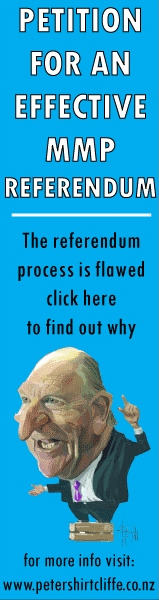
shirtcliffe ad
Evidence:

  • It has been found to work pretty well and all parliamentary parties except ACT support it.
  • The UK election is about to remind people how perverse FPP is.
  • Peter Shirtcliffe is spamming people in order to gain support for his anti-MMP campaign.
  • His google ad campaign looks like this ====>

Seriously. That’s him. A ranting white middle-aged elderly patrician of the sort New Zealand’s governments were almost exclusively composed before the change in electoral system — and on a soap-box, for goodness’ sake. A starker warning of what’s in store should the electoral system change is hard to envisage. Also: it’s visually busy and garish. The blue is neither National-party royal blue, nor ACT-party aqua-blue, nor flag-Navy; it’s nothing. The message is over-long and confused (campaign for an effective referendum? Don’t you mean to campaign against the electoral system? No? Ok then.) And the cartoon …

Thanks, Peter, you’re doing your country a great service.

(Thanks to Lyndon Hood in the comments to Russell’s thread linked above for the pic.)

[This line inserted to fill whitespace].

L

Organic protest, and reframing the mineral debate

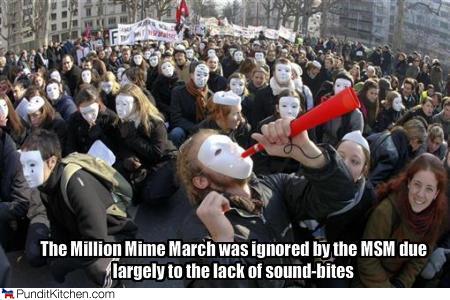
political-pictures-mimes-million-march

Like many others, I was amazed at the turnout for the anti-mining protest in Auckland on Saturday. That 50,000 people would turn out for such an event is remarkable in itself — the NZRU’s financial problems would be solved if they could attract so many people to half a dozen rugby matches each year, and we’re currently rebuilding Eden Park so they can seat that many a dozen or so times next year, and then maybe once or twice a year thereafter.

But the more remarkable thing about this march was its apparently organic nature. From my read — based only on the media coverage, mind — this was not a visually and ideologically cohesive, “branded” demonstration such as “enough is enough” and the more recent child discipline march, which were more or less Boobs On Bikes without the boobs or the bikes, advocating the wholesale adoption of a political product. It was not a heavily stage-managed piece of public theatre as the Foreshore and Seabed hÄ«koi was, and it was not a set-piece undertaken with a specific tactical purpose such as the most memorable marches of the Springbok Tour were. There were t-shirts and banners and so on, but these were not issued like uniforms with marching orders and approved wording for slogans, imagery and talking points. These were not rented crowds, seas of mime-like bodies serving as a vehicle for someone else’s words and sentiments. This was a genuine all-comers march, and if its almost unprecedented turnout did not bring genuine authority, then its authenticity surely must.

The response from the usual authoritarians has been a heady blend of confusion, disbelief and denial — the same sorts of delusions I normally accuse Labour partisans of falling prey to, when the observable data fails to conform to ideological modelling. This is bad for them, and good for those who oppose the government’s mining plans: if the government persists in believing the models instead of the data, it will go the way of the last government which did so.

But I don’t think this government will do that. I think it will see the writing on the wall, and reframe the mineral debate. Key and Brownlee have surely now seen their error: addressing mining in Schedule 4 as a national economic development issue rather than as a set of regional development issues. Going for it all in one bite was greedy, and as Danyl says, reflects the sort of complacency which creeps in when your opposition isn’t up to the task of opposing. But as strong and authentic as the Auckland march was, it has a weakness, and that’s that it’s composed of Aucklanders. Mining schedule 4 as a national strategy has failed, and likely at the cost of the opportunity to mine in the Coromandel and on Great Barrier Island, but it has thrown into sharp relief those areas where local views are less opposed — such as Paparoa, and possibly Mt Aspiring. As I commented on The Standard earlier, West Coasters are overwhelmingly in support of extended mining, a solid turnout in Nelson notwithstanding. Portraying Nelsonites as latte-sipping greeny liberal lifestylers begrudging their honest hard-working brethren on the other side of the hill a chance at the riches of the land will turn this into a classic town/country divide of the sort National and its mining allies are very skilled at exploiting. So watch for a few hundred — or maybe a thousand — Coasters marching in Westport to support the mining proposal being equated to this weekend’s demonstration in Auckland, and watch for well-meaning Aucklanders, Wellingtonians, Nelsonites and those from elsewhere being told in fairly certain terms to butt out of their regional business.

The government will be taking a risk if it proceeds with this plan, even in a regional form, because it has already permitted the debate to be established as a national issue about national parks in which everyone from the Cape to the Bluff has a stake — but it has amassed plenty of political capital, and now is the time in the electoral cycle to use it. Particularly with the Australian federal government unveiling a new resource tax, New Zealand just got more attractive for mining interests, and the imperative to dig, baby, dig will be stronger than ever.

L