Death is not the end

A curious post from Marty G at The Standard, who asks: “as newspapers die?” This is part of a wider debate about the future of the media, which I’d like to expand beyond just newspapers. As a caution to those who would conflate ‘newspapers are dying’ with ‘the media is dying’, I would suggest that the demise of the mainstream media is, in words incorrectly attributed to Mark Twain, greatly exaggerated. Fundamentally this comes down to the following:

1. If people care about it, it can likely be profitably monetised.
2. If it can be profitably monetised, big business will eventually come to dominate it.
3. The existing newsgathering infrastructure, brand authority, networks, subscriber bases and institutional expertise are still held almost exclusively by big business.

Big business may not be good at innovating, but it is very good indeed at buying innovation and covering the last mile. That’s what it’ll do, and in some cases, what it’s doing already.

There will be changes — in terms of how content is created and distributed, to the revenue model and in particular to the specific media consumed — but fundamentally the mainstream news media will continue to do what they do, which is tell people what they need to know.

The media do not predominantly provide consumers with a good — news or information or something to wrap fish and chips in or something to watch while eating dinner) — rather, they provide a service — a filtering system which sieves out and highlights the things which people need to know to function in their social and professional and ideological worlds. There’s already more news and information out there than anyone can possible pay attention to. We all have our preferred filtering systems — The Standard and Kiwipolitico are two; who you choose to follow on Twitter is another; whether you wake up to Morning Report as I do or Marcus Lush or The Rock or Southern Star, you’re relying on those sources to give you the information you need to function competently in your world that day, and in the days to come. This is the Ralph’s Pretty Good Grocery principle: “If you can’t find it at Ralph’s, you can probably get along (pretty good) without it”. At present, mainstream media filtering models are more advanced than they’ve ever been — but extremely crude by comparison to the sorts of models employed in new media.

Adopting the filtration models which are being developed in new media will require media companies to adopt some of those media forms, and abandoning the old forms. To take one thing (there are plenty of others) which newspapers, radio and television don’t really do at all: interactivity. So we’re going to see things become more interactive, and that interactivity become part of the filtration system. This is how Google’s advertising functions: your usage choices are a source of data about you, and that data is a pretty good predictor of what you’ll click next. That’s good for advertisers, because it offers them a chance to sell you stuff you might want, and it’s good for you, because of all the zillions of pieces of media out there in the world, it allows a media provider to better determine which are more likely of interest to you.

We’ll also see much more device integration, and in particular the development of e-reader hardware which acts and behaves like paper, and the development of news products which use that hardware to mimic newspapers in function — providing the visual grammar of headlines, columns and images on a broadsheet or tabloid page, a form which is very highly developed and so well-understood as to barely be considered a semantic form any more (like continuity editing, or 4/4 time) — but which is almost entirely absent from existing internet news media. I understand that Apple Computer has on order a couple of million high-resolution low-power 10-inch touchscreen LCDs to make a next-generation reader device for market in the next 12 months or so.

But these things are largely cosmetic. Overall, the fundamental nature of the media market will not change. Some of the big companies might die or fall apart, but they’ll be replaced. It won’t be independents and startups for ever, and there will never be a persistent community-of-knowledge citizen-journalists-ruling-the-roost utopia such as many in the blogosphere so desperately wish for (because it would allow them to quit their jobs and get paid for doing this full-time). The main reason for this is that news costs money, whereas opinion (i.e, 90% or more of bloggery) is mostly free but is reliant on news. The money for the news machine comes from the interesting fact that, in the commercial media industry, the ‘product’ and ‘consumer’ are the reverse of what most people think they are. The ‘product’ is not programmes or articles or news (that’s a service); and the ‘consumer’ is not the person reading, watching or listening. That person — you, and me, and everyone else who consumers the media — is the product, and the consumer of commercial media services is the advertiser whose products you also consume. The media, by functioning as an effective filtering system, serves you up content you want and serves up your eyeballs, earholes, networks and ultimately your wallets to advertisers who pay the media handsomely for doing so. Everyone wins — or at least, everyone goes away thinking they’ve gotten a good deal. This model, at a fundamental level, is not under threat, because there is no other ready means of monetising news. That’s not to say it will always be so. It’s possible that a media business model will emerge which doesn’t rely on advertising, but one way or the other, someone is paying, and if it’s not the advertisers paying for you, then in all likelihood it will be you paying for yourself. How much would you pay? Would that be enough? These are real questions, because talk might be cheap, but news ain’t.

L
Dreams and realities

This morning at The Standard, vto* questioned how anyone can figure that the TVNZ7 ad featuring Bill English could be political advertising, since it doesn’t contain any baldly partisan political statements.

What is party political about it? Nobody has come with anything specific to support the contention – merely, “it looks political” “I know political when I see it” etc etc. Specifics folks, specifics.

Although I tend to think vto is either being purposefully obdurate or is just simply oblivious, it’s a fair question. Since in my experience he is usually genuinely puzzled rather than just shilling for the blues,** I undertook to do an analysis of the clip for his edification (or ridicule). As I said in the comments thread, you don’t create this sort of thing by accident:

This is a form which has been finely tuned and crafted over half a century to serve a very specific set of purposes — it’s a complex and very challenging medium where every frame, every word, every note is loaded up with as much subtle meaning as possible. With apologies to Tolkien, one does not just walk into political advertising.

A few basics of political discourse, first. While in the case of video, a text is made up of sounds and images, this is different from the ‘words’ and ‘pictures’ vto talks about. There is also a temporal dimension to video: editing, mise-en-scene and lighting changes, camera and focal movement, etc. which I’ll lump in with ‘image’ for these purposes. Likewise, most of the sound is spoken words, but there is also music, which is non-trivial in terms of meaning. The point is that nothing is in there by accident. When you have a limited budget and the requirement to work within a 45 second ad slot, nothing is optional or discretionary.

Given that there are images and sounds, and that they’re all there for a reason, it should be clear that there’s more to analyse than just the words and pictures, and so an apparent absence of political meaning in the words and pictures doesn’t mean the text lacks political meaning; it just means that it’s not overt (or not overt to everyone). The meaning lurks in how the various parts of the text hang together as much as in the ‘words’ and ‘pictures’ themselves. This, also, is purposeful: people are natively suspicious of political messages, and it helps to be able to communicate them via means which people aren’t accustomed to analysing closely. People are very well accustomed to interpreting political speech (‘words’), but much less accustomed to parsing video texts and the subtexts which emerge when multiple texts are intercut with each other in a dense and coordinated fashion. This is what makes video such a strong medium for political communication; why Eisenstein and Riefenstahl and Capra were given such prominent positions in their respective regimes, and why practically every US presidential election since 1960 has been predicted by which candidate’s TV coverage was the stronger.

The clip in question presents a dual narrative which appeals simultaneously to peoples’ cautious, empirical, rational side and to their hopeful, nationalistic, emotional side in order to produce a sense of hope. It is composed of two separate video texts intercut: one featuring footage of Bill English, Minister of Finance and Deputy Prime Minister; and the second of Bill English, kiwi bloke. The topic is the same, and the visual edit minimises the visual difference between the two narratives, while the voice remains constant throughout. This continuity of voice leads us to interpret the statements of Serious Bill and Chipper Bill as if they are uttered by the same person (which they are) and in the same role and context (which they certainly are not). The context is provided by the image, not the sound, and demonstrates that one person can (and should) hold both opinions simultaneously although the relationship between the two narratives is arguable. Of course, people can hold both views simultaneously (though whether they should is another matter).

The first, Serious Bill, establishes the Minister of Finance at a respectful social distance in a dark suit (with cut-ins to tie and face); the Sky Tower and the bright lights of NZ’s commercial capital in the background, a composition chosen to provide authority and credibility. This is a fairly soft form of the tycoon shot, a wealthy man overlooking his glistening domain. He speaks calmly and in technical terms, playing NZ’s economic problems with a straight bat. He uses the first person plural (“we”) throughout in order to include the audience in his statements. He looks the camera (audience) square in the face, talking directly to us.

The second, Chipper Bill, is established in a full-frame headshot, cut from a full-frame headshot of Serious Bill. This is what I mean by ‘minimising the visual distance’ between the Two Bills. He starts with “Y’know”, a commonplace employed more often to tell people what they (should) know than to genuinely appeal to shared common knowledge. This also marks a distinction between the complex, technical language used by Serious Bill and the colloquial, understandable terms and sentiments which follow. It is a relief to hear someone speaking ‘plain english’ after all that techno-jargon, right? Especially when he’s saying something we want to hear: good news about how “we can beat those Aussies”, after the bad news which Serious Bill was talking about, how our we’ve been “underperforming” when compared to them.

Chipper Bill — smiling and personable, an approachable everyman in a patriotically black polo shirt, continues to be intercut speaking in exhortative platitudes about how we just need to “back ourselves” (cut briefly to Chipper Bill gazing into the middle distance) and “apply some old-fashioned Kiwi can-do”, and so on, in response to Serious Bill’s authoritative but somewhat dry and gloomy facts. This use of “old-fashioned” is a hint of a dig at the previous government, the one responsible for “underperforming”; this dig is made a bit more explicit with the enthusiastic “we’re nearly through the tough times and things are looking up” — just leave it to good old National and everything will be well, not like that other lot, who were opposed to everything traditional, right?

The two narratives describe the reality of how things are (described by Serious Bill) and a dream of how things could be (described by Chipper Bill), as the music gradually rises in the background. The clincher, and the factor which makes this more a political advertisement than anything else, is that Bill English is the connection between the two narratives: if you accept the narrative line, he is the key to turning the dream into reality. This is essentially an overarching ‘hope’ narrative, a most powerful sort in troubled times, as Barack Obama realised, and as expressed by Drew Westen in the first chapter of his book The Political Brain, which opens with an analysis of two contrasting video advertisements for Democrat presidential candidates: one successful, for the Clinton campaign, and one unsuccessful, for the Kerry campaign. What was Clinton’s narrative? Hope.***

This ad was not about policy. Its sole purpose was to begin creating a set of positive associations to him and narrative about the Man from Hope — framed, from start to finish, in terms of hope and the American Dream. […] The ad created in viewers a vivid, multisensory network of associations — associations not only to the word hope but to the image of Hope in small-town America in an era gone by.

This “Two Bills” ad creates a similar hope narrative around the putative Kiwi Dream of “beating the Aussies” with “good old Kiwi can-do”. How could anyone not like that?

Just so you’re not starved of policy analysis, there are unstated, non-trivial National party assumptions about what’s important all through the ad too. The prime one among these is a focus on financial metrics (GDP growth, productivity growth) to the exclusion of other considerations. A Labour ad along these lines might have emphasised a balance between economic and environmental and other outcomes such as quality of life — the fact that this ad mentions no other metrics than wealth is not value-neutral or void of political meaning: it demonstrates the writer’s policy priorities and direction. As well as that, the “beating the Aussies” narrative is a core plank of the government’s current policy of “closing the gap” — it’s not policy-neutral either, but is a function of the government’s own preferences and their political strategy of measuring themselves against previous governments on metrics which favour them. And hang on a minute: are we really “through the tough times”, and are things really “looking up”? Depends who you ask; this is a matter of opinion and legitimate professional dispute among Those Who Know About Such Things, it’s not a slam-dunk even if the Finance Minister says so: after all, it’s his job to say so. And will “old-fashioned Kiwi can-do” on its own really be sufficient to bridge the significant productivity and GDP growth gaps between NZ and Australia? What the hell is “old-fashioned Kiwi can-do” anyhow, and if it were that easy, why haven’t we done it all before? The entire narrative is constructed of politically-charged assumptions, but it is formed in such a way as to discourage the audience from thinking too hard about it.

There’s one other thing, too: Plain English is Bill’s newsletter to his constituents, and it looks like the similarities don’t end there. It was a catch-cry of his 2002 election campaign. Perhaps if he’d had this production team working on that campaign he’d have won, or at least done well enough to prevent Don Brash from taking over.

So that’s a reasonably thorough teasing out of the political content of this seemingly-innocuous 45-second commercial. As I said in the comment thread at The Standard, the only thing more absurd than this ad getting made and screened with a straight face is Eric Kearley employing the Lebowski Defence when challenged on the fact that the ad quacks very much like a propaganda duck. Regardless of whether it was bought and paid for, as the more conspiratorial commentators think, or whether the use of the form was simply a (very successful) ploy to garner attention, it’s idiotic to pretend that this isn’t political advertising in function. While I tend to find industrial explanations for apparent media bias more compelling than political explanations, people like Kearley obstinately denying the bleeding obvious doesn’t make it especially easy to keep doing so.

L

* Stands for ‘Vote Them Out’, as I recall.
** What else this implies about vto I leave as an exercise to the reader :)
*** It helped that Bill Clinton was from the town of Hope, Arkansas.

Protesting a little bit too much

21clarkyoungnats_smallDPF published two posts yesterday about prominent lefties comparing righties to fascists: Minto comparing Bush to Hitler and Amin, and Carter comparing Key to Mussolini. I agree with him that both comparisons are entirely unjustified, and do a great disservice to political discourse in this country.
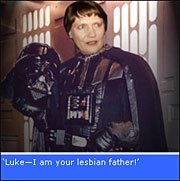
But without taking away from that, let’s not forget that David, his commentariat, his blogging cohort and indeed some of his ideological allies have spent most of the past decade making political hay by comparing Helen Clark to various dictators. David was central to the Free Speech Coalition whose billboards protesting the Electoral Finance Act evoked Mao Zedong and Frank Bainimarama; he wrote a weekly column entitled ‘Dispatch from Helengrad’, perpetuating the Clark=Stalin syllogism; his blog permits and tacitly endorses the almost daily comparison of left-wing political figures to tyrants; his closest blogging acquaintance Cameron Slater has constructed his political profile almost entirely of such cloth. The National and ACT parties themselves have a very large portfolio of such comparisons — from the Young Nats publishing the famous image above, to Heather Roy talking about the Clark government’s ‘feminazi’ welfare agenda to Bill English’s frequent comparisons of the Clark government to the Mugabe regime in Zimbabwe, both in the House and in the media. And how could I forget John Banks — former National party cabinet minister and now Citizens & Ratepayers Mayor of Auckland — whose public comparisons of Clark to Hitler, Stalin, Mao and Pol Pot and references to her as the ‘Chairman of the Central Committee’ among others only ceased when he decided to run for Mayor and they were no longer politically tenable. To say nothing of the foaming of various branches of the libertarian and objectivist movements, who are admittedly further from National than Labour are, but nevertheless have been occasional allies of convenience. Although typically less egregious than Carter’s and Minto’s comparisons, these are all the same in principle. The difference is one of magnitude, not of type. And the very worst examples of the type are exclusively from the right.

I should imagine that many of those who engaged in these sorts of attacks on Clark and her government but who are wide-eyed with mock outrage now that the shoe is on the other foot believe (to themselves if not in public) that the former comparisons were rooted in reality, while these latter are not and so are not justified. This demonstrates a phenomenal absence of political or historical perspective: Clark, like Bush, was removed peacefully from office by the ordinary process of democratic action, and the comparison of their programmes with those of the named dictators simply does not bear comparison, and it is disrespectful to history to draw it. David is right to point out that Labour are wrong for stooping to the level of National and ACT and their less-savoury constituents, but that does not erase the initial wrongness which spawned it, and in which he played a role.

L

[Edited to add Banksie and the libertarians to the list of offenders, and add the image at top.]

Traction

hide-rort

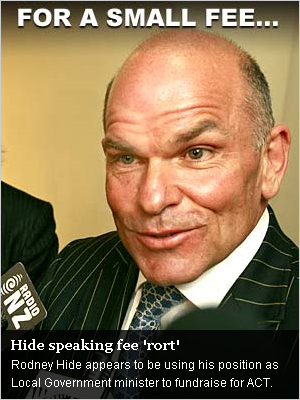
The story of Rodney Hide’s ministerial fundraiser is making headway — at present, it’s the splash spot on stuff.co.nz and is pretty prominent on the Herald site as well.

This image is strong. Close-ups are rarely flattering, and this one has an unctuous, indignant defensiveness which evokes, well, just about every crooked politico in history. The text, leading with the universal refrain of officials on the take and following up hard with that beloved word ‘rort’, gives the audience all the necessary context. This is a position Hide has spent his political career avoiding, and one which he was once merciless in prosecuting. It’s a long way to fall.

It seems that the credit for this should go to Eddie, who drew together its various strands into the narrative we now have. It’s been picked up by a few blogs, including Red Alert, where Phil Twyford published his own clearly-derivative-but-not-attributed riff on the topic earlier today, complete with Goff’s press release which forms the basis for the NZPA story. And it looks like Eddie even chose the photo which Stuff ran with — only one is flipped on the vertical. Well done.

Update: Lyndon in the comments points out that the threads were in fact drawn together by North Shore mayor Andrew Williams in the first instance, and published on Scoop.co.nz – so Frist P0st credits there, although the Labour response seems more derivative of Eddie’s work than that, so my point largely remains.

L

Maybe the greens are doomed after all

That’s greens with a small g, not the party itself, though with reference to this.

Anonymous Coward at The Standard sez:

To put it simply, you cannot be a socialist, a greenie or any kind of progressive and eat meat.

Way to isolate those political movements to the lunatic fringe.

I have myself used a similar rhetorical device before, notably in critique of Chris Trotter’s class-and-only-class dogma. But I didn’t go so far as to insist that people can’t rightly call themselves progressives unless they return their raupatu land to the tangata whenua from whom it was taken (as my family did) — only that they support, rather than hinder the overall agenda of Māori self-determination.

I’m thrilled for people to advocate lifestyle changes on the basis of their political, economic and environmental consequences, and I was right with the AC in their struggle for acceptance of their chosen lifestyle option — until it became clear that if I wasn’t with them, I was against them. It’s important to draw strong distinctions of principle and practice in your political movement, but I surely don’t need to point out the manifest idiocy of setting the bar so high as to consciously exclude four fifths or nine tenths of the population. Including toad!

In short: if them’s the club rules, then count me out, and count ‘most everyone else out as well — it’s your loss, not mine. Perhaps socialism is already marginalised in this way; but environmentalism and progressivism have a future without this sort of damfoolish absolutism. The future of those two political movements lies more with liberalism, as the preeminent philosophical force in modern Western democratic politics, than with the sort of proscriptive authoritarianism evident in that post. If they are to succeed it is with the carrot of willing change, not the stick of forced exclusion.

L

When the odious get onerous.

After a short week overseas I came back to find myself involved over the weekend in another argument about blog etiquette. It started out when I read Not PC’s post on  a troll. The issue basically boils down to the fact that one particularly nasty right wing frother (think Jesse Helms channeling Joe McCarthy and Glen Beck, but without the charm of either; to wit: racist, homophobic, foul-mouthed and pig ignorant)–who in the spirit of things we shall call “ratbuggered–” did enough to get himself banned and named by the blog owner. I weighed in on the side of the owner in the comments section, even while noting that here at KP we have put ratbuggered on auto-moderation so as to see if he has anything reasonable to say (so far he has not), and that as practice we do not “out” people who we have had trouble with (even though we have the ability to identify them). I noted that there are no universal laws or code of ethics preventing the outing of individuals using pseudonyms on blogs, for whatever reasons the blog owners may choose. There was much to and fro in the comments section, including from ratbuggered himself (who apparently lives in Tauranga. I shall leave you to draw conclusions).

The argument got picked up at No Minister, and things got pretty heated in the comments section. I weighed in some more, in further depth, arguing that market logics should determine blog traffic and that the blogosphere was ( come to think of it, like the Hobbesian “state of nature” that realists see to be the basic structure  of international relations) a self-enforcing society with no universal values or ethics (even if some may share implicit ethical constraints and some others may develop mutually binding rules of conduct)). For that I got robustly vilified by ratbuggered and his ideological soulmates (including the No Minister contributor aptly calling himself “Adolf”). I lot of it was name-calling rather than counter-argument.

What did surface as a counter-argument was amusing. Apparently these champions of free speech, liberty, freedom and individualism–the same ones who delighted in the outing of the two beneficiaries by Paula Bennett a few weeks back–believe that it is “unethical” to name an unwanted and repeatedly intrusive troll once all other appeals for him to desist have failed. PC weighed in as well and the entire argument turned into a circus. Rather than try to repeat myself and capture what others said, I urge you to read the entire thread as it is quite entertaining.

What it confirms in my mind, besides the fact that ratbuggered lives in a parallel Strangelovian universe that can only cause one to pity anyone sharing his household (should that even be feasible), is how hypocritical some of the rightwingers are. They love the free market when it suits them, but step on any of their self-righteous beliefs with market arguments and their closet social authoritarian viscerally jumps out. Ratbuggered is clearly an armchair bully and coward of no consequence (and is, indeed, a troll of the first order), but it sure is wild to see  some of the blogging right turn against markets, choice and individual responsibility when these run counter to their preferred view of the world.

All in all it was glimpse into a netherworld of unreason and hatred that, like plane crashes and train wrecks, is morbidly fascinating if intellectually terminal. Although I do not agree with most of Not PC’s political views, at least his is a reasoned discourse, which is precisely why ratbuggered found no haven on his blog. May the same occur here, regardless of the ideological persuasion of the commentariat.

Headline battle!

LingLingBattleWithin a half-hour, the two leading trumpet-blowers of the blogosphere have favoured us with their interpretations of the latest developments in the Bill English accomodation saga, and their headlines are marvellous. Both are factual; neither contain any misleading or false information, and yet they convey such different things.

First (chronologically), in the red corner: The Standard:

English admits he’s been rorting us

  • “English”, formal, invoking his role and status as a public personage and the head of a noted family (who also benefit from the ‘rort’).
  • “admits”, an implied concession of wrongdoing (even though English’s statement — not linked or substantively quoted in the post– makes quite clear that he’s conceding nothing of the sort).
  • “he” and “us”, an active phrasing emphasising the power dynamic in play, in which “we” are being exploited by “him”.
  • “rorted”, a hugely fashionable term in these parts nowadays (a fact on which someone recently wrote an interesting article; can anyone remember who?). It’s a strong, colourful term redolent of the back-slapping corruptness of entitlement, viewed as harmless and trivial by those privileged few who, by dint of social station, connections or wealth are able to perpetrate it, and as an insufferable reminder of greedy injustice by those not so able. This is the word it all hangs on: it provokes the visceral reaction of disgust, and divides the “him” from the “us”.
  • “[has] been” and the past tense throughout, focusing on what has happened. In some ways represents a softening: he has been, but he isn’t any more. But in the wider context this emphasises the ongoing nature of the campaign against English, an unspoken “see, we were right all along, and we have forced this admission” — again, despite the fact that English claims there’s no such admission. Being backward-looking, it focuses on the matter of principle, not of practice; it doesn’t matter that he paid the proceeds of his rort back, what matters is that he rorted it in the first place.

And in the blue corner, Kiwiblog:

Bill pays back allowance

  • Parsimonious, omitting a part of speech which in this case would bear important information, leaving the question open: “his” allowance? “the” allowance? We don’t know if the author thinks he has a right to it or not. It’s just “allowance”.
  • “Bill”, informal, emphasising his individuality and personal characteristics rather than social roles or position. Familiarity suggests reliability, trustworthiness.
  • “pays back”, active phrasing indicating Bill’s volition — he was not forced into anything, he did it of his own accord. Also echoes the Nats’ favoured cat-call of the past half-decade: “pay it back!”, first directed at Helen Clark, then at Winston Peters, a clear delineation drawn because Bill is paying it back and they didn’t.
  • “allowance”, something one is allowed. As in the other headline, this is the word it all hangs on. Its use implicitly disclaims any wrongdoing; because it’s impossible to ‘rort’ an ‘allowance’ by definition, this begs the question of whether Bill is, in fact, allowed it.
  • “pays” and use of present tense throughout, focusing on the future rather than the past, practicalities rather than principles, actions and consequences rather than character or trustworthiness. No harm, no foul, right?

With headlines like this, why would you even need to read the article — or the actual statement?

L

Wrong objection

David Farrar falsely equivocates when he asks the following:

Why do so many people who complain that ACT got five seats in Parliament on only 3.65% of the vote, never complain that the Maori Party got five seats in Parliament on 2.39% of the vote?

The issue isn’t so much that ACT didn’t deserve seats for their share as that, for proportional consistency’s sake, NZ First deserved seats for their share as well. From there, people work backward to ‘If NZF didn’t get them, why should ACT have gotten them?’

The overhang is a misdirection away from the fact that the 5% threshold is the main source of entropy in our proportional system (and its neighbour SM). The two types of electedness he suggests are the same — winning an electorate and coming in on the list — aren’t, as David well knows, and this is a capricious argument from him. To prevent an electorate member from sitting on proportional grounds directly disenfranchises the electorate who voted for her. The solution to a system which arbitrarily disenfranchises a large number of voters on the basis of other voters’ decisions surely isn’t more disenfranchisement — it’s less.

As I’ve argued before, removing or lowering the threshold would reduce voter regret among the supporters of marginal parties, and embolden those electors to vote for their chosen party, resulting in truer representation. The possible impact on an overhang party — one which has traditionally won more seats than its share of the vote would otherwise entitle it — is an interesting case, and would force people who now vote tactically to re-evaluate their decisions.

I have an upcoming post asking what factors people value in an electoral system, and issues like these are germane to the forthcoming discussion about MMP.

L

Another post on blog moderation.

When Anita and Jafapete invited me to join this blog collective, I agreed on condition that we assiduously avoid descending into the flame wars and rant fests so prevalent in the blogosphere, and that we be non-partisan (as I do not want to be seen as a Labour party toadie).  It turns out that we are unanimous in our opinion on both conditions. Even so, in the first few months of operation I took much flack because of my attempts to impose a “zero tolerance” approach to vulgarity and ad hominem attacks (and yes, some of my early attempts at moderation were quite crude). This included, not surprisingly, personal attacks on me (complete with the usual cheap shots about my well known employment dispute) on other blogs. But proof of the worthiness of that stance is now evident.

On the one hand, many well-known blogs–be they right or left–that do not practice moderation of posts and comments have descended into what colloquially are known as “troll farms:” places where the unhinged, cowardly and blindly zealous (as well as purposeful stirrers and trouble makers) trade insults and threats behind pseudonyms working from the safety of their keyboards. This has taken a toll particularly on the right side of the spectrum, where absent Helen Clark (“Klark,” in the right wing lexicon) and Labour in government, the more rabid commentators have taken to fighting amongst themselves over who is most pure to conservative principles and espousing a variety of conspiracy theories borrowed from US nutters and their media facilitators. Several right-wing blogs have simply shut down or splintered. The overall effect is to damage the brand of those that remain. This is particularly the case with DPF’s showcase, in which his reluctance to censor the hateful and vitriolic has seen many of his reasoned commentators decamp entirely, leaving a number of the threads to fester in their nastiness.

The Left side of the spectrum has its own version of this decline. Besides the overtly and blindly partisan scribbling of party mouthpieces, some of the major “independent” Left blogs allow their own version of flaming, to say nothing of serving as conduits for anti-Semitic rants posing as critiques of Zionism and Israel, blanket hatred of the US and hyperbolic attacks on National and its policies (which, if I oppose them in general, are not quite the “fascist”  measures that some of the Left blogs claim them to be).

Which is why I feel quite vindicated in holding the hard line on comments. Over the short life of this blog the commentary and debates have been notable for their (general) civility and intelligence. In fact, the level of discourse is such that the comment threads are often more insightful than the original posts. A regular cadre of highly informed commentators contribute to the discussion, and in the case of Pascal’s Bookie, joined the collective. Meanwhile the ranters (both Left and Right), after initially trying to inject their venom into our arguments, and given up and moved back to their (respective) caves. Even so, we continue to have to moderate the commentary, now mostly for vulgarity (as it is a NZ cultural feature, it seems, to be reflexively profane). But the larger point has been proven: if one wants to have reasoned commentary and debate on political and social issues in a blog format, then moderation is absolutely necessary so as to ward off the inevitable intrusion of trolls (be they ideological or by nature). Over time the need for moderation subsides as the commentariat becomes self-enforcing in its expression (as has been the case here), but it remains as the default principle for newcomers and established commentators alike.

There may be a place for flaming and trolling on other types of blog, but when it comes to political, economic and social matters, reason and grace in expression are the standard by which we live.

Hide-ing to nothing

Two topics in this post, because I don’t have time to fully develop them.

First, John Key must not ignore the anti-smacking referendum. Although the question was leading, the result was decisive and will embolden people like the Copeland/Baldock/McCoskrie axis of evil to drive the stake deeper into the heart of NZ’s traditional social liberalism. Tinkering with guidelines won’t mollify them, and won’t stop the electorate from listening to them because it doesn’t address the substantive point about the status of a light smack in law. What will do that is the Borrows Amendment. With a view to neutralising further attacks on the discipline legislation, I think the government should adopt and pass the Borrows Amendment with due haste, and put the issue to bed (without its dinner). It’s a mutual-second-best solution, whereas the repeal as passed in 2007 was not and will not endure.

Second, Rodney Hide’s position on the Auckland mana whenua seats is consistent and his behaviour is responsible. The (proposed) mana whenua seats in the Auckland case aren’t the same as the Māori electoral seats – they’re appointed, not elected, and this gives him separate grounds to oppose them. It is not inconsistent that he favours entrenching Māori electoral seats if they exist, but not of implementing any more such seats, and not implementing any seats which aren’t elected. He’s being responsible in clearly signaling his intentions in a fairly measured way. He’s not trying to exercise any more power than he has, but simply saying ‘my resignation will be a cost of making this decision, just so you know’ and requiring John Key to consider whether that cost is worth it. In addition, he’s working with Pita Sharples on the issue rather than taking a reflexively oppositional approach. Finally, this is strengthening his core political brand. It’s smart politics all around because whether he gets his way or not, he comes out of this looking good.

Update: A third thing – eternal guest-poster r0b at The Standard continues to go from strength to strength.

L