The “I” thing

iAs much as there are great expectations on John Key’s statement to Parliament today, the pressure on Phil Goff is only slightly less. He may not have the responsibility of running a country, but that’s the problem: little or nothing indicates he will have a country to run in the foreseeable future, the optimism of the activist left notwithstanding. Goff’s reply needs to be a game-changer; it needs to reframe the past year, foreshadow the coming “middle year” when the policy engine runs at full noise, and it needs to demonstrate that Goff has got some game and is willing to bring it.

It looks like Labour have just such an event in mind, but I have substantial misgivings about Goff’s planned reply to Key’s throne speech.

If the article in the Sunday Star Times is to be believed, the speech’s greatest asset will also be its greatest weakness: it’s to be delivered in the first person. There’s going to be a lot of “I have failed to” and “I should have” sort of statements coming out of Goff’s mouth which will undoubtedly be taken out of context, and on a more subtle level, it will reiterate the fact that Goff is in a pretty impotent position at present. Labour is disconnected from key constituencies, and there remains a perception that it still doesn’t really get why it lost. People will more naturally associate “failure” and “sorry” and so on with Labour than with National. The task of this speech and the coming months is to turn that around, but it will be hard work to sufficiently remind the audience that these things relate to Key rather than Goff himself, given that they’re coming from Goff’s mouth and because it runs counter to the established narrative about Key and what people want to believe about him.

He’s staking his own personal and political appeal against that of the PM. It’s a big risk, but hey, boldness is what’s needed. It’s not as if Goff has much to lose, and if he can make it work, it has potential to reframe the debate from being about the opportunities of the future to the missed opportunities of the past.

L

Life mimicking art: we can handle the truth

Tom Cruise’s finest hour.

Cameron Slater will appear in court tomorrow to defend charges relating to name suppression breaches. Based on my non-legal understanding of the situation, he will defend the charges on a series of technicalities when it has been obvious even to casual observers that he knew what he was doing, that he doesn’t believe he has done the slightest thing wrong, and indeed that he is intensifying and expanding his campaign for reform of (some aspects of) the justice system.

Defending this through spurious legal chicanery seems wrong-headed to me. I disagree (vehemently) with what Slater has said and done, but I am wholly in favour of his right to hold the opinions he holds and think that if he acted on them in good conscience then those acts should be robustly defended on their merits as social critique. If they are to have any legitimacy, acts of civil disobedience (though some might call this uncivil) must not be resiled from, because backing away and making excuses to get off on a technicality robs the enterprise of its only strength: that it is a principled stance against a status quo which is wrong or unjust.

I think it should be obvious enough that there is some dissatisfaction with the state of name suppression law at present, and while the Law Society have released an excellent review, the debate has not filtered down into the general public in any meaningful way as yet. Even though I largely approve of the current state of affairs, I think it’s a debate worth having; I’m not afraid to have it, but I think it should be had in the cool light of day, unshielded by shady innuendo and legal fiction.

So, Cameron, my suggestion to you is this: if you really want to reform name suppression laws (and the wider justice system), get up on your hind legs in court, say something along the lines of “you’re goddamn right I did”, take your lumps and kick off the public debate with some credibility. Standing up for what you believe is not only a right; in civil society it’s a responsibility. If you gave action to your conscience and you do not resile from it, don’t hide behind lawyers: be proud of what you did. We can handle the truth.

L

It’s official*

* (As official as a 1,000-person phone poll can be, anyhow.)

Māori support for Phil Goff after “blue collars, red necks” is very low — 18% among all respondents, and 36% among Labour voters. That’s dire. (Full Digipoll results here.)

So, if these numbers are to be believed, (also with the proviso that this rot probably began before the Nationhood speech) the first part of my critique is borne out: Labour under Phil Goff will struggle for support among Māori, without serious and long-term remedial work. The two other points of my critique remain open: that it is philosophically unjustifiable for a progressive left party to betray a loyal support base and its quest for tino rangatiratanga in this manner; and that the corresponding long-term increase in support among the “social conservatives” in the working class, who were the targets of the strategy, will probably not make up for this loss (and the negative-sum effects of depressing Māori turnout). I’ll watch with interest.

What’s interesting is that Goff’s rhetoric has moderated substantially since December. Goff and Pagani seem to have lost their nerve. This is potentially the worst of all possible worlds for Labour’s electoral fortunes: they have rightly been tarred with the redneck brush, probably alienating Māori and social liberals in important numbers, but not sustained their narrative for long enough to turn the targets of their appeal away from National. Double loss in electoral terms; but I think something of a gain in strategic terms for the party.

Long may their nerve to continue this ugly business remain weak.

L

Great prospects

Hat tipped to Paul McBeth for this one.

As one side engages in some tentative but hugely premature triumphalism, and the other side points the accusatory finger, a sleeping giant awakes. This man — our Nixon, in whom we apparently see ourselves as we really are — has rekindled the fire which once consumed the hearts and minds of the nation (and the knickers of untold women old enough to know better) and thrown himself with renewed fervour into the task of “getting his old job back”.

Thanks either to wicked humour or outright shamelessness on the part of Auckland University political science staff, Winston Peters has been granted the unlikeliest of springboards to launch his 2010 campaign to return to the Beehive in 2011: a lecture to (presumably first year) political science students on the MMP political system. Of course, if they’d wanted a serious lecture on the topic, any number of graduate (and even some of the more geeky undergraduate) students could have done it, but the choice of Winnie was inspired because, instead of just telling these young things the dry facts and functions of the system — let’s face it, they can learn that from a book or even wikipedia.* But here’s a chance for them to learn how the system works in actual fact, from someone who has used it to screw others and been screwed himself, and to learn all that from someone who, just coincidentally, is in a position to demonstrate that no matter how down and out a politician might seem, under MMP he’s only one voter in twenty away from the marble floors, dark wood and green leather benches which house our democratic institutions.

The speech itself is the saga of the heroic battlers who guided the noble, fragile MMP system through the minefields of bureaucracy, persevering despite the “inner cabal cherishing hidden agendas” intent upon bringing about its premature demise. Those heroic battlers were represented by New Zealand First, epitomising the “traditional values of New Zealand politics”; “capitalism with a kind, responsible face”; the “long established social contract of caring for the young and the old and those who were down on their luck through no fault of their own”; a strong, honest party which was forced into coalition with National, although even then the dirty hacks in the media failed to correctly report these facts.

It’s a wonderful story, a fabulous creation myth, and if you’ve listened to Winston’s speeches over the years, none of it will be foreign to you.

But the speech dwells upon the darker, more recent history of MMP, and particularly its perversion by the forces of separatism. This initially seems odd for a speech which praises MMP, but it makes perfect sense when you consider the wider narrative: you can’t rescue something which isn’t in trouble, and the wider narrative is, naturally enough, that Winston is here to rescue New Zealand from MMP and the separatists — blue and brown — who have overtaken it. This is done, in true Winstonian style, with a masterful play on words:

You’ve all heard or seen the British comedy TV show “the two Ronnies” – well we have our own comedy show starring the “two Hones”. Hone, of course, is Maori for John – and the two “Hones” don’t give a “Heke” about who they insult on Waitangi Day.

If you listen closely, you might almost be able to hear the sound of undergraduates giggling nervously, and more quietly but present nevertheless, the sound of confused and frustrated battlers who don’t see what they stand to gain out of any of the current political orthodoxy starting to think “you know, Winston wasn’t so bad after all.”

So, Winston is back. For the record, I still don’t think he’s got the winnings of an election in him without the endorsement of an existing player, and I think it’s better than even money that he would drag any endorser down with him. His credibility is shot to hell, and this is a naked attempt to reach out to a Labour party who have just begun to put a little historical distance between themselves and him, but it will be very tempting for a Labour party struggling to connect with the electorate. If we as a nation are very, very unfortunate, Labour’s failure to reinvent themselves and the illusory success among some of the usual suspects of the “blue collars, red necks” experiment last year — notably not repeated in this week’s speech — will cause them to reach out for the one thing they lack: a political leader who understands narrative, who possesses emotional intelligence and political cunning in spades, who knows how to let an audience know who he is and what he stands for, and make them trust him (sometimes despite all the facts), and who has a ready-made constituency of disgruntled battlers who feel (rightly or wrongly) that the system doesn’t work for them.

Please, let it not come to that.

L

* Incidentally, it may come as a surprise to some of you that these dry facts and procedural details were the reason I dropped out of PoliSci in my first year, and studied Film instead (before realising that it all came back to politics anyway).


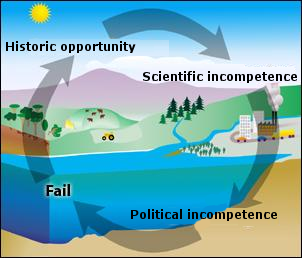
Climate credibility fail

fail

I’ve remained largely silent on the so-called ClimateGate thus far, mostly out of an abject lack of expertise to judge the whys and wherefores of it all. It’s science, I’m not a scientist. But given Poneke’s magnum opus on the topic, the likelihood of an IPCC Himalayan glacier retraction and a NZ Herald survey which found that New Zealanders harbour deep doubts about anthropogenic climate change, I thought it apposite to repost something I wrote the other day at the bottom of a very long (but interesting) thread (somewhat edited). It’s something I’ve argued many times in other contexts.*

Climate change is often couched as an important problem of the sort which democracies fail to address — along with things like the global credit crisis, and fascism. But the failure is not with democracy itself, but with the calibre of certain actors within it. Climate change is an issue which should have been hit out of the park by any political movement with any competence, because the magnitude of the stakes and the weight of both reasoned evidence and benign symbolic matter which it embodies yield raw material for the most profound and powerful sorts of political campaigns — the sort which fundamentally change peoples’ beliefs and allegiances and which, if properly conducted, can grant a political movement incredible license to implement far-reaching policy of the sort which reforms society at its most basic levels. The Great Depression was just such an event for Franklin Delano Roosevelt and Michael Joseph Savage. The miners strike was for Margaret Thatcher. September 11 was for George W Bush. And so on.

And yet, the skeptics are winning the battle of ideas around climate change. The failure to convince the electorates of the free world of the need for urgent climate change policy, a matter of the most critical and immediate importance backed by the best science available, reflects an utter failure on the part of political and scientific elites whose most important job it is to provide such leadership. The political and scientific establishment has squandered a phenomenal opportunity, with the exception of Al Gore, who with An Inconvenient Truth did more to progress the cause of gaining electorate buy-in to the topic than everyone else has done since. They are struggling and failing, not only to implement reforms of the magnitude which are required, but even to maintain the credibility of the scientific establishment.

Some [including Ag, to whom this was originally addressed] argue that it was always impossible to sell climate change to the electorate due to the vested interests amassed against it, cognitive biases, lack of expertise, plain ignorance, etc. Those are important factors, but other factors are more important and more controllable to boot — after all, people in a liberal society can only really control their own actions, and must be prepared to defend their positions against others.

The scientific establishment failed by allowing a tiny minority of skeptics and raving moonbats and vested interests to frame their establishment as a corrupt back-slapping club funded by grant money; by evading and prevaricating and playing dirty when legitimately challenged on important matters of fact and procedure; most recently by covering up emails and giving the conspiracy theorists grist for their mills. In defending their failures, they blame the heterodox minority, the vested interests, the rapturists and the conspiracy theorists.

Politicians have failed mainly by couching their arguments in favour of urgent climate change policy in terms of hard facts and economic figures, assuming that people could connect the dots themselves rather than spelling it out in terms they could understand at a visceral or intuitive level as well as when they whip out their utility calculators. The politicians blame the same people as the scientists, ignoring the fact that a generation of failure on their part to adequately contest the battle of ideas and to safeguard the political process against the influence of vested interests has allowed such lobbyists to become entrenched.

Part of this is systemic — there are problems with the scientific peer review system which politicians can’t understand; there are ruthless and well-resourced lobbyists with vested interests which have been permitted to entrench themselves in democratic political systems. But none of that is any excuse. They should have been able to drive it home anyway, given the raw material at their disposal. This is not a failing of democracy, but a failing of certain actors within the democratic system: particularly, those who believe so deeply that they are right, so they need not prove their case. People who think that inherent truth of the position will simply shine through. If their position was that strong, then it should have been easy, right? This ignores a fundamental reality of a free society: that people are free to be wrong, and must be brought about by reason and persuasion or not at all. I think it is that strong, and should have been easy.

The world is going to pay for the failure of climate scientists to adequately protect their credibility, and for the failure of politicians and policymakers to adequately sell the most politically saleable concept of the past generation — that the planet is going to get inhospitable if we continue to pollute it, and we don’t have a fallback position — and it’s infuriating that those responsible for this failure want nothing more than to shift blame for their own incompetence.

L

* It should be clear, but nevertheless: I’m not arguing that AGW isn’t real; in fact, the opposite: I am arguing that the problem is real but that the credibility of much of the evidence and the policy agenda is critically undermined. I don’t really buy Poneke’s conclusions drawn from his analysis of the emails, although I do accept that they demonstrate severe systemic and credibility failures which call a lot of the evidence into question. But in order to believe that it’s all a hoax, you have to believe in a scientific conspiracy of unprecedented scale, with no credible payoff. I just don’t see it.

The riddle of Key’s incredible popularity

ONE of the year’s intriguing mysteries remains the source of Prime Minister John Key’s popularity when there is no evidentiary reason for the continuing level of public support he enjoys.
In the US, the American public, both Republicans and Democrats, have long realised that President Barack Obama’s “yes, we can” is more accurately defined as “no, we can’t”, despite the passage of his health-care bill on Christmas Eve.
In this, he has achieved rare bipartisanship. Both major parties accept that the bill, in its current form, is a real stinker.
So much for compromising with the states and with every Congressman and Senator to get it passed.
Given Key has achieved nothing of similar magnitude […] he has finished his first year in office with a duck on the political scoreboard.
[…]
The mystery of Key’s incredible popularity may well lie in the sneaky admiration New Zealanders have for those who get away with extraordinary scams.
Remember how the Great Train Robber Ronnie Biggs found a haven (for a while) with his family in Melbourne while on the lam from British authorities and how he managed to stay ahead of the law while making good his escape to Brazil?
Biggs was no Ned Kelly, nor a Robin Hood, but managed to gather a surprising mass of public sympathy despite dudding his wife and children and was in all reality no more than a petty criminal addicted to good-looking women and a lazy lifestyle.
New Zealanders appreciate clever rip-offs and may not yet have cottoned on to the personal cost that they will have to bear from Key’s profligacy with their cash.

If I could spy on you, dear readers, I suspect I would see a few heads nodding in approval.

As the second-to-last paragraph hints, the above wasn’t written about John Key — it was written by conservative columnist Piers Akerman in Sydney’s Sunday Telegraph the week before last. I’ve replaced ‘Kevin Rudd’ with ‘John Key’ and ‘Australian’ with ‘New Zealander’ (and cut it, obviously).

But dedicated partisans on both sides are frequently similar in their thinking, and I’ve read pretty much this sort of argument again and again from Key’s enemies — people whom I hope are embarrased that they deal in the same sloppy generalities and bitter grumblings as Piers Akerman — over the past year. It misses the point, which is that he’s still popular. By definition, he’s doing well. And yet there is no ‘evidentiary reason’ for it to be so.

This provides a clue as to Akerman’s puzzlement, and that exhibited on this side of the Tasman with regard to Key’s ongoing favour: you’re looking at the wrong factors. The main factor omitted by Akerman and others of his sort is that he (Rudd or Key, take your pick) is emotionally resonant with the electorate. This matters; in some cases, it’s enough on its own. He (either of them) won a campaign based on next to no policy at all, leading the incumbent oppositions of the day to ridicule him, ignoring what was right under their noses: that policy wasn’t necessary.

The modern left’s obsession with facts and figures, expected utility and measurable outcomes should, in a rational world, grant them a strong advantage in any political contest. Indeed, the classical analysis is that democratic political systems which apportion votes by population rather than by wealth are inherently biased toward the working classes who are more numerous by definition. Given the assumption that Labour’s policies objectively provide greater material advantage to a larger number of electors than National’s policies, they should win that horserace every time. But they don’t, because politics is not rational. Concrete policy achievements are not the key to political success; their impact is largely limited to how they make the electorate feel about the party and candidates, not how they impact on the electorate in observable, material terms (although, depending on the policy, this can have considerable impact). The link is not direct and linear: there’s a crucial and very complex layer of abstraction which most politicians on the left simply don’t see.

Drew Westen (about whom I’ve been raving to anyone who’ll listen for the past year or so) goes into much more detail about this, and his book The Political Brain should be required reading to anyone who wants to know how people actually think about politics — when they think at all, which isn’t very much or very hard.* He calls this focus on reason ‘trickle-up politics’; as valid, he says, as trickle-down economics. This strategy concentrates its firepower on the dispassionate brain, the least-important part when it comes to making important judgements, and disdains that which lurks beneath — the part which can call upon deep-seated experience and instinct to order the supposedly rational brain to do what feels right, utility calculations be damned.

Generally speaking, the right understands this better, and they tend to lead from the gut. This provides the left with what they think is an opening to debate the matter on facts, not realising that facts aren’t very important in political decision-making. Westen and other researchers have found in a wide range of experimental situations that they can predict with greater than 80% accuracy a person’s position on a given political issue of the day, knowing only how the person feels about the issue. Adding facts back into the equation only improves predictions by a few per cent. They literally don’t matter without the emotional resonance. This is true for everyone from randoms on the street to justices of the Supreme Court. It’s just how people are.

So, my one wish for the NZ left for 2010 is this: stop thinking of political popularity as the result of naked appeals to the material self-interest of utility accountants; stop hectoring those who remain unconvinced and ask why they are unconvinced, without resorting to the lazy option of complaining that they are fools or stricken by false consciousness or that they just like a good scam when they see one. Start thinking of politics as a system for engagement and trust-building, by which to build a mandate to make a better country. National aren’t that strong; it’s just that they’re against opposition who turn up to the battle for hearts and minds armed with a spoon.

L

*Westen’s research is American and focuses solely on the two-horse Republican v Democrat battle, so it isn’t directly analogous to NZ or Australian politics. Nevertheless, most of the traits he observes hold true to a fairly large extent.

More flaggery

Interesting discussion about flags going on at John Ansell’s blog and Kiwiblog and elsewhere. Go and vote on your favourite fern flag. I’m all for a new flag, but these designs are too logo-ish for my taste. Flags seem to me like the sort of things which ought to be made up of geometric fundamentals. That having been said, I think Ansell’s design A is emblematically the strongest, but I don’t think solid black is an appropriate colour for a national flag. If pressed I would reluctantly choose E or C. Is there an obvious reason why green and black aren’t paired somehow?

Fun thought: would the monarchists and traditionalists and nationalists be claiming victory if the government decided to adopt a new national flag which crown agencies would use, with the proviso that other folks could use the old flag if they wanted?

L

Name suppression: protecting victims’ rights

There is a woman, a victim of rape, who knows that every time any acquaintance  looks at her they know what her husband did to her. When she walks through the supermarket every shopper may be looking at her and thinking about her terror, fear and shame.

In a healthy society she would have no reason to feel ashamed, but ours is not a healthy society: most victims of rape do feel shame, embarrassment and humiliation.

When a blogger decided to court fame and media attention by making a political point about name suppression he not only outed the man whose name was suppressed, he also revealed the victim’s identity – he revictimised a woman who has already suffered enough.

[The blogger’s name has been removed as suggested in a comment as the name of the blogger, in turn, leads toward the woman’s identity]

Deeply subversive

Some of you will know that I take perverse joy in waking up to Geoff Robinson and Sean Plunket each morning,* and I regard Sean as one of the country’s best interviewers (and the best hard-news interviewer, though Mary Wilson gives him a fair run some days). Pablo has written about Radio NZ’s treatment of him over his bid to write a column for Metro, and I think it’s fair to say he (Sean) is pretty sore about the whole affair. He does not strike me as one to trifle with, and though I can’t quite put my finger on it, I think something very subtle is going on with Sean Plunket’s new blog: Sean Makes Crafts.

Welcome to the blogosphere, Sean. We watch with interest.

Update: It seems Poneke and The Standard got onto this before me.

Update 2: Sean Plunket denies he has anything to do with it. Well, that’s just the sort of thing he would do, wouldn’t he?

L

* Not only me. My daughter, just turned 1, does a little dance when she hears the Morning Report music. Strange, but true.

Back away slowly

Update: This post was a response to an attack on me by Chris Trotter. Since it was published, Chris has graciously apologised for writing it, and for the general bad blood between us. He has deleted the post from Bowalley Road, and I give him my hearty thanks for the reconsideration.

I have also been culpable in this rather nasty exchange, which stretches back almost a year. For that part in it I, too, must apologise. While I retain strenuous objections to Chris’ political positions (as I’m sure he does to mine) these needn’t have become personalised, and are better discussed calmly as befits reasonable adults. While they may yet prove intractable, it should be possible for people in a free society to hold irreconcilable differences and yet remain civil. Much heat, and too little light, has emerged from this meeting of political minds, but I think there is potential for future engagement between Chris and I based on some sort of goodwill and tolerance rather than upon vituperation and political posturing, and I will do what I can to cultivate it.

While Chris has deleted his post, I do not believe in tampering with the historical record in that way. While I might regret things I’ve said, I won’t pretend I didn’t say them. And so the content of my response remains below the fold. It should be read with the subsequent context and this apology (and pledge to more constructive engagement in the future) very firmly in mind. In fact, the most worthwhile thing by far to emerge from the dispute is an unexpectedly useful discussion led by commenter “Ag” on the nature of class consciousness and electorate rationality: I commend that discussion, rather than the post from which it emerged, to the KP readership.

L

Continue reading “Back away slowly”