Hīnaki

HÄ«nakiI agree with Kelvin Davis’ criticism of the eagerness of certain Māori groups to be involved in owning and operating the new private prison, and I think it’s a strong and principled argument.

My clear preference is for no private prisons. But if there are going to be private prisons (and it looks like a certainty), then all else being equal, wouldn’t it be better if they were (part-)run by Māori, with a kaupapa Māori focus (on rehabilitation, restorative justice, etc)? As I remarked, and as Eddie C sketched in slightly more detail in comments to my last post on the topic, the incentives are screwy for private prisons and rehabilitation, it’s hard to measure and hard to manage and as a consequence rehabilitation is even less effective than usual. But I can’t help but think that attaching a cultural incentive — the knowledge that one’s whanaunga are actually or potentially involved — might change that picture and take a few of the harsh edges off the “business of punishment” model employed by mainstram private corrections agencies.

L

Perspective and colonial counterfactuals

It’s hardly the stuff of rigorous historico-social investigation, but Simon Schama sees much to celebrate in NZ biculturalism — particularly in comparison to our Anglo comparators:

But it’s the story of Maori and pakeha, the settlers of European origin, that – for all the pain, betrayals and suffering – still deserve to be known and celebrated as offering a different model of cultural encounter than anywhere else in the world. […] Of course there have been serious problems of unequal social opportunity, of street gangs. But if there is anywhere in the post-colonial world where two cultural worlds truly live an engaged life alongside each other, it’s in New Zealand.
Such stories don’t come along very often. Cherish them. Chant them. Dance them.
Upane upane, kaupane, whiti te ra! Up the ladder, up the ladder, the Sun Shines.

This is broad-brush stuff, and minimises the genuine grievance and disquiet which exists on both sides of the cultural divide — his “divided no longer” caption to a stock photo is altogether too pat. And his assessment of Paul Holmes as a “tough” and “a reproach to dozy thinking” is marginal at best. But Schama’s observation that what we have in this country is quite unlike any other postcolonial nation is exactly right. It provides a glimpse at what might have been been elsewhere, and what might have been here if the post-Treaty settlement had been undertaken in better faith.

This raises a question Pablo and I discussed in email after he wrote this post (I didn’t want to hijack the excellent discussion there): do those who hate and fear Tino Rangatiratanga and consider the Treaty a “simple nullity” really believe that the people of Aotearoa — of all colours — would be better off if the typical colonial counterfactual were true — if Hobson’s marines and settlers had simply driven the natives into the sea or exterminated them as animals? In my email to Pablo, I wrote:

I’ve often argued (as a wind-up or a devil’s advocate position) that the Māori are ungrateful whingers who don’t appreciate what an incredibly good deal they got from Hobson, and that NZ would have been better off if Europeans had just landed with boatloads of armed soldiers and done to the natives what they did in the rest of the world. Anything for a peaceful life. What’s interesting is that, even when discussing the topic with people who genuinely believe that the Treaty is a gravy train and the natives are taking the piss and actually are ungrateful, they generally balk at this suggestion. That consent [given by the colonised to the colonisers], however fraught and limited, is important to how we see ourselves. That’s one of the reasons I’m generally pretty hopeful about the bicultural future.

I expressed somewhat similar views in comments to this post of Chris Trotter’s a short time later. Neither Chris, nor the other commenter to that post (RedLogix, with whom I’ve had robust but usually cordial disagreements on this topic) responded to my comments, which I took as a sort of confirmation of my thesis.* As I say, this is the usual response to the argument I’ve made many times before — all but the most unrepentant rednecks are repelled by the view that colonialism NZ-style was worse than what might have happened if we’d undertaken it Australian-style. This indicates to me that even for those who are highly critical of it grudgingly accept that the Tino Rangatiratanga movement, Waitangi Tribunal and attendant concessions to Māori in our political and social systems are better than the counterfactual alternative of a white monoculture in the South Pacific, even if it were more peaceful. The importance of this for a bicultural future is profound.

L

* I don’t want to put words in Chris and RL’s mouths, though — it may be that they simply thought my remarks too ridiculous to bother engaging with. Happy to accept clarification on this point.

(Schama article via Tim Watkin at Pundit. Thanks! And as it happens, Idiot/Savant at No Right Turn has excerpted it as well.)

Apologies to those who hate rugby metaphors

… but they’re really useful. Here’s another one.

After the election, I ruminated upon the future of the Labour party, employing a fairly hackneyed rugby analogy to describe the crossroads at which they stood. I’ve been meaning to follow it up and write about the fact that they’re very much playing the Crusaders game, rather than the Hurricanes game, but I’ve struggled to find the motivation to do so because it’s just so bleeding obvious that that’s what they’re doing.

But yesterday’s comment by Trevor Mallard on the “Mr Key goes to Washington” story is pretty revealing — especially from such a die-hard Hurricanes fan:

In Super 14 terms this is like a loss with a bonus point.
And what are the odds of the President putting his head into the meeting to give John another chance to smile and wave to the cameras.
Will almost certainly happen but will still be a loss with two bonus points.
Sort of like the Hurricanes rather than the Crusaders –- may be a bit of feel good but no one believes they are really going to be there when the real business is done.

And he has a good point: who wants to back the Hurricanes if they can’t actually do the business, win the matches and bring home the silverware? All the razzle-dazzle in the world is hollow if it doesn’t yield results.

But Trevor could just as well be describing Labour’s performance in opposition. He characterises National and its government as playing the Hurricanes game, while it’s clear that Labour are playing the Crusaders game — but the problem is that Labour are playing the Crusaders game badly. They’re trying to be defensively strong, but they’re not really; the consensus is just that their opponents lack strike power out wide. They’re struggling to win even their own set-piece ball. Despite plenty of opportunities they’ve been almost singularly unable to punish mistakes — and the mistakes they’ve taken aim at have often been the wrong ones. They’ve tried various tactics which are analogous to infringing at the ruck, but have been caught out by the ref, making them look desperate rather than enterprising.

So what’s the half-time talk? I don’t know. It would probably be worse to try to change the gameplan at this stage than to persist, but absent a stunning second-half rally, it’ll be a long and humiliating off-season. Good thing relegation isn’t a possibility.

Update: Naly D reckons I’ve described the Chiefs game, rather than a poor version of the Crusaders game. So if that suits you, imagine it thus. But it sort of ruins the symmetry. Too much accuracy in an analogy isn’t always a good thing.

L

Chris hitting his stride

It’s well known to most that Chris Trotter and I have had considerable differences. But despite them, I must say that when he’s on form it can be a sight to behold.

So it is with his latest set-piece about Auckland governance, which gives voice to the intuitive disquiet felt by many, weaving many of the themes behind the sometimes tentative and incoherent criticism of the (aptly-named) Supercity plan into a cohesive polemic narrative, putting meat on those bones and placing these recent events in a historical context which resonates.

Required reading, whether or not you agree with it, and deserving of a wider audience than the blogosphere generally provides.

L

More narrativium

A fortnight ago I wrote a post about how the government’s conduct in office makes them vulnerable to accusations of cronyism and a tendency to be vague about the boundary between the political and the personal. In the past week, two more events have come to light which fit this narrative.

The lesser of the two is former National minister Roger McClay winding up in court for claiming mileage and expenses from his non-profit employer when they were paid for by the parliamentary service. It’s a long time since he was in parliament, but the episode speaks to the character of senior National party members.

More egregious is the decision to appoint former National Deputy Prime Minister Wyatt Creech to stitch up Environment Canterbury, which makes a great one-two punch with the news that they want to appoint former National Prime Minister Jenny Shipley as Commissioner. Thanks to I/S at No Right Turn for joining these dots.

Christchurch Central Labour MP Brendon Burns has made his views pretty plain, and as a consequence, the scrutiny may discourage the appointment. That’s the thing about keeping an eye on cronyism: it enables an opposition to punish a government brutally for both its past and its current misdeeds, and it brings a level of scrutiny from the media and other public agencies which has a chilling effect on further misdeeds. Even aside from the partisan advantages this brings, that’s good for democracy either way. Of course, in order to take full advantage of this narrative, Labour has to come out and actually denounce Taito Phillip Field’s own corruption during his time as a Labour minister. That’d be good for democracy, too.

L

Let it burn

At the head of a large army [Po-ts’ai] was besieging Ch’ang-she, which was held by Huang-fu Sung. The garrison was very small, and a general feeling of nervousness pervaded the ranks; so Huang-fu Sung called his officers together and said: “In war, there are various indirect methods of attack, and numbers do not count for everything. Now the rebels have pitched their camp in the midst of thick grass which will easily burn when the wind blows. If we set fire to it at night, they will be thrown into panic, and we can make a sortie and attack them on all sides at once, thus emulating the achievement of T’ien Tan.” That same evening, a strong breeze sprang up; so Huang-fu Sung instructed his soldiers to bind reeds together into torches and mount guard on the city walls, after which he sent out a band of daring men, who stealthily made their way through the lines and started the fire with loud shouts and yells. Simultaneously, a glare of light shot up from the city walls, and Huang-fu Sung, sounding his drums, led a rapid charge, which threw the rebels into confusion and put them to headlong flight.
— Sun Tzu, The Art of War, XII.9(4)

I can’t agree less with Grant Robertson’s, response to David Garrett’s latest bit of madness. He says he “doesn’t want to give further oxygen” to Garrett’s “extreme and appalling” views, but that’s exactly what they need: oxygen. At present both Rodney Hide and John Key probably want to forget the fact that Garrett is the ACT party’s Law and Order spokesperson, and that consequently there are no such things as his “personal views” on these topics which are separable from those of the party — he is the ACT party’s mouthpiece on such matters, and the government’s ally. We, the people who elected him and permitted Hide to assign him that role, are entitled to take these views seriously, examine them in the context of other things he has said and done, and the opposition’s job is to prevent anyone from forgetting what this man stands for, and how far his definition of “reasonable” is from that of the wider public. From now until he’s ejected from parliament, Garrett should not be able to show his face to the public without a graphic reminder of the fact that he think homosexuality is morally equivalent to paedophilia; that he favours policy (now implemented) which means more prisoners will suffer rape as a consequence of their punishment; and that he thinks poor brown parents should be sterilised. He must be required to either defend his views robustly, or forced to issue yet another humiliating public apology; and both ACT and the government must be required to defend their association with him, or forced to dissociate, demote or publicly censure him.

The instinct for the opposition to deny a topic like this the spotlight only makes political sense when the opposition is vulnerable on the issue; when they fear it could result in a populist backlash against them. Even then, the principles at stake mean a very strong backlash would be required to justify restraint on simple pragmatic grounds. There is no prospect of such a backlash in this case: as Grant says, the statement is “extreme and appalling”. Does Grant think his own sense of what is extreme and appalling differs so much from that of the electorate that they will not agree with him? The worst possible course of action for ACT and the government is to allow this topic to remain at the top of the political agenda for as long as possible. Failing to even try to keep it there shows a lack of political nerve on the part of the opposition; a continuation of the failed strategy employed prior to the election, which Key won in no small part because the very people who should be fighting against him bolstered his public image as a mild, simple, non-threatening chap. Genuine threats must be neither mocked or minimised; the “extreme and appalling” should not be laughed off or left unchallenged. This is the sort of weak-kneed liberal wimpishness and lack of rectitude which leads many voters to mistrust parties on the left, and cleave to parties and leaders whose convictions are firm and forthrightly held. The good and the just does not speak for itself, much as we might wish it would. It requires champions to stand for it, and evil truimphs when those champions fail to stand and fight.

To do so is not the “dirty” personalisation of politics: the character and views of a man who sits on the Law and Order select committee, and in the future could conceivably hold a warrant for Justice, Corrections or Police are perfectly legitimate matters for political debate, which speak both to his ability to represent the interests of New Zealanders and to the quality of the processes and people which allowed him to attain such a position.

The Garrett Solution, as I’ve argued elsewhere, contradicts almost everything the small-government right claims to stand for. After a decade of howling about “Nanny State in the bedroom” and “social engineering” we now see that their erstwhile objections to both these things were not principled, as they claimed, but were in fact just objections on the merits. Social engineering is wrong, they say, unless it’s at the genetic level. It’s also not new: this sort of thing was enthusiastically embraced during the last government by the more unhinged members of the extreme right, and now it has gone mainstream.

The topic of eugenics is the strongest symbolic matter introduced to the political sphere by any participant this term; it is a topic on which the right can only lose, and introduced by someone who is already vulnerable. The grass is high around the government’s camp, the fire is set by one of their own: now, if they are to gain an advantage, the opposition must fan the flames and beat the drums.

L

Psychic’s Advocate

Poneke has another post up about Sensing Murder. Just for the record, I agree with the core argument of the post, and its somewhat famous predecessor. It should come as no shock to most of you that I also agree that the worst bit is that some journalists and current affairs directors treat them as newsworthy — but that’s the newsmakers’ failure, not the psychics’.

But here’s a comment from Falafulu Fisi I think could use a little unpacking:

People earn money for a living by being honest and hard work.
Business men are successful by being brilliant in running their businesses.
Paranormal practitioners (psychics etc,…) earn money via people’s stupidities and gullibility’s. They can become rich of course. Put them into the real world to try and earn an honest living they would be the laziest and incompetent wherever they are.

And in response, this from Klytemnestra:

I would have to disagree somewhat with Falafu Fisi. Excluding those cranks who actually believe they can talk to the dead, these ‘psychics’ are really quite successful business people. Getting rich by exploiting niche markets with false services no one really needs; this is a feat worthy of a degree of respect, even if they are repugnant in every other way.

Contra both of them, I’d argue that their “honest living” isn’t as psychics, or necessarily as providers of false services; it’s as entertainers. After all, those who actually use those “services” are a tiny fraction of those who consume the televised or stage-managed product which results. I also don’t accept Poneke’s suggestion that these consumers necessarily believe they have psychic powers — after all, it doesn’t follow that people who watch vampire movies actually believe in vampires. But even if they did, it ultimately doesn’t matter: taking advantage of peoples’ credulity isn’t wrong in and of itself, and for doing it these folk don’t deserve any more — and in general considerably less — criticism than financial advisers, real estate agents and talk radio hosts. They give a great many people who want such things something to watch of an evening, and something to believe in and make them feel all warm and fuzzy inside. In this regard it’s little different from — say — soap operas or romantic comedies. There’s a fair argument that it’s ghoulish, and perhaps hurtful to the real people involved, but in this regard it’s little different from — say — the cheesier end of TV current affairs or other reality programming.

Even if you don’t personally see any value in it, that’s an honest living, wouldn’t you agree?

L

Unmix these metaphors

ace_of_spades

In the last couple of weeks the government’s pistons have started pumping. After a year’s worth of blue-boiler-suited (non-unionised) engineers making sure the sleek machine is primed and fuelled and oiled and ready for action, the engine has roared into life and is beginning to blow out a cloud of smoke in preparation for a screaming burnout. As it proceeds, the party has dealt its Labour opposition a decent hand of cards; you could say they’ve built a house of them, which the mighty engine is in danger of knocking down. After campaigning on a platform of returning integrity and effectiveness to the Beehive, the public are beginning to get an inkling that the emperor may lack a couple of vital articles of clothing.

hughes12

Returning to cards: the strongest card is the decision to mine the conservation estate, announced last year. Classic crony capitalism is shaping up to be the trump suit. The other cards: Hide‘s junket timed to coincide with a wedding; Harawira‘s trivial but more spectacularly mismanaged junket; Key‘s and McCully‘s mining shares; revelations that Brownlee lied about being lobbied by mining interests which would stand to benefit from his actions as a minister; attacks against Radio NZ which benefit Joyce‘s former business partners; attacks against ACC which benefit the insurance industry to which the party has well-known ties; and ministers Heatley, Brownlee and Groser who were pinged pinching from the public purse for their own private pleasure.

corporate_crooks

Mining the conservation estate is the keystone of all this, the central peg on which the whole thing hangs — because the allegations cannot be denied outright, only explained. Particularly in the cases of Key and McCully’s shares, the value of the conflict of interest is irrelevant. It probably should be relevant, but it isn’t really: either there is a conflict of interest, or there isn’t. While there would be (much) more hay to be made from a large shareholding, that isn’t necessary to plant the seed of doubt in the rich loam of the electorate’s and the media establishment’s collective consciousness.

plant-a-tree

Likewise the other issues: trivial, but they ring true and all riff on the same themes. Hide’s transgression was much more significant in actual material terms than was Harawira’s, but Harawira was punished much more harshly because he failed to recognise the symbolic matter in play: both required abject, cringing apologies. Key’s “sloppy” uranium shares, which he was “too busy running the country” to recall owning is reminiscent of John McCain‘s failure to remember how many houses he owned, for which he was rightly crucified by a country staring down the barrel of an economic crisis which would cost many people their only home. The smiling visages of the three ministers on the front page of the Dominion Post: the Minister of Economic Development who can’t be trusted with a credit card; the Fisheries Minister who likes to splash out on feeds of kaimoana for his mates and party hangers-on; the Minister for Climate Change Negotiations wining and dining the former National minister who was an integral part of the Copenhagen negotiation, and now heads the environmental branch of the OECD apparatus. And so on. These are symbolic issues, not matters of real actual wrongdoing. But the government can’t just dismiss them outright, it needs to argue the merits, and by the time you have to argue the merits on this kind of thing, you’ve probably already lost the symbolic battle. This sort of behaviour passes the public’s sniff-test about how they think about the National Muldoon gave us. And it fits the narrative of the modern Key/Brash-era Nats as wheeler-dealers, well-heeled fat-cats with a finger in every pie, feathering the nest for their secretive plutocrat mates. It brings to mind an iceberg, with the tiny, trivial transgressions peeking above a glassy surface which hides the monstrous mass below.

iceberg

The job of the opposition is to tie all this into a coherent story which people can understand and feel in their guts: a myth that trips off the tongue at the pub or in the line at the football, in the front seat of a taxi, sitting on the bus, standing around the water-cooler or in the smoko room — in as many variations as there are poets of the NZ electorate.

This post cannot end without a mention of the good work the folks at The Standard — particularly Eddie — have done toward assembling the blocks for this narrative pyramid. I am often critical of them, and their tendency toward partisan hackery frustrates me, but they do a lot of good work, and it shouldn’t go unrecognised. They’ve covered all the main aspects listed here, but they can only go part of the way: now is for the opposition parties and their allies to lurch into action. All the cards have not yet been dealt; the ace of spades may yet be seen. Although the raw material is all there, it won’t be easy writing this story — just ask Lockwood Smith, who only by dogged repetition and worrying away at the Taito Phillip Field bone managed to raise the electorate and media’s awareness of that actual and manifest case of political corruption. But this is the opposition’s job, and if they can untangle the metaphors and lay them out for people in simple, appealing, resonant terms, they will gain some traction. Then perhaps, they too will begin to belch smoke and fire, and roar down the road to victory.

L

The glow of the furniture, piled high for firewood

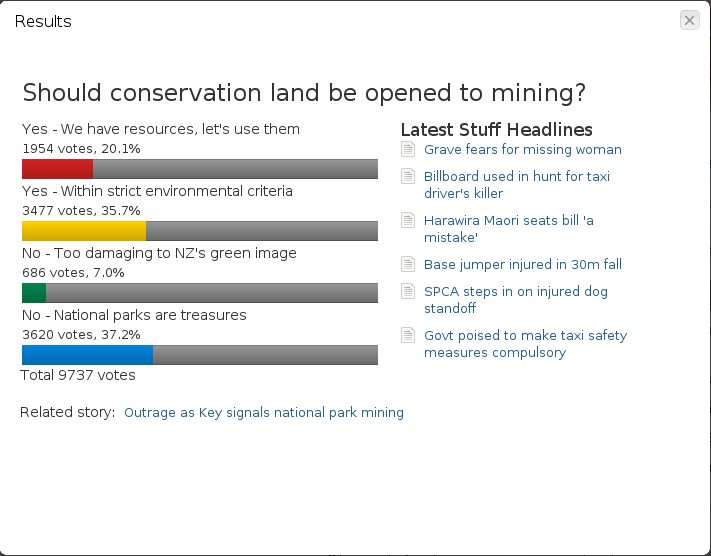
There’s been much analysis, wisdom, whimsy, and snark about Gerry Brownlee’s plans to mine the conservation estate. But rather than talk about it, I’m going to repair to a rather dubious poll from stuff.co.nz:
stuffminingpoll

Two things are interesting about this poll. First, for an internet poll, the options are uncharacteristically nuanced. This leads to the second interesting thing: these results are deeply incoherent.

I’m going to work from two assumptions (both of which are pretty arguable). First, I’m going to go out on a limb and assume that stuff.co.nz poll respondents are pretty similar to NZ Herald poll respondents and the commenters on “Your Views” and Stuff’s equivalent — putting it very charitably, let’s just suppose that they’re somewhat further economically to the right, less environmentally conscious and with stronger authoritarian tendencies than Gerry Brownlee. Second, I’m going to assume that a poll like this should break roughly along partisan lines, since it’s a government policy opposed by the opposition, part of an overall strategy to mimic Australia, a complex topic of national significance with which people generally have little first-hand experience (the sort of thing they tend to entrust to their representatives), and the poll answers are heavily propagandised using the government and opposition’s own sorts of terms.

The poll result is incoherent because it doesn’t break along (rightward-slanted) partisan lines, although it initially looks like it does. A total of about 56% of respondents approve of mining in principle, and this is roughly what I would expect given this framing, the current government position on the topic, and the demographic characteristics of this type of poll. It’s what the government is banking on in terms of support with this policy: if it drops much lower, they’ll probably back down. But where it gets incoherent is in the other two options. The third option (“too damaging to NZ’s green image”) is about what the Green party is polling, and the fourth (“National Parks are treasures”) is about what the Labour party wishes it was polling. That’s bass-ackwards, because the third option is the Labour party’s actual position on many environmental matters (even Carol Beaumont’s passionately-titled post falls back on NZ Inc. reasoning), while the fourth position is the Green party’s actual deeply-held position of principle. A second source of incoherence is the political framing of the second (most popular) question. By definition, if conservation land is mined it’s not being conserved any more.

Both Labour and the Greens have huge opportunities here, but they need to position themselves to properly take advantage of them. Labour, for its part, needs to tone back the NZ Inc. reasoning which plays into all the assumptions of the second question: that it is a simple trade-off of one type of economic value against another type and come out looking good on the margin. This is classic trickle-up politics, rationale which appeals to the brain instead of the gut. The people who are picking options one and two probably think they’re doing so on solid rational bases: more money, more efficient use of resources, etc. — but the real reasons are probably more to do with ideology (mastery of the environment) and nationalism (catching up with Australia). Labour’s best move here is to appeal to peoples’ identity: New Zealanders think of themselves as people who live in a wild and pristine country, and they like having that country to go and ramble about in (even if they hardly ever do it). The Greens could also adopt such a position, abandoning the wonkery for things which matter to people. Russel Norman tried with his speech in reply yesterday, but I swear, whoever wrote it needs the ‘G’, ‘D’ and ‘P’ keys removed from their keyboard. He needs to take a few hints from the team who got an organic farmer elected to the Senate in Montana on an environmentalist platform by telling him to stop talking about environmentalism and start talking about how much he loved the land. The Greens also need to rethink their deeply confused firearm policy, but that’s a minor thing. In a country with such a strong constituency of outdoorsfolk and wilderness sportspeople it’s an absolute travesty that the MP who represents the hunting lobby is the urbane Peter Dunne, and the only party who genuinely values wild places is represented by earnest city-dwelling vegetarians.

But Labour and the Greens can’t divide this constituency between them; they need to make this appeal positive-sum, and steal back some of those who voted option two. The way to do this is to attack the implicit logic of option two, the idea that you can mine something and still be conserving it, and to remove the idea that this sort of thing is for a government to decide, that it’s somehow too complex or technical for ordinary people to understand. This shouldn’t be hard to do — it’s a plain old political education campaign. But it requires framing and a narrative whereby reasonable people can really only bring themselves to choose the wilderness; causing them to lose faith in the assurances of the government’s “strict environmental criteria”. The narrative needs to be about who we are in New Zealand, and it needs to be one which appeals to socially-conservative rural and suburban folk who would never think of voting for earnest city-dwelling vegetarians even though they share many of the same bedrock values. It needs to be like the lyric in the title: we are burning our furniture, and that’s not what civilised people do. New Zealand is not a nation of environmental degenerates, except when insufferable environmentalist smugness forces them to choose degeneracy as the less-bad identity position.

This is an issue on which the left can win, because it’s already a pretty marginal issue for the government. It cuts against a long-standing bipartisan reverence for National Parks, and it cuts against New Zealand identity as New Zealanders see it. Even on what should be a pretty reactionary online poll, the government only wins by 6%. Turn one in six of those people around and the issue gets put on ice for good.

L

Musical interlude

I’m snowed in with work today (as I was yesterday), hence lack of commentary on the speeches and such.

But thanks to Simon Sweetman, I know that the mighty Gil Scott-Heron has released his first album in a decade and a half, titled I’m New Here. And it’s good. The Guardian is streaming the whole thing. Go and listen to it.

L