Howling at the moon

It’s not very often I get excited about a new entrant to NZ’s media ecology. The last time I did was for MiNDFOOD, based on the pre-release PR, and that only lasted until I opened the thing up and realised it was just another glossy ad-filled waiting-room mag with skinny celebrities on the cover.

But this morning I’ve read most of werewolf, the latest offering from Scoop’s Gordon Campbell and others, to be published every full moon. I’m pleasantly surprised. The debut edition features a reasonably thorough survey of Helen Clark’s little-considered but much-valued arts policy through the Oughties; a good bag of the smacking petition which drew immediate fire from petition backers Bob McCoskrie and Larry Baldock in comments; a satire primer from the dependably excellent Lyndon Hood; and a bit about the effect of electoral systems on democracy – case in point: Lebanon. Music and travel writing as well. Go read some of it.

I can only assume that Gordon’s choice of masthead is drawn from the same place as my title, the name of Ian Wishart’s publishing company. In some ways werewolf reminds me of Investigate: a niche publication which will try to carve out its niche from a critical, complicated, politically and philosophically-engaged, media-aware, somewhat geeky audience and specialising in long-format, analysis-rich material which digs a bit deeper than that published (and re,re,republished) by the usual suspects.

Like Investigate/TGIF/TBR, it has potential to bridge the divide between traditional and new media formats essentially by providing the best of both worlds – periodic, reliable and high-quality content which doesn’t demand too great a commitment in time or resource from its audience but which provides blog-style opportunities for engagement should readers want them. Since I don’t imagine Gordon and co. would overly appreciate being compared to Ian, I should note that that’s where I think (and hope) the similarity ends – NZ doesn’t need another ideologically-bound narcissistic soap-box publication, and that this first edition is not. Nevertheless, I wish them all the success Ian has had, and bring on the next episode.

L
Arr

Although I never got around to doing the follow-up post on the political-symbolic aspects of the Pirate Bay case (for which you can all blame my baby daughter), one of the consequences of the guilty verdict I considered has come to pass: the Swedish Piratpartiet has won a seat in the European parliament, gaining more than 7% of the vote in Sweden.

How much change they can make in that bureaucratic behemoth is another matter but their election as a Streisand effect-like result of the Pirate Bay verdict which gave them an immense boost in public profile, shows that this is a political issue with teeth.

L

Turns out I am a Sensible Moderateâ„¢ after all

Normally I despise and distrust political quizzes as misleading trivia, but since this one confirms my existing prejudices about myself I’ll post it anyhow.

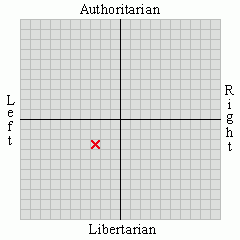
My Political Views
I am a center-left moderate social libertarian
Left: 2.64, Libertarian: 2.48

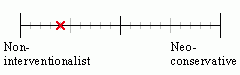
My Foreign Policy Views
Score: -6.04

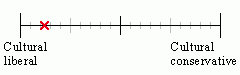
My Culture War Stance
Score: -7.51

Hat-tip: Dave at Big News; and ScrubOne (who seems to be my polar opposite) is apparently compiling another chart of the NZ blogosphere, so everyone knows which canned propaganda terms correctly apply to whom.

L

Lawsome

David Haywood has posted a mighty mashuptastic bit of Lawsery on the Richard Worth case which you should all read. Judging by some of his (Laws’, or should that be Lawses?) comments on the wireless this morning, I’d say it’s not too far off the mark.

L

Update: The actual column is somewhat, err, flaccid by comparison.

Balance of scrutiny

One of the major issues in this Richard Worth affair, like the Tony Veitch affair, is the degree of scrutiny to which the various parties are being subjected, and the degree to which their assertions are accepted without scrutiny.

Richard Worth’s motives, alleged actions and responsibility generally have not been subjected to significant public scrutiny or discussion (although his reputation has). The victim’s motives, supposed actions and responsibility for her position as a victim have been subject to a much higher degree of investigation; that is, expected to withstand closer scrutiny in order to be considered credible, as have those of her political agent Phil Goff. In most cases this has not been subtle, although some has.

I know, who’d have thunk it. Sexual harrassment victim held to account more strongly than alleged harrasser, sky blue and water wet. But this case, where the differentials in power and standard of acceptable conduct between alleged harasser and alleged victim could not be more stark, illustrates more than most why it’s arse-backwards.

But I think we are seeing a change in the public attitude toward this sort of thing. Although Louise Nicholas, Kristin Dunne-Powell and the anonymous victim here are still subjected to undue scrutiny and speculation, the media have in each case gradually begun to treat the incidents more seriously. As John Key is discovering, it is no longer politically viable to simply ignore this sort of thing and hope it goes away.

L

Chosŏn Realism

(This and the last are posts I’ve been meaning to put up all week, having been prevented by a migraine and a deadline.)

This week seems an opportune time to link to a small but superb collection of North Korean propaganda posters reproduced (with two brief and fascinating contextual notes) from David Heather and Koen de Ceuster’s book North Korean Posters.

ess_north_korean_39
(“Let’s extensively raise goats in all families!”)

Discussion of the second test in the media has cast a great deal of heat and not very much light on the issues at stake, including one alarming statement in the NZ media by Tim Beal of Victoria University that the USA could defeat the DPRK militarily “without losing a single soldier” (audio), which runs contra to the understanding of the situation I had when I lived there. My understanding, admittedly mostly from pub discussions with officers in the South Korean and US defence establishment, was that the reason there’s a stalemate is a sort of mutually assured destruction, because while the forces in the South clearly have the strategic advantage, the DPRK has an unknown but very large number of well-protected and hidden artillery pieces and conventional rockets in the mountains just north of the border, within easy range of Seoul, and the few dozen hours it might take to destroy them all could result in catastrophic loss of life and infrastructure in that very densely-populated city.

Tough call.

L

Civil disobedience is not an attack

Paul Henry led TV One’s Close Up the other evening with disbelief that GetAcross – “just a few protesters” – could bring Auckland to “a virtual standstill”, and that the police were “powerless to stop them – almost unwilling to stop them”.

Yes, that is amazing.

But he goes on:

But that’s what happened yesterday when protesters broke through barriers and walked across the Harbour Bridge, raising the spectre of just how vulnerable we are to civil disobedience.

Hang on a minute. “Vulnerable” denotes susceptibility to attack, and this construction therefore defines “civil disobedience” as an attack on society, or at least on Auckland. But civil disobedience as a form of activism, an agent of social change or a means of engaging people in the wider political process is by definition not an attack, but one of the `institutions of societal democracy’ referred to in Pablo’s recent post on the topic; a civic duty, to use Thoreau’s formulation, rather than an act of social destructiveness. That the police didn’t – or couldn’t – prevent it by force seems to me a good thing for our society, and I might add a refreshing change from former attitudes toward peaceful protest.

This wasn’t an attack which weakened society, it was an action which could strengthen it by demonstrating that when you want something, there’s no better way to get it than to make your views known. The GetAcross action didn’t result in violence, property damage, serious disorder or anything of the sort – all it did was show up a critical weak link in Auckland’s infrastructure chain. When a couple of thousand – at most – people on bikes can cause tens of thousands of people to become stuck in traffic just by crossing one bridge, once, there are more serious problems than the protest action. If by simply adding a lane two metres wide, ARTA could prevent this from ever having to happen again – then why wouldn’t they? If not, then aren’t they asking for the weak link to be tested, again and again?

L

Update: To my great delight, James at Editing The Herald has skewered Garth George’s latest set of authoritarian mutterings about this topic on the sharp spike of the the black civil rights movement. Party on, James.

I don’t see a test case

Much has been said about the poor reporting of the case of James Mason, who was yesterday found guilty of punching his four year-old in the face, but the thing I can’t figure out isn’t the focus on the ear-flick or whatever, but why anyone thinks it is a s59 test case. From having read the Stuff and Herald stories, I gather the following:

  1. To qualify as a s59 test case the verdict would need to hinge on a question of law in the new section of the Crimes Act. Mason would have had to admit striking his son and claim it was either inconsequential or not for the purpose of correction but for the purpose of preventing harm.
  2. Mason denied having struck his son, thus negating the possibility of any defence on either of those grounds.
  3. Mason’s denial was contradicted by two witnesses who testified to seeing him do so.
  4. The jury found that as a matter of fact Mason did strike his son, and duly found him guilty, there having been no argument that it was justified on the grounds of being inconsequential or for the purpose of preventing harm.
  5. Since Mason didn’t appeal to a matter of law, but to a matter of fact, the case couldn’t have been a test case no matter what the verdict was.

It may be because I haven’t read widely today, but the only other person I’ve seen make this argument is RedLogix at The Standard. Are we missing something here?

Aside from which, let me repeat the sentiment that those who want to burn political capital by defending a man who punches a four year-old in the face in public are more than welcome to do so.

L

Memo to the left: the māori party is not your enemy

Eddie at The Standard has posted the latest in a long line of post-election attacks on the māori party, this time for Tariana Turia criticising Labour’s filibuster against the supercity bill. Leaving aside the fact that I disagree with Tariana’s remarks on the filibuster, this attack is typical in that it picks up some specific decision and applies a convenient ideological misinterpretation of its purpose and likely consequences to prove the existence of a traitorous conspiracy against Māori, the working class, the broader left, freedom, truth, justice, motherhood and apple pie. The Standard is far from being alone in this – others on the left resort to this tactic, and the the original and most egregious example of the form is Chris Trotter’s rabid “Kupapa” attack on Tariana Turia (which doesn’t seem to be online but was helpfully reproduced in full by DPF).

There are good grounds upon which to criticise the māori party, but engaging with the government in good faith and using their independence to progress their agenda, however incompletely, isn’t one. Or to put it another way, it’s reasonable to criticise them on the success or failure of their programme, but not for having a programme at all. Having been caught between the devil and the deep blue sea the māori party decided that the devil needed to be taken at his word for once, and at this point their good relationship with National is all that stands between us and a National/ACT government with a clear mandate to enact precisely the sort of jack-booted majoritarian agenda against which Labour and the Greens are now filibustering. The decision to work with National was a risky one, and if that risk doesn’t pay off they will be sorely punished by their electorate. Labour supporters seem intent on undermining the relationship in order to regain the political allegiance of Māori, and that’s a very big risk. They are also intent on undermining the Greens’ more recent relationship with National, thereby undermining what few progressive options exist for this term. Just because Labour has to sit out the coming three years doesn’t mean others on the left must do so – or even that they should, because every progressive voice involved in the governmental process has a moderating effect on what would otherwise be a very ideologically homogeneous group. The māori party isn’t strictly a left party but it remains a potential ally which Labour alienates at its peril.

If it is to be a credible force, progressive politics in this country should be about more than the kind of `my party, right or wrong’ partisan blindness that these sorts of attacks suggest, and which Trotter’s columns make explicit. The greatest weakness historically faced by progressive movements is their fractiousness in the face of a united opposition movement who are just as strongly factionalised but are prepared to put their individual differences on hold in service of common goals. The greatest strength of progressive movements is their independence and tactical diversity, but this is only of value when that diversity is allowed to stand, rather than being cut down if it does not conform. The left must be as politically inclusive as the society it wishes to create. Howling denunciations and ostracising those who disagree plays directly into the hands of the massed forces opposite.

The impression given by attacks like this is that Labour want three disastrous years, so they’ll have an easier time regaining the treasury benches in 2011. I hope, for all of our sakes, that they have a Plan B.

L

Kissing babies

… or in this case, trying to brainwash them. Ali Ikram’s Political Week in Review includes a clip of John Key at a rally against the Waterview decision telling a wee kid in a stylish National-Blue jersey with ACT-Yellow shoulder pads:

Your favourite colour is blue, ok? Not red. Those people, they’re cold and desperate.

Now, he’s clearly hamming it up for the camera crew and present adults, but this is nasty, divisive stuff. Leave the kids out of it, at least until they’re old enough to know that you can’t always believe what strange men tell you.

This isn’t quite as outrageous as those parents who took their hapless kids along to protest in favour of violence against children, but it’s more evidence against the moderate, inclusive Brand Key.

(Thanks to D for the tipoff.)

L