Duelling imperatives

So, the National Business Review has decided to (partially) monetise its interweb presence.

In a rather petulant letter, publisher Barry Colman takes aim at the enemies of journalism and backs his team to be able to make a paid content model work where very few have done so before, and never in such a tight and competitive media ecology as we have in NZ.

As you know, there has been endless discussion for a number of years about the crazy model adopted by newspapers in most parts of the free world in which they pay the enormous costs of running professional newsrooms only to give their content away free – while at the same time slashing newsroom numbers to save money as circulation and advertising revenues fall.
And to add to the madness it has been the aggregators that have profited the most from the supply of that free news copy. Worse still the model has spawned a huge band of amateur, untrained, unqualified bloggers who have swarmed over the internet pouring out columns of unsubstantiated “facts” and hysterical opinion.
Most of these “citizen journalists” don’t have access to decision makers and are infamous for their biased and inaccurate reporting on almost any subject under the sun (while invariably criticising professional news coverage whose original material they depend on to base their diatribes).
It is only a matter of time before the model collapses. The alternative is newsrooms decimated to the point of processing public relations handouts or unedited government propaganda from their fully staffed team of spin doctors.

Good luck to them. Unfortunately, blaming competitors (yes; bloggers are competitors for reader time and attention) for the (slow) failure of one’s business never made the business suddenly work better, and this sort of competition-blaming is typically the refuge of people who believe they have an ordained right to profits. As Dan Conover says:

This spring and early summer has been a continuous parade of naked emperors and specious arguments. There’s the Cable TV argument. The iTunes argument. They’ve argued the Watchdog Case and the Piracy Case. And as the combined knowledge of the network ground each of these quickly down to dust, the salespeople moved on to the next one. Did the “blame the bloggers” approach flop? OK: Blame Google.

(Conover has links in his post, which you can follow if you go there. He was a newsman; now he’s a blogger. Go figure.)

Blame anyone except the industry itself for failing to sufficiently move with the market. But perhaps that’s what Barry Colman thinks he’s doing. There are good reasons behind the decision, chief among which is the importance of maintaining a strong and well-resourced newsgathering apparatus. He’s aware that a move to a pay model needs to be accompanied by a dramatic increase in quality, and posits the fairly reasonable idea that people will pay for it.

The trouble with artificial scarcity is partly highlighted by Cactus Kate:

For the pay-per-view am I to be reading low paid first-jobbed twenty-something children repeating the news, or will I read serious senior business journos actually breaking stories that matter?

Good question. If you withhold your best content from the market, you’re cutting off your nose to spite your brand. The imperatives which drive your business conflict: you want to put your best content in front of as many people as possible because it’s the best content (not the ordinary content) which drives your readership and reputation; by locking it away, you hide your light under a bushel so few people know about it, and even if people chance to find out about it (from those relatively few who do have a subscription) then they can’t access it anyway. This is not the way to become a news or commentary source of record. And if you don’t, And if you don’t put your best content up there, then what are you offering again?

At best it seems like this model will rob Peter to pay Paul – that is, the NBR’s ordinary content (and readership) will suffer for the benefit of those few subscribers. This is also what online commenters the NBR site seem to think, and online opinion is predictably scathing.

There has to be a better way.

Edit: I should add that artificial scarcity can potentially work if the content is strong enough. Fairfax’s Australian Financial Review is probably the best daily newspaper in Australasia, and because of its exceptional content, extremely strong commitment to journalistic practice and authoritative market position it is able to dictate such strict terms of access that it causes major headaches for media analysis companies, archivers and researchers. The AFR has no real competition, and that’s what enables it to call the shots. But the NBR is not the AFR – nowhere near, more’s the pity.

L

Missed opportunity

… to reuse a proper old-fashioned consonant headline.

This Stuff title could have read “Bigger than Potter”, to better match the more-famous misquote of Lennon’s statement about Jesus, or better yet, could have stolen the headline best employed by the promoters of Twilight: Hotter than Potter, because ultimately that’s what this story (and image) are about: Emma Watson as the new see-brainy-girls-are-hot-too icon.

2595686The choice of secondary image in the story itself (at right) possibly hints at a different characterisation: quirky, awkward-but-in-a-cute-way, ordinary, unthreatening.

Watson might have better career prospects according to her fans but I reckon Daniel Radcliffe, by taking on serious and apparently demanding adult roles such as Equus, has made stronger moves to avoid ending up typecast.

It seems that life after Potter will be easily more interesting than the series itself.

L

Credulous about copyright

This morning’s Insight documentary on NatRad is an example of what happens when journalists who know almost nothing about a given topic are tasked with putting together an in-depth, large-scale piece of investigative journalism on that topic. is based on the misleading assertion that copyright grants its owner an inherent right to an income.

Kim Griggs’ journalistic technique is fine – she’s talked to the major stakeholders, given both sides of the story and generally done very well at covering the issues. But she’s labouring under a delusion about what copyright grants. Specifically, she says:

Put simply, copyright is a bundle of rights which exist once an idea is given concrete form. That form can be a song, a film, a book, a cartoon, a map, or even an email, and the copyright owner has the right to decide how it’s used and to get paid for it.

My emphasis. But there is no copyright law anywhere which grants creators a right to get paid – all they have is the right to control the exploitation of their work, and if they can turn that into payment, then good on them. In the documentary John Key also makes this error, conflating “compensation and recognition” into the right to get paid.

It’s this false idea – that copyright owners have an inherent right to be paid regardless of how broken their business model might be – which prevents the development of better business models which mean they don’t need to treat their customers like the enemy in order to make money. Even the copyright lobby accepts this; they’re just so far behind the curve that their old models have failed before their new models are even off the drawing board. Of course, if they want to keep applying the stick, rather than employing the carrot, that’s their right.

The content owners have pulled a snowjob on Kim Griggs, which It is unfortunate, because there’s already too much uncertainty and misinformation on this matter, without more confusion being added by people who should be clarifying the issues.

Edit: Kim Griggs has emailed me to outline her extensive experience and expertise in the copyright industry in NZ, and Pippa makes many of the same points in a comment. On that basis I have apologised to Kim for the statement above about her expertise, and for suggestion she was fooled by the copyright lobby.

Nevertheless, my broader criticism stands: the statement I highlighted is wrong in fact and is unhelpful to the cause of reasoned debate because it blurs issues around economic rights, moral rights, contract law and industry practice into a blank statement that copyright == money.

I’ve offered Kim an opportunity to put her case here, if she chooses.

L

Polysemic text, context and objective meaning

If a door is closed, karate chop it open.
The basic critique I and others have made about the s59 referendum question is that it only makes sense if you accept the implicit assertions with which it is loaded. Linguistic or semiotic texts don’t have wholly objective meanings – their meaning is partially subjective to the interpreter, and meaning approaches objectivity only to the extent to which people can (or will) agree on the interpretation of a text. What we call ‘objective’ meaning in a text really describes a particularly strong agreement on interpretation within a notional audience, and frequently what we call an absence of understanding or comprehension of a text really just describes an absence of agreement on the interpretation between one part of a notional audience and another. It’s easy to overstate this: usually within a given audience there is a reasonable degree of agreement on interpretation, and this is particularly true with regard to ordinary or mundane language or imagery. Some texts are more complex than others, and some are more controversial and will tend to divide the agreement of an audience more than others, but this is not a pure subjectivist or hyper-relativist argument that there is no useful meaning in anything or that definitions or the understanding of common referents are irrelevant or somehow unattainable. Just to say that meaning is not strictly encoded in a text but is as much a function of interpretation. Texts with more than one reasonable reading for a given notional audience (such that ordinary people within an audience group can reasonably differ on interpretation) are called ‘polysemic’, which is just a fancy technical way to say they have multiple meanings.

Broadly speaking the task of a propaganda campaign, or of political speech in general, is to pose a monosemic question or scenario – one which a reasonable person from within the target audience group can only read or answer in one way. This often relies on loading one’s text with as much implicit context as possible so as to avoid the possibility of part (or all) of your audience misreading it; shipping with instructions, as it were. In a strategic sense, it is not the text itself which is the payload – the frame and its implied norms enable the propagandist to construct (manufacture) the audience’s consent for their preferred reading of the wider text.

Returning to the s59 referendum question, it is a fair and credible attempt at freighting a question with an implicit value judgement which renders the answer obvious if the question is read naïvely. But it goes too far; reasonable people don’t need to try very hard to see the payload, which is the implication that (a) a smack can be part of good parental correction and (b) such a smack is a criminal offence. In a successful propaganda campaign of this nature, the textual agenda is more obvious and the contextual agenda less so, and the referendum’s supporters have been working very hard to try to shut down contrary readings of their campaign in order to de-emphasise the frame and context, and emphasise the naïve text. They’ve failed in this, but it is instructive nevertheless, and that isn’t to say they haven’t achieved any of their objectives. The problem is that the referendum question and campaign is essentially preaching to the choir – it makes sense to a conservative segment of the population who care a lot about this issue and are riled up by the constraint on their “freedom” to smack, and it speaks to them because they already accept its premises. But it isn’t much use as a polemic device because, for those who don’t accept its premises, it just looks like a stupid question. This is the problem with developing political strategy in an echo-chamber – just because you believe your own hype doesn’t mean everyone does. To pervert Schneier’s Law: anyone can design a political campaign so clever that he or she can’t imagine why anyone wouldn’t agree with it. This feeds back into my ongoing critique of the state of Labour politics: toward the end they believed their own hype, in much the same way as the AAS lobby believes theirs.

Campaigns which employ symbolic or propaganda methods, whether for beneficial purposes or not, are ultimately about social control. A society which responds uniformly and predictably is, all else equal, easier to control than a diverse society, so a great deal of effort is put into the crafting of messages, delivery systems, textual and contextual input to a society which will generate predictable output. Public campaigns, to be successful, require their audience to share strong agreement about interpretation and common understanding of context for their payload to be effective. Robbed of context and freighted assumptions, even something as apparently intuitive, important and uncontroversial as a FEMA public readiness campaign can be highly puzzling and confusing if read naïvely.

Edit: And sometimes, when the context seems obvious, it’s not:

Get the context at BAGnewsNotes or YouTube. If you read the video right, he’s being a gent, not a cad.

L

Optimism isn’t enough

I have, of late, been rather critical of Labour, and the reason for my critical tone is at least partially because the sort of Pollyanna bullshit exhibited by certain partisans on this thread (and elsewhere) is eerily similar to the rah-rah-it’s-all-good campaign of 2008, in which the True Believers grossly underestimated John Key and National, attacked him on his weaknesses and derided him as less than credible and not a proper threat, and got soundly and deservedly whipped at the polls for doing so. I don’t want to see that happen again, so I say: stop just assuming the electorate will come to their senses and vote Labour because they know it’s right, or because Labour’s policies will objectively benefit them. They won’t; that’s not enough. You have to convince them to do so; you have to make them want to support you; you have to lead them. So IrishBill’s advice is a good generic communication strategy; it’s also critical that it also be backed by a credible policy strategy (which, I hope, is brewing at present).

To all the True Believers: you don’t help your chosen party by being uncritical cheerleaders; you feed the echo-chamber. Stop it. Loyalists should be a party’s harshest critics and strongest agitators for change when things aren’t working – which, absent deep changes within Labour since the 2008 election, they aren’t. Good supporters ask hard questions, expect good answers, reward rigour, punish prevarication and do not live in awe of or aim to preserve the precious disposition of their representatives. They do not deride those who do so as traitors or try to hush them up for fear of giving the impression of disunity, killing any hope of dynamism in the process.

So far I see precious little of this on the left in NZ, and that does not fill me with hope for the future. The glimmers of hope I see are from the Green Party and the māori party, who have had the good sense to cut themselves loose from the drifting hulk of Labour, at least until its people start to set things to rights again.

L

Drifting toward a surveillance culture

As a propaganda geek, I’m concerned (some might say paranoid) about surveillance and its growing use as a means of social control, or as a tool to gather information used to justify and enact other social control mechanisms. Surveillance is the flipside of propaganda, and propaganda systems of social control can’t function properly without the feedback which surveillance provides; effectively, without surveillance, the controller is blind. This encompasses both the hard kind (cameras, enforced ID checking, enhanced search and detention rights) and the soft kind (data mining and data matching, consumer profiling, and so on). For this reason I don’t have a Facebook account, or a Fly Buys card, and I don’t use my gmail account for anything much other than website registrations as a spamtrap; and everything into or out of my webserver in Texas is encrypted. Although since they decided that registration wasn’t mandatory I do have a Snapper card (I wrote about potential surveillance problems with Snapper a bit over a year ago). I feed it with cash. Note: I’m not paranoid about hiding my identity; I’m paranoid about what other information might be matched to it and how an interested party might use that information to target me for use as part of their agenda.

Anyway. Surveillance is becoming increasingly ubiquitous, as people trade off privacy against security, but the problem is that the trade-off is implicitly framed as a matter of who you choose to trust – the ‘crims’ (those with something to hide and therefore something to fear), or those who maintain that security (and who necessarily have greater powers to put that information to use).

I’m working on a project at present which involves reviewing a great deal of media coverage about antisocial behaviour in Western Australia, and surveillance appears widely regarded as the key to cracking the (apparently endemic) problems they have over there. These include:

  • Cameras in streets, cameras in parking lots, cameras on nightclub doors; cameras above dance floors, cameras everywhere, in many cases mandated by liquor licensing regulators
  • Rights for police and other authorities to access footage in real time
  • Fingerprint scanners on club doors
  • The requirement to ‘sign in’ to clubs by giving over your ID as a condition of entry
  • Systems by which one club can (must? not sure about this) immediately share its patron database with other clubs in the area, so if a patron is ejected from one club they are barred from them all
  • Powers for police and licensing regulators to ban ‘problem patrons’ from every single licensed premise in the state for a period of up to five years, without them having been found guilty of any offence

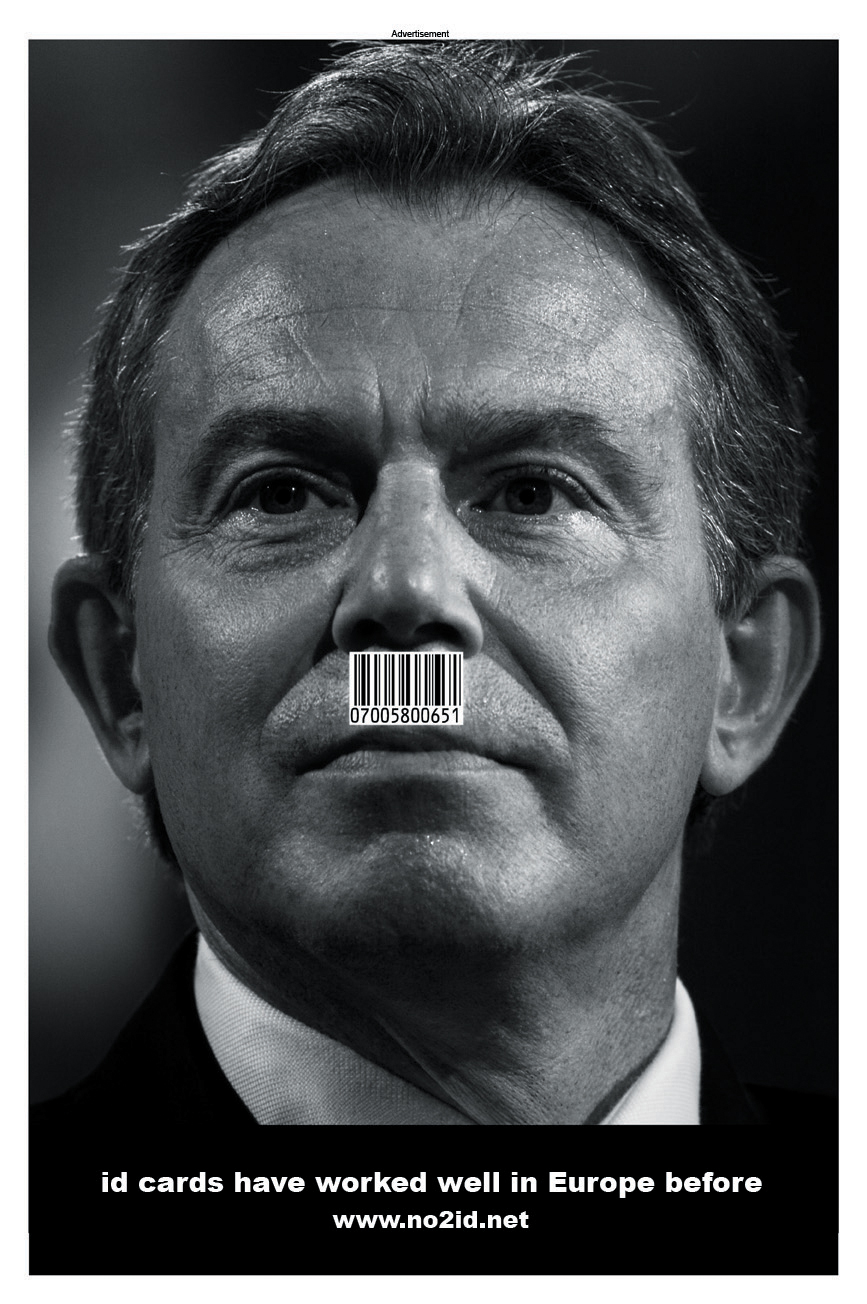
ID cards have worked well in Europe beforeFrankly, it’d be enough to put me off going to the pub. The culture there has become so accepting of surveillance that this is generally unquestioned by those in authority, and the electorate demands nothing more of its representatives. Perhaps even worse is the UK, whose national ID card scheme was the subject of an excellent but unsuccessful counter-propaganda campaign.

While we have some surveillance cameras (most notably in Queen Street and central Christchurch) and a reliance on RFIDs (in passports, for instance), and we have a police culture of aggressive surveillance and with strong authoritarian tendencies, things aren’t so bad in New Zealand. So it is with some dismay that I read yesterday’s op-ed by Chapman Tripp solicitors Simon Peart and Richard May on the NZ Herald website which warns of the alarming powers of surveillance and social control which could be exercised by regulatory bodies including the Commerce Commission, the Reserve Bank (!) and MAF under the newly (and quietly)-introduced Search and Surveillance Bill. They really are quite alarming – the right to covertly surveil ordinary citizens in their own homes, the extention of enforcement powers normally the preserve of the police to other regulatory bodies, the right to infiltrate and surveil computer networks and to secure premises against their legitimate owners, and, frighteningly, the nullification of legal privilege in some communications. Read the article. Read the bill if you can spare the time (it’s 196 exhausting and obfuscatory pages).

As I said, this comes down to trust. The problem is that, even though I generally trust governments, I don’t trust their regulatory and social control agencies which are not subject to electoral veto. That’s the problem with this bill – it seeks to remove the matters of surveillance and investigation from the political sphere where it belongs and create a new surveillance culture norm in NZ.

Edit: I have somehow missed the Gordon Campbell’s excellent piece on the same topic. Read that, too.

L

The Pirate Bay – sold!

Swedish company Global Gaming Factory X claims to have bought The Pirate Bay, in a press release declaring the acquisition. At the same time, they purchased Peerialism, which has developed “peerialistic” content-sharing models; new models which keep content-owners as happy as consumers. Or so they reckon. The purpose of the acquisition appears to be a move away from a content distribution model of questionable legality and toward a “third way” model of sorts.

We would like to introduce models which entail that content providers and copyright owners get paid for content that is downloaded via the site, ” said Hans Pandeya, CEO GGF. The Pirate Bay is a site that is among the top 100 most visited Internet sites in the world. However, in order to live on, The Pirate Bay requires a new business model, which satisfies the requirements and needs of all parties, content providers, broadband operators, end users, and the judiciary. Content creators and providers need to control their content and get paid for it. File sharers ‘need faster downloads and better quality, ” continues Hans Pandeya.

I don’t know how credible this all is; there’s no indication on the site that anything has changed. But if the news is legit, it is a major blow to the free content movement and the agenda which opposes rampant corporate control of information (about which I have written before). It could show that the fiercest ideological outlaws, people who have laughed in the face of legal and financial threats for years, are motivated by money after all. It also shows, perhaps, that losing a major lawsuit isn’t always a bad thing: it’s hard to see TPB, which has virtually no staff, assets or anything other than brand recognition being sold for SEK60m (NZ$12m) before the lawsuit and its Streisand Effect.

Edit: It’s now official, though they use the word “might” in a way the above-linked press release doesn’t.

Despite the price tag, that’s apparently not the point:

TPB is being sold for a great bit underneath it’s value if the money would be the interesting part. It’s not. The interesting thing is that the right people with the right attitude and possibilities keep running the site.

They also roll out a good lick of market-libertarian rhetoric in their favour:

On the internets, stuff dies if it doesn’t evolve. We don’t want that to happen. We’ve been working on this project for many years. It’s time to invite more people into the project, in a way that is secure and safe for everybody. We need that, or the site will die. And letting TPB die is the last thing that is allowed to happen! If the new owners will screw around with the site, nobody will keep using it. That’s the biggest insurance one can have that the site will be run in the way that we all want to. And – you can now not only share files but shares with people. Everybody can indeed be the owner of The Pirate Bay now. That’s awesome and will take the heat of us.

Just a bit too pat. My skepticism about their motives stands.

L