Sexual abuse recovery rationing by the ACC

This morning the New Zealand Association of Psychotherapists delivered an open letter to the Minister for ACC asking him to explain and justify the proposed changes to ACC’s sensitive claims policy. This issue was covered by Anjum last week and is now picking up steam.

Briefly, the proposals (which are due to come into effect in September) would change both the nature and amount of entitlement of treatment to which sexual abuse or assault victims are entitled. The changes represent a move from a therapeutic model mostly operated by psychotherapists and counsellors to a symptom-management model mostly run by the mental health system. Victims’ entitlement to treatment will generally be reduced to a maximum of sixteen hours, essentially meaning that many victims of the most severe abuse will not be fully treated. In addition, victims will need to explain themselves to as many as three different assessors in order to access this limited treatment, with each assessment a form of revictimisation. As if that wasn’t enough, knowing that many cases simply will not be treatable in the mandated 16-hour timeframe, some psychotherapists have indicated that they will refuse on ethical grounds to begin the work, knowing that they cannot finish it, on the basis of the ‘first, do no harm’ principle which underscores their practice as clinicians.

This means the already-high barriers to effective treatment of sexual abuse trauma are about to get higher. In effect, they are being rationed so as to exclude the ‘worst’ cases who require the most work (and therefore the most cost) to treat. However the revictimisation of repeated assessments and the uncertainty of treatment form a strong disincentive – not wanting to open a wound without being sure it can be closed, many people will simply not seek treatment, and many counsellors will simply not be able to provide it on ethical grounds. This chilling effect will lead to sexual abuse being pushed further underground and the problem fading from the public view to a greater extent than it already is, with potentially catastrophic long-term social consequences. At last count, sexual abuse cost NZ about $2.5 billion per year including the costs of crime, imprisonment, drug and alcohol, other health issues, unemployment and the cycle of abuse which an absence of treatment sustains. For the cost of a few million dollars in treatment, how much will that be allowed to increase?

The most absurd thing is that these are cuts to front-line services for victims of serious crime; the very thing the government said it would be increasing. ACC’s Sensitive Claims Unit costs $30m or so annually to deliver $20m of front-line services, and these cuts will shift that balance much further toward the back-office by relying more heavily on already-overworked case managers and the top echelons of the practice – psychiatrists and clinical psychologists who currently do 10% of the work – rather than the relatively cheap and numerous psychotherapists and counsellors who do the other 90%.

For the inevitable conspiracy theorists, this also isn’t a matter of psychotherapists feathering their nests – for most, ACC work is a small part of their practice, and not an especially lucrative part of their practice, since most can charge (much) more on the open market than what ACC will pay.

Expect this to be a fairly big deal in the coming weeks. It is an issue which is deeply embedded in many policy fields: justice, victim’s rights, human rights, child abuse, crime, drug and alcohol abuse and mental health are just a few. It’s not going away, because sexual abuse is not going away.

L

Disclosure: I was involved to a small extent in the process around this open letter. I have family members on both ends of this issue – both providing and receiving treatment. You probably do, too, even if you don’t know it.
Hide-ing to nothing

Two topics in this post, because I don’t have time to fully develop them.

First, John Key must not ignore the anti-smacking referendum. Although the question was leading, the result was decisive and will embolden people like the Copeland/Baldock/McCoskrie axis of evil to drive the stake deeper into the heart of NZ’s traditional social liberalism. Tinkering with guidelines won’t mollify them, and won’t stop the electorate from listening to them because it doesn’t address the substantive point about the status of a light smack in law. What will do that is the Borrows Amendment. With a view to neutralising further attacks on the discipline legislation, I think the government should adopt and pass the Borrows Amendment with due haste, and put the issue to bed (without its dinner). It’s a mutual-second-best solution, whereas the repeal as passed in 2007 was not and will not endure.

Second, Rodney Hide’s position on the Auckland mana whenua seats is consistent and his behaviour is responsible. The (proposed) mana whenua seats in the Auckland case aren’t the same as the Māori electoral seats – they’re appointed, not elected, and this gives him separate grounds to oppose them. It is not inconsistent that he favours entrenching Māori electoral seats if they exist, but not of implementing any more such seats, and not implementing any seats which aren’t elected. He’s being responsible in clearly signaling his intentions in a fairly measured way. He’s not trying to exercise any more power than he has, but simply saying ‘my resignation will be a cost of making this decision, just so you know’ and requiring John Key to consider whether that cost is worth it. In addition, he’s working with Pita Sharples on the issue rather than taking a reflexively oppositional approach. Finally, this is strengthening his core political brand. It’s smart politics all around because whether he gets his way or not, he comes out of this looking good.

Update: A third thing – eternal guest-poster r0b at The Standard continues to go from strength to strength.

L

The hits keep coming

Tara Te Heke has been reading from the Ayn Rand playbook with her idea of a DPB party. Classic troll, and devastatingly effective. There are some truly vile things being said there, and in amongst it, the earnest lunacy of a 3,000-word biblical anti-sermon apparently intended as a sort of Turing test. There’s so much baying on the thread that I’m not sure if anyone has come up with the quote about democracy being two cannibals and a vegetarian voting on what to have for dinner, but it can’t be far off.

The thing I can’t wait for is DPF getting back and answering his doubters, haters and watchers. Whatever else it is, this guest post experiment has been wonderful theatre.

L

Resentful reactionary ethnocentric cultural protectionism

Buy Robyn Kippenberger an atlas, and a history of New Zealand. The chief executive of the RNZSPCA was on The Panel (audio; starts at about 06:15) this afternoon talking about the killing and eating of dogs, as opposed to other critters. Quoth Ms Kippenberger:

I think it’s generally agreed that we have companion animals in European countries, and we don’t eat them. […] I guess that New Zealand is a country that is largely European, and Māori, and none of us eat our dogs. And we’re also … and that’s the main culture in this country. […] I mean, if you want to eat dog, then go to Viet Nam, or go to China, or indeed, maybe go to Tonga.

In the immortal words of that noted killer and eater of critters, Barry Crump: hang on a minute mate. I have a few questions for Ms Kippenberger. In no particular order:

  • Who’s this ‘we’ you’re presuming to speak for, again, and who gave you the right to speak for them?
  • Since when was New Zealand a ‘European’ country? It’s in the South Pacific; the same part of the world as Tonga, incidentally.
  • Given that Māori brought dogs with them to Aotearoa for the express purpose of eating them, how exactly is it culturally offensive for Māori?
  • Upon what basis do you define ‘New Zealander’ as excluding Chinese, Viet Namese and Tongan people?
  • Why do you presume to go on the radio and talk about matters on which you are clearly not informed (viz: geography, Māori history, cultural identity and multiculturalism)?

She goes on:

What we’re saying is, it’s culturally insensitive to do it here. Other cultures tell us what is culturally insensitive to do in their countries. I don’t think that it’s anything other than giving people the heads-up that if they live in this country, actually, we don’t like what they’re doing if they do that.

The underlying discourse here is something along the lines of:

The whole world is PC and everyone gets to have their meddling way, telling us what we can and can’t do, so us whitebread suburban honkey hand-wringers are going to take this chance to draw a line in the sand, to the north of Asians and Islanders, and to the south of Māori (but not Māori as they actually are; but only as we feel like we are supposed to think of them, as rather like us, only brown).

(My words, not hers).

Yes, many New Zealanders object to the killing and eating of pets, particularly dogs. But liberal, multicultural society is quite capable of handling these differences internally. The SPCA is not an agency of cultural arbitration; as Ms Kippenberger has so aptly demonstrated, it is not equipped to be such an agency. Even the CEO doesn’t have the skills or inclination to come up with any better argument than assimilative monoculturalism, and can’t even get the most basic facts and logic of that feeble and reactionary argument right. Its mandate should be limited to those things it knows about – advocating against cruelty to animals while they’re alive, for example. There’s no argument here that the animal was treated cruelly, so the SPCA has no business being involved.

Animal rights and welfare activists should be likewise angered by this. Ms Kippenberger, who ought to be a champion of your cause, has demonstrated that it is led by fools whose attitude to cultural difference is ‘go back to the Islands’.

L

Dogs are food too

What are the SPCA doing raiding a guy’s cook-out because dog is on the menu? This was not an issue of cruelty; the dog was apparently killed in a ‘humane’ way,* and there’s no law against such killing; it’s really just the imposition of cultural norms about what sorts of animals are food and which aren’t.

I’ve eaten dog in three countries, as well as some other unusual and nasty things. I wouldn’t make a habit of it, but I know people who would. For a year I lived about half a kilometre from a dog farm; a place where dogs were kept before being slaughtered. It was pretty foul, especially when the wind changed, but the difference from any other industrial slaughterhouse was really only one of degree. Meat, as they say, is murder. People are permitted to kill pigs, chickens, cattle, rabbits, ducks, fish, goats, deer and fuzzy little lambs; dogs should be no different, and the SPCA has no business in arbitrating what ought to be a private matter, unless it’s their policy to come knocking any time anyone kills anything. But they have no right to do so. Imagine the drama if they started throwing their weight around at a Pākehā deerstalker’s cook-out, rather than that of a Tongan cultural outsider.

L

* There’s a fair argument as to whether this is a meaningful term, which I’ll elide for the purposes of this post.

Submit!

Submissions to the NZ Geographic Board regarding the proposed change of the spelling of ‘Wanganui’ to ‘Whanganui’ close tomorrow. Whether you support the change or the status quo, I urge you to make your position (and arguments) known to the NZGB and to the country.

It will come as no surprise to readers that I support the proposed name change. The majority of my submission is drawn from the four posts I have written on the topic. There’s plenty (plenty!) more about this out there on the interwebs as well.

Submit!

L

Edit: My full submission is below the fold.

Continue reading “Submit!”

No longer a good, not yet a service

“Getting what you deserve” by Nick Smith in today’s Independent (which isn’t, it’s Fairfax-owned) is a good read about the future of the media. In beautiful irony, it doesn’t seem to be online, so I’ll excerpt it here:

“Journalists deserve low pay” Robert Picard, media economics professor at Jonkoping University, Sweden, opined provocatively. “Wages are compensation for value creation and journalists simply aren’t creating much value these days.”

The alarming disappearance of papers and journalists (27,000 have lost their jobs in the US alone in the last 18 months) is, Picard argues, a result of loss of control of content.

Picard believes skilled journalists are not like skilled plumbers. Their skill is the distribution of other peoples’ knowledge. Now, that knowledge is distributed online at little cost, and control of the saleable commodity has disappeared. “The primary value created today comes from the basic underlying value of the labour of journalists. Unfortunately that value is now near zero.”

Rupert Murdoch, so often cast as the scourge of journalism, is shaping up as a white knight. His News Corp is to start charging for website content. … His determination to wrest control of content and ensure payment is significant. The Financial Times followed last week with its own iTunes-inspired business model Fairfax Media, Australia-based publisher of The Independent, is also said to be considering joining the pay-per-read campaign. If both follow through, every daily Australian newspaper, save the West Australian, will charge for at least some online reading. Fairfax chief executive Brian McCarthy’s comments that digital delivery must be monetised will cheer Barry Colman, publisher of the National Business Review, the only New Zealand website to charge a fee. Colman says a pay-per-view model is the only way to stop further newspaper losses and the erosion of quality.

[Edit: It’s online now. Thanks I/S.]

The problem with Murdoch, Colman and indeed the good professor whose quote leads the piece, is that they see news as a good; a thing which people should pay for. But really, it’s not a good – it’s a service.

Or more precisely, news text and information is a good, but it can’t readily be monetised – what can, and must, be monetised is the service of distributing and providing access to that good, and most critically, the service of filtering out all the stuff which is irrelevant. This is the service journalists provide – their real value isn’t, as Picard says, generating content in the paragraph factory, it’s in their role as decision-makers defining what is news and what isn’t, what people need to know about and what they don’t.

Murdoch and his cohort see the internet, which robs their ‘good’ of value, as a problem to be solved or circumvented. But the internet is the only thing which will allow for the establishment of a genuine service which will enable media companies to provide tailored, targeted content to individual readers.

Content can be free – but as the volume of content grows, the value of relevance increases. That’s where the money is.

L

Wanting to believe

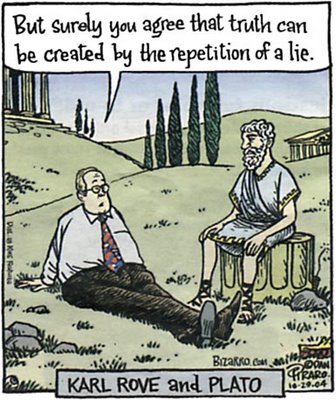
Now that Barack Obama’s Kenyan ‘birth certificate’ has been revealed as a fairly simple forgery, you’d reckon the birther nutcases would crawl back into their holes in shame, right? Not a chance. (Original site here – the fact it triggers anti-malware warnings is proof of a coverup, natch.)

So it is with any such theory. Evidence brought to bear simply points to a wider, stronger and better-resourced conspiracy.

roveplato

Memo to birthers: you’ve lost Karl Rove.

(Cartoon via Open parachute.)

L

Putin the scribbler

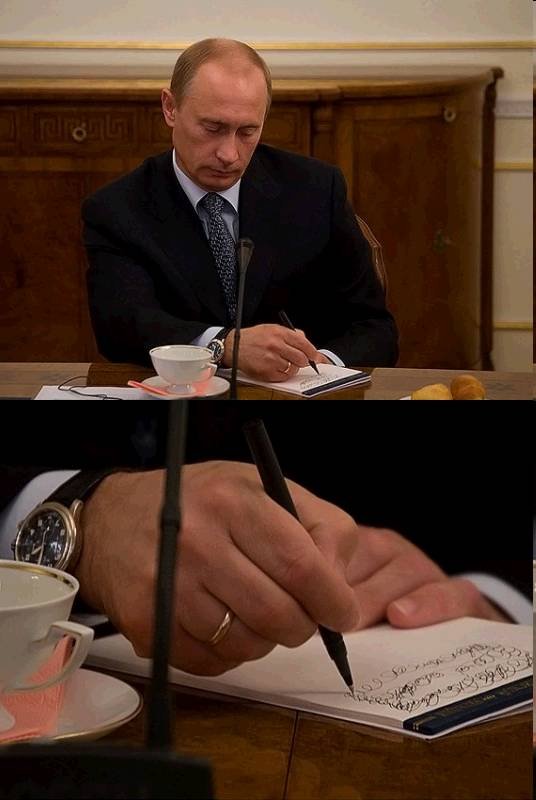
In contrast to last week’s vanity shots of Vladimir Putin, an illustration that you don’t get anywhere in the Russian political-security complex by writing down your thoughts on bits of paper.

putin-scrib

Or by looking idle.

(Thanks to AG for the pic.)

L