You can’t mess with the messers

[Note: Idiot/Savant stole my initial title for this post — word for word! — forcing me to get more creative. The definitive version is here. Not sure about the video, though.]

Education minister Anne Tolley has tacitly threatened to go nuclear on primary principals who refuse to comply with National Standards directives, or who speak out against them. In a speech to the Principals’ Federation conference in Queenstown today, she said:

It’s much quicker [contacting me with concerns] and you will get results, rather than going to the media and making threats, which is just politicking, and achieves little.
And while we’re on that subject, you are pretty unique among public servants who can speak freely in the media. May I remind you that I made representations to make sure that continues.
However – no public servants have ever been granted the privilege of picking and choosing which Government laws they choose to administer. Lawyers, accountants and all the other professionals working in Ministries can offer opinions. But it’s the Government that makes policy decisions.

Now, there’s an implication here that the minister might retract her “representations” to make sure that the rights of teachers to speak freely are preserved, but there’s nothing to this. Any move to constrain teachers’ views or their expression would immediately draw furious and justified denunciations of the government for politicising and propagandising the education system, such as no liberal political movement could withstand.

In the final analysis she’s 100% correct about the government setting policy and the sector implementing it. By way of remedy, the ministry can take over the running of a school which fails to implement education policies adequately, and Trevor Mallard suggests the ERO has already started heavying truculent schools to set an example to others.

But it is an empty threat. For one thing, you can’t play the bossy schoolmarm with schoolteachers and principals — they wrote the book on it, and know all the tricks of the game, having put up with them from students for their entire professional lives. Not to mention that, as career educators they have far more invested in the quality of their education system than a minister who’s only been in the job two years and could be gone in the next cabinet reshuffle.

More crucially, though, the minister is up against old-fashioned collective action: a heavily unionised workforce which knows it is indispensable and irreplaceable. So what happens if it’s not just one school? What happens if it’s a dozen, or a hundred, or almost all the primary schools in the greater Auckland area, or the schools of two National heartland electorate regions at either end of the country, or as much as 94% of the sector overall?

Later in the speech, Tolley said:

I’ll say it again – we are going to get this right, for the students, and for their parents.

But when push comes to shove, National Standards simply cannot be implemented by fiat. Teachers, directed by principals, are those who must undertake the implementation of the policy. While I cite them reluctantly because I don’t entirely agree, it’s somewhat like what the Randians are saying about Obama’s response to the BP oil spill: no amount of threat or bluster can provide any additional incentive to progress a cleanup whose failure or undue delay will spell a certain end to the company. No matter how you slice it, there are not enough Ministry of Education staff members, non-unionised part-time relievers or teachers who are happy with National Standards as proposed to do the complex and important work of assessing all the students who need to be assessed; cataloguing, moderating and communicating those assessments to parents and the ministry in a coherent manner. This is ignoring the fact that you can’t simply parachute a compliant teacher or apparatchik into an unfamiliar classroom and have them do it with any legitimacy. The teachers who stand up in front of that class of kids day-in and day-out are the only ones who can properly assess them, and they know it.

The sector also knows it’s in the right. Educators’ opposition to National Standards is neither ideological nor capricious, and they have have consistently levelled principled and pragmatic arguments against only the proposed implementation of the policy, backed by the best local and international experts in the field. They support assessment standards in principle, and have repeatedly suggested reasonable alternatives to the proposed implementation. The problem isn’t with their willingness to work with the minister; it’s that the minister isn’t interested in working with the sector.

So ultimately one of two things will happen: one side or the other will compromise sufficiently for the issue to progress, or the minister will be faced either with backing down in abject failure or sacking a significant proportion of the education workforce, with the consequent failure of the policy by default, not to mention a massive outcry from parents who’re forced to take time off work because their kids can’t go to school (and from their bosses, and bank managers, and almost everyone else). There’s no better way to bring the country to its knees.

Tangentially, this situation illustrates a branding risk I’ve been meaning to post on for a while: if you name a policy initiative after your party or some other core bit of your identity, you had better be damned sure you can get it through to full implementation without a hitch, lest its failure tarnish your good brand. Quite apart from any concerns with the policy, his National government has failed to do so with its National Standards. Not only is the policy programme and its attempted implementation against the wishes of the only people who can implement it a catastrophic mistake, but its naming looks like a spectacular failure as well. If it’s not pulled out of the fire soon, in future, all National’s political enemies will have to do to score a point is recount some of the more embarrassing events of this episode and say “these are National’s Standards”. It’s already happening — I’ve seen that very sentence used at Red Alert, for instance, regarding something unrelated to education reform. Instant conversion of a wonkish policy criticism to a gut-level identity observation which will resonate with the folk who just wanted their kids to go to school, those who wanted nothing more than to teach them as best they could, and ultimately the kids themselves. For this reason, my instinct is that the long-term damage to National’s brand and electability on this matter will become too high a price to pay for the perceived win over the sector, and those with a more strategic view of National’s situation will require that the wound be cauterised. Although it’s a backdown, over the long term this will be good for the party. More importantly, it will be good for the country.

L

Of Llamas and Lamas

Public advisory, especially for DPF:

Llama


Lama


And to bring the post back around to the topic of Chinese authoritarianism and responses thereto, with a bonus llama connection: The Song of the Grass-Mud Horse made a splash a year or so ago, as a protest against the Chinese government’s internet “harmony” policy. The video is below (and contains necessary obscenity):

This graphically illustrates a point that shouldn’t need to be mentioned, but often does, and of which I was not fully conscious until I spent some time in China: for all that they are propagandised as such in the West, the Chinese are not simply mute automata struggling under the heel of their dictators. The public sphere, however constrained it might be by our standards, exists — and the diversity of views aired in it is increasing, not decreasing.

L

The dam breaks

“Where does the political correctness end?”

That’s the question from Michael Laws in response to the shocking news that local Māori are calling for “Rimutaka” to be changed to “Remutaka”. His dire predictions are coming to pass. The savage, foreign spelling of Whanganui has been coercively imposed by the forces of craven self-hating white PC liberality upon the good burghers of Wanganui — sorry, I mean Wonganewy — and now every Māori place-name in the country is going to be similarly stripped of the light patina of civilisation bestowed upon it by the linguistic touch of the God-fearing right-thinking settler.

As local councillor John Tenquist — or should that be Tinquist? — says, it’s always been that way for more than his 76 years, so that’s how it should always be:

What is wrong with the way it is? Once again we are pandering to a minority. We have some European heritage in this country and, rightly or wrongly, it has been Rimutaka for over 150 years, so if it ain’t broken, don’t fix it. The locals on either side of the hill will never change the name from what they have always known.

Of course. Those old people knew what they were doing back then when they changed the name. Wouldn’t have done it without a reason. Back in those days, they knew that eating at the dining table was the final bulwark against the collapse of Western civilisation, betokened nowadays by so much more than the creeping advance of Hori-fied place names. We are losing our grip, little by little. We even have to sing the national anthem in Māori — and the Māori version first, even though they didn’t write it! Our country’s most-trusted citizen and most-decorated war hero is a Māori. We’ve got a Māori flag, a Māori All Black team, and half our goals at the World Cup were scored by a Māori! I fully expect that by the time of the 2014 World Cup we’ll be fielding a team called the All Browns. In the unlikely event that we can qualify, given the well-known lack of footballing skill possessed by those not of European extraction.

And would you look at that: Mayor Michael was right all along. Once again, spearheading this frontal assault on all that is right and proper are those bloody river Māoris and their unpronounceable names:

The story behind the area’s name is that a Maori chief, Haunuiananaia, an ancestor of the Te Ati Hau a Paparangi people of the Whanganui region, left his home in southern Taranaki to pursue his errant wife Wairaka, who had run off with a slave.
During his journey, he sat down to rest on a mountain and think about his quest. He named the mountain Remutaka – which means to sit down.

The Mairist Republic of Whanganuistan draws ever closer. And we’re supposed to call the highest peak in the Wellington region after something some savage once sat his arse on?

It’s past time for New Zealand’s downtrodden, powerless, disenfranchised white majority to rise up, and let the clarion cry be heard: “Come and see the violence inherent in the system! Help, help, we’re being repressed!

L

Rudd’s problems in a nutshell

Just a quick hit: this article in Sydney’s Sunday Telegraph from last Valentine’s Day details the less-than-lovey response Rudd received from students invited to the annual Parliamentary Q&A.

It’s not that they were set against him — young Australians overwhelmingly supported Kevin ’07, and continue to support Labor. It’s that he treated them with disdain. He didn’t prepare for what should have been a PR gift; made things up to suit the narrative he wanted to project; and then pulled rank and got angry when his prevarications were exposed.

Clearly rattled, Mr Rudd answered the perfectly legitimate questions like an annoyed schoolteacher, pointing his finger and disputing her claims. “Well, you’re shaking your head. Can I just say that is a fact, and if you ring up principals around the country it’s happening,” he said on air. The Australian National University student [Angela Samuels, 18] has since been backed by principals around the nation, saying they had not been given the laptops that were promised. “I was just shaking my head because I wasn’t happy with what was happening,” she said. “I’m in contact with schools. I know what he’s saying isn’t the truth. It’s annoying that he stands in front of cameras and says things that aren’t true.”
[…]
“He came in with the message that the Government was taking action,” Kate Campbell, 21, said. “He’s a very good political operator, he knows how to manage the media and manipulate people and their perceptions.” Andrew McDonnell, 22, said young people were now questioning their loyalties to the Government as a result of their experiences. “I respect him for his intelligence but if he tried to be more genuine and honest he’d be more popular,” he said.

Lesson: even when your gameplan is to emphasise style over substance (which is fair enough), it is imperative that you’re able to fall back on substance when style fails — as, under sustained and competent critique, it inevitably will.

L

From the Department of Random Ideas

How about Shane Taurima for Sean Plunket’s replacement on Morning Report?

A radically different style from Plunket, but he does have good interviewing chops, very extensive experience and strong credentials, especially in hard political news. His interviews with party leaders before the election were exceptional and demonstrated that he can’t be pigeonholed as a “brown issues” journalist. To my knowledge he has been scrupulously neutral with regard to politics, throughout both the present and previous governments. He is fluent in te reo, and has — dare I say — a deeper understanding of Māori issues than any other journalist who would be considered for the role. He would bring a marked change of style and perspective to the programme.

I am on record stating a preference for Radio NZ to elevate someone from within their existing journalistic ranks rather than head-hunting a star, but we sure could use some more Māori faces and voices in the mainstream broadcast news. There are a few: Julian Wilcox, Eru Rerekura, Willie Jackson, John Tamihere, Jenny-May Coffin and others all do good work, but at the fringes — on low-rating or niche channels, constricted bulletins and difficult timeslots, or in sports or talkback rather than proper news. There are a number of senior reporting and editorial/production staff — such as Duncan Garner, and Carol Hirschfeld’s departure from Campbell Live in particular is sorely missed — but all in all Mike McRoberts is the only Māori anchor of a mainstream news programme, and most people don’t think of him as such (which is in many ways a testament to his success).

Shane has just quit his job at Marae due to the impending format shift, and his role with TVNZ is apparently in doubt. John Bishara of Te Māngai Pāho says he must be “going to something better”, so I suppose one question is whether Morning Report is “something better”.

L

Brown still on the horse

Bless the Herald, burying the most important point of an article about the Auckland supercity mayoralty race at the very bottom:

Mr Brown also spoke of leadership and the need to deliver a resounding majority for the mayor so he or she could sit there with the mandate with the support of the community. [sic]
Judging from the mood of the meeting [in Point Chevalier], he won a resounding victory last night.

It seems remarkable to me that Brown could beat John Banks “resoundingly” in gentrified Pt Chev, of which (as I recall) Banks is himself a long-time resident. But then, I don’t know Auckland very well, and perhaps I’m misreading it. Is there something I’m missing or is this actually a biggish deal?

It apparently counterindicates DPF’s and Hamish Collins of No Minister’s reasoning that Len Brown is toast because Kerre Woodham reckons he’s a nutter and she is some sort of bellwether for this “Grey Lynn liberal” demographic. Because her status as a talkback host and columnist who recently came out in favour of three strikes didn’t disqualify her from that already.

Disclosure: According to 8 Tribes questionnaire, bogus pop-sociology though it might be, I’m very squarely a member of the Grey Lynn tribe myself. I’m sure you’re all shocked, just shocked.

L

Visual perks of office

(NZ Herald.)

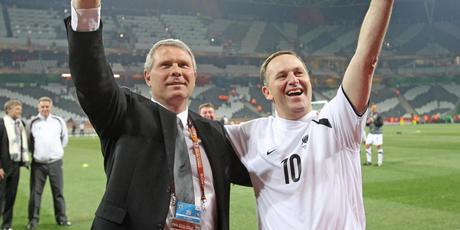
I don’t have much time today, but wanted to note the above image of John Key in an All White strip after this morning’s 1-1 victory over Italy. The significance of the event notwithstanding, the slightest chance of a result such as this, and its reflected glory, was surely a significant reason for Key to attend the All Whites-Italy match. Fair enough, too.

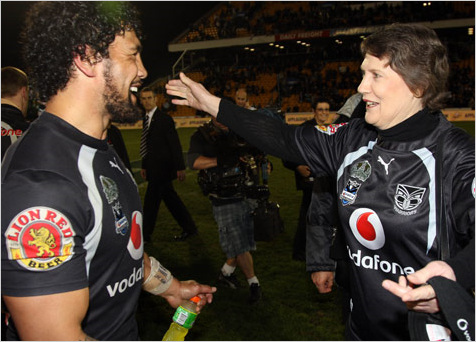
It also reminded me of when then-PM Helen Clark donned a Kiwis Warriors jersey after a momentous rugby league victory (2005 Tri-Nations?). But for the life of me, I can’t find a photo of that event. I know it was pretty well-seen at the time — footage of the team celebrations with Clark was part of the post-match TV broadcast and made the news, but it’s like the stills have just vanished down the memory hole.

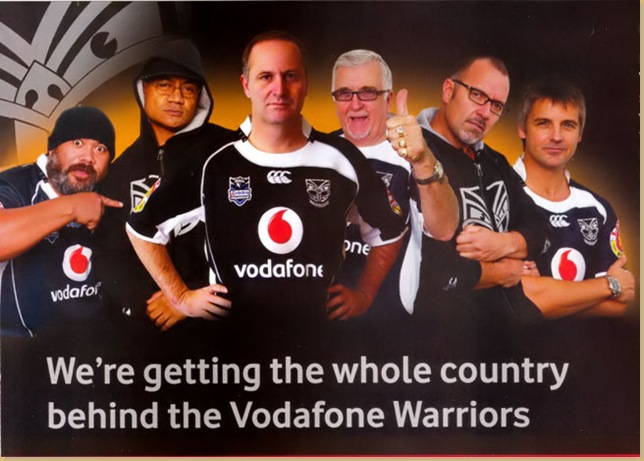
Ironically, while googling, I did find a photo of John Key as a Warrior, though this one is apparently advertising bumpf:

(H/T NZ Conservative, who asked “I wonder if Helen would have done it?” Well, wonder no more.)

Those look suspiciously like Steve Price’s forearms.

Edit: Pat, in the comments, points out that I’m probably remembering the Warriors, not the Kiwis. Probably right. There are certainly a bunch of PR shots of Clark with the team after their 19 September 2009 playoff win over the Roosters — conveniently just a couple of weeks before the general election.

(Stuff gallery.)

Thanks Pat.

L

Life mimicking art: outrageous vainglory

This is John Galt.
“This is John Galt.”

If there lingers any doubt the film production of Atlas Shrugged is going to be an epic adolescent ego-stroking festival, it must surely be dispelled by the news that the director (Paul Johansson, of teen-angst-dram series One Tree Hill) is also the hero: John Galt. The resonant hubris of this is so stark that the fact he’s never directed a feature film before barely deserves a mention.

There’s one point of interest for New Zealand viewers, though: Grant Bowler, probably better known as Wolf from Outrageous Fortune, is down for Hank Rearden.

There is no such thing as a temporary (career) suicide.
“There is no such thing as a temporary (career) suicide.”

Grant Bowler has some chops, and he suits the character. My previous misgivings notwithstanding, I reckon that’ll be reason enough to watch it. But, my goodness, what a brush to risk being tarred with.

(H/T to Peter Cresswell and his always-excellent ramble.)

L

Bestest

Stuart Dye’s column which uses perfectly sound* logic to reach the conclusion that the All Whites are the world’s fifth-equal-best football team,** is a bit of fun. The only problem is that while reading it I kept getting flashbacks to the flimsiest rationalisations of the left’s 2008 election campaign. By careful selection and weighting of the criteria by which to judge the political field it was possible to argue — at times convincingly — that Labour and the Greens had it in the bag, and that’s what many people did instead of taking a long hard look at their team’s performance.

Ironically enough, I’m pretty sure those picking the criteria and making the rationalisations weren’t surprised in the slightest when their outcomes failed to eventuate.

Delusional partisan jingoism in a sport where we have a snowball’s chance: harmless. In politics: not so harmless.

L

* For unusual values of “perfectly” and “sound”.
** Above us are Brazil, Germany, the Netherlands and Argentina — and by now Mexico and Nigeria Greece, which I suppose makes us seventh equal.

Len Brown shows how it’s done

I don’t know much about Manukau mayor and Auckland Supercity mayoral candidate Len Brown, but this I do know: the guy has fire in his belly, and is prepared to stand and be judged by the authorities and his constituents.

This speech (audio, or edited video here if you can get it to work) is old-fashioned public-sphere politics — both rhetorical and substantive — done properly. He admits misusing his council credit card, calls in the highest authority in the land to investigate it, and says let the cards fall as they may.

This is an object lesson on accountability and due process for Chris Carter. Two senior progressive politicians, both fighting for their political lives over the same issue, and two radically different approaches. Where Carter has recoiled from public scrutiny and repeately refused to take any responsibility for his wrongdoing, Brown has done the opposite, calling for the highest standard of oversight and demonstrating that he will accept its outcome. He has both appealed to the values and culture of liberal democracy in asking that assessments be made on the substance of the allegations against him, and appealed to liberal democracy’s civic institutions to provide the best possible basis for that judgement.

Win or lose the election, Brown has acted with integrity and demonstrated his commitment to democracy, and as far as that goes, he’s already beaten Carter hands-down. But even in terms of electoral advantage, he has played a huge liability into a potential — depending on what the A-G’s investigation shows up — advantage. While such heartfelt contrition is a poor substitute for not having done wrong in the first place, the electorate likes a candidate who is prepared to stand up and be counted like this, and moreover, it tends to like a candidate whose commitment to the job is as strong as Brown’s clearly is. So this mayoral race just got interesting.

L