I write like…

Via PC, a nifty tool: feed it some text and it tells you who you write like.

From a more-or-less random sample of my writing on this site, more than 50% comes back telling me I write like David Foster Wallace. I’d never heard about him until now, but wikipedia lists his form as “postmodern literature” and “hysterical realism”. I can see how that cap would fit. But Wallace hanged himself in 2008. That’s not so good.

Outliers include the post from the other day about tits and teeth news presenter selection, which is like Stephen King, possibly confirming Pablo’s dim view of it. The dam breaks, my only real attempt at satire, apparently reads like James Joyce. My epic and furious response to Chris Trotter from a while back is in the style of H P Lovecraft, which I think is rather fitting.

L

Iti and Bomber: response to “The Big Dog”

Rather than further sidetrack the discussion about police and firearms at The Dim Post, quick answers here to inquiries there by “The Big Dog” as to my views on two topics:

Lew, I’d be interested to know what you think of Tame Iti?

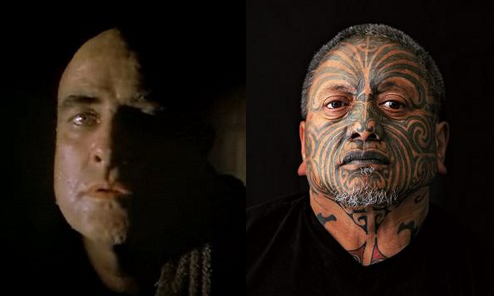
Tame Iti is a convenient symbol of all that whitey wants to fear. Since the events of October 2007 he’s been dressed up as our very own Colonel Kurtz.

Likewise Hone Harawira to an extent; Danyl’s brilliant commentary on this is here. The reality is — to put it very mildly — somewhat different. This isn’t to say that either are utterly blameless, or that this depiction is entirely unwanted; only that their notoriety is rather greater than is really deserved.

Lew, What did you think of Bomber Bradbury’s take?

(Assuming Bomber’s take on police and firearms here.) Bomber distrusts and fears the police, and he has his reasons for doing so. In that context the response is not unreasonable or unusual. While I agree with a lot of what he says in principle, I essentially see police as part of a healthy civil society, not as its enemy, so I ascribe those concerns somewhat less weight. So where Bomber insists on hard restrictions on police powers, I am more content with soft restrictions and strong civilian oversight. It’s an open question as to whether our present oversight is sufficient, though.

Edit: TBD was actually asking for my views on Bomber’s response to the October 2007 Urewera Terra raids. I’ve answered in the comments below.

L

Personal narrativium

From the NZ Herald, Why I should be the mayor:

Len Brown:

Every day I wake up and, for one thing, I’m thankful I do wake up. But secondly, I have the greatest job in the world and it’s a job that enables me to make a difference, to really change people’s lives, to deliver change, new direction and positive growth in the community. I can sort of perform little miracles around our place. When the change occurred I wondered whether I could shift this position to the community that has raised me since I was 7. I have very quickly found that passion. It has been an extraordinary journey thus far and the opportunity to deliver something by the way of step change and extraordinary redirection of Auckland and taking up of its potential, a marrying of our business dynamic with our community aroha and love is something I believe is an extraordinary opportunity, and I would like to take that opportunity.

John Banks:

At age 18, I decided that I would balance the family ledger by joining the police. The Auckland police told me in no uncertain terms that I was a lowlife son of two shitbags and there was no place for me in the New Zealand police. Twenty-five years later, I became the Minister of Police. I’m doing this to balance the family ledger.

So it’s “boundless enthusiasm for community miracles” squaring off against “individual crusade for redemption, nothing to do with Auckland” in the Supercity mayoral battle. If that’s all there was to it, Banksie would be a lost cause.

L

Firearms, no debate

I generally agree with r0b’s reasoning on the police need — or lack — for firearms. This is a mostly-empty moral panic.

But how things have changed for Greg O’Connor of the Police Association. This from 1 June 2009:

Mr O’Connor, who is currently studying policing in Scandinavia, did not support all police carrying guns but said the matter had to be looked at. […] “We said the debate should take place outside the emotion of Len Snee’s death and it’s disappointing to see that now there’s not going to be any debate there needs to be.”

A year ago Greg O’Connor was careful to frame the Police Association response in this way. He repeatedly said he didn’t want to arm all officers, he just wanted “a debate”, and one which would take place in the cold light of reason rather than as a knee-jerk in the aftermath of a police shooting. That’s a mature and responsible position. But even though the debate has not really occurred in the intervening year, his position has congealed — or perhaps he now just feels more at liberty to express it — into “all guns, all the time”.

What’s changed in the past year? The agenda has changed, that’s all: how firearms are framed in the public discourse about policing. Any time a firearm is used — regardless of the outcome — it’s a big media deal. Recent events such as the Urewera Terra raids of October 2007, the retrial of David Bain, the story of a large number of dogs being “massacred” using a firearm, and of course a number of police shootings have imprinted the prominence of firearms as public menace on the public consciousness. This has progressed alongside a police and crime-reporting discourse which has as its basic theme the notion that our plucky boys and girls in blue are under constant attack from all sides. Contrary to O’Connor’s noble aim, there has been no meaningful debate about arming police. This fact suits his arm-the-cops purposes, and it’s now clear that those cries for a debate, and the appearance of a debate within the Police, were made with the primary purpose of simply keeping the issue primed and on the public agenda. It’s lurked there, undebated, for a while, and with these most recent events it’s moving rather rapidly closer to actually happening. That’s a dangerous way to set policy.

Although I accept this is a contentious position, I generally believe that we need to trust the operational discretion and instincts of frontline police staff, as long as we have tough and independent disciplinary oversight as to their policy, and conduct in implementing that policy. On this basis, I’m not categorically opposed to the notion of police vehicles containing a lock-box with firearms in it, which police can use in accordance with firm and well-documented policy in light of the tactical circumstances in which they find themselves. But I would say that this isn’t very different to the current status quo, and the use of firearms must not be left to the sole discretion of an individual officer. The deployment policy and tactical decisions to deploy must be matters for which police command can be held accountable, for which the police as an organisation are responsible.

But what I’m more interested in is a public debate on this, and other policing matters. We really need one.

L

Faces not for radio

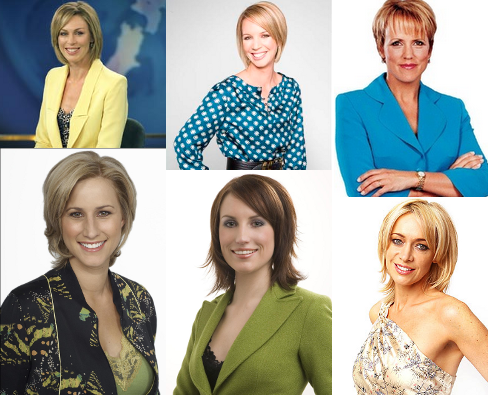
A post by Janet Wilson expresses a general conspiracy theory I’ve held for a long time about why radio news is usually better than TV news: because the people are chosen for different qualities. To an extent the “beauty bias” is present in every field, and of course, even in news it is simplistic — there are a host of other factors to do with resourcing, format, training and so on. As in almost all fields — and for the same sorts of reasons — these pressures weigh much more heavily on women journalists than on men, and consequently the aesthetic homogeneity of NZ’s top female TV presenters is striking:

What Janet calls “tits and teeth” selection really matters: people instinctively trust attractive people more than unattractive people (as long as they’re not too attractive), and broadcast news is all about projecting authority and trustworthiness via a predominantly visual medium. Dress and bearing are also relevant — as is voice, which is even more important in radio. But those things can, to a much greater extent, be worked on or around.

So TV news is biased in favour of attractiveness. In general, a presenter’s job is to present — their newsgathering, interviewing and editorial skills are backgrounded to a considerable degree. So this bias isn’t entirely unjustified for presenters, but the problem is that it’s also clearly evident in the journalistic ranks from which presenters are drawn. While it does not exclude journalistic quality the beauty bias does weight against it. Because the jump from reporter to presenter is a crucial part of a broadcast journalist’s career arc, and being unwilling — or unable — to fit the pattern is an explicit and well-known limitation to advancement, it likely dissuades people who might otherwise make outstanding broadcast journalists — which society desperately needs — from entering the profession. As Janet notes, the bias also selects against experience, because while men tend to become “distinguished” as they age (strengthening their gravitas) women do not, and those who don’t retain their youthful dash paradoxically become less favoured as their screen experience increases.

A case in point on this last point has lately been evident in the most trivial forum: Breakfast, on TV One. My wife, at home with our daughter, remarked on the greater capacity of One News anchor Wendy Petrie to deal with co-host Paul Henry’s soft-gonzo screen persona while she covered for Pippa Wetzell recently: a sort of dismissive indulgence, as if of a poorly-behaved child on his birthday. The customary pairing is a classic mismatch: Henry dominates the studio while Wetzell — herself a quality presenter, as we occasionally see when Henry is absent — is often forced into the role of slightly-embarrassed fall-gal. Petrie, with close to a decade’s primetime hard-news presenting experience under her belt, is out of Henry’s league and she knows it.

Of course, she herself has the beauty bias on her side. But the question is: how long does she have left? And how many other talents have we lost — or never found — due to the dire ravages of crow’s feet, a poor hairdo, a few additional kilos, or a mismatched outfit?

(Thanks to Naly D for the link to Janet’s article.)

L

PS: I’d like to endorse Nicola Kean’s campaign to go to Columbia Journalism School, as others are doing. Go and vote for her, and perhaps she’ll do better than another well-known graduate from these parts.

MMP in NZ is really safe

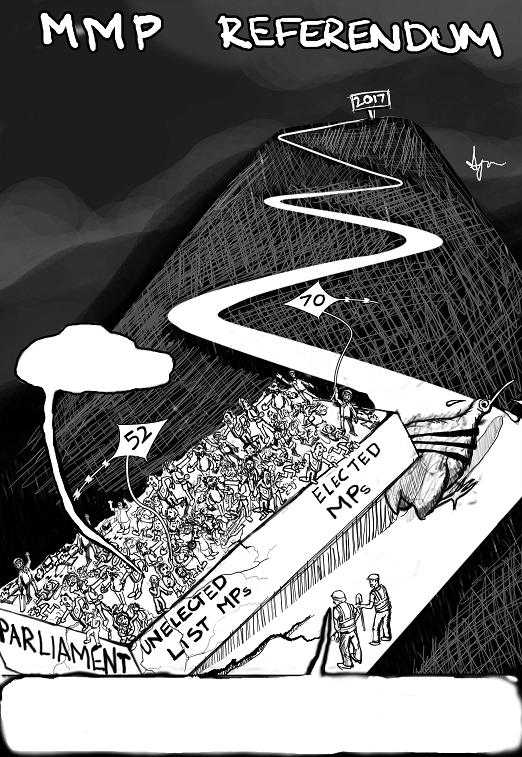
As I’ve said before, Peter Shirtcliffe’s campaign to scupper MMP (again) is probably a blessing in disguise for the electoral status quo in New Zealand. If any further evidence were required, the following should suffice for now:

The speech bubbles are blank because Peter is running a caption competition to find a punchline. Demonstrating piercing insight into his relevance to NZ politics, he has chosen the Kiwiblog Right for these words of inspiration. Personally, I think that leaving them blank perfectly captures the character of this campaign: inchoate, futile, tone-deaf irrelevance.

Hopefully he won’t be too disheartened by the far-from-enthusiastic response of Farrar’s captive authoritarians.

L

It might be unpatriotic to say so, but …

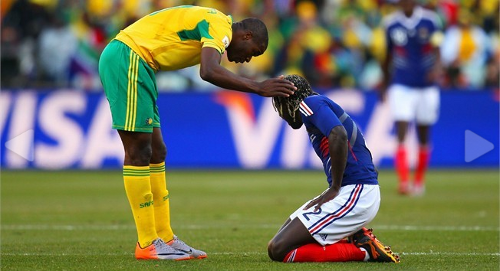
… the All Whites’ unbeaten record at the FIFA World Cup was not the tournament’s greatest underdog performance. That accolade should go to the hosts, for beating France, who were a perfect illustration of all that’s wrong with football in 2010. High-strung Ferrari-driving show-ponies who failed to perform and behaved like rebellious toddlers when expected to do so; led by dictatorial, egomaniac management who refused to accept the results of their own uselessness with any sort of humility.

South Africa were ranked second-lowest in the tournament, lower even than the All Whites, and they demonstrated that if you hang tough and play as a team you can beat a side which, on paper, is far better than you are (and keep them out of the second round). The footballing world owes South Africa a rich debt of gratitude, not only for organising what was by all accounts a cracking tournament, but for humiliating France.

A fitting end to a tournament for which they shouldn’t have qualified in the first place.

L

Sleeping dogs

Tim Watkin usually writes good sense, but with the latest post on gun control it’s clear he just doesn’t know his subject. Toughening gun control in NZ is basically a hiding to nothing, both in policy and in symbolic terms. It’s pointless for three main reasons:

  1. We already have pretty sane firearm laws and gun culture which regulate legitimate gun owners, and constrain the sorts of weapons most useful to criminals;
  2. As a country, we own a lot of guns, and they’re important to our way of life and identity, and this importance is the subject of bipartisan political consensus;
  3. We have very low rates of gun-related crime already, and any regulation which would be effective would be very costly, both in financial and political terms.

Just to preface this: I own a hunting rifle, and as a bit of a propaganda geek I’ve paid close attention to gun control as a matter of symbolic politics (alongside abortion, it’s a leading “touchstone” rhetorical issue in US domestic politics). I’ve been watching the way NZ is beginning to develop a (rather amateurish, but effective enough to not be laughable) US-modeled gun-ownership lobby with interest as well. But I’m not one of those “don’t tread on me” gun nuts who thinks bringing a loaded assault rifle to a town hall meeting is a core part of the democratic process. Owning a firearm is useful, but it’s not an absolute right — rather one which must be weighed against other consequences, including those which stem from arming communities. But I object to knee-jerk policy proposals which misoverestimate the problem, won’t solve it in any case, and will come at considerable cost.

What problem?
The most significant objection I have to Tim’s analysis is that he assumes gun crime is a serious enough problem to warrant harsh regulatory consideration; and seems to think that tackling it like the government has “tackled” knife crime is a sensible approach. I reckon both are suspect assumptions.

According to a UN survey from 2000 (the most recent I can easily access), 13% of our homicides (including attempts) were committed with a firearm, at an annual rate of 0.18 per hundred thousand population. That is a rate slightly higher than the UK (0.12 per hundred thousand, with much more strict firearm laws); just over half the rate of Australia (0.31, also with much more strict firearm laws, including a hugely expensive buyback programme undertaken in 1996 with the intention of solving the problem). I don’t think things have changed all that much; in 2009, the year of Jan Molenaar, the figure was 15% of our recorded murders (incl. attempts). You can use the Statistics NZ tools to get data here. You can also compare a bunch of countries’ rates here, but be sure to read the disclaimer. The bottom line is that we have extremely low gun crime rates by world standards, especially given that we have very high gun ownership rates. By far the highest proportion of gun-related deaths in NZ are suicides — I don’t have the numbers to hand but I recall it being above 70%. That’s a consideration, since suicides are usually committed with weapons of opportunity, and a firearm is particularly effective. But this is not the argument being made.

Knives are a much more serious problem, accounting for about twice as many homicides in NZ, and “other weapons” and “manual” which I assume includes unarmed homicides are also generally more common than firearm murders. The government has seen fit to “crack down” on knife crime by trying to prevent youths’ access to knives at the retail level using a voluntary code of practice. This is pure security theatre. Everyone credible knows it won’t make a blind bit of difference because kids don’t go and buy a knife from a shop, they just take one from the kitchen drawer or the toolbox in the garage. Firearms are already much more heavily regulated than this, and as a consequence people wanting one but who lack a license don’t roll into Hunting & Fishing and buy one — they get them illegally because we have no idea how many there are or who owns them (more on this later). So the comparison between guns and knives, while tempting, is bogus. Knife crime is much more serious than firearm crime, much less-heavily regulated, and the trivial additional regulation proposed won’t change anything — but it also won’t cost anything.

What guns?
Part of the reason gun crime is such a minor problem in NZ is due to our history and culture with guns, and in particular the fact that “personal defence” has never been a justification for firearm ownership. Tim also gets this wrong: citing “personal defence” as a reason for needing a firearms license will mean you get denied one, especially if you’re trying to apply for a restricted weapons license (which is the example he uses).

Excluding the post-settlement period, firearms in NZ have generally been conceptualised in law and culture as tools rather than weapons — for hunting, sport shooting, or the defence of the realm. Most in existence today are .22 calibre rabbit guns, or bolt-action ex-infantry rifles from the first and second world wars, passed down from father to son, or modern firearms based on near-identical designs, or shotguns designed for gamebird hunting. Partly due to length, partly due to action design and calibre, these are pretty useless for self-defence except for the appearance of threat and as clubs. By the same token, they are far from ideal for offensive use. Part of the reason criminals are rarely armed with firearms is because they are nearly impossible to conceal (which makes carrying or using them a riskier proposition than, say, a knife), and if sawn off below the regulation length of 30 inches, they are still not very convenient, and give police instant cause for book-throwing if discovered.

There are relatively few pistols or assault rifles in NZ, and those which are owned are very tightly controlled, with extremely high standards required of the owners. The NZ Police apparently operate a “sinking lid” policy on restricted weapons: to gain permission to import or produce one, you need to destroy another. This has driven the market price of such weapons through the roof, putting them out of the reach even of many legitimate collectors; although it must be said that the distinction between a “military-style” semi-auto and any other semi-auto is largely (not entirely) cosmetic, and one is no less deadly than the other. As the rather grim saying goes, the seven-round magazine restriction on an ordinary semi-auto centrefire rifle just means that if you want to kill more than eight people, you’ll need to reload.

Firearm licenses, especially those for restricted weapons like military-style semi-automatics and pistols, are issued at the discretion of an Arms Officer on the basis of the applicant being of “fit and proper” character. The threat of losing the license acts as a firm constraint on legitimate gun owners’ behaviour, with most hunters, collectors, etc. living in fear of having their license revoked. This constraint comes into force, for example, when deciding whether to keep a firearm for self-defence purposes in a country where most potential assailants, burglars, etc. are not themselves armed: if you happen to use it as such, you must then explain to your arms officer how come you had it handy, rather than locked up in its safe, with the bolt and ammunition separated. Most people comply to avoid this inconvenience, and because they know that the chances of a family member actually meeting a life-or-death situation are much higher with a loaded firearm lying around than otherwise.

In general (and again, I don’t have the figures to hand) the vast majority of gun crime in NZ is committed by people without a legal right to own or use a firearm in the first place (being not “fit and proper”). Jan Molenaar was just such a person, so using him as an exemplar of all that is wrong with the system is a bit misleading. It’s certainly an indictment on police procedure following the last shake-up of gun laws. Probably the biggest failure in our gun licensing regime is the lack of a registration system for specific firearms. It’s expensive, time-consuming and bureaucratic but would have been of some use had it been implemented when suggested by the Thorp report, even if just to draw a clear demarcation line between compliant and non-compliant owners. I think that horse has bolted now.

As for the matter of private internet sales of arms and ammunition — Tim clearly hasn’t used Trade Me for this purpose. It’s considerably more robust than any comparable method other than a brick-and-mortar shop (and many B&M shops use the same methods to sell nationwide). Anyone can view restricted auctions, but to bid or ask a question you need to enter your firearm license number. Repeated failure to do so (or entering made-up numbers) gets you blacklisted. If buying otherwise than by a face-to-face meeting, you are required to complete a form designated by the Police for this very purpose, and have it counter-signed by your local Arms Officer, who sights your license. The first step (needing to enter your number) prevents anyone without access to a license even bidding or making contact with a seller. This is probably the most effective safety mechanism in the system.

Sleeping Dogs
These are policy and cultural reasons which explain why trying to crack down on gun ownership in NZ is likely to be pointless. But Tim’s post was largely about the political aspects of the issue: the tension between the imperative to be Tough On Crime and the danger of getting tarred with the Nanny State brush. In symbolic terms, I reckon gun control is a loser for both of the major parties because, unlike the knife measure which is empty theatre, any meaningful changes to the gun ownership regime will come at a considerable costs. One important consideration with this is that in NZ (and Australia), unlike in the USA, gun control is seen as a matter of bipartisan consensus, with both National and Labour generally occupying the middle ground (and ACT and the Greens taking up the flanks). This means there’s little or no partisan advantage to be gained by either side.

The first of these costs is purely financial. A registration, licensing audit, inspection-reclassification or buyback scheme to remove firearms (or certain firearms) from circulation (or from the hands of those not “fit and proper”) is hugely expensive. The Australian Federal Government raised a special tax for the purpose and spent hundreds of millions of dollars on its buyback scheme, and even given the dramatic reduction in gun crime rates which resulted, it was generally seen to be wide-open for rorting. In New Zealand, with a much lower baseline level of gun crime, much less money and much more pressing law and order policy issues, this simply wouldn’t fly. Quite apart from the money, the drain on already-stretched police time would make a mockery of the government’s pledge to deliver resources to the front lines and away from the “bureaucrats”. And for all of that, it would still predominantly capture guns possessed by licensed owners: the “good guys” who, of all people, should retain their gun-owning privileges.

The second, and probably weightier cost is about the NZ identity. As I’ve argued before, wild places matter to us in identity terms. While most New Zealanders don’t own firearms, and never will, many more than the 250,000 who do like to think of themselves as potential outdoorsfolk who might go and shoot a possum and do their bit to save the rata. I don’t want to overstate this, though. Gun owners and hunters are viewed with considerable ambivalence by the general public, and with some cause. The gun lobby doesn’t do itself or the more reasonable branches of the sporting community any favours, and to a large extent they’re thought of in similar terms to Jan Molenaar and the various flavours of SHTF nutters.

But Nanny State also comes into this. Tim suggests that Labour couldn’t afford to do this for fear of strengthening the narrative established by the last term of the Clark government (I agree), but that National might just be able to get away with it. I disagree. Half of National’s support base are farmers or rural/semi-rural men of above-average income who are generally law-abiding and consider themselves responsible citizens in partnership with the authorities — of the view that the government “works for us”, rather than the view that the government is an agent of their oppression. (There are exceptions to this last, but mostly they vote for ACT and are thus irrelevant to this calculus.) This is almost exactly the same demographic which wants to be able to take care of his own rabbit problem and hunkers down in a cold maimai before dawn on the first weekend of winter for a laugh, and they greatly value the illusion that doing so is an inalienable right akin to that laid down by the Second Amendment. They tolerate (often with considerable reluctance) the existing licensing regime partly as a pragmatic solution to the social problem of crime, and partly because it accords them the status of being officially deemed “fit and proper”. But they will not tolerate further incursions on these privileges, and it is this demographic whom the gun lobby, with its US-imported “armed society is a polite society” rhetoric, is targeting using the present hysteria about violent crime as a springboard. These are the guys who already feel under threat from policies like the ETS, which prevents them from buying the V8, forcing them to settle for the V6.

This demographic might be the sort of people who could be persuaded to support tighter restrictions if there were a strong crime-reduction case to be made for it. But since there’s so little to gain, and since the existing regime is already at the margins of what is acceptable, National rouses these sleeping dogs and permits their radicalisation at its peril.

L

Incidentally: The Gruen Nation

While I’m on the topic of Australian politics, the news that the team behind ABC’s The Gruen Transfer will be producing a series of episodes on the upcoming federal election campaign, during the campaign.

For those who’re not familiar with it, the show is named for Victor Gruen, the architect who designed the now-ubiquitous shopping mall to disorient patrons and sap them of their agency — at which moment the “Gruen transfer” is said to have taken place. It’s a frank weekly look at the nuts and bolts, tricks and traps of advertising, fronted by comedians, tricksters and advertisers themselves and you can watch it on the ABC website.

Of course, the techniques employed to sell soap or soft drink or summer holidays can be and often are equally applied to politics — the howls of those who would rather pretend it were otherwise, that politics is somehow different notwithstanding. So during the campaign is the very best time to air such a look at how the same techniques apply to political marketing. Well done ABC. I’d love to see such a thing here. This is the machinery at the sharp end of democratic consent-manufacture.

(And for interest, here’s a long article about Gruen and mall design from The New Yorker.)

L

Depicting Julia Gillard

I’ll be watching with interest the characterisation — and caricaturisation — of Australia’s new PM, especially as compared to Helen Clark. Some of you might be aware that I once wrote a research paper on the characterisation of Clark by John Banks and Lindsay Perigo in talk radio during 2007. I was informed at the time that, via the usual academic networks, a copy made its way from Victoria University of Wellington to someone at the Australian National University in Canberra who had contacts within the then-Deputy Leader’s office, and that Gillard had read it with some interest. I’m not sure how true that is, but I do know she took a keen interest in Helen Clark’s public image, likely with this very eventuality in mind, so it isn’t altogether implausible.

The Clark-Gillard comparison is a natural one, due partly to geographical and temporal proximity; but also due to genuine similarities between their politics, manner and ascent to power. The comparisons have been highly ambivalent. The usual slanderers have already begun spreading the same ludicrous assertions that Gillard, like Clark, is a closet lesbian, on the grounds that she hasn’t had children and is more apparently bolshy than her husband. Apparently very deep in the closet, since she’s come out against gay marriage. (But then, she would, wouldn’t she?)

Peter Cresswell described her as Helen Clark with lipstick, which I guess is negative as to her politics but positive as to her perceived femininity, notwithstanding that Clark did in fact wear lipstick herself. Auckland University’s Jennifer Curtin pointed out some comparisons as to the two women’s assumption of their roles, though I can’t help but think she must have a more nuanced and complex position on the topic than was suitable for an AAP statement:

“They’ve both started off on the left but moved kind of to the centre of their party,” she said. They both appear to be hard workers, good speakers and have made similar choices in selecting their political allies and portfolios – opting to avoid women’s policies specifically. “If they represent women they do it in a more mainstream kind of way,” Curtin said.

Clark’s biographer Brian Edwards, speaking on ABC Radio National, outlined the similarities in more detail:

Well there are extraordinary similarities. I’ve been reading some of the reports about Julia Gillard in the papers here in New Zealand, and it’s absolutely uncanny, and what we’ve just heard is also true, that from the start, Helen Clark was a professional politician, she was absolutely focused, her intention I guess, long term, was to be prime minister, and she would do everything possible to do that. And if you look at the two women, as I say, the similarities are remarkable. Both unmarried, both decided, clearly, that being a politician and aiming to be prime minister did not go with having children, that was the decision, a positive decision which Helen Clark made, she and her partner, Peter Davis. Helen in fact, never wanted to get married and was actually more or less pushed into it by the Labour Party, and wept on her wedding day, which was relatively unusual. She was an atheist, she received some of the same sort of criticisms that I gather Julia Gillard has received in your country for her voice, she had a strong Kiwi accent, a rather deep voice; for her looks, people didn’t like the look of her hair, they didn’t like the look of her teeth; she was accused of being a lesbian, primarily by her opponents admittedly in those early days, and had an extraordinarily hard struggle to make it at all.
And these were all things that a man would not expect to happen at all in politics. None of those things would have come up if the man was a bachelor or was married or didn’t have any children, or any of those other things.

Clark fought these attacks, in part, by recourse to a “makeover” in mid-2005, when she appeared on the cover of women’s magazines — notably Woman’s Weekly — more heavily made up, more softly and sympathetically portrayed and generally appealing more directly to women, and to men who, if they had to be led by a sheila, wanted to be led by a real sheila. This was probably crucial to her winning the 2005 election. Gillard, The Australian tells us today, already has a similar glossy campaign well underway. It’s a good move. (Anyone who wants to call it fake or staged or a cheap trick or blatant media sycophancy to make such an appeal had better first recall John Key’s appearance on Gone Fishin’ (audio), and accompanying article by host Graeme Sinclair in — you guessed it — Woman’s Weekly. Incidentally, if anyone has or can find a copy of the video of that Gone Fishin’ episode, I’d love to see it. I missed it at the time.)

Other Gillard comparisons have also been made: to Margaret Thatcher (as Clark before her was), and to British Labour’s present acting leader Harriet Harman. In contrast with Jennifer Curtin’s observation that neither Clark nor Gillard emphasise their femininity in policy terms, The New Statesman‘s Alyssa MacDonald argues that the public treatment of Harman illustrates that it’s still not politically viable to be an overtly feminist female leader, even in 2010:

Both come from legal backgrounds, hold multiple political posts, have strong union connections, speak with distinctive voices and are always politically “on”. But while Gillard is popular and respected, Harman is often, very unfairly, spoken of as hectoring, dowdy and not very bright. Even before Gordon Brown’s departure, her chances of becoming Labour leader were the same as the number of forthcoming Harman biographies: zero.
Politically, there’s a glaring difference between Gillard and Harman. One has fought consistently for a feminist agenda, while the other has approached her political career with individualistic ambition. Not to do Gillard down — she’s very good at her job and she deserves her success — but her premiership isn’t necessarily any more of a great lunge forward for women than Margaret Thatcher’s was thirty years ago.
Meanwhile, Harman’s drive to push issues such as rape laws and the Equality Bill into the spotlight has undoubtedly been good for British women — and a huge contibuting factor to her unlovely public image.
Gillard’s success is still a symbolic step forward, signalling that the presence of women in Australian politics has become normal. And it looks likely to be good news for the country as a whole. But it’s not as if Australian women now have a Harman at the top to look out for their interests.

As MacDonald notes, Gillard is much more favourably-portrayed than Harman (and I would add, than Clark was at any point during her leadership). I think a lot of this is down to the “lipstick” to which PC refers: a metaphorical sort of lipstick which speaks to a particular notion of femininity, like the kind which Sarah Palin made famous. For one thing, Gillard’s attractiveness has been emphasised by the favourable comparison to Scottish actress Tilda Swinton:

This distinctive visage, the “bricklayer” voice to which Brian Edwards alluded, and her speaking style have been welcomed by the Australian media and satirical communities, who found Rudd “almost irritatingly bland”, according to editorial cartoonist Bill Leak. This from an article, also in today’s Australian on the topic:

Gillard’s wealth of striking anatomical attributes is almost too much of a good thing, says Cathy Wilcox of The Sydney Morning Herald and The Sun Herald. “She’s got so many features that if you just go for one, it isn’t enough. The challenge is how to get all those things in there without her head being enormous.”
Since Gillard took power, editorial artists have been studying her face with the obsessiveness of a lover, poring over photos and freeze-framing the TV to parse her every angle and expression.
Australia’s first female Prime Minister, seen through their eyes, has a “striking head of hair”, “incredibly beautiful skin”, eyes that manage to be simultaneously “squinty” and “big and distinctively shaped”, “chubby cheeks” with “pronounced cheekbones” and a mouth that “sits small and low” above “a small chin that tucks into an incredibly long neck”. Not even her earlobes escape attention.
And who else but an artist would notice that the new PM has “a reasonably ample bottom in relation to her head”?
But there is one facial feature in particular about which they all rhapsodise: Gillard’s “pointy”, “assertive”, “wonderful” nose. A nose, as Leak puts it, “that looks like you could chop wood with it”.
Fiona Katauskas, freelance cartoonist and producer of the Talking Pictures segment on the ABC’s Insiders, says Gillard’s nose is a defining feature that artists can utilise to express her character, just as the jutting lower-lip of former PM John Howard came to represent his determination, or obstinacy.
“I will take a punt and say Gillard’s nose will become the equivalent of Howard’s lip,” she says.

What’s interesting about all this is that, unlike most of the discussion of Clark and Harman’s appearance, it is robust but not unkind. Gillard’s relatively warm reception is being put down to her status as Australia’s first female PM, and I think there’s some legitimacy to that view; a genuine preparedness to “give her a go” tinged by a fear that bagging her too early would come off as sexist. We’ll see how long that persists, and how long her distinctiveness — of appearance, manner, and political character — is portrayed as quirky and endearing rather than bizarre and threatening.

L