The Reluctant Ringnut

Since the 5.1 magnitude aftershock on the evening of March 20, various Ringnuts — that is, people who take Ken Ring’s moonie earthquake “predictions” seriously — have been saying things along the lines of “SEE ITS TRUE HE TOLD YOU AND YOU DIDN’T LISTEN!” Their ranks include people who really should know better, who’re revealing that when faced with a bit of smoke and a couple of mirrors they’re as credulous as the next rube.

Such as Brian Edwards, who asks “So – was Ken Ring right or wrong?”, and after arraying a series of banal and rigourless equivocations, attempts to turn scepticism on its head by appealing to the old charlatan’s fallback: cosmic uncertainty, man. We don’t really know anything, so everything’s as good as everything else, man.

The trouble is that Brian’s banal and rigourless equivocations — I’ll not repeat them here — are of a piece with those issued by Ken Ring, and that’s the whole point. Brian tries to have a lazy bob each way on the question of whether Ring is right or wrong. Ring has a bob in each of a dozen different ways, from earthquakes of unspecified magnitude across a very wide area, or possibly a weather event of unspecified nature, occurring in a very broad span of time; or possibly nothing at all. The predictive uselessness these banal and rigourless equivocations have been very thoroughly thrashed out in the past month — notably by David Winter, Alison Campbell [edit to add: and Grant Jacobs]. The punchline is that it would have been a shock if his “prediction”, such as it was, had not “come true”.

What separates the Ringnuts (both the reluctant, who claim the mantle of scepticism, and the True Believers) from the rest of us is the realisation that, given the nature of Ring’s “predictions” it is impossible to answer Brian’s question, “Was Ken Ring right or wrong?”. Ken Ring doesn’t give us a testable prediction, so we can’t even get to the point of assessing its rightness or wrongness. Ken Ring is neither right nor wrong. He doesn’t even get to the point of being wrong, since he hasn’t said anything meaningful.

Given all of this, being wrong would be a considerable improvement for Ken Ring.

L

White Queen

Andrew Geddis has a good post up on Pundit about Hilary Calvert and her apparent ignorance of the Humpty Dumpty scene from Through the Looking-Glass.

The extent of Calvert’s idiocy being so egregious, it seems a mite churlish to point out — in addition to failures of basic logic and lawyerly literary culture — the flaws of historical and legal reasoning in her now-famous speech on the foreshore and seabed topic. But Calvert dug her own pit when she wittered on about tangata whenua “crawling on the seabed” like some sort of primitive bottom-dwelling life forms, holding their breath for the better part of two centuries, and the length of a cannon-shot — and the following can’t go unmentioned. Despite being a big-city property lawyer, Hilary Calvert apparently hasn’t done the first bit of research into the basic legal history of this particular property-rights debate. The Muriwhenua report of the Waitangi Tribunal (Wai 22), one of the mechanisms which resulted in fishery rights being vested in various iwi (the “Sealord deal”), is a very well-known and documented case, and covered the matter of indigenous control of coastal waters in considerable detail. Its findings were robust, and were summarised as follows in the report of the Foreshore & Seabed Review Panel:

The Tribunal, which heard detailed evidence on that particular district, concluded that there was an ‘inner’ zone related to the continental shelf, stretching 12 miles out from shore. The hapū and tribes of Muriwhenua had full control over fishing and passage inside that zone. They claimed the same rights further out, but only insofar as they could be enforced against challengers. In the ‘Māori idiom the hapū and tribes of Muriwhenua held the “mana” or “authority” of the whole of the Muriwhenua seas’ within a minimum of the 12-mile zone. The nearest British cultural equivalent, the Tribunal found, ‘is to consider that they exercised “dominion” over that part, or “owned” it as part of their territorial waters’. We accept this view that Māori tribes had dominion over their territorial waters as at 1840, and that in the particular circumstances of the Muriwhenua district, it extended for at least 12 miles out to sea.

So neither Calvert nor anyone in the ACT research unit who checks speeches for accuracy (yeah, permit me a little poetic liberty) has even read the definitive public document from which this replacement law has emerged — let alone attained even a passing familiarity with the basic historical situation which underpins the argument around customary property rights to the coastal marine area. ACT don’t even understand the legal situation regarding the foreshore and seabed review; they oppose it viscerally, without even really knowing or thinking about why. Let me be clear: there are good reasons to oppose the passage of this bill. Although I don’t personally agree, I’ll even go so far as to say that there could be good, principled reasons to oppose this bill because it goes too far in compensating tangata whenua. The reasons being stated by ACT in general and Hilary Calvert in particular are not such reasons, by any meaningful standard.

ACT’s position prior to this week was bad enough; this week it has degenerated into farce. In Through the Looking-Glass the White Queen believes six impossible things before breakfast, and lives in backwards, looking-glass time. On the basis of this performance one has to wonder whether Calvert, once apparently a pretty sharp operator, is finding that her faculties of critical and professional reasoning are becoming atrophied. Though, as someone on Danyl’s blog remarked yesterday, it pays to remember that she was ranked below David Garrett on the party list.

L

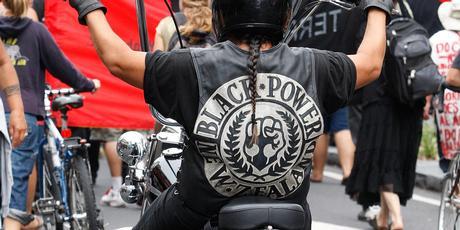
Shame on the Herald

… for trying to run game on New Zealand, scaremongering the Foreshore and Seabed hÄ«koi:

That was on page four of the dead tree edition, and online here, under the headline “Opponents put up roadblocks to bill”. Use of this outrageously unrepresentative photo makes a number of unjustified implications which aren’t present in Claire Trevett’s generally factual and balanced article. These include:

  • Most obviously, the suggestion that the marchers are gang members, with the implication of violence and public menace that creates, despite the fact that the march was peaceful having been mentioned in the opening sentence of Trevett’s article;
  • Creation of a general equivalence between Māori protesters and gang members, with all the racism that implies;
  • The suggestion that opponents of the foreshore and seabed legislation are acting on a separatist “black power” imperative, when the article makes clear that the opponents mentioned in the headline are an ideological grab-bag consisting of the ACT and Green parties, and Hone Harawira;
  • The suggestion that the marchers are literally blocking roads, when the article makes clear that the roadblocks referred to in the headline are metaphorical, and little more than the usual sort of procedural delaying tactics employed in Parliament to drag out the progress of a bill — in this case until next week, when the hÄ«koi reaches Wellington.

The core message of this choice of photo to accompany what is mostly a story about the trivial frustrations of a government trying to pass an unpopular law is this: Māori radicals and gangs are forcibly blocking this law, and they will block you from the beach as well.

It would be absurd if it wasn’t so offensively misleading.

(via Pascal’s bookie)

L

Gulp!

ACT MP and lawyer Hilary Calvert, on the Marine & Coastal Area (Takutai Moana) Bill, in Parliament last night:

“Historical use of the seabed any significant distance from the shore seems impossible to prove, and allowing for title over it to be granted over it to iwi allows for unjust and potentially divisive future claims. No one historically crawled about on the seabed miles from shore. There was just no chance of anybody holding their breath from 1840 til now on the seabed. It’s not gonna happen.

(My emphasis.)

Once again, I think we all owe a debt of gratitude to the ACT party for illustrating so plainly to us what — and how — they really think.

L

Revealed preference

Former National leader Don Brash addressed the ACT party conference at the weekend, which was half “catching Australia” boilerplate and half a warming-over of the infamous “nationhood” speech given at Orewa in January 2004 (for a thorough rebuttal of which see Jon Johansson, Orewa and the Rhetoric of Illusion). During his address at the weekend (although no mention is made of this in the text of the speech on his website, linked above), Brash correctly stated that the Treaty of Waitangi was ahead of its time, because the contemporary Australian approach, by contrast, was to “shoot the natives”.

At this point, a heckler in the audience piped up: “let’s bring it in“. (Audio).

Moments like these, when people are put in the position of genuinely involuntary response to some stimulus or other, are pretty rare in a political environment dominated by strict stage-management, spin and counter-spin. Their type and quality can tell you a whole lot about a political movement, especially when the response is collective, spontaneous, and embedded within a heightened or aroused political context, such as in the middle of a keynote speech.

What happened next was that the delegates in attendance at the ACT party laughed. At the suggestion that New Zealand implement a system of genocide against its indigenous people which, even back in 1840, was a source of shame for Australia, those in attendance at the annual conference of a New Zealand government party whose ranks include two ministers of the crown laughed. It is hard to be sure from the audio, but it sounds like Don Brash also laughed — someone on-mike did, and in such circumstances only the speaker is miked. Quickly, the laughs turned to disapproving murmurs, and Brash continued speaking as if nothing had happened. But by then the moment was over — the ACT delegates’ true colours had been revealed.

Not all of them, to be sure. No doubt there were those who were agape at the suggestion. Stony, stunned silence from the delegation at large would certainly have been an appropriate response and one which I don’t think would have been too hard to muster. Eric Crampton has suggested (though I suspect he’s by no means committed to this line of argument) that nervous laughter is a fair response to shock; admitting also that nobody seems to be claiming that the laughter was nervous. Eric also placed one in five odds on the heckler being a ringer whose plan was to elicit just this sort of response, in order to discredit the ACT party. Fair enough, I suppose. But it’s not the heckle itself which was disturbing — every party contains its fringe lunatics, those who fly off the handle and say embarrassing things. What’s disturbing is the response, the spontaneous, reflexive, collective reaction to the suggestion of genocide.

Just as Labour are the party of humourless, tuneless harridans after their “John the Gambler” song at the 2008 annual conference, and the Greens are the party of morris dancing hippies because of their 2001 annual conference, the fundamental take-away here is that ACT is the party who laughs at genocide jokes. The ACT delegates own that moment of laughter, just as much as they own the disapproval which followed it. It’s not even out of character for a party which has for some years now campaigned on the basis of arguments that indigenous people represent barriers to the white man’s progress, and was at the time of the interjection revelling in a sustained argument to that very effect: get rid of the bloody natives, and things’ll be a lot easier around here, and then we might catch up with Australia, who solved their bloody native problem good and proper. It speaks to the core beliefs of those in attendance, and what’s more, it largely reiterates what most peoples’ impressions of the ACT party are, based on their rhetoric, their policy positions, and their steadfast opposition to every bit of legislation giving the slightest acknowledgement to Tino Rangatiratanga.

Whether a ringer or an organic outgrowth from the party delegation, whether speaking his own truth to power or having just had a few too many free glasses of capitalist sauvignon, the people of New Zealand are indebted to this anonymous heckler. He has granted the nation a unique insight into the ACT party, and rare basis upon which to judge its underlying character. That’s good for democracy.

L

Put it out of its misery

After defending New Zealand’s broadcast news media in recent weeks, and bemoaning the lack of funding for public service broadcasting in particular, TVNZ has tonight hit rock-bottom. The so-called national broadcaster has been comprehensively shamed by TV3, and in the battle for news credibility it has capitulated having barely fired a shot.

John Campbell announced the Sendai Earthquake live on Campbell Live, and TV3 interrupted its broadcast of the high-rating Glee with micro-bulletins (leading the ad breaks) not long afterwards, and eventually ditched the show altogether to show live coverage from Japan’s English-language NHK network. TV One, in contrast, let MasterChef play to the end before switching to NHK. The digital-only channel TVNZ7 was also broadcasting coverage from NHK.

Both commercial channels continued to play ads, but other than that, did a pretty good job of balancing raw foreign coverage, context provided by their local presenters, and important updates for New Zealanders (tsunami alert status, etc.). And then, after broadcasting quake coverage for about an hour, One switched back to its regular programming, showing “Pineapple Dance Studios”, a reality TV show about “the larger-than-life exploits” of the dancers at said London studio. TVNZ’s other channel, TV2, was broadcasting American Idol. At some point (I haven’t been watching it) TVNZ 7 switched back to its regular programming: a book show of some sort. TV3, apparently without a second thought, cancelled the rest of its scheduled programming, and continues to carry the NHK feed, interspersed with relevant original content, including reports from New Zealand expats in Japan.

The contrast could not be more stark: while both One and TV3 remain general-purpose TV channels with a bolt-on news component, TV3 thinks of itself as and actually behaves like a bona fide news outlet, while for all its big talk TVNZ has revealed itself to be just another vehicle for empty escapism. TV3 demonstrated considerably better newscasting chops than TVNZ during the Canterbury earthquake of 22 February, but the comparison was unfair because TVNZ’s live broadcast infrastructure was more or less destroyed in the earthquake, so they had considerably less capacity to respond, for reasons outside their control. It is true that, given the volume of disaster coverage we have had recently, there is a need for an escapist bolt-hole — not least, for the traumatised survivors of the Canterbury earthquakes. But that’s what TV2 and American Idol are for. Make no mistake: given our current disaster awareness, the relatively strong links between New Zealand and Japan — including the presence of Japanese USAR teams still in Christchurch — that country’s broad and deep experience of coping with events such as these, and the fact that the tsunami waves are predicted to submerge entire islands in the Pacific, including, presumably some of our protectorates — this is of legitimate news interest to New Zealanders. It is apparently the largest earthquake recorded in Japan in the past century, and one of the ten largest earthquakes ever recorded. By any meaningful metric it is an important news story worthy of our attention.

At the heart of my defence of public service broadcasting lately has been the argument that public service broadcaster raise the bar of competition, forcing commercial broadcasters to sharpen their game. To quote myself (from a comment on Red Alert the other day):

The British broadcast media are very good indeed, and the main reason for this is the BBC. Yes, the BBC itself makes up a lot of the broadcast media environment there, but more importantly, it forces commercial competitors to compete with something other than lowest-common-denominator mass-market ratings. The same dynamic exists in the two other major media markets with strong and well-provisioned PSBs: Canada and Australia, where the CBC and ABC respectively set an enormously high standard for commercial competitors to meet. This is one of the major roles of public service broadcasting, especially in news: to set a high bar for competition.
If you want to solve the problems within New Zealand’s media environment, if you want to raise the bar: make the commercial media outlets compete with something that hasn’t been gutted and hamstrung. Fund TVNZ and Radio NZ properly, give it freedom to hire and retain the best people, buy the best content, and generally do what it does, and let the others work to match them. Everyone wins.

To give just one tiny example of how this might have worked: TV3 may have reconsidered its decision to air advertisements for fast food and outboard motors between shots of buildings and fleeing vehicles being swept away by ten metre waves, if there had been a viable ad-free newscast in competition with it. To give another: perhaps, if there was some competition prepared to put up the NHK feed overnight for those whose family members and friends are in Japan, TV3 might not have cut to Sports Tonight after Nightline had aired. But there wasn’t any competition. When governments underfund public service broadcasters or hamstring them by imposing the contradictory roles of a public service mandate and the need to return a profit to the consolidated fund, both roles are weakened. We get the worst of both worlds: as taxpayers, we pay public money to fund public service broadcasting, provision of which is undermined by the channel’s need to remain obedient to market imperatives, and in exchange for putting up with ads we end up with a pale imitation of a commercial broadcaster as well. One News — and to an even greater extent TVNZ 7 — supposedly a dedicated ‘factual content’ channel — disgraced themselves and failed New Zealanders tonight. The tagline “New Zealand’s news. Anywhere. Anytime” should perhaps be revised to “Anywhere. Anytime. Except when there’s third-rate reality programming to air instead.”

TVNZ, by waving the white flag tonight, has demonstrated that it’s all but worthless as a public service broadcaster. The market is doing its job for it. If the government isn’t going to fund it well enough to turn it into a proper public service broadcaster, they might as well sell it, if they can find anyone who’ll pay anything for it. If they can’t, perhaps they can just take it out behind the shed and put it out of its misery.

L

Chávez doubles down

Hugo Chávez’ statements of support for Gaddafi are very concerning in a leader with already-established authoritarian credentials, and speak to a concerning lack of perspective.

His latest statement, an offer to provide mediation to resolve the Libyan situation, similarly demonstrates that he’s beyond reason. Suggestions of independent mediation often have merit, and ‘talking cures’ can be useful in low-level disputes. The sentiments expressed — “a peaceful solution”; “the south finding solutions for the south” — are certainly noble. But while they have their place, mediation efforts like this are often more useful as face-saving devices permitting overcommitted leaders to engage in mutual de-escalation than to resolving a deep and genuine conflict such as exists in Libya. They are certainly of little use in situations where time is short and lives are being lost, and have rightly been condemned as wasteful procrastination in other cases, most notably in Palestine.

Moreover, if a ‘talking cure’ was the ticket, there exists an internationalist framework more robust, better-funded and for all its many flaws more independent than Chávez’ hastily-invented “international peace commission” — the United Nations, whose security council recently voted unanimously to impose sanctions on the Gaddafi regime, and to refer its leaders, including Gaddafi himself, to the International Criminal Court for prosecution. Chávez, for all his misgivings about the UN, and all his delusions about American imperialism, is no fool and no stranger to the norms of international democracy; he knows that his alternate commission has no chance of being taken seriously. This is an empty symbolic gesture of renewed solidarity with a dictator who has become the most — and perhaps the most justifiably — loathed leader in the world today.

Gaddafi, nevertheless, has accepted the offer, and Chávez, for his part, has admitted that given his prior support for the Libyan dictator, it would be “hypocritical of him to join the chorus of international condemnation of Gaddafi now”. Chávez has had an opportunity to clarify his earlier position of support, to repudiate it, or to use his relationship with Gaddafi to call for him to cease murdering his people. So far from doing so, he has doubled down, tying his international reputation and credibility to that of Muammar Gaddafi.

There will undoubtedly remain a few people who will defend him, or who will try to compartmentalise his good works from his bad, and make excuses for him, but to my mind Hugo Chávez is lost to the democratic left. He has showed that he values Gaddafi’s power, and its maintenance, higher than the lives and freedom of the ordinary citizens of Libya. In the most charitable analysis, he has shown that he considers mass civilian slaughter an acceptable price to pay to prevent Western imperialism — which we might know by its other name of ‘humanitarian intervention’. I see no reason to suppose that, push coming to shove, he would not take a similar view of his own citizens as cannon fodder in an ideological conflict.

L

Double-tracking

Danyl Mclauchlan posits a conspiracy theory:

there is a pretty great opportunity to use the Maori seats to rort the system: if you had two Maori Parties, one that ran electoral candidates in six out of the seven electorates and only canvased for electorate votes, and another that had a safe seat in the seventh electorate and only canvased for party list votes in the other regions then you could, conceivably, end up with a dozen MPs (albeit with some overhang due to your electorate imbalance) and hold the balance of power in perpetuity.

Danyl’s scheme is essentially what the Greens tentatively proposed before the last election: green voters in Māori electorates consider casting electorate votes for the māori party candidate, and māori party voters cast their party vote for the Greens. The proposal was rejected by the māori party, which at the time was (in my view) a tactical error but a wise strategic choice.

It was a tactical error because of the efficiency argument (a positive-sum alliance permitting the two parties to extract more parliamentary representation from the same base of electoral support). But without the benefit of hindsight it was a good strategic move because the māori party’s whole point was not to be shackled to the ‘Pākehā’ parties, and its long-term survival still likely depends on its establishing its own persistent powerbase; one which could stand a chance of surviving even the abolition of the Māori seats. The only way to do that is to grow the party vote by strengthening ‘brand’ support among its electorate. (Also the proposal was made quite late in the campaign, and the potential for voter confusion was high.)

Those factors which made the plan a strong strategic risk for the māori party in 2008 now no longer obtain, or at least not so strongly. It has largely sacrificed its independence from the Pākehā political mainstream anyway, and could potentially lose considerable support for that reason. It may hang onto electorates, but it is likely that ‘brand’ support is lower than before. So with the benefit of hingsight, they might as well have gone with the Greens last time. Nowadays, they have a radical wing-man in Hone, who will work with them and who shares, despite all the rhetorical ructions, considerable common ground with the party’s other members and its foundational kaupapa. They can work together; Hone working to attract the ‘brand’ support for an independent indigenous party, the existing māori party maintaining their electorate positions and continuing to work within the mainstream.

I’m not convinced this will happen — as the Richards say in comments to Danyl’s post, a lot of it is personality-bound — but it could work in principle.

There’s one other factor, though. Although ACT and National have been collaborating in this way since Rodney Hide was gifted Epsom, the moment the māori party and a new radical wing led by Hone start doing it, the headline will be “Maaries rorting democracy to establish an apartheid state”. Those who’ve been benefiting from this sort of positive-sum electoral coordination for years will be those most urgently banging that drum and waving those banners. That’s a powerful disincentive.

Edit to add: Of course, there’s also a referendum on MMP on the day of the election. A scheme such as this would be an outstanding means of undermining MMP’s popular support and endangering its future.

L

The three cities of Christchurch

As local context and in contrast to my recent posts on the media response to the Christchurch earthquake, you must read this arresting report from Christchurch resident Peter Hyde. It is long, but the following facts are crucial:

There are THREE cities in Christchurch right now, not one.
RESCUE CITY is inside the four main avenues, and it is cordoned off. That means almost all our knowledge of it comes from media, and man is it a honey-pot for them!
It’s given us understandably-incessant tales and images of injury, tragedy, loss, broken iconic buildings, heroism, sacrifice, leadership and gratifying international response. It’s extremely television-friendly.
My quake experience started there, but actually almost nobody lives in Rescue City. The resources and attention which are seemingly being poured into it right now are NOT addressing the most urgent post-quake needs of the population of Christchurch.
SHOWER CITY is any part of Christchurch where you can take a hot shower, because you have electricity and running water and mostly-working sewer lines. By latest estimates, that’s about 65% of the city — much of it out west.
In that part of Christchurch, weary and stressed people are getting on with life — though some may be wondering if they still have a job. And a few of them with energy and time to spare are wondering if they can do more to help the rest of the city.
The media naturally lives in Shower City, and they talk almost exclusively to the business leaders and the Rescue City leadership who also inhabit it.
REFUGEE CITY is the rest of Christchurch — mainly the eastern suburbs, though there are pockets elsewhere. It includes perhaps 50,000 to 100,000 people, though a more-mobile chunk of them may have self-evacuated by now.
Only half of those who remain in Refugee City have power, and almost NONE have running water. Many have been living on their own resources, and their neighbours’, for over a week now.
That means that batteries have run down, gas (if they had any to start with) has run out, other supplies are low or gone. Roads are often very bad – and a lot of those from the poorer suburbs have no transport anyway.
Their houses may or may not be intact. Their streets may be clear, broken, or full of silt. Or sewage. There are no showers. Or ways to wash clothes. Or to wash dishes. Or to heat the “must boil” water that is available — assuming they can make it to the nearest water truck, day after day. No refrigeration. No working toilets, and precious few portaloos. No face masks to defend against the blown silt.
They have no internet either, and usually no phones. And their radio batteries are dead or dying. The papers — if you can get one — are rapidly dated, and usually far too general in their coverage. It really doesn’t help someone without a car in Aranui to know that Fisher and Paykel are providing free laundries in Kaiapoi!
All the above means the locals have few resources, little information, and no “voice” either. It’s remarkably hard to call talkback radio – or your local politician — or emergency services — when your landline is out and your cellphone battery is dead. Or when it maybe has JUST enough charge to stay on hold for 5 minutes – but not 20! – when calling the sole government helpline.
The media flies over, drives past and dips into Refugee City, usually at the main welfare or water points. But they don’t cover it that much. From my observations, the officials – those who are making decisions about the relief effort – seem to do likewise.
[…]
IN THESE POWERLESS SUBURBS, THE OFFICIAL RESPONSE IS FAR FROM ENOUGH. Especially in terms of the fundamentals.

It continues at considerable length, and I urge you to read it all, particularly the bit which tells you what you can do to make a difference.

Edit: There is another similarly grim comment from Puddleglum at The Standard:

I’ve spent the last few days shovelling silt in the east of Christchurch. My nephew who had helped dig a friend out of his house in Bexley on Saturday has been over more of the eastern suburbs. Basically, it gets exponentially worse the further east from the central city you go.
These people are already angry, stressed, dismissive of the reactions of most authorities and doggedly trying to do it themselves – yet, as the poster notes, they had the fewest resources to begin with. It’s heartbreaking. Bitter jokes punctuate emotionally strained comments about ‘you just have to go on’, ‘what else can you do?’, ‘THEY won’t help’. They did really appreciate the volunteer ‘diggers’, though.

Read the whole thing.

I’m on deadline and short on time, but my initial response is as follows.

The response is not blind to class or social station. Of course it’s not; as early as last Wednesday I was seeing tweets from people in what is now Shower City saying “we’re doing it hard, but those poor areas down the line haven’t got anything”. This is a feature of disaster responses everywhere. Of course, those suburbs hardest-hit are those suburbs hardest-hit. But what’s really problematic is intersectionality: live in a hard-hit suburb and you’re poor? Tough for you.

I suspect the problem is not so much exploitation as it is ignorance, both wilful and otherwise; by both officials and others. Referring back to the discussions of exploitation on my previous posts, it might be that the residents of Refugee City would welcome a horde of snooping cameras, as long as they could be assured that the footage they captured would stimulate a greater and better-targeted response.

The media has a responsibility to tell this story, as much as it does to relay the uplifting narratives of solidarity and community resilience from Rescue and Shower Cities. A week on from the event, it should not fall to an insomniac resident of Refugee City who is fortunate enough to have the electricity, technical means, personal wherewithal and social networks to tell this story as if it is some sort of revelation. That is the job of the professionals. We should already know all of this.

In their meagre defence, I have heard some media outlets asking questions such as these. A reporter (from TV3) asked Bob Parker yesterday, after the fanfare resulting from the discovery of the time capsule, whether it was good enough that Aranui still didn’t have toilets. (His reply was not good enough — that the response had been very good overall — and the journalist did not push him.) They toured Aranui yesterday, talking with the residents and broadcasting their concerns — lack of facilities, lack of attention, breakdown of the rule of law. Breakdown of the rule of law. People fleeing their homes because, at twilight, groups of people roam around casing houses for burglary.

The media must report this, and in some cases it has: but ultimately it is for the government to undertake a response which mitigates against this inequitably-distributed misery. And a government who is reportedly considering policy changes which will weigh heavily upon lower-income New Zealanders would be well-advised to look after those citizens’ response.

As they say: the whole world’s watching.

L

(Thanks to Emma Hart for bringing this to my attention.)

One man’s terrorist…

Via Thomas Beagle, the following astonishing story:

In Libya, an unlikely hero of a youth-led revolution
BENGHAZI, LIBYA – Mehdi Mohammed Zeyo was the most unlikely of revolutionary heroes. The bespectacled 49-year-old worked in the supplies department of the state-owned oil company. He was a diabetic with two teenage daughters.
But something snapped inside him as a youth-led uprising in Libya against the government of Moammar Gaddafi quickly turned bloody.
[…]
On the morning of Feb. 20, he walked down the stairs of his apartment building with a gas canister hoisted on his shoulder, witnesses said. He put two canisters inside his trunk of his car, along with a tin can full of gunpowder. Driving toward the base, he flashed the victory sign to the young men protesting outside and hit the gas pedal.
Gaddafi’s security forces sprayed his black car with bullets, setting off a powerful explosion, witnesses said. The blast tore a hole in the base’s front gate, allowing scores of young protesters and soldiers who had defected to stream inside. That night, the opposition won the battle for the base, and for Benghazi, as Gaddafi’s forces retreated.
[…]
Zeyo had left a will listing the debts he owed so that they could be paid, but Hafidh said the community and the company where Zeyo worked would take care of his family. On Zeyo’s desk Monday was a printed piece of paper pasted to the computer screen.
“We are from God and we return to God,” it said.
At home, his wife put her head down.
“We had no sons to carry on his name. But this is how God works, and now his name is written in history,” she said.

That was published in the Washington Post, and syndicated to the front page of the international news section of today’s Dominion Post. Read the whole thing, it’s worth your time.

Then try to re-imagine this story if the protagonist was an uneducated working-class youth from the Palestinian Occupied Territories, rural Afghanistan or the Iran-Iraq borderlands.

L