Posts Tagged ‘Winston Peters’

Recognising the enemy

datePosted on 09:46, April 18th, 2013 by Lew

Last night the New Zealand parliament voted 77-44 on the third reading of the Marriage (Definition of Marriage) Amendment Bill, passing it into law. The strategy I wrote about after the first reading has been spectacularly successful, and marriage equality will be a reality as soon as the bill receives the royal assent.

There were many powerful speeches last night. Louisa Wall discussed the spectrum of cultural traditions around sexual and gender diversity, and called a huge roll of supporters from almost every corner of the political compass.

Maurice Williamson lampooned the supposed “gay onslaught”, celebrated the “big gay rainbow” that had appeared in his electorate this morning as a sign, and hilariously used his training in physics to calculate the amount of time a person of his mass and humidity would burn for in the fires of Hell. “I will last for just on 2.1 seconds — it’s hardly eternity, what do you think?”

Tau Henare gave his old party leader Winston Peters a lesson in political history, why referenda aren’t the answer to everything, and why exactly he is no longer a member of the New Zealand First party.

Mojo Mathers spoke of the pride she felt when her daughter attended the school formal with her girlfriend. And following the vote, in scenes that have been viewed all around the world, the House stood and broke into song.

There were others. But for me the heaviest work of the night was done by Kevin Hague, who got to the very heart of enmity to this bill, and to this cause in general. I’ve quoted him at length, emphasis mine:

“I remember travelling to Auckland’s North Shore to protest against one of our opponents, Pastor Richard Flynn, who called publicly for homosexuals like me to be put to death. Over the years I have campaigned hard for the right of our communities to not be outsiders any more, to assume a full place in New Zealand society. With every new reform, the same group uses the same strategy, raising fears of terrible consequences which always fail to materialise.
[...]
“Mr Speaker, that’s why this bill is about so much more than achieving equality under the law, a basic human right that has been denied us until this day. It’s about saying ‘these lives matter: our society is big enough for us all.’ With this bill, our parliament stretches out its arms to my communities and says ‘our society is big enough for you, too — you belong, unequivocally, and without compromising who you are.’

“When the debate started, I thought all of the people like Richard Flynn had thankfully gone. The early comments from opponents were refreshingly free from fire and brimstone. There is no doubt that New Zealand has grown up over the past 27 years, as we have become a more modern, vibrant, and pluralistic society. But as the debate has worn on we have seen the re-emergence of a hard core whose opposition to this bill has lost its veneer of reasonableness. Their problem with this bill is that they believe that we gay and lesbian people are morally inferior. They don’t want to include us as as full participants in New Zealand society. They recognise — correctly — what full legal equality, what this signal means. And they don’t like it.

Kevin Hague’s measured words and calm delivery obscure a stark and clear-sighted analysis: This is war. The enemy does not regard us as human, and they never will, so we must defeat them utterly. When it comes to GLBTI people, adherents to this creed of brimstone will be satisfied with nothing less than extermination and erasure: they are an existential threat. Although it is often couched in such terms, beneath the veneer theirs is not a rational objection founded in philosophy or pragmatism, in science or honest assessment of tradition; it is simply fear and hatred that burns like the fires they preach. This is not confined to the religious sphere — variants of the brimstone creed exist within secular society, and across a broad ideological spectrum, but they share extremism in common. Much of the discourse around marriage equality, and much of the discourse around related matters, rests on ignoring, minimising or mocking those who stand up for the brimstone creed, but the brilliance of Kevin’s analysis is that he meets them — and it — kanohi ki te kanohi, staring it in the face and recognising it for what it is.

But marriage equality won because it isn’t just an issue for GLBTI people. Ghettoising it as a “gay issue”, (as feminism for generations has been ghettoised as a “women’s issue” and racial equality has been ghettoised as a “black” or a “brown issue”) was a delaying strategy that worked for a time. But no longer. Marriage equality passed because a bill introduced by a gay Māori woman was supported not only by gay Māori women, but by men and women, young and old, homosexuals and heterosexuals and bisexuals, liberals and conservatives, socialists and libertarians, atheists and agnostics and Christians and Muslims, Māori, Pākehā, Pasifika, Chinese and Indians.

All of us who believe in a just society, and an equal society, who believe in a place where ancient prejudices, cultural inertia or the maintenance of privilege cannot justify erasure must fight these battles too. The brimstone creed isn’t just an existential threat to “teh gays” — it is an existential threat to a free and decent society, and we will not have won until we defeat them utterly. There are many more battles like this, and with the clear vision and fierce determination of people like Louisa Wall and Kevin Hague, I am strangely optimistic about fighting them.

L

Labour: locking in lose-lose

datePosted on 18:53, March 13th, 2013 by Lew

David Shearer says he won’t rule out buying back shares in state-owned power companies sold by the government. He won’t rule it in, either. Why? Does he need to consult his leader?

There’s so much wrong with this that I scarcely know where to start. This buyback agenda has been set by Winston Peters; it’s now two years since the 2011 election campaign kicked off with a pledge to sell these assets, and it’s like the boffins in Labour haven’t yet had an original idea about it. The problem with old generals is supposed to be that they fight today’s war with the strategies of yesterday’s war, but this is worse — it’s fighting yesterday’s war with the strategies that lost the one before that.

But enough about my thoughts on the referendum. This time the issue is what happens after the SOEs are sold. Chris Trotter has articulated strong political arguments for nationalisation, and I think these serve to demonstrate that nationalisation is not simply untenable for a left-wing political movement.

So while I’m not persuaded the opposition should do it, there’s definitely a right and a wrong way to go about nationalisation. The core principles are similar to those in play with the initial privatisation: that we should have good information about the intentions of the main political decision-makers; and that people should not have property expropriated without due process. This need not be perfect consent — an election result delivering under 50% was sufficient to grant a mandate to privatise half the value of these assets, for example.

Market and electorate signals
Shearer’s “maybe we will, maybe we won’t” is the worst possible position. The markets into which these shares will be floated need signals so as to judge risk, and the electorate needs signals so as to judge the quality and character of the politicians they might vote for in 2014 and beyond.

A clear “we will buy them back” or “we will not buy them back” would do that; it would tell the market and the electorate what to expect and they could act accordingly. Both groups would know we were dealing with politicians of at least some sort of conviction, and more to the point, someone willing to make some big calls, to put something on the line. Today we see before us a Labour leader who has neither the conviction to know what he wants to do, nor any will to do it.

As Chris says, a stance one way or the other would provide Labour with a mandate. If Labour considers nationalisation irresponsible, then as voters we ought to know that; but it is much more crucial to justify an actual nationalisation programme. Given that the current criticism of the government is that they lack a mandate to do something they campaigned for a whole election year on doing, I struggle to see how even the most one-eyed Labour partisan could honestly justify the massive expense of buying back SOE shares unless it was clearly signalled and voted on beforehand.

This need not be unconditional. Graeme Edgeler has suggested a provisional pledge — Labour could say that if, say, two thirds of respondents in the referendum vote to not support the asset sales then an incoming Labour government would seek to nationalise them. David Shearer has many options that are better than “maybe”.

Economics of a sell-off/buyback
If Labour genuinely believes — as it has told us for two years now — that the value of these assets is greater than the cost of borrowing to buy them, it should be easy enough to show that buying them back at fair market value is worthwhile. This will likely have the effect of inflating the price, but it would at least do our international reputation comparatively little harm.

It might be reasonable for Labour to pledge to buy the shares back at cost, but only if the pledge is made credibly and early — certainly no later than the first round of sales. The pledge would be fair warning to investors: if they choose to disregard it, that’s on them.

Because it allows the markets to price in the risk of a Labour-led government coming in and making good on its promise, signalling nationalisation in this way would likely depress the initial sale value of shares. If the threat was sufficiently credible it could, in principle, depress demand for shares to the point that selling them would be uneconomical — thereby preventing the sale, or limiting it to just one or two SOEs. While this would look bad for the government there is also a downside risk that the opposition would be seen to be sabotaging the scheme — but given that Labour seems certain the scheme is unpopular, that should not concern them too much.

Because there is an ideological imperative behind the sale (that is to say, the market already knows the government has to sell in order to retain political credibility) it seems likely the shares will already yield less than what an equivalent float by a less-motivated seller might yield. There are other industry-specific factors which could also depress the price — the fact that hydro generation is not much good in the middle of a historic drought, for example. I have no knowledge of the value of the assets as they stand, but it doesn’t seem totally outrageous that it might not be all that high as it is, and a little more risk might just be enough to turn people away.

Conversely, a nationalisation conducted after the shares have been sold has the opposite effect. An ideological bulk-buyer in a fair market will bid the price up. Even worse is the middle-ground: if there exists sufficient uncertainty before the float the sale price could be depressed; followed by a Labour election win and nationalisation, causing the price to rise. The government would be selling low and buying high.

Venezuela of the South Pacific
The worst of all cases is if Labour does not provide a strong and credible signal of nationalisation ahead of the float, and then proceeds with a “surprise” nationalisation on an at-cost or dictated price — or worse yet, expropriation without compensation, as has been suggested by some of the more wild-eyed idealists. Parliament is sovereign; in principle, an incoming government could do this. But it would be a brutal assault on property rights and repugnant to a modern liberal democracy, especially one so dependent on international trade as we are. It could justifiably lead to New Zealand being treated as a pariah kleptocracy, and since the SOEs are being floated on the ASX and will likely include some institutional investors there, it could also have deep trade, diplomatic and cultural implications. I expect there is also the risk of legal challenge.

The worst aspect of holding the “maybe” position Shearer has taken is that the risk of “Venezuela of the South Pacific” scaremongering exists as long as this scenario is not clearly and credibly ruled out. I don’t seriously believe this sort of expropriation would happen under a modern Labour government, but political narratives needn’t be based on reality.

If Labour commits to nationalisation then scaremongering will commence, but at least the party will be able to control the narrative around it, and articulate arguments in principle for it, as Chris has done. If the SOEs are that popular it shouldn’t be too big a risk. If Labour rules out nationalisation then such scaremongering may still eventuate, but will be weak. If they continue to sit on the fence, they get the scaremongering, but not the opportunity to rebut it. Lose-lose.

That Labour would even consider holding the “maybe” position is astonishing, but it is New Zealand First policy after all. It reflects an awareness that New Zealand First is here to stay, will probably hold the balance of power at the 2014 election, and could make nationalisation a condition of its being part of any Labour-led coalition. The deep problem is that Labour, lacking a political agenda of its own, is letting others define it. Until the party leader is prepared to lead, Labour will keep losing.

L

A discourse on David Shearer and the identity politics thing

datePosted on 20:51, December 14th, 2011 by Lew

For my sins, over the past week or so I have been engaging at The Standard again. It’s been a rather tiresome business (for them as well, I’m sure) but has yielded some lucid moments. One exchange between “Puddleglum”, Anthony and I in the bowels of an open mike thread has been particularly useful, and since it contains my views on a question I am often asked, I’d rather it not end up down the memory hole. I reproduce it here in full (without the benefit of editing; so it’s a bit rough).

[I originally said Anthony was the author FKA "r0b" at The Standard -- this isn't the case; it's some other Anthony. My mistake, and thanks to the r0b, Anthony Robins, for pointing it out.] Puddleglum has a blog himself — thepoliticalscientist.org — that is well worth reading.

Puddleglum
Hi Lew,

If Armstrong is correct in the following quotation (and this leadership race has all been about the ‘blokes’ battling the ‘minorities’ and the ‘politically correct’), then won’t the election of Shearer shift Labour more towards the right wing, social conservatism that you appear not to like about NZF?

“Shearer will bring change by making the party less hostage to the political correctness that still plagues its image. He is interested in things that work, rather than whether they fit the party’s doctrine. “

I may misunderstand where your ‘loyalties’ or preferences lie, but it does seem odd if you are supporting a shift in Labour’s focus towards something that would be much more compatible with NZF (including Prosser and Peters, neither of whom strike me as staunch upholders of ‘political correctness’), given how little regard you appear to have for NZF.

(As an aside, I’m not sure why Armstrong is so sure he knows Shearer’s mind – he’s obviously heard Shearer say more than he’s been reported as saying – but I guess he is a political journalist … It would have been good to hear Shearer say these things to the public if, indeed, Armstrong has it from the horse’s mouth, as his tone strongly implies – “Shearer will …”, etc..).

Lew
Hey PG,

I’m not convinced by this argument that Shearer represents the forthcoming defenestration of Māori, women, gays, the disabled, and so forth as a matter of doctrine, although folk who hope it does have been eager to say so — Armstrong, Audrey Young, Trotter amongst them. Shearer’s MSc was on the tension between Māori cultural values and environmental resource management, and he has worked on behalf of Māori in that field, preparing Tainui’s land claim to the Waitangi Tribunal and looking at sultural issues around wastewater treatment in Auckland. I have as yet seen no evidence that Shearer represents the social “right” of the party either. His pairing with Robertson as deputy certainly seems to counterindicate that argument. He says he’s “right in the middle” of Labour, though I suppose he would say that. I am open to persuasion on both these points, however, and if such defenestration does occur I may yet come to regret my support for Team Shearer.

But I think there’s also a misreading of my “loyalties”. The much-loved canard around here and at Trotter’s place is that I want Labour to be an “identity politics” party, whereas, in actuality, I want an end to the infighting that pits “the workers” against other marginalised groups or seeks to subsume everyone’s needs to those of straight white blue-collar blokes. All must have a presence within any progressive movement. I think there’s a false dichotomy that to appeal to “middle New Zealand” a party must be just a wee bit racist, homophobic and sexist, because that’s what “middle New Zealand” is. I don’t agree; although I can see how that is one route to popularity, I don’t think it’s one that’s very suitable for Labour.

Notwithstanding all of that I do think that being able to break the factionalisation and patronage — crudely expressed by Damien O’Connor — that has resulted in a weak list and a dysfunctional party apparatus is the most crucial task facing Shearer, and I can see how this could be spun against him. But on balance, getting the overall institutional and overall health of the party back on track is the priority. As long as it’s not simply replacing one lot of factions with another.

L

Anthony
It really depends if he plays zero-sum loss/gain, instead of fixing problems that when addressed help everyone. But even though I preferred Cunliffe I don’t think Shearer is a evil bastard who will throw women, gays and Maori under the bus.

It’s just convincing insecure pricks like Armstrong that they’re not missing out (and normal people who are perfectly fine), while they lift everyone up.

Been one of the problems with the left for a while – not taking middle NZ with them in their thinking and just expecting them to “get it” after it’s done and dusted.

You can see how the Nats do it better with their policy formation and with the task forces they set up, they admit there is a problem that needs to be solved in some way, get a team of “experts” in place, get feedback from all quarters then create policy based on it (even if they were planning that policy all along). It’s a great way to create a narrative that the electorate can follow to understand policy or at least get some understanding that a problem that needs to be solved exists in the first place.

If it looks in the slightest way controversial or a potential wedge issue they will use this method.

Puddleglum
As I said, “If Armstrong is correct …”

I think previously you’ve noted the importance of symbolism (e.g., in the early days of the MP coalescing with National).

There is a danger that the symbolic projection being attempted (‘we are ordinary New Zealanders too’ – whatever that means) can box Labour in when it comes to ‘judgment calls’ on those social issues.

Trying to benefit electorally from symbols you don’t really believe in (in its crudest form, ‘dogwhistling’) can bite you back.

I think, for example, that Shearer may well be keen not to “get in front” of middle New Zealand on any of these issues (wasn’t that one of the concerns about Clark’s government, for ‘middle New Zealand’?).

That’s fine and pragmatic, and doesn’t mean necessarily being a little bit racist, homophobic, or whatever. But it might mean muting your commentary and positioning on those issues a tad.

And that could make some, at least, leap from the windows rather than waiting to be ‘defenestrated’.

I think that’s the challenge with the more ‘centrist’ positioning.

Lew
Anthony, I agree with all of that.

PG, I think that is the challenge with a more “centrist” positioning, but ultimately the long game is what matters. It’s mostly futile to try to campaign outright on unpopular topics — or those that are “in front” of popular thought, as you aptly put it — when you don’t control the agenda. Clark found out in 2004/5 when Brash hijacked the agenda at Orewa after a very progressive first term, and again in 2008 when the s59 repeal became a de facto government bill about the childless lesbians Helen Clark and Sue Bradford* wanting to personally bring up Waitakere Man’s kids.

I daresay there will be a lot of ideological austerity shared about over the coming term, not limited to the usual whipping children of progressive movements, but likely encompassing the unions and hard-left factions as well (and much of this may be pinned on Shearer to frame him as a “right” leader, when his hand may have been forced by political circumstance.) The project is to rebuild Labour as a political force, because if Labour continues to decline nobody — not Māori, not women, not the unions — is going to benefit.

Sometimes discretion is the better part of valour. My major stipulation is that whatever gets nudged out onto the ledge, as it were, is done with due engagement and consideration of those it impacts, not simply decreed by the leadership as being “not a priority” (and if you disagree you’re a hater and a wrecker).

L

* Notwithstanding the fact that neither are lesbians, and Sue Bradford isn’t childless.

Team Shearer

datePosted on 22:19, November 30th, 2011 by Lew

I have little useful to add to the voluminous discussion about who the Labour party will choose to succeed Phil Goff. I’m on the outside. This is Labour’s decision to make, and I don’t have a dog in the fight, except inasmuch as a good opposition and a strong Labour party is going to be crucial to Aotearoa. So I don’t know which way the caucus votes are headed, but like any other punter I have views, and I thought I’d sketch them out anyhow.

First of all it is positive that Goff and King have not stepped down immediately, forcing a bloodletting session 72 hours from the election. Two weeks is, I think, long enough to come to terms with the “new normal” and for a period of sober reflection (and not a little lobbying), but not long enough for reflection to turn to wallowing, or lobbying to degenerate into trench warfare. Leaving it to brew over summer, as some have suggested by arguing Goff should remain until next year, would be the worst of all possible options and I am most pleased they have not chosen this path.

As for the options: after some preliminary research the other day I declared for Team Shearer. I am still somewhat open to persuasion, and he lacked polish on Close Up this evening. But he seems to have unusual intellectual substance and personal gravitas. His relative newness to parliamentary politics is offset by extensive experience in other fields, particularly with the UN where tales of his exploits are fast becoming the stuff of urban legend. Most crucially, I understand he is the least institutionalised or factionalised of the potential leaders, the one with the greatest capacity to wrangle the “political wildebeest” that is the Labour Party, to use Patrick Gower’s excellent phrase. This last is, I believe, the most crucial ability. I said before the election that the next long-term Labour leader will be a Great Uniter, as Clark was (although possibly not in the same way Clark was; awe and fear aren’t the only ways to unite a party), and while there are not broad ideological schisms within the Labour party*, it is deeply dysfunctional in other ways and needs to be deeply reformed. This is a hard task, and it may be that no one leader can manage it, and it may take many years in any case, but it looks to me like Shearer’s external experience and outsider status make him the stronger candidate on this metric.

One other thing about Shearer: he seems to have strong support among non-Labourites, including Labour’s ideological opponents. In the Close Up spot he was reluctant to declare Labour a “left-wing party” which will make him unpopular (though I consider this just a statement of fact). I’ve seen some tinfoil-hattery around this — “if people like Farrar and Boag like him, it must be a trap” and so forth. This notion that “the right” has nothing better to do than wreck the Labour party, that every endorsement or kind word is an attempt to undermine, or the suspicion that the muckrakers must surely have some dirt on a favoured candidate borders on a pathology. Such reasoning leads to perverse outcomes, and adherents to this kind of fortress mentality make excuses for poor performance, and congratulate themselves for narrow wins and near losses, rather than challenge themselves to build a strong, disciplined unit capable of winning more robust contests in the future. An example of this in the recent election, where a small but crucial group of Labour supporters abandoned their party, campaigning and voting for New Zealand First in a last-ditch effort to produce an electoral result in their favour, without concern for the strategic effects this might have on the party’s brand and future fortunes. In spite of the lesson of 2008, they swapped sitting MPs Kelvin Davis, Carmel Sepuloni, Carol Beaumont, Rick Barker and Stuart Nash for Winston Peters and his merry band of lightweight cronies. Plenty of dirt there; it would have been a miserable term in government for Phil Goff if the numbers had broken slightly to the left, and (depending on the intransigence of Peters and the other minor parties) one from which the Labour Party may never have properly recovered.

Ironically, Labour has those defectors — about 3% of the electorate if the polls are to be believed — to thank for the opportunity now presented to it by the resounding defeat. If the result had held at around 30% (and NZ First been kept out by the threshold), temptation would have been to revert to the mindset post-2008 election that it had been close enough, that the left had been robbed by the electoral system and the evil media cabal, and that little change was really needed. With support at its worst since the Great Depression, no such delusions can persist, and there is, it would seem, a strong will for reform within the party.

I don’t think the other two likely Davids would make bad leaders either (concerns about Cunliffe that I expressed during the campaign notwithstanding). Cunliffe’s platform with Mahuta is strong, in particular because it will enable the party to reach out to Māori, which they desperately need to do to remain relevant. Parker reputedly has greater caucus support than Cunliffe, and he is also apparently standing with Robertson, who is also said to be standing for the leadership himself. All three Davids are talking about reform, and it will be harder for any of them to paper over the cracks or pretend that nothing is wrong, as Goff and King did. But whatever their will, it is not clear that Davids Cunliffe or Parker have the same conflict-resolution, negotiation and strategic development experience that Shearer does. And they are themselves a part of the problem, having been ministers (however excellent) under Clark, and supporting and sharing responsibility for the abysmal strategy and see-no-evil mentality evident within Labour since 2008.

But the party must do what is right for the party. It is important that the final decision remains with the caucus because as the past year has shown, no matter what the public and commentariat thinks no leader can be effective who is at odds with his team. Ideological congruence also matters; Shearer may be have the best skillset for the reform job, but he may legitimately be considered too centrist by the caucus.

I’ve always been clear that I want the NZ left to win, but I want them to have to work hard for it. I don’t want easy outs, excuses or complacency; I want Labour to be able to beat the toughest, because that’s what produces the smartest strategy and the strongest leaders, and the best contest of ideas. I am sure principled right-wingers hold similar views; they are just as sick as I am of a dysfunctional opposition obsessed with its own faction-wars and delusions of past glory, stuck in the intellectual ruts and lacking in strategic and institutional competence, even though it might make their electoral challenge easier. Good political parties don’t fear the contest of ideas; they embrace it. So my hope is that Labour does not concern itself overmuch with second-guessing the views of their ideological foes, or those on the periphery, but puts the candidates through a thorough triage process and then lets him get on with the job of putting their party back together. It’s not a trap, it’s a challenge.

L

* The lack of ideological diversity is a problem; a healthy political movement should always be in ferment. But it is not the most pressing problem facing the party at present.

Teapot Tapes poll: political moral suasion

datePosted on 23:38, November 18th, 2011 by Lew

I recently tore into Chris Trotter’s argument that polls are deployed to promote a “spiral of silence”, to demoralise those holding non-majority views, and to deter them from political speech and action. I stand by that post, and I still don’t think the argument holds in the general case, but this morning I think we saw an example where polling data was used in just such a way.

National campaign chair Steven Joyce appeared on Morning Report defending the party’s handling of the “teapot tapes” strategy. Joyce came to his Morning Report interview armed with overnight polling data that he says shows 81% of people are sick of the coverage of the teapot tapes, only 13% think the issue is a big deal, and that some in the media ought to take a long, hard look at themselves. Russell Brown covers the topic in more detail; this post began as a comment there).

Leaving aside questions about the veracity of these figures (they could be utterly fabricated and we’d be none the wiser; Bomber reckons they’re bollocks), this actually is a case of a politician deploying polling data to send a message, not only to the media, but to the public: If you care about this you’re out of touch, disconnected, in the minority, obsessed with trivia, and you ought to be ashamed of yourselves. While I disagree with his assessment, what’s more interesting is how he framed that assessment: as a normative argument about what election campaigns ought to be about, and what “real New Zealanders” care about; echoing John Key’s “issues that really matter” rhetoric, which is precisely what all the National supporters I’m in touch with have been saying: nothing to see here, it’s a sideshow, can we get back to the substance, and all that.

Which is pretty ironic given that the Nats have done extremely well for most of the preceding five years by staying the hell away from policy arguments wherever possible. It’s a pretty remarkable position from a National party whose strategic success has been largely founded on a ruthless commitment to campaign realism, expressed by avoiding “noble” pursuits such as the robust policy focus and appearances in the hard-news media in favour of what is effective — personality and brand-focused campaigns, point-scoring, agenda domination, and routine appearances in sympathetic forums, for example. It’s even more remarkable since Joyce himself has been the architect of this strategy since the 2008 campaign.

So I am cynical about National’s sudden love for the “real issues”. They have touched on them before — the election-year launch of the privatisation policy that I wrote about in February is the best recent example — but this has hardly been their preferred route. What seems more likely is the “spiral of silence” imperative — marginalise, shame and heap scorn upon those who genuinely see a substantial public interest in the way the teapot tapes episode has played out, not out of a prurient interest in the contents of those tapes but because — as Danyl notes, it “keys into a huge range of really substantive issues: the Prime Minister’s integrity; media ethics; surveillance”. This deployment of normally-secret polling data — probably collected for this exact purpose using carefully-framed questions — seems like an attempt to bully into silence those who aren’t willing to ignore an unprecedented breakdown in the relationship between the Prime Minister and the media, and a nearly-unprecedented glimpse into the internal workings and political culture of the National party and its leader.

It has had the desired effect on other political parties — Phil Goff and Peter Dunne have sung from the same songsheet today, leaving only Winston Peters to reap the electoral harvest from these events. Given that, it is not unlikely that it would have a similar effect on voters, especially in Epsom. Of course, there may not be an electoral harvest; the polling data might be accurate and it may genuinely be perceived as a “Bowen Triangle” sideshow. I don’t think so, but then, I would say that.

Update: Since writing this, Fairfax has released a poll of their own that suggests the public are over the teapot tapes. Its numbers are considerably more ambivalent than those released by Steven Joyce, however; the strongest result was for the obviously-correct proposition that politicians should be able to discuss controversial topics privately (63%). On this basis Matthew Hooton is now praising the strategy as “genius”. It’s also important to realise that this isn’t a pure popularity contest, but a balance of complex factors — the intensity of sentiment on either side matters. As Danyl remarked in the Public Address thread, “If 4% of National supporters switch their vote over to Winston Peters on the basis of this affair, then that’s a strategic catastrophe for Joyce’s party, no matter what the other 96% do.” There’s no indication that this has happened, of course, but there’s no really definitive indication of the fallout from these events at all. The Herald on Sunday tomorrow will be fascinating.

L

Today has been a remarkable day. Rarely do we see such an epic failure of communication as we have seen from Alasdair Thompson. Because these events have played out mostly in public, they also present an unusually transparent example.

What follows is ten specific strategic communication lessons which are clearly evident from these events. My analysis isn’t political — I have political and ideological views on this matter, and I intend to write these up after some reflection, but the purpose here is to look at things dispassionately and pragmatically and consider what was done wrong, and what might have been done differently. They are framed quite generically and can be pretty widely applied. This is a long post, so I’ve hidden most of it below the fold.

Everything here is presented on an “in my opinion, for what it’s worth” basis, and should under no circumstances be interpreted as reflecting the views of my employer, or anyone other than me personally.

Read the rest of this entry »

Hard rain’s a-gonna fall

datePosted on 00:14, February 3rd, 2011 by Lew


The past week has illustrated in clear terms the New Zealand Labour party’s decline as an effective opposition party. In the opening moments of election year 2011, John Key has stepped up to demonstrate the full extent of the National government’s apparent impunity. He has done this in three ways.

First, by fronting Morning Report, Nine to Noon, Campbell Live and other tier-1 hard-news media to outline his intention to partially privatise SOEs. Privatisation, since the Fourth Labour Government, has been a ‘third rail’ issue; one the NZ left is unequivocally opposed to. By going into bat for privatisation personally, and in considerable policy detail, Key confounded criticism which has been (justly) levelled at him throughout the electoral term so far that he often refuses to show up on hard media, while continuing to keep regular spots in soft formats like Breakfast, and on less rigorous media such as Newstalk ZB. He also invested his own (considerable) political capital in the enterprise, making privatisation a matter of his own judgement and credibility.

Second, he sought out and is revelling in the controversy caused by his “Liz Hurley is hot” stunt, undertaken on Radio Sport with convicted back-breaker Tony Veitch. In political terms, the first bit was no meaningful risk; Key has played the ‘frankly, I’m a red-blooded Kiwi bloke’ card several times before, always to good effect, and most notably when he informed a press scrum he’d had a vasectomy. The decision to undertake an interview with the disgraced Veitch was a considerably more risky proposition because of the nature of Veitch’s offending against his partner, combined with the subject matter of their conversation, and the fact that Key’s political appeal to women has been considerably stronger than previous National leaders. This seems clearly calculated to demonstrate what he can get away with; and the gamble has in fact paid off so well that Phil Goff today felt compelled to follow suit, suggesting a slightly sad “me too, me too” narrative.

The third of Key’s big moves was today’s dual announcement that the election would be held on 26 November, 10 months away and following the Rugby World Cup; and that he would not consider a coalition arrangement which included Winston Peters. Coupled with ruling out working with Hone Harawira outside his present constraints in the māori party, this declaration will provide considerable reassurance to National’s traditional base, and will scotch any possibility of wavering conservatives casting a hopeful vote for Winston Peters as an each-way bet. It is a risky proposition, though — Peters remains a redoubtable political force, and it is not beyond possibility that he returns to parliament. However I think Key has read the electorate well; he knows that while a small number of people love Peters, and a small number loathe him, many of those in the middle are vaguely distrustful of him. As Danyl points out, he’s managed to link Peters to Goff in a way which emphasises both leaders’ worst attributes: Peters’ polarising tendency, and the general unease and disdain with which voters view Goff. The decision to call the election so early is also bold. It means relinquishing the incumbent advantage of being able to control the electoral agenda; being able to determine when ‘government as usual’ ceases and ‘campaign season’ begins. This is an intangible but valuable benefit, and it has been traded off against another piece of reassurance: the sense that Key and his government are “playing it straight” with the New Zealand public; that they intend to run an open and forthright campaign and to seek an honest mandate for their second term. The choice of election date isn’t entirely selfless, of course — the All Blacks are odds-on favourites to win the Rugby World Cup, and even if they don’t, the tournament, its pageantry and excitement and revenue boost will bifurcate the campaign. The traditional campaign period will mostly be drowned out by this event, save for the last few frantic weeks.

In most election years, swapping agenda-setting rights for a “playing it straight” feeling would be a poor tradeoff. In most election years, a sexist stunt with a known and publicly reviled wife-beater would be a poor start. In most election years, running a campaign based on privatisation would simply be a non-starter. While the paragraphs above read somewhat like breathless praise of Key’s status as a political playa, that’s not my intent. I think he’s good, but mostly John Key just knows what he can get away with. The reason he can get away with all of these things is because there is no credible opposition to prevent him from doing so. Anyone half-decent can look sharp when playing against amateurs.

It has been Labour’s job to prevent the government from reaching the state of near-impunity they now enjoy, and their failure to do so means there is now a real danger that Key will get the genuine and sweeping mandate he seeks. To a considerable extent they were doomed in the task of preventing this from the outset, because they didn’t think it was possible that he’d ever achieve it. Clark Labour throughout 2008 fundamentally misunderestimated Key, writing him off as a bumbling lightweight, and this was a crucial error. Since well before the election — this example is from July 2008 — I’ve been arguing to anyone who’ll listen that instead of taking easy pot shots at Key based on his weaknesses, any critique should focus on his strengths. Quoting myself, from the above:

Key’s strengths [per the Herald bio], which enabled him to succeed as a currency trader: Decisiveness. Determination. Patience. Ice-cold calm under fire. Willingness to risk it all. Ability to follow through. Remorselessness.
If you want to attack John Key, draw attention to what might happen under a Key government. Given his history, he’s not some motley fool who won’t make sweeping changes – he hasn’t gotten where he is today by being timid. I think he has the wherewithal to roll out a sweeping programme of political and social change the like of which we haven’t seen since Lange, but I think that, unlike Lange, he won’t get cold feet. If you don’t like Key’s politics, I suggest you begin thinking about what might happen if the guy is given the power he seeks.

The delusion that John Key is a hapless fool who’s somehow mysteriously gotten his hands on the reins of power remains very much alive within New Zealand lefties; this was the tired old line I got spun as recently as this afternoon, by one of the internet’s best-known Labourites (with a nice dollop of ‘if you don’t praise Labour, you’re a rightie’ for good measure).

But this tendency to misjudge and underestimate Key is only part of the problem. Denizens of The Standard aside, anyone within the loop who has a modicum of reason has figured out that Key is not the lightweight he was — quite willingly — framed as. But now the narrative is set: it’s That Nice Man John Key, who drinks beer out of the bottle while tending the barbecue with Prince Harry, and thinks Liz Hurley is hot. They don’t have a credible counter-narrative, but they have to say something against the health cuts, education cuts, tax cuts, ACC cuts, pending privatisation and so on — and so they fall back on their usual tired old cliches, which, while superficially looking like what an opposition is supposed to do, lack cohesion and run counter to the established wisdom about Key and his government — wisdom laid down, in the first place, by the Labour party in its 2008 campaign.

The lack of narrative cohesion is so dire that the party claims that privatisation of SOEs is repugnant to the voting public of New Zealand; and almost simultaneously puts out a press release saying that it’s a cynical ploy to “cling to power”. The manifest incompatibility of these two propositions — cynically promoting an unpopular policy to retain power — speaks for itself.

If the inability to construct a viable narrative is symptomatic of a wider lack of ideas and direction within Labour. Election-year spin aside, their policy offering is weak as well. Their big blockbuster kicking-off-election-year policy of a $5000 tax-free zone was big enough to draw plenty of criticism about cost and targeting (including from people like Brian Easton), but timid enough that nobody was made to sit up and take notice for any other reason (sidenote: when Brian Easton, John Shewan, Chris Trotter and I all oppose something, I think you can be pretty sure it’s not a winner).

This is just the most recent example of what we’ve seen throughout the past two years: Labour’s vision, and its execution, simply aren’t up to scratch. I have no internal knowledge of the Labour party, and I don’t know whose fault this is. I guess the leadership blames the strategists, the strategists blame the policy wonks, the policy wonks blame the spin-doctors and the spin-doctors blame the MSM™. All that’s just excuse-making for losers. There are no socially-just power-redistribution schemes in politics, and if there were they would be rorted. There is no fair. The job of being in opposition is to win despite the odds being stacked against you; to do and say things worthy of the news media’s time, worthy of the government’s concern, and worthy of the electorate’s endorsement. If you’re not doing that, you’re not up to the task.

As the title implies, the political weather this election year is not going to be a warm drizzle. John Key wants a mandate; he wants a strong and broad mandate which will permit him to wreak widespread social, economic and political changes upon New Zealand’s landscape, and he is prepared to put a lot on the line to gain it. He is playing for keeps, and my instinct is that an opposition who couldn’t keep pace with ‘smile and wave’ is going to be crushed by the rampant beast which is currently girding for war. What’s more, by all accounts Key is actually, genuinely coming to the New Zealand electorate with a transparent policy offering in good faith, keeping his promise that nothing would be privatised without his first having sought a mandate to do so, which robs Labour of their strongest symbolic weapon: the “by stealth” bit of their catchcry “privatisation by stealth”. Time will tell if this holds, but at present the Key government is doing exactly what it says on the box. Labour can’t claim they haven’t known about this all along. Privatisation has been the bogeyman about which they’ve been warning the New Zealand public for at least a decade, which makes the incoherence of their recent response all the more unforgivable. That National would consider running an election campaign on this cornerstone issue, loathed and feared by so many New Zealanders, is surprising. That they can expect to do so without trying to get their agenda through on the sly is shocking. That they reasonably expect to do all that and win is unthinkable. Let there be no doubt: if Key wins this election on these grounds, it is because Labour, by failing to adequately discharge their role as a competent opposition, have permitted him to do so.

Perhaps it is not too late. Perhaps Key has overplayed his hand; perhaps Goff has a secret weapon. Perhaps a young Turk is fixing to roll Goff and his cadres and make a break for it. I do not think any of these are likely. So it may be that the one good electoral thing to emerge from 2011 is a heavy and humbling loss which would see the Labour party reduced to a meagre husk. An exodus of the lively and creative thinkers of the party to another vehicle; or the enforced retirement of the deadwood responsible for the present state of affairs; or both would clear the way for a thoroughgoing rejuvenation of the movement’s principles and its praxis and its personnel. While it would be cold comfort to the generation of New Zealanders who will bear the brunt of the Key government’s second and third-term policies, it would be a crucial and long overdue lesson in political hubris, never to be forgotten, and infinitely preferable to another narrow loss and the moribund hope that next time it’ll be different.

L

The Big Wet

datePosted on 15:27, January 12th, 2011 by Lew

Having neglected my bloggerly duties these past six weeks (in fact, I’ve been neglecting all my duties which aren’t strictly in service of looking after my family and keeping my job), I had resolved to write something about one of the many momentous events which have taken place recently. There are many to choose from. Some topics (Pike River; Wikileaks; Foreshore and Seabed for instance) are no longer immediate; others (the re-emergence of Winston Peters, commencement of the NZ general election campaign and its forerunner the Botany by-election) are not yet sufficiently well-formed for me to quite know what to say about them yet. Yet others (notably the shooting of Gabrielle Giffords, Wikileaks and the Urewera Terra trials) have been more ably dealt with by Pablo and/or so many others, such that anything I could say would be redundant. There’s already enough peoples’ two cents rattling around in the hollow urn of internet discussion. In the context of these events other things I was meaning to write about (such as the manvertising topic Pablo discussed before the break) seem a bit trivial.

Add to all of this, today there is really only one story; that an area twice the size of Texas — the canonical measure of a really big thing — is underwater in Queensland; including much of Brisbane. The coverage put out by the Australian media, and in particular the ABC, is first-rate, and the best I can do is commend it to your attention.

There is one point, however, that I don’t think has been made strongly enough: and that’s that events such as these are a consequence of climate change. While it is fashionable for climate change deniers to mock those pointing to the increasing frequency and severity of snowstorms, cold snaps, hurricanes and torrential rainfall events as evidence for ‘global warming’; implying that climate science proponents try to take everything as evidence of ‘global warming’, the fact is that the term ‘global warming’ was retired and replaced with ‘climate change’ because the thesis isn’t just that the planet will get warmer.

That’s part of it, but the events — snowfall and what not — being pointed to are not climate; they are weather. The relationship between climate and weather is a lot like the relationship between mathematics and arithmetic — indistinguishable if you don’t understand them, but fundamentally of a different order. Weather, like arithmetic, is by and large small, trivial, unarguable stuff — stuff which is more or less self-evident. It rained this much last week; 2+2=4 — whereas climate, and mathematics, are bigger, more open-ended and by definition less quantifiable. Mistaking ‘weather’ for ‘climate’ is an immensely useful rhetorical device, and one which I believe has not been sufficiently well guarded-against by those whose task it is to argue the climate change case. But even though it may not have been made clear to the degree necessary for broad public and political comprehension, this distinction is well understood by those working in the field and anyone who cares to acquaint themselves even scarcely with the material. And fundamentally the take-away is this: climate change caused by the increased quantity of greenhouse gases in the atmosphere, to the extent that it takes place, will have unpredictable flow-on effects such as increased frequency and severity of severe weather events, and not just heat waves and droughts such as ‘warming’ would suggest.

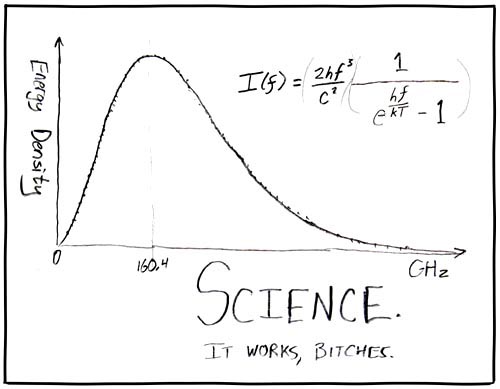
The XKCD comic above (of which some years ago, my wife bought me the t-shirt) shows the Cosmic Microwave Background radiation spectrum. This has nothing much to do with climate change, but it is a famous proof of the scientific method: a near-perfect agreement between theory and actuality which is pretty fundamental to our understanding of a bunch of stuff. Science’s only defence; the only thing which gives it any importance or makes it any use at all, is that it works. When properly applied, it predicts actual events. The Queensland floods, as well as other such events, are happening as predicted, and anyone who tells you otherwise is either ignorant, or having you on, or both. In Andrew Bolt‘s case, it’s both. Queenslanders — and others similarly impacted by such events — need neither.

L

Hang ‘em high

datePosted on 12:16, October 8th, 2010 by Lew

Labour Supercity candidate Daljit Singh, standing for election to the Otara-Papatoetoe Local Board, has been revealed as one of those charged with voting fraud-related offences. As Idiot/Savant says, it’s awful that this information didn’t come out earlier so that he could be punished electorally as well as judicially, but this is part of the price we pay for a robust justice system.

However, the fact that Singh has avoided his due scrutiny thus far (and, farcically, may yet be duly elected to the board) makes strict attention to his case all the more important, and places a heavier burden on those who are associated with him –and in particular on the Labour party whom he represents — to respond swiftly and decisively to divorce themselves from Singh and his alleged misdeeds. This must take cognisance of the fact that he has not yet been convicted of anything and it may be conditional and hypothetical, but if Labour have learned anything at all from the Taito Phillip Field scandal, it’s that a lesser test than ‘convicted in a criminal court’ must apply with regard to such matters.

In the interim Singh’s erstwhile allies must assess the evidence and base their response on judgements as to its veracity, but the moment his guilt is admitted or proven, they must be the first to call for his (figurative) hanging; because they stood to benefit from his fraud, they must condemn it all the more loudly. Singh and Labour’s enemies can be relied upon to do so; his allies must also. Andrew Little has initially done so, and this is heartening. IrishBill at The Standard, as an allied third party, has done likewise.

It is also perfectly legitimate to draw links between Singh and others’ alleged wrongdoing and Labour’s own fundamental standards and character, since candidates by definition represent the party. While one rotten apple does not (as many will certainly argue) imply a party of inveterate crooks, this latest incident on top of the Field affair, Labour’s steadfast support for Winston Peters through the Owen Glenn donation scandal, and continuing perverse behaviour by Chris Carter (I could list more examples) do certainly speak to crucial failures of judgement when it comes to the party’s selection and endorsement of both candidates and allies. If the rumoured pecadilloes of Richard Worth, the overt bigotry and criminal background of David Garrett, and the blundering damfoolishness of Melissa Lee (there are more examples here also) can be said to illustrate the character of the ACT and National parties (and I believe they can) then the same must surely hold true for Labour. Whatever speaks to character speaks to the heart and soul of a political movement, and by this standard Singh’s implication in voter fraud, if proven, will be a lifelong stain on the party which admitted and endorsed him.

And if anyone so much as breathes words like courageous corruption in apologia for Singh and whoever else, hoist them by the same rope. Democracy’s ends are only as good as the weakest part of its means.

L

Great prospects

datePosted on 21:15, January 29th, 2010 by Lew

Hat tipped to Paul McBeth for this one.

As one side engages in some tentative but hugely premature triumphalism, and the other side points the accusatory finger, a sleeping giant awakes. This man — our Nixon, in whom we apparently see ourselves as we really are — has rekindled the fire which once consumed the hearts and minds of the nation (and the knickers of untold women old enough to know better) and thrown himself with renewed fervour into the task of “getting his old job back”.

Thanks either to wicked humour or outright shamelessness on the part of Auckland University political science staff, Winston Peters has been granted the unlikeliest of springboards to launch his 2010 campaign to return to the Beehive in 2011: a lecture to (presumably first year) political science students on the MMP political system. Of course, if they’d wanted a serious lecture on the topic, any number of graduate (and even some of the more geeky undergraduate) students could have done it, but the choice of Winnie was inspired because, instead of just telling these young things the dry facts and functions of the system — let’s face it, they can learn that from a book or even wikipedia.* But here’s a chance for them to learn how the system works in actual fact, from someone who has used it to screw others and been screwed himself, and to learn all that from someone who, just coincidentally, is in a position to demonstrate that no matter how down and out a politician might seem, under MMP he’s only one voter in twenty away from the marble floors, dark wood and green leather benches which house our democratic institutions.

The speech itself is the saga of the heroic battlers who guided the noble, fragile MMP system through the minefields of bureaucracy, persevering despite the “inner cabal cherishing hidden agendas” intent upon bringing about its premature demise. Those heroic battlers were represented by New Zealand First, epitomising the “traditional values of New Zealand politics”; “capitalism with a kind, responsible face”; the “long established social contract of caring for the young and the old and those who were down on their luck through no fault of their own”; a strong, honest party which was forced into coalition with National, although even then the dirty hacks in the media failed to correctly report these facts.

It’s a wonderful story, a fabulous creation myth, and if you’ve listened to Winston’s speeches over the years, none of it will be foreign to you.

But the speech dwells upon the darker, more recent history of MMP, and particularly its perversion by the forces of separatism. This initially seems odd for a speech which praises MMP, but it makes perfect sense when you consider the wider narrative: you can’t rescue something which isn’t in trouble, and the wider narrative is, naturally enough, that Winston is here to rescue New Zealand from MMP and the separatists — blue and brown — who have overtaken it. This is done, in true Winstonian style, with a masterful play on words:

You’ve all heard or seen the British comedy TV show “the two Ronnies” – well we have our own comedy show starring the “two Hones”. Hone, of course, is Maori for John – and the two “Hones” don’t give a “Heke” about who they insult on Waitangi Day.

If you listen closely, you might almost be able to hear the sound of undergraduates giggling nervously, and more quietly but present nevertheless, the sound of confused and frustrated battlers who don’t see what they stand to gain out of any of the current political orthodoxy starting to think “you know, Winston wasn’t so bad after all.”

So, Winston is back. For the record, I still don’t think he’s got the winnings of an election in him without the endorsement of an existing player, and I think it’s better than even money that he would drag any endorser down with him. His credibility is shot to hell, and this is a naked attempt to reach out to a Labour party who have just begun to put a little historical distance between themselves and him, but it will be very tempting for a Labour party struggling to connect with the electorate. If we as a nation are very, very unfortunate, Labour’s failure to reinvent themselves and the illusory success among some of the usual suspects of the “blue collars, red necks” experiment last year — notably not repeated in this week’s speech — will cause them to reach out for the one thing they lack: a political leader who understands narrative, who possesses emotional intelligence and political cunning in spades, who knows how to let an audience know who he is and what he stands for, and make them trust him (sometimes despite all the facts), and who has a ready-made constituency of disgruntled battlers who feel (rightly or wrongly) that the system doesn’t work for them.

Please, let it not come to that.

L

* Incidentally, it may come as a surprise to some of you that these dry facts and procedural details were the reason I dropped out of PoliSci in my first year, and studied Film instead (before realising that it all came back to politics anyway).

12Next