Return to the Big Stick, with some carrots thrown in.

A while back I wrote about Trump’s nostalgia for the “gilded” era (defined by tariffs and wars) and his return to a “neo” version of Gunboat Diplomacy with his threats to annex Greenland, Canada and the Panama Canal. The term “gilded age ” was bestowed before but came to focus on William McKinley’s time in office by none other than Mark Twain, who noted that by “gilded” he meant all glittery on the surface and thoroughly corrupt underneath. How prescient he was, because what was true then certainly is true now.

Here I propose to extend the US imperialist theme that was part of that era by moving onto a famous phrase from McKinley’s successor, Teddy Roosevelt. McKinley was assassinated while in office and Roosevelt, as Vice President, at age 42 assumed the presidency. More than his extensive political career, including serving as governor of New York, he was famous for his leadership of the Rough Riders during the Spanish-American War and had served as an assistant secretary of the Navy before joining McKinley on the 1900 Republican presidential ticket. In 1906 he was awarded the Nobel Peace Prize for his mediator role in ending the 1904-05 Russo-Japanese War., so perhaps that is another legacy of that era that Trump (he of “I have ended eightor nine wars” fame) would like to emulate. Roosevelt was also the president who authorized the building of the Panama Canal, so the historical tie-backs do not end with Trump’s preposterous fixation on the Nobel Peace Prize or on (re) claiming pieces of other country’s territory..

Roosevelt coined the phrase “speak softly and carry a big stick.” This aphorism guided his approach to relations with the Western Hemisphere, where it came to be known as the Roosevelt Corollary to the Monroe Doctrine. The corollary stated that beyond declaring the Western Hemisphere off-limits to non-hemispheric foreign military powers such as Spain, France, Germany and Russia (the Monroe Doctrine) , Roosevelt added the notion that the US would be the hemispheric policeman enforcing that doctrine as well as imposing peace on “uncivilized” and restive post-colonial Latin American societies.

The “Speak Softly/Big Stick” approach had five component parts:  First, it was essential to possess a serious military capability that would force adversaries to tread carefully when it came to challenging US power, especially in Latin America. At the time that meant a world-class navy (not only was Roosevelt a former Assistant Secretary of the Navy but he had written a book on the 1812 naval war between the US and England as well as several articles on naval power projection that were deeply influenced by the pioneering naval geopolitical analyst Alfred Thayer Mahan). The other qualities of the Speak Softly/Big Stick posture were to act justly toward other nations, never to bluff, to strike only when prepared to strike hard, and to be willing to allow the adversary to save face when being deterred, or when demurring, or if push comes to shove, in defeat.

It should be clear that Trump is incapable of speaking softly in any setting and that he bluffs, lies and dissembles as a matter of vulgar and bullying course. It is also clear that Trump is following Steve Bannon’s advice to “flood the zone” with an endless barrage of inane and serious initiatives, to the point that it is hard to disaggregate and differentiate between them in order to discern the details of the content because every day brings another scandal, Executive Order, or presidential musings on any number of things.

But in the approach towards what his former national security advisor (and now indicted defendant in a Trump political relation scheme) John Bolton called the “Triangle of Tyranny” (Cuba, Nicaragua, Venezuela), now expanded to include Colombia, Trump is clearly brandishing the big stick of US intervention, including of military attack, against them. At the same time, he is bestowing selective favors (let’s call them “carrots”) on rightwing governments like those of Javier Milei in Argentina and Nayib Bukele in El Salvador while overtly and covertly providing assistance to rightwing opposition leaders in states led by leftists, such as the case with the (reportedly) CIA-backed, recently announced Nobel Peace Prize recipient Maria Corina Machado in Venezuela. This regional foreign policy approach is worth breaking down in further detail.

Since the early 1960s US foreign policy in Latin America has been dominated by Cuba, Cuban exiles and anti-communism. The exiles are an important domestic lobby with deep reach into the Republican Party but they also line the pockets of Democrats in key districts and recently have now been joined by anti-Chavez/Maduro (anti-Bolivarian) Venezuelan exiles, anti-Sandinista exiles from Nicaragua and rightwing nationalists from other Latin American countries, Chileans most recently. Concentrated in places like South Florida, New Jersey and the Washington DC area, these groups of voluntary and involuntary expatriates wield disproportionate influence over US foreign policy in the region. And a fair few of them, Cuban and not, are violently inclined.

The Trump administration is not just brandishing the Big Stick in Latin America. It is welding it to bash its perceived enemies and hapless people caught up in its machinations. It began by broadening the definition of terrorism to include narco-traffickers, who it argues sow fear in the US by supplying drugs and via associated criminal activities. It has particularly focused on Mexican cartels like those in the Northern states of Sonora and Sinaloa, Venezuelan gangs like Tren de Agua and Salvadorean gangs like MS-13 that, ironically, grew and became powerful syndicates inside the US rather than their countries of origin. The expansion of the term terrorist to include drug gangs allows the US latitude when engaging them with force, because irregular warfare groups like ideological non-State actors (say, ISIS) that use terrorist tactics are not covered by the Laws of War and Geneva Convention. Labelling criminal drug traffickers “narco-terrorists” therefore clears the way for the US to engage in extra-judicial execution of those suspected on being so. But in order to do so, the US must ignore the fact that under US, international and regional national laws, drug running is not a capitol offence even if due process is followed. So, as Trump himself has openly said, they “are just killing them.”

Perhaps in recognition of this and not wanting to be charged as a war criminal, the 4 star admiral who leads the US military command responsible for Latin America, the Southern Command or SOUTHCOM, is taking early retirement, perhaps forfeiting his fourth star retirement pay because he did not serve out a full year in that rank after promotion. He may also had in mind Secretary Hegseth’s advice to the assembled general and admirals this month that if they had any “cringe” about his order, then they should do the honorable thing and resign.

The US pirate approach to the use of force at sea has led to the murder of over 50 individuals (Colombian, Ecuadorian, Venezuelan and Trinidadian citizens) by US forces without charge, arrest, trial, sentencing or any evidence of drug-smuggling (e.g. no floating bales of drugs after the strikes even while other debris was observed on the surface). In fact, imagery of the targeted vessels indicate that they were wooden outboard motor boats that could not reach the US mainland from Venezuela (which the US claims without evidence was the originating point) without multiple refuelling stops at sea or on land, (where they could be detained with relative ease by any number of regional law enforcement agencies). The same is true for the boats presumably coming our of Colombia that have been targeted in the Eastern Pacific. By its actions the US choses to be judge, jury and executioner without warrant, which effectively make its behaviour acts of piracy. The fact that none of the countries whose nationals were killed in these extrajudicial strikes are at war with the US only highlights the outlaw impunity with which Trump’s Big Stick is wielded.

Eight of the twelve kinetic operations against” narco-terrorists” happened in the Caribbean off the coast of Venezuela in international waters. Four strikes have killed people in wooden boats in the Eastern Pacific off the coast of Colombia (the Colombians claim one of the strikes was in Colombian territorial waters) and Central America. Trump is threatening to expand US military operations onto land in Venezuela and Mexico, where left-centre president Claudia Scheinbaum has clashed with Trump over his immigration and border control policies. Now Trump has cast his malevolent eye on Colombia, apparently because president Gustavo Petro, the first left centre president to survive and win a presidential election campaign in decades, had the temerity to criticise Trump’s immigration policies and join anti-ICE protests in New York City during the UN General Assembly meetings at which he spoke. That angered Trump, who revoked Petro’s visa and began to launch baseless accusations that Petro was somehow in cahoots with the narco-traffickers. The message was then backed with the kinetic strikes off Colombian shores.

Ironically, Colombia has traditionally been the US’s strongest ally in Latin America, especially as part of the so-called “War on Drugs,” and it definitely has the most experienced armed forces in the region thanks to its decades-old wars with various leftist guerrilla groups like the FARC and ERP. US special forces embedded with their Colombian counterparts for many years and the Colombians use US weapons platforms, equipment and training doctrine. They are no push-over military with generals sporting good conduct medals. They are also very proudly nationalistic, so they will not be walk-overs in the event the US decides to up the ante with them. It is therefore doubtful that the US will significantly step up physical attacks on Colombian territory and nationals, limiting itself to personal, diplomatic and economic sanctions, and, of course, noisy bluster from the loudmouth-in-chief.

The image of the fat armchair general that Secretary of Defence/War Pete Hegseth railed about in his talk to the US military brass a few weeks ago is more suited to Venezuela, which has slid from the lofty “pink tide” aspirations of the Bolivarian Revolutionary colonel and president Hugo Chavez in 1999 to a venal, bloated, corrupt one party “elected” kleptocracy under his former Vice President and one-time bus driver, now fraudulently re-elected president, Nicolas Maduro. Recognising the deep weakness under the veneer of Bolivarian solidarity, the US has threatened to invade Venezuela and Trump has openly claimed that he has authorized CIA covert operations in that country. The not-so-subtly declared objective is clear: regime change and replacement with a US-friendly leadership.

That would not be surprising given that several US -backed plots have been uncovered against both Chavez and Maduro, but in this instance Trump appears to be playing a crude psychological pressure game designed to foster paranoia and factionalism with the Venezuelan political and military leadership. And if the reports of Nobel Peace Prize winner Machado’s links to the CIA prove true, then those leaders have good reason to be concerned. After all, rightwing Cuban, Nicaraguan and Venezuelan exiles are openly plotting and scheming along with rightwing US groups to overthrow their respective home governments as soon as possible, and organising to that end in enclaves like Weston, Florida, northwest of Miami. The CIA is on friendly terms with these groups. Could this be the makings of Bay of Pigs 2.0 even if the exiles think of scenarios like the invasions of Grenada or Panama? We shall see.

Interestingly, although the US is putting direct heat on Colombia and Venezuela at the moment, it has taken as more subdued approach to Cuba and Nicaragua. On a scale of openness, Colombia is clearly first–it is democratic after all–but Cuba is in a slow process of liberalisation itself, while Nicaragua has regressed into a quasi-Stalinist kleptocracy much like Maduro’s Venezuela. So why the difference when it comes to waving and welding the Big Stick? In fact, Cuba, Nicaragua and Venezuela all have close ties with Iran, the PRC, Russia, North Korea and assorted non-state actors like (what is left of) Hamas and Hezbollah. And yet Colombia is lumped in with Venezuela as a narco-terrorist State according to the Trumpian world map. The answer may lie in domestic politics–Trump has made numerous false claims about Venezuelan gangs taking over US cities, including Tren de Agua, while the US cocaine trade is largely controlled by Colombians–and personal hubris: Trump hates Petro because the latter showed up at a demonstration against Trump and Stephen Miller’s version of the Gestapo, while Maduro is an easy to ridicule tinpot clown posing as a revolutionary strongman.

Cuba and Nicaragua, on the other hand, are getting the kid glove treatment in comparison. This may be an admission that the White House does not see them as easy push-overs, worth confronting, or as places against which the MAGA base will rally. Perhaps they simply are seen to be undesirable scapegoats given their low drug-running profiles, even if the truth is that both autocracies have hand-in-glove connections to the narcotics trade.

The dissimilar approaches are made odder by the ongoing presence of a Russian naval base in Cuba (Cienfuegos) and Nicaragua’s expansion of ties with obvious US adversaries. One would think that the Trump Big Stick would be applied equally to all of the leftist “Fearful Foursome” countries, but perhaps this is just a reflection of Trump’s personalist policy making and attention span rather than ideological enmity or geopolitical calculation. Alternatively, perhaps the US thinks that regime change in Venezuela will stop the flow of oil and other resources from it to its regional allies, thereby indirectly squeezing them as well.

What is most ominous in the evolving scenario is that Trump appears determined to forcibly impose regime change on Venezuela. He obviously does not understand the lessons of Afghanistan, Iraq, Libya, and Syria in recent years and instead is hell-bent on showing his toughness by picking on a country that cannot put up a legitimate fight against US forces. His pretext is the claim of drug-running out of Venezuelan bases, although there has been no concrete proof yet provided to that effect. To buttress his bully move (which is an odd stance for a guy who campaigned on withdrawing the US from foreign conflicts), Trump has ordered the deployment of a carrier task force (a carrier with 5000 sailors, +/-100 aircraft, including 70 warplanes, 5 destroyers, a submarine and tenders) to the Southern Command area of operations (AOR) where an additional 8 warships are already stationed along with a US Marine Expeditionary Force. SOUTHCOM also uses Army, Marine, Navy and Coast Guard assets on specific occasions as deemed warranted, and is already conducting strategic and tactical bomber runs near Venezuelan airspace by B-52s and B-1s stationed on the US mainland.

One can get a sense of what US forces have deployed to the Caribbean to date here.
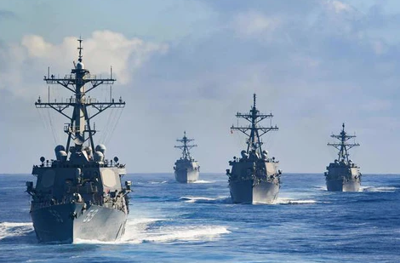
US Navy ships in Southern Caribbean. Source: Trinidad Express.

What all of this means is that the game is on. Moving this amount of assets to the Caribbean Basin, especially given the presence of land forces in the deployment, is no bluff. Trump seems to think that he can make an example out of Venezuela, contrary to historical precedent when it comes to the forced regime change going as planned or producing the desired results. One things is certain. It will be Venezuelans who suffer the most from any eventual escalation, and their scotch-swilling wealthy exile “leaders” will do nothing to shield them from a US assault.

In contrast to all of this Big Stick manoeuvring, Trump has offered Argentine president Javier Milei a USD$40 billion bridge loan as a form of bailout for Milei to make interest payments on outstanding public loans. No international lender like the IMF or World Bank would do so because of concerns about Milei’s reckless fiscal and macroeconomic policies (at one point he wanted to dollarize the Argentine peso and shipped off Argentina’s gold reserves to England on a private plane). Private investors took advantage of Milei’s public sector asset sale program to strip them of what value they held, repatriated the profits from the re-sale of those assets, then left the economy. What private investors remain are engaged in dodgy crypto schemes and destructive enterprises like critical mineral mining (lithium, in particular) where regulation is lax and where profits are largely sent abroad.

Milei himself is embroiled in an investigation into a memecoin “pump and dump”/”rug pull” scheme concocted along with Trump-allied US crypto billionaires, where he touted on social media a specific coin called $Libra that rapidly rose, then fell in value, making the 9 founding $Libra accounts around USD$82 million and leaving 72 thousand other investors with USD$251 million in losses in just over 3 hours. Milei later distanced himself from the scheme but it was discovered that he was one of the 9 founding accounts, which as per usual were managed by his sister and chief personal advisor, otherwise known as “Ms. 3 percent” for the price of the “commissions” she demands of entities doing business with the Argentine State (the most recent involving a pharmaceutical company). Milei’s sister, Karina, is also being investigated for links to–surprise!–narcotraffickers and assorted other dark forces in the Argentine landscape.

The Trump bridge loan bailout for Argentina was in fact a political rescue line thrown to Milei. His party (Libertad Avanza or Freedom Advances) did very poorly in provincial and first round congressional elections in September and at the time of the bailout it was assumed to be posted to suffer a similar fate, or at least not improve its minority Congressional representation in the national midterm elections this past weekend. That would jeopardize his reform agenda for the remainder of his presidential term, making him a lame duck and paving the way for a return of either a Peronist party faction leader or a newer centrist coalition-backed candidate. Either of these option would spell the end of the “chainsaw” approach to public sector restructuring as well as Milei’s pro-US (and pro-Israel and anti-climate change) position, something that Trump seeks to avoid.

As it turns out, Libertadad Avanza won 41.7 % of the congressional electorate vote, defeating the opposition coalition, which won 40.4% of the total number of party votes. This improves the government’s bloc position in Congress and strengthens Milei’s hand in imposing more reforms, but it also sets the stage for ongoing deadlocks and resort to rule-by-Executive decree on the part of the Argentine president. But for the moment, chalk this up as a win for Trump’s bailout carrot/election interference gambit because even if short term in nature, it may have influenced things in a US-favorable way when it comes to Argentine foreign policy. Since Trump threatened to rescind the bailout of Milei’s party did not win, it is quite possible that tis weighed significantly on the minds of voters (who still turned out in record low numbers–67.8%– in spite of voting being mandatory).

What is also interesting is not that the bailout was given for political rather than sound economic reasons. That happens. What is of note is that the bailout comes at a time when US tariffs on Chinese goods resulted in retaliatory tariffs on US agricultural products, especially soybean exports. Most of these are grown in Red Trump-voting states. When the retaliatory tariffs kicked in Argentina dropped its export taxes on soybeans, and along with Brazil rapidly took advantage to increase soybean exports to the PRC. In just a few months Argentine and Brazilian soybean exports have taken over the previous US share of the PRC soybean import market. So in effect Trump has bailed out a foreign government for ideological reasons even though it directly hurts a core voting block in the MAGA coalition. That makes neither economic or political sense.

In response to criticism of this deal, Trump puzzlingly announced that he would reduce tariffs on Argentine beef imports so that it could increase its US market share. At a minimum that means reducing US beef prices in the face of Argentine import competition., which is now the stated intention of the plan (beef price reductions across the board). Once again, US beef is mostly produced in Red states, so here too the economic and political logic at play appears to be contrary to the interests of key MAGA voters. It seems that for Trump ideological buttressing of an ally abroad is more important than the material fortunes of US farmers, and he does not fear electoral retribution as a result. That is another oddity, unless he has a plan for avoiding electoral backlash in the first place, which may be what the overall beef price reduction plan is all about..

In El Salvador, Trump has courted Nayib Bukele, the self-styled “world’s coolest dictator” who offered to house US deportees at his infamous CECOT prison in exchange for money, diplomatic favours and the betrayal of several FBI informants tied to the Salvadorean gang MS-13. Regarding the latter, Secretary of State promised the FBI that he would not divulge the informant’s names to Bukele but then did so, whereupon Bukele demanded they be returned to El Salvador rather than stay in US detention. Secretary Rubio obliged and it is now presumed that the informants are dead. Here the Big Stick was wielded on behalf of a foreign government in conjunction with domestic objectives rather than used against it for strategic gain.

Further afield, MAGA operatives have close links to former Brazilian president (and coup plotter) Jair Bolsonaro’s party and his revanchist sons while the Trump administration has imposed a 50 percent across-the-board tariff on Brazilian goods as well as travel sanctions against the judges that convicted Bolsonaro and sentenced him to six years in prison for sedition earlier this year. The Trump connection to Latin American opposition groups includes rightwing Chilean figures, adherents of the old Pinochet dictatorship and new tech moguls, as it is reported to be quietly influencing the policies of Paraguay (led by a conservative) and rightwing opposition factions in Peru. In effect, in these instances the Big Stick used by one foreign policy hand is complemented by a more subtle and covert velvet glove approach on the other.

In the end, Trump’s return to a US gilded age is very much true in the original Twain sense of the phrase, and its adoption of a crude form of Gunboat Diplomacy characterised by a Big Stick/Carrot approach is playing out in contradictory but obvious ways in what Trump considers, to Latin American revulsion, to be the US’s backyard where the Roosevelt Corollary to the Monroe Doctrine gives it the right to act with wanton disregard for International law and imperialist impunity with regard to the rights of individuals and States. Much like demolishing of the White House East Wing serves as an allegory for the destruction of the US constitutional system and social fabric, the return to the Big Stick and selective carrots is symbolic of an increasingly feckless approach to US foreign policy, regionally defined.

As the saying from former Mexican president Porfirio Diaz goes (amended here to include the entire region): “Poor Latin America. So so far from God and so close to the United States.”

Que Pachamama los proteja!

Declaration: I was the Regional Policy Analyst for the Interamerican Region and Caribbean Desk Officer in the Office of the US Secretary of Defense (OSD/ISA/IA), co-Team Leader of the Cuba Task Force and a consultant to the CIA, US Southern Command, US Air Force Special Operations and US Navy Special Operations Commands in the 1990s. In those roles I was engaged in exactly the sort of exercises that go into this type of war-planning/preparation and am well aware of the long history of US anti-drug campaigns in the region as well as the US military involvement in them (including the infamous Pablo Escobar/Cali Cartel years). My commentary is informed by those experiences and by the certain knowledge that the norms and restraints that governed the actions of my colleagues and I no long apply when it comes to the application of US military force.

A suggestion for Biden’s foreign policy (with bonus “A View from Afar” podcast).

I have been thinking about US foreign policy after the upcoming election. My working assumption is that try as he might, Trump will lose the election and be forced from office. There will be much litigating of the results and likely civil unrest, but on Jan 21, 2021 the Orange Merkin will no longer disgrace the office of US president.

The damage to the US reputation and interests done by the Trump administration has been extraordinary and will take much time and effort to reverse, and even then some of the damage may be irreparable. The scope of what has to happen is too broad to discuss in a short KP post, but here is some food for thought: If Biden wins the US election he should name Barack Obama as ambassador extraordinaire/special envoy to lead the repair, restoration and reform of US foreign relations.

That is a very big task, which is why no one can do more to undue the damage wreaked by Trump than POTUS 44. Obama is the most respected politician in the world according to global surveys and his party is (slowly) moving leftwards. The latter is important because it means that some of the old shibboleths of US foreign policy like unconditional support for Israel or Saudi Arabia can be challenged from within the Democratic establishment of which Obama is part. More broadly, he represents both continuity and change in US foreign policy, and has the stature to confront, cajole and convince international interlocutors. Unconstrained by the strictures of the presidency yet deeply aware of US failures and flaws–including his own while POTUS–as well as its strengths and interests, Obama would have relative freedom and autonomy when negotiating on the country’s behalf. That affords him some room for manoeuvre when addressing thorny matters of international import.

All he needs is institutional (presidential, most importantly) support and the awareness that the US cannot return to the status quo ante. Post-Trump and post-pandemic, with new power contenders firmly entrenched in the international scene and with a broad erosion of international norms and mores, the world is a different place than it was during his term in office, and not necessarily one that looks to the US for unchallenged leadership or moral guidance. That is precisely why someone of his stature is needed to help redefine and reconstitute US foreign relations.

Theoretically Obama could take a step down to SecState, but that is awkward given his previous job and prior relationship with Biden. Making him a global Mr. Fix-It answering directly to POTUS 46 gives him institutional weight commensurate with his stature as ex-president. That frees up the eventual SecState to concentrate on rebuilding the foreign service (decimated by Trump’s minions) and conducting the daily business of diplomacy while Obama concentrates on the hard nuts to crack: the suspended START intermediate range missile negotiations with the Russians, the abandoned Iran nuclear limitation deal, the cancelled Trans Pacific Partnership (TPP) trade compact, Israeli-Palestinian relations, the DPRK impasse, etc. He knows the issues, he knows the principles and principals involved and he knows the history behind and between them.

There will be much on Obama’s plate, to be sure, but with enough resources devoted to the task such a division of labor between him and the State Department could more rapidly address the myriad areas of foreign policy that have been left derelict or deliberately damaged by the mediocrities currently running the White House, Foggy Bottom and other agencies of the federal government responsible for foreign policy issues. That makes the selection of SecState especially important, as the person would need to be able to handle Obama’s plenipotentiary status and also the demands of running the foreign policy bureaucracy while supporting the ex-president’s endeavours.

Biden has already singled that he will use some “old hands” (mostly Obama staffers) in his foreign policy team and will re-assert the preference for democracy and human rights in his approach to foreign relations. But his nostalgic perspective will need to be seriously tempered by two incontrovertible facts, one internal and external. Externally, he will take office at a time when the US is a declining power confronted by rising and resurgent powers and an absence of consensus on how nation-states should behave in such transitional times. It no longer has the will or the ability to be the world’s policeman and the US-led global economic model operative during a half century has seen its frailties exposed by Covid-19. The US must adjust accordingly.

Internally, Biden must agree to a significant number of the foreign policy demands of the left-wing of the Democratic Party not only in order to win the election but in order to achieve stability within government after it. He will try to do so incrementally rather than radically but the bottom line is that he has to do so given the changing times in which we live.

Then there is the military aspect of foreign policy. Since Bush 43 the US has been over-reliant on the military as a blunt instrument of foreign policy to the detriment of diplomacy. The traditional dictum that the military should be used only when diplomacy fails has long been discarded, and the Trump administration simply does not comprehend that “military diplomacy” is not always about the deployment, threat and use of force. The relationship between diplomacy and military force is not a zero sum game. The approach to it therefore has to change.

Recently Hillary Clinton has written about the need to reconsider the “Four D’s” of foreign policy: defence, diplomacy, development and the domestic sources of US international relations. Although she (like Biden and Obama) remains wedded to the liberal internationalist school of thought whereby market economies and democratic politics are considered to be the best economic-political combination for both national as well as international politics (something that is under serious challenge on a number of fronts including from within the US), her call for a review and revision of the priority placed on the four pillars of US foreign policy represented by the “D’s” is worth considering.

In fact, although there is a need to bring in fresh and more progressive voices into the US foreign policy establishment, Hillary Clinton might just make an excellent Secretary of Defence should she be willing to take the job. After all, no one is going to say that her relatively hawkish views are ill-suited for the job running the Pentagon, and her vast experience can be used to bring entrenched interests within it into line, assuming that she believes her own words about the need for institutional reform. Like Obama, she can represent continuity and change, this time in US military policy. She knows the issues, she knows the principles and principals involved, and she knows the history behind and between them.

After the disaster that is Trump and company, her perceived flaws pale in comparison–and they will not be up for electoral scrutiny in any event since SecDef is a nominated position confirmable by Congress, not an elected position subject to the popular vote. Should the Democrats cut into the GOP Senate majority or win control of the Senate in November, then she should be given serious consideration for the job.

There will be much work to be done. The US needs experienced hands to undo the damage, but it also needs an ideological rethink given the changed context post-Trump. In an ironic way, Trump has cleaned the slate and therefore cleared the way for a new approach to US foreign policy. That moment is soon to arrive. So long as Biden, Clinton and Obama have learned from the past and are listening to the left side of the Democratic base, it seems sensible to use them in their reconfigured roles.

For more on this check out this week’s “A View from Afar” podcast.

The real roots of Iranian “brinkmanship.”

I have been unimpressed with Western corporate media coverage of the tensions involving Iran in the Strait of Hormuz. They repeat the line that Iran is the source of current tensions, that it is a major sponsor of terrorism, that it is hell-bent on acquiring nuclear weapons and threatening its neighbours and that it is playing a dangerous game of brinkmanship with its attacks on shipping in the Strait. I disagree with much of this, so allow me to explain why.

A few months back the Trump administration unilaterally withdrew from the Iranian nuclear control agreement (the P5+1 deal involving the US, UK, France, China and Russia plus Germany). Leaked diplomatic cables show that it did so manly because the Obama administration had signed it, not because it was a “bad deal” (in fact, the Iranians were upholding their end of the bargain and had complied with all international monitoring conditions). After withdrawing from the deal the US imposed a new round of tougher sanctions on Iran, with most of the bite coming from secondary sanctions on non-US based firms and organisations that do business with the Persian giant.

Let us be clear on this. The US unilaterally withdrew from a viable multinational agreement mainly because of presidential hubris, then unilaterally imposed sanctions not only on Iran but others who may wish to continue to commercially engage with it. The US sanctions are not supported by, and in fact are seen as illegitimate by many countries, including China, Russia and most of the countries in the EU. Yet, because the US has great economic weight, it can use the secondary sanctions in order to force international compliance with its edict.

Until recently the sanctions were not enforced by the military of any country other than the US. But on July 4 the Royal Navy stopped and seized an Iranian oil tanker off the coast of Gibraltar, arguing that it was transporting oil to Syria in violation of EU sanctions (the sanctions only apply to aviation fuel and only cover EU members, which Iran is not). The tanker’s proximity to the colony was fortunate in that Britain has limited autonomous power projection capability in the Middle East but does have a naval garrison on the Rock. So the seizure was as much due to opportunity as it was support for principle.

Iran warned that it would retaliate to this act of “piracy” and this past week it did by seizing two tankers, one of which was UK-flagged (the other was briefly detained and released). The owners of the UK-flagged vessel have not be able to contact it since it was boarded by Iranian Revolutionary Guard Corps (IRGC) commandos.

This follows on Iran recently shooting down a US drone over the Strait and the sabotage of four vesels in a UAE port and two merchant ships in international waters that have been attributed to the IRGC. Needless to say, this appears to demonstrate that indeed, a brinkmanship game is being played. But let us disaggregate a few facts.

The UK was informed of the Iranian tanker’s movements by the US, which asked that it be seized when it made the passage from the Atlantic into the Mediterranean. The May government complied even though Trump has repeatedly disparaged her and welcomed her ouster. The Iranians know that Teresa May is a lame duck and that Boris Johnson, her likely successor, simply does not have the stomach for a all-in confrontation with Iran when the Brexit mess is ongoing and the government is effectively paralysed on multiple fronts. To be clear: the UK is facing a crisis of governance and the Iranians know this. So any military counter has to come from somewhere else.

It certainly will not come from Europe, Asia or anywhere but the US. That is the rub. The Iranians know that Trump is a classic bully. All bluster and bravado but a coward at heart. When informed of the Iranian’s seizure he first uttered threats but then put distance between himself and the UK by saying that the US does not receive much oil that transits through the Strait and that other nations need to up their military patrols through it and the Persian Gulf if they want their vessels to be safe.

This signals that Trump does not believe that a US-Iran conflict would be existential or done out of necessity and that he does not see alliance commitments as universally binding. This gives him room to refuse UK requests for military assistance in getting the Iranians to resolve the stand-off on its terms. In doing so he effectively has thrown the UK under the bus as a reward for it doing the US bidding with regard to the Iranian tanker now tied up in Gibraltar. So much for that “special relationship.”

Although chickenhawk John Bolton, Trump’s National Security Advisor, is keen to shed other people’s blood in order to force an Iranian submission, Trump, like Johnson, does not appear to be inclined to do so. Besides his neo-isolationist proclivities, Trump has undoubtably heard from US military authorities that a conflict with Iran would make Afghanistan and Iraq look like a kindergarten party. The US military is stretched as it is, the US public is sick of constant war, a long election year is just beginning and no allies other than Israel and perhaps Saudi Arabia are going to be willing to join the US in a fight of its own making.

That is an important point to note. It is clear that for Bolton and other re-cycled neoconservatives like Mike Pompeo, the march to war with Iran is about regime change, not international commerce. US foreign policy elites have never gotten over the Iranian Revolution and the US embassy seizure in 1979, and the US military has since then had a prickly relationship with Iran in its regional sphere influence. US criticism of some of Iran’s more regressive policies as a reason to push for regime change holds little weight given its support for the likes of Saudi Arabia, and regardless of the theocratic nature of the regime Iranian elections are considered by international observers to be among the cleanest in the Middle East (thereby putting the lie to claims that Iran is as authoritarian as other regional autocracies).

The US push for war with Iran is therefore not grounded in concerns about international norms and the specifics of Iranian behaviour but in getting some measure of retribution for what some US elites feel was a great loss of face forty years ago and an ongoing reminder of US powerlessness in specific instances. The trouble for the likes of Bolton and Pompeo is that most world leaders understand their real motivations and so are reluctant to join their war-mongering bandwagon.

The Iranians know this. They know that they have Russia as a military partner and China as an economic lifeline. They know that any military conflict involving them will close the Strait for more than just the duration of hostilities. They not only have one of the largest militaries in the Middle East but they also have proxies like Hezbollah and allies like Syria who will join in what will be a multi-fronted asymmetric war of attrition against the US that will not be confined to the immediate region. They key is for Iran to isolate the US and a few allies in a manoeuvre-based military conflict that avoids short mass-on-mass exchanges and which over time inflicts political and military costs that become unbearable.

Although Bolton may believe in the rhetoric of “effects-based strategy” and therefore assume that any successful kinetic engagement between the US and Iran will be limited, short and intense, the problem with such assumptions is that the adversary may not subscribe to what is taught in US command and general staff colleges. I assume that US military planners understand this.

It is therefore very likely that Iran will get to exchange the British tanker for the ship detained in Gibraltar and that it will be able to continue to make the point that it has the means to disrupt commerce in the sea lanes adjacent to it. The latter is an important tactic for Iran because the price for it ending its maritime disruption campaign is a loosening of the US sanctions regime on it. Unless oil-importing countries step up their own naval protection of ships flagged by or destined for them (which brings with it the possibility of military confrontation with Iran), then they run the risk of economic slowdowns caused by fuel shortages, to say nothing of increased insurance costs and fuel prices as the impasse continues.

In short, it does not appear likely that the US is going to come riding to the rescue of non-US vessels anytime soon and yet will continue to demand that the world bow to its Iranian sanctions regime. Trump and his advisors may see it as a necessary hard choice for US allies but to them it is more likely to be seen as being placed in an untenable position.

Finally, it should be remembered that modern Iran has not engaged in an unprovoked attack on another country. Although it supports and uses irregular military proxies, it is nowhere close to being the sponsor of terrorism that several Sunni Arab petroleum oligarchies are. In spite of its anti-Israel rhetoric (destined for domestic political consumption), it has not fired a shot in anger towards it. Its strategic position in the Middle East is as strong now as it ever was. It has complied with the terms of the nuclear control agreement. It has good commercial relations with a wide variety of countries, including New Zealand. It therefore has no incentive to start a conflict even if it does have a strong incentive to turn the tables on the sanctions regime by demonstrating that imposing costs works in many ways and on more than just the targets of sanctions themselves.

It would be wise for Western leaders to put themselves in Iranian shoes when considering the security dilemma in the Persian Gulf, because if anything the root of the current tensions lies not in Tehran but in Washington, DC.

Go The Donald!

I am lucky to be able to vote in the US as well as NZ, and very much relish the opportunity in both countries. In the US I am registered as a voter in Florida, which is a closed primary state. “Closed” primary states are those in which a voter has to declare a party preference prior to the primaries in order to vote in them. For years before and after I established a residence in Florida I listed my political affiliation as “Independent,” something that allowed me to choose a primary to vote in the “open” primary states where voting preferences did not have to be declared prior to primary season (they only have to be declared and ticked off on the day at the balloting station). In 2008 I decided to switch my declared affiliation to Democrat so that I could vote in the Florida Democratic Party primary given that not only were Obama and Hillary running for president, but there were races for the US House, Senate and local seats that needed to see Republicans defeated.

This year I am going to switch affiliation to Republican. Why? Because that way I can vote for Donald Trump in the Republican primary in the hope that he makes it to the GOP National Convention next July. It has been a very long time since either major party has had a brokered convention where several candidates are in the running for the presidential nomination, and should The Donald survive until then the craziness will be well and truly on. Since he is totally unqualified to be dog catcher much less president and unelectable in the general election, it is my sincere hope that he hangs in all the way to the convention and either becomes the GOP candidate, determines who is, or runs a third party candidacy after losing out in the convention to one of the others. The only thing better would be for Kanye to join that gaggle of fools and trolls but, alas, he is going to wait until 2020 to run.

Already The Donald has become to the GOP what Miley Cyrus is to pop muzak: a wrecking ball. The Republican National Committee must be choking on their Cohibas (illegal until the recent diplomatic reopening with Cuba) and dying a slow death every time he speaks or when they read the polls. Because let us be clear: Trump appeals to the stupidest, xenophobic, economically illiterate, racist, bigoted, misogynist, white cultural supremacist elements in US society. He follows in a long line of populist demagogues that extends back through Ross Perot to Pat Buchanan, George Wallace and Huey Long.  He may purport to speak unvarnished truth but in fact what he says is most often non-sensical rubbish that fails to address reality much less the intricacies of democratic governance with a division of powers: he is going to “do the deal” with whomever; most Mexicans are rapists and drug dealers; he will “build a wall and make Mexico pay for it” (along 1,900 miles of topographically challenging terrain that includes numerous sensitive ecological zones and wildlife corridors); he will deport “illegals ” and their “anchor babies,”  (all 14 million of them); he will simultaneously confront China, Iran and Russia; he will make the US military “great” again so that no one will “mess” with it (forgetting that the US spends more on defense than the next seven countries combined–US$610 billion or 20 percent of US federal spending and 3.7 percent of GDP–and still has people “messing” with it); he will provide better women’s health care in spite of gutting Planned Parenthood and removing health care for “alien” women because he “cherishes” women in general (ignoring the fact that two of his wives were not citizens when he married them). Everyone in politics but him are incompetent or idiots. His speeches are endless repeats of these and other inane mantras interspersed with self-congratulatory self-praise and personal insults directed at his rivals, all other politicians and anyone who disagrees with him.

The truth is that he has no plan, has no policy agenda, has no friggin’ clue what it is like to deal with the complex issues that confront the US. And that is why the rednecks and dimwits like him. He makes the hard seem easy.

What is great about this is that he is forcing the other GOP candidates to respond to him, and they have stepped up to the plate in predictable style. Among other gems, Ben Carson (the neurosurgeon) says homosexuality is a choice because men go to prison straight and come out gay; Scott Walker just suggested that building a 3,987 mile wall on the Canadian border is worth looking into; Jeb Bush wants to abolish Planned Parenthood and believes that the invasion of Iraq “turned out well;” Ted Cruz and Marco Rubio want walls and deportations even though they are children of recent immigrants who were legally documented after, not before their arrivals. They all claim that the US military and its veterans have been crippled by Obama even though it was Bush 43 who ordered them into two simultaneous wars while cutting back veterans benefits as well as the budget for post-combat trauma rehabilitation. They all claim that ISIS is an Obama invention even though it was Dubya’s purge of Saddam’s army that provided the leadership material for what became ISIS’s fighting forces. They all oppose gun control and climate change science and all support hacking, fracking, drilling and spilling regardless of environmental consequence. They all oppose abortion and gay marriage even if some of their past records indicate otherwise. The list of idiocy goes on but should not surprising given that Rick Perry, Rich Santorum, Mike Huckabee and several snivelling weasels remain in contention.

As things stand now, the GOP primary is a circus. There may not be any juggling or animal acts, but there sure are a lot of clowns, and The Donald is the ringmaster. Even if the number of viable candidates drops to 2 or 3 by the time of the GOP convention, it will be Trump who sets the Right’s narrative for the general election. Yippee!

It looks like the US media has decided to sit back and watch the circus unfold. Fox News tried to undermine him in the first debate that it aired, but his nasty personal attacks on the female panelist only strengthened his support among the troglodyte crowd and has forced Fox to backtrack and give him coverage as the Party favourite. All other outlets are content to watch the train wreck proceed while offering the mediocre tedium that passes for informed analysis by the usual spectrum of pundits. As a result, the GOP favourite, Jeb Bush (or “Mr. Low Energy,” as The Donald calls him) has seen his coverage slip to the sidelines along with the other yokels. Likewise, for all of the Fox News chest beating, Hillary Clinton is getting a general pass by the press because her sins are run of the mill when it comes to DC politics and her campaign is about practicable policy, not theatrics.

The key to the outcome will be seen in January when the first GOP primaries are held. If The Donald does well in them he will be hard to stop. So the RNC has to find a way to do him in either before then or to go all out nuclear on him should he prevail in Iowa or New Hampshire. That is when the questions about his draft dodging, drug use, association with organised crime, commercial racism, trust fund baby status, adultery, academic record embellishment and a host of other peccadilloes and not-so-small sins will find their way into the mainstream media. But even then he may be too big a juggernaut to derail in time for the GOP to coalesce around another candidate who may stand a chance in the general election.

I cannot begin to express how delighted I am to watch this unfold. The Donald may well force the GOP to split into two, with the Tea Baggers on one side and the corporate sponsors on the other.

Either way, he is single-handedly killing the US Right as a unified political force.

For that I have one thing to say: Go The Donald!