Rats fleeing a moral slum.

Apropos the Washington Post/CNN stories regarding Pete Hegseth verbally instructing the Joint Special Operations Command (JSOC) Commanding Officer (Admiral Frank Bradley) and SEAL Team 6 to “kill them all” when survivors of a missile strike were seen clinging to the wreckage.

Well, the inevitable happened once the story got out. After weeks bragging about ordering attacks on supposed drug-running boats that have killed 81 people so far (no tangible evidence of drug-smuggling has been provided and even if they were involved in such activities, the penalty for drug-smuggling is imprisonment, not summary extrajudicial execution at sea), Trump and Hegseth are  trying to distance themselves from the order to kill shipwrecked survivors of a US military strike on a unarmed civilian boat by throwing Admiral. Bradley under the bus. 

Trump says that Hegseth told him that he did not order the strike and that he (Trump) would not have ordered it if he knew about it. Hegseth says that he did not give the “kill them all” order and did not watch the live feed coverage of the second strike (aka “double tap”) that killed the survivors even though he watched the rest of the operation up until that moment. They both pointed the finger for giving the “pull the second trigger” order at Admiral Bradley, who according to the original story passed it down the chain of command to SEAL Team 6, who then fired the Hellfire missile that killed the two people treading water. In total, 11 people died in the two strikes. No drugs were located.

This sequence of blame-shifting was predictable because Trump and Hegseth have no sense of honour or ethical compass guiding their actions in what conservative writer George Will calls a “sickening moral slum of an administration.” We can only hope that Admiral Bradley, whose career is finished regardless of who ultimately gave the double-tap kill order, has receipts or a document trail that will provide evidence of where the illegal order came from and who, precisely, gave it. Because killing shipwrecked survivors, during times of war and certainly doing times of peace, is a war crime, a crime under US and International law, and a violation of the Geneva Conventions and US code of military justice. That the people in question were defenceless civilians not engaged in a real conflict with the US makes things worse and opens up the possibility of criminal liability for those involved in giving and executing the order.

Interestingly, Admiral Alvin Holsey, the previous commander of the Southern Command (SOUTHCOM), which is the lead command involved in the military pressure campaign against Venezuela and its supposed drug-running activities, tendered his resignation 45 days after the Sept. 2 double tap strikes. He was not involved in the chain of command that conducted the strikes so likely was ignorant of operational details (SEAL Team Six was answering to JSOC, not SOUTHCOM). He had not yet completed the first year of his three year term and may have to forfeit the fourth star promotion to Admiral that came with his appointment to be the Southern Command boss (that is significant in terms of his retirement benefits). It could well be that Admiral Holsey resigned in protest against the illegal extrajudicial kills of mariners at sea. Should he be called before Congress to testify under oath about what he knew and when he knew about the double-tap and other kinetic operations carried out in the SOUTHCOM Area of Responsibility (AOR), things could get interesting.

Likewise, the Post story claims to be quoting two people in the room when Hegseth gave the “kill them all” order, with corroborating statements by five other people with direct knowledge of the operation. Given the high level decision-making involved, these are likely to be senior military officers and/or civilian Defense Department personnel. Should they be requested to appear before Congressional investigations committees and be questioned under oath, things could well get dicey for Hegseth in particular, but potentially for Trump as well if he knew about the “kill them all” policy in advance of the strikes.

As things stand, while Admiral Holsey will retire honorably, Admiral Bradley could well wind up court-martialed, sentenced and imprisoned, dishonorably discharged and all retirement benefits forfeited. For a 35 year service naval office and former SEAl, this is a tremendous fall from grace. The same could well happen to others in the chain of command that fateful night.

Which is why I hope that they carry receipts in the form of documentary evidence about the mission.

Even so, the Supreme Court has ruled the Trmp is immune from prosecution for actions taken in his official capacity as President (including murder). Trump can use his pardon powers to shield Hegseth, Bradley and others in the chain of command who participated in the operation. Trump has already demonstrated his willingness to exercise his pardon power as he deems fit, including pardoning war criminal Eddie Gallagher, a former SEAL.

Whatever happens, one can only hope that this is the beginning of the end for the corrupt and incompetent (yet dangerous) deck of cards known as the MAGA White House. Because just like the garish gold decor now festooning its walls like it was a Liberace showcase in Vegas, the term “gilded” in its original sense seems most appropriate. 

Shiny on the outside, rotten on the inside.

Return to the Big Stick, with some carrots thrown in.

A while back I wrote about Trump’s nostalgia for the “gilded” era (defined by tariffs and wars) and his return to a “neo” version of Gunboat Diplomacy with his threats to annex Greenland, Canada and the Panama Canal. The term “gilded age ” was bestowed before but came to focus on William McKinley’s time in office by none other than Mark Twain, who noted that by “gilded” he meant all glittery on the surface and thoroughly corrupt underneath. How prescient he was, because what was true then certainly is true now.

Here I propose to extend the US imperialist theme that was part of that era by moving onto a famous phrase from McKinley’s successor, Teddy Roosevelt. McKinley was assassinated while in office and Roosevelt, as Vice President, at age 42 assumed the presidency. More than his extensive political career, including serving as governor of New York, he was famous for his leadership of the Rough Riders during the Spanish-American War and had served as an assistant secretary of the Navy before joining McKinley on the 1900 Republican presidential ticket. In 1906 he was awarded the Nobel Peace Prize for his mediator role in ending the 1904-05 Russo-Japanese War., so perhaps that is another legacy of that era that Trump (he of “I have ended eightor nine wars” fame) would like to emulate. Roosevelt was also the president who authorized the building of the Panama Canal, so the historical tie-backs do not end with Trump’s preposterous fixation on the Nobel Peace Prize or on (re) claiming pieces of other country’s territory..

Roosevelt coined the phrase “speak softly and carry a big stick.” This aphorism guided his approach to relations with the Western Hemisphere, where it came to be known as the Roosevelt Corollary to the Monroe Doctrine. The corollary stated that beyond declaring the Western Hemisphere off-limits to non-hemispheric foreign military powers such as Spain, France, Germany and Russia (the Monroe Doctrine) , Roosevelt added the notion that the US would be the hemispheric policeman enforcing that doctrine as well as imposing peace on “uncivilized” and restive post-colonial Latin American societies.

The “Speak Softly/Big Stick” approach had five component parts:  First, it was essential to possess a serious military capability that would force adversaries to tread carefully when it came to challenging US power, especially in Latin America. At the time that meant a world-class navy (not only was Roosevelt a former Assistant Secretary of the Navy but he had written a book on the 1812 naval war between the US and England as well as several articles on naval power projection that were deeply influenced by the pioneering naval geopolitical analyst Alfred Thayer Mahan). The other qualities of the Speak Softly/Big Stick posture were to act justly toward other nations, never to bluff, to strike only when prepared to strike hard, and to be willing to allow the adversary to save face when being deterred, or when demurring, or if push comes to shove, in defeat.

It should be clear that Trump is incapable of speaking softly in any setting and that he bluffs, lies and dissembles as a matter of vulgar and bullying course. It is also clear that Trump is following Steve Bannon’s advice to “flood the zone” with an endless barrage of inane and serious initiatives, to the point that it is hard to disaggregate and differentiate between them in order to discern the details of the content because every day brings another scandal, Executive Order, or presidential musings on any number of things.

But in the approach towards what his former national security advisor (and now indicted defendant in a Trump political relation scheme) John Bolton called the “Triangle of Tyranny” (Cuba, Nicaragua, Venezuela), now expanded to include Colombia, Trump is clearly brandishing the big stick of US intervention, including of military attack, against them. At the same time, he is bestowing selective favors (let’s call them “carrots”) on rightwing governments like those of Javier Milei in Argentina and Nayib Bukele in El Salvador while overtly and covertly providing assistance to rightwing opposition leaders in states led by leftists, such as the case with the (reportedly) CIA-backed, recently announced Nobel Peace Prize recipient Maria Corina Machado in Venezuela. This regional foreign policy approach is worth breaking down in further detail.

Since the early 1960s US foreign policy in Latin America has been dominated by Cuba, Cuban exiles and anti-communism. The exiles are an important domestic lobby with deep reach into the Republican Party but they also line the pockets of Democrats in key districts and recently have now been joined by anti-Chavez/Maduro (anti-Bolivarian) Venezuelan exiles, anti-Sandinista exiles from Nicaragua and rightwing nationalists from other Latin American countries, Chileans most recently. Concentrated in places like South Florida, New Jersey and the Washington DC area, these groups of voluntary and involuntary expatriates wield disproportionate influence over US foreign policy in the region. And a fair few of them, Cuban and not, are violently inclined.

The Trump administration is not just brandishing the Big Stick in Latin America. It is welding it to bash its perceived enemies and hapless people caught up in its machinations. It began by broadening the definition of terrorism to include narco-traffickers, who it argues sow fear in the US by supplying drugs and via associated criminal activities. It has particularly focused on Mexican cartels like those in the Northern states of Sonora and Sinaloa, Venezuelan gangs like Tren de Agua and Salvadorean gangs like MS-13 that, ironically, grew and became powerful syndicates inside the US rather than their countries of origin. The expansion of the term terrorist to include drug gangs allows the US latitude when engaging them with force, because irregular warfare groups like ideological non-State actors (say, ISIS) that use terrorist tactics are not covered by the Laws of War and Geneva Convention. Labelling criminal drug traffickers “narco-terrorists” therefore clears the way for the US to engage in extra-judicial execution of those suspected on being so. But in order to do so, the US must ignore the fact that under US, international and regional national laws, drug running is not a capitol offence even if due process is followed. So, as Trump himself has openly said, they “are just killing them.”

Perhaps in recognition of this and not wanting to be charged as a war criminal, the 4 star admiral who leads the US military command responsible for Latin America, the Southern Command or SOUTHCOM, is taking early retirement, perhaps forfeiting his fourth star retirement pay because he did not serve out a full year in that rank after promotion. He may also had in mind Secretary Hegseth’s advice to the assembled general and admirals this month that if they had any “cringe” about his order, then they should do the honorable thing and resign.

The US pirate approach to the use of force at sea has led to the murder of over 50 individuals (Colombian, Ecuadorian, Venezuelan and Trinidadian citizens) by US forces without charge, arrest, trial, sentencing or any evidence of drug-smuggling (e.g. no floating bales of drugs after the strikes even while other debris was observed on the surface). In fact, imagery of the targeted vessels indicate that they were wooden outboard motor boats that could not reach the US mainland from Venezuela (which the US claims without evidence was the originating point) without multiple refuelling stops at sea or on land, (where they could be detained with relative ease by any number of regional law enforcement agencies). The same is true for the boats presumably coming our of Colombia that have been targeted in the Eastern Pacific. By its actions the US choses to be judge, jury and executioner without warrant, which effectively make its behaviour acts of piracy. The fact that none of the countries whose nationals were killed in these extrajudicial strikes are at war with the US only highlights the outlaw impunity with which Trump’s Big Stick is wielded.

Eight of the twelve kinetic operations against” narco-terrorists” happened in the Caribbean off the coast of Venezuela in international waters. Four strikes have killed people in wooden boats in the Eastern Pacific off the coast of Colombia (the Colombians claim one of the strikes was in Colombian territorial waters) and Central America. Trump is threatening to expand US military operations onto land in Venezuela and Mexico, where left-centre president Claudia Scheinbaum has clashed with Trump over his immigration and border control policies. Now Trump has cast his malevolent eye on Colombia, apparently because president Gustavo Petro, the first left centre president to survive and win a presidential election campaign in decades, had the temerity to criticise Trump’s immigration policies and join anti-ICE protests in New York City during the UN General Assembly meetings at which he spoke. That angered Trump, who revoked Petro’s visa and began to launch baseless accusations that Petro was somehow in cahoots with the narco-traffickers. The message was then backed with the kinetic strikes off Colombian shores.

Ironically, Colombia has traditionally been the US’s strongest ally in Latin America, especially as part of the so-called “War on Drugs,” and it definitely has the most experienced armed forces in the region thanks to its decades-old wars with various leftist guerrilla groups like the FARC and ERP. US special forces embedded with their Colombian counterparts for many years and the Colombians use US weapons platforms, equipment and training doctrine. They are no push-over military with generals sporting good conduct medals. They are also very proudly nationalistic, so they will not be walk-overs in the event the US decides to up the ante with them. It is therefore doubtful that the US will significantly step up physical attacks on Colombian territory and nationals, limiting itself to personal, diplomatic and economic sanctions, and, of course, noisy bluster from the loudmouth-in-chief.

The image of the fat armchair general that Secretary of Defence/War Pete Hegseth railed about in his talk to the US military brass a few weeks ago is more suited to Venezuela, which has slid from the lofty “pink tide” aspirations of the Bolivarian Revolutionary colonel and president Hugo Chavez in 1999 to a venal, bloated, corrupt one party “elected” kleptocracy under his former Vice President and one-time bus driver, now fraudulently re-elected president, Nicolas Maduro. Recognising the deep weakness under the veneer of Bolivarian solidarity, the US has threatened to invade Venezuela and Trump has openly claimed that he has authorized CIA covert operations in that country. The not-so-subtly declared objective is clear: regime change and replacement with a US-friendly leadership.

That would not be surprising given that several US -backed plots have been uncovered against both Chavez and Maduro, but in this instance Trump appears to be playing a crude psychological pressure game designed to foster paranoia and factionalism with the Venezuelan political and military leadership. And if the reports of Nobel Peace Prize winner Machado’s links to the CIA prove true, then those leaders have good reason to be concerned. After all, rightwing Cuban, Nicaraguan and Venezuelan exiles are openly plotting and scheming along with rightwing US groups to overthrow their respective home governments as soon as possible, and organising to that end in enclaves like Weston, Florida, northwest of Miami. The CIA is on friendly terms with these groups. Could this be the makings of Bay of Pigs 2.0 even if the exiles think of scenarios like the invasions of Grenada or Panama? We shall see.

Interestingly, although the US is putting direct heat on Colombia and Venezuela at the moment, it has taken as more subdued approach to Cuba and Nicaragua. On a scale of openness, Colombia is clearly first–it is democratic after all–but Cuba is in a slow process of liberalisation itself, while Nicaragua has regressed into a quasi-Stalinist kleptocracy much like Maduro’s Venezuela. So why the difference when it comes to waving and welding the Big Stick? In fact, Cuba, Nicaragua and Venezuela all have close ties with Iran, the PRC, Russia, North Korea and assorted non-state actors like (what is left of) Hamas and Hezbollah. And yet Colombia is lumped in with Venezuela as a narco-terrorist State according to the Trumpian world map. The answer may lie in domestic politics–Trump has made numerous false claims about Venezuelan gangs taking over US cities, including Tren de Agua, while the US cocaine trade is largely controlled by Colombians–and personal hubris: Trump hates Petro because the latter showed up at a demonstration against Trump and Stephen Miller’s version of the Gestapo, while Maduro is an easy to ridicule tinpot clown posing as a revolutionary strongman.

Cuba and Nicaragua, on the other hand, are getting the kid glove treatment in comparison. This may be an admission that the White House does not see them as easy push-overs, worth confronting, or as places against which the MAGA base will rally. Perhaps they simply are seen to be undesirable scapegoats given their low drug-running profiles, even if the truth is that both autocracies have hand-in-glove connections to the narcotics trade.

The dissimilar approaches are made odder by the ongoing presence of a Russian naval base in Cuba (Cienfuegos) and Nicaragua’s expansion of ties with obvious US adversaries. One would think that the Trump Big Stick would be applied equally to all of the leftist “Fearful Foursome” countries, but perhaps this is just a reflection of Trump’s personalist policy making and attention span rather than ideological enmity or geopolitical calculation. Alternatively, perhaps the US thinks that regime change in Venezuela will stop the flow of oil and other resources from it to its regional allies, thereby indirectly squeezing them as well.

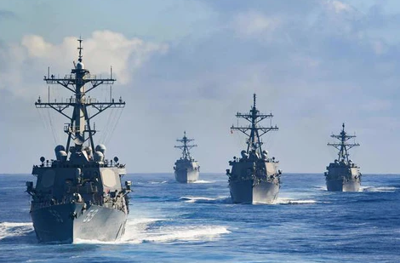
What is most ominous in the evolving scenario is that Trump appears determined to forcibly impose regime change on Venezuela. He obviously does not understand the lessons of Afghanistan, Iraq, Libya, and Syria in recent years and instead is hell-bent on showing his toughness by picking on a country that cannot put up a legitimate fight against US forces. His pretext is the claim of drug-running out of Venezuelan bases, although there has been no concrete proof yet provided to that effect. To buttress his bully move (which is an odd stance for a guy who campaigned on withdrawing the US from foreign conflicts), Trump has ordered the deployment of a carrier task force (a carrier with 5000 sailors, +/-100 aircraft, including 70 warplanes, 5 destroyers, a submarine and tenders) to the Southern Command area of operations (AOR) where an additional 8 warships are already stationed along with a US Marine Expeditionary Force. SOUTHCOM also uses Army, Marine, Navy and Coast Guard assets on specific occasions as deemed warranted, and is already conducting strategic and tactical bomber runs near Venezuelan airspace by B-52s and B-1s stationed on the US mainland.

One can get a sense of what US forces have deployed to the Caribbean to date here.

US Navy ships in Southern Caribbean. Source: Trinidad Express.

What all of this means is that the game is on. Moving this amount of assets to the Caribbean Basin, especially given the presence of land forces in the deployment, is no bluff. Trump seems to think that he can make an example out of Venezuela, contrary to historical precedent when it comes to the forced regime change going as planned or producing the desired results. One things is certain. It will be Venezuelans who suffer the most from any eventual escalation, and their scotch-swilling wealthy exile “leaders” will do nothing to shield them from a US assault.

In contrast to all of this Big Stick manoeuvring, Trump has offered Argentine president Javier Milei a USD$40 billion bridge loan as a form of bailout for Milei to make interest payments on outstanding public loans. No international lender like the IMF or World Bank would do so because of concerns about Milei’s reckless fiscal and macroeconomic policies (at one point he wanted to dollarize the Argentine peso and shipped off Argentina’s gold reserves to England on a private plane). Private investors took advantage of Milei’s public sector asset sale program to strip them of what value they held, repatriated the profits from the re-sale of those assets, then left the economy. What private investors remain are engaged in dodgy crypto schemes and destructive enterprises like critical mineral mining (lithium, in particular) where regulation is lax and where profits are largely sent abroad.

Milei himself is embroiled in an investigation into a memecoin “pump and dump”/”rug pull” scheme concocted along with Trump-allied US crypto billionaires, where he touted on social media a specific coin called $Libra that rapidly rose, then fell in value, making the 9 founding $Libra accounts around USD$82 million and leaving 72 thousand other investors with USD$251 million in losses in just over 3 hours. Milei later distanced himself from the scheme but it was discovered that he was one of the 9 founding accounts, which as per usual were managed by his sister and chief personal advisor, otherwise known as “Ms. 3 percent” for the price of the “commissions” she demands of entities doing business with the Argentine State (the most recent involving a pharmaceutical company). Milei’s sister, Karina, is also being investigated for links to–surprise!–narcotraffickers and assorted other dark forces in the Argentine landscape.

The Trump bridge loan bailout for Argentina was in fact a political rescue line thrown to Milei. His party (Libertad Avanza or Freedom Advances) did very poorly in provincial and first round congressional elections in September and at the time of the bailout it was assumed to be posted to suffer a similar fate, or at least not improve its minority Congressional representation in the national midterm elections this past weekend. That would jeopardize his reform agenda for the remainder of his presidential term, making him a lame duck and paving the way for a return of either a Peronist party faction leader or a newer centrist coalition-backed candidate. Either of these option would spell the end of the “chainsaw” approach to public sector restructuring as well as Milei’s pro-US (and pro-Israel and anti-climate change) position, something that Trump seeks to avoid.

As it turns out, Libertadad Avanza won 41.7 % of the congressional electorate vote, defeating the opposition coalition, which won 40.4% of the total number of party votes. This improves the government’s bloc position in Congress and strengthens Milei’s hand in imposing more reforms, but it also sets the stage for ongoing deadlocks and resort to rule-by-Executive decree on the part of the Argentine president. But for the moment, chalk this up as a win for Trump’s bailout carrot/election interference gambit because even if short term in nature, it may have influenced things in a US-favorable way when it comes to Argentine foreign policy. Since Trump threatened to rescind the bailout of Milei’s party did not win, it is quite possible that tis weighed significantly on the minds of voters (who still turned out in record low numbers–67.8%– in spite of voting being mandatory).

What is also interesting is not that the bailout was given for political rather than sound economic reasons. That happens. What is of note is that the bailout comes at a time when US tariffs on Chinese goods resulted in retaliatory tariffs on US agricultural products, especially soybean exports. Most of these are grown in Red Trump-voting states. When the retaliatory tariffs kicked in Argentina dropped its export taxes on soybeans, and along with Brazil rapidly took advantage to increase soybean exports to the PRC. In just a few months Argentine and Brazilian soybean exports have taken over the previous US share of the PRC soybean import market. So in effect Trump has bailed out a foreign government for ideological reasons even though it directly hurts a core voting block in the MAGA coalition. That makes neither economic or political sense.

In response to criticism of this deal, Trump puzzlingly announced that he would reduce tariffs on Argentine beef imports so that it could increase its US market share. At a minimum that means reducing US beef prices in the face of Argentine import competition., which is now the stated intention of the plan (beef price reductions across the board). Once again, US beef is mostly produced in Red states, so here too the economic and political logic at play appears to be contrary to the interests of key MAGA voters. It seems that for Trump ideological buttressing of an ally abroad is more important than the material fortunes of US farmers, and he does not fear electoral retribution as a result. That is another oddity, unless he has a plan for avoiding electoral backlash in the first place, which may be what the overall beef price reduction plan is all about..

In El Salvador, Trump has courted Nayib Bukele, the self-styled “world’s coolest dictator” who offered to house US deportees at his infamous CECOT prison in exchange for money, diplomatic favours and the betrayal of several FBI informants tied to the Salvadorean gang MS-13. Regarding the latter, Secretary of State promised the FBI that he would not divulge the informant’s names to Bukele but then did so, whereupon Bukele demanded they be returned to El Salvador rather than stay in US detention. Secretary Rubio obliged and it is now presumed that the informants are dead. Here the Big Stick was wielded on behalf of a foreign government in conjunction with domestic objectives rather than used against it for strategic gain.

Further afield, MAGA operatives have close links to former Brazilian president (and coup plotter) Jair Bolsonaro’s party and his revanchist sons while the Trump administration has imposed a 50 percent across-the-board tariff on Brazilian goods as well as travel sanctions against the judges that convicted Bolsonaro and sentenced him to six years in prison for sedition earlier this year. The Trump connection to Latin American opposition groups includes rightwing Chilean figures, adherents of the old Pinochet dictatorship and new tech moguls, as it is reported to be quietly influencing the policies of Paraguay (led by a conservative) and rightwing opposition factions in Peru. In effect, in these instances the Big Stick used by one foreign policy hand is complemented by a more subtle and covert velvet glove approach on the other.

In the end, Trump’s return to a US gilded age is very much true in the original Twain sense of the phrase, and its adoption of a crude form of Gunboat Diplomacy characterised by a Big Stick/Carrot approach is playing out in contradictory but obvious ways in what Trump considers, to Latin American revulsion, to be the US’s backyard where the Roosevelt Corollary to the Monroe Doctrine gives it the right to act with wanton disregard for International law and imperialist impunity with regard to the rights of individuals and States. Much like demolishing of the White House East Wing serves as an allegory for the destruction of the US constitutional system and social fabric, the return to the Big Stick and selective carrots is symbolic of an increasingly feckless approach to US foreign policy, regionally defined.

As the saying from former Mexican president Porfirio Diaz goes (amended here to include the entire region): “Poor Latin America. So so far from God and so close to the United States.”

Que Pachamama los proteja!

Declaration: I was the Regional Policy Analyst for the Interamerican Region and Caribbean Desk Officer in the Office of the US Secretary of Defense (OSD/ISA/IA), co-Team Leader of the Cuba Task Force and a consultant to the CIA, US Southern Command, US Air Force Special Operations and US Navy Special Operations Commands in the 1990s. In those roles I was engaged in exactly the sort of exercises that go into this type of war-planning/preparation and am well aware of the long history of US anti-drug campaigns in the region as well as the US military involvement in them (including the infamous Pablo Escobar/Cali Cartel years). My commentary is informed by those experiences and by the certain knowledge that the norms and restraints that governed the actions of my colleagues and I no long apply when it comes to the application of US military force.

Another Hollow Bluff.

I know from reviewing readership stats that KP readers are not as much interested in international relations as they are in NZ domestic and foreign policy and various social issues. There is some interest in what Donald Trump is doing to the world from his throne in the Oval Office, so I figured I would scratch that itch and write a brief about yet another moronic move that he has recently made.

After being trolled on Telegraph by former Russian president and current Russian National Security Council Deputy Chair Dimitry Medvedev, Trump posted on his Truth Social media account that he had ordered two nuclear submarines “closer to Russia” in “the (appropriate) regions.” He repeated this on the conservative Newsmax television channel a few hours later, claiming that what Medvedev said was a threat that needed a strong response. However, given the realities, I doubt that Medvedev or Putin are quaking in their boots. Let me break down why they are not.

To begin with, Trump is presumably talking about nuclear armed submarines like the Ohio-class “boomers” that carry sea launched ballistic missiles (SLBMs). The US has plenty of nuclear powered attack submarines (SSNs) like the Virginia class boats that are the basis of the AUKUS development project with Australia and Great Britain, but these do not carry SLBMs and would not provide any deterrent effect on Russia or another hostile nuclear-armed State. If the message is not meant as a strategic deterrent and SSN;s are being sent, then their strike value is limited and tactical.. Given that Trump’s complaints about Russia are about a strategic ceasefire in Ukraine, a tactical response is unlikely to move the Russians into compliance and will just escalate the situation beyond Ukrainian borders.

So Trump is likely referring to the Ohio class boats, which carry Trident II D5 SLBMs that have ranges of 4100-7600/11,500-14,000+ nautical miles/kilometers and travel at supersonic speeds ranging upwards from MACH 19 (20,000 feet per second or 18,000 mph/29,000 kph). The carry 8-14 multiple independently targeted re-entry vehicles (MIRVs) with warheads that have “throw-weights” of 100 to 435 kilotons (the latter deigned to hit “hardened” targets like missile silos, command bunkers and deep tunnel complexes. In comparison, the “Little Boy” bomb that destroyed Hiroshima was 15 kilotons). They tend to lurk in off shore deep waters, often in undersea canyons, waiting for the order to strike. Given their ranges and speeds, there is no need for SLBM platforms like the Ohio class boats to “get closer” to targets. In fact, to do so is folly.

Why? When the order comes, these submarines must rise from deep water (they are said to be able to dive as deep as 1,500 feet or more) to relatively shallow depths of 150-200 feet. That is because the underwater propulsion stage of the SLBM, which uses a sophisticated variant of steam-based propulsion, does not have the energy or pushing power to reach the surface from greater depths. Once the surface is reached, a solid gas propellant is ignited, accelerating the missile to supersonic speed before MIRV re-entry.

This is where Trump’s bluff is called. Ordering US SBMs “closer to Russia” negates the advantages of deep water concealment because it brings the submarines over shallower coastal shelves or seas (say, the Baltic or Black Seas). That makes it easier for Russian anti-submarine warfare (ASW) platforms (including attack submarines of their own) to hunt, locate and track them. In addition to sonar and radar as well as satellite imagery, modern hydrophone detection systems and seafloor thermal and acoustic mapping arrays are used to seek out and record the acoustic signatures of submarines (which can be as distinctive as finger prints), something that is easier in more shallow and warmer waters given sea layer temperature variations produced by water density, depth pressure, refraction, salinity, thermoclines, etc., including the waters of narrows, straits and other maritime chokepoints. Even deep water can conduct and bend sound over long distances, such as in the low frequency SOFAR channel that extends from 600-1200 meters down in low to middle latitudes to near the surface at higher latitudes (which is one way of listening to whale calls with hydrophones). All of which is to say that the frequency, wavelength, bend and amplitude of underwater sounds are related to water temperature and depth, so have become important markers for underwater scientists and engineers, including those in the submarine/ASW businesses.

Phrased another way that Trump might understand: cold and deep water good for submarines; warm and shallow, bad. Trump clearly has not gotten this brief. Or perhaps his version came from the same advisors who told him that a tariff is a non-transferable tax paid by foreign exporters to the US.

In that light ordering US SLBM submarines into shallower and possibly warmer waters near Russian coasts as a show of force and then giving the precise number of those being told to so is a breach of basic submarine operational security. It allows the opportunity the Russians the opportunity to refine their ASW skills and perhaps even get a better idea of how the two particular submarines in question look and sound like underwater. In other words, besides the childish nature of the tit-for-tat spat with Medvedev, Trump has been suckered into blurting out, yet again, potentially sensitive information about US naval capabilities and operations.

The US Navy has choices to make. It can do nothing and try to pretend that it followed his orders, hoping that his minions in the Navy and Pentagon are kept out of the submariner information loop. It could order the ships to drive around in circles and claim that it followed orders. It can object to the commander-in-chief’s order and try to convince him to rescind it at the risk of having careers ended (if he in fact issued one). Or they can salute and follow commands as they are instructed to do even if it puts crews and contingency plans at risk. None of this was necessary given current US submarine operational protocols and capabilities, so this was not a believable warning much less a credible threat. It was theatrical bluster without merit.

But then again Trump is a mixture of ignorance, impulse, thin-skinned ego, bully and pomposity, so his meaningless showman’s gesture will remind Medvedev, Putin and many otherwise US-allied leaders yet again that there is a petulant knucklehead sitting in the Oval Office as POTUS.

MAGA!

Sending in the Marines.

One of the basic foundations of democratic civil-military relations is that the active duty military is organised and trained to fight and defeat foreign enemies in combat–that is, by using organised lethal force until the enemy is defeated. Domestic security is a matter of national/federal, state and local law enforcement. Their training and organization is in ensuring via non-combat means civilian adherence to the rule of law. Although use of lethal force is one component of domestic law enforcement, it is constrained by legal and social frameworks in a way that military combat lethality is not (and even then the military is supposed to adhere to the Laws of War, both in terms of jus ad bellum (reasons for going to war) and jus in bello (conduct in war)). Domestic security is about keeping the peace and maintaining control of civilian populations; external security is about prevailing over armed adversaries of the State.

Domestic and external security represent the Janus faces of what Althusser and others labeled the repressive state apparatuses (RSAs). Both internal and externally-focused repressive apparatuses are wrapped around an inner core of ideology, usually framed as patriotism, nationalism and selfless sacrifice (for external agencies) and community service, protection and duty of care (for internal agencies). There are elements and agencies other than the military and uniformed constabulary services in the RSAs, including such things as paramilitary units and criminal courts, that involve several shades of grey when it comes to repressive focus. The US is an exemplar in this regard, what with its proliferation of security agencies and militarization of local police forces, but the principle of separation between domestic and external repression has long been considered sacrosanct in US civil-military relations. So much so that the 1878 Posse Comitatus Act (18 U.S.C. 1385) specifically prohibits the use of active duty troops for domestic security purposes unless authorized by Congress.

In the US reserve military units such as the National Guard are called upon during periods of serious security crisis as a backup to local law enforcement. This usually happens at the orders of the State government but can happen by order of the president in extenuating circumstances. In the majority of cases they do not carry combat weaponry, instead deploying non-lethal tools appropriate for their law enforcement support roles (say, tear gas for crowd control).

Both reserve and active duty military can and are used for natural disaster and humanitarian relief, but they do not carry live weapons when doing so. Their assistance is focused on provision of critical goods and services to affected communities, not enforcing security.

While Trump appears to be within his authority to order the California National Guard into Los Angeles for law enforcement purposes, “federalising” what should normally be the Governor’s decision, and may even have authority to order other state’s National Guard units to join the forces gathered in LA (there is debate on this), his ordering of a US Marine infantry brigade into LA is an egregious assault on the separation of internal and external security functions under democratic conditions and a major erosion of a core tenet of US civil-military relations. The Marines are trained and organised to seek out and destroy the enemy, not practice crowd control. Their entire orientation is towards prevailing in lethal combat, not convincing rowdy crowds engaging in protest and dissidence to go home.

Perhaps the deployment of Marines is an intimidation tactic and they will not be carrying combat weapons or live ammunition. But if they are, we are now facing the real prospect of US soldiers killing US citizens and residents on home soil.

Years ago I shared space with the Haiti Task Force in the Office of the Secretary of Defense. I heard them discussing sending in Marines to quell anti-American violence in Port-au-Prince (there is a history of US Marines in Haiti). I chimed in from the sidelines that I thought it was a bad idea to use combat troops to engage in what was supposed to be civilian peace enforcement operations. The US has military police and paramilitary units like the US Marshalls and Border Patrol (and now ICE!) who train in those sort of things. I was ignored by my colleagues and a brigade of Marines were ordered and deployed to enforce the peace. When confronted by a rock-throwing mob they opened fire, killing over 100 people. The streets did in fact go quiet.

I asked the head of the Haiti Task Force why they chose that option when there were others available. He simply said that the people to be confronted where foreigners on foreign soil, so it was permissible to use combat troops for crowd control under those circumstances. In fact, today US private military contractors have been engaged to do exactly the same thing in Haiti given the breakdown in law and order there. It seems like in Haiti history repeats, but in different garb.

More importantly, deployment of Marines to LA is not a case of lethally confronting foreigners on foreign soil. For all the talk of “illegal aliens” and “invasion,” the protesters are on US soil exercising their right to peacefully protest and dissent. Those who act violently certainly can be handled by local law enforcement without the resort to combat-oriented troops whose missions primarily involved killing people abroad.

This is more than authoritarian-minded over-reach by a fear-mongering president. It is what a democracy’s slide into dictatorship looks like.

Trump’s theatre of the absurd.

I know that it is undiplomatic to say so, but I sure wish that some foreign leader would interrupt one of Trump’s Oval Office public humiliation stunts to tell him to his face in front of the media that he is an adolescent bullying imbecile who seems to think that such stunts make him look strong. And then up and leave.

King Hussein of Jordan, President Zelensky of Ukraine and now President Ramaphosa of South Africa have been subject to the ambush/humiliation stunt, so all future foreign dignitaries are on notice that they too can become props in an act of staged political onanism inside Trump’s Oval Office (except Putin, who if he ever makes it to DC while Trump is POTUS will likely see Trump greeting him by bending over and grabbing his ankles).

Of course, foreign leaders could just refuse to do the staged photo op knowing that they will be ambushed and keep any one-on-one discussions private, or they could simply refuse to do any White House one-on-one visits while Trump is in residence. Whatever they do, someone has to start standing up to Trump in public. The bullying, the photoshopped handouts and edited videos, the endless false claims and lies, the fawning array of nodding sycophants surrounding the main characters in the staged farce–at what point do foreign leaders decide that prostrating themselves in this theatre of the absurd is a bridge too far? Do they really think that if they grin and bear it that they will get something from the Trump administration? Seriously?

It seems that people acquiesce to his boorishness because they want to curry his personal favour, believing that will translate into individual, diplomatic, economic, military or some other (national) benefit to them given the personalist authoritarian nature of Trump’s rule. Or they are just scared. They fail to understand that his “transactional” approach to foreign relations is mostly one-way, from them to him, and that he does not repay their favours or ass-kissing by responding in kind. To the contrary. We have now moved into emperor-has-no-clothes, clown show territory with he and his crowd (as seen in recent congressional testimony by his cabinet members), so the house of cards is starting to look increasingly flimsy. Clearly fake props like the MS 13 knuckle photoshop or the edited South African video and doctored handouts are signs of incompetence among his PR people. For a guy who is all about tough image, THAT is a major Achilles heel.

As an aside–it is pretty obvious that Trump’s interest in the plight of Afrikaner farmers in South Africa is due to the racist influence of Elon Musk and Peter Theil. Musk and others on Twitter/X post dozens of memes, mostly containing false and often crude narratives that include references to black intellect and culture, about the white “genocide” occurring in South Africa. This is not a coincidence and may be due in part to Musk and Theil’s South African heritage, their distaste for black majority rule (as Curtis Yarvin- influenced oligarchy-supporting “techbros”) and their intense dislike of South Africa’s role in trying to bring war crimes charges in the International Criminal Court (ICC) against the Israeli leadership for its actions in Gaza and the West Bank. That dovetails with Trump’s racist dog-whistling (if not outright beliefs) and slips into the “s**thole country” storyline that he used in his first term. In taking up the Afrikaner “refugee” trope Trump reveals himself to be a puppet of the South African billionaires as well as the ringleader of the MAGA clown show.

The good news is that even if foreign dignitaries suffer further indignities from Trump, the damage to the US reputation (and national pride!) will be such that foreign States will work to avoid dealing with Trump altogether while he is still in office. As I have written elsewhere, among all the other things that Trump is and is not, he and his minions are not serious people and should be treated as such. Avoiding Oval Office photo ops is just a start. Best leave that to Kid Rock and other useful MAGA fools and tools.

A culture of cruelty.

In February I wrote a post about “the politics of cruelty” in which I highlighted the mean-spirited commonalities of recently elected rightwing governments in the US, NZ, Italy and other democracies. In this post I shall expand on them with reference to some of the authoritarian features that I researched and wrote about when I was a young academic.

In the 1980s and early 1990s when I wrote about Argentine and South American authoritarianism, I borrowed the phrase “cultura del miedo” (culture of fear) from Juan Corradi, Guillermo O’Donnell, Norberto Lechner and others to characterise the social anomaly that exists in a country ruled by a state terror regime like the “Proceso de Reorganizacion Nacional” in Argentina from 1976 to 1983. In those circumstances individual psycho-pathologies are often rooted in the pervasive feelings of dread, vulnerability and hopelessness brought about by the regime’s use of death squads, disappearances and other violent authoritarian measures to enforce public compliance with their edicts. That pervasive sense of fear extends to collective life, something that was and is a deliberate objective of authoritarians because it produces a sense of survivalist alienation and social atomisation in the body politic, thereby disrupting basic horizontal bonds between and within groups in civil society (you can see one of my essays that uses this concept here: https://www.jstor.org/stable/2111080).

In recent years and especially since Trump’s re-election in the US, Javier Milei’s election in Argentina and the election of the right wing “chaos coalition” in NZ, I see an extension of this concept in what I will call the culture of cruelty. A culture of cruelty is one in which social groups and organisations, including governments, engage in particularly cruel behaviour in order to punish, humiliate and revel in the plight of others, particularly political opponents and scapegoated social out-groups. We only need to think of Trump’s deportation policies and the behaviour of his immigration Gestapo, ICE, to see the culture of cruelty at work. We can see it is the DOGE chainsaw approach to public sector employment and federal regulations. We can see it at MAGA rallies. It is personalised in the behaviour of Trump advisors like Stephen Miller, Karoline Leavitt and Tom Homan, who show utter contempt for the suffering their policies have caused and in fact appear to relish being able to rub in the fact that they can act with apparent impunity due to the weakness of the courts and congressional or partisan complicity. 

In fact, the “culture of impunity” is another characteristic of authoritarianism that I and others wrote about three decades go, and it goes hand-in-hand with the culture of fear because it is the feeling of impunity that leads dictatorships to use wanton repression as an instrument of subjugation of the popular will. In other words, the culture of regime impunity leads to the imposition of a culture of fear in society. That is what is at work, to various degrees, under Trump, Milei, the evil clown circus currently ruling NZ (especially in the ACT and NZ First parties) and in other former liberal democracies today.

This culture is mean-spirited and malicious. In many instances it is fuelled by hatred of “others,” be they immigrants, indigenous people, people of colour or different faiths, those who are sexually “deviant” from “traditional” norms (i.e. non-binary) and others who do not conform to a given set of social mores or expectations or are simply easy scapegoats given public attitudes. It is facilitated by the increased vulgarisation of social discourse and erosion of societal norms regarding behaviour and civic exchange, now megaphoned and accentuated by social media. It is cruelty for cruelty’s sake, and uses cruelty as a punishment, as an intimidation tactic and as a dark reminder of what is possible when one is targeted for any number of perceived transgressions

Cruelty can be physical, mental, emotional, social or any combination of them because its impact is not confined to just one dimension or aspect of human existence. It is “unusual” in that its objective is to cause disproportionate anxiety, anguish, stress and suffering to targeted people and groups beyond whatever duress might (or might not) be warranted under the circumstances. The term “scarred for life” is an accurate depiction of the broader long-term effects that cruelty can have on the human subject. And when it comes to public policy or social exchange among groups, that is exactly what perpetrators hope to achieve via its use: it psychologically traumatises people and groups in the moment as well as their individual and collective memories, something that renders asunder the social fabric into which they were previously woven.

As is the case with torture (which is inherently cruel), social and political cruelty works. Not so much as an instrument to induce cooperation from those otherwise disposed not to give it, but as a disincentive, revenge or retribution tool against them.

I could write more about the subject but this is not the place to do so. However, I hope that the notion is clear. We are now in an era where the culture and politics of cruelty have become integral features of democratic politics in at least some Western societies (I will leave aside for the moment the fear that exists in countries ruled by authoritarian regimes like those in Russia, China or Nicaragua). And if the cultures of impunity that have led to the imposition of these growing cultures of cruelty and fear in Western societies continues unchecked, then another social pathology will follow–the reaping or harvesting of fear (“cosecha del miedo,” in O’Donnell’s words) in the form of a legacy of damaged people and institutions resultant from the practice.

Should that happen, then democracy as a social construct and a method of governance will never be the same.

The limits of over-reach.

Here is a scenario, but first a broad brush-painted historical parallel.

Hitler and the Nazis could well have accomplished everything that they wanted to do within German borders, including exterminating Jews, so long as they confined their ambitious to Germany itself. After all, the world pretty much sat and watched as the Nazi pogroms unfolded in the late 1930s. But Hitler never intended to confine himself to Germany and decided to attack his neighbours simultaneously, on multiple fronts East, West, North and South. This came against the advice of his generals, who believed that his imperialistic war-mongering should happen sequentially and that Germany should not fight the USSR until it had conquered Europe first, replenished with pillaged resources, and then reorganised its forces for the move East. They also advised that Germany should also avoid tangling with the US, which had pro-Nazi sympathisers in high places (like Charles Lindbergh) and was leaning towards neutrality in spite of FDR’s support for the UK.

Hitler ignored the advice and attacked in every direction, got bogged down in the Soviet winter, drew in the US in by attacking US shipping ferrying supplies to the UK, and wound up stretching his forces in North Africa, the entire Eastern front into Ukraine and the North Mediterranean states, the Scandinavian Peninsula and the UK itself. In other words, he bit off too much in one chew and wound up paying the price for his over-reach.

Hitler did what he did because he could, thanks in part to the 1933 Enabling Law that superseded all other German laws and allowed him carte blanche to pursue his delusions. That proved to be his undoing because his ambition was not matched by his strategic acumen and resources when confronted by an armed alliance of adversaries.

A version of this may be what is unfolding in the US. Using the cover of broad Executive Powers, Musk, Trump and their minions are throwing everything at the kitchen wall in order to see what sticks. They are breaking domestic and international norms and conventions pursuant to the neo-reactionary “disruptor” and “chaos” theories propelling the US techno-authoritarian Right. They want to dismantle the US federal State, including the systems of checks and balances embodied in the three branches of government, subordinating all policy to the dictates of an uber-powerful Executive Branch. In this view the Legislature and Judiciary serve as rubber stamp legitimating devices for Executive rule. Many of those in the Musk-lead DOGE teams are subscribers to this ideology.

At the same time the new oligarchs want to re-make the International order as well as interfere in the domestic politics of other liberal democracies. Musk openly campaigns for the German far-Right AfD in this year’s elections, he and Trump both celebrate neo-fascists like Viktor Urban in Hungry and Javier Milei in Argentina, Trump utters delusional desires to “make” Canada the 51st State, forcibly regain control of the Panama Canal, annex Greenland, turn Gaza into a breach resort complex and eliminate international institutions like the World Trade Organization and even NATO if it does not do what he says. He imposes sanctions on the International Criminal Court, slaps sanctions on South Africa for land take-overs and because it took a case of genocide against Israel in the ICC, doubles down on his support for Netanyahu’s ethnic cleansing campaign against Palestinians and is poised to sell-out Ukraine by using the threat of an aid cut-off to force the Ukrainians to cede sovereignty to Russia over all of their territory east of the Donbas River (and Crimea). He even unilaterally renames the Gulf of Mexico as the Gulf of America in a teenaged display of symbolic posturing that ignores the fact that renaming the Gulf has no standing in international law and “America” is a term that refers to the North, Central and South land masses of the Western Hemisphere–i.e., it is not exclusive to or propriety of the United States.

Trump wants to dismantle the globalised system of trade by using tariffs as a weapon as well as leverage, “punishing” nations for non-trade as well as trade issues because of their perceived dependence on the US market. This is evident in the tariffs (briefly) imposed on Canada, Mexico and Colombia over issues of immigration and re-patriation of US deportees.

In other words, Trump 2.0 is about redoing the world order in his preferred image, doing everything more or less at once. It as if Trump, Musk and their Project 2025 foot soldiers believe in a reinterpreted version of “shock and awe:” the audacity and speed of the multipronged attack on everything will cause opponents to be paralyzed by the move and therefore will be unable to resist it. That includes extending cultural wars by taking over the Kennedy Center for the Arts (a global institution) because he does not like the type of “culture” (read: African American) that is presented there and he wants to replace the Center’s repertoire with more “appropriate” (read: Anglo-Saxon) offerings. The assault on the liberal institutional order (at home and abroad), in other words, is holistic and universal in nature.

Trump’s advisors are even talking about ignoring court orders barring some of their actions, setting up a constitutional crisis scenario that they believe they will win in the current Supreme Court.

I am sure that Musk/Trump can get away with a fair few of these disruptions, but am not certain that they can get away with all of them. They may have more success on the domestic rather than the international front given the power dynamics in each arena. In any event they do not seem to have thought much about the ripple effect responses to their moves, specifically the blowback that might ensue.

This is where the Nazi analogy applies. It could be that Musk and Trump have also bitten more than they can chew. They may have Project 2025 as their road map, but even maps do not always get the weather right, or accurately predict the mood of locals encountered along the way to wherever one proposes to go. That could well be–and it is my hope that it is–the cause of their undoing. Overreach, egos, hubris and the unexpected detours around and obstacles presented by foreign and domestic actors just might upset their best laid plans.

That brings up another possibility. Trump’s remarks in recent weeks are descending into senescence and caducity. His dotage is on daily public display. Only his medications have changed. He is more subdued than during the campaign but no less mad. He leaves the ranting and raving to Musk, who only truly listens to the fairies in his ear.

But it is possible that there are ghost whisperers in Trump’s ear as well (Stephen Miller, perhaps), who deliberately plant preposterous ideas in his feeble head and egg him on to pursue them. In the measure that he does so and begins to approach the red-line of obvious derangement, then perhaps the stage is being set from within by Musk and other oligarchs for a 25th Amendment move to unseat him in favour of JD Vance, a far more dangerous member of the techbro puppet masters’ cabal. Remember that most of Trump’s cabinet are billionaires and millionaires and only Cabinet can invoke the 25th Amendment.

Vance has incentive to support this play because Trump (foolishly, IMO) has publicly stated that he does not see Vance as his successor and may even run for a third term. That is not want the techbro overlords wanted to hear, so they may have to move against Trump sooner rather than later if they want to impose their oligarchical vision on the US and world. An impeachment would be futile given Congress’s make-up and Trump’s two-time wins over his Congressional opponents. A third try is a non-starter and would take too long anyway. Short of death (that has been suggested) the 25th Amendment is the only way to remove him.

It at that point that I hope that things will start to unravel for them. It is hard to say what the MAGA-dominated Congress will do if laws are flouted on a wholesale basis and constituents begin to complain about the negative impact of DOGE cost-cutting on federal programs. But one thing is certain, chaos begets chaos (because chaos is not synonymous with techbro libertarians’ dreams of anarchy) and disruption for disruption’s sake may not result in an improved socio-economic and political order. Those are some of the “unknown unknowns” that the neo-con Donald Rumsfeld used to talk about.

In other words, vamos a ver–we shall see.

Media Link: “A View from Afar” on the US elections.

The latest “A View from Afar” with Selwyn Manning and I follows the lines drawn in my most recent post here at KP. Because the podcast is basically a dialogue between Selwyn and I on the subject of the day, it goes in some directions not covered in the KP post. For those interested, the show can be found here.

Sifting through the wreckage.

Although I shared some thoughts about the US election on other social media platforms, here are some items that emerged from the wreckage:

Campaigns based on hope do not always defeat campaigns based on fear.

Having dozens of retired high ranking military and diplomatic officials warn against the danger Trump poses to democracy (including people who worked for him) did not matter to many voters. Likewise, having former politicians and hundreds of academics, intellectuals, legal scholars, community leaders and social activists repudiate Trump’s policies of division mattered not an iota to the voting majority.

Nor did Harris’s endorsement by dozens of high profile celebrities make a difference to the MAGA mob. In fact, it enraged them. What did make a difference was one billionaire using the social media platform that he owns to spread anti-Harris disinformation and pro-Trump memes.

Raising +US$ billion in political donations did not produce victory for Harris. Outspending the opponent is not a key to electoral success.

Decisively winning the presidential debate–with 65 million live viewers–proved inconsequential for Harris. Conversely, getting trounced in the debate, where he uttered the comment that “they are eating the digs, they are eating the cats, they are eating the pets of people who live there,” proved no liability for Trump. The debate was just theatre and viewers retained the partisan preconceptions before and after its airing. In other words, debates are overrated as indicators of political mood shifts or campaign success.

Trump’s incoherent, racist and xenophobic rants did not give the MAGA mob any pause when considering their choices. In fact, it appears that the resort to crude depictions of opponents (“stupid KaMAla”) and scapegoats (like Puerto Ricans) strengthened the bond between Trump and his supporters.

Macroeconomic and social indicators such as higher employment and lower crime and undocumented immigrant numbers could not overcome the MAGA narrative that the US was “the garbage can of the world.” Positive macroeconomic data was drowned out by the MAGA drumbeat decrying high inflation and rising retail costs even if those costs are the product of global supply chain disruptions and corporate price-gouging. Nor could Harris, despite her accomplished resume in all three government branches at the local, state and federal levels, overcome the narrative that she was “dumb” and a DEI hire who was promoted for reasons other than merit. It did not help that she refused to stake a clearly different position from Biden on some key policy issues, something that ultimately cost her votes (Harris received 15 million less votes than Biden did in 2020, while Trump remained close to his 2020 vote total in a race marked by significant numbers of eligible non-voters).

Culture war narratives worked for Trump. Attacks on “woke” ideology and relentless negative advertising about the dangers of transgender people struck a nerve not only in red states, but nation-wide (remember that Trump won the popular vote and all seven of the so-called swing or battleground states). The same was true for Congressional races, where the GOP won the Senate and looks to be on the verge of retaining the House. The result is a MAGA mandate, which extends into the Supreme Court as a result of its ruling that sitting presidents are immune from prosecution for “official” acts and which will likely see more Trump appointees replacing some of the current justices over the next four years.

It did not matter to the MAGA mob that Trump threatened retribution against his opponents, real and imagined, using the Federal State as his instrument of revenge. In fact, they want him to do so and, in contrast, support Trump’s promised to pardon all January 6 rioters. It also did not matter that Trump’s second term agenda is more radical, punitive and comprehensive than his first term (Project 2025 and Agenda 47 are extensive in scope and will leave an indelible mark on the federal government). Calling Trump a fascist only whetted the MAGA appetite for his authoritarian approach to politics.

Having 34 felony fraud convictions, including paying hush money to a porn actress out of campaign funds and then covering the payments up using dubious accounting methods did not hurt Trump at all and in fact was seen as an example of Democrats using the legal system against him (“lawfare”). His losses in defamation suits, including an adjudication that he is a sexual predator, meant absolutely zero to more than 70 million voters. For many in the voting majority, voting for the felon was a badge of honour. There were t-shirts made and sold at Trump rallies that read out variations of “I am with the felon.”

Age was not a factor even though Trump displays evident signs of cognitive decline. In contrast, gender and race were negative factors for Harris. It appears that the US has a major problem with selecting female presidents and the re-emergence of overt racism courtesy of Trump’s foray into politics produced a backlash against her mixed-race heritage.

Reproductive rights were not the watershed issue many thought that they would be, including for many female voters. The economy and immigration were the top priorities of female voters. Conversely, MAGA efforts to court “bro” support via social media catering to younger men “Alphas” worked very well, as this usually apathetic voting bloc turned out in record numbers. In a way, this is a double setback for women: as an issue of bodily autonomy and as an issue of gender equality given the attitudes of Trump endorsers like Tucker Carlson, Joe Rogan, Andrew Tate, Charlie Kirk, Ben Shapiro etc. Their misogyny has now been reaffirmed as part of a winning political strategy. Individually and collectively, women will bear the consequences of this intergenerational move backwards.

Undocumented immigrants in the US will now become targets for Trump’s mass deportation campaign. This could well force many underground since entire families, including US-born children of undocumented migrants, are targeted for deportation. The logistics involved in doing so may prove impossible to undertake, but it will not be for lack of trying (Stephen Miller will head the effort). This will have a decided negative effect on the low wage economy that underpins the US productive apparatus. Ordering the military to participate in the round-ups and detention of undocumented people and their US-born relatives could well spark a constitutional crisis (because that might violate the Posse Comitatus Act of 1878).

Ukraine and Western Europe have much to fear. Perhaps Taiwan as well. Palestinians will be forsaken by Trump. With the exception of Iran, authoritarians around the world will be pleased. So will the Netanyahu government in Israel. Liberal democracies new and old will need to adopt hedging strategies depending on what Trump demands of them. Some, like the current NZ government, may simply behave like obsequious supplicants bowing before the Orange Master.

Fear will extend to the federal bureaucracy and regulatory system, which will now be subject to Project 2025/Agenda 47, Trump loyalty tests, Elon Musk’s razor gang approach to public spending and RFK Jr.s public health edicts. In fact, it looks like the Trump second term approach to governance will take a page out of Argentine president Javier Milei’s “chainsaw” reforms, with results that will be similar but far broader in scope. Cost-cutting in and further privatisation of public services will have a profoundly dislocating effect on the social and economic fortunes of millions of people tied in one way or another to federal public services and good provision.

All in all, from where I sit it looks like a bit of a calamity in the making. But then again, I am just another political scientist that got the results all wrong–and there are many of us who did so. So much for the value of an advanced degree from a prestigious university and three+ decades of reading, writing and teaching about politics. I just as well could be a wino in the street when it comes to my US election prognostication skills.

I think that I will sit out on the deck and stare at the sea for a while because that is my saving grace: At least I am living in NZ and not in the US.

Not all authoritarians are fascists.

A few days ago I responded to a post about Trump being a fascist on one of my friend’s social media page, then made a few comments on the consultancy social media page by way of follow up. Given the subsequent back and forth (including with regular KP reader Diane under her other social media moniker) I figured I might as well share my thoughts here. I realise that it may seem pedantic (it is) and inconsequential (it is not), but the misuse of value added terms is a trigger for me. So, with my political science/comparative politics hat on, let me offer some thoughts on the matter.

First, by way of prelude and backdrop to why I have decided to opine about this particular subject, let me explain something about analytic precision, specifically the notion of conceptual integrity. Conceptual transfer is an analytic tool where a concept is taken out of its original context in order to explain a different phenomenon that replicates the original meaning intact. The integrity of the original meaning is upheld in spite of the transfer. Say, a wheel back when is a wheel today even if its specific features are different. Conversely, conceptual stretching is a situation when a concept is stretched beyond its original meaning in order to describe a different, usually related but not the same, phenomenon. It loses explanatory and analytic integrity as it is stretched to explain something different. For example, when a hawk is called an eagle or an orca is called a killer whale. As an analytic tool the former is methodologically sound and intellectually honest. The latter is not. Conceptual integrity and precision is particularly important when using loaded or charged words, especially in contentious areas like politics.

There are plenty of authoritarians but only few were fascists or neo-fascists. There are Sultanistic regimes like those of the Arab oligarchies. There are theocracies like Iran (which used elections as a legitimating device). There one party regimes like the Belarus, PRC, DPRK, Syria and Cuba, one party dominant/limited contestation regimes like Algeria,Egypt, several of the K-stans, Hungary, Russia, Singapore, Tunisia, Turkey, Nicaragua and Venezuela and Egypt, military-bureaucratic regimes like those of the Sahel, and a variety of personalist and oligarchical leaders and regimes elsewhere. The way in which leadership is contested/selected and exercised, the balance between repression and ideological appeals in regime governing approaches, the mixture of inducements (carrots) and constraints (sticks) when it comes to specific key policy areas (say, in labor, tax, sexual preference and reproductive rights laws). There are many manifestations of the authoritarian phenomenon, so mislabeling some types as others compounds the practical and conceptual problems associated with the conceptual imprecision and confusion.

That is why it is unfortunate that Trump is being labeled a “fascist.” He clearly is a dictator wanna-be but fascism was a political movement specific to 20th century interwar Europe that combined charismatic leaders at the head of a mass mobilisational one party regimes with specific economic projects (state capitalist heavy industrialisation in the case of Nazi Germany) and state-controlled forms of interest group representation (state corporatism, to be specific). Fascist gain power via elections, then end them. Trump may lead the MAGA movement but he has no ideological project other than protectionist economics, diplomatic and military isolationism and nativist prejudice against assorted “others.” He prefers to manipulate rather than eliminate elections as a legitimating device. Barring an outright military takeover at this command, he will not be able to control the three branches of government even if he wants and tries to. He cannot control how interest groups are organised and represented unless he changes US laws governing interest representation and intermediation. Most fundamentally, he is just about himself, using tried and true scapegoating and fear-mongering in an opportunistic push to gain power. It worked once in 2016, so he is at it again, this time with a “better” (Project 2025) plan. That is scary but not fascist per se.

The closest he gets to a proper political category is national populist. As seen in the likes of Juan Peron in Argentina, Getulio Vargas in Brazil and Lazaro Cardenas in Mexico, these were charismatic leaders of mass mobilised movements as well, but who had different economic projects, different social bases (e.g. German Nazism and Franco’s fascist regime in Spain were middle class-based whereas Italian fascism and Argentine Peronism was urban working class-based and Mexican populism under Cardenas was peasantry-based), and who did not use warmongering to restore their nations to a position of global dominance (as did the European fascists). Trump’s base is low education working and lower middle class rubes encouraged by opportunistic business elites who self-interestedly see short-term benefit from supporting him. In other words, his supporters are the greedy leading the stupid.

It appears that respected people like Generals Milley and Kelly, who served in the Trump administration, are mistaken when they ever to him as a fascist. What they are describing is no more than garden party electoral authoritarians such as that of Viktor Urban or Recep Erdogan. Trump may admire despots like Putin, Kim and Xi, but he is a long way from being able to copy them, and none of them is a fascist in any event. Dictatorial ambition and authoritarian approaches come in many guises beyond the often misused term fascism. In fact, superstructural affinities like rhetorical style, corruption and bullying tendencies aside, Trump is less a fascist than he is a lesser moon in the authoritarian universe.

If I had to label him, I would say that Trump is a populist demagogue who has strong authoritarian ambitions such as purging the federal government of non-loyalists and persecuting his political opponents. Perhaps he will graduate into becoming a full-blown dictator. But what he is not is a fascist, at least not in the proper sense of the word. He is too ignorant to implement a modern variant of fascism in a place like the US, and there are too many institutional and social counters in the US to any move he may make in that direction. What I will admit is that he has neo-Nazis in his inner circle (Stephen Miller) and evil Machiavellians as his consiglieri (Steve Bannon, soon to be released from jail for contempt of Congress). Along with assorted lesser ogres equipped with the Project 2025 playbook, it is possible that they could turn the US political system into something resembling a modern variant of a national populist regime. But there is a ways to go before that happens.

I therefore feel that it is unfortunate and counterproductive to call him a fascist. It is like how he and his minions call Kamala Harris a “communist” or “socialist.” The labels are absurd and betray a profound ignorance of what those terms mean (and the differences between them), but they make for good red meat rallying points for a MAGA base that lacks the education or common sense to see the smear for what it is or the reality that communists and socialists do not get to hold the positions of California Attorney General, US Senator and Vice President (the closest they have come in recent times is Vermont Senator Bernie Sanders, and he is no communist).

If the good generals and Vice President Harris decided to take a page out of his fear-mongering smear playbook by calling him a fascist, that may be understandable given the danger he poses for US democracy. But it is also dishonest (given Milley and Kelly’s educations, I find hard to believe that they do not know what fascism is and is not, but then again, many general grade officers major in military history, international relations and/or security studies rather than comparative political science and so may not be familiar with the proper definitions of the term. As for Harris, she is trained as a lawyer. Enough said).

Anyway, the point of this undoubtably boring exegesis is to get a pet peeve off of my chest, which is the resort to conceptual stretching in order to negatively frame narratives about political phenomena.