MMP in NZ is safe

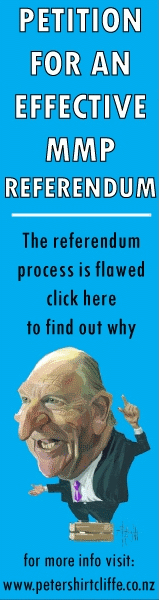
shirtcliffe ad
Evidence:

  • It has been found to work pretty well and all parliamentary parties except ACT support it.
  • The UK election is about to remind people how perverse FPP is.
  • Peter Shirtcliffe is spamming people in order to gain support for his anti-MMP campaign.
  • His google ad campaign looks like this ====>

Seriously. That’s him. A ranting white middle-aged elderly patrician of the sort New Zealand’s governments were almost exclusively composed before the change in electoral system — and on a soap-box, for goodness’ sake. A starker warning of what’s in store should the electoral system change is hard to envisage. Also: it’s visually busy and garish. The blue is neither National-party royal blue, nor ACT-party aqua-blue, nor flag-Navy; it’s nothing. The message is over-long and confused (campaign for an effective referendum? Don’t you mean to campaign against the electoral system? No? Ok then.) And the cartoon …

Thanks, Peter, you’re doing your country a great service.

(Thanks to Lyndon Hood in the comments to Russell’s thread linked above for the pic.)

[This line inserted to fill whitespace].

L

Thoughts about Key’s Afghan PR Exercise.

I have seen and read the reports of John Key’s much anticipated “secret” trip to Afghanistan.  I must say that it is one of the more amateurish, cringe worthy attempts at symbolic politics I have seen in a long time–not quite as bad as George W. Bush’s “Mission Accomplished” carrier charade, but of the same ilk. Let me explain why.

First, the good part. I think it was entirely sensible for the National spin-meisters and military brass to tie the Afghan detour to the Gallipoli celebration trip. The unfortunate RNZAF chopper accident on ANZAC day forced a change of plans so that the PM could attend  the funerals of the ill-fated crew, but that only added to his  message of military support and remembrance. As for the greedy economic opportunists who have criticised him for abandoning the arse kissing trade mission to the Arab Gulf Coast, they need to realise that given the circumstances in which the tragedy occurred, Mr. Key had no political option but to return for the funerals. How would it have looked if he choose to continue to brown nose the Arabs while some of the nation’s service people were laid to rest?  The likes of one Mr. Langely may put personal self-interest before recognition of service, but most Kiwis understand that not only was it politically necessary for Mr. Key to return, it was the right thing to do.

But that is about as good as it gets. Contrary to the fawning editorial opinion of the NZ Herald, Key’s tiki tour of Afghanistan showed how out of his league he is on international security affairs.

He started out by mentioning that he was flown by helicopter from his arrival point (presumably Bagram Air Force Base, the site of a notorious US “black” detention centre) to the SAS location. In doing so he managed to convey the message that the most heavily defended areas of Kabul are still too dangerous for Western VIPs to drive through, and that the SAS is not located in Kabul as he claims but is actually based elsewhere. He then pointed out that he used heavily armed motorcades to travel in Bayiman and elsewhere because he and his entourage were “juicy fish” for insurgent targeters.

Well, not quite. In a country that is awash in visits by heavy-hitters from a number of countries, Mr. Key is more like  an anchovy.  Moreover, heavily weighted  Western motorcades involving a half dozen armoured SUVs and armed escort vehicles are not immune to roadside bombs (and I bet he traveled in the third or fourth vehicle). In fact, given that they have to travel on main arteries and disrupt local traffic and pedestrian flows as they do so, convoys such as Mr. Key’s actually make for better targets for opportunistic guerrillas deeply embedded in a resentful local population (especially where well-prepared guerillas can deploy efffective IEDs on five minutes notice). If leaving a light footprint is what hearts and minds are partially about, then his mode of land transport was a tactical failure.

Mr. Key prattled on about how he wanted to experience the conditions in which the NZDF operate in that theater. But he choose to spend his evenings at the British embassy. That is a double insult: first to the UN and ISAF patrons of the NZDF mission, which have their own housing compounds or use heavily guarded hotels for visiting VIPs; and secondly to the NZDF itself. Mr. Key could have stayed in officer quarters in any number of bases including at the PRT in Bayiman or the SAS operations centre (which is likely to be on the Afghan military base where its anti-terrorism Crisis Response Unit is headquartered). But instead he choose to take the poncy route and accept accommodation from the colonial master. How quaint of him, and how much it tells us about his sincerity in wanting to understand the conditions that NZ troops face.

Mr. Key managed to offend the Bayiman locals by trying to shake hands with a girl, a cultural taboo in that region. So much for MFAT and NZDF giving him a head’s up about local customs, to say nothing of his lack on intuition about the context in which he was operating. For him, ignorance on that occasion turned out not to be bliss. For the NZDF PRT team, this could have been ther moment where 6+ years of good civil-military relations became unstuck. The question begs: would Helen Clark have been so, uh, uninformed? >>Note to Red Alert and The Standard–while I appreciate your views you must not use this post to score political points because to my mind you are little better when it comes to partisan  issues such as this>>

In defending their role, Mr. Key  said that the SAS had not fired their weapons. This is laughable to the point of tears. The very nature of their “training” mission, as well as the fact that they have participated in at least two well publicised firefights (even if we accept the argument that they did so in “support” roles, which is ludicrous), requires that the SAS  employ their weapons, even if merely as covering or suppressing fire for their Afghan comrades.

And yet, the supplicant NZ press uncritically lapped up his patent lie while he hid under the doctrine of  plausible deniability (that is, because Mr. Key may have believed the lie to be true because his advisers or the NZDF command told him to take their word at face value and he had no reason to doubt them because he simply does not know better). Here, Mr. Key’s ignorance truly is a measure of political insulation, if not bliss.

Mr. Key told this same press that he was “considering” extending the deployments of the Bayiman PRT and SAS past their respective termination dates in September 2010 and March 2011 respectively. This was a forgone conclusion given that the NZDF wanted to do so and given the government’s obsession with tying a bilateral US-NZ free trade agreement to its military commitment in Afghanistan as well as the recent military-to-military reapprochment between the two countries. Heck, the foreign press was told before the trip that the extension had already been authorised but Mr. Key played cagey with the NZ press. Could that be because he wants to appear to be considerate of opposition voices in parliament when in fact he is not?

Mr. Key did his usual name-dropping act. He met with Karzai and General McCrystal. He met with local leaders. Although he waxed lyrical about what they had to say, he made no mention of what he had to say to them. Did he tell Karzai that his corruption and the drug-running antics of his cronies would not be tolerated? Did he press Karzai on not back-sliding on human rights, especially for wimin and ethnic minorities? Did he query McCrystal on continued civilian casualties at the hands of ISAF forces, and did he make clear to the General what the NZDF understanding of the rules of engagement are?  Nothing of the sort has been mentioned, so for all the NZ public knows he could have been exchanging cricket scores and family photographs with the Big Boys.

And then there was the piece d’resistance: John Key fitted out in a journalist flak jacket and helmet, his blood type outlined like a bulls-eye on his chest, grinning like a kid in a GI Joe costume. Then there were the photos of him acting friendly with the pilots on the RNZAF C-130 and acting pensive on the US Blackhawk ‘copter that did the bulk of his tour transfers. Dang. I have no doubt that he needed the body armour when he was not sipping tea with the Poms, but did his minders really think that a photo op in that outfit would come across as warrior-like and decisive? If so, they are clueless because he just looked goofy, somewhat akin to the infamous photo of Democratic candidate Michael Dukakis sitting in a tank turret wearing a helmet in the 1988 US presidential campaign. In both cases the image spells out L-O-O-O-O-O-S-E-R.  As for the aircraft photos: staged and contrived from the get-go. He looked like he was on one of those Air NZ tourist charters to the Antartic summer solstice. Another photo op FAIL.

Mind you, the NZDF brass as well as the troops on the ground would have appreciated the gesture, albeit for different reasons. So there was symbolic worth in the venture. It was in its execution where the enterprise failed.

Because they are clueless National PR flacks will congratulate themselves on a job well done in getting their message about the PM out to the masses, and the supplicant invited press will play the role of willful lapdogs by writing positive stories based on National PR releases (in part, because they share the government’s contempt for the intelligence of the general population, and in part because they would like to be invited along on other future junkets of this sort). But the cruel truth is that the exercise showed yet again how far out his depth the PM is when confronting the intricacies of even the most rudimentary aspects of foreign affairs. For those with a better sense of judgement, the exercise was embarrassing, not encouraging. Or as Pauly Fuemana would have said, “how bizzare.”

Fire in the House

The opposition was strong in Parliament today. I’m stuck for time, so what follows is somewhat stream-of-consciousness.

Front and centre was the government’s failure to perform on unemployment and wage growth, the subject of criticism from both flanks. Bill English had led off with “the budget will be about the many, not the few”, and then “but seriously …”, to a stinging rebuke from David Cunliffe, who listed the government’s failings as he saw them. This adoption by the government of Labour’s own tagline looks like an attempt to muddy the counter-campaign and poach their emphasis, trying to set up National as the party representing “the many”, rather than the policy merits of the government’s program, but if so it’s a fairly ham-fisted one. While “the many” looks on its way to becoming this election cycle’s “hard-working Kiwis”, the government’s attempt here to muscle in indicates that National has accepted Labour’s rhetorical framing, although they disagree with it. If you adopt your opponent’s narrative, you need to be able to make it your own — either that, or you need to dismantle and discredit it. English did neither.

Cunliffe was strong, also raising the variance between English’s aspirational and controversial “Plain English” ad and the policy track he has delivered. Sir Roger Douglas also took aim, and was forced by the Speaker to rephrase the question (to Paula Bennett): “Which is more important? Young people getting jobs, or pandering to the Left?”.

Bennett also took a bit of a pasting on the matter of the identity of one Peter Saunders. The Standard has picked this up so I’ll not elaborate more. Wayne Mapp, standing in for the Minister of Agriculture also stumbled on a line of questioning from Sue Kedgley regarding AgResearch’s GM cattle trials. Not exactly a shock since, not being the minister himself, that information wasn’t top of his mind, but it contributed to the general atmosphere.

Then it was all on in General Debate, with Goff, King and Cunliffe leading off on the same topic matter (jobs/wages) with a couple of fiery speeches, and re-emphasising the “smile and wave/photo-op/government by poll” meme and the retrenchment of the government’s mining plans. Judith Collins concentrated on David Cunliffe’s lack of orthodox economic credibility, and purported concern for Goff having to shoulder the dual burden of leading a party in which Cunliffe was both the finance spokesperson and a leadership contender. Nice concern troll, but what’s more interesting is how much she was looking forward to seeing Cunliffe’s expenses records — and the threats hurled across the House while she thought she was not miked — “You wait, just you wait! …” Some irony in this given that it was just yesterday Collins raised the most threadbare defence of her (or someone else’s) extensive use of the ministerial self-drive car: “All the travel is within the rules – that’s all I’m prepared to say on it.”

So, while superficially an ordinary sort of Wednesday (albeit one where the Member’s Day was not clobbered by urgency), I think this has provided a few glimpses of the 18 months to come: a robust focus on core materialist issues from the Labour party, ahead of the budget, and a clear desire to debate the policy merits; combined with continued attacks on the credibility and perceived competence of English and Bennett in particular; the government attempting to subvert the opposition’s framing rather than exclusively arguing the merits; Collins v Cunliffe shaping up as a key battle. Nothing flash, but it’s starting to look like something resembling a threat. Most importantly, something to require the government to rethink its own gameplan. Until now they’ve had the ability to act almost with impunity, their errors going unpunished. If today’s performance is any indication, no longer.

L

Public airwaves talkback


Normally Radio NZ National’s The Panel is a pretty sound — if somewhat fluffy — current affairs show, in which the panelists are ideologically fairly diverse (though not occupationally diverse; mostly celebrities, PR flacks, or newspaper columnists). They tend to leave aside their more extravagant views to engage in a fairly civil and reasoned manner.

But when The Panel happens to have two people of similar ideological views or a common background, it tends to turn into an echo-chamber of congratulatory backslapping. Today it’s nothing more than talkback for self-righteous wealthy middle-aged people who — since they’re listening to National Radio — think talkback is beneath them, but like to have a good whinge about how society’s going to the dogs anyway. The guests are private investigator Julia Hartley Moore and former cop and current Police Ten-7 presenter Graham Bell, and the topics for discussion (and general timbre) are as follows (From memory, so I may omit some, but you get the idea):

  • TV harmful for very young children: “We never had TV in my day, we went outside! Parents are using TV as a babysitter! Never did that in my day! TV is rotting childrens’ brains! There’s no excuse for ever doing anything other than what’s perfect, we always did!”
  • Cellphones used to arrange and record fights: “I told you cellphones were bad, never come to any good, those things. We never had cellphones in my day, and even if we had them we’d never have gotten into fights. And even when we got into fights, it was all posturing, really, and nobody ever actually got hurt. It’s the parents’ fault, letting their kids watch TV.”
  • Kent State massacre 40th anniversary: “Yeah, that was pretty bad.”
  • People throwing litter from cars: “I can’t believe people do that, and people with flash cars as well! Never would have happened in my day.”
  • Young people should be allowed to drink because they can vote and fight for their country: “I don’t think they should be allowed to do any of those things! In my day we got a bit pissed, and some of us still do, but that was different. These new alco-pops are ruining society! I blame the parents, what are they doing about this? Disgraceful.”
  • No service at service stations: “PC OSH nanny state gone mad! Old ladies having to check their own oil and water? Total bollocks! Teenaged attendants who only take your money, was never like that in my day. And don’t get me started on pre-pay pumps…”
  • Hypochondria: “I blame the internet, and the expectation that the medical profession can just provide a magical pill which will fix everything!”
  • Roman Polanski reckons he’s done his time for drugging and raping a 13 year-old girl: “No way, he’s been living the good life. Throw the book at him — hang him high!”

Well, I sort of agree with the last one. But this is the sort of reactionary love-fest we expect from the rest of the opinion media, not from Radio NZ. It’s not the conservatism I can’t stand; it’s the absence of reflection and the naïve belief that the world really is that simple.

Update: To demonstrate the extent to which I’m not exaggerating, you can listen here.

L

Its all Greek to me.

There is a political rhythm to the Greek economic crisis. We spent a long weekend on Santorini dodging strikes–Tuesday was the transport workers, Wednesday was the wharfies, Saturday was the May Day demonstrations. Next Wednesday there is a general strike. Our timing has so far been impeccable. We took a ferry last Thursday, so missed the wharfie action that paralyzed Pireus and left a bunch of cruise ship passengers stranded. We returned on Sunday evening so missed the May Day demonstrations that disrupted the Metro rail. We fly to Samos this upcoming Thursday, so will miss the general strike as well. Fingers crossed that nothing happens next Monday, when we fly back. Given recent strike patterns, Monday is due for one so our luck may run out (not that getting stuck on Samos is a bad thing). But we are getting the hang of the flow of things and look forward to seeing how the general strike goes. Although the foreign press has focused on some violence, the reality is that it is only small groups of anarchists who are clashing with the police, and most of them are teenage students. The unions and other civil associations are led by grey haired folk who may have been prone to street action two or three decades ago, but who now are just trying to protect their collective livelihoods (although two banks were attacked by petrol bombs last night, the usual anarchist and Marxist-Leninist suspects are being blamed).

What is interesting about the unfolding of the Greek economic crisis is how ignorant most foreign observers are about its root causes. Most focus on inefficiency and waste in the public sector and the supposedly indolent Greek way of life, which even if true has its causes in something other than the Greek psyche (as some allege). Let me explain.

In the 1950s a strain of developmentalist thought emerged called modernisation theory that claimed that the problem of Latin America and the Mediterranean Rim was a lack of Anglo-Saxon Protestant values resultant from the mix of rigidly hierarchical religious cultures (Catholic, Muslim or Orthodox) and warm climates. The general drift of this “theory” was encapsulated in the so-called Iberian or Mediterranean Ethos: a culture of indulgence, indolence, patronage, clientalism and fatalism structurally rooted in a benign climate that allowed for easy shelter and food production. If only the Greeks, Italians, Spaniards and Portuguese (which actually is not on the Med) had to live in cold climates where survival depended on industry and resourcefulness–then they would have developed the “proper” entrepreneurial values that would have allowed them to develop along the “proper” lines of the Anglo-Saxon world. In other words, backwardness is a function of culture and climate.

Leaving aside the fact that there are plenty of temperate climate locations where entrepreneurial spirits have flourished, and plenty of cold climates where it has not, or the fact that lumping together whole regions in a culturalist explanation is ignorant at best and racist at worst, or that the notion of one universally ‘proper” form of development is both, this discredited canard ignored the structures of economic and political power (many overtly shaped by foreign intervention) that emerged in these regions and which were not reducible to either climate, religion, or civic culture.

By the 1970s modernisation theory was shown to be profoundly flawed. On a scale of over-determinism (when not cultural supremecism), it is up there along with the “warm water port” theory of imperialism. Yet, in recent years, and specifically with relation to the Greek crisis, it has been resurrected in revamped fashion as an explanation for developmental failure. Inspired by neo-liberal thought, the neo-modernisation thesis is that countries with “too much” state involvement in the economy are prone to political nepotism, rent-seeking, corruption and inefficiency. That makes for a lazy, supplicant, and favour-seeking society. The key to development lies in reducing the role of the public sector so that private enterpise can flourish. The private sector is seen as THE panacea for developmental retardation, and elites in places like Germany believe that the Greeks need to accept this.

While there may be some truth to the need for private sector leadership,  the root causes of the current Greek crisis are, again, not as simple as the overbearing role of the state, nor is the solution simply a matter of reducing it.

As I mentioned in the previous post, Greece has an underdeveloped private sector. But–and this is a very big but– the weakness of  the Greek private sector preceded rather than followed the advent of the modern Greek state, and the private sector never attempted to become the motor force for the entire society. If one considers the nature of internecine conflict in Greece dating back two  milenia (for the historically disinclined, please think about Athens and Sparta, or better yet, the Peloponnesian Wars), one realises how parochial local, sectoral and island interests can be.  That worldview continues today. Greek private industry, such as it is, has little concern about contributing to the public good. 

In light of Greek capitalist myopia and parochialism, the recipe for social peace has rested on the public sector being used as a means of absorbing excess labour (along with emigration). The labour market and welfare systems are two-tiered: there are few protections for workers in the private sector outside of employer generosity or union strength, while the public sector adheres to ILO standards. Tax-evasion is a national sport, but the problem is not with individuals but with politically-connected corporations and agricultural interests as well as religious organisations who do not pay anywhere close to their due share of the tax burden but who do put serious money into the main political parties and individual politicians in order to protect their profits (since the money spent on politics is infinitesimal when compared to the valuated tax assessment of their worth). In order to conceal the results of this long-standing practice, successive governments, be they centre-right or centre-left, cook the Treasury books and leave it for their successors to sort out, in what has become an elaborate wink and nod shell game played between themselves and their foreign creditors.

Greeks are by and large a nation of small property owners. Owning a home is, like in NZ, their core objective. The private sector is dominated by small and micro-enterprises run by owner-operators (often familial in nature) who eek out small margins catering to immediate needs (think dairies, dry cleaners. locksmiths and the like). The state does not direct investment capital towards these people, not does it particularly focus investment in large corporations either. What large-scale investment exists comes from foreign-connected sectors such as shipping, and much of the profit generated by the handful of such firms goes off-shore.

To this can be added a large black market fueled by unchecked migration across Greece’s incredibly porous borders. One in ten inhabitants in Greece are foreign born and the majority are undocumented.  This cash economy circulates outside the confines of the state (remember my anecdote about the gypsy street fair in the last post), yet is vital to filling the demand for basic necessities as well as for labour in the agricultural and service (including tourism) industries. Relatively little of the economic activity generated by these non-citizens provides revenue for the state, and with little immigration enforcement available (and largely impossible to regularise in the near term), that situation will only get worse as the official economy shrinks under the austerity regime now being imposed.

Thus the historical source of income stability (at least since the end of the colonel’s dictatorship in 1973) are public service jobs. But without an efficient tax system owing to the political cronyism of the major economic players, public budgets require external financing, which has led to more than two decades of deficit spending happily financed by foreign financial speculators trading in risk derivatives. The idea behind this play, which I accept, is that while firms may go bankrupt nations do not. Compounded interest ensures the investor’s profitability even if the principle is lost in a default (as Argentina showed in 2001-02). So the bottom line is that the system now under siege worked for everyone–the Greek elite enjoyed its privileges, the Greek population remained relatively content and peaceful even if economically underdeveloped by modernisation theory standards, and foreign financiers made money off Greek debt.

The trouble is that with the creation of the Eurozone currency system controlled by one central bank, countries such as Greece were placed in a financial straitjacket that eliminated the autonomy and cushion provided by independent national currencies.  It cannot devalue or overvalue its currency based on market conditions (as for example, Singapore does regularly), and thus is locked into a monetary (supply and demand) framework over which it has not control. Hence, should it default on its debt to its European backers, one major option would be to defect from the Eurozone and re-establish its national currency. There will be pain involved but it would allow Greece to reorganise its finances in more independent, if austere terms. It has enough investment to ensure that even with defection it will not sink (consider that tourism constitutes 20 percent of the Greek economy and its limited niche export markets could actually be favoured by such a move). That in turn might encourage others, particularly the other members of the so-called “Club Med,” to follow suit, which could well spell the end of the Eurozone (especially when considering that a Tory victory in the UK will mean an end  of talk of its ever joining and that Turkish incorporation into the EU could set the stage for an even bigger Greek-type scenario). Thus the Greek bail-out is not so much about Greece as it is about protecting the Eurozone as a currency market.

Which means that the strikes are going to continue, at an increased pace and on a potentially broader scale. In the face of elite indifference to their plight, it is the only means of defense for most Greeks. They have just been told that the public sector will take a 25 percent wage cut on top of a ten percent cut six months ago, then have wages frozen for three years. Imagine if that happened in NZ. Do you think that even the placid Kiwi public worker would take that lying down when s/he had no part in the deficit debacle? The retirement age will also rise while pension benefits will be cut. Although most people appear to accept the former, the latter is a major source of aggravation because as I mentioned before, there is little to no private sector pension plans. Prices of public utilities are set to rise and there is talk of privatising the bulk of the health system (which already is a two-tier system in which private health providers are used by the wealthy). All of which is to say that the burden of sacrifice will be shouldered by those who had nothing to do with creating the crisis in the first place. In fact, although improvements in tax enforcement are mentioned, that remains to be seen, and nowhere has it been mentioned that politicians will take a wage cut or corporations will be required to offer non-wage employment benefits in order to off-set cutbacks in public benefit programs while encouraging labour migration to the private sector. 

Which makes me think that the recently announced IMF/ECB Greek rescue package is more cosmetic than substantive and could well provoke a public backlash that could provoke renewed military interest in internal security. That, indeed, would be a disaster.

Note: As always, my observations on Greece are indebted to the insight of my partner as much as my own. I will take blame for any errors.

PS: I have been thinking of writing a post about our brushes with petty crime and come curious Greek mores, but do not want to turn this into a travelogue.  I shall try to integrate any such thoughts into a larger discussion of more serious subjects.

Organic protest, and reframing the mineral debate

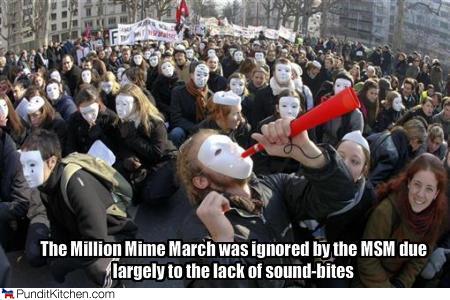
political-pictures-mimes-million-march

Like many others, I was amazed at the turnout for the anti-mining protest in Auckland on Saturday. That 50,000 people would turn out for such an event is remarkable in itself — the NZRU’s financial problems would be solved if they could attract so many people to half a dozen rugby matches each year, and we’re currently rebuilding Eden Park so they can seat that many a dozen or so times next year, and then maybe once or twice a year thereafter.

But the more remarkable thing about this march was its apparently organic nature. From my read — based only on the media coverage, mind — this was not a visually and ideologically cohesive, “branded” demonstration such as “enough is enough” and the more recent child discipline march, which were more or less Boobs On Bikes without the boobs or the bikes, advocating the wholesale adoption of a political product. It was not a heavily stage-managed piece of public theatre as the Foreshore and Seabed hÄ«koi was, and it was not a set-piece undertaken with a specific tactical purpose such as the most memorable marches of the Springbok Tour were. There were t-shirts and banners and so on, but these were not issued like uniforms with marching orders and approved wording for slogans, imagery and talking points. These were not rented crowds, seas of mime-like bodies serving as a vehicle for someone else’s words and sentiments. This was a genuine all-comers march, and if its almost unprecedented turnout did not bring genuine authority, then its authenticity surely must.

The response from the usual authoritarians has been a heady blend of confusion, disbelief and denial — the same sorts of delusions I normally accuse Labour partisans of falling prey to, when the observable data fails to conform to ideological modelling. This is bad for them, and good for those who oppose the government’s mining plans: if the government persists in believing the models instead of the data, it will go the way of the last government which did so.

But I don’t think this government will do that. I think it will see the writing on the wall, and reframe the mineral debate. Key and Brownlee have surely now seen their error: addressing mining in Schedule 4 as a national economic development issue rather than as a set of regional development issues. Going for it all in one bite was greedy, and as Danyl says, reflects the sort of complacency which creeps in when your opposition isn’t up to the task of opposing. But as strong and authentic as the Auckland march was, it has a weakness, and that’s that it’s composed of Aucklanders. Mining schedule 4 as a national strategy has failed, and likely at the cost of the opportunity to mine in the Coromandel and on Great Barrier Island, but it has thrown into sharp relief those areas where local views are less opposed — such as Paparoa, and possibly Mt Aspiring. As I commented on The Standard earlier, West Coasters are overwhelmingly in support of extended mining, a solid turnout in Nelson notwithstanding. Portraying Nelsonites as latte-sipping greeny liberal lifestylers begrudging their honest hard-working brethren on the other side of the hill a chance at the riches of the land will turn this into a classic town/country divide of the sort National and its mining allies are very skilled at exploiting. So watch for a few hundred — or maybe a thousand — Coasters marching in Westport to support the mining proposal being equated to this weekend’s demonstration in Auckland, and watch for well-meaning Aucklanders, Wellingtonians, Nelsonites and those from elsewhere being told in fairly certain terms to butt out of their regional business.

The government will be taking a risk if it proceeds with this plan, even in a regional form, because it has already permitted the debate to be established as a national issue about national parks in which everyone from the Cape to the Bluff has a stake — but it has amassed plenty of political capital, and now is the time in the electoral cycle to use it. Particularly with the Australian federal government unveiling a new resource tax, New Zealand just got more attractive for mining interests, and the imperative to dig, baby, dig will be stronger than ever.

L

Cannabis bust news coverage bingo

Here’s a fun game. Watch tonight’s TV news (either channel) and count the following tropes.

Update: I did this — both channels, since they were conveniently on at separate times, and was pleasantly surprised by reasonably sober tone of coverage. Comments in italics.

  • Gratuitous display of cannabis leaf or other marijuana iconography
    Four times on One and thrice on 3. Mostly in the display of the “Switched On Gardener” signage.
  • Gratuitous display of drug porn (huge quantities of plants, or egregiously sticky buds, etc.)
    5 times each. TV3 used this as their studio backdrop, otherwise it was the same stock footage throughout, obviously supplied by the police. A distinct lack of additional file footage and High Times-style images of the sort which are usually stock-in-trade for this sort of coverage.
  • Police casually destroying huge quantities of same
    None! Only some police confiscating computers, other equipment in the TV3 footage.
  • Tenuous linkages of marijuana with other drugs, violence or terrorism
    None! Some passing mentions and image of other drugs, firearms and references to organised crime, but nothing tenuous or unjustified.
  • File footage of a shadowy person smoking a joint — None!
  • If it’s clear despite anonymisation that the person is brown-skinned
    None of these either.
  • Footage of people being arrested or detained
    No images of people being arrested. One shot of an unidentified (white) person walking down the street as the voiceover informed us that those arrested were appearing in court.
  • Footage of supposedly ill-gotten gains: flash cars, etc.
    Twice each, references to property being seized under proceeds of crime legislation. Nothing major.
  • Smug, serious middle-aged white people expressing deep concern.
    The only examples of this in both cases were press conference shots of the senior police officer.
  • Triumphal statements that this has broken the back of the cannabis industry, with no supporting evidence
    Again, just what the police told us. Reporters stuck generally to the facts.
  • Reporter looking smug and saying words to the effect of “we can’t reveal which garden centre at the moment …” with the clear implication that it’ll all become clear pretty soon, and anyone who’s anyone already knows
    Well, although National Radio didn’t report (and the police refused to say on-air) which gardening shop chain it was, it was no secret, so none of this.
  • Breathless revelations that people who aren’t beneficiaries or gang members are involved in cannabis production and consumption
    Mentioned twice on One and once (but more extensively) on 3 — the fact that “managers and directors” of the company were among those arrested. But in general, not a big deal made of this fact.
  • Implication that schoolchildren might have been in danger
    Not mentioned or implied at all.
  • No mention of the fact that alcohol causes orders of magnitude more harm by almost every indicator
    Not mentioned or implied either, but on both channels, the booze story took precedence, occupied considerably more screen time, and was covered in much more depth.

So, all in all, nothing much to separate the coverage on One and 3 news. Both items were characterised by a heavy (almost total) reliance on official source material and footage — although both did a field cross, TVNZ’s was the usual pointless live cross, while TV3’s reporter didn’t even make the screen, with the field shots showing police hauling stuff out of a building. Both used similar (probably supplied) footage and images as background, and emphasised the length of the investigation, the number of people involved, and the impact the bust would have on the cannabis industry. Neither report was journalist-centric, with both reporters essentially relaying facts with a minimum of editorialisation. Both reports showed a distinct lack of sensationalised narrative, imagery or suggestion, lacking the usual devices employed to propagandise and pad out this sort of topic matter.

So: well done One and 3 News :)

L

As advertised

Late last year, when the ACC ructions were underway, the professionals working in the sector warned that people would die as a consequence of the reforms mandated by the new Clinical Pathway on the assessment and treatment of sexual abuse victims.

Since then, and on the basis of the pathway, ACC has taken to declining claims despite publicly claiming consistently throughout the past six months and as recently as today that there was no cost-cutting imperative. This has resulted in a drop of more than 90% in the number of claims approved year-on-year. Explain that, if you can. Nick Smith couldn’t, though he tried to do so during Question Time. It has also caused a chilling effect in which people are simply not applying, since they’d have to undergo the trauma of the exhaustive documentation and excessive review required by the pathway only to have their claims declined.

It’s impossible to separate these reforms from the overarching government plan to privatise — partially or wholly — ACC, and when viewed in this light it becomes clear what’s going on: this is how insurers make their profits. And, just lilke it said on the box, people are dying. It’s a good thing there’s going to be a review, but what’s better is that the sector is organising their own review in parallel. Should make for an interesting compare-and-contrast. I am aware that certain senior National party MPs are aghast at the conduct of ACC, so there may begin to emerge some pressure from within the party for change, as well as from outside. We’ll see.

L

Current events

I was reluctant to post while I had the chance on ANZAC day, since there was such a good debate going on, and now I’ve (temporarily) run out of time again. So just a few quick observations.

  • Phil Goff’s one-two punch on the top tax rate and Auckland governance is solid, and both are good orthodox Labour positions for him to take. But it’s more of the same: lacking verve and failing to get cut-through as a consequence. I mean to post on the positioning of the taxation pledge at some stage, but in case I don’t get to: this is a good opportunity for Goff to demonstrate compromise as well as differentiate himself, by coupling a reimplementation of the top rate with an increase of the threshold.
  • Even without Sunday’s tragic helicopter crash, Goff’s timing was poor in making these two announcements before ANZAC Day. I guess you take the opportunities you can get, but delaying things by a week would have been more useful in my view.
  • As an aside, my mum knew the three late airmen vaguely through Search and Rescue, and confirms the universal sentiment that they were of the very best sort. I’m pleasantly surprised that the crash hasn’t turned into a witchhunt about why we’re still using Vietnam-era hardware; as true as the sentiment might be, we can all do without people thundering “if we’re going to have a military, we owe it to our troops to have it decently-outfitted” under circumstances such as these. Such is the power of ANZAC day, I suppose.
  • On a related point, the discipline with which the military, government, police and media have adopted the Air Force’s framing terminology in this event is remarkable. All four groups are talking about “the Air Force family” and exploiting the metaphor for all it’s worth. Those words are used almost every time one of these people stands in front of a microphone, and in addition the three deceased are “brothers”; Mark Sainsbury reported live last night from the family’s “lounge”, the squad room at Ohakea air base; all four have referred to the Iroquois as being like “your grandfather’s axe” — the reference being that, although it’s very old, when the handle is worn it gets replaced, and when the head is worn it gets replaced, so while it’s his axe in spirit, it actually contains no parts of the original tool and is as good as new in function. On the one hand, this is compelling symbolic stuff: nobody who deviates from this framing can really be said to be showing the proper sort of respect and deference; on the other hand, it’s a bit creepy for everyone to be falling into lockstep behind Defence HQ communications. There are ways of saying these things without using the exact same words, and the constant repetition spooks me. Maybe I’m just sensitive. [Edit: There was a clean sweep for “Air Force family” or something similar in speeches supporting the Prime Minister’s parliamentary motion of condolence. No shock there, I suppose.]
  • On a somewhat lighter note, Councillor Tony Jack has picked the wrong district council to put a motion banning macrons in council materials. This is the Kāpiti Coast District Council, who moved to put the macrons into Paekākāriki and ÅŒtaki only a month ago. Jack’s motion was voted down, at which point he predictably declared that PC had gone mad. Bless. Of course, the Stuff article doesn’t contain the macrons, so I guess he wins as far as that goes.
  • Tim Watkin at Pundit continues to write excellent sense and ask smart questions about race relations in Aotearoa New Zealand. I think the emphasis in Tim’s piece is just right — there is a legitimate claim to indigeneity for non-Māori, but it’s not so obvious as Trevor Mallard’s “I was born in Wainuiomata”, and there’s a lot to work out before such definitions can be settled upoin comfortably. I’m all for having this discussion. I particularly like the ornithological allegory drawn by commenter “william blake” — we are all PÅ«keko!
  • Also on a lighter note, a (very) atheist friend whose six year-old daughter has chosen to go to Bible study classes recently asked him if, because Jesus had risen from the dead, that meant he was a zombie. It apparently took every ounce of his parental commitment to letting his girl make up her own mind to explain the origins of zombie stories, how myths come about, etc. rather than just saying, yes, Jesus is a zombie. Good on him — not sure I would have had the fortitude.
  • Speaking of things biblical, and of belonging, Joanna Newsom has a new album out, and here’s the first single — about tilling one’s own bit of the Garden of Eden:

Ok, so not so brief after all. Discuss. I’ll dive back in as I can. You can treat this as an open thread as well: post what you want to talk about.

L