Recognising the enemy

Last night the New Zealand parliament voted 77-44 on the third reading of the Marriage (Definition of Marriage) Amendment Bill, passing it into law. The strategy I wrote about after the first reading has been spectacularly successful, and marriage equality will be a reality as soon as the bill receives the royal assent.

There were many powerful speeches last night. Louisa Wall discussed the spectrum of cultural traditions around sexual and gender diversity, and called a huge roll of supporters from almost every corner of the political compass.

Maurice Williamson lampooned the supposed “gay onslaught”, celebrated the “big gay rainbow” that had appeared in his electorate this morning as a sign, and hilariously used his training in physics to calculate the amount of time a person of his mass and humidity would burn for in the fires of Hell. “I will last for just on 2.1 seconds — it’s hardly eternity, what do you think?”

Tau Henare gave his old party leader Winston Peters a lesson in political history, why referenda aren’t the answer to everything, and why exactly he is no longer a member of the New Zealand First party.

Mojo Mathers spoke of the pride she felt when her daughter attended the school formal with her girlfriend. And following the vote, in scenes that have been viewed all around the world, the House stood and broke into song.

There were others. But for me the heaviest work of the night was done by Kevin Hague, who got to the very heart of enmity to this bill, and to this cause in general. I’ve quoted him at length, emphasis mine:

“I remember travelling to Auckland’s North Shore to protest against one of our opponents, Pastor Richard Flynn, who called publicly for homosexuals like me to be put to death. Over the years I have campaigned hard for the right of our communities to not be outsiders any more, to assume a full place in New Zealand society. With every new reform, the same group uses the same strategy, raising fears of terrible consequences which always fail to materialise.
[…]
“Mr Speaker, that’s why this bill is about so much more than achieving equality under the law, a basic human right that has been denied us until this day. It’s about saying ‘these lives matter: our society is big enough for us all.’ With this bill, our parliament stretches out its arms to my communities and says ‘our society is big enough for you, too — you belong, unequivocally, and without compromising who you are.’

“When the debate started, I thought all of the people like Richard Flynn had thankfully gone. The early comments from opponents were refreshingly free from fire and brimstone. There is no doubt that New Zealand has grown up over the past 27 years, as we have become a more modern, vibrant, and pluralistic society. But as the debate has worn on we have seen the re-emergence of a hard core whose opposition to this bill has lost its veneer of reasonableness. Their problem with this bill is that they believe that we gay and lesbian people are morally inferior. They don’t want to include us as as full participants in New Zealand society. They recognise — correctly — what full legal equality, what this signal means. And they don’t like it.

Kevin Hague’s measured words and calm delivery obscure a stark and clear-sighted analysis: This is war. The enemy does not regard us as human, and they never will, so we must defeat them utterly. When it comes to GLBTI people, adherents to this creed of brimstone will be satisfied with nothing less than extermination and erasure: they are an existential threat. Although it is often couched in such terms, beneath the veneer theirs is not a rational objection founded in philosophy or pragmatism, in science or honest assessment of tradition; it is simply fear and hatred that burns like the fires they preach. This is not confined to the religious sphere — variants of the brimstone creed exist within secular society, and across a broad ideological spectrum, but they share extremism in common. Much of the discourse around marriage equality, and much of the discourse around related matters, rests on ignoring, minimising or mocking those who stand up for the brimstone creed, but the brilliance of Kevin’s analysis is that he meets them — and it — kanohi ki te kanohi, staring it in the face and recognising it for what it is.

But marriage equality won because it isn’t just an issue for GLBTI people. Ghettoising it as a “gay issue”, (as feminism for generations has been ghettoised as a “women’s issue” and racial equality has been ghettoised as a “black” or a “brown issue”) was a delaying strategy that worked for a time. But no longer. Marriage equality passed because a bill introduced by a gay Māori woman was supported not only by gay Māori women, but by men and women, young and old, homosexuals and heterosexuals and bisexuals, liberals and conservatives, socialists and libertarians, atheists and agnostics and Christians and Muslims, Māori, Pākehā, Pasifika, Chinese and Indians.

All of us who believe in a just society, and an equal society, who believe in a place where ancient prejudices, cultural inertia or the maintenance of privilege cannot justify erasure must fight these battles too. The brimstone creed isn’t just an existential threat to “teh gays” — it is an existential threat to a free and decent society, and we will not have won until we defeat them utterly. There are many more battles like this, and with the clear vision and fierce determination of people like Louisa Wall and Kevin Hague, I am strangely optimistic about fighting them.

L
Journalistic license.

Over the years I have been repeatedly misidentified by NZ media types and others in the public domain as to what I am or have been. I have been called a Middle East expert, White House aide, CIA agent, Zionist agent, 9/11 conspirator, Nazi war criminal, anti-Muslim racist, security expert and assorted other niceties. The trouble with these characterizations is that they are all wrong. Worse yet, some of them have invited unwanted and unpleasant personal attention.

Imagine then my dismay to see Andrea Vance of Fairfax identify me as a “former US spy” in an article about the GCSB report. How did she get that label? I certainly made no such claim so it is difficult to understand why she felt that she could publish such a characterization, especially since it carries in some minds a very negative connotation. Shame on her.

The reality is that I simply am a former defense policy analyst and consultant to US security agencies who alternated government service with academia. My background is in international relations and comparative politics with emphasis on unconventional warfare, intelligence analysis, Latin American politics, regime dynamics and labor relations. Lots of field and documentary research, but no spying involved.

Bonus question: readers are invited to suggest who might be on the list of 88 people spied on by the GCSB. I imagine that the Urewera 18 were and that some in the NZ Muslim community may continue to be. The Zaoui defense team might be a good bet. Environmental, animal and anti-FTA activists could be targets. John Minto and Valerie Morse believe that they have been (Val, of course, was part of the Urewera crowd). Any other suggestions?


Spot the difference

Prime Minister John Key has released a statement expressing condolences at the death of Baroness Margaret Thatcher:

The Government is today paying its respects to the family, friends and colleagues of former British Prime Minister Margaret Thatcher who passed away overnight.

“Baroness Thatcher was a passionate and formidable politician who loved her country. She was a strong and decisive leader with unwavering principles. She was Britain’s first and only female Prime Minister.

“We join with political leaders around the world in remembering Margaret Thatcher’s service to the people of Britain and her significant impact on the global political environment,” said Mr Key.

Labour leader David Shearer has also issued a statement:

Labour leader David Shearer has paid tribute to former British Prime Minister Lady Margaret Thatcher, who has passed away aged 87.
“This is an enormously sad time for her family. My thoughts are with them, and the people of Britain, at this time.”
Mr Shearer says he admired Lady Thatcher as fiercely determined leader, who stood up for what she believed in.
“Lady Thatcher will be remembered as a strong and determined leader.”
During her time as Prime Minister, from 1979 until 1990, she faced some real challenges – from the conflict in the Falklands to tremendous economic changes,” says Mr Shearer.
“She has left a strong and permanent legacy in Britain. Lady Thatcher believed passionately in what she was doing, and she will be missed by many.”
Mr Shearer says he had met Lady Thatcher once in Britain, prior to his entering politics.
“I met Lady Thatcher only briefly, and I remember being somewhat in awe of her, as such a well-recognised, well-known world leader.

(Both statements slightly edited.)

L

Pick a side

Commenter Chris (not THAT Chris), says:

For all I know, [Dame Susan Devoy] may be a complete dud, or a wonderful race relations mediator. But whatever she is, you are being totally unrealistic passing judgement on her because she refused to appear on TV within a day of starting her (part-time) job.

Well, no. A part-time job that pays $270k per year? Someone appointed to a role like this should not need on-the-job training to be able to answer basic questions about it. Nobody is asking for detailed policy analysis or in-depth engagement with specific issues — only for broad discussion in principle, so we can get a sense of where she stands, and how her qualifications on race relations differ from those of some random person down the pub.

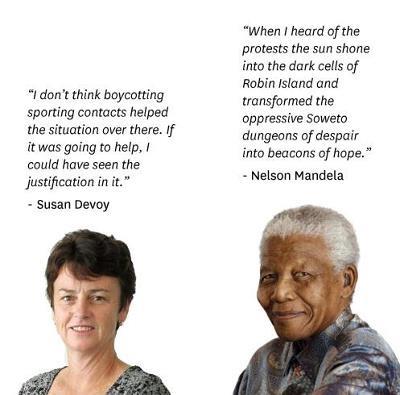
On previous performance I’d have thought there wasn’t that much to distinguish her from someone down the pub on these issues. But recently Toby Manhire dug up this wee gem from her autobiography, in which she reveals that the only thing preventing her from playing the “sunshine circuit” in apartheid South Africa was the threat of sponsorship being cancelled and that “media coverage could damage my reputation in this country.”

She also doesn’t think sports boycotts helped the situation there. Here are two people who do:

Dame Susan’s words were probably written in 1992, and it is possible she holds a different view now. I hope someone will ask her. But by 1992 the end of apartheid was already nigh, several years of negotiations to end it having already been undertaken between the government of FW de Klerk and Nelson Mandela (who had been out of prison since 1990). South Africa fielded a “non-racial” team at the 1992 Olympic Games in Barcelona — the first Olympics it had been permitted to compete in since 1960. The notion that sport had not been an important factor in its end is simply not credible, and was not credible in 1992 either.

So I know whose side I’m on. Still, it beats the Prime Minister’s claim that he didn’t know what side he was on. At least Dame Susan is open about her ignorance of the issue.

L

Media Link: More GCSB weirdness.

I was interviewed on Radio NZ about the controversy surrounding the appointment of Ian Fletcher as GCSB director. I had to leave out a number of important points like the need for objectivity and political neutrality in intelligence operations, or how the PM could have had a surrogate reach out to Fletcher rather than get personally involved in his selection. Otherwise, the gist is here.

Selections matter

Justice Minister Judith Collins has appointed Dame Susan Devoy as Race Relations Commissioner.

She replaces Joris de Bres, who has served two five-year terms and is very well-regarded in Māoridom (at least) because (in part) he understands the importance of his own Dutch whakapapa, and the complexity of his place as an immigrant in Aotearoa. As Bryce Edwards and Morgan Godfery have noted, he has also shown an unusual willingness to comment on issues related to his mandate of opposing racism.

No doubt this fact has informed Collins’ decision to appoint someone less feisty. Dame Susan has little or no high-level experience in the field, and I suppose the thinking is that she brings a clean slate to the role or, to put it another way, her thinking and the degree of her engegement with the issues will be more easily influenced by the prevailing governmental culture. But Dame Susan is not a blank slate. A week ahead of Paul Holmes’ now-infamous Waitangi Day a complete waste column, she wrote one of her own that, although it employed language more befitting a Dame, nevertheless expressed similar sentiments. One year ago our new Race Relations Commissioner wished that instead of Waitangi Day we could have “a day that we don’t feel ashamed to be a New Zealander” and pined after a holiday like that celebrated in Australia, where — a few recent and grudging obeisances aside — 50,000 years of history and the brutal facts of the settlement of that land are blithely ignored in a jingoistic celebration of Ocker Pride.

That would be bad enough, but it gets worse: Dame Susan doesn’t have a clue what she’s doing:

Jacob McSweeney: “She admits she doesn’t have a wealth of experience in race relations, but she says the job isn’t overly complicated.”
Susan Devoy: “I don’t think it’ll make it any more difficult than dealing with any other issues, I mean, you know, this is all under the Chief Human Rights Commission [sic], and so therefore whether it’s disability or gender or employment or race, you know, the issues are not dissimilar. This is just about making it right for every New Zealander.”

(From Checkpoint.)

This is a terrible appointment. Anyone who thinks Aotearoa’s race-relations culture isn’t complicated is by definition not equipped for the job of guiding and guarding it. Not only is our new Race Relations Commissioner ashamed of our national day, but as far as she’s concerned it’s just another ism — revealing how little she must know about disability, employment or gender issues into the bargain.

So as far as that goes, she looks like the perfect post-ideological, post-identity selection for such a job: a common-sense managerialist who, to the limited extent that she understands the issues in play, finds them distasteful.

What a good opportunity for Labour! The National government, at a time when racial and cultural tensions are a major issue, clearly doesn’t value race relations sufficiently to put anyone competent in the job. But the Labour party has selection problems of its own: an Ethnic Affairs spokesperson who is a former race relations commissioner (Rajen Prasad) so far down the list that he doesn’t get a ranking; and a Māori Affairs spokesperson — and former minister — Parekura Horomia, also unranked. Labour is perilously short on brown faces, with none in the top five and one — Shane Jones — in the top 10, and him only recently returned from purgatory. Morgan Jack McDonald has some advice on this topic.

The hard truth is that Labour isn’t in a position to criticise the government on race relations issues. This is due to their internal failures of strategy, not due to exigencies forced upon them. For all that the appointment of Dame Susan Devoy to Race Relations Commissioner is terrible, the Key government has done a lot more than expected in other areas of race relations, particularly with regard to progressing Treaty settlements. That gives them cover. They’ve gotten away with worse than this appointment, and they’ll keep getting away with it as long as the major party of opposition lets them.

L

(Thanks to James Macbeth Dann for drawing my attention to Dame Susan’s column, which was plucked from obscurity by Coley Tangerina.)

Labour: locking in lose-lose

David Shearer says he won’t rule out buying back shares in state-owned power companies sold by the government. He won’t rule it in, either. Why? Does he need to consult his leader?

There’s so much wrong with this that I scarcely know where to start. This buyback agenda has been set by Winston Peters; it’s now two years since the 2011 election campaign kicked off with a pledge to sell these assets, and it’s like the boffins in Labour haven’t yet had an original idea about it. The problem with old generals is supposed to be that they fight today’s war with the strategies of yesterday’s war, but this is worse — it’s fighting yesterday’s war with the strategies that lost the one before that.

But enough about my thoughts on the referendum. This time the issue is what happens after the SOEs are sold. Chris Trotter has articulated strong political arguments for nationalisation, and I think these serve to demonstrate that nationalisation is not simply untenable for a left-wing political movement.

So while I’m not persuaded the opposition should do it, there’s definitely a right and a wrong way to go about nationalisation. The core principles are similar to those in play with the initial privatisation: that we should have good information about the intentions of the main political decision-makers; and that people should not have property expropriated without due process. This need not be perfect consent — an election result delivering under 50% was sufficient to grant a mandate to privatise half the value of these assets, for example.

Market and electorate signals
Shearer’s “maybe we will, maybe we won’t” is the worst possible position. The markets into which these shares will be floated need signals so as to judge risk, and the electorate needs signals so as to judge the quality and character of the politicians they might vote for in 2014 and beyond.

A clear “we will buy them back” or “we will not buy them back” would do that; it would tell the market and the electorate what to expect and they could act accordingly. Both groups would know we were dealing with politicians of at least some sort of conviction, and more to the point, someone willing to make some big calls, to put something on the line. Today we see before us a Labour leader who has neither the conviction to know what he wants to do, nor any will to do it.

As Chris says, a stance one way or the other would provide Labour with a mandate. If Labour considers nationalisation irresponsible, then as voters we ought to know that; but it is much more crucial to justify an actual nationalisation programme. Given that the current criticism of the government is that they lack a mandate to do something they campaigned for a whole election year on doing, I struggle to see how even the most one-eyed Labour partisan could honestly justify the massive expense of buying back SOE shares unless it was clearly signalled and voted on beforehand.

This need not be unconditional. Graeme Edgeler has suggested a provisional pledge — Labour could say that if, say, two thirds of respondents in the referendum vote to not support the asset sales then an incoming Labour government would seek to nationalise them. David Shearer has many options that are better than “maybe”.

Economics of a sell-off/buyback
If Labour genuinely believes — as it has told us for two years now — that the value of these assets is greater than the cost of borrowing to buy them, it should be easy enough to show that buying them back at fair market value is worthwhile. This will likely have the effect of inflating the price, but it would at least do our international reputation comparatively little harm.

It might be reasonable for Labour to pledge to buy the shares back at cost, but only if the pledge is made credibly and early — certainly no later than the first round of sales. The pledge would be fair warning to investors: if they choose to disregard it, that’s on them.

Because it allows the markets to price in the risk of a Labour-led government coming in and making good on its promise, signalling nationalisation in this way would likely depress the initial sale value of shares. If the threat was sufficiently credible it could, in principle, depress demand for shares to the point that selling them would be uneconomical — thereby preventing the sale, or limiting it to just one or two SOEs. While this would look bad for the government there is also a downside risk that the opposition would be seen to be sabotaging the scheme — but given that Labour seems certain the scheme is unpopular, that should not concern them too much.

Because there is an ideological imperative behind the sale (that is to say, the market already knows the government has to sell in order to retain political credibility) it seems likely the shares will already yield less than what an equivalent float by a less-motivated seller might yield. There are other industry-specific factors which could also depress the price — the fact that hydro generation is not much good in the middle of a historic drought, for example. I have no knowledge of the value of the assets as they stand, but it doesn’t seem totally outrageous that it might not be all that high as it is, and a little more risk might just be enough to turn people away.

Conversely, a nationalisation conducted after the shares have been sold has the opposite effect. An ideological bulk-buyer in a fair market will bid the price up. Even worse is the middle-ground: if there exists sufficient uncertainty before the float the sale price could be depressed; followed by a Labour election win and nationalisation, causing the price to rise. The government would be selling low and buying high.

Venezuela of the South Pacific
The worst of all cases is if Labour does not provide a strong and credible signal of nationalisation ahead of the float, and then proceeds with a “surprise” nationalisation on an at-cost or dictated price — or worse yet, expropriation without compensation, as has been suggested by some of the more wild-eyed idealists. Parliament is sovereign; in principle, an incoming government could do this. But it would be a brutal assault on property rights and repugnant to a modern liberal democracy, especially one so dependent on international trade as we are. It could justifiably lead to New Zealand being treated as a pariah kleptocracy, and since the SOEs are being floated on the ASX and will likely include some institutional investors there, it could also have deep trade, diplomatic and cultural implications. I expect there is also the risk of legal challenge.

The worst aspect of holding the “maybe” position Shearer has taken is that the risk of “Venezuela of the South Pacific” scaremongering exists as long as this scenario is not clearly and credibly ruled out. I don’t seriously believe this sort of expropriation would happen under a modern Labour government, but political narratives needn’t be based on reality.

If Labour commits to nationalisation then scaremongering will commence, but at least the party will be able to control the narrative around it, and articulate arguments in principle for it, as Chris has done. If the SOEs are that popular it shouldn’t be too big a risk. If Labour rules out nationalisation then such scaremongering may still eventuate, but will be weak. If they continue to sit on the fence, they get the scaremongering, but not the opportunity to rebut it. Lose-lose.

That Labour would even consider holding the “maybe” position is astonishing, but it is New Zealand First policy after all. It reflects an awareness that New Zealand First is here to stay, will probably hold the balance of power at the 2014 election, and could make nationalisation a condition of its being part of any Labour-led coalition. The deep problem is that Labour, lacking a political agenda of its own, is letting others define it. Until the party leader is prepared to lead, Labour will keep losing.

L

The left’s lose-lose SOE strategy

If it wasn’t already over on the night of 26 November 2011, the argument about the popular legitimacy of the government’s plan to partially privatise selected state-owned enterprises was finally put to bed when the pre-registration website for the Mighty River Power float fell over shortly after it went live. Whether this was a result of intentional underprovisioning to generate buzz or genuine organic demand doesn’t matter: within 24 hours 100,000 people had pre-registered interest in buying shares. That’s about one-third of the signatures opponents of the scheme took seven months to collect to force a citizens initiated referendum. The battle over whether these assets will be sold has been well and truly lost, and expending more political firepower on it is futile. The left needs to start organisaing around how they will be run.

This episode highlights two separate failures of strategy; one from the 2011 election, and one for 2014 and beyond.

Salience
Labour mistook asset sales for a high-salience issue and tried to run a campaign on it, when in reality too few cared enough for it to work. I have no reason to disbelieve the assertion that most people don’t want the assets sold. But the evidence of the election, the sluggish uptake of petition signatures, and the general lack of traction gained by the Labour party, for whom this has been the only coherent policy frame since the election, show that it is not an issue about which people are strongly exercised.

This strategy worked quite well for NZ First, and to a lesser extent the Greens, both of whom have the luxury of being able to appeal to a smaller base who care more strongly about a narrower range of issues. But it didn’t work for Labour, and the recognition that what works for parties of a relatively activist mindset doesn’t work for a broad-based, moderate mainstream party is long overdue. It failed. Time to move on.

Mandate
The notion that the government, having spent the entire year 2011 campaigning on it, lacks a mandate to proceed with asset sales is utter nonsense, as I wrote when the campaign kicked off. Labour and the Greens have decided the mood of low-level dissatisfaction with the plan that failed to win them the election will be sufficient to derail the policy now that it is on the move. They have decided that a citizen-initiated referendum, which worked so well for the opponents of the Section 59 repeal, is their best tool. Andrew Geddis wrote brilliantly about the problems with this in June last year, and here I essentially restate one of his arguments — that the Greens and Labour should be careful what they wish for. Both Labour and the Greens rely on the maxim that what’s right is not always popular. By insisting that policy be popular to be passed they risk painting themselves into a corner when next in government.

Plenty of bad policies are popular — three strikes, scaremongering about immigration, and most of the government’s welfare reforms are good examples. Despite what Josie Pagani might say, all are inimical to Labour and Green politics. How can they oppose these policies, if they’re so popular? Conversely, how can they insist on passing unpopular policies? Many of these are more central to the Greens than to Labour — the Greens are not a popular party; they poll just above 10%, so why are they embracing populism? Their policy agenda relies on making the electorate eat its greens, so to speak. Emissions control legislation, for example, will be deeply unpopular if it’s remotely effective. Likewise public transport and urban development policies, whose upfront costs are large and immediate but whose benefits are long-term and gradual, will be incredibly hard to pass if they insist on gaining the support of car-reliant suburban villa-owners.

Whether they “win” the referendum or not, at best Labour and the Greens will be vulnerable to legitimate accusations of hypocrisy whenever they propose policy that is merely somewhat popular, as opposed to being very popular. The will have demonstrated that consistency doesn’t really matter, and that could do deep harm to their long-term credibility. Worse yet, they could stand rigidly by their new-found populism and only propose policy that a clear majority of the electorate wants. Both strategies do more for NZ First than they do for Labour and the Greens.

The discussion has changed
The left has lost the argument about asset sales. Barring some sort of deus ex machina it’ll go ahead and will probably be a net vote winner for the government. But the apparent mismanagement of Solid Energy has given Labour and the Greens an opportunity to reframe the state-owned enterprise discussion, away from who owns these businesses to how they are run.

Both parties must be reluctant to do this, given that many of the bad decisions were made under the previous Labour government, and much of the lost money was poured into “green” tech like biofuels. But it is a necessary shift if the left is to own some of this debate. Regardless of what occurred before 2008, that things got so much worse under the current government, and that this was apparently a surprise to the shareholding minister is a serious failure of governance, and the public deserves answers about it. It’s a good opportunity for the left to highlight the point that there are good government managers and bad government managers, and that they will be the former, not the latter. The Greens have begun to do this by arguing that the government’s policies and directives to Solid Energy — including the lignite strategy, and changes to the Emissions Trading Scheme — effectively kneecapped the company.

Labour and the Greens should take the initiative and reframe this SOE debate now. If they persist with beating the dead horse of ownership, the risk is that the government will strengthen its case that the state simply isn’t fit to own businesses, paving the way for the rest of the SOEs to be sold as soon as they can secure a mandate to do so. The only alternative I can see for the opposition is a pledge to re-nationalise the sold assets. If they’re going to do that they need to get on with it — if they reveal this policy after the Mighty River Power float goes ahead the risk isn’t the argument that the state shouldn’t own businesses; it’s that Labour and the Greens are parties of big-government kleptocracy, trying to turn Aotearoa into the Venezuela of the South Pacific.

L

El Chavismo sin Chavez.

I am sure that there will be plenty of eulogies, some fawning and some harsh, for Hugo Chavez. Since I spent a good part of my academic career writing about Latin American politics, to include the nature of national populists such as Chavez and a bit about his regime itself, I am well aware of his shortcomings and strengths. It is in the nature of national populism to be redistributive, mass mobilizational and increasingly authoritarian. As a left-wing variant, the Chavez regime was all of those things, and the fact that the US supported the 2002 coup against him only cemented the increasingly authoritarian direction of the regime. But his authoritarianism was mass rather than elite-based, and it was this mass support that carried him through three terms and four elections. He was no tin pot despot. His rule was a bit more complicated than that of, say, Robert Mugabe, who took a popular national independence movement and turned it into an armed clan-based kleptocracy.

The Achilles heel of national populism is the personalist nature of executive rule. Peron, Vargas, Cardenas and Chavez–all increasingly concentrated power in their own hands, thereby removing institutional checks and balances as well as clear lines of authority and succession. That could be the undoing of the Boliviarian experiment.

After the 2002 coup Chavez purged the military and civilian state bureaucracy of professionals and populated the upper ranks with acolytes. This decreased the efficiency and capabilities of state agencies, both armed and unarmed. He increasingly relied on Cubans for behind the scenes leadership of his internal security services, including his personal bodyguards. He played divide and conquer with his parliamentary counterparts at the same time that he re-jigged the constitution to increase the length of his presidential terms as well as the electoral prospects of his political party. He populated the judiciary with supporters and increasingly restricted freedoms of public expression and the press. He trained and armed supporter militias organized along the lines of the Cuban Auto-Defense Committees. Some of these have been accused of intimidating and assaulting members of the political opposition.

He used inclusionary state corporatist mechanisms of interest group administration that bestowed favor and patronage on supportive groups and excluded or punished non-supportive groups (which thereby polarized civil society organizations). This allowed for top-down direction of the thrust of state policy and funding directed at civil society, but it also gradually surpressed independent and autonomous expressions of grassroots interest.

All of this was justified on the grounds that he faced a disloyal opposition aided and abetted by hostile foreign powers, the US in particular. Although there is an element of paranoia in those claims, there is also a large grain of truth to them. The hard fact is that just the appearance of socialist inclinations on Chavez’s part sent the US into knee-jerk opposition, something that was particularly acute under the Bush 43 administration and was not undone once Obama was elected.

Chavez did much good for Venezuela, particularly in the fields of health, education, welfare and community organization. During his time in power infant mortality rates dropped and literacy rates increased dramatically. The percentage of Venezuelans living in poverty dropped from 50 percent to below 30 percent in ten years. Rural hospitals and schools were built where there previously were none. His regime kept the price of domestic petrol cheap (as it could as a major oil-producing and refining nation), which allowed the poorest segments of the population to weather rises in the price of imported commodities.

In spite of the claims of his detractors, he won four elections handily and relatively cleanly in the eyes of most international election observers. His tenure marks a major historical moment in Venezuelan life, and his legacy will be indelible on it. Whatever his authoritarian tendencies, he was no Pinochet or Somoza. Although his regime selectively repressed the opposition, it did not systematically torture or kill. Nor did it expropriate all private wealth, although it did seek to raises upper-income taxes, nationalize some strategic assets and prevent capital flight via financial controls. Needless to say, this earned him the emnity of Venezuelan elites and their foreign supporters.

He was a close ally of the Cuban regime, but given the common hostility of the US, that was born as much out of necessity than it was out of ideological affinity (truth be told, Raul Castro always thought of Chavez as a buffoon but Fidel was flattered by his attention and both were grateful for his cheap oil supplies. The Cubans worried that he would provoke a confrontation with the US that would suck them in and destabilize them).

He expanded Venezuela’s diplomatic, economic and military relations (towards China, Russia and Iran in particular, but also with other Latin American states) so as to counter-balance the traditional US-focused obsequiousness of his predecessors. He was the motor force behind the solidarity market Latin American trade bloc known as the Boliviarian Alliance for the Americas (ALBA), which among other things rejected IMF and World Bank financial prescriptions. He had  significant Latin American popular and governmental support, which was mirrored in international media coverage.

He is alleged to have cultivated relations with Hezbollah and the Iranian Revolutionary Guard.

He presided over the deterioration of Venezuela’s core infrastructure, to include its oil production facilities (in which foreign investment dried up in response to his nationalization policies), as well as a dramatic rise in violent crime (Caracas has one of the highest murder rates in the world). He did not stop corruption but merely shifted it in favor of those who wear red berets. Venezuelan consumption of Scotch whisky, already the highest in the world when he assumed power in 1999, increased steadily from then on. He was unable to curb the Venezuelan obsession with female plastic surgery and beauty queens. So not all is well in the Boliviarian Republic. I shall leave it for others to debate the trade-offs involved and the pros and cons of his regime.

On balance, in the Latin American scheme of things Hugo Chavez was a relatively moderate caudillo (strongman) with a staunch independent and redistributive streak and majority popular support until the end.

The real problem at the moment is that his movement has no natural leader to succeed him. Moreover, he was the ideological glue of the regime: it was his vision, his praxis, the drew the course of events. With him gone the ideological basis of the regime is subject to interpretation by contending personalities and factions within the Boliviarian movement. His designated Vice President, Nicolas Maduro, has no independent power base, much less broad support within the Party. He has a serious rival in Diosdado Cabello, a former Army colleague of Chavez’s who is the head of the National Assembly. Cabello has support within the military, whereas Maudro’s support comes from within the union movement and public bureaucracy. Yet neither is visibly stronger than the other, so the backroom maneuvering and in-fighting has begun in earnest (and in fact began when Chavez returned to Cuba for surgery last December).

To this can be added the opposition, which rallied around the figure of Henrique Caprilles Radonski in the October 2012 elections that saw Chavez elected for the fourth time. A presidential election is supposed to be held 30 days  after the public announcement of Chavez’s death (March 5). Riding a wave of grief, unity and solidarity, Maduro is the favorite to win that election if he is a candidate. It will be interesting to see if Maduro can maintain his grip on power before or after the elections in the absence of support for his mandate, however electorally affirmed. One thing is certain: Maduro is no Chavez, and everyone knows that.

Caprilles might not run in the immediate elections so as to delegitimize them and allow the Boliviarian in-fighting to proceed unimpeded and without a common political enemy to focus on. Whatever happens over the short-term, the bigger question is whether the Boliviarian experiment can outlive its creator. Can there be Chavismo without Chavez? Given the dynamics at play within and without the Boliviarian regime, the odds are not entirely favorable.

For the time being we will be treated to the grand spectacle of a Venezuelan state funeral, where the streets will be awash in red and the dignitaries will include a who’s who of US adversaries and critics, Hollywood leftists and very few heads of state from the developed capitalist world. As for Chavez–will his afterlife smell of sulphur or of something more pleasant?

False Dichotomies and Binary Simplification.

One of the most useful analytic constructs in social science is the so-called “great dichotomy.” The idea is to distill an argument into a series of either/or propositions for the purposes of explanatory clarity. The point is not to see the world in binary fashion, as if all matters of social import can be reduced to good/evil, black/white propositions. Instead, the idea is to break down the logical and epistemological sequence embedded as component parts in any particular argument, particularly those of a normative nature. One can then deduce the overall strength of the case being made based on the logical consistency of those parts.

Scholars understand that complex realities are not reducible to mere dichotomies. But using the great dichotomy as part of a methodological approach to social science helps separate that which is relatively binary in nature and that which is a bit more complex. For example, X kills B. One dichotomous question, answerable with a simple yes or no, would be “was X drunk at the time?” That in turn can help illuminate the question as to why X chose to kill, as in “X killed Y after he caught Y in bed with his partner after being out on the piss all night.” The follow-up question would then be “would he have killed if he was not drunk?” If the answer is “yes,” then alcohol is not a significant contributing or mitigating factor. Although there is more to that sorry tale, the use of a dichotomous approach allows focus to narrow on its more complex aspects. That is the stuff of social science explanation. The key is to understand that dichotomous approaches are analytic tools designed to get to the gist of an issue, but are not meant to accurately represent or explain by themselves a larger and more complex question. They help remove extraneous clutter and provide better backdrop clarity on a given issue.

In contrast, binary or dyadic simplification is the practice of reducing explanations of social phenomena to an either/or, good/bad, black/white proposition. Not only is this a practice that deviates from the original mathematical use. It is one that ignore complex realities and which can lead to the construction of false dichotomies that impede clear and rational understanding of the subject in question. The danger of binary simplification is that it not only provides easy answers to complex problems for the intellectually lazy or dishonest. It also provides them with easy enemies and scapegoats because it poses the dichotomy as a zero sum proposition: things that are bad in the world or with which they disagree are the result of some other’s actions, and those actions are inimical, dangerous or otherwise contrary to their preferred version of reality. Thus the “other” must be resisted, vilified and in some cases defeated.

The real sad part is that many people, perhaps most people, are prone to accept binary explanations for complex phenomena. Thus we hear things like “guns do not kill people, people do,” “if gays are allowed to marry than marriage means nothing,” “feminism destroyed the family unit and has made men into girly boy eunuchs,” “abortion is murder,” or “you are either with us or against us.” These are one-line explanations for multi-volume problems or, said differently, comic book answers to complex questions.

I am prompted to write this in light of some stupid remarks in our own comment threads and another one-liner that made the rounds in the aftermath of Mr. Prosser’s cretinous opinions about Muslims. The one-liner, which was bandied about on the comment threads of right-wing blogs as well as those of the NBR goes as follows: “Not all Muslims are terrorists but all terrorists are Muslims.”

I will not dwell on how ignorant that remark is. I will just point out that, among others, the IRA, the Oklahoma City bombers, the Red Army Faction, assorted Latin American guerrilla groups, Greek anarchists, the Tamil Tigers and–dare I say it–a host of non-Muslim governments practice terrorism on a regular and often sustained basis. Yet it is that binary simplification that allows people like Mr. Prosser to believe that actions such as banning Muslim (or presumably Muslim looking, whatever that is) men from boarding planes is the solution to the terrorist problem (and I should point out that the practice of using planes as guided missiles or blowing up commercial airliners did not start with Muslims).

What I find most interesting is that those most prone to adopting binary simplistic approaches to social explanation, to include the construction of false dichotomies in order to make their arguments, tend to inhabit the (dare I say dyadic?) extremes of the ideological spectrum. Those on the Left blame everything on corporate greed while those on the Right blame everything on socialism. White supremacists see evil advancing along racial lines, something that is reciprocated by those who think that only white people can be racist and the plight of non-whites is entirely the fault of white guys, colonial or modern. The arguments on each end blend together depending on the specific subject being addressed (such as arguments in NZ that Pakeha corporate elites or brown dole-bludging treaty troughers are the source of all ruin). In any case, their common bottom line is an absurd reductionism that poses the world in falsely dichotomous, binary terms.

Sadly, people can make a name for themselves by playing the binary simplification game. This is very evident in political blogs and the rhetoric of the ideological extreme. It also is a common tool for politicians of all stripes. The media gravitates to such people because it prefers simple sound bites and one-liners to complex explanations. After all, there is only so much information one can put into a 700 word story or 3 minute video spot. As a result, the practice of binary simplification becomes commonplace and widely accepted as expert commentary or even “truth.”

For a guy who lives in a multivariate universe in which multiple explanations compete for my understanding of what occurs to and around me, it is depressing to think that we are increasingly governed by those who trade in binary simplification and false dichotomies.

Then again, perhaps the beginning of  an explanation for that can itself be posed as a great dichotomy.