
In light of the shooting in Minneapolis this past week of an unarmed woman by an ICE agent, I put on my formal “security analyst” hat for an on-line interview with Radio New Zealand on what the US security agency ICE is and does. I think that the RNZ explainer does a good job of outlining the basics regarding its scope of authority and powers. Let’s just say that they are broad.
2025 Stats.
I am a little late to the year end summary due to the Venezuela crisis but here are some stats for last year.
I wrote 45 posts, an average of 3.75/month. My busiest month was February with nine posts and my slowest was July, with none. Not sure why I was uninspired to write in mid-winter.
KP received 23.4 thousand views during the year, November being the busiest month and July the slowest for viewership. It attracted 14 thousand visitors and 193 comments. The number of daily readers varied between 50-100 people. The majority of viewers came form NZ, the US, Australia and the PRC, although the distribution was global. Besides search engines, the biggest referring sources were Kiwiblog, The Standard and X. Most of the comments were from regular readers, to whom I owe thanks for their support, with a lesser amount coming from occasional visitors and trolls.
As always, NZ related posts received the most views. An April post about the Green’s identity politics (520 views) and last month’s post about the Bondi shootings (395) received the most views., with other NZ-related posts occupying most of the following top ten spots (average of 339.2). The blog retains its niche in the political blog ecosystem but does not appear to be growing readership in any significant measure.
Overall KP remains in a holding pattern. I am the sole contributor and pay the bills (to Word Press and Dreamhost). I continue to ask that if anyone is interested in contributing, particularly those with a female/feminist and Maori/Pacifika angle, please get in touch. These areas are beyond my competence to discuss in depth, so any help in that regard, within the boundaries of humility and courteousness, is welcome. (I say this because past requests like this have brought about interest from egotists, polemicists and just plain malignant personalities).
On a positive note albeit tangental to this blog itself, it looks like the “A View from Afar” podcast will re-start in February. For those who may be curious, although my partner and friend Selwyn Manning was always prepared to continue, a combination of personal circumstances and ideological despair overwhelmed me after Trump’s re-election and subsequent events, so I decided to take a prolonged break. AVFA was humming along in its own niche, but I just was not up to putting in the prep and presentation time even if Selwyn was. He was very understanding and just told me to get in touch when ready to resume. We have now spoken and will do just that next month if things go as planned.
All the best to all of your for the New Year.
Military Extortion as Coercive Diplomacy (UPDATED).
The lethal theatre of the absurd that has been the Trump administration’s sabre rattling performances in the Central American basin over the last few months culminated with the military attack on Venezuela and the kidnapping of its president and his wife in the early hours of Saturday morning, Caracas time. The tactical precision of the special operation was excellent, efficient and low cost when it came to human lives. While the exact number of Venezuelan casualties are yet unknown (although there have been reports of dozens killed, including Cubans), US forces suffered eight injuries and although some of the helicopters deployed suffered shrapnel damage, all assets returned to base safely. From a military tactical standpoint, the operation was a success and a demonstration of capability.
Even so, the broader picture is more complicated and therefore less straightforward when it comes to assessing the aftermath. Here I shall break down some of the main take-aways so far.
The strike on Venezuela was interesting because it was a hybrid decapitation and intimidation strike. Although US forces attacked military installations in support of the raid (such as by destroying air defence batteries), they only went after Maduro and his wife using their specialist Delta Force teams. That is unusual because most decapitation strikes attempt to remove the entire leadership cadres of the targeted regime, indulging its civilian and military leadership. They also involve seizing ports and airfields to limit adversary movements as well as the main means of communications, such as TV and radio stations, in order to control information flows during and after the event. The last thing that the attacker wants is for the target regime to retain its organizational shape and ability to continue to govern and, most importantly, mount an organised resistance to the armed attackers. This is what the Russians attempted to do with their assault on Kiev in February 2023.
That did not happen in this instance. Instead, the US left the entirety of the Bolivarian regime intact, including its military leadership and civilian authorities. Given reports of CIA infiltration of Venezuela in the months prior to the attack and the muted Venezuelan response to it, it is likely that US agents were in “backdoor” contact with members of the Bolivarian elite before the event, providing assurances and perhaps security guarantees to them (amnesty or non-prosecution for crimes committed while in power) in order to weaken their resistance to the US move. US intelligence may have detected fractures or weakness in the regime and worked behind Maduro’s back to assure wavering Bolivarians that they would not be blamed for his sins and would be treated separately and differently from him.
This might explain Vice President Delcy Rodriguez’s promise to “cooperate” with the US. That remains to be seen but other Bolivarian figures like Interior Minister Diosdaro Cabello and Defense Minister Vladimir Padrino Lopez, notorious for their leadership of Maduro’s repressive apparatus, may not be similarly inclined given that their post-Maduro treatment is likely to be very different–and they still may have control over and the loyalty of many of the people under their commands.
Trump says that the US “will run” the country for the foreseeable future until a regime transition scenario is developed, but in light of the limited nature of the military operation, it is unclear how the US proposes to do so. What is clear is that the US had real time intelligence from the CIA and perhaps regime insiders that allowed them to track and isolate Maduro in a moment of vulnerability. Ironically, for Maduro this proved fortunate, because given the surveillance that he was subjected to, any attempt to escape Caracas could have resulted in his death by drone. Instead, he and his wife get to be a guest of the US federal justice system.
(As an aside, it is noteworthy that the Maduro’s were indicted on cocaine trafficking charges and possessions of machine guns. No mention is mentioned in the indictments of fentanyl, the justification for the extra-judicial killings of civilians at sea by US forces and one of the initial excuses for attacking Venezuela itself (the so-called “fentanyl shipment facilities”). Possession of machine guns is not a crime in Venezuela, certainly not by a sitting leader facing constant violent threats from abroad. So the US is basically charging them with unlicensed firearms violations in the US rather than in Venezuela–where it has no jurisdiction–even though they do not reside there while switching the basis for the kidnapping from a fictitious accusation to something that may have more evidentiary substance. But in truth, the legal proceedings against the Maduros are no more than a fig leaf on the real reasons for their extraordinary rendition).
Even if limited in nature as a decapitation strike, the immediate result of the US use of force is intimidation of the remaining Bolivarians in government. Unless they regroup and organise some form of mass resistance using guerrilla/irregular warfare tactics, thereby forcing the US to put boots on the ground in order to subdue the insurgents (and raising the physical and political costs of the venture), at some point the post-Maduro Bolivarians will be forced to accept power-sharing with or replacement by the US backed opposition via eventual elections, and as Trump has indicated, the US will take control of Venezuelan oil assets (in theory at least). In his words: “they (US oil companies) will make a lot of money.” For this to happen the US will maintain its military presence in the Caribbean and adjacent land bases, in what Marco Rubio calls “leverage” in case the Venezuelans do not comply as demanded. This is coercive diplomacy in its starkest form.
Put bluntly, this is an extorsion racket with the US military being used as the muscle with which to heavy the Bolivarians and bring them to heel. In light of Trump’s and the US’s past records, this should not be surprising. The question is, has the US read the situation correctly? Are the Bolivarians ao much disliked that the country will turn against them in droves and support an ongoing US presence in the country? Is the military and civilian leadership so weak or incompetent that they cannot rule without Maduro and need the US for basic governmental functioning (which is what the US appears to believe)? Have all of the gains made by lower class Venezuelans been eroded by Maduro’s corruption to the point that a reversal of the Bolivarian policy agenda in whole or in part is feasible? Will average Venezuelans, while thankful for the departure of the despot, accept abject subordination to the US and its puppets? Or will Cuban and Russian-backed civilian militias and elements in the armed forces retreat into guerrilla warfare. thereby forcing the US into a prolonged occupation without a clear exist strategy (i.e. deja vu all over again)?
There are some interesting twists to the emerging story. Maria Corina Machado, the CIA-backed opposition figure-turned-Nobel Peace Prize winner, has positioned herself to be the power behind the throne for Maduro’s heir apparent, Edmundo Gonzalez, who most election observers believe won the 2024 presidential elections but was denied office due to Maduro’s clearly fraudulent manipulation of the vote count. But Trump says that she “is not ready” and does not have the ” support” or “respect” within Venezuela to run the country. This seems to be code words for “too independent-minded” or “not enough of a puppet” (or even “female”) for Trump, who seems unaware of how a close overt association between his administration and any potential future Venezuelan leader may receive mixed reactions at home and abroad. In any event, sidelining Machado could have some unexpected repercussions.
Then there is the issue of how the US and its Venezuelan allies propose to purge the country of foreign actors like Hezbollah, Russians, Cubans and most importantly from an economic standpoint, the Chinese. Rounding up security operatives is one thing (although even that will not be easy given their levels of experience and preparation); dispossessing Chinese investors of their Venezuelan assets is a very different kettle of fish So far none of this appears to have been thought out in a measure similar to the planning of the military raid itself.
Finally, Trump’s claims that Venezuela “stole” US oil is preposterous. In 1976 a nationalisation decree was signed between the Venezuelan government–a democracy–and US oil companies where Venezuela gained control of the land on which oil facilities were located and received a percentage of profits from them while the private firms continued to staff and maintain the facilities in exchange for sharing profits (retaining a majority share) and paying sightly more in taxes. That situation remained intact until the 1990s, when a series of market-oriented reforms were introduced into the industry that loosened State management over it. After Hugo Chavez was elected president in 1998 on his Bolivarian platform, that arrangement continued for a short time until 2001 when the Organic Hydrocarbon Law was reformed in order to re-assert State control and foreign firms began withdrawing their skilled labor personnel and some of their equipment when taxes were increased on them. By 2013 the oil infrastructure was decrepit and lacking in skilled workers to staff what facilities are still operating, so Chavez (by then on his death bed) expropriated the remaining private holdings in the industry.
This was clearly unwise but it was not illegal and certainly was not a case of stealing anything. Moreover, the Venezuelan oil industry limped along with help from Bolivarian allies like the PRC and Russia because it is the country’s economic lifeline (and cash cow for the political elite dating back decades). So it is neither stolen or completely collapsed. As with many other things, the complexities of the matter appear to be unknown to or disregarded by Trump in favour of his own version of the “facts.”
Regardless, the PRC and Russia have stepped into the breech and invested in Venezuela’s oil industry with people and equipment. They may resist displacement or drive a hard bargain to be bought out. It will therefore not be as simple as Trump claims it to be for US firms to return and “make a lot of money” from Venezuelan oil.
It is these and myriad other “after entry” (to use a trade negotiator’s term) problems that will make or break the post-Maduro regime, whatever its composition. In the US the word is that the US “broke it so now owns it,” but the US will never do that. It has seldom lived up to its promises to its erstwhile allies in difficult and complex political cultures that it does not understand. It has a very short attention span, reinforced by domestic election cycles where foreign affairs is of secondary importance. So it is easily manipulated by opportunists and grifters seeking to capitalise on US military, political and economic support in order to advance their own fortunes (some would say this of the MAGA administration itself). If this sounds familiar it is because it is a very real syndrome of and pathology in US foreign affairs: focus on the military side of the equation, conduct kinetic operations, then try to figure out what else to do (nation-build? keep the peace? broker a deal amongst antagonistic locals?) rather than simply declare victory and depart. Instead, the US eventually leaves on terms dictated by others and with destruction in its wake.
One thing that should be obvious is that for all the jingoistic flag-waving amongst US conservatives and Venezuelan exiles, their problems when it comes to Venezuela may just have started. Because now they “own” what is to come, and if what comes is not the peace and prosperity promised by Trump, Rubio, Machado and others, then that is when things will start to get real. “Real” as in Great Power regional conflict real, because launching a war of opportunity on Venezuela in the current geopolitical context invites responses in kind from adversaries elsewhere that the US is ill-equipped to respond to, much less control.
The precedent has been set and somewhere, perhaps in more than one theatre, the invitation to reply is open.
Stay tuned and watch this space.
The hollow hegemon.
Trump 2.0’s foreign policy has revitalised “old school” realists who, after years of being challenged by neo-realists, idealists, liberal internationalists and constructivists, have embraced the return of Great Power politics based on balancing power capabilities, national self-interest and geopolitical notions of spheres of influence, drawing on historical antecedents for policy-making precedent. This brings back memories of my own education in the discipline, where I studied under some of the foremost International Relations (IR) scholars of the late 20th century (including Hans Morgenthau’s last lectures as an emeritus professor and sit-in attendance at Henry Kissinger’s first course in academia after leaving government service) as well as people like Albert Wohstetter and Paul Ello for nuclear strategy and Morton Kaplan on international systems theory.
During that period of time I also was introduced to the study of comparative politics by the likes of Adam Przeworski, Philippe Schmitter, Guillermo O’Donnell, Loyd and Susanne Rudolph, something that made me appreciate the nuances and differences between national political systems (both authoritarian and democratic) as well as their impact on foreign policy and International relations. Przeworski, Schmitter and O’Donnell as well as other colleagues and students were the driving force in the study of comparative authoritarian regime decline in the late 1970s and early 1980s and then of the transitions to democracy in the late 1980s. Although fourth generation scholars have resurrected the focus (or perhaps reinvented the analytic wheel) on democratic backsliding or decay and the ways in which authoritarians emerge in democracies, the earlier works remain fundamental to understanding the dynamics of regime change, be it to or from democracy/dictatorship.
Sadly, the international relations literature (and US policy-makers) ignored and continue to ignore these and other aspects of comparative politics, thereby leaving a void in IR understanding of how foreign policy and strategic perspectives are made in different national contexts. The focus on the State as a unitary actor in a world of similars blinds it to the differences between States the it comes to addressing the external world. Geopolitics recognises that size, for example, matters, but it does not recognise how size and size differentials, resource endowments, etc.–the basis of geopolitics–translates into foreign policy perspectives and making. Think of it this way: even if both are small liberal democratic primary good exporters, NZ has a very different political culture and foreign policy than Uruguay. They are not uniform in their approaches to the world and even if both are mice in a global elephant show, they react very differently to many world events.
In light of these analytic deficiencies in the IR field, I made comparative foreign policy a regular feature of my own research and teaching because I felt that there was a gap between the study of international relations, especially the realist school of IR theory, and the study of comparative politics, which tended to be more region-specific and usually did not extend beyond the borders of the country under study. However, comparative politics research (at least then) required language training and cultural immersion, which was the main reason why I chose my adopted home country, Argentina, as the subject of my Ph.D. research ( I spent my childhood and teenage years there so was immersed in the culture and politics of the place). I also began to see that although thorough reading of Thucydides, Hobbes, Metternich, Clausewitz and Sun Tse were essential to understanding the history of IR and warfare, old school realism, back then and now in its resurgence, suffers from the same intellectual flaws: selective historicism and a lack of political depth when its comes to cross-national engagement. The State as unit of analysis is fine as a broad brush stroke, but it is in the finer, sometimes idiosyncratic aspects of foreign policy making where the differences between States are made. That should be better accounted for.
For example, let’s start with the notion of “spheres of influence.” Apparently the Trump 2.0 foreign policy “brain” trust has decided that a return to dividing the world into Great Power spheres of influence–that is, geographic areas in which their interests dominate and their power is unchallenged–is a good thing. The US reclaims the Western Hemisphere and Greenland under the 1823 Monroe Doctrine, Russia gets East Europe and Central Asia, the PRC gets East continental Asia, the Middle East is considered shared influence space and they agree to compete for influence and territory in Africa (because, as Kissinger once joked, it was a good place to trial weapons). The historical precedent for this “neo-Gilded” view is the McKinley presidency and that of his successor Teddy Roosevelt during the so-called “golden age of imperialism” in the late 1800s-early 1900s, something that I have recently written about here.
The “spheres of influence” posture derives from geopolitical theory. Geopolitics is about the relationship between geography, political power and power projection. There are three main types of geopolitical theory, one being a continental view based on control of land masses (MacKinder), the second being a maritime focused view based on control of the seas (Mahan), and the third being aerial (or vertical) geopolitical theory focused on air power domination (de Seversky, Douhet, Mitchell). Spheres or zones of influence (as per MacKinder) are areas within the physical control or direct influence of a given power and where its interests prevail unchallenged by competing powers.
As weapons technologies have advanced, so have the scope of geopolitical thought, leading to hybrid theories (cyber warfare and joint forces automated warfare) and the expansion of the reach of sub-types into space and nuclear weapons (aerial), submarine and seabed warfare (maritime) and irregular guerrilla warfare (continental). Great Powers such as the US and PRC now embrace all geopolitical perspectives in their national security strategies, with smaller powers left to focus on a more limited range of strategies based on their resource capabilities and geographic location.
The trouble is that the “spheres of influence” scheme is a product of a different, less technologically advanced era when physical barriers to power projection were more important to strategic calculations. In today’s strategic environment those impediments have been increasingly overcome by technological advancement (especially hybridisation and joint force automation), so the notion that a Great Power can wall off entire regions as as if they were its own is archaic at best and ludicrous at worst. Moreover, it fails to account for how the nation-states located in a given region react to attempted Great Power sphere of influence projection. The original premise of the term was based on strategic conceit born of overwhelming military superiority, where a Great Power forced nation-states within its self-proclaimed sphere of influence to bend to its will while strategic competitors acquiesced to or at least did not dare challenge the claim in the face of a bilateral overmatch.
This ignores the true historical record. Take the Western Hemisphere and the Monroe Doctrine. The US proclaimed it as the foundation of its approach to “its” region at a time when it was hard for competitors like France, Germany and Russia to reclaim or lay claims to Western Hemisphere territory. But some did (think of the French, UK and Dutch presence in the Caribbean), and later during the Cold War both Soviet and Chinese covert operations worked hard to support Marxist-Leninist/Maoist insurgencies against US backed (most often authoritarian) regimes. That is because Western Hemisphere societies, including elements within political elites, did not recognise the Monroe Doctrine as anything other than an imperialist statement of intent. Only the most craven boot-licking dictators like Somoza, Batista or Trujillo bent to Uncle Sam’s will back in the day. But even then many in their societies did not, a sentiment that was and is wide-spread throughout the region to this day. Other than contemporary brownnosers like Bukele and Miilei, few in the Western Hemisphere consent to being part of a US sphere of influence. Many will not acquiesce either if push comes to shove.
On a practical level, although the US can bully Venezuela and other small neighbouring states, it is entirely different matter when it comes to larger countries like Brazil, Colombia and Mexico (and Canada!). Moreover, the PRC has developed extensive infrastructure facilities and networks throughout the region (including the largest container port and hub distribution center in South America in Peru) and is heavily invested in extractive enterprises as well as supplying advanced telecommunications technologies to regional clients. Although PRC firms relinquished control of container processing terminals on either end of the Panama Canal when the US pressured Panama on the matter, it is the largest Latin American agricultural commodity purchaser, including of soybean quotas normally allocated to the US but disrupted by Trump 2.0’s tariffs (which Argentina and Brazil happily stepped in fill). Other entities like the EU also have extensive economic ties to the Western Hemisphere, so without using military means extra-regional actors have created a situation that is far from conducive to a repeat of the “Gilded Age’ where the US called the shots using, as I have mentioned before, Gunboat Diplomacy and the Big Stick policy in order to do so. Finally, global lines of communication, including supply chains and telecommunications networks, make it impossible to return to a sphere of influence-based international system. There are simply too many systemic variables and changes to allow for a return to the past.
Put simply, the US may be selling the Monroe Doctrine as the bottom line when it comes to claiming that the Western Hemisphere as its sphere of influence, but the inhabitants of the region, to now include economic, social and political elites not beholden to the US and who have developed ties to non-regional actors like the PRC and EU, are not buying the idea that the claim has a legitimate basis for it. To the contrary, only the US has a long history of military and covert interventionism in regional affairs, so there is a large reservoir of ill-will towards it that is now once again being tapped. Other than the bullying antics and influence-peddling in a few instances, for most of the Western Hemisphere the US claims and threats are more of the same ole’, same ‘ole, but this time with more bluster than substance.
That brings up another realist chestnut: the notion of a “hegemon” that dominates a given geopolitical space and the networks established within it, be they regional or global in nature. Here again, the lack of analytic depth and comparative politics cross-pollination is evident. For realists hegemony is equal to domination based on power asymmetries and national resource capability differentials. Since national interest determines the foreign policy of Great Powers and power is the currency used to secure that interest, Great Powers work to dominate other powers in contested areas and especially within spheres of influence. Given contending or opposing national interests, this inevitably leads to conflict, which itself can be cultural, economic, diplomatic, social and/or both overt and covert military/kinetic. Conflict is the systems regulator and the exercise of national power is the ultimate determinate of conflict outcomes. In that view, durable peace is an anomaly, not a normality, which is why establishing spheres of influence provides for international systems stability via balance of power politics.
The trouble here is that realism does not recognize domestic agency on the part of individual nation-states. They are just units of analysis in a larger power-balancing game. Although scholars have raised the issue of the “second image” in recent years, that is, the role of domestic factors in shaping foreign policy, realists remain fixated at the nation-state level, treating it as a homogenous actor with uniform preferences and interests. With that variable controlled, realists can then focus (fixate?) on power balancing within the international system rather than on the causes and motivations of decision-makers operating within it.
Comparative politics helps in this regard. For example, in the neo-Gramscian school of IR theory, the notion of consent is introduced in order differentiate between domination (which is unilateral imposition of preferences on others and their subordination and acquiescence to that superior force), and hegemony understood properly as social order based on consent. For realists hegemony and domination are synonymous and consent does not matter–subordination and acquiescence do.
For comparative politics theorists consent is the core feature that distinguishes between democracy and authoritarianism. Democracies are based on mass contingent consent, reproduced and reinforced via things like regular open elections and freedoms of association, movement, speech and the like. Authoritarianism, on the other hand and whatever its specific guise, is based on the domination of one social group over all others. In some cases the dictatorship is theocratic. In others it is military. In others still, it is clan, ethnic, tribal or class-based. In all cases it is imposed rather than consented to.
Therein lies the problem with the selective historicism and shallow analytic approach that serves as the realist foundation for Trump foreign policy 2.0. It confuses acquiescence with consent, hegemony with domination and removes agency from actors other than the US while using outdated concepts to make revisionist claims on other people’s territory. Trump and his entourage may think that might makes right and that a new era of Great Power balancing based on spheres of influence is at hand, but it does not have the Might or Right to re-make the global system in its preferred retrograde vision because, quite frankly, times have changed and it has neither the internal unity or external capabilities or will to pay the costs required to effectively secure a sphere of influence-based balance of power in an increasingly polycentric (as opposed to multipolar) context.
In that sense, Trump foreign policy 2.0 is that of a hollow hegemon, devoid of the moral, ethical, intellectual and ultimately physical ability to fully cash in the checks that the mouths of Trump and his sycophantic minions are writing. They can certainly deliver on some short-term promises (say, impeding drug trafficking) and achieve short-term goals (e.g., influencing foreign elections) while doing harm to others and the US reputation, but over the long term the self-appointed role of the US as global hegemon will be hollowed out to the point that all that will remain is a paper tiger growling in a cage of its own making.
Truth be told, the US has started to look like the Soviet Union in its decline. It is a military giant, but a bloated one as well, with waste, fraud and corruption embedded throughout the military-industrial complex. It is ruled by a self-serving, corrupt, pandering and highly partisan political society that is disconnected from the social realities of most of its citizens and obsequious to the interests of the economic elites that fund them (the so-called “techbros” and Wall Street being foremost amongst them). And it is deeply divided–one might say increasingly splintered–along racial, religious, ethnic, sectarian, cultural and political lines that serve as diversions from and disguises for the class divisions that underpin the increasingly frayed social fabric. That is not the stuff that a hegemon is made of.
Because in the end the real measure of power is social cohesion, political unity and policy-making discipline grounded in practical reality coupled with a realistic strategic vision that takes account the a nation’s comparative global position given the tenor and technologies of the times rather than the performative symbolism of political theatre–or perhaps better said, the cruel and vacuous circus side-show–that the Trump 2.0 administration has become.
Addressing some mistruths.
The Bondi Beach mass murder attack is yet another inevitable sequel to the Israel-Palestine conflict. The precise nature of the sequels are seldom known, much less prevented in advance of their occurrence, but the fact that they will occur should. be obvious to anyone who has studied or experienced the dialectic of sectarian violence whatever its specific origins. In this case we saw a small-cell (not lone wolf) attack where operational secrecy in preparing, planning and execution was apparently well maintained.
While digesting the stock pap that passes for NZ local “expert” commentary on the Hanukkah attacks I found myself thinking about the broader tone of Western media coverage and the implicit biases reflected in it. Let me start with a few small points of order and then speak to what is left largely unsaid in mass media coverage.
The father and son attacks on the celebrating Jewish crowd at Bondi may or may not be a terrorist attack or simply a hate crime. I have written about this many times before, here and professionally, but the core of the definition is worth repeating. Terrorism is a violent tactic that has been used by States (during and outside of war), non-state ideological actors, criminal organisations and psychopathic individuals. It has a subject (audiences), object (to influence the will or psychological health of subjects by installing fear and dread among them) and target (victims). Seemingly random and unwarranted violence is the instrument and being terrorised is the effect. For unconventional warfare analysts and practitioners, the motivation of the terrorists is less important than the epistemological sequencing or chain of causality involved. Terrorism must have all three components in order to be correctly labeled as such.
Terrorism can be (and often is) a product of hatred but is not synonymous with hate crimes. Hate crimes lack the subject-object-target sequencing that distinguishes terrorism from other forms of unconventional violence. Hate crimes are often born of passion and fury. They may be done for revenge, retribution or sadistic pleasure. In some cases these pathologies enter into the terrorist’s equation. But what distinguishes hate crimes from terrorism is in the latter’s choice of subjects and objects, which gives an element of cold dispassioned rationality to the calculation. The subjects are more than the victims and their immediate circles. They include governments, communities, specific entities or organisations,, supporters, opponents and peer competitors. The object is to do more than inflict pain, suffering and punishment on victims and subjects. It is to bend the will of subjects in a specific direction pursuant to the perpetrator’s interests.
More simply, terrorism is a reflective exercise of violence. Hate crimes are a visceral violent response.
It remains to be seen whether the Bondi attacks were reflective or visceral in nature. Reporting has suggested a variety of motives but nothing concrete has been produced other than reports that one of the gunmen traveled to the Philippines in recent months, which may or may not be linked to the presence of ISIS cells in that country. What is clear is that the Australian government and global media have jumped to describe the event as an antisemitic terrorist attack. The antisemitic part of that label is undoubtably true (more on this below) but the terrorism label appears to be more one of unreflective convenience, political opportunism and/or agenda-serving rather than serious analysis (as is the case with what passes for local “expertise” in NZ).
Mind you, not all instances of hidden agenda grammatical opportunism and mistruth are necessarily bad. Authorities may misuse terms like terrorism to shake society out of complacency and/or expand their legitimate deterrent or preventive reach via expanded powers of surveillance and arrest with cause. The emotive weight of terms like terrorism may allow legislative and institutional reforms that provide legal and operational latitude that previously did not exist but which are needed inn the face of fluid and evolving threat scenarios. On the other hand, the risks of official misuse of terms like terrorism are obvious, to which can be added media misuse for reasons other than objective reporting of the facts and political and interest group misuse of terms in pursuit of partisan and sectorial advantage.
War criminal and corrupt fraudster Benjamin Netanyahu’s attempt to blame the attacks on Australia’s recognition of the right to Palestinian Statehood is the most patently crude of recent attempts to take advantage of the situation for self-serving purposes. He is far from alone, as pro- and anti-gun lobbies have jumped into action over the issue and then, of course, pro-Israel and pro-Palestine lobbies blanket the media with their respective takes on who/what/when/why/how. The objective truth does not matter here. What matters is the public weight of the sectorial spin.
We can assume that counter-terrorism authorities in Australia (now under the microscope because one of the gunmen was monitored for some time as a possible ISIS sympathiser and was known to. hold a legal firearms license and six hunting weapons), are acutely aware of what the attack really was but prefer in any event to fall into line when it comes to brandishing the terrorism accusation. As for other Western governments and media, the uncritical use of that label suits their specific interests quite well.
By way of another aside, please note that “ISIS influenced” is not equivalent to “ISIS” or “ISIS directed.” The killers showed little fire control in using their weapons (such as one providing covering fire for the other) and demonstrated little tactical acumen like effectively using cover and efficient angles of fire to their front and rear, instead scurrying around while firing indiscriminately into the crowd and at arriving police. Theirs was not the work of proficient and disciplined assassins trained by and serving in a militia, but instead appears be that of weekend warriors with limited time at the shooting range. They were still deadly, but they may not be actual members of ISIS. In fact, no claims of intellectual or material authorship of the attack have been made ISIS or any affiliate group.
Another unacknowledged mistruth is the constant reference to the “Israel-Hamas” conflict and the events of October 7, 2023. No serious person disputes that Hamas committed unspeakable atrocities on that day, including crimes against humanity. They deserved what came to them. However, had Israel limited itself to pursuing, locating and killing every single person involved in the attacks with some “collateral” damage thrown in because of the “fog of war,” relatively few people other than rabid Islamicists would have objected. October 7 was too barbaric for the global community to tolerate and for a very brief moment, much like the US after 9/11, the world majority stood in sympathy for and solidarity with the Israeli people (as distinct from the Israeli government)..
Like the US after 9/11, Israel squandered that goodwill. We will not dwell on the backdrop to October 7 here (the intelligence failures, the clandestine Israeli support for Hamas prior to the attacks, the unspoken agenda of conquest shared by radical Jewish ethno-nationalist elements in the Knesset and wider Israeli community, including by foreign-born illegal settlers on Palestinian land in the West Bank). What we will address is a simple fact that is crucial to understanding the inevitability of sequels such as that at Bondi Beach.
That fact is that the conflict in Gaza is not between Hamas and Israel. It may have started that way, but Israel’s response, an act of collective punishment of an entire population that quickly became a prolonged process of ethnic cleansing that has now become a UN-recognized genocide, and which has moved into the West Bank, makes the conflict an Israel-Palestinian war. It has also spilled into Lebanon, home to many Palestinians, under the pretext of eliminating Hezbollah (and by connection, Iranian interference in the Levant). The war is grossly one-sided and is being waged against an entire people, not just armed insurgents and their immediate political leaders and supporters. Truth be really told, it is civilizational in nature and seen by the (willing and unwilling) participants exactly as that.
It is this war–an Israeli war of annihilation designed to pave the way for permanent occupation and annexation of Palestinian lands–that has ripped off the scab of global antisemitism. Primordial antisemitic prejudices now combine with modern grievances and anti-Jewish tropes in the face of global indifference to the suffering of the Palestinian people. Western liberal democracies do nothing or side with Israel. Authoritarians of the Left and Right steer clear of the fight or cut secret deals with Israel in order to keep commercial, diplomatic and security ties flowing. Regardless of thousands of protests and millions of marchers, the situation has not appreciably changed and instead we hear open commentary about US-backed development of Gaza as a tourist destination. Needless to say, anger, frustration, hopelessness and feelings of powerlessness begin to mount. In that mix, hatred rises and eventually–inevitably given human nature–violence happens.
That is why semantic precision is necessary. The conflict in Gaza is not between Hamas and Israel but waged by Israel against the Palestinian people, That started the sequel-chain involving antisemitism (which gathered “old school” hatred of Jews such as that of neo-Nazis and Groypers with modern anti-imperialist and anti-colonialist hatred), and pushed its eventual descent into, at a minimum, hate crimes (such as the Australian arson and graffiti attacks on Jewish centres leading up to the Bondi attacks), and now perhaps a mass murder event that may be an act of (even if unlikely if we are honest in our use of the term) terrorism.
The sad and often unspoken fact is that signal events like the Gaza conflict bring out suppressed hatred and prejudices as well as opportunistic corporate, social, political and ideological agendas that seek to frame the narrative about the event and its sequels in specific self-serving fashion. Unfortunately, the media and political commentariat in NZ is not immune from that syndrome.
A return to darkness.
In 1994 I was the lead author of the US National Security Strategy for the Western Hemisphere (in reality, the region below the US-Mexico border and adjacent waters). In that section of the Annual US National Security Strategy Report (which covers the entire globe), my colleagues and I focused on regional democracy promotion and cooperative security arrangements after years of authoritarianism and internal conflicts in Latin America, focusing on civil-military relations, conflict resolution and non-traditional security concerns like environmental degradation, drug production and so-called “human security” issues (e.g. poverty alleviation) that could be mitigated via international military assistance and cooperation programs. That section, as with other regions around the globe, was written with input from various other foreign policy agencies, including the intelligence community, State Department, NSC, Treasury, Customs and Immigration and various service branches, although the Office of the Secretary of Defense compiled and published the report under the Department of Defense banner.
An underlying premise of our work at that time was to try to end the history of US military and grey are/covert (and obsessive anti-communist) interventionism in the region, in particular by deliberately ignoring the 1823 Monroe Doctrine and 1904 Roosevelt Corollary that saw Latin America as the US “backyard” where it played the role of regional policeman via Gunboat Diplomacy and other Big Stick means.
It is therefore with profound alarm that I read that the 2025 US National Security Strategy for the Western Hemisphere explicitly bases itself on the Monroe Doctrine (which is neither a Treaty or sanctioned by international law), and adds a “Trump Corollary” to the Roosevelt Corollary. The Trump Corollary states that the US is the determinant of Latin American fortunes rather than these stemming from the sovereign exercise of a Latin American country’s free will.
Implicit in this strategy is the notion that the US will and can intervene I the internal affairs of Latin American states. It’s interventionism is not guided by support for democracy and/or opposition to autocracy. That is irrelevant to the new US strategic calculus. What matters is the age-old geopolitical concern with having “friendly” and pro-US regimes installed in and foreign competitions pushed out so that the US (or better said, Trump-connected interests) can maximise regional opportunities of an economic and political sort.
The 2025 National Security Strategy for the Western Hemisphere is an outright claim to unilateral US imperialist interventionism. Seen in that light, it frames recent US actions in the region in sharper (and darker) relief and explains its recent meddling in the internal affairs of places like Argentina, Brazil, Honduras, Mexico, El Salvador and Venezuela as component parts of this new (neo) imperialist strategy.
That augers poorly for regional peace and security. The PRC is now the leading trade and investment partner of several LATAM countries and is unwilling to surrender its interests to the US (or better said, Trump-aligned economic interests). It has a satellite tracking facility in Argentine Patagonia and is heavily involved in port management in several countries (including a newly opened container processing port facility and transportation hub in Peru, the largest of its kind in Latin America). It is deeply involved in resource extraction and infrastructure development throughout the region. This is the type of soft power influence that the US used to wield, but which is now being replaced by crony capitalism, election meddling and Gunboat Diplomacy. Although there is much to dislike about its approach, the PRC “does business” with Latin Americans as partners and sovereign equals. The US rattles sabres and extra-judicially kills Latin American civilians under pretexts, regarding its Southern neighbours as nothing more than assorted lawn furniture that can be arranged at will or whimsey.
At some point push may come to shove. The US currently has the strategic advantage over the PRC and other extra-regional competitors, but they may only be temporary as the MAGA administration hollows out the federal government and sows partisan political and social division within US society. In a weird sense, the US could wind up like the USSR at the end of the Cold War: a bloated military machine standing on a fractured society and skewed oligarchical economy where the interests of a connected few prevail over the needs of the many.
Whatever happens, born of ignorance and hubris, this year’s US National Security Strategy is a retrograde turn in its relations with its Latin American neighbours.
Rats fleeing a moral slum.
Apropos the Washington Post/CNN stories regarding Pete Hegseth verbally instructing the Joint Special Operations Command (JSOC) Commanding Officer (Admiral Frank Bradley) and SEAL Team 6 to “kill them all” when survivors of a missile strike were seen clinging to the wreckage.
Well, the inevitable happened once the story got out. After weeks bragging about ordering attacks on supposed drug-running boats that have killed 81 people so far (no tangible evidence of drug-smuggling has been provided and even if they were involved in such activities, the penalty for drug-smuggling is imprisonment, not summary extrajudicial execution at sea), Trump and Hegseth are trying to distance themselves from the order to kill shipwrecked survivors of a US military strike on a unarmed civilian boat by throwing Admiral. Bradley under the bus.
Trump says that Hegseth told him that he did not order the strike and that he (Trump) would not have ordered it if he knew about it. Hegseth says that he did not give the “kill them all” order and did not watch the live feed coverage of the second strike (aka “double tap”) that killed the survivors even though he watched the rest of the operation up until that moment. They both pointed the finger for giving the “pull the second trigger” order at Admiral Bradley, who according to the original story passed it down the chain of command to SEAL Team 6, who then fired the Hellfire missile that killed the two people treading water. In total, 11 people died in the two strikes. No drugs were located.
This sequence of blame-shifting was predictable because Trump and Hegseth have no sense of honour or ethical compass guiding their actions in what conservative writer George Will calls a “sickening moral slum of an administration.” We can only hope that Admiral Bradley, whose career is finished regardless of who ultimately gave the double-tap kill order, has receipts or a document trail that will provide evidence of where the illegal order came from and who, precisely, gave it. Because killing shipwrecked survivors, during times of war and certainly doing times of peace, is a war crime, a crime under US and International law, and a violation of the Geneva Conventions and US code of military justice. That the people in question were defenceless civilians not engaged in a real conflict with the US makes things worse and opens up the possibility of criminal liability for those involved in giving and executing the order.
Interestingly, Admiral Alvin Holsey, the previous commander of the Southern Command (SOUTHCOM), which is the lead command involved in the military pressure campaign against Venezuela and its supposed drug-running activities, tendered his resignation 45 days after the Sept. 2 double tap strikes. He was not involved in the chain of command that conducted the strikes so likely was ignorant of operational details (SEAL Team Six was answering to JSOC, not SOUTHCOM). He had not yet completed the first year of his three year term and may have to forfeit the fourth star promotion to Admiral that came with his appointment to be the Southern Command boss (that is significant in terms of his retirement benefits). It could well be that Admiral Holsey resigned in protest against the illegal extrajudicial kills of mariners at sea. Should he be called before Congress to testify under oath about what he knew and when he knew about the double-tap and other kinetic operations carried out in the SOUTHCOM Area of Responsibility (AOR), things could get interesting.
Likewise, the Post story claims to be quoting two people in the room when Hegseth gave the “kill them all” order, with corroborating statements by five other people with direct knowledge of the operation. Given the high level decision-making involved, these are likely to be senior military officers and/or civilian Defense Department personnel. Should they be requested to appear before Congressional investigations committees and be questioned under oath, things could well get dicey for Hegseth in particular, but potentially for Trump as well if he knew about the “kill them all” policy in advance of the strikes.
As things stand, while Admiral Holsey will retire honorably, Admiral Bradley could well wind up court-martialed, sentenced and imprisoned, dishonorably discharged and all retirement benefits forfeited. For a 35 year service naval office and former SEAl, this is a tremendous fall from grace. The same could well happen to others in the chain of command that fateful night.
Which is why I hope that they carry receipts in the form of documentary evidence about the mission.
Even so, the Supreme Court has ruled the Trmp is immune from prosecution for actions taken in his official capacity as President (including murder). Trump can use his pardon powers to shield Hegseth, Bradley and others in the chain of command who participated in the operation. Trump has already demonstrated his willingness to exercise his pardon power as he deems fit, including pardoning war criminal Eddie Gallagher, a former SEAL.
Whatever happens, one can only hope that this is the beginning of the end for the corrupt and incompetent (yet dangerous) deck of cards known as the MAGA White House. Because just like the garish gold decor now festooning its walls like it was a Liberace showcase in Vegas, the term “gilded” in its original sense seems most appropriate.
Shiny on the outside, rotten on the inside.
No surprises versus plausible deniability.
The sordid saga of Jevon McSkimming reminds us of the inherent tension between two largely unspoken axioms of democratic politics. These are the “no surprises” and “plausible deniability” rules. Infrequently formalised in written instructions and more commonly shared as unwritten understandings between government officials, these axioms require delicate juxtaposition in order to strike the right balance between institutional accountability, individual responsibility and partisan fortunes. Balancing the oft-counterpoised understandings speaks to the vertical and horizontal dimensions of institutional and individual accountability as well as issues of institutional self-preservation, bureaucratic “capture,” individual and partisan interests. It is a tough mix to get right and yet if democracy is to be served, that is exactly what must happen.
What will not be addressed here are the specifics of the McSkimming case or whether this balancing act occurs in authoritarian regimes. The former has been covered extensively by political commentators detailing the chronology of and participants in events leading to recent revelations. The latter usually do not concern themselves with addressing matters of public accountability so do not place as much emphasis on the axioms in question. They may not like surprises and tend to deny responsibility when called out on failures or misbehaviour, but authoritarians mostly discount the governance implications of their actions because mass contingent consent is not the basis of their rule.
In contrast, mass contingent consent and attendant faith in institutions, leaders and policies constitute the foundation of the social license that is given to political leaders and government institutions to perform their duties and responsibilities in democracies. That is the foundation of the vertical accountability that lies at the core of democratic governance–both leaders and institutions are accountable to the people that they ostensibly serve. Several mechanisms ensure vertical accountability–elections being the ultimate adjudicator of government performance–including entities like inspectors general of agencies, comptrollers, auditors, boards of inquiry, independent commissions, parliamentary committees and in-house regulation enforcement of institutional and personal standards of conduct. Electorates vote for governments to carry out a given policy agenda, and the institutional apparatus is responsible to the electorate via independent means as well as through the mediation of that government for implementation of that agenda within the framework of the law.
Unfortunately in practice many oversight agencies like the Independent Police Complaints Authority (IPCA), the Inspector-General of Intelligence and Security prior to the Zaoui case and various parliamentary committees developed reputations for having been the subjects of “bureaucratic capture” whereby the entities that they are supposed to monitor wind up controlling what they can see and do when it comes to their oversight and investigation functions. In some instances they and Royal Commissions of Inquiry have been suspected of being “whitewashing” devices at the service of the government of the day or the agencies they oversee or investigate. This erodes public trust and promotes insularity, unethical behaviour and organisational defensiveness within public bureaucracies, especially those in the security and intelligence arenas.
Whether they are subject to bureaucratic capture or not, where institutional traditions in NZ government agencies and amongst some parts of the political class reward unaccountable practices, there may exist the sense that there will be limited to no consequences for untoward behaviour because the agencies in which they serve or depend on close ranks and shield them when things “hit the fan.” If vertical accountability mechanisms are weak or rigged against honest and transparent scrutiny and responsible exercise of duty, then the institutional culture in government agencies may develop forms of self-preservation that usurp legitimate public accountability.
This organizational pathology is known as a culture of impunity. Officials and agencies get away with misbehaviour because they are protected by their peers and political superiors, and the more that happens and the longer a tradition of doing so exists within any given agency, the more likely that, absent major institutional reform, that will be the default response when individual and organisational problems arise.
It is in this context that the tension between the “no surprises” and “plausible deniability” axioms come into play. The “no surprises” policy is simple: subordinates inform superiors in advance of problems or trouble (personal, political, institutional) that may be coming their way. This provides government leaders the opportunity to prepare contingency plans for what they know is coming. That involves more than crisis management and PR spin campaigns that “get out in front” of the emerging story. It may or may not involve diversion tactics and “flooding the zone with s**t.” It also offers leaders the chance to engage in proactive reforms that are already underway when the issue in question reaches the public domain.
“No surprises” is a discrete foundation of vertical accountability in democracies that is critical to informed decision-making and government stability. It prevents smaller problems from metastasizing into institutional or political crises and reassures and reaffirms public faith and trust. It has a horizontal accountability dimension in that warnings embedded in the “no surprises” (or “head’s up) policy can be shared with other agencies not specifically involved in the matter at hand. For example, the Police could have shared information about the Christchurch terrorist that was derived from investigations into criminal matters with their intelligence counterparts had they not been governed by a “siloed” inter-agency information-sharing policy. In other words, there was an institutional antipathy towards horizontal accountability between the NZ Police and other security agencies that prevented proactive action that might have prevented the March 15 mosque attacks.
Conversely, the intelligence community warns the Police about potential foreign government involvement in criminal enterprises targeting NZ. In may instances this is part and parcel of inter-agency information sharing, but it also is clear that does not always happen and that in NZ accountability between agencies (again, the horizontal dimension of public accountability) is not a commonly observed standard in practice.
Tension in governance occurs because there is another side of the coin when it comes to institutional and political accountability: “plausible deniability.” Modern democratic leaders have learned that often the best way to deal with crises is to deny any knowledge or involvement in them and to that end ensure that no evidence can come to light tying them to any specific event, order or action. Instead, the problem is blamed on people or entities further down in government organisational charts. Reagan and George H.W. Bush denied any involvement in the Iran-Contra affair even thought the plotting and scheming was done down the hall from the Oval Office in the West Wing. Donald Trump denies knowing who the people are that he pardons or consorts with (consensually or not) before they become controversial, and instead uses diversions and personal character assassination to shift attention onto others. Helen Clark knew nothing about the Urewera raids before they happened and John Key knew nothing in advance about the Kim Dotcom raids or assorted acts of cabinet misbehaviour. They were then “surprised” when these events hit the public eye but could plausibly deny that they were involved in them, thereby escaping responsibility for the excesses committed in each case (in which the NZ Police were heavily involved). Although McSkimming rose to senior rank in the NZ Police during the Ardern/Hipkins government, Mr. Hipkins apparently knew nothing about his problematic proclivities, as is the case with the current government leadership, including the Minister of Police.
I have experience with this axiom. During my stay in the US Department of Defense I was advised to make sure that the paper trail ended at the desk of someone above me in the Pentagon pecking order. Otherwise I would be made the scapegoat should controversial actions that I was involved with became a matter of public interest. It did not matter that these actions “came from the top,” that is, were ordered by people much higher up in the US security policy-making food chain and way above my pay rate. Instead, senior officials made sure that should things hit the fan, so to speak, on some policy issue in my field of responsibility, that the lowest ranking subordinate would take the blame/be blamed and those giving the orders would get a free pass on the accountability scales because there was no evidence specifically connecting their orders to subsequent actions taken further down the chain of command.
Those were the days of physical paper trails. Today they are email trails or even text trails, but their evidentiary worth is the same. The buck stops not with the higher-ups but with some schmuck further down the bureaucratic line. As it turns out, I was lucky. My immediate superior, a military man, told me that so long as he was kept informed about my “grey zone” activities, he would take responsibility for them should things go awry. In other words, he was combining “no surprises” with “plausible deniability” on my account. He was an honourable man dealing with difficult and complex situations involving security policy, bureaucratic practice, partisan politics and national interests.
Closer to recent events in NZ, revelations that emails directed by McSkimming investigators were re-directed to the Police Commissioner’s office on the latter’s orders raises the question as to wether plausible deniability outweighed the no surprises axiom in the handling of the investigation. It opens the question of retrospective accountability with regard to the Ardern government (what it knew and when it knew about McSkimming’s behaviour while it was in power). It raises questions about the possibility of outside influences and pressures on the investigators and their work, and if there were any, in what form and by who. In other words, both vertical and horizontal accountability appears at cursory glance to have been compromised in the handling of the matter.
To its credit, the IPCA pulled no punches in its assessment of the handing of the McSkimming case. It remains to be seen what consequences derive from its report, or whether a line will be drawn on the affair in the interests of–you guessed it–organizational reputation. Much will be made of the need to “move on” from this unfortunate episode, and already the civilian and uniformed leadership speak of a “few bad eggs” spoiling the otherwise good reputation of the NZ Police. You can insert your Tui ad here.
Again, it is very worth detailing the specifics of the IPCA report findings and the details of other potential acts of institutional coverups by the NZ Police (for example, handling of the investigation into the Roastbusters rapist gang that included the son of a police officer). But those are incidents that of themselves do not address patterns of institutional behaviour and the implications that they have for democratic governance. For that, dots must be joined and trends analysed in order for broader syndromes to be. identified and addressed.
In the end it appears that deeper reflection on accountability mechanisms, institutional culture, organizational practice and individual responsibility within official settings needs to be undertaken. Getting rid of a few “bad apples” from public institutions does not stop organizational pathologies from reproducing and infecting public agencies as a whole, especially when they are the product of long-standing traditions of institutional impunity in which the balance between “no surprises” and “plausible deniability” is tilted in favour of those who dishonour the public trust contingent consent given to them.
Mamdani’s monster move.
The shouting about communist/socialist/Marxist/Islamist by the US Right when it comes to Zohran Mamdani suggests they live in a 1950s McCarthyite time warp and/or an ideological ignorance bubble. Besides a social democratic being none of the above, the operative term in the phrase is “democratic.” He was elected in a landslide on a working class focused platform that was well known and well received across the electoral demographic (age, gender, religion race, etc.)”. Although the Right did its dishonest best to smear him with the usual culture wars and “Reds under the beds” fear-mongering, it may be the case that after years of corrupt NYC machine politics-as-usual that catered to the interests of the corporate and oligarchical classes, voters are willing to try something new.
“New” means a move to the center-Left. Mamdani is no radical extremist no matter what the rabid Right mouth-frothers say about him. NYC has never had a social democratic mayor and given what has come before, especially recently, perhaps voters decided to not listen to the troglodytes and try something different when it comes to a governance approach.
Mamdani still has to deal with a city council, borough governments, state government and people within his own party who will force him to compromise in order to be effective. But shifting the starting point to the policy Left after years of the city government maintaining a corporate-Right bias could just break the hold of embedded vested interests when it comes to how the public purse is distributed. That can only be a good thing, especially if working and middle class socio-economic wellbeing is a major focus.
Best of all, even if NYC is not representative of the entire nation (far from it), Mamdani is an absolute nightmare for the MAGA morons in and out of government at all levels. That is because should he be successful and cast his eyes an even higher federal office, there is bound to be a lot of bed-wetting in Red States and in red parts of DC as a result.
That should be fun to watch.
On a personal note, the rightwing hysteria about Mamdani’s “Marxism” brought back memories of when I underwent my first Top Secret US security clearance interview and polygraph test (in the early 1990s). I was asked if I had ever been a member of a Communist Party or advocated for the overthrow of the US government. Although I had affiliations with left-wing groups in Argentina and then elsewhere as a teenager and young adult, I could honestly say that I was never a member of any Communist Party (basically because most CPs of that era were pro-soviet Stalinists and I was and am not into Stalinists). I could also honestly say that I did not advocate the overthrow of the US government, although I certainly advocated for the overthrow of US client dictatorships in Latin America and elsewhere.
So I said “no” to both questions and passed that part of the exam. In the long form interview I explained to my interviewers from the Defence Intelligence Agency (DIA) that I was a Peronist symnpathizer-turned-neo-Gramscian analytic Marxist whose political sympathies tended towards what was then called the “Eurocommunist” line. I tried to be helpful and told them that they should try to be more specific in their questioning, since there were significant differences between Maoists, Leninists, Trotskyites and other Marxist derivatives. In response (and I kid you not, dear readers), the interviewers literally rolled their eyes, looked at each other, shook their heads and mouthed the letters “W-T-F?” After a long pause, the lead guy said to me “we do not care whatever you were and are so long as you are not a commie.” That was the state of play when it came to official Defence Department understanding of Marxism in the year Bill Clinton came to office.
They then moved on to ask me if I “liked” men. What ensued was an interesting discussion about the meaning of “liking men” and in what context. Their basic line was that they did not care whether I “liked men” or not, but that they simply had to know in the event that I was blackmailed given my new job. My then Navy Officer girlfriend was highly amused by this when I told her about the interview and offered to vouch for my, er, “proclivities.”
Anyway, I passed the test and headed off to the Pentagon with my clearance secured. I met a fair amount of closet commies and man-likers once there.
Mamdani was not among them.
Return to the Big Stick, with some carrots thrown in.
A while back I wrote about Trump’s nostalgia for the “gilded” era (defined by tariffs and wars) and his return to a “neo” version of Gunboat Diplomacy with his threats to annex Greenland, Canada and the Panama Canal. The term “gilded age ” was bestowed before but came to focus on William McKinley’s time in office by none other than Mark Twain, who noted that by “gilded” he meant all glittery on the surface and thoroughly corrupt underneath. How prescient he was, because what was true then certainly is true now.
Here I propose to extend the US imperialist theme that was part of that era by moving onto a famous phrase from McKinley’s successor, Teddy Roosevelt. McKinley was assassinated while in office and Roosevelt, as Vice President, at age 42 assumed the presidency. More than his extensive political career, including serving as governor of New York, he was famous for his leadership of the Rough Riders during the Spanish-American War and had served as an assistant secretary of the Navy before joining McKinley on the 1900 Republican presidential ticket. In 1906 he was awarded the Nobel Peace Prize for his mediator role in ending the 1904-05 Russo-Japanese War., so perhaps that is another legacy of that era that Trump (he of “I have ended eightor nine wars” fame) would like to emulate. Roosevelt was also the president who authorized the building of the Panama Canal, so the historical tie-backs do not end with Trump’s preposterous fixation on the Nobel Peace Prize or on (re) claiming pieces of other country’s territory..
Roosevelt coined the phrase “speak softly and carry a big stick.” This aphorism guided his approach to relations with the Western Hemisphere, where it came to be known as the Roosevelt Corollary to the Monroe Doctrine. The corollary stated that beyond declaring the Western Hemisphere off-limits to non-hemispheric foreign military powers such as Spain, France, Germany and Russia (the Monroe Doctrine) , Roosevelt added the notion that the US would be the hemispheric policeman enforcing that doctrine as well as imposing peace on “uncivilized” and restive post-colonial Latin American societies.
The “Speak Softly/Big Stick” approach had five component parts: First, it was essential to possess a serious military capability that would force adversaries to tread carefully when it came to challenging US power, especially in Latin America. At the time that meant a world-class navy (not only was Roosevelt a former Assistant Secretary of the Navy but he had written a book on the 1812 naval war between the US and England as well as several articles on naval power projection that were deeply influenced by the pioneering naval geopolitical analyst Alfred Thayer Mahan). The other qualities of the Speak Softly/Big Stick posture were to act justly toward other nations, never to bluff, to strike only when prepared to strike hard, and to be willing to allow the adversary to save face when being deterred, or when demurring, or if push comes to shove, in defeat.
It should be clear that Trump is incapable of speaking softly in any setting and that he bluffs, lies and dissembles as a matter of vulgar and bullying course. It is also clear that Trump is following Steve Bannon’s advice to “flood the zone” with an endless barrage of inane and serious initiatives, to the point that it is hard to disaggregate and differentiate between them in order to discern the details of the content because every day brings another scandal, Executive Order, or presidential musings on any number of things.
But in the approach towards what his former national security advisor (and now indicted defendant in a Trump political relation scheme) John Bolton called the “Triangle of Tyranny” (Cuba, Nicaragua, Venezuela), now expanded to include Colombia, Trump is clearly brandishing the big stick of US intervention, including of military attack, against them. At the same time, he is bestowing selective favors (let’s call them “carrots”) on rightwing governments like those of Javier Milei in Argentina and Nayib Bukele in El Salvador while overtly and covertly providing assistance to rightwing opposition leaders in states led by leftists, such as the case with the (reportedly) CIA-backed, recently announced Nobel Peace Prize recipient Maria Corina Machado in Venezuela. This regional foreign policy approach is worth breaking down in further detail.
Since the early 1960s US foreign policy in Latin America has been dominated by Cuba, Cuban exiles and anti-communism. The exiles are an important domestic lobby with deep reach into the Republican Party but they also line the pockets of Democrats in key districts and recently have now been joined by anti-Chavez/Maduro (anti-Bolivarian) Venezuelan exiles, anti-Sandinista exiles from Nicaragua and rightwing nationalists from other Latin American countries, Chileans most recently. Concentrated in places like South Florida, New Jersey and the Washington DC area, these groups of voluntary and involuntary expatriates wield disproportionate influence over US foreign policy in the region. And a fair few of them, Cuban and not, are violently inclined.
The Trump administration is not just brandishing the Big Stick in Latin America. It is welding it to bash its perceived enemies and hapless people caught up in its machinations. It began by broadening the definition of terrorism to include narco-traffickers, who it argues sow fear in the US by supplying drugs and via associated criminal activities. It has particularly focused on Mexican cartels like those in the Northern states of Sonora and Sinaloa, Venezuelan gangs like Tren de Agua and Salvadorean gangs like MS-13 that, ironically, grew and became powerful syndicates inside the US rather than their countries of origin. The expansion of the term terrorist to include drug gangs allows the US latitude when engaging them with force, because irregular warfare groups like ideological non-State actors (say, ISIS) that use terrorist tactics are not covered by the Laws of War and Geneva Convention. Labelling criminal drug traffickers “narco-terrorists” therefore clears the way for the US to engage in extra-judicial execution of those suspected on being so. But in order to do so, the US must ignore the fact that under US, international and regional national laws, drug running is not a capitol offence even if due process is followed. So, as Trump himself has openly said, they “are just killing them.”
Perhaps in recognition of this and not wanting to be charged as a war criminal, the 4 star admiral who leads the US military command responsible for Latin America, the Southern Command or SOUTHCOM, is taking early retirement, perhaps forfeiting his fourth star retirement pay because he did not serve out a full year in that rank after promotion. He may also had in mind Secretary Hegseth’s advice to the assembled general and admirals this month that if they had any “cringe” about his order, then they should do the honorable thing and resign.
The US pirate approach to the use of force at sea has led to the murder of over 50 individuals (Colombian, Ecuadorian, Venezuelan and Trinidadian citizens) by US forces without charge, arrest, trial, sentencing or any evidence of drug-smuggling (e.g. no floating bales of drugs after the strikes even while other debris was observed on the surface). In fact, imagery of the targeted vessels indicate that they were wooden outboard motor boats that could not reach the US mainland from Venezuela (which the US claims without evidence was the originating point) without multiple refuelling stops at sea or on land, (where they could be detained with relative ease by any number of regional law enforcement agencies). The same is true for the boats presumably coming our of Colombia that have been targeted in the Eastern Pacific. By its actions the US choses to be judge, jury and executioner without warrant, which effectively make its behaviour acts of piracy. The fact that none of the countries whose nationals were killed in these extrajudicial strikes are at war with the US only highlights the outlaw impunity with which Trump’s Big Stick is wielded.
Eight of the twelve kinetic operations against” narco-terrorists” happened in the Caribbean off the coast of Venezuela in international waters. Four strikes have killed people in wooden boats in the Eastern Pacific off the coast of Colombia (the Colombians claim one of the strikes was in Colombian territorial waters) and Central America. Trump is threatening to expand US military operations onto land in Venezuela and Mexico, where left-centre president Claudia Scheinbaum has clashed with Trump over his immigration and border control policies. Now Trump has cast his malevolent eye on Colombia, apparently because president Gustavo Petro, the first left centre president to survive and win a presidential election campaign in decades, had the temerity to criticise Trump’s immigration policies and join anti-ICE protests in New York City during the UN General Assembly meetings at which he spoke. That angered Trump, who revoked Petro’s visa and began to launch baseless accusations that Petro was somehow in cahoots with the narco-traffickers. The message was then backed with the kinetic strikes off Colombian shores.
Ironically, Colombia has traditionally been the US’s strongest ally in Latin America, especially as part of the so-called “War on Drugs,” and it definitely has the most experienced armed forces in the region thanks to its decades-old wars with various leftist guerrilla groups like the FARC and ERP. US special forces embedded with their Colombian counterparts for many years and the Colombians use US weapons platforms, equipment and training doctrine. They are no push-over military with generals sporting good conduct medals. They are also very proudly nationalistic, so they will not be walk-overs in the event the US decides to up the ante with them. It is therefore doubtful that the US will significantly step up physical attacks on Colombian territory and nationals, limiting itself to personal, diplomatic and economic sanctions, and, of course, noisy bluster from the loudmouth-in-chief.
The image of the fat armchair general that Secretary of Defence/War Pete Hegseth railed about in his talk to the US military brass a few weeks ago is more suited to Venezuela, which has slid from the lofty “pink tide” aspirations of the Bolivarian Revolutionary colonel and president Hugo Chavez in 1999 to a venal, bloated, corrupt one party “elected” kleptocracy under his former Vice President and one-time bus driver, now fraudulently re-elected president, Nicolas Maduro. Recognising the deep weakness under the veneer of Bolivarian solidarity, the US has threatened to invade Venezuela and Trump has openly claimed that he has authorized CIA covert operations in that country. The not-so-subtly declared objective is clear: regime change and replacement with a US-friendly leadership.
That would not be surprising given that several US -backed plots have been uncovered against both Chavez and Maduro, but in this instance Trump appears to be playing a crude psychological pressure game designed to foster paranoia and factionalism with the Venezuelan political and military leadership. And if the reports of Nobel Peace Prize winner Machado’s links to the CIA prove true, then those leaders have good reason to be concerned. After all, rightwing Cuban, Nicaraguan and Venezuelan exiles are openly plotting and scheming along with rightwing US groups to overthrow their respective home governments as soon as possible, and organising to that end in enclaves like Weston, Florida, northwest of Miami. The CIA is on friendly terms with these groups. Could this be the makings of Bay of Pigs 2.0 even if the exiles think of scenarios like the invasions of Grenada or Panama? We shall see.
Interestingly, although the US is putting direct heat on Colombia and Venezuela at the moment, it has taken as more subdued approach to Cuba and Nicaragua. On a scale of openness, Colombia is clearly first–it is democratic after all–but Cuba is in a slow process of liberalisation itself, while Nicaragua has regressed into a quasi-Stalinist kleptocracy much like Maduro’s Venezuela. So why the difference when it comes to waving and welding the Big Stick? In fact, Cuba, Nicaragua and Venezuela all have close ties with Iran, the PRC, Russia, North Korea and assorted non-state actors like (what is left of) Hamas and Hezbollah. And yet Colombia is lumped in with Venezuela as a narco-terrorist State according to the Trumpian world map. The answer may lie in domestic politics–Trump has made numerous false claims about Venezuelan gangs taking over US cities, including Tren de Agua, while the US cocaine trade is largely controlled by Colombians–and personal hubris: Trump hates Petro because the latter showed up at a demonstration against Trump and Stephen Miller’s version of the Gestapo, while Maduro is an easy to ridicule tinpot clown posing as a revolutionary strongman.
Cuba and Nicaragua, on the other hand, are getting the kid glove treatment in comparison. This may be an admission that the White House does not see them as easy push-overs, worth confronting, or as places against which the MAGA base will rally. Perhaps they simply are seen to be undesirable scapegoats given their low drug-running profiles, even if the truth is that both autocracies have hand-in-glove connections to the narcotics trade.
The dissimilar approaches are made odder by the ongoing presence of a Russian naval base in Cuba (Cienfuegos) and Nicaragua’s expansion of ties with obvious US adversaries. One would think that the Trump Big Stick would be applied equally to all of the leftist “Fearful Foursome” countries, but perhaps this is just a reflection of Trump’s personalist policy making and attention span rather than ideological enmity or geopolitical calculation. Alternatively, perhaps the US thinks that regime change in Venezuela will stop the flow of oil and other resources from it to its regional allies, thereby indirectly squeezing them as well.
What is most ominous in the evolving scenario is that Trump appears determined to forcibly impose regime change on Venezuela. He obviously does not understand the lessons of Afghanistan, Iraq, Libya, and Syria in recent years and instead is hell-bent on showing his toughness by picking on a country that cannot put up a legitimate fight against US forces. His pretext is the claim of drug-running out of Venezuelan bases, although there has been no concrete proof yet provided to that effect. To buttress his bully move (which is an odd stance for a guy who campaigned on withdrawing the US from foreign conflicts), Trump has ordered the deployment of a carrier task force (a carrier with 5000 sailors, +/-100 aircraft, including 70 warplanes, 5 destroyers, a submarine and tenders) to the Southern Command area of operations (AOR) where an additional 8 warships are already stationed along with a US Marine Expeditionary Force. SOUTHCOM also uses Army, Marine, Navy and Coast Guard assets on specific occasions as deemed warranted, and is already conducting strategic and tactical bomber runs near Venezuelan airspace by B-52s and B-1s stationed on the US mainland.
One can get a sense of what US forces have deployed to the Caribbean to date here.
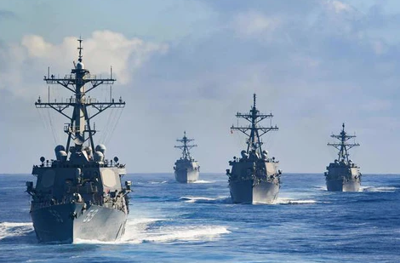
US Navy ships in Southern Caribbean. Source: Trinidad Express.
What all of this means is that the game is on. Moving this amount of assets to the Caribbean Basin, especially given the presence of land forces in the deployment, is no bluff. Trump seems to think that he can make an example out of Venezuela, contrary to historical precedent when it comes to the forced regime change going as planned or producing the desired results. One things is certain. It will be Venezuelans who suffer the most from any eventual escalation, and their scotch-swilling wealthy exile “leaders” will do nothing to shield them from a US assault.
In contrast to all of this Big Stick manoeuvring, Trump has offered Argentine president Javier Milei a USD$40 billion bridge loan as a form of bailout for Milei to make interest payments on outstanding public loans. No international lender like the IMF or World Bank would do so because of concerns about Milei’s reckless fiscal and macroeconomic policies (at one point he wanted to dollarize the Argentine peso and shipped off Argentina’s gold reserves to England on a private plane). Private investors took advantage of Milei’s public sector asset sale program to strip them of what value they held, repatriated the profits from the re-sale of those assets, then left the economy. What private investors remain are engaged in dodgy crypto schemes and destructive enterprises like critical mineral mining (lithium, in particular) where regulation is lax and where profits are largely sent abroad.
Milei himself is embroiled in an investigation into a memecoin “pump and dump”/”rug pull” scheme concocted along with Trump-allied US crypto billionaires, where he touted on social media a specific coin called $Libra that rapidly rose, then fell in value, making the 9 founding $Libra accounts around USD$82 million and leaving 72 thousand other investors with USD$251 million in losses in just over 3 hours. Milei later distanced himself from the scheme but it was discovered that he was one of the 9 founding accounts, which as per usual were managed by his sister and chief personal advisor, otherwise known as “Ms. 3 percent” for the price of the “commissions” she demands of entities doing business with the Argentine State (the most recent involving a pharmaceutical company). Milei’s sister, Karina, is also being investigated for links to–surprise!–narcotraffickers and assorted other dark forces in the Argentine landscape.
The Trump bridge loan bailout for Argentina was in fact a political rescue line thrown to Milei. His party (Libertad Avanza or Freedom Advances) did very poorly in provincial and first round congressional elections in September and at the time of the bailout it was assumed to be posted to suffer a similar fate, or at least not improve its minority Congressional representation in the national midterm elections this past weekend. That would jeopardize his reform agenda for the remainder of his presidential term, making him a lame duck and paving the way for a return of either a Peronist party faction leader or a newer centrist coalition-backed candidate. Either of these option would spell the end of the “chainsaw” approach to public sector restructuring as well as Milei’s pro-US (and pro-Israel and anti-climate change) position, something that Trump seeks to avoid.
As it turns out, Libertadad Avanza won 41.7 % of the congressional electorate vote, defeating the opposition coalition, which won 40.4% of the total number of party votes. This improves the government’s bloc position in Congress and strengthens Milei’s hand in imposing more reforms, but it also sets the stage for ongoing deadlocks and resort to rule-by-Executive decree on the part of the Argentine president. But for the moment, chalk this up as a win for Trump’s bailout carrot/election interference gambit because even if short term in nature, it may have influenced things in a US-favorable way when it comes to Argentine foreign policy. Since Trump threatened to rescind the bailout of Milei’s party did not win, it is quite possible that tis weighed significantly on the minds of voters (who still turned out in record low numbers–67.8%– in spite of voting being mandatory).
What is also interesting is not that the bailout was given for political rather than sound economic reasons. That happens. What is of note is that the bailout comes at a time when US tariffs on Chinese goods resulted in retaliatory tariffs on US agricultural products, especially soybean exports. Most of these are grown in Red Trump-voting states. When the retaliatory tariffs kicked in Argentina dropped its export taxes on soybeans, and along with Brazil rapidly took advantage to increase soybean exports to the PRC. In just a few months Argentine and Brazilian soybean exports have taken over the previous US share of the PRC soybean import market. So in effect Trump has bailed out a foreign government for ideological reasons even though it directly hurts a core voting block in the MAGA coalition. That makes neither economic or political sense.
In response to criticism of this deal, Trump puzzlingly announced that he would reduce tariffs on Argentine beef imports so that it could increase its US market share. At a minimum that means reducing US beef prices in the face of Argentine import competition., which is now the stated intention of the plan (beef price reductions across the board). Once again, US beef is mostly produced in Red states, so here too the economic and political logic at play appears to be contrary to the interests of key MAGA voters. It seems that for Trump ideological buttressing of an ally abroad is more important than the material fortunes of US farmers, and he does not fear electoral retribution as a result. That is another oddity, unless he has a plan for avoiding electoral backlash in the first place, which may be what the overall beef price reduction plan is all about..
In El Salvador, Trump has courted Nayib Bukele, the self-styled “world’s coolest dictator” who offered to house US deportees at his infamous CECOT prison in exchange for money, diplomatic favours and the betrayal of several FBI informants tied to the Salvadorean gang MS-13. Regarding the latter, Secretary of State promised the FBI that he would not divulge the informant’s names to Bukele but then did so, whereupon Bukele demanded they be returned to El Salvador rather than stay in US detention. Secretary Rubio obliged and it is now presumed that the informants are dead. Here the Big Stick was wielded on behalf of a foreign government in conjunction with domestic objectives rather than used against it for strategic gain.
Further afield, MAGA operatives have close links to former Brazilian president (and coup plotter) Jair Bolsonaro’s party and his revanchist sons while the Trump administration has imposed a 50 percent across-the-board tariff on Brazilian goods as well as travel sanctions against the judges that convicted Bolsonaro and sentenced him to six years in prison for sedition earlier this year. The Trump connection to Latin American opposition groups includes rightwing Chilean figures, adherents of the old Pinochet dictatorship and new tech moguls, as it is reported to be quietly influencing the policies of Paraguay (led by a conservative) and rightwing opposition factions in Peru. In effect, in these instances the Big Stick used by one foreign policy hand is complemented by a more subtle and covert velvet glove approach on the other.
In the end, Trump’s return to a US gilded age is very much true in the original Twain sense of the phrase, and its adoption of a crude form of Gunboat Diplomacy characterised by a Big Stick/Carrot approach is playing out in contradictory but obvious ways in what Trump considers, to Latin American revulsion, to be the US’s backyard where the Roosevelt Corollary to the Monroe Doctrine gives it the right to act with wanton disregard for International law and imperialist impunity with regard to the rights of individuals and States. Much like demolishing of the White House East Wing serves as an allegory for the destruction of the US constitutional system and social fabric, the return to the Big Stick and selective carrots is symbolic of an increasingly feckless approach to US foreign policy, regionally defined.
As the saying from former Mexican president Porfirio Diaz goes (amended here to include the entire region): “Poor Latin America. So so far from God and so close to the United States.”
Que Pachamama los proteja!
Declaration: I was the Regional Policy Analyst for the Interamerican Region and Caribbean Desk Officer in the Office of the US Secretary of Defense (OSD/ISA/IA), co-Team Leader of the Cuba Task Force and a consultant to the CIA, US Southern Command, US Air Force Special Operations and US Navy Special Operations Commands in the 1990s. In those roles I was engaged in exactly the sort of exercises that go into this type of war-planning/preparation and am well aware of the long history of US anti-drug campaigns in the region as well as the US military involvement in them (including the infamous Pablo Escobar/Cali Cartel years). My commentary is informed by those experiences and by the certain knowledge that the norms and restraints that governed the actions of my colleagues and I no long apply when it comes to the application of US military force.