
In the second episode of our podcast this year, Selwyn Manning and I discuss the stability and near-term future prospects for Vladimir Putin’s regime in Russia. All is not well.
The dirty power of culture wars.
A few decades ago I wrote an essay about the impact of state terror on Argentine society. One of my points was that terrorism was used by the military dictatorship known as the “Proceso” not because it was particularly effective at ferreting out subversives but because it worked as an atomising agent in Argentine society. That is, it used pervasive fear of institutionalised terrorism as a means to “infantilize” people and increasing isolate and alienate them as individuals, which served to destroy the horizontal social bonds that were the basis of collective solidarity among the groups targeted by the dictatorship. That in turn eased the way for the imposition of so-called neoliberal economic policies that redistributed income downwards for the majority, significantly curtailed the State role in economic management and provision of basic public services, destroyed social welfare, health and education safety nets and pauperised the population in general while increasing the material fortunes of the elites associated with the regime.
State terror created a culture of fear that atomised and isolated people in the public space, thereby paving the way for their infantilisation as social subjects and eventual dependency on and subjugation by their dictatorial masters. What is less known is that the so-called “Dirty War” waged by the dictatorship known as the “Proceso” (Process) was justified not on economic but on cultural grounds, as a defense of “traditional (Catholic) values” placed under siege by immoral, degenerate, atheistic Communist subversion in the guise of liberalism, feminism, secularism, homosexuality, youthful rebellion and other depraved foreign ideologies that had no “natural” place in the patriarchal, heteronormative capitalist social status quo that dominated Argentina at the time. Now, in the contemporary era, a variant on this theme has been introduced into socio-political narratives in the liberal democratic West as well as elsewhere: Culture Wars.
In recent years conservative authoritarians have moved to using electoral facades rather than coups as a means of gaining and maintaining government office. Their weapon of choice is no longer terror imposed by or on behalf of the State but a defense of traditional values against attempts by progressives to undermine the moral fabric of society. Similarly, authoritarians out of office no longer seek to use guerrilla war as a main vehicle for conquering power but instead embark on crusades against “wokeness,” “political correctness” and perceived (and mostly imaginary) attacks on “free speech” by liberal-progressive-socialist-communists. In both cases the strategic move has been from a physical war of manoeuvre to a cultural war of position in which the battle is over values and identities, not necessarily (although ultimately involving) government offices, economic policies or physical terrain. In other words, the social backdrop to political competition and conflict is now increasingly dominated by Culture Wars.
That is notable because the Culture Wars approach rejects or replaces the most basic axiom in politics: that people vote with their wallets. Think of it this way. The MAGA crowd voted against its economic interests when it voted for Trump (even if Trump’s “America First” economic pipe dream was sold to them as feasible). More recently, both Vladimir Putin and Recap Erdogan in Russia and Turkey diverted popular attention from their disastrous economic policies and corruption towards a defense of “traditional” values, in Putin’s case “traditional” Christian values (supported by the Russian orthodox hierarchy) and in Erdogan’s case “traditional” Muslim values (again, supported by conservative clerics). They both railed against the depravity of the West and the corrosive impact the importation of Western mores and ideas has had on their respective societies. In fact, Putin went so far as to order the invasion of Ukraine because of its “degenerate” liberal (when not Nazi) leadership’s threat to the ethnic Russian part of the Ukrainian population. The point is that when Culture Wars are used as an electoral strategy in order to outweigh objective economic realities, they often are successful.
The emphasis on Culture Wars is understandable when conservative authoritarians have no economic legs to stand on. That is where the parallel between US and NZ conservatives come in. Neither the GOP in the US or National/Act in NZ have economic platforms that are remotely close to practicable, sustainable or deserving of popular support. They are in fact elitist in construction and elitist in benefit. So, rather than modify their economic policy platforms away from their exhausted and discredited neoliberal/market-driven trickle-down policies, these conservatives turn to inciting Culture Wars as a means of diverting attention towards superstructural and often artificial fault lines in their respective democratic societies. In the US things like gun rights and opposition to racial, gender and sexual equality may be an “organic” product of American Christian repression and its record of historical conquest, but in NZ the notion of unrestricted gun ownership rights and opposition to transgender rights (on the slanderous grounds that the latter are “groomers” and pedophiles) are foreign imports that have no “organic” or native origins in NZ society. However, the attacks on co-governance frameworks in NZ is indeed rooted in deep-seated Pakeha racism against Maori, so the fusion of foreign imported ideologies and local regressive perspectives on race mesh easily into a divide and conquer (so they think) Culture War strategy on the part of the NZ Right.
More broadly, the assault on gender and sexual identity minorities, immigrants and various types of non-traditional non-conformity that defy the traditional narrative about what the “proper” society should look and behave like is rife throughout the Western liberal democratic world even where gun rights are restricted in the interests of public safety (seen, not unreasonably, as a public good rather than an infringement on individual liberty), where racism is not a historical stain or contemporary problem or where economic policies have popular support. It is major a stock in trade of elected authoritarians like Victor Orban in Hungary, Andrzej Duda in Poland and former president Jair Bolsonaro in Brazil as well as a host of demagogic political and social figures throughout the world, to say nothing of outright autocrats like Putin, Erdogan and a swathe of Middle Eastern and African oligarchs and strongmen.
The important thing to bear in mind is that like state terror as a social atomising agent, Culture Wars work. Trump, Bolsonaro and Orban rode them to victory in democratic executive branch elections, Putin and Erdogan used them to rally support for their unpopular regimes (with Erdogan likely to win a run-off election next weekend in spite of his disastrous economic policies and Putin holding onto power like a (rat-trapped) rat on cheese despite Russia’s futile war on Ukraine). Wanna-be’s like Luxon, Peters and Seymour in NZ seem to believe that their best bet is to copy at least some aspects of the Culture Wars strategy and adapt them to Aotearoa’s particular circumstances in the run up to this year’s general election. Given the media attention devoted to co-governance, transgender rights (or better said, their mere presence), vaccinations and the use of Te Reo in public discourse, there may in fact be grounds for traction in that angle of approach. That makes it more imperative that people push back at the introduction of retrograde ideological arguments in the NZ context. They are largely not from here and have no place in Aotearoa.
The pushback is necessary for a simple reason. Culture Wars work as a socio-political strategy because they are based on a dirty little secret: that fear is a great perception and behaviour modifier. Culture warriors traffic in the promotion of fear, both real and imagined, rational and irrational. This fear is of targeted “others,” those who can be readily identified and easily scapegoated while also be made into seemingly malevolent Leviathans who must be struck back by common, sensible, “traditional values”-holding people–the silent majority, as it were. Although it is helpful to the Culture Was projects if the “others” look different, worship different Gods, have different customary practices or engage in non-heteronormative sexual behaviour, it matters less what the “others” actually do than that they are identified as threats to traditional values and mores. The use of disinformation and misinformation is helpful in this regard because fear is a tool whether the basis for it is true or not–and it is most often not true or grounded in reality. What matters is achieving the objective, not the truth. The objective, in turn, is to restore a previous societal status quo in the face of pressures to make it more equitable, inclusive and responsive to the needs of those marginalised.and voiceless under the “traditional” scheme of things.
Complacency is the ally of the Culture Warriors because silence allows them to megaphone their messages of fear and hate through corporate and social media unimpeded by fact checkers, truth-speakers or coherent ripostes. Decent people may believe that Culture Wars are just a side-circus show that does not in fact distract from bread and butter and other serious issues of the day when people make their political and social preference choices. But as the likes of Brian Tamaki and various conservative media talking heads have shown, they do in fact have an impact on public perceptions when not challenged by more tolerant and open-minded arguments. Their fear-mongering gains ground in the measure that complacency cedes them rhetorical space in the pubic discourse.
All of which is to say that although there may be considerable distance in practice between Argentine (or Chilean or Guatemalan or Salvadorean, etc.) state terrorism and the Culture Wars in contemporary democracies, they are on a continuum where fear (manufactured or real) is exploited for political and social advantage above and beyond the economic projects that may underpin them. As Bernard de Voto noted (paraphrased here), “a person’s eyes and ears and the fulcrum of his/her judgement supplies his/her capability for action.” The fulcrum of fear is made up of orchestrated “Othering” in which contending perceptions of norms, mores and acceptable behaviours, that is, the conflict between between traditional and “progressive” values, is focused on particular subjects and groups. The purpose of Culture Wars is to warp the ideological fulcrum on which social consensus rests in order to obtain political, social and often material advantage whether it be based in the truth or not.
As a bottom line culture warriors play dirty with the truth just as much as the Argentine Dirty War ignored international norms and strictures against the torture and killing of civilians. Much like the logic of the “Proceso” when defending its actions, the ends of the culture warrior justifiy the means, and in a world in which the value of tradition is increasingly under question and often challenge, warping of the ideological fulcrum in order to promote manipulable fear in the body politic is just as useful as the pliers, branding irons, cow-prods and battery clamps used by the Latin American torturers of yore.
To which I say now as I said back then, mutatis mutandis: “Nunca Mas!”
PS: For those who may be interested in the essay linked to above, please email me (pablo@kiwipolitico.com) and I will send you a copy of the entire essay as an attachment in my reply.
Media Link: ” A View from Afar” first show of 2023.
After considerable delays related to the impact on Cyclone Gabrielle on both North Island coasts, the “A View from Afar” podcast with Selwyn Manning and I has resumed. After a brief introduction talking about the storm aftermath, we follow up the previous KP post about AUKUS, then briefly talk about the Discord classified material leaks and the power struggle in Russia. You can find the podcast here.
NZ and AUKUS PIllar 2.
As part of our preparations for the resumption of the “A View from Afar” podcasts, Selwyn Manning and I have been discussing topics for the first show. We have agreed on a micro/near-macro/far focus, with the first segment being about NZ, specifically about whether NZ should join the proposed “Pillar 2” of the recently announced AUKUS agreement that will see Australia acquire nuclear-propelled submarines based on US and UK submarine technologies. We will then move on to the impact of the Discord classified material leaks and perhaps, time permitting, what is going on in Russia recently. As part of my preparations, I shall use this post to outline some of the issues involved in NZ’s potential involvement with AUKUS Pillar 2.
AUKUS Pillar 1 involves the forward rotation of US Virginia class attack submarines based in Guam to HMAS Stirling outside of Perth, Western Australia beginning in 2027 and then the introduction of Australian nuclear-powered submarines based on the Virginia Class and UK Astute class attack submarines in the 2030s, followed by a new Australian class (the AUKUS class) in the 2040s. The SSNs (designation for nuclear powered attack submarines) will have the capability to conduct extended patrols off of New Zealand’s East Coast (which the current Collins-class diesel-electric Australian submarines cannot do) without entering NZ territorial waters (the 12 mile limit). This allows them to monitor adversary surface and submarine activity in and around NZ’s EEZ and further off-shore as well as conduct the submarine intelligence collection and intercept operations that modern submarines are primarily used for in times of peace. Undersea fiberoptic cables linking the US and Western Pacific are a major point of interest to all nations with a submarine intelligence operations capability since these are the main data exchange conduits across and within the Pacific that can be used for both offensive as well as defensive purposes in times of peace as well as war. The AUKUS submarines will certainly be used to these intelligence collection and interception ends.
It is very likely that, as has been the case with RNZAF P-3 maritime patrol and ASW aircraft in recent decades, the new RNZAF P-8 maritime patrol/ASW aircraft will be in regular contact with Australian and US naval assets, including the new RAN submarines. There is nothing new in that since the NZDF works towards seamless interoperability with Australian defense forces on land, sea and air and regularly conducts joint operations with ADF, US and other “friendly” forces across all battlefield dimensions, including tactical signals and technical intelligence. In a sense, nothing changes for NZ in terms of its defense posture now that AUKUS is in place. What does change is the modernity of the Australian naval platforms that it will be able to interact with in future operations as well as the broader range of Australian submarine coverage around all NZ shores (which in turn frees up US submarines for patrols further North in the Western Pacific). Otherwise, the current status quo remains.
For its part AUKUS Pillar 2 involves the non-nuclear, mostly economic and scientific aspects of the agreement. NZ would not have to loosen its non-nuclear status in order to participate in Pillar 2, either with regard to the submarines themselves or the land-based technologies that might be based or developed on its soil. The technologies involved include quantum computing, artificial intelligence, robotics, nano-technologies, unmanned aviation and sub-surface platforms, various sensing capabilities (e.g. acoustic, thermal, electronic, cyber) and related supply chain industries that have the potential for commercial as well as military-intelligence applications. For the Australian military industrial complex, AUKUS is a win-win. For NZ defense industrial circles, the same might apply if NZ joins Pillar 2.
When the agreement was announced Australian authorities touted the economic and scientific benefits that will accrue to Australia as a result of its signing. As the host state, Western Australia will not only see HMAS Stirling upgraded and jobs added to it in order to accomodate the presence of the nuclear submarines, but Perth and other parts of the state are envisioned to be in line to get some spill-over business in the form of input suppliers to the base. Seeing that, other Australian states have lobbied the federal government for a piece of the potential economic pie, noting for example that South Australia has a well-established boat-building capability and Victoria and New South Wales have extensive high technology sectors clustered around their main urban centres. Business leaders have joined the defense and security community in highlighting the high tech, value-added nature of both the products being developed as well as the jobs created by involvement with Pillar 2 initiatives.
Where does that leave NZ? A little while ago Minister of Defense Andrew Little said that his government “might consider” involvement in Pillar 2 once the specific details of it become known. His focus was strictly on the economic ripple effects and possible benefits to NZ of involvement in the scheme. However, in the past week Foreign Minister Nanaia Mahuta has rejected the very idea of involvement in Pillar 2, stating that policy decisions “are made by cabinet,” not by officials in the foreign or defense ministries. She went on to say that involvement in AUKUS was contrary to the “Pacific Way” of consensus building on key regional policy issues. This suggests that there is a fracture between the left and right wings of the Labour Party on the subject, something that will undoubtably come back into play as the October General Election draws closer.
We can safely assume that as a means of burnishing its conservative security and pro-business credentials, National will welcome involvement in Pillar 2 should it win in October. That is, to paraphrase notorious Iran invasion hawk Donald Rumsfeld, a “known known.” It may therefore be a better strategy for Labour to walk back its interest in Pilar 2 at least until the elections are over, if for no other reason than to not court problems with potential coalition partners like the Greens and Te Pati Maori. For their part, Australian security and business elites are unlikely to want to share the potential wealth of Pillar 2, so to speak, with NZ precisely because NZ politics is too unreliable when it comes to defense and security, especially when nuclear anything is involved. Unless Australian businesses are involved on NZ soil, why should the economic benefits of AUKUS extend beyond Australia, the US and the UK? As far as the agreement goes, NZ might as well be Canada in terms of economic involvement, and the Canadians do not constantly display a virtue signaling posture when it comes to nukes. From the standpoint of the principals involved, NZ is just trying to free-ride on their hard work.
More pointedly, as Jim Rolfe kindly alerted us in his comment below, most of what might be covered in Pillar 2 is already (at least seemingly) covered by the Five Country Technical Cooperation Program (TTCP). The TTCP is an extensive science and technology information-sharing arrangement between the 5 Eyes partners that covers a broad range of defense and intelligence-related scientific and technical subjects. Perhaps there are substantive and technical aspects to Pillar 2 that extend beyond what is covered by the TTCP remit and hence can be seen as a complement to or upgrade of already extant arrangements or a means of piggy-backing on what is already there when it comes to defense, security and intelligence industry collaboration. Remember that the pitch coming from Minister Little (as far as can be discerned) is about economic benefits that have the potential for “dual use” (i.e. military and civilian) applications, with the attendant spin-off civilian commercial effects highlighted rather than the military-security related flow-on effects per se.
One argument against NZ involvement in Pillar 2 is that it will be seen as a provocation by the PRC and thus invite retaliation. The PRC has a record for over-reacting to perceived snubs and NZ is a very dependent and hence vulnerable trade partner of it. Unlike Australia, which has strategic minerals that the PRC needs for sustain its industrial development and economic growth, NZ exports low value-added primary goods and derivatives to the PRC (think milk powders, lamb and beef, paua, crayfish and logs). When the PRC cut off Australian imports because of a diplomatic row, it went after things like wine and other non-essential goods, not the strategic minerals. NZ has no such export diversity from which to choose from when it comes to selective PRC trade sanctions, and with a third of its GDP grounded in primary good exports to the PRC, the direct and ripple effects of Chinese retaliation would be severe.
But there is a catch. The PRC already well knows which side NZ is on when it comes to international security affairs. It is well aware that NZ is part of 5 Eyes if for no other reason than the PRC is a prime target of 5 Eyes intelligence-gathering efforts, which includes a role for the NZ signals and technical intelligence agency, the GCSB. NZ has a military alliance with Australia, is a non-NATO NATO ally and has not one but two bilateral security agreements with the US (the Wellington and Washington agreements). Involvement in Pillar 2 is not necessarily an anti-PRC turn in NZ’s defense posture even if it may indirectly help the ring-fencing strategy that the US and its Pacific allies are currently undertaking vis a vis the PRC in the Western Pacific.
For the PRC, there are far more immediate concerns: the diplomatic-security (not full military) QUAD alliance involving Australia, India, Japan and the US; the recently renewed bilateral defense and security ties between the US and the Philippines, including forward basing rights for US troops as well as regular joint exercises; the change in the Japanese constitution that moves away from pacifist principles and which has facilitated a dramatic increase in defense expenditure, including on offensive weapons; the so-called US military “pivot” to the Indo-Pacific which has seen a majority of its naval assets moved into that theater along with increased numbers of amphibious troops such as the recently established US Marine expeditionary force based in Darwin and forward deployment of increased US Air Force assets in Guam; and the revitalisation of bilateral defense pacts between the US and various Southeast Asia states such as Singapore, which now has a permanent US navy presence at its naval base at Changi. There is the pushback from the US and regional allies against PRC belligerency towards Taiwan and its sovereignty-expanding island-building projects in disputed atolls across the South China Sea. The ramifications of all of these potential contingency scenarios are more pressing when it comes to Chinese military planning, so it is doubtful that NZ signing on to Pillar 2 will cause the PRC to react in an unexpected way even if it has that track record of over-reaction to perceived slights.
Plus, there is way for the PRC to exploit an advantage when it comes to NZ’s potential involvement in Pillar 2. It can use its extensive intelligence networks inside of NZ to try and obtain sensitive information about the industries and technologies involved as well as the political and military decisions that may surround them. Without firing a shot the PRC may well be able to undermine some aspects of AUKUS if it uses its intelligence assets in NZ and Australia wisely and adroitly. We can only assume that the NZ intelligence community is aware of this possibility and along with its AUKUS partners is planning counter-espionage efforts accordingly.
A significant aspect of AUKUS is that it violates the South Pacific Nuclear-Free Zone Treaty (an update of the 1986 Treaty of Rarotonga), especially Article 4 relevant to nuclear propulsion and the storage of fissile material. The stationing of the AUKUS submarines at HMAS Stirling may be an attempt to circumvent the Treat by claiming that the base is located on the Indian Ocean and outside of the SPNFZT area of coverage. But the truth is spelled out in the language of the original Treaty as well as its refinements. This is the area covered by the SPNFZT:
Should Australia breach (which is what many believe that it is doing) or renounce the SPNFZT, then it sets a precedent for other nuclear states to establish a non-weapons nuclear presence in the South Pacific if they can find a willing partner in the region (say, by forward basing a nuclear powered submarine in a Pacific Island Forum country much as the US will be doing at HMAS Stirling later this decade). The recent PRC-Solomon Islands bilateral security pact opens the door for such a possibility, and if that does in fact occur in the Solomons or elsewhere, then the taboo on stationing nuclear material of any sort in the region will have been broken.
On balance, for reasons both internal to NZ as well as those intrinsic to Australia, NZ involvement in Pillar 2 is in my opinion at least temporarily dead in the water. When it comes to high tech/value added production, perhaps NZ is better off supporting its nascent gaming, unmanned avionics and rocket booster-building industries rather than those associated with AUKUS, especially because the ripple effects of AUKUS will be felt in NZ anyway, however lightly in terms of public consumption. Moreover, with non-involvement the threat of PRC retaliation is mooted and the costs of conducting increased counter-espionage efforts against it are avoided as well.
From a political-diplomatic standpoint, Minister Mahuta may be right: NZ participation in Pillar 2 is letra morta.
” A View from Afar” returns.
On Thursday May 11, 2023 at 12PM (noon) NZ time/8PM Wed 10th May US East Coast time/1AM Thursday London time/8 AM Thursday Singapore time and 10AM Thursday Sydney time, the A View from Afar podcast will resume broadcasting. Selwyn Manning and I will discuss the AUKUS agreement and its implications for New Zealand and the fallout from the Discord classified material leaks as well as global affairs from a South Pacific perspective.
The show is interactive so tune in and join us!
Gamers, terrorists and spies.
For the better part of the last decade analysts have warned about the use of online interactive action games as a recruiting ground for white supremacists and neo-nazis (and to a lesser extent jihadists). The use of Crusader and modern Western military imagery in battles with dark skinned enemies facilitated the recruitment pitch, which given the subject material is mostly targeted at teenaged and young adult men. The policy implication of these warnings is that intelligence agencies, specifically signals and technical intelligence agencies such as those grouped in the Anglophone 5 Eyes network, need to devote resources to monitoring online gaming communities for signs of extremists and their attempts at expanding their ranks via the internet as well as formulating actual online plots to commit acts of violence.
Unfortunately most of these warnings went unheeded and continue to largely be ignored. Government intelligence agencies such as those grouped in the 5 Eyes have myriad threats and many other priorities to address besides online extremists using gaming as a recruitment portal. This has left a gap in their coverage of what is now a full fledged digital community of hate. This community does not just have gaming as a vehicle. It also includes chat and noticeboards like 4Chan and 8Chan, Reddit, Discord and other on-line communities that under the mantle of “free speech” cater to extremist viewpoints. Sadly, that attracts advertising revenue from those seeking to profit from hate and violence, be it via the sale of “hunting” weapons, uniforms, military insignia, survival gear and other para-military outfitters or publications and entities that promote ideological agendas that dovetail with the views of these types of online communities (think Voice for Freedom or Counterspin Media as NZ examples). Equally sadly, in spite of the efforts of the Christchurch Call and various advocacy groups, a majority of technology companies are loathe to self-police when it comes to issues of “free speech,” much less provide client data to security agencies in all but the most dire and pressing of circumstances.
This brings us to the subject of the recent leaks of highly classified US intelligence reports by a Massachusetts Air National Guard service member serving as an enlisted cyber transport system journeyman. In that capacity, 21 year old Airman First Class (E-3) Jack Teixeira of the 102nd Intelligence Wing of the Massachusetts Air National Guard headquartered at Joint Base Cape Cod on the site of Otis Air Field was responsible for maintaining cyber security for the Wing. In order to discharge his duties Airman Teixeira very likely was granted a Top Secret/Sensitive Compartmentalized Information (TS/SCI) security clearance that allowed him untrammelled access to what is known as a “SCIF,” a tightly secured room or building in which both paper and digital records are stored. He also had authority to visit off-station secure sites such as the Special Operations Command and other military intelligence units as part of his official duties. The US government refuses to comment on the matter of his clearances and how he obtained them pending his trial.
Using his access, as early as February 2022 Airman Teixeira began to transcribe and leak information from highly classified documents to a group of about 50 online gaming enthusiasts that were grouped in a Discord channel called “Thug Shaker Central.” He also is reported to have leaked to a larger Discord group and to forums on 4Chan and Reddit. Among these groups were a number of foreign nationals, including Russians. Two common aspects of the channels he leaked to is that they had weapons, uniform and military paraphernalia fetishes and trafficked in white supremacist, anti-Semitic, anti-Muslim, racist and misogynist narratives, with Teixeira himself now being exposed as adhering to those beliefs. The only thing missing from the profile of the gamer guys Teixeira consorted with is the label “Incel,” as in iInvoluntarily celibate. I am not sure about the others but Teixeira certainly seems to fit that bill.
At first his transcribed leaks received a lukewarm response from his (mostly younger) audience because they were pages long and covered a broad range of subjects, from details on the Russian-Ukranian War, Chinese satellite warfare plans, Taiwanese defence preparedness, Egypt’s flirtation with selling arms to the Russians, US eavesdropping on South Korean communications and much, much more. After a while, when he realised that many of the group members he was trying to impress were simply not reading his “nuggets,” he began to photograph and download the documents themselves. The would prove to be his undoing.
Transcribing the documents gave him plausible deniability because the decontextualised words (i.e., no identifying markings) could have been sourced by many people from many SCIFS. But his associates were all young male gamers who are highly visual in their information-processing, so paragraphs of words without pictures soon turned boring for them. Hence, in order to keep their attention spans focused on his “nuggets” and therefore affirm his status as leader of the Thug Shaker Central group, Teixeira needed to go digital. Once he did and the documents appeared on-line with official markings like TS/SCI and NOFORN (“No Foreign” distribution), then the counter-espionage crowd in military intelligence, the FBI and the National Security Agency (NSA) could get to work tracking him down. However, there was a twist to his uncovering. As it turns out it was the New York Times digital investigations team that first saw the documents online. Then the Washington Post was alerted to their presence. After tracing their IP addresses and social media accounts linked to them, these outlets contacted members of the Thug Shaker Command, who confirmed the legitimacy of the documents and how they came to be online. At that point the journalists contacted the US government for comment and the hunt was on. Teixeira was captured within a couple of weeks and is now awaiting trial. He faces a lengthy prison sentence and possibly a death sentence under federal espionage and treason laws. Others might find themselves arrested as well. As it stands, two commanders of the 102nd Intelligence Wing have been stood down over the breach.
Several questions have been raised as to how and why he could have been granted a high level security clearance and given so much access to sensitive information. There are also questions raised about why the chat rooms he was involved with were not being monitored by the relevant authorities and why a seemingly obscure Joint Base at an otherwise relatively quiet tourist destination be a place where deep secrets of all sorts are stored. Allow me to answer at least some of them and draw some comparisons with my own experience.
Because of the nature of his job, Teixeira required high level clearances. He comes from a Portuguese-American military family and was two years out of high school when he joined the Guard. This mitigated in his favour because it appears that he was security vetted by a contractor working for but not by a US government agency. Edward Snowden underwent the same process and we have seen how that turned out. In this case the Discord leaks are far more serious both in terms of the breadth of the subjects covered–there are more than 500 documents in the tranche realised so far- and the depth of the exposure, which includes revelation of “sources and methods.” It is not surprising that the US government has gotten rigorously quiet on the matter. Moreover, Snowden gave his purloined data files to investigative journalists and perhaps the Russian government. Teixeira put them online, where they spread from closed groups to open forums.
His family background growing up in a well-established middle class Portuguese-American community (many of the people in that part of Massachusetts and Rhode Island are descendants of Cape Verdean whalers) and his young age would have suggested to his security vettors that he had no “baggage” that could compromise national security. If they were contractors as I believe they were, he likely wouldn’t have undergone the background checks that I underwent in the 1990s by the Defense Intelligence Agency, which included polygraphs, interviews with family, friends from Argentina all the way to that current moment, work colleagues, undergraduate and graduate student peers, even my ex-wife (not surprisingly, she had little good to say about me). I was asked about my sexual preferences, political beliefs (especially whether I had ever been a member of a Communist Party), vices (gambling, alcohol, drugs, prostitutes), financial situation (especially debt) and numerous other deeply personal matters. The main concern then was two-fold: whether I could be trusted with sensitive material, and whether I could be blackmailed. My ex-wife’s opinion notwithstanding, it turns out I was pretty milquetoast as far as applicants go.
It is unlikely that a contractor would go to such lengths to establish Teixeira’s background given his age and personal life, although the apparent ignorance of his gaming activity and the fraternity of gamers that he associated with was a major lapse on the part of both the vettors as well as US signals and military intelligence agencies. However, even if he had undergone the more rigorous DIA background checks (which still exist), it would have been unlikely that, other than the gaming angle, there would have been anything alarming on his record unless he had been arrested on felony charges. He had not been. From the contractor’s point of view it made sense to go lightly on his background check, using police and FBI records and perhaps some interviews with family and friends. Since neither US intelligence agencies or the military looked into his social media and gaming profiles, there were no red flags to which the vettors could have been alerted, and they clearly did not do that sort of due diligence themselves.
The use of security vetting contractors became common place after 9/11 as the US sought to expand its intelligence networks and analyses against non-State global irregular warfare actors as well as “traditional” adversaries (and friends!). The DIA and smaller intelligence and security vetting units simply could not handle the volume of security checks required by the thousands of new hires in the intelligence-security field. There are now over 1.5 million people in the US with “Top Secret” security clearance and another 3 million with “Secret’ clearances. The solution to the overwhelming demand for background checks was to farm out the vetting to private firms with experience in the field, such as private investigation agencies or firms specifically set up by former security officials to do security vetting as their bread and butter. However, the profit motive often leads to cost-cutting when it comes to the more laborious features of the vetting process, so many firms took the cheaper way and cut corners in that regards. Investigation into the Snowden leaks uncovered that the process by which he was granted high level clearances was flawed and incomplete. It looks like the same may have happened with Airman Teixeira.
Remember that the military is a young person’s business. They do most of the killing and they are the ones who mostly die. Gaining security clearances at a young age is quite common in the US military, especially for specialised units and more so for intelligence units. Teixeira’s age was therefore not a disqualifying factor per se and again, was likely seen as a good justification for quick granting of his clearances.
What about the unit to which he was assigned? Why would it have access to such a broad array of highly classified information? The answer is that the 102nd Intelligence Wing is a renown unit with many important responsibilities. Among them, Teixera’s assigned subordinate unit, the 102nd Intelligence, Surveillance and Reconnaissance Group, processes signals and technical intelligence from U-2 spy planes, RQ-4 Global Hawk and MQ-9 Reaper drones and supports the National Geospatial-Intelligence Agency (from which satellite data is collected). These platforms conduct operations all over the world but specifically over Ukraine in support of the Kiev regime. Some are reported to deploy from Otis Air Field. That means that the SCIF at Joint Base Cape Cod is an integral component of US global intelligence collection activities and the US effort to support Ukraine, which justifies the presence of highly sensitive intelligence in it.
Teixeira also travelled to other SCIF sites and had opportunity to copy classified intelligence from them as well as from his home base. If he did it obviously violates his secrecy oath and sets him up for a number of serious charges. The question is whether he did so just to impress his gamer friends, or for money, or for some ideological reason. The answer is as of yet unclear. The dominant train of thought is that he is an immature young man trying to impress other younger immature men with his “insider” status as one of those who know secrets. He clearly did not do so for money. But his darker comments about race, aspects of US government policy and Russia, much of it in line with the MAGA/QAnon narrative, could point to an ideological motive. Whether that be hatred of the Deep State and Democrats or support for Russia has yet to seen.
I should point out that in my case I was sworn to not only never divulge the TS/SCI material that I handled, but also to not talking or writing without prior authorisation about the classified aspects of my government jobs for twenty years after I left public service. Anything that I did want to write or talk about in my post-government career needed to be cleared by the Defense Department, DIA or intelligence agencies that I worked with, and I was informed that anything that involved ongoing operations or assets still alive or in service would be redacted from any material I wanted to use. There were serious penalties for removing classified material from the SCIFs that I worked in (Unauthorised removal of Classified Material), and much worse, for deliberately removing classified materials in order to hand them to a third party, whomever that may be (Espionage). It will be hard for Airman Teixeira to argue that his actions were unintentional rather than deliberate, and given who were among the groups that he leaked to, it might find him facing espionage charges. The situation does not look good for him.
Whereas what attention has been brought to the online gaming community by the security agencies has focused on rightwing extremism and terrorism, it is clear that the espionage and counter-espionage aspects of interactive digital forums needs to be factored in as well. To that expansion in the scope of cyber-intelligence operations must come a thorough re-appraisal of how security background checks are conducted on people applying for high-level security clearances. This is not just a US problem. There have been enough lapses in NZ security background checks to warrant a review of current SIS procedures and processes for vetting applicants, with or without the help of consultants. Currently non-citizens can get a high level clearance if they pass the SIS checks, but here too at least some of the vetting has been contracted out to private firms (including one that was led by Michelle Boag, of all people). The issue of citizenship aside, there is enough historical evidence to suggest that the SIS (as the lead agency when it comes to security clearance vetting and background checks) might be wise to commission an independent review of its vetting procedures and operations.
Some may remember the case of the Walter Mitty-type fraudster named Stephen Wilce, the guy who claimed to have been a member of the British Olympic bobsledding team and a former SAS trooper who served as Head of the NZ Defence Technology Agency and Chief Defence Scientist from 2005 until he was exposed in 2010. He held very high level security clearances, handled very sensitive defence information and yet was vetted by an outside firm hired by the SIS. One would have thought that they might have looked up the roster of the British bobsledding team in the 1980s when he claimed to be on it, but apparently that was too much to ask. Makes one wonder where Mr. Wilce is now.
I mention this anecdote because the cyber world has opened up a whole new frontier when it comes to security and intelligence. Preventing breaches and leaks has become both easier and more difficult. Easier because the technological means to detect early online threats is greater than in previous decades. Harder because security threats have multiplied along with advancing technologies. What is needed is a proactive strategy of cyber-vigilance in conjunction with tightened requirements for background checks on those handling classified information, including monitoring social media for evidence of online extremism. Although much has been said about how the NZ Police and intelligence community are dedicating significant resources to doing so, it is telling that the Police Commissioner admitted that his agency was caught off-guard by the online planning of the Parliamentary protests last year, and in fact were unaware of the convoys that were organised via various well-known messaging applications to descend on Wellington. By the time the Police realised the size of the protest, the protestors were already setting up camp on the lawns and streets surrounding the Beehive.
Meanwhile, with that note of caution out of the way, can we all say “AI?”
The zero-sum logic of rightwing culture wars.
Many years ago a sister-in-law of mine and I were debating about gay marriage. I have no issue with it but she did. When I asked her what the problem was, she said something to the effect that “giving gays the right to marry diminishes the sanctity of my (straight) marriage.” I found that logic to be very odd. Why would gay folk marrying in any way take away from or diminish straight marriage? If anything it would reinforce the normative preeminence of marriage as an institution over common law partnerships of any orientation, and would give additional legal protection to both the couple and any children that they raise (especially when it comes to travel and foreign residence because some States, among other things, require people to be married for spousal benefits, work permits and child visas. Singapore and several Latin American countries have such requirements).
Over the years my sister-in-law mellowed on gay rights because of exposure to gay people in her wider family, at work and amongst friends. Good on her. But the flaw in her earlier logic has stuck with me and been reemphasised in my mind by the current wave of cultural wars unleashed, Russian invasion-style (and with Russia’s actual involvement) by Western right-wingers. The premise remains the same: granting rights to gays, transgendered, intersexuals, historically oppressed communities, linguistic and religious minorities, schoolchildren (when it comes to what they can read and see in class), etc. comes at the direct expense of someone else, particularly straight white religious adults. Universalizing human rights is seen as usurping the rights of parents, business owners, religious authorities, and in fact, the “natural” patriarchical, racial, sexual and other social hierarchies of previous eras. The “natural” order is seen to be under existential threat and hence all-out war must be waged against those who, consciously or not, adopt Gramsci’s concept of a “war of position” in order to infiltrate “traditional” social, economic and political institutions with subversive intent.
Which makes me remember that foot-binding was once part of the “natural” order in China, and beating of wives and children permissible in Latin America, the Middle East, Africa and Asia–to say nothing of much of the Anglo-Saxon world. Bullying very much remains a cultural trait in Aotearoa. Not all tradition is worth preserving.
Much is written about the role of fear in rightwing perspectives. Fear of the “other” specifically. But fear needs to be analytically disaggregated as a concept and social construct. That is to say, fear has its own logic, sometimes rational and sometimes not. What is feared is less important than why it is feared. What fear is rests on two things: uncertainty and a particular perspective on how costs and benefits are distributed. This involves basic notions of loss and gain, particularly who gains and who losses in any social interaction. It is perversely transactional in nature. For example, cuddling an alligator may make him friendly, Or not. How one weighs the balance of odds in that interaction is what determines whether they fear the ‘gator or not. On the other hand, those who go to war know that death is a very likely fate. They know that, they internalize that (because of military socialization), and they get on with the job.
Civil society does (or at least should) not operate that way. It is about the limits of communal tolerance, not the requirements of war. This makes the cultural war references all the more disingenuous and destructive because, quite frankly, one (granting rights to previously marginalized groups) is not like the other.
The type of analytic logic where one rejects the extension of rights to others is known as “zero-sum:” one actor’s gain comes in inverse proportion to another actor’s loss. Expansion of rights for some is seen as a loss of rights for others. Coexistence is impossible under those circumstances because one group wins directly at the expense of another. This is the root perspective underlying prejudice among those who are not stupid (with the idiots more susceptible to the mean-spirited manipulation of non-stupid bigots and authoritarians).
Continuing the game-theoretic angle, the reality is that rather than zero-sum, the likely outcome of the culture wars is either (on the positive side), even–sum (both sides neither win or lose), positive-sum (both sides win) or (on the negative side) negative-sum (both sides lose). Either the bigots abandon the zero sum logic and the rights franchise is expanded to marginal communities without discernable loss of rights to historically dominant groups, with potential benefits accruing to binary and non-binary people resulting from the exchange, or both sides lose as the culture wars deepen, become more divisive, leading to broad scale violence and social rupture as all sides begin to see the conflict as existential. To be sure, I would prefer to see even-sum or positive-sum outcomes prevail but truth be told, many of the transphobes and their rightwing fellow travelers and enablers already see the “struggle” as existential–or an opportunity to stir up contrived controversy.
The last point is worth noting. Some of the arguments against the extension of rights to marginalized groups and individuals indicate that those making them know that they are specious. Claiming that drag queens and transgender people (transsexuals and Democrats!) are pedophiles and “groomers” betrays a moral and ethical dishonesty or gross ignorance. Claiming that transgender people using female bathrooms are a sexual assault threat to biological females (aka females at birth) is grotesque given the gender orientation and self-identity of the non-binary individuals. It may be true that heterosexual male sexual predators have sometimes dressed as women in order to gain access to female-only facilities with evil intent, but the instances of this have been extremely rare and, even rarer yet, are the instances of transgender women using their non-binary status to commit sexual assaults on heterosexual women. Plus, the root problem of such exceptionally rare assaults are different. A heterosexual male posing as a female in order to commit sexual assaults on biological females in female-only spaces is not the same problem as transgender females assaulting other females. The motivations–a question of the mind rather than simply driven by biology–are different even if violence and coercion are the method. As any specialist on transgender violence will explain, the more common issue is one of violence against rather than perpetrated by transgender folk.
Then there is this. Given the percentage of people world wide who are genuinely transgender, the odds of them constituting a significant number of sexual predators anywhere is mathematically low even if all of them were of evil disposition. Which is clearly not the case. When and where transgender initiated violence occurs is a product of personal and social circumstance given the specific context in which a person is situated. Again, the confluence of circumstances that lead to a transgender person lurking in bathrooms or grooming children is exceptional and the arguments that they are common occurrences is risible.
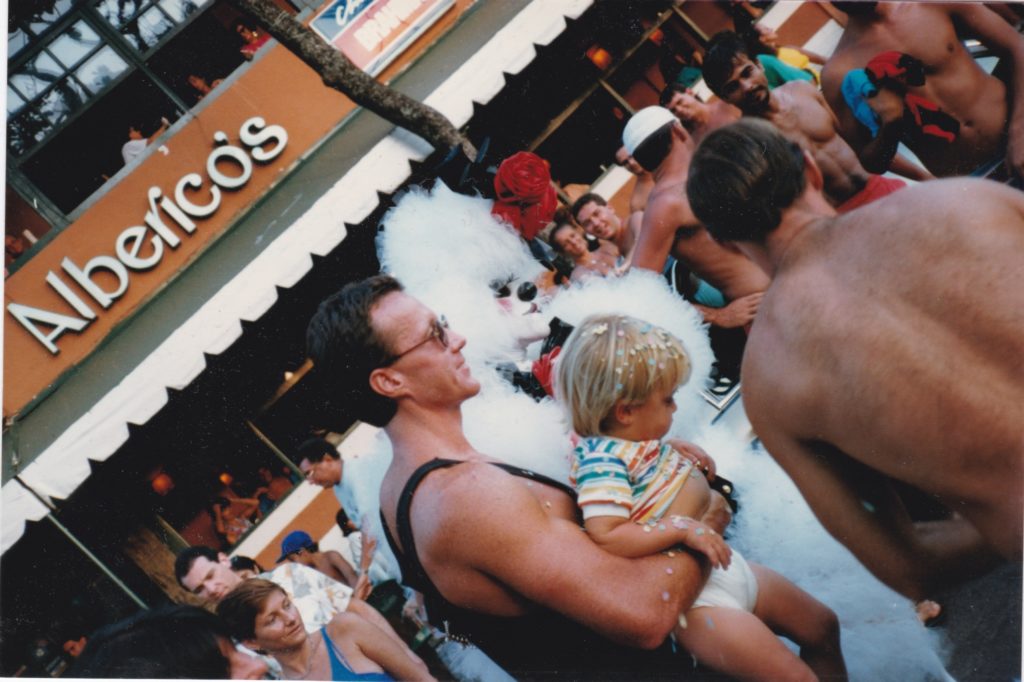
Pablo and his first son in Rio de Janeiro during Carnaval, 1987. The poodle is a dude.
I am no expert on the subject, but believing that gender difference is defined purely by genitalia is reductio ad absurdem logic at its worse given the presence of non-gender type conforming (third sex) people throughout history. In fact, several non-Western cultures, including those in India and Polynesia, accept the existence of non-binary people and see them as a separate category rather than as either male or female. Their social roles are not those of males or females, and the culture accepts them for who they are. The history of these human beings has been largely non-violent. The trouble is that in Western societies issues of gender/sex have traditionally been treated as either/or rather than a socially acceptable inflection point on the continuum of human difference. The opprobrium historically assigned to transgender people in the West can therefore be seen as part of a larger pathology grounded in conservative Christian repression when it comes to sexuality and “proper” gender/sexual roles. That is weird. To put it vulgarly by paraphrasing the Tool song title, a “hooker with a penis” may be just that regardless of gender identification (thanks Maynard).
It seems to me that although transphobia is the prejudice d’jour, it follows a long history of bigotry that is marked by the zero-sum approach to social relations. It is simply an extension of earlier and repeated attempts to limit the rights of designated “others” who are seen, hypocritically or out of ignorance, as a threat to the “normal” way of life and social order.That this zero-sum perspective is shared and megaphoned by conservative churches, politicians, lobbying groups and media whose network connections cross international borders makes for a more dangerous and troubling future for those who believe in and have a preference for democracy, human rights and the benefits of egalitarian societies.
Then there is the issue of “wokeness.” In 25 years in academia and the subsequent years doing consulting, I have never once been bothered or infringed upon by “woke” anything. I say this even after having lost an academic job after false accusations of being racist by a foreign (female) student and her coterie of “progressive” supporters annoyed by my stance on some controversial international issues (like the Palestinian-Israeli conflict). Even after that, “wokeness” is simply not an impediment to me leading my life. Personal anecdote aside, I think I know the reason for this. I assume that being “woke” means being attentive to the needs and concerns of others, especially the traditionally oppressed, exploited, subordinated and marginalised. I assume that it means paying attention to one’s words and deeds so as to not cause psychological, emotional or physical harm to others. It means calling out and confronting dog whistling, gaslighting and overt racists, xenophobes, bullies and bigots. If I am correct about what it means to be “woke” then I have no reason to be concerned and instead can be counted in as a “woke” snowflake. And if it means pointing out the analytic flaws in the zero-sum logics of bigots (should the bigots try to be analytic rather than emotive in their reasoning), then I am waaaay woke. Shoot, I just might be a closet gay dude who has not consciously realised it yet! My wife sure is gonna be surprised when she finds out.
Also, if any side is behaving as (anti) woke snowflakes, it is the Right. If they watch their mouths and refrain from bleating hateful rhetoric, no one will “cancel” them. Instead, all they do is complain and whine about socialist/communist/liberal/progressive wokeness and cancel culture and the attack on (insert traditional values and “freedom” shibolleths here). They see everything as an assault on their social superiority, entitlements and privilege That includes the extension of rights to those they traditionally dominated. They are the ultimate “Karens.”
More on point, this is not about cancel culture and stifling free speech. People are merely denouncing hate-mongering and calling out arbitrary privileges assigned by class, race, birthplace or gender. Some of it may boisterous but much of it is justified and non-violent. More broadly, if one cannot understand that individual and collective rights come with responsibilities and that rights end when they infringe, deny or impede on those of others, then one is anything but democratic in social orientation, an ignoramus, or both. In fact, many of those pushing back at the extension of rights to previously excluded groups are outright authoritarian and socially hierarchical in perspective, be they racists, transphobes or Islamicists. Put it this way, if you believe that human society is akin to lobster society where the male with the largest claw gets the best feeding and mating grounds, then you need to go back to high school biology 101 and stop with the cross-species analogies. This is not about alpha and betas, predators and prey, hunters and gatherers and the “natural” social hierarchies. It is about fairness, equality and social justice.
The good news, if any, is that more and more of them are now out in the open, so they can be confronted more readily across many platforms and venues. The bad news is that they also have broad support, including from the institutions mentioned above.
In the end one either wants to see people treated equally so long as they obey basic and broadly shared social mores and principles, or you do not. As far as I can tell Drag Queens reading children’s stories in school and libraries is in line with the first view. Inciting and enabling hatred towards and threatening violence towards marginalized people is not.
This is not “just” about conforming to the gender identity and social roles that genitalia assigns us at birth. It is about much more. It is about who we are as human communities.
Reality check.
There are some wellness, crystal-gazing, holistic spiritual guidance types in my disaster-hit coastal community who insist that the power of positive thinking will overcome the physical and material damages incurred by the community. They object to restrictions on road travel even though the damages caused by slips and water run-off is extensive and as of yet only stop-gap repaired. Heck, we do not even have traffic controls on our one lane muddy slip-ridden exit and entryways!
Although these self-absorbed navel gazers are a distinct minority they are very loud and bullying, with some using their historic roots in this neck of the woods as justification for shouting down everyone else. Apparently tenure (as in multigenerational living in this place as opposed to “newcomers” like me who have been here 24 years) means that they know best for all residents and their views are not be challenged. A few of these wunderkind have rarely left this isolated valley except for local forays or limited ventures further outside their co coons, giving them a somewhat limited perspective on the big bad world out there–and how to cope with unfamiliarity and difference of perspective and thought. And then there are the few that are associated with or support anti-vaccination and conspiracy theory weirdness.
However, because some are very adept at doing things like community volunteerism in between their yoga sessions and self-realization seminars, they feel they have the authority to speak over everyone else about almost everything. Democratic notions of compromise and consensus in decision-making are ignored in favor of a “our way or the highway” approach with plenty of vitriol added into the mix (which belies the “positive psychology” facade). They speak of serving the collective good–and some of them do–but they are not interested in collective input into their closed circle decision-making. There is a certain provincialism to their leadership claims and their refusal to listen to different opinions, much less opposing views. Trouble is, some also happen to well placed as cogs in our civil defense and resilience networks.
As the saying goes, times of crisis brings out the best and worst in people as well as expose the Peter Principle when it comes to levels of incompetence in public agencies. To this can be added, unfortunately, the fact that one particular skillset does not always translate easily into other fields of endeavor. In this case that fact appears to have been lost on the provincial know-it-all crowd and it now seems that these folk have crossed a line of toleration vis a vis the larger whanau with some of their obstructive and self-serving antics. This is dividing the community just as we are finally getting a semblance of normality to some parts of it (other than the roads and ruined homes). It is disappointing and discouraging because it has caused simmering divisions amongst people torn between family and friendship ties with the know-it-alls and the practical realities of the wider community’s real pressing needs..
That is where the know-it-all appeals to positive psychology fall flat. They want us to stay calm, bite our tongues and carry on following their pop psychological wellness healing Tik Tok-depth advice. In other words, everyone should think good thoughts, the contagion effect will apply, and everything will be alright.
To which I have one response.
The promise of positive psychology ends where the laws of physics begin.
Like on dangerous roads.
The return to Big Wars.
After the Cold War the consensus among Western military strategists was that the era of Big Wars, defined as peer conflict between large states with full spectrum military technologies, was at an end, at least for the foreseeable future. The strategic emphasis shifted to so-called “small wars” and low-intensity conflicts where asymmetric warfare would be increasingly carried out by Western special forces against state and non-state actors who used irregular warfare tactics in order to compensate for and mask their comparative military weakness vis a vis large Western states. Think of the likes of Somalian militias, Indian Ocean pirates, narco-guerrillas like the Colombian FARC, ELN and Mexican cartels, al-Qaeda, ISIS/DAESH, Boko Haram, al-Shabbab, Abu Sayyaf and Hezbollah as the adversaries of that moment
Although individual Western states configured their specific interpretations of the broader strategic shift to their individual geopolitical circumstances, the broader rationale of SOLIC (Special Operations and Low Intensity Conflict) made sense. The former Soviet Union was in disarray, with Russia militarily weakened, diplomatically shrunken, economically plundered and political crippled. Its former Republics were yet unable to independently exploit their material resources, and some of its former vassal states in the Warsaw Pact were seeking NATO membership. NATO itself had lost it main purpose for being, since the threat of major war with the USSR (the original rationale for its creation) no longer existed. The PRC had yet to enjoy the economic fruits of fully embracing capitalism in order to buy, borrow and steal its way to great power status and thereby shift away from its defensive land-based strategic posture. In a swathe of regions “failed states” awash in local armed disputes replaced proxy regimes and propped up despots. In other words, there were no “big” threats that required “big” wars because there were no “peers” to fight. The strategic emphasis shifted accordingly to countering these types of threats, often under the guise of “peace-keeping” and nation-building multinational missions such as the ill-fated ISAF mission in Afghanistan.
More broadly, the strategic shift seemed right because the world had moved from a tight bipolar system during the Cold War, where the US and USSR led military blocs armed with nuclear weapons, to a unipolar system in which the US was the military, economic and political “hegemon” dominating global affairs. At the time US strategists believed that they could single-handedly prevail in 2.5 major regional wars against any adversary or combination of adversaries.That turned out to be a pipe dream but it was the order of the day until the sequels to 9/11. Even then, the so-called “war against terrorism” was asymmetric and largely low-intensity in comparative terms. Other than the initial phases of the invasion of Iraq, all other conflicts of the early 2000s have been asymmetric, with coalitions of Western actors fighting much weaker assortments of irregulars who use guerrilla tactics on land and who did not contest the air and maritime spaces around them. As has happened in the past, the longer these conflicts went on the better the chances of an “insurgent” victory. Afghanistan is the best modern example of that truism but the persistence of al-Shabbab in Northern Africa or emergence of ISIS/DAESH from the Sunni Triangle in Iraq’s Anbar Province in the aftermath of the overthrow of Saddam Hussein’s Baathist regime demonstrates the validity of the notion that guerrilla wars are best fought by insurgents as protracted wars on home terrain. In other words, apply a death by a thousand cuts strategy to foreign invaders until their will to prolong the fight is sapped.
When I was in the Pentagon in the early 1990s the joke was that bomber pilots and tank operators would need to update the resumes in order to become commercial pilots and bus or truck drivers. Money moved away from big ticket items and into the SOLIC community, with a rapid expansion of SEAL, Green Beret, Ranger and Marine Recon units designed to operate in small group formations behind or within enemy lines for extended periods of time. If the Big War moment culminated in “Shock and Awe,” the SOLIC strategy was two pronged when it came to counter-insurgency (COIN) objectives: either decapitation strikes against “high value targets” or a hearts and minds campaign in which cultural operations (such as building schools, bridges and toilets) supplemented kinetic operations led by allied indigenous forces using the elements of military superiority provided by Western forces. This required familiarisation with local cultures and indigenous terrain, so investment in language training and anthropological and sociological studies of societies in which the SOLIC units operated was undertaken, something that was not a priority under Big War strategies because the objective there is to kill enemies and incapacitate their war effort as efficiently as possible, not to understand their culture or their motivations.
SOLIC turned out to be a mixed bag. The US and its allies found out, yet again, that much as like in Viet Nam, indigenous guerrilla forces were often ingenious, inspired and persistent. They learned to get out of the way when Western forces were massed against them, and they knew how to utilise hit and run tactics to frustrate their enemies. It was only when they made mistakes, like ISIS/DAESH’s attempt to create a territorially based Caliphate in Northern Irag and Northern Syria, and then engaged in a protracted defence of its base city Mosul, that they were decisively defeated. Even then remnants of this group and others continue to regroup and return to the fight even after suffering tremendous setbacks on the battlefields. As the saying goes, it is not who suffers the least losses that wins the fight, but instead it is those who can sustain the most losses and keep on fighting that ultimately prevail in a protracted irregular warfare scenario. Again, the Taliban prove the point.
During the time that the West was engaged in its SOLIC adventures, the PRC, Russia and emerging powers like India invested heavily in military modernisation and expansion programs. While the US and its allies expended blood and treasure on futile efforts to bring democracy to deeply entrenched authoritarian societies from the barrel of a gun, emerging great powers concentrated their efforts on developing military power commensurate with their ambitions. Neither the PRC, Russia or India did anything to support the UN mandates authorising armed interventions in Iraq and Afghanistan, and in fact Russia and the PRC funnelled small arms to the Taliban via Pakistan, another yet nuclear armed but unstable state whose utility lies in its strategic ambiguity when it comes to big power conflicts. That fence-straddling posture will eventually be called.
However the future specifics unfold, that move to new or renewed militarisation was an early sign that the unipolar moment was coming to an end and that a multipolar order was in the making. Meanwhile, politics in the West turned inwards and rightwards, the US withdrew from Iraq and ten years later from Afghanistan without making an appreciable difference on local culture and society, with the entire liberal democratic world responding weakly to the PRC’s neo-imperialist behaviour in its near abroad and increasing Russian bellicosity with regards to former Soviet states, Georgia and Ukraine in particular (to say nothing of their direct influence operations and political interference in places like the US, UK, Germany and Australia). The challenges to US “hegemony” were well underway long before Donald Trump dealt US prestige and power a terminal blow.
Things on the strategic front came to a head when Russia invaded Ukraine in February 2022. The West and NATO had responded weakly to the annexation of the Donbas region and Crimea by pro-Russian separatists and Russian “Green Men” ( professional soldiers in green informs without distinctive insignia) in 2014. The same had occurred in Georgia in 2008, when Russian forces successfully backed pro-Russian irredentist groups in the Georgian provinces of South Ossetia and Abkhazia. Vladimir Putin read the West’s response to these two incursions as a sign of weakness and division within NATO and the liberal democratic world in general. He figured that an invasion of Ukraine would be quick and relatively painless because many Ukrainians are of Russian descent and would welcome his troops and prefer to be part of Mother Russia rather than a Ukrainian government presided over by a comedian. NATO and the US would dither and divide over how to respond and Russia would prevail with its land grab. And then, of course, Russia has a legion of hackers dedicated to subverting Western democracy in cyberspace and on social media (including in NZ) and better yet, has acolytes and supporters in high places, particularly in the US Republican Party and conservative political movements the world over.
In spite of all of these points of leverage, none of the Kremlin’s assumptions about the invasion turned out to be true. Russian intelligence was faulty, framed to suit Putin’s vainglorious desires rather than objectively inform him of what was awaiting his forces. Instead of a walk-over, the invasion stiffened Ukrainian resolve, ethnic Russians in Ukraine did not overwhelmingly welcome his troops and instead of dividing, NATO reunified and even has begin to expand with the upcoming addition of Finland and Sweden now that the original threat of the Russian Bear (and the spectre of the USSR) is back as the unifying agent.
Meanwhile the PRC has increased its threats against Taiwan, completely militarised significant parts of the South China Sea, encroached on the territorial waters and some island possessions of neighbouring littoral states, engaged in stealthy territorial expansion in places like Bhutan, clashed with Indian forces in disputed Himalayan territory and cast a blind eye on the provocative antics of its client state, North Korea. It has used soft power and direct influence campaigns, including wide use of bribery, to accrue influence in Africa, Latin America and the South Pacific. It arms Iran, Cuba, Venezuela and Nicaragua in spite of their less than splendid regime characteristics. It violates international treaties and conventions such as the Law of the Sea, the sovereignty of airspace over other nation’s territories and various fishery protection compacts. It uses its state-backed companies for espionage purposes, engages in industrial espionage and intellectual property theft on grand scale and acts like an environmental vandal in its quest for raw material imports from other parts of the world (admittedly, it is not alone in this). It does not behave, in other words as a responsible, law-abiding international citizen. And it is now armed to the teeth, including a modernised missile fleet that is clearly designed to be used against US forces in the Western Pacific and beyond, including the US mainland if nuclear war becomes a possibility.
All of this sabre rattling and actual war-mongering by the PRC, Russia and allies like Iran and North Korea were reason enough for Western strategists to reconsider the Big War thesis. But it is the actual fighting in Ukraine that has jolted analysts to re-valuing full spectrum warfare from the seabed to outer space.
Since 2016 the US Defense Department has begin to shift its strategic gaze towards fighting Big Wars. In its 2022 National Defense Strategy and related documents, this orientation is explicit, mentioning north the PRC and Russia as main threats.For its part, the PRC has responded in kind and warns that US “interventionism” will pay a heavy price should it interfere with China’s rightful claims on its near abroad (which on Chinese maps extend well into the Pacific). The DPRK is accelerating its ballistic missile tests and openly talking about resuming nuclear warhead testing. India is going full bore with aircraft carrier and submarine fleet expansion. Germany is re-arming as its supplies Ukraine with increasingly sophisticated battle systems while the UK and Australia are raising their defense spending above 2 percent of GDP (the much vaunted but until recently ignored NATO standard). France has withdrawn from its SOLIC operations in North and Central Africa in order to prepare for larger conflicts involving its core interests. Japan has revised its long-standing pacifist constitution and has begun to add offensive weapons into its inventory as well as more closely integrating with the 5 Eyes Anglophone signals intelligence network.
The arms race is on and the question now is whether a security dilemma is being created that will lead to a devastating miscalculation causing a major war (security dilemmas are a situation where one State, seeing that a rival State is arming itself seemingly out of proportion to its threat environment, begins to arm itself in response, thereby prompting the rival State to increase its military expenditures even more, leading to a spiralling escalation of armament purchases and deployments that at some point can lead to a misreading of a situation and an armed clash that in turn escalates into war).
The race to the Big War is also being fuelled by middle powers like those of the Middle East (Israel included) and even Southeast Asia, where States threatened by Chinese expansionism are doubling down on military modernisation programs. A number of new security agreements such as the Quad and AUKUS have been signed into force, exacerbating PRC concerns that its being ring-fenced by hostile Western adversaries and their Asian allies. As another saying goes, “perception is everything.”
None of this means that large States will abandon SOLIC anytime soon. Special forces will be used against armed irregular groups throughout the world as the occasion requires. But in terms of military strategic doctrines, all of the major powers are now preparing for the next Big War. That is precisely why alliances are being renewed or created, because allied firepower is a force multiplier that can prove decisive in the battle theater.
One thing needs to be understood about Big Wars. The objective is that they be short and to the point. That is, overwhelming force is applied in the most efficient way in order to break the enemy’s physical capabilities and will to fight in the shortest amount of time. Then a political outcome is imposed. What military leaders do not want is what is happening to the Russians in Ukraine: bogged down by a much smaller force fighting on home soil with the support of other large States that see the conflict as a proxy for the real thing. The idea is get the fight over with as soon as possible, which means bringing life back to the notion of “overwhelming force,” but this time against a peer competitor.
The trickle down effects of this strategic shift are being felt in Australasia. Singapore has agreed to hosting forward basing facilities for a US littoral combat ship and its shore-based complement as well as regular port calls by US Navy capital ships such as aircraft carriers. The Philippines have renewed a bilateral defense pact with the US after years of estrangement. Australia has aligned its strategic policy with that of the US and with the signing of the AUKUS agreement on nuclear-powered submarines and adjacent military technologies has become a full fledged US military ally across the leading edges of military force (Australia will now become only the second nation that the US shares nuclear submarine technologies with, after the UK). Even New Zealand is making the shift, with recent Defense White Papers and other command announcements all framing the upcoming strategic environment as one involving great power competition (in which the PRC is seen as the regional disruptor) with the potential for conflict in the South and Western Pacific (with a little concern about the adverse impact of climate change of Pacific communities thrown in). In other words, the times they are a’changin’ in New Zealand’s strategic landscape. For NZ, comfort of being in a benign strategic environment no longer applies.
It remains to be seen how long New Zealand’s foreign policy elite fully comprehend what their military commanders are telling them about what is on the strategic horizon. They may well still cling to the idea that they can trade preferentially with the PRC, stay out of Russian inspired conflicts and yet receive full security guarantees from its Anglophone partners. But if they indeed think that way, they are in for an unpleasant surprise because one way or another NZ will be pulled into the next Big War whether it likes it or not.
Stuck in two worlds.
I have been loath to write more about the situation in my cyclone-ravaged coastal community, but since we are going on a month since Gabrielle hit and things are not quite optimal, I thought I would offer this brief status report.
Basically, we are largely trapped in place between two dangerous roads. Supplies, food and fuel are being ferried to us and rubbish taken out by helicopter thanks to Auckland Emergency Management (AEM). We have power and cell phone coverage thanks to the lines company. But when it comes to fixing the roads–admittedly a major undertaking– Auckland Transport has basically been indifferent to our plight. Their very poor communications with the community essentially are that a) they will take 3-4 weeks to complete a feasibility study on how to repair the slips; and b) it will be over a year before normal road use can be restored. Meanwhile a posse of local builders have worked tirelessly, using their own tools and money, to shore up the slide areas and place plastic rain seal covers on slips so as to prevent further erosion and falls. But the roads are an unsafe mess and barely passable as things stand today.
AT actively discourages this private party work and hints at liability for those who do it. It has also officially closed the two roads to all but emergency and essential travel, thereby voiding vehicle insurance for non-emergency/essential workers who attempt to transit them at their own risk. This is a major quandary because there are around 50 school children in the valley who need to reach school buses on the main arterial road above the slips, a primary school in the valley that requires some parents to drive kids in between and around the slips, people who have medical and other important or time-sensitive appointments that cannot be delayed, and people who need to work but cannot work from home so must try to commute as if things were normal.
They are not.
AT does not appear to understand any of this and one gets the sense that the bosses safely ensconced in their Auckland offices have decided that we are low priority or the remedies too hard to be dealt with urgently. We get placating words on video conference calls but no practicable follow up. More broadly, employers and the public in Auckland do not appear to fully comprehend what is going out here. People are being told to come back to work soon or suffer the consequences. Day-trippers and tourists drive out blissfully unaware that the entire region is closed to non-residents because the roads simply cannot cope with the weight of traffic.
When it comes to AT and the contractors and other authorities it is using to “assess” our roads, one hand does not appear to know what the other is doing. AT says that the upper road is “hard” closed because of the underslips beneath the remaining road surfaces, but local civil defence authorities say that is because of boulders perched precariously over the road above some of the slips. Meanwhile people sneak in an out across the slip zones because there is no enforcement of the “hard” closure.
It gets worse. A few days back I followed local civil defence instructions and attempted to exit the valley on the hour as instructed, with people presumably manning stop/go signs on both ends of the most dangerous stretch (and sole one lane exit). When I got to that stretch I saw no signs of any sort but was committed to the task because at that point there was no way to turn around. Two thirds of the way up this infamous stretch of road (known as “The Cutting” because of its steep incline and sheer drops (where people have died in the past)), I came around a corner hugging the uphill bank only to find a dump truck and a digger blocking my way. I had no room to turn around and no visibility behind me. Workers milled around while the digger scraped dirt from the bank and dumped it in the truck.
After a while and getting zero response from said workers, who seemed to think that our appearance in the middle of their work zone was part of the scenery, my wife walked over and spoke with them, eventually finding a supervisor. Not only did that fellow not know about the “exit on the hour” rule but he did not know about the local primary school or the school bus runs that happened twice a day as parents try to get to drop-off and pick-up points on the arterial road. He was under the assumption that the road was closed, which it probably should be but it is the only one that is viable (in the loosest sense of the word) given that the other road has been completely closed due to the danger posed by overhanging boulders and undercuts beneath the roadway–dangers that AT has no plan to fix at this point because the feasibility studies have not been completed. Mind you, much of the damage caused by slides was the direct result of AT neglecting to clear culverts and drains throughout the catchment for twenty years in spite of many requests logged to send crews out to do this basic maintenance.
It is not just AT that has once again failed in its obligations. Some politicians are part of the problem as well. Although local council members appear happy to entertain the idea, our local MP dismissed the suggestion that we ask the NZDF if military engineers can come out and have a look at the road damage in order to make repair recommendations and/or install a Bailey Bridge (which is a modular construction that can support the weight of tanks) over the worst slip on the upper road that has less of an incline than the Cutting. That is a pity because the request has to come from the central government, not local councils. Apparently without consulting the NZDF or the Minister of Defence, the MP said that the Army is too busy in the Hawks Bay to help us even though the NZDF does disaster relief/humanitarian assistance and lots of military engineering as a matter of course, and has not exhausted those resources with its efforts on the other side of the North Island. It would have been nice gesture to her constituents if she had at least paid lip service to the request or passed it on to a Minister who could do so in her stead.
Meanwhile, Auckland Council has ordered the closure of the Waitakere ranges and West Coast beaches to non-residents, setting up roadblocks on the main arterial road connecting our communities with the western suburbs. We have to show proof of residence in order to get through the cordons, day in and day out. Even relatives cannot come to visit. Yet at the same time temporary accomodation providers are attempting to circumvent the process, with tourists showing up with no knowledge that they are entering a disaster zone with treacherous roads. Some of these temporary accomodation providers have declined to open their rentals to neighbours who lost their homes or were otherwise displaced by the storm. As the saying goes, crises bring out the best and worst in people.
On top of all this, AT is hinting at permanent road closures and AEM is gently suggesting that residents consider the possibility of having to relocate outside the valley. Needless to say, the idea of selling out and buying elsewhere (even if a sale were possible and a similar property was available) or trying to find rental accomodation in Auckland’s housing market, taking kids out their local schools and placing them elsewhere, paying ongoing bills for the abandoned properties while paying rent and bills on temporary accomodation is not a happy prospect to have to deal with.
As a result, anxiety, stress and in some cases despair have taken root in the community. For every resilient person and the local heroes who work to clear the roads, staff the emergency community hub and unload the choppers, there are others who are suffering a type of post-traumatic stress disorder (PTSD). Tempers are frayed and quarrels have emerged between those who ignore the road closures and risk the travel in and out, those who obey the rules but cannot return to a normal routine, and those who are part of the essential/emergency services network (such as members of the fire party and first response) who use the privilege of their association to do as they please even when not on call-outs. That creates a “have, have not” situation that breeds resentment between factions. Anarchy is slowly raising its head in the stillness of the post-storm bush. The bottom line is that the social fabric of my isolated community is starting to fray and worse yet, I fear that someone is going to get killed on the roads while AT dithers about its response.
Here is the irony. Kiwis make a big deal about being part of the “First World” and regularly deride “Third World” banana republics. Perhaps in our politics, diplomacy and material life most of NZ is indeed an advanced liberal democracy. But when it comes to infrastructure maintenance (preventative, regular and events-reactive) and local emergency crisis response, we are very far from that. We are in a form of official response limbo but here is the rub: in Third World countries people just get to the task of rebuilding. They do not bother with bureaucratic red tape, feasibility studies, securing resource consents and pulling proper permits from officials wearing hard hats, lanyards and high viz vests while they study clipboards. In the Third World people just get on with the job of restoring normalcy.
In greater Auckland we get third world infrastructure overseen (and overlooked) by a first world bureaucracy that is big on code compliance but slow on delivering rapid solutions to desperate situations. Which means that for me and others in my community, when it comes to post-Gabrielle disaster response, we have the worst of both worlds.