Enough rope

On Mike Hosking’s Newstalk ZB show this morning, a discussion of the gender pay gap and Catherine Delahunty’s bill on the topic — and an object lesson in not believing your own hype:

Alasdair Thompson [Employers & Manufacturers’ Association CEO]: “Let me get down to tin tacks here. It is unfortunate, if you like, that men and women are different –“
Helen Kelly [Council of Trade Unions President]: [incredulous laughter]
AT: “– they are. The fact is, women have babies, they take time out of their careers to have babies. Women have — look, I don’t like saying this, this is how contentious this is, but here’s a fact of life. If you really want to keep some statistics, look at who takes the most sick leave. Why do they take the most sick leave? Women do in general. Why? Because, ah, you know, once a month they have sick problems. Not all women, but some do. They have children that they have to take time off to go home and take leave of. Therefore their productivity — not their fault, it’s … it may be because they haven’t got it sorted out with their partners, where the partners take more responsibility for what happens outside work. There are all of these issues, and none of this is covered in these statistics that this bill wants to sort out. Now, I’m sorry, I don’t like saying these things because it sounds like I’m sexist, but it’s a fact of life.”
HK: “Sure does, Alasdair, I’m glad you said them, it’s fantastic. I let you go on that one.”

(Audio)

Helen Kelly played Alasdair Thompson like a harp here. For a start, his argument is bogus — as Kelly says, the figures don’t back it up in the general case, and where they do back it up there’s a host of confounding variables. (For just one of many possible objections, since women already earn less than men for the same work, there’s an advantage at the margin where they retain the primary childcare responsibility, all else being equal. On the basis of this Thompson says they should be further penalised.)

But quite apart from the standard of the argument, Thompson ended up defending the indefensible in indefensible terms. It’s one thing to defend the indefensible in terms that seem reasonable, quite another to do so in terms that are repugnant. Rather than arguing the difference of interpretation and retaining the dignity of a Captain of Industry, a benevolent leader of men (and women) who cares about their wellbeing, he slipped into the worst sort of boss-man-splaining. This might work just fine in boardrooms where the interests of those present are aligned, but it’s not much good in the public sphere. He clearly realised this, but only once he had committed to it: his delivery was garbled and disjointed, clearly ad-hoc, and so heavily caveated that it’s hard to take any of it seriously.

But that’s what we must do. This guy is an experienced representative of New Zealand’s employers, speaking in his official capacity on a topic for which he had (or ought to have) prepared, in a mainstream media outlet. We are entitled to take him at his word, and we should thank him for telling us what he really thinks. And we should thank Helen Kelly for giving him such a plum opportunity to do so.

Update: Not one to do things by halves, Thompson has doubled — or, tripled down, with a press release arguing that women are paid less because they’re just not worth as much, and statements to the Herald blaming “socialists”, “Labour” and “unions” and claiming 90% support for his position. That number has now mysteriously vanished from the Herald’s story, and comments by readers of the National Business Review — Thompson’s natural constituency — are running 80-20 against him at the time of writing this update.

You could say he’s quadrupled down, even, since he’s now taken to twitter, responding to criticism and barbed quips with cut & pasted lines from his press release. A more epic fail is hard to envisage.

L

Recuerdos de la Muerte (Memories of Death).

Today (March 24) is the 35th anniversary of the coup that ushered in the “dirty war” in Argentina that cost 30,000+ lives, more than 10,000 “desparecidos”  (“disappeared,” or those who were last seen in custody but whose bodies have never been discovered), with tens of thousands tortured and exiled. Never has the dark side of the Argentine psyche been on worse display than during the so-called “Proceso de Reorganisacion Nacional” (“Process of National Reorganisation”), and hopefully the bitter lessons learned will prevent a repetition of that wretched episode in Argentine history. The hard truth is that although the September 11, 1973 golpe that ousted Salvador Allende in Chile is more well-known (as was the dictator Pinochet), and the Argentine coup followed others in Uruguay (1973), Bolivia (1974), Peru (1968), Brazil (1964) and several previous ones in Argentina itself (1962, 1966, with an internal military coup in 1970), the dictatorship installed in 1976 was the most sadistic, murderous and cruel of them all. In its brutality and efficiency it was the exemplar of South American authoritarianism.

For people like me–raised in Argentina and directly exposed to the dictatorships of the 1960s and 1970s–the horrors of those days do not go away easily. For a generation of Argentines, to say nothing of their counterparts in Chile and elsewhere such as in Central America, the traumas of those years will linger forever, and it is only now, with the birth of a generation completely unaffected by the dictaduras, that the process of psychological healing can begin in earnest. While people who came of age in the 1960s and 1970s continue living, it will be impossible to erase from the collective memory the pervasive climate of fear that characterised life during those times.

The immediate result of the climate of fear was known as “atomizing infantilisation:” the body politic is forcibly stripped of its horizontal solidarity networks by the imposition of state terror, which paralyses resistance and reduces the individual social subject to the level of a child’s nightmare. Just as children fear the monsters under their beds and are powerless to stop their depredations, so too a society subjected to a systematic campaign of state terror is reduced to a sense of utter helplessness and vulnerability. After all, in the case of the dictatorships, the monsters were real and death or torture could occur at any time, for seemingly any reason. Terror appeared arbitrary but was in fact systematic, with the objective being to break the will of anyone who might oppose the dictatorial project.

The result was a condition of survivalist alienation: people just tried to go about their personal business, retreat into their immediate private lives and avoid trouble by relinquishing public commitments. The Argentines had a phrase for this: “de la casa al trabajo y del trabajo a la casa:” From the house to work and from work to home. Under such conditions there is no collective social subject. There is just submission.

It was under these conditions that the beginnings of the neoliberal macroeconomic experiments began in the Southern Cone. It was not just a matter of outlawing unions and political parties. It was about “cleaning the slate” of all those who could thwart the laboratory experiment that was the imposition of monetarist policies in South America. It was about using the climate of fear to reforge collective identities  so that the working classes would never challenge the primacy of capital again. It was about elites taking advantage of the window of opportunity provided by dictatorship to restructure the economy in a more favourable image, setting in place structural changes that would fundamentally alter class relations and the relationship of the state and society to capital in a way that the latter would always have the dominant say in social life. It was about, in the language of the time, “forcibly extirpating without anesthesia the malignancies of communism, atheism, feminism and homosexuality from the body politic” (the phrase is attributed to Argentine General Benjamin Menendez, who was one of the dictatorship’s most bloodthirsty leaders). In sum, the project was about using systematic application of state terror to sow the seeds of fear, alienation and despair in which market-driven projects could be imposed. Above that, the use of state terror was focused on social cleansing–in Chile it was about eliminating class challenges to capatilist rule. In Argentina it was about preserving an elite way of life. In either case, the dictators stopped at nothing to make their point.

These are the projects from which Roger Douglas, Richard Prebble, Ruth Richardson, John Key and the Business Roundtable take inspiration. These are the models upon which the NZ economic reforms are based. And if we think of the way in which NZ macroeconomic reform and other aspects of social policy have been “reformed,” we can see that the authoritarian example has been emulated in more than the economic realm. In other words, the NZ market “model” is a softer version of the Southern Cone dictatorial projects, absent the repression but with the same thrust.

We should also remember the climate of fear when we observe the Middle East. Populations that have been victimised, brutalised and traumatised by long-standing dictatorships are unlikely to have forgiveness and conciliation on their minds as the dictators begin to tremble. But the dictators and their allies know this, which stiffens their resolve to not suffer the retributions that they richly deserve. That does not easily make for a democratic “spring.”

All of which is to say, when it comes to contemplating the virtues of dictatorial regimes because they provide economic models or security partnerships, the answer in the first instance should be the rallying cry of the heroic Mothers of the Plaza de Mayo: “Nunca Mas!!”

NB: The title of this post comes from Argentine author Miguel Bonasso, who wrote a book by that name.

The three cities of Christchurch

As local context and in contrast to my recent posts on the media response to the Christchurch earthquake, you must read this arresting report from Christchurch resident Peter Hyde. It is long, but the following facts are crucial:

There are THREE cities in Christchurch right now, not one.
RESCUE CITY is inside the four main avenues, and it is cordoned off. That means almost all our knowledge of it comes from media, and man is it a honey-pot for them!
It’s given us understandably-incessant tales and images of injury, tragedy, loss, broken iconic buildings, heroism, sacrifice, leadership and gratifying international response. It’s extremely television-friendly.
My quake experience started there, but actually almost nobody lives in Rescue City. The resources and attention which are seemingly being poured into it right now are NOT addressing the most urgent post-quake needs of the population of Christchurch.
SHOWER CITY is any part of Christchurch where you can take a hot shower, because you have electricity and running water and mostly-working sewer lines. By latest estimates, that’s about 65% of the city — much of it out west.
In that part of Christchurch, weary and stressed people are getting on with life — though some may be wondering if they still have a job. And a few of them with energy and time to spare are wondering if they can do more to help the rest of the city.
The media naturally lives in Shower City, and they talk almost exclusively to the business leaders and the Rescue City leadership who also inhabit it.
REFUGEE CITY is the rest of Christchurch — mainly the eastern suburbs, though there are pockets elsewhere. It includes perhaps 50,000 to 100,000 people, though a more-mobile chunk of them may have self-evacuated by now.
Only half of those who remain in Refugee City have power, and almost NONE have running water. Many have been living on their own resources, and their neighbours’, for over a week now.
That means that batteries have run down, gas (if they had any to start with) has run out, other supplies are low or gone. Roads are often very bad – and a lot of those from the poorer suburbs have no transport anyway.
Their houses may or may not be intact. Their streets may be clear, broken, or full of silt. Or sewage. There are no showers. Or ways to wash clothes. Or to wash dishes. Or to heat the “must boil” water that is available — assuming they can make it to the nearest water truck, day after day. No refrigeration. No working toilets, and precious few portaloos. No face masks to defend against the blown silt.
They have no internet either, and usually no phones. And their radio batteries are dead or dying. The papers — if you can get one — are rapidly dated, and usually far too general in their coverage. It really doesn’t help someone without a car in Aranui to know that Fisher and Paykel are providing free laundries in Kaiapoi!
All the above means the locals have few resources, little information, and no “voice” either. It’s remarkably hard to call talkback radio – or your local politician — or emergency services — when your landline is out and your cellphone battery is dead. Or when it maybe has JUST enough charge to stay on hold for 5 minutes – but not 20! – when calling the sole government helpline.
The media flies over, drives past and dips into Refugee City, usually at the main welfare or water points. But they don’t cover it that much. From my observations, the officials – those who are making decisions about the relief effort – seem to do likewise.
[…]
IN THESE POWERLESS SUBURBS, THE OFFICIAL RESPONSE IS FAR FROM ENOUGH. Especially in terms of the fundamentals.

It continues at considerable length, and I urge you to read it all, particularly the bit which tells you what you can do to make a difference.

Edit: There is another similarly grim comment from Puddleglum at The Standard:

I’ve spent the last few days shovelling silt in the east of Christchurch. My nephew who had helped dig a friend out of his house in Bexley on Saturday has been over more of the eastern suburbs. Basically, it gets exponentially worse the further east from the central city you go.
These people are already angry, stressed, dismissive of the reactions of most authorities and doggedly trying to do it themselves – yet, as the poster notes, they had the fewest resources to begin with. It’s heartbreaking. Bitter jokes punctuate emotionally strained comments about ‘you just have to go on’, ‘what else can you do?’, ‘THEY won’t help’. They did really appreciate the volunteer ‘diggers’, though.

Read the whole thing.

I’m on deadline and short on time, but my initial response is as follows.

The response is not blind to class or social station. Of course it’s not; as early as last Wednesday I was seeing tweets from people in what is now Shower City saying “we’re doing it hard, but those poor areas down the line haven’t got anything”. This is a feature of disaster responses everywhere. Of course, those suburbs hardest-hit are those suburbs hardest-hit. But what’s really problematic is intersectionality: live in a hard-hit suburb and you’re poor? Tough for you.

I suspect the problem is not so much exploitation as it is ignorance, both wilful and otherwise; by both officials and others. Referring back to the discussions of exploitation on my previous posts, it might be that the residents of Refugee City would welcome a horde of snooping cameras, as long as they could be assured that the footage they captured would stimulate a greater and better-targeted response.

The media has a responsibility to tell this story, as much as it does to relay the uplifting narratives of solidarity and community resilience from Rescue and Shower Cities. A week on from the event, it should not fall to an insomniac resident of Refugee City who is fortunate enough to have the electricity, technical means, personal wherewithal and social networks to tell this story as if it is some sort of revelation. That is the job of the professionals. We should already know all of this.

In their meagre defence, I have heard some media outlets asking questions such as these. A reporter (from TV3) asked Bob Parker yesterday, after the fanfare resulting from the discovery of the time capsule, whether it was good enough that Aranui still didn’t have toilets. (His reply was not good enough — that the response had been very good overall — and the journalist did not push him.) They toured Aranui yesterday, talking with the residents and broadcasting their concerns — lack of facilities, lack of attention, breakdown of the rule of law. Breakdown of the rule of law. People fleeing their homes because, at twilight, groups of people roam around casing houses for burglary.

The media must report this, and in some cases it has: but ultimately it is for the government to undertake a response which mitigates against this inequitably-distributed misery. And a government who is reportedly considering policy changes which will weigh heavily upon lower-income New Zealanders would be well-advised to look after those citizens’ response.

As they say: the whole world’s watching.

L

(Thanks to Emma Hart for bringing this to my attention.)

Underclass Redux


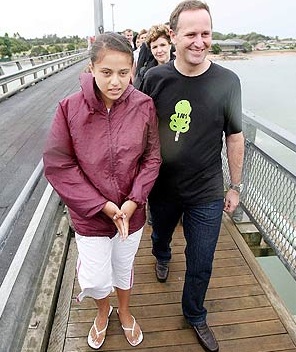
Campbell Live tonight returned to McGehan Close (see the report, by Tony Field, here). This street in Mt Albert — on the boundary of Helen Clark’s and Phil Goff’s electorates — was visited by then-opposition leader John Key before Waitangi weekend 2007 for a particularly cynical stunt. This was Key’s first big symbolic play as leader of the opposition, and it was a hum-dinger. He had already singled out the residents of this street in that year’s State of the Nation address at a whitebread rugby club in faraway Christchurch, branding them archetypal members of the New Zealand ‘underclass’, and the visit saw him glad-handing and patronising a bunch of poor brown people who’d already been used as shot in the National party propaganda cannons.

The purpose of the speech, and visit, was to install one of the core planks of the National party narrative about the Clark government — that it was at best unconcerned with the plight of said underclass; and at worst, actively cultivated such a demographic, which would be permanently dependent on Labour’s welfare policies and would therefore be a permanent source of electoral support for the Labour party. (So the ‘bribing the bludgers to breed’ theme goes, rarely uttered by anyone with authority in public but a commonplace among the usual proxies; check almost any General Debate thread on Kiwiblog from around that time for instance.) This is absurd in more ways than it’s feasible to explain here, so I won’t bother. Let’s just leave it at ‘the underclass doesn’t really vote’.

Nevertheless, the visit was a roaring success. Key, bearing smiles and gifts and wearing a tiki t-shirt, charmed the residents of McGehan Close and evidently persuaded them both of his party’s goodwill toward them and of its social and economic plan to lift them from their grim circumstances. The event culminated in Key taking 12 year-old Aroha to the Waitangi Day celebrations — a move full of potent symbolism, even if it was seen to be somewhat exploitative. Drawn out over a full week of coverage (at the time a rare commodity for Key, who had replaced Don Brash as leader just before the Christmas break) this was a highly successful stunt and should have been an early warning of Key’s great talent for making cheesy set-piece events ‘work’ and feel human. The sentiment he evoked in the people of McGehan Close was certainly real.

It’s just a pity the ‘ambitious’, ‘aspirational’ policy programme Key promised them wasn’t.

Joan Nathan, Aroha’s mother, remains on the DPB (having been let go from her hastily-arranged job working for National MP Jackie Blue) and struggles more than ever to cope, now with a sixth child. Aroha, now 16, is living in the care of Child, Youth and Family, which Joan says is the best thing for her, since she is unable to provide a decent life for her daughter. Nathan and others, although they believed in and voted for Key, are now disenchanted and universally express the sentiment that the government’s policies favour the rich, not the poor, and that they haven’t been helped one iota by the change of government; in fact, things have gotten worse. Not much of this is different than it was this time last year, when the Sunday Star Times visited the Close.

So far, so obvious, you might say — and it is; indeed this sort of outcome was very widely predicted at the time. But this is important because it is as strong a counter-narrative as exists for the opposition in this election year. It reframes Key as a faker, a charlatan, an opportunist who’ll exploit whatever circumstances will advantage him, without loyalty or the willingness or ability to follow through on his word; as someone whose focus is on boardroom issues rather than on peoples’ wellbeing. Discussing and reading around the topic on twitter this evening I’ve seen considerable criticism of this Campbell Live story as a cheap human-interest stunt, as opportunistic and exploitative (or moreso) than the original event. I couldn’t agree less. It is a clear, unambiguous example of an investigative journalist simply revisiting a story where much was promised, and measuring it against what has actually happened. This is crucial to its narrative value: these events reframe Key by measuring his own defining stunt — his signature trick — against the objective reality of lived experience. Theory and rhetoric versus real people, living in the real world governed by the policy built from that theory and rhetoric. It is a reality check in its purest form.

There are disadvantages to this narrative line, also, and the virulent responses to the Campbell Live report this evening — I believe I saw presenter Rachel Smalley shudder a little whilst reading some of them out — hint at them. One is the obvious suggestion that Joan Nathan and the other residents of McGehan Close could have done better for themselves, but have chosen not to; the victim-blaming routinely visited upon the poor by the less-poor. A more serious and related line of critique is that there’s a recession on, and everyone’s hurting. Or that it’s only been three years, and change takes time.

But hang on a minute — wasn’t the point of the whole point of electing a Key-led National government to take advantage of the resulting step-change which would boost economic growth, job growth, provide better opportunities, an end to welfare dependency, safer communities and a general increase in general socio-economic mobility and wellbeing? Key made all these promises quite explicitly, not just in person to the residents of McGehan Close, but to the whole nation throughout the campaign and at almost every opportunity since. There are no jobs. There are no higher wages, and without these things you can’t exactly buy shares in SOEs. There is no greater social mobility. The ‘underclass’, as exploitatively defined by Key, still exists.

Having failed McGehan Close, John Key has failed all of us. Quite apart from the fact that we were all promised these things, or things like them, and by and large have yet to receive them, a central theme of the ‘underclass’ policy argument was that by lifting people out of poverty and bringing then into the ‘overclass’ (? — this shows just how meaningless ‘underclass’ is except as a propaganda term), the government would make society better for everyone. This is a noble goal, and one I agree with in its idealistic entirety. I think you would go a long way to find someone in a position of any political credibility who’d publicly disagree with it. The first order of business for any opposition should be to hold John Key to those promises, and demand of Key the wealthier, more mobile, and socially healthier society we were promised.

But the most vicious response will be the one which the initial stunt in 2007 was meant to evoke — the notion that the ‘underclass’ are breeding in order to get more welfare from the Labour party. The core of this line of reasoning, if I may call it that, will be attacks on Nathan herself as a mother, having had a sixth baby and having had Aroha, the subject of the initial stunt, removed from her care. The attacks will be highly personalised, racist and gendered, and they will be lashed closely to Labour party policy and doctrine. But, assuming a competent and spirited opposition, that’s ok — the National party aren’t in opposition, 18 months out from an election; they’re in government in election year. Having been elected on a moderate, sympathetic platform with strong support from women and Māori, and looking to consolidate that platform into a strong and honestly-won mandate means that the government no longer has such freedom to dog-whistle. Particularly given that an opposition counter-narrative would cast doubt on all those sympathetic characteristics, the resort to the divisive tactics of 2008, such as trying to wedge ‘hard-working kiwis’ against the ‘underclass’, and so on, would be extremely risky for the government.

In light of my last post, perhaps it is a little glib to assume a competent and spirited opposition, and in perfect truth I don’t really think Labour has this fight in them (although Grant Robertson saw the Campbell Live piece and seems to have had a similar response to mine, which is heartening). But it is an argument waiting to be had, and one which must be had sooner or later. The boundaries are drawn up; media interest is already piqued, and this is a bread-and-butter social and economic justice issue for Labour. There’s a wealth of symbolic material and slogans to employ — ‘reality check’ and ‘by failing McGehan Close Key has failed us all’ are two they can have for free, and if a Labour party can’t base a campaign around ‘underclass‘ then they’re not worthy of the name.

Time to engage.

L

Who are the next generation of NZ Left Thinkers?

I almost choked on my chardonnay when I read over the weekend a quote from Chris Trotter stating that Bomber Bradbury represented the future of NZ Left thinking. Martin is a genial enough, alternative-minded, progressive niche market entertainer with strong opinions, generally good intentions and a decent grasp of current affairs. But Chris must have dropped an E to be that generous in his assessment of Bomber’s contributions to NZ’s Left intelligentsia. He also mentioned Jordan Carter as an up-and-coming Labour strategist, which seems to be less a product of party drug induced rapture and more of a wide-spread consensus amongst Lefty consignieri (and Labour Party consiglieri) about Jordan’s talents as a party strategist.

That got me to thinking about who are the next generation of NZ’s Left thinkers. I have had a fair share of young progressives pass through my classes while engaged in university teaching in Aotearoa (including, I believe, both Jordan and Bomber), which makes me wonder who in the under 40-generation will inherit the mantle that Chris, Matt McCarten, Laila Harre and very few others currently represent (not that I think that the over 40’s are finished in terms of their contributions to activism and Left political thought–it is the future of the ideological school that has been piqued in my mind by Chris’s comment). Note that I am not thinking exclusively of activists, academicians or politicians, and am trying to get an idea of the wide swathe of young Left thinkers that may be out there.

I of course am biased in favour of my colleagues here on KP Anita and Lew, who I think represent the sharper edge of Left-leaning bloggers. Idiot Savant is another blogger who seems to fit the bill, as do some of the authors at The Hand Mirror, and some of the folk over at the Standard exhibit intellectual depth beyond their obvious partisan ties. Bryce Edwards might be one who straddles the gap between blogging and academia (although truth be told, I know little of Bryce’s scholarly writing and am quite aware that there are very few quality Left academicians in NZ social science departments–most are po-mo or derivationist navel-gazing PC knee jerkers with little to offer by the way of contribution to modern Marxist, neo-Marxist or post-Marxist debates). There are bound to be young Maori who can contribute to future Left debates from more than a reflexive, grievance-based perspective. Of the neo-Gramscians, Kate Nicholls is a personal favorite of mine, but I am too close to her to be fully objective. For their part, I do not think that Stalinist or Trotskyites represent the future of NZ Left praxis, much less thought.

The issue is important because unless the NZ Left can rejuvenate itself intellectually and separate its scholarly tradition from the base practice of partisan politics and street-level activism, then it will cede the field of reasoned debate to the intellectual Right, something that in turn will have negative consequences for the overall prospects of progressive change in the country. In other words, the Left needs to reproduce itself intellectually as well as politically if it is to compete in the market of ideas that in turn influences the way in which the very concepts of politics, citizenship, rights, entitlements and obligations are addressed.

I therefore pose the question to KP readers: who would be on your short list of young NZ Left intellectuals who represent the future of progressive thought in Aotearoa?

Stay classy, Atlases

VEXNEWS‘ headline, while verbose, really does nail it: GREEDY GERRY: Heartless Harvey fiddles at lavish Gold Coast party while Queensland drowns.

That’s Gerry Harvey, of Harvey Norman; and John Singleton, who (with Harvey) owns a thoroughbred brokerage aptly named ‘Magic Millions’. This photo and others were taken at its launch while much of the rest of the state of Queensland was underwater. From the article, with my emphasis:

When asked by a reasonably friendly Gold Coast Bulletin scribe about whether continuing the event in light of the hardship endured by the rest of Queensland, Harvey’s partner John Singleton’s response showed a remarkable lack of sensitivity even by the vulgar standards of the average Sydney spiv: “You feel a bit guilty having a good time when you see what is happening in other parts of Queensland and northern NSW, but on the other hand the Aussie way is life goes on.” Charming.

Context, however, is everything. There’s a good reference to the fall of Rome in there, but here’s the real bit of background which brings it home:

Gerry Harvey is closely associated with the brand of his many outlets where so many Australians buy the goods that furnish their homes. Many (fortunate enough to be insured) Queenslanders will come to file into these outlets in the days and months ahead when they want to replace all the things they lost. He stands to make (yet another) fortune. You’d think the man would show a little more decency during this sobering time for our country.

Well, you would — but in fact, it’s worse than that. Many of those worst affected by flooding actually aren’t insured for it — because insurers expressly exclude flood damage from their policies. Most cover storms (falling water in the local area) but not flooding (rising water, or that which originated elsewhere). The Queensland Department of Primary Industry has a summary:

A major obstacle that delays insurance claims is the different definitions for flood and inundation in insurance policies. The Australian Securities and Investments Commission (ASIC) defines ‘flood’ as:
“In general terms, flood damage refers to the inundation of a property by water which overflows from a natural watercourse, while storm and tempest damage refers to the inundation of a property by water as the result of a storm.”
Therefore, some inundation risks are covered by the term ‘flood’.
According to ASIC’s Consumer Understanding of Flood Insurance Report, both types of damage are usually linked to a storm, and a property may be inundated by both water from the storm and water overflowing from a natural watercourse. However, most insurance policies don’t cover damage to a property if caused by:
* inundation of water flowing from a natural watercourse
* inundation of water from both the storm and overflow of a natural watercourse (unless most of the damage is caused by stormwater)
* other phenomena, such as earth movement, even though this may itself have been caused by water from a storm.
The Insurance Council of Australia advises consumers to review the terms and conditions of their cover in their Policy Disclosure Statement.
If in doubt, contact your insurer.

It makes sense, as an insurer, to decline to offer cover for anything which might actually cost money; and there abides a regulatory environment which permits insurers to do just this. The topic, and related problems resulting from poor government policy, are covered in some detail in a column by La Trobe University disaster researcher Rachel Carter in today’s Australian. Consequently, despite the present floods being declared the most severe disaster in Queensland’s history and with some discussion today that it may be the worst in the history of the Commonwealth, insurers were, a few days ago, saying that the losses to their industry would be modest.

(Sidebar: if you’ve not connected the dots, this is the same insurance industry to which the Key government intends to deliver ACC early in their second term. Don’t say you weren’t warned.)

And so it is as it ever was: even in an affluent, modern first-world democracy with strong disaster-response agencies, which likes to regard itself as an egalitarian nation where the “little guy” gets a fair suck of the sav — when push comes to shove the big guys make out like bandits, and the little guy goes under.

In both cases, literally.

L

Class, identity, solidarity and dissent

Recently commenter Tiger Mountain raised the parallel between solidarity with Actor’s Equity regarding The Hobbit and support for the māori party given their coalition with National and sponsorship of some bad legislation. I explained how they’re not equivalent, but leaving aside the main difference of mandate (which the māori party has and AE doesn’t) the wider issue of critical solidarity is an important one, and one which has been raised several times recently. In the wake of The Hobbit fiasco matters of class, identity and solidarity are high in everyone’s minds, and I think in spite of our many differences, we can agree that’s a good thing.

Another contribution to the wider debate is by Eddie at The Standard. For once I find myself agreeing with Eddie’s opening sentence about the māori party, which is:

The problem with any identity-based political movement is it pre-supposes that the common identity of its members surpasses their conflicting class interests.

It’s true, although I would have phrased it as follows:

The problem with any class-based political movement is it pre-supposes that the common class of its members surpasses their conflicting identity interests.

I wrote at length about this dynamic tension at a time when it looked like Labour was going to force Māori to choose between their class identity and their identity as tangata whenua — and how foolish forcing such a choice would be. (It’s still not clear whether Labour has abandoned it, but it at least seems obvious that they don’t have a full-blooded commitment to the blue collars, red necks strategy. But that’s by the way.)

What tends to follow from statements like that one is a series of value judgements about which set of interests ought to take precedence. This can be valuable, but is often tiresome, particularly when those making the pronouncements are “fighting a corner” for only one half of the equation (usually, it must be said, the “class” corner). But Eddie has mostly (not entirely) resisted the urge to do so and focused on the internal dispute within the māori party, and in particular the rather dictatorial stance taken by Tariana Turia regarding opposition to the new Marine & Coastal Area (hereafter MCA) Bill. That’s an important debate and examination of it is valuable, but what’s not really valuable is Eddie’s attempt to frame Turia’s stance as a matter of māori identity v class identity. It’s not. It’s a matter of the tension between moderate and radical factions within the movement; part of the internal debate within Māoridom.

Class is an element of this internal debate, but it is not the only element, and I would argue it is not even the predominant element. I think it’s clear that the conciliatory, collaborative, third-way sort of approach to tino rangatiratanga taken by Turia and Sharples under the guidance of Whatarangi Winiata (and whose work seems likely to be continued by new president Pem Bird is the predominant force. I also think the main reason for the left’s glee at the ascendance of the more radical faction is largely due to the fact that there’s a National government at present (and recall how different things were when the boot was on the other foot from 2005-2008). Those leading the radical charge against the MCA bill — notably Hone Harawira, Annette Sykes and Moana Jackson (whose primer on the bill is required reading) are not Marxists or class advocates so much as they are staunch advocates for tino rangatiratanga, who oppose the bill not so much for reasons based on class, but for reasons based on kaupapa Māori notions of justice. The perspectives of all three are informed by these sorts of traditionally-leftist analyses, but those analyses are certainly not at the fore in this dispute (as they have been in some past disputes). In fact, the strongest (you could say “least refined”) Marxist critiques of the bill advocate for wholesale nationalisation of the F&S, unapologetically trampling on residual property rights held by tangata whenua in favour of collective ownership.

For Eddie’s caricature of the dispute as “identity” v “class” to hold strictly, Turia, Sharples, Flavell and Katene would need to occupy the “authentic” kaupapa Māori position, the legitimate claim of acting in the pure interests of mana motuhake and tino rangatiratanga; while Harawira, Sykes and Jackson (among others) would need to be largely denuded of this “identity” baggage, and be more or less pure class warriors. Neither is true; Harawira, Sykes and Jackson’s critique of the bill isn’t a Marxist critique; they’re arguing that the bill doesn’t serve the imperative of tino rangatiratanga and is therefore not an authentic kaupapa Māori position; an assertion that Sharples has tacitly accepted with his response that the Maori Party must accept compromise. (This is true, of course; I agree with Sharples and Turia as far as that goes. I just disagree that this bill is the issue upon which to compromise so heavily. Because of that, I come down on the side of Harawira, Sykes and Jackson.)

The other misguided thing is how Eddie frames Turia’s insistence that Harawira and others adhere to the party line as some sort of manifestation of Māori over class identity within the party — the quelling of dissent and insistence on loyalty to the leadership elite’s position as a “Māori” way of doing things, opposed to a “Left” way of doing things. This is absurd. The “left” does not automatically stand in defence of dissent or the public airing of heterodox views, much though Eddie (and I) might wish that it should. As I already mentioned, this is shown by Labour’s response to Turia in 2004 and the māori party’s first full term, suspicious at best and hostile at worst. The AE dispute is also an excellent illustration. In that case, the prevailing, “authentic” left position (including that taken by many writers at The Standard, though not — as far as I can recall — by Eddie) was to insist on total public solidarity with the union. In other words, precisely what Turia is insisting upon. I disagreed with this position in AE’s case, and I disagree with it in the māori party’s case. Dissent of this sort (or the imperative of its suppression) is not some innate part of “the left”, nor is it absence a characteristic of “identity politics”. It can exist or not in movements of either type, depending on the merits and specifics. It’s my view that such dissent is the beating heart of a movement, and it is peril to quash it. It is a shame that Turia seems to be making the same error as Helen Clark made regarding this issue in 2004.

But despite these objections, ultimately I agree with Eddie about one other thing: the dispute is really interesting, and the emergence of radical critiques and challenges within the movement is exciting and important. The māori party has a mandate to agree to the MCA act as drafted; after all, according to Edmund Burke’s famous saying, representatives owe their constituents not only their efforts but their judgement on what is just and right and possible. They’re not elected to always take the easy route of political martyrdom, and because of this they may find themselves staring down their constituents. Sometimes they may win. But nowhere are representatives guaranteed that those constituents must not try to stare back. If those who oppose the bill can raise a hÄ«koi in support of their cause, then let them do so, and more strength to their waewae. And let members of the “left” movements, if their enmity to the bill is genuine, rather than a reflexive attack on a National-led government and the māori party orthodoxy which supports it, march alongside them in solidarity. That will be some sort of justice.

L

Enemies like these

I’m getting used to being vilified by the orthodox Marxist left, such as in the latest round of debate with Chris Trotter and some of his commenters, and to an extent in the response by Scott Hamilton. I don’t mind all that much, but it’s rather aimless. The critique that I’m not orthodox enough, not a proper red; that my sense class consciousness is atrophied — it all misses the point somewhat. I’m not a socialist; never have been. I’m a liberal social democrat, with strong emphasis on the “democrat”.

I’m a trade unionist because of this commitment to democracy. Unions, properly run, are strongly democratic — and their democracy enhances the more usual parliamentary and representative forms which govern our society. The question in the AE case, the matter over which I disagree with Chris and Scott and the orthodox Marxists is: from what does a trade union derive its moral authority? From the democratic mandate granted it by the workers it represents and the extent to which its actions serve their interests, or from its ideological rectitude and adherence to Marxist doctrine? I’d argue that both are necessary; the movement’s activities must be informed by a class analysis, but fundamentally the union exists to enact the wishes of its membership. The job of union organisers and so on is to educate and motivate that membership to commit to class struggle. The argument Chris and Scott are making, as if it’s an irreducible truth of trade unionism, is that the ideological rectitude on its own is enough. The quality or value of a union’s actions must not be assessed or tested against their workers’ stated needs, they say; if whatever a self-declared union and its handful of activist representatives decides to do passes the Marxist sniff-test, then anyone who fails to fall into lockstep behind it is a scab, and mandate be damned. (I’m not sure they even believe this, really; I think there would be some things even the most die-hard socialists would balk at — which would mean we’re simply disagreeing over the merits of AE’s case, which I think is a much more useful argument to have. I posed a hypothetical question to this effect on Bowalley Road this morning, but have received no responses at the time of writing this.)

But falling automatically into lockstep behind a union’s actions without consideration of whether they’re any good, or whether they serve their industry’s stated needs is bad for society, and it’s dangerous for the unions.

In our liberal democratic society, the right for workers to join a trade union and bargain collectively derives from the democratic nature of union movements; the fact that they enact workers’ wishes. This is the basis of the strong and very legitimate democratic Marxist critique of corporatism; that businesses in a democratic society ought to be democratic. It is also one of the chief arguments deployed in unions’ defence, and it is a very good one in a social and political context where the idea of democracy occupies such a powerful symbolic position. Unions do not enjoy any legitimacy by virtue of their ideological rectitude; in fact, their commitment to Marxist ideological doctrine is a considerable disadvantage in terms of their survival. Because of this, the trade union which relinquishes its commitment to democracy also risks relinquishing its claim to legitimacy, and if trade unions as a whole start to cut corners on democracy, then the movement as a whole risks granting anti-union governments a pretext to weaken and outlaw unions on the basis that they don’t actually represent workers’ interests. This is quite apart from the points I made in my last post on this topic, to the effect that non-democratic institutions tend to make bad decisions because they lack robust internal processes for developing and enacting their agendas.

So my overarching problem with Actor’s Equity acting without a mandate is that they risk the legitimacy of the trade union movement at large. (I initially predicted, in comments at the Dim Post, that the fallout would be contained by the wider movement — how wrong I was.) I try never to give my allies a pass for incompetence. Doing so breeds more incompetence. I didn’t give Labour a pass for the Foreshore & Seabed Act and I’m not giving a pass to the māori party as they look to be supporting a similarly expropriative replacement bill. So there’s no way I’m going to overlook the real and serious damage caused to the trade union movement and the cause of workers’ rights by this upstart union who took excessive action without a mandate. They’ve done real and genuine harm to the trade union movement and they’ve made industrial relations — which should have been a Labour’s trump suit — an easy source of tricks for the government. And this at the very time the union movement was beginning to gather strength again! There was an anti-union protest on Labour Day — how much worse do things have to get? Sure, blame the Tory government, or the ‘right-wing media’ or the falsely-conscious running-dogs; and to an extent this is justified. The government must bear sole responsibility for the legislation they’re passing, for instance; the details of that bill cannot be blamed on AE. But AE provided them the cover to pass it without much controversy; and indeed, none of these agencies enjoyed the political and symbolic freedom to unleash the sort of anti-worker tirades they have in recent weeks until AE’s egregious overreach — all with the full blessing of Trotter and Hamilton, almost everyone writing and commenting at The Standard and all those orthodox Marxists who claim to be champions of the worker. With enemies like these, Key and his government — and their ideological fellow-travelers — have no need of friends.

L

Lessons from The Hobbit: more unionisation, not less

The Hobbit saga has been an ugly but edifying lesson in the realities of how industrial action interacts with political posturing and national identity. My own view is that Actor’s Equity did their industry and their country — I would say ‘their membership’, but when they set this ball rolling they didn’t have one — an enormous disservice. Lacking a mandate and any legal standing, they undertook almost the worst possible course of action of calling an international SAG boycott. They attempted to hold a national icon and his nationally-iconic production to ransom at the apparent behest of an Australian union (the MEAA) with a history of this sort of aggressive mismanagement and who stands to gain from any reputational damage suffered by the New Zealand film industry. Their cause is worthy, but they picked the wrong fight with the wrong person at the wrong time, on the wrong basis, employing the wrong tactics, and did so without the support of their industry. Almost everything they could do to lose this battle, they did.

But too much has already been written on that topic, and I won’t add to it any further. The point I’d rather make is that the incompetence shown by AE in this dispute would never have thrived in a more robust industrial relations culture: that is to say, one in which union membership and participation was the norm rather than the exception, in which more workers had an understanding of what their union was there for and the union in question understood their industry’s needs and agenda better.

Fundamentally, the entire problem here is AE’s lack of a mandate: even leaving aside the fact that they had no legal standing as a NZ union until this time last week, the trouble is that they represent a tiny fraction of the actors who form a tiny fraction of those responsible for the production of any film, and yet they have the apparent ability to blacklist that entire industry (whom they don’t represent). Even the most ardent trade unionist can surely see the moral hazard here. All those who we’ve seen fronting AE have been the best-respected and most-established actors; actors whose careers aren’t in material danger regardless of the outcome of The Hobbit. But what of those actors who are genuinely struggling, whose faces don’t appear in tens of thousands of living rooms every Tuesday night, and who don’t top “best-of” lists? And what of the silent legions of drivers, designers, artists, labourers, riggers, electricians, carpenters and caterers who are the real motive engine behind the film industry? Are their needs well-served by the actions of a few prima donnas who represent them without their consent? Apparently not, which is why a thousand of them turned out to protest the actions of that unelected few. Orcs, Chris Trotter called them; useful idiots said Idiot/Savant.

To an extent it’s their fault for not being adequately organised to mount a counter-insurgency against AE’s hijack of their industry. And that’s why my suggestion is for film industry workers to arm themselves and prepare to fight for their needs. Whether it’s in separate unions by sector or a single, unified screen workers’ union doesn’t much matter, as long as there is strong and robust organisation behind it which elects leaders who hold a genuine mandate to speak for the real needs of their industry. Nature abhors a vaccuum, and the only way that a handful of pretty faces and household names with little or no industrial relations experience and an Australian carpetbagger with a reputation for mischief-making get to speak for an entire industry is when the alternative is nothing. Conventional wisdom — particularly from the government — is to de-unionise, and already the veiled threats about the consequences of a general strike during the 2011 Rugby World Cup are beginning. But de-unionisation at a time like this simply cedes the field. Efforts must be redoubled — not only to negotiate the sorts of concessions gained by Irish actors for collective bargaining among independent contractors, but to ensure that whoever claims to have a union mandate in future has the crowd with the torches and pitchforks following them, rather than chasing them.

L

Unions are to capitalism what opposition parties are to government.

In the debates about the proposed labour law reforms there appears to be fundamental misunderstanding or ignorance by National and ACT of the purpose of unions in capitalism. The latter are seen by NACT as at best a source of inefficiency and profit loss; at worst parasitic wealth destroyers. They appear to misunderstand that capitalism left to its own devices, with no collective counter-weight provided to workers, is akin to a political regime without opposition parties. That is, it is inherently an authoritarian status quo in which owners rule and workers obey. Thus, if we hold it self-evident that democracy is a better form of regime than dictatorship precisely because it allows for the existence of a freely organised competitive political opposition that can contest power and times compete for it, then we must also recognise that capitalism needs unions in order to be representative and fair to the society at large. The trade off between democracy and capitalism is exactly that: a diminished rate of exploitation in direct proportion to the measure of voice exercised by workers in pursuit of a fair share for all.

That is why unions were organised in the first place: to bring a subordinate group vehicle of voice and redress to the economic system. Whatever their very evident flaws (Leninist organisation, iron law of oligarchy bureaucratic rationales), unions provide a democratic counter-weight to unfettered capitalist exploitation. Just as it is preferable not to have a closed, unaccountable (or at least vertically unaccountable) oligarchical elite run the affairs of state, so too is it undesirable, from a democratic perspective, to have a closed, vertically unaccountable economic elite determine the social relations of production. If one believes in democratic capitalism, one must believe in a central partnership role for unions within it.

This is true whether labour-based or capitalist-oriented parties are in power, since in capitalist societies the material welfare of all is dependent on the investment decisions of capitalists. But capitalists need workers to realise their investment, and workers need to be productive for profits to occur. There is consequently a structural bias in favour of providing the working conditions and larger social context in which profitable production can occur over the long term. For that to happen workers need to accept the system as given, which is a function of them perceiving a partnership stake in it. That means a modicum of voice and representation. Democratic capitalists consequently understand the need to exchange super-exploitation and authoritarian control of the workplace for increased working class representation in both politics and production. In turn workers (and their political representatives) accept the capitalist foundations of society and the dominant role of capitalists within it (in other words, they forego a move towards socialism). This exchange is at the heart of democratic capitalism. Although negotiating the margins of the democratic capitalist social contract can occur depending on the nature of the government in power, “touching the essential” aspects of it is not.

Authoritarian capitalism offers many short term advantages to business, but it does not guarantee long term gains. Unmitigated authoritarian exploitation, be it in the workplace, politics or both, breeds resentment. Born of a lack of consent to the dominant system, resentment can be manifest in everything from petty acts of social defiance to industrial sabotage to revolution. Short term acquiescence may be bought with material rewards, but the long-term picture remains clouded so long as workers do not buy in to the system as given and instead resent their subordinate status in it. Absent mass consent and given the inevitability of working class resentment, the resort to the “weapons of the weak” negatively impinges on profit, if for no other reason then that the costs of repression grow larger the longer authoritarian control is maintained. After all, you cannot repress the same amount of people in the same measure over time.  Since capitalists abhor uncertainty and seek stable rates of secure return, a peaceful, consent based socio-economic and political order is preferable to an imposed one. That gives economic utility to democratic capitalism.

In fact, where democratic capitalist systems work best (hegemonically, as it were), many if not most workers strive to become capitalists themselves (small businesspersons, at a minimum). They see themselves on a continuum of upward mobility based on workplace fair play and merit. Socialism is not their preferred option. The proof is in the mythos: is this not the Kiwi, Ozzie and American dream?

Here is where NACTs reforms and the demands of the employer class says much about their true orientation. They claim belief in freedom of choice and the benefits of market competition as the great levelers of social ambition. If that were true, then they would welcome workers to freely organise without legal constraint or negative repercussion because true market competition and workers freedom of choice would improve overall economic (labour) market efficiency. After all, according to their own logic, the market works best when all have equality of opportunity, and it clears best when all actors enter into the market exchange exercising their full potential as free agents involved in the mutual supply and demand of goods and services. So if workers exercising their free choice want unions, then more the better from a market perspective. Why put constraints on that freedom?

Yet in practice NACT seeks to place constraints on working class collective choice and voice so as to better exercise owner/manager prerogatives in the workplace. They are, in other words, hypocrites who do not really believe in the power of the free market or closet authoritarians out of ignorance (unlikely) or by design. Or both. No amount of political spinning can disguise that fact.

What is more, NACT does not appear to comprehend, from a cynical perspective, that allowing for unionisation, including union workplace access, while reducing limitations on the right to strike and collectively bargain across economic sectors can actually serve very usefully as an alienation device in which workers are led to believe that they are real partners in production in a system in which the fruits (surplus value) of their labour are appropriated by others (in a variant of Lenin’s “democracy as capitalism’s best possible political shell” argument). Although unfettered collective action has the potential to open the door to worker challenges to control of production, the reality is that in democratic capitalism private ownership is reified from birth to grave and most workers live with the dream of being bourgeois in culture and consumption if not employment. So whether cynically or sincerely committed to workplace democracy, enlightened capitalists understand the long-term political utility of union representation in democratic society. NACT and its business supporters appear to be anything but enlightened.

As I mentioned in my previous post on the matter (“The Blues Go Black”), the proposed reforms owe their inspiration to the Pinochet Labour Code. The question is whether NACT have the same view of unions as Pinochet and “Pepe” Pinera did, and if so, why do they make any pretense as to being democratic? Could it be that what we are seeing in NZ is the first attempts to turn the economic bases of the democratic social contract into something akin to unchecked elite imposition under manipulated electoral conditions?