Mamdani’s monster move.

The shouting about communist/socialist/Marxist/Islamist by the US Right when it comes to Zohran Mamdani suggests they live in a 1950s McCarthyite time warp and/or an ideological ignorance bubble. Besides a social democratic being none of the above, the operative term in the phrase is “democratic.” He was elected in a landslide on a working class focused platform that was well known and well received across the electoral demographic (age, gender, religion race, etc.)”. Although the Right did its dishonest best to smear him with the usual culture wars and “Reds under the beds” fear-mongering, it may be the case that after years of corrupt NYC machine politics-as-usual that catered to the interests of the corporate and oligarchical classes, voters are willing to try something new. 

“New” means a move to the center-Left. Mamdani is no radical extremist no matter what the rabid Right mouth-frothers say about him. NYC has never had a social democratic mayor and given what has come before, especially recently, perhaps voters decided to not listen to the troglodytes and try something different when it comes to a governance approach.

Mamdani still has to deal with a city council, borough governments, state government and people within his own party who will force him to compromise in order to be effective. But shifting the starting point to the policy Left after years of the city government maintaining a corporate-Right bias could just break the hold of embedded vested interests when it comes to how the public purse is distributed. That can only be a good thing, especially if working and middle class socio-economic wellbeing is a major focus.

Best of all, even if NYC is not representative of the entire nation (far from it), Mamdani is an absolute nightmare for the MAGA morons in and out of government at all levels. That is because should he be successful and cast his eyes an even higher federal office, there is bound to be a lot of bed-wetting in Red States and in red parts of DC as a result.

That should be fun to watch.

On a personal note, the rightwing hysteria about Mamdani’s “Marxism” brought back memories of when I underwent my first Top Secret US security clearance interview and polygraph test (in the early 1990s). I was asked if I had ever been a member of a Communist Party or advocated for the overthrow of the US government. Although I had affiliations with left-wing groups in Argentina and then elsewhere as a teenager and young adult, I could honestly say that I was never a member of any Communist Party (basically because most CPs of that era were pro-soviet Stalinists and I was and am not into Stalinists). I could also honestly say that I did not advocate the overthrow of the US government, although I certainly advocated for the overthrow of US client dictatorships in Latin America and elsewhere.

So I said “no” to both questions and passed that part of the exam. In the long form interview I explained to my interviewers from the Defence Intelligence Agency (DIA) that I was a Peronist symnpathizer-turned-neo-Gramscian analytic Marxist whose political sympathies tended towards what was then called the “Eurocommunist” line. I tried to be helpful and told them that they should try to be more specific in their questioning, since there were significant differences between Maoists, Leninists, Trotskyites and other Marxist derivatives. In response (and I kid you not, dear readers), the interviewers literally rolled their eyes, looked at each other, shook their heads and mouthed the letters “W-T-F?” After a long pause, the lead guy said to me “we do not care whatever you were and are so long as you are not a commie.” That was the state of play when it came to official Defence Department understanding of Marxism in the year Bill Clinton came to office.

They then moved on to ask me if I “liked” men. What ensued was an interesting discussion about the meaning of “liking men” and in what context. Their basic line was that they did not care whether I “liked men” or not, but that they simply had to know in the event that I was blackmailed given my new job. My then Navy Officer girlfriend was highly amused by this when I told her about the interview and offered to vouch for my, er, “proclivities.”

Anyway, I passed the test and headed off to the Pentagon with my clearance secured. I met a fair amount of closet commies and man-likers once there.

Mamdani was not among them.

Comparative value versus comparative worth.

Recent NACTFirst government assaults on female pay equity, public sector employment, labour regulations and other worker’s rights (to say nothing of trying to roll back Maori Treaty rights and enshrine the primacy of property right in NZ law), got me to thinking about how we measure value and worth in society. I tend to think of society being made of contributors and freeloaders. Contributors add value to their communities, be they large or small. They can be paid or unpaid, employed or volunteers, able-bodied or disabled. To me, these people are of high value and therefore of high worth. Freeloaders, on the other hand, are those who ride on the backs of others’ contributions. They can be criminals or hedge fund managers, financial advisors and consultants, rightwing bloggers and conspiracy theorists, gossip columnists or politicians. They do not create value in or for society. They appropriate worth when they can by appraising and selling themselves for more than their real value.

To be clear, this measure is not about surplus value in production and by whom it is appropriated. It is about the relationship between real value and actual worth, which may or may not be related.

Three illustrations of the spurious relationship of value and worth come to mind. There is an old saying in Latin America that a great bargain is to buy a person for their real value and then sell them for what they say they are worth. On another front, someone I know runs a financial advisory service where he caters to what he initially called “high value people.” When it was pointed out to him that he was conflating material worth with human value, he changed his firm’s logo but we have not had a good relationship since (he caters to clients with disposable investment assets of USD 10 million or more, including professional athletes). In a similar but opposite vein, my late mother, an organic intellectual if there ever was one, used to say that our wage scales are completely upside down. We should pay rubbish collectors and sewer cleaners the highest salaries and pay professional athletes and entertainers the minimum wage. Her reasoning was that athletes and entertainers provide some value to society but will receive many more benefits, material and otherwise, from the public adulation that they engender, and they will receive these benefits long after their active careers are done. Their material worth far exceeds their social value.

Conversely, those who do what in India is considered Untouchable work are essential to the good functioning of modern society and in fact critical to maintaining public health and well-being. Because of the nature of their work and the negative exposures involved in it, their careers are short and often brutish. And yet in modern society the reverse is true when it comes to their value and worth. They are paid far less (as a measure of worth) than their actual value to society. Why is that? Even if we factor in things like education, entrepreneurship and other intervening variables and admit for the existence of objectively fair measures of value and worth (and by this I do not mean the stupid comparisons of nurses and teachers versus cops and firefighter’s pay or any other gendered work comparisons), it seems that oftentimes the relationship between actual societal value and perceived worth is perversely skewed in inversely proportional ways.

That brings me back to the secondary teacher’s strike this past week. Although I left academia over a decade ago before the academic Taylorists turned universities into scholastic sweatshops whose focus is on revenue generation rather than intellectual advancement, and who believe that Science, Technology, Engineering and Mathematics (now sometimes replaced by “Economics and Management” as the back end of the “STEM” mantra) should be the sole focus of university research and teaching (eliminating the Arts and Social Sciences), I maintain contacts with a number of academics who have managed to keep their jobs and still pursue the life of the mind while teaching within the limits of current Taylorist curriculum paradigms and business models.

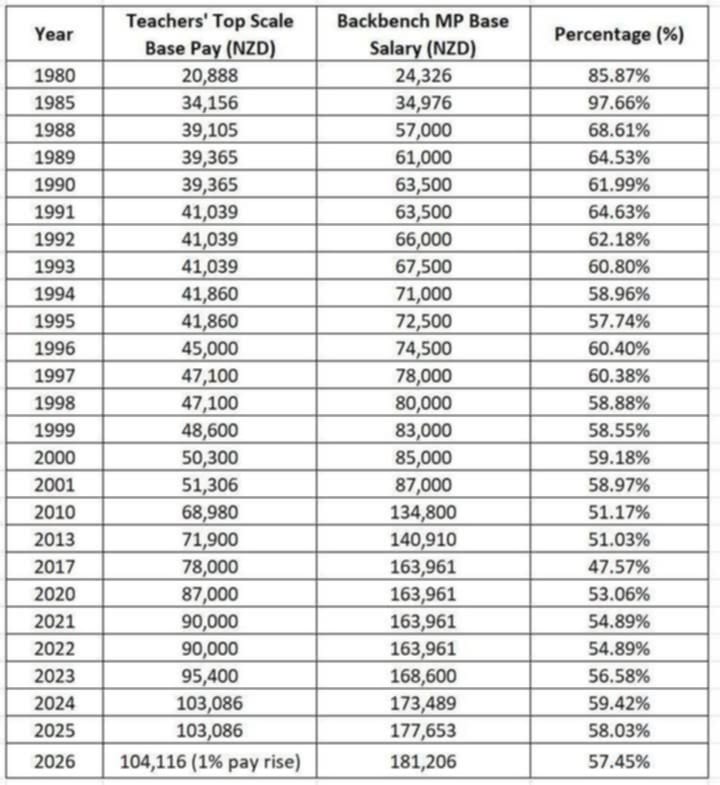
One of these contacts has just been made redundant by the NZ university to which they are affiliated (which is in the process of dismantling its social science programs while still recruiting students for admission in to them), so is considering turning to secondary school teaching as a new career path. They are also thinking about working in a policy analyst role, including in a parliamentary or political party setting. As part of the research and preparation process for that transition, and in light of the current stand-off between the government and secondary teacher’s union about cost-of-living (COLA) wage increases, they reached out to fellow colleagues who do research on related subjects in order to get a comparative idea of wages in those career fields. Although there are a number of interesting facts that came from the materials that my contact received that are worth discussing at another time, this one was shared with me. It involves the comparative base remuneration of backbench MPs and the upper end of teacher’s pay scales.

The data begs some questions. Who brings more value to NZ society, MPs or teachers? How is their value measured? What is worth more to NZ society, politicians or teachers? How is their (comparative) worth measured? Comparatively speaking, in terms of their contributions to NZ society, who is valued more and who is worth more? More broadly, is there a relationship between value and worth in NZ?

As for the specifics of the chart. Why is is the worth of backbench MPs (as measured in wages) significantly higher than that of the most experienced and well paid teachers? Since MPs also receive non-wage benefits such as accomodation and travel allowances and are often “comped” by lobbyists and other interlocutors in the form of meals and other incidentals, why is the wage gap between them and the most experienced teachers so significant? As for work equivalence, it can be argued that both MPs and teachers work long hours beyond their assigned time in class or in the parliament debating chamber, and both sacrifice family life and other leisure pursuits in order to do so. Both have formal work hours and yet engage in much informal work (say, coaching sports teams or participating in civic groups). Both MPs and teachers have invested much time and resources into their own educations and qualifications as well as through practical experience. So why the difference in worth if their value to society is similar if not equal? Or is their value not equal and hence their worth simply reflects the difference?

That last question is key. Does NZ society value MPs more than teachers and thus pay them more as a measure of their worth? Admitting for a degree of autonomy in setting institutional wage standards, are the average parliamentarians worth that much more than the most experienced teachers? Is their comparative worth–and that of teachers–based on any measure of value?

Perhaps there is a market-based answer to the question such as “politicians are rare gems that are hard to find while teachers are a dime a dozen because they are like pebbles on a beach, etc.” But even if this were true, perhaps scarcity of a resource is not a true measure of value. Memecoins such as $TRUMP may be worth much (+USD8.36/coin with a market cap of over USD 1.6 billion) but do they have any intrinsic or tangible value?

I will leave it for readers to ponder these questions and the more general question about the relationship of social value and material worth. However, one thing should be clear. Only when that relationship is defined and put into practice can we begin to speak of working towards a fair and equitable democratic capitalist society.

The Green’s Identity Bubble Problem.

The scurrilous attacks on Benjamin Doyle, a list Green MP, over his supposed inappropriate behaviour towards children has dominated headlines and social media this past week, led by frothing Rightwing agitators clutching their pearls and fanning the flames of moral panic over pedophiles and and perverts. Winston Peter decided that it would be good to amplify the defamatory claims from his perch as Deputy Prime Minister and Party Leader, relying on rhetorical questions (where is the media?) and innuendo to megaphone the venomous narrative while avoiding legal liability for defamation. The pile-on is despicable.

Besides the obvious partisan basis for the attacks on Doyle and the Green Party co-leaders for defending (in somewhat pedantic and condescending terms) their colleague, the Rightwinger’s alarm about what I will call “the kiss”–a chaste lip-to-lip “smooch” between father and very young son–betrays deep-seated heterosexual repression that is Barry Crump-ish in nature. It avoids the fact that in many cultures men kiss their children on the lips well into pubescence and that men and boys hug and kiss each other and even hold hands in public. I grew up in Argentina, and if one looks at how the World Cup champions celebrate their victories you will see a lot of male kissing and father-child lip-kissing going on and no-one thinks to impute untoward sexual intent to any of it. Not all countries are populated by repressed, insecure, heterosexual misogynistic transphobes.

The attacks on Doyle also could well be linked to the ongoing smears levelled against Golriz Ghahraman, the former Green MP who was convicted for shoplifting after an intense months-long public vilification campaign carried out in and echoed by the media and led by notorious Dirty Politics-adjacent actors. It turns out that Ghahraman’s brief detention in a supermarket earlier this year in what was initially described as another shop-lifing attempt was in fact an orchestrated set-up by malicious security guards with dubious connections to the police and social media personalities. The whole thing was a beat up, as are the Doyle accusations, done in part by the same crowd of Rightwing “usual suspects.” Truth be told, the guys–always guys–who disparage her the most seem to be the type of guys that she is not interested in, especially middle aged to elderly Pakeha male public figures. In summary: they hate her because she will never have them (and who knows how many have tried? Someone should ask Sean Plunkett or David Seymour about that because they carry on about her like spurned suitors).

That having been said, the Greens do have a big problem, and it is not just the non-conformist (some would say “weird” or “odd”) lifestyles of some of their members. It is not about their Morris dancing or their lifestyles per se, but about who they select and the way in which they get into parliament. As my former colleague here at KP Lew and other have written on social media in the past few days, the Greens problem is one of candidate vetting, not candidate lifestyles. In fact, I mentioned this concern previously ( a decade or so ago!) when Haley Holt of television fame was placed on the candidate list in a top ten spot. She did not get elected or make list selection due to the Green Party vote that year, but in retrospect she looks positively middle-of-the-road when compared to some of her recent successors!

As I see it, the Greens spend too much time living in an alternative identity bubble, trying to tick as many rainbow and alternative lifestyle boxes as is possible (Doyle claims to be a “pansexual,” something that can lead to many interpretations and in the case of the Right-wingers, the worst possible ones. He confirmed their worst thoughts by using language with sexual undertones in his private social media posts that included the photos of his son). I have heard that they wanted to add polyamory to their electoral platforms, which even Barry Crump may have found a bit rich if he was not in charge of the action. These are not the types of candidate and policy that appeal to the voting majority, and even under MMP that matters for coalition-building purposes.

To be clear: being “odd,” “weird” or “alternative” is not a crime and should not be treated as such (as happened with Doyle). But having those traits can prove detrimental to the Party’s overall fortunes, especially when opponents seize on them to hype their “deviancy” and other supposed criminal behaviour. In the words of the late French sociologist Robert Michels (in a book titled Political Parties), the first duty of an organization is to protect itself.

After all, being transgressive is not always a virtue in politics, especially in an era where culture wars about alternative lifestyles and non-conformity to “traditional” social norms is a cornerstone of Rightwing political agendas. In such an ideological climate, perhaps it is better to put other (non-identity based) policy concerns before identity (and here I respect the Greens stance on the Israel-Palestine conflict, which from a social justice standpoint is well within their purview even it opens them to charges of anti-Semitism either directly or via association while other parties equivocate and quibble about NZ’s position).

The Greens seem to have moved from being an environmental party with a social-democratic policy agenda under Jeanette Fitzsimmons, Sue Bradford, Keith Locke and Ron Donald to keffiyeh-wearing alternative social justice urbanite identitarians who, from an outside-the-beltway perspective such as mine, occasionally hug a tree, stop a logging truck or swim around like dolphins in sheltered coves before re-assembling at the nearest barista shop for mocha latte soy milk cappuccino-fueled social policy strategy sessions with other black-clad or tie-dyed and multi-pierced plural pronoun individuals who think very highly of themselves and stay up way too late at night, to the point that their countenances are as parlous as their personalities.

I am joking of course, and one hopes that the woke can take a joke on this one. Because this piss-take is not equivalent to the hate-speech supporting sociopaths in the Free Speech Union. The joke is not about letting harm be done to the multiple varieties of identitarians; it is about goofing on their self-absorbed lack of serious purpose and self-awareness, and why this does not make for good candidate and policy selection.

I do so in order to make a point. The Greens were episodically effective when they were watermelons–red on the inside and green on the outside. They were fairly effective as “teals”–blue on the inside and green on the outside. But other than people like Chloe Swarbrick, who is in fact a smart and effective politician, and perhaps Steve Abel as an environmental purist, the Green Party has become a hodgepodge of virtue signalling identitarian grievance and defence. It is increasingly not relatable to anything other than those in their identity bubbles and while individuals like Swarbrick may be able to carry the party on her election coattails, they appear to be enmeshed in a self-inflicted political death spiral due to the character of their caucus. Think of the MPs that the Greens have lost in recent years outside of the electoral cycle and who they have been replaced with. Think of the dramas associated with these departures and the behaviour of some of those still sitting on their benches. With some exceptions, they come across as unserious people pursuing unpopular agendas. No wonder they are seen as easy pickings for bullying political hyenas like Peters and Shane Jones.

Contrast that with Te Pati Maori (TPM). Whatever you want to say about them, TPM clearly know how to vet and select people who conform to their unified policy agenda. Their agenda may seem like a lot of symbolic politics without substance and with some buffoonery thrown in, and there may be some dodgy connections between them and people like John Tamihere and his Waipareira Trust (sort of along the lines of ACT and the tobacco lobby or NZ1st and the fishing and mining lobbies) but two things stand out in contrast to the Greens: 1) the TPM “bubble” is activist and united at its ethnic and ideological core (including a class line), not an disparate assortment of identitarians representing different socially marginalised groups; 2) party discipline is strong. The feet follow the head and the head knows what the feet are doing in the long march ahead.

It will be interesting to see how the Greens do in the next elections. I have a feeling that the gains that they have made in recent years will be reversed even if a Labour-led coalition is elected. I am also curious to see how TPM does, because it seems to be targeting Labour’s left and Maori flanks with its more militant and confrontational appeals. For the moment, however, and again repudiating the reprehensible attacks on Doyle, Ghahraman, Tamatha Paul and Ricardo Mendez-March (the latter for for being foreign-born), the main problem for the Green Party is that it is self-inflicted because of a lack of proper candidate selection criteria and process as well as candidate education as to what is expected of them (including their use of social media and other aspects of their personal behaviour) and how they will be treated by their opponents and media.

Benjamin Doyle haș gone to ground under an apparent barrage of death threats and has suspended the social media account that led to them. But such after-the-fact actions do not remedy what was an avoidable controversy in the first place. All that was needed was some good sense, a modicum of decorum, and a candidate selection process that is based not so much on ticking off identity boxes as it is about electing and/or listing serious people with a common policy agenda that transcends post-modern identity politics while retaining a common social justice focus that is centred in and on environmental politics with a (waged) class orientation.

After all, as the saying goes, politics is the art of the possible. What the Greens have been doing as of late is quite the opposite.

Te Pati Loco?

Normally I would not write about Maori issues. I may have been living in NZ for over 25 years but I do not feel that it is my place to opine because I am not an expert on Maori history and politics and do not speak Te Reo (because as anyone who seriously studies comparative politics will attest, foreign language proficiency is a bottom line requirement for scholarship in the field unless you only study countries and cultures that speak your mother tongue). Hence in the past I deferred to Lew to write about Maori issues here at KP, but since he has departed there is no one left to do so.

However, in light of the recent carkoi and protests organised by Te Pati Maori (TPM) in response to the Coalition of Cruelty’s budget, I thought I would touch briefly on a matter of Te Pati Maori praxis. I was dragged into the debate about the protests when I noted on social media that the use of the term “strike” to characterise the direct action was done in error or for dramatic effect since “strike” is codified in employment law as a collective withholding of labour services by employees from employers in the context of workplace disputes. If the labour service withdrawal is called by collective agents and follows the procedures for engaging in such action (giving notice, etc.) then it is a strike “proper.” if it is done by individuals or groups of workers without collective authorization, then it is a “wildcat” strike that may be deemed unlawful by employment courts. A general strike is a labour service withdrawal across economic sectors done for economic and/or political purposes, which is difficult because it requires unity of purpose and action by employees working in different productive areas, which in turn requires agreement between union agents and agent/principal agreement in every union on the action. That is a big ask.

Taking a day off from work to go to a protest, be it by using paid, unpaid or medical leave or no leave at all is not a strike no matter what one calls it. Workers assume the employment risks associated with such actions. Employers can weigh their responses according to the law and their relationship with employees. That could even include giving people the day off or paying them overtime to stay on the job, among other options. Again, the nature of the relationship between boss and worker outside of the legal framework can influence an employer’s response for better or worse.

I figured that since I have written two books and a dozen or so scholarly articles about comparative labour relations, including the subject of strikes and State responses to working class collective action, that my neutral if pedantic observation about the proper use of the term “strike” would be as unremarkable as it was incontrovertible. I was wrong.

To be sure, the use of the term “strike” in the Te Pati Maori protest literature, which explicitly references it as a display of Maori economic power, lent itself to the view that Maori were going on strike. As such, right-wingers seized on the term to call for employer retaliation against those who joined the protests. There was much agitation on the Right about violations of contract (individual or collective) and the penalties that should be levied. The PM weighed in with the comment that workers should be careful about striking and that strikes should be done on weekends because that way they would not be as disruptive.

Besides the fact that a PM should know the difference between a strike and a protest (rather than cynically feed into the “strike” narrative), it is pretty rich for him to suggest that strikes are best done on weekends. As I said on social media, by that logic we should take our holidays on weekends as well. The whole point of strikes, protests, demonstrations and other types of direct action is precisely to be disruptive of the status quo as given in defence of a cause or to air grievances. A protest without disruption is like an army without a fight, full of rebels with causes but no stomach for consequences. Protests and strikes are about assuming collective and individual risk. The risk may be large or small depending on circumstance, but in one way or another it hangs over acts of “unauthorised” direct action in most every instance.

Having said all of that, I understand the call to strike in the Te Pati Maori literature as using the original sense of the term, which means “to deliver a blow.” The protest was organised as a symbolic blow against the reactionary anti-Maori thrust of the Coalition of Cruelty’s policies. It was not about Maori labour service withdrawals per se.

For my troubles in clarifying what is and what is not a strike and how the term was misused in the call to action by both supporters and opponents of the protests, I was called condescending, paternalistic, pompous, a lightweight, and best of all, a “racist c**t,” the latter by a lady who surely must kiss her mum and perhaps children with that mouth. As I wrote to her, she must be fun to be around.

All of that aside, I then got the pleasure of watching Te Pati Maori leaders speak in and outside of Parliament on the subject of the protest and much more. Although Ms.Ngarwera-Packer presented her views coolly, her counterpart Mr. Waititi was at his bombastic, hyperbolic best, taking the tradition of Marae oratory to a level that even that tax-funded weiner-tugger Shane Jones cannot match. He threw out gems such as “if Maori are 60 percent of the prison population then (we) deserve 60 percent of the Corrections budget,” a feat of logic so extraordinary that it would be akin to saying that NZ should pay the PRC, Russia and rightwing extremists most of the intelligence budget because they are the ones being spied on. To be frank, I have always found Mr. Waititi to be a bit of a buffoon and charlatan, but then again, that is probably the old Pakeha racist codger in me doing the assessment (I have been characterised as such before).

Which is why I paused to reflect on my reaction to his rants. Others have already noted the hypocrisy of TPM being funded by taxpayers and gaining prominence via “Pakeha” procedures and institutions. They have noted with alarm the seditious rhetoric of Mr. Waititi’s wife, the daughter of none other than that paragon of indigenous resistance, John Tamihere (although Mr. Tamihere’s management of the Waiparera Trust, for whatever its faults, was first rate during the pandemic and is widely respect in the West Auckland community). Now the TPM is calling for a separate Maori parliament, presumably to run in parallel to the “Pakeha” parliament and be equal to it. I am not sure how it will be funded and what outcomes it hopes to achieve, but it provides some food for thought about political alternatives even if it has a snowball’s chance in hell of materialising while the current government is in power.

The proposal is interesting in part because one of the features of a Mixed Member Proportional (MMP) democratic system like that in NZ is that it allows small, narrow-focused or single issue parties to get elected and press their interests within parliament, using coalition-building and vote-trading as a means of doing so. The ACT and Green Parties started out this way and have now widened their political appeals beyond their original core policy platforms. Whether that is for better or worse is for others to decide, but the general thrust for both of them was to start narrow and then widen their platforms via the incorporation of other agenda items and constituencies. ACT has gone with the gun rights crowd, incels and racists; the Greens have gone with identity issues, animal rights and rainbows. Both have had success by doing so. NZ First has done something a bit different, using malleable nationalist populism as a vehicle for Winston Peter’s political aspirations. To his original xenophobia and self-loathing Maori appeal (to blue rinse Pakehas), he has now added anti-vaccination conspiracy weirdness and slavish “anti-woke” corporate bootlicking to the party repertoire. Like the broadening shifts undergone by ACT and the Greens, it has served his party well and allowed it and ACT to become the tail-wagging rump ends of the Coalition of Cruelty dog.

Te Pati Maori is a different kettle of fish. Gone are the days of Pita Sharples and Tariana Turia, who tried to play the centrist–some might say assimilationist–parliamentary game.They supported both Labour and National-led governments while confining themselves to practical pursuit of “reasonable” goals, that is, objectives that could be achieved by and within the system as given. Truth be told, the Maori Party record was mixed at best, but one thing that did come out of its emergence on the political scene is that outside of Maori-related issues (say, rural health and lower-income welfare support), it had zero to little impact on NZ government policy. The “big” policy decisions were made by Pakeha-dominated parties, including things like foreign and defence policy (I wrote about the Maori Party’s lack of consequence in NZ foreign policy other than on international indigenous affairs in this scholarly article).

Today’s Te Pati Maori is different. More than a just a party name change, it is overtly anti-Establishment and “progressive” in orientation (whatever “progressive” means to them, which may not be what other “progressives” think that they are). As the proposed Maori parliament suggests, TPM rejects the system as given. That is why it uses the word “strike” without regard to the Pakeha convention known as Employment Law. It’s spokespeople openly speak of “revolution” and government overthrow even if it is unclear what they actually mean when they use those terms. What is clear is that TPM is more about political theatre and symbolic politics than delivering tangible policy outcomes to and for their constituents. If anything, its marginalization within the political system has increased along with its militant rhetoric and actions. It might be too early to tell, but the carkoi protests could be seen in that light: as a lot of bluster and fanfare but no tangible impact or results to show for them. In fact, the response from most other parties was to either lambaste or shrug and ignore Te Pati Maori’s antics. Time will tell if the impact of the protests are more subtle and longer-term in nature but for the moment TPM stands alone, seemingly barking into the wind.

Again, that got me wondering as I stopped to check my white privilege. Am I being unkind to TPM? Or am I just another racist cracker bleating about the rise of a righteous and strong indigenous voice?

I found my answer in Gramsci. It occurs to me that, because TMP often refers to its actions and rationales in neo-Marxist terms with a smattering of Paulo Freire, Franz Fanon and Norm Chomsky thrown in, that Te Pati Maori sees itself waging a war of position within the “trenches” of the NZ Pakeha State. That is to say, it is working from within to disseminate its “counter-hegemonic” vision and policy prescriptions in civil and political society. Its focus is on grassroots organising, starting with Maori and reaching out from there into other “progressive” communities such as those grouped under the Green and Left Labour banners. It is not worried about converting the old Pakeha elites or engaging in parliamentary compromises because, as the recent census shows, Maori are growing in demographic numbers while Pakeha are declining. Given the structure of MMP, that growth can translate into increased seats in whatever parliament they chose to stand in, and given the youth appeal that they presently feel that they have, time is on their side. Along with forging alliances within the Labour and Green parties, unions and other civil society organisations, TPM is using a long-game strategy where what it is doing now sows the seeds for its successes down the road.

They may not be so loco after all.

So what to make of Te Pati Maori? Are they just nuts (as the term “loco” implies)? Are they communists, extremists and separatists as Winston First and Tugger Jones claim them to be? I would argue no to both suggestions. What TPM is doing is a time-honoured yet new form of politics in a social media age, where their theatrics are part of a grassroots appeal to marginalised and disaffected (not always the same) groups, especially proletarians of colour. By working “in the trenches” TPM can slowly promote an ideological re-orientation away from neoliberal vestiges (because neoliberalism is not just an economic doctrine but has become over the course of two generations a social construct that frames our way of life) and towards a type of post-modern indigenous-centric perspective infused with working class-based values and perspectives. This view is self-realised and awake rather than woke, defiant but not always disrespectful, confrontational but not conflictual, independent rather than (Pakeha) dependent, cooperative and collective rather than corporate in organization. It may take time for the TPM-led movement to congeal, but the stirrings are there and the people are ready for generational change to take effect. That is the plan and TPM sees itself as the instrument for converting that plan into praxis.

Or so they hope.

Parsing the Democratic Primaries.

I am about to mail my overseas ballot to Florida so that it can be counted in the Democratic primary on March 17. In Florida you have closed as opposed to open primaries, which means that one must declare a party preference in order to vote in a party primary. Unlike open primaries, independents are excluded from primary voting in Florida (although they are allowed to vote in the general election in November). The restriction on primary voters impedes voting on local candidates and ballot initiatives, referenda and local ordinance amendments that are not included on the general ballot.

Because of this I registered as a Democrat in the early 2000s. I primary voted for Kerry in 2004, Clinton in 2008, Obama in 2012 and Sanders in 2016. My vote was based on rationales that included anyone against Bush 43 in 2004, a female over a dark-hued male in 2008 (because I thought that changing the gender of the presidency was more significant than the color of the guy in it), support for a good president under difficult circumstances in 2012 and support for a democratic socialist in 2016 (in order to pull the Democratic Party platform to the left when running against an unhinged maniac because the writing was on the wall by March that Trump was going to win the GOP nomination and my thought was that even if Bernie lost to Clinton it would force her to adopt some of his policy initiatives because she needed his supporters to vote for her). My selections lost the general in 2004, lost the primary in 2008, won general re-election in 2012 and lost the primary in 2016. Because the ballot is printed well in advance, I have a choice of sixteen candidates, most of whom dropped out of the race a while ago.

This year the Democratic primary campaign has two axis points. The first is generational, as elderly candidates (defined as those over 60) vie against younger ones. Biden, Sanders, Warren, Steyer and now Bloomberg are staffing the geriatric front, while Klobuchar and Buttigieg are what is left of the young guns. Of the oldies, none other than Sanders appears to have medical issues of consequence and all appear to attract support without regard to age. So agism will not be a factor in the election, especially given that Trump is in that age bracket as well.

The second axis is ideological. Warren and Sanders represent the “progressive” side of the Democratic coin, whereas Biden, Bloomberg, Buttigieg, Klobuchar and Steyer represent the pragmatic side.

Within these camps there are divisions as well. Sanders has long described himself as a democratic socialist and for many years campaigned and won elections as an independent, only joining the Democratic Party in 2016 (and again in 2019) in order to run for president (he continues to serve and run for re-election as the junior Senator from Vermont as an Independent and campaigns as a democratic socialist in that state). Warren is a social democrat, not opposed to capitalism per se but interested in humanising it. Like Sanders she is a junior Senator from a liberal Northeastern state (Massachusetts, where she replaced the temporary excuse for a Senator now serving as Trump’s ambassador to New Zealand, Scott Brown). Both have been effective legislators, although Warren is seen as a bit more ideological than Sanders within the confines of the Senate Democratic caucus and Sanders, despite his somewhat crusty personality, being more amendable to intra-party compromise.

Both of these candidates are challenging the Democratic establishment. They repudiate the corporate orientation of the Democratic National Committee and the “centrist” policies of the likes of the Clintons. Not withstanding support from the “Squad,” they are not particularly well-liked by their congressional peers or the party establishment but have mobilised strong grassroots support. Warren has a (now distanced) corporate background and has agreed to some SuperPAC (third party unlimited bundled) funding. Sanders has not and continues with his grassroots, small donor approach to campaign financing.

On the pragmatic side, there are two billionaires, Bloomberg and Steyer. They appeal to voters based on their business success and the fact that they are not conmen like Trump. Bloomberg is a former three term mayor of New York City, where his crime fighting policies have come under fire for being racist and discriminatory (the so-called “stop and frisk” policy targeting African and Latino young males). He also has been the subject of numerous sexual harassment complaints and lawsuits. Steyer has no political experience to speak of but also does not have the baggage associated with it.

I will not vote for either billionaire on principle given that the Democratic Party is supposed to be the party that defends workers within the US political system. As for the pragmatic non-businessmen, Biden is the quintecent Washington insider, an integral member of the corporate/centrist faction with the party. He has vast experience in many important roles, including that of Vice President under Obama. But his experience has been checkered and now hangs like an albatross across his neck when it comes to electoral appeal. While it is true that he is certainly a better alternative than Trump, he also seems to be losing a bit of his mental edge. It is one thing to be a deranged lunatic throwing insane red meat rants and tweets to his base while feathering the nest for his family, cronies and friends from the Oval Office (Trump). It is another to be seen as doddering when trying to convey maturity and seriousness of purpose. So Biden is not the guy for me.

Buttigieg and Konuchar are interesting. She is a former prosecutor turned Senator from a conservative north Midwestern state (Minnesota, where only the snow is whiter than the population). She is seen as bringing that good old midwestern practicality to her politics, and she works hard to be seen as the voice of reason given the limits of US political discourse. Buttigieg just ended his eight year term as mayor of South Bend, Indiana, the city where he was born and where he was widely popular except for in the African-American community (since he removed a popular African American police chief and condoned hard police tactics against minority suspects). The novelty of his candidacy resides in the fact that he is young (38), gay, and served as a military intelligence officer in Afghanistan in 2014. His positions largely mirror those of Klobuchar, and like her he campaigns on his centrism, common sense and a dedication to public service. The two of them project themselves as non-traditional but reasonable alternatives to the Orange Weasel as well as the leftists in their party. They tick a number of constituency boxes that are important for Democratic voters, so their appeal has the potential to transcend their policy proposals.

Conventional wisdom is that “socialists” cannot win US general elections. The DNC and mainstream corporate media are working hard to undermine the Sanders and Warren candidacies as “unelectable.” The pragmatists are trying to capitalise on this perception, warning that to nominate a leftists is to guarantee victory to Trump.

At one time apparently afraid of the threat posed by Biden, Trump now appears to believe the truth in the “no socialist” line, yet cleverly harps on how Sanders is getting a raw deal from the DNC and media. Remember that part of the reason Biden has fallen in the polls is that Trump’s smears against him and his son relating to the Ukraine, which resulted in Trump’s impeachment, have in some measure stuck. Now, with Biden trending down, Trump sees his easiest path to victory being a one on one with Sanders, contrasting his national populist bombast with the Senator’s critiques of the system as given.

We even have the Russians apparently wading into the mix, supporting both Trump and Sanders in their 2020 disinformation and hacking campaigns. This is apparently due to the fact that a) they were very successful in 2016 when implementing this “undermine from within” strategy in favour of Trump; and b) both Trump and Sanders are correctly seen as “disruptor” candidates, so no matter who wins so does the Russian subterfuge. Trump, of course, denies any Russian meddling and forced the resignation of intelligence officials who made the claims to Congress. Sanders has repudiated any and all Russian interference no matter who is favoured. Regardless, Russia has inserted itself into the election narrative in, yet again, a central way. Somewhere Stalin is smiling.

That is the background to my primary vote. My choice remains difficult. I am leaning towards a progressive, so it will have to be Warren or Sanders, again, so as to not only get one of them into office but to re-frame the parameters of the Democratic policy platform. But I have major problems with both. Sanders comes off, in my eyes, as a stooped over cranky guy with medical issues who is the political equivalent of the old man yelling “get off of my lawn.” He may be right on his policy prescriptions but he is somewhat off-putting, and his refusal to come clean on his recent heart attack and underlying condition may be exploited by Trump in the event that he wins the nomination.

Likewise, Warren reminds me of someone’s grandmother preaching a holier than thou gospel while glossing over some of the contradictions in her past. Trump has already given her a racist nickname and he and his operatives will go to town on her if she has any dirt in her past. Even so, her dismantling of Bloomberg in the Nevada debates was excellent and showed that she has the acuity and spine to go after powerful adversaries. She may have a chip on her shoulder for a variety of reasons, but if she can use that as a motivational force I say good on her.

Klobuchar and Buttigieg are more personally appealing and both seem likeable as well as articulate and competent. Trump is going to have a hard time attacking them on personal grounds unless there is something sordid in their past. Professionally, in spite of some rumblings about both of their records in public office, there appears to be nothing that is disqualifying. But they clearly have the corporate/media backing, with Buttigieg in particular appearing to attract major money from deep- pocketed interests. That is worrisome because, no matter how much certain well-heeled liberal elites hate Trump, their support comes with strings attached.

My preference would be to vote for president/vice-president tickets in order to get a balance amongst them. I regret that Kamala Harris dropped out of the race, because she seems like a very tough cookie from a liberal state who could could easily shred Trump in any head to head. Female and of color, she hits the identity politics checkmarks, but she is not progressive. Perhaps she is lining herself up for a VP run or a cabinet post, but I question whether either of those options is better than where she is now as Senator from California.

Sanders and Warren will not likely share a ticket together. It is unlikely that they would go with any of the pragmatists unless Klobuchar or Buttigieg change their policy proposals. Biden might go with the younger pragmatists but they are unlikely to welcome him onto the ticket, and the progressives will run from him. A Klobuchar/Buttigieg ticket or vice versa would be an attractive proposition for many people in spite of the limited regional appeal they have outside of the midwest. Individually, however, they will have a hard time appealing to progressive Democratic voters.

So a major question I have is about the feasibility and popular appeal of a progressive/progressive, pragmatic/pragmatic, progressive/pragmatic or pragmatic/progressive ticket in November. That question will not answered until after the Democratic Convention in July, so I have to return to who I prefer for the top spot.

All of these possibilities rest against a backdrop of defensive voting. I mentioned this in posts about the 2016 election and I was wrong. What I said then was that voters from groups that Trump scapegoated and demonised would come out and vote against him in numbers, seeing Clinton as the lesser evil in that equation. Asians, Muslims, Hispanics, African Americans, LBQT folk, feminists, youth, leftists–I was sure that they would rally against the clear and present danger that was Trump back then. But they did not. Instead, they stayed home, thereby handing the victory to him (44 percent of eligible voters abstained from voting in the 2016 presidential election). Sure, a lot of this was due to the Russian disinformation campaign, including the leaked Clinton emails to Wikileaks and the FBI investigation into her communications security one month out from Election Day. But a lot had to do with disenchantment with the system in general and the lack of progressive, or at least sensible Democratic options.

I am not so sure that apathy will prevail in 2020. Trump is no longer a possibility but instead is a reality. The harm he has caused is tangible, not potential. Another four years of him will be, from the standpoint of Russian saboteurs, a strategic wet dream. So it is possible that previously apathetic voters will come to the plate this time around and, if nothing else, use the lesser evil approach to vote against Trump’s re-election.

There is another thing to consider. in 2016 the Republican National Community and GOP political establishment all argued that a centrist was needed in order to defeat the Democrats. A ‘safe pair of hands” with a stronger grasp on foreign policy and committed to the pursuit of trade, etc. was the key to success. Someone like Jeb Bush, John Kasich or Mitt Romney. The whole point was to demonstrate strength with a conservative tilt. Instead, they were sidelined by a xenophobic, bigoted sexual predator with narcissistic and sociopathic tendencies who made gutter-level, crass rightwing populist appeals to the stupidest and greediest segments of the voting population. That carried him first to victory over the GOP elites and then to victory over the mainstream establishment candidate (thanks Steve Bannon).

And then the GOP fell in line behind Trump, so the decent into hyper-partisan lunacy is now complete.

Perhaps then, it is the same with the Democrats. Perhaps the DNC is wrong and a centrist is not the answer to Trump. Perhaps the Democratic corporate elite and media centrists are not reading the pulse of the Democratic electorate correctly and have misjudged the thirst for real progressive change lying latent (and not so latent) in the land. Perhaps, having once been given hope, now there is real thirst for change, and that change starts with nominating a Democratic presidential candidate who can not only defeat the corporate-backed centrists and then Trump, but also defeat the institutional obstacles (say, in healthcare, immigration, education and foreign policy) now standing between meaningful reform and more of the same.

After all, the polls and the pundits suggest that the US electorate is more polarized than ever. So why would a centrist strategy work, especially when the other side has gone full tilt in favor of a demagogic Mad King?

In the meantime, who the heck am I going to vote for?

Pebbles under the mattress.

The structure of capitalism can be likened to that of a bed. The productive apparatus serves as the bed frame. Although there is plenty of variance to the exact configuration of the frame, its structure and purpose is the same: to underpin capitalism as a social construct, here meaning the social relations that emerge from the combination of private ownership of the means of production (productive assets) coupled with market steerage of the macroeconomy and the political relations that emerge from them.

Upon this frame lies a mattress made up of the social relations of production. In earlier times the capitalist mattress was heavy and rigid, with class lines sharply and simply defined and social roles strictly prescribed. Over time, as capitalism evolved and got more sophisticated and complex, moving from the industrial revolution to advanced industrial capitalism and then post-industrial production linked via commodity, supply and financial chains to less advanced economies in earlier stages of capitalist development, the social mattress above it developed accordingly, becoming less rigid and more sensitive to variation in collective and individual connections with the productive base. The clear-cut and strongly defined class relations of previous stages of capitalist development have been replaced in advanced societies by a more variegated tissue of social relations that blur class distinctions and add increased diversity to the way in which people interact in and out of production.

As this capitalist bed frame and mattress get more refined, elements previously unnoticed or quashed by the weight of more primitive capitalist relations have begun to be felt. Some predate capitalism, some emerged with it and some are byproducts of its trajectory. These can be called pebbles of identity.

Pebbles of identity unrelated to production in a direct way have existed between the capitalist base and superstructure all along but were previously eclipsed (when not suppressed) by the dominance of socio-economic class identifiers: blue and white collar workers, managers and owners encompassing the proletariat, peasantry, lumpenproletariats, bourgeoisie and what is left of the aristocracy sharing space with entrepreneurial elites.

In the post-industrial, post-modern contemporary era pebbles of identity play a major role in determining social relations, so much so that their presence can prove disruptive to the tranquility of the body politic as traditionally constituted. Identities previously unrecognised become apparent and are acutely felt in social discourse and political action. The question is whether the post-industrial capitalist mattress can comfortably accomodate them or whether it will prove incapable of buffering the inevitable tensions that emerge from the interplay between pre-modern, modern and post-modern identifiers in present day economies. Likewise, the evolution of capitalist modes of production accentuate or reduce the impact of some pebbles of identity over time. Identities associated with agrarian societies may not be not be felt as strongly in post-modern service sector economies. Religion and dialect may diminish in importance as the social mattress of capitalism changes secularly over time, and what were once mere grains of hidden or downplayed identity become prominent to the point of feeling like rocks underlying social intercourse.

The relative import of pebbles of identity is unique to a given capitalist society. In some, pre-modern identities such as gender, race, religion or language are felt more widely than post-modern identities tied to consumption preferences (be it music, arts, food or  automobiles). In others sexual orientation and gender identity overlap and/or compete with activist causes of various stripes. The way in which these are felt is conditioned by the socio-economic class structure embedded in the social fabric of the capitalist mattress.

Most social scientists, including economists, agree that understanding the characteristics of the capitalist frame is a necessary but not sufficient condition for understanding the dynamics of contemporary capitalism as a whole. The question for political analysts and students of social science in general is therefore where to put the emphasis when factoring superstructural features into the equation: the mattress or the pebbles? Identity politics have become very much a dominant theme in left-leaning politics as of late, much to the delight of alt-Right strategists like Steve Bannon who see the durability of socio-economic class as an organising principle for political action and who see the Left’s emphasis on pebbles of identity unrelated to production as the basis for political organising as a guarantee of failure.

Their belief, one that I concur with, is that emphasising identity over socio-economic class leads to a fragmentation of political action to the detriment of unity of purpose. Horizontal solidarity lines based on objective relationship to the means of production (say, as wage earners) are superseded by vertical silos of self-identification (say, as anime or steam punk fans), something that makes effective collective action of any sort very difficult at best when dominant class adversaries are united.

When identity tribalism triumphs over the class line, the Left is atomised and partitioned rather than consolidated.

This does not deny the fact that there are many for whom the socioeconomic class mattress is very thin and for whom the pebbles of non-class identity loom large underneath their notions of individual and collective self. These people emphasise identity as the locus of political action in capitalist societies precisely because the traditional social mattress of capitalism is threadbare and worn, thereby requiring a more granular understanding of the social relations of factors outside of production.  Adding these into the analytic mix helps supplement class analysis and in doing so paints a more representative picture of contemporary capitalism that helps inform  a more responsive form of praxis that is better in step with the tenor of the times.

It is left for readers to decide which approach is best suited to understanding contemporary capitalism. I for one continue to rest easy on the mattress made of the class-based social relations of production. Beyond that my interest in pebbles of identity derives from the explanatory weight I put on different attributes of the society where I have analytically chosen to place my pillow.

Debunking business “confidence.”

One of the more suspect metrics used to evaluate a government’s economic program is so-called “business confidence.” The premise behind surveys of “business confidence” is that business is the motor force of capitalist economies and business leaders are the most accurate readers of their health. Business confidence in the state of economic affairs is therefore considered an accurate weathervane on prospects for growth and prosperity. The trouble is that the premise is false as well as one-sided.

That is because “business confidence” is a political rather than an economic indicator given by one collective actor in the process of production. In other words, politics frames the way in which economic policy is made and, given that, political context is what gives business “confidence” in economic policy. It simply reflects the attitude of capitalists towards different governments and their approaches to economic matters. This means that there is an inherent bias in any survey of “business confidence,” to wit, business confidence is always higher under right-leaning governments and lower under left-leaning governments, particularly during the early days of a government’s tenure when policy changes and legislative reform are being enacted.

Although business confidence may wax and wane under both government types, the starting point is always lower for left-leaning governments. Left-leaning governments are believed by capitalists to be interested in strengthening worker’s position in production at the expense of employers. Worse yet from a capitalist perspective, left-leaning governments also seek to alter the social relations of production via so-called social engineering projects that empower the working and disadvantaged classes at the expense of entrepreneurs. Business consequently sees the assumption of office by left-leaning governments as a zero-sum game: capitalists lose in the measure that workers gain (for example, by strengthening rights to organise and collectively bargain and pushing tax-funded redistribution schemes).

Conversely, the presumption is that under right-leaning governments business will gain at worker’s expense (say, via deregulation of  collective labour rights and health and safety standards). That is more a measure of expectation than confidence: business expects right-leaning governments to be favourable to their interests because they assume (often rightly so) that left-leaning governments will not be. The reverse is true for workers: they expect less of right-leaning governments than left-leaning ones. The issue for both sides is one of expectations being met. Confidence in government or the lack thereof derives from that.

Savvy business people will cloak their comments about confidence by citing larger macroeconomic factors such as interest rates, fiscal deficits, trade balances, currency market fluctuations, commodity booms and busts, taxation, skill shortages, foreign disruptions such as Brexit, etc. Although these clearly play a backdrop role, the relative confidence of business is often grounded in more mundane things. Consider New Zealand.

In the current NZ moment, business confidence is said to be low. Why is that? ? If the comments of the head of the NZ Employers and Manufacturers Association are anything to go by, not much. In televised remarks made a few days ago, the EMA boss said that the domestic violence leave and longer tea break legislation was an undue burden on businesses’ bottom lines. Think of that: granting short-term paid leave to employees who are the victims of domestic violence and giving workers slightly longer tea breaks somehow is injurious to business confidence. Apparently the notion of worker morale and welfare does not enter into the EMA equation, and therefore it is, in its own eyes, right for it to have less confidence in a government that seeks to address those issues.

The same goes for business complaints about minimum or living wage increases, paid parental leave, the right to organise and strike etc. None of these necessarily interfere with a company’s productivity or profitability.  What they do is make it harder to exploit the inherent vulnerability of workers in the labour process and/or degrade health, safety and environmental standards, thereby diminishing manager and ownership’s ability to secure gross material advantages as a result.

It is hard to believe that issues such as these are the real concerns that erode business confidence in the current government. In reality, business was always going to claim to be less confident once the Labour-led coalition formed a government, with that lack of confidence accentuated once labour market reform measures began to be implemented. It is quite possible that announcing a lack of business confidence in the Labour-led government’s policies is a capitalist way of punishing the coalition for its election victory. Nothing short of complete upholding of National-era labor laws and regulations would have kept business confidence stable, and even then uncertainty about future changes under the Labour-led coalition would likely have seen a drop in business confidence in anticipation of those changes. Here again, the issue is more about expectations than confidence per se.

In that light, the notion of “business confidence” being an indicator of anything other than capitalist hostility to or distrust of left-leaning governments is silly. A fairer measure would be to survey capitalist “expectations” of governments and compare business surveys with those measuring worker expectations. After all, workers are those who actually produce things and provide services, so even if they are not consulted in investment decisions and long-term planning, they are the (increasingly discardable,) human material upon which such (increasingly political) considerations are made. So their expectations are a necessary part of any honest discussion of “confidence” in government policy.

In other words, expectations are the basis upon which sectorial confidence is secured, and if expectations are negative or low, then confidence will follow accordingly.

It is likely that workers have a reverse image perception to business in that regard: they expect more benefits for workers from left-leaning governments than from right-leaning governments. Recent strike activity by public sector unions demonstrates a willingness of those workers to up the ante when dealing with a left-leaning government in a measure not seen under the previous right-leaning crowd. They simply expect more of the Labour-led coalition.

The true measure of confidence in a government is in the relationship between business and labour expectations. Matching up the expectations of business and workers allows determination of the relative confidence each group has in government. A tilt either way will lead to more or less confidence on the part of one or the other. It is in the balance between the satisfaction of expectations where the compromise on sectorial confidence is found.

It would be interesting to see what areas of common concern and agreement emerge from surveys of business and labour leaders. This could provide grounds for cooperative approaches to policy solutions involving those issue-areas.

All of which is to say that the confidence of those who ultimately produce wealth in society is as important as that of those who manage and own productive assets. This confidence is based on their respective expectations of government set against the economic backdrop of the moment. Only by comparing the two can an accurate picture be drawn of how productive groups view the performance of governments on matters of economic import.

Anything short of that is misleading and biased in favour of capital. But then again, perhaps that is the point of business confidence surveys as they are presented today.

Unions, Parties and the decision to strike.

For the bulk of my academic career I worked on issues of regime change and interest group intermediation, with a particular interest in Latin America. I wrote a couple of books (one co-authored) about state-labour relations in several South American countries and a fair number of articles that included discussion of how labour engaged in collective action under different regime types. The comparative study of state-labour relations remains an abiding interest of mine.

One of the axioms of comparative democratic labour relations is that unions will engage in more cooperative labour relations strategies and therefore strike less under Left governments than they will under Right governments. The presumption is that since Left governments are working class based or supported, and because they are sympathetic to working class concerns in their policy platforms, there is less incentive for unions to take strong collective action against them, particularly with respect to strikes and  other forms of labour service withdrawal. This is especially so because such direct action could undermine the Left government in question and leave it vulnerable at the next election.

Because unions presumably prefer to have Left governments over Right governments in office, resorting to labour service withdrawals would be a counterproductive union political strategy over the medium term even if economically productive over the short term. That is true of public sector strikes in particular (since strikes, even when focused on economic issues, are inherently political when they involve the state as employer), but private sector strikes are also seen as electorally injurious to Left governments (after all, if a Left government cannot “control” unions then what is the point of having them?).

In terms of so-called political strikes as well as economic strikes, Labour governments are generally thought to offer a better prospect for labour peace.

Conversely, unions supposedly dislike Right governments and therefore engage in more confrontational approaches to labour relations, particularly if there perceive that there has been a rollback of union legal and economic gains under those or previous Right governments. Both economically and politically, unions have reason to adopt more militant strategies under Right governments.

The subtleties embedded in this dichotomy are found in the strategies of public sector versus private sector unions against a backdrop of relative union density and the legal frameworks governing wage-setting. This assumes that union leaders and members share the same ideological orientation and that union leaders accurately transmit the material demands of the rank and file during negotiations with the State and employers (i.e. the principal/agent relationship is tight and coordinated). At that point employer characteristics at the level of the firm as well as productive sector come into play, set against a backdrop of relative business sectorial organisation (both as producers and employers) and the labour relations framework operative at the time. A collective action and strategic interaction is framed by macroeconomic conditions and government budgets, with sectorial growth and Treasury surpluses being determinants of the latitude for negotiation in any particular instance.

For the last three decades all of this occurs in the context of the globalisation of production, consumption and exchange under market-oriented macroeconomic policies developed and implemented by public sector technocrats that seek to outsource public sector service provision and downsize the legal authority and managerial and regulatory functions of the State as part of government mandated, market-oriented ideological agendas.

In the era of market-oriented economic reform, changes in labour relations’ legal frameworks have tended to favour employers and business associations over labour unions under both Left and Right democratic governments, with the degree of favouritism seen in the approaches towards collective bargaining adopted by each. Overall, although Left governments have mitigated much market-oriented labour reform while Right governments have sought to accentuate and exploit them in order to weaken the labour movement and atomise working class representation and collective strength, the trend has seen a weakening of union power across the democratic capitalist world as measured in union density, membership numbers and the collective rights and legal authority governing working class representation in production. This has been acutely felt in the private sector where individual worker rights and contracts predominate over collective rights and representation. With their relative collective strength, public sector unions remain as the diminished core of most contemporary labour movements in capitalist democracies.

A key factor in determining the propensity to strike is wage-setting institutions. Generally speaking, the more centralised the bargaining nexus and more monopolistic the bargaining agents doing the negotiating, the more likely that unions will prosper in their demands without having to resort to strikes. In contrast, the more decentralised the bargaining forum and the more disparate the bargaining agents, the more likely it is that employers will have the upper hand in bilateral negotiations with employees, thereby increasing the possibility of strikes. For example, tripartite (labour, state, capital) wage boards governing wage negotiations in specific economic sectors tend to push compromises that trade incremental wage gains for productivity, job security and reinvestment guarantees. Conversely, enterprise level bargaining between employers and various employee bargaining agents tends to fix or depress wage bills in exchange for non-wage guarantees. In New Zealand collective bargaining is more closely based on the latter model rather than the former and yet overall strike levels have remained low.

The way in which the union movement is incorporated and inserted in the political system matters in this regard. The form of initial incorporation (that is, the way in which unions are initially integrated into the national political system), may be more of historical rather than practical import for well-established unions created in the previous century and whose insertion in the political system today was consolidated some time ago. But initial incorporation matters much to recently organised contemporary unions without long political histories. That is because the terms of their political incorporation and subsequent political insertion in the political system are still being determined and sometimes disputed, including by older or more established unions as well as the State and employers. These may not echo or even resemble the conflicts surrounding initial labour incorporation and political insertion in the past, but they nevertheless condition the way these newer collective agents are allowed to exercise economic and political representation in the present context.

There are three main forms of labour political insertion. In some liberal democracies organised labour is inserted in the political system in Left party dominant fashion, e.g., the party dominates the union in both leadership selection as well as member political affiliation. In other liberal democracies unions dominate or control the party, with union representatives holding key Party positions down to grassroots organising and regularly running for office. In still others unions are independent of Left political parties although nominally sympathetic to them, with union leaders and members displaying a broader range of party affiliations than under the first two types. In illiberal democracies so-called “yellow” unions (factory or business unions and “professional associations”) exist that are independent or affiliate with Right parties. In the main these are not considered to be authentic representatives of working class collective interests because they are created by or at the behest of employers in lieu of them.

This brings up the subject at hand. There currently is the possibility of nurses, public servants and teacher’s strikes in the next few weeks. Conservative commentators have claimed that this is to take advantage of the Labour-led coalition’s “weakness” and to seize the moment of opportunity provided by Labour’s unwillingness to confront the unions in question. That runs against the conventional wisdom about Left governments and unions. So the question is: why are the nurses, public sector and post-primary teacher’s unions threatening to strike?

One answer may lie in that all of these collective agents are public sector unions that are independent of the Labour Party and its coalition partners. Membership density is high but the sociological demographic in each is changing, with younger members being more ethnically diverse and less identified with the traditional class structures of the industrial era (since those under 30 are of the post-industrial, post-modern age). This may have led to a rejigging of agent/principal relations within the respective unions that might make them more prone to challenge the labour relations orthodoxies of the past, to include being more cooperative when Left governments are in power.

Another answer may lie in the fact that Labour, for all of its “progressive” policy pronouncements and initiatives, still clings to market-driven logics of production that, even when cushioned along the margins, reinforce the collective bargaining dominance of capitalists. Seen in labour legislation and the role of national labour administration as an interlocutor between labour and capital, this includes cost-cutting managerial rationales in the public sector, where modern Taylorist principles have been borrowed from the private sector and applied to public sector service provision.

That bureaucratic orientation could be partially due to the fact that most Labour leaders are career politicians with few backgrounds “grounded” in the realities of working class activism, and/or because the party’s focus has recently concentrated more on identity rather than class politics. This has caused Labour to accept market logics in principle and market-oriented solutions to employment relations in fact. The NZ Labour Party is less a working class party than a coalition of post-industrial causes joined by antipathy to conservative (read: Anglo-Saxon Christian capitalist heterosexual and patriarchal) mores. Seeing the situation in this light could well disincline nurses, teachers and bureaucrats from continuing to toe the “cooperative” line, especially if the union demographic traits outlined above prove to be correct.

It is worth noting that the long-established unions affiliated with the Labour Party have not uttered a peep about strikes, to include not offering solidarity with the nurses and teachers. Newly created unions like UNITE in the private sector have engaged in strikes regularly against private employers under the previous Right government and are supportive of the action. But in general the union movement in New Zealand has remained out of the conflict between the State (as manager and employer via the civil service, DHBs and Education Ministry) and the nurses, bureaucrats and teachers unions.

Another question is why did these unions (or most others, for that matter) not strike regularly when the National government was in office? Was it a matter of contracts being in force? Or was it the limits placed on strike action both legally and practically? On the face of it, it seems odd that civil servants, nurses, teachers and other productive groups would wait to strike until Labour was in office if they were out of contract towards the end of the National government. Did they think that striking in an election year would lessen Labour’s chances of winning a plurality and forming a government or, put more appropriately, strengthen National’s arguments that they needed to continue to hold a tight reign on labour market dynamics less the economy lose momentum? This is true for private sector unions but particularly so in the case of public sector unions. Or are the conservative commentators correct and non-Left party affiliated public sector unions simply more willing to exploit Labour’s perceived “weakness” on collective bargaining matters?

If so, then the Labour-led coalition has a problem that is more political than economic.

I am still working through the logics at play because I do not know the internal dynamics of the unions in question nor the Labour-led government’s strategy for handling the strike threat. But if any readers would like to join the discussion and illuminate me on the details of each position, that would be welcome.

From watermelons to algae.

For the first time since 2002 I will not be giving my party vote to the Green Party. Nor will I give my electorate vote (in Helensville) to its candidate. The rush to privilege personality over substance, to put pretty young (mostly female) faces high on the party list in spite of remarkable lack of qualifications by most of those so anointed (the exception amongst the high placed newcomers being Golriz Ghahraman, who I have respect for even though she also has little practical political experience), coupled with the abandonment of any class oriented (particularly brown working class) policy focus in favor of winning over the millennial metrosexual hipster vote, has diminished the Greens in my eyes. They all seem nice enough as individuals, but being congenial does not suffice to staff an effective political vehicle.

My disenchantment with the Greens occurred before Metiria Turei pulled the short-sighted stunt about her past record of welfare (and voting) fraud, which if clever as a politically opportunistic tactic, was incredibly foolish in light of the inevitable reaction from her opponents and the corporate media. In doing so she may have raised awareness of the plight of those needing public benefit support, but she also set back the cause of welfare reform by opening herself and every other struggling parent to charges of being prone to fraud and abuse of taxpayer-funded benefits. As an experienced politician she should have known better.

With the current line up the Greens have finished the move from Red to Blue at their core and in so doing have diminished their electoral appeal in my estimation. I recognize that I am not part of their targeted demographic and am in fact more of the demographic from which the expelled Kennedy Graham and David Clendon come from, but if the Greens wanted to expand their voter base one would have thought that they would maintain their appeal to traditional “watermelon” voters while actively recruiting the blue-green millennial vote. Instead, they appear to have decided to abandon a traditionally loyal (but shrinking due to age) group of voters in pursuit of another potentially larger but less committed one. In fact, it as if the party list selection is aimed at young urbanites under the age of 35 who prefer image and style over experience and substance. Besides being an insult to the intellect of younger voters, the stratagem also appears to have backfired, at least if recent polls are to be believed.

So goodbye to Greens it is for me. But what to do next? The Right side of the electoral ledger (including Winston First) is a non-starter, the Opportunities Party is a vanity project (albeit with the random ponderable idea), the Maori Party is, well, narrowly focused, and entities like the Internet and Mana parties are full of unsavory critters or marginal types that are best shunned rather than encouraged (I say this in spite of my affection for the likes of John Minto and Sue Bradford, but they cannot carry the can of representation all by themselves). So the options for a disgruntled Green voter are limited…

….To not voting or voting for Labour. I have thought about not voting but that would be the first time I did so in my entire adult life. Plus, the political scientist that I live with takes a very dim view of people shirking their civic responsibilities in a democracy, so I have maintaining domestic harmony to consider. Given the damage another National government can do, it therefore would be irresponsible for me to not contribute to their ouster.

Hence I am left with Labour. But therein lies the rub: Labour has stolen a page out of the Greens book and gone with a so-called youth movement in its candidate selection, including of its leadership. It too is all about a campaign based on sunshine, smiley faces and chocolates in every box. In terms of practicable politics, both Labour and the Greens campaign like debutantes at their first school ball–all hope and illusion, seemingly unaware of the practical (and often dark) realities of what happens when they come to that sort of party.

The good news is that electoral campaigns are nothing more than political icing. The cake in politics is found in the policy platform that a party has underlying it. It is where new ideas find their way into policy proposals and moves to change laws, statutes and regulations. And that is where I feel comfortable voting for Labour this year. Because, beyond the long-overdue commitment to fully legalise abortion, Labour’s policy playbook has many good ideas well worth considering. Most importantly, unlike the Greens their core policy proposals are both doable and targeted at more than their electoral base. Unlike the diminished appeal of the political equivalent of blue algae surface blooming in a stagnating electoral pond of its own making, Labour appears, for the first time in years and in spite of its campaign strategy plagiarism of the Greens, to actually have commonweal alternatives to offer that are more than the usual “National lite” policies of the last decade.

So my party vote this year goes to Labour. Perhaps I will return to the Green fold in years to come, but not now. I am undecided about the electorate vote other than to state that I would rather run rusty metal slivers under my fingernails than vote for the Green or National candidates. Perhaps the Legalize Cannabis Aotearoa crowd will run a candidate in Helensville, in which case I can vote for someone who at least admits to being high rather than someone who is riding on a cloud of flattery and sycophancy that is more divorced from the realities of practicing politics than anyone in the thrall of reefer madness.

Letters from America: Opioids and Venezuelans.

I am on an extended stay in the US that will see me in several states and regions before my return to NZ in December. I decided that this is a good opportunity to write an occasional “Letters from America” series gathering together random thoughts on various aspects of US politics, society and culture. First stop is the East Coast of South Florida.

Late summer in South Florida is hot (over 30C daytime temps), humid (over 80 percent until the PM thunderstorms break the steam bath), and languidly quiet. Tourists are few and far between and the locals alternate hiding from the heat indoors with forays to the beach or pool.

The two items on my mind today are opioids and Venezuela. Since the latter might not seem to be an US relevant subject, let me start with it.

Venezuela is in the middle of a slow burning civil war sparked by deteriorating economic and social conditions caused by the incompetence, corruption and myopic power lust of the Maduro government that succeeded the father of the Boliviarian Revolution, Hugo Chavez, upon his death. Unlike many non-Venezuelan leftist commentators I have no time for Maduro and the petty authoritarian kleptocrats that surround him just because he opposes the US and the US opposes him.  He is just another prop in the endless right-wing arguments about how the Left cannot govern either competently or in a democratic way. As much as I loathe the Venezuelan oligarchy that has always been a disloyal opposition to the Boliviarians, I despair for the Venezuelan poor, working and middle classes who saw hope in the Revolution and have now had their aspirations terminally dashed under a barrage of water cannon, tear gas, sniper fire, rocks and molotovs. The root causes and official responses to the crisis are not just the work of external interference and internal agitators (sound familiar?).

Blame lies everywhere in Venezuela today, but no one will take responsibility and the regime has simply met its end with the last resort of dictators–repression. What comes after may be no better, or worse.

The reason that Venezuela is a social issue in South Florida as well as a political issue in the US is simple: there are over 100,000 Venezuelans living in South Florida, many recent arrivals as “refugees” from the Boliviarian regime. Many moved their capital and as much of their fixed assets to the US as they could (capital flight being a key indicator of political instability), bought property in a climate that is similar to that of their homeland, and struck up political alliances with the long-standing Cuban exile community. Like minds think alike, and the type of Cubans and Venezuelans who inhabit South Florida come from the reactionary-to-troglydite end of the political spectrum.

The union of Cuban and Venezuelan reactionaries, coupled with the money they bring into local, state and national politics, has been instrumental in turning the Trump administration’s approach to both countries in a backwards direction. The Cuban-Venezuelan lobbying bloc is staunchly pro-Trump. Not surprisingly, the restored relations with Cuba begun by the Obama administration have been partially rolled back, and the US has just announced asset freezes and other punitive sanctions against Maduro and members of his personal entourage wherever US jurisdiction applies. The White House has been at pains to note that Maduro joins Mugabe, Kim Jung-Un and Assad as the only heads of state sanctioned in this way, and the way in which the farcical and rigged constitutional referendum was held in Venezuela this past weekend was likened to assorted atrocities committed under Stalinism, Pol Pot etc. No mention of the US glad-handing the Saudis, Erdogan in Turkey or Egypt’s Abdel Fattah el-Sissi even as they engage in more egregious human rights violations than Maduro on a systematic basis. But hey, as a general rule politics in the US is about hypocrisy loudly masquerading as righteousness or indignation, so in that regard the White House sqwaking about Maduro (who again, is not a fit or suitable ruler for his country) needs to be taken with a grain of comparative salt.

There is a more sinister element in this “Venezuelafication” of South Florida. Although one of my pleasures in returning to SoFl is to have access to many Spanish-speaking radio and TV channels (including the legendary “Escandalo (Scandal) TV”), what pours out of the talk shows is an increasingly violent insurrectionary call to eliminate “traitors,” “dupes” and assorted others who are seen to enable or support the Cuban and Venezuelan regimes both at home as well as in the US. This has meshed with the alt-Right narrative about “libtards” and other usurpers of the White Christian social order because many of the Cuban and Venezuelan exiles are also virulent racists and classists who view the poor brown masses in their homelands as human vermin equivalent to those reviled by the US Right. And because the Cuban and Venezuelan regimes, whatever their faults,have  empowered brown people in their countries and removed some of the deep-seated social and institutional barriers to their success, the White Cubans and Venezuelans see red in more than one way.

What that has done is to compliment and expand the rhetoric of violence surrounding political debate in SoFl. And whereas it may have been true in the past that “an armed crowd is a polite crowd,” that presumed that the crowd in question had some basic shared notion of civility and proper comportment to fall back on when things got heated. Under Trump that is no longer the case and in fact the opposite is now openly encouraged: give no quarter to political opponents, hear, much less heed no argument from them, confront and attack them at all times using all means necessary to silence them.

Then add some Cuban and Venezuelan mouth frothing ranters with money and influence into the mix. The bottom line is that local and state democracy suffers when expat revanchists take center stage in it.

Were it that I was inclined to seek escape in prescription drugs because it would inure me to the dangers inherent in that trend. But others are not as averse as I.  Over 2 million Americans are addicted to prescription opioids (mostly Oxycontin, Vicodin and Methadone). Over 1000 people a day are hospitalised with opioid overdoses, and 100 people a day are dying of them. In 2015, the last year for full records, over 15,000 people died of opioid overdoses, with 183,000 having died between 1999 and 2015. In 2016 the estimated number of opioid overdose deaths jumped to over 59,000 people, the largest increase ever. Even so, the sale of prescription drugs has quadrupled, along with overdose deaths, during the 1999-2015 time frame. Why is this so?

The first cause is the proliferation of shady “pain clinics” in which unethical doctors hand out prescriptions for opioids like lollies. The process if simple: you walk into the clinic complaining of chronic pain of one type or another, you get a script in less than 10 minutes for a $30-40 fee, and the cycle continues after you leave the clinic and enter the pharmacy conveniently located either next door or a few storefronts down from the clinic (usually located in strip malls).  SoFl is awash with these places, and it is not a stretch say that it is easier to get one’s hands on opioids than it is cocaine, cannabis or other illegal drugs.

The second cause is the discounting of opioid prices in states and regions that have an opioid addiction problem. You read that right: pharmaceutical companies sell their drugs at cheaper prices in those regions where addiction rates are highest. What might these regions be? Well, pretty much all of those Red States that voted strongly for Trump, Florida included. Think Ohio, Indiana, Missouri, Arkansas, Pennsylvania, the Dakotas, West Virgina–if the state went strong for Trump, it is likely that the price of a Vicodin is less than that in a Blue State.

Who are the victims of opioid addiction? Again, the connection with Trump’s voter base is strong: predominantly white working class or unemployed/partially employed males aged 25-54 years (most of the figures used here are from the Center for Disease Control and Prevention–CDC).

In the face of these epidemic-sized addiction figures, the attorney generals of several states in which the problem is concentrated have filed class action suits against the pharmaceutical companies for their price discounting and targeted marketing of vulnerable populations. But resistance has already been met at the federal level, with GOP congress people rebuking those who would seek to interfere with market imperatives and the freedom of choice people have when it comes to self-medication.

The problem does not end there. The rise in addiction has in turn given rise to a thriving “rehab” industry in which addicts enter into so-called “sober homes” in order to detox. Trouble is, these sober homes are often no more than temporary way stations for addicts trying to kick the habit and pain clinics and pushers have been drawn to them like flies to poop. In many cases “sober homes” are nothing more than glorified shooting galleries, with the attendant rise in criminality associated with the phenomenon. Cities throughout the US but especially in SoFl, including the one I am in, have had to redraft zoning and occupancy laws in order to discourage these type of addiction parasites from continuing to profit from human misery.

So there you have it: a country whose internal political polarization is abetted by that imported from abroad, filtering into a society that in many places is awash in guns and prescription drugs unscrupulously  supplied by industries profiting from them. These same places provide the core demographic–the hard 35 percent–of Trump’s support base who are the ones who support his every move, including demands for regime change in Cuba and Venezuela and a turn against the notions of civility and democratic disocurse that previously served as the ideological myth that once bound the nation together.

The trouble for this “Deplorables” core, as well as the Cuban and Venezuelan exiles longing for a return to the pre-revolutionary past, is that Trump’s promises are nothing more than the prescription drug version of a pipe dream.