Podcast Update: Latest “A View from Afar” is now available..

Selwyn Manning and I will be discuss the how’s and whys of the illegal Israeli/US war of aggression against Iran but with a different angle than most because we eventually focus on potential upsides to the conflict. Yes, you read that right. Rather than dwell on war porn and weapons fetishism, we outline some positive systemic repercussions and consequences looking forward.

That is our bias for hope.

You can find the show here: https://www.youtube.com/watch?v=HtJOeVMshc8

Counter-Force versus Counter-Value in Conflict.

Given the amount of dis/misinformation being pushed about the nature of the conflict between the Israel-US alliance and Iran, it might be good to understand some basic concepts. I will leave aside for the moment that blatant illegality of the US/Israel preventative war of aggressive choice on Iran and instead concentrate on the nature of their respective approaches to the conflict when seen in broad context.

Counter-force strikes are lethal kinetic operations against “hard” targets like military installations, command and control bunkers, air, land and naval platforms, missile depots, launchers and launching sites, and anything that is involved in an enemy’s ability to mass and project force. This includes intelligence-gathering and military communications grids and even satellite surveillance and sensor stations. The key to the definition is that the targets are identifiably military or military-related in nature. The purpose of counter-force strikes is to degrade or eliminate the enemy’s military capabilities and ability to fight whether or not it has the will to continue to do so. Along with strikes on airfields and naval depots, Ukraine’s attacks on missile and drone production sites in Russia are examples of counter-force targeting,

Counter-value strikes are lethal kinetic operations undertaken against “soft” targets. The include all non-combatants and non-military infrastructure like civilian power grids, water treatment plants, hospitals, schools, churches, athletic and community facilities and anything that is not directly involved in a military effort. Counter-value strikes are generally prohibited under international law, including the Laws of War, but have continue to be used as a psychological weapon whose purpose is to undermine the collective morale of and willingness to continue support for the fight by the targeted population. This can be done to provoke a popular uprising, prompt socially disruptive internal refugee flows and to foment political unrest, or can simply be designed to psychologically break people and destroy the material and social cohesion of society.

The firebombing of Dresden and Tokyo in WW2, as well as the nuclear bombing of Hiroshima and Nagasaki, were counter-value strikes. The Japanese military campaigns in East Asia, particularly in China and Korea, were mostly counter-value in nature. The Russian drone campaign against civilian targets in Ukraine is a recent example. So are most terrorist attacks regardless of who commits them. Assaults by military forces on civilian targets with the objective of eliminating popular support for insurgencies, be they in Gaza, El Salvador, Guatemala, Chechnya or Afghanistan, are another instance of counter-value targeting. All hark to a previous era where unlimited wars of annihilation were waged by societies, not just military forces representing them. As exercises in collective punishment, they are all contraventions of international law.

Long term readers will remember when I posted here at KP about the error of thinking that the nuclear doctrine of “mutual assured destruction” (MAD) still applied to contemporary nuclear targeting strategies. Killing cities is a counter-value proposition, and in the days of dumb bombs and inaccurate guidance and surveillance technologies, was deemed the necessary means of bringing wars to their earliest conclusion (although the repercussive effects would remain for decades). Heavier throw-weights (warheads, as measured in mega or kilotons of nuclear explosive yields) compensated for inaccuracy (as measured by Circular Error Probables (CEPs), which is the circumference around a target point within which a warhead can be expected to fall). But as military technological advancements took hold by the 1970s, MAD was replaced with “flexible response,” where nuclear strikes were first directed at counter-force targets like ICBM missile silos, air and naval bases with nuclear weapons presence. CEPs were reduced to meters as distances and numbers of warheads increased per missile launched, which along with real-time manoeuvrable guidance systems allowed the use of lower throw-weights on more accurately designated counter-force targets.

Having killed the enemy’s response capabilities, surrender can be compelled or negotiated with the defenceless decision-makers on the other side. If that fails, their societies remain as easy counter-value targets. That logic now spans the spectrum of warfare capabilities from the battlefield to the strategic level.

In conventional wars, militarily superior actors–those with dominant military capabilities and resource bases–prefer counter-force targeting because it suits their strengths and degrades the opponent’s military capabilities without excessive “collateral” damage amongst civilians. As the old saying goes, after the strikes have achieved their strategic objectives there needs to be someone to negotiate with and a society that is capable of restoring some sense of functionality to its institutions and administrative and logistical capabilities. Removing a threatening military presence without removing or destroying its host society is seen as the most cost-effective means of achieving post-war peace and stability on the dominant actor’s terms.

Military inferior actors–say, guerrilla groups or less powerful states (as measured in military capabilities, resource bases and social support for political decision-making processes and institutions)–prefer to engage in counter-value strikes. They cannot afford to fight toe-to-toe against a more powerful foe or engage in a counter-force wars of attrition. That only plays to the stronger opponent’s strengths and hastens inevitable defeat. Think of Saddam Hussein’s strategy in the first Gulf War (Desert Storm), where he tried to use old Soviet era tactics to confront the US military and its allies in Kuwait and Iraq as if they were peer competitors. Instead, “Shock and Awe” did not go well for Saddam’s forces. The war lasted six and a half months and although Saddam was allowed to remain in power because no better options were deemed to be available, it was believed that he had learned a lesson and returned to his “box.” As it turned out, it just set the stage for the second Gulf War and his overthrow a decade later.

Most militarily inferior leaders are not as foolish as Saddam was and do not “stand up” to fight countries like the US and Israel on symmetrical terms. Instead, their best bet is to resort to unconventional, irregular warfare tactics that place a premium on counter-value targeting and flexibility of maneuver as part of widening and prolonging the conflict into non-military spheres. They seek to involve the enemy populations and neutral actors in the fight, making it an ongoing engagement with economic and social repercussions that extend far beyond the conflict zone. That raises the direct and indirect political and material costs of the militarily-superior opponent.

That is what Iran is doing in response to the US/Israeli attacks. While it does some counter-force operations against Israeli and forward-positioned US forces, its strategy is also based on counter-value targeting of civilian infrastructure in neighboring Arab countries as well as Israel. That includes key shipping lanes and transportation/logistical hubs. The counter-value targeting is illegal, to be sure. But from the Iranian perspective it is a necessary part of its defensive strategy against the military superiority deployed against it. It cannot win the war on military terms, although it might be able to force a stalemate if the will of the US (and perhaps Israeli) public turns against continuing the war, something particularly significant given that the US holds midterm elections in November.

Raising the economic, social and political costs of the war, including but not limited to oil prices, is one way that the Iranians can compensate for their militarily inferior position. Threatening civilian targets in the Arab oligarchies, along with the threats to shipping through the Straits of Hormuz, has an adverse ripple effect on tourism, air and sea passenger travel, merchant cargo and air freight prices and supply chain schedules, insurance premiums, and much more. It also sows fear in the populations of states that Iranians target because of their alignment with the US and Israel, even if they do so in a passive way (say, by allowing military overflights and/or forward US basing). That in turn can pose domestic problems for Gulf oligarchies because even if they aren’t democracies and are as closed when it comes to governance as is the revolutionary Islamic regime in Iran, most have significant Shiite minorities living and working in them. Killing the Shiites’ spiritual leader as well as the head of the Islamic State of Iran, Ayatolla Khamenei, does not sit well with his millions of co-religionists, so Iranian attempts to stoke tensions along sectarian lines via kinetic operations on civilian targets inside Sunni Arab territories can be expected as part of its counter-value campaign. In other words, it brings the war home to the Arab oligarchs.

For their part, the US and Israel have engaged in a hybrid or mixed conflict model: they use both counter-force and counter-value strikes as part of their military campaigns. They both emphasise to the public the successes of the former, including the Israeli strike on the compound that killed Khamenei (along with his wife, daughter-in-law and grandson and his son-turned-successor badly wounded). The MAGA administration boasts of destroying dozens of Iranian warships (including a lightly armed frigate that was over 2000 nautical miles from Iranian waters when it was torpedoed off of the coast of Sri Lanka after participating in an Indian-led naval exercise) and aircraft as well as hundreds of land-based military targets (e.g., missile launchers and weapons storage facilities).They are less keen to acknowledge their counter-value strikes, such as the bombing of a girls school that resulted in over 170 deaths (the US says it had dated targeting coordinates for the double Tomahawk missile strikes on the site), a desalination plant and an oil refinery in Tehran, to say nothing of numerous civilian buildings throughout the country. (Incidentally it is against international law to target water supplies and bomb facilities that result in great environmental damage, such as the refinery Tehran).

From the various US statements about why it chose to make war on Iran–first to destroy its nuclear program (supposedly destroyed last year), then eliminate it as the “greatest sponsor of terrorism in the world” (although the 9/11 attackers, al-Qaeda, Taliban and ISIS are overwhelmingly Sunni Muslim and unrelated to Iran and recent mass attacks in the West have been carried out mostly by rightwing extremists), and then to pursue regime change, to now a bit of “all of the above”– it is clear that the hybrid warfare strategy is basically a catch-all assault blanket designed to destroy Iranian society as much as its military and political regime. In other words, it is an attack on the Iranian nation-State, not just those at the top of the bureaucratic ladder (and now subjected to “decapitation” strikes).

Perhaps the US believes that a popular uprising will emerge from the rubble and that someone like the son of the ousted dictator Shah Reza Pahlavi will restore the Peacock Throne. If so and inspire of what Iranian exiles in the West claim about the strength of organised opposition to the Islamic Republic inside and outside of Iran, they are deluded and will be disappointed because the revolutionary regime is resilient, determined, well-prepared for a protracted struggle and very much infiltrated into every aspect of Iranian life. Plus, Persian ethno-nationalism is a very strong ideological bind in Iranian society, so even if the US and Israel attempt to “Balkanise” Iran via the arming and funding of irredentist ethnic groups like the Kurds, it is unlikely that Iranian society will atomise along ethnic lines over the long-term. But if it does, that will only lead to more instability and conflict as primordial divisions spill into modern conflict modalities.

Israel has a different strategic agenda. Convincing the US to join it in its attack on Iran citing “existential” grounds is just part of the larger plan to redraw the map of the Middle East in an image more favorable to Israel. With an accommodation having been reached with its Sunni Arab neighbors on regional security issues (including intelligence-sharing and non-support for an independent Palestinian state), October 7 was the catalyst-precipitant for the move, which has been decades in the making amongst Zionist strategists and intellectuals. Once Hamas gave Netanyahu the excuse–and saved him from his ongoing legal troubles in the process–with its indiscriminate as well as ill-fated assault on Israeli civilians as well as military personnel, the gears were set in motion for a multi-fronted/multi-pronged hybrid war involving conventional and unconventional means (and perhaps nuclear weapons if the desired geopolitical outcomes of the war look increasingly unachievable by conventional means).

US and Israeli war-mongering is also a double “wag the dog” scenario. Netanyahu needed to divert attention from his court case and the costs of occupying Gaza and the West Bank, whereas Trump needed to divert attention from the Epstein files and his unpopular domestic policy agenda. For Israel, destruction of Iran as a nation-state is seen as a way to remove a longer-term existential threat to not only Israel but Jews is general (because Iranian proxies have targeted Jews around the world). This is why the possibility of an Israeli first strike use of nuclear weapons on Iran cannot be discounted. Should the US quit the fight and/or the war bog down and become a Ukrainian-style quagmire, then the resort to nuclear strikes may be put on the table. Given Israel’s record when it comes to international conventions and the Laws of War, that is a worrisome prospect. Given the global community’s record when it comes to stopping aggression and thwarting nuclear weapons first use (even the US refuses to renounce first use strikes and Israel certainly does not), who is going to stop them?

When militarily-superior actors become frustrated by their lack of success in forcing opponent’s capitulation via counter-force targeting, they are tempted to resort to counter-value targeting in order to intimidate and force the opponent’s population into submission. That denies the opponent its support base and cannon fodder in a protracted war scenario. But it also is a type of state terrorism in wartime and as such a war crime. And it often has the opposite effect, as besieged populations abandon short-term internecine enmities in favour of uniting against the common aggressor. Think of it this way: whether the parent’s of the murdered schoolgirls opposed the ayatollahs or not, they all know very well who killed their daughters. It was not Khamenei and they will not forget.

Given that the US has been the most consistently at-war country in the world over the past 60 years and Israel has consistently used counter-value targeting as a social control instrument in occupied Gaza and the West Bank over the same period, both have dark records of moving from counter-force to counter-value operations depending on tactical circumstances, This is more the case for the US, where failures in strategic framing and overly-optimistic reliance on weapons technologies and belief in “effects-based” results have left gaps in short-and medium-term goal-setting and contingency planning. Be it in Vietnam, Iraq, Afghanistan and now Iran, the US has consequently veered into counter-value operations well beyond the counter-force objectives of its initial rules of engagement. In a sense, the move to counter-value targeting is a sign of the desperation on the part of political and military leaders when their counter-force superiority does not produce the results that they anticipated in the (short) time frames that they hoped for (remember that the US likes its wars short and snappy, much like the video games many of its soldiers played before they joined the kinetic real world).

For Israel, the resort to counter-value targeting pursues both tactical and strategic objectives. At the broadest level, this is what distinguishes Israeli from US military objectives in Iran. It can be argued that there is some legitimacy of the Israeli position in that some of the extreme anti-Semitic statements of Iranian leaders over the last 4 decades have involved threats to eliminate the “Zionist Entity” in its entirety. Clearly that is a poor choice of words when it comes to menacing a nuclear-armed regional rival backed by a declining superpower, but in any event it has given Israel a (largely contrived) justification for its actions along “kill or be killed” lines.

The summary outlook for this war is for it to slow down, widen and become more of a counter-value than a counter-force affair that costs millions in treasure and litres of blood, and eventuate with a status quo that is different at the margins but essentially the same at its core–but all at a far higher price in terms of international stability and global order.

The situation distilled: This war has plenty of background but the immediate reason is that two powerful and malevolent guys and their respective support retinues needed and therefore staged a diversion from their respective personal and political foibles by picking a fight with some other distasteful foreign fellows just because they could.

Others are and will suffer the consequences long after they are gone.

US and Israel gone rogue.

First the US kidnaps the president of a sovereign state after killing more than a score of civilians on the open seas without warrant or evidence of wrongdoing. Now it kills the head of state and supreme religious leader of another sovereign country, teaming up with a regime credibly accused of committing genocide and ethnic cleansing in Gaza and the West Bank in order to do so. Whatever one may think of the individuals and regimes targeted (I happen to not be a fan of either) or the narrative spin given by Western governments and media, the selective unilateral application of force without international approval in the absence of imminent threat from either country demonstrates two things: 1) the US and Israel have gone rogue; and 2) in doing so they have set a dangerous precedent for others to follow suit (think China with regard to Taiwan).  That this act of belligerence is taken in part as a “wag the dog” diversion from Trump’s Epstein and domestic policy problems as well as Netanyahu’s legal troubles only makes the matter worse.

It also reinforces a core notion of nuclear deterrence theory: having nuclear weapons deters attacks. North Korea, China and Russia are all despotic but nuclear armed. They are not attacked by other nuclear states (and for those who might raise the issue, Ukrainian strikes on Russia are retaliatory and limited). Pakistan and India are nuclear armed but limit their military encounters vis a vis each other to conventional weapons. Same with Pakistan and Afghanistan–their conflict is limited to guerilla and conventional exchanges. Israel has nukes so is not subject to full scale attacks, again, just limited and often unconventional sporadic strikes by missiles and guerrillas/terrorists. 

But Venezuela and Iran are not nuclear armed (even if the latter is trying to develop that capability for the reasons described here), so they are attacked with impunity. This confirms the deterrent value of even a small number of deliverable nuclear weapons, including so-called “dirty” bombs. Even just having one any day will keep full scale aggressors away.

Whatever the outcome of the US/Israeli attacks on Iran both short- and long-term, and in spite of the Western media fascination with war and weapons porn, things seem poised to get worse as a result. Iran has limited experience with democracy (and the CIA helped orchestrate a coup against its last democratically-elected president in the early 1950s), so even if Mossad and the CIA are organizing post-conflict political forces to replace the theocratic regime, there is no guarantee that what follows will be democratic (and if people think that the Shah Reza Pahlavi’s son living in LA is the answer, they are sorely mistaken). Plus, Iran’s scattershot military response against Gulf States is designed to inflame the Sunni/Shiite divisions within them as well as anti-US and anti-Israel sentiment. That could spell trouble for theĀ  Western-backed sultanistic dictatorships that control them (none of the Arab Gulf States are democratic, which makes the hypocrisy of US rhetoric justifying its aggression against Iran and Venezuela more obvious. Especially when Trump honors and does business with Saudi prince Mohammed bin-Salman, who ordered the murder of US citizen and Washington Post columnist Jamal Kashoggi in 2018 ). Moreover, Iran and its proxies have cells in many foreign countries, including the US, which will now be likely activated because of the egregious nature of the preventative and/or regime change-focused war of opportunity (as opposed to a war of necessity) unleashed upon it.

As for the response inside Iran, it is difficult to ascertain. Even with Mossad/CIA agitators in place, Persian nationalism and anti-interventionist sentiment against “the Great Satan” and “Zionist Entity” may prove a significant obstacle to installing a pro-Western regime. The Revolutionary Guards can clearly see that they have nothing left to lose by doubling down on their hardline response to the US and Israeli calls for an uprising and coup, and relying on airpower alone will not allow the US and Israel to impose their political will on Iranian society (which besides the usual rural-urban divides also includes religious hardline and moderate divisions, modern secular elements versus cultural traditionalists, educated versus uneducated sectors, gender divisions, etc.). In other words, while prudent from a US/Israeli perspective, the “no boots on the ground” approach may be insufficient to enforce regime change on Iranian society even if the new regime is autocratic as well. That leaves the field for other actors to get involved, even if in surreptitious ways.

In the previous KP post, I spoke of the death knell of liberal internationalism exemplified by the Epstein client list. Now, with the US and Israel having gone rogue, we witness the demise of Westphalian principles like respect for sovereignty amongst nation-states, to say nothing of concepts like jus ad bellum (reasons for war). On top of Russia’s aggression against Ukraine, Israel’s scorched earth approach to its fight against Palestinians and unlawful aggression at home and abroad by a number of other regimes around the world, the package of precedents being opened up is ominous for world peace and international order.

Time to button up and batten down.

Military Extortion as Coercive Diplomacy (UPDATED).

The lethal theatre of the absurd that has been the Trump administration’s sabre rattling performances in the Central American basin over the last few months culminated with the military attack on Venezuela and the kidnapping of its president and his wife in the early hours of Saturday morning, Caracas time. The tactical precision of the special operation was excellent, efficient and low cost when it came to human lives. While the exact number of Venezuelan casualties are yet unknown (although there have been reports of dozens killed, including Cubans), US forces suffered eight injuries and although some of the helicopters deployed suffered shrapnel damage, all assets returned to base safely. From a military tactical standpoint, the operation was a success and a demonstration of capability.

Even so, the broader picture is more complicated and therefore less straightforward when it comes to assessing the aftermath. Here I shall break down some of the main take-aways so far.

The strike on Venezuela was interesting because it was a hybrid decapitation and intimidation strike. Although US forces attacked military installations in support of the raid (such as by destroying air defence batteries), they only went after Maduro and his wife using their specialist Delta Force teams. That is unusual because most decapitation strikes attempt to remove the entire leadership cadres of the targeted regime, indulging its civilian and military leadership. They also involve seizing ports and airfields to limit adversary movements as well as the main means of communications, such as TV and radio stations, in order to control information flows during and after the event. The last thing that the attacker wants is for the target regime to retain its organizational shape and ability to continue to govern and, most importantly, mount an organised resistance to the armed attackers. This is what the Russians attempted to do with their assault on Kiev in February 2023.

That did not happen in this instance. Instead, the US left the entirety of the Bolivarian regime intact, including its military leadership and civilian authorities. Given reports of CIA infiltration of Venezuela in the months prior to the attack and the muted Venezuelan response to it, it is likely that US agents were in “backdoor” contact with members of the Bolivarian elite before the event, providing assurances and perhaps security guarantees to them (amnesty or non-prosecution for crimes committed while in power) in order to weaken their resistance to the US move. US intelligence may have detected fractures or weakness in the regime and worked behind Maduro’s back to assure wavering Bolivarians that they would not be blamed for his sins and would be treated separately and differently from him.

This might explain Vice President Delcy Rodriguez’s promise to “cooperate” with the US. That remains to be seen but other Bolivarian figures like Interior Minister Diosdaro Cabello and Defense Minister Vladimir Padrino Lopez, notorious for their leadership of Maduro’s repressive apparatus, may not be similarly inclined given that their post-Maduro treatment is likely to be very different–and they still may have control over and the loyalty of many of the people under their commands.

Trump says that the US “will run” the country for the foreseeable future until a regime transition scenario is developed, but in light of the limited nature of the military operation, it is unclear how the US proposes to do so. What is clear is that the US had real time intelligence from the CIA and perhaps regime insiders that allowed them to track and isolate Maduro in a moment of vulnerability. Ironically, for Maduro this proved fortunate, because given the surveillance that he was subjected to, any attempt to escape Caracas could have resulted in his death by drone. Instead, he and his wife get to be a guest of the US federal justice system.

(As an aside, it is noteworthy that the Maduro’s were indicted on cocaine trafficking charges and possessions of machine guns. No mention is mentioned in the indictments of fentanyl, the justification for the extra-judicial killings of civilians at sea by US forces and one of the initial excuses for attacking Venezuela itself (the so-called “fentanyl shipment facilities”). Possession of machine guns is not a crime in Venezuela, certainly not by a sitting leader facing constant violent threats from abroad. So the US is basically charging them with unlicensed firearms violations in the US rather than in Venezuela–where it has no jurisdiction–even though they do not reside there while switching the basis for the kidnapping from a fictitious accusation to something that may have more evidentiary substance. But in truth, the legal proceedings against the Maduros are no more than a fig leaf on the real reasons for their extraordinary rendition).

Even if limited in nature as a decapitation strike, the immediate result of the US use of force is intimidation of the remaining Bolivarians in government. Unless they regroup and organise some form of mass resistance using guerrilla/irregular warfare tactics, thereby forcing the US to put boots on the ground in order to subdue the insurgents (and raising the physical and political costs of the venture), at some point the post-Maduro Bolivarians will be forced to accept power-sharing with or replacement by the US backed opposition via eventual elections, and as Trump has indicated, the US will take control of Venezuelan oil assets (in theory at least). In his words: “they (US oil companies) will make a lot of money.” For this to happen the US will maintain its military presence in the Caribbean and adjacent land bases, in what Marco Rubio calls “leverage” in case the Venezuelans do not comply as demanded. This is coercive diplomacy in its starkest form.

Put bluntly, this is an extorsion racket with the US military being used as the muscle with which to heavy the Bolivarians and bring them to heel. In light of Trump’s and the US’s past records, this should not be surprising. The question is, has the US read the situation correctly? Are the Bolivarians ao much disliked that the country will turn against them in droves and support an ongoing US presence in the country? Is the military and civilian leadership so weak or incompetent that they cannot rule without Maduro and need the US for basic governmental functioning (which is what the US appears to believe)? Have all of the gains made by lower class Venezuelans been eroded by Maduro’s corruption to the point that a reversal of the Bolivarian policy agenda in whole or in part is feasible? Will average Venezuelans, while thankful for the departure of the despot, accept abject subordination to the US and its puppets? Or will Cuban and Russian-backed civilian militias and elements in the armed forces retreat into guerrilla warfare. thereby forcing the US into a prolonged occupation without a clear exist strategy (i.e. deja vu all over again)?

There are some interesting twists to the emerging story. Maria Corina Machado, the CIA-backed opposition figure-turned-Nobel Peace Prize winner, has positioned herself to be the power behind the throne for Maduro’s heir apparent, Edmundo Gonzalez, who most election observers believe won the 2024 presidential elections but was denied office due to Maduro’s clearly fraudulent manipulation of the vote count. But Trump says that she “is not ready” and does not have the ” support” or “respect” within Venezuela to run the country. This seems to be code words for “too independent-minded” or “not enough of a puppet” (or even “female”) for Trump, who seems unaware of how a close overt association between his administration and any potential future Venezuelan leader may receive mixed reactions at home and abroad. In any event, sidelining Machado could have some unexpected repercussions.

Then there is the issue of how the US and its Venezuelan allies propose to purge the country of foreign actors like Hezbollah, Russians, Cubans and most importantly from an economic standpoint, the Chinese. Rounding up security operatives is one thing (although even that will not be easy given their levels of experience and preparation); dispossessing Chinese investors of their Venezuelan assets is a very different kettle of fish So far none of this appears to have been thought out in a measure similar to the planning of the military raid itself.

Finally, Trump’s claims that Venezuela “stole” US oil is preposterous. In 1976 a nationalisation decree was signed between the Venezuelan government–a democracy–and US oil companies where Venezuela gained control of the land on which oil facilities were located and received a percentage of profits from them while the private firms continued to staff and maintain the facilities in exchange for sharing profits (retaining a majority share) and paying sightly more in taxes. That situation remained intact until the 1990s, when a series of market-oriented reforms were introduced into the industry that loosened State management over it. After Hugo Chavez was elected president in 1998 on his Bolivarian platform, that arrangement continued for a short time until 2001 when the Organic Hydrocarbon Law was reformed in order to re-assert State control and foreign firms began withdrawing their skilled labor personnel and some of their equipment when taxes were increased on them. By 2013 the oil infrastructure was decrepit and lacking in skilled workers to staff what facilities are still operating, so Chavez (by then on his death bed) expropriated the remaining private holdings in the industry.

This was clearly unwise but it was not illegal and certainly was not a case of stealing anything. Moreover, the Venezuelan oil industry limped along with help from Bolivarian allies like the PRC and Russia because it is the country’s economic lifeline (and cash cow for the political elite dating back decades). So it is neither stolen or completely collapsed. As with many other things, the complexities of the matter appear to be unknown to or disregarded by Trump in favour of his own version of the “facts.”

Regardless, the PRC and Russia have stepped into the breech and invested in Venezuela’s oil industry with people and equipment. They may resist displacement or drive a hard bargain to be bought out. It will therefore not be as simple as Trump claims it to be for US firms to return and “make a lot of money” from Venezuelan oil.

It is these and myriad other “after entry” (to use a trade negotiator’s term) problems that will make or break the post-Maduro regime, whatever its composition. In the US the word is that the US “broke it so now owns it,” but the US will never do that. It has seldom lived up to its promises to its erstwhile allies in difficult and complex political cultures that it does not understand. It has a very short attention span, reinforced by domestic election cycles where foreign affairs is of secondary importance. So it is easily manipulated by opportunists and grifters seeking to capitalise on US military, political and economic support in order to advance their own fortunes (some would say this of the MAGA administration itself). If this sounds familiar it is because it is a very real syndrome of and pathology in US foreign affairs: focus on the military side of the equation, conduct kinetic operations, then try to figure out what else to do (nation-build? keep the peace? broker a deal amongst antagonistic locals?) rather than simply declare victory and depart. Instead, the US eventually leaves on terms dictated by others and with destruction in its wake.

One thing that should be obvious is that for all the jingoistic flag-waving amongst US conservatives and Venezuelan exiles, their problems when it comes to Venezuela may just have started. Because now they “own” what is to come, and if what comes is not the peace and prosperity promised by Trump, Rubio, Machado and others, then that is when things will start to get real. “Real” as in Great Power regional conflict real, because launching a war of opportunity on Venezuela in the current geopolitical context invites responses in kind from adversaries elsewhere that the US is ill-equipped to respond to, much less control.

The precedent has been set and somewhere, perhaps in more than one theatre, the invitation to reply is open.

Stay tuned and watch this space.

A return to darkness.

In 1994 I was the lead author of the US National Security Strategy for the Western Hemisphere (in reality, the region below the US-Mexico border and adjacent waters). In that section of the Annual US National Security Strategy Report (which covers the entire globe), my colleagues and I focused on regional democracy promotion and cooperative security arrangements after years of authoritarianism and internal conflicts in Latin America, focusing on civil-military relations, conflict resolution and non-traditional security concerns like environmental degradation, drug production and so-called “human security” issues (e.g. poverty alleviation) that could be mitigated via international military assistance and cooperation programs. That section, as with other regions around the globe, was written with input from various other foreign policy agencies, including the intelligence community, State Department, NSC, Treasury, Customs and Immigration and various service branches, although the Office of the Secretary of Defense compiled and published the report under the Department of Defense banner.

An underlying premise of our work at that time was to try to end the history of US military and grey are/covert (and obsessive anti-communist) interventionism in the region, in particular by deliberately ignoring the 1823 Monroe Doctrine and 1904 Roosevelt Corollary that saw Latin America as the US “backyard” where it played the role of regional policeman via Gunboat Diplomacy and other Big Stick means.

It is therefore with profound alarm that I read that the 2025 US National Security Strategy for the Western Hemisphere explicitly bases itself on the Monroe Doctrine (which is neither a Treaty or sanctioned by international law), and adds a “Trump Corollary” to the Roosevelt Corollary. The Trump Corollary states that the US is the determinant of Latin American fortunes rather than these stemming from the sovereign exercise of a Latin American country’s free will.

Implicit in this strategy is the notion that the US will and can intervene I the internal affairs of Latin American states. It’s interventionism is not guided by support for democracy and/or opposition to autocracy. That is irrelevant to the new US strategic calculus. What matters is the age-old geopolitical concern with having “friendly” and pro-US regimes installed in and foreign competitions pushed out so that the US (or better said, Trump-connected interests) can maximise regional opportunities of an economic and political sort.

The 2025 National Security Strategy for the Western Hemisphere is an outright claim to unilateral US imperialist interventionism. Seen in that light, it  frames recent US actions in the region in sharper (and darker) relief and explains its recent meddling in the internal affairs of places like Argentina, Brazil, Honduras, Mexico, El Salvador and Venezuela as component parts of this new (neo) imperialist strategy.

That augers poorly for regional peace and security. The PRC is now the leading trade and investment partner of several LATAM countries and is unwilling to surrender its interests to the US (or better said, Trump-aligned economic interests). It has a satellite tracking facility in Argentine Patagonia and is heavily involved in port management in several countries (including a newly opened container processing port facility and transportation hub in Peru, the largest of its kind in Latin America). It is deeply involved in resource extraction and infrastructure development throughout the region. This is the type of soft power influence that the US used to wield, but which is now being replaced by crony capitalism, election meddling and Gunboat Diplomacy. Although there is much to dislike about its approach, the PRC “does business” with Latin Americans as partners and sovereign equals. The US rattles sabres and extra-judicially kills Latin American civilians under pretexts, regarding its Southern neighbours as nothing more than assorted lawn furniture that can be arranged at will or whimsey.

At some point push may come to shove. The US currently has the strategic advantage over the PRC and other extra-regional competitors, but they may only be temporary as the MAGA administration hollows out the federal government and sows partisan political and social division within US society. In a weird sense, the US could wind up like the USSR at the end of the Cold War: a bloated military machine standing on a fractured society and skewed oligarchical economy where the interests of a connected  few prevail over the needs of the many.

Whatever happens, born of ignorance and hubris, this year’s US National Security Strategy is a retrograde turn in its relations with its Latin American neighbours.

Rats fleeing a moral slum.

Apropos the Washington Post/CNN stories regarding Pete Hegseth verbally instructing the Joint Special Operations Command (JSOC) Commanding Officer (Admiral Frank Bradley) and SEAL Team 6 to “kill them all” when survivors of a missile strike were seen clinging to the wreckage.

Well, the inevitable happened once the story got out. After weeks bragging about ordering attacks on supposed drug-running boats that have killed 81 people so far (no tangible evidence of drug-smuggling has been provided and even if they were involved in such activities, the penalty for drug-smuggling is imprisonment, not summary extrajudicial execution at sea), Trump and Hegseth are  trying to distance themselves from the order to kill shipwrecked survivors of a US military strike on a unarmed civilian boat by throwing Admiral. Bradley under the bus. 

Trump says that Hegseth told him that he did not order the strike and that he (Trump) would not have ordered it if he knew about it. Hegseth says that he did not give the “kill them all” order and did not watch the live feed coverage of the second strike (aka “double tap”) that killed the survivors even though he watched the rest of the operation up until that moment. They both pointed the finger for giving the “pull the second trigger” order at Admiral Bradley, who according to the original story passed it down the chain of command to SEAL Team 6, who then fired the Hellfire missile that killed the two people treading water. In total, 11 people died in the two strikes. No drugs were located.

This sequence of blame-shifting was predictable because Trump and Hegseth have no sense of honour or ethical compass guiding their actions in what conservative writer George Will calls a “sickening moral slum of an administration.” We can only hope that Admiral Bradley, whose career is finished regardless of who ultimately gave the double-tap kill order, has receipts or a document trail that will provide evidence of where the illegal order came from and who, precisely, gave it. Because killing shipwrecked survivors, during times of war and certainly doing times of peace, is a war crime, a crime under US and International law, and a violation of the Geneva Conventions and US code of military justice. That the people in question were defenceless civilians not engaged in a real conflict with the US makes things worse and opens up the possibility of criminal liability for those involved in giving and executing the order.

Interestingly, Admiral Alvin Holsey, the previous commander of the Southern Command (SOUTHCOM), which is the lead command involved in the military pressure campaign against Venezuela and its supposed drug-running activities, tendered his resignation 45 days after the Sept. 2 double tap strikes. He was not involved in the chain of command that conducted the strikes so likely was ignorant of operational details (SEAL Team Six was answering to JSOC, not SOUTHCOM). He had not yet completed the first year of his three year term and may have to forfeit the fourth star promotion to Admiral that came with his appointment to be the Southern Command boss (that is significant in terms of his retirement benefits). It could well be that Admiral Holsey resigned in protest against the illegal extrajudicial kills of mariners at sea. Should he be called before Congress to testify under oath about what he knew and when he knew about the double-tap and other kinetic operations carried out in the SOUTHCOM Area of Responsibility (AOR), things could get interesting.

Likewise, the Post story claims to be quoting two people in the room when Hegseth gave the “kill them all” order, with corroborating statements by five other people with direct knowledge of the operation. Given the high level decision-making involved, these are likely to be senior military officers and/or civilian Defense Department personnel. Should they be requested to appear before Congressional investigations committees and be questioned under oath, things could well get dicey for Hegseth in particular, but potentially for Trump as well if he knew about the “kill them all” policy in advance of the strikes.

As things stand, while Admiral Holsey will retire honorably, Admiral Bradley could well wind up court-martialed, sentenced and imprisoned, dishonorably discharged and all retirement benefits forfeited. For a 35 year service naval office and former SEAl, this is a tremendous fall from grace. The same could well happen to others in the chain of command that fateful night.

Which is why I hope that they carry receipts in the form of documentary evidence about the mission.

Even so, the Supreme Court has ruled the Trmp is immune from prosecution for actions taken in his official capacity as President (including murder). Trump can use his pardon powers to shield Hegseth, Bradley and others in the chain of command who participated in the operation. Trump has already demonstrated his willingness to exercise his pardon power as he deems fit, including pardoning war criminal Eddie Gallagher, a former SEAL.

Whatever happens, one can only hope that this is the beginning of the end for the corrupt and incompetent (yet dangerous) deck of cards known as the MAGA White House. Because just like the garish gold decor now festooning its walls like it was a Liberace showcase in Vegas, the term “gilded” in its original sense seems most appropriate. 

Shiny on the outside, rotten on the inside.

Return to the Big Stick, with some carrots thrown in.

A while back I wrote about Trump’s nostalgia for the “gilded” era (defined by tariffs and wars) and his return to a “neo” version of Gunboat Diplomacy with his threats to annex Greenland, Canada and the Panama Canal. The term “gilded age ” was bestowed before but came to focus on William McKinley’s time in office by none other than Mark Twain, who noted that by “gilded” he meant all glittery on the surface and thoroughly corrupt underneath. How prescient he was, because what was true then certainly is true now.

Here I propose to extend the US imperialist theme that was part of that era by moving onto a famous phrase from McKinley’s successor, Teddy Roosevelt. McKinley was assassinated while in office and Roosevelt, as Vice President, at age 42 assumed the presidency. More than his extensive political career, including serving as governor of New York, he was famous for his leadership of the Rough Riders during the Spanish-American War and had served as an assistant secretary of the Navy before joining McKinley on the 1900 Republican presidential ticket. In 1906 he was awarded the Nobel Peace Prize for his mediator role in ending the 1904-05 Russo-Japanese War., so perhaps that is another legacy of that era that Trump (he of “I have ended eightor nine wars” fame) would like to emulate. Roosevelt was also the president who authorized the building of the Panama Canal, so the historical tie-backs do not end with Trump’s preposterous fixation on the Nobel Peace Prize or on (re) claiming pieces of other country’s territory..

Roosevelt coined the phrase “speak softly and carry a big stick.” This aphorism guided his approach to relations with the Western Hemisphere, where it came to be known as the Roosevelt Corollary to the Monroe Doctrine. The corollary stated that beyond declaring the Western Hemisphere off-limits to non-hemispheric foreign military powers such as Spain, France, Germany and Russia (the Monroe Doctrine) , Roosevelt added the notion that the US would be the hemispheric policeman enforcing that doctrine as well as imposing peace on “uncivilized” and restive post-colonial Latin American societies.

The “Speak Softly/Big Stick” approach had five component parts:  First, it was essential to possess a serious military capability that would force adversaries to tread carefully when it came to challenging US power, especially in Latin America. At the time that meant a world-class navy (not only was Roosevelt a former Assistant Secretary of the Navy but he had written a book on the 1812 naval war between the US and England as well as several articles on naval power projection that were deeply influenced by the pioneering naval geopolitical analyst Alfred Thayer Mahan). The other qualities of the Speak Softly/Big Stick posture were to act justly toward other nations, never to bluff, to strike only when prepared to strike hard, and to be willing to allow the adversary to save face when being deterred, or when demurring, or if push comes to shove, in defeat.

It should be clear that Trump is incapable of speaking softly in any setting and that he bluffs, lies and dissembles as a matter of vulgar and bullying course. It is also clear that Trump is following Steve Bannon’s advice to “flood the zone” with an endless barrage of inane and serious initiatives, to the point that it is hard to disaggregate and differentiate between them in order to discern the details of the content because every day brings another scandal, Executive Order, or presidential musings on any number of things.

But in the approach towards what his former national security advisor (and now indicted defendant in a Trump political relation scheme) John Bolton called the “Triangle of Tyranny” (Cuba, Nicaragua, Venezuela), now expanded to include Colombia, Trump is clearly brandishing the big stick of US intervention, including of military attack, against them. At the same time, he is bestowing selective favors (let’s call them “carrots”) on rightwing governments like those of Javier Milei in Argentina and Nayib Bukele in El Salvador while overtly and covertly providing assistance to rightwing opposition leaders in states led by leftists, such as the case with the (reportedly) CIA-backed, recently announced Nobel Peace Prize recipient Maria Corina Machado in Venezuela. This regional foreign policy approach is worth breaking down in further detail.

Since the early 1960s US foreign policy in Latin America has been dominated by Cuba, Cuban exiles and anti-communism. The exiles are an important domestic lobby with deep reach into the Republican Party but they also line the pockets of Democrats in key districts and recently have now been joined by anti-Chavez/Maduro (anti-Bolivarian) Venezuelan exiles, anti-Sandinista exiles from Nicaragua and rightwing nationalists from other Latin American countries, Chileans most recently. Concentrated in places like South Florida, New Jersey and the Washington DC area, these groups of voluntary and involuntary expatriates wield disproportionate influence over US foreign policy in the region. And a fair few of them, Cuban and not, are violently inclined.

The Trump administration is not just brandishing the Big Stick in Latin America. It is welding it to bash its perceived enemies and hapless people caught up in its machinations. It began by broadening the definition of terrorism to include narco-traffickers, who it argues sow fear in the US by supplying drugs and via associated criminal activities. It has particularly focused on Mexican cartels like those in the Northern states of Sonora and Sinaloa, Venezuelan gangs like Tren de Agua and Salvadorean gangs like MS-13 that, ironically, grew and became powerful syndicates inside the US rather than their countries of origin. The expansion of the term terrorist to include drug gangs allows the US latitude when engaging them with force, because irregular warfare groups like ideological non-State actors (say, ISIS) that use terrorist tactics are not covered by the Laws of War and Geneva Convention. Labelling criminal drug traffickers “narco-terrorists” therefore clears the way for the US to engage in extra-judicial execution of those suspected on being so. But in order to do so, the US must ignore the fact that under US, international and regional national laws, drug running is not a capitol offence even if due process is followed. So, as Trump himself has openly said, they “are just killing them.”

Perhaps in recognition of this and not wanting to be charged as a war criminal, the 4 star admiral who leads the US military command responsible for Latin America, the Southern Command or SOUTHCOM, is taking early retirement, perhaps forfeiting his fourth star retirement pay because he did not serve out a full year in that rank after promotion. He may also had in mind Secretary Hegseth’s advice to the assembled general and admirals this month that if they had any “cringe” about his order, then they should do the honorable thing and resign.

The US pirate approach to the use of force at sea has led to the murder of over 50 individuals (Colombian, Ecuadorian, Venezuelan and Trinidadian citizens) by US forces without charge, arrest, trial, sentencing or any evidence of drug-smuggling (e.g. no floating bales of drugs after the strikes even while other debris was observed on the surface). In fact, imagery of the targeted vessels indicate that they were wooden outboard motor boats that could not reach the US mainland from Venezuela (which the US claims without evidence was the originating point) without multiple refuelling stops at sea or on land, (where they could be detained with relative ease by any number of regional law enforcement agencies). The same is true for the boats presumably coming our of Colombia that have been targeted in the Eastern Pacific. By its actions the US choses to be judge, jury and executioner without warrant, which effectively make its behaviour acts of piracy. The fact that none of the countries whose nationals were killed in these extrajudicial strikes are at war with the US only highlights the outlaw impunity with which Trump’s Big Stick is wielded.

Eight of the twelve kinetic operations against” narco-terrorists” happened in the Caribbean off the coast of Venezuela in international waters. Four strikes have killed people in wooden boats in the Eastern Pacific off the coast of Colombia (the Colombians claim one of the strikes was in Colombian territorial waters) and Central America. Trump is threatening to expand US military operations onto land in Venezuela and Mexico, where left-centre president Claudia Scheinbaum has clashed with Trump over his immigration and border control policies. Now Trump has cast his malevolent eye on Colombia, apparently because president Gustavo Petro, the first left centre president to survive and win a presidential election campaign in decades, had the temerity to criticise Trump’s immigration policies and join anti-ICE protests in New York City during the UN General Assembly meetings at which he spoke. That angered Trump, who revoked Petro’s visa and began to launch baseless accusations that Petro was somehow in cahoots with the narco-traffickers. The message was then backed with the kinetic strikes off Colombian shores.

Ironically, Colombia has traditionally been the US’s strongest ally in Latin America, especially as part of the so-called “War on Drugs,” and it definitely has the most experienced armed forces in the region thanks to its decades-old wars with various leftist guerrilla groups like the FARC and ERP. US special forces embedded with their Colombian counterparts for many years and the Colombians use US weapons platforms, equipment and training doctrine. They are no push-over military with generals sporting good conduct medals. They are also very proudly nationalistic, so they will not be walk-overs in the event the US decides to up the ante with them. It is therefore doubtful that the US will significantly step up physical attacks on Colombian territory and nationals, limiting itself to personal, diplomatic and economic sanctions, and, of course, noisy bluster from the loudmouth-in-chief.

The image of the fat armchair general that Secretary of Defence/War Pete Hegseth railed about in his talk to the US military brass a few weeks ago is more suited to Venezuela, which has slid from the lofty “pink tide” aspirations of the Bolivarian Revolutionary colonel and president Hugo Chavez in 1999 to a venal, bloated, corrupt one party “elected” kleptocracy under his former Vice President and one-time bus driver, now fraudulently re-elected president, Nicolas Maduro. Recognising the deep weakness under the veneer of Bolivarian solidarity, the US has threatened to invade Venezuela and Trump has openly claimed that he has authorized CIA covert operations in that country. The not-so-subtly declared objective is clear: regime change and replacement with a US-friendly leadership.

That would not be surprising given that several US -backed plots have been uncovered against both Chavez and Maduro, but in this instance Trump appears to be playing a crude psychological pressure game designed to foster paranoia and factionalism with the Venezuelan political and military leadership. And if the reports of Nobel Peace Prize winner Machado’s links to the CIA prove true, then those leaders have good reason to be concerned. After all, rightwing Cuban, Nicaraguan and Venezuelan exiles are openly plotting and scheming along with rightwing US groups to overthrow their respective home governments as soon as possible, and organising to that end in enclaves like Weston, Florida, northwest of Miami. The CIA is on friendly terms with these groups. Could this be the makings of Bay of Pigs 2.0 even if the exiles think of scenarios like the invasions of Grenada or Panama? We shall see.

Interestingly, although the US is putting direct heat on Colombia and Venezuela at the moment, it has taken as more subdued approach to Cuba and Nicaragua. On a scale of openness, Colombia is clearly first–it is democratic after all–but Cuba is in a slow process of liberalisation itself, while Nicaragua has regressed into a quasi-Stalinist kleptocracy much like Maduro’s Venezuela. So why the difference when it comes to waving and welding the Big Stick? In fact, Cuba, Nicaragua and Venezuela all have close ties with Iran, the PRC, Russia, North Korea and assorted non-state actors like (what is left of) Hamas and Hezbollah. And yet Colombia is lumped in with Venezuela as a narco-terrorist State according to the Trumpian world map. The answer may lie in domestic politics–Trump has made numerous false claims about Venezuelan gangs taking over US cities, including Tren de Agua, while the US cocaine trade is largely controlled by Colombians–and personal hubris: Trump hates Petro because the latter showed up at a demonstration against Trump and Stephen Miller’s version of the Gestapo, while Maduro is an easy to ridicule tinpot clown posing as a revolutionary strongman.

Cuba and Nicaragua, on the other hand, are getting the kid glove treatment in comparison. This may be an admission that the White House does not see them as easy push-overs, worth confronting, or as places against which the MAGA base will rally. Perhaps they simply are seen to be undesirable scapegoats given their low drug-running profiles, even if the truth is that both autocracies have hand-in-glove connections to the narcotics trade.

The dissimilar approaches are made odder by the ongoing presence of a Russian naval base in Cuba (Cienfuegos) and Nicaragua’s expansion of ties with obvious US adversaries. One would think that the Trump Big Stick would be applied equally to all of the leftist “Fearful Foursome” countries, but perhaps this is just a reflection of Trump’s personalist policy making and attention span rather than ideological enmity or geopolitical calculation. Alternatively, perhaps the US thinks that regime change in Venezuela will stop the flow of oil and other resources from it to its regional allies, thereby indirectly squeezing them as well.

What is most ominous in the evolving scenario is that Trump appears determined to forcibly impose regime change on Venezuela. He obviously does not understand the lessons of Afghanistan, Iraq, Libya, and Syria in recent years and instead is hell-bent on showing his toughness by picking on a country that cannot put up a legitimate fight against US forces. His pretext is the claim of drug-running out of Venezuelan bases, although there has been no concrete proof yet provided to that effect. To buttress his bully move (which is an odd stance for a guy who campaigned on withdrawing the US from foreign conflicts), Trump has ordered the deployment of a carrier task force (a carrier with 5000 sailors, +/-100 aircraft, including 70 warplanes, 5 destroyers, a submarine and tenders) to the Southern Command area of operations (AOR) where an additional 8 warships are already stationed along with a US Marine Expeditionary Force. SOUTHCOM also uses Army, Marine, Navy and Coast Guard assets on specific occasions as deemed warranted, and is already conducting strategic and tactical bomber runs near Venezuelan airspace by B-52s and B-1s stationed on the US mainland.

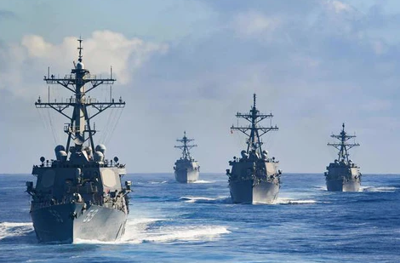
One can get a sense of what US forces have deployed to the Caribbean to date here.

US Navy ships in Southern Caribbean. Source: Trinidad Express.

What all of this means is that the game is on. Moving this amount of assets to the Caribbean Basin, especially given the presence of land forces in the deployment, is no bluff. Trump seems to think that he can make an example out of Venezuela, contrary to historical precedent when it comes to the forced regime change going as planned or producing the desired results. One things is certain. It will be Venezuelans who suffer the most from any eventual escalation, and their scotch-swilling wealthy exile “leaders” will do nothing to shield them from a US assault.

In contrast to all of this Big Stick manoeuvring, Trump has offered Argentine president Javier Milei a USD$40 billion bridge loan as a form of bailout for Milei to make interest payments on outstanding public loans. No international lender like the IMF or World Bank would do so because of concerns about Milei’s reckless fiscal and macroeconomic policies (at one point he wanted to dollarize the Argentine peso and shipped off Argentina’s gold reserves to England on a private plane). Private investors took advantage of Milei’s public sector asset sale program to strip them of what value they held, repatriated the profits from the re-sale of those assets, then left the economy. What private investors remain are engaged in dodgy crypto schemes and destructive enterprises like critical mineral mining (lithium, in particular) where regulation is lax and where profits are largely sent abroad.

Milei himself is embroiled in an investigation into a memecoin “pump and dump”/”rug pull” scheme concocted along with Trump-allied US crypto billionaires, where he touted on social media a specific coin called $Libra that rapidly rose, then fell in value, making the 9 founding $Libra accounts around USD$82 million and leaving 72 thousand other investors with USD$251 million in losses in just over 3 hours. Milei later distanced himself from the scheme but it was discovered that he was one of the 9 founding accounts, which as per usual were managed by his sister and chief personal advisor, otherwise known as “Ms. 3 percent” for the price of the “commissions” she demands of entities doing business with the Argentine State (the most recent involving a pharmaceutical company). Milei’s sister, Karina, is also being investigated for links to–surprise!–narcotraffickers and assorted other dark forces in the Argentine landscape.

The Trump bridge loan bailout for Argentina was in fact a political rescue line thrown to Milei. His party (Libertad Avanza or Freedom Advances) did very poorly in provincial and first round congressional elections in September and at the time of the bailout it was assumed to be posted to suffer a similar fate, or at least not improve its minority Congressional representation in the national midterm elections this past weekend. That would jeopardize his reform agenda for the remainder of his presidential term, making him a lame duck and paving the way for a return of either a Peronist party faction leader or a newer centrist coalition-backed candidate. Either of these option would spell the end of the “chainsaw” approach to public sector restructuring as well as Milei’s pro-US (and pro-Israel and anti-climate change) position, something that Trump seeks to avoid.

As it turns out, Libertadad Avanza won 41.7 % of the congressional electorate vote, defeating the opposition coalition, which won 40.4% of the total number of party votes. This improves the government’s bloc position in Congress and strengthens Milei’s hand in imposing more reforms, but it also sets the stage for ongoing deadlocks and resort to rule-by-Executive decree on the part of the Argentine president. But for the moment, chalk this up as a win for Trump’s bailout carrot/election interference gambit because even if short term in nature, it may have influenced things in a US-favorable way when it comes to Argentine foreign policy. Since Trump threatened to rescind the bailout of Milei’s party did not win, it is quite possible that tis weighed significantly on the minds of voters (who still turned out in record low numbers–67.8%– in spite of voting being mandatory).

What is also interesting is not that the bailout was given for political rather than sound economic reasons. That happens. What is of note is that the bailout comes at a time when US tariffs on Chinese goods resulted in retaliatory tariffs on US agricultural products, especially soybean exports. Most of these are grown in Red Trump-voting states. When the retaliatory tariffs kicked in Argentina dropped its export taxes on soybeans, and along with Brazil rapidly took advantage to increase soybean exports to the PRC. In just a few months Argentine and Brazilian soybean exports have taken over the previous US share of the PRC soybean import market. So in effect Trump has bailed out a foreign government for ideological reasons even though it directly hurts a core voting block in the MAGA coalition. That makes neither economic or political sense.

In response to criticism of this deal, Trump puzzlingly announced that he would reduce tariffs on Argentine beef imports so that it could increase its US market share. At a minimum that means reducing US beef prices in the face of Argentine import competition., which is now the stated intention of the plan (beef price reductions across the board). Once again, US beef is mostly produced in Red states, so here too the economic and political logic at play appears to be contrary to the interests of key MAGA voters. It seems that for Trump ideological buttressing of an ally abroad is more important than the material fortunes of US farmers, and he does not fear electoral retribution as a result. That is another oddity, unless he has a plan for avoiding electoral backlash in the first place, which may be what the overall beef price reduction plan is all about..

In El Salvador, Trump has courted Nayib Bukele, the self-styled “world’s coolest dictator” who offered to house US deportees at his infamous CECOT prison in exchange for money, diplomatic favours and the betrayal of several FBI informants tied to the Salvadorean gang MS-13. Regarding the latter, Secretary of State promised the FBI that he would not divulge the informant’s names to Bukele but then did so, whereupon Bukele demanded they be returned to El Salvador rather than stay in US detention. Secretary Rubio obliged and it is now presumed that the informants are dead. Here the Big Stick was wielded on behalf of a foreign government in conjunction with domestic objectives rather than used against it for strategic gain.

Further afield, MAGA operatives have close links to former Brazilian president (and coup plotter) Jair Bolsonaro’s party and his revanchist sons while the Trump administration has imposed a 50 percent across-the-board tariff on Brazilian goods as well as travel sanctions against the judges that convicted Bolsonaro and sentenced him to six years in prison for sedition earlier this year. The Trump connection to Latin American opposition groups includes rightwing Chilean figures, adherents of the old Pinochet dictatorship and new tech moguls, as it is reported to be quietly influencing the policies of Paraguay (led by a conservative) and rightwing opposition factions in Peru. In effect, in these instances the Big Stick used by one foreign policy hand is complemented by a more subtle and covert velvet glove approach on the other.

In the end, Trump’s return to a US gilded age is very much true in the original Twain sense of the phrase, and its adoption of a crude form of Gunboat Diplomacy characterised by a Big Stick/Carrot approach is playing out in contradictory but obvious ways in what Trump considers, to Latin American revulsion, to be the US’s backyard where the Roosevelt Corollary to the Monroe Doctrine gives it the right to act with wanton disregard for International law and imperialist impunity with regard to the rights of individuals and States. Much like demolishing of the White House East Wing serves as an allegory for the destruction of the US constitutional system and social fabric, the return to the Big Stick and selective carrots is symbolic of an increasingly feckless approach to US foreign policy, regionally defined.

As the saying from former Mexican president Porfirio Diaz goes (amended here to include the entire region): “Poor Latin America. So so far from God and so close to the United States.”

Que Pachamama los proteja!

Declaration: I was the Regional Policy Analyst for the Interamerican Region and Caribbean Desk Officer in the Office of the US Secretary of Defense (OSD/ISA/IA), co-Team Leader of the Cuba Task Force and a consultant to the CIA, US Southern Command, US Air Force Special Operations and US Navy Special Operations Commands in the 1990s. In those roles I was engaged in exactly the sort of exercises that go into this type of war-planning/preparation and am well aware of the long history of US anti-drug campaigns in the region as well as the US military involvement in them (including the infamous Pablo Escobar/Cali Cartel years). My commentary is informed by those experiences and by the certain knowledge that the norms and restraints that governed the actions of my colleagues and I no long apply when it comes to the application of US military force.

Another Hollow Bluff.

I know from reviewing readership stats that KP readers are not as much interested in international relations as they are in NZ domestic and foreign policy and various social issues. There is some interest in what Donald Trump is doing to the world from his throne in the Oval Office, so I figured I would scratch that itch and write a brief about yet another moronic move that he has recently made.

After being trolled on Telegraph by former Russian president and current Russian National Security Council Deputy Chair Dimitry Medvedev, Trump posted on his Truth Social media account that he had ordered two nuclear submarines “closer to Russia” in “the (appropriate) regions.” He repeated this on the conservative Newsmax television channel a few hours later, claiming that what Medvedev said was a threat that needed a strong response. However, given the realities, I doubt that Medvedev or Putin are quaking in their boots. Let me break down why they are not.

To begin with, Trump is presumably talking about nuclear armed submarines like the Ohio-class “boomers” that carry sea launched ballistic missiles (SLBMs). The US has plenty of nuclear powered attack submarines (SSNs) like the Virginia class boats that are the basis of the AUKUS development project with Australia and Great Britain, but these do not carry SLBMs and would not provide any deterrent effect on Russia or another hostile nuclear-armed State. If the message is not meant as a strategic deterrent and SSN;s are being sent, then their strike value is limited and tactical.. Given that Trump’s complaints about Russia are about a strategic ceasefire in Ukraine, a tactical response is unlikely to move the Russians into compliance and will just escalate the situation beyond Ukrainian borders.

So Trump is likely referring to the Ohio class boats, which carry Trident II D5 SLBMs that have ranges of 4100-7600/11,500-14,000+ nautical miles/kilometers and travel at supersonic speeds ranging upwards from MACH 19 (20,000 feet per second or 18,000 mph/29,000 kph). The carry 8-14 multiple independently targeted re-entry vehicles (MIRVs) with warheads that have “throw-weights” of 100 to 435 kilotons (the latter deigned to hit “hardened” targets like missile silos, command bunkers and deep tunnel complexes. In comparison, the “Little Boy” bomb that destroyed Hiroshima was 15 kilotons). They tend to lurk in off shore deep waters, often in undersea canyons, waiting for the order to strike. Given their ranges and speeds, there is no need for SLBM platforms like the Ohio class boats to “get closer” to targets. In fact, to do so is folly.

Why? When the order comes, these submarines must rise from deep water (they are said to be able to dive as deep as 1,500 feet or more) to relatively shallow depths of 150-200 feet. That is because the underwater propulsion stage of the SLBM, which uses a sophisticated variant of steam-based propulsion, does not have the energy or pushing power to reach the surface from greater depths. Once the surface is reached, a solid gas propellant is ignited, accelerating the missile to supersonic speed before MIRV re-entry.

This is where Trump’s bluff is called. Ordering US SBMs “closer to Russia” negates the advantages of deep water concealment because it brings the submarines over shallower coastal shelves or seas (say, the Baltic or Black Seas). That makes it easier for Russian anti-submarine warfare (ASW) platforms (including attack submarines of their own) to hunt, locate and track them. In addition to sonar and radar as well as satellite imagery, modern hydrophone detection systems and seafloor thermal and acoustic mapping arrays are used to seek out and record the acoustic signatures of submarines (which can be as distinctive as finger prints), something that is easier in more shallow and warmer waters given sea layer temperature variations produced by water density, depth pressure, refraction, salinity, thermoclines, etc., including the waters of narrows, straits and other maritime chokepoints. Even deep water can conduct and bend sound over long distances, such as in the low frequency SOFAR channel that extends from 600-1200 meters down in low to middle latitudes to near the surface at higher latitudes (which is one way of listening to whale calls with hydrophones). All of which is to say that the frequency, wavelength, bend and amplitude of underwater sounds are related to water temperature and depth, so have become important markers for underwater scientists and engineers, including those in the submarine/ASW businesses.

Phrased another way that Trump might understand: cold and deep water good for submarines; warm and shallow, bad. Trump clearly has not gotten this brief. Or perhaps his version came from the same advisors who told him that a tariff is a non-transferable tax paid by foreign exporters to the US.

In that light ordering US SLBM submarines into shallower and possibly warmer waters near Russian coasts as a show of force and then giving the precise number of those being told to so is a breach of basic submarine operational security. It allows the opportunity the Russians the opportunity to refine their ASW skills and perhaps even get a better idea of how the two particular submarines in question look and sound like underwater. In other words, besides the childish nature of the tit-for-tat spat with Medvedev, Trump has been suckered into blurting out, yet again, potentially sensitive information about US naval capabilities and operations.

The US Navy has choices to make. It can do nothing and try to pretend that it followed his orders, hoping that his minions in the Navy and Pentagon are kept out of the submariner information loop. It could order the ships to drive around in circles and claim that it followed orders. It can object to the commander-in-chief’s order and try to convince him to rescind it at the risk of having careers ended (if he in fact issued one). Or they can salute and follow commands as they are instructed to do even if it puts crews and contingency plans at risk. None of this was necessary given current US submarine operational protocols and capabilities, so this was not a believable warning much less a credible threat. It was theatrical bluster without merit.

But then again Trump is a mixture of ignorance, impulse, thin-skinned ego, bully and pomposity, so his meaningless showman’s gesture will remind Medvedev, Putin and many otherwise US-allied leaders yet again that there is a petulant knucklehead sitting in the Oval Office as POTUS.

MAGA!

Careful what you wish for.

One gets the sense that Netanyahu has used his post-October 7 military successes (including ethnic cleansing and IDF war crimes in Gaza) to prepare for this moment of friction vis a vis Iran while manoeuvring Trump into a corner on joining the war in pursuit of regime change as much or more than nuclear non-proliferation (as I have pointed out in previous posts, Trump is an empty intellectual vessel devoid of firm policy positions other than those that he thinks serve himself. He is therefore highly susceptible to suggestions that appeal to his vanity and self-interest, such as being “the saviour of Iran” if he joins Israel in the military campaign against the theocratic regime).

Already, the son of the deposed Shah, Reza Pahlavi, has broadcast statements claiming that he and his supporters will return to Iran soon after the collapse of the current theocratic regime. Pahlavi is close to Netanyahu and Trump’s inner circle and US-based heirs of the Shah’s exiled supporters (many concentrated in and around LA) are willing to assume control of a post-theocratic government under Reza Pahlavi’s leadership. The stage appears to being set for a regime take-over following military defeat of the ayatollahs.

The trouble is that while many Iranians abhor the mullahs and Revolutionary Guard, they also remember very well what the Shah’s rule was all about (SAVAK, anyone?). They remember well that Israel was the Shah’s best ally, and that Mossad helped train and shared intelligence with SAVAK. So it is not clear that his heirs will be universally welcomed, something that sets the stage for prolonged internal conflict within the Persian power. In addition, with the old leadership gone a new generation of militant leaders may emerge in their place, hardened by their experiences with Israel and its Western backers. They may not prove easily removable or amenable to a negotiated compromise on governing alongside Western-backed groups.

Even if the West gets its way and the ayatollahs are deposed, there is the issue whether a new generation of Iranian expats, many coming from monied backgrounds in places like Southern California, have the skillsets with which to govern a country, and culture, that mixes pre-modern beliefs with post-modern technologies and a ponderous bureaucracy that straddles a stark urban/rural demographic divide. Will the US pour in aid to help them with the task of reconstruction at a time when DOGE is cutting back on all types of US foreign aid? Will Iranians welcome such assistance and the US/Western personnel that deliver it? Or will they resist what could be seen as an affront to their nationalistic and cultural pride?

This is a noteworthy point. Persian nationalism is rooted in millennia, not the last half century. Persians come in many faiths and ethnicities, and what unites them isa rejection of foreign interference in their affairs, especially by Sunni Arabs and Western colonisers (and their descendants). In the US and other interested parties there appears to be a failure to understand how deep Persian nationalism runs as an ideological glue in Iranian society. This could prove costly for the adherents of forcible regime change in that country.

The US and Israel appear to believe that after they bomb Iranian nuclear development and storage sites, military infrastructure and command and control facilities and kill leaders of the revolutionary regime, the people will rise up, the regime will fall, a new government will be installed and everyone will go home happy. The truth is otherwise. Iran will have to undergo a long term military occupation if a new order is to be imposed. Who is going to do that? Iran is a huge country and as mentioned, not all of its inhabitants welcome foreign interference in their affairs. The US and Israel do not have the capability to impose an occupation regime, not does any other State in part because of their realistic unwillingness to do so. So the operative assumption in Washington and Tel Aviv about regime change in Iran seems to be based on a pipe dream conjured up in the war-fevered minds of Trump and Netanyahu’s strategic advisors. And a reality check is also worth noting: the occupations of Iraq and Afghanistan this century by Western-led coalitions have not ended well for them or with the stated objectives of their missions being achieved.

Then there is the reaction of the global Shiite diaspora to seeing their most venerated leaders killed, incapacitated or imprisoned by Western powers or those backed by the West. Iran may not be able to defend itself against Israel and the US by conventional and nuclear military means, but it has many unconventional assets at its disposal, and they have global reach. The current tit-for-tat exchanges may be a prelude to a widening regional and perhaps global conflict fought by unconventional means. The end to the current (fairly short) conventional military war may be just the beginning of a protracted unconventional, asymmetrical conflict that could spill into other States in the region and beyond.

And here is another background thought: The modern Western-led international community has always reacted poorly to revolutionary regimes, e.g.: USSR, PRC, Cuba, Nicaragua, Iran, Angola, Algeria, Granada, DPRK, etc.. The specific evolutionary ideology matters less than the usurpation of power by force because it upsets the international status quo because it upsets an international status based on acceptance of shared rules and norms (if not values). That is, states agree to get along within established rules of conduct and revolutionaries do not respect that basic rule of the game and seek parametric change in their societies as well as in their relations with the external world..

In response, revolutionary regimes tend to support each other against former colonial and imperialist Western powers, creating a vicious circle of hostile action/reaction. It may be 46 years after the Iranian revolution, but perhaps this is somehow at play here?

Whatever the case, I have a bad feeling that this is not going to end well, except perhaps for Netanyahu (who will receive a boost in domestic support after the Iranian regime is ousted as well as perhaps further delay his court trial on corruption charges and the collapse of his coalition government). Trump is being slow-walked by Netanyahu into joining a war of convenience rather than necessity that may spiral into a deeper regional confrontation that will consume US blood and treasure for some time to come (in exact contravention of Trump’s promises to end US foreign “entanglements”). With the US mid-term elections scheduled for next year, prolonged involvement in Iran may prove damaging to Trump’s allies in Congress and hinder pursuit of the GOP/MAGA policy agenda if they lose one or both majorities in the Deliberative Chambers. Meanwhile, Iran’s allies Russia and China sit quietly on the sidelines, either out of impotence or because they are hedging their bets. One gets the feeling that, especially with regard to the PRC, they are not impotent.

The slanted (often triumphant) Western media coverage of the conflict disguises the fact this may not be entirely over soon, and that whatever its battlefield successes Israel may pay a heavy reputational and diplomatic price for its actions, as the rise of global anti-semitism suggests is in fact now the case.

Dark and sad times ahead, I’m afraid.

Pre-emptive or preventive?

I do not mean to be pedantic about this sort of thing, but since it lies within my area of supposed “expertise,” here goes:

Unlike what is being reported in the corporate media and by some defense officials, the Israeli strike on Iran was not “pre-emptive.” “Pre-emptive” means “a sudden strike thwarting an imminent attack.” That is not the case here. Iran was not about to imminently attack Israel. What Israel has done is a preventive attack designed to degrade Iran’s nuclear R&D/storage facilities, missile launcher sites and command and control capabilities. The IDF attack is focused on preventing and delaying development of Iran’s nuclear strike capability before it reaches operational status and was telegraphed in advance (remember the US pulling out embassy staff and military families from facilities in the Middle East this week). Both suspected weapons-grade nuclear stores as well as launching platforms were on the target list, as were those responsible for them.

The preventive nature of the move may help moderate the Iranian response. On the other hand, killing the Revolutionary Guard Commander and Deputy Commander is a serious affront that will require a response in order for the Iranian regime to save face among its domestic audiences. So the escalation scenario is real, albeit not as bad as it could be. What is clear is that unlike preemptive attacks, the Israeli preventive attack has no justification in the Laws of War (jus ad bellum) and is therefore illegal under International law. One might understand why the Israelis conducted the strikes and there is plenty of precedent for them, but that does not make them legal.

Just like his response to October 7 with the ethnic cleansing of Gaza and expansion of illegal settlements in the West Bank, Netanyahu has seized his moment of opportunity because, quite frankly, he can. No one will stop him (certainly not the Iranians) and the US backs him, with most of the West tacitly supporting Israel with their silence or tepid responses to the conflict. This, I suspect, is due to Israel’s value as an intelligence partner of the West as much as any other reason.

Let’s see how this plays out….