Shoutout to Starship.

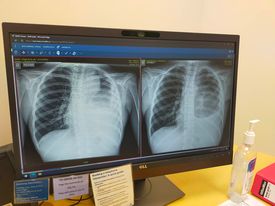
My son returned home this week after spending two weeks at Starship undergoing major surgery. It was dicey for a while, as he had a lemon-sized tumor removed from his anterior sternum that was putting pressure on his heart and lungs and which had extended out onto his upper left rib cage. It turns out that he had a mediastinal multilocular thymic cyst, most likely congenital and therefore present since his birth. Normally they atrophy and are absorbed by the age of three, but in his case it apparently kept growing. He was asymptomatic until this past May, when he developed shoulder pain and shortness of breath. After several misdiagnoses and a change of GPs he was referred to Starship in late September, where chest X-rays showed a large mass. Things accelerated from there. It turns out that the shoulder pain was referred pain and common with chest tumors–but one has to know what to look for and the original GPs did not.

Multilocular thymic cysts are extremely rare but fortunately most often benign. There are more tests to be done and even the possibility of further surgery to remove remnants of the mass from his ribs, but the hope is that now that the large hard mass has been removed the rest will stop growing and wither or can respond to drug therapy or some other form of non-surgical intervention. What is amazing is that my son’s left lung had collapsed at some point in the past–maybe even a year ago–but he had continued to play soccer, ride his bike and run cross-country until his symptoms appeared in May. He finally had to stop sports in July while we looked for an answer.

In any event, he is on the mend even if not entirely out of the woods yet. The prognosis is good for the long-term. He is now pleased at his ability to breath and move about pain-free (other than from the chest and drain wounds), He thought that the shoulder pain was just from over-doing it on the monkey bars and that it was normal to be short of breath after exertion. And well one would be on both counts when operating on one lung and a compressed heart.

I wanted to use this post to publicly thanks the medical staff at Starship for saving his life and for the world-class quality of the attention that my son received, both during the surgeries (he had two), during four days in paediatric cardiac ICU and during the remainder of his time on the cardiac paediatric ward (he was there because of the open chest surgery, not his heart per se, because cardiac surgical teams are the best versed in matters of chest surgery recovery). Everything about Starship was first rate, especially the surgical care from the moment the mass was detected to the ongoing post-operative recovery here at home, where the team has called us to check on him and outline a schedule for follow-ups. Above their skills as surgeons, anaesthetists and paediatric nurses, what sets the Starship staff apart if their incredible level of compassion and empathy for their patients as well as their patient’s whanau. My son was on the upper end of the paediatric age group (ten) but the way in which the staff interacted with toddlers and newborns was, from my family and I could see, absolutely wonderful.

If there is an institution to which a charitable contribution can be made, I recommend Starship Hospital simply because it provides world class care and, among all the other worthy causes that can be supported, it is uniquely able to provide an actual physical future for those who otherwise would have none.

“Second image” issues in NZ foreign policy.

The term “second image” in international relations theory refers to an argument about the domestic sources of a nation-state’s foreign policy. The argument posits that it is the nature of those domestic sources that determines the way in which nation-states perceive and approach foreign policy. Conversely, the phrase “second image reversed” refers to the international/foreign influences on domestic politics in individual nation-states, arguing that the type and extent of foreign influence in a nation-state has a strong impact on the nature of its domestic politics. These notions have been offered in order to explain the differences between authoritarian versus democratic foreign policy-making as well as the impact of power differentials, propaganda, misinformation and disinformation on public perceptions of foreign events as well as on the very nature of political life in targeted countries (such as is claimed to be the case with Chinese influence campaigns in places like NZ). One side sees domestic politics shaping the broad contours of foreign policy; the other sees international events and influences framing the nature and conduct of domestic politics and local approaches to foreign policy.

Both views can be true and co-exist at the same time. The way in which domestic politics influences foreign policy-making can in turn be informed by foreign influence and intervention in domestic politics. Again, the way Chinese interests have influenced political and economic elites in NZ (covertly or overtly) has had a clear impact on the way NZ has approached the PRC as a foreign interlocutor. Academic Anne-Marie Brady has written extensively about PRC use of “magic weapons” such as influence campaigns in NZ and elsewhere, but one only need think of former politicians like Jenny Shipley, Don Brash and John Key sitting on the boards of a Chinese bank and companies with NZ interests to understand how reversed second imagery works.

The second image aspect of foreign policy-making is particularly noteworthy in NZ because of its one-sidedness. As mentioned above, there is plenty to suggest that there are numerous foreign influences helping shape NZ foreign policy-making. Some are legitimate and open in their presence, such as NZ membership in various NGOs, treaties and conventions with binding rules governing standards of behaviour by members, as well as in NZ’s abiding by international norms and conventions when it comes to things like domestic labour laws, environmental regulations, intellectual property and patent rights, emissions trading schemes, various health, welfare and safety standards and the like. Others, such as PRC “sharp power” direct influence campaigns, are more opaque in nature and often unrecognised or unacknowledged by those on the receiving end of them. Whatever form it may take, it is widely recognised that in NZ the reversed second image is very present when it comes to foreign policy-making.

Less so is the second image itself. The NZ foreign policy community is small, with a select number of academic and private sector actors joining government officials in shaping the country’s approach to the outside world. Public involvement in foreign policy is minimal and the political class treat it as if it was rare earth. Not surprisingly, in this year’s election campaigns discussion of foreign policy has been conspicuous by its absence. With some exceptions noted in outlets like Newsroom, the Spinoff, 36th-Parallel.com and the works of people like Matt Nippert, Gordon Campbell, Selwyn Manning and David Fisher, much of this is due to the corporate media’s focus on controversy and gotcha moments rather than on in-depth analysis of substantive issues of any sort, much less those involving foreign relations. NZ based academics like Robert Patman, Rueben Steff and Van Jackson all write thoughtfully about foreign policy matters, to include aspects of NZ foreign policy, but their contributions in the media are (often self-) limited and do not inform campaign or political party policy coverage (as far as I know).

Political parties are not saying much either. Except National, parties have offered short–sometimes very short-– manifestos (thanks to The Spinoff for collating them), and interestingly the Greens have the must robust policy platform, even if in a touchy-feely, tree-hugging, climate-centric sort of way. For its part ACT just wants to increase defense spending and buy more ships, planes and guns because that is what the BIG BOY ALLIES DO, while NZ First as well as ACT want to ignore/withdraw from the UN Declaration on the Rights of Indigenous Peoples (ACT says ignore, NZ First says withdraw, so it is a matter of conjecture as to whether ignoring is better than withdrawing from a legally non-binding Declaration that NZ initially opposed but eventually signed up to).

Te Pati Maori are all about increasing support for Pacifika leaders and not much else, while Labour is pretty much all about trade, trade, more trade, more trade involving Maori and the derivative issues from trade (such a patent and intellectual property rights). Focusing on the blue rinse plate special, Winston and his motley crew of racists (increasingly shared with ACT), anti-vaxxers and QAnon believers want to move the Naval base from Devonport to Marsden Point. The Greens oppose AUKUS, South Pacific militarisation and support using the military for climate change mitigation purposes. Te Pati Maori have nothing much to say about Defence, nor for that matter does Labour in its campaign documents (as much as I have seen of them). Interestingly, no party speaks about intelligence issues in spite of the recently released reports advocating for intelligence community reform in the wake of March 15 and the rise of domestic white supremacist and other forms of seditious extremism. National is especially distinguished because it has nothing much to say on any foreign policy position, but if I was to hazard a guess as to what it may be, I reckon that it would be “more of the same” with a “please be nicer to the PRC” spin added to it. (NOTE: I stand to be corrected if Labour and National have put out comprehensive foreign policy platforms but so far I have not found any when doing cursory searches).

To recap: foreign policy is woefully underrepresented in the current election campaign, much as it was in previous elections. While NZ gets the second image reversed treatment in spades, the domestic sources of foreign policy are limited to a handful of foreign policy elites who in large measure appear to be unchecked by and do not receive significant policy directives from the government and political class of the day. Instead, it is the other way around.

Although foreign policy has always been the province of elites in most countries due to the requirements of educational backgrounds, international knowledge and experience, added to the necessities of maintaining consistent diplomatic relations across home and foreign governments over time, in NZ this is worrisome because the public has virtually no input, via civil society organisations, lobbies or political parties themselves, into foreign policy perspectives and decision-making processes. For example, much is said about (and I have argued against) the notion that NZ has an ‘independent” foreign policy. But how is that informed by domestic agents and interests? Certainly not by public referenda or informed consent voiced in elections. Certainly not by academic debates about the theoretical and practical meanings of the term “independence” in foreign policy. Certainly not by community public hall forums. Certainly not by journalistic challenges to the official line.

Economic elites may have an inside track in foreign policy-making and even work hand-in-glove with Foreign Ministry officials to ensure that trade-centric policies are the core of NZ’s international position regardless of who is in government and what NZ proclaims on other matters, but who else gets a look in? Academics? Perhaps a chosen few (certainly not this ex-professor). Consultants? (Likely more than a few, usually retired diplomats or military officials, and again, certainly not this one). Lobbies (certainly, but in very limited and exclusive numbers). Religious organisations? Unions? Environmental Groups? Human Rights Organisations? Sadly, although these latter groups may have a presence on the home front, their input into the foreign policy process can be considered to be largely negligible.

The hard truth is that foreign policy making in NZ is made by a relatively small group of bureaucrats and well-connected, self-interested private sector insiders and interest groups largely unchecked by the political elite, much less public opinion. They have little accountability of a vertical sort, and even less on a horizontal level (i.e. accountability to their political overseers’ and the public, on the one hand, and to other State bureaucracies on the other). That poses a problem because horizontal and vertical accountability of public agencies is considered a hallmark of liberal democracies. They answer to the public, to politicians and to each other. Unfortunately, in NZ the foreign policy elite largely do not.

This is problematic because of the syllogism involved. If we accept a) that in NZ the second image reversed phenomenon is very real, with foreign influences having a significant impact on foreign policy elite perspectives and decision-making; and b) that little second image input goes into NZ foreign policy-making outside of a small group of overlapped and interconnected elites that are largely unaccountable to anyone but themselves; then c) NZ’s foreign policy is shaped more by foreign-influenced elite perceptions and interests than those of the voting public at large. In an autocracy this would be the normal state of affairs, but for a liberal democracy it is a concerning issue, to say the least.

Perhaps as the election campaign moves closer to decision day there will be more robust discussion of foreign policy issues, including those related to intelligence, defense and international security. Perhaps there will be debate on whether NZ is truly independent or not, whether the trade-centric focus is still fit for purpose, and what NZ’s approach to Great Power competition should be in an era of increased multipolarity and broadening of areas of contestation in regions such as the South Pacific that were once thought to be “benign” strategic environments. But as things stand that seems unlikely, and instead we will be treated to an endless series of stories and debates about which party and candidate sent out the meanest tweet, who got caught out telling porkies and who dog-whistled the most in order get media click-bait coverage.

If so, that is not good enough.

Something on the Politics of Social Engineering

Over the years here at KP I have episodically written about the impact of ideology on social order and the debates that revolve on what constitutes the “proper” way in which to organise society. In that light I have mentioned the subject of social engineering, that is, social reform projects initiated by both Right and Left-leaning governments that use public policy to influence social behaviour in pursuit of specific collective outcomes. Here I shall return to the subject, with particular reference to how it has an impact on the upcoming NZ general election.

Some readers may recall my writing about the social engineering aspects of the neoliberal projects of the 1980s-2000s in NZ and elsewhere. To recap, the practical success of neoliberalism as an ideological construct went something like this: neoliberalism started out as a Chicago School approach to macroeconomics that was premised on the belief that finance capital was the leading edge of capitalism and could therefore guide societies towards the most efficient material outcomes. Known as “monetarism” as advocated by Milton Friedman and his acolytes, it was given practical application in the authoritarian laboratory known as Pinochet’s Chile and, in less draconian fashion, NZ under the likes of Roger Douglas and Ruth Richardson. (as some will recall, Douglas and Richardson even copied some of Pinochet’s labour laws as part of their NZ reforms).

The operating premise behind the turn to monetarism was that the Keynesian welfare state had exhausted its natural limits and outlived its usefulness, leading to parasitic rent-seeking behaviours on the part of interest groups tied to bloated public bureaucracies represented by corrupt unions that also were more interested in feeding at the public trough rather than pursing the common good. In order to break the grip of this perverse alliance of leeches, a dramatic structural reform project needed to be undertaken in which the State sector was reduced in size, public good provision was privatised, union power was constrained and people were forced to look to the private sector for their immediate and long term needs (and perhaps the wants of a fortunate few).

Note that this was purely a structural project, that is, a macroeconomic effort to reshape national economies in ways that would promote efficiency and reduce waste. Rather than State managers in places like Central Banks, Ministries of Finance or Economy, investment led by international finance capital would determine those areas in the national economy into which resources were directed using neo-Ricardian principles of comparative and competitive advantage. Codified in the so-called “Washington Consensus” adopted by the World Bank and International Monetary Fund, it had severe dislocating effects on the populations in which it was applied, something that required authoritarian imposition in places like the Southern Cone of Latin America but also serious reductions in collective rights in democracies like NZ, the UK and the US.

It turns out that in order to create the “laboratory” in which neoliberal prescriptions could work as theorised by the Chicago Boys, the human subjects needed to be denied their rights via repression (state terror in the case of the Southern Cone experiments) or drastic reductions in their collective rights in the marketplace (in places like NZ). Legally speaking, both in terms of what workers/employees could address as well as with regard to their modes of representation, the overall impact of neoliberalism was a diminution of wage earner’s ability to defend their interests in the labour market (albeit without the repression in NZ that was deemed necessary in less complacent societies like Chile).

The broader idea was to use structural reform projects to break the welfare statist mould and replace it with a stripped down and leaner State focused on core areas such as defense and security while the private sector assumed de facto control of macroeconomic policy via the appointment of its representatives to State economic oversight, management and regulatory agencies. Having done so, behavioural changes in society would inevitably follow because the state-centric mindsets of the welfare state era would give way to more market-influenced approaches by both individuals and groups. What those changes in concrete terms might be mattered less so long as they conformed to market-driven logics.

In this view monetarist structural reforms would lead to market-dominated social logics. Everyone would become a self-interested maximiser of opportunities within the rational limits of their individual choices given the market conditions in which they operate, with the overall aggregate of choices leading to market clearance at a societal level. Reproduced over time and across generations, market-oriented public perceptions of the “proper” society would become self-fulfilling. Those who accepted the premise would succeed in life and those who refused to accept or could not cope with the individualistic focus and atomising impact of a more market-driven social order would be left behind in its wake. Eventually the societal market would clear based on the sum total of the interactions between people acting as homo economicus in the first instance, to which then could be added the ascriptive (non-material) aspects of human endeavour.

This market-oriented project has certainly succeeded in NZ, even if not by original design. The architects of the early structural reforms were focused on institutions and public policy involved in economic matters, not specifically on social behaviour. But as the influence of those reforms seeped deeper into society, accompanying cultural reforms began to be proposed. To the structural reforms of the first phase of the neoliberal project were attached superstructural addenda that helped cement its ideological grip on public perceptions and behaviour. Remember that ideology is a social construction, that is, an idea about how things should and should not be. Ideologies exist in concrete material conditions with their own historical circumstances and legacies as well as their immediate contexts. In that light, ideology specifies the relationship between the imaginary and the real and the preferred path between them (which among other things raises the notion of the perfectibility of humankind). Neoliberals have an ideological bias in favour of the individual rights and freedoms; Leftists have a bias in favour of collective responsibilities and the public good.

Neoliberals are morally agnostic when it comes to social behaviour in market societies, limiting their preferences to broader freedoms of choice for individuals in such circumstances. Leftists have a normative preference for collectively beneficial social dynamics in which individual rights and responsibilities are equitably balanced with the common good.

In that light, at the superstructural level neoliberalism is an ideology that purports to demonstrate the proper way in which human societies should be organised and how people should interact within them using unfettered property and individual rights as cornerstones of the social contract. There can be no doubt that when compared to the early 1980s pre-neoliberal period, NZ society today is largely governed by market-driven principles and market-oriented institutions. And as a result, NZ social behaviour has changed.

Rather than discussing neoliberalism and market-oriented social engineering any further, let me simply point out that it started out as a conscious structural reform project that morphed into a a way of looking at the world. That in turn led to changes in society as the impact of the structural reforms took hold and deepened over the years. Market-oriented social engineering was a product and consequence of the structural reforms rather than something that was specifically envisioned from the onset. In a sense, the social engineering aspect of neoliberalism, insofar as producing behavioural changes in society, came as a bottom-up, spontaneous response to structural reform rather than as a top-down, deliberately thought-out project that extended beyond issues of political economy.

Think of it this way. Once the nature of the game is altered (say, from cricket to basketball), so too the rules of the game change, followed by changes in who plays and the way they play the new game. It may even determine who is more likely to win. But even then, the way in which the new game is played by those favored and disfavored by the new rules may be unanticipated by those who changed it in the first place. That is the essence of the social engineering consequences of the shift from welfare statism to neoliberalism in places like NZ. They were not preordained or foretold. They just happened as a “natural” consequence or response to the market-oriented structural changes undertaken. Neoliberals are comfortable with that alone, figuring that things like the balance between comfort and security will be sorted out by the interplay of social market forces.

That is where Left social engineering projects differ, and often fail. Unlike the neoliberal approach, which focused on structural (macroeconomic) reform that eventually bubbled up through the layers of the social division of labour in civil society to become new social norms and modes of behaviour, Left social engineering projects are consciously top-down in nature. Unlike market-driven social engineering projects, which focus on the downsizing reform of State institutions and regulations in order to free up policy decision-making space and freedom of manoeuver for private interests, here the primary focus is on changing collective and individual behaviour using the regulatory State as the agent of reform.

Left-leaning social engineering is what economists call “nudging” projects, but on steroids. In this context “nudging” are efforts to make discrete policy adjustments that encourage changes in social behavior, for example, by painting hopscotch, tic-tac-toe or even rainbow arcs on staircases in transportation hubs in order to encourage healthy stair climbing rather than indolent escalator riding. However, the thrust of Left social engineering projects is large rather than small, macro rather than micro, overt rather than discrete. It is “nudging” on a grand scale, or if one were to view such projects negatively, “shoving” the body politic in a particular behavioural direction.

Leftist social engineering involves “think big” projects like the recent “Zero Road Toll” land transportation campaigns or the move to replace automobile lanes with cycle and bus lanes in urban centres (where Left-governed councils use funding from the Labour-led government to make changes to local roading systems that discourage the use of cars and encourage substitute modes like bicycles, buses and trains). They focus on inducing big behavioural changes such as the lowering of smoking rates via high taxation of cigarettes or the switch to electric cars via increased taxation on diesel and petrol cars levied in tandem with rebates on new electric car purchases. The focus is on changing behaviours, not underlying structures, in a reverse of the neoliberal approach.

What these top-down Left social engineering projects do not do is alter the macroeconomic system as given, nor fully account for the microeconomic and unanticipated non-economic behavioural responses to their initiatives. The premise is that if policy-makers use State powers to constrain or frame certain types of human activity or behaviour via taxation, regulation, re-organisation and persuasion, then they will elicit specific types of responses. Rather than morally agnostic when it comes to outcomes, they are normatively-driven (aka biased) towards producing preferred collective outcomes. For example, if you narrow city streets by installing bike and busways and prohibit surface parking without increasing off-street parking spaces, the assumption is that people will abandon their cars and seek alternative modes of transportation whether they live in urban centres or commute to them. Vehicle congestion will be lowered, airborne particulate and street wastewater pollution will fall and people will get healthier by walking more and cycling.

The problem is that this does not account for the universe of car usage, to include the need to transport children and household supplies, the limited availability of disabled transportation access or presence of health issues that make cycling or access public transport difficult, the need for private vehicles for work, lack of transportation alternatives in satellite communities connected to urban employment centres, etc.

In other words, no major structural reforms are adopted, and no hedge is made against unanticipated responses to the implementation of grandiose projects. Market-led capitalism remains untouched as the core of the national economy, with modifications in tax policy nibbling around the margin of the macroeconomic model and broader behavioural changes in society encouraged–some would say imposed–by State fiat. This is the reverse of the neoliberal project, which focused on immediate structural changes and consequences and did not indulge in offering preferences when it came to longer-term social behaviours.

The results for the Left (such as it is in NZ) are often disappointing: With insufficient police resources to enforce road safety policies that are designed to reduce the road death and injury toll, the toll remains static in spite of millions spent on advertising campaigns. In places like West Auckland, ambitious traffic reduction schemes are implemented in places originally designed to attract rather than discourage car usage (e.g. around the Henderson mall and adjacent shopping areas), thereby resulting in gridlock, anger, protests, large-scale violations of the new traffic guidelines and eventual abandonment of the project altogether in the face of community resistance to the change and at a cost of millions of wasted taxpayer dollars.

The same can be said about recent approaches to water provision. The Three Waters project is designed to rationalise water rights, quality and supply by centralising managerial authority in a reduced number of districts while providing better voice for indigenous partners. However, rather than be welcome as an improvement in public good provision, what it received by way of response was both a racist backlash against improved Maori representation as stakeholders and pushback from those who see the removal of decentralised decision-making (however incompetent or inefficient it may be) as an erosion of democratic rights to self-governance when it comes to local water management.

The top-down approach to social engineering is based on one of two logics: that people will respond as required given what they have been legislatively told is in their best collective interest; or people will willingly comply with what they perceive as beneficial for the common good. The catch is that with atomising, individualistic neoliberal perspectives and logics deeply embedded throughout society in NZ, the former will be resisted or ignored and the latter will be met with non-compliance. Given the ideological influence of “legacy” market-oriented social perspectives in contemporary NZ, their impact on general acceptance of 6th Labour government social engineering projects has been deleterious to say the least.

This was seen in the reaction by NZ anti-vaccination, anti-masking and anti-mandate campaigns to the government’s pandemic mitigation efforts, where world-leading prevention, containment and mitigation strategies developed by public health professionals and epidemiologists faced concerted resistance from the business community, conspiracy theorists, rightwing political opportunists, media figures and assorted tinfoil hat “cookers” that culminated in the Parliamentary protests and riot of 2022, and which continue to percolate and be mainstreamed today. In that case a declared national emergency demanded a rapid social engineering response in the face of an immediate existential threat, and yet even then it was repeatedly challenged as an authoritarian over-reach and infringement on basic freedoms. If ever there was concrete proof that the neoliberal ideological championing of the primacy of individual choice was firmly embedded in NZ society, it was in this type of response to what was otherwise a clear case of the State acting on behalf of and defending the collective interest (specifically, public health and welfare) against a common threat.

The point of this rumination is to help understand why the current government may lose the October election. Although it objectively has had more successes than failures during very trying times, it is the combination of market-dominated macroeconomic logics, deeply rooted neoliberal social perspectives and resentment against “top-down” approaches to social engineering that has swayed public opinion against it. That, more than unearthed scandals, media “gotcha” moments or the policies of the parties themselves, seems to be the root cause behind the apparent electorate desire to replace the current government with a Right coalition in which the racist, extremist tail will wag the vacuous “moderate” dog.

That is of concern not only because it threatens to undo some of the good work of the 6th Labour government, but mostly because not all Right social engineering projects are of the bottom-up variety to begin with and all of them require a turn to some form of authoritarianism in their initial stages (as the turn to neoliberalism in NZ in the 80s demonstrates). With ACT being the ideological/dog-whistling tail on the National dog, the turn rightwards will be top-down and harsh.

Media Link: “AVFA” on regional realignment in the Sahel.

In this week’s “A View from Afar” podcast Selwyn Manning and I discuss regional realignment in the Sahel region of Africa. Subjects include the Nigerian coup, the new dictatorship belt stretching from Sudan to Guinea (Red Sea to the Atlantic) through Chad, Niger, Mali, and Burkina Faso, Russian influence and historical legacies, the decline of Western influence and the emergence of the Wagner PMC as the new East India Trading Company with military, diplomatic and economic roles to play in the pro-Russian tilt currently underway in that geographic transition zone between Saharan and Sub-Saharan Africa. There was much ground to cover so have a look/listen here.

Benign Strategic Nostalgia.

It has been interesting to observe reactions to the release of a cluster of national security-related documents by the NZ government last week. They include threat assessments and forecasts, defense capabilities and priorities, and areas requiring upgrades and reform, and much more. Among the issues being considered is one that I have discussed here before, the question of whether NZ, if it is invited to participate, should join “Pillar 2” of the AUKUS agreement between the US, UK and Australia on submarine and related high technology transfers. NZ is not part of the submarine (Pillar 1) component, where the US and UK will begin to rotate nuclear attack submarines through HMAS Sterling outside of Perth in a few years, then help Australia acquire and eventually build nuclear-propelled attack submarines based on US and UK models now in service. Given its non-nuclear status, NZ is not party to that aspect of the agreement although it will eventually benefit from AUKUS submarine patrols off of its Eastern seaboard and EEZ as well as from the improved signals intelligence collection streams these platforms provide to the 5 Eyes intelligence network that NZ is part of through the GCSB electronic intelligence agency.

Pillar 2 is about establishing local high technology defense industry hubs in Australian locations and perhaps NZ. These would focus on developing indigenous and shared quantum computing, cyber security, artificial intelligence and an assortment of signals and technical intelligence capabilities relevant but not limited to submarine warfare and intelligence collection and which could have trickle-down benefits for commercial and other non-military enterprises. These technologies may not be available from other countries, as they a are part of high security collaboration between close military allies. The Australian federal government has already apportioned billions of dollars to several states so that they can engage in Pillar 2-related industrial development, promising to create thousands of jobs and spin-off business opportunities by doing so. Although I do not see why Australian business interests and local governments would want to share the employment and the short-term as well as trickle-down profit benefits of the Pillar 2 pie with non-nuclear NZ, NZ authorities and businesses have expressed an interest in being included in the non-nuclear aspects of the deal.

That is where the reaction in NZ has gotten interesting. Although the specific details of any participation in Pillar 2 have yet to be announced (in fact, everything so far has consisted of vague declarations of interest on the part of the NZ Defense, Intelligence and Security Minister, Andrew Little), there has been a strong pushback from certain sectors of the foreign policy community, including Foreign Minister Nanaia Mahuta, former Prime Minister Helen Clark, and prominent academics such as Robert Patman. They all think that it is a bad idea, and while they offer a variety of reasons, their arguments against NZ participation in AUKUS Phase 2 appear to boil down to three beliefs: 1) trade dependence makes it dangerous to annoy the PRC because of the risk of economic retaliation (since AUKUS is clearly designed to counter Chinese military expansion and influence in the Southern Pacific and beyond); 2) there is moral equivalence between the PRC and US or the PRC is seen as a benign actor when compared to Western imperialists; 3) NZ must remain neutral when it comes to Great Power competition in order to remain “independent” in foreign affairs. All of these assumptions should be tested in any debate about NZ’s potential role in AUKUS Phase 2 (should it eventuate).

Until the specifics of any invitation for NZ to participate in Pillar 2 are outlined in detail, I remain agnostic on the proposition. I can see the benefits but also remain concerned that the nuclear propulsion component of Pillar 1 of the agreement is a violation of the 1997 Treat of Rarotonga that declares the South Pacific to be a nuclear free zone. Contrary to what some may think, the Treaty prohibits not only nuclear weapons but the presence of nuclear power and storage facilities on land as well. That means that AUKUS nuclear maintenance facilities, should they be constructed at HMAS Sterling, will likely be in violation of the Treaty. It appears that by basing the AUKUS subs on an island outside of Perth in Indian Ocean waters, the AUKUS signatories believe that they have circumvented that prohibition, but if one looks at the original maps that are attached to the Treaty declaration one will see that the coastal waters of Western Australia are in it. That means that practically speaking, AUKUS provides a precedent for the forward basing of other nuclear-powered naval vessels in the region, including from the PLAN (e.g. the PRC Navy, but others as well). That augers poorly for the Pacific remaining nuclear-free even if we acknowledge that nuclear submarines, including those that carry nuclear weapons, in all likelihood already transit Southern Pacific waters on a regular basis.

Although arguments by knowledgeable and reasonable people such as Patman are couched in neutral, objective language, there is also an internal political aspect to the discussion. Helen Clark was the PM when NZ signed the first Western bilateral Free Trade Agreement (FTA) with the PRC, which many NZ trade advocates consider to be the “gold standard” of NZ FTA’s. Clark has a personal stake in that agreement, which was expanded by her successor John Key, so she certainly does not want to see her government’s crowning foreign policy achievement undermined by subsequent Labour governments with different perceptions on international security affairs and the role of the PRC within it. Remember that Clark was very much on the Left of the Labour Party before pragmatic centralism pushed her rightwards once she became PM. Remember also that she eliminated the air combat wing entirely when her government renegaded on the purchase of second-hand F-16s from Pakistan that would have replaced the obsolescent A-4 Skyhawk squadron. At first her government starved the NZDF of resources and delayed replacement of ageing equipment (although it accepted delivery of the completely oversized purchase of 105 LAV wheeled armoured vehicles signed by the previous National government, which then were largely kept in storage, deployed in small numbers and/or damaged in accidents and in operations until recent on-sales to Chile. There are still a few dozen left, most surplus to requirements). In fact, in the early days of her stint as PM, she downplayed the need for robust military forces because, in her infamous words, NZ existed in a “benign strategic environment.” That was before 9/11.

Then things changed. After 9/11 the Clark government saw the opportunity to ingratiate itself to the US (after the freeze in security relations occasioned by the 1984 non-nuclear declaration that ended ANZUS) by offering support for the so-called “War on Terror.” Along with disgraced former SIS Director Richard Wood (now still feeding at the public trough as Chair of the NZ Environmental Management Risk Management Authority (ERMA). He is also Chair of the NZ/France Friendship Fund, a nice sinecure for a former ambassador to Paris and Algiers), Clark was front and centre in orchestrating the malicious framing and railroading of Algerian asylum seeker Ahmed Zaoui as an al-Qaeda linked terrorist. Although Zaoui was less dangerous to NZ that any number of Christchurch skinheads, he was imprisoned in a maximum security prison for several years until a team of dedicated advocacy lawyers proved his innocence, including that the SIS under Woods’s direction and at the Clark government’s behalf had lied and produced false evidence of his alleged crimes (the Vietnam “scouting” trip video being the most ludicrous of them). She also ordered the NZ intelligence community to focus its resources on the anti-jihadist crusade in Aotearoa and elsewhere (which may well have included NZSIS complicity in the US extraordinary rendition and black site operations against suspected al-Qaeda terrorists and supporters, the details of which remain suppressed), and to top things off attempted to use the newly-minted powers of the Terrorism Suppression Act (TSA) to arrest and jail the so-called Urewera 18 band of leftists and Maori sovereignty activists (charges were dropped against all but four defendants, and the remaining were convicted of minor weapons charges after years of costly litigation, as had been the case with Zaoui).

Terrorism became the foil for Clark’s turn to security toughness even if the jihadist threat, both before and after 9/11, has been more talk than walk (no Muslim has been involved in an ideologically-motivated violent attack in NZ before or after 9/11. The 2021 supermarket stabber was, as I have written before, a lonely and homesick mentally ill person with a blade fetish and no effective counselling support, not an ideologically committed extremist). Sensing the tenor of the times, Clark dropped her progressivism on both domestic and foreign policy issues and turned rightwards out of political expediency (remember her opposition to cannabis legalisation while in office? She now supports it), thereby setting the stage for a change in NZ’s security perspective and assessment of threats.

At the same time she was polishing her anti-jihadist bonafides on the back of an innocent man and settling scores with pesky activists, she authorised NZDF deployments to Afghanistan and Iraq (even while not formally supporting the US-led invasion of Iraq in 2003). Not all of those deployed, shall we say, were NZDF engineers, and those deployments turned into a longer-term engagement in both countries that did not end until the end of the 2010s/early 2020s. In the end both countries reverted to form once the NZDF vacated the premises, leaving as a result 10 dead soldiers, several more wounded, credible accusations of war crimes and a cost of millions of dollars.

The turn towards revitalising ties with Western security partners began with her government. Under her watch NZ negotiated the core of the bilateral Wellington and Washington Agreements on US-NZ defense cooperation (later signed into force by her successors). NZ also deepened its ties within the 5 Eyes signals-technical intelligence network involving Anglophone partners. That makes it pretty rich of her to now claim that NZ has become too ensnared in the 5 Eyes “vice” and has adopted too much of a Western-centric security perspective. In fact, it appears that beyond her obvious hypocrisy, Clark has returned in retirement to her lefty roots in order to burnish her tarnished progressive credentials with certain domestic and foreign audiences. But that does not make her right when it comes to NZ’s national security and contradicts her actions on the security front while in office.

Beyond her personal foibles, the Clark interjections in current NZ security debates is evidence that she clearly is out of the loop when it comes to current NZ intelligence and defence threat assessments, but more importantly, is more proof of a significant fracture within Labour Party circles (the domestic aspects concerning tax policy and other issues having already become public). For example, Foreign Minister Mahuta has been demoted within Cabinet and appears increasingly confined to ceremonial roles rather than substantive engagement with foreign policy formulation. Minister Little has clearly assumed a dominant role in foreign policy decision-making as well as in security affairs, having repeatedly stated that NZ “no longer operates in a benign strategic environment” in a pointed message for Clark to pull her head in (and to be sure, the rightward drift in Labour after Jacinda Ardern’s tenure as PM is palpable this election year).

He, of course, is objectively correct on that score. NZ has to adapt its strategic posture to the times, and these times are not those extant during Clark’s tenure as PM. She and like-minded others need to stop living in the past, clinging to outdated notions of foreign policy “independence,” and treating the PRC as a benign global actor. As I have written before, NZ operates with bounded autonomy in our foreign affairs, something that gives it flexibility but which does not allow it complete freedom of choice or action when it comes to things like Great Power competition. But for NZ to be flexible in light of existing constraints, it must clear-eyed about what is and what is not in its medium to long-term interests. That is because in these fluid transitional times re-shaping the increasingly multipolar global order, trade opportunism is just a short-term solution, especially when it runs counter to longer-term international security trends.

If I were to be charitable, I would simply say that Clark and her fellow travellers need to understand that the PRC of 2008, when the FTA was negotiated, no longer exists. Gone is the relative openness and transparency of the CCP regime led by Hu Jintao and in its wake has risen the repressive and expansionist regime led by Xi Jinping. Clark and others may wax nostalgic for a past where the PRC would adopt liberal internationalist principles when it comes to foreign affairs and join the community of nations as a democratising Great Power, but that sadly has not happened. Instead, Xi has consolidated his grip on power, increased authoritarian powers against civil society, moved to culturally extinguish restive minorities like the Uyghurs, and de facto annexed Hong Kong while sabre-rattling against Taiwan and usurping the maritime territory of its littoral neighbours around the South China Sea. All while expanding its military capabilities (including its nuclear arsenal) and conducting global political influence (United Front) and espionage campaigns that include large-scale as well as focused cyber intrusions, intimidation of diaspora populations and industrial-size patent and copyright theft. That in turn has reconfigured the threat environment in which NZ is situated. The recently released package of NZ security documents pointedly make reference to these facts, among other things.

Even if we agree that rising Great Powers like the PRC have to do what they have to do when it comes to expanding their power, and recognising that Western countries have done similar things and worse well up to the recent past, it is nevertheless clear that the PRC is not operating as good international partner on all fronts, and that its behaviour is very much inimical to the rules-based order that NZ professes to uphold in the international system. In fact, the PRC under President Xi explicitly rejects the premise of liberal internationalism citing, perhaps at least partially correctly, that the international institutional status quo was built by and for Western imperial and neo-imperial powers and their allies, not for the Global South.

In that light AUKUS may not be the solution to the changes in the South Pacific strategic landscape and in fact it might make things worse if it serves as a precedent for the erosion of its non-nuclear status and catalyst for further militarisation of the region. But resorting to knee-jerk objections based on a rosy vision of some ethereal past does not help advance the debate about where should NZ situate itself in the equation and what moral, ethical, and practical utility AUKUS rests upon, especially since as far as the AUKUS partners are concerned, it is a fait accompli whether NZ is involved or not.

In that light, assessments and arguments based on nostalgia for a benign strategic past where issue-linkage could be abandoned and trade and security could be decoupled now seems naive at best and foolhardy at worst. But then again, I do not have skin in the game when it comes to past foreign policy decisions that have, in a path-dependent way, led us to where we are today.

Hara Kiri.

I do not usually write about NZ domestic politics, much less the personal dramas of those involved in them. But here I will make an exception because I am unhappy about recent events.

To be clear, the downward mental health spiral that ended Kiri Allan’s political career has produced some good commentary on the pressures in NZ politics and the toll that they take on politician’s mental health and family life. It was just a few years ago that Todd Muller had to step down from the National Party Leadership due to the stresses of the job, and to the credit of most he was allowed to do so in some measure of peace and dignity. 

However, while there has been empathetic commentary about former minister Kiri Allan, the sad fact is that many in the National-Act coalition—particularly their two leaders– and a swathe of media acolytes have used the personal tragedy to attack Ms. Allan and the government that she served in what can only be seen as venal, nasty political opportunism coupled with media complicity. Like a pack of baying hyenas with a scent for blood, they have continued to hector the former minister in stand-ups and interviews, write irrelevant stories about people who lived in the area of an accident that was the last act in a prolonged process of psychological deterioration, talked with the owner of the parked vehicle that was involved in the accident (who was not present when it happened) and to cap it off, demanded and received permission from the Speaker of the House to engage in an emergency debate on Ms. Allan’s resignation and her mental “well-being” that quickly proved to be nothing more than an excuse to launch spurious attacks on the government. Shame on the Speaker for caving to the demands of the frothing Opposition mob, shame on the ACT Party Alfred E Newman look-alike who used someone’s personal tragedy for opportunistic political gain and shame on the unethical shills who pass as conservative media for cheerleading the whole thing and for continuing the ad hominem persecution well after Ms. Allan departed her portfolios.

Psychologically damaged by a dark combination of personal and professional pressures and therefore fragile in spite of her outwards appearance, Ms. Allan committed an act of political suicide last week. Like Mr. Muller, she should be allowed to find her peace.

Moreover, when one looks at the media treatment of this story and others involving Wahine Maori in politics, one cannot but suspect that there is some misogynistic racism behind the slant in the coverage to say nothing of the crude hypocrisy of not focusing balanced attention on the less than salubrious behaviours of some in the NACT coalition (who tend to be Pakeha and generally male). The “people living in glass houses throwing stones” adage would seem appropriate here, but the Opposition leadership and NZ corporate media seem keen to keep the focus on those being pelted rather than those doing the throwing.

Anyway, in the days after the news broke and seeing how it was covered and commented upon, I wrote a few Social Media posts reflecting on the affair. Here they are in annotated form.

“Voters may want to consider the responses of some Opposition politicians and Rightwing media figures to the personal tragedy of a Government Minister in order to assess their character and fitness for governing. Some might be found wanting (both as politicians and as commentators) if empathy and restraint are required.

Some have claimed that empathy caused the “mess.” Sorry, wrong. The former minister was a competent cabinet member and not an “empathy” hire (whatever that is, but presumably in reference to her Maori ethnicity). Political leadership is measured in various ways and seen on various dimensions, and empathy encompasses both.

Others claim that this is just an attempt to “deflect” from the former minister’s responsibility in causing a non-injury accident. There is no deflection. The drink driving/resisting arrest (which are more likely “failure to accompany”) charges will be handled by the courts under penalty of law. She will face justice and be held responsible for her actions. That is a personal matter, and should not be cause for politically opportunistic attacks. I should also note the the drink driving charge was on the lowest range of the scale so she will at worst receive a fine and possible disqualification from driving. Likewise, the resisting arrest/failure to accompany charge appears to be a case of lack of cooperation rather than physical resistance, so that too will unlikely result in a jail term. It is by no means a trivial matter, but in the scheme of things Ms. Allan’s alleged offending is not going to bring about Armageddon.

Still others claim that this shows Labour government incompetence because Ms. Allan was allowed to return to her job after a previous mental health breakdown. To which I responded: Please stay on topic. This is about a personal mental health problem that destroyed a political career, not about competence (which has never been disputed in this particular case). Other recent ministerial resignations are fair partisan game given the circumstances of their exit, but this one is not.”

It also must be understood that it is hard to ascertain when a person can return to work after a mental health crisis and what might trigger another one. That is at best a matter to be discussed between the person involved and their psychological counselors, not by medically unqualified political party leaders (who should reply on expert advice as well as personal assurances when making calls about reinstatement). Everything indicates that professional criteria, not political expediency, was the main determinant of Ms. Allan’s return to work.

Nearly a week after the accident, today’s news story is that police dogs were used to track Ms. Allan after the crash and she was found 500 meters away from the scene. So the dogs did their job and it is certainly not a good look to have left the scene. But what relevance does this have to politics? Why is it still a major news story? Ms. Allan was in crisis and made bad decisions on that night. The matter is now between Ms. Allan and the justice system, and the evidentiary how’s and why’s of the accident will be presented in court. So what is the point in salaciously belaboring and speculating about the circumstances? She has resigned and will not run for re-election in October, in a district where she is widely respected and admired. Politically speaking, the story has run its course so everything at this point is a partisan beat-up (and bullying).

Meanwhile, the human offal that passes for the National and ACT Party leaders continue to lie and dog-whistle using US-style politics of racial and class division as a wedge on the electorate while capitalizing on personal failures in the government ranks to score cheap political points rather than concentrate on delivering realistic and collectively beneficial policy alternatives oriented toward pursuing the common good. Truth be told, the NACTs have nothing other than the tired old “hard on crime, lower taxes, cut public spending and roll back regulations while privatizing public services” rubbish that has proven detrimental to the welfare of most people in contemporary market democracies. Vague and discredited trickle down economic policies do not work and are no substitute for creative approaches to the collective interest. Since the NACTs have nothing on that score, they just whine, lie and engage in personal attacks as per the Dirty Politics playbook.

Whatever the failures of the current government and some of its ministers, one thing appears certain at this point: having a NACT coalition in power will be a disaster for most of us even while it benefits a very distinct few and the corporate media uncritically applauds—some would say encourages–their self-serving nation-busting antics. Now is the time to open our eyes and see what choice is before us in October: the politics of cruelty, division and avarice, or the politics of moderation and continuity. If the choice turns out in favour of the latter, even as a “lesser evil” option, it offers a basis to repudiate nastiness, greed and sectarianism as well as foreign ideological influences in NZ. If the choice is for the former, it means that a majority chooses to embrace the darker side of our national psyche.

That will be a collective tragedy, not a personal one.

When a “coup” is not a coup.

In the wake of the short-lived Wagner Group incursion into Russia I decided to tweet some basic definitions of various irregular collective action taken against political regimes and ruling elites. That was in due in no small measure to my frustration with mindless media in NZ and elsewhere originally labelling the event as a “coup” (as in coup d’état) before settling on “mutiny” after the fact. I figured that I would flesh out the tweets and publish them here.

A coup d’état (French, a strike against the State) or “golpe” (Spanish, golpe de Estado or blow to or against the State) is an armed intervention by the military and other elites against a civilian regime. A putsch (German, a violent attempt to overthrow) is a failed armed intervention by the military and civilian factions in order to produce a coup (I am indebted to Ian Morrison for correcting my initial characterisation). A mutiny is an armed protest by elements in the military against other units and/or their superiors.It does not involve civilians and tends to focus on internal, institutional grievances. A Rebellion/Revolt is an armed uprising by sectors of society against political elites, sometimes with military support. The difference between the two terms is due to the size and scale of the armed collective action–rebellions are larger than revolts and span a broader set of grievances. An insurrection is an armed uprising by elements of civil society against the ruling regime, sometimes with military support. A revolution is a grassroots act of mass collective violence against a regime followed by parametric (political, economic and social) change of that regime and in society. A pronunciamento Spanish, a pronouncement or declaration) is an armed ultimatum or statement of intent and claim by elements of the military, paramilitary militias or armed elements of civil society. It is designed to convey a message and a seriousness of purpose to targeted elites regarding their handling of certain grievances held by those making the pronouncement. It is not designed to provoke regime change per se but instead seeks to force an outcome favourable to those making the demands (my thanks to Adam Przeworski for bringing this to my attention).

Note that under certain conditions one type of event can lead to another in a cascade effect, e.g. a pronouncement leading to a rebellion leading to an insurrection that results in revolution. We also must distinguish between armed inter-elite quarrels (coups, putsches, some pronouncements), mutinies and civil society uprisings.

As for the Wagner foray into Southwestern Russia and the outer Moscow region, my impression is that it was a testing of the waters taken in order to gauge what support Wagner leader Yevgeny Prigozhin has within the Russian military and public. Remember that Prigozhin did not target Putin himself, just his High Command. In fact, for a year now Prigozhin has used his media platforms to call for the removal of Minister of Defense Sergei Shoigu and Chief of the General Staff Valery Gerasimov. He has labeled them cowardly and corrupt, noted that their children live the lives of pampered princelings and princesses in places like Dubai, and holds them responsible for command failures and the needless deaths of thousands of ordinary Russian soldiers. He has even called for their execution. But he has said nothing about Putin, who grew up in his hometown of Saint Petersburg.

In my opinion, Prigozhin wants to lead the MoD, not remove Putin. In fact, allowing Putin to remain as president might make it easier for Prigozhin to exercise real power from the Ministry of Defense as well as direct the prosecution of the war. We also must remember that there are other private military corporation (PMCs) operating in Russia, the largest being the one controlled by GASPROM, the state oil and gas monopoly. Prigozhin is well aware of their capabilities and presumably would like to consolidate them under an umbrella organization with global reach. Wagner fits that bill.

Having seen the lukewarm military/public response to his pronouncement, he decided that now was not the time to storm Moscow. Instead, he cut a deal with Putin that allowed he and his men to re-locate to Belarus and eventually elsewhere (since Wagner has a significant presence in many places a bit more hospitable than Belarus and where he would be less vulnerable to Russian retaliation). Even if he did not enter Moscow Prigozhin damaged Putin’s strongman image and may have fatally weakened Shoigu and Gerasimov’s positions. After all, Russian oligarchs and attendant economic elites may now see a reason to hedge their bets when it comes to the possibility of victory in the Ukraine and the durability in power of Putin and his coterie.That means exploring post-Putin options (which to be fair are as of yet invisible and which are likely to be just as authoritarian as the current ruling crowd). The Russian public is also more aware of elite fractures within the regime, so this move may be just the first salvo in a more prolonged power struggle within Russia. In fact, Prigoshin has made comparisons between the current situation in Russia and the 1917 Bolshevic Revolution, so even if he is not conceptually clear on what the purpose of his move was (other than the preposterous “march for justice” he claimed it was), he clearly sees Russia in a pre-revolutionary light.

Anglophone media bobbleheads and opinionators went to their stock analogies of poisoned teas and open high rise windows to characterise Prigoshin’s future. I disagree with them because Prigozhin has an insurance policy. Prigozhin’s insurance policy is, most immediately, that Putin needs Wagner if he is going to get any positive military result in Ukraine. If he kills Prigozhin, Wagner will quit the fight or suffer big defections and Russia will lose in Ukraine. That would likely spell the end of Putin. More broadly in terms of insurance against retaliation, Wagner also serves as a foreign ambassador and liaison between the Russian government and a number of state and non-state entities in the rougher parts of the world. It makes billions of dollars by offering protection to Chinese and other diamond and gold mining investors in Africa (a percentage of which goes to Russian state coffers), and provides military advice and personal protection to a rogues gallery of despots in Africa and the Middle East. It is a de facto (grey area) arm of the Russian state in many places where official relations are lacking or where the Russians believe that there is a need for them to be hidden from public view. Heck, Wagner are even rumoured to have some sort of operation in the Chatham Islands!

The Wagner Group may be known for its use of conscripts and brutality but in true mercenary fashion it has a senior cadre of hardened, smart and cunning military strategists drawn from around the world, including several Western countries. They are paid well and their families are well looked after. They are loyal to Prigozhin, so if he goes (one way or the other) then they go, And because Wagner operates in many different places, has its hands in many pies and delves into a broad array of endeavours (including signals intelligence, psychological operations and cyber crime), it has leverage on Putin. That is why Putin must allow Prigozhin to live, as least for the moment or until the war with Ukraine comes to an end. He needs Wagner in the fight (which makes Prigozhin’s current decision to withdraw his troops from Ukraine an additional pressure point on Putin and his military command).

In any event what Prigozhin did with his advance on Moscow was not a coup, or a putsch, or even a mutiny (since his troops are not part of the Russian military even while fighting alongside it). It might plausibly been called a revolt or a rebellion if it had garnered more popular support, but it did not reach the level of insurrection or revolution–at least not yet. So I am left with “pronouncement” as the best way of characterising the move because if nothing else, this pronouncement could well be a prelude of things to come.

Media Link: Disinformation at RNZ.

I was fighting a head cold when I did this interview so was not as lucid as I would have liked to be, but credit to RNZ for giving me the airtime. It has to do with the placing of Russian disinformation talking points in stories on Radio New Zealand’s digital platform. Knowing about Russian disinformation campaigns in the US dating back to at least 2016 as well as similar campaigns in various European states since that time, and watching the spread of foreign sourced disinformation during the pandemic and afterwards here in NZ, I have been trying to call attention to the insidious nature of these types of psychological warfare. After all, if you can subversively undermine trust and confidence in liberal democratic governance from within, then there is no need to confront it from without. The Russians are not the only ones who play this game.

The good news is that Western intelligence agencies, including those in NZ, are belatedly focused on countering the phenomenon.

https://www.rnz.co.nz/national/programmes/morningreport/audio/2018894129/buchanan-says-he-sounded-alarm-over-disinformation-in-nz

Geopolitical balancing in the W/SW Pacific.

Last year the People’s Republic of China (PRC) and the Solomon Islands signed a bilateral security agreement that includes police training and port visits by Chinese security advisors and naval vessels. This includes training in “crowd control” and protection of Chinese investments in the Solomons and opens the door to the possibility of forward basing of Peoples Liberation Army Navy (PLAN) assets in the archipelago. Needless to say, Western governments, including the US, Australia and New Zealand, reacted negatively to the deal (whose terms have not been entirely released), as have some members of the Pacific Island Forum community.

This year, the Australia, the UK and the US formally signed the AUKUS nuclear submarine agreement whereby Australia would first acquire, then manufacture nuclear powered submarines based on US and British attack submarine designs. The PRC and several Pacific Island Forum (PIF) states reacted negatively to the agreement (which may violate the 1997 Treaty of Rarotonga establishing a South Pacific nuclear free zone), although other Western Pacific Rim nations were either muted or supportive in their responses.

Also this year the US and Papua New Guinea (PNG) signed a bilateral security agreement that will allow US forces to operate on and from PNG soil and which includes a significant economic development component as part of the package. More recently, Japan and New Zealand signed a bilateral military cooperation agreement that is focused on joint operations in the South Pacific, initially for humanitarian reasons (such as the recent disaster relief efforts after the volcanic eruption in Tonga, where Japan participated) but opening the possibility of future joint military training and exercises in kinetic operations, especially in the West and SW Pacific maritime security environment. This follows on an intelligence-sharing agreement between Japan and NZ signed last year that allows better Japanese access to the 5 Eyes signals and technical intelligence collection alliance involving the US, UK, Australia and Canada as well as NZ, and which may pave the way for eventual Japanese integration into the alliance. Since intelligence sharing is part of military synergies and interoperability between different armed forces, this sequence of bilateral agreements would seem to be a natural progression in the NZ-Japanese security relationship.

What does all of this have in common? it is part of what might be seen as balance of power gamesmanship between the PRC and various rival powers in the SW Pacific region. Balances of power are, as the name implies, about balancing the power of one or more states against that of other states. These balances involve military, economic and diplomatic power and/or influence projection. Some so-called balances of power are actually not balanced at all and involve the domination by one state of a given strategic arena. This was the case for the US in the greater Pacific basin from WW2 up until recently. Now, with the decline of the US as a unipolar international “hegemon” and the rise of an emerging multipolar world that includes the PRC as a Great Power contender, the Western reaches of the Pacific basin have become a zone of contestation in which US and Chinese influence and power projection compete.

Other balances of power may be between two or more states sometimes operating as partners against common rivals and sometimes operating as sub-sets of a larger arrangement. Most balance of power subsets involve regional subsets of global rivalries.For example, NATO and the Warsaw Pact were European regional balancing vehicles contained within the larger bi-polar balance of power between the US and USSR during the Cold War. The contemporary rivalry between the Sunni Arab oligarchies and the Persian theocratic regime in Iran is a Middle East example of a regional balance of power in which competition for influence and support for armed proxies is part of the balancing game.

In East and Southeast Asia, several states have joined US-led coalitions in order to balance out the increasing PRC military presence in that part of the world. The Philippines, Singapore, Malyasia, Vietnam and Thailand, to say nothing of South Korea, Japan and Taiwan, all have bilateral military-security agreements with the US that are specifically designed to help counter Chinese power projection in Western Pacific Rim area of operations (AOR).

A way to think about this multi-tiered/multi-faceted geopolitical balancing is to envision as what economists call a “nested” game, i.e. a game or games played within a larger game or games. The largest game sets the broad contours of what happens within it, with smaller games or subsets focused on specific meso- or micro-aspects of the larger (macro) game and with each level of games reinforcing balancing plays on the others. A less academic way is to think of balance of power games as being akin to a Matryoshka Doll with the largest game holding within it a number of smaller subsets that give internal substance to the overall representation.

The action/reaction dynamic between the PRC and rival powers involves a) the attempt to ring-fence the PRC in terms of its power projection in order to limit its capability to influence, via the threat of coercion or otherwise, regional politics; and b) the attempts by the PRC to break out of the corralling project erected against it. Arguments aside about whether the breakout move or the ring-fencing project came first, that is now a fait accompli. The dynamic is out in the open in the South China Sea, where the PRC has abandoned its insular, land-based strategic perspective and announced its maritime presence with its island-building project in international waters and its increased deployments of armed vessels off the coasts of its littoral neighbours as well as out into the blue waters of the West and Southwestern Pacific.

In return, the US has shifted sixty percent of its naval assets to the Pacific (rather its traditional focus on the Atlantic), and moved significant contingents of long-range bombers and fighter aircraft to bases in Guam, Okinawa and in the near future Australia. It has bolstered troop numbers and rotations in places like the Philippines, South Korea and Australia and increased the tempo of joint exercises with a host of regional partners. Likewise, the French have increased the size of their Pacific army and naval fleets (headquartered in Noumea and Papeete, respectively), as well as the number of exercises with Australian and US forces in the SW Pacific. The ring-fencing versus breakout balancing project, in other words, is well underway.

For a podcast discussion based on this post, please head to “A View from Afar.”

This begs a larger question. Does the PRC have legitimate interests in the Pacific and as a Great Power should those interests be understood and respected? Think of the Belt and Road Initiative and other large Chinese investments in foreign infrastructure development and resource extraction and the great risks that they carry. Accordingly, the PRC has an interest in maintaining access to major sea lanes and potential resource opportunities in the Pacific region. The question is whether it wants to work in accordance with international norms and in concert with the international community on things like freedom of navigation and regulation of seabed mining or does it wish to control sea lanes and set its own rules when it comes to exploiting natural resources in the Western Pacific.

The issue seems to be not about the legitimacy of PRC interests but the way it behaves in pursuit of them. The South China Sea is an example: bullying of neighbors, violating international norms with its island-building projects, the illegitimate extension of sovereignty claims over the whole South China Sea basin, the attempt to claim and control key choke points in international waters like the Taiwan Straits. All of these moves would seem to set a bad precedent for PRC power projection aspirations further South and are therefore the basis for regional concern about its growing presence. Then there is the issue of governance and PRC checkbook/debt diplomacy reinforcing corruption in the PIF states.

All of this suggests that, contrary to expectations two decades ago, the PRC behaves like a bad global/regional “citizen.” It violates norms and the rules based order and ignores established codes of conduct regarding the pursuit of national interests when projecting power and influence abroad. It is militarily and diplomatically aggressive when asserting its claims abroad, and as the pandemic response demonstrates, it is less than transparent and truthful when dealing with the motivations for and consequences of its actions.

To be sure, it is equally true that the “rules-based international order” was made for and by Western Great Powers before and after WW2, and the PRC is correct in noting that when calling for a new global regime that is not dominated by Western interests. Western colonialism and neo-imperialism has much to answer for. But it should also be understood that the setting of international rules by Western powers was as much a form of self-limiting strategy o themselves as it was an imposed (Western dominated) status quo.

That is, the Western great powers agreed to set rules that limited their relative freedom of action in the international sphere as much as it consolidated their dominant positions within it. The reason for this was that by establishing mutually accepted self-limiting rules as codes of conduct in various arenas (say, trade), Western powers reduced the chances that competition could turn into conflict because mediation and arbitration clauses are part of the rules-based order. More than dominate the global South, they wanted to reduce the risk of unfettered competition on any front leading to conflict among them.

One of the assumptions that underpinned inviting the PRC into the WTO and World Bank was that the PRC would understand and accept the self-limiting strategy that was the conceptual basis of the rules-based order. It was assumed that by playing by the rules the PRC could be integrated peacefully as an emerging Great Power into the community of nations. The trouble is that those assumptions proved false and under Xi Jinping the PRC has embarked on a project of individual aggrandizement rather than multinational cooperation. In its military posturing and wolf warrior diplomacy, violation of things like intellectual property and patent rights, use of telecommunication technologies for espionage, violation of resource protection regulations etc., the PRC’s behaviour shows its contempt for the self-limiting premise of the rules-based order.

That could well be what alarms the West as much as any specific instance of Chinese aggression. If the rules-based order can be successfully ignored or challenged, then a turn to a Hobbesian state of nature or international state of anarchy becomes potential reality. Russia has already signalled its rejection of the rules-based order and is in a strategic alliance with the PRC that explicitly claims a need for the establishment of a new world order. Many in the global South, tired of Western imperialism, interventionism and rigging of the trade and diplomatic rules and mores of the current “liberal” internationalist system., have indicated support for a new global regime led by Russia and the PRC. Thus the concern in the West and allied nations is not about any specific action on the part of the PRC but about said actions being a trigger point that not only could lead to military conflict but to a collapse of the international consensus in support of the rules-based order (and of liberal internationalism in general).

The West-led ring-fencing coalition will argue that the matter is not about thwarting PRC ambitions but about getting it to accept the mutual self-limiting logic of the li, rules-based liberal international order. The Chinese will argue that the issue is precisely about thwarting PRC breakout ambitions to national greatness on the world stage.

In the end the argument will be made in Western security circles and amongst their allies that the regional balancing acts going on in the Western Pacific are due to the need for a defensive response to contemporary PRC military-diplomatic belligerency that, along with other authoritarian challenges, attempt to usurp the rules-based liberal international order. The PRC will counter that its breakout policies are designed to overcome years of Western-imposed containment pursuant to claiming its rightful place as a global Great Power leading a revamped multipolar international system. The arguments one way or the other are themselves evidence of geopolitical balancing at work, but the consequences should miscalculations occur or mistakes happen have the potential to make for much more than an imbalance in or rebalancing of relative power projection capabilities in the West and Southwest Pacific. At that point mutual self-limitation as a foreign policy consensus may become a thing of the past.

.

Unfinished Projects.

When I left academia in 2011 I was forced to stop two book projects that were in the works. Without institutional support and resourcing it is impossible to conduct in-depth academic research that requires field trips to foreign countries and access to university libraries. The move to private consulting was a necessary but painful part of my transition out of academia, and when I sit in my home office I stare at boxes of documents, transcribed interviews and the other detritus of those works-in-progress. The ideas that motivated their collection are still in my head.

The first book was to be titled “Security Politics in Peripheral Democracies: Chile, New Zealand and Portugal.” In it I sought to explain the differences in the security policies and perspectives of three democracies that literally exist on the periphery of the regions in which they are located–Chile on the Southwest corner of the Western Hemisphere, Portugal on the Southwest corner of Europe and NZ on the Southwest corner of the Pacific. All were/are peripheral to the major security decisions of the last three decades even if they were subject to them and participants in some of the military and intelligence operations that happened because of them. Two of these countries are post-authoritarian democracies (Chile and Portugal) while NZ is a post-colonial democracy. They vary in their social liberalism, political organization and in the influence of past legacies, especially in the field of civil-military relations. Portugal is a member of NATO and the EU, Chile is a member of MERCOSUR and Rio Treaty Alliance; NZ is a non-nuclear non-NATO partner and member of numerous trade blocs.

Chile and Portugal have strategic perspectives with strong maritime orientations. NZ, despite it being an archipelago far removed from any significant land mass, retains an Army-centric military even if it regularly speaks of the maritime threat environment (but has few resources to defend against maritime threats). In terms of intelligence gathering priorities, Chile and Portugal maintain a largely domestic-focused internal protection orientation (even if Chile monitors its neighbors as a matter of course), while NZ has mainly had a more foreign-focused orientation due to its membership in the 5 Eyes signals intelligence network (that may be changing as a result of recent domestic security concerns).

One interesting finding of my research was that after 9/11 Chile and Portugal did not re-direct significant resources toward Islamicist terrorist threats. Officials in both countries told me that they had no problems with Islamicists for a variety of reasons, Chile’s being the limited presence of Muslims in the Southern Cone (and hence limited grounds for localized grievances) and limited interaction with Muslim-dominant states, while Portugal cited good relations with the Muslim world in general and the local Muslim community in particular (many of whom are part of the Portuguese post-colonial diaspora). As it turns out, neither country suffered Islamicist attacks in the decades following 9/11.

Conversely, and in spite of its physical distance from the conflicts involving Islamicists in other parts of the world, during the 18 years that followed the attack on the World Trade Center and Pentagon, NZ intelligence shifted its threat detection and assessment almost entirely towards locating and neutralizing domestic jihadists while actively supporting the anti-Islamicist crusade in Afghanistan, Iraq and elsewhere. This, despite there being no record of an ideologically-motivated terrorism attack committed by a Muslim in NZ before or after 9/11. As time went on there was a shift towards monitoring wanna-be jihadists heading to the ISIS killing fields in the Middle East, then the return of those who survived and so-called “jihadi brides” to Aotearoa. This anti-Islamicist perspective could well be due more to obligations to or influence by the larger 5 Eyes partners more than the actual threat posed by Islamicists to NZ and its interests.

Then came March 15, 2019 and the domestic focus of the NZ intelligence community reactively shifted to the threat of rightwing/white supremacist extremism along with ongoing counter-intelligence operations directed at hostile States attempting to gain a foothold in NZ (especially the PRC).

These are just a few of the general characteristics of the sample, which is based on a “most-similar” selection criteria where commonalities amongst independent variables are used to group them in order to look for differences at the intervening and dependent variable levels (“most-different” qualitative methodologies do the reverse, using differences to form a sample while looking for commonalities of outcomes. In a way the difference in methodological approach is akin to deductive versus inductive reasoning).

I did field research in Chile and Portugal, where I conducted interviews with active and former military and intelligence officials and retrieved official documents from archives and ministerial libraries. The NZ part of the research was to be the last, but alas I ran into some strife at Auckland University and was forced to abandon what I thought would be the easiest part of the research. As it is, I completed about 15,000 words of a conceptual and methodological introduction and had begun to shop the book prospectus to potential publishers when the axe fell. I may or may not revive and update the project for publication but the same obstacles remain: limited institutional and personal resources to conduct field research properly.

I am aware of country specialists who write about the foreign and security policies of each of the mentioned countries, but none who draw comparative conclusions. To my mind, that is a gap in knowledge that remains to be filled.

In the background during this time and ongoing in my mind since the 1980s has been the desire to write a more theoretical book about consent. Much is now made of the issue of consent in the context of inter-personal (especially sexual) relations and individual-institutional interactions (e.g. the issue of “informed consent” to medical procedures, background checks, school activities, politics searches and the like). The entire social media landscape is about terms and conditions that individuals agree to that basically state that consumers/clients consent to the retrieval and use of their personal data by the immediate platforms and third parties who purchase meta-data and more specific types of data depending on circumstance. Consent has become a bit of a buzzword in recent years but not for the reasons I am particularly interested in.

The subject of consent in personal interactions with people, authorities and corporations is well known and has been the subject of much public discussion by politicians, civil libertarians and security advocates, especially after 9/11 and the emergence of new media technologies that have broken down the previous separation between ‘public” and “private” media as well as the international versus domestic/global versus local division of influence, threats and authority (that is, things are now “intermestic” and “glocal” in nature rather than bifurcated in terms of scope).

My interest in the notion of consent, however, is not about that. It began several decades ago when writing a book about post-authoritarian labor-state relations in Argentina, Brazil and Uruguay. I leaned heavily on the notion of mass contingent consent in the construction and maintenance of democracy, something very much overlooked in recent discussions of liberal democratic decay and “back-sliding.”

That notion of democracy resting on contingent mass consent institutionalized under conditions of electoral uncertainty became a centerpiece of my thought as I worked to dis-aggregate and then re-aggregate the economic, political and social strands of mass contingent consent to popularly elected but time-bounded governments. I found out that democracy rests on institutional, societal and economic pillars, all of which have at their core the concept of mutual contingent consent. After all, consent is not give once, forever, and is not given on just one field of play. In fact, democratic consent is iterative and multifaceted, which in turn spills over or trickles down into other aspects of life in a democratic society such as sexual relations and parental authority over minors as well as notions of economic and social safety nets. Toleration, solidarity, respect for difference, economic fair play–these and many other notions about what constitutes the essence of a democratic society have the concept of contingent consent at their core.

Contingent consent usually must be mutual because it involves two or more parties engaged in a social relationship entering into an agreement on the terms of that relationship. There is such a thing as tacit consent, where the agreement is implied rather than explicit. But even then there is a choice involved. This raises and important aspect of consent: it is not acquiescence. Acquiescence is submission to the imposed will or demands of a stronger, higher or threatening authority, power or individual. It is given reluctantly absent other options. Consent, on the other hand, is given freely, willingly, and actively. It is born of a desire to engage rather than submit to an imposed circumstance or condition. Acquiescence is what authoritarians demand and depend on. Contingent consent is a foundational stone of democracy.

In other words, democracy is not just about free and open elections held at regular intervals. That is a necessary but insufficient condition for democracy to obtain as a regime type, political culture and form of social organization. What makes democracies substantive rather than just procedural (i.e. it is grounded in institutional, societal and economic behaviors and mores rather than just regular elections), is the reproduction of mass contingent consent over time. That is very much a dynamic enterprise that must respond to changing material, ideological, technological and social conditions if it is to survive as an egalitarian form of rule. Otherwise it risks slipping into authoritarianism of one type or another, as unfortunately has been seen in recent years even in very mature advanced liberal democracies as well as relatively immature democracies (the US and Brazil, for example).

My original idea was to link the macro- meso- and micro- aspects of mutual contingent consent in a book length conceptual exegesis. I believed then and believe now that the reinforcement of democratic norms and mores based on mutual contingent consent at the macro (political-institutional) levels filters down into the fabric of society and promotes meso- and micro-cosmic reproductions of mutual contingent consent in all aspects of social life, be it in business relations, churches, sports clubs and particularly amongst individuals (for example, workers consent to certain work requirements in exchange for acceptable wages and health and safety standards). In turn, the reproduction of democratic behaviour at the micro- and peso-levels reinforces the macro aspects of democratic contingent consent, making it a reproducible institutional feature as well as a social practice.

I fully understand that such a view must grapple with the inherent anti-democratic, if not outright authoritarian aspects of capitalism, racism, sexism and other types of bigotry and prejudice (including avarice). That was to be a full chapter or more in the work once I got to it. My guiding principle for envisioning a better democratic future was that even if incremental and slow, the mutually reinforcement of democratic values based on contingent consent would have a generational impact that led to more equitable if not egalitarian societies represented by political elites who shared those values as being intrinsically worthy rather than expedient or opportune for their immediate material and political fortunes.

In the end I managed to write a 7500 word introduction to this book project. It has laid dormant ever since but, just like the peripheral democracy project, it remains in my mind as a reminder of better days when I could think freely and pursue intellectual projects unencumbered by the financial concerns that now shape much of what I do (including the need to be “relevant” in the media news cycle). That was the value of academia to me, as a place where I drew a comfortable salary and which offered institutional support that allowed me to pursue my intellectual interests along with the more mundane duties of teaching and administration required by the job. From my understanding of tertiary affairs today, given the advent of Taylorist education sector management styles, that luxury no longer applies for most academics.

Over the years I have written a number of KP posts that address various aspects of democratic consent, so long-term readers will remember some of them. They are archived for those with an interest in the subject who have not read them. I know that I can always go back to this project because in the end the notion of consent is certainly not going away anytime soon unless religious and secular authoritarians manage to dominate public discourse and popular narratives about “proper” social values and mores, including what constitutes consent and when/where it should be applied in the social realm. More immediately, the issue of consent has been politicised and trivialised by entities and agencies when it comes to female behaviour, male sexual predation, student’s rights, parents rights, “sovereign” citizens and a host of other social interactions. Sadly, the need for consent as a foundation of democratic social interaction appears to have been distorted or lost in recent years even if it may have been a significant consideration before.

That is the crux of the matter: contingent consent at any level is the fundamental basis for all forms of democratic exchange. Just as they saying “love uncertainty and you will love elections” was a clarion cry in the (re-)construction of democracy in the 1980s and 1990s in Latin America, so too must we remember that respect for mutual contingent consent as an intrinsic good must be the basis for all social interaction in a truly democratic society.

The question now is how to regain a basis for mutual contingent consent and the trust that is required in order to achieve it in an environment increasingly marked by dis- and misinformation purveyed by ideological extremists and facilitated by media outlets and political agents with no understanding of or concern for its importance in practical terms. Therein lies the rub.

In any event, the two book projects sit in boxes and on hard and flash drives, waiting for the moment when they are re-opened and revised. That day may never come but the fact that I am writing here about them is like the thought of re-connecting with a couple of long-lost friends from a better time and a happier place. They may be gone but are certainly not forgotten and with luck, perhaps we will meet again.