A return to darkness.

In 1994 I was the lead author of the US National Security Strategy for the Western Hemisphere (in reality, the region below the US-Mexico border and adjacent waters). In that section of the Annual US National Security Strategy Report (which covers the entire globe), my colleagues and I focused on regional democracy promotion and cooperative security arrangements after years of authoritarianism and internal conflicts in Latin America, focusing on civil-military relations, conflict resolution and non-traditional security concerns like environmental degradation, drug production and so-called “human security” issues (e.g. poverty alleviation) that could be mitigated via international military assistance and cooperation programs. That section, as with other regions around the globe, was written with input from various other foreign policy agencies, including the intelligence community, State Department, NSC, Treasury, Customs and Immigration and various service branches, although the Office of the Secretary of Defense compiled and published the report under the Department of Defense banner.

An underlying premise of our work at that time was to try to end the history of US military and grey are/covert (and obsessive anti-communist) interventionism in the region, in particular by deliberately ignoring the 1823 Monroe Doctrine and 1904 Roosevelt Corollary that saw Latin America as the US “backyard” where it played the role of regional policeman via Gunboat Diplomacy and other Big Stick means.

It is therefore with profound alarm that I read that the 2025 US National Security Strategy for the Western Hemisphere explicitly bases itself on the Monroe Doctrine (which is neither a Treaty or sanctioned by international law), and adds a “Trump Corollary” to the Roosevelt Corollary. The Trump Corollary states that the US is the determinant of Latin American fortunes rather than these stemming from the sovereign exercise of a Latin American country’s free will.

Implicit in this strategy is the notion that the US will and can intervene I the internal affairs of Latin American states. It’s interventionism is not guided by support for democracy and/or opposition to autocracy. That is irrelevant to the new US strategic calculus. What matters is the age-old geopolitical concern with having “friendly” and pro-US regimes installed in and foreign competitions pushed out so that the US (or better said, Trump-connected interests) can maximise regional opportunities of an economic and political sort.

The 2025 National Security Strategy for the Western Hemisphere is an outright claim to unilateral US imperialist interventionism. Seen in that light, it  frames recent US actions in the region in sharper (and darker) relief and explains its recent meddling in the internal affairs of places like Argentina, Brazil, Honduras, Mexico, El Salvador and Venezuela as component parts of this new (neo) imperialist strategy.

That augers poorly for regional peace and security. The PRC is now the leading trade and investment partner of several LATAM countries and is unwilling to surrender its interests to the US (or better said, Trump-aligned economic interests). It has a satellite tracking facility in Argentine Patagonia and is heavily involved in port management in several countries (including a newly opened container processing port facility and transportation hub in Peru, the largest of its kind in Latin America). It is deeply involved in resource extraction and infrastructure development throughout the region. This is the type of soft power influence that the US used to wield, but which is now being replaced by crony capitalism, election meddling and Gunboat Diplomacy. Although there is much to dislike about its approach, the PRC “does business” with Latin Americans as partners and sovereign equals. The US rattles sabres and extra-judicially kills Latin American civilians under pretexts, regarding its Southern neighbours as nothing more than assorted lawn furniture that can be arranged at will or whimsey.

At some point push may come to shove. The US currently has the strategic advantage over the PRC and other extra-regional competitors, but they may only be temporary as the MAGA administration hollows out the federal government and sows partisan political and social division within US society. In a weird sense, the US could wind up like the USSR at the end of the Cold War: a bloated military machine standing on a fractured society and skewed oligarchical economy where the interests of a connected  few prevail over the needs of the many.

Whatever happens, born of ignorance and hubris, this year’s US National Security Strategy is a retrograde turn in its relations with its Latin American neighbours.

The Chaotic Reaction.

I recently gave a public lecture that addressed the question of how to make sense of the current state of international disorder. The sponsors of the talk know some of my writing and media comments about various aspects of international relations and foreign affairs, so they asked me to try and frame the picture for a group of smart non-experts. I decided to do so by noting the sources of the disorder and the three general responses to what, as I noted in the earlier post about A Return to Nature, is a moment of global chaos.

The current moment of chaos has its origins in the 2008 financial crisis, COVID, Donald Trump’s ascendence and Putin’s invasion. The 2008 financial crisis demonstrated the inherent fragility and biases of Western institutions that underpinned the so-called liberal international order. The more international entities were tied into Western financial circles, the more they lost when the artificially heated (via things like sub-prime lending) markets crashed. On the other hand, entities that were lesser tied into Western financial circles, including Asian banks, suffered less from the crisis. A lesson was learned there, one that rippled across increasingly skeptical views of the full range of institutions that underpinned the liberal international system.

COVID accelerated public skepticism about the role of science, international and national government responses to public health crises, and the balance between individual rights and collective responsibilities in modern societies. Although some countries like NZ managed to mitigate the negative impact of COVID in largely successful ways, even then the trade-offs involved in terms of freedom of movement, economic security and bodily autonomy have been widely debated and, sadly, largely detrimental to public faith in democracy. In other countries (such as the UK and US), gross government incompetence only served to confuse and sour the public on government, full stop. For their part authoritarian states simply clamped down on public discussion of whatever measures they undertook, so the public in many places is none the wiser for having experienced the pandemic.

Donald Trump’s appearance on the political scene was the both the culmination of and a catalyst for a trend towards rightwing authoritarian populism in erstwhile liberal democracies, and has had a major ripple effect the world over. In fact, it is safe to say that Trump will be the seminal figure of the 21st century, for better or worse (I vote worse) unless some other sociopathic bullying narcissist learns from him and doubles down on his governing approach in the latter half of this century.

Russia’s 2022 invasion of Ukraine followed a pattern of increasing unilateral military “diplomacy” that violated international norms and disregarded legal strictures. The PRC’s actions in the South China Sea, Israel’s behaviour in Gaza and the West Bank, the Syrian civil war, Russia’s previous incursions in Georgia and Crimea all paved the way for the invasion of Ukraine.The bottom line to all of these actions is two-fold: no one had the capability to enforce the liberal international rules as given regarding conflict initiation, and therefore actors who had the capabilities to do so engaged in rules violations with relative impunity. International sanctions and condemnations, it turns out, are not enough.

In light of that and the moment of chaos that is now the post-liberal global state of affairs, three responses have emerged.

Going it alone: America First Disruptors.

The core idea comes from Chaos Theory, which sees opportunity in disorder. Those who are prepared for the moment can seize it. It champions agency (of actors) and events (COVID, revolutions, coups) in the way Machievelli wrote about virtu (agency as a virtue) and fortuna (fortune or luck in the form of external events). Only the US and PRC have the ability to “go it alone” in today’s global system based other respective resource bases, but China has chosen a different path (see below). So the US has opted to go it alone with Trump playing the role of great disruptor. It suits his management style as described in biographies and interviews, so fits comfortably as an approach to governance.

As it turns out, the father of neoliberalism, Milton Friedman, was an adherent of Chaos Theory. He believed that a big crisis, such as the Chilean coup d’état of September 11, 1973, created a vacuum into which disruptors can pour new ideas and policies. Trump is now the theory’s foremost exponent, but to varying degrees Xi, Putin, Modi, Milei, Bukele and Netanyahu also see themselves as great disruptors willing to use the moment of international disorder to their advantage. Trump and his advisors saw the liberal international order as strait jacket on US power, and in its demise see opportunity for the imposition of US hegemony on a global scale. For them, the old adages about might makes right, law of the jungle and dog eat dog can now apply. But in order to do so on the world stage dominated by strong-willed and often authoritarian competitors, domestic authoritarianism must be employed to impose the Disruptor’s will and demonstrate resolve to foreign interlocutors. This helps explain why the Trump administration is engaging a militarised response to immigration and urban crime fighting at home. For him the issue is simple: hurting democratic norms at home proves his willingness to impose US dominance abroad in unilateral pursuit of its interests.

The potential problem for this approach is one of incompetent over-reach: at some point the effort to impose unilateral authoritarian solutions may backfire and produce a blowback from negatively affected parties and their allies.

In term of employing chaos theory, US can be seen as the as sun, with Israel, Argentina and El Salvador in its orbit. In each case national leaders are pushing the boundaries of acceptable government behaviour because of their association with and backing by the Trump administration. Whether this will hold over the long-term is a risky bet.

Liberal reformism.

In this approach the goal is to redeem liberal internationalism by emphasising democratic values and regulated market capitalism. The idea is to broaden and reform the liberal institutional structure in order to accomodate non-Anglo-Saxon European representation in global institutions like the World Bank and IMF. In other words, the approach is trying to maintain an updated liberal order by becoming fairer. The move is European-led with non-European and post-colonial actors now on board such as Japan, Canada, ROK South Korea,, NZ and Australia. The trouble with this approach is its hypocrisy, lack of enforcement powers and domestic polarization undermining consensus on its basic premises (about the preferability of democracy and regulated markets). Security of this system is still tied to the US-centric order but weakening as countries peel off from US on the question of Israel/Palestine. A fundamental premise of the liberal order, that of tying trade and security between market democracies, is now under siege and will continue to be so as long as the US persists with its go it alone strategy.

Global South Constructivism/Institutionalism.

Here the response to the moment of crisis is to develop parallel institutional networks led by the BRICS bloc of nations that are based on interests (prosperity), not values. These interests increasingly focus on developing and maintaining technology hubs where none existed before (say, Qatar and the UAE), and tcreating parallel institutional networks developed to replace the Western-dominated post-World War Two liberal institutional order. The idea behind this approach is that economic integration will be followed by South-South security linkages (but are not there yet). Since demographic change points to the world’s population increasingly concentrated in and technologies migrating to previously under-developed regions of the Global South, the belief is that the trends favour the post-colonial world, not the Western colonisers.

The PRC-led Belt and Road Initiative largely financed by the Chinese Development Bank (now lending more money than the World Bank) and recent Shanghai Cooperation Organisation meetings are the biggest manifestation of this approach, with the incorporation of Arab oligarchies, Iran and Indonesia into the BRICS signalling a major broadening of the South network. In this the US go-it-alone approach acts as a trigger or catalyst for action, with Trump’s approach to the Ruso-Ukrainian conflict also serving as a get out of jail card for Putin as the South shifts from neutrality to support for Russia in the midst of a growing tariff war on the part of the US and most everyone else (except places like Russia, oddly enough). For many, the economic war led by the US is far more existential than the physical war waged by Russia in Ukraine and many have chosen sides, however discretely, accordingly.

This is just a short outline of the responses to the moment of international crisis, drafted as notes for a public lecture rather than a full analysis of the phenomenon. I shall leave it for readers to ponder whether the classifications are correct or whether they need to be replaced, modified or additions made. The basic idea is that we have moved from a unipolar international system to an emerging multi-polar order comprised of actors and constellations of actors with increasingly high technology orientations (“technophiles” creating “technopoles”) that transcend and in fact challenge traditional Western dominance of international institutional norms and agencies.

The time is ripe to seize the moment.

Thinking about life in a nuclear armed crowd.

The title of this post comes from Albert Wohlstetter’s 1976 seminal essay Moving Towards Life in a Nuclear Armed Crowd. In that essay he contemplated a world in which several nations had nuclear weapons, and also the strategic logics governing their proliferation, deployment and use (mainly as a deterrent). For years after his essay was published, the number of nuclear-armed states remained low. Today they include the US, UK, France, PRC, Russia, India and Pakistan, with Israel as an unacknowledged member of the club and Iran and North Korea as rogue aspirants. At one time late in the Cold War, Argentina, Brazil and South Africa had nuclear weapons programs but abandoned them as part of the their transitions to democracy. By and large the Non-Proliferation Treaty (NPT) has kept the acquisition of nuclear weapons in check, something that along with various arms control agreements between the US and USSR/Russia (SALT I and II, START, the Intermediate Range Nuclear Forces Treaty (INF)), helped stabilise a low number nuclear weapons state status quo for five decades.

But that may be about to change. Not only have nuclear powers like the PRC, India and Pakistan opted to not be bound by international arms control agreements and others like Israel, Iran, India, Pakistan and DPRK have ignored the NPT. All of the major bilateral treaties between the US and Russia governing strategic and tactical nuclear weapons have been allowed to lapse. The non-proliferation regime now mostly exists on paper and is self-enforcing in any event. There are no genuine compliance mechanisms outside of voluntary compliance by States themselves, and in the current moment nuclear armed states do not wish to comply

The situation has been made considerably worse by the re-election of Donald Trump to the US presidency. Although he speaks of securing some sort of “deal” with Iran that freezes its nuclear weapons development programs, his threats of withdrawing from NATO, including withdrawal of security guarantees under the collective security provisions of Article 5 of the NATO Charter, coupled with his pivot towards Russia in its conflict with Ukraine, has forced some countries to reconsider their approach towards nuclear weapons. Polish Prime Minister Donald Tusk told his parliament this week that Poland “must reach for the most modern possibilities, also related to nuclear weapons and modern unconventional weapons” because of the threat of Russian aggression and unreliability of the US as a security partner under such circumstances. Similarly, French President Emmanuel Macron has floated the idea of extending a French “nuclear umbrella” over Europe (read: NATO and the EU) should the US renege on its Article 5 obligations.

The perception that the US is no longer a reliable security partner, at least under the Trump administration, must be considered by front-line states such as South Korea and Taiwan, perhaps even Japan and Germany, that are threatened by nuclear armed rivals and which until now were heavily dependent on the US nuclear deterrent for defending against aggression from those rivals. The situation is made worse because Trump is now using extortion (he calls it “leverage”) as part of his approach to security partners. His demands that Ukraine sign over strategic mineral rights to the US and that Panama return control of the Panama Canal to the US under threat of re-occupation are part of a pattern in which US security guarantees are contingent on what the US can materially get in exchange for them. Even then, Trump is notoriously unethical and prone to lying and changing his mind, so what US guarantees may be offered may be rescinded down the road.

Trump wants US security partners to spend 2 to 5 percent of GDP on defence and threatens to not honour US agreements with them if they do not. Although this may well force some NATO members and others to up their spending on defence (as Australia, Poland and South Korea already do), the one-size-fits-all percentage of GDP demand fails to recognise the circumstances of small and medium democracies such as NZ, Portugal and Holland, among others. Trump may call it driving a hard bargain, others may say that his approach is “transactional,” but in truth he is extorting US allies on the security front in order to gain concessions in other areas. And for “whatever” reason, he admires Putin and deeply dislikes Ukrainian president Zelensky as well as Canadian Prime Minister Trudeau, something reflected in his approach to bilateral issues and the way he talks about them. The personal is very much political with Trump, and he is an impulsive bully when he believes that it suits him to be.

The US pivot towards Russia under Trump has been much discussed in terms of its implications for the world order, strategic balancing among Great Powers and the future of the US-centric alliance systems in Europe and Asia. It truly is a major transitional moment of friction in world affairs. But the issue of nuclear proliferation as a response to the changed US stance has gone relatively unnoticed. Remember, these are not the moves of rogue states that are hostile to the old liberal international order. These are and may well continue to be the responses of democratic and/or Western aligned states that were integral members of that old order, who now feel abandoned and vulnerable to the aggression of authoritarian Great Powers like Russia and the PRC.

In the absence of the US nuclear guarantee and in the security vacuum created by its strategic pivot, indigenous development and deployment of nuclear weapons becomes a distinct possibility for a number of states that used to have the US nuclear guarantee but now are unsure if that is still true, and have the technological capabilities to do so. The global spread of high technologies makes the pursuit of nuclear weapons easier than in previous eras, and if time, money and willpower are devoted to doing so, nuclear proliferation will inevitably happen. Remember that nuclear weapons are primarily deterrent weapons. They are designed to deter attacks or retaliate once attacked, but not to strike first (unless destruction of the targeted society is the objective and retaliation in kind is discounted). They are the ultimate hedge against aggression, and now some non-nuclear states are reconsidering their options in that regard because the US cannot be trusted to come to their defence.

Russia has repeatedly raised the spectre of using tactical nuclear weapons in Europe should it feel cornered, but even the Kremlin understands that this is more an intimidation bluff aimed at comfortable Western populations rather than a serious strategic gambit. But that only obtains if the US still honors its nuclear defense commitments under NATO Article 5, and if it no longer does, then the Europeans and other US allies need to reassess their nuclear options because Russian threats must, in that light, be considered sincere.

Even so, first use of nuclear weapons, specially against a non-nuclear state, remains as the ultimate red line. But that line has been blurred by Trump’s equivocation. Nuclear hedging has now become a realistic option not just for front-line democratic states facing authoritarian aggression, but with regards to the US itself because it is a no longer a reliable democratic ally but is instead a country dominated by an increasingly authoritarian policy mindset at home and in its relations further abroad. Ironically, the “madman with a nuke” thesis that served as the core of deterrence theory in the past and which continues to serve as the basis for resistance to Iran and North Korea’s nuclear weapons programs can now be applied to the US itself.

There are two ways to look at the situation. On the one hand the chances of nuclear proliferation have increased thanks to Trump’s foreign policy, especially with regards to US international commitments and alliance obligations. On the other hand, deterrence theory is in for an overhaul in light of the push to proliferate. This might re-invigorate notions of flexible response and moves to provide stop gaps in the escalatory chain from battlefield to strategic war. Notions of nuclear deterrence that were crafted in the Cold War and which did not change with the move from a bi-polar to a unipolar to a multi-polar international system must now be adapted to the realities of a looser configuration–some call them metroplexes or constellations–in which the spread of advanced technologies makes the possibility of indigenous development of nuclear deterrence capabilities more feasible than in the old security umbrella arrangements of previous decades.

The irony is that it is the US pivot towards Russia that has popped the cork on the nuclear proliferation bottle. States like Iran and the DPRK have been subject to sanctions regimes that have slowed the development of their nuclear arsenals. But that happened against the backdrop of the US providing binding security guarantees to its allies, offering a credible nuclear deterrent to those who would seek to do harm against them and giving material support to the NPT. That is not longer true. It is the US that now must be viewed with suspicion, if not fear. The briefcase with nuclear codes is within a few arm’s lengths wherever Trump goes and he is now staffing the highest ranks of the US military-security complex with personal loyalists and sycophants rather than seasoned, politically neutral, level headed professionals with experience in the practice of strategic gamesmanship, including nuclear deterrence and war planning. Under those circumstances it would be derelict for military and political leaders in erstwhile US allied states to not hedge their bets by considering acquiring nuclear weapons of their own.

This was not what Wohlstetter envisioned when he wrote his essay. But after a period where that nuclear armed crowd appeared to stabilise and even shrink, some of his insights have become relevant again. It may no longer be about MAD (mutual assured destruction), but it sure is SAD.

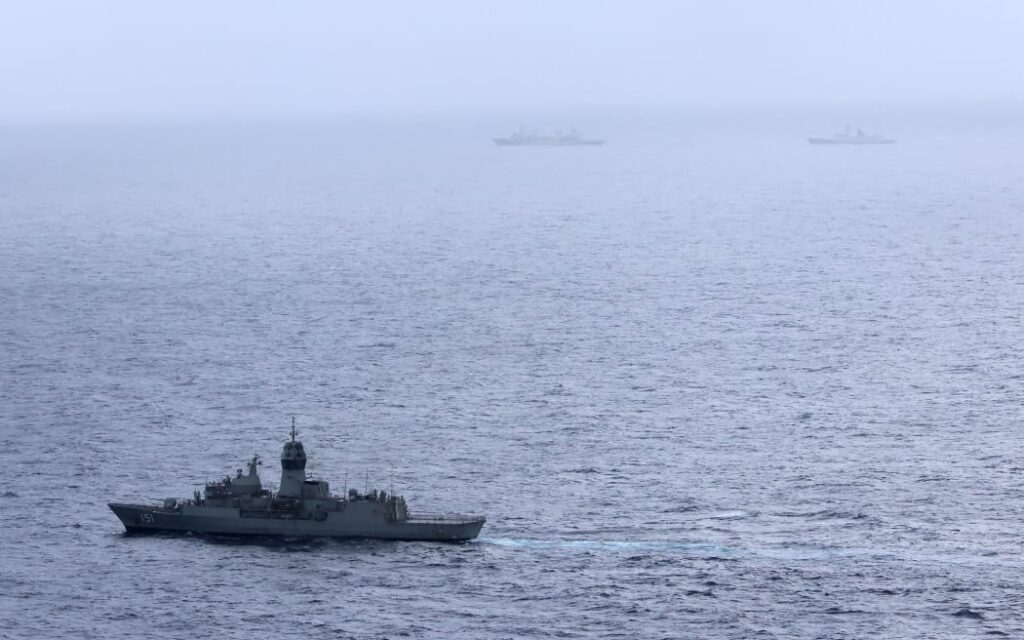
About that PLAN flotilla in the Tasman Sea.

Here are some thoughts about the hysteria surrounding a Chinese Peoples Liberation Army Navy (PLAN) flotilla conducting freedom of navigation exercises in the Tasman Sea, including live fire drills.

1) The flotilla has been tracked for over a week by New Zealand and Australian forces. The tracking began when the flotilla was well NE of the Australian northeastern coast.

HMAS Arunta shadowing PLAN vessels in the Tasman Sea. Source: ADF handout/AFP.

2) The flotilla is operating in accordance with international law and maritime regulations regarding military operations in international waters.

3) The flotilla has no air cover deployed with it and therefore no effective means to defend itself against a coordinated air assault. It is basically a sitting duck for Australian air defences and even NZDF air defences (because the NZDF P8s and Seasprite helicopters carry air to surface munitions as well as torpedos).

4) The flotilla may have a submarine deployed with it.

5) The presence of the PLAN ships in the Tasman is a form of military diplomacy, showing the flag in a distant body of water as a demonstration of blue water power projection capabilities.

6) The PLAN freedom of navigation (FON) exercise in the Tasman Sea may well be a response to a joint Australian-New Zealand FON exercise in the Taiwan Strait in September 2024. Those waters are far more disputed than the Tasman Sea (because the PRC claims them as territorial waters), so the PRC objected to the exercise at the time and declared that it would formulate an appropriate response in due course. This could be it. But the PLAN vessels are far from Australian and NZ territorial waters, so the legality of their presence in open seas is indisputable.

7) The presence of the PLAN flotilla conducting live fire drills (5 conventional surface to surface rounds fired from the Type 055 destroyer Zunyi’s main gun at a floating target, as observed by personnel on the HMNZS Te Kaha) and other exercises is an excellent opportunity for Australian and New Zealand to hone their naval counter-force capabilities, including tactical signals and technical intelligence intercepts and collection from the flotilla. If a submarine is involved then the Antipodean allies can refine their anti-submarine warfare (ASW) capabilities as well, which is exactly what their P8 patrol and ASW aircraft are designed to do. As it stands, Australia and NZ are using air and surface platforms to shadow the PLAN boats.

8) Much has been made about the lack of warning given by the PLAN before the live fire drills. Such warnings are a courtesy, not part of any formal protocol. They are usually issued 12+ hours prior to the drill in order for interested parties such as civilian aviation and maritime operators to plan accordingly and clear away from the target area. The PLAN gave 15 minute warnings, forcing a few planes to adjust course away from the no-fly zone. That was perhaps rude as far as courtesy goes, but nothing more.

9) Most of the hysteria about the flotilla is led by Australian opposition figures in politics and media in an election year. Most of the alarm in New Zealand is led by Sinophobic media commentators or people with little knowledge of military affairs or the nuances of military diplomacy, much less naval operations (especially in NZ). All of them want to tie the exercises to broader Chinese moves in the Southwest Pacific such as the recent bilateral strategic agreement between the PRC and the Cook Islands. For their part, Ministry of Defense officials on both sides have been muted in their response and military officials have been largely silent (presumably because they know what is really happening).

10) It is clear that the PRC is “flexing” its military might in more and more distant places, as any Great Power would do. But not every display of power capability constitutes an imminent threat. Should Australia and NZ pay attention to the exercise? Absolutely, especially because it can be used as a learning tool for their respective naval counter-force platforms. Should they feel threatened by the exercises? Absolutely not. Claims of the exercise posing a threat, being a provocation or an act of intimidation by the PRC betray the biases of those who make such claims. The PRC is just doing what Great Powers do, and if anything it is reminding others of its capabilities while testing them in front of foreign eyes.

Sailors aboard an Australian navy ship look out at Chinese vessels on February 13, picture by the Australian Defence Force

Sailors aboard the HMAS Arunta observe the PLAN flotilla in the Tasman Sea. Source; AFD handout/AFP

11) In the end, if the US, UK, French or other Western navies conducted the exact same exercise in the Tasman Sea, there would be little controversy about it. Because it is the PLAN, however, anti-PRC elements in Australia and New Zealand want to use the occasion to stir up trouble in pursuit of their own agendas. But the truth is that the PRC is not designated as an adversary or hostile state by either Australia or New Zealand, who in fact enjoy largely cordial and beneficial trade relations with the Asian giant. Although there have been moments of friction between Australia and New Zealand, on one hand, and the PRC on the other over a number of political, diplomatic and military strategic issues, and the PRC remains a major concern for the Australian and NZ security communities for a number of reasons, none of this justifies turning what is a relatively small display of power projection into an international incident.

Everyone needs to clam down and relax.

A reminder about soft power.

Waste and fraud certainly exist in foreign aid programs, but rightwing celebration of USAID’s dismantling shows profound ignorance of the value of soft power (as opposed to hard power) in projecting US influence and interests abroad by non-military/coercive means (think of “hearts and minds,” “hugs, not bullets,” “honey versus vinegar,” etc.). Soft power is also a component of “smart power” and “sharp power” strategies in which a combination of foreign policy instruments are used in concert in pursuit of a variety of non-kinetic ends (i.e. objectives short of war).

This razor-gang approach is short-sighted at best and stupid at worst given that the humanitarian/developmental aid vacuum left by US withdrawal from such efforts opens up the field to potential inroads by US rivals. Add to that the fact that USAID pays US farmers around $2 Billion for surplus rice, soy, corn and other agricultural commodities that otherwise would not be grown or go to waste, and the MAGA/DOGE move against USAID is a double-sided own-goal.

The NZ government, which currently is under the sway of MAGA/DOGE-style public policy ideologies, might do good to remember this when it deals with soft power competition in the South Pacific. Waving a (thornless) stick (say, in the form of withdrawal of foreign aid) at Pacific Island Forum countries when they negotiate bilateral economic, diplomatic and developmental aid agreements with non-“traditional” (non-Western/colonial) partners is likely to elicit some blowback of its own.

After all, regardless of the specific compacts agreed to in the past, sovereign States, whatever powers and protections they may have ceded to “traditional” partners, ultimately are autonomous agents of their own destinies. Foreign aid is a good way to remind them that that may be true but destinies can often be intertwined for mutual benefit even if other parties come late to the table.

Still the 5 Eyes Achilles Heel?

The National Cyber Security Centre (NZSC), a unit in the Government Communications Security Bureau (GCSB) dedicated to cyber-security, has released a Review of its response to the 2021 email hacking of NZ members of the Inter-Parliamentary Alliance on China (IPAC, a global organization of parliamentarians) and Professor Anne-Marie Brady, the well known China expert and critic. A number of problems were identified, both operational and (yet again) with regard to accountability and transparency, so I thought I would briefly summarise them.

The Review states that too much focus was placed by the NCSC on “technical” solutions to the email phishing probes instead of considering the “wider” context in which the hacking occurred. In layman’s terms that is akin to saying that the NCSC got busy plugging holes in the parliamentary server firewalls after breaches were detected without considering who was being targeted and what purpose the hacking may have served. This is remarkable because the hacking came from ATP-31, a unit linked to PRC military intelligence well known for having engaged in that sort of activity previously, in NZ and elsewhere. Moreover, the NCSC had to be alerted by a foreign partner that the email phishing efforts were part of a progressive hacking strategy whereby the ultimate target was not the emails of MPs but of the IP addresses that were being used by those MPs. In fact, the NCSC currently does not have procedures for how to respond to reports that foreign, including state-sponsored, actors are targeting New Zealanders. The NCSC found out about the parliamentary email servers hacking from Parliamentary Services in the first instance, and then from foreign partner intelligence that was passed on to it by the NZSIS.

This is of concern for several reasons, not the least of which is that it took a foreign 5 Eyes partner to alert the NCSC to something that it should have been well aware of itself (progressive hacking), and because the NCSC initially assumed, for whatever reason, that the phishing was done by ordinary criminals rather than foreign intelligence units. It also assumed that MPs were already engaged in providing their own security, even after Parliamentary Services flagged potential breaches of its email servers to the NCSC. In fact MPs were apparently told more by Parliamentary Services than the NCSC about their being targeted (albeit after the fact), and the University of Canterbury, Professor Brady’s employer, apparently was never contacted about potential security breaches of their servers.

Since MPs may have sent and received emails from multiple IP addresses attached to their official and personal devices, the security breach implications of the email hacks could be considerable given the potential cross-over between personal and official MP communications. Put bluntly, it is incredible that a dedicated cyber-security unit that is an integral part of the GCSB and through it the Anglophone 5 Eyes signals/technical intelligence network did not consider the membership of the targeted MPs in IPAC and that the phishing occurred at the same time that Professor Brady’s emails were targeted (Brady is known to have close contacts with IPAC). This is basic 1+1 contextual stuff when it comes to operational security in cyberspace, so one gets the sense that the NCSC is made up of computer nerds who have little training in geopolitics, foreign policy, international relations or how the world works outside of WAN and LAN (hint: these are basic computer terms). They simply approached the hacking attacks as if they were plugging a leaking dike rather than consider what may be prompting the leaks and red-flagging them accordingly.

The advice given by the Review was for the NCSC to engage more with the targeted individuals in real time, who only found out about their exposure long after the fact. Moreover, the Minister of Intelligence and Security was not briefed on these intrusions, much like the targeted MPs and Professor Brady were not. Again, this defies the notion of democratic oversight, transparency and accountability within NZ intelligence agencies. Worse yet, it follows on the heels of revelations that for a few years a decade ago the GCSB hosted a foreign partner “asset,” presumably a signals or technical intelligence collection platform, at GCSB headquarters in Wellington without the knowledge of the then Minister or even the GCSB Director-General. Operational control of that platform, including specific taskings and targets, were done by the foreign partner. Imagine if one of the taskings was to geotrack a foreign human target in order to eliminate that target. If word was leaked about GCSB’s hosting of the tracking platform, it might cause some diplomatic tensions for NZ. At a minimum it is a violation of both NZ’s sovereignty as well as basic notions of intelligence agency accountability in a democracy. It seems that, almost a decade later, the much vaunted reforms designed to increase intelligence community accountability embedded the 2017 Security and Intelligence Act had not filtered down to the NCSC dike-plugging level.

This is a very bad look for the GCSB, both in the eyes of its domestic clients as well as those of its 5 Eyes partners. NZ already had a reputation for being the “Achilles heel” or “weak link” of the 5 Eyes network due to its lax security protocols and counter-intelligence capabilities. This may only confirm that belief in spite fo significant efforts to upgrade GCSB capabilities and toughen up its defences, including in cyberspace. And, judging from the reactions of the targeted MPs and Professor Brady, domestic clients of the NCSC, who are both private and public in nature, may not feel too reassured by the Review and its recommendations.

It is known that the GCSB is made up of an assortment of engineers, translators and computing specialists. It has a remit that includes domestic as well as foreign signals and technical gathering and analysis, the former operating under the framework of NZ law under the 2017 Act (most often in a partnership with a domestic security agency).This brings up a question of note. If the staff are all of a “technical” persuasion as described above, then it follows that they simply adhere to directives from their managers and foreign partners, collect and assess signals and technical intelligence data as directed by others, and do not have an in-house capacity to provide geopolitical context to the data being analyzed. It is like plugging leaks without knowing about the hydraulics causing them.

In that light it just might do good to incorporate a few foreign policy and comparative political analysts into the GCSB/NCSC mix given that most of NZ’s threat environment is not only “intermestic” (domestic<–>international) but “glocal” (global and local) as well as hybrid (involving state and non-state actors) in nature. Threats are multidimensional and complex, so after the fact “plugging” solutions are temporary at best.

Given their diversity, complexity and sophistication, there are no “technical” solutions that can counter contemporary threats alone. Factoring in the broader context in which specific threats materialise will require broadening the knowledge base of those charged with defending against them or at a minimum better coordinating with other elements in the NZ intelligence community in order to get a better look at the bigger picture involved in NZ’s threat environment.

The NCSC in-house Review is silent on that.

Media Link: Post-pandemic economics and the rise of national populism” on “A View from Afar.”

On this edition of AVFA Selwyn Manning and I discuss post-pandemic economics and the rise of national populism. It seems that a post-pandemic turn to more nationalist economic policies may have encouraged the rise of populists who use xenophobia and bigotry as a partisan tool by adding non-economic fear-mongering and scapegoating to the necessity of shifting to more inwards-looking structural reform. You can find the show here.

Media Link: “A View from Afar” on the moment of friction, and more.

After a hiatus of over four months Selwyn Manning and I finally got it together to re-start the “A View from Afar” podcast series. We shall see how we go but aim to do 2 episodes per month if possible.

Here we start of with a catch up on events since the last podcast of 2023. Selwyn liked the KP moment of friction post from April 1, and so we used it as the stepping stone into a discussion that incorporates material from several recent KP posts and other news. I hope that you find the podcast of interest. You can find it here.

Arguing about a moot point.

I have been following recent debates in the corporate and social media about whether it is a good idea for NZ to join what is known as “AUKUS Pillar Two.” AUKUS is the Australian-UK-US nuclear submarine building agreement in which the US and UK will provide Australia with the know-how and training on how to build and operate a small nuclear submarine fleet beginning in the 2030s. It has two components.

Pillar One involves the submarines themselves, which will be home ported at HMAS Stirling outside of Perth. Beginning in 2027 US Virginia-class and UK Astute-class attack subs (from which the future AUKUS-class Australian submarines will incorporate design features) will start rotating through HMAS Stirling so that Royal Australian Navy (RAN) and civilian personnel at HMAS Stirling can become familiar with nuclear submarine technologies and home port surface operations. The US will sell Australia up to three Virginia-class Block IV and Block VII subs beginning in the early 2030s and delivery of five new AUKUS submarines (designated as SSN-A’s) will begin in the mid 2040s. RAN crews are already attending the US Navy nuclear propulsion school in South Carolina and they will also join UK and US Astute- and Virginia-class boats on deployments as a part of their training. The project envisions the Royal Navy receiving SSN-A boats to replace their Asute-class fleet beginning in the early 2030s, and for the RAN to have a nuclear fleet of eight boats by 2050. Although nuclear propelled, they will not be nuclear armed. They are attack submarines whose main roles are to kill other submarines, surface vessels and land-based targets with conventionally armed torpedoes and cruise missiles. They are also tasked with intelligence-gathering missions involving technical, signals and even human collection methods.

Pillar Two of the AUKUS agreement involves complex technology research, development and transfers. The primary areas of focus will be on computer and cyber technology (including Artificial Intelligence, Quantum Computing and classified undersea technologies), hypersonic and counter-hypersonic platforms (already in progress), and Radar Capability, including the Deep Space Advanced Radar Capability (DARC) that will see tracking stations built in the Pillar One Countries. Pillar Two is designed to move beyond basic systems interoperability between the military allies, which is already in place, and integrate the military-industrial complexes of the three partners in ways that will not only lead to more seamless integration of complex technologies but also help create and expand high tech development hubs in each country, but especially in Australia and the UK. This is seen as having tremendous “trickle down” benefits for the civilian economies of each country as the flow-on effects of Pillar Two ripple into related industries up and down the supply, service, and delivery chains and their associated labour markets.

In March 2023 then Defense Minister Andrew Little of the Labour Party said that NZ was interested in discussing potential involvement in the non-nuclear aspects of Pillar 2, and in July 2023 US Secretary of State said that the “door was open” for countries like NZ to join the agreement. In December 2023 new Prime Minister Christopher Luxon reiterated his government’s interest in potentially joining in the non-nuclear aspects of Pillar Two, something that was followed by an announcement in February 2024 by Australia that it would begin to brief NZ officials on developments with regard to Pillar Two. However, after losing the October 2023 election the Labour Party reversed course and announced its opposition to participating in Pillar Two, and even the Grande Dame of the Labour Party, former NZ Prime Minister and UNDP chief Helen Clark, came out strongly against it. She has been joined in her opposition by a number of prominent NZ academics, peace, non-proliferation and disarmament campaigners, human rights and environmental activists, civil society organisations and left political movements as well as former diplomats.

Their concerns range from not wanting to jeopardise NZ’s trade relationship with the PRC, which has strongly denounced AUKUS as a provocative attempt to militarily counter and encircle it in the Western Pacific (and there is truth to that), which has a history of using trade as a retaliatory weapon in order to show its displeasure with other State’s behaviour, and upon which NZ is significantly trade-dependent, to fears of a nuclear arms race and/or great power conflict in the Southwestern Pacific that would have a disastrous impact on Pacific Island societies, economies and environments.

That latter point is significant because the permanent basing of nuclear submarines at HMAS Stirling appears to be in violation of the 1997 Treaty of Rarotonga declaring the South Pacific to be a nuclear-free zone.The maps of the South Pacific nuclear-free zone attached to the Treaty include the Australian West Coast fronting the Indian Ocean, and the Treaty prohibits the storage of significant quantities of fissile material or nuclear-processing facilities within the Zone. So the AUKUS agreement is seemingly in violation of the Treaty, which if so sets a dangerous precedent (AUKUS supporters claim that at worst the signatories exploited loopholes in the Treaty that make the agreement compliant with it). This can now open the door for other States to station nuclear powered submarines in the region, say for example, the French in New Caledonia or French Polynesia or the PRC in the Solomon Islands (thanks to the recently signed bilateral security agreement between the two countries). That would not be good from a strategic or arms control standpoint and would fulfil the darkest dreams of the non-proliferation community.

These opposition voices are countered by security experts and conservative political observers who see closer relations with AUKUS as enhancing NZ’s security in a rapidly deteriorating international security environment (in which militarily aggressive Russia and the PRC are seen as leaders of an authoritarian, anti-democratic, anti-Western bloc emerging from the Global South), and which also has great economic benefits for NZ should it join Pillar Two.

That is the foundation of the debate I mentioned at the beginning of this essay. Put crudely, Lefties do not want NZ involvement in Pillar Two. Righties do.

All of this seems to me to be a bit of a moot point. I hopped on the consultancy social media account to outline two reasons why, and I have expended them below.

First: the NZDF and GCSB (as part of 5 Eyes) will share AUKUS-related military technology and signals and technical intelligence collection advances because of their ongoing integration with Australian and US maritime operations and 5 Eyes partnership, especially when it comes to Western Pacific Anti-Submarine Warfare (ASW) roles. The incorporation of new P-8 long range patrol and ASW aircraft into the RNZAF and upgrades to the RNZN frigates have been done with that complex interoperability in mind. The NZDF already uses the principle of interoperability when working alongside its military partners–the US, UK and Australia being foremost among them– so whatever systems integration upgrades that result from AUKUS will be shared with NZ in any event. As it is, the NZDF already communicates with US and Australian submarines as a matter of course, so it will continue to do so once the nuclear-propelled ships come on board (remember that submarine hunters and surface patrol platforms need to distinguish friend from foe, and the best thing to do in that case is to ask upon contact or be alerted in advance by friendly forces). So as far as non-nuclear military technology sharing with the NZDF goes, it is a done deal. NZ does nothing (at least publicly) and yet it still gets to play with the military “big dogs.”

Also keep in mind that submarines are excellent signals intelligence collection or intercept platforms, particularly when it comes to undersea fiberoptic telecommunications cables. So upgrading to nuclear powered subs by the RAN will expand the range and operational capabilities of its maritime signals intelligence collection platforms as well as improve its ability to monitor hostile naval movements above and below the water line. The NZDF and GCSB will benefit from that, again, without having to do anything different than what they are doing already but with improved intelligence-gathering capabilities as a result.

Secondly, Australia, the UK and the US high technology sectors will not gift NZ firms a slice of the Pillar 2 pie for competitive and political reasons. Why allow the small high technology sector of a non-nuke “freeloading” country to benefit when AUKUS firms can benefit instead? Plus, AUKUS high technology sectors employ voters, have entrepreneurial lobbies and involve established economies of scale, so why share the Pillar Two market with what essentially would be a start-up upstart that has no political influence and electoral impact in the AUKUS countries themselves?

In effect, for operational as well as economic and political reasons, NZ involvement in Pillar Two is improbable. It will be briefed about Pillar Two as announced, but an invitation to join the endeavour faces opposition both from within and from without NZ. It therefore seems that the current government is engaging more in political and diplomatic posturing when it speaks of NZ’s involvement in Pillar Two rather than realistically assessing the prospects of that ever happening.

In that light, perhaps the fears of Pillar Two opponents are overblown?

A moment of friction.

In strategic studies “friction” is a term that it is used to describe the moment when military action encounters adversary resistance. “Friction” is one of four (along with an unofficial fifth) “F’s” in military strategy, which includes force (kinetic mass), fluidity (of manoeuvre), fog (of battle) as well as uncertainty (of outcomes, which is usually referred to in military circles as the “oh F**k” factor)). Friction comes from many causes, including terrain, countervailing force, psychological factors, the adversary’s broader capabilities and more. As German strategist Karl von Clausewitz noted, friction can be encountered at the three levels of warfare: strategic, operational and tactical.In other words, “Clausewitzian friction” is not just confined to the battlefield.

The notion of friction is drawn from the physical world and has many permutations. It is not confined to one particular element or dimension. It is about opposition, even if of similar elements or forces, including the element of will. For example, when they meet, fluids and air of different weights create turbulence. Fire on different fire extinguishes or expands. Earth on earth leads to crumbling or inertial momentum. The product of the combination of these physical forces, say fluid on air or earth or fire, depends on the relative weight of each. The same goes for psychological factors in human contests. Mutatis mutandis (i.e., with the necessary changes having been made), this is applicable to international relations. It may seem like a conceptual stretch but I see the use of the notion of friction in terms of international relations more as an example of conceptual transfer, using Clausewitz as a bridge between the physical and the political/diplomatic worlds (more on this later).

In the past I have written at length about the systemic realignment and long transition in post Cold War international relations. The phrase refers to the transition from a unipolar post-Cold War international system dominated by the US (as the “hegemon” of the liberal internationalist world order) to a multipolar system that includes rising Great Powers like the PRC and India and constellations of middle powers such as the other BRIC countries (Brazil, Russia, South Africa and recently added members like Egypt, Iran, Saudi Arabia, the UAE, Ethiopia and perhaps Argentina (if it ratifies its accession)) as representatives of the rising “Global South.” In spite of their differences, these rising power blocs are counterpoised against what remains of the liberal institutionalist order, including the EU, Japan, South Korea and Australia. I have noted that the long moment of transition is characterised by international norm erosion and increased rule violations and the consequent emergence of conflict as the systems regulator until a new status quo is established (and from which that new status quo emerges). That conflict may come in many guises–economic, diplomatic, cultural and, perhaps inevitably, military or some combination thereof. When conflicts turn military, the moment of force has arrived. And when force is met by opposing force, then friction is inevitable.

Here I extend the notion of friction to include the international moment that we are currently living in. That is, I have conceptually transferred the notion of friction to the international arena because “transfer” in this instance means applying the notion of friction to a wider environment beyond the physical plane without distorting its original meaning. That allows me to avoid the methodologically dubious practice of conceptual stretching (where a term is stretched and distorted from its original meaning in order to analytically fit a different type of thing).

The long transitional moment is what has taken us to this point and allowed me to undertake the transfer, and it is here in the transitional trajectory from unipolar to multipolar international systems where the future global status quo will be defined. It is a decisive moment because it is the period where force has become the major arbiter of who rises and who falls in the systemic transitional shuffle. Given that there are many competitors in the international arena who are capable and willing to use force as well as other means to advance their interests, I suggest that the global community has reached its moment of friction, that is, the turning point in the long transitional process. Everything that has come before was the lead-in. Everything that comes after will be the result of this conflict-defined moment.

It is no exaggeration to write this. Besides the Ruso-Ukrainian war and the Israel-Hamas war, there is the armed stand-off in the Red Sea between Iran-backed Houthis and a naval coalition led but he US, the ongoing skirmishes between PRC naval forces and those of the Philippines, Vietnam and Western naval forces as well as the PRC military threats to Taiwan, the Israeli-Hezbollah conflict along the Israel-Lebanon border, Islamist violence in the Sahel and Eastern Africa as well as in Russia, Afghanistan, Pakistan and other other parts of Central Asia, ongoing conflict in Syria between Assad’s Russian-backed forces, the remnants of ISIS and Western-backed rebels, the Turkish-Kurd conflict along the Turkish, Syrian and Iraqi borders, the civil war in Libya, escalating fighting between the Democratic Republic of Congo and Rwanda over mineral rich areas in and around the eastern Congolese city of Goma (in which private military companies and irredentist militias are also involved), narco-violence in Latin America that has reached the level of challenging state monopolies over organised violence in places like Ecuador and parts of Mexico, piracy in the Indian Ocean and in the Malacca Straits, cross-border ethno-religious conflict in Afghanistan and Pakistan, ethnic cleansing in Myanmar, the PRC and Gaza, tribal conflict in Papua New Guinea and more. Norms and rules governing interstate as well as domestic forms of collective behaviour are honoured in the breach, not as a matter of course. Individuals, groups and States are increasingly atomised in their perspectives and interactions and resort to the ultimate default option–conflict–to pursue their interests in the face of other’s opposition..

Friction extends to economics. The era of globalisation of free trade has ended as nations revert to post-pandemic protectionism or focus on “near-“and “friend-shoring” in order to avoid supply chain bottlenecks resultant from commodity production concentration in a small number of countries. Although not a trade pact strictly speaking, the PRC Belt and Road Initiative undermines Western trade agreements like the TPPA and lesser regional arrangements because it ties developmental assistance and financing to Chinese industries and markets. Intellectual property and technology theft is wide-spread despite International conventions against them (endnote just by the PRC). The era of Bretton Woods is over and the agencies that were its institutional pillars (like the World Bank, IMF and regional agencies such as the IADB and ADB) are now increasingly challenged by entities emerging from the Global South like the China Development Bank and BRICS common market initiatives.

In addition, as part of international norms erosion and rules violations, many diplomatic agreements and treaties such as those prohibiting the use of chemical weapons and even genocide are also now largely ignored because, in the end, there is no international enforcement capability to reinforce what is written. The International Court of Justice and International Criminal Court can impose sanctions and issue arrest warrants but have no enforcement authority of their own. The UN can authorise peace-keeping missions and issue resolutions but is subject to Security Council vetoes on the one hand and belligerent non-compliance in the other (besides Israel ignoring UN demands for a cease-fire and humanitarian pauses in Gaza, people may forget that there are UN peace keeping missions in the Sinai, Golan Heights and Israel-Lebanon border, including NZDF personnel among them, because these “blue helmet” missions have had no ameliorating impact on the behaviour of the participants in the Israel-Hamas-Hezbollah-Syria conflict). Adverse rulings in international courts have not stopped the PRC island-building and aggressive military diplomacy in the South China Sea. The examples are many. Given that state of affairs, States and other actors increasingly turn to force to pursue their interests.

Whatever restraint was promoted by the laws of war and international conflict-resolution institutions during the post-Cold War interregnum has been abandoned or become exceptions to the new anarchic rule. One might even say that the international community is increasingly living in a state of nature, even if the terms “anarchy” and “state of nature” are loose interpretations of what Hobbes wrote about when he considered the Leviathan of international politics. But the basic idea should be clear: the liberal internationalist system has broken down and a new order is emerging from the conflict landscape that characterises the contemporary international arena.

Again, the friction is not just things like the military confrontations between Russia, Russian and Iranian-backed proxies in the Middle East and the PRC against a range of Western and Western-oriented nations in the Western Pacific. The BRICS have proposed to develop a single unitary currency to rival the Euro and are openly calling for a major overhaul of international organizations and institutions that they (rightfully so), see as made by and for post-colonial Western interests. But the question is whether what they have in mind as a replacement will be any better in addressing the needs of the Global South while respecting the autonomy of the Global North. My hunch is that it will not, and will just add another front to the moment of friction.

I shall not continue enunciating the reasons why I believe that we have arrived at an international moment of friction (e.g. cultural degradation and social vulgarisation, etc.). That is because I cannot specify what will be come given that push has now led to shove, nor can I offer a solution set to the problems embedded in and underwriting this sorry moment. What I can say is, just like the fact that we need to learn to embrace uncertainty in the transitional process since outcomes are not assured and guarantees cannot be offered (although some industries like tobacco, liquor, weapons and insurance all profit during times of uncertainty and market hedging strategies become the common response of risk-adverse actors to uncertain economic times, so can be calculated or anticipated), so too we must, if not embrace, then learn to prepare for an era in which friction will be the dominant mode of international transaction for some time to come.

For small countries like NZ, repeating empty mantras about foreign policy “independence” no longer cuts it even as a slogan. The moment of international friction poses some existential questions about where NZ stands in the transitional process, how it will balance competing international interests when it comes to NZ foreign and security policy, and about who to side with when conflict comes.

Because it will.

Forget the date. This is no April Fools joke.