Skirting the storm.

I arrived in Miami just as Hurricane Irene turned northeast, sparing Florida but pounding the Mid- and North Atlantic seaboard. From what I saw of the outer fringe of the storm when it was a category 3 hurricane–5 meter frothing waves, high gusting winds and torrential (sometimes horizontal) rain, the folk up north were lucky that the storm weakened as it hit colder water and made landfall. Not surprisingly, many complained about the mandatory evacuation measures that were put into place, arguing that it was over-kill given the downgrading of Irene to a category 1 storm, even though the flooding and winds that did reach the major population centers clustered along the East Coast caused more than 30 deaths, major damage to property and infrastructure, and prolonged  power outages that affected over 5 million people. Just like those who flocked to the shoreline to see the big surf, it is as if they simply cannot understand the implications of what was originally headed their way. In many ways, this reflects the general state of US politics at the moment.

The current political climate in the US is dominated by the Republican primary campaign. Truth be told, it has all the aspects of a circus side-show, freaks and all. There is Michele Bachmann, she of the “always on high beam” glazed stare and Cold War apocalyptic views with the closet queen husband who claims that he converts homosexuals to heterosexuality through prayer (giving a whole new meaning to the phrase “laying on of hands”). There is Rick Perry, a W. Bush wanna-be Texas governor who does not believe in man-made climate change and endorses creationist interpretations of evolution. There is a black guy with a slave name (Herman Cain) who ran a chain of pizza shops and seems to think this is enough experience to run the country. There is the evergreen Ron Paul, who looks better over time in the measure that his party candidates increasingly evidence pre-reconstruction beliefs. There is Newt Gingrich, serial adulterer and engineer of the last government shutdown, pontificating about a return to “constitutional values” ( he must be thinking about the founding father’s penchant for liasions with female slaves). There is millionaire Mitt Romney, once again attempting to recast himself in a right-wing image, this time as a Tea Party supporter. Romney and another candidate, John Huntsmann, are both Mormon former governors of states that in no way reflect the larger society in which they exist (Massachusetts is an unsually liberal state, while Utah is unusually conservative). Behind this motley suit-clad crew are the ranters and ravers, led by Sarah Palin and Glenn Beck, who want to bomb Iran, Venezuela, North Korea, Pakistan and any other place the communist-socialist, islamofascist, feminazi, ecoterrorist gay-lesbian secular humanist alliance is taking hold.

The GOP is a party now governed by its rump, in the guise of the Christian fundamentalists and Tea Party anti-government activists (who in spite of their claimed belief in self-reliance are strangely silent on the issue of accepting federal aid to the hurricane disaster zones, perhaps because Bachmann and televangalist Pat Robertson both claimed that the hurricane and the earthquake that preceded it on the East Coast were acts of God designed to warn politicians to be fiscally prudent and morally conservative). It is a party that has congressional leaders that openly gloat that their primary objective is to make the Obama administration fail, even if it takes forcing government agency closures as arguments over budgetary matters continue at an impasse (the agreement on the debt ceiling is only a temporary measure). This includes trying to tie federal disaster relief to budget cuts in other areas. It a party that is openly disloyal and disrespectful of the presidency, and which has open champions on conservative media outlets that are equally disrespectful and delusional in their approach to “correcting” the multiple ailments afflicting the country. These people dream of an Ozzie and Harriet la-la land where Negros, Hispanics, Arabs and other non-whites know their place.

The trouble for this crowd of neo-cons, bible-bashing fundies, xenophobes, racists, isolationists, revanchists and neo-imperialists (and yes, there is a bunch of contradictions layered in there) is that their proposed solutions to the US malaise avoid the major issue and in fact will serve to exacerbate it: growing class differentials, both in income and opportunity. In the US today, the top 400 individual income earners control as much of the national wealth as the bottom 60 percent of the population. This is what I have called in the past the “Brasilianisation” of US society, where income inequalities become monumental, except that now Brazil is thriving and growing its middle class by using the type of state-managed macroeconomic policies so reviled by the American Right, to the point that it beginning to look like what the US once was (no insult to Brazil intended).

Yet the Tea Baggers and GOP want to continue tax breaks for the upper ten percent of the population and corporations (some of whom have paid no net tax in the last five years) while drastically reducing public funding for so-called “entitlements” like universal health care, welfare, education and infrastructure development. The new scapegoats, along with the traditional targets of brown-skinned immigrants, are public sector employees, who now are being targeted for layoffs and redundancies at both the state and federal level. A major target are public school teachers, whose pensions are considered to be a major drain on state coffers (in spite of the fact that these employees paid a significant percentage of their salaries into their pension funds).

Behind all of this is open hatred of unions to the point that some GOP candidates want to eliminate them entirely. Bachmann, for example, wants to disestablish the National Labor Relations Board, a non-partisan oversight body established by FDR as part of the New Deal that encourages the right to collective bargaining and union representation in the workplace (but not closed shops). Anti-union governors have emerged in several states (most notably in Florida, Minnesota and Wisconsin) using union-bashing as a populist tool in pursuit of fiscal reform. Given president Obama’s conciliatory and compromising stance vis a vis GOP demands (some have called it a sell-out), cracks in the Democratic support base are starting to show, with the labor movement, Congressional black caucus and Hispanic leaders all denouncing his retreat from the “progressive” (as much as you can be in the US)  policies on which he campaigned. This augers poorly for his re-election chances in 2012, although given the dog-and-pony show that is the GOP candidate list, he remains the default option.

Of course, these same reactionaries want the US to maintain a global military presence (now in more than 80 countries) that can strike at any adversary, real or imagined (recall the invasion of Grenada under a previous Republican president). They fail to understand that keeping a global war machine requires and exceptional level of public funding through taxation, and that the 100+ trillion dollar US public debt is in large measure due to the Bush 43 administration’s deficit-spending pursuit of two wars of occupation (one of necessity, one of choice) that is currently costing 1 million dollars per deployed soldier per day (one only has to think of the logistics lines and cost of equipment to see how these figure tallies up).

Rather than push to withdraw or downscale the US foreign military presence these same folk preach about the need to maintain the US role as global policeman, particularly in light of the re-emergence of China and Russia as strategic rivals along with the threats posed by states such as Iran and other middle powers that fail to adhere to US dictates. They deny that they are imperialists, but in order play the role of world cop the GOP is willing to sacrifice the roots of domestic stability, in the form of an equitable tax base and the robust provision of public goods and services.

This brings up what the GOP and Tea Party extremists cannot see and what their policies will aggravate: class conflict. The US has always been good at deliberately down-playing class conflict in favour of racial tensions, cultural differences and issues of social choice. During times of plenty, say the 15 year period between 1993 and 2008, the underlying class divisions in US society could be more readily submerged by these distractions, making the electorate easily manipulable by the corporate-political elite that benefited the most by the macro-economic policies of the last two decades. But in the last three years, as the same economic elites who plunged the US economy into recession were awarded corporate bail-outs by both the Bush 43 and Obama administrations, millions of “ordinary” Americans have lost their jobs, their homes and their future prospects. Now, rather than providing the federal safety net as a stop-gap against further social dislocation and the unrest that it brings, the GOP is successfully pressuring the federal government to remove key components of the fundamental social contract that has underpinned US society since the 1960s.

The proposed conservative roll back ignores the fact that what got the US out of the Great Depression, the New Deal, was founded on a federal job creation program, and that the Great Society of the 1960s was rooted in the expansion of civil rights tied to equal opportunity access promoted and enforced by the federal government. Instead, the American Right has adopted a “survival of the fittest” approach in no small part because they are the fittest to survive given who their economic benefactors are. The reality is that their proposed remedies are exactly the opposite of what has worked in the past to revitalise the economy and will have negative consequences far in excess of whatever benefit they hope to achieve.

What the GOP, Tea Baggers and the frothing-at-the-mouth media conservatives are blind to is the fact that their policies will accentuate class differences, leading to increasing alienation and dispair amongst those for whom the American Dream no longer exists. One only need to look at the UK riots to understand where such policies lead to, yet the likes of the infamous Koch brothers (billionaires who are funding the Tea Party movement) continue to push for policies that reduce the ability of the federal government to help those at the bottom of the socioeconomic totem pole.

There is irony in the fact that the Tea Party movement is made up of mostly white middle  and working class people yet advocates tax and fiscal policies that openly favour the rich and corporate interests instead of their own. In fact, the Tea Party movement is backing policy prescriptions that are a thinly veiled attack on the working poor and lower middle classes as much as they are a coddling of the wealthy. But then again, false consciousness is a common feature of declining class fractions confronted with the evolution of society in which they no longe matter, as they seek to cling to a nostalgic version of the past in which they served as the motor force of the economy and culture. They no longer are, and the conservative correctives will ensure that it stays that way.

The bottom line is that like the fools who ignored warnings about the hurricane, the American Right is plunging the country towards its worst nightmare: the day in which class conflict emerges out into the open and cannot be disguised by so-called “culture wars” and the other customary diversions that have been used successfully in the past. When that day comes not only will the discourse of politics be different. So too will be social interaction, which will begin to adopt centrifugal rather than centripetal characteristics as the fabric of society begins to fray.

NB: A note for Lew: you will be interested to know that television advertising in the US increasingly sees the use of military personnel (or actors protraying armed service people) in a variety of huckster roles, from selling donuts to cars to anxiety medicine. Most of the military personnel being potrayed (including female soldiers) are depicted as being from the enlisted ranks, as a common touch with the consuming masses. Since you are the media analysis guru I shall leave it to you to ponder the implications of the military presence in US advertising, but if it is true that advertising reflects more general social preferences, trends and mores, then from my non-expert vantage point it sure looks like the militarisation of public discourse is near complete (which only will make the impending clash of class interests that more alarming).

Needs, Wants and the threshold of consent.

They say that necessity is the mother of invention. If so, then the genius of capitalism is that it translates wants into needs. Needs determine necessity. The deliberate promotion of wants into needs in pursuit of profit has become the driving force behind technological innovation,the necessity of which is driven as much by consumption as it is productive requirements.

Thirty five years ago few people had remote controlled televisions. Over time the remote became affordable for mass consumption, and by now few televisions come without them.  As a unanticipated externality or derivative, local pathologies have risen as the” need” to consume  taken hold: couples fight over viewing options, leading to personal conflicts or the acquisition of another television and remote for separate viewing and marital harmony (as well as further profit). As the cost of televisions with remote controls drops under the weight of competition, material preferences (and social pathologies) are extended into the mass of society. Thrity years ago no one needed a remote controlled television. Now everyone does, at least in the “developed” world.

Twenty years ago mobile phones were clunky, heavy and expensive. So where computers. Landlines sufficed for most verbal communication, and computers were in a relatively early and restricted stage of mass development. Since mobile phones  and computers were not needed for everyday communication they were a luxury good or professional tool, not a mass consumption item.

Today computers and mobile phones are everywhere, with squadzilliions worth of gigabytes and full spectrum interconnectivity complete with multi-media capability built into the latter and with the former moving into nanotechnologies of unprecedented scale. Everyone must have one or the other (or preferably both) and landlines are being phased out along with desktop computers. The very nature of inter-personal and group interaction has been altered by the advent of portable communication devices and the move into social media. This has had political as well as personal impllications.

The translation of wants into needs is evident in the service sector, which now occupies the majority of GDP is many countries. 15 years ago only the uber rich wanted personal trainers and life coaches. Now there are scads of them (the US has an association of life coaches that numbers 150,000 members), as there are many other types of service that cater to wants translated into needs. Think car and dog groomers, garden landscapers, plastic surgeons that do vanity work–the list of non-productive occupations that service the “wants into needs” trade is immense and only limited by the amount of disposable income available.

Turning wants into needs fuels profit  riding on unsecured advancement.  Making affordable the previously unobtainable, then embedding  the consumption of previously wanted goods to the point that they become needs that influence human behaviour, perpetuates the cycle of profit as well as technological, innovation and service frontiers. But in its success it generates new inefficiencies. Time in and efficiency of production is saved and improved, but time is also wasted in the pursuit of consumption of non-productive consumer commodities or individual interests and pleasure pursuits (all those of you reading this at work will get the drift). Commodity fetichism sets in, and here is where the Achilles Heel of contemporary capitalism ultimately rests.

For any regime to be legitimate in the eyes of its own people, and hence to be stable over time, it must establish and continually uphold the threshold of mass contingent consent upon which its rule is founded. Consent, as readers may remember from a series of posts done on KP a while back (and the literature on which those posts were based), is simultaneously secured and expressed at the economic, social and political levels. Political consent is given through elections and adherence to institutional channels of conflict resolution, redress and voice. Social consent is achieved by mass acceptance of ideological norms guiding individual and group behaviour. Economic consent is given by participation in the system of profit and private property and exchange for incremental gains in mass material standards.

Consent is not given once, forever. It is given contingent on expectations being met at all three levels of operation, the combination of which represents the threshold of mass contingent consent at any given time. Nor are expectations static. Instead, the develop and advance as a result of the translation of wants into needs over time. Mid-career professionals have different material expectations than teenagers on their first job. Adults have different expectations than (and of) their children. They also have different responsibilities, some of which are a product of achieving past expectations. The same holds true for social and political consent. As people become accustomed to one set of expectations they come to want more, and in so doing play into the “wants into needs” logic. In advanced democracies people want more social and political entitlements, if not rights, than did those present at the origins of the democratic state in their respective countries.They also want more things, particularly those that are related to social status and advancement. The threshold of mass contingent consent, in other words, rises over time and in the measure that mass contigent consent is achieved and reproduced.

The emergence of cultures of mass consumption that are disconnected from production have broken the easy translation of wants into needs. Conspicuous consumption is everywhere but the means of achieving it increasingly is not. Uncoupling of production from consumption reverses one traditional logic upon which it was based: that production lead or keep pace with consumption (the supply side argument).  It also undermines demand-side logics because these are based on an assumption that production will be dominated by consumer preferences rather than speculative calculations of gain, and that the production of consumer durable and non-durables would absorb most global capital in advance of consumer demand.

The current phase of globalised capitalism brought with it the uncoupling of production from consumption even as the “wants into needs” syndrome persists. The specific result is that, relatively speaking, global production of goods has declined while the consumption of non-productive commodities has increased. That means that there is an excess of wants with respect to needs. In fact, mass focus on obtaining a proliferation of wants has served to obscure the basics of needs. That makes people feral rather than solidarity-minded, even as the divorce between their material and social priorities and structural reality come into conflict. 

This quickens the process of alienation based on a sense of relative deprivation, which in turn is the source of collective unrest based on the withdrawal of mass contingent consent to the economic project (since it is the feeling of relative as opposed to absolute deprivation that riles people up. If everyone is equally poor and deprived they take comfort in their common condition. When some are much better off than others and the means to achieve conspicuous consumption status are reduced, then collective resentment grows). When material gains are not assured, much less incremental in the passing of one generation to the next, then the structural foundations for a mass withsdrawal of consent are set in place.

Withdrawal of mass contingent consent from the economic project leads to withdrawal of consent at a social level. The turn to collective violence and acts of individual norm violation and misbehaviour are manifestations of a lack of consent to the prevailing social mores, which are seen as instruments of elite control in pursuit of an economic project that no longer allows for the satisfaction of wants turned into needs via material gratification. The withdrawal of mass contingent consent to the ideological project represented by different combinations of social mores and norms is the precipitant for a withdrawl of political consent. The masses turn away from institutional channels of expression, voice and redress. This is a crisis of the political regime.

This seems to be more or less where the UK is at present, although it is just one of many countries in which dominant paradigms are being challenged and in which maintenance of mass contingent consent is under question. That many of the UK looters and rioters had mobile phones, wore designer label clothes and connected via social media does not obviate that fact; it is just another manifestation of the “wants into needs” syndrome turned sour.

The fundamental issue is that the “wants into needs” logic worked well so long as the material production of goods outstripped the wants of the general population. But as production vis a vis consumption decreased and full employment policies gave way to more precarious employment schemes in non-productive work, the gap between needs and wants widened for the majority, forcing concession and backtracking in material lifestyles. That has had social and economic repercussions as the first generations of citizens who will not be as well off as their parents lose faith in the system that their parents consented to.

One might call this situation many things, but the bottom line is that it represents a transitional moment that has no defined outcome but which is certain to include severe dislocations of the economic, social and political sort in the measure that a new threshold of mass contingent consent (however debased, as was the case with the Argentine and Chilean democracies that followed the state terror experiments of the 1970s and 1980s) is not achieved. The outcome is uncertain, and the situation is delicate and dangerous (to again paraphrase the founder of the Italian School of Marxism).

NB: Obviously this post is stems from the previous posts on the UK riots and the fiscal crisis of the Western capitalist State, as well as the comments about them. It also has longer-term roots in a series of lectures that I  used to give in upper division undergraduate courses on worlds systems, modernisation and dependency theory as well as revolutions, insurgencies and counter-hegemonic movements. I will resume writing about other things shortly.

Really too big to fail.

Market responses to the US debt crisis and financial downgrade have been like king tides as of late, and inevitably speculation centers on the possibility of a “double dip” global recession (this speculation is more than rhetorical. Gold and other precious metal prices have spiked overt the last three weeks as investors flee the stock, bond, commodity and currency markets). There is much talk, some fearful and some hopeful, of a global meltdown of epic proportions. The argument goes that downgrading the US credit rating devalues US Treasury bonds and the dollar, which slows US private investment at home and abroad, decreases domestic consumption, increases unemployment and generally prolongs the recession begun in 2008. This ripples negatively across the globe given the interconnectivity of commodity chains and the central role of the US in them. Be it on the Left or the Right, the belief in state bankruptcy is taken as an article of faith.

The reality is different. What is happening is a fiscal crisis of the Western State rooted in a cyclic crisis of capitalism. Arguments about the blown-out US public debt obscure the fact that it is the result of the same conditions that produced the 2008 recession and which are at root the cause of the next one. For the last thirty years the ‘bubble” of private debt was replicated by the US Government, in the last decade under the strain of simultaneously fighting two prolonged low intensity conflicts. In Europe public debt was in part procured in order to compensate for private debt (via the provision of subsidized entitlements). Capital was lent on looser and looser terms as interest payment calculations came to rival returns on productive investment as the dominant macroeconomic logic. The market in financial derivatives boomed, then busted, bringing with it a crisis in small scale property ownership at the same time that major manufacturers were being bailed out by the US government.

There is a difference, however, between the private sector and the State when it comes to fiscal crises. The analogy between States and firms is overdrawn. Firms go bankrupt; States do not. States may default on loans and suffer the indignities of downgrading by financial institutions, but they do not go out of business. The reason is simple. States  with a presence in the global economy may fail but they do not cease to exist.

Modern states are political entities with other measures of power beyond economic resources, are rooted in historical and cultural ties within more or less fixed borders, have distinct political systems and political regimes that govern them, and are therefore sheltered from the hard realities that beset wayward market agents in a globalised system of production, service and exchange. More importantly with regard to the social and political relations of production, the modern nation-state supercedes the market at any specific moment even while being generally subject to its rhythms and dictates. It is, after all, a capitalist type of state that is not reducible to the productive apparatus.

Imagine even if the US defaulted on its current obligations. Its credit rating would fall further in parallel with the value of its currency, but how long will that last? Even if the US fails its financial obligations, it would be the markets that push for a debt restructuring favourable to it.  As the core of the global economy, the US is simply too big to fail because its financial collapse would reverberate widely and deeply through the world. In fact, with the exception of undeveloped failed states and microstates with minimal economic resources to promote, virtually all modern states can survive a fiscal crisis and default.

 Take Argentina, which in 2000 defaulted on its foreign loans, uncoupled its currency from the US dollar and then renegotiated the terms of its obligations. Since most of the outstanding balance was interest rather than principal, foreign creditors were eventually forced to settle on terms favourable to the Argentines (about 60 cents on the dollar lent). The weakened Argentine peso stimulated commodity exports and attracted foreign investment in resources and primary goods. In spite of endemic corruption, political interference and a multitude of market inefficiencies, over the last five years Argentina has averaged growth rates in excess of six percent and attracted the highest levels of foreign investment ever even while maintaining a large public deficit.

 Greece, the poster child of all that is supposedly wrong with governments and societies that do not couple entitlements with production, is another such case. What would happen if Greece defaulted on its recently rescheduled loans? Will it cease to be? what it could do is drop out of the Eurozone, replace the Euro with the much less expensive drachma, and print money to fund its domestic obligations. Somee foreign investors may flee, but local capitalists will continue to engage the domestic market, people will continue to consume, albeit at lower rates with regards to imported goods, tourists will still flock to see the historical sites and visit the islands, and the country will continue to exist. In fact, should it be successful at restructuring its economy on more internally-focused terms out from under the straitjacket of Eurozone obligations (say, by making its tax collection system more rational and efficient), it could serve as a model for the other “PIGS” nations—Portugal, Ireland and Spain—as well as Italy.

It was Northern European, mostly German capital, directly and channeled through the European Central Bank, which sought to recycle in the European periphery the super-profits accrued during the last two decades of derivative market expansion. These are the creditors who took the risk in the PIGS and who now demand debt repayment schedules rooted in austerity measures and privatization programs. They are also the beneficiaries of a strong Euro, unlike the weaker Southern European economies now under siege. Should debtor countries in Europe decide to reconfigure their economies around a devalued national currency a la Argentina, the European Union will be finished as a currency regulator. Here the sub-regional ripple or contagion effect makes each of the PIGS too big to fail, something that is magnified in the case of the US. Loss of credit rating and a high debt to GDP ratio, in others words, does not translate into State bankruptcy.

 The larger point is that states can default but they cannot be bankrupted because they are not solely economic agents but instead sovereign political actors with interests that transcend a financial bottom line. They can be upgraded and downgraded as financial risks, but even if investment falls and inflation rises, they will not disappear. Think of Brazil and Argentina in the late 1980s when inflation ran at over 1000 percent per year. Did they disappear? Did all foreign investment dry up? Did local markets crash?

Truth be told, capitalism, led by finance capital, was on overheated overdrive for the two decades before 2008, only slowing down briefly after events such as 9/11, even when objective conditions advised against the maintenance of the macroeconomic policies private agents used to calculate the speed of their returns. Western States emulated private agent logics, whereas Asian banks and sovereign wealth funds  were less keen to adopt derivatives-led financial approaches backed by increasingly unsecured loans (although some of that did creep into Asian markets as regional economies attracted Western investment).

Here is where global networks come in. Rather than wage war on States with economies in default, other States that are debt free or less indebted work to cover their investments, and those of their private agents, in the debtor States. This means that even if private agents in the debtor States fail as a result of their market excesses or miscalculation, and State treasuries do n not have enough reserves to cover their debts, States remain open for business, perhaps even on more favourable terms depending on the nature of sovereign debt restructuring agreements (public debt for equity swaps are one measure that can improve State efficiencies as a result of restructuring). Inefficient producers are expelled from the market; inefficient States muddle along.

The entire Western capitalist combine was due for a retrenchment given the downward slope it has been on since spending, both public and private, exceeded productive output in material goods and services. So long as money could be made off of lending money and risks were passed on to increasingly lower-level actors, early 21st century capitalism saw States tax and spend without coherent productive purpose (which mirrored the approach of the financial markets). This was a good political calculation but not a sound economic grounding for future productive growth within current capitalist parameters. Thus the turn towards private sector retrenchment in 2008, with public sector retrenchment now following.

We hear about the demise of various States because they can no longer afford to repay what they have borrowed in order to maintain whatever it is that is considered precious to national identity and political stability–public goods and entitlements in Europe, a war machine in the US. Retrenching Western States may not be able to provide these services in the measure they used to, but thy remain (however diminished) as linchpins of an international system that has its origins in the Treaty of Westphalia rather than Bretton Woods or the Washington Consensus. States are the ties that bind that global system of exchange, and Western States continue to have a central role in it even as the system moves towards increased multipolarity.

Markets and politicians alike need to be cognizant of this fact, because as Keynes pointed out, it is political conditions, not economic conditions, that are the best guarantors of long-term investment. Rather than the economic particularities of a given investment climate at a specific moment in time, political stability offers better conditions for secure future private return. A stable national polity is the best guarantee of profit even if the public books are not balanced. That is the political cost for the social peace that is the basis for economic stability.

Ironically, it was the short-term focus of the macroeconomic logics that propelled the “bubble” that led first to the financial crisis of 2008 and now to the current conditions of political impasse and social instability in many liberal democracies. That is where the convergence of the fiscal crisis of the Western State and the cyclic crisis of capitalism can lead to liberal democratic State failure: when it produces a crisis of legitimacy of the political elite, often confused with regime crisis, that once rooted in and superimposed on the economic downturn and social unrest constitutes an organic crisis of the State. The UK evidences these type of pre-conditions.

Rather than demand zero-sum tax cuts and a diminished State role in guaranteeing the social relations of production,  the priority of the market during a State fiscal crisis should be to to express confidence in the State because delegitimisation of the latter is an absolute guarantee of disasterous market consequences for the private actors involved with them in the event that they are overthrown or fragment. That is where market ideologues have failed in their basic obligation: to help foster the political and socio-economic conditions in which stable rates of private return are generated. Instead, they are exacerbating the crisis with their jitters, demands and panic trading. This will not lead to an organic crisis in most liberal democratic states (which will muddle along), but it could produce legitimacy crises in newly democratic states or those with significant social cleavages. Even then the prospect of State, as opposed to regime or private sector failure, is unlikely.

All of which is to say that when it comes to the fiscal crises of modern Western States, this too shall pass.


Rioting Poms.

A short while ago we were treated to the spectacle of a Royal Westminster wedding, a royal tour of Canada and the US, then another lesser royal wedding. The UK and colonial media went crazy with 24/7 coverage of the fairy tale personae involved, and the image conveyed was of stability and continuity in British foundational politics.  All was well in the Realm.

In the months since the first royal celebration things have grown dimmer. There is the hacking scandal in which politicians and the police appear to be complicit in the illegal tapping of private information by media corporations (primarily but not exclusively Murdoch-owned assets). Added to this sign of elite criminal coziness, now there is a police shooting followed by wildcat riots that represent criminal opportunism rather than outrage about the death itself. The UK media are swamped with reporters, police spokespersons and politicians all chanting in unison about the “mindless thuggery” and criminality of the youth who are widening the scope of violence beyond Tottenham and London itself.

The official emphasis on criminality cannot hide a number of things that depict a reality that s a far cry from royal bliss. The youth involved, while criminally opportunistic in their looting and vandalism, are a mix of ethnicities, but all seeming of working class or unemployed status (On TV I actually saw some young Hassidic Jews amongst the rioters in Tottenham). Some may have participated in earlier demonstrations and rioting about restrictions on access to higher education and the cost of basic services. They appear to be coordinated–in yet another tweeter and smart phone fashion–enough to stay a step ahead of the thinly stretched British Police. The fire service is not attending to full alarm fires because of fears for their security and the Police cannot predict when the next smash, burn and grab will happen. The mob is ahead of the Man, and the mob is angry.

So far the British government has declined to send in the army even though suggestions have been made that they have very robust anti-riot capabilities in Northern Ireland. The language used to justify that non-action is precious: the government states that it does not deploy such hard assets on British soil. So the riot police in London chase rioters using shields, helmets, horses and batons while the British Army uses armoured personnel carriers, water cannon trucks and live ammunition to keep the peace in Belfast and beyond. Some Imperial habits are hard to break, even though the Empire is long gone and its post-colonial consequences have come home to roost in the capital itself.

The hard fact is that the criminality of the rioters is a political act whether or not those involved or the government and corporate media would like to admit it. At a time when the PM, Police Commissioner, Mayor of London, and assorted other leading officials were on vacation in places like Ibiza, Tuscany and Milos, the youth now on riotous display swelter in the housing estates where unemployment, racial separatism, ethnic conflict and everyday economic insecurity are rife. Like their counterparts in any number of less developed countries, they can see up close the material lifestyles and commodity consumption of the royals, celebrities, sportsmen and corporate elites, but do not have (and likely will never have) the means of access to them. Worse yet, they live in a world where the institutional framework is stacked against them, leading to the violent turn inwards when the opportunity presents itself. The Police response is to ask parents to lock up their children.

Be it Marx, Luxemburg, Lenin, Guevara, Marighella, Ayman al-Zawahari, or Muqtada al-Sadr, revolutionaries understand the potential of the criminal mass engaged in collective violence. Lumpenproletarians are the street vanguard who, however unconsciously, help to bring social contradictions to a head and expose the weakness of the elite response and the inherent fragility (sclerosis?) of the status quo as a whole. Where instigated or abetted by politically conscious cadres (and there is some evidence of this at play here), their actions are designed to accelerate the organic crisis of the State, in which economic, social and political cleavages overlap and congeal into compound fractures not resolvable by force, reform-mongering or after-the-fact piecemeal pacification. Given the ongoing repercussions of the 2008 recession and the increasingly global debt crisis, and no matter how they are disguised by ethnic and religious division, the structural foundations for a larger class war in the UK may be fixing in place.

This does not mean that the British government will not be able to quell the disturbances this time around. But what these riots may be is a dress rehearsal for more to come, perhaps in conjunction with the Olympics next year, where militant planners accelerate the pace, focus and intensity of mass collective violence at a time when the British elite are exposed to global scrutiny and their security resources are already working at full capacity. That raises the issue of whether the official approach to rioters will shift to the more lethal Northern Irish “solution” set, and whether those charged with adopting a more lethal approach will have the ideological conviction to respond in such a way to the actions of fellow citizens rather than foreigners (I note that it will be possible for the official narrative  to scapegoat “outsiders” drawn from minority ethnic communities that hold non-Western beliefs, but even that may fail to overcome foot soldier or beat police reluctance to turn their weapons on their own).

In any event, we should see the riots for what they really are: an expression of mass subordinate discontent and disaffection, the product of profound alienation, expressed through collective criminal violence operating in seemingly opportunistic and decentralised fashion in the face of official incompetence or lack of will. That, by most reasoning, is a good sign of a pre-revolutionary situation, one that has the potential to become more of an existential threat to the status quo should tactical guidance and coherent ideological justification be given to it. After all, if what we are experiencing is a crisis of capitalism in the liberal democratic world, then it was only a matter of time before superstructural conditions and precipitating events would combine into a violent rejection of the system as given in countries in which the societal contradictions were most apparent. Be it in Greece, in France, in Spain or now in the UK, should these contradictions continue to fester and combine, it will not be Tea Party-type clones that will lead the insurrectionary charge, nor will they be as polite.


PS: Before Red Dave and other ideologically militant readers opine that I am belatedly joining their ranks, let me state that I do not see this as the beginning of a global revolution or necessarily of one in the UK. It is a pre-revolutionary moment, which means that the UK government still has the ability to engage in divide-and-conquer, selective application of force and reform-mongering tactics (along the lines I mentioned with regard to the Arab uprisings in an earlier  post dedicated to them). There is a fair bit of ground to cover before the Arab Spring gives way to a Red European summer.

Suspecting the Spies.

Claims by Phil Goff that he was not briefed by Warren Tucker on the SIS Israeli backpacker investigation are remarkable because of what they imply. Not only is he suggesting that Tucker violated his statutory mandate to keep him, as Leader of the Opposition, fully informed of ongoing intelligence matters. His comments also raise the possibility that the SIS filters the information it provides to the Opposition Leader in a way that differs from that given to the government (and in this case provided incomplete information or none at all on a matter of importance). If true, the latter suggests that the SIS serves the government of the day rather than the national security interest at large, and that it “spins” the way it reports on intelligence matters in ways that cater to the government’s political necessities rather than based on objective assessments of the security and threat environment at any given moment. This is a violation of democratic principle.

The current National government would not be the first one to prefer that the SIS “spin” its reporting according to political necessity rather than fact. After all, the SIS did exactly that for the Fifth Labour government in the Zaoui case. Thus Goff’s indignation is a bit rich, although he may have a valid concern that the extent of spin and filtration in his briefs has exceeded the previous norm (recall that Don Brash, then Opposition Leader, said on radio that the case against Zaoui was thin, which suggests that he was getting honest briefings from the SIS at that time).

This is very troubling. If the SIS is, in fact, playing loose with its statutory obligations vis a vis intelligence briefings for the Opposition leader, it raises serious issues about its organisational accountability and transparency when answering to the elected officials (and public) to which it is responsible and to whom it ostensibly serves. This might not be unexpected in an authoritarian regime but it is absolutely anathema to democratic governance.

It is hard to see what political gain Phil Goff would achieve by attacking the credibility of a senior public servant such as Warren Tucker. Being an experienced politician, Goff would know that such a move would generate a backlash against him, including from quarters normally sympathetic to his views. Moreover, Goff has a considerable experience with intelligence flows given his previous roles as Minister of Defense and Minister of Foreign Affairs, and a fairly extensive professional history with Tucker himself. So, why did Goff do this? With no electoral advantage to be gained and plenty of downside to consider, why did he feel the need to turn what should have been the subject of a quiet discussion into a public fracas?

I suspect–without any inside knowledge–that his version of events is closer to the truth than that provided by Tucker. I suspect that when Tucker briefed Goff on March 14 as part of their regular monthly briefings he calculated it best not to bring up the Israeli case. The reasons were that Tucker would have noted that Goff was mired in the Darren Hughes affair and given Labour’s reaction to the previous Israeli spy scandal involving passport fraud in 2004, he might use the suspicion of more Israeli skullduggery as a diversion from the Hughes matter (and his handling of it). Since the SIS investigation of the Israelis was concluded by March 6, there was nothing to report other than that suspicions had been raised by the hasty departure of the three surviving Israeli tourists and that these suspicions were unfounded (I shall leave aside for the moment a number of questions that could indicate that there is more to the story than a mistaken suspicion).

Thus, it is possible that Mr. Tucker felt it wise, given National’s commitment to strengthen bilateral ties with Israel (including security ties), to gloss over or omit mention of the investigation during the March 14 meeting. That is not a cardinal sin and does not suggest impropriety so long as Mr. Goff was provided a full intelligence brief in writing. Goff claims that he was not provided such documentation. The SIS admits that there is no transcript of record of the meeting other than Tucker’s briefing notes (that is, the notes prepared before the meeting), something that not only violates standard bureaucratic procedure but also quite possibly the Public Records Act (I find it quite astonishing that the intelligence briefs are done on a one-on-one basis between the Director of Intelligence and the Opposition Leader without a third party transcriber of record, be it a secretary or someone nominated for that role by both parties). I could be wrong of course, but there are enough discrepancies in the SIS version of events to open room for such speculation.

The story gets weirder because the SIS maintains that Mr. Goff was also briefed on the matter on April 6, and then again on July 25 after the story about the Israelis broke in the press. Why the SIS would brief Mr. Goff on the matter on July 25 when it claims it had already briefed him twice is hard to understand unless Goff demanded a “please explain” meeting with Tucker after the revelations. Also hard to understand is why the SIS, under Tucker’s signature, would rapidly declassify its records of the March and April briefings as well as the summary of the investigation in order to provide them to a notorious right wing blogger who is, in fact, criminally convicted of breaching judicial orders regarding matters of privacy (in other words, the big fella is not known for his discretion or diplomacy when it comes to dealing with secrets). Not only is the rapidity with which the Official Information Act request from the blogger was answered quite astounding (5 working days from the request to the answer from Mr. Tucker, with the documents in question declassified the same day as the blogger’s OIA request), but it now seems that other outlets were denied or delayed in having their OIAs on the same matter answered, and that the SIS selectively requested that OIAs be sent to it on the subject couched in very specific language.

If we recall that the leak to the press of the Israeli investigation came from within or close to the SIS itself, and we add to it the normal reticence of spies to engage in public arguments with politicians about their business, and then factor in the selective provision of OIA data to sympathetic outlets, all on top of Mr. Goff’s claims, then we cannot but begin to suspect that the SIS is heavily politicised in what it does, does not operate as a neutral and apolitical source of intelligence flows, and in fact is behaving in ways that are inimical to democratic oversight and control over the national security apparatus. If true, the politicisation of the SIS (or at least its leadership) is a sign of institutional atrophy as well as bias, and worse yet, is a stain on the professionalism and integrity of those who work in the clandestine services. This is kiss of death type of stuff because foreign governments and New Zealand’s intelligence partners will have noted the deeper implications of the row between Goff and Tucker, something that will influence the way in which they approach matters of intelligence sharing with the New Zealand government.

There is much more to the story but let’s just say that this controversy once again raises serious issues about the SIS role, its integrity, and its ability to serve the public in a neutral and objective fashion without political influence or bias. Whatever Mr. Goff’s motivations, his outcry has raised fundamental questions that will not easily be swept away or silenced, and have the potential to drag Prime Minister Key into the fray (because Mr. Key is Minister for Intelligence and Security and thus Mr. Tucker’s nominal “boss,” and if it turns out the SIS has massaged its briefs or played with its documentation after the fact, then Mr. Tucker’s position becomes untenable–and perhaps criminally liable).

I tried to cover some of these points in an interview on TVNZ’s “Breakfast” show, which if nothing else shows that amid the celebrity sightings, gossip-mongering and general inanity of morning television there is still some room for the occasional serious discussion: http://tvnz.co.nz/breakfast-news/paul-buchanan-warns-sis-stoush-5-59-video-4339934/video

Frayed at the edges.

Coming home after witnessing the Singaporean elections in May, it has been interesting to watch the preludes to New Zealand’s elections in November. In SG it was a matter of all against one, with the “all” in opposition being heavily constrained in what they could  do or say by the ruling party. Even so, opposition to the PAP gained parliamentary seats and an increased popular vote. Voter turnout was higher than in previous years, and the youth vote was an important factor in the outcome. There was a clear dividing line between pro-regime and opposition parties, with political identities drawn over issues of authoritarian efficiency versus increased accountability, material entitlements, transparency and representation. There was a focus to the electoral debate.

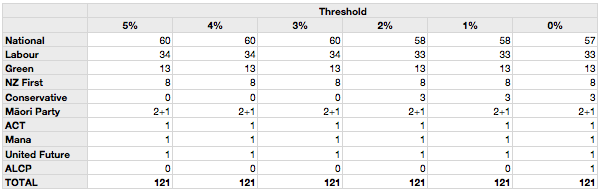
It seems that in New Zealand there is no such clear-cut divide along the political centre. Instead there exists a political spectrum that is frayed along the edges and which has an ideological void in the middle.  ACT is splintering, as did the Maori Party once Hone Harawira quit. The common denominator is that on both ends of the New Zealand electoral divide, where the most ideological elements of political society reside, there is a complete lack of unity, much less understanding of the need for a common class line. This plays into the hands of the mainstream parties. At the risk of over-simplification and claiming no particular expertise, let me sketch the broad contours.

The putsch against Rodney Hide was a triumph of the market ideologues over the social conservatives in the ACT party. The Garrett scandal, the odd views of some of its MPs and Hide’s increasingly populist rhetoric are seen as deviations from the neoliberal market ideology that is supposedly the core of the ACT belief system. When Hide became vulnerable over his use of taxpayer money (the perk-buster was found to be more of a perk-consumer), the market ideologues moved against him. Concerned about demographics, ACT has managed to secure a commitment to stand from an influential female ex pat blogger with a reputation for brutal honesty and corporate savvy. It also recruited a farmer.

Once the Don was installed as the new Leader, ACT showed another face–that of racial revanchist. Crossing the market ideologue/social conservative divide, there is some serious opposition within ACT to maori redistributive claims and the erosion of Pakeha prerogatives under the banner of political correctness. Rather than delve into the reasons for its opposition, ACT has chosen to publicly focus on individual maori that it describes as extremists who are holding the country financially hostage with their ongoing demands. Among these is Hone Harawira. This is not a view shared by all market ideologues in the party, so the “white cowards” have been called out by the revanchists. What is lost in the intra-party discussion about identity and cultural claims is the common class line that ostensibly binds ACT together–that of the trade-oriented corporate elite. Whatever they think in private, this elite is bound to be horrified by the presence of racial revanchists in the Party, which could reduce the amount of material and political support that they will pledge to it. Absent a coherent structural underpinning to its other ideological claims, ACT has little to offer even them.

The Maori Party has done likewise. It was never a progressive party, but instead is a socially conservative vehicle that represents the interests of the maori economic elite and important iwi (specifically, leadership hierarchies). Its major focus is on ownership within the legal structures as given, and on specific budgetary earmarks for maori given Crown obligations under the Treaty. This is a source of division with the likes of Harawira, who sees things from a working class, indigenous sovereignty perspective.

The Mana Party is a reflection of the latter view, to which have been added those of assorted communists, socialists, anarchists and maori rights activists who can be roughly divided between (mostly Pakeha) anti-imperialists and (mostly maori)  indigenous sovereignty supporters. There is considerable overlap between the two camps, although the issue of native ownership is a thorny subject for the marxists. Here too there is a lack of a consistent class line, or structural foundation, upon which to build the cultural and socio-political bases of the party. Some in Mana put indigenous rights above all other things; others put working class interests to the fore. Neither side has a realistic economic agenda given New Zealand’s structural realities.

There is also a cult of personality aspect to Mana that belies its progressive label. Rather than represent a Kiwi version of Malcolm X as some have suggested, Hone is more akin to the Reverend Al Sharpton. He is loud, he is proud, but he is not exactly a revolutionary threat to the system. Unlike X, who did not allow whites into his party and who preached on the merits of  voluntary self-segregation and the need for a separate black state within the US based upon economic independence, Hone accepts Pakeha support while fulminating against colonial injustices and their modern legacies. He acts as an agent provocateur rather than an agent for change. Given the views of the anti-capitalists in the Mana party whose priorities are more class-based than identity-driven, this does not make for ideological coherence between the base and the leader.

The Greens have moved away from their Left origins and settled into the role of responsible middle class party with a focus on sustainable development. Having mostly removed the red from the party watermelon, the second generation of Green party leaders have become the preferred channel of expression for environmentally aware voters with an interest in universal rights, egalitarianism, sovereignty and non-intervention (to include opposition to trade agreements without environmental and human rights provisions). This makes it a comfortable partner for Labour, a bridge between the Maori and Mana parties in areas of common concern, and an inoffensive adversary of National that can be worked with on specific issues. In spite of their attractiveness to the enlightened bougeousie, the Greens have no class line.

The absence of strong class orientations, be it Right or Left, along the fringe of NZ politics is  in part a deliberate result of the blurring of class lines and focus on economic individualism promoted over the least two decades by the two major parties. Both parties subscribe to market-driven logics, tempered by populist appeals around election time. Both represent the interests of corporate, rather than class actors–National defends the logic of the Round Table while Labour defends that of the union movement and domestic market capitalists. Neither represents the interests of a given class, but instead attempt to cross over voter preferences with catch-all appeals oriented towards the economic centre: the salaried middle classes. The latter are the swing voters who are less inclined to see themselves as a distinct interest group, are less ideological in their views, and who have not collectively organised to that effect. By  targeting this segment of the electorate the mainstream parties are able to give the interests of their supporting corporate class fractions much broader political appeal.

In New Zealand the electoral fringe holds less popular sway than before, and has less of an influence on mainstream politics. It will not matter in November’s electoral math, and some parties may well disappear. This is a pity because at a minimum the ideological fringe in an MMP system is useful as a means of keeping the centrist parties more honest when it comes to issues of class, race and public policy interest. Ideally, fringe parties provide the outer ideological markers that frame policy debate at any given moment. Absent a coherent ideology embedded in a class line amongst fringe parties, the parameters for policy debate narrow considerably. Given non-ideological competition between the major parties, this leads to unrepresentative distortions in the way in which policy reform is argued and made.

Admittedly, this is a very broad, subjective and impressionistic overview. Supporters of the parties in question will no doubt take exception to my views. Others will see my emphasis misplaced or that I am just plain wrong on specifics. I will happily stand corrected where necessary. What I have tried to do is not argue the details but note the larger trend. The lack of a class line in New Zealand’s political fringe is both a product and a reinforcement of the corporatisation of mainstream politics and popular culture, with policy debates stripped of structurally-based ideological content and confined to those areas in which corporate solutions are possible. Stripping ideological content from public policy debates diminishes the quality of democracy. In a society anchored in structural inequalities (however mystified by issues of identity and post-modernism), the absence of class-based ideological debate leaves the field of politics open to corporate elite domination, no matter how much “trickle down” policy proposals are offered during political campaigns. There is, in other words, no substantive class focus to political debate even during elections.

In November we will be reminded of that fact.


Royal Hubris.

As an ex-pat yank I am not much for royals. Its a war of independence, ex-colonial legacy type of thing, I imagine, but the idea that some otherwise useless people connected by traceable bloodlines can claim superiority and the right to “lead” just grates on me. The universal law of genetic decline comes to mind here (previously posted upon).

So it is with bemusement that I read that the 2nd in line to the British throne and his new bride have decided to skip a NZ visit this year because “it might influence the elections.”

Are they high (legally or not)? Sheeeeet. I suspect anyone who believes this to be true to be absolutely chronic.

Whatever the numbers of royalist fools in NZ, it takes a stoner quantity of imperial hubris to think that Wills and Kate could influence the outcome of the November elections. In fact, I reckon that Alisdair Thompson’s strong National links (including his reported blokey relationship with the PM) will be more decisive in November than these two over-privileged parasites on a party holiday.

If you ever want to see an egregious example of dole-bludgeing, go no further than Royalty.  Some of the men may do military service while living lifestyles way above their pay grade, but the wimin do nothing other than charity socials and token appearances to excite the hoi polloi.

I say **** that. Lets get rid of the bludgers and go for full independence ASAP. After all, what have we to lose other than our symbolic colonial chains?

John Key spanking behind closed doors

A few days ago the DomPost ran on p2 a generally positive story about John Key’s parenting which contained, without comment, the follow paragraph:

“Apparently it’s called planking but I don’t know – if we hadn’t changed the law, it would have rapidly moved to spanking,” [John Key] joked in a speech to the Parents Inc fathers’ breakfast in Wellington yesterday.

It struck me at the time that it was a joke at odds with the image of Key publicly taking credit for brokering the passage of the legislation. Of course it wasn’t a public joke, it was to an an entirely friendly audience pulled together by Parents Inc[1], of men paying $59 a head to hear Key, Gordon Tiejtens, and others and “enjoying the fellowship of other men”. This is reminiscent of Key joking about Tuhoe being cannibals, again Key showing a reactionary conservative face to an appreciative audience behind closed doors.

Perhaps I shouldn’t be surprised, perhaps John Key’s public/private image contrast is no more than we can hope for. But shouldn’t the media be looking out for and commenting on this? If he’d told an equivalent joke about beating his wife, having sex with a 15 year old, or snorting cocaine, would the media have taken the time to point out the contrast?


[1] Parents Inc, a conservative Christian organisation, lobbied against the repeal of section 59, and has since had National appoint its Executive Officer to a term as a Family Commissioner and, more recently, had $2.4million of untendered contract awarded to it.

Does small always have to mean provincial?

Here is a question for readers. Just because NZ is small does that mean it has to be provincial? Having returned–and happily so–to NZ after a 3+ year absence, I am struck as to how insular public debates tend to be. Leave aside the grating RWC ads and hype. Although it makes much ado about a second tier sporting event, it is being hosted here and there is money to be made as well as sporting prestige on the line. So the hoopla could happen anywhere. I also understand the focus on Christchurch given the earthquakes, but am struck by how most attention is on the human dramas and not on the policy response and consequences of the disasters (which seem to this uninformed eye to be slow and not considerate of long-term implications). More broadly, be it in the tone of political debate, the focus of popular culture, or the economic preoccupations of the moment, it all seem a bit inbred to me. Am I just being precious or unduly judgmental?

I ask because I came back from Singapore, which is small but is incredibly cosmopolitan because of its strategic location and thriving expat culture (native Singaporeans are quite insular as well but have been forced to cope with the influx of more worldly people as part of their national transformation project). Switzerland, San Marino, Andorra, Monaco, Ireland and Malta are small but their location in Europe makes them acutely sensitive to and knowledgeable of their larger neighbour’s actions and interests. The same can be said for Uruguay, surrounded by larger States, or Central American republics, dwarfed by Mexico and the US. This is not to say that the masses as a whole in these countries are always on top of international affairs or erudite in their discussions of global trends, but that they seem to have a better appreciation of the world around them than what is evident in NZ. That seems counter-intuitive.

I say so because the tyranny of distance should have been overcome by advances in telecommunications and transportation, NZ is increasingly a nation of immigrants, including many from non-traditional source countries, its commercial ties are more varied and distant than in earlier generations, its has high standards of literacy and access to news sources, it has a good percentage of citizens returning from OE’s and its diplomatic connections reflect all of these trends. So why is it that, if I am correct, NZ remains rooted in a seemingly mythical short-and-gumboots, rugby-fixated mentality unconcerned about the larger world in which it is inserted? After all, unlike like large states that can “afford” to be ignorant of world affairs because of their economic weight and territorial size (e.g., the US), Kiwis are constantly told that their well-being is directly linked to NZ’s position in the international community. If that is true I would expect that average Kiwis would take an interest in global issues and ask questions of national elites about them.

Why, for example, has the NZ government made no public pronouncements on Syria (and muted comments about Libya) given its purported commitment to human rights? Why has issues like human trafficking, child labour and environmental degradation not entered into the debate about undertaking trade agreements with Asian despotic states? Why have tensions between Fiji and Tonga only been awarded two days of media attention, especially given the role of other powers behind the scenes and NZ’s connections to both countries? Why is there no debate about the NZDF role in Afghanistan given the beginning of the US military withdrawal in July? Why is it assumed that “privatisation” and public expenditure reductions are sacrosanct when in many faster developing parts of the world that are also commodity export-dependent (Latin America, SE Asia) such market-driven zealotry has been abandoned in favour of more judicious public management schemes that see public welfare and employment as requisite part of the social contract (and long-term stability)? Why is draconian anti-terrorist legislation and expansion of domestic intelligence powers passed when NZ security elites admit that the threat of a terrorist event is extremely low and that domestic threats are more likely to be criminal than political in nature (with some of that criminality being a direct result of NZ’s permissive attitude towards trade conditions and regulatory requirements on foreign investment and corporate accountability). Why are national leaders allowed to dismiss those who raise such concerns as extremists or unhinged?

In fact, what the heck happened to policy debates in general? Why is it that when not rugby the entire country seems to be fixated on human dramas and political sleaze rather than the pressing issues that impact they very way society is organised?

I realise that NZ may not be alone in this syndrome, should it in fact be real. It just strikes me as incongruous that a country with such an abundance of human capital should be so inward-focused, especially if it’s material, social and political status is directly connected to, and dependent upon, its ties to the outside world. Provincialism may serve the interests of elites who can govern and do business without considered scrutiny so long as a few popular sops are thrown the public’s way, but it seems to me to be an unfortunate comment on national consciousness if indeed it is a reality rather than a figment of my imagination.