I guess that we should see the silver lining in the CV-19 pandemic. It has finally done what no political opponent could do. It has fundamentally undermined Trump’s credibility and that of the science-denying elements within the GOP and rightwing media. The important aspect of this is that the loss of credibility is evident in a private sector that otherwise was willing to cast a blind eye on the Trump/GOP corruption and buffoonery so long as the latter advanced business interests via deregulation, tax cuts etc.
Now that Trump’s incompetence has been fully exposed, as has that of his immediate advisors and sycophants in and around the White House, private businesses, state and local governments are taking action in defiance of his original bluster and denials. Led by their owners, elected officials and high level managers, entire sports have cancelled or postponed seasons, universities and school districts have closed, cities and states have ordered mandatory quarantines and numerous mass events have been abandoned. Even the military has acted against his original commands, instead opting to listen to military doctors and other experts about the effects of CV-19 on troop concentrations (such as cancelling military exercises and forbidding all domestic travel for service personnel). This, in response to what Trump initially called a politically inspired hoax and to which the GOP/media science deniers decried as the product of partisan hysteria and media manipulation. The fact that private businesses have led the defiant response is especially telling. No lefties among them.
The ineptitude and incompetence of the Trump administration is not only shown in its delayed response and original denials and deflections. The order to institute a ban on all travellers from Europe–done by the same people who crafted the Muslim ban attempted shortly after Trump was inaugurated–was done without forewarning to airlines, airport authorities and local law enforcement, much less the traveling public, American as well as foreign. No contingency plan was crafted, much less enacted, leaving federal border control agencies such as Customs, Immigration, Border Patrol and TSA short-staffed and undermanned in the face of a surge of last minute mass arrivals before the ban commencement date. Additional CV-19 health screenings deployed at the same time has resulted in chaos at airports of entry, with thousands of passengers stuck for hours in baggage returns and lined outside passport control stations (again, manned by federal employees). The result has been a clusterf**k of epic proportions.
Although he has been tested and cleared after being exposed to the virus, Trump may still fall ill because the test only measures one’s status on the test date. If that happens, he becomes a candidate for Article 25 removal from office since he is physically unable to perform the functions of president (which was the original intent of the framers. I shall leave aside jokes about his mental competence but let’s just say that his addled blathering about the pandemic does not inspire confidence). I have a feeling that if he gets sick, those in the GOP who secretly loathe him will have their knives out, because his gross negligence and inaction in handling the response will have election consequences for the party as a whole later this year. Seriously, if the predicted thousands of deaths and job losses and billions in productivity losses resultant from the botched initial response and the chaotic catch-ups since then actually happen, given the now open news that the Trump administration eliminated key public health agencies and replaced public servant scientists with lackeys, then the makings of an election disaster are looming large over the GOP’s political future.
Until now, the GOP’s 2020 election strategy was to ride Trump’s coattails as hard as possible. In the wake of CV-19 that seems politically suicidal. And if GOP politicians start to distance themselves from Trump in their campaigns, the possibility of intra-GOP fratricide becomes more likely. In fact, it is likely that factions are sharpening their knives as I write, with the pro-Trump crowd developing plans to delay the elections or smear anti-Trump politicians as traitorous during a national emergency. For their part, the anti-Trump faction will attempt to convince the public that they did all that they could to prevent him from doing more harm to the Union. That will be a tough sell, but so to will be any argument in support of Trump’s handling of the crisis.
The real trouble for the GOP starts if the pandemic lasts in the US for months, well into the post-convention campaign season (which starts in July). If the death and sick toll mounts to anything close to what is being predicted and job losses increase while businesses shut down, then perhaps even hardened MAGA morons will re-consider their support for the imbecile-in-chief. Even if they do not, undecided and independent voters could well draw the conclusion that enough is enough while the previously apathetic who did not vote in 2016 may finally realise that their votes do in fact count when it comes to national leadership selection. None of this bodes well for the GOP in November.
Perhaps there is a goddess after all. Her name is Mother Nature, and in this instance all she had to do is to let human folly advance her work. That may wind up being a painful but necessary political blessing for the US regardless of who wins the Democratic presidential nomination.
With Super Tuesday primaries concluded, it is looking like the Democratic presidential nomination will be a two horse contest much like it was in 2016, with Joe Biden replacing Hillary Clinton as the centrist pick backed by the Democratic National Committee (DNC). Bernie Sanders once again carries the underdog aspirations of the progressive wing of the party. This year Sanders represents a more significant threat to the centrists than he did in 2016, and they have worked very hard to disparage him as “unelectable” and “”too radical” for the American voting public. I believe that this may be a wrong assumption to make.
Let’s address the issue of Sander’s socialism first. He professes to be democratic socialist, running as such under the banner of “Independent” throughout his political career until registering for the Democratic presidential nomination in 2016. But his “socialism” does not include socialising the means of production or doing anything other than using tax policy to redistribute wealth downwards, reforming health and education so that they become affordable to lower and middle income earners, promoting public works projects, re-establishing the role of the State as a macro-manager in economic areas prone to excess or abuse and diminishing support for fossil fuel production and defence spending.
Everything else on his policy agenda, while different than those of his opponents (say, when it comes to the US relationship with Israel and Palestine), may be alternative but are not socialist per se. In fact, all of his policy prescriptions are more akin to those of European social democracy than to democratic socialism (where the decisions about socialising the economy are done via democratic processes) because capitalism as a socio-economic construct is not challenged or replaced. It is just humanised and re-oriented towards the welfare of the majority, not of the elite minority. Sanders himself has pointed out that the stress is on the “democratic” in his democratic socialism, so it does not appear that he is doctrinaire when it comes to policy outcomes.
To this intrinsic aspect of his political philosophy can be added the extrinsic constraints on what he can do. The structural power of capital in the US is not going to be seriously challenged, much less undermined by a Sanders presidency. The US economy and its social relations of production are deeply rooted in notions of private property, self-initiative, “free” enterprise and a host of other market-focused orientations that transcend the business world. The US remains a huge economic engine that, even if it has lapsed into cowboy, crony and parasitic capitalism in places (such as the financial and health industries) and is very dependent on the State for its competitive edge (say, in awarding of defence- and other technology-related contracts), is largely impervious to whole-scale reform or collapse.
Along with an economy that is “too big to fail,” it is best to think of the relationship between US capitalism and the presidency as that of a monkey driving a machine–it is not so much the monkey that matters but the ongoing movement of the machine. In that light, Sanders can play the role of the monkey, acting as a corrective that tries to reign in the baser urges of the cowboys, cronies and parasites now dominating the US economic engine without impeding the forward momentum of the entire combine.
Added to the sheer structural inertia that must be overcome in order to reconstitute US capitalism is the political influence that it wields. Corporate influence permeates all levels of the US political system. Its influence is corrupting and often corrosive in places, and it extended deep into the Democratic Party–particularly the Party’s centrist, corporate-friendly faction. As Poulantzas wrote, the capitalist elite is not homogeneous and is divided into ascendent and descendent class fractions. The GOP defends the interests of the descendent class fractions that represent fossils fuels, auto manufacturers, agricultural interests, the military-industrial complex and traditional financial sectors. Democrats represent high tech, telecommunications, renewable energy, new financial sectors and other nascent and ascendent industries. The Democrats also represent, however diminished in presence when compared to the 1960s and 70s, the organised labour movement in traditional manufacturing industries as well as the public sector.
The capitalist class divisions in the US are not razor sharp and there is some overlapping in their political representation (for example, pharmaceuticals and insurance), particularly when the lobbying interests incorporate cultural idioms (such as the case with the gun lobby). Needless to say, there a host of other non-economic interests represented in the political system, although identity and value-based groups tend to aggregate in polar fashion (say, among ethnic, LBGTQ and religious communities). The main point is the centrist Democrats are corporate Democrats, not progressives, and for all of the talk of the “Gang of Four” leftist female representatives, the majority of Democrats in Congress are underwritten by and represent the corporate interests of the capitalist class fractions that they are associated with.
A Sanders presidency will therefore confront not only a hostile Republican opposition in Congress and in states dominated by Republicans. It will also have to contend with the very centrists that tried to impede his nomination in the first place. These corporate/centrist democrats will demand concessions and challenge anything that see as too radical to pass as law. That means that a Sanders policy agenda is likely to be watered down if it is to be implemented, which means that the final product will be anything but radical. The end result will be an incremental approach to policy reform, not revolution.
Sanders has already reframed the narrative on universal health to the point that some variation of single-user pay is likely to meet with congressional majority approval (assuming that the Democrats hold the house in 2020). He would be smart if he allowed for private health insurance schemes to co-exist with the public option (as in many other liberal democracies), since that will allow those with disposable incomes to afford things such as elective or cosmetic care outside of the public health system. The larger point is that he has offered some alternatives and initiatives that could well find support in Congress, especially if his election victory over Trump is significant. The greater the margin of his victory, the more a mandate he has within the Democratic Party as well as amongst the national electorate, and a large win will also help diminish GOP resistance to post-Trump corrections because in defeat Trump will have few political friends.
All of which is to say that although Sanders has many constraints on what he can do once in office, he potentially will have enough political clout and flexibility to pass legislation and enact significant reforms even if they cannot be described as “radical” or “revolutionary.”
It is true that Trump and the GOP dirty tricksters relish the opportunity to run against Sanders, who they see as easily beatable in a general election. The Republican smear machine is primed to go all out with its Cold War style fear-mongering. For them, Biden is a harder opponent to defeat because he cannot be painted into an ideological corner and tarred by spurious associations with the demons of the bi-polar world past.
But just like the centrist Democrats, the GOP may be wrong in its appraisal. Many younger voters are not frightened by the epithet “Socialist!” and have no memory of the Cold War. Bernie’s cantankerous independence from machine politics is seen as a positive. It is therefore possible that they will turn out in numbers that otherwise will not be seen in support of a Biden candidacy. The defensive “anyone but Trump” vote might be enhanced rather than diminished by Sanders. After all, Bernie represents a true break with the Swamp, whereas Biden is its product and Trump is basking in it while trying to monetarily benefit from the immersion. So it could well be that dismissals of The Bern are premature because his strengths as an honest alternative within the Democratic Party outweigh his weaknesses as an outsider in a system that is rigged in favour of insiders (for example, via the use of Superdelegates as tie-breakers in the Democratic National Convention).
What is clear is that the DNC fear a Sanders nomination not so much because they think that he will lose to Trump but because he represents a threat to THEIR interests. Even if diluted, his policy reforms will target them as a first order of business, as a way of clearing the path for substantive reforms in the policy areas in which they are vested.
Hence the disparaging of Sanders and downplaying of his chances at a general election victory. The proof of whether the anti-Sanders campaign has worked will come in the next two weeks when a cluster of primaries are held, including in Florida where I, just as a did in 2016, voted (via absentee mail ballot) for the Bern. If nothing else, just like then, my rationale is that even if Sanders does not win the nomination, if he gets a substantial amount of delegates he will have influence on Biden’s policy platform. Biden needs Sanders’ supporters to back him–and many “Bernie Bros” have said that they would rather sit on the couch or vote for Trump than see another corporate Democrat dash their progressive aspirations–so my thinking is that if the convention vote is close or at least not a Biden landslide, then the centrists will have to negotiate with Sanders over the campaign platform in order to get him to endorse Biden and encourage his followers to join the “anyone but Trump” camp.
Given the obstacles in front of him, Sanders may not be able to implement the progressive agenda that he campaigns on and which his supporters yearn for. But when compared with Biden, he certainly is not more of the same. Building on the momentum of the 2018 mid-term elections, perhaps that is the best we can hope for.
I am about to mail my overseas ballot to Florida so that it can be counted in the Democratic primary on March 17. In Florida you have closed as opposed to open primaries, which means that one must declare a party preference in order to vote in a party primary. Unlike open primaries, independents are excluded from primary voting in Florida (although they are allowed to vote in the general election in November). The restriction on primary voters impedes voting on local candidates and ballot initiatives, referenda and local ordinance amendments that are not included on the general ballot.
Because of this I registered as a Democrat in the early 2000s. I primary voted for Kerry in 2004, Clinton in 2008, Obama in 2012 and Sanders in 2016. My vote was based on rationales that included anyone against Bush 43 in 2004, a female over a dark-hued male in 2008 (because I thought that changing the gender of the presidency was more significant than the color of the guy in it), support for a good president under difficult circumstances in 2012 and support for a democratic socialist in 2016 (in order to pull the Democratic Party platform to the left when running against an unhinged maniac because the writing was on the wall by March that Trump was going to win the GOP nomination and my thought was that even if Bernie lost to Clinton it would force her to adopt some of his policy initiatives because she needed his supporters to vote for her). My selections lost the general in 2004, lost the primary in 2008, won general re-election in 2012 and lost the primary in 2016. Because the ballot is printed well in advance, I have a choice of sixteen candidates, most of whom dropped out of the race a while ago.
This year the Democratic primary campaign has two axis points. The first is generational, as elderly candidates (defined as those over 60) vie against younger ones. Biden, Sanders, Warren, Steyer and now Bloomberg are staffing the geriatric front, while Klobuchar and Buttigieg are what is left of the young guns. Of the oldies, none other than Sanders appears to have medical issues of consequence and all appear to attract support without regard to age. So agism will not be a factor in the election, especially given that Trump is in that age bracket as well.
The second axis is ideological. Warren and Sanders represent the “progressive” side of the Democratic coin, whereas Biden, Bloomberg, Buttigieg, Klobuchar and Steyer represent the pragmatic side.
Within these camps there are divisions as well. Sanders has long described himself as a democratic socialist and for many years campaigned and won elections as an independent, only joining the Democratic Party in 2016 (and again in 2019) in order to run for president (he continues to serve and run for re-election as the junior Senator from Vermont as an Independent and campaigns as a democratic socialist in that state). Warren is a social democrat, not opposed to capitalism per se but interested in humanising it. Like Sanders she is a junior Senator from a liberal Northeastern state (Massachusetts, where she replaced the temporary excuse for a Senator now serving as Trump’s ambassador to New Zealand, Scott Brown). Both have been effective legislators, although Warren is seen as a bit more ideological than Sanders within the confines of the Senate Democratic caucus and Sanders, despite his somewhat crusty personality, being more amendable to intra-party compromise.
Both of these candidates are challenging the Democratic establishment. They repudiate the corporate orientation of the Democratic National Committee and the “centrist” policies of the likes of the Clintons. Not withstanding support from the “Squad,” they are not particularly well-liked by their congressional peers or the party establishment but have mobilised strong grassroots support. Warren has a (now distanced) corporate background and has agreed to some SuperPAC (third party unlimited bundled) funding. Sanders has not and continues with his grassroots, small donor approach to campaign financing.
On the pragmatic side, there are two billionaires, Bloomberg and Steyer. They appeal to voters based on their business success and the fact that they are not conmen like Trump. Bloomberg is a former three term mayor of New York City, where his crime fighting policies have come under fire for being racist and discriminatory (the so-called “stop and frisk” policy targeting African and Latino young males). He also has been the subject of numerous sexual harassment complaints and lawsuits. Steyer has no political experience to speak of but also does not have the baggage associated with it.
I will not vote for either billionaire on principle given that the Democratic Party is supposed to be the party that defends workers within the US political system. As for the pragmatic non-businessmen, Biden is the quintecent Washington insider, an integral member of the corporate/centrist faction with the party. He has vast experience in many important roles, including that of Vice President under Obama. But his experience has been checkered and now hangs like an albatross across his neck when it comes to electoral appeal. While it is true that he is certainly a better alternative than Trump, he also seems to be losing a bit of his mental edge. It is one thing to be a deranged lunatic throwing insane red meat rants and tweets to his base while feathering the nest for his family, cronies and friends from the Oval Office (Trump). It is another to be seen as doddering when trying to convey maturity and seriousness of purpose. So Biden is not the guy for me.
Buttigieg and Konuchar are interesting. She is a former prosecutor turned Senator from a conservative north Midwestern state (Minnesota, where only the snow is whiter than the population). She is seen as bringing that good old midwestern practicality to her politics, and she works hard to be seen as the voice of reason given the limits of US political discourse. Buttigieg just ended his eight year term as mayor of South Bend, Indiana, the city where he was born and where he was widely popular except for in the African-American community (since he removed a popular African American police chief and condoned hard police tactics against minority suspects). The novelty of his candidacy resides in the fact that he is young (38), gay, and served as a military intelligence officer in Afghanistan in 2014. His positions largely mirror those of Klobuchar, and like her he campaigns on his centrism, common sense and a dedication to public service. The two of them project themselves as non-traditional but reasonable alternatives to the Orange Weasel as well as the leftists in their party. They tick a number of constituency boxes that are important for Democratic voters, so their appeal has the potential to transcend their policy proposals.
Conventional wisdom is that “socialists” cannot win US general elections. The DNC and mainstream corporate media are working hard to undermine the Sanders and Warren candidacies as “unelectable.” The pragmatists are trying to capitalise on this perception, warning that to nominate a leftists is to guarantee victory to Trump.
At one time apparently afraid of the threat posed by Biden, Trump now appears to believe the truth in the “no socialist” line, yet cleverly harps on how Sanders is getting a raw deal from the DNC and media. Remember that part of the reason Biden has fallen in the polls is that Trump’s smears against him and his son relating to the Ukraine, which resulted in Trump’s impeachment, have in some measure stuck. Now, with Biden trending down, Trump sees his easiest path to victory being a one on one with Sanders, contrasting his national populist bombast with the Senator’s critiques of the system as given.
We even have the Russians apparently wading into the mix, supporting both Trump and Sanders in their 2020 disinformation and hacking campaigns. This is apparently due to the fact that a) they were very successful in 2016 when implementing this “undermine from within” strategy in favour of Trump; and b) both Trump and Sanders are correctly seen as “disruptor” candidates, so no matter who wins so does the Russian subterfuge. Trump, of course, denies any Russian meddling and forced the resignation of intelligence officials who made the claims to Congress. Sanders has repudiated any and all Russian interference no matter who is favoured. Regardless, Russia has inserted itself into the election narrative in, yet again, a central way. Somewhere Stalin is smiling.
That is the background to my primary vote. My choice remains difficult. I am leaning towards a progressive, so it will have to be Warren or Sanders, again, so as to not only get one of them into office but to re-frame the parameters of the Democratic policy platform. But I have major problems with both. Sanders comes off, in my eyes, as a stooped over cranky guy with medical issues who is the political equivalent of the old man yelling “get off of my lawn.” He may be right on his policy prescriptions but he is somewhat off-putting, and his refusal to come clean on his recent heart attack and underlying condition may be exploited by Trump in the event that he wins the nomination.
Likewise, Warren reminds me of someone’s grandmother preaching a holier than thou gospel while glossing over some of the contradictions in her past. Trump has already given her a racist nickname and he and his operatives will go to town on her if she has any dirt in her past. Even so, her dismantling of Bloomberg in the Nevada debates was excellent and showed that she has the acuity and spine to go after powerful adversaries. She may have a chip on her shoulder for a variety of reasons, but if she can use that as a motivational force I say good on her.
Klobuchar and Buttigieg are more personally appealing and both seem likeable as well as articulate and competent. Trump is going to have a hard time attacking them on personal grounds unless there is something sordid in their past. Professionally, in spite of some rumblings about both of their records in public office, there appears to be nothing that is disqualifying. But they clearly have the corporate/media backing, with Buttigieg in particular appearing to attract major money from deep- pocketed interests. That is worrisome because, no matter how much certain well-heeled liberal elites hate Trump, their support comes with strings attached.
My preference would be to vote for president/vice-president tickets in order to get a balance amongst them. I regret that Kamala Harris dropped out of the race, because she seems like a very tough cookie from a liberal state who could could easily shred Trump in any head to head. Female and of color, she hits the identity politics checkmarks, but she is not progressive. Perhaps she is lining herself up for a VP run or a cabinet post, but I question whether either of those options is better than where she is now as Senator from California.
Sanders and Warren will not likely share a ticket together. It is unlikely that they would go with any of the pragmatists unless Klobuchar or Buttigieg change their policy proposals. Biden might go with the younger pragmatists but they are unlikely to welcome him onto the ticket, and the progressives will run from him. A Klobuchar/Buttigieg ticket or vice versa would be an attractive proposition for many people in spite of the limited regional appeal they have outside of the midwest. Individually, however, they will have a hard time appealing to progressive Democratic voters.
So a major question I have is about the feasibility and popular appeal of a progressive/progressive, pragmatic/pragmatic, progressive/pragmatic or pragmatic/progressive ticket in November. That question will not answered until after the Democratic Convention in July, so I have to return to who I prefer for the top spot.
All of these possibilities rest against a backdrop of defensive voting. I mentioned this in posts about the 2016 election and I was wrong. What I said then was that voters from groups that Trump scapegoated and demonised would come out and vote against him in numbers, seeing Clinton as the lesser evil in that equation. Asians, Muslims, Hispanics, African Americans, LBQT folk, feminists, youth, leftists–I was sure that they would rally against the clear and present danger that was Trump back then. But they did not. Instead, they stayed home, thereby handing the victory to him (44 percent of eligible voters abstained from voting in the 2016 presidential election). Sure, a lot of this was due to the Russian disinformation campaign, including the leaked Clinton emails to Wikileaks and the FBI investigation into her communications security one month out from Election Day. But a lot had to do with disenchantment with the system in general and the lack of progressive, or at least sensible Democratic options.
I am not so sure that apathy will prevail in 2020. Trump is no longer a possibility but instead is a reality. The harm he has caused is tangible, not potential. Another four years of him will be, from the standpoint of Russian saboteurs, a strategic wet dream. So it is possible that previously apathetic voters will come to the plate this time around and, if nothing else, use the lesser evil approach to vote against Trump’s re-election.
There is another thing to consider. in 2016 the Republican National Community and GOP political establishment all argued that a centrist was needed in order to defeat the Democrats. A ‘safe pair of hands” with a stronger grasp on foreign policy and committed to the pursuit of trade, etc. was the key to success. Someone like Jeb Bush, John Kasich or Mitt Romney. The whole point was to demonstrate strength with a conservative tilt. Instead, they were sidelined by a xenophobic, bigoted sexual predator with narcissistic and sociopathic tendencies who made gutter-level, crass rightwing populist appeals to the stupidest and greediest segments of the voting population. That carried him first to victory over the GOP elites and then to victory over the mainstream establishment candidate (thanks Steve Bannon).
And then the GOP fell in line behind Trump, so the decent into hyper-partisan lunacy is now complete.
Perhaps then, it is the same with the Democrats. Perhaps the DNC is wrong and a centrist is not the answer to Trump. Perhaps the Democratic corporate elite and media centrists are not reading the pulse of the Democratic electorate correctly and have misjudged the thirst for real progressive change lying latent (and not so latent) in the land. Perhaps, having once been given hope, now there is real thirst for change, and that change starts with nominating a Democratic presidential candidate who can not only defeat the corporate-backed centrists and then Trump, but also defeat the institutional obstacles (say, in healthcare, immigration, education and foreign policy) now standing between meaningful reform and more of the same.
After all, the polls and the pundits suggest that the US electorate is more polarized than ever. So why would a centrist strategy work, especially when the other side has gone full tilt in favor of a demagogic Mad King?
In the meantime, who the heck am I going to vote for?
It should be obvious by now but let’s be clear: The same folk who regularly traffic in disinformation, misinformation and “fake news” are also those who most strongly claim that their freedom of expression rights are being violated when moves are made to curb hate speech (as opposed to protected offensive speech). They lie, they mislead, they conspire and they subvert, only to whine when they are called out on their prejudice and deceit.
That is what might be called message “cloaking” or “masking:” using the legal protections of democracy in order to undermine it from within via propaganda and psychological operations designed to confuse, divide and accentuate extant social cleavages, or what right-wing extremists call “acceleration.” This harks to old Marxist-Leninist notions of exacerbating social contradictions, although for Marxists these are class based in capitalist societies whereas the alt-Right sees race and ethno-religious differences as the main fault lines to be exploited (precisely because capitalism is seen to aggregate ethnicities into socio-economic classes, thereby diluting the racial or ethno-religious basis of “proper”–read: Anglo-Saxon–governance).
Ironically, the alt-Right and white supremacists share Lenin’s view that democracy is “capitalism’s best possible political shell,” and they, like him, see it as an impediment to “pure” government (be it of the workers or of a chosen racial or ethnic group, respectively). Lenin believed that democracy blinds workers to their common interests because of the false promise of choice offered by the universal vote. Conversely, Alt-Right adherents and white supremacists believe that democracy (both in terms of the right to vote and in legal protections for minorities, etc.) gives too much power to “inferior” or “replacement” groups, thereby impeding merit-based efficient (read: White) governance. Perhaps both are right.
All of this happens in a context where public cynicism about political elites runs deep in both mature and emergent democratic societies. Venality, corruption and instrumental opportunism are rife throughout the so-called ‘free” world, leading to disenchantment and anger towards “the system” as a whole. This creates the space where conspiracy theories, false alternative narratives, fear-mongering, scape-goating and other deliberate distortions of the truth take hold in the collective consciousness. Some of this is at play on the Left side of the political spectrum but the majority of notions about the existence of a (presumably homogeneous in outlook and transnational in manifestation) Deep State, climate change being a hoax, 9/11 being an inside job, etc. come from the Right, harking back to previous incarnations of paranoid fantasies like those of the John Birch Society and various anti-Semitic cults that see Jewish control behind every major social organisation. In fact, pushed by social media connectivity, new and old Rightist tropes have merged into a particularly nasty amalgam of hate and manipulated ignorance.
The convergence of hate speech enthusiasts, climate change deniers, bigots, xenophobes and assorted conspiracy mongerers has been facilitated by social and alternative media platforms, which has given them common ground and global reach. They fight vigorously to defend their “right” to voice retrograde views while working equally as hard at propagating all sorts of subterfuge and stupidity in pursuit of their ulterior motives.
The saddest part is that this syndrome has seeped into mainstream politics throughout the democratic world, with Right-oriented parties now adopting both dis-and misinformation campaigns and “cloaking” as political tactics. National-populist parties provide the most obvious example, but one only need to look at the GOP in the US or the ACT and National parties in NZ to see how this seepage works. If I was uncharitable I would call it the “Trump tactic dispersion effect:” lie, deny, invent, obfuscate and obstruct in pursuit of partisan and personal gain without regard to the negative impact it has on the political system as a whole. The GOP is too far gone to recover from its MAGA infection, but the NZ Right parties need to be called out on their attempts to model some of their tactics on Trump’s approach and those of the alt-Right.
The irony is that the major beneficiaries of this dispersion effect are authoritarians, both those internal to the societies in question as well as the foreign despots who see utility in the weakening of democracy world-wide (and who therefore encourage and support disinformation/cloaking efforts globally).
After all, the deadliest thrusts of sharp power are into soft targets.
It has been revealed that firing ranges used by the NZDF while deployed to the Provincial Reconstruction Team (PRT) in Bamyan Province, Afghanistan, contained unexploded ordnance that caused numerous deaths and injuries after the NZDF withdrew the PRT in April 2013. In 2014 seven children were killed when an unidentified high explosive device detonated after they brought it back to their village. In the five years following the NZDF withdrawal seventeen people were killed and several dozen injured by unexploded munitions they encountered in and around the five firing ranges used by the PRT during its 12 year mission in Bamyan. While all of the ranges were used for small arms training, two, the Beersheba and Dragon ranges, also were used for training with high explosive rounds, including grenades, shoulder fired mortar shells/rocket propelled grenades (RPGs) and armour piercing heavy caliber bullets. It was near the Beersheba range where the children found the munition that killed them.
The NZDF claims that it had cleared over ten tons of unexploded ordinance from the Bamyan ranges before it left the province. This was done early in the PRT tour because the ranges had been used by Russian, US and Afghan forces in the years before the NZDF arrived, and the concern was the safety of NZDF troops when using those ranges. After the NZDF left, it contracted with the Afghan Directorate for Mine Action Coordination (DMAC) to have contractors clear the ranges. In October 2013 this was supposedly done, to what the NZDF calls an Afghan government approved standard.
After the children’s deaths the standard was lifted to a UN approved level. From then on negotiations were enjoined to determine who should do subsequent clearing of the ranges, what the costs would be and when they should begin. In 2018 the NZDF agreed to pay US$10 million into a fund operated by the UN for employing explosive ordinance disposal (EOD) contractors to engage in follow up clearance of the ranges. The delay in agreeing to the payment was differences between the NZDF/MoD and the US Department of Defence (DoD) over the cost of the job. If I understand correctly what the NZDF has said on the matter, the US wanted NZ to pay US$48 million for clearing all of the Bamyan ranges, whereas NZ wanted to pay much less and only help clear the Beersheba and Dragon ranges. The US$ 10 million dollar sum appears to be the cost of the latter. The key thing to remember here is that while people were being killed and injured by ordinance on those ranges, the US and NZ were arguing about the cost of clearing them.
The NZDF claims that the contractors who did the October 2013 clearance were approved by the Aghan government. The raises questions about the tender and contract-letting process. Who were these contractors? Did the NZDF have any say in their approval? How was the handover between PRT EOD personnel and the contractors handled (since the NZDF EOD operators would have had maps of the ranges that indicated where they had cleared unexploded ordinance fired by NZDF troops as well as any incidental unexploded ordinance (UXO) found on them)?
The October 2013 range clearance done by the contractors was of a type known as a “surface clearance.” As the name implies, this means visually inspecting the range for any unexploded ordinance lying on the above-ground surface. This might include inspections under loose rocks and on slips or crevasses in the mountainous terrain of the area.
The NZDF has made the accurate point that given the amount of ordinance fired on the ranges over the years by multiple armed services from several countries, it is near impossible to determine if the munitions that are killing and injuring people came from the NZDF or another military. That would require shell fragments, explosive residue or other evidence of source, none of which is available. The NZDF notes that in terrain like that of Bamyan, with weather like that of Bamyan, unexploded rounds can last and lie undetected for years and be carried out of the ranges by landslides, snowmelt, floods and other natural events as well as people. The latter point is not as silly as it might seem: in countries such as Afghanistan scrap metal scavenging is an important source of income for impoverished communities, and firing ranges are a treasure trove of scrap metal in the form of bullet casings and other metallic debris of war. For children, some of this debris is an irresistible toy. For all who tread there by choice or innocence, venturing onto an inactive firing range is an invitation to disaster.
What the UN standard of range clearance demands, and what the US and NZ were negotiating about, is what is known as a “subsurface clearance.” This requires the use of metal detectors and other means of locating live explosive objects underground, usually up to depths of two meters given the munitions (such as those of the NZDF) used on the ranges. This raises several questions.
Knowing that it had fired three types of high explosives on the Beersheba and Dragon ranges (some of which were duds) and knowing that some of them were capable of penetrating into the ground rather than just ricochet off of the surface, why did the NZDF agree to a surface clearance even if it conformed to an Afghan government standard? Was it told that the initial clearance would be subsurface in nature only to have that changed to a surface clearance after it left, or did it assume that a subsurface clearance would be the case? One would think that as part of the handover and contracting process with regard to the post-PRT range clearances the NZDF would have informed DMAC about the presence of unexploded high explosives on those ranges and in return be provided with explicit knowledge of what type of clearance would be conducted in October 2013. If it agreed to a surface clearance knowing that it had potentially unexploded ground-penetrating high explosives on the ranges, then that would be a dereliction of its duty of care to the civilian population of the area.
One also has to ask about the role of the Afghans. After the NZDF withdrew from Bamyan, who gained control over the ranges? The Afghan National Police (ANP), the Afghan National Army (ANA), the DMAC or some other government entity? Were the ranges sign-posted and/or fenced off? Or were the ranges left open? Whatever the answer, there appears to have been some serious dereliction of duty on the part of those who inherited control of the ranges after the NZDF left.
Under Protocol Five of the UN Convention on Certain Conventional Weapons (CCW), countries are responsible for disposing of the Explosive Remnants of War (ERW) after they leave the area in which they operated. The responsibility is not legally binding and often ignored, but is the likely reason why the US and NZ negotiated the second round of range clearances with the UN Mine Action Service (UNMAS). That is important because in effect, the responsibility to “clean up” does not end when an armed organisation leaves an area–the issue is not about present control but of past usage.
To be clear: NZ has no enforceable legal liability for leaving subsurface UXOs uncleared after it abandoned the Bamyan PRT, even though the NZDF was aware of the possibility of their existence. Those UXOs were likely not fired from NZDF weapons but given the history of the ranges, the NZDF was quite likely aware of their presence simply because US forces had used the ranges and very likely mapped them out for their own protection, then handed them over to the PRT as an allied ISAF force.
The NZDF did have a moral-ethical responsibility to consider the non-combat consequences of leaving the ranges cleared to a surface standard given what had been fired in them. Since the stated purpose of the PRT was about nation-building, hearts and minds and the rest of that mission palaver, it seems that something got lost at the end.
None of that matters. According to the UNCCW protocol five on ERW, the NZDF and NZ government were obligated by international convention to assume responsibility for the initial and subsequent range clearances. That the NZDF failed to do so in the initial tender and handover to the first post-deployment EOD contractors, and that it took five years to negotiate a price for its participation in the obviously necessary follow-ups to what was clearly an inadequate job in October 2013, tells us something about the value placed by the NZDF on the lives of Afghanis, including their children.
Prime Minister Ardern said that she was first informed of the issue in 2018 and now, after the matter became public, has told the NZDF that it has been moving too slowly and needs to speed up its involvement with the UNMAS-led subsurface clearance process. This begs the question as to why she was not informed earlier about was a thorny military-diplomatic issue, which in turn raises yet again the matter of NZDF transparency and accountability to the government of the day.
By all public accounts, the Bamyan ranges do not contain unexploded ordinance from “heavy” air assaults or artillery, including cluster bombs, white phosphorus rounds or 500 to 2000 lb. bombs. If that were the case the whole story changes dramatically in several ways, including on the subject of responsibility. Assuming that they were only used for small arms and limited high explosive weapons training, then the US$10 million price tag for NZDF participation in the UNMAS clearance efforts in two abandoned firing ranges seems high but reasonable if it involves compensation to relatives of victims, deployment of NZDF EOD specialists back to assist in the range clearing efforts and/or paying the for salaries and equipment for honest and professionally competent EOD contractors. That is is predicated on UNMAS hiring EOD contractors that are not corrupt, incompetent or cronies of local officials and instead are totally dedicated to eradicating the deadly residue of a conflict supposedly gone past.
In the end, this is another reminder of the legacies of war and the unfinished business that remains long after troops come home. Because for those living in places like Bamyan, the war does not end when the foreigners leave.
Some readers may remember that I mentioned last year that I was applying for NZ citizenship. I filled out the paperwork and had my original citizenship interview in February. Everything went well until they discovered that, because I had spent five months in the US in 2017, I had not been in continuous NZ residency for the full amount of time required before the interview took place (one has to spend 240 days in NZ in a 12 month period or 1,350 days across the five years preceding the application, so I was overseas for one month over the 4 month yearly limit). I was therefore ineligible for citizenship at that time.
That was not much of a problem, as everything else looked good to go and I was advised to re-apply at the end of August once I had accumulated the required number of continuous days in residence. That I did, and had another interview in early October, paid my fee, and settled into wait the 3-4 months before getting word as to whether my application had been approved. As it turns out, approval can only be granted by the Minister responsible for citizenship matters upon the recommendation of her staff, so my decision will fall to Tracey Martin of NZ First.
About a week after I applied I was contacted by a Senior Investigator from the Department Internal Affairs. He told me that in early December last year they had received an anonymous email making serious allegations against me and requesting that I be denied citizenship. Because of that, he was duty bound to request a meeting so that I could respond to the allegations in person.
We held that meeting last week. I was relieved to know that the complaint was not of a personal nature. Instead, it concerned by public writing and commentary, including, presumably, on this blog.
The complainant alleges that I am not loyal to New Zealand; that I am not loyal to the Queen and would not be subject to her rule; that my published opinions are contrary to NZ national interests; that I have a strong bias in favour of US interests; that I am a scaremonger; that I am a foreign “imbedded (sic) operative;” and that I am seeking to influence the internal affairs of NZ by foreign interests. The person then goes on to request that my application be rejected on those grounds.
Needless to say I had plenty to comment on. I had to laugh at the references to the Queen since no native-born Kiwi is asked to swear loyalty to her and most of my native-born friends are a wee bit skeptical about royalty in any event. I have heard the stuff about being a covert operative before (CIA, Mossad, take your pick), and as for trying to influence things in NZ I noted that I happily plead guilty to the charge of trying to participate in public debates on matters that fall within my range of interest and expertise given my professional training and background. I noted that the complainant appeared to have a poor understanding of liberal democracy and the freedoms inherent in it.
One thing that interested the investigator was how this person knew that I was going to apply for citizenship. Again, the complaint was made in the first week of December 2018. I could only think of two possible situations where I mentioned my intentions around that time. One was in a professional forum under Chatham House rules. The other was on this blog. So I went into the blog archives and low and behold, in late November/early December 2018 I wrote several posts about the PRC and the Anne-Marie Brady affair (the break-ins of her office and home and the weak Police response to them after her paper about Chinese influence in NZ politics was published). Those posts attracted the attention of a pro-PRC troll who went by the name of Mark and who gave all the appearance of being a Chinese New Zealander. Some of you may remember him, but you will not find him in the comments because I eventually blacklisted him (after labelling him “skid mark”) for repeatingly violating the terms governing comments on KP.
Mark did not solely focus his attention here. Around the same time he wrote similar comments on YourNZ, Bowalley Road, Croaking Cassandra and No Minister (Tom Hunter may recall him). His argument and tone was pretty much the same on all platforms.
I decided to look into Mark just a wee bit. It turns out that last December he created a twitter account under the name Mark Zhang (MarkZha88709847). He posted 16 tweets on December 8, then vanished. I cross checked the language in the complaint with the comments he made here and in other forums as well as the tweets and I am pretty sure that he is the complainant.
There is much irony in this. Here is a guy who is a blatant pro-PRC stooge who questions my loyalty to NZ and sees my supposed pro-US bias as grounds for disqualification. This Einstein does not seem to comprehend that even anonymous emails using VPN can be traced back to their source and that making frivolous complaints that waste official time and resources could warrant further scrutiny (the investigator had to fly from Wellington to Auckland to interview me).
In any event, the interview with the investigator seemed to go well. I was given a copy of the allegations and asked to review and sign the written transcript of my responses, which I did. I am satisfied that there is nothing that I have done in my 22 years living in NZ that warrants my being denied citizenship, but that is for Tracey Martin to decide.
With luck, come late summer or early fall I will be lining up in a citizenship ceremony to pledge my loyalty to the Queen of New Zealand (which, as it turns out, is apparently the wording of the loyalty oath).
It seems fair to say that we currently live in a problematic political moment in world history. Democracies are in decline and dictatorships are on the rise. Primordial, sectarian and post-modern divisions have re-emerged, are on the rise or have been accentuated by political evolutions of the moment such as the growth of nationalist-populist movements and the emergence of demagogic leaders uninterested in the constraints of law or civility. Wars continue and are threatened, insurgencies and irredentism remain, crime proliferates in both the physical world and cyberspace and natural disasters and other climatic catastrophes have become more severe and more frequent.
One of the interesting aspects to this “world in turmoil” scenario is the global surge in social protests. Be it peaceful sit-ins, land occupations, silent vigils, government building sieges, street and road blockades, pot-banging and laser-pointing mass demonstrations or riots and collective violence, the moment is rife with protest.
There are some significant differences in the nature of the protests. Contrary to previous eras in which they tended to be ideologically uniform or of certain type (say, student and worker anti-capitalist demonstrations), the current protest movement is heterogeneous in orientation, not just in the tactics used but in the motivations underpinning them. In this essay I shall try to offer a taxonomy of protest according to the nature of their demands.
Much of what is facilitating the current protest wave is global telecommunications technologies. In previous decades people may have read about, heard about or seen protests at home or in far-off places, but unless they were directly involved their impressions came through the filter of state and corporate media and were not communicated with the immediacy of real-time coverage in most instances. Those doing the protests were not appealing to global audiences and usually did not have the means to do so in any event. Coverage of mass collective action was by and large “top down” in nature: it was covered “from above” by journalists who worked for status quo (often state controlled) media outlets at home or parachuted in from abroad with little knowledge of or access to the local, non-elite collective mindset behind the protests.
Today the rise of individual telecommunications technologies such as hand-held devices, social media platforms and constant on-line live streaming, set against a corporate media backdrop of 24/7 news coverage, allows for the direct and immediate transmission of participant perspectives in real time. The coverage is no longer one sided and top down but multi-sided and “bottom up,” something that not only provides counter-narratives to offical discourse but in fact offers a mosaic landscape of perspective and opinion on any given event. When it comes to mass collective action, the perspectives offered are myriad.
The rise of personalised communication also allows for better and immediate domestic and transnational linkages between activists as well as provide learning exercises for protestors on opposite sides of the globe. Protestors can see what tactics work and what does not work in specific situations and contexts elsewhere. Whereas security forces have crowd control and riot training to rely on (often provided by foreign security partners), heretofore it was difficult for protest groups to learn from the experiences of others far away, especially in real time. Now that is not the case, and lessons can be learned from any part of the world.
The nature of contemporary protests can be broadly categorised as follows: protests against economic conditions and policy; protests against central government control; protests against elitism, authoritarianism and corruption (which often go hand-in-hand); protests against “others” (for example, anti-immigrant and rightwing extremist protests in the US and Europe); protests over denied rights or recognition (such as the gay and pro-abortion and anti-femicide demonstrations in Argentina, or indigenous rights protests in Brazil); single-issue protests (e.g. climate change); or mixtures of the above.
The literature on mass collective action often centres on what are known as “grievance versus greed” demands. One side of the continuum involves pure grievance demands, that is, demands for redress born of structural, societal or institutional inequalities. On the other side are demands born of the desire to preserve a self identified right, entitlement or privilege. In spite of the connotations associated with this specific choice of words, greed demands are not necessarily selfish nor are grievance based protests always virtuous. For example, greed demands can involve respect for or return to basic civil liberties as universal human rights or demands for the preservation of democracy, such as in the case of Hong Kong. Conversely, grievances can often be selfish in nature. Thus, although the pro-Brexit demonstrations are construed as demands that politicians heed the will of the people, the underlying motivation is defensive and protective of a peculiarly defined form of nationalism. A particularity of the modern era is that although most of the protests are portrayed as grievance-based, a considerable amount are in fact greed-based and not always virtuous, as in the case of the Charlottesville white supremacy marches and anti-immigrant demonstrations in Europe.
Protests against economic policies and conditions have recently been seen in Chile, France, Ecuador and Iraq. Protests against centralised government control have been seen in Catalonia, Indian Kashmir and Hong Kong. Protests against authoritarianism, elitism and corruption have been seen in Lebanon, Russia, Venezuela, Bolivia, Haiti, Iran and Nicaragua. Protests against elitism are seen in the UK (over Brexit), and against state repression in Greece. “Othering” protests have occurred in the US, Italy, Hungary, Greece and South Africa, among other places. Interestingly, the majority of contemporary protests are not strictly economic (structural) in nature, but instead concentrate on superstructural factors such as the behaviour of government, restrictions on voice and representation and/or the vainglorious impunity of socioeconomic elites.
Often, such as in Chile, the protests begin as one thing and morph into another (starting out as protests against economic policy and conditions and then adding in protests against heavy handed state repression). The more new actors join the original protestors, the more likely the protests themselves will adopt a heterogenous or hybrid nature. That also extends to the tactics employed: while some protesters will choose passive resistance and civil disobedience as the preferred course of direct action, others will choose more confrontational tactics. The precise mix of this militant-moderate balance is determined by the prior history of protest and State repression in a given society (see below). The idea is to clear space for a peaceful resolution to the dispute with authorities, something that may require the use of confrontation tactics in order for authorities to accede to moderate demands. Remember: in spite of the language used, the protests in question are not part of or precursors to revolutionary movements, properly defined. They are, in fact, reformist movements seeking to improve upon but not destroy the status quo ante.
In recent times the emergence of leaderless resistance has made more difficult the adoption of a coherent approach to direct action in which moderate and militant tactics are used as part of a unified strategy (or praxis) when confronting political authorities. This is an agent-principal problem before it is a tactical problem because there is no core negotiating cadre for the protest movement that can coordinate the mix of moderate and militant actions and speak to the authorities with a unified voice and grassroots support. Under such conditions it is often difficult to achieve compromises on contentious issues, thereby extending the period of crisis which, if left unresolved by peaceful means, can lead to either a pre-revolutionary moment or a turn towards hard authoritarianism. That again depends on the society, issues and history in question.
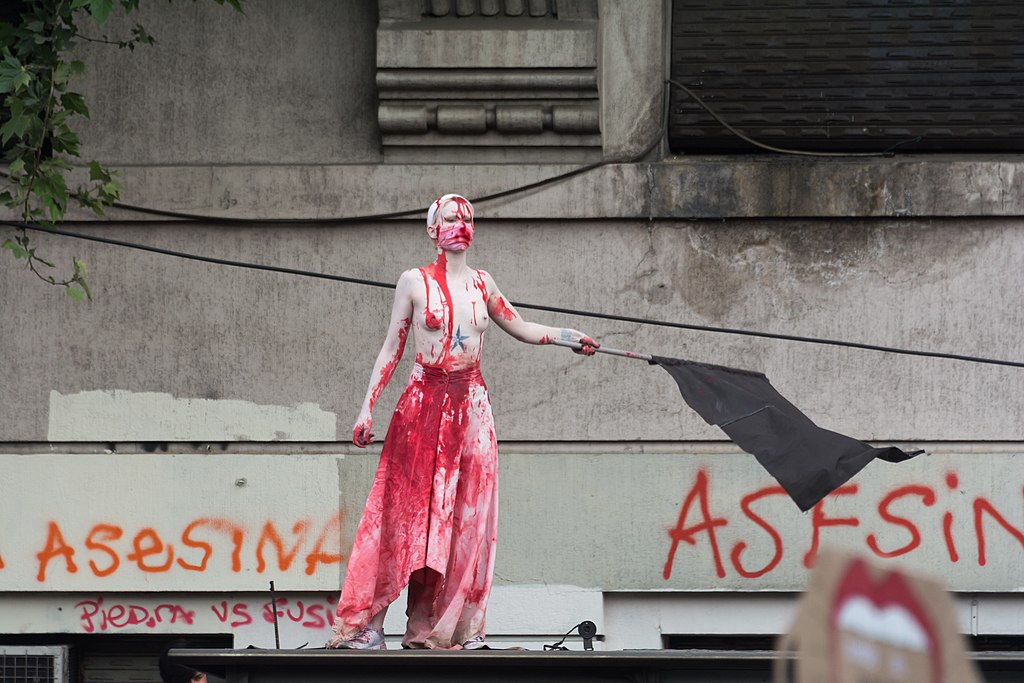
Santiago, Chile, November 2019.
Introduction of new actors into mass protest movements inevitably brings with it the arrival of criminals, provocateurs, third columnists and lumpenproletarians. These seek to use the moment of protest as a window of opportunity for the self-entered goals and use the protest movement as a cloak on their actions. These are most often the perpetrators of the worst violence against people and property and are those who get the most mainstream media coverage for doing so. But they should not be confused with the demographic “core” of the movement, which is not reducible to thugs and miscreants and which has something other than narrowly focused personal self-interest or morbid entertainment as a motivating factor.
The type of violence involved in mass collection action tells a story. Attacks on symbols of authority such as monuments and statues, government buildings or corporate entities general point to the direction of discontent. These can range from graffiti to firebombing, depending on the depth of resentment involved. Ransacking of supermarkets is also a sign of the underlying conditions behind the disorder. Destruction of public transportation does so as well. Attacks on security forces in the streets are a symbol of resistance and often used as a counter-punch to what is perceived as heavy handed police and/or military responses to peaceful protest. In some societies (say, South Korea and Nicaragua) the ability to counter-punch has been honed over years of direct action experience and gives pause to security forces when confronting broad-based social protests.
On the other hand, assaults on civilians uninvolved in security or policy-making, attacks on schools or otherwise neutral entities such as sports clubs, churches or community organisations point to either deep social (often ethno-religious) divisions or the presence of untoward elements hiding within the larger movement. Both protest organisers and authorities need to be cognisant of these differences.
In all cases mass protests are ignited by a spark, or in the academic vernacular, a precipitating event or factor. In Bolivia it was president Morals’s re-election under apparently fraudulent conditions. In Chile it was a subway fare hike. In France it was the rise in fuel prices that sparked the Yellow Vest movement that in turn became a protest about the erosion of public pension programs and and worker’s collective rights. In Ecuador it was also a rise in the price of petrol that set things off. In Hong Kong it was an extradition bill.
One relatively understudied aspect of contemporary protests is the broader cultural milieu in which they occur. All societies have distinctive cultures of protest. In some instance, such as Hong Kong, they are not deeply grounded in direct action or collective mass violence, and therefore are slow to challenge the repressive powers of the State (in the six months of Hong Kong protests three people have been killed). In other countries, such as Chile, there is a rich culture of protest to which contemporary activists and organisers can hark back to. Here the ramping up of direct action on the streets comes more quickly and involves the meting out of non-State violence on property and members of the repressive apparatuses (in Chile 30 people have died and thousands injured in one month of protests). In other countries like Iraq, pre-modern sectarian divisions combine with differences over governance to send protests from peaceful to homicidal in an instant (in Iraq over 250 people were killed and 5,000 injured in one week of protest).
Just like their are different war-fighting styles and cultures, so too are their different protest cultures specific to the societies involved.
The differences in protest culture, in turn, are directly related to cultures of repression historically demonstrated by the State. In places like Hong Kong there has been little in the way of a repressive culture prior to the last decade or so, and therefore the Police response has been cautious and incremental when it comes to street violence (always with an eye towards what the PRC overlords as well as Hong Kong public will consider acceptable). In Chile the legacy of the dictatorship hangs like a dark shadow over the security forces, who themselves have enjoyed a considerable degree of autonomy from civilian oversight in the years since the transition to democracy (in what can be considered, along with the market-driven macroeconomic policies that favour the dictatorship’s economic supporters, another authoritarian legacy). In places like Egypt the repressive response is predicated on belief in the utility value of disproportionate force: any demonstration, no matter how peaceful, is met with degrees of (often extra-judicial) lethality so as to serve as a lesson and set an example for others.
The way in which state security organisations respond to protests is also a function of the degree of security sector coherence. Issues such as inter-service rivalries, factional disputes within the armed services, different perspectives on civil-military relations and standards of professional autonomy all factor into if and how those charged with the management of organised violence will respond to differentiations types of protest.
It is therefore in the dialectic between social protest and State repressive cultures where the physical-kinetic boundaries of collective mass action are drawn. Some societies are restrained or “polite” and so too are their notions of proper protest. In others, the moment for restraint ends when protests begin.
Underlying different approaches to contemporary protests is the issue of consent and toleration, or more precisely, the threshold of of consent and toleration. Basically popular consent is required for democratic governance to endure and prosper. Consent is given contingently, in the expectation that certain material, social and political thresholds will be met and upheld by those who rule. When the latter fail to meet or uphold their end of the bargain, then consent is withdrawn and social instability begins. Although it is possible for consent to be manipulated by elites, this is a temporary solution to a long-term dilemma, which is how to keep a majority of the subjects content with their lots in life over time?
Contingent mass consent also depends on a threshold of toleration. What will people tolerate in exchange for their consent? The best example is the exchange of political for economic benefits in dictatorships: people give up political rights in order to secure material benefits. But the threshold of toleration is often fragile and unstable, especially when grievances have been festering for a time or demands have repeatedly gone unmet. When that is the case the spark that precipitates the withdrawal of mass contingent consent can be relatively minor (say, defeat by a national football team in a World Cup or the assassination of an innocent by the security forces).
Each society develops its own threshold of contingent consent and toleration. What people will tolerate in Turkey is not the same as what people will tolerate in New Zealand (assuming for the purposes of this argument that Turkey is still a democracy of sorts). In fact, the very basis of consent differ from society to society: what Turks may consider acceptable in terms of material, social and political conditions may not be remotely acceptable to the French. Even outright authoritarians need to be conscious of the threshold of consent and toleration, if not from the masses then certainly from the elites that support them. But that only adds to their governance dilemmas, since pursuit of elite contingent consent can bring with it an intolerable situation for the masses. At that point the cultures of protest and State repression will come into play.
Ultimately, the current age of protest is the product of a global crisis of governance. Belief in the combination of market capitalism and democratic forms of representation as the preferred political-economic combination has eroded significantly. Rapid demographic and technological changes, increased income inequalities and other pathologies associated with the globalisation of production and exchange have undermined the notion that a rising tide lifts all boats under liberal democratic conditions. Authoritarians have increasingly filled the void both in countries that have democratic traditions as well as those that do not. Using the power of the State, they propagate fear-mongering and scapegoating between in- and out-groups in order to consolidate power and stifle opposing views.
The irony is that the turn to authoritarianism may be seen as the solution to the crisis of democratic governance, but it is no panacea for the underlying conditions that produced the current wave of protest and in fact may exacerbate them over the long term if protest demands are repressed rather than addressed. If that is the case, then what is currently is a global move towards reformism “from below” could well become the revolutionary catharsis than recent generations of counter-hegemonic activists failed to deliver.
That alone should be reason enough for contemporary political leaders to study the reasons for and modalities of the current wave of protests. That should be done in an effort not to counter the protests but to reach compromises that, if not satisfying the full spectrum of popular demands, serve as the foundation for an ongoing dialogue that reconstructs the bases of consent and toleration so essential for maintenance of a peaceful social order. It remains to be seen how many will do so.
I did an interview on the TVNZ Breakfast Show about the situation in Hong Kong. I tried to frame the issue as a collective action problem between two sides with very different end games. The video is here.
Because of time constraints we could not discuss the fact that the Hong Kong protests do not have a unified leadership that could lend coherency to the strategy and connection between tactics and that strategy. It also did not address the fact that the protestors have now moved to challenging the (HK) State’s monopoly over organised violence in the territory, which means that it is posing an existential threat to a core function of that State. Since the Hong Kong State has little more than police and intelligence agencies as its repressive apparatus, that means that further and more serious challenges to this monopoly will be met by a State that has far more coercive power at its disposal–the PRC.
I should have mentioned at some point that the interplay between hard-liners and soft-liners on both sides is crucial to a peaceful settlement. Only if soft-liners prevail on both sides will the solution be peaceful, but in order to have that happen the soft-liners will have to prevail within their respective camps. With hard core nationalists on both sides rejecting any form of compromise as a loss of face and demonstration of weakness, the stage is set for them to prevail. If they do the outcome will be bloody.
The soft-line opposition strategy is based on the fact that the PRC can wait a long time while gauging international reaction to immediate events in Hong Kong, added to the fact that provoking a violent PRC response erases what the Hong Kong hard liners aspire to deliver ( and those goals are indeed aspirational rather than deliverable). It remains to be seen if the principles understand this type of logic.
We also did not discuss the how the moderate-militant approach I mention in the clip has to be part of a larger incremental gains strategy whereby the protestors try to push a “two steps forward, one step back” agenda that sees them roll back various authoritarian initiatives while conceding on short term or relatively minor issues (perhaps including the extradition bill that sparked the current round of protests).
Nor did we discuss the fact that at the time of initial handover from the UK, the PRC was in no position to contest the terms of the agreement, especially those centred on the “One Nation, Two Systems” 50 year compromise. Nearly halfway into that process, it is clear that conditions have changed. Among other things, Hong Kong is no longer the source of GDP and international capital that it was for the PRC in 1997, having been eclipsed by mainland centres of commerce like Shanghai. This makes it less risky for the PRC to impose its will and accelerate the devolution process before the 50 year transition period ends in 2047. That puts it on a collision course with those in Hong Kong who want more rather than less autonomy when that time comes.
Finally, we did not discuss the fact that should push come to shove the protesters are on their own. For all the US bluster and the threats of trade sanctions against the PRC if it uses force to quell the protests, no one is coming to the rescue. Not the UK, not the EU, not NATO, not SEATO, not Taiwan, not blue-helmeted UN troops–nobody will do anything significant in their defence.
That means that there is a limit to what the protestors can achieve by pushing the protest envelope, since there will be no counter to the PRC use of force if and when it comes. Hence the need for the incremental gains approach mentioned above, and even that may be too little to stave off the eventual PRC takeover in 2047.
I have been reading and listening to the aftermath of Trump’s comments about the four female first term Democratic representatives, all of whom are “people of color.” I found the US coverage interesting both as evidence of partisanship and the deep vein of bigotry that Trump has tapped into in order to advance his political career. But some of the coverage has got me to thinking about how the issue is being framed, specifically whether or not his comments were “racist.”
Here is how I see it: Strictly speaking, the “go back to where you came from” line is xenophobic. It often is underpinned by racism, as in Trump’s case. But it is not the same or reducible to racism because culture, religion, language, dress etc. factor in as well. The primary inference is that the “other” is “foreign.” The distinction is important, especially in a country that has the Statue of Liberty as a national symbol.
Trump’s ignorance of his target’s birth origins does not take away from the underlying anti-foreign message. It appears that in the US xenophobia is more widespread than racism. Trump knows this. That allows him to disavow racism and yet throw bigoted meat to his base because foreigners are “aliens,” the inference being that they are sub-humans who come from crime-infested sh*tholes (his language, not mine). That he speaks of these first generation citizens’ supposed hate for America and loyalty to foreign enemies like al-Qaeda (both demonstrable lies) rather then focus on their racial characteristics is proof that the emphasis is on their foreign “otherness.” Likewise, in calling them socialists and communists Trump and his minions emphasise the “un” American nature of those ideologies and their supposed embrace of them. It is to the xenophobic streak in US society that Trump is speaking to, some of which may be embedded in broader racist sentiment.
As a third generation US citizen descended from Irish Catholic, Italian and Scottish stock, I am well versed in the “go back to where you came from” opinions directed at my grandparents. Then as now it may have overlapped with but was not strictly a matter of racism.
Anyway, as I see it, for all of the nice inscriptions on Lady Liberty, the US has a deeply rooted xenophobic streak that parallels and often overlaps with its history of racism. There are times when one strand overshadows the other, for example during the civil rights struggles of the 1960s when racism took centre stage and xenophobia took a back seat. In today’s context the “acceptable” form of bigotry–besides ongoing homophobia and misogyny–is xenophobia, not racism.
This is what allows the Trump administration to detain thousands of “illegal aliens” (most of the world uses the term “undocumented migrants”) in internment camps. It is what allows it to separate hundreds of “alien” children from their parents and remove them to detention centres far from where their parents are held. The justification for such depravity is not offered on the basis of race but on the basis of birth origin. That, it seems, is more acceptable to many “Americans” who would not accept the wholesale incarceration of African- or Asian-Americans on the sole basis of race.
Oh wait, check that thought. That was only true in other times.
Incidentally, I place qualifier marks around the term “Americans” because “America” refers to continents rather than individual nations, so the appropriation of the word by the US is more a form of linguistic imperialism than an actual descriptor of who is born there.
In any event, I feel that the emphasis on whether Trump’s comments were racist or not obscures and detracts from the fact that xenophobia, stoked by years of endless war against and tensions with foreigners (mostly of color) has made it the preferred form of bigotry wielded by Republicans and those who are fearful of the loss of white dominance in a country where demographic change does not favour them.
Whether or not it will be used as part of a winning electoral strategy by Trump and the Republicans in 2020 remains to be seen. But what it does demonstrably prove is that the historical roots of xenophobic “othering” are being well watered today.
Postscript: Conspicuous by its absence from the MSM coverage is the fact that Trump’s bigotry is, amid all of the rest, gendered at its core. He appears to take particular issue with women who challenge him, especially those who are non-white. He saves the worst of his personal insults for them, and in the case of Rep. Omar he has walked up to the fine line separating protected offensive speech from hate speech. After all, when he falsely claims that someone “hates America,” “is loyal to al-Qaeda,” is a “communist” and even was married to her brother (yes, he did indeed say that), then he is coming perilously close to inciting violence against her. After all, if you condense what he is saying, she is an insolent commie incestuous female who hates America and who therefore does not deserve the common protections afforded “real” citizens.
Yet the media has not focused on these components of his rhetoric as much as they should be. Instead we get the usual analyses that “he is consolidating his base” and “he is trying to tar the Democratic Party with the “four women of the apocalypse” brush”, which if true do not fully capture the evilness of his intent. While I do not think that his offensive views merit impeachment at this point (since in my opinion they do not rise to the level of high crimes and misdemeanours), should anything happen to any one of the so-called “squad,” and should that be the work of a Trump supporter, then I think that there is fair grounds to do so.
The inquiry into whether the SAS acted illegally during a nighttime raid on a suspected insurgent’s hideout in Afghanistan in 2010 (code named Operation Burnham), which resulted in six civilian deaths and serious wounds to 15 others, is slowly coming apart. This is unfortunate because the NZDF, which has allocated NZ $8 million to its representation at the inquiry, looks likely to be let off the hook even though the inquiry has revealed a pattern of lying, deception and cover up on its part. The issue transcends the actions of the SAS and allied forces on the ground and moves into the behaviour of the NZDF chain of command in Afghanistan and NZ after the first reports of civilian casualties came to light. Unfortunately, it now seems that will be whitewashed into oblivion.
So far the Inquiry (chaired by Sir Geoffrey Palmer and Sir Terence Arnold) has revealed that contrary to NZDF statements, civilians were known to be killed from the beginning and that at least some of them were “MAMs” (military aged males) who were unarmed. It also revealed that, again contrary to earlier NZDF reports, a US AC-130 gunship was involved in the operation and hit targets as they fled the villages in which the operation was conducted. Some of these may have been women and children, although the NZDF changed the identification of civilians to possible “INS” (insurgents) once the raid became a matter of public attention. The after-action reports demonstrate that little difference was given to suspected INS and MAMs when calling in air strikes, and that the AC-130, which is a rather blunt instrument when used on people out on open terrain, was the primary instrument of death. Only one person was killed by an SAS trooper, that being a hapless unarmed shepard who stumbled towards a SAS sniper position providing cover from a ridge line above the villages.
The NZDF’s (unnecessary, in my opinion) deception and cover up will largely remain lost because of two things: there secrecy in which the Inquiry has been shrouded; and the tactics of some of those who brought the matter to public attention. Let me explain.
The Inquiry was set up as a result of the allegations in a 2017 book by Jon Stephenson and Nicky Hager titled “Hit and Run.” The book followed a series of magazine stories by Mr. Stephenson about the SAS in Afghanistan and the Operation Burnham raid. Mr. Stephenson did almost all of the field research and original writing that went into the book, with Mr Hager joining later in order to add weight to the venture and bring it to quick publication in an election year. Although Mr. Hager got first author treatment on the cover page and in the media, the truth is that Mr. Stephenson was responsible for the majority of what was written in it.
As can be expected given their different roles in the project, the authors differed on some key issues, including the use of non-military maps to illustrate the location of the targeted villages and the tone of some of the language used to describe the SAS’s actions (which have been described by some as “war crimes” committed in revenge for the death of a NZDF soldier weeks earlier). One bone of contention was whether in fact any Taliban associated with the deadly attack on the NZDF land convoy were present in the village of Naik. That matters because the NZDF said that there were and that justified the raid. As it turns out, Mr. Stephenson subsequently reported that indeed, two Taliban commanders–the objectives of the “kill or capture” SAS-led mission–were present in the village but left before the raid commenced. However, the book claim is that no insurgents were present, apparently because none were found by the SAS in the targeted villages and Mr. Stephenson had not yet been able to secure interviews with the escaped Taliban commanders before the dateline for publication. The discrepancy does not invalidate the many other claims in the book but points to differences in journalistic approach between the two Hit and Run authors–differences that, along with other errors in the book (such as location errors on the maps used in the book), the NZDF and its supporters have been quick to seize upon.
The book came out, a furore ensued, the NZDF pretty much denied everything, then slowly began to correct its narrative and admit to much of what was written, and an Inquiry was eventually launched once the Labour-led government was installed (the previous National government refused to launch an inquiry and accepted the NZDF version of events).
The scope of the Inquiry was initially narrowly construed: determine what happened and whether the SAS and its Afghan and US partners contravened the laws of war. This is what led to the near-blanket extension of secrecy to the evidence and testimony given before it, as multiple agencies such as the GCSB and SIS had some involvement in the affair, SAS personnel are normally given anonymity during official investigations, and sources, methods, tactics and the names of individuals could be compromised if transparency was faithfully observed. This has led to disappointment in some quarters and increased tension between the Inquiry leaders and the accusers over the lack of transparency.
The bottom line is that whatever the legitimacy for the rationale behind keeping much of the Inquiry secret, its primary focus was always about the how Operation Burnham unfolded as a combat event. Questions about NZDF post-event misrepresentation could only be addressed once the facts on the ground were established.
I am ignorant of the exact timing of their entrance (perhaps even from the onset), but at some point the much celebrated team of Deborah Manning, Rodney Harrison QC and Richard McCleod (of Ahmed Zaoui fame) were invited to represent the victims of the raid in the Inquiry. It was at that point that things began to fall apart. The reason is that adding the villager’s perspective into the mix at the same time as responsibility was being determined muddled the Inquiry by stretching its terms of reference. Again, the original scope of the Inquiry was to determine what happened, whether illegal acts were committed and to attribute responsibility if so. Once that was established then the issue of reparations, compensation and other forms of victim redress could be discussed because it would be clearly established how they were victimised.
This is an important distinction. It is appropriate for the villagers to testify as witnesses. It is another thing to have them testify as victims. The former seeks to uncover other points of view on what was a chaotic nighttime operation. The latter presupposes culpability and concentrates on the matter of redress. Yet, judging from the legal team’s statements, it is this second matter that appears to be the focus of the villager’s representation in the Inquiry.
Under such conditions allowing villager legal representation to sit alongside the book authors who made the claims against the NZDF in the first instance is akin to putting the cart before the horse. To phrase it in political science terms, it is a case of methodological inversion because the focus on the villagers-as-victims selects on the dependent variable (the situation after the raid) rather than on the independent and intervening variables leading to the outcome (the reasons for and conduct of the raid). Put even another way: Yes, we know that innocent people died and were wounded in the raid and that the NZDF attempted to cover it up. But the question is whether they were killed unlawfully, and if so, by who, exactly? It is only when those questions are answered that discussion of what to do by way of redress can begin.
Unhappy with the proceedings, the villager’s legal team has quit the Inquiry (there is much talk about the villagers being disillusioned with the Inquiry but one has to wonder how much agency did they have and how conversant with the proceedings were they given the fact that they are largely illiterate peasants living in remote valleys 14,000 kilometres away from where the Inquiry is being conducted). Now Mr. Stephenson has publicly revealed that, based on interviews with them, two Taliban commanders were in Naik after all. That is problematic because it contradicts the villager’s original testimony as claimed in the book (which stated that no Taliban were present in the villages before the raid) and Mr. Hager’s supporting remarks to the Inquiry (which Mr. Stepehnson apparently contradicted in his testimony to the Inquiry months ago, where he left open the possibility that Taliban were present in the village before the raid but which he did not confirm publicly until recently). This still leaves a lot yet to be determined but certainly gives the impression that all is not well on the accuser’s side of the table.
I believe that the thrust of the book is correct even if mistakes were made on details and the language in it is a bit strong at times. Although controversial, Mr. Hager’s previous writing on matters of NZ security and intelligence have largely been proven correct. I have a ton of respect for Ms. Manning and Mr. Stephenson in particular, both of whom I know socially. I also believe that the SAS are very professional and are not prone to killing people for the sport of it. What I do not have much regard for is military superiors using secrecy and public relations to spin stories that evade the truth and which serve to shirk responsibility when things go wrong.
Alas, the NZDF brass may prevail in this instance. Most of those in leadership positions at the time Operation Burnham was conducted have moved on to other pastures and would not face punitive sanctions in any event. A few middle ranking soldiers might be called to account but it is doubtful that anything career threatening will happen to them. The soldiers who conducted the raid are very unlikely to be found to have committed illegal acts given the fog of war in difficult circumstances (I say this having read a number of the after-action summaries provided to the Inquiry).
Perhaps I am wrong and the Inquiry will find that the NZDF falsified documents and mislead the civilian leadership of the moment as to what actually occurred that night (one should recall then Defense Minister Wayne Mapp’s statements immediately following the raid versus later, once the book was published and he was revealed as a source for it). In that case perhaps some heads will roll. But I find that prospect unlikely.
What I do find likely is that, undermined by competing agendas amongst the principles involved in confronting the NZDF and shrouded by the mantle of secrecy afforded to it by the Inquiry, the military will pay no price even in the event that mistakes were made and innocents hurt as a result of them. I hope to be proven wrong and stand to be corrected if any of the above analysis is faulty, but at this juncture I think that in more ways than one the NZDF may well have dodged a bullet.