Optimism isn’t enough

I have, of late, been rather critical of Labour, and the reason for my critical tone is at least partially because the sort of Pollyanna bullshit exhibited by certain partisans on this thread (and elsewhere) is eerily similar to the rah-rah-it’s-all-good campaign of 2008, in which the True Believers grossly underestimated John Key and National, attacked him on his weaknesses and derided him as less than credible and not a proper threat, and got soundly and deservedly whipped at the polls for doing so. I don’t want to see that happen again, so I say: stop just assuming the electorate will come to their senses and vote Labour because they know it’s right, or because Labour’s policies will objectively benefit them. They won’t; that’s not enough. You have to convince them to do so; you have to make them want to support you; you have to lead them. So IrishBill’s advice is a good generic communication strategy; it’s also critical that it also be backed by a credible policy strategy (which, I hope, is brewing at present).

To all the True Believers: you don’t help your chosen party by being uncritical cheerleaders; you feed the echo-chamber. Stop it. Loyalists should be a party’s harshest critics and strongest agitators for change when things aren’t working – which, absent deep changes within Labour since the 2008 election, they aren’t. Good supporters ask hard questions, expect good answers, reward rigour, punish prevarication and do not live in awe of or aim to preserve the precious disposition of their representatives. They do not deride those who do so as traitors or try to hush them up for fear of giving the impression of disunity, killing any hope of dynamism in the process.

So far I see precious little of this on the left in NZ, and that does not fill me with hope for the future. The glimmers of hope I see are from the Green Party and the māori party, who have had the good sense to cut themselves loose from the drifting hulk of Labour, at least until its people start to set things to rights again.

L
s169: enshrining a murderer’s right to blame the victim

Clayton Weatherston put a knife in his bag, went to his ex-girlfriend’s house and stabbed her to death. He admits to all of that but he is pleading not guilty to murder, and s169 of the Crimes Act means he may only be found guilty of manslaughter. s169 says that blaming her is a defence, it says that if she provoked him and he killed her it is not murder.

It sounds far fetched, but it’s happened many times before. In 2006 Tevita Noa was found not guilty of murder; he had beaten his wife to death with a cricket bat after finding explicit photos on her cell phone. Amsheen Arif Ali stabbed Colin Hart five times, only manslaughter because Hart had made sexual advances toward him. Phillip Edwards bashed David McNee in the face 40 times, stole his car and possessions and boasted about it afterwards, only manslaughter because McNee, paying Edwards for sex, had touched Edwards’ anus.

s169 enshrines blaming the victim in law – it says that in New Zealand a man may beat a woman or a gay man to death as long as it’s their fault, her fault for wanting to leave, his fault for being gay.

In 2007 the Law Commission recommended the repeal of the section and … nothing.

Earlier this year Simon Power’s office told me

I expect to consider these proposals later this year, and will assess, at that stage, how any reforms of this nature might fall within the Government’s current legislative priorities.

But … nothing.

So, if you want to live in a country which doesn’t enshrine victim blaming in law, write to Simon Power and ask him to repeal s169 of the Crimes Act, ask him to treat the murder of wives, gay men and ex-girlfriends as murder.

[Many thanks to Idiot/Savant who has kept this issue on the agenda]

Convincing the Police we have a right to protest

It is good to see that – after a 12 year battle – the right to protest in Parliament grounds is finally being reaffirmed. The short version is that in 1997 the then speaker Doug Kidd authorised the arrest of 75 people protesting against education reforms in Parliament grounds and later trespassed them all. It has taken 12 years for the speaker’s office and the Police to finally agree to apologise and pay compensation.

It is frustrating that in a supposedly open democratic society there are so many example of the Police and authorities trying to stifle dissent, and that it takes many years and many costly lawyer hours to get to a point the courts finally make them back down. Recent examples that spring to mind are people being arrested and prosecuted for writing in chalk on a footpath, using a loud hailer and blowing a whistle again on a public footpath, and burning a NZ flag (which required a High Court appeal). If you’re interested in more examples I found this article while I was checking I remembered the chalk incident correctly.

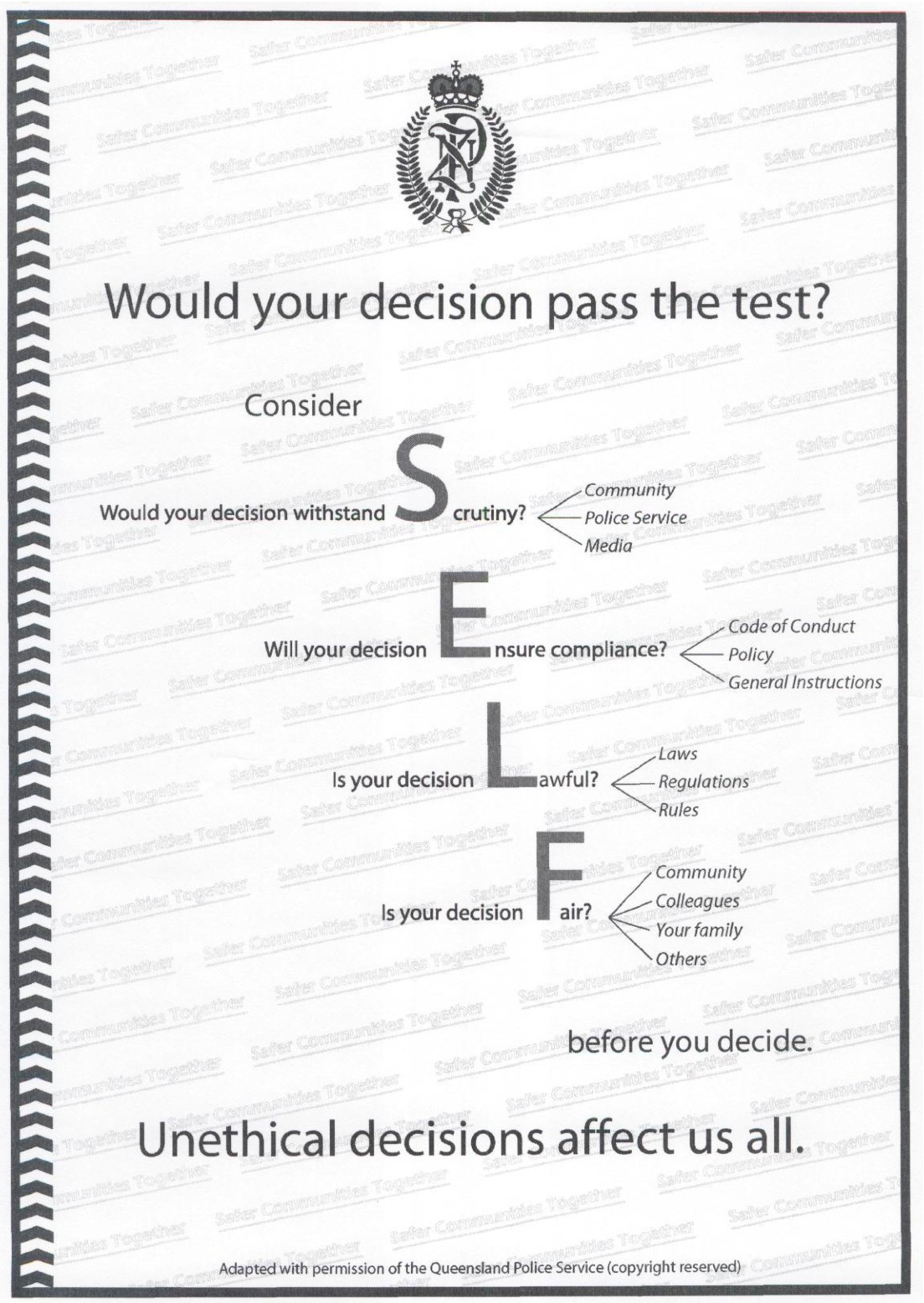
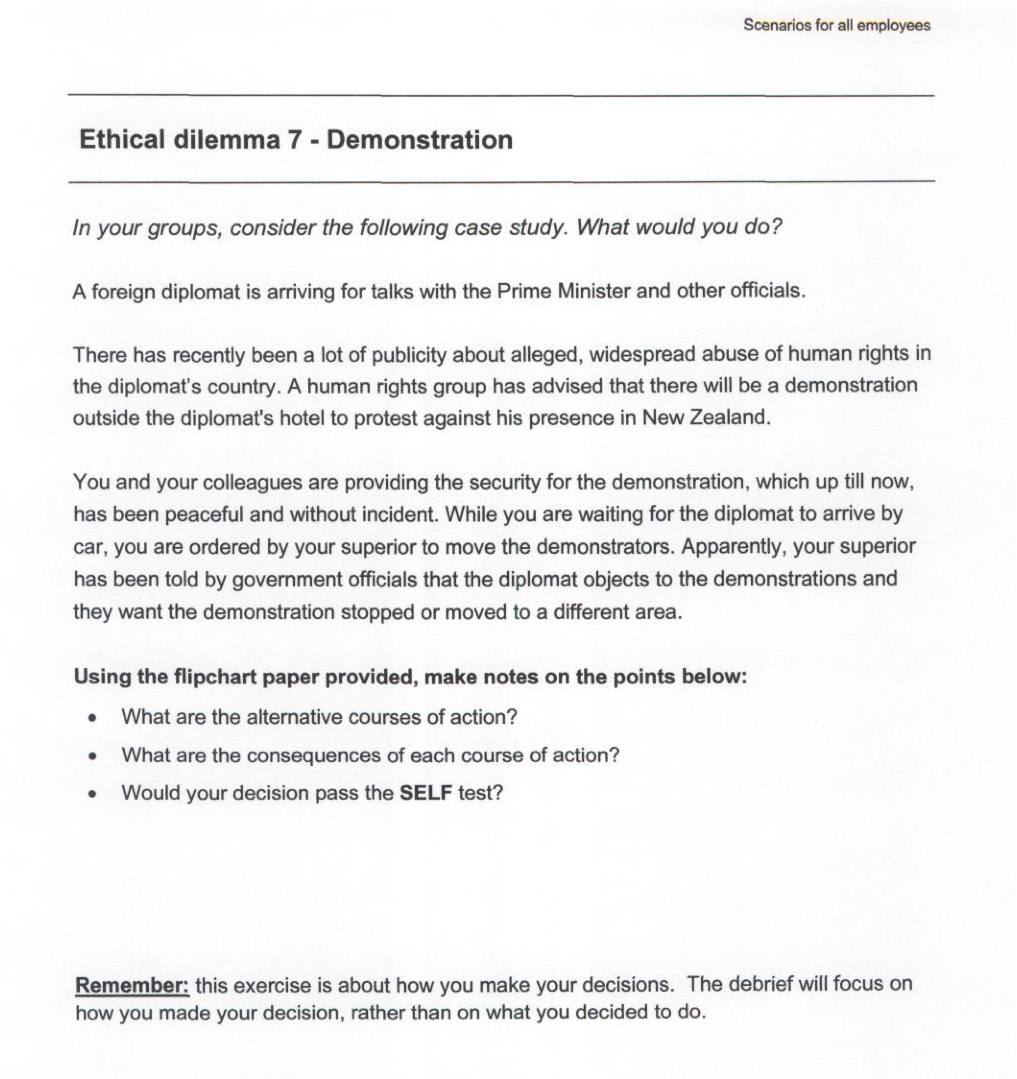
In theory the Police are there to protect our rights, including our right to participate in democratic protest, but it frequently feels like their main goal is to protect the dominance of the current power elite. It was interesting to see this scenario appear in the ethics training material the Police have developed since the Commission of Inquiry into Police Conduct (driven by the Police rape trials)

Ethical dilemma example 7
I would like to imagine this is a sign of a turning tide, and the Police will now be protecting our right to protest, but recent examples of deliberate and exploitative infiltration of protest groups, and the use of defenders of torturers like Mark Lowenthal by the Police for training and advice is hardly a good sign. Do these recent examples pass their own test?

NZ Police SELF test

All talk, no trousers – Labour’s position on pig farming

On Thursday last week Brendon Burns, a Labour MP on the primary production select committee, posted on Red Alert about pig farming. More precisely he said he was horrified by sow crates, and he’d had a little dig at the Minister about MAF’s Chief Vet. So far so average, aware of issues, making political mileage, but there might be more… 

So we asked, a whole bunch of comments on Red Alert and a whole bunch on a related post on The Standard, we asked “What is Labour going to do?”

You see this is an area where Labour, although in opposition, could make a real difference right now. All they need to do is say with conviction “Within two months of Labour next winning an election and leading a government we will introduce the necessary small change in legislation, and big change in the animal welfare code to ban sow crates etc[1], we would have the changes in place in our first 12 months, they would come into force 2 years later”. So every single pig farmer in New Zealand, because they might not support Labour but they know Labour will lead a government again, will know when they plan a new piggery or do maintenance on an old one, that they should make the necessary changes now, because it’s cheaper to do it now that retrofit later. So if Labour stood and and said it with conviction, the conditions of pigs would start changing – not as fast as they should, but some pigs would live less horrible lives in 2010.

But anyway, back on with the story, commenters asked what Labour would do, suggested changes that could be made, and Rochelle even offered a private members bill she’s drafted.

Brendon Burns and his Labour friends? Not a peep, not a word, not a comment. So on Saturday I bumped the post, and got a reply from Brendon Burns:

Might be that other Labour MPs are onto this but I am happy to receive suggestions on amending legislation and have a look.
And, btw, MPs are eating free range pork (and chicken.) I asked a question of Bellamys months ago and they have assured me, via their suppliers, that no sow-crate pork is used, none imported and all free range.

Yeah, that’s right, we’ve already offered a private members bill, and the best he can do is say Bellamies don’t use sow crated pork and chicken. 

But y’know he might just have forgotten to read any of the comments, so I posted another comment to check that he has actually got a copy of Rochelle’s bill and… silence.

Perhaps Labour has a Plan, and will be announcing their animal welfare policy any day now. Sadly, however, it appears that, for Labour, the suffering of pigs is nothing more than an opportunity for political point scoring.

How decidedly average.


[1] Where etc includes all the cruel things done to intensively farmed pigs and chooks.

How to guess the political will of the country

Logic says that the recent Key/National scandals and a week budget have got to be damaging National’s popularity, yet the polls are barely moving. l’ve been thinking about why this is and I have come up with three possibilities (others very welcome!)

  1. Outside the beltway no-one actually cares – none of the issues resonate with swing voters. Worth and Mt Albert were a side show for politics geeks, and no-one holds National responsible for the economy tanking.
  2. People are turning off National but they’re not turning to anything else. National may be losing its gloss, but Labour doesn’t look any more appetizing than it did in November last year.
  3. The election is a long way away and people will stick to their 2008 preference for a bit longer.it would seem fickle to switch allegiances so soon, and perhaps people feel they need to give Key a little longer to show his true mettle.

How, in the face of polls which simply ask how you would vote (a lagging indicator of mood), can we really judge the mood of the country?

Identity is more than class

Marty mars, commenting at The Standard, nails down the problem with Eddie’s and IrishBill’s latest bit of anti-māori party propaganda in one brief sentence:

You cannot fix any class issue until the race issue is sorted and that won’t be sorted while you are still working everything from the class angle.

Until the Marxist left realises that Māori have their own political identity and generally don’t (won’t and shouldn’t) identify en bloc with non-Māori political movements which require their Māori identity to be subsumed by a transnational class identity, it can’t reliably count on Māori support, and can’t really consider itself an inclusive movement.

Substitute ‘Māori’ for other political minorities if you like – the internationalist movement will only be successful when it learns to accommodate diversity and turn it to political advantage, rather than trying to squash it.

The Clark Labour government’s fundamental inability to realise this (by passing the Foreshore and Seabed Act, most notably) is why the māori party is trying other options. They and their people have had seventeen decades worth of out-of-touch honkeys telling them how to achieve the sort of political and economic progress they want, and at the same time largely denying them the resources with which to achieve such progress. Time for a new strategy, and creating a bidding war between the two main ideological blocs doesn’t look like a bad one, to me.

Hone is right, though – the party is going to have to get a lot more than they have if they want to retain their people’s loyalty and not be seen, come 2011, as the Brown Tories.

L

Putting the referendum in context

Firstly, a couple of facts:
  • This is Sheryl Savill’s petition not Larry Baldock’s. Savill, a staff member at Focus on the Family‘s New Zealand organisation put this forward before Baldock jumped on the referendum bandwagon.
  • MPs from a other parties, including National (Bob Simcock) and NZ First (Brian Donnelly and Barbara Stewart), had placed bills to either repeal or amend s59 in the ballot in the past, they were just less lucky than Sue Bradford.
  • The bill received support from both sides of the house throughout the debate.
  • The bill was eventually passed 113 to 8 – it was supported by a massive majority of MPs
  • The actual text of the new s59 can be found here – it does not actually ban smacking

Secondly, in case any of you are interested in a much more wordy context I have attached, below the fold, a slightly updated piece I wrote for a different purpose earlier this year. It was written to follow on from a summary of the international context, if anyone’s really keen I can post that too :)

Continue reading “Putting the referendum in context”

David Garrett – standing on the sidelines throwing stones at his own team

I know there’s a complex in-government/not-in-government thing, and a David Garrett is only a junior backbencher and appears to be one of the more out of control ones, but …

I’m not sure it’s a good look when Garrett publicly supports the private prosecution of two Chief Executives of government departments. His party is currently providing confidence and supply to the government which employs the CEs, and he’s on the select committee which oversees their departments.

Reading between the choices of spin

When National leaked and then announced the home insulation fund they had a choice about how to spin it. I can easily think of four options they had (I’m sure there are others):

  1. Environmental/climate-change: home insulation reduces energy consumption, thus reducing the amount of generation required, thus reducing the use of thermal generation (read thermal as burning stuff :) which in turn reduces CO2 emissions which in turn reduces the effects of climate change. 
  2. Environmental/sustainability/primary-production/innovation: NZ businesses are doing some really interesting work in sustainable home insulation using NZ’s primary products rather than imports. A nice photo op with a company making home insulation from wool and voilà, the story is about innovation, sustainability and government support for agriculture and primary production in a recession.
  3. Health/education/social-development: Insulated warm dry homes improve family health and child education outcomes by reducing sickness and deafness. Photo op: Minister visits family in recently insulated home, since insulation went in the kids are much more healthy and doing much better at school, little Moana might even trundle over to the Minister with a picture book and read it to him. PR gold – government cares for families and kiddies!
  4. Traditional-infrastructure/building sector: Insulating homes means the existing builders, insulators and contractors will have more work and will weather the recession.

National chose option 4 – why? It’s not the best PR option and it’s not the most on message, every other option had clear weathering the recession messages plus something forward looking and visionary. Instead they chose the staid dull message which appeals only to the traditional infrastructure industries.

The only explanation I could come up with is that traditional infrastructure is where National’s traditional funders and backers have come from, perhaps they wasted a golden opportunity for positive spin for a little old fashioned pay back?

This post was, in part, inspired by Zetetic’s post about National’s current lack of attention to the concerns of female voters. A couple of  their options would’ve been great options if they cared about women voters, instead they chose the spin best suited for the Fletcher Building board.

Arr

Although I never got around to doing the follow-up post on the political-symbolic aspects of the Pirate Bay case (for which you can all blame my baby daughter), one of the consequences of the guilty verdict I considered has come to pass: the Swedish Piratpartiet has won a seat in the European parliament, gaining more than 7% of the vote in Sweden.

How much change they can make in that bureaucratic behemoth is another matter but their election as a Streisand effect-like result of the Pirate Bay verdict which gave them an immense boost in public profile, shows that this is a political issue with teeth.

L