Let it burn

At the head of a large army [Po-ts’ai] was besieging Ch’ang-she, which was held by Huang-fu Sung. The garrison was very small, and a general feeling of nervousness pervaded the ranks; so Huang-fu Sung called his officers together and said: “In war, there are various indirect methods of attack, and numbers do not count for everything. Now the rebels have pitched their camp in the midst of thick grass which will easily burn when the wind blows. If we set fire to it at night, they will be thrown into panic, and we can make a sortie and attack them on all sides at once, thus emulating the achievement of T’ien Tan.” That same evening, a strong breeze sprang up; so Huang-fu Sung instructed his soldiers to bind reeds together into torches and mount guard on the city walls, after which he sent out a band of daring men, who stealthily made their way through the lines and started the fire with loud shouts and yells. Simultaneously, a glare of light shot up from the city walls, and Huang-fu Sung, sounding his drums, led a rapid charge, which threw the rebels into confusion and put them to headlong flight.
— Sun Tzu, The Art of War, XII.9(4)

I can’t agree less with Grant Robertson’s, response to David Garrett’s latest bit of madness. He says he “doesn’t want to give further oxygen” to Garrett’s “extreme and appalling” views, but that’s exactly what they need: oxygen. At present both Rodney Hide and John Key probably want to forget the fact that Garrett is the ACT party’s Law and Order spokesperson, and that consequently there are no such things as his “personal views” on these topics which are separable from those of the party — he is the ACT party’s mouthpiece on such matters, and the government’s ally. We, the people who elected him and permitted Hide to assign him that role, are entitled to take these views seriously, examine them in the context of other things he has said and done, and the opposition’s job is to prevent anyone from forgetting what this man stands for, and how far his definition of “reasonable” is from that of the wider public. From now until he’s ejected from parliament, Garrett should not be able to show his face to the public without a graphic reminder of the fact that he think homosexuality is morally equivalent to paedophilia; that he favours policy (now implemented) which means more prisoners will suffer rape as a consequence of their punishment; and that he thinks poor brown parents should be sterilised. He must be required to either defend his views robustly, or forced to issue yet another humiliating public apology; and both ACT and the government must be required to defend their association with him, or forced to dissociate, demote or publicly censure him.

The instinct for the opposition to deny a topic like this the spotlight only makes political sense when the opposition is vulnerable on the issue; when they fear it could result in a populist backlash against them. Even then, the principles at stake mean a very strong backlash would be required to justify restraint on simple pragmatic grounds. There is no prospect of such a backlash in this case: as Grant says, the statement is “extreme and appalling”. Does Grant think his own sense of what is extreme and appalling differs so much from that of the electorate that they will not agree with him? The worst possible course of action for ACT and the government is to allow this topic to remain at the top of the political agenda for as long as possible. Failing to even try to keep it there shows a lack of political nerve on the part of the opposition; a continuation of the failed strategy employed prior to the election, which Key won in no small part because the very people who should be fighting against him bolstered his public image as a mild, simple, non-threatening chap. Genuine threats must be neither mocked or minimised; the “extreme and appalling” should not be laughed off or left unchallenged. This is the sort of weak-kneed liberal wimpishness and lack of rectitude which leads many voters to mistrust parties on the left, and cleave to parties and leaders whose convictions are firm and forthrightly held. The good and the just does not speak for itself, much as we might wish it would. It requires champions to stand for it, and evil truimphs when those champions fail to stand and fight.

To do so is not the “dirty” personalisation of politics: the character and views of a man who sits on the Law and Order select committee, and in the future could conceivably hold a warrant for Justice, Corrections or Police are perfectly legitimate matters for political debate, which speak both to his ability to represent the interests of New Zealanders and to the quality of the processes and people which allowed him to attain such a position.

The Garrett Solution, as I’ve argued elsewhere, contradicts almost everything the small-government right claims to stand for. After a decade of howling about “Nanny State in the bedroom” and “social engineering” we now see that their erstwhile objections to both these things were not principled, as they claimed, but were in fact just objections on the merits. Social engineering is wrong, they say, unless it’s at the genetic level. It’s also not new: this sort of thing was enthusiastically embraced during the last government by the more unhinged members of the extreme right, and now it has gone mainstream.

The topic of eugenics is the strongest symbolic matter introduced to the political sphere by any participant this term; it is a topic on which the right can only lose, and introduced by someone who is already vulnerable. The grass is high around the government’s camp, the fire is set by one of their own: now, if they are to gain an advantage, the opposition must fan the flames and beat the drums.

L

Are we?

While at the Save Radio NZ lunch-at-parliament today, it occurred to me that we’re probably the only country in the first world where you’re allowed to climb the trees on parliament grounds. Is this true?

If so, I think it says a lot about us.

L

You are only as good as your opposition.

During the years that Labour was in government, I was appalled by the lack of serious discussion on security and defense issues (or any other issue, for that matter). Instead of asking hard questions of the government about defense policy, strategic focus, the military budget, reasons for the TSA,  Zaoui’s unfair inprisonement, the competency and purview of the NZSIS, oversight of police intelligence etc., National barked about petty scandals and personal pecadillos. Its strategy was to snipe from the sidelines, make no statements of policy or specific commitments to substantitive changes, and to wait until labour self-destructed and/or voters got tired of its incumbency and opted for change for changes sake. The strategy worked.

The irony is that now in opposition, Labour has not been successful at doing the same. That affords National the political space to continue to test the winds on issues like taxation, defense, educational standards, climate change and mining of national parks without firmly commiting to a course of action. It appears to be a strategy of policy by stealth osmosis: simply announce a proposal, let the pundits and informed public debate the merits, go with the flow and shift the specifics depending on how public opinion polling shows the response to be, or offer rhetorical placations while leaching through the opposition. In some cases (GST perhaps?) that may means abandoning the proposal entirely but in most cases it means saying one thing, speaking of compromise, but doing another without meaningful concession.

The irony is that by being so wishy-washy, National prevents Labour from making political capital out of its opposition. Although it seems to have tried to copy National’s playbook for the opposition–snipe, nag, whine but not commit to a policy or course of action that would directly confront National’s proposals in antithetical terms–which may be due to a belief that the first year in government belongs to the government, with the proper role of opposition being to offer no real alternatives until closer to election day, the strategy has failed Labour.

In an interview Selwyn Manning (of Scoop fame) noted that Key and his advisors could afford to do do policy reversals and utter vague, retractable promises because there was “no cabinet-in-waiting” on Labour’s side of the aisle. The insight is spot-on: with no quality opposition pressing hard, specific, technical questions in a number of policy areas on it, and with the  front and back-benches surrounding Phil Goff populated by lightweights or mealy-mouthed opportunists,  National has the luxury of being indolent. It is the default option, the easy way out, basking in the afterglow of the “anything but Clark” attitude of many in the electorate. Given the abysmal state of political reporting in general, and majority disinterest in, if not distaste for politics, this gives National a triple dose of insulation from sharp questions and better alternatives.

However, that may have begun to change. Evidence suggests that at least some voters who shifted their preferences to National out of a sense of fatigue with Labour, or who thought that National would be more moderate and pragmatic than dogmatic in its approach to policy-making, are beginning to reconsider their support for the Key government (including those who may still like Mr. Key personally).  That in turn offers an incentive to Labour to stop playing the attack poodle role in opposition and to develop some policy bite along with its bark. For that to happen, though, Labour needs a shake up in its ranks, not so much in its Leadership (after all, is there really an attractive alternative other than Mr. Goff?), but in the seats that have potential ministerial rank should they return to power. Best to do that sooner rather than closer to election time, in order to stake out an alternative policy platform that erodes National’s policy justifications while firming up the expertese and debating skills of the pretenders to cabinet jobs in a future Labour government.

NB: I write this after a week in NZ after a year-long absence. My thoughts are preliminary and driven by my alarm at the absence of serious policy discussions, or perhaps better said, the absence of coverage of policy discussions in the NZ media (the kerfuffle over Key’s stake in a uranium mining outfit being an example of political coverage that hammers the margins rather than the meat of its policy implications). That is either a sign of mass comfort or apathy (or both), none of which makes for an informed public and accountable government. After all, a government may only be as good as the quality of its opposition, but government and opposition are only as good as what the informed public demand. At this juncture, I see little public demand and limited quality depth in NZ political society.

The “I” thing

iAs much as there are great expectations on John Key’s statement to Parliament today, the pressure on Phil Goff is only slightly less. He may not have the responsibility of running a country, but that’s the problem: little or nothing indicates he will have a country to run in the foreseeable future, the optimism of the activist left notwithstanding. Goff’s reply needs to be a game-changer; it needs to reframe the past year, foreshadow the coming “middle year” when the policy engine runs at full noise, and it needs to demonstrate that Goff has got some game and is willing to bring it.

It looks like Labour have just such an event in mind, but I have substantial misgivings about Goff’s planned reply to Key’s throne speech.

If the article in the Sunday Star Times is to be believed, the speech’s greatest asset will also be its greatest weakness: it’s to be delivered in the first person. There’s going to be a lot of “I have failed to” and “I should have” sort of statements coming out of Goff’s mouth which will undoubtedly be taken out of context, and on a more subtle level, it will reiterate the fact that Goff is in a pretty impotent position at present. Labour is disconnected from key constituencies, and there remains a perception that it still doesn’t really get why it lost. People will more naturally associate “failure” and “sorry” and so on with Labour than with National. The task of this speech and the coming months is to turn that around, but it will be hard work to sufficiently remind the audience that these things relate to Key rather than Goff himself, given that they’re coming from Goff’s mouth and because it runs counter to the established narrative about Key and what people want to believe about him.

He’s staking his own personal and political appeal against that of the PM. It’s a big risk, but hey, boldness is what’s needed. It’s not as if Goff has much to lose, and if he can make it work, it has potential to reframe the debate from being about the opportunities of the future to the missed opportunities of the past.

L

Legislators versus representatives (or, how Scott Brown is about to get schooled).

Former Cosmopolitan Magazine nude pinup boy Scott Brown’s victory in the special election to fill Ted Kennedy’s Senate seat is a body blow to the Democrats and Obama administration, especially with regard to its attempts at healthcare reform. The pundits have already well dissected the reasons for the first GOP senatorial victory in Massachusetts since Edward Brooke’s tenure ended in 1979. Voter anger with the Washington “establishment,” the role of the Tea party movement, the arrogance and complacency of the Coakley campaign–all of these factors made for a decisive electoral shift that will have significant repercussions outside of the state in which the original tea party took place. That much is clear.

But what have the good people of Massachusetts got for their preference? For one thing, they have a rookie Senator who has no national-level experience at all and just ten years of legislative experience in a very liberal state. Nor does he have any executive experience. In fact, Barack Obama looks like an elder statesman in terms of previous experience when compared to the male model-turned politician. Moreover, Brown has been elected at a time of extraordinary anti-politician and anti-Washington sentiment that, even if born out of the mistakes of commission and omission of the Bush 43 administration, have seemingly been compounded by his successor. This has made for a highly volitile political climate that in turn has made extraordinarily attractive his vague populist appeals as a Washington “outsider,” something that traditionally resonates with a disgruntled electorate (and boy, are they disgruntled now!).

Why this matters is because of the arena in which he is about to enter. Much more so than in parliamentary systems (where party discipline and hierarchy often supersede the representational mandate, especially when List MPs are involved), elected officials representing states at the national level in the US Congress fulfill two roles: that of representatives and legislators. On the one hand, they represent the interests of their constituents, be it district (US House of Representatives) or state-wide (US Senate). This role is played up during electoral campaigns (hence Mr. Brown’s claim that he is a “Brown Republican” who will independently champion the interests of his state), and is much more important for US House representatives who are elected every two years. Senators, in contrast and by design, elected every six years and representing state-wide interests that can be quite heterogenous and often competing, tend to limit their appeals to the representative role to election season. Either way, that is only half of the equation.

Once in office, US congressmen and women become legislators. That means that they need to engage in the political bargaining and understanding of national-level issues as well as those that most immediately impact their individual constituencies. Sometimes these two levels of engagement–national and local–run against each other. The congressional legislator, by the nature of the US political process, must steer towards compromise rather than principle in most instances given the competing interests at play. Thus the legislator role often is at odds with the representative role, which is part of the reason why the Founding Fathers designed the two-chamber Congress (in order to allow the Senate to overcome the populist tendencies of House members). 

This is where Scott Brown is about to be schooled. As a novice Senator he will be at the bottom of the congressional pecking order. His appointment to committees, which is determined by a mix of seniority, trade-offs and patronage, will depend largely on how he “gets along” with his fellow Senators (committee work being the most important aspect of a senator’s job, as it is in committee where all bills are first considered). Since his victory is owed more to the tea bag movement and conservative media support rather than than of the GOP bloc in Congress, he is walking into a forum without much political cover. Moreover, he is a moderate Republican (for example, he supports abortion rights) in a party increasingly dominated by non-elected conservative fundamentalists. Sure, he will be lionised by the Republican National Committee and congressional bloc at first. But once the hard work of legislating begins, his representative appeal will have to take a back seat to the back room wheeling and dealing of which legislation is made (recall the old adage that the two things one never wants to see being made is sausage and US legislation). As a minority state senator in a one-party state like Massachusetts he has some notion of what that entails, but if he is to be more than a one-term Senator, he will have to lift his game exponentially given the national stage he is now playing on.

All of which means that his anti-Washington, anti-healthcare appeal, which was essentially a negative campaign about who he was not and what he opposed, now has to be transformed into a practice of pragmatic compromise and centrism unless, of course, he is hoping that GOP majorities will be restored in both Houses in the November 2010 mid-term elections. But even if that occurs, he still has to downplay his representative role in favor of his legislative obligations, at least until he is up for re-election. In a political moment where disenchantment and resentment is rampant throughout the electorate, that may turn out to be far harder than running a dark horse campaign against a lackluster opponent. But if he favours the representative role over the legislator role now that he is in office, he runs the risk of alienating his Senate colleagues and consequently be rendered hopelessly ineffectual in delivering on his promises. Either way, he has his work cut out for him, and his good looks are of no use in that context.

PS: Among many other things I will leave for the moment the conservative movement penchant for photogenic poster people over those with substantive political experience, or the potentially  (seemingly counter-intuitive) negative implications this outcome has for any NZ-US trade deal.

Dreams and realities

This morning at The Standard, vto* questioned how anyone can figure that the TVNZ7 ad featuring Bill English could be political advertising, since it doesn’t contain any baldly partisan political statements.

What is party political about it? Nobody has come with anything specific to support the contention – merely, “it looks political” “I know political when I see it” etc etc. Specifics folks, specifics.

Although I tend to think vto is either being purposefully obdurate or is just simply oblivious, it’s a fair question. Since in my experience he is usually genuinely puzzled rather than just shilling for the blues,** I undertook to do an analysis of the clip for his edification (or ridicule). As I said in the comments thread, you don’t create this sort of thing by accident:

This is a form which has been finely tuned and crafted over half a century to serve a very specific set of purposes — it’s a complex and very challenging medium where every frame, every word, every note is loaded up with as much subtle meaning as possible. With apologies to Tolkien, one does not just walk into political advertising.

A few basics of political discourse, first. While in the case of video, a text is made up of sounds and images, this is different from the ‘words’ and ‘pictures’ vto talks about. There is also a temporal dimension to video: editing, mise-en-scene and lighting changes, camera and focal movement, etc. which I’ll lump in with ‘image’ for these purposes. Likewise, most of the sound is spoken words, but there is also music, which is non-trivial in terms of meaning. The point is that nothing is in there by accident. When you have a limited budget and the requirement to work within a 45 second ad slot, nothing is optional or discretionary.

Given that there are images and sounds, and that they’re all there for a reason, it should be clear that there’s more to analyse than just the words and pictures, and so an apparent absence of political meaning in the words and pictures doesn’t mean the text lacks political meaning; it just means that it’s not overt (or not overt to everyone). The meaning lurks in how the various parts of the text hang together as much as in the ‘words’ and ‘pictures’ themselves. This, also, is purposeful: people are natively suspicious of political messages, and it helps to be able to communicate them via means which people aren’t accustomed to analysing closely. People are very well accustomed to interpreting political speech (‘words’), but much less accustomed to parsing video texts and the subtexts which emerge when multiple texts are intercut with each other in a dense and coordinated fashion. This is what makes video such a strong medium for political communication; why Eisenstein and Riefenstahl and Capra were given such prominent positions in their respective regimes, and why practically every US presidential election since 1960 has been predicted by which candidate’s TV coverage was the stronger.

The clip in question presents a dual narrative which appeals simultaneously to peoples’ cautious, empirical, rational side and to their hopeful, nationalistic, emotional side in order to produce a sense of hope. It is composed of two separate video texts intercut: one featuring footage of Bill English, Minister of Finance and Deputy Prime Minister; and the second of Bill English, kiwi bloke. The topic is the same, and the visual edit minimises the visual difference between the two narratives, while the voice remains constant throughout. This continuity of voice leads us to interpret the statements of Serious Bill and Chipper Bill as if they are uttered by the same person (which they are) and in the same role and context (which they certainly are not). The context is provided by the image, not the sound, and demonstrates that one person can (and should) hold both opinions simultaneously although the relationship between the two narratives is arguable. Of course, people can hold both views simultaneously (though whether they should is another matter).

The first, Serious Bill, establishes the Minister of Finance at a respectful social distance in a dark suit (with cut-ins to tie and face); the Sky Tower and the bright lights of NZ’s commercial capital in the background, a composition chosen to provide authority and credibility. This is a fairly soft form of the tycoon shot, a wealthy man overlooking his glistening domain. He speaks calmly and in technical terms, playing NZ’s economic problems with a straight bat. He uses the first person plural (“we”) throughout in order to include the audience in his statements. He looks the camera (audience) square in the face, talking directly to us.

The second, Chipper Bill, is established in a full-frame headshot, cut from a full-frame headshot of Serious Bill. This is what I mean by ‘minimising the visual distance’ between the Two Bills. He starts with “Y’know”, a commonplace employed more often to tell people what they (should) know than to genuinely appeal to shared common knowledge. This also marks a distinction between the complex, technical language used by Serious Bill and the colloquial, understandable terms and sentiments which follow. It is a relief to hear someone speaking ‘plain english’ after all that techno-jargon, right? Especially when he’s saying something we want to hear: good news about how “we can beat those Aussies”, after the bad news which Serious Bill was talking about, how our we’ve been “underperforming” when compared to them.

Chipper Bill — smiling and personable, an approachable everyman in a patriotically black polo shirt, continues to be intercut speaking in exhortative platitudes about how we just need to “back ourselves” (cut briefly to Chipper Bill gazing into the middle distance) and “apply some old-fashioned Kiwi can-do”, and so on, in response to Serious Bill’s authoritative but somewhat dry and gloomy facts. This use of “old-fashioned” is a hint of a dig at the previous government, the one responsible for “underperforming”; this dig is made a bit more explicit with the enthusiastic “we’re nearly through the tough times and things are looking up” — just leave it to good old National and everything will be well, not like that other lot, who were opposed to everything traditional, right?

The two narratives describe the reality of how things are (described by Serious Bill) and a dream of how things could be (described by Chipper Bill), as the music gradually rises in the background. The clincher, and the factor which makes this more a political advertisement than anything else, is that Bill English is the connection between the two narratives: if you accept the narrative line, he is the key to turning the dream into reality. This is essentially an overarching ‘hope’ narrative, a most powerful sort in troubled times, as Barack Obama realised, and as expressed by Drew Westen in the first chapter of his book The Political Brain, which opens with an analysis of two contrasting video advertisements for Democrat presidential candidates: one successful, for the Clinton campaign, and one unsuccessful, for the Kerry campaign. What was Clinton’s narrative? Hope.***

This ad was not about policy. Its sole purpose was to begin creating a set of positive associations to him and narrative about the Man from Hope — framed, from start to finish, in terms of hope and the American Dream. […] The ad created in viewers a vivid, multisensory network of associations — associations not only to the word hope but to the image of Hope in small-town America in an era gone by.

This “Two Bills” ad creates a similar hope narrative around the putative Kiwi Dream of “beating the Aussies” with “good old Kiwi can-do”. How could anyone not like that?

Just so you’re not starved of policy analysis, there are unstated, non-trivial National party assumptions about what’s important all through the ad too. The prime one among these is a focus on financial metrics (GDP growth, productivity growth) to the exclusion of other considerations. A Labour ad along these lines might have emphasised a balance between economic and environmental and other outcomes such as quality of life — the fact that this ad mentions no other metrics than wealth is not value-neutral or void of political meaning: it demonstrates the writer’s policy priorities and direction. As well as that, the “beating the Aussies” narrative is a core plank of the government’s current policy of “closing the gap” — it’s not policy-neutral either, but is a function of the government’s own preferences and their political strategy of measuring themselves against previous governments on metrics which favour them. And hang on a minute: are we really “through the tough times”, and are things really “looking up”? Depends who you ask; this is a matter of opinion and legitimate professional dispute among Those Who Know About Such Things, it’s not a slam-dunk even if the Finance Minister says so: after all, it’s his job to say so. And will “old-fashioned Kiwi can-do” on its own really be sufficient to bridge the significant productivity and GDP growth gaps between NZ and Australia? What the hell is “old-fashioned Kiwi can-do” anyhow, and if it were that easy, why haven’t we done it all before? The entire narrative is constructed of politically-charged assumptions, but it is formed in such a way as to discourage the audience from thinking too hard about it.

There’s one other thing, too: Plain English is Bill’s newsletter to his constituents, and it looks like the similarities don’t end there. It was a catch-cry of his 2002 election campaign. Perhaps if he’d had this production team working on that campaign he’d have won, or at least done well enough to prevent Don Brash from taking over.

So that’s a reasonably thorough teasing out of the political content of this seemingly-innocuous 45-second commercial. As I said in the comment thread at The Standard, the only thing more absurd than this ad getting made and screened with a straight face is Eric Kearley employing the Lebowski Defence when challenged on the fact that the ad quacks very much like a propaganda duck. Regardless of whether it was bought and paid for, as the more conspiratorial commentators think, or whether the use of the form was simply a (very successful) ploy to garner attention, it’s idiotic to pretend that this isn’t political advertising in function. While I tend to find industrial explanations for apparent media bias more compelling than political explanations, people like Kearley obstinately denying the bleeding obvious doesn’t make it especially easy to keep doing so.

L

* Stands for ‘Vote Them Out’, as I recall.
** What else this implies about vto I leave as an exercise to the reader :)
*** It helped that Bill Clinton was from the town of Hope, Arkansas.

Traction

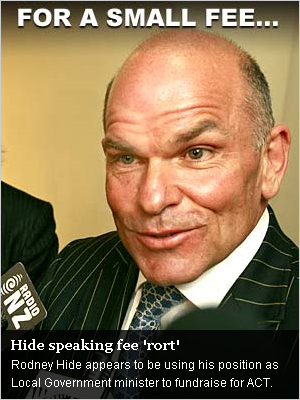
hide-rort

The story of Rodney Hide’s ministerial fundraiser is making headway — at present, it’s the splash spot on stuff.co.nz and is pretty prominent on the Herald site as well.

This image is strong. Close-ups are rarely flattering, and this one has an unctuous, indignant defensiveness which evokes, well, just about every crooked politico in history. The text, leading with the universal refrain of officials on the take and following up hard with that beloved word ‘rort’, gives the audience all the necessary context. This is a position Hide has spent his political career avoiding, and one which he was once merciless in prosecuting. It’s a long way to fall.

It seems that the credit for this should go to Eddie, who drew together its various strands into the narrative we now have. It’s been picked up by a few blogs, including Red Alert, where Phil Twyford published his own clearly-derivative-but-not-attributed riff on the topic earlier today, complete with Goff’s press release which forms the basis for the NZPA story. And it looks like Eddie even chose the photo which Stuff ran with — only one is flipped on the vertical. Well done.

Update: Lyndon in the comments points out that the threads were in fact drawn together by North Shore mayor Andrew Williams in the first instance, and published on Scoop.co.nz – so Frist P0st credits there, although the Labour response seems more derivative of Eddie’s work than that, so my point largely remains.

L

Winner does not take all

Peter Shirtcliffe is furious (audio), and well he might be, because the government’s plans for electoral reform are eminently sensible, subject to wide bipartisan support, and most critically, not at all hasty. This is electoral reform done right: for change, a majority of voters must reject the status quo system outright at two consecutive general elections, with plenty of time for reflection, consultation and campaigning before each.

Shirtcliffe’s proposal for a one-off vote on which electoral system to use at the 2011 election makes only one concession from his holy grail of government decisiveness: he thinks it should be preferential. His scheme aims to deliver that grail to his beloved National party wholesale and for good, by springing fundamental constitutional change upon the NZ electorate with less than two years’ notice and discussion, with no societal safety net, no cooling-off period, no opportunity for reflection. It would turn the time between now and the 2011 general election into an all-out propaganda war for the future of democracy in New Zealand, a war in which the National government and its allies hold all the strategic ground: unprecedented popular support and an opposition at its nadir; confused and rebranding environmental and social justice movements; the recent memory of an unpopular and dysfunctional government which represented all that people thought was wrong with MMP; a political environment in which many people will simply vote for what That Nice Man John Key recommends; and an anti-MMP lobby which is practiced, prepared and very well-resourced. Shirtcliffe’s careful circumspection — refusal to express opinions on such matters as what system should be adopted, and how campaign funding should be managed — and flattery of the plebiscite (“we’ve got an intelligent electorate out there”) seeks to hide this behind a high-handed neutrality of purpose, masking the fact that the process he advocates yields his own cause very great advantages.

Shirtcliffe’s decisiveness imperative insists that the winner must take all, in elections and in constitutional reform as in heavyweight boxing: a few ceremonial minutes in an enclosed space which determine who is the winner and who is the loser, and all that happens in between bouts is meaningless hype. It is not a democratic model, it is not a consultative model, it is not a model which gives adequate consideration to the views and opinions of the electorate at large; far from respecting electors as intelligent and capable actors, it reduces politics for the individual voter to a single, somewhat inconvenient event which happens once every three years, or in the case of something as important as changing the electoral system, once every generation or so if we’re very fortunate. Fortunately for New Zealand, and indeed to the great credit of the National party, he has been denied. The proposed framework should yield a legitimate and durable result, and one which should be supported even by those whose preferred option is not selected.

There’s much which could go awry yet, but this framework is as good as we could hope for. Idiot/Savant’s assertion that “if we want to protect MMP, its not enough simply to vote for no change in 2011 – we also have to chuck out National, just to be on the safe side” seems a little overwrought — National under Key has taken to MMP like a duck to water, learning to play both ends against the middle in a way the Clark government never did. And although there have been some recent cat-herding problems to do with keeping errant ministers in line, and around the rugby world cup, I can’t see a desire to return to the bad old days of one party rule. I do think National will campaign hard for SM as an it’s-the-same-really-only-better option, and this provides Labour and the Greens a good opportunity to differentiate itself — by pushing for MMP-as-it-is-now, or MMP-with-some-changes; although it must be said Labour aren’t behaving much like MMP-aware political actors these days. A larger threat from the National party, I believe, is the possibility of rolling the abolition of Māori seats into the new electoral system, or choosing to support an electoral system in a second referendum which (they may claim) renders the seats obsolete. This will be a strong wedge, and will enable National to frame the debate in terms beneficial to its own interests.

I await the further propagandisation of electoral systems with interest. Meanwhile, I/S’s conclusion is unarguable: “we need to make it clear to both parties: our democracy is non-negotiable.” And I’m still interested in peoples’ responses to the question: what kind of electoral system do we actually want?

L

Headline battle!

LingLingBattleWithin a half-hour, the two leading trumpet-blowers of the blogosphere have favoured us with their interpretations of the latest developments in the Bill English accomodation saga, and their headlines are marvellous. Both are factual; neither contain any misleading or false information, and yet they convey such different things.

First (chronologically), in the red corner: The Standard:

English admits he’s been rorting us

  • “English”, formal, invoking his role and status as a public personage and the head of a noted family (who also benefit from the ‘rort’).
  • “admits”, an implied concession of wrongdoing (even though English’s statement — not linked or substantively quoted in the post– makes quite clear that he’s conceding nothing of the sort).
  • “he” and “us”, an active phrasing emphasising the power dynamic in play, in which “we” are being exploited by “him”.
  • “rorted”, a hugely fashionable term in these parts nowadays (a fact on which someone recently wrote an interesting article; can anyone remember who?). It’s a strong, colourful term redolent of the back-slapping corruptness of entitlement, viewed as harmless and trivial by those privileged few who, by dint of social station, connections or wealth are able to perpetrate it, and as an insufferable reminder of greedy injustice by those not so able. This is the word it all hangs on: it provokes the visceral reaction of disgust, and divides the “him” from the “us”.
  • “[has] been” and the past tense throughout, focusing on what has happened. In some ways represents a softening: he has been, but he isn’t any more. But in the wider context this emphasises the ongoing nature of the campaign against English, an unspoken “see, we were right all along, and we have forced this admission” — again, despite the fact that English claims there’s no such admission. Being backward-looking, it focuses on the matter of principle, not of practice; it doesn’t matter that he paid the proceeds of his rort back, what matters is that he rorted it in the first place.

And in the blue corner, Kiwiblog:

Bill pays back allowance

  • Parsimonious, omitting a part of speech which in this case would bear important information, leaving the question open: “his” allowance? “the” allowance? We don’t know if the author thinks he has a right to it or not. It’s just “allowance”.
  • “Bill”, informal, emphasising his individuality and personal characteristics rather than social roles or position. Familiarity suggests reliability, trustworthiness.
  • “pays back”, active phrasing indicating Bill’s volition — he was not forced into anything, he did it of his own accord. Also echoes the Nats’ favoured cat-call of the past half-decade: “pay it back!”, first directed at Helen Clark, then at Winston Peters, a clear delineation drawn because Bill is paying it back and they didn’t.
  • “allowance”, something one is allowed. As in the other headline, this is the word it all hangs on. Its use implicitly disclaims any wrongdoing; because it’s impossible to ‘rort’ an ‘allowance’ by definition, this begs the question of whether Bill is, in fact, allowed it.
  • “pays” and use of present tense throughout, focusing on the future rather than the past, practicalities rather than principles, actions and consequences rather than character or trustworthiness. No harm, no foul, right?

With headlines like this, why would you even need to read the article — or the actual statement?

L