The real enemy within.

Rather than a measured analysis delving into complex and intricate political issues, this post winds up being a bit of a rant. That is because the subject is simple and deserves our disdain. I shall start out gently, then get to the heart of the matter. Here goes.

One unfortunate human trait is to not learn the correct lessons from history or from personal experience and past mistakes, and to instead draw different conclusions that end up compounding the original problem or creating new ones. In politics one of the more loathsome traits is for politicians to observe what works in a different political context and then try to transpose that behaviour onto their own approaches regardless of whether the local political history and culture remotely resemble that of the different context . Another is to think that an original sin (say, genocide) can be improved upon or go unpunished with better preparation, determination and technologies, and so rather than avoid committing a similar transgression, the actor in question seeks to improve upon it. These are particularly noxious forms of conceptual stretching because they have real-life consequences rather than just be a methodologically improper substitute for legitimate conceptual transfer.

One tried and true example of this unfortunate syndrome is the “enemy within” attack on domestic political “opponents” (although in truth these “enemies” most often tend to be scapegoats and marginalised social groups). Most people are aware of the Nazi use of the term to justify their approach to Jews, Roma, Communists and homosexuals. South American dictatorships referred to dissidents and political opponents in such terms as well, labelling them a “cancer” that had to be “forcibly extirpated” in order for the body politic to survive. This led to torture, “disappearances” and mass murder as tools that enforced social compliance with regime edicts.

In NZ we now have a Kiwi version of the “enemy within” trope. It is part of a broader borrowing of US and other foreign rightwing concepts. For example, ACT emulates the Elon Musk/DOGE and Argentine president Javier Milei approaches to public sector dismantlement in the name of cost-cutting. NZ First leaders Winston Peters and Shane Jones have opted for importing US culture wars while disregarding basic environmental science, discovering that “woke” is bad and that scapegoating immigrants and non-binary people is good cover when helping pad the bottom lines of their industry benefactors (fisheries and mining, specifically). National opts for US-style corporate welfare and voter suppression ploys, trying to outlaw prisoner voting and reduce or eliminate Maori wards.

The structure of parliament helps in this regard because minor parties only need to focus on gaining five percent of the popular vote in order to achieve representation and, should the National Party win a plurality of seats and reach agreement with its minor ideological counterparts, be part of a coalition government such as the one that governs now. In short: appealing to base retrograde prejudices and ignorance works well as a MMP threshold target strategy for rightwing parties. Leftwing parties? Not so much (although te Pati Maori is doing its level best to emulate their rightwing antagonists when it comes to performative politics for their target electoral demographic)

Although the why in “why do they do it?” is pretty clear (hint: because it works), the use of US political culture imports in Aotearoa is problematic because it is underwritten by violence and the threat thereof. There is nothing debatable about this. The US has a long sordid history and culture of political violence, something that has been exacerbated in recent times by Trump’s malevolent personality and MAGA’s mean mendacity, traits that are echoed by a legion of rightwing enablers in and out of public office, cheered on by “influencers’ and commentators in the corporate and social media landscape/ecosystem.

This sewer is awash in conspiracies, disinformation, misinformation and outright lies seeking to foment social division and partisan advantage. It revels in dog-whistling, stochastic violence and projecting evil character and intent to ideological rivals when in fact, it is the Right that commits the majority of political violence in the US (and arguably NZ as of late. Think of our local neo-Nazis). And as the Charlie Kirk murder and repeated attacks on liberal-progressive “enemies” of Trump have shown (including elected officials) , it can be deadly (interestingly, after denouncing Kirk’s murder, the attack on a Mormon temple in Michigan and the staged attack on Trump in Butler, PA as the work of leftists, the US rightwing–including the White House–has gone very quiet once it was revealed that in all three instances the perpetrators were MAGA adherents and/or held extreme rightwing views).

The influence of US non-state ideological actors like Steve Bannon, Curtis Yarvin, Jordan Peterson (although Canadian born), the Atlas Institute and Koch brothers front agencies first came to light in NZ during the pandemic and run-up to the 2022 parliamentary protests. Although Australian, the Christchurch terrorist had a sympathetic circle of Anders Breivik-worshipping fellow travelers who, although unmentioned in the whitewash that was the Royal Commission Report on the attacks, were well-known to security authorities (even if he was considered a minor player before he made his move). These various ideological strands came together to meld anti-vaccination, anti-Semitic, male supremacist, QAnon and Deep State conspiracies into a broad anti-government message tailored to the NZ context.

With a mixture of foreign and domestic funding and massive coverage from local news outlets, rightwing extremist views were then mainstreamed in parliament and in corporate media megaphones. People like Winston Peters rubbed shoulders with conspiracists who brandished signs calling for Jacinda Ardern and Ashley Bloomfield’s executions. Racist agitators like David Seymour spoke of Stalinist “gulags” and loss of individual freedoms due to Covid lockdowns and vaccination mandates while seeking to upend the nation’s foundational documents enshrining Treaty rights for Maori. Lesser bozos (e.g. Peter Williams, Sean Plunket, Michael Laws and various bloggers) were given platforms in the media landscape regardless of the truth behind their arguments (social media was and is the worst in this regard). For media bosses, (themselves rightwing-adjacent in spite of accusations of “leftist bias”), clicks and eyeballs mattered more than the content of the conversations themselves.

More broadly, if we consider the term “demos” (people) as the root concept in our understanding of democracy (as rule of the people), NACTFirst policies are anti-demos at their core. Denying pay equality to women, refusing to negotiate in good faith with nurses and teachers on matters of wage and working conditions, cutting health leave for non-permanent (annual contract) workers, removing nicotine and fossil fuel taxes while ending electric vehicle subsidies, raising speed limits, opening conservation land to invasive mining, loosening fishery regulations, re-opening off-shore gas and oil exploration, trying to make English the only official language of NZ and removing te Reo from official documents and public spaces, and of course the assault on Treaty rights and attempts to enshrine the primacy of private property rights rather than the collective good in law, these and other usurpations of the demos commonweal in favor of the narrow-minded desires of special interests–most of them pushed under urgency without proper consultation and deliberation—demonstrate a callous indifference, even disdain, for the people of NZ at large, especially non-dominant and marginalized groups.

Lately the ogres have turned their dark attention to non-binary people, “wokesters” of various stripes, feminists, environmentalists, immigrants (not just Muslim) and assorted “communists,” “Marxists” and “socialists” that they see as NZ’s subversive “enemy within.” And when the targets of their malevolent attention push back, the Right go all snowflake and complain about harassment, cancel culture and intimidation. We must say it again: projection much?

The move from calling people “woke” and hippy-dippy luddites who do not share NZ “values” to calling them perverts and domestic extremists is a dangerous slope towards incitement of violence against them. It is also hypocritical. Let us be clear. The NZ Right are not directing their venom at seditious outfits like Voices for Freedom or Counterspin media or astroturf disinformation organisations like Groundswell, the Taxpayers “Union” and Free Speech Coalition. To the contrary, these entities constitute part of the rightwing hate network that includes media like The Platform and Reality Check Radio, to say nothing of the more subtle reactionary messaging on mainstream outlets like Newstalk ZB and Stuff.

The NZ Left need to stop being defensive, get their shambolic houses in order, grow some spine and call out the rightwing hate-mongers for what they are. National may be more incompetent than intolerant, but ACT and NZ First are more intolerant than incompetent. Their use of US culture war language provides excellent recruitment material for narrow-minded, prejudiced and ignorant people on their side of the ideological street, but also works insidiously to incite violence against the supposedly extremist progressive enemy on the other side of that street. This gives the NZ Left a window of opportunity in the form of speaking the truth about Peters, Seymour, Luxon and their lesser associates. They are petty tyrants whose interest in democracy is instrumental, not intrinsic, and who are quick to drop democratic niceties if they feel that their social and political status is challenged by “woke” progressives.

Put another way. When a militant or agitated Left protester wants to send an ideological message, they put a crowbar or an axe through a politician’s window or pour syrup on a foreign agitator. When a Right protester wants to send a message, they seek to hurt someone by words and deeds. They say as much, and as the Christchurch massacres, attack on James Shaw and recent arrest of a murderous punk demonstrates, they are prepared to assault and kill for their “cause.” The parliamentary protests were a good example of that simmering hate and violence eventually spilling out into the open.

When it comes to political violence and rightwing claims of victimhood, the proven truth is contrary to their claims. The real snowflakes are those who specialise in race baiting, xenophobia and misogynistic insults who now cry crocodile tears about opponents “inciting” violence against them. Their hypocrisy is real and the double standard is evident.

In the end, under the cover of their vacuous rhetoric and mean-spirited actions, it is actors like ACT and NZ First who are the worst enemy of NZ democracy. They corrode it from the inside, playing by the rules as given where they are exploitable, but at heart are an anti-democratic, foreign-inspired and -supported enemy inside the walls of NZ political society that try every means possible to rig and play the political system (say, by exchanging political donations for narrowly focused political favours and by trying to alter basic constitutional principles) in order to thwart the fair and equitable distribution of scarce societal resources for the benefit of the common good.

They can shout US derived slogans and point their fingers at opposition parliamentarians as an invitation to intimidation, but the hard truth of NZ politics is palpable and cold. The enemy within NZ politics does not come from the Left. It comes from an increasingly anti-democratic Right influenced from abroad and corrupted at its core. It has a visible name in ACT and NZ First, and a willing accomplice in an enfeebled National leadership.

Shame on the lot of them. They need to be electorally booted to the curb. It remains to be seen if the parliamentary Left, such as it is, has the starch to do so.
Comparative value versus comparative worth.

Recent NACTFirst government assaults on female pay equity, public sector employment, labour regulations and other worker’s rights (to say nothing of trying to roll back Maori Treaty rights and enshrine the primacy of property right in NZ law), got me to thinking about how we measure value and worth in society. I tend to think of society being made of contributors and freeloaders. Contributors add value to their communities, be they large or small. They can be paid or unpaid, employed or volunteers, able-bodied or disabled. To me, these people are of high value and therefore of high worth. Freeloaders, on the other hand, are those who ride on the backs of others’ contributions. They can be criminals or hedge fund managers, financial advisors and consultants, rightwing bloggers and conspiracy theorists, gossip columnists or politicians. They do not create value in or for society. They appropriate worth when they can by appraising and selling themselves for more than their real value.

To be clear, this measure is not about surplus value in production and by whom it is appropriated. It is about the relationship between real value and actual worth, which may or may not be related.

Three illustrations of the spurious relationship of value and worth come to mind. There is an old saying in Latin America that a great bargain is to buy a person for their real value and then sell them for what they say they are worth. On another front, someone I know runs a financial advisory service where he caters to what he initially called “high value people.” When it was pointed out to him that he was conflating material worth with human value, he changed his firm’s logo but we have not had a good relationship since (he caters to clients with disposable investment assets of USD 10 million or more, including professional athletes). In a similar but opposite vein, my late mother, an organic intellectual if there ever was one, used to say that our wage scales are completely upside down. We should pay rubbish collectors and sewer cleaners the highest salaries and pay professional athletes and entertainers the minimum wage. Her reasoning was that athletes and entertainers provide some value to society but will receive many more benefits, material and otherwise, from the public adulation that they engender, and they will receive these benefits long after their active careers are done. Their material worth far exceeds their social value.

Conversely, those who do what in India is considered Untouchable work are essential to the good functioning of modern society and in fact critical to maintaining public health and well-being. Because of the nature of their work and the negative exposures involved in it, their careers are short and often brutish. And yet in modern society the reverse is true when it comes to their value and worth. They are paid far less (as a measure of worth) than their actual value to society. Why is that? Even if we factor in things like education, entrepreneurship and other intervening variables and admit for the existence of objectively fair measures of value and worth (and by this I do not mean the stupid comparisons of nurses and teachers versus cops and firefighter’s pay or any other gendered work comparisons), it seems that oftentimes the relationship between actual societal value and perceived worth is perversely skewed in inversely proportional ways.

That brings me back to the secondary teacher’s strike this past week. Although I left academia over a decade ago before the academic Taylorists turned universities into scholastic sweatshops whose focus is on revenue generation rather than intellectual advancement, and who believe that Science, Technology, Engineering and Mathematics (now sometimes replaced by “Economics and Management” as the back end of the “STEM” mantra) should be the sole focus of university research and teaching (eliminating the Arts and Social Sciences), I maintain contacts with a number of academics who have managed to keep their jobs and still pursue the life of the mind while teaching within the limits of current Taylorist curriculum paradigms and business models.

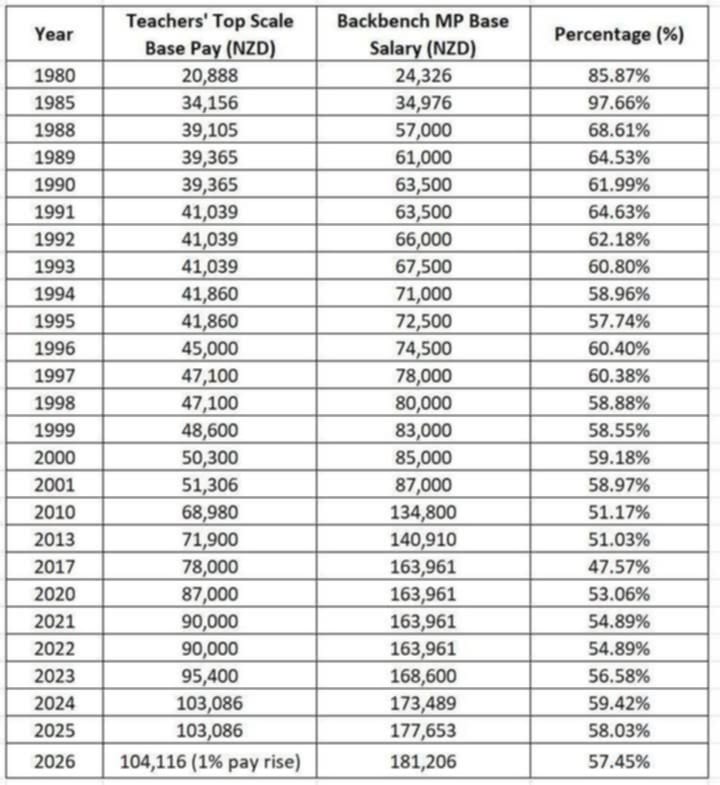
One of these contacts has just been made redundant by the NZ university to which they are affiliated (which is in the process of dismantling its social science programs while still recruiting students for admission in to them), so is considering turning to secondary school teaching as a new career path. They are also thinking about working in a policy analyst role, including in a parliamentary or political party setting. As part of the research and preparation process for that transition, and in light of the current stand-off between the government and secondary teacher’s union about cost-of-living (COLA) wage increases, they reached out to fellow colleagues who do research on related subjects in order to get a comparative idea of wages in those career fields. Although there are a number of interesting facts that came from the materials that my contact received that are worth discussing at another time, this one was shared with me. It involves the comparative base remuneration of backbench MPs and the upper end of teacher’s pay scales.

The data begs some questions. Who brings more value to NZ society, MPs or teachers? How is their value measured? What is worth more to NZ society, politicians or teachers? How is their (comparative) worth measured? Comparatively speaking, in terms of their contributions to NZ society, who is valued more and who is worth more? More broadly, is there a relationship between value and worth in NZ?

As for the specifics of the chart. Why is is the worth of backbench MPs (as measured in wages) significantly higher than that of the most experienced and well paid teachers? Since MPs also receive non-wage benefits such as accomodation and travel allowances and are often “comped” by lobbyists and other interlocutors in the form of meals and other incidentals, why is the wage gap between them and the most experienced teachers so significant? As for work equivalence, it can be argued that both MPs and teachers work long hours beyond their assigned time in class or in the parliament debating chamber, and both sacrifice family life and other leisure pursuits in order to do so. Both have formal work hours and yet engage in much informal work (say, coaching sports teams or participating in civic groups). Both MPs and teachers have invested much time and resources into their own educations and qualifications as well as through practical experience. So why the difference in worth if their value to society is similar if not equal? Or is their value not equal and hence their worth simply reflects the difference?

That last question is key. Does NZ society value MPs more than teachers and thus pay them more as a measure of their worth? Admitting for a degree of autonomy in setting institutional wage standards, are the average parliamentarians worth that much more than the most experienced teachers? Is their comparative worth–and that of teachers–based on any measure of value?

Perhaps there is a market-based answer to the question such as “politicians are rare gems that are hard to find while teachers are a dime a dozen because they are like pebbles on a beach, etc.” But even if this were true, perhaps scarcity of a resource is not a true measure of value. Memecoins such as $TRUMP may be worth much (+USD8.36/coin with a market cap of over USD 1.6 billion) but do they have any intrinsic or tangible value?

I will leave it for readers to ponder these questions and the more general question about the relationship of social value and material worth. However, one thing should be clear. Only when that relationship is defined and put into practice can we begin to speak of working towards a fair and equitable democratic capitalist society.

Some comments on NZ politics.

I had some time on my hands the past few days so spent more attention than usual consuming news about NZ domestic politics. My interests tend to lie further afield, but recent government assaults on Maori rights, women’s pay equity, constitutional neutrality, environmental, health and safety regulations, equitable taxation policy, state sector employment, Labour’s pandemic response and assorted other lesser insults have drawn me, perhaps like a moth to flame, to seek some illumination on the local political scene. These are a few tidbits that I took away this week., translated into social media posts.

  1. Chloe Swarbrick’s remarks about the government’s cowardice on the issue of Palestinian statehood in the wake of Israeli actions in Gaza.:

First all, Swarbrick is correct. If only six coalition MPs had some moral-ethical courage, then NZ could join the majority of the international community, including three of the 5 Eyes partners, in condemning Israel’s collective punishment of all Palestinians for the sins of Hamas on October 7, 2023, including the IDF’s use of ethnic cleansing and mass starvation as a means to that end. For that she was told to apologise by the Speaker (and National MP) for using the phrase “if six…members had a spine” and when she did not, ordered to leave the debating chamber. and later “named.” This is my comment on social media: “Peters, Jones and Seymour voice ugly boorish insults against their opponents (including racist taunts) and are allowed to remain in the House. Swarbrick correctly points out the spineless behaviour of government MPs regarding Gaza and gets thrown out. So much for Speaker impartiality” (referencing routine remarks made by the NZ First and Act leaders).

Also, as an aside to the particulars of this case, I should note that in light of prior history by Brownlee and other conservative MPs when it comes to progressive female members, there is a whiff of misogyny in the ruling. As a relative said to me (paraphrased here), male MPs can be loud, rude, condescending and bombastic when speaking to the House, but women cannot get angry or raise their voices even in defense of universal values. Now, I realise that Brownlee fashions himself as “old school” when it comes to parliamentary ethics and protocols, but if these boy’s club unwritten rules are part of the “old school” way of doing parliamentary politics, I say that he and others of his ilk need to be woken from their Rip Van Winkle stupor and shown the door.

By way of a broader backdrop, we should be clear that for all of its talk about foreign policy independence and having stood up to the US and its Anglophone allies with the 1985 non-nuclear declaration, NZ is a diplomatic follower, not a leader. It waits until other States make a move or show initiative on sticky international issues or events, then coattails on whatever seems most beneficial over the short-term. It pays lip service to international rules and norms but sniffs the wind when foreign policy smoke is in the air.

This syndrome has been accentuated in recent decades, particularly by National-led governments, and is now at rock bottom when it comes to NZ supination to other’s interests. The governing coalition’s current lack of resolve when it comes to denouncing the Palestinian catastrophe and upholding the right to Palestinian self-determination can be attributed to slavish obsequiousness to the US (Trump) position on the matter, perhaps abetted by the influence of the NZ Israeli lobby. Whatever ulterior ends the coalition of chaos may think that this approach may serve vis a vis the bilateral relationship with the US, they are sorely mistaken. NZ is just another squirrel looking for that elusive US nut.

2) On the decision to remove Maori words from schoolbooks :

I wrote “a main tool of cultural erasure is to remove all public references in a language other than that of the dominant social group. The CCP does it to the Uyghurs in the PRC. The excuse for doing so is usually to promote assimilation and social cohesion. The real motive is darker.”

I could go on about the attempts to erase indigenous languages and dialects in the public sphere is a host of places, particularly in Latin America, the region I am most familiar with, but also in Canada, the US, Africa and parts of the Pacific. The practice was so common in the colonial past that some linguists have written about the cultural genocide that follows erasing of a native language. When ti comes to identity and cultural preservation, language (and words) matter.

What is also remarkable is that it is well accepted that, rather than “confusing” in the Education Minister’s words, learning other languages at an early age promotes brain development and complex thought. Defending the removal of Maori words from children’s books is therefore doubly retrograde: it is the first step of an attempt at cultural erasure (at least in the public space), bookending similar attempts to remove te reo from public buildings and signage; and it is counter-productive (and counter-factual) as a pedagogical approach. Shame on Erica Stanford and her acolytes! And if a few Maori words are confusing, why not remove all non-English words from school books? Sacre bleu!

3) On the refusal of former Labour Ministers to front up to a public hearing of the Royal Common of Inquiry into the Pandemic Response:

“Why front up to a kangaroo court when the kangaroo judges are the political opposition? Especially after providing written answers to documented questions supplied by the kangaroos about events long in the public domain? Smacks of an ex-post political beat-up best avoided.” The fact that the Inquiry was instigated by ACT and NZ First as a partisan bludgeon after listening to conspiracy theorists and anti-vaxxers appears lost on the corporate media (partisan media like Plunket, Bridges and Hoskings just megaphone the anti-Labour lines). In fact, Labour should be pushing back harder at the political instigators, for example by questioning how they came to get involved in the witch hunt after actively supporting Labour’s pandemic response at the time, and who feeds them their talking points.

4) On a serving NZDF member is standing trial for espionage.

“The espionage charge against a serving NZ soldier is remarkable. The defendant is accused of working for, at the behest, or on behalf of a foreign State. Many questions arise from soldier’s court martial/trial. 1st: Which State? 2nd: what motive(s)? 3rd: what was compromised?”

Charging an active duty NZDF member with spying is remarkable because that charge–espionage– is only brought if the accused is suspected of working as a covert foreign agent. It does not refer to any domestic interlocutor., patron or client. I seem to recall at the time of the arrest that the soldier was detained for having objectionable material, presumably extremist literature (the military does not court martial people for having porn unless it is of the illegal variety). The soldier was also said to have links to right wing white supremacist groups. So it would be premature and very possibly wrong to finger the PRC as the puppet master (as the usual suspect). Given its other dark activities in NZ, Russia is a possibility. Or some other State. What should be clear is that it would not be an ally of the NZDF like the US, UK, Australia, Canada, France or other countries that routinely share higher-level intelligence with the NZDF (say, on operations, deployments, capabilities and tactics) that the soldier could not easily access unless s/he was in a military intelligence billet.

There could be a mix of motives involved, including money, sex and ideology. The counter-intelligence aspects of uncovering the suspected spy are also worth considering. In that light the trial should be interesting and revelatory, assuming that coverage is not effectively shut down for reasons of national security (yeah, right).

Should it be your inclination, feel free to weigh in within the KP rules of discourse.


Political societies and economic preferences.

Much discussion has been held over the Regulatory Standards Bill (RSB), the latest in a series of rightwing attempts to enshrine into law pro-market precepts such as the primacy of private property ownership. Underneath the good governance and economic efficiency gobbledegook language of the Bill is a desire to strip back regulations in order to give capitalists of various stripes more latitude of action.

The RSB is interesting for two reasons. One, it is the type of omnibus bill that is designed to supersede other legislation in the policy enforcement chain. It is a “mother of all laws” or foundational stone type of legislation that its proponents hope will serve as a basis for future legislative reforms and policy-making and to which all existing laws must be retro-fitted. Although it varies in its NZ specifics, it emulates the “Ley Omnibus” (later named “Ley Bases” (Base Law) pushed through by Argentine president Javier Milei last year, which basically allows for the dismantling of the Argentine State bureaucracy, reform of labor and environmental laws, slashes the public budget, and opens the economy to foreign investment.

As a result, although the inflation rate has been drastically reduced and some foreign investors have taken interest in the Argentine economy, the poverty rate now reaches nearly 60 percent, health indicators (and facilities) have cratered, pension and social welfare plans have been decimated, unemployment and crime have risen, and basic public services are on life support (including power and water provision in some areas). Despite these deleterious effects, Milei’s “chainsaw” approach has been celebrated by the ACT Party, sponsor of the RSB and its predecessors, so here again we see an example of NZ politicians borrowing concepts from similarly-minded foreign governments.

They are not alone: the incoming Trump administration’s Project 2025 and Project 47 copy aspects of Hungarian president Viktor Orban’s authoritarian-minded constitutional reforms (since it centralises power in the Executive Branch and restricts civil liberties and opposition rights). More ominously, because it is an omnibus bill that redraws the NZ constitutional map in a preferred image, it echoes the Nazi “Empowerment Law” that Hitler pushed through in the German parliament after the was named Chancellor in 1933, albeit without the repressive powers later confirmed upon him. As in the case with Milei and his Base Law (and Hitler at the beginning of his legislative campaign), the RSB depends on securing a slim parliamentary majority in order to to pass into law.

What is important to note is that such omnibus legislation is most often used in democracies by authoritarian-minded politicians who are afraid that they cannot get their policy reforms passed and accepted otherwise. It is a soft form of constitutional coup whereby the “rules of the game” are stacked via legislative reform in favour of a specific set of interests, not the public good. It is a “soft” type of coup because it uses lawful/constitutional means to achieve its ends. In a perverse way it is a sign of weakness that its proponents do so, as if they know that their preferred policy prescriptions will be rejected by the electorate in the absence of an overarching law forcing the public to follow them.

To be clear, here the focus is on omnibus or foundational laws, not more specifically drawn laws that follow from them. For example, commercial and environmental law cover aspects of social and economic life but are not “foundational” in the sense that they do not provide cornerstone underpinnings to civil and criminal law, which in turn address detailed and specific rights and obligations regarding various aspects of social life, including enforcement of those rights and obligations by an independent judiciary. “Penalties under the law” refer to this level secondary of judicial oversight, which in turn is governed by foundational principles enshrined in omnibus legislation (which is the province of constitutional law).

There is a second, more fundamental problem with this approach. It involves the distinction between political society and economic society and why they should not be intertwined.

Political societies are aggregations of people within given physical boundaries who agree upon or are forced to accept certain universally-binding rules regarding representation, leadership and collective decision-making. Because NZ is the subject of this post, we shall leave aside for the moment various authoritarian political communities. As a liberal democracy, NZ has a form of rule based on majority contingent consent to the system as given, formally expressed through elections but more granularly in the everyday actions of voters who accept their positions in the social order. People go to work, play, attend school, have relationships and generally comport themselves as members of society in accordance with commonly accepted notions of acceptable behaviour (e.g., “live and let live,” “due onto others as one would do onto oneself,” respect difference and the rules of the road, etc.). But that majority consent to any given democratic rule is contingent on public expectations being met, both materially as well as politically. Political and economic societies are formed to address (and shape) those expectations.

Economic societies are aggregations of people operating within a given productive structure, making things and generating surpluses from their labor and labor-saving inventions while exchanging goods and services. “Homo economicus” is non-political. S/he maximises economic opportunities in order to pursue material interests. The ways of doing so are many and can involve collective as well as individual effort, which is often determined by the type and modalities of production (industrial, agricultural, mixed, etc.) and the material goods being pursued.

Vulgar structuralist thought holds that the type of economic society determines what type of civil and political society emerge from it. To this day, proponents of things like (neo)modernisation theory adhere to this belief. But such views offer a simplistic read on the interplay between economic and non-economic factors, so claims such as “free markets lead to democracy,” and ” political parties are the political equivalent of economic agents in the productive process” are overdrawn at best. A more nuanced take is that civil and political life may have a grounding in economic life but are not reducible to or epiphenomena of it. In some instances, say in the cultural sphere, human behaviour is not a surface reflection of an underlying economic reality or framework.

Political society is about collective governance and civil engagement. In democracies it involves a “legal” agreement, compact, or contract about the way in which the political order should be governed, which involves ostensibly neutral institutions and processes, As such, it can co-exist with a number of economic arrangements and is not inherently linked to any one. For example, over the years democracy has coexisted comfortably with varieties of capitalism and socialism. Authoritarianism has also co-existed with capitalism and socialism. The particular combination of economic framework and governance structure defines specific variants of regime type: NZ is a “liberal” democracy because it is based on a capitalist economic foundation (first settler colonialist, now primary good export, real estate ownership and services dependent production). North Korea is a Stalinist country because it combines one-party authoritarian rule with State control of the mixed industrial/agrarian economy.

What this means is that laws in a democracy are basically a means of adjudicating disputes, avoiding collective conflicts and regulating individual and collective behaviour regardless of economic status (think of the “justice is blind” adage). Ideally, they should be agnostic or neutral with regard to economic preferences because it is possible that future generations of voters will elect to support different types of economic arrangements that they believe suit their collective and individual material interests better than current schemes.

But that is not what has happened. In NZ and elsewhere in liberal democracies, things like private property rights have been enshrined in law and thereby protected by the State. The evolution of this marriage of political and economic societies is complex but the bottom line is that NZ is a capitalist society governed by a democratic capitalist State that enforces the primacy of capital above all other things. To be sure, much lip service is given to civil liberties, human rights, equality before the law, even adherence to the principles of Te Tiriti o Waitangi. But the foundation of the modern NZ State is not based on a contract between interested parties such as the agents who signed the Treaty, or on respect for the rule of law per se, but on the structural dependence of NZ society on capitalism. The role of the NZ State is to help resolve the contradictions that inevitably emergence in a political system where a minority of voters control major parts of the productive apparatus but rely on the labour of others (wage labour) in order to generate the material surpluses (profits) that allow them to exercise (indirect) political as well as (direct) economic control in NZ society.

The RSB seeks to further deepen that structural dependence of NZ society on capital by giving certain capitalist fractions more leeway in the conduct of their self-interested affairs. When fully implemented it will atomise wage-labor both in and out of production while consolidating specific types of capitalist structural control. In that light the RSB codifies the State’s role (or non-role) in facilitating capitalists’ (aka businesses) self-interested pursuit of profit. From then on self-interested maximisers of opportunities, individual and corporate, will seek comparative advantages in the deregulated marketplace.

The problem, again, is that enshrining a specific set of economic preferences or biases in a political charter interferes with voter’s freedom of choice when it comes to their own economic interests and desires. Depending on their circumstances and structural location in the productive apparatus, not everyone may be a fan of capitalism or accept the primacy of private property rights. Some may even prefer socialism, however that is defined. Prioritizing and facilitating the pursuit of specific economic preferences contravenes the commonweal (public interest) basis of democratic political charters such as that governing Aotearoa. Instead, it rigs the societal “game” in fair of a select few.

Other, more astute minds have already voiced their opposition to the RSB on a variety of grounds. Here the point is to remind readers of why omnibus bills are inherently anti-democratic even if they are legally constitutional, and why democratic political society is distinct from and should remain “above” economic society however construed. The former deals with universal values and interests; the latter involves specific sectorial interests and their material objectives in a system structurally based on the pursuit of profit. Although they may be overlapped in fact because of NZ’s history of structural dependence on capital, the public good is best served when the political/legal framework is agnostic or neutral when it comes to sectorial interests. That is what democratic collective bargaining systems are for and why political lobbying needs to be tightly regulated. Instead, the RSB seeks to tilt the game board in the direction of a specific set of interests, not the public interest at large.

Alas, although it is not meant to be, the rightwing NZ economic and political twain have met, and the outcome is the RSB. For the reasons outlined above, that is why it should be opposed.

Voting as a multi-order process of choice.

Recent elections around the world got me to thinking about voting. At a broad level, voting involves processes and choices. Embedded in both are the logics that go into “sincere” versus “tactical” voting. “Sincere” voting is usually a matter of preferred choice, specifically of a candidate or outcome. Simply put, a person votes for their preferred option. But what about “lesser evil” or “second best” choices? Are they “sincere”? Rather than a matter of genuine sincerity of choice, the general demarcation separating “sincere” voting from “tactical” voting is not so much the motive for choice or the specific choices involved but the all or nothing of the process–it is the final selection point before an elected entity or outcome is confirmed. In other words, sincere choices are end choices, regardless of the logics by which they are made.

This allows us to distinguish between elections as a process versus elections as choices between options. Until the last vote is counted in the final round of voting, everything is tactical even if choices for individuals are sincere in the moment.

Under Mixed Member Proportionate (MMP) electoral systems like that in NZ voters do tactical voting all of the time. They consider the relationship between party and candidate votes and choose accordingly. Sometimes voters go with a straight party-candidate vote but other times they split votes between party and candidates. That depends on how they view specific party chances in inter-party competition, the electorate candidate in relation to their party, that candidate in relation to the electorate voting history (does she stand a chance?), and the merits of other candidates in a given electorate. Much of this assessment is done unconsciously in the moment of choice but in any event the voter’s calculation is multi-level and relative in nature.

A vote is tactical when we vote for a candidate or party or coalition or ballot option with the shadow of the future in mind, as far as we can foresee it. We may do so for defensive as well as win-seeking reasons, like what happened in France this past week, where the Left removed competing candidates in a number of electorates in order to improve the chances of designated “unity” candidates defeating rightwing opponents in the second round of parliamentary elections. That was done in order to help defeat the serious possibility of a rightwing victory in the second round parliamentary elections after the first round saw the Right win a significant plurality of the vote. The tactic of limiting inter-Left competition was defensive in nature rather than a “go for the win” effort because all involved understood the costs of allowing a rightwing victory and put their immediate preferences (and differences) aside in order to confront the common threat.

When it comes to tactical voting people may also vote for lesser evils rather than preferred options because the context in which voting occurs may advise them to do so. Voters may simply have to choose between otherwise distasteful candidates or options. In multiple round voting it is the process as much as the immediate outcomes that motivate voters in the first instance, as they are seeking to do something now in order to set up a better sincere choice option in the future. Think of the US primary system, where party candidates are selected not just for their merits but also with an eye towards their “electability” in the general elections. A candidate with lesser ideological purity or Party credentials may win in the selection round because primary voters feel that s/he is more likely to be elected in a general election where sincere choices are made.

On the other side of the coin, as a campaign strategy, what Labour recently did in the UK when it flooded electorates with candidates, even in Tory strongholds where it traditionally had zero chance of competing, was a “throw it at the wall and see what sticks” first-order approach. Labour put up slates of candidates who in many cases have little to no experience in politics and who were in a number of instances sent as electoral cannon fodder into historically secure Conservative electorates. Labour strategists banked on the belief that public disgruntlement with the Conservatives would spill over into Labour winning at least some traditionally Tory seats, and in that they were successful. But this was just the first order outcome. The second order outcome is how these candidates-turned-MPs will perform given their lack of experience. Some will do well but if enough turn out to be incompetent or worse, then Labour runs the risk of incurring a voter backlash against it in just one electoral cycle. That is the second-order problem of the “throw at the wall” candidate selection tactic: good for the short-run, but a bit uncertain over the longer term.

For his part, French President Macron has ruled out working with the largest of the Left parties (“France Unbowed”) in the coalition that came first in the second round of the French parliamentary elections thanks to the defensive unity candidate first order manoeuvres, so is now trying to carve away smaller Left parties from the Left coalition so they can form a majority coalition with his Centrists. He apparently has promised the Prime Minister’s job to a Left candidate if they agree to his terms (in France the president selects the PM). But if he cannot do this, then France will be in political gridlock through and beyond the Olympics. So his first order tactical gambit of calling snap elections and forming a defensive alliance against the Rightists worked, but now the second order consequences embedded in the process must be confronted and resolved less the otherwise unwelcome triumph of the Right become reality.

In Iran the reformist Pezeshkian won the run-off election against a conservative hard-liner. The latter could be seen as a “continuist” following the approach of his dead predecessor (recently killed in a helicopter crash), whereas Pezeshkian seeks a thaw in Iran’s foreign relations with the West and a relaxation of restrictions on social freedoms at home. But since the Council of Elders and the Ayatollah Khamenei are the real power brokers in Iran, perhaps they allowed Pezeshkian to run (they did not allow any other reformist to do so) in order to gauge public sentiment and/or use the elections as an escape value that eases social pressures on the regime by allowing the electorate to institutionally vent its views. Think of it as an Iranian political pressure cooker, with the electorate permitted to let off pent-up steam during the election process.

The first round of that vote only brought 40 percent of the electorate to the polls, but the second round brought in 53 percent. Beyond the narrowing of the field of candidates in the second round, the turnout and strong majority vote for Pezeshkian demonstrates the apparent need for some reform-mongering when it comes to policy making. This is a strong signal that the Elders must consider if they are to keep a lid on things. They have been sent a message about what the public wants in public policy, especially (judging from field reports) about social mores and behaviours. But what about the hard-liners? They have the guns, are not going away and are ill-disposed towards Pezeshkian’s proposals.. So the second order question is to reform monger or not and if so, how much is too much? Again, it is a process, and the choice of Pezeshkian is a first-order means towards a perhaps necessary but uncertain end.

In the US the Biden question is not only should he stay or should he go, but also how and when? Sooner or later? At the convention or before? Does he designate an heir if he goes (presumably Vice President Harris) or does he throw it open to a short-list of previously vetted candidates? The James Carville opinion piece in the New York Times was an interesting proposition, with its geographically organized Town Halls acting as an extended job interview process for designated candidates. And the George Clooney op-ed in the same newspaper pretty much spells out why Biden has moved from being an asset to a liability for the Democrats. Here too there is a process as well as the individual to consider, something that must converge into an electable platform that can defeat Trump. So the first order choice is about Biden staying or going, the second order choice is about when and how to replace him and the third order choice is about the agenda and team needed to defeat Trump. With those three parts of the process resolved, a sincere choice can be presented to the electorate in November.

This is about more than Joe Biden. In a democracy people serve their party in the first instance, the party serves the country in the second instance and the country serves the nation in the last instance (“country” being a political entity with territorial boundaries codified in the notion of “State” and “nation” being a political society or culture legally represented by a country). For the Democrats the issue is not just about choice of a presidential candidate in light of Biden’s perceived limitations (age, fragility, cognitive decline), but about the institutional process by which their candidate choice is made. The process is time-sensitive given the upcoming Election date, so the choices must be soon and facilitated by the institutional process. It remains to be seen if Biden and other Democrats fully understand the difference between his fortunes and those of the party–and the country itself, but if they do, then the process of candidate selection is as important as the candidates themselves.

Again, I am no voting behaviour expert (too much bean-counting and tea leaf-reading for me), so please take this very incomplete and shallow sketch as a a preliminary rumination about choice and process in voting. I will leave for another day discussion of certain hard realities about voting in practice–things like voter suppression, gerrymandering, redistricting, incumbent advantage, campaign finance laws and loopholes, polling, etc.–as well as the use of game theoretic and AI models as predictive tools in voting analysis. That is best left to those who focus on such things. But having said that I do think that recent elections offer an opportunity to ponder the process as well as the choices that democratic elections involve. Hence this note.

Author’s Postscript: This essay serves as the basis of my remarks for the “A View from Afar” podcast of July 14, 2024.

Te Pati Loco?

Normally I would not write about Maori issues. I may have been living in NZ for over 25 years but I do not feel that it is my place to opine because I am not an expert on Maori history and politics and do not speak Te Reo (because as anyone who seriously studies comparative politics will attest, foreign language proficiency is a bottom line requirement for scholarship in the field unless you only study countries and cultures that speak your mother tongue). Hence in the past I deferred to Lew to write about Maori issues here at KP, but since he has departed there is no one left to do so.

However, in light of the recent carkoi and protests organised by Te Pati Maori (TPM) in response to the Coalition of Cruelty’s budget, I thought I would touch briefly on a matter of Te Pati Maori praxis. I was dragged into the debate about the protests when I noted on social media that the use of the term “strike” to characterise the direct action was done in error or for dramatic effect since “strike” is codified in employment law as a collective withholding of labour services by employees from employers in the context of workplace disputes. If the labour service withdrawal is called by collective agents and follows the procedures for engaging in such action (giving notice, etc.) then it is a strike “proper.” if it is done by individuals or groups of workers without collective authorization, then it is a “wildcat” strike that may be deemed unlawful by employment courts. A general strike is a labour service withdrawal across economic sectors done for economic and/or political purposes, which is difficult because it requires unity of purpose and action by employees working in different productive areas, which in turn requires agreement between union agents and agent/principal agreement in every union on the action. That is a big ask.

Taking a day off from work to go to a protest, be it by using paid, unpaid or medical leave or no leave at all is not a strike no matter what one calls it. Workers assume the employment risks associated with such actions. Employers can weigh their responses according to the law and their relationship with employees. That could even include giving people the day off or paying them overtime to stay on the job, among other options. Again, the nature of the relationship between boss and worker outside of the legal framework can influence an employer’s response for better or worse.

I figured that since I have written two books and a dozen or so scholarly articles about comparative labour relations, including the subject of strikes and State responses to working class collective action, that my neutral if pedantic observation about the proper use of the term “strike” would be as unremarkable as it was incontrovertible. I was wrong.

To be sure, the use of the term “strike” in the Te Pati Maori protest literature, which explicitly references it as a display of Maori economic power, lent itself to the view that Maori were going on strike. As such, right-wingers seized on the term to call for employer retaliation against those who joined the protests. There was much agitation on the Right about violations of contract (individual or collective) and the penalties that should be levied. The PM weighed in with the comment that workers should be careful about striking and that strikes should be done on weekends because that way they would not be as disruptive.

Besides the fact that a PM should know the difference between a strike and a protest (rather than cynically feed into the “strike” narrative), it is pretty rich for him to suggest that strikes are best done on weekends. As I said on social media, by that logic we should take our holidays on weekends as well. The whole point of strikes, protests, demonstrations and other types of direct action is precisely to be disruptive of the status quo as given in defence of a cause or to air grievances. A protest without disruption is like an army without a fight, full of rebels with causes but no stomach for consequences. Protests and strikes are about assuming collective and individual risk. The risk may be large or small depending on circumstance, but in one way or another it hangs over acts of “unauthorised” direct action in most every instance.

Having said all of that, I understand the call to strike in the Te Pati Maori literature as using the original sense of the term, which means “to deliver a blow.” The protest was organised as a symbolic blow against the reactionary anti-Maori thrust of the Coalition of Cruelty’s policies. It was not about Maori labour service withdrawals per se.

For my troubles in clarifying what is and what is not a strike and how the term was misused in the call to action by both supporters and opponents of the protests, I was called condescending, paternalistic, pompous, a lightweight, and best of all, a “racist c**t,” the latter by a lady who surely must kiss her mum and perhaps children with that mouth. As I wrote to her, she must be fun to be around.

All of that aside, I then got the pleasure of watching Te Pati Maori leaders speak in and outside of Parliament on the subject of the protest and much more. Although Ms.Ngarwera-Packer presented her views coolly, her counterpart Mr. Waititi was at his bombastic, hyperbolic best, taking the tradition of Marae oratory to a level that even that tax-funded weiner-tugger Shane Jones cannot match. He threw out gems such as “if Maori are 60 percent of the prison population then (we) deserve 60 percent of the Corrections budget,” a feat of logic so extraordinary that it would be akin to saying that NZ should pay the PRC, Russia and rightwing extremists most of the intelligence budget because they are the ones being spied on. To be frank, I have always found Mr. Waititi to be a bit of a buffoon and charlatan, but then again, that is probably the old Pakeha racist codger in me doing the assessment (I have been characterised as such before).

Which is why I paused to reflect on my reaction to his rants. Others have already noted the hypocrisy of TPM being funded by taxpayers and gaining prominence via “Pakeha” procedures and institutions. They have noted with alarm the seditious rhetoric of Mr. Waititi’s wife, the daughter of none other than that paragon of indigenous resistance, John Tamihere (although Mr. Tamihere’s management of the Waiparera Trust, for whatever its faults, was first rate during the pandemic and is widely respect in the West Auckland community). Now the TPM is calling for a separate Maori parliament, presumably to run in parallel to the “Pakeha” parliament and be equal to it. I am not sure how it will be funded and what outcomes it hopes to achieve, but it provides some food for thought about political alternatives even if it has a snowball’s chance in hell of materialising while the current government is in power.

The proposal is interesting in part because one of the features of a Mixed Member Proportional (MMP) democratic system like that in NZ is that it allows small, narrow-focused or single issue parties to get elected and press their interests within parliament, using coalition-building and vote-trading as a means of doing so. The ACT and Green Parties started out this way and have now widened their political appeals beyond their original core policy platforms. Whether that is for better or worse is for others to decide, but the general thrust for both of them was to start narrow and then widen their platforms via the incorporation of other agenda items and constituencies. ACT has gone with the gun rights crowd, incels and racists; the Greens have gone with identity issues, animal rights and rainbows. Both have had success by doing so. NZ First has done something a bit different, using malleable nationalist populism as a vehicle for Winston Peter’s political aspirations. To his original xenophobia and self-loathing Maori appeal (to blue rinse Pakehas), he has now added anti-vaccination conspiracy weirdness and slavish “anti-woke” corporate bootlicking to the party repertoire. Like the broadening shifts undergone by ACT and the Greens, it has served his party well and allowed it and ACT to become the tail-wagging rump ends of the Coalition of Cruelty dog.

Te Pati Maori is a different kettle of fish. Gone are the days of Pita Sharples and Tariana Turia, who tried to play the centrist–some might say assimilationist–parliamentary game.They supported both Labour and National-led governments while confining themselves to practical pursuit of “reasonable” goals, that is, objectives that could be achieved by and within the system as given. Truth be told, the Maori Party record was mixed at best, but one thing that did come out of its emergence on the political scene is that outside of Maori-related issues (say, rural health and lower-income welfare support), it had zero to little impact on NZ government policy. The “big” policy decisions were made by Pakeha-dominated parties, including things like foreign and defence policy (I wrote about the Maori Party’s lack of consequence in NZ foreign policy other than on international indigenous affairs in this scholarly article).

Today’s Te Pati Maori is different. More than a just a party name change, it is overtly anti-Establishment and “progressive” in orientation (whatever “progressive” means to them, which may not be what other “progressives” think that they are). As the proposed Maori parliament suggests, TPM rejects the system as given. That is why it uses the word “strike” without regard to the Pakeha convention known as Employment Law. It’s spokespeople openly speak of “revolution” and government overthrow even if it is unclear what they actually mean when they use those terms. What is clear is that TPM is more about political theatre and symbolic politics than delivering tangible policy outcomes to and for their constituents. If anything, its marginalization within the political system has increased along with its militant rhetoric and actions. It might be too early to tell, but the carkoi protests could be seen in that light: as a lot of bluster and fanfare but no tangible impact or results to show for them. In fact, the response from most other parties was to either lambaste or shrug and ignore Te Pati Maori’s antics. Time will tell if the impact of the protests are more subtle and longer-term in nature but for the moment TPM stands alone, seemingly barking into the wind.

Again, that got me wondering as I stopped to check my white privilege. Am I being unkind to TPM? Or am I just another racist cracker bleating about the rise of a righteous and strong indigenous voice?

I found my answer in Gramsci. It occurs to me that, because TMP often refers to its actions and rationales in neo-Marxist terms with a smattering of Paulo Freire, Franz Fanon and Norm Chomsky thrown in, that Te Pati Maori sees itself waging a war of position within the “trenches” of the NZ Pakeha State. That is to say, it is working from within to disseminate its “counter-hegemonic” vision and policy prescriptions in civil and political society. Its focus is on grassroots organising, starting with Maori and reaching out from there into other “progressive” communities such as those grouped under the Green and Left Labour banners. It is not worried about converting the old Pakeha elites or engaging in parliamentary compromises because, as the recent census shows, Maori are growing in demographic numbers while Pakeha are declining. Given the structure of MMP, that growth can translate into increased seats in whatever parliament they chose to stand in, and given the youth appeal that they presently feel that they have, time is on their side. Along with forging alliances within the Labour and Green parties, unions and other civil society organisations, TPM is using a long-game strategy where what it is doing now sows the seeds for its successes down the road.

They may not be so loco after all.

So what to make of Te Pati Maori? Are they just nuts (as the term “loco” implies)? Are they communists, extremists and separatists as Winston First and Tugger Jones claim them to be? I would argue no to both suggestions. What TPM is doing is a time-honoured yet new form of politics in a social media age, where their theatrics are part of a grassroots appeal to marginalised and disaffected (not always the same) groups, especially proletarians of colour. By working “in the trenches” TPM can slowly promote an ideological re-orientation away from neoliberal vestiges (because neoliberalism is not just an economic doctrine but has become over the course of two generations a social construct that frames our way of life) and towards a type of post-modern indigenous-centric perspective infused with working class-based values and perspectives. This view is self-realised and awake rather than woke, defiant but not always disrespectful, confrontational but not conflictual, independent rather than (Pakeha) dependent, cooperative and collective rather than corporate in organization. It may take time for the TPM-led movement to congeal, but the stirrings are there and the people are ready for generational change to take effect. That is the plan and TPM sees itself as the instrument for converting that plan into praxis.

Or so they hope.

Policing protests.

Images of US students (and others) protesting and setting up tent cities on US university campuses have been broadcast worldwide and clearly demonstrate the growing rifts in US society caused by US policy toward Israel and Israel’s prosecution of its war against Palestinians in response to the Hamas attack on Israeli-occupied territory along the Gaza Strip on October 7 of last year. The police behaviour appears to be a bit over the top, to say the least, given that the protests are purportedly peaceful for the most part, or at least until the cops arrive. It would seem that the police do not care for freedoms of speech or assembly, so there appears to be an anti-democratic bias at play in the suppression of these protests. But there are some angles to the subject that need further discussion, so let’s dig in on them.

Assuming that protesters are not harassing, intimidating or assaulting people or damaging public or private property, then the police response in place like Emory University, University of Southern California and the University of Texas (to name a few), is in fact excessive. Even if trespass orders are given, there is no need to manhandle, use tear gas, rubber bullets or generally hurt protestors in order to get them to leave a designated area unless they are being violent. If they block roads and physically impede public movements in and around the demonstration, then protesters can be arrested and cited under law for a subsequent court appearances. But unless they actively (as opposed to passively) resist, then violence should not be used against them and even then, all care should be made by law enforcement to consider the physical well-being of those arrested. Marching people out by the elbows is one thing. Throwing them to the ground and cuffing them behind their backs is another. Breaking arms or legs and pepper-spraying people people is a step too far. Again, this assumes that protesters are not behaving in a threatening or violent manner.

Private schools can issue trespass notices for any reason and have the police enforce them. Likewise, public institutions can do much the same although here the space being occupied is owned by taxpayers and therefore not as easily subject to tresspass orders unless people start damaging things or other folk. This was the case with the 2022 Wellington parliamentary protest, which was held on parliament grounds but eventually spilled into adjacent streets (and beyond), all of which are public spaces. Given that public institutions are thought of as “the people’s places,” authorities must exercise extra caution when attempting to end protests on and in them. Unlike the centralised nature of law enforcement decision-making in NZ (due to the unitary nature of government), as a federal republic that means that in the US State and/or local authorities must make the decision to move against a protest, usually at the request of university administrators. There are plenty of regulations in place that give State and local governments authority over public spaces, so the right for public authorities to enforce trespass notices is there. It is how they do so that is the issue.

Here I must pause for a brief aside about “free” versus “hate” speech, which is at the crux of the protests and how they are handled. Waving banners and yelling “long live Hamas” is an example of protected free speech. Given Hamas’s record, it may offend many people but no harm is invited and no violence is incited. On-lookers can walk away if they object. It is therefore a case of protected “offensive” speech at worst. However, yelling or waving banners saying “kill the Jews” or “nuke Gaza” is not. It is an incitement to violence against a specific group of people. As such it needs to be treated as a precursor to a hate crime as it invites and incites violence against a designated target. Law enforcement authorities need to understand the difference and formulate their responses accordingly.

Think of it this way: Kyle Chapman and other NZ neo-Nazis can play dressup and march around yelling “Sieg Heil” and “white power” all they want, so long as they do not cross the line into advocating violence or committing acts of violence against others. The police need to know what is protected (anti-social racist incel boorishness) and what is not (advocating harm to others). Unfortunately, the police in Christchurch have a history of downplaying the issue when Kyle and his fellow creeps cross that line, something that may have been a factor in the events of March 15, 2019.

The same logic holds true for pro-Palestinian demonstrators. They cross the line if they call for the eradication of Jews anywhere. “Death to Zionism” is not the same as “Death to Jews” no matter how much some would like to conflate the two. Zionism is an ideology. Jews are people. One is a belief, the other are living humans. Although some Jews are Zionists, not all are and even then they do not deserve to be targeted for being Jews (there are non-Jewish Zionists as well, especially in US fundamentalist Christian communities).

The matter of how to end protests is complicated by the fact that infiltrators with other agendas often join sincere people participating in legitimate protests who are exercising their rights to freedom of speech and assembly. The agitators may act as agent provocateurs in order to turn otherwise peaceful protests into something nasty, in order to expose the contradictions of the Deep State, capitalism, Big Pharma, the government or any number of other nefarious agencies who are believed to usurp and act contrary to the popular will. I witnessed this phenomena close up during my youthful protest days, where a group called the Spartacus Youth League, of Trotskyite persuasion, in Chicago and Washington DC, used a tactic where masked “Spart” columns moved to the front of crowds facing off with police and proceeded to assault the cops at close range with projectiles and blunt objects (but from behind the frontline of peaceful protesters). That usually caused a police riot where cops began to beat on everyone in front them while the “Sparts” slunk away to the back of the crowd and started looting and vandalising on the sidelines. The original reason for the protest often got lost in the mayhem, which of course is what the media focused on.

Although I do not know if the “Sparts” or other groups have engaged in this sort of action in the recent student protests, there are reports of non-students joining the student protesters, which in of itself is not a bad thing. But if they come with other agendas, say, turning a pro-Palestine or anti-genocide protest into a “Kill the Jews” hate fest, then the usual protections of speech and assembly no longer apply. Again, that is because the latter is a type of hate speech, inciting violence against a specific group of people because of who they are (as opposed to what the State of Israel does), and as such is no longer afforded the protections available to offensive “free” speech.

Not to belabour the point, but consider this: One can vociferously call Netanyahu a murderer and Israel a genocidal regime without personalising and inciting violence against Jews as an ethno-religious group. One can voice support for Palestinians and call for university divestiture of investments in companies that do business with the State of Israel without hating all Jews. Although holding and voicing these views may be offensive to some, it is not anti-Semitic to do so. After all, not all Jews are Israeli or support Netanyahu or Israel’s polices towards Palestine. The line is drawn when support for Palestinians or criticism of Israel turns into calling for violence against Jews. That moves what some may consider offensive speech into the realm of hate speech, which does not deserve the protections of law. Likewise, defence of Israel cannot extend to advocating the ethnic cleansing of Palestinians from their ancestral lands. If so, the line between free speech and hate speech is then crossed.

For police in liberal democracies (I shall not bother writing about how authoritarians handle protests since they do not concern themselves with the niceties of free speech and assembly), the conundrum is this: do they come in hard from the onset and disperse the crowds with overwhelming force? Or do they adopt a passive containment strategy that allows people to blow off steam before they decide to end their action either voluntarily or with non-violent encouragement by or disincentives from the authorities (say, by threatening suspension or dismissal from universities if students do not disperse by a specific time)?

In the Wellington protests the police adopted the passive approach. For a month they dealt with the crowds in a largely peaceful manner even though agitators and extremists joined the ranks of the original anti-vaccination/anti-mandate crowd. The police even overlooked the fact that there were public health restrictions (specifically, social distancing requirements) still in place when the protest caravans began to arrive in Wellington in early February, something that contributed to an upsurge in Covid cases in the crowd. Over time the infiltrators began to dominate the protest discourse, to include voicing MAGA support, waving confederate flags, railing against the “Deep State,” echoing QAnon weirdness, voicing violent threats against “Jabcinda” (including her execution and that of other officials) and otherwise behaving like aggressive a-holes. As days turned into weeks the public health and public order downsides of the protest grew larger and more uninvolved people were negatively impacted by it. Many of the original protest leaders, like the so-called Voices for Freedom, retreated back to their home keyboards rather than staunch things out to the bitter and inevitable end. Eventually, after a month of paralysis in central Wellington and at high cost in resources and injury, the cops moved in to disperse the encampment. A riot ensured.

Perhaps it did not help for the then Speaker of the House to order that the parliamentary lawn sprinklers be turned on and that awful pop music be played over loudspeakers above the encampment. Presumably he thought that would weaken the resolve of the protesters and they would all go home. Instead, that just turned the parliament lawn into a cow paddock and irritated the aesthetic sensitivities of the conspiracy theorists, who simply added bad pop music and involuntary cold water showers to their list of Deep State machinations. More importantly, the Speaker clearly did not consult with the Police Commissioner before he made his moves, or if he did, they must have concocted that genius plan after sharing a few pints at The Backbencher. In retrospect it was not a good decision.

So for the police the question is what to do? Go in hard early or adopt a passive containment/defusion strategy? (I will leave aside the idea that the police would chose not to enforce anti-demonstration laws and let people gather as they please simply because in a place like NZ or the US, the cops are mostly anything but progressive or anti-status quo in mindset even if individual members may be sympathetic to a specific cause. Having said that, the Washington DC police refused to move against pro-Palestinian protestors at George Washington University, a private school, after university administrators requested that they clear the student encampment. The cops said that the group was small and peaceful, so the “optics” would not look good. Make of that what you will.).

A different approach might have been to identify infiltrators and extremists via undercover and technological observation and use more selective techniques to isolate and separate them from the crowd. After all, the police are part of a repressive apparatus that not only has a monopoly over organised violence within a given territory but which has the authority of the State behind it. Of all actors, they should know–in fact be schooled in–the art of subtle extirpation of troublemakers as well as in the well-known goon squad tactics usually associated with riot control. That did not happened in Wellington and the goon squad approach eventually had to be used.

(I cannot go into the details here but in Greece there are two types of riot police, one dressed in green gear and the other in blue gear. The different colours signals to protesters the different levels of repression that is about to be meted out so that people can chose whether to stay or leave before the blue goons make their entrance. That serves to separate the protest wheat from the chaff once the blue squad arrives. For their part protesters in Athens had Loukanikos the riot dog on their side during my time in Athens as well as his “son” Kanellos, who is said to still be part of the resistance).

In the US things are different. The police doing the repressing represent state and local (municipal and county) authorities. Consequently, their training and approach to protest varies widely. From what I have seen, the cops at Emory (which is in Atlanta, Georgia) and the University of Texas have very little time for protestors. Their governors, both reactionary Republicans, have joined in the smear that the protestors are anti-semitic and pro-terrorist, thereby opening the door to a heavy-handed approach to dispersing the crowds. It should be noted that Emory University is a private school and its administrators requested that the Atlanta police break up the demonstration. At UT-Austin it was the governor who ordered the troops in (I do not know if that was done at the request of university administrators or of his own volition, but given his remarks the latter appears to have been the case).

Conversely, at Colombia, Yale, Harvard, New York University and USC (all private schools outside of the Deep South), the police initially exercised a bit more restraint but nevertheless resorted after just a few days to forcibly removing people in handcuffs or bodily if they refused to move. Perhaps that is reflective of the US police mindset when it comes to this particular cause and the people doing the protesting. If the protests were reversed (pro-Israel rather than pro-Palestine), it would be interesting to see if the police tactics changed. From the standpoint of equality under the law, one would hope not, but a realistic appraisal of the situation suggests to me that pro-Israeli demonstrations in the US would be met very differently by law enforcement and in fact may have to be “protected” from counter-demonstrators (as has happened in Australia).

Then there is the issue of disinformation. Most of the word about the protests is spread by social media, and various platforms are used by protest organisers to spread the action beyond its origins. This opens a window of opportunity for state and non-state actors to introduce disinformation into protest campaigns in order to advance other, hidden agendas. For example, it would seem to be a professional imperative for Russian and Chinese disinformation units to target the protests in order to further undermine the historic public consensus in support of Israel in the US (born of political elite and media bias in favour of Israel), in order to advance their respective adversarial interests vis a vis the US in the Middle East and beyond. From a strategic perspective it would be derelict of them not to exploit this window of opportunity, as undermining an enemy from within using non-military means is far more resource efficient that waiting until open conflict with that enemy has begun. Both the PRC and Russia have prior form in this regard (including in NZ), so it is not a stretch to speculate that they may be doing so with regard to the student protests. Police and other intelligence agencies need to be aware of this possibility and approach the cyber realm accordingly.

Of course, the root cause of this situation of discord and dissent in the US is the Israeli elite’s psychopathic behaviour both before and after October 7 and the willing blindness of US foreign policy elites to the fact that Israel is not only the tail that wags the US foreign policy dog in the Middle East but has now become a strategic liability rather than a strategic asset (which derives from its importance when it comes to intelligence gathering on and sharing of Middle Eastern affairs). It has taken young adults–students–to bring critical attention to that fact, but for US adversaries they are just pawns in a larger game.

In the end how to police protests has much to do with the cause, the culture (both in civil society as well as in policing), who is doing the protesting and who is in government at the time. Some causes may be purer than others. The students are protesting about terrible events in a far-off place based on the ideal that collective punishment leading to genocide is wrong and that casting a blind on it is complicit. Besides the cookers and nutters, the anti-vaxx crowd in Wellington were more about their personal inconvenience and material losses rather than protection of the commonweal or public good. In an odd way that suggests that the latter should have been dealt with in stronger terms from the onset while the student protests need to be handled in a less repressive way. But that is where culture and governments come in. In the US the police are more about kicking a** and taking names, whereas in NZ the approach is more to play community cop rather than Judge Dread. Likewise, US governments at every level always want to be seen as upholding “law an order” even if the laws are retrograde and the order is rigged, whereas the Labour government in place at the time of the protests was determined to try and play things softly-softly in the hope that cooler heads would prevail in the protesting crowd and things would end quietly, in the Kiwi way.

They did not.

There are lessons to be learned from both of these protest episodes, mostly about what not to do rather than what to do.

Reminder: “Frenemies” are not friends.

News that the Chinese ATP 40 cyber-hacking unit penetrated parliamentary internet networks in 2021 has renewed concerns about the PRC’s malign intentions in Aotearoa. But is the hack that significant given the length of time that has passed since its discovery and the lack of sensitivity of the information that was accessed?  I was asked to write about this for a corporate news outlet but since it is my work I have added some details and posted it here.

The hack is unsurprising given that NZ is a 5 Eyes partner and parliamentary services and the parliament counsel’s office handle sensitive information as a matter of course. NZ may be a trading partner of the PRC but is in essence a security adversary given its membership in 5 Eyes and its close military alignment with the US, Australia and other Western states that are (whether rightly or wrongly) hostile to PRC power-projection world wide. Since the PRC is a main focus of 5 Eyes signals and technical intelligence collection, it would be remiss for ATP 40 to ignore potential avenues of exploitation when it comes to obtaining political or security-related intelligence in NZ. That is part of their mission, and complements the well-known presence of numerous PRC human intelligence agents in this country.

It is therefore reassuring that the GCSB National Cyber Security Centre (NCSC) discovered the hack and found that no strategically important or sensitive information was breached. We shall have to trust them on that. However, that does not mean that this will be the last time ATP 40 or some other PRC cyber-hacking unit will attempt to breach NZ government and private cyber defences. That is what they do, and because NZ has in the past been seen as the Achilles heel of the 5 Eyes network due to traditionally poor cyber security practices, it will likely do so again. This is an ongoing problem that the NCSC was created to address, but the offence versus defence dynamic inherent in (cyber) espionage and warfare is still in play and will continue to be so for the foreseeable future.

Some have suggested that NZ impose sanctions on the PRC in response to the parliamentary cyber intrusion. The US and UK have announced such measures due to similar PRC behaviour with regard to them (more on this below). However, for NZ that would be a mistake because sanctions at this point would be counter-productive. First, because it would be akin to poking a tiger and invite disproportionate retaliation over what is a relatively minor transgression in the broader scheme of things. Since NZ has yet to wean itself off of its self-made PRC trade dependency, it cannot afford to alienate it just yet, if ever, over an intrusion of this order.

Secondly, these type of breaches are usually handled quietly so that the offending party is not completely sure of how and why they were thwarted or countered. In other words, the GCSB does not want to show its hand when it comes to its counter-hacking capabilities. That the breach occurred in 2021 and only has been acknowledged now indicates that the GCSB feels that enough time has elapsed for operational security concerns to be ameliorated and a “fair warning” issued to the hackers that they are being identified, traced and countered. So there is no need to cause an inevitably damaging public spat with a much more powerful interlocutor. For all the coziness of the 5 Eyes members, no one will come to NZ’s economic rescue if the PRC decides to take punitive economic measures against NZ in the event that NZ tries to impose sanctions of some sort on its largest trade partner.

The timing of the GCSB announcement about the 2021 hack is also coincident with the US publishing the identities of ATP 40 hackers targetting US infrastructure and Australia and the UK warning of their and other Chinese political interference efforts in strong terms, with particular focus in the UK and US on PRC hacker compromises to voting systems in election years in both. The timing of the announcements about PRC hacking efforts therefore seems to be a 5 Eyes-coordinated “shot across the bow” that gives warning to ATP 40 and their counterparts that the times of easy access to critical data infrastructure, even if indirectly and even in NZ, are over. 

But that may be all that it is and not, at least in NZ’s case, a reason for NZ to escalate the matter beyond what it already has said and done. Chinese diplomats have been summoned to MFAT for a “please explain” and scolded for ATP 40’s misbehaviour. The PRC Foreign Ministry has rejected the accusations and warned about scurrilous attempts to besmirch the PRC’s good name. Perhaps it is time to let the dogs go back to sleep.

It remains to be seen if this type of State-backed cyber-probing ends because if nothing else the PRC hacking community is ingenious, well resourced and persistent. For them, this is part of the PRC’s ascent to having a multi-dimensional (voice and cyber encrypted communication intercept, physical and infrared (thermal) imagery aquisition, submarine fiberoptic cable “tapping,” capabilities, etc.), broad specturm, multi-domain (air, land, sea, space, cyber) warfare infrastructure on its way to achieving superpower status. As part of 5 Eyes, NZ is standing in the (albeit in a small) way of that goal. It was and is bound to be an ongoing target of Chinese espionage efforts, including in the cyber domain.

Ultimately the revelations about ATP 40s operations in NZ are a reminder against cyber complacency at home and at work, be in the public or private sectors. This is very true when dealing with so-called “frenemies,” that is, States with which NZ has cordial, even friendly relations on the public surface but with which underlying value systems and security relations are incompatible, strained or even hostile. So long as NZ is a member of the 5 Eyes network and the PRC is an adversary and target of that network even if it is NZ’s largest trade partner, ATP 40 and other PRC intelligence units will be hard at work seeking to discover and exploit any potential avenues of opportunity in NZ cyber-space as well as in other domains. It may be in that in the past “loose lips sunk ships,” but in the contemporary era all keystrokes, phone calls, encrypted messages, Tik Toks and Instas are also grist for the intelligence mill—and exploitable as such.

An earlier version of this essay appeared on March 27, 2024 in the NZ Dominion Post (the-post.co.nz, p.19) and affiliated media outlets.

Two offenders, different treatments.

See if you can spot the difference.

An Iranian born female MP from a progressive party is accused of serial shoplifting. Her name is leaked to the media, which goes into a pack frenzy even before the Police launch an investigation. She resigns from parliament, declines to seek name suppression (what was the point?) and eventually pleads guilty to several charges of non-violent property crime involving goods worth less than $9,000 (which is a cut-off standard for sentencing purposes). Her court appearance is the lead story in most media even though there are a couple of major wars and several famines occurring, to say nothing of a number of developments in NZ politics and society that are a bit more significant than the travails of a troubled individual. She and her disgrace are headline news in NZ.

On the other hand there is a male Pakeha “senior political figure” in a rightwing party who during the course of a fraud investigation had someone come forth accusing him of serial sexual offending. Eventually the number of charges grew to nine involving at least two victims. He resigned his senior party position once the fraud investigation heated up, and then he was charged with the sex offences. The offending is historical and related to a well known volunteer service organization in which he held senior leadership roles and was involved with young people in a mentoring role. The judge assigned to the case granted him and his party name suppression in 2023 because, among other things, disclosure of their identities might have a negative impact on his party’s chances in the 2023 election. The judge ordered that the suppression order be reviewed after the election.

The election happened six months ago. No review of the suppression order has been undertaken. The trial of this person has been put off until August 2024. As far as I can tell (am happy to be proven wrong), the media have done nothing to find out why his name suppression continues. The Leader of his party has been asked directly about the case and answers by talking about contempt of court. Worst yet, the media has not asked questions as to why a judge would introduce explicitly political criteria into a decision to grant name suppression in light of the seriousness of the charges, which involve physical sexual assaults on minors. During the build up to an election.

I asked these questions in a series of social media posts. I respected the name suppression order but spoke about the background of the case. Although I received many positive responses I also received a number of veiled threats that I was violating the suppression order by alluding to this man, even obliquely. That is besides the fact that his offending is an open secret in the volunteer circles in which he was a prominent figure, his party affiliation and former role is common knowledge in political circles, and his name has been disclosed in a number of social media outlets and even mentioned in parliament (which even if done under parliamentary privilege and struck from the written record, lives on in the video archive of the debates at the time of his mention). I am told by these critics that it does not matter if others have previously spoken of him in direct terms and that I am liable for up to six months in jail for my “criminal offending” (exact words). If so, I am going to have to get in the back of a long que of criminal offenders and the taxpayers are gong to have to fork out a fair amount of public money having the Crown prosecute us. Selective prosecution, say of me, would only worsen the situation when it comes to the appearance of (at a minimum) Crown bias and (at worst) judicial integrity and neutrality.

I suspect that the threats of legal retribution are coming from within this fellow’s political party. The concern is more about protecting him and the Party rather than seeking justice for his alleged victims or adhering to judicial standards about protecting victims and presumptions of innocence. Plus, the threats have a sort of finger-in-the-dike quality to them, as there will be a flood of coverage once the legal circus hits the road. That is, assuming that things ever get to trial and some sort of pre-trial agreement in not reached (which I think is possible at this point. The trouble with any such deal is that it will likely include some form of permanent name suppression in exchange for a guilty plea to some of the charges).

However things end up, there remains a deeply troubling aspect to this study in contrasts. The first is the media’s behaviour. It involves the hounding the former MP-turned private citizen on the one hand, and the ignoring of the other case almost entirely. This follows a media pattern of going after female progressive politicians for their indiscretions while largely soft-peddling similar behaviour from male politicians. Moreover, it is not as if name suppression prevents intrepid reporters from digging into the larger story of the male senior political figure in more depth, even if as background to the coverage of the trial when it happens (there is plenty of coverage from 2021 to last year). The media double-standard is stark: young female progressive gets the full “cameras in the face and shouted questions” treatment, whereas when it comes to this alleged Pakeha male serial sexual predator, there are nothing but crickets.

Even so, the worst part of this sorry dichotomy is the use by a judge in a criminal case of overtly political criteria as a factor in granting name suppression for a defendant–specifically the possible impact on a political party’s election chances if one of its senior member’s name is released before the election after being charged with sex offences. In my view political considerations simply should not be a criteria for name suppression, ever, and even more so if it involves a senior leader of a party about to contest a national election. That the ruling went unchallenged (as far as I know) and that the media did not question the rationale behind it is a disgrace. It brings the neutrality and/or judgement of that judge into question and opens the door to doubts about equal standards of justice in NZ. Even the appearance of anything other than impartiality and neutrality is a stain on NZ’s judicial good name, and this decision does not look good.

I understand that name suppression orders are designed to protect victims as well as the reputations and livelihoods of people accused of crimes (the sex charge defendant’s name was also suppressed because it was accepted by the court that he could not find a job if his name were revealed and he could therefore lose his house). But in this case the victims are now adults, at least some have come forward already, the defendant has been identified in a fraud investigation involving that voluntary organisation as well as in parliament, multiple face-blurred photos of him have been published that are no impediment to identifying him (especially the ones in which he appears more than once in a distinctive shirt at the fraud and sex charge hearings), and the elections are over and done with (his party did well in them and is now part of government). None of what I have said here or in other fora adds any new light on his identity. It is out there for those who are interested in finding out.

What I have done in this and the other posts is pose an open question about media double standards and judicial neutrality in his case. As I said elsewhere, something smells, and it is not the aroma of purloined boutique shop designer brand merchandise.

Turn to nasty.

From its first actions as government, it seems that the National-ACT-NZ First (NACT1st) coalition is basing its approach to policy-making on utu (they would prefer to say revenge), racism and repaying their donors and supporters with aggressive repeals of legislation passed under the previous Labour government. The approach is brutish, brazen and nasty, but unsurprisingly was not something that they campaigned on during the general election. It seems that they knew how unpopular their retribution would be so they just winked and nodded to their silent partners (like the tobacco and fossil fuel lobbies) while yammering about crime, housing costs, foreign home buyers and tax cuts. They successfully used a compliant clickbait-obsessed corporate media to platform them and highlight personal peccadillos in the Labour caucus in order to undermine faith in the Labou-led government while avoiding answering hard questions about their real agenda.

Now in office, they demonstrate a complete disregard for democratic procedures and processes. For all the talk from the Right about the “Stalinist” bent of the Ardern government during the pandemic, the fact is that Labour spent much (often fruitless) time in public consultations and parliamentary committee hearings hashing out the pros and cons of a number of important policy issues. The actually listened to the public and to the Opposition on important matters even if not ultimately agreeing with them. The NACT1st approach, in contrast, has been to pass under urgency, without any public consultation, repeals of major pieces of legislation like the Smokefree Act, Fair Pay Agreements, Ute Fuel Tax and Clean Energy Rebates. They seek to abolish the use of Te Reo in official communications and review the Treaty of Waitangi (how they propose to do is a matter of conjecture at this point).They cancelled major infrastructure projects already underway. They want to reduce the number of ministries, specifically those having to do with Pacifika and Maori affairs. They propose to deregulate a host of commercial activities, open Conservation lands to mining and renew oil and natural gas leases.They want to privatise parts of the public health service, permit Charter schools and military-style boot camps for adolescents, and in general adhere to long since discredited neoliberal prescriptions for economic management.

In other words, they have adopted a retrograde scorched earth approach to Labour policy measures that appears to be taken out of a book written by Argentine president and “anarcho-capitalist” Javier Milei, the self-denominated tantric sex guru who consults his cloned Mastiffs for policy advice (I am not making this up). Milei has reduced the size of his cabinet from 18 to 9 ministers and has threatened to remove 100,000 public servants from the federal payroll (Argentina is a federal republic with a presidential-dominant democratic system, unlike NZ’s parliamentary democracy). The ministries of education, labor, employment, social development and social security have been absorbed into a new uber Ministry of Human Capital, and the ministries of transportation, women and gender, environment, and culture were eliminated outright.

Milei wants to close the Central Bank and “dollarize” the economy, although his more centrist advisors convinced him to hold off on that while other measures are implemented. Instead they have devalued the Argentine peso by 54 percent overnight last week, basically halving the income of anyone who did not have significant dollar reserves in personal accounts or who is paid in US dollars (one can imagine who the lucky ones might be). The fact is that most Argentines do not get paid in dollars and do not have bank accounts holding them in any significant quantity.

To top things off, Milei, who has a penchant for hurling misogynistic insults at female critics, has publicly stated that “blue eyed” people are intellectually superior (he himself is blue-eyed in a country of brown-eyed people), and proposes to repeal abortion rights and legal protections for non-binary individuals. Truth be told, Milei is a freak both personally and ideologically, a merkin elected out of desperation by just over half of the voting population tired of the corrupt politics as usual but who ignored the fact that he is not the lesser of the many evils that they are saddled with. He is no panacea for what ails the country.

Given the tone of NACT1st statements in recent days, could this be a path that it will chose to follow? Members of its coalition have voiced support for Milei and his project, so it is not a reach to think that they might want to emulate at least some of his policy ‘reforms.” Certainly the attacks on Maori seem to come from a “blue eyed” perspective.

There is something profoundly ugly about this, yet it is an approach to governing that is celebrated by rightwing groups like the Tax Payers and Free Speech “Unions,” assorted rightwing bloggers and, now that Elon Mush has opened the lid on the septic tank, a bunch of reactionary, racist, misogynistic and gay- and trans-phobic social media trolls, to say nothing of the reactionaries on platforms like Counterspin, The Platform and Reality Check Radio. It as if NACT1st has ripped a scab off the NZ body politic and out has oozed the pustulence of rightwing authoritarian-minded intolerance, greed and bigotry.

The good news is that the combination of narcissistic egos and incompetence that is the hallmark of the new government may well be their undoing.They are simply too stupid, too myopic, too crass, craven and venal to understand the subtitles and nuances involved in crafting lasting policy for the betterment of the commonweal. Or perhaps that has never been their intention.

To put it in a vulgar way more in line with the thrust of NACT1st’s approach, if Milei is a merkin, then Luxon is the bell-end on an onanist policy-making caucus.

It will be interesting to see what the public reaction to the razor gang approach will be. In Argentina Milei has already used Executive Powers to repress public demonstrations against his edicts. But Argentine civil society is often raucous and its union movement is staunch and not averse to street violence to make its case. Most of the Argentine public service is unionised, so the move to mass redundancies is going to encounter fierce resistance. Since the security forces are working class people whose families will be negatively impacted by Milei’s cutbacks on welfare, health and education services, it remains to be seen if they will stay loyal to him and follow his orders if people hit the streets in protest. Whatever happens, the next few months will be tumultuous at best.

In NZ the political culture is not as violent as that of Argentina but it does have limits of toleration. The Prime Minister in a parliamentary democracy like NZ does not have the Executive discretion available to Milei. But the NZ union movement is nowhere as staunch or as important to the productive apparatus as is its Argentine counterparts, being more of the compromise- rather than confrontation-oriented persuasion (some might call it the lapdog approach to employment relations where getting along with employers and surviving as a collective agent is more important than defending the interests of the rank and file, but I will leave it for others to decide if the characterisation fits). Whatever the case, the moment of truth has arrived for Kiwi society when it comes to responding to these assaults on hard-won social gains. Will Kiwis bend a knee in submission or stand up and fight? If they fight (even if just symbolically with acts of political theatre and perhaps episodic property damage), will the police stand against or with them? Will the NACT1st government try to resort to Emergency Powers in the face of civil unrest?

The larger issue is how NACT1st sees democracy. As readers might remember from previous posts on the subject, one can perceive democracy in two different ways. On the one hand, it can be seen as having intrinsic worth or being an intrinsic good in that it is the best possible (albeit flawed) method of giving voice to the people and substantively protecting the interests of all via a system of contingent compromises on major social, political and economic issues. It has its problems but is universally better than its alternatives when considering the heterogenous diversity of the social fabric and the need for achieving some sort of balance or equilibrium in the face of multiple competing demands in the political, social and economic marketplaces.

On the other hand democracy can be seen instrumentally, that is, as a means to an end or a tool to achieve power or partisan, sectoral or personal gain. Javier Milei has this perspective and it appears that NACT1st does as well. There is nothing intrinsically good about democracy in this view. For those who see democracy instrumentally, authoritarianism would be a better choice but it is too obvious in its bias. Instead, democracy’s worth is that it gives a veneer of representation and voice to the self-serving actions of winners of electoral contests, who then proceed to award themselves, their supporters and patrons with the spoils of governance. As Lenin put it, democracy is capitalism’s “best possible political shell.” There still may be checks and balances on the government, but those come from formal institutions like the judiciary rather than civil society itself. The latter must seek recourse in the street as well as if not more than formal channels and processes because the deck of officialdom is stacked against them when democratic instrumentalists hold the reins.

All of which is to say that the next six months should be interesting for both Argentina and NZ. Under their version of the social contract the new rightwing governments are hellbent on rolling back the clock when it comes to rights and obligations. They want to downsize the State when it comes to the provision of public goods and services, and they want to return to a social hierarchy more akin to the 1950s than the present era. Unfortunately for them, those days are long gone and both Argentine and Kiwi society cannot be remade in that nostalgic image.

In the end the fate of their regressive projects rests on whether civil society will go along with or organise against them. Because the bottom line of democratic governance is mass contingent consent to the political authorities and projects of the day, and on that score it remains to be seen if the Milei or NACT1st governments will enjoy that bottom line for any significant amount of time.

My reckon is that they will not, but that Argentines will be far less complacent than Kiwis when defending their interests.