No surprises versus plausible deniability.

The sordid saga of Jevon McSkimming reminds us of the inherent tension between two largely unspoken axioms of democratic politics. These are the “no surprises” and “plausible deniability” rules. Infrequently formalised in written instructions and more commonly shared as unwritten understandings between government officials, these axioms require delicate juxtaposition in order to strike the right balance between institutional accountability, individual responsibility and partisan fortunes. Balancing the oft-counterpoised understandings speaks to the vertical and horizontal dimensions of institutional and individual accountability as well as issues of institutional self-preservation, bureaucratic “capture,” individual and partisan interests. It is a tough mix to get right and yet if democracy is to be served, that is exactly what must happen.

What will not be addressed here are the specifics of the McSkimming case or whether this balancing act occurs in authoritarian regimes. The former has been covered extensively by political commentators detailing the chronology of and participants in events leading to recent revelations. The latter usually do not concern themselves with addressing matters of public accountability so do not place as much emphasis on the axioms in question. They may not like surprises and tend to deny responsibility when called out on failures or misbehaviour, but authoritarians mostly discount the governance implications of their actions because mass contingent consent is not the basis of their rule.

In contrast, mass contingent consent and attendant faith in institutions, leaders and policies constitute the foundation of the social license that is given to political leaders and government institutions to perform their duties and responsibilities in democracies. That is the foundation of the vertical accountability that lies at the core of democratic governance–both leaders and institutions are accountable to the people that they ostensibly serve. Several mechanisms ensure vertical accountability–elections being the ultimate adjudicator of government performance–including entities like inspectors general of agencies, comptrollers, auditors, boards of inquiry, independent commissions, parliamentary committees and in-house regulation enforcement of institutional and personal standards of conduct. Electorates vote for governments to carry out a given policy agenda, and the institutional apparatus is responsible to the electorate via independent means as well as through the mediation of that government for implementation of that agenda within the framework of the law.

Unfortunately in practice many oversight agencies like the Independent Police Complaints Authority (IPCA), the Inspector-General of Intelligence and Security prior to the Zaoui case and various parliamentary committees developed reputations for having been the subjects of “bureaucratic capture” whereby the entities that they are supposed to monitor wind up controlling what they can see and do when it comes to their oversight and investigation functions. In some instances they and Royal Commissions of Inquiry have been suspected of being “whitewashing” devices at the service of the government of the day or the agencies they oversee or investigate. This erodes public trust and promotes insularity, unethical behaviour and organisational defensiveness within public bureaucracies, especially those in the security and intelligence arenas.

Whether they are subject to bureaucratic capture or not, where institutional traditions in NZ government agencies and amongst some parts of the political class reward unaccountable practices, there may exist the sense that there will be limited to no consequences for untoward behaviour because the agencies in which they serve or depend on close ranks and shield them when things “hit the fan.” If vertical accountability mechanisms are weak or rigged against honest and transparent scrutiny and responsible exercise of duty, then the institutional culture in government agencies may develop forms of self-preservation that usurp legitimate public accountability.

This organizational pathology is known as a culture of impunity. Officials and agencies get away with misbehaviour because they are protected by their peers and political superiors, and the more that happens and the longer a tradition of doing so exists within any given agency, the more likely that, absent major institutional reform, that will be the default response when individual and organisational problems arise.

It is in this context that the tension between the “no surprises” and “plausible deniability” axioms come into play. The “no surprises” policy is simple: subordinates inform superiors in advance of problems or trouble (personal, political, institutional) that may be coming their way. This provides government leaders the opportunity to prepare contingency plans for what they know is coming. That involves more than crisis management and PR spin campaigns that “get out in front” of the emerging story. It may or may not involve diversion tactics and “flooding the zone with s**t.” It also offers leaders the chance to engage in proactive reforms that are already underway when the issue in question reaches the public domain.

“No surprises” is a discrete foundation of vertical accountability in democracies that is critical to informed decision-making and government stability. It prevents smaller problems from metastasizing into institutional or political crises and reassures and reaffirms public faith and trust. It has a horizontal accountability dimension in that warnings embedded in the “no surprises” (or “head’s up) policy can be shared with other agencies not specifically involved in the matter at hand. For example, the Police could have shared information about the Christchurch terrorist that was derived from investigations into criminal matters with their intelligence counterparts had they not been governed by a “siloed” inter-agency information-sharing policy. In other words, there was an institutional antipathy towards horizontal accountability between the NZ Police and other security agencies that prevented proactive action that might have prevented the March 15 mosque attacks.

Conversely, the intelligence community warns the Police about potential foreign government involvement in criminal enterprises targeting NZ. In may instances this is part and parcel of inter-agency information sharing, but it also is clear that does not always happen and that in NZ accountability between agencies (again, the horizontal dimension of public accountability) is not a commonly observed standard in practice.

Tension in governance occurs because there is another side of the coin when it comes to institutional and political accountability: “plausible deniability.” Modern democratic leaders have learned that often the best way to deal with crises is to deny any knowledge or involvement in them and to that end ensure that no evidence can come to light tying them to any specific event, order or action. Instead, the problem is blamed on people or entities further down in government organisational charts. Reagan and George H.W. Bush denied any involvement in the Iran-Contra affair even thought the plotting and scheming was done down the hall from the Oval Office in the West Wing. Donald Trump denies knowing who the people are that he pardons or consorts with (consensually or not) before they become controversial, and instead uses diversions and personal character assassination to shift attention onto others. Helen Clark knew nothing about the Urewera raids before they happened and John Key knew nothing in advance about the Kim Dotcom raids or assorted acts of cabinet misbehaviour. They were then “surprised” when these events hit the public eye but could plausibly deny that they were involved in them, thereby escaping responsibility for the excesses committed in each case (in which the NZ Police were heavily involved). Although McSkimming rose to senior rank in the NZ Police during the Ardern/Hipkins government, Mr. Hipkins apparently knew nothing about his problematic proclivities, as is the case with the current government leadership, including the Minister of Police.

I have experience with this axiom. During my stay in the US Department of Defense I was advised to make sure that the paper trail ended at the desk of someone above me in the Pentagon pecking order. Otherwise I would be made the scapegoat should controversial actions that I was involved with became a matter of public interest. It did not matter that these actions “came from the top,” that is, were ordered by people much higher up in the US security policy-making food chain and way above my pay rate. Instead, senior officials made sure that should things hit the fan, so to speak, on some policy issue in my field of responsibility, that the lowest ranking subordinate would take the blame/be blamed and those giving the orders would get a free pass on the accountability scales because there was no evidence specifically connecting their orders to subsequent actions taken further down the chain of command.

Those were the days of physical paper trails. Today they are email trails or even text trails, but their evidentiary worth is the same. The buck stops not with the higher-ups but with some schmuck further down the bureaucratic line. As it turns out, I was lucky. My immediate superior, a military man, told me that so long as he was kept informed about my “grey zone” activities, he would take responsibility for them should things go awry. In other words, he was combining “no surprises” with “plausible deniability” on my account. He was an honourable man dealing with difficult and complex situations involving security policy, bureaucratic practice, partisan politics and national interests.

Closer to recent events in NZ, revelations that emails directed by McSkimming investigators were re-directed to the Police Commissioner’s office on the latter’s orders raises the question as to wether plausible deniability outweighed the no surprises axiom in the handling of the investigation. It opens the question of retrospective accountability with regard to the Ardern government (what it knew and when it knew about McSkimming’s behaviour while it was in power). It raises questions about the possibility of outside influences and pressures on the investigators and their work, and if there were any, in what form and by who. In other words, both vertical and horizontal accountability appears at cursory glance to have been compromised in the handling of the matter.

To its credit, the IPCA pulled no punches in its assessment of the handing of the McSkimming case. It remains to be seen what consequences derive from its report, or whether a line will be drawn on the affair in the interests of–you guessed it–organizational reputation. Much will be made of the need to “move on” from this unfortunate episode, and already the civilian and uniformed leadership speak of a “few bad eggs” spoiling the otherwise good reputation of the NZ Police. You can insert your Tui ad here.

Again, it is very worth detailing the specifics of the IPCA report findings and the details of other potential acts of institutional coverups by the NZ Police (for example, handling of the investigation into the Roastbusters rapist gang that included the son of a police officer). But those are incidents that of themselves do not address patterns of institutional behaviour and the implications that they have for democratic governance. For that, dots must be joined and trends analysed in order for broader syndromes to be. identified and addressed.

In the end it appears that deeper reflection on accountability mechanisms, institutional culture, organizational practice and individual responsibility within official settings needs to be undertaken. Getting rid of a few “bad apples” from public institutions does not stop organizational pathologies from reproducing and infecting public agencies as a whole, especially when they are the product of long-standing traditions of institutional impunity in which the balance between “no surprises” and “plausible deniability” is tilted in favour of those who dishonour the public trust contingent consent given to them.
Some comments on NZ politics.

I had some time on my hands the past few days so spent more attention than usual consuming news about NZ domestic politics. My interests tend to lie further afield, but recent government assaults on Maori rights, women’s pay equity, constitutional neutrality, environmental, health and safety regulations, equitable taxation policy, state sector employment, Labour’s pandemic response and assorted other lesser insults have drawn me, perhaps like a moth to flame, to seek some illumination on the local political scene. These are a few tidbits that I took away this week., translated into social media posts.

  1. Chloe Swarbrick’s remarks about the government’s cowardice on the issue of Palestinian statehood in the wake of Israeli actions in Gaza.:

First all, Swarbrick is correct. If only six coalition MPs had some moral-ethical courage, then NZ could join the majority of the international community, including three of the 5 Eyes partners, in condemning Israel’s collective punishment of all Palestinians for the sins of Hamas on October 7, 2023, including the IDF’s use of ethnic cleansing and mass starvation as a means to that end. For that she was told to apologise by the Speaker (and National MP) for using the phrase “if six…members had a spine” and when she did not, ordered to leave the debating chamber. and later “named.” This is my comment on social media: “Peters, Jones and Seymour voice ugly boorish insults against their opponents (including racist taunts) and are allowed to remain in the House. Swarbrick correctly points out the spineless behaviour of government MPs regarding Gaza and gets thrown out. So much for Speaker impartiality” (referencing routine remarks made by the NZ First and Act leaders).

Also, as an aside to the particulars of this case, I should note that in light of prior history by Brownlee and other conservative MPs when it comes to progressive female members, there is a whiff of misogyny in the ruling. As a relative said to me (paraphrased here), male MPs can be loud, rude, condescending and bombastic when speaking to the House, but women cannot get angry or raise their voices even in defense of universal values. Now, I realise that Brownlee fashions himself as “old school” when it comes to parliamentary ethics and protocols, but if these boy’s club unwritten rules are part of the “old school” way of doing parliamentary politics, I say that he and others of his ilk need to be woken from their Rip Van Winkle stupor and shown the door.

By way of a broader backdrop, we should be clear that for all of its talk about foreign policy independence and having stood up to the US and its Anglophone allies with the 1985 non-nuclear declaration, NZ is a diplomatic follower, not a leader. It waits until other States make a move or show initiative on sticky international issues or events, then coattails on whatever seems most beneficial over the short-term. It pays lip service to international rules and norms but sniffs the wind when foreign policy smoke is in the air.

This syndrome has been accentuated in recent decades, particularly by National-led governments, and is now at rock bottom when it comes to NZ supination to other’s interests. The governing coalition’s current lack of resolve when it comes to denouncing the Palestinian catastrophe and upholding the right to Palestinian self-determination can be attributed to slavish obsequiousness to the US (Trump) position on the matter, perhaps abetted by the influence of the NZ Israeli lobby. Whatever ulterior ends the coalition of chaos may think that this approach may serve vis a vis the bilateral relationship with the US, they are sorely mistaken. NZ is just another squirrel looking for that elusive US nut.

2) On the decision to remove Maori words from schoolbooks :

I wrote “a main tool of cultural erasure is to remove all public references in a language other than that of the dominant social group. The CCP does it to the Uyghurs in the PRC. The excuse for doing so is usually to promote assimilation and social cohesion. The real motive is darker.”

I could go on about the attempts to erase indigenous languages and dialects in the public sphere is a host of places, particularly in Latin America, the region I am most familiar with, but also in Canada, the US, Africa and parts of the Pacific. The practice was so common in the colonial past that some linguists have written about the cultural genocide that follows erasing of a native language. When ti comes to identity and cultural preservation, language (and words) matter.

What is also remarkable is that it is well accepted that, rather than “confusing” in the Education Minister’s words, learning other languages at an early age promotes brain development and complex thought. Defending the removal of Maori words from children’s books is therefore doubly retrograde: it is the first step of an attempt at cultural erasure (at least in the public space), bookending similar attempts to remove te reo from public buildings and signage; and it is counter-productive (and counter-factual) as a pedagogical approach. Shame on Erica Stanford and her acolytes! And if a few Maori words are confusing, why not remove all non-English words from school books? Sacre bleu!

3) On the refusal of former Labour Ministers to front up to a public hearing of the Royal Common of Inquiry into the Pandemic Response:

“Why front up to a kangaroo court when the kangaroo judges are the political opposition? Especially after providing written answers to documented questions supplied by the kangaroos about events long in the public domain? Smacks of an ex-post political beat-up best avoided.” The fact that the Inquiry was instigated by ACT and NZ First as a partisan bludgeon after listening to conspiracy theorists and anti-vaxxers appears lost on the corporate media (partisan media like Plunket, Bridges and Hoskings just megaphone the anti-Labour lines). In fact, Labour should be pushing back harder at the political instigators, for example by questioning how they came to get involved in the witch hunt after actively supporting Labour’s pandemic response at the time, and who feeds them their talking points.

4) On a serving NZDF member is standing trial for espionage.

“The espionage charge against a serving NZ soldier is remarkable. The defendant is accused of working for, at the behest, or on behalf of a foreign State. Many questions arise from soldier’s court martial/trial. 1st: Which State? 2nd: what motive(s)? 3rd: what was compromised?”

Charging an active duty NZDF member with spying is remarkable because that charge–espionage– is only brought if the accused is suspected of working as a covert foreign agent. It does not refer to any domestic interlocutor., patron or client. I seem to recall at the time of the arrest that the soldier was detained for having objectionable material, presumably extremist literature (the military does not court martial people for having porn unless it is of the illegal variety). The soldier was also said to have links to right wing white supremacist groups. So it would be premature and very possibly wrong to finger the PRC as the puppet master (as the usual suspect). Given its other dark activities in NZ, Russia is a possibility. Or some other State. What should be clear is that it would not be an ally of the NZDF like the US, UK, Australia, Canada, France or other countries that routinely share higher-level intelligence with the NZDF (say, on operations, deployments, capabilities and tactics) that the soldier could not easily access unless s/he was in a military intelligence billet.

There could be a mix of motives involved, including money, sex and ideology. The counter-intelligence aspects of uncovering the suspected spy are also worth considering. In that light the trial should be interesting and revelatory, assuming that coverage is not effectively shut down for reasons of national security (yeah, right).

Should it be your inclination, feel free to weigh in within the KP rules of discourse.


Kash Patel comes to town.

This week FBI Director Kash Patel arrived in Wellington to open a full time Legal Attache office (previously Legal Attaches rotated from offices at the US embassy in Canberra depending on need). Like excited children government ministers lined up for photo ops and the corporate media breathlessly reported on what Patel had to say. What he had to say, and how it was reported, was a mixture of circus side-show and fawning toadying, all uncritically covered by click-bait obsessed media scribes.

In view of that, please allow me to correct the record.

To begin with, the FBI is a law enforcement agency with powers of arrest, not an intelligence agency that does not have arrest powers. It is not a secret spy agency. Its NZ partner agency is the NZ Police, not the SIS or GCSB. In that role the FBI is a consumer of intelligence streams coming from 5 Eyes agencies (in NZ, the GCSB) as well as the NZ Police and SIS, but is not part of the 5 Eyes network. 5 Eyes is a signals and technical intelligence gathering and sharing network to which the FBI does not belong. INTERPOL is an international law enforcement partnership that the FBI is a member of. Although INTERPOL may share intelligence that originates in 5 Eyes, it has a distinct organisation, function and role. As 5 Eyes partners, the GCSB counterpart in the US is the NSA, and the US partner of the SIS ( a human intelligence agency) is the CIA.

In short, the FBI is an altogether different type of security agency and should not be confused with intelligence agencies properly defined.

Patel’s talk of direct FBI/5 Eyes links is therefore PR spin pushed by the US and Trump’s entourage that has no actual basis in fact. Using the LEGAT office ribbon-cutting ceremony in Wellington as an excuse, Patel’s visit was an overdue “show the flag” exercise by a US senior official more than 6 months after Trump entered office, and rather than Secretary of State Marco Rubio the US sent a conspiracy theorist-turned-second tier executive branch official instead, who then ran the anti-PRC/5 Eyes line even if Legal Attaches (FBI agents) deal with transnational crime, not strategic balancing or geopolitical competition and do not participate directly in 5 Eyes activities. (Note to readers: the FBI director is not a US cabinet position and is subordinate to the Attorney General in the US Department of Justice, so trotting out NZ cabinet ministers for a meet-and-greet, including those involved in intelligence matters, was obsequious in the extreme).

Be that as it may, Patel engaged in a bit of diplomatic performance art using the NZ government and media as props with which to push Trump’s anti-PRC agenda rather than focus on the relatively mundane business of opening a stand-alone LEGAT office, which are common in most US embassies and which, again, other than intelligence sharing on transnational crime via INTERPOL and partner agencies in foreign countries like the NZ Police,, do not directly engage in espionage or other forms of intelligence gathering (the fact that the office is outside the main US embassy complex and has undergone a slight name change does not mean anything particularly significant other than the need for more dedicated space and Trump’s obsession with putting his branding on everything. But a “law enforcement attache” is just a LEGAT by another name, and having separate office space may simply be a matter of re-allocating physical resources).

Patel’s remarks about the LEGAT office opening being a counter to the PRC that bolstered the 5 Eyes was a purposeful distraction from what should have been a low-key affair and should have been treated as such because for NZ bringing in an adversarial take on the PRC in an otherwise unremarkable and unrelated matter makes for disproportionate diplomatic discomfort. Neither the US embassy or MFAT press releases mentioned the PRC or 5 Eyes., so the cringe factor must have been high amongst the diplomatic corps. Then again, Patel likely knew that, but since hype and showmanship is what Trump is all about and Patel’s main audience was the one in the Oval Office, the NZ government and corporate media dutifully obliged by indulging the dog-and-pony show about the PRC and 5 Eyes. It was a pitiful display of diplomatic supination that may well have adverse consequences down the road.

To be clear. The significance of Patel’s visit to open a dedicated full time LEGAT office in NZ lies in the fact that it is official recognition that transnational crime is now a major problem in the Southwest Pacific and hence a priority for the US and other Western security agencies. In the measure that the PRC is involved in things like drug smuggling and cyber crimes in the region, it will be on the radar of these agencies, but in that regard it is just one of many state and non-State actors operating in what are known as “grey area” zones where criminal organisations and some State actors cooperate out of mutual interest. North Korean and Russian use of South-Pacific flagged ships to circumvent sanctions and smuggle oil is one example of this, as is the cyber-hacking activities of criminal entities tied to the Kremlin, Iran and PRC (among others). Likewise, transnational crime networks presence in island States like the methamphetamine trade in the Samoas (where drugs sourced in the US and Mexico are smuggled from American Samoa to Samoa across their common land border) require better resourced and coordinated regional law enforcement responses. The new US LEGAT office in Wellington is part of that effort.

As for terrorism and people smuggling (other designated priority areas announced by the US embassy during Patel’s visit), the role of the PRC is marginal at the very worst. And yet Patel placed it front and centre in his remarks at the opening ceremony

Regardless of the US spin so slavishly reported in NZ, opening a dedicated LEGAT office in Wellington is not about countering the PRC or bolstering 5 Eyes. It is about strengthening bilateral crime-fighting capabilities between the US and NZ in the Southwest Pacific. And if there is anyone other than criminals tracked and caught by the enhanced inter-agency law enforcement cooperation and regional presence of the FBI in the SW Pacific who have most to fear by the upgrade, it is those who may have extradition warrants issued by the US for their arrest. That is because Legal Attaches are the main vehicle for executing US warrants in any given country.

Kim Dotcom, are you paying attention?

About that PLAN flotilla in the Tasman Sea.

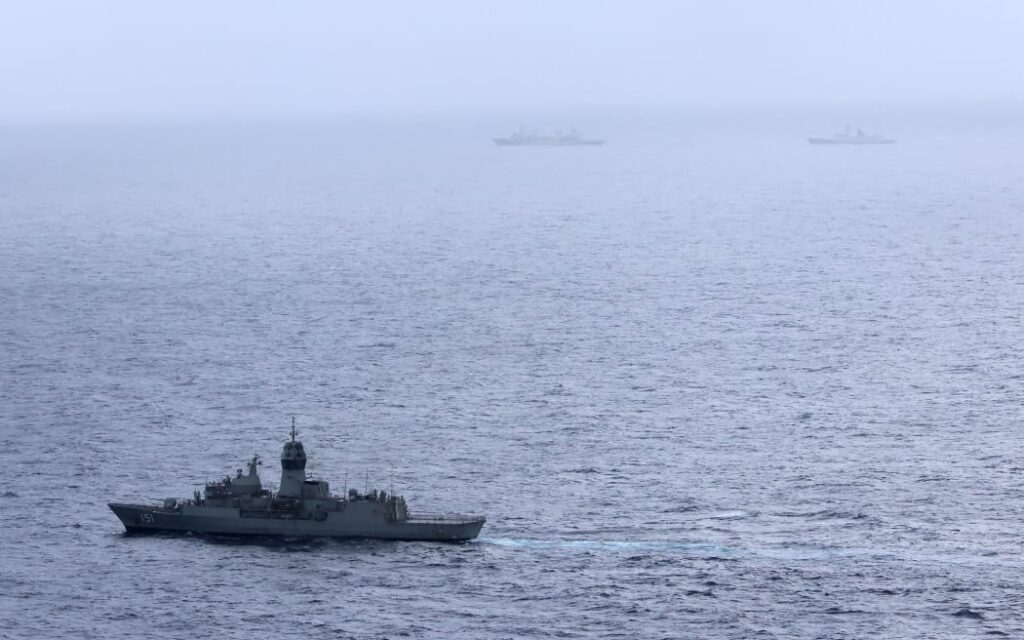
Here are some thoughts about the hysteria surrounding a Chinese Peoples Liberation Army Navy (PLAN) flotilla conducting freedom of navigation exercises in the Tasman Sea, including live fire drills.

1) The flotilla has been tracked for over a week by New Zealand and Australian forces. The tracking began when the flotilla was well NE of the Australian northeastern coast.

HMAS Arunta shadowing PLAN vessels in the Tasman Sea. Source: ADF handout/AFP.

2) The flotilla is operating in accordance with international law and maritime regulations regarding military operations in international waters.

3) The flotilla has no air cover deployed with it and therefore no effective means to defend itself against a coordinated air assault. It is basically a sitting duck for Australian air defences and even NZDF air defences (because the NZDF P8s and Seasprite helicopters carry air to surface munitions as well as torpedos).

4) The flotilla may have a submarine deployed with it.

5) The presence of the PLAN ships in the Tasman is a form of military diplomacy, showing the flag in a distant body of water as a demonstration of blue water power projection capabilities.

6) The PLAN freedom of navigation (FON) exercise in the Tasman Sea may well be a response to a joint Australian-New Zealand FON exercise in the Taiwan Strait in September 2024. Those waters are far more disputed than the Tasman Sea (because the PRC claims them as territorial waters), so the PRC objected to the exercise at the time and declared that it would formulate an appropriate response in due course. This could be it. But the PLAN vessels are far from Australian and NZ territorial waters, so the legality of their presence in open seas is indisputable.

7) The presence of the PLAN flotilla conducting live fire drills (5 conventional surface to surface rounds fired from the Type 055 destroyer Zunyi’s main gun at a floating target, as observed by personnel on the HMNZS Te Kaha) and other exercises is an excellent opportunity for Australian and New Zealand to hone their naval counter-force capabilities, including tactical signals and technical intelligence intercepts and collection from the flotilla. If a submarine is involved then the Antipodean allies can refine their anti-submarine warfare (ASW) capabilities as well, which is exactly what their P8 patrol and ASW aircraft are designed to do. As it stands, Australia and NZ are using air and surface platforms to shadow the PLAN boats.

8) Much has been made about the lack of warning given by the PLAN before the live fire drills. Such warnings are a courtesy, not part of any formal protocol. They are usually issued 12+ hours prior to the drill in order for interested parties such as civilian aviation and maritime operators to plan accordingly and clear away from the target area. The PLAN gave 15 minute warnings, forcing a few planes to adjust course away from the no-fly zone. That was perhaps rude as far as courtesy goes, but nothing more.

9) Most of the hysteria about the flotilla is led by Australian opposition figures in politics and media in an election year. Most of the alarm in New Zealand is led by Sinophobic media commentators or people with little knowledge of military affairs or the nuances of military diplomacy, much less naval operations (especially in NZ). All of them want to tie the exercises to broader Chinese moves in the Southwest Pacific such as the recent bilateral strategic agreement between the PRC and the Cook Islands. For their part, Ministry of Defense officials on both sides have been muted in their response and military officials have been largely silent (presumably because they know what is really happening).

10) It is clear that the PRC is “flexing” its military might in more and more distant places, as any Great Power would do. But not every display of power capability constitutes an imminent threat. Should Australia and NZ pay attention to the exercise? Absolutely, especially because it can be used as a learning tool for their respective naval counter-force platforms. Should they feel threatened by the exercises? Absolutely not. Claims of the exercise posing a threat, being a provocation or an act of intimidation by the PRC betray the biases of those who make such claims. The PRC is just doing what Great Powers do, and if anything it is reminding others of its capabilities while testing them in front of foreign eyes.

Sailors aboard an Australian navy ship look out at Chinese vessels on February 13, picture by the Australian Defence Force

Sailors aboard the HMAS Arunta observe the PLAN flotilla in the Tasman Sea. Source; AFD handout/AFP

11) In the end, if the US, UK, French or other Western navies conducted the exact same exercise in the Tasman Sea, there would be little controversy about it. Because it is the PLAN, however, anti-PRC elements in Australia and New Zealand want to use the occasion to stir up trouble in pursuit of their own agendas. But the truth is that the PRC is not designated as an adversary or hostile state by either Australia or New Zealand, who in fact enjoy largely cordial and beneficial trade relations with the Asian giant. Although there have been moments of friction between Australia and New Zealand, on one hand, and the PRC on the other over a number of political, diplomatic and military strategic issues, and the PRC remains a major concern for the Australian and NZ security communities for a number of reasons, none of this justifies turning what is a relatively small display of power projection into an international incident.

Everyone needs to clam down and relax.

The disinformation grift in NZ.

A while back I was engaged in an unpleasant exchange with a leader of the most well-known NZ anti-vax group and several like-minded trolls. I had responded to a racist meme on social media in which a rightwing podcaster in the US interviewed one of the leaders of the Proud Boys movement (in 2017) in which the Proud Boy made claims that 55 percent of UK Pakistanis were in-bred (“consanguineous” in their pseudo- scientific terminology) and that 50 percent of the births by women in such relationships were still-born. The IV was reposted late last year as a way to link the incidence of inbreeding to the “Pakistani gang rape networks” stories circulating in the UK and picked up by white supremacists the world over. The local anti-vax leader reposted the IV approvingly.

I made a comment on the thread about how if their data was true they should have nothing to worry about since a 50 percent stillborn rate pretty much is a path to extinction, especially when half of the surviving in-bred children would be too mentally incapacitated to do anything dangerous and pose a threat to the UK status quo (which was the implication in the IV). Because the Proud Boy leader showed photos of supposed official medical data charts to back up his views, I questioned if he had data on Mormons or Hasidic Jews in order to make cross-religious/ethnic comparisons. Instead, one of the trolls on the thread posted an official looking chart (but with no title, source or other information) listing a number of Muslim majority nations with their respective “consanguineous” birthrates. When I noted that the data presentation look cherry-picked because it only covered Muslim majority countries, the respondent insisted otherwise. So be it. The best response I got was that Pakistani Muslim in-breeding in the UK was a problem because they would burden the health care system. Fair enough but that was not the thrust of the discussion, which again was focused on social issues related to Muslim immigration in the UK. In any event, after that the argument descended into personal insults, ridiculous claims and, well, racism.

I have chosen not to identify the NZ anti-vax group or the referenced particular leader other than with generic “woke” pronouns because they are not worth the energy. People who follow the NZ anti-vax movement will know who the person is. So why expend oxygen on them and give them more attention, especially since that is what they crave? Also, when I refer to the “disinformation grift” I am not referring to the government-funded anti-extremism and radicalization entities that sprung up after the March 15, 2019 rightwing terrorist attacks in Christchurch, which have been falsely accused by rightwing mouthpieces of being opportunistic troughers pilfering from the public purse. I give no credence to those accusations and instead will focus on those who deliberately spread lies and falsehoods about vaccines, the nature of government health edicts, health indicator demographics and assorted other seditious claims among the tinfoil hat brigade.

The exchange with the anti-vaxxer and racists got me to thinking about how it appears that this NZ anti-vax leader has materially benefitted from arguing against government pandemic mitigation efforts, health authority mandates, “socialist” or “fascist” infringements on individual rights (of movement and assembly), forced introduction of foreign materials and nano-technologies into humans via the “jabs,” and imposition of quarantines and travel bans while vilifying Jacinda Ardern as being a modern day Hitler or Stalin with Ashley Bloomfield (and Dr. Anthony Fauci in the US) being her Dr. Mengele, among assorted other lunacies.

The twist is that I know this person because “they/it” live in my small community and was a teacher’s aide at the local primary school that my son attended. They/it was known in the community for their/it’s anti-vax views (for diseases like measles) well before the pandemic, but back then they/it took a relatively low profile and did not proselytize their/it’s views until Covid struck. This is not to say that these views were unknown, since they/it used personal social media accounts to post about their/it’s beliefs. These include a well-known antipathy towards large people, particularly those of colour, seemingly due to they/it’s healthy diet and “wellness” lifestyle (let’s just say that they/it does not like people who enjoy KFC).

Unfortunately, in the exchange following the racist IV post they/it accused me of stalking and being “weird and creepy” because I could see they/it’s comments even though I had blocked them a long time ago (that is actually part of the blocking policy on the social media platform that we were using). The resort to personal attacks is of course taken off the rightwing playbook where, as Steve Bannon recommended, “you flood the zone with crap” by hurling false accusations and smears at detractors, who you then accuse of censorship, de-platforming and attempting to shut down free speech rights. I told they/it to not flatter themselves thinking that they/it was worth my attention. Ultimately the whole thing turned into a circle-jerking waste of time so I blocked them again and left the discussion.

They/it’s move into rightwing racial politics reminded me of they/it’s past comments and those of other anti-vaxxers on the subject. In fact, if I remember correctly, members of this particular anti-vax group appeared at anti-mandate rallies alongside neo-Nazis like Kyle Chapman. In that light I continued to reflect on how they/it’s material fortunes seem to have improved since they/it founded their group and began soliciting funding for it (some which is allegedly from foreign–mainly US–sources), to the point that they/it now appears to have moved well beyond the knitting circles and reading to kids line of work that they/it had before the pandemic arrived. They/it was, unsurprisingly, part of the 2022 Parliament demonstrations but fled before the rioting began, and continues to agitate for their causes on social media and radio, including doing an interview with Infowars, the US-based conspiracy podcast website run by the attention-seeking cur known as Alex Jones.

They/it’s messages overlap with other “cookers” such as the now separated duo of lunatics at Counterspin Media and the seemingly deranged Liz Gunn, and their/it’s focus has evolved to include anti-Maori, anti-immigrant and the usual Deep State BS that gives rightwing extremists fever dreams. That is interesting because it appears that concerns about vaccines are not the only thing that they/it fears, which might explain their approvingly re-posting about Pakistani in-breeding in the UK and the general reproduction rates of Muslims world-wide. It seems replacement theory is on their radar, which is odd because one way to get ethnically replaced is to stop taking vaccines for previously common diseases while other groups follow the science of vaccinations. That is an irony lost on white reproduction-obsessed cookers.

Anyway, what struck me is that the entire anti-vax movement not only overlaps with other causes based on prejudice and “othering” of targeted scapegoats, but also is a source of grift for those who lead them. Gosh, who would have thought it? As that wretch Jones has proven, there is money to be made in disinformation if you are just dishonest and unethical enough to do so. From what I have discerned and without wanting to waste further time and energy on this sorry subject, here is how I see the disinformation grift progression as a crude flow-chart:

Prior anti-vax beliefs+general discontent with authority–> anti-vax disinformation riding on concerns about Covid mitigation efforts–>Deep State conspiracy theories (Ardern as Hitler/Stalin, bureaucrats trying to control everyone, etc.)–> Big Pharma/globalist machinations (dove-tailing with Jewish) conspiracies–> racism (anti-Muslim, anti-maori, anti-immigrant)–> homo- and transphobia–> climate change denialism–> defence of “free speech”–> pleas for money–> foreign funding–> realisation that fund-raising surpluses can be appropriated as personal rents= the disinformation grift.

The idea is to keep spreading lies and fomenting hate and division, make money off of the effort, put some money back into public information campaigns and pocket the rest. This could well be a lucrative business model for those so inclined. I do not know the tax status of this particular anti-vax group but would not be surprised if it claimed charitable status. As mentioned earlier, its sources of funding may include foreign donors as well as mum-and-pop subscribers/donors. But there does not appear to be any public auditing of the group’s accounts, including the remuneration of its directors and amounts spent on luxury items (as opposed to public information materials regarding the supposed dangerous of vaccinations).

As far as I can tell, no media investigations have been launched into the tax status, revenues and expenditures of this group or similar astroturf (as opposed to genuine grassroots) “interest group” cons like Counterspin, Groundswell or Brian Tamaki’s personal “church.” I shall leave aside for the moment alleged grifting at places like the Waipareira Trust simply because the Trust’s stated objectives are not based on abject lies and disinformation and they do deliver real tangible community services, so whatever grift that may be occurring there–and legitimate questions have been raised to that effect–is not a disinformation grift.

Presumably an OIA request might pry open some information about them from the IRD and other pertinent authorities, but that is beyond my forensic capabilities at the moment. Any investigative reporters willing to give it a go (if there are any left, other than Gordon Campbell, Nicky Hager and Matt Nippert)?

In the end, my suspicion is that even if there was legitimate vaccine skepticism before the pandemic arrived that carried over into some of the opposition to the Covid pandemic mitigation efforts in NZ and elsewhere, it has morphed into a broader-focused globally-networked rightwing money-making scheme based on the propagation of dis- and mis-information about health matters, social issues, culture, demography and identity. To make matters worse, the disinformation being peddled by “cookers” has crossed over into mainstream political discourse thanks to it being parroted and mainstreamed by some corporate media, most rightwing social media and ignorant and/or opportunistic politicians doing so for partisan gain.

None of this is good for democracy (the abuse of rights to free speech is part of the grift) or social cohesion. But that is the state of play as we begin the second quarter of the new century.

PS: Now that the Disinformation Project and the Violent Extremism Research Centre (sic) were defunded by NACT and have ceased to exist, is there any other dedicated research agency looking into the activities of group’s such as those mentioned above? Both of these entities had their flaws but at least kept their eyes on the ball when it came to political extremists in Aotearoa. But what exists now? Just curious.

Security Politics in Peripheral Democracies; Excerpt Four.

Internal versus external security.

Regardless of who rules, large countries can afford to separate external and internal security functions (even if internal control functions predominate under authoritarian regimes). In fact, given the logic of power concentration and institutional centralization of coercive control that defines them, authoritarian regimes do not completely separate internal police and external military roles. Instead they prefer to overlap (if not fuse) the two (especially when confronted by mobilized internal dissent). In some cases the overlap or fusing is accompanied by an expansion of intelligence services with paramilitary capabilities, most of which are directed against domestic dissent. Conversely, small countries often find that the best way to achieve economies of scale in military matters is to combine some internal and security functions, such as through a national gendarmarie that merges police and paramilitary functions (border control, organized crime interdiction, counter-terrorism, etc.). However, a political problem makes the issue a bit more problematic for small democracies. That is because the combination of internal and external security roles may suit the political needs and threat perceptions of small country authoritarian regimes, but is at odds with the liberal democratic tradition with regards to the management of organized violence by the state.To wit: democratic regimes of all sizes prefer to administratively and legally separate internal police from external military security functions as part of the decentralization of economic, political and normative power that defines them as a system of rule. 

This has traditionally extended into the field of intelligence, although some small democracies such as New Zealand have historically centralized their intelligence gathering services as a matter of economy given their abject reliance on foreign patrons for external intelligence provision. More recently, some liberal democracies, led by the United States, have adopted more integrated approaches towards intelligence gathering in the wake of the September 11, 2001 attacks and subsequent acts of rightwing/white extremist terrorism.  For post-authoritarian regimes such as those of Chile and Portugal, the tension between the urge to centralize internal and external military and intelligence functions versus the normative preference for democratic decentralization became one of the major issues of civil-military relations after the restoration of electoral rule.

Regardless of size, the external/internal division of the combat function versus police duties has been the source of debate with regard to its impact on the ability to fight and win external wars. Some analysts believe that the ability to achieve victory in external wars is not a function of regime type, which means that the external versus internal security dichotomy only matters with regard to domestic control issues. What is most important for victory in conventional war is the relative size of the adversaries, specifically large size (see Desch, 1999). For other authors military preoccupation with domestic security, especially those such as the counter-insurgency operations that was the focus of Latin American national security doctrines in the 1960s-1980s, adversely impact of their ability to carry out external military missions. Here the diversion of resources towards internal warfare, especially when carried out by military authoritarian regimes with political agendas that involve the military as an institution remaining in power for extended periods of time, is a certain recipe for external combat weakness. The Greek invasion of Cyprus in 1973 and 1982 Argentine invasion of the Falkland Islands, done for diversionary reasons by military regimes confronting rising socioeconomic unrest after extended periods of internal repression, are considered emblematic in that regard. 

It should be noted that the argument in favor of internal mission orientation being a drain on the external combat function is based upon the modern experience of recent military authoritarian, not democratic regimes. Even then, those who see no significance to the internal/external combat distinction point to other authoritarian regimes—the Soviet Union, China, Cuba, Vietnam, as well as Nazi Germany and Japan prior to 1942—to argue that the issue is problematic only when the military as an institution occupies the highest political decision-making roles in the regime. Military colonization of the state apparatus outside of its areas of professional expertise, coupled with the politicization of the officer corps that inevitably entails, is widely considered to be deleterious to military professionalism, particularly with regard to the external combat function. If for no other reason than this, many authoritarian regimes as well as all democratic regimes hold axiomatic that the armed forces as an institution, regardless of strategic focus, will subordinate to civilian political authority. The Peoples Republic of China, Cuba, Iran and contemporary Russia conform to this norm.

Whatever the truth of the matter with regard to the internal/external combat orientation and conventional warfare fighting ability, separation of external combat and internal security functions under democratic regimes is a normative preference rather than a practical requirement, even when logistical support infrastructures overlap to a significant degree. It is by no means an immutable norm, since the distinction between combat and police functions can be (and has been) blurred by democratic regimes in the event of major internal unrest or conflict.  In fact, concern with internal threats can and are often a focus of major attention by democratic regimes, as evidenced by Portuguese military concern well into the 1980s with so-called “indirect threats” (Marxist third columns) after the abortive Communist government take-over of 1975.  As a result, analysis of threat perception herein will not be confined to externally focused assessments, and will include internal threat assessment as well. But by and large, the combat function of militaries in democracies is an externally focused enterprise. After all, policing is about law enforcement and disciplining those who would violate universal standards of mores, norms and acceptable codes of social conduct; military combat is about killing foreign enemies of the state. Rather than maintaining domestic law and order, it is in carrying out the latter task where small democracies are at a disadvantage.

Because of the benefits conferred by size, the combat role of the armed forces in small democracies (demographically defined as those with populations under 20 million) is generally limited to being the junior partners of multi- or bi-national external military alliances, rather than the ultimate guarantors of national self-defense. Armed forces in small democracies most often serve as territorial and border patrols, be it at sea in the case of maritime nations such as Chile, Portugal and New Zealand, or on land as in the case of Chile and Portugal, or as an internal reserve should civil disorder assume mass proportions unmanageable by the police (as in New Zealand).  For most small democracies, contributions to larger security alliances pay dividends in the form of national defense being guaranteed by collective security reciprocities within those alliances. Some may choose to enhance value per soldier in the form of combat specialization, to include special operations (such as the New Zealand Special Air Services, or SAS, which often are attached to British or Australian SAS units when deployed overseas). Others may prefer to deploy troops for humanitarian and police operations such as nation building and peacekeeping under multinational aegis (where New Zealand has extensive experience with “blue helmet” deployments). In such missions the skills utilized are more akin to civil defense and disaster relief infrastructure. In any event, the nature of these commitments and missions differ, which brings up the question of political justification, mission definition, operational control–and of mission creep.

There is a two-fold external orientation among the militaries of small democratic regimes. The armed forces of small democracies tied to formal military alliance structures like NATO or ASEAN tend to specialize in defined combat roles (such as long range patrol and tracking) as part of joint force integration with their larger partners. In doing so they respond to the political justifications for the use of force offered by their larger allies, and seldom have their specific national interests at stake or used as a primary rationale for the deployment of troops abroad. This is sold to domestic constituencies as the necessity of burden sharing, where the protection afforded by larger allies is the return on the investment of troops in the larger conflicts those allies may be involved in.

On the other hand, the armed forces of small democracies with independence of mind and a non-aligned posture often seek refuge under the multilateral umbrella of United Nations mandates. Participation in “blue helmet” exercises such as peacekeeping and nation-building gives reason for keeping troops on the payroll, thereby offering a bureaucratic rationale of self-preservation for the military as an institution. Here the political justification for the external deployment of troops responds to the broader concerns of the international community as expressed through the United Nations or regional security agencies. It has a basis in self-interest because it reaffirms notions of mutual self-defense that smaller states embrace as a deterrent against the unilateral depredations of larger states. It also reaffirms the role of the armed forces in providing for the well being of others as well as being the last line of national defense. It is seen to encourage military professionalism via collaborative exposure to and interaction with other military forces. 

The international role of the armed forces in such cases is mostly directed towards engineering, medical and police support, often in concert with civilian non-governmental or multinational organizations. These not only can be deployed internally in the case of an emergency, but also serve as human resource training for skilled labor inputs to the domestic market (the two sides of its internal support role). The combat function, although trained for, is clearly subordinate to the humanitarian and other non-lethal functions of the military apparatus.

Next: The Military Politics “Partial Regime.”

Media Link: Discussing the NZSIS Security Threat Report.

I was interviewed by Mike Hosking at NewstalkZB and a few other media outlets about the NZSIS Security Threat Report released recently. I have long advocated for more transparency, accountability and oversight of the NZ Intelligence Community, and although the latter remains only as a hope the Report is a decent step towards making the NZSIS more open about how it sees the NZ threat environment. The Report is straight-forward and easy to read, and even if it does not identify sources and methods (as it should not), it gives the public a good idea (sometimes in refreshingly blunt terms) of how it prioritises the threat landscape and the means and criteria by which threats are identified as matters of national security concern.

The interview is here.

The Report is here.

Security Politics in Peripheral Democracies: Excerpt Three.

The notion of geopolitical  periphery.”

The concept of periphery used here refers strictly to what can be called the geopolitical periphery. Being on the geopolitical periphery is an analytic virtue because it makes for more visible policy reform in response to changing external conditions. It is defined as a situation where a nation is engaged in, but not central to the pressing military-security issues of the moment, be it through direct engagement in conflict or involvement in larger alliance decision-making. It does not refer to the core-periphery distinction commonly used by worlds-systems theory and its successors, and as the case sample shows, it is not a product of the global North versus South divide. It does not refer to economically peripheral countries in a context of regionalization and globalization of production, trade and exchange, although it acknowledges the overlap that may occur between economic and military integration processes. As used here “periphery” is not synonymous with “marginality.” The differentiation is based on the fact that these countries are involved, even if not by choice, in the overarching military-security engagements of recent times. They are not excluded from them. Moreover, when it comes to regimes, “marginal” implies instability or inconsequentiality of the regime. Yet the first criterion for selection used here is not the relative stability or consequence of the regimes in question (although democratic regime stability is a factor in the analysis of the case studies), but their relative distance from international military-security decision-making during fluid times. 

It is this commonality that binds the case studies together as a sample: their relative distance from the decision-making that governs the major conflicts of the last two decades. After all, none of these countries has a vital national interest at stake in these conflicts other than a commitment to international norms and principles and support for larger allies. This does not mean that they are inconsequential in the scheme of things, or as analytic subjects. To the contrary, as actors that must respond to changing external conditions without having decisive influence in the decision-making that created them, small peripheral democracies are excellent subjects for the study of policy reform in fluid times, be it in the field of military politics or others. This is due to what might be called the “ripple effect” of world politics: ideological and policy change in the center has a stronger impact the further from the center of decision-making, but still connected to it, that a country gets. As a result small peripheral democracies are, in a phrase, microanalytic barometers of larger international trends (see Buchanan and Nicholls, 2003).

What these countries all share is physical distance from the major political and military power centers around which issues of global security revolve, and physical distance from the military conflicts in which their armed forces are involved. Physical distance in large measure determined their traditional status on the geopolitical periphery. Portugal is located on the southwestern corner of Europe, Chile on the southwestern edge of the Western Hemisphere, New Zealand in the southwestern corner of the Pacific Rim. This has historically given them a measure of insulation from direct threats by larger adversaries (Portuguese concerns about Spain and Chilean concerns about Argentina, Bolivia and Peru notwithstanding), as well as physical distance from the major conflicts of the twentieth and early twenty first centuries. Even so, given the global reach of military power mentioned earlier, their relation to global conflicts has been more political than physical, in the form of neutrality or alliance with larger powers. 

That has been reflected in their approaches towards World War Two, the Korean War and Vietnam conflict. Remaining neutral in World War Two, Portugal spent decades on the outskirts of NATO decision-making in spite of its being a founding member of the alliance. Chile, another neutral in World War Two (although, like Portugal, its Axis sympathies were undisguised), was by 1970 no more than, in the words of Henry Kissinger, “a dagger pointed at the heart of Antarctica.” Militarily, New Zealand offered its subjects to a variety of UK and US-led wars during the twentieth century and well into the next. These make for different legacies when confronting the current context in which security politics are constructed. The bottom line is that it is, first and foremost, spatial location that makes these countries members of the geopolitical periphery, a situation that continues to do this day. From that point the political aspects of the military-security equation can be factored in.

The consequences of these legacies are discussed ahead. For the purposes of the argument, the focus here is exclusively on geopolitically peripheral democracies, nations that reside on the geographic fringe of the major military alliances and coalitions that have dominated the world scene in the last 25 years, although continuing to have ongoing involvement or engagement with them. As it turns out, the reasons for geopolitically peripheral status differ among the cases, something that in turn has an impact on the way in which each country has approached the changing international security environment of the last two decades.

Next: Internal versus External Security.

Excerpting “Security Politics in Peripheral Democracies.”

In the late 2000s-early 2010s I was researching and writing a book titled “Security Politics in Peripheral Democracies: Chile, New Zealand and Portugal.” The book was a cross-regional Small-N qualitative comparison of the security strategies and postures of three small democracies on the global geopolitical periphery, both physically and in terms of their involvement in the major strategic decisions of modern times. I set the time frame for the study as the period 1990-2020 because it covered the end of the Cold War as a starting point and included 9/11, the so-called War on Terror and the transition from bipolarity to unipolarity to multipolarity in the International system (the latter which remains ongoing). Its original endpoint will require some extension to account for developments since 2020, but the conceptual apparatus and analytic framework underpinning the study remains valid as a methodological approach (more on this later).

As some readers may know, I departed NZ academia in 2007 and after spending three years at the National University of Singapore I returned to NZ to follow my wife (who took an academic job in her homeland) and to help raise a family. I resurrected and rebranded a consultancy that I had started in the US prior to my arrival in NZ and left academia for good. That was a bittersweet decision to make, since I enjoyed teaching and research, but I am told and have seen that the academic Taylorism and market-driven managerialism that I butted heads with in the 2000s has gotten much worse since my departure from the academe.

Unfortunately, without the institutional support of a university and needing to monetarize my knowledge and experience via the consultancy in order to help pay the bills, I had to abandon the book project. I already had 13,000 words written by way of an introduction outlining the rationale behind and methodological approach to the project, but needed follow up research funds to undertake field research in the countries being studied. That was impossible given my new “business” orientation, plus I had already been turned down for a Marsden Research Grant while still at the NZ university where I used to work (it turns out the Marsden Fund award committee at that time was uninterested in security topics, much less a cross-national comparative study in which NZ was just one case study rather than the focus of attention). In fact, even such basic things as not being able to access a university library greatly impended my ability to do the secondary research required for the book to be comprehensive and thorough in its analysis. If one thinks of the cost of buying specialised books and subscriptions to professional journals and other pertinent material (for example, a single individual subscription to one political science journal can cost US$400/year), then it should be clear that writing academic books involving in-depth research in a social science discipline requires institutional support that I no longer had. Confronted by that reality, I shelved the project even as I thought of resurrecting it later or at least eventually writing an academic article that summarised my findings.

Ten years or so later, I have started to look at what I wrote and decided that I am going to except the introduction here at KP in order to share the conceptual premises and analytic framework used in it. I am hoping that some readers will find the argument of interest and if so inclined, offer critiques, comments and suggestions. I am not sure that the book will ever come to fruition but perhaps I can get that academic article out or simply publish it on the consultancy website even if it is more of a think piece than a targeted assessment of a matter relevant to paying client interests. Most importantly, it gives me a reason to re-visit the original argument and make updates as part of the review and revision process.

The excerpts will begin to appear in the next post. I shall try to keep them relatively short but true to the original book narrative.

Media Link: “A View from Afar” on deterrence versus de-escalation.

In this week’s “A View from Afar” podcast Selwyn Manning and I return to the airwaves to discuss whether deterrence is still a useful concept in international relations and, if so, whether it applies equally to all states. We also consider whether deterrence contributes to international security dilemmas and whether it is antithetical to de-escalation. You can find the show here.