Cowardice disguised as prudence.

Here is a short re-post from my other social media. It is a question about foreign policy incompetence, cowardice and coalition politics.

After much public hinting, 5 Eyes partners Australia, Canada and the UK delayed announcing recognition of the Palestinian right to Statehood in order for NZ join them against an intransigent US stance. NZ has not, so they have now gone ahead with the announcement before the UN General Assembly this week. That begs the question: What favour does NZ expect to curry from its supine obsequiousness to the US and Israel and from who, exactly? Or are internal NACTFIRST politics and/or interest group lobbying steering its approach (against the advice of the diplomatic corps)? Either way, the position is untenable as well as indefensible.

There is a tail-wags-the-dog aspect to this, with David Seymour being the tail. The NACTCFIRST leaders may have been waiting to see how the non-US 5 Eyes partners formally announced their stance (moral cowardice masquerading as pragmatism) , but Seymour’s loose talk about non-recognition (conflating Hamas with Palestine while doing so) undermined that. Now NZ looks gutless on the world stage even if Winston voices the eunuch’s lament about his DPM usurper. Real pragmatic logic would have been to read the global room (not hard), see the 5 Eyes non-US partner hints and UN condemnations of Israeli genocide as directional cues and go with the flow, ride the coattails, recognise the obvious and be on the right side of history.

But NACTFIRST did not. They are an omnishambles on their way to becoming a clown car dumpster fire that is now not only negatively impacting the material and spiritual lives of voters and residents on the domestic front, but, pragmatically, on NZ’s image abroad.

NZ has gone from being clean and green to ethically lean and mean.

Some comments on NZ politics.

I had some time on my hands the past few days so spent more attention than usual consuming news about NZ domestic politics. My interests tend to lie further afield, but recent government assaults on Maori rights, women’s pay equity, constitutional neutrality, environmental, health and safety regulations, equitable taxation policy, state sector employment, Labour’s pandemic response and assorted other lesser insults have drawn me, perhaps like a moth to flame, to seek some illumination on the local political scene. These are a few tidbits that I took away this week., translated into social media posts.

  1. Chloe Swarbrick’s remarks about the government’s cowardice on the issue of Palestinian statehood in the wake of Israeli actions in Gaza.:

First all, Swarbrick is correct. If only six coalition MPs had some moral-ethical courage, then NZ could join the majority of the international community, including three of the 5 Eyes partners, in condemning Israel’s collective punishment of all Palestinians for the sins of Hamas on October 7, 2023, including the IDF’s use of ethnic cleansing and mass starvation as a means to that end. For that she was told to apologise by the Speaker (and National MP) for using the phrase “if six…members had a spine” and when she did not, ordered to leave the debating chamber. and later “named.” This is my comment on social media: “Peters, Jones and Seymour voice ugly boorish insults against their opponents (including racist taunts) and are allowed to remain in the House. Swarbrick correctly points out the spineless behaviour of government MPs regarding Gaza and gets thrown out. So much for Speaker impartiality” (referencing routine remarks made by the NZ First and Act leaders).

Also, as an aside to the particulars of this case, I should note that in light of prior history by Brownlee and other conservative MPs when it comes to progressive female members, there is a whiff of misogyny in the ruling. As a relative said to me (paraphrased here), male MPs can be loud, rude, condescending and bombastic when speaking to the House, but women cannot get angry or raise their voices even in defense of universal values. Now, I realise that Brownlee fashions himself as “old school” when it comes to parliamentary ethics and protocols, but if these boy’s club unwritten rules are part of the “old school” way of doing parliamentary politics, I say that he and others of his ilk need to be woken from their Rip Van Winkle stupor and shown the door.

By way of a broader backdrop, we should be clear that for all of its talk about foreign policy independence and having stood up to the US and its Anglophone allies with the 1985 non-nuclear declaration, NZ is a diplomatic follower, not a leader. It waits until other States make a move or show initiative on sticky international issues or events, then coattails on whatever seems most beneficial over the short-term. It pays lip service to international rules and norms but sniffs the wind when foreign policy smoke is in the air.

This syndrome has been accentuated in recent decades, particularly by National-led governments, and is now at rock bottom when it comes to NZ supination to other’s interests. The governing coalition’s current lack of resolve when it comes to denouncing the Palestinian catastrophe and upholding the right to Palestinian self-determination can be attributed to slavish obsequiousness to the US (Trump) position on the matter, perhaps abetted by the influence of the NZ Israeli lobby. Whatever ulterior ends the coalition of chaos may think that this approach may serve vis a vis the bilateral relationship with the US, they are sorely mistaken. NZ is just another squirrel looking for that elusive US nut.

2) On the decision to remove Maori words from schoolbooks :

I wrote “a main tool of cultural erasure is to remove all public references in a language other than that of the dominant social group. The CCP does it to the Uyghurs in the PRC. The excuse for doing so is usually to promote assimilation and social cohesion. The real motive is darker.”

I could go on about the attempts to erase indigenous languages and dialects in the public sphere is a host of places, particularly in Latin America, the region I am most familiar with, but also in Canada, the US, Africa and parts of the Pacific. The practice was so common in the colonial past that some linguists have written about the cultural genocide that follows erasing of a native language. When ti comes to identity and cultural preservation, language (and words) matter.

What is also remarkable is that it is well accepted that, rather than “confusing” in the Education Minister’s words, learning other languages at an early age promotes brain development and complex thought. Defending the removal of Maori words from children’s books is therefore doubly retrograde: it is the first step of an attempt at cultural erasure (at least in the public space), bookending similar attempts to remove te reo from public buildings and signage; and it is counter-productive (and counter-factual) as a pedagogical approach. Shame on Erica Stanford and her acolytes! And if a few Maori words are confusing, why not remove all non-English words from school books? Sacre bleu!

3) On the refusal of former Labour Ministers to front up to a public hearing of the Royal Common of Inquiry into the Pandemic Response:

“Why front up to a kangaroo court when the kangaroo judges are the political opposition? Especially after providing written answers to documented questions supplied by the kangaroos about events long in the public domain? Smacks of an ex-post political beat-up best avoided.” The fact that the Inquiry was instigated by ACT and NZ First as a partisan bludgeon after listening to conspiracy theorists and anti-vaxxers appears lost on the corporate media (partisan media like Plunket, Bridges and Hoskings just megaphone the anti-Labour lines). In fact, Labour should be pushing back harder at the political instigators, for example by questioning how they came to get involved in the witch hunt after actively supporting Labour’s pandemic response at the time, and who feeds them their talking points.

4) On a serving NZDF member is standing trial for espionage.

“The espionage charge against a serving NZ soldier is remarkable. The defendant is accused of working for, at the behest, or on behalf of a foreign State. Many questions arise from soldier’s court martial/trial. 1st: Which State? 2nd: what motive(s)? 3rd: what was compromised?”

Charging an active duty NZDF member with spying is remarkable because that charge–espionage– is only brought if the accused is suspected of working as a covert foreign agent. It does not refer to any domestic interlocutor., patron or client. I seem to recall at the time of the arrest that the soldier was detained for having objectionable material, presumably extremist literature (the military does not court martial people for having porn unless it is of the illegal variety). The soldier was also said to have links to right wing white supremacist groups. So it would be premature and very possibly wrong to finger the PRC as the puppet master (as the usual suspect). Given its other dark activities in NZ, Russia is a possibility. Or some other State. What should be clear is that it would not be an ally of the NZDF like the US, UK, Australia, Canada, France or other countries that routinely share higher-level intelligence with the NZDF (say, on operations, deployments, capabilities and tactics) that the soldier could not easily access unless s/he was in a military intelligence billet.

There could be a mix of motives involved, including money, sex and ideology. The counter-intelligence aspects of uncovering the suspected spy are also worth considering. In that light the trial should be interesting and revelatory, assuming that coverage is not effectively shut down for reasons of national security (yeah, right).

Should it be your inclination, feel free to weigh in within the KP rules of discourse.


Kash Patel comes to town.

This week FBI Director Kash Patel arrived in Wellington to open a full time Legal Attache office (previously Legal Attaches rotated from offices at the US embassy in Canberra depending on need). Like excited children government ministers lined up for photo ops and the corporate media breathlessly reported on what Patel had to say. What he had to say, and how it was reported, was a mixture of circus side-show and fawning toadying, all uncritically covered by click-bait obsessed media scribes.

In view of that, please allow me to correct the record.

To begin with, the FBI is a law enforcement agency with powers of arrest, not an intelligence agency that does not have arrest powers. It is not a secret spy agency. Its NZ partner agency is the NZ Police, not the SIS or GCSB. In that role the FBI is a consumer of intelligence streams coming from 5 Eyes agencies (in NZ, the GCSB) as well as the NZ Police and SIS, but is not part of the 5 Eyes network. 5 Eyes is a signals and technical intelligence gathering and sharing network to which the FBI does not belong. INTERPOL is an international law enforcement partnership that the FBI is a member of. Although INTERPOL may share intelligence that originates in 5 Eyes, it has a distinct organisation, function and role. As 5 Eyes partners, the GCSB counterpart in the US is the NSA, and the US partner of the SIS ( a human intelligence agency) is the CIA.

In short, the FBI is an altogether different type of security agency and should not be confused with intelligence agencies properly defined.

Patel’s talk of direct FBI/5 Eyes links is therefore PR spin pushed by the US and Trump’s entourage that has no actual basis in fact. Using the LEGAT office ribbon-cutting ceremony in Wellington as an excuse, Patel’s visit was an overdue “show the flag” exercise by a US senior official more than 6 months after Trump entered office, and rather than Secretary of State Marco Rubio the US sent a conspiracy theorist-turned-second tier executive branch official instead, who then ran the anti-PRC/5 Eyes line even if Legal Attaches (FBI agents) deal with transnational crime, not strategic balancing or geopolitical competition and do not participate directly in 5 Eyes activities. (Note to readers: the FBI director is not a US cabinet position and is subordinate to the Attorney General in the US Department of Justice, so trotting out NZ cabinet ministers for a meet-and-greet, including those involved in intelligence matters, was obsequious in the extreme).

Be that as it may, Patel engaged in a bit of diplomatic performance art using the NZ government and media as props with which to push Trump’s anti-PRC agenda rather than focus on the relatively mundane business of opening a stand-alone LEGAT office, which are common in most US embassies and which, again, other than intelligence sharing on transnational crime via INTERPOL and partner agencies in foreign countries like the NZ Police,, do not directly engage in espionage or other forms of intelligence gathering (the fact that the office is outside the main US embassy complex and has undergone a slight name change does not mean anything particularly significant other than the need for more dedicated space and Trump’s obsession with putting his branding on everything. But a “law enforcement attache” is just a LEGAT by another name, and having separate office space may simply be a matter of re-allocating physical resources).

Patel’s remarks about the LEGAT office opening being a counter to the PRC that bolstered the 5 Eyes was a purposeful distraction from what should have been a low-key affair and should have been treated as such because for NZ bringing in an adversarial take on the PRC in an otherwise unremarkable and unrelated matter makes for disproportionate diplomatic discomfort. Neither the US embassy or MFAT press releases mentioned the PRC or 5 Eyes., so the cringe factor must have been high amongst the diplomatic corps. Then again, Patel likely knew that, but since hype and showmanship is what Trump is all about and Patel’s main audience was the one in the Oval Office, the NZ government and corporate media dutifully obliged by indulging the dog-and-pony show about the PRC and 5 Eyes. It was a pitiful display of diplomatic supination that may well have adverse consequences down the road.

To be clear. The significance of Patel’s visit to open a dedicated full time LEGAT office in NZ lies in the fact that it is official recognition that transnational crime is now a major problem in the Southwest Pacific and hence a priority for the US and other Western security agencies. In the measure that the PRC is involved in things like drug smuggling and cyber crimes in the region, it will be on the radar of these agencies, but in that regard it is just one of many state and non-State actors operating in what are known as “grey area” zones where criminal organisations and some State actors cooperate out of mutual interest. North Korean and Russian use of South-Pacific flagged ships to circumvent sanctions and smuggle oil is one example of this, as is the cyber-hacking activities of criminal entities tied to the Kremlin, Iran and PRC (among others). Likewise, transnational crime networks presence in island States like the methamphetamine trade in the Samoas (where drugs sourced in the US and Mexico are smuggled from American Samoa to Samoa across their common land border) require better resourced and coordinated regional law enforcement responses. The new US LEGAT office in Wellington is part of that effort.

As for terrorism and people smuggling (other designated priority areas announced by the US embassy during Patel’s visit), the role of the PRC is marginal at the very worst. And yet Patel placed it front and centre in his remarks at the opening ceremony

Regardless of the US spin so slavishly reported in NZ, opening a dedicated LEGAT office in Wellington is not about countering the PRC or bolstering 5 Eyes. It is about strengthening bilateral crime-fighting capabilities between the US and NZ in the Southwest Pacific. And if there is anyone other than criminals tracked and caught by the enhanced inter-agency law enforcement cooperation and regional presence of the FBI in the SW Pacific who have most to fear by the upgrade, it is those who may have extradition warrants issued by the US for their arrest. That is because Legal Attaches are the main vehicle for executing US warrants in any given country.

Kim Dotcom, are you paying attention?

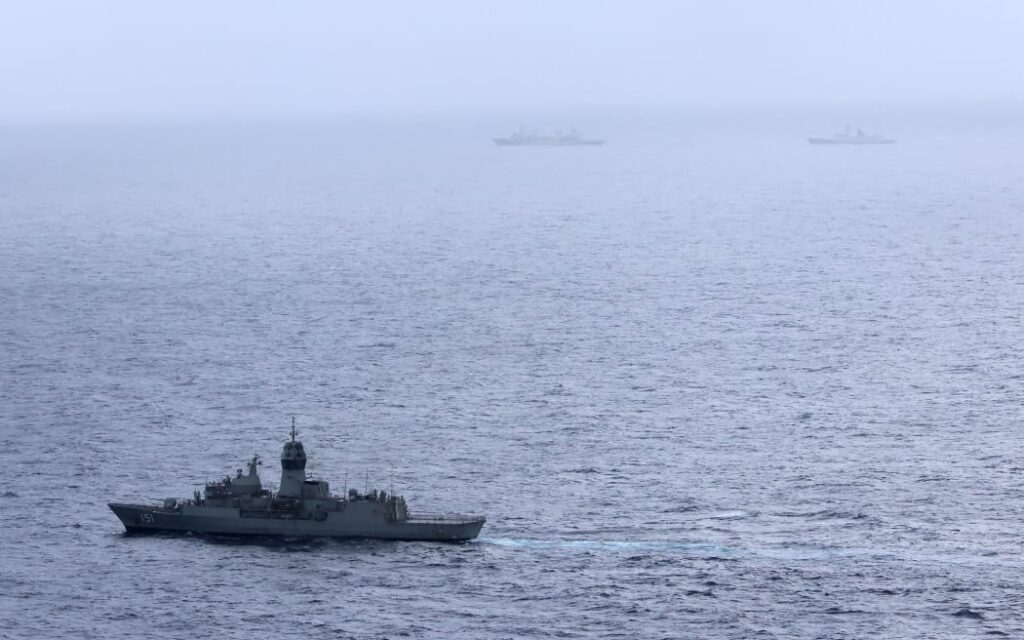
About that PLAN flotilla in the Tasman Sea.

Here are some thoughts about the hysteria surrounding a Chinese Peoples Liberation Army Navy (PLAN) flotilla conducting freedom of navigation exercises in the Tasman Sea, including live fire drills.

1) The flotilla has been tracked for over a week by New Zealand and Australian forces. The tracking began when the flotilla was well NE of the Australian northeastern coast.

HMAS Arunta shadowing PLAN vessels in the Tasman Sea. Source: ADF handout/AFP.

2) The flotilla is operating in accordance with international law and maritime regulations regarding military operations in international waters.

3) The flotilla has no air cover deployed with it and therefore no effective means to defend itself against a coordinated air assault. It is basically a sitting duck for Australian air defences and even NZDF air defences (because the NZDF P8s and Seasprite helicopters carry air to surface munitions as well as torpedos).

4) The flotilla may have a submarine deployed with it.

5) The presence of the PLAN ships in the Tasman is a form of military diplomacy, showing the flag in a distant body of water as a demonstration of blue water power projection capabilities.

6) The PLAN freedom of navigation (FON) exercise in the Tasman Sea may well be a response to a joint Australian-New Zealand FON exercise in the Taiwan Strait in September 2024. Those waters are far more disputed than the Tasman Sea (because the PRC claims them as territorial waters), so the PRC objected to the exercise at the time and declared that it would formulate an appropriate response in due course. This could be it. But the PLAN vessels are far from Australian and NZ territorial waters, so the legality of their presence in open seas is indisputable.

7) The presence of the PLAN flotilla conducting live fire drills (5 conventional surface to surface rounds fired from the Type 055 destroyer Zunyi’s main gun at a floating target, as observed by personnel on the HMNZS Te Kaha) and other exercises is an excellent opportunity for Australian and New Zealand to hone their naval counter-force capabilities, including tactical signals and technical intelligence intercepts and collection from the flotilla. If a submarine is involved then the Antipodean allies can refine their anti-submarine warfare (ASW) capabilities as well, which is exactly what their P8 patrol and ASW aircraft are designed to do. As it stands, Australia and NZ are using air and surface platforms to shadow the PLAN boats.

8) Much has been made about the lack of warning given by the PLAN before the live fire drills. Such warnings are a courtesy, not part of any formal protocol. They are usually issued 12+ hours prior to the drill in order for interested parties such as civilian aviation and maritime operators to plan accordingly and clear away from the target area. The PLAN gave 15 minute warnings, forcing a few planes to adjust course away from the no-fly zone. That was perhaps rude as far as courtesy goes, but nothing more.

9) Most of the hysteria about the flotilla is led by Australian opposition figures in politics and media in an election year. Most of the alarm in New Zealand is led by Sinophobic media commentators or people with little knowledge of military affairs or the nuances of military diplomacy, much less naval operations (especially in NZ). All of them want to tie the exercises to broader Chinese moves in the Southwest Pacific such as the recent bilateral strategic agreement between the PRC and the Cook Islands. For their part, Ministry of Defense officials on both sides have been muted in their response and military officials have been largely silent (presumably because they know what is really happening).

10) It is clear that the PRC is “flexing” its military might in more and more distant places, as any Great Power would do. But not every display of power capability constitutes an imminent threat. Should Australia and NZ pay attention to the exercise? Absolutely, especially because it can be used as a learning tool for their respective naval counter-force platforms. Should they feel threatened by the exercises? Absolutely not. Claims of the exercise posing a threat, being a provocation or an act of intimidation by the PRC betray the biases of those who make such claims. The PRC is just doing what Great Powers do, and if anything it is reminding others of its capabilities while testing them in front of foreign eyes.

Sailors aboard an Australian navy ship look out at Chinese vessels on February 13, picture by the Australian Defence Force

Sailors aboard the HMAS Arunta observe the PLAN flotilla in the Tasman Sea. Source; AFD handout/AFP

11) In the end, if the US, UK, French or other Western navies conducted the exact same exercise in the Tasman Sea, there would be little controversy about it. Because it is the PLAN, however, anti-PRC elements in Australia and New Zealand want to use the occasion to stir up trouble in pursuit of their own agendas. But the truth is that the PRC is not designated as an adversary or hostile state by either Australia or New Zealand, who in fact enjoy largely cordial and beneficial trade relations with the Asian giant. Although there have been moments of friction between Australia and New Zealand, on one hand, and the PRC on the other over a number of political, diplomatic and military strategic issues, and the PRC remains a major concern for the Australian and NZ security communities for a number of reasons, none of this justifies turning what is a relatively small display of power projection into an international incident.

Everyone needs to clam down and relax.

A reminder about soft power.

Waste and fraud certainly exist in foreign aid programs, but rightwing celebration of USAID’s dismantling shows profound ignorance of the value of soft power (as opposed to hard power) in projecting US influence and interests abroad by non-military/coercive means (think of “hearts and minds,” “hugs, not bullets,” “honey versus vinegar,” etc.). Soft power is also a component of “smart power” and “sharp power” strategies in which a combination of foreign policy instruments are used in concert in pursuit of a variety of non-kinetic ends (i.e. objectives short of war).

This razor-gang approach is short-sighted at best and stupid at worst given that the humanitarian/developmental aid vacuum left by US withdrawal from such efforts opens up the field to potential inroads by US rivals. Add to that the fact that USAID pays US farmers around $2 Billion for surplus rice, soy, corn and other agricultural commodities that otherwise would not be grown or go to waste, and the MAGA/DOGE move against USAID is a double-sided own-goal.

The NZ government, which currently is under the sway of MAGA/DOGE-style public policy ideologies, might do good to remember this when it deals with soft power competition in the South Pacific. Waving a (thornless) stick (say, in the form of withdrawal of foreign aid) at Pacific Island Forum countries when they negotiate bilateral economic, diplomatic and developmental aid agreements with non-“traditional” (non-Western/colonial) partners is likely to elicit some blowback of its own.

After all, regardless of the specific compacts agreed to in the past, sovereign States, whatever powers and protections they may have ceded to “traditional” partners, ultimately are autonomous agents of their own destinies. Foreign aid is a good way to remind them that that may be true but destinies can often be intertwined for mutual benefit even if other parties come late to the table.

Media Link: AVFA on Israel going rogue.

In this episode of the “A view from Afar” podcast Selwyn Manning and I discuss Israel’s expansion of its war in Lebanon as part of a “six front” strategy that it thinks it can win, focusing on the decision-making process and strategic logic at play that led to the most recent turn of events. Plus some game theory references just to place things in proper context.

Media Link: ” A View from Afar” on multidimensional hybrid warfare and the ineffectiveness of multilateral institutions.

This week’s “A View from Afar” podcast addresses the issue of multidimensional hybrid warfare using the Israeli pager attacks in Lebanon as a starting point before moving on to discuss the failures of multilateral institutions, the UN in particular, when it comes to handling war crimes and crimes against humanity. It is a sad state of affairs.

The Murky World of Israel’s Booby-Trapped Pagers and Walkie-Talkies

Excerpting “Security Politics in Peripheral Democracies.”

In the late 2000s-early 2010s I was researching and writing a book titled “Security Politics in Peripheral Democracies: Chile, New Zealand and Portugal.” The book was a cross-regional Small-N qualitative comparison of the security strategies and postures of three small democracies on the global geopolitical periphery, both physically and in terms of their involvement in the major strategic decisions of modern times. I set the time frame for the study as the period 1990-2020 because it covered the end of the Cold War as a starting point and included 9/11, the so-called War on Terror and the transition from bipolarity to unipolarity to multipolarity in the International system (the latter which remains ongoing). Its original endpoint will require some extension to account for developments since 2020, but the conceptual apparatus and analytic framework underpinning the study remains valid as a methodological approach (more on this later).

As some readers may know, I departed NZ academia in 2007 and after spending three years at the National University of Singapore I returned to NZ to follow my wife (who took an academic job in her homeland) and to help raise a family. I resurrected and rebranded a consultancy that I had started in the US prior to my arrival in NZ and left academia for good. That was a bittersweet decision to make, since I enjoyed teaching and research, but I am told and have seen that the academic Taylorism and market-driven managerialism that I butted heads with in the 2000s has gotten much worse since my departure from the academe.

Unfortunately, without the institutional support of a university and needing to monetarize my knowledge and experience via the consultancy in order to help pay the bills, I had to abandon the book project. I already had 13,000 words written by way of an introduction outlining the rationale behind and methodological approach to the project, but needed follow up research funds to undertake field research in the countries being studied. That was impossible given my new “business” orientation, plus I had already been turned down for a Marsden Research Grant while still at the NZ university where I used to work (it turns out the Marsden Fund award committee at that time was uninterested in security topics, much less a cross-national comparative study in which NZ was just one case study rather than the focus of attention). In fact, even such basic things as not being able to access a university library greatly impended my ability to do the secondary research required for the book to be comprehensive and thorough in its analysis. If one thinks of the cost of buying specialised books and subscriptions to professional journals and other pertinent material (for example, a single individual subscription to one political science journal can cost US$400/year), then it should be clear that writing academic books involving in-depth research in a social science discipline requires institutional support that I no longer had. Confronted by that reality, I shelved the project even as I thought of resurrecting it later or at least eventually writing an academic article that summarised my findings.

Ten years or so later, I have started to look at what I wrote and decided that I am going to except the introduction here at KP in order to share the conceptual premises and analytic framework used in it. I am hoping that some readers will find the argument of interest and if so inclined, offer critiques, comments and suggestions. I am not sure that the book will ever come to fruition but perhaps I can get that academic article out or simply publish it on the consultancy website even if it is more of a think piece than a targeted assessment of a matter relevant to paying client interests. Most importantly, it gives me a reason to re-visit the original argument and make updates as part of the review and revision process.

The excerpts will begin to appear in the next post. I shall try to keep them relatively short but true to the original book narrative.

Still the 5 Eyes Achilles Heel?

The National Cyber Security Centre (NZSC), a unit in the Government Communications Security Bureau (GCSB) dedicated to cyber-security, has released a Review of its response to the 2021 email hacking of NZ members of the Inter-Parliamentary Alliance on China (IPAC, a global organization of parliamentarians) and Professor Anne-Marie Brady, the well known China expert and critic. A number of problems were identified, both operational and (yet again) with regard to accountability and transparency, so I thought I would briefly summarise them.

The Review states that too much focus was placed by the NCSC on “technical” solutions to the email phishing probes instead of considering the “wider” context in which the hacking occurred. In layman’s terms that is akin to saying that the NCSC got busy plugging holes in the parliamentary server firewalls after breaches were detected without considering who was being targeted and what purpose the hacking may have served. This is remarkable because the hacking came from ATP-31, a unit linked to PRC military intelligence well known for having engaged in that sort of activity previously, in NZ and elsewhere. Moreover, the NCSC had to be alerted by a foreign partner that the email phishing efforts were part of a progressive hacking strategy whereby the ultimate target was not the emails of MPs but of the IP addresses that were being used by those MPs. In fact, the NCSC currently does not have procedures for how to respond to reports that foreign, including state-sponsored, actors are targeting New Zealanders. The NCSC found out about the parliamentary email servers hacking from Parliamentary Services in the first instance, and then from foreign partner intelligence that was passed on to it by the NZSIS.

This is of concern for several reasons, not the least of which is that it took a foreign 5 Eyes partner to alert the NCSC to something that it should have been well aware of itself (progressive hacking), and because the NCSC initially assumed, for whatever reason, that the phishing was done by ordinary criminals rather than foreign intelligence units. It also assumed that MPs were already engaged in providing their own security, even after Parliamentary Services flagged potential breaches of its email servers to the NCSC. In fact MPs were apparently told more by Parliamentary Services than the NCSC about their being targeted (albeit after the fact), and the University of Canterbury, Professor Brady’s employer, apparently was never contacted about potential security breaches of their servers.

Since MPs may have sent and received emails from multiple IP addresses attached to their official and personal devices, the security breach implications of the email hacks could be considerable given the potential cross-over between personal and official MP communications. Put bluntly, it is incredible that a dedicated cyber-security unit that is an integral part of the GCSB and through it the Anglophone 5 Eyes signals/technical intelligence network did not consider the membership of the targeted MPs in IPAC and that the phishing occurred at the same time that Professor Brady’s emails were targeted (Brady is known to have close contacts with IPAC). This is basic 1+1 contextual stuff when it comes to operational security in cyberspace, so one gets the sense that the NCSC is made up of computer nerds who have little training in geopolitics, foreign policy, international relations or how the world works outside of WAN and LAN (hint: these are basic computer terms). They simply approached the hacking attacks as if they were plugging a leaking dike rather than consider what may be prompting the leaks and red-flagging them accordingly.

The advice given by the Review was for the NCSC to engage more with the targeted individuals in real time, who only found out about their exposure long after the fact. Moreover, the Minister of Intelligence and Security was not briefed on these intrusions, much like the targeted MPs and Professor Brady were not. Again, this defies the notion of democratic oversight, transparency and accountability within NZ intelligence agencies. Worse yet, it follows on the heels of revelations that for a few years a decade ago the GCSB hosted a foreign partner “asset,” presumably a signals or technical intelligence collection platform, at GCSB headquarters in Wellington without the knowledge of the then Minister or even the GCSB Director-General. Operational control of that platform, including specific taskings and targets, were done by the foreign partner. Imagine if one of the taskings was to geotrack a foreign human target in order to eliminate that target. If word was leaked about GCSB’s hosting of the tracking platform, it might cause some diplomatic tensions for NZ. At a minimum it is a violation of both NZ’s sovereignty as well as basic notions of intelligence agency accountability in a democracy. It seems that, almost a decade later, the much vaunted reforms designed to increase intelligence community accountability embedded the 2017 Security and Intelligence Act had not filtered down to the NCSC dike-plugging level.

This is a very bad look for the GCSB, both in the eyes of its domestic clients as well as those of its 5 Eyes partners. NZ already had a reputation for being the “Achilles heel” or “weak link” of the 5 Eyes network due to its lax security protocols and counter-intelligence capabilities. This may only confirm that belief in spite fo significant efforts to upgrade GCSB capabilities and toughen up its defences, including in cyberspace. And, judging from the reactions of the targeted MPs and Professor Brady, domestic clients of the NCSC, who are both private and public in nature, may not feel too reassured by the Review and its recommendations.

It is known that the GCSB is made up of an assortment of engineers, translators and computing specialists. It has a remit that includes domestic as well as foreign signals and technical gathering and analysis, the former operating under the framework of NZ law under the 2017 Act (most often in a partnership with a domestic security agency).This brings up a question of note. If the staff are all of a “technical” persuasion as described above, then it follows that they simply adhere to directives from their managers and foreign partners, collect and assess signals and technical intelligence data as directed by others, and do not have an in-house capacity to provide geopolitical context to the data being analyzed. It is like plugging leaks without knowing about the hydraulics causing them.

In that light it just might do good to incorporate a few foreign policy and comparative political analysts into the GCSB/NCSC mix given that most of NZ’s threat environment is not only “intermestic” (domestic<–>international) but “glocal” (global and local) as well as hybrid (involving state and non-state actors) in nature. Threats are multidimensional and complex, so after the fact “plugging” solutions are temporary at best.

Given their diversity, complexity and sophistication, there are no “technical” solutions that can counter contemporary threats alone. Factoring in the broader context in which specific threats materialise will require broadening the knowledge base of those charged with defending against them or at a minimum better coordinating with other elements in the NZ intelligence community in order to get a better look at the bigger picture involved in NZ’s threat environment.

The NCSC in-house Review is silent on that.