What the media is for

There has been a lot of coverage about the coverage of the second Canterbury earthquake, and this is another post on that general topic. However rather than deal with the specifics — already superbly examined by Mediawatch (45 minute audio) and others — this is a comment on the purpose and functions of media in a society such as ours. It should be read in light of my previous post on the topic.

A commenter on Tim’s piece at Pundit makes the following objections about the media coverage of the most recent Canterbury earthquake:

I always thought the media collected news, let those involved explain the significance and do their best to give complete and balanced coverage.
It is not the media’s job to carry on carrying on “to show support.”
Media should be getting out the information to those affected and to the general public. Not manipulate us with their constructs of “courage” and “tenacity” but provide the important facts.

It is common, but this is just the sort of idealised notion of the media’s role which I referred to earlier in that comment thread when I said:

So the trend I’ve observed, here and in other discussions on the topic, is that a few of those who don’t really understand the media or its social role, or who have idealised notions of that role, or who are amateur ‘MSM’ critics with an ideological beef, just hate it all the more for doing more of what it does. On the other hand, those who work in or with the media, or have a broad understanding of its wider functions down here in the real world pretty much agree — with a few notable exceptions, like Steven Price — that there’s some sort of social purpose being served by all this additional coverage, even if it’s imperfect; and at least have some respect — if not awe — for the magnitude of the undertaking.
Haters gonna hate, I suppose.

The media’s job is not “just the facts, ma’am”. The media’s job is right there in the name: to mediate events for a society which, by and large, will never experience them firsthand but which nevertheless relies on a strong baseline of common experience. Most New Zealanders’ main exposure to the Canterbury earthquakes will be via the media. So their job is not simply to report the facts of a situation, but its essential truth, or — as usually happens — the various truths. It is incumbent upon the media to present more than a dessicated, dispassionate view of the Canterbury quake, for it is not a dessicated, dispassionate situation for those involved. As a matter of fairness to Cantabrians, if the events they cover speak to narratives of courage and tenacity, or loss or anguish or triumph or solidarity or whatever, then the media has a responsibility to convey those narratives more or less faithfully. And as a matter of national cohesion they need to convey a sense of the magnitude and intensity of it all to the rest of the nation. This is the rough-cut of history, after all, and history is neither dessicated nor dispassionate. So that’s a very open-ended task; incorporating also the functions Bruce mentions. These are non-exclusive.

There are other roles, also. Not least among the media’s other functions down here in the real world is to attract and hold audiences (without which they cannot survive), and to strengthen their newsmaking reputations (without which they cannot retain any credibility). In the case of disaster coverage, the former is almost totally subservient to the latter, since the cost of producing wall-to-wall coverage in trying conditions far outweighs the advertising return from doing so — especially since much of the resulting coverage has been shorn of commercials or aired in place of other, much more lucrative programming. But this is a rare example of a genuine crisis, an opportunity for the news media to put their worst-case-scenario plans into action These are (some of) the self-interested aspects of media conduct, and many of the media’s critics like to pretend (or wish) these imperatives don’t (or didn’t) exist; that the job of the media is simply to be altruistic without consideration of the cost, and without an eye to the benefits they might draw from their coverage. But all major media outlets in this country operate along essentially commercial lines (even those which are not commercially funded, such as Radio NZ, are benchmarked on ratings in ways similar to how commercial media are), so these imperatives apply almost as much to the ‘public service’ broadcasters as to those owned by foreign venture capital firms whose sole interest is shareholder returns.

I mention this because, right or wrong, it is a crucial link in the chain: without some sort of return accruing to media outlets (whether directly financial, or in terms of strengthening their brand, or the profile of their top people, or whatever) they won’t — can’t — dedicate resources to covering an event. As long as media outlets’ performance generally rests on attracting and retaining eyeballs and earholes, media outlets will engage in the sorts of behaviours which tend to maximise their attractiveness to those eyeballs and earholes. (I’d argue that even in the case of public service broadcasters like Radio NZ, this isn’t a bad state of affairs, since a medium not accountable to an audience basically enjoys impunity, and impunity is bad wherever it exists.)

Among the most crucial roles is the ‘fourth estate’ function of holding power to account. Without more than half of the country’s best journalists in Christchurch this past week, this most crucial democratic function would be severely atrophied. While the crisis response capacities of the media are stretched, those of wider civil society are far more so. It is crucial that the quality of the social response, and especially the elite response of the government, civil defence, police, emergency services and the military is adequately scrutinised. Wall-to-wall coverage makes it worthwhile for Mediaworks and Fairfax and TVNZ and APN and RNZ and TRN to give those journalists a reason to be there. Without that strong presence, those whose job it is to coordinate the response and recovery — during a state of national emergency, which gives them the legal authority to do very nearly anything they like, as long as it can be argued to serve the response — would be working with considerably less scrutiny than they are. Impunity, in other words. And that’s no good for anyone. There have been few, or perhaps even no ‘gotchas’ revealed so far. Absent strong media scrutiny this would give rise to suspicions that failures were being hidden. Because the scrutiny has been there — including the constant and often distasteful badgering for an updated death toll — it rather suggests a competent and transparently-run response. That’s something which is good for everyone.

L

The television will be revolutionised

Tim Watkin has written a great think-piece on Pundit about the “birth of a new news” in New Zealand. He asks a lot of good questions about the imperatives and tensions inherent in this (and I hate the term) new paradigm:

Rather than a journalist doing the thinking for the viewers and the carefully condensed report presented, the thinking (and feeling) is done live in front of you, and sometimes is exposed as shallow or headline-driven. It’s real, for better or worse. As Paul Holmes puts it, ‘the curtain is pulled back’. But is the loss of thinking time worth the gain? Are we better informed if we see behind the scenes?
Quantity can become the enemy of quality. Mistakes are made when resources are stretched so far, whether they come in the form of spelling mistakes, tactless phrases, offensive unedited pictures or whatever.
When you have to talk and keep talking and talk some more while the next guest is being moved into position or some pictures are being edited or a dropped phone line re-established, you’re bound to say something off-key and earn ire from your audience. But those skills are being learnt under fire as I write, perhaps making for better journalists down the track, trained in the heat of battle.
I’d be interested to see the comment thread toss these pros and cons around. What do you think of the coverage? Of this trend to such extensive news-telling? What’s stood out? Are you better served? What’s worked, what hasn’t?

While this sort of coverage has been well entrenched in more mature mass-media markets for some years, it is indeed new to New Zealand. The extent of coverage we saw of the Pike River tragedy (and the valuable scrutiny of government and corporate conduct which that entailed) would probably not have occurred without the spur provided by the September 4 earthquake, which forced our local newsmakers to deploy in ways they’d never deployed before, and to consider how they might respond to a greater event.

I’ve been deeply immersed in the earthquake coverage since it happened. Probably too deeply, and it is too early for me to address any of Tim’s questions in any depth. I urge you to go and discuss them at Pundit. But Tim’s next paragraph provides the kernel of my tentative answers: he tangata, he tangata, he tangata:

In TVNZ’s control room this morning decisions large and small were being made in an instant by people who were typing in text for on-screen banners, talking on the phone to journalists about to go to air, receiving updates from the newsroom, and listening to live interviews – all at the same time. Hey, as I’ve learnt in the past year, that’s what producers do. It’s important to understand the complexity of the environment, however, when you’re judging the coverage from the comfort of your armchair.

It is people. All those snap decisions are the reason it’s crucial that serious news organisations continue to employ the smartest and most dedicated people they can find, because when the chips are really down and there’s nobody to direct traffic, news needs to fall back on the instincts, judgement, professionalism and initiative of newsmakers, from the most junior interns to the best-known household names.

For all the howlers (“live bodies” is one I heard this morning; there are dozens more) the overall response by the New Zealand media has been extremely strong, and in addition to broadcasting the facts and context of this event, has served a greater purpose: to make New Zealand and the world care about Christchurch. That’s support that disasters in countries without a robust media infrastructure don’t normally draw: contrast the response with quakes, floods and so on in Pakistan, Brazil, Iran, China, and elsewhere. Individualised human experience — such as that of Ann Voss, interviewed live on TV3 after nine hours trapped in her office, having already farewelled her children — embedded in broader context become emblematic of the event; they provide distant, detached viewers a handle by which to grasp the enormity of the disaster. That’s valuable; not only for those glued to their screens, but for those whose lives and deaths have been laid rudely bare before the cameras. And how much more so for the uprisings in the Middle East, where wall-to-wall coverage, especially on Al Jazeera, has been instrumental in generating worldwide solidarity and sympathy with those who seek to overthrow their oppressors?

For this reason I have little agreement with those who complain of media exploitation — for two examples, see Steven Price and Jonathan Green — although their arguments are understandable. I think most Christchurchers (and West Coasters, Queenslanders, Tunisians, Egyptians and Libyans) would consider a small measure of fleeting, mostly inadvertent exploitation is a reasonable price to pay for their stories being told to the world in ways which make the world shed tears for them, get angry on their behalf, and reach into their pockets to help. The news production model is mutual exploitation, after all.

A bigger question is: when will it end? At what point will the newsmaking apparatus have outlasted its usefulness, and be doing better service by covering personality politics, celebrity scandal and sporting achievements? Another question I can’t really answer. But I think we can trust the judgement of those people whose decision it is to make.

L

Solidarity with Brian Edwards.

Brian Edwards is being threatened by the Sunday Start Times because he blogged about some questionable journalistic practices in that rag. The SST took offense and unleashed its lawyers. Given that they do not refute anything Mr. Edwards blogged about, that smacks of corporate bullying.

I am not a big fan of Mr. Edwards’ politics but on this one the call is easy: I stand in solidarity with him for daring to responsibly exercise his right to free expression by challenging the accepted narrative of a corporate media outlet. Not only does the SST hire sleazy “journalists” while exploiting other honest hacks and firing more reasoned commentators. It also takes a page out of the “new management” handbook and tries to lawyer up and threaten to legally outspend those in a relatively (financially) disadvantaged position regardless of the merits of their case (I saw this approach first hand in my dealing with Auckland University regarding my employment dispute). For that reason alone they need to be repudiated. As for the merits of the story that Mr. Edwards blogged about, you can judge for yourself by following this link to the original source.

Suggestions as to how to engage in counter-hegemonic direct action against the SST are welcome.

Underclass Redux


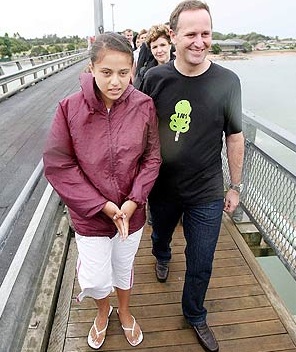
Campbell Live tonight returned to McGehan Close (see the report, by Tony Field, here). This street in Mt Albert — on the boundary of Helen Clark’s and Phil Goff’s electorates — was visited by then-opposition leader John Key before Waitangi weekend 2007 for a particularly cynical stunt. This was Key’s first big symbolic play as leader of the opposition, and it was a hum-dinger. He had already singled out the residents of this street in that year’s State of the Nation address at a whitebread rugby club in faraway Christchurch, branding them archetypal members of the New Zealand ‘underclass’, and the visit saw him glad-handing and patronising a bunch of poor brown people who’d already been used as shot in the National party propaganda cannons.

The purpose of the speech, and visit, was to install one of the core planks of the National party narrative about the Clark government — that it was at best unconcerned with the plight of said underclass; and at worst, actively cultivated such a demographic, which would be permanently dependent on Labour’s welfare policies and would therefore be a permanent source of electoral support for the Labour party. (So the ‘bribing the bludgers to breed’ theme goes, rarely uttered by anyone with authority in public but a commonplace among the usual proxies; check almost any General Debate thread on Kiwiblog from around that time for instance.) This is absurd in more ways than it’s feasible to explain here, so I won’t bother. Let’s just leave it at ‘the underclass doesn’t really vote’.

Nevertheless, the visit was a roaring success. Key, bearing smiles and gifts and wearing a tiki t-shirt, charmed the residents of McGehan Close and evidently persuaded them both of his party’s goodwill toward them and of its social and economic plan to lift them from their grim circumstances. The event culminated in Key taking 12 year-old Aroha to the Waitangi Day celebrations — a move full of potent symbolism, even if it was seen to be somewhat exploitative. Drawn out over a full week of coverage (at the time a rare commodity for Key, who had replaced Don Brash as leader just before the Christmas break) this was a highly successful stunt and should have been an early warning of Key’s great talent for making cheesy set-piece events ‘work’ and feel human. The sentiment he evoked in the people of McGehan Close was certainly real.

It’s just a pity the ‘ambitious’, ‘aspirational’ policy programme Key promised them wasn’t.

Joan Nathan, Aroha’s mother, remains on the DPB (having been let go from her hastily-arranged job working for National MP Jackie Blue) and struggles more than ever to cope, now with a sixth child. Aroha, now 16, is living in the care of Child, Youth and Family, which Joan says is the best thing for her, since she is unable to provide a decent life for her daughter. Nathan and others, although they believed in and voted for Key, are now disenchanted and universally express the sentiment that the government’s policies favour the rich, not the poor, and that they haven’t been helped one iota by the change of government; in fact, things have gotten worse. Not much of this is different than it was this time last year, when the Sunday Star Times visited the Close.

So far, so obvious, you might say — and it is; indeed this sort of outcome was very widely predicted at the time. But this is important because it is as strong a counter-narrative as exists for the opposition in this election year. It reframes Key as a faker, a charlatan, an opportunist who’ll exploit whatever circumstances will advantage him, without loyalty or the willingness or ability to follow through on his word; as someone whose focus is on boardroom issues rather than on peoples’ wellbeing. Discussing and reading around the topic on twitter this evening I’ve seen considerable criticism of this Campbell Live story as a cheap human-interest stunt, as opportunistic and exploitative (or moreso) than the original event. I couldn’t agree less. It is a clear, unambiguous example of an investigative journalist simply revisiting a story where much was promised, and measuring it against what has actually happened. This is crucial to its narrative value: these events reframe Key by measuring his own defining stunt — his signature trick — against the objective reality of lived experience. Theory and rhetoric versus real people, living in the real world governed by the policy built from that theory and rhetoric. It is a reality check in its purest form.

There are disadvantages to this narrative line, also, and the virulent responses to the Campbell Live report this evening — I believe I saw presenter Rachel Smalley shudder a little whilst reading some of them out — hint at them. One is the obvious suggestion that Joan Nathan and the other residents of McGehan Close could have done better for themselves, but have chosen not to; the victim-blaming routinely visited upon the poor by the less-poor. A more serious and related line of critique is that there’s a recession on, and everyone’s hurting. Or that it’s only been three years, and change takes time.

But hang on a minute — wasn’t the point of the whole point of electing a Key-led National government to take advantage of the resulting step-change which would boost economic growth, job growth, provide better opportunities, an end to welfare dependency, safer communities and a general increase in general socio-economic mobility and wellbeing? Key made all these promises quite explicitly, not just in person to the residents of McGehan Close, but to the whole nation throughout the campaign and at almost every opportunity since. There are no jobs. There are no higher wages, and without these things you can’t exactly buy shares in SOEs. There is no greater social mobility. The ‘underclass’, as exploitatively defined by Key, still exists.

Having failed McGehan Close, John Key has failed all of us. Quite apart from the fact that we were all promised these things, or things like them, and by and large have yet to receive them, a central theme of the ‘underclass’ policy argument was that by lifting people out of poverty and bringing then into the ‘overclass’ (? — this shows just how meaningless ‘underclass’ is except as a propaganda term), the government would make society better for everyone. This is a noble goal, and one I agree with in its idealistic entirety. I think you would go a long way to find someone in a position of any political credibility who’d publicly disagree with it. The first order of business for any opposition should be to hold John Key to those promises, and demand of Key the wealthier, more mobile, and socially healthier society we were promised.

But the most vicious response will be the one which the initial stunt in 2007 was meant to evoke — the notion that the ‘underclass’ are breeding in order to get more welfare from the Labour party. The core of this line of reasoning, if I may call it that, will be attacks on Nathan herself as a mother, having had a sixth baby and having had Aroha, the subject of the initial stunt, removed from her care. The attacks will be highly personalised, racist and gendered, and they will be lashed closely to Labour party policy and doctrine. But, assuming a competent and spirited opposition, that’s ok — the National party aren’t in opposition, 18 months out from an election; they’re in government in election year. Having been elected on a moderate, sympathetic platform with strong support from women and Māori, and looking to consolidate that platform into a strong and honestly-won mandate means that the government no longer has such freedom to dog-whistle. Particularly given that an opposition counter-narrative would cast doubt on all those sympathetic characteristics, the resort to the divisive tactics of 2008, such as trying to wedge ‘hard-working kiwis’ against the ‘underclass’, and so on, would be extremely risky for the government.

In light of my last post, perhaps it is a little glib to assume a competent and spirited opposition, and in perfect truth I don’t really think Labour has this fight in them (although Grant Robertson saw the Campbell Live piece and seems to have had a similar response to mine, which is heartening). But it is an argument waiting to be had, and one which must be had sooner or later. The boundaries are drawn up; media interest is already piqued, and this is a bread-and-butter social and economic justice issue for Labour. There’s a wealth of symbolic material and slogans to employ — ‘reality check’ and ‘by failing McGehan Close Key has failed us all’ are two they can have for free, and if a Labour party can’t base a campaign around ‘underclass‘ then they’re not worthy of the name.

Time to engage.

L

Expecting too much from the Tunisian crisis.

The lack of understanding of what the Tunisian political crisis represents has been alarmingly evident in the media coverage of it. Journalists have said such inanities as “until a couple of days ago Tunisia was a beacon of stability in the region…” and raised the possibility of a so-called ripple effect spreading from Tunis to other North African states. They have called the popular uprising against the ousted president Ben Ali the “Jasmine Revolution,” thereby demonstrating their profound ignorance of what a revolution really is. The truth is that Tunesia was a small powder keg waiting to blow but no one wanted to state the obvious about it, and when it did blow the reaction has been to over-estimate its magnitude and repercussive effects. 

Let me dispel some of these misrepresentations. First, the uprising in Tunisia is not a revolution. A revolution is an overthrow of the state by a mass-based, ideologically-driven and collectively organised armed resistance movement that results in parametric change in the political, economic and social institutions governing society. In Tunisia what occurred was sometimes violent popular demonstrations against an unpopular and corrupt long-serving despot which precipitated an inter-elite crisis that resulted in the exile of Mr. Ben Ali, his family and close allies. The regime did not fall, the military has re-gained control of the streets and the protests have not coalesced into an organised, focused, counter-hegemonic opposition that poses itself as an alternate sovereign and has the capacity to engage in a war of maneuver against the repressive apparatuses of the state. All the demonstrations and protests have done is allow the Tunisian regime the opportunity to reform-monger in order to placate popular discontent while shifting the focus of blame on the disgraced former president. The “opposition,” such as it is, has no plan for taking control of the reigns of state, has no program for governing, and is in fact mostly made up of jobless youth aimlessly venting their rage at symbols of power rather than constructively organising am effective counter to it. Given those facts it is naively optimistic to expect that the crisis will result in major change of a democratic sort. It may be the impetus for a political opening, but it is no guarantee of it.

As for the “ripple effect” of the purported “Jasmine Revolution.” Undoubtedly the Arab street has taken notice of the Tunisian crisis and oppositions in places like Egypt, Algeria, Jordan, Morocco and Libya have been encouraged by the events in Tunis. But the elites in these countries have also taken notice and have no doubt shared information with each other on the nature and threat posed by their respective domestic oppositions. Largely disorganised and ideologically heterogeneous, Arab oppositions also often have overt Islamicist tendencies in incipient leadership positions (and in some cases, like Algeria, an active Islamicist armed resistance tied to al-Qaeda), something that will prompt Western backing for the political status quo in these countries even if they go about re-shuffling their own leadership cadres as a result of the warning provided by the Tunisian crisis. Where these oppositions do have an organisational core, it is more often than not undemocratic in nature and, in the case of Islamicists, explicitly opposed to democracy and supportive of a return to theocratic rule (in states that by and large have worked hard to promote a measure of institutional secularism that coexists with religious hierarchies operating in parallel spheres of influence).

Then there is the lesson of other so-called “colour revolutions” such as the Orange Revolution in the Ukraine, Rose Revolution in Georgia and Tulip Revolution in Kyrygyzstan. These have resulted not in democracy in these states but in the emergence of electoral authoritarian regimes that, if better than the former Soviet republics that they replaced and certainly more pre-Western in nature,  do not come close to offering the full measure of voice, representation, transparency and accountability that their adherents so fervently hoped for during the heady days of street protests that ushered in regime change in each.

Thus a sober assessment of the Tunisian crisis should see it for what it is: a wake up call to the Tunisian and other Arab political elites that ignoring simmering popular discontent and failure to engage in macroeconomic and socio-political reforms will ultimately cause tensions to boil over, and such popular boil-overs pose the risk of regime change if well-organised and supported in the face of regime paralysis. It also means that just because a regime is pro-Western does not mean that a blind eye should be cast on its excesses and exclusions, if for no other reason than doing so will encourage the type of leadership behaviour that gives ideological ammunition to extremists who otherwise would not gain the support of the majority.

For Arab oppositions, the lessons are also clear. “Spontaneous” revolts may garner media attention, but nothing substitutes for ideological consistency, collective organisation and the cultivation of mass appeal in preparation for the moment when what Rosa Luxemburg called the “mass strike” is to be launched. And that, of course, is exactly what the Arab political elites are already keenly focused on preventing with the aid and assistance of their Western counterparts, all under the guise of the so-called “war on terrorism.” Even so, the intelligence failures, particularly by the French and the US, to even remotely predict the unrest in Tunisia speaks volumes about Western lack of understanding of the real dynamics on the ground in North Africa. I mean, how hard is it to assess that a long-lived, openly despotic kleptocracy with repressive contempt for its own citizens would engender popular resentment against it, especially with unemployment levels running at 15 percent of the adult population and more than 20 percent for males under the age of 30? Or does being “pro-Western” absolve such regimes of all sins? Is this what passes for “stability” in the myopic eyes of the Western press and diplomatic corps, or is the mere lack of an organised opposition that gives such regimes a mantle of legitimacy they neither deserve or have in practice? In other words, does the absence of a viable opposition by default grant authoritarian regimes legitimacy (at least in the eyes of the West if not their own people)?

This is not to say that all opposition is futile. To the contrary. But incipient democracy movements in these countries need to refine their message into a clear ideological counter to the status quo, seek to establish broad based constituencies based upon coherent platforms for policy reform, and look to each other as well as viable interlocutors in the West so as to jointly press for substantive reform of their respective political systems while deflecting accusations of ideological extremism and inflexible militancy. Until they do so they will be seen as a rabble rousing mob rather than as a viable political alternative.

That is why the Tunisian crisis, while significant for both its domestic and regional implications, is more of a false hope than a first step in the democratisation of North Africa. For the latter to happen both elite and popular attitudes towards governance will need to change, and nothing in the character of regional oppositions or the tone of their approach to organised resistance, to say nothing of government responses to popular discontent, indicates that is about to happen anytime soon regardless of the immediate impact of the winter of Tunisian discontent.

As the gun smoke clears, the Right run for cover.

As someone who once lived in the area of Tucson where the politically motivated shooting of US Representative Gabrielle Giffords and 19 others occurred, I have something of a personal connection to the event. I shopped in the strip mall where the attack took place and still have friends in Tucson who I visit when possible. Were I still living at my last address there,  Giffords would have been my Representative. I am well aware of Arizona political culture and the issues that divide it, and know something about its gun laws as well. Thus I am not surprised one iota that an assassination attempt on a “liberal” Democrat would happen in Arizona, although it is somewhat surprising that it happened in Tucson, which is a liberal college town oasis in an otherwise vast political landscape of new and old right-wing conservatism.

Unsurprisingly, as soon as news of the shootings hit the airwaves left-leaning commentators blamed right-wingers for inciting the killer while GOP leaders, Tea Party representatives and the populist demagogues in the media all moved quickly to put distance between themselves and the gunman even though the latter professed beliefs that were very much in concert with the thrust of the Tea Party message as well as those of earlier conservative fringe movements. In fact, some in the rightwing media suggested that the Left has its own violent extremists so the table is balanced on that score.

To which I ask: when was the last time a Left activist in the US attempted to kill a politician? Lee Harvey Oswald was less a committed Stalinist during his time in the USSR and more of a social outcast looking for a belief system to cling to (I shall defer from bringing in Mafia-related and other conspiracy theories at this point). John Hinkley’s attack on Ronald Reagan does not count as he was motivated by the demons in his head, and the attacks on Gerald Ford by members of Charles Manson’s gang in the mid-1970s were equally devoid of political content. But as recently as 2009 a right wing extremist, apparently egged on by the commentary of talkshow rabble rousers, killed abortionist George Tiller outside his church. This has followed a series of attacks carried out by right wing militants that include the Oklahoma City bombing and repeated attacks across the country on abortion clinics. Minutemen and other self-professed right wing militias have demonstrated a penchant for violence against others. The Unibomber was motivated by a mix of left and right views. Islamicists operate according to a profoundly conservative belief system. Anti-Castro Cuban nationalists have committed acts of domestic and international terrorism (including the bombing of a Cuban airliner) in pursuit of their conservative goals.

In contrast, Earth First! and the Animal Liberation Front have lefty ideals and destroy property but do not kill people. Anti-trade protestors and anarchists have run riot in Seattle and DC but mostly gotten (some might say well-deserved) police beatings and tear gassed for their efforts. Puerto Rican nationalists have disrupted Congress and planted bombs but killed no one. Thus it would seem that contrary to the claim that the US Left has its fair share of murderous extremists, not since the days of the SLA, Weatherman and Black Panthers has there been a deadly attack carried out by Left militants on political targets. During that same time period, in contrast, the right wing fringe has claimed dozens of victims, of which those in Tucson are the latest. Truth be told, this is only the latest in a long history of right wing assassination attempts on “liberal” political targets that are seen as “communists,” “socialists,” Trilateral Commission and World Government surrender monkeys, atheists or some unholy combination of all of the above. Just as the John Birch Society had its fair share of armed extremists, so now it appears that modern US conservative movements attract a similar element to their ranks. 

To put a not-so-fine point on it: be it as lone wolves or as part of a criminal conspiracy, it is the fringes of the US Right where most political violence comes from. Even if in most cases the extremists involved exhibited signs of mental illness (as in this case), in the modern US it is right-wing militants who disproportionately get murderous. That could be due to the lack of appeal for calls for working class “revolution” in a country founded on the sanctity of individual liberties and property rights, but one would think that would make Leftist militants more rather than less prone to violence against those political figures that attract their ire. Instead, it is the reverse.

Rather than debate the question of how complicit, implicitly or explicitly, the Tea Party, GOP, Sarah Palin and conservative media have been in the Tucson attack, let me offer a simple formula that outlines the context in which it occurred (and will occur again). Note that this “formula” is exclusive to the US but can be altered, mutatis mutandis,  to apply to other countries as well:

Loose gun control laws+availability of semi-automatic weapons+polarised politics+venomous hate mongering political rhetoric in media and in election campaigns+rapid demographic change+economic crisis+ eroding social cohesion and solidarity+deranged or otherwise sociopathic personality disorders+precipitating event (personal or political)=likelihood of an armed attack on a perceived “traitor” by someone espousing militant ideological views.

In the contemporary US, this formula suggests that the attack in Tucson is neither unique or a once-off, and in fact points to a condition of ongoing anomie that barring a major change in both the structural and superstructural causal factors listed above, will lead to more such events in the near to medium future. Rather than the content of any one ideology or creed, it is the combination of factors that makes for the murderous enemy within, and no amount of blame-fixing and scapegoating of “foreign” beliefs detract from that fundamental fact.

PS: for those interested in a more immediate look at the tragedy, take a gander at my old home town newspaper: http://azstarnet.com/

UPDATE: As if on cue a NZ version of the unhinged reactionary chickenhawk faction weighs in, with a link to this post: http://truebluenz.wordpress.com/2011/01/11/it-is-not-about-loughner-or-palin-its-about-the-republic/

Priceless.

Justice delayed, now denied.

Rather than ring out the old year and ring in the new year with the usual inane rubbish about new beginnings and fresh starts, annual lists, countdowns etc., how about we use the occasion for a reality check, in this case a reality check on the state of the NZ judiciary using one very important case.

On October 15, 2007 a number of individuals were arrested on a variety of charges, including planning terrorist attacks. Others were arrested later, and collectively they have come to be known as the Urewera 18. On May 30, 2011, three and half years after they were arrested, the majority of these defendants will finally go to trial (three defendants will be tried separately).  Not only is the delay largely a result of the Police and Crown trying to introduce new charges after the fact and argue for the admissibility of evidence obtained under the Terrorism Suppression Act that was ultimately not invoked against the accused. Now, in a decision which has had its reasoning suppressed by the court, the Urewera 15 have been ordered to have a trial by judge. You read correctly: not only have they been denied  the right to a prompt trial but are now denied a jury of their peers. To that can be added holding the trial in Auckland when most of the defendants live elsewhere and their purported crimes were committed outside of Auckland.

Between the delays, venue and judge-only trial, the Crown and judiciary is engaging in a blood-letting exercise designed to drain the defendants materially and emotionally long before they enter the courtroom on May 30. Arguing under section 12 that the case is too complex, with too many defendants, with too many side-issues and matters of procedure to be considered adequately by a panel of laymen and women is an insult to the NZ public as well as a thinly veiled attempt at juridically saving face in a case that was over-ambitious, politically-motivated and legally flawed from inception.

This is further evidence of the ingrained authoritarianism and lack of accountability rampant in the judicial system. Judges act as if they are above the laws they are supposed to uphold. The Crown vindictively prosecutes cases without regard to their merits or costs because political interests are at play (remember that the NZ wikileaks cables show NZ government officials telling the US embassy in Wellington that theZaoui case was not winnable–then saw the Crown go ahead for another two years arguing for Zaoui’s incarceration or expulsion until the SIS finally dropped the pretext that he was a threat to national security). Elites are given name suppression for the flimsiest of reasons and judges protect their own when these transgress. This is exactly the sort of judicial attitude in dictatorships.

And yet, it is the attitude in NZ as well. Meanwhile, not a single mainstream media outlet has raised the subject of the long delayed and now jury-denied Urewera trial since the decision on the latter was announced in early December. Not a single right-wing blog has raised the obvious civil liberties and rule of law implications of the case. The Left commentariat has been largely silent as well, with the notable exceptions of Idiot Savant and Russell Brown.

Why is this? Is this silence a result of the fact that the accused are an ideological minority that are easy to scapegoat and persecute? If so, that is exactly the reason why the full spectrum of democratic commentators should be protesting the case: in a democracy it is not mainstream, “normal,” “nice guys” who deserve the most legal protection and rights of redress. It is the ideologically suspect, reprehensible, marginalised, ostracized or otherwise outcast who deserve the full protections of law precisely because they are at the mercy of the majority–a majority that is often ill-informed or manipulated by authorities when it comes to evaluating the merits of any given case against anti-status quo political activists. The majority may rule, but free, fair and impartial trials are the minority’s best bulwark against its tyranny.

That is another reason why a jury trial is deserved by the Urewera 15. A  jury, selected from the public mainstream, can listen to and observe the prosecution evidence and the defense against it in detail, first hand, then deliberate on the merits of each. That ensures that no judicial bias or hidden quid pro quos enter into the process. As things stand, the judge who hears the trial is vulnerable to such accusations, which is more the reason to bring an impartial jury into the process.

I am not entirely sympathetic to the causes being espoused by the Urewera 18. I do believe in their right to act militantly in defense of them subject to the penalties of  law should they act in ways that contravene criminal standards (as hard as it is to say, I extend this belief in the right to militant activism to neo-Nazis and skinheads as well so long as no harm to others results from it). Here I disagree with some distinguished Left commentators, who have seen something sinister in their activities and who believe that the political motivations of the defendants makes the case “special.”

I have already written at length on why politically-motivated crimes should not be treated as a special category so will not belabour it here. But I am sure that those who see sinister intent in the Urewera 18  will agree that the way this prosecution has gone is wrong on several levels. Even if the Urewera defendants are in fact complicit in something more than activist fantasy-ism and role-play, they deserve to be treated fairly according to the rule of law consistent with the foundational principles of a free society. Yet they have not, and nary a peep has been heard about that from those who should know better and who ostensibly are champions of the democratic ethos.

This attitude is shameful and should be repudiated by all fair minded people regardless of ideological persuasion.  The trial-by-judge decision must be appealed as a denial of due process and publicly repudiated by those who believe in the democratic ideal.

How’s that for some New Year’s resolutions?

Embedded journalism, war correspondence and PR farce.

I was invited to present a paper on embedded journalism to the Pacific Media Centre conference noted below in a previous post. Not being a journalist, if offered me an opportunity to reflect on the evolution of war correspondence in the post-Viet Nam era, especially since I had witnessed some trial runs of the “embed” concept while working in the Pentagon in the 1990s and could therefore speak to the history behind the current practice, as well some of the dilemmas it now poses for the US military.

The nice folk at Media 7 decided that the subject was worth covering in a show, especially since my talk at the conference was paired up with a presentation by independent journalist Jon Stephenson on how the conflict in Afghanistan is being spun for NZ audiences, with particular reference to the use of columnist Garth George as a PR flak for the NZDF.

This week on Media 7 Jon, Garth and I were invited to discuss with host Russell Brown the subjects of embedded journalism and journalistic integrity in war. In the first segment Russell and I briefly discuss the subject of embedded journalism (as much as you can when trying to provide a synopsis of a 6000 word essay–the essay is available via the PMC by writing Andrea or David at the addresses listed as contacts on the poster). In the second segment Jon and Garth offer their very differing opinions about journalistic integrity in the coverage of the NZDF mission in Afghanistan. The difference in their views is eye-opening but let us be clear about who is who: Jon is a bonafide war correspondent who works independently of military protection in some very dangerous conflict zones; Garth is a stay-at-home columnist with a sinecure (that word again!).

On a very different note, the show ends with a nice skewering of romance novel prose done impeccably by Sarah Daniell (starring herself as the heroine/narrator/interviewer). It is quite funny. Look for the Tony Blair quote.

You can find the show here.

Isolated

This brief report from Radio Waatea brings into crispish focus a few issues regarding the māori party’s support for the new Marine & Coastal Area (Takutai Moana) Bill, and perceived collaboration with the National-led government against its constituents’ own interests:

Sharples upset at Maori Media Ingratitude
Maori Party co-leader Pita Sharples says he’s disappointed at the heat coming on him from the Maori media over the Marine and Coastal Area Bill.
Criticism of the bill by iwi such as Ngai Tahu and Ngati Kahungunu and from Taitokerau MP Hone Harawira has been extensively reported.
But Dr Sharples says it’s better than the existing Foreshore and Seabed Act, and the Maori media should reflect that.
“They forget we’re there on their side to do stuff for them. Instead of sort of helping us knock down the barriers, they try to knock us down as the barrier. And yet without as it were the initiation of us in there, there would be no efforts at all and in the context of past Maoris in government, we have really achieved outstanding results,” he says.
Dr Sharples says the Maori Party hasn’t got enough credit the whanau ora welfare delivery model and for his rehabilitation units in prisons, which will open next year.

Sharples is right in several important respects. The role the māori party party has played in getting take Māori and tino rangatiratanga on the government agenda has been crucial. The māori party really does have a unique claim to an “authentic” kaupapa Māori politics, and this should make Māori media such as Waatea, Māori Television and TVNZ’s Māori programming division (which produces Te Karere and Marae) should be strongly sympathetic towards their policy programmes. Should, I say, if the end policy result was seen to be consistent with those kaupapa.

But these agencies do not owe the māori party any favours. As media outlets their job is not to shill for a party line but to present a considered view of current events in context, and by reporting the deep dissatisfaction within Māoridom regarding the MCA bill they are doing just that. Māori media have generally shown a strong commitment to independence and impartiality — which is a particularly tricky thing to do given their cultural focus — and their coverage of the māori party’s policy platform is simply an extension of that commitment. Long may it continue, and would that it were more broadly shared.

What this episode really illustrates is the extent to which the māori party is isolated from its support structures with regard to its position on the MCA bill. Just as the party has failed to persuade its own constituency, and indeed its own caucus, that the MCA bill is worth supporting, it has failed to persuade the only media establishment which might be sympathetic to its cause as to the merits of that cause. All this illustrates one of two things: either the party is way off base; the strategy of supporting the bill is bad for Māori and Māori know it; or that the strategy of supporting the bill is actually a great deal better than anyone knows, but the party has largely failed to articulate this.

I know which I’m tending toward, and I invite readers to argue their case. But no matter which you believe, I think it’s clear that attacking the media is neither a mature nor a useful response. Successful actors in modern democracy lead the media, like they lead their electors — in the knowledge that both must follow willingly, by consent (however grudging), or not at all. If, as a politician, you ever find yourself running a sustained campaign of trying to shove either the media or your constituents in a certain direction against their will, berating or harassing or whipping them for their stupidity or intransigence or for simply failing to follow instructions — then you have very probably already failed.

L