On a lighter note: Machine of Death

Not that the Rolling Stones have destroyed us — I mean, you can’t always get what you want. You know what I’m saying? Brown sugar. I have no idea what that means.  -- Glenn Beck, The Glenn Beck Program, October 27, 2010

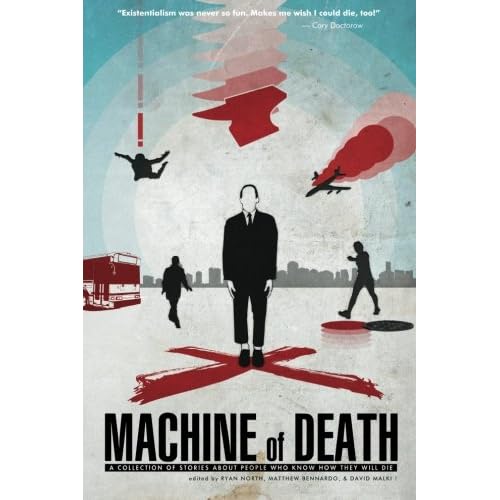
On 26 October 2010, the guy who writes the marvelous Dinosaur Comics and a bunch of others self-published a book (because nobody would publish it for them) of short stories based around the idea of a machine which could tell you how you would die. The book is called Machine of Death. They happened to choose October 26 as the publication date without knowing that Glenn Beck’s latest tome of dangerous absurdities with the suitably loony title “Broke: The Plan to Restore Our Trust, Truth and Treasure was to be released on the same day. While it’s nice that Machine of Death pipped Beck’s book in the amazon.com sales rankings on opening day (proof), what’s most wonderful about this little episode is that it so incensed Glenn Beck that he had a wee rant about the book on his widely syndicated radio programme. It’s so gloriously insane, there’s nothing to do but quote it in full:

And I want to tell you that, um…our books are ALWAYS #1. And I find it REALLY fascinating, FASCINATING, that if you go to Amazon.com, Broke is number THREE. And the two books that are ahead of it — one is Keith Richards’ Life, which is getting a TON of — you know, that’s everywhere.
But this is a book about, you know, how he snorted his father’s ashes, after death. (sarcastically) THAT’S cool. This is the SDS [Students for a Democratic Society] book. This is for all of the — this is for [union leader] Andy Stern who’s all, I guarantee you he’s on the phone and has been the last few days, you know, with people like, you know, Bill Ayers going “All right, DUDE! Ah, do you remember when we were rolling around in the mud like animals? Remember that? This guy was smoking ash — you know, smoking his dad, and, and, popping stuff into his veins? Ah, those were the DAYS, man.” And then William Ayers was like, “Whaddaya mean, those were the days? I’m still doin’ that stuff, man!”
So that… “culture of death.” And it’s an escape into the past, of, you know, the Woodstock stuff.
And then, the #1 book — TODAY, at least — is Machine of Death. And it’s a — collected stories about, you know, people who know how they’re gonna die. Haowww!
So you have DEATH — I know it’s called Life, but what a life it is, really! It’s a culture of death! OR, “How do we restore ourselves?”
These are the — this is the left, I think, speaking. This is the left. You want to talk about where we’re headed? We’re headed towards a culture of death. A culture that, um, celebrates the things that have destroyed us. Not that the Rolling Stones have destroyed us — I mean, you can’t always get what you want. You know what I’m saying? Brown sugar. I have no idea what that means.
— Glenn Beck, The Glenn Beck Program, October 27, 2010

This, as if it needs to be said, is the other side of the Angel of Death ad I wrote about the other day; what happens if the font of inchoate hatred which powers the Tea Party movement isn’t carefully channeled through propaganda wizards and filmmakers and spin doctors. Wonderful. Frightening.

L

Performance art

Listening to Tao Wells’ stone-cold crazy performance on Radio New Zealand’s The Panel this afternoon (audio, starts at about 19:30) it’s pretty clear that the whole thing is simply a continuation of The Beneficiary’s Office, his performance art project.

I’m not sure what the endgame is, beyond driving publicity for Wells and ‘The Wells Group’, the self-styled PR agency running The Beneficiary’s Office. But fundamentally this is the only explanation for the character who fronted The Panel. The studied eccentricity of his characterisation and rhetoric — the Leninesque styling and cheap, ill-fitting suit; the suggestion that he might replace Paul Henry on Breakfast, using the scandal du jour as a springboard for publicity; the incoherent, aggressive, entitled, self-indulgent indignant victimhood of his media presence — he is exploiting the fourth wall illusion, the audience’s naïve impression that they’re separate from the performance; that the show stops at the proscenium arch. To do so Wells is reading from the big book of Glenn Beck and Sarah Palin. His project is a little bit of inchoate Tea Party wingnuttery turned back on an issue so close to the wingnuts’ hearts that they can’t see the mockery in it. No matter that his actual argument doesn’t bear the slightest bit of rational scrutiny and is all but completely obscured by his outrageous delivery — this isn’t the point. The point is to suck people in and involve them in the performance by lighting the flame of their hatred. To make them attack the tar-baby. As Palin’s own idol Ann Coulter said, paraphrasing Joseph Göbbels and George Orwell in her diatribe Slander: “Any statement whatever, no matter how stupid, any ‘tall tale’ will be believed once it enters into the passionate current of hatred.”

So to everyone who’s found themselves incandescent with righteous fury, uttered slogans like “the world doesn’t owe you a living!” or called for the disestablishment of Creative NZ or defended Wells and his absurdist position — this includes the media who’ve covered it from the ‘benefit scandal’ angle; obviously WINZ, who’ve cut his benefit; and most notably David Farrar and the KBR, whose response has been nothing short of magnificent — you’re part of the show. You have been trolled.

So as far as that goes, well done, Tao Wells.

L

PC priorities

The media beat-up du jour is the non-story of Te Papa Tongarewa “barring” (or “banning”, “forbidding”, other such absolute terms) pregnant and menstruating women from entry due to the nature of some tāonga on display.

Except they’ve done no such thing. The “ban” isn’t actually a restriction at all — they’ve been clear that it’s a request, not an ironclad edict; and in any case, the exhibit isn’t open to the public, but to staff from other museums. It’s an invite-only behind-the-scenes tour. And the crucial point is that the tāonga in question have been given to Te Papa on condition that this advice is given to prospective viewers. Let me be crystal clear: nobody would be barred from attending on the grounds that they are pregnant or menstruating. If someone wanted to turn up and say “bollocks to all of that, me and my unborn child are going to see those taiaha!”, it’s been made clear that she would be permitted to do so. That might be inflammatory and offensive, like farting in church or wearing a bikini to a funeral, but nobody is forbidding it. And that’s as it should be: Te Papa is our place and nobody should be barred outright. If the condition required exclusion, then that would be fair enough on the part of the owners — who can reasonably impose whatever conditions they please — but quite explicitly not ok for Te Papa, who would be better to decline the opportunity outright to maintain its public mandate.

Of course, this hasn’t stopped everyone with a platform from winding up to rage against the imposition of archaic, alien superstitions upon their civil liberties. But almost without exception, the restriction-which-isn’t-really-a-restriction doesn’t apply to them, since — as far as I’m aware — none of those objecting are in fact museum staff who would be eligible for the tour. And amongst this vicarious umbrage there’s an awful lot of squawking about misogyny and imposition of cultural values, and much more uncritical repetition of the misleading language of “bans” and such. It goes as far as idiotic and lurid suggestions about personal searches using sniffer dogs, for crying out loud.

All this has manifested as a soft and rather opportunistic sort of anti-Māori racism, where Māori are the casualties of our sticking up for the rights of pregant and menstruating women. There’s a common implication that they are the oppressive stone-age patriarchy using whatever means they can to victimise our women; and “forcing” their rude barbarian culture into our civilised and noble times. This is understandable from the usual PC gone mad crowd who’ve suddenly — conveniently — found their inner feminist, but somewhat more disappointing from those who would often be described as the hand-wringing PC liberals, people who ought to know better that it is possible to reconcile conflicting cultural values of this sort in an amicable fashion via the standard tools of live-and-let-live liberalism. And while those same hand-wringing PC liberals do rail against the worst excesses of those illiberal institutions which make up mainstream NZ society — chief amongst them the Catholic church — the response to this case has generated anger out of all proportion. Te Papa had to make the decision: take the tāonga on with the advisory condition, or not at all. Perhaps those objecting to this policy would prefer that nothing of this sort ever go on display. There is a genuine cultural conflict here, but it can quite simply be resolved: those pregnant and menstruating women who believe their right to attend trumps the request to the contrary may do so then and there. Not only are they not prevented from doing so by those hosting the tours, they actually have the right to do so should they choose, and that right should be defended. Those who do not may do so at another time which is convenient to them. The tragedy is that for most of the liberals in this battle of PC priorities, women must be given categorical superiority over Māori. They are arguing for their own culture to be imposed across the board; the very illiberalism they claim to oppose.

There are (at least) two people who are making good sense on this matter: Andrew Geddis, whose liberal argument is very close to my own views, but much better formed; and Lynne Pope who, almost uniquely among the bullhorns sounding around this topic, is a Māori woman who’s actually been on the tour in question. Neither of them have lapsed into the myopic, reflexive Māori-bashing which is the most unbecoming aspect of this situation.

The lesson for New Zealand’s liberals is this: it isn’t necessary to trample on the cultural needs of Māori to accomodate the needs of women. Liberalism itself provides tools to reconcile these differences. They just need to be used.

Update 20101018: As usual, Scott Hamilton makes good sense on this topic.

L

Unattributed paraphrasing as unspoken flattery?

From time to time I read bloggers who complain that there work is stolen by MSM “repeaters” and repackaged under the repeaters’ by-line or in a story under their name. This form of plagarism is hard to prove conclusively because unless the repeater uses phrases word for word, s/he can claim that fortuitous intellectual coincidence rather than malice was involved.

Then I read Kerre Woodham’s column in today’s HoS. The tone is similar to the thrust of my post earlier in the week about the rise and fall of Paul Henry. That’s OK, as a number of people have taken the view that TVNZ management is as much if not more responsible than Mr. Henry for the debacle that his “insensitive remarks” has turned into.

But what are the chances that she and I would both use the phrase “bullet proof” in paragraphs specifically referring to the moment at the Qantas Media Awards when Henry decided he was invulnerable? Since her version appears five days after mine did, is it a wonderful coincidence and example of great minds thinking alike or an example of the type of repeating that other bloggers have complained about? In other words, is this Kerre’s “Noelle moment” or am I reading too much into it and being too possessive of a widely used argument and phraseology?. Readers can compare both essays and decide for themselves.

Either way, I guess I should be flattered–except that she gets paid to write things that I dole up for free.

The Rise and Fall of a TV Icon (updated).

I am loathe to give more oxygen to the Paul Henry saga but think that I have a fair idea of the chain of events that led to his suspension and possible sacking. This is due to my personal familiarity with him as a result of my appearances on the Breakfast show. Let me explain.

When I first started showing up on TVNZ after 9-11, I dealt with Mike Hoskings (and Ali Mau) on Breakfast and either Paul Holmes or Linda Clark in the evening news interview shows. The two men have big egos but are smart, do their homework, and are mentally quick on their feet. Linda Clark and Ali Mau are all of those things without the ego. Although they swapped slots from time to time and I also have spoken at some length with Peter Williams on and off-camera, it was Hoskings who ran the bulk of the Breakfast interviews with me, especially during the early days of the 2003 Iraq invasion.

Some years later Hoskings left Breakfast and I began to be interviewed by Paul Henry. He was initially circumspect, always polite and although not as studied as his predecessor, he seemed well-prepared (in part because I tend to give producers some talking points on the subject the night before the show). His only flaw was his tendency to talk over and interrupt while editorialising about the subject rather than allowing the interviewee (me) greater reign for in-depth analysis. But that, perhaps, is the nature of Breakfast TV, which world-wide is the shallow end of the TV news pool.

Something happened, though, during the last 3 or 4 years, at a time when I moved abroad. Henry began to crack jokes, some of dubious taste, and these jokes found resonance amongst his viewers. The more positive feedback TVNZ received, the more he continued to play the role of provocateur rather than newsperson. As ratings went up the TVNZ brass gave him more rope on which to swing his shtick–a rope that he has now hung himself with. Serious interviews were gradually replaced by often funny and not-so-funny ad libs on stories presented in the half hourly news updates. By 2010 Breakfast was a bit of a morning circus, with the female co-hosts serving as straight props for Mr. Henry’s increasingly schoolboy antics.

As John Minto has pointed out, Henry is a serial offender. This year alone he has disparaged on air  people because of their appearance, mental condition, surname and ethnicity (at least twice). In each instance he targeted an innate trait rather than some aspect of the individual’s behaviour. And each time complaints to the BSA and TVNZ about his comments resulted in no more than verbal admonishments from his bosses. In fact, it is now clear that there was much of a wink and nod to these supposed warnings.

Then, at the Qantas Media Awards, he used the People’s Choice award presentation to read out a profanity laced purported letter from a disgruntled viewer which again, had misogynist and homophobic references in it. The mostly Pakeha elite audience roared with laughter. That is the moment when Paul Henry decided he was bullet proof.

His sense of invulnerability was not only driven by high approval ratings. Every Monday he was given the opportunity to interview his ideologically kindred Prime Minister. Every Monday the interview finished with some quick banter between two self-satisfied “smart guys” riding high in the polls. Although what they believed passed for quick-witted repartee was more often banal and insipid, the seeds were sown in their exchanges for the infamous remarks about the Governor General this past Monday.

In effect, although the ultimate cause of his own downfall, Mr. Henry was aided, abetted and facilitated along the way by an array of celebrities, executives, “news” outlets, politicians and hangers-on who are running for cover now that his true nature has been exposed. A large swathe of the general public also played a role in his rise, and in the particular tone he adopted as his confidence in his own celebrity grew. He therefore has reason to be aggrieved. After all, a few weeks ago he was on stage basking in the glow of popular acclamation for doing precisely the things for which he is now suspended and vilified.

I do not think that he should be sacked. A long suspension yes, but if Tony Veitch can be returned to the airwaves after his crimes, then an uncloseted bigot surely can seek redemption. The viewing audience will be the ultimate judge of that. Whatever his long-term future in TV, at a minimum a long time off air while chasten and make Henry think twice before uttering pejoratives or ridicule. The time out of the limelight may force him into the type of self-reflection that could, in fact, make him a better presenter. Or not.

What I find most personally ironic is that I was fired and my academic career ruined for writing an intemperate and unprofessional email to a student in which I accused the student of using “some sort of Western liberal guilt” to weasel out of an assignment due date. Although I was subsequently proven correct in my suspicions that the excuse was a ruse that did in fact prey on my supposed liberal sentiments, I was vilified as a racist and kicked to the curb by Auckland University. The email (for which I immediately apologised, long before any disciplinary proceedings began) was wrong, to be sure, but the outrage, public defamation and punishment far exceeded the offense (sorry for whinging about this by way of comparison, but as you can see it really sticks in my craw and I have not quite gotten over it given the grief it has caused my partner and I).

TVNZ, on the other hand, encouraged Mr. Henry’s behaviour in spite of repeated complaints about it, something that was confirmed by the spokeperson’s initial statement that he merely said what others were too afraid to say. TVNZ apparently never gave him a formal written warning, or even a serious verbal warning. To the contrary. Until things hit the fan it repeatedly defended and encouraged his boorish behaviour because it was deemed profitable for him to do so.

Thus, from my perspective, the Unite union (and other self-righteous johnny-come-latelies like Peter Dunne) is wrong in demanding Mr. Henry’s sacking even if his “crime” is egregious, and even if he is not a union member. The reason is that  the precedent his sacking would set is worse than his individual transgressions. Of course, he may have an individual contract with TVNZ whereby he serves at the whim and discretion of the management, in which case he is well and truly at their mercy–whatever his contract status, this is a particularly bad time to be an unorganised worker facing managerial scrutiny given the thrust of National’s labour reform bill.

As much as it pains me to say so given the circumstances of this case, I think that the union movement should stay out of the debate or use it as a means of reminding workers that collective membership is the best defense against individual victimisation by management no matter how famous the worker may be. After all, the employment issue here is about Henry’s job performance given his contractual obligations and the terms and conditions therein, something that should not be susceptible to public pressure or managerial attempts at corporate face-saving.

For the unions the issue should be one of contractual obligation and due process, nothing more. In that sense the union position should be akin to the American Civil Liberties Union (ACLU) defending the right of neo-Nazis to free speech. It is the principle of due process rather than the inadmissible act that is the defendable issue. Paul Henry may be a loud-mouthed, bigoted, overpaid ignorant talking head buffoon, but at the end of the day he is a wage slave living high at the mercy of his corporate bosses. It was the TVNZ paymasters, not Mr. Henry, who dictated the on-air environment in which he spoke. At any time they could have reigned him in, disciplined him or otherwise cut short his propensity to vent divisive, hateful, prejudiced or otherwise rude comments. But they did not. Instead, they encouraged and facilitated him.

Now that the public reaction is adverse, TVNZ will allow him to twist in the winds of opprobrium while his bosses figure out how to best ride out the storm. But as a Herald columnist aptly phrased it, the fault is not just with the monkey, but with the organ grinder, and it is there where the real source of blame for this debacle needs to be focused. In other words, if heads are going to roll, they should roll high rather than low.

Anchor me

Indian-born Hawkes Bay-resident overstayers Sital and Usha Ram are to be deported with or without their three children, who are New Zealand citizens aged eight and six. These are not ‘anchor babies’ in the US sense that that hate-term is employed; no attempt has been made by the Rams to mislead Immigration or to hide from the authorities, nor are they using their childrens’ citizenship status to thumb their noses at the powers that be. This is, for all intents and purposes, a model New Zealand family.

The children, as New Zealand citizens, have a “cardinal and absolute right of residence” according to a 2008 judicial ruling, which means they can on no account be deported. This is where they belong, it’s where they live, the only place in the world they can do so in full legality, since it is impossible to exchange their New Zealand citizenship for Indian citizenship until they turn 18 (and indeed, nobody can force them to do so).

As the article says, they face a terrible choice: return to India and condemn their children to a life of poverty, or return to India alone and leave their children behind. But it’s not really much of a choice: they can’t simply abandon their children in either sense. Fundamentally, the terrible choice is faced by the government, who must decide whether to tear a family quite literally apart, permanently. To demonstrate their loyalty both to their children and to their country and therefore to win this battle in the public view, the Rams need do nothing more than peacefully resist being separated from their children. Call the government’s bluff. Let Immigration enforcers tear apart mother and daughter, father and sons. Let them carry the parents bodily to the paddywagon, and from the paddywagon to the waiting aircraft. Let it be known that this is the government’s doing; their choice, not that of the parents. This is a chance to force the government to actually do the dirty work of eviction and deportation, to undertake the harsh deeds which their tough-on-everything rhetoric implies. And they should be forced to put their actions where their words are.

So my advice to Usha and Sital Ram is: invite John Campbell into your home. Let him and his camera crew be present at the time of the forcible separation; in your living room and at the airport, and let the whole world watch, and listen to the wailing. The narrative will be big bad Muldoonist Daddy State jack-boot dawn raids, breaking down doors and wrecking families in 2010 as in 1980, and the country will need to decide: is this who we are? Does this represent us and our aspirational, compassionate, multicultural society?

And, as Pablo suggests in his recent post about Paul Henry, it’s a question which needs to be answered.

Update: As usual it’s occurred to me that a poet has previously expressed my core argument in two lines:

Do not go gentle into that good night,
Rage, rage against the dying of the light.
(Dylan Thomas)

L

Things that scare me

Today I was waiting in my doctor’s waiting room and, as my older daughter played with the water machine, I espied in the hands of a kindly, grandmotherly looking woman, a copy of the July edition of Investigate magazine — the one about how Obama is going to eat everyone’s babies. But also the one with the article about whether North & South got their recent report on vaccination right.

The North & South June edition, which contained the report on vaccination, was also on the magazine table. I’ve read it, and it’s sound investigative journalism about an important topic: how some diseases we thought were dead and buried are enjoying a resurgence because some otherwise sensible people decide not to vaccinate against them. I haven’t read the Investigate article in question, because my life is short enough as it is, and at any rate I refuse to fund Ian Wishart.* But the Investigate editorial position on vaccination — pretty well documented in previous articles which I have read — is just the sort of thing which raises the spectre of doubt in the minds of parents already nervous about having to hold their little treasures down so a nurse can stick a needle in them. Finding such a hysterically anti-science tract as Investigate in a doctor’s surgery bestows upon it a medical legitimacy it does not deserve. There’s a time and a place for this sort of material, but a medical context is not appropriate. It’s like the proverbial smoking doctors whose habits were supported by Big Tobacco in exchange for reassuring their patients that smoking didn’t do them any harm.

The other daughter? At the time, she was in the nurse’s office getting her jabs. I had a word to the nurse about it; she was almost as alarmed as I was and said she’d remove the offending rag. That’s something.

L

* I’m sure this entitles me to a free bout of Wishartian pig-wrestling and not-at-all-veiled implications about the standard of my professional work such as Scott received, but I’ll pass, thanks all the same.

The perils of Paul (updated).

The flap over Paul Henry’s latest remarks got me to thinking. First, why was John Key smirking and downplaying the obvious racist content of Henry’s questions about what a “proper” Kiwi should look like? Why did Key instead not point blank admonish Henry for his remark, or at least give him the rope to hang himself with by asking him what HE thought a New Zealander looked like? Why did Phil Goff say that  the incident was “Paul being Paul” rather than put the wood into him? Why did the TVNZ spokesperson claim that Henry says what other people think but do not want to say? Is that a fact that I missed somewhere? Am I being too PC in thinking that with this latest remark Henry has truly jumped the shark? Or is the silent majority in NZ really a bunch of closet bigots for whom Paul Henry is a champion? (and if so, that is too close to the Tea Party/Sarah Palin connection for comfort). Has the turn to market egotism driven so deep into the NZ collective psyche that such remarks are considered tolerable or even funny?

For a guy about to return to NZ and seek citizenship after 13 years of permanent residency, these are more than casual questions.

UPDATE: Henry really is the bigot gift that keeps on giving. In his on-air (non) “apology” the day after his first comments about the GG, not only does he not apologise for the remarks themselves (instead he apologies for any offense they may have caused), but he then goes on to use a slur for Roma (gypsy) while saying that he is of a less distinguished background than Sir Anand because he (Henry) is of half Roma descent apparently. So the bottom line for Mr. Henry is that there are in fact superior and inferior people based upon their inherent characteristics rather than their individual merits or flaws, and using pejorative slurs is Ok so long as one can claim kinship to the insulted group. In sum: Henry uses an ethnic slur while falsely apologising for a racist question. Priceless.

‘Ethnographic’ TV: compare & contrast

At the risk of courting Pablo’s disappointment, I’m descending briefly from lofty theoretical heights to make a few rather rambly observations about two new examples of ‘ethnographic’ reality television in New Zealand: How the Other Half Lives and Are You My Tribe? (both of which screen on TV One, Monday nights).

First, the similarities: Both shows follow a pretty well-established format popularised most thoroughly by Louis Theroux: ‘gonzo anthropology’ for the television audience. Both are journeys of discovery undertaken by middle-aged celebrities who have made their names and reputations by being all-round Kiwi blokes — former All Black Marc Ellis and broadcaster Mikey Havoc. Both have enthusiastically embraced their ignorance of those aspects of life in New Zealand which form their shows’ subject matter. Both possess the superficial characteristic required for such an endeavour: the ability to establish and maintain rapport with people whilst simultaneously objectifying them; or, put another way, the ability to make the objectification not seem quite so objectionable.

In HTOHL Ellis is explicitly using his status as a cultural elite to investigate defined sub- or counter-cultures within New Zealand society. In AYMT Havoc uses the same cultural elite status to gain entry to te Ao Māori in an attempt to make up for 38 years of having (as one Ngāi TÅ«hoe kaumatua put it) not bothered. Both Havoc and Ellis speak to — and for — ordinary Pākehā middle-class New Zealand; that swathe of folk who are, by any objective definition, in charge of the country economically, politically and culturally; and who yet harbour considerable uncertainty about whether they are or not. There’s an unselfconscious normative aspect to this; HTOHL’s blurb declares that Ellis “reckons he’s pretty normal” but in the show “he jumps the fence of normality”; the word ‘other’ is even in the show’s title. AYMT pointedly started with the most ‘scary’ iwi for its first show, which went to some lengths to emphasise TÅ«hoetanga as a distinguishing characteristic. So the clear subtext of both shows is to firm up that shaky sense of cultural identity by emphasising the fact that the cultural objects of his investigation — those, by definition, with a strong and distinctly-articulated identity — are on the margins, outside society’s norms and not really wholly accountable to them. The screening of the two shows back-to-back is a bit troublesome here; I’m vaguely disturbed by the equation of Māori with the sort of fringe subcultural ‘others’ which are the objects of Ellis’ investigations — Neo-Nazi survivalists, witches, born-again Buddhists and so on.* One of the key things the last few decades should have taught Aotearoeans of all hues is that Māori aren’t just another fringe group.

So much for the similarities. There are some pretty fundamental differences between these two shows, which are also emphasised by their consecutive timeslots. The first and most obvious of these is the specific objects and the host’s relationship to them. Ellis is lighthearted and superficial; he’s more interested in the gonzo than in cultural engagement, and the choice of fringe subcultures as his objects permits him to be flippant and dismissive when it suits. Havoc, playing for much higher stakes, doesn’t have this luxury: he can’t treat his objects as cultural curiosities or as a freakshow. He has to take his objects seriously, and this requires him to engage more deeply and more honestly with them than Ellis does, to put more of himself on the line, drawing more out from the objects of his investigation.

That difference gives rise to the second major difference: the presence and extent of judgement as to life according to ‘other’ norms. The heart of programming like this — and of comparative ethnography in general — is in the carefully-contained judgement of the investigator. The point is to examine the cultural fronts, where norms butt up against each other; and the key attribute of a host isn’t so much to be a jovial wise-cracking ‘good bloke’, it’s to do so whilst gaining genuine insight into where the cultural fronts lie, how they might be negotiated, and indeed whether it’s possible to negotiate them. This is a pretty rare quality; one which Louis Theroux has in spades and which permits him to make such eye-opening television: the objects of his investigation don’t feel like they’re being objectified. As a rule they are disarmingly frank, and sometimes frighteningly so. Theroux achieves this sort of dynamic by carefully constraining his judgement, but not abandoning it altogether. Theroux asks the question which needs to be asked and holds his own cultural ground, but does so in a way which does not threaten or attack his objects. Theroux refuses to become complicit in admiring whatever edifices of self-delusion his objects erect, but also does not make it his business to tear them down.

For all that Havoc exhibits maudlin and faintly embarrassing envy for the strong and rooted sense of identity possessed by Ngāi TÅ«hoe (honestly, how many generations will it take for people to realise that being Pākehā is not the absence of culture; it is a culture in and of itself!), he enters into the discourse in good and robust faith to find out what that identity is, and what it tells him about his own. His aim is not to disabuse them of their stranger notions, but nor is it just to impassively observe. Havoc puts himself in uncomfortable situations (such as powhiri and a raucous kitchen-table drinking session) but does not relinquish his own cultural ground, finding ways to ask the question — like addressing the fact that one in four young Māori end up in prison, and asking “how is ‘exclusive’ different from ‘racist’?” — and expecting good answers, without alienating those who must provide them.

Ellis, on the other hand, is not required to do anything more than the superficial, so he doesn’t. He exhibits a much stronger sense of his own identity than than Havoc does, but there’s almost nothing of it in the programme. His own reality is never challenged: the cultural front never emerges because instead of engaging and standing firm on his own ground, he withdraws into jocular trivialities, avoiding the conflict which is necessary for this sort of exercise. Discomfort is limited to banalities like sitting through three-hour chanting ceremonies and sleeping rough in the bush. He gets through the entire first episode of this season with Kyle Chapman, former leader of the National Front and probably New Zealand’s best-known neo-Nazi, without once initiating discussion about the ideological and racist foundations of Chapman’s Survive Club. What’s more, when one of the club members talks about how the ‘maaris’ — and Ngāi TÅ«hoe in particular — are the leading threat to New Zealand’s civil society, he fails to ask the question (in fact, judging by a posting on Survive Club’s website it seems that not being a “media hate monger” was part of the deal.) It takes a special sort of obliviousness to not remark on the irony of a group of racial-supremacist armed wannabe commandos training for the coming apocalypse in a remote part of the Southern Alps who think some other group are the real threat.

You don’t get to be Louis Theroux without asking that question.

L

* I can certainly see the counter here: Tūhoe training camps; rongoa Māori and modern religions like Hauhau and Ratana.

Sometimes the duty of the free press is to not report.

The on again, off again Koran burning planned by a small time evangelical preacher in Gainsville Florida has received world wide coverage and raised serious concern among the US military and foreign policy elite that it will cause a murderous reaction against US citizens living and fighting in the Muslim world. The issues has dominated the news in the US for days (I am currently located about 120 miles southeast of Gainsville), played out in a perverse media tag team with the so-called 9-11 mosque controversy. Official concern is so great that President Obama, Secretary of State Clinton and ISAF commander General David Petreus have denounced the planned pyrotechnics, while Secretary of Defense Robert Gates made a personal call to the preacher to ask him to cease and desist.

So far, the preacher has said that he will stop the burnings only if the 9-11 mosque supporters agree to move it someplace else. Which means that on top of the provocation and outrage he intends, he has now added blackmail.

Fueled by right wing media led by Fox News TV and Radio outlets, the issue has been debated on a free speech grounds. It is generally accepted that the wacked out preacher has a right to burn Korans, but division is over whether he has a responsibility to not do so given the larger consequences of his actions. Some officials have tried to find a way to stop him using hate speech legislation, saying that his obvious intent is to spread hatred towards all Muslims and the faith itself, something that is not protected by the first amendment. Others have responded that he should be allowed to do as he please and that the US should not kow-tow to “terrorists” just because Muslims react hysterically to the desecration of the holy book or images of the prophet.

I shall leave aside the obvious greater harm argument that clearly demonstrates why the Koran burning is a bad idea. I shall also avoid addressing the fact that Islam is not the only religion where its adherents respond violently to perceived insults to their faith. I will leave aside the argued to death free speech aspects of the case. Instead, I will address two aspects of this affair that appear to be underplayed.

The first issue is a matter of perception of the event in the Muslim world. Like it or not, most people living in Muslim nations cannot fathom the concept of a separation of church and state, or that the US government and local authorities do not have the power to just physically stop the preacher from holding the event. That is because most live in authoritarian states where religion and politics are deeply intertwined and governments regularly intervene in matters of religion (to include prohibitions on certain types of religious activity, regulations on marriage, etc.).  As a result, most citizens in the Muslim world cannot conceive of  such an event being carried out without government approval, so see it as an officially sanctioned statement of how the US views Islam. That may be ignorant or confused on the facts, but it is the reality of the context in which the Koran burning is perceived in the Muslim world. (Note to those who may take offense: this is a comment about the deeply ingrained authoritarian nature of power structures in the Muslim world rather than about the content of its faith, and refers not to the educated classes but to the broader mass of people who do not have access to the facilities and vehicles that would allow them to make discerning judgements on international issues. The same can be said about other political cultures as well).

The second issue is the reckless role of the US press. The preacher in question leads a 50 person fringe fundamentalist congregation that has in the past protested against gays and threatened to torch a copy of the Torah (since he believes that Judaism is also a “dirty” religion). He clearly has delusions of grandeur, if not being a few cans short of a six pack. The national press paid no mind to his previous antics, so why is it doing so now? Why not just ignore him? Why is this event considered front page news when his other antics were not?  In sum: why give this nutbar oxygen?

Given the sensitivities at play, the national press could have buried the story in the “odd news” section or not covered it at all given its marginal nature. To their credit, outlets like the NYT and WP have limited their coverage to the reactions and not played the story on the front pages of their respective publications. But, led by Fox and a network of Christian radio and TV outlets, the US press has covered the Gainsville Goober as if he were Sarah Palin’s running mate.

That is where they fail their obligations to the public. As with any democratic entity, the press has responsibilities along with rights. Those responsibilities include not inflaming or otherwise causing small events to bocome international incidents that have the potential to cause great harm to US interests and its citizens. It has an obligation not to stoke the fires of religious and ethnic hatred. And yet the right-wing media in the US has done exactly that, aided and abetted by conservative politicians like Newt Gingrich who see political gain being made off of the scapegoating of Muslims and (with regards to immigration and future demographics) Hispanics.

This helps explain why the tone of public debate in the US has become so vulgarised and debased. There is a large element of the press that has become “Murdochised,” (sic), that is, it will report on anything that can cause scandal, outrage and division in the interest of profit and political advantage. It has eschewed its responsibilites to the larger public interest in the pursuit of partisan gain. It is, in other words, unworthy of the constitutional guarantees under which it cloaks its behaviour.

All of which is to say that if there is a nasty fallout from this stunt, whatever blood is spilled is not only on the hands of the religious provocateur and his small band of intolerant followers, but also on the hands of their media and political facilitators who turned a backwoods hoe down into an international incident.