The real enemy within.

Rather than a measured analysis delving into complex and intricate political issues, this post winds up being a bit of a rant. That is because the subject is simple and deserves our disdain. I shall start out gently, then get to the heart of the matter. Here goes.

One unfortunate human trait is to not learn the correct lessons from history or from personal experience and past mistakes, and to instead draw different conclusions that end up compounding the original problem or creating new ones. In politics one of the more loathsome traits is for politicians to observe what works in a different political context and then try to transpose that behaviour onto their own approaches regardless of whether the local political history and culture remotely resemble that of the different context . Another is to think that an original sin (say, genocide) can be improved upon or go unpunished with better preparation, determination and technologies, and so rather than avoid committing a similar transgression, the actor in question seeks to improve upon it. These are particularly noxious forms of conceptual stretching because they have real-life consequences rather than just be a methodologically improper substitute for legitimate conceptual transfer.

One tried and true example of this unfortunate syndrome is the “enemy within” attack on domestic political “opponents” (although in truth these “enemies” most often tend to be scapegoats and marginalised social groups). Most people are aware of the Nazi use of the term to justify their approach to Jews, Roma, Communists and homosexuals. South American dictatorships referred to dissidents and political opponents in such terms as well, labelling them a “cancer” that had to be “forcibly extirpated” in order for the body politic to survive. This led to torture, “disappearances” and mass murder as tools that enforced social compliance with regime edicts.

In NZ we now have a Kiwi version of the “enemy within” trope. It is part of a broader borrowing of US and other foreign rightwing concepts. For example, ACT emulates the Elon Musk/DOGE and Argentine president Javier Milei approaches to public sector dismantlement in the name of cost-cutting. NZ First leaders Winston Peters and Shane Jones have opted for importing US culture wars while disregarding basic environmental science, discovering that “woke” is bad and that scapegoating immigrants and non-binary people is good cover when helping pad the bottom lines of their industry benefactors (fisheries and mining, specifically). National opts for US-style corporate welfare and voter suppression ploys, trying to outlaw prisoner voting and reduce or eliminate Maori wards.

The structure of parliament helps in this regard because minor parties only need to focus on gaining five percent of the popular vote in order to achieve representation and, should the National Party win a plurality of seats and reach agreement with its minor ideological counterparts, be part of a coalition government such as the one that governs now. In short: appealing to base retrograde prejudices and ignorance works well as a MMP threshold target strategy for rightwing parties. Leftwing parties? Not so much (although te Pati Maori is doing its level best to emulate their rightwing antagonists when it comes to performative politics for their target electoral demographic)

Although the why in “why do they do it?” is pretty clear (hint: because it works), the use of US political culture imports in Aotearoa is problematic because it is underwritten by violence and the threat thereof. There is nothing debatable about this. The US has a long sordid history and culture of political violence, something that has been exacerbated in recent times by Trump’s malevolent personality and MAGA’s mean mendacity, traits that are echoed by a legion of rightwing enablers in and out of public office, cheered on by “influencers’ and commentators in the corporate and social media landscape/ecosystem.

This sewer is awash in conspiracies, disinformation, misinformation and outright lies seeking to foment social division and partisan advantage. It revels in dog-whistling, stochastic violence and projecting evil character and intent to ideological rivals when in fact, it is the Right that commits the majority of political violence in the US (and arguably NZ as of late. Think of our local neo-Nazis). And as the Charlie Kirk murder and repeated attacks on liberal-progressive “enemies” of Trump have shown (including elected officials) , it can be deadly (interestingly, after denouncing Kirk’s murder, the attack on a Mormon temple in Michigan and the staged attack on Trump in Butler, PA as the work of leftists, the US rightwing–including the White House–has gone very quiet once it was revealed that in all three instances the perpetrators were MAGA adherents and/or held extreme rightwing views).

The influence of US non-state ideological actors like Steve Bannon, Curtis Yarvin, Jordan Peterson (although Canadian born), the Atlas Institute and Koch brothers front agencies first came to light in NZ during the pandemic and run-up to the 2022 parliamentary protests. Although Australian, the Christchurch terrorist had a sympathetic circle of Anders Breivik-worshipping fellow travelers who, although unmentioned in the whitewash that was the Royal Commission Report on the attacks, were well-known to security authorities (even if he was considered a minor player before he made his move). These various ideological strands came together to meld anti-vaccination, anti-Semitic, male supremacist, QAnon and Deep State conspiracies into a broad anti-government message tailored to the NZ context.

With a mixture of foreign and domestic funding and massive coverage from local news outlets, rightwing extremist views were then mainstreamed in parliament and in corporate media megaphones. People like Winston Peters rubbed shoulders with conspiracists who brandished signs calling for Jacinda Ardern and Ashley Bloomfield’s executions. Racist agitators like David Seymour spoke of Stalinist “gulags” and loss of individual freedoms due to Covid lockdowns and vaccination mandates while seeking to upend the nation’s foundational documents enshrining Treaty rights for Maori. Lesser bozos (e.g. Peter Williams, Sean Plunket, Michael Laws and various bloggers) were given platforms in the media landscape regardless of the truth behind their arguments (social media was and is the worst in this regard). For media bosses, (themselves rightwing-adjacent in spite of accusations of “leftist bias”), clicks and eyeballs mattered more than the content of the conversations themselves.

More broadly, if we consider the term “demos” (people) as the root concept in our understanding of democracy (as rule of the people), NACTFirst policies are anti-demos at their core. Denying pay equality to women, refusing to negotiate in good faith with nurses and teachers on matters of wage and working conditions, cutting health leave for non-permanent (annual contract) workers, removing nicotine and fossil fuel taxes while ending electric vehicle subsidies, raising speed limits, opening conservation land to invasive mining, loosening fishery regulations, re-opening off-shore gas and oil exploration, trying to make English the only official language of NZ and removing te Reo from official documents and public spaces, and of course the assault on Treaty rights and attempts to enshrine the primacy of private property rights rather than the collective good in law, these and other usurpations of the demos commonweal in favor of the narrow-minded desires of special interests–most of them pushed under urgency without proper consultation and deliberation—demonstrate a callous indifference, even disdain, for the people of NZ at large, especially non-dominant and marginalized groups.

Lately the ogres have turned their dark attention to non-binary people, “wokesters” of various stripes, feminists, environmentalists, immigrants (not just Muslim) and assorted “communists,” “Marxists” and “socialists” that they see as NZ’s subversive “enemy within.” And when the targets of their malevolent attention push back, the Right go all snowflake and complain about harassment, cancel culture and intimidation. We must say it again: projection much?

The move from calling people “woke” and hippy-dippy luddites who do not share NZ “values” to calling them perverts and domestic extremists is a dangerous slope towards incitement of violence against them. It is also hypocritical. Let us be clear. The NZ Right are not directing their venom at seditious outfits like Voices for Freedom or Counterspin media or astroturf disinformation organisations like Groundswell, the Taxpayers “Union” and Free Speech Coalition. To the contrary, these entities constitute part of the rightwing hate network that includes media like The Platform and Reality Check Radio, to say nothing of the more subtle reactionary messaging on mainstream outlets like Newstalk ZB and Stuff.

The NZ Left need to stop being defensive, get their shambolic houses in order, grow some spine and call out the rightwing hate-mongers for what they are. National may be more incompetent than intolerant, but ACT and NZ First are more intolerant than incompetent. Their use of US culture war language provides excellent recruitment material for narrow-minded, prejudiced and ignorant people on their side of the ideological street, but also works insidiously to incite violence against the supposedly extremist progressive enemy on the other side of that street. This gives the NZ Left a window of opportunity in the form of speaking the truth about Peters, Seymour, Luxon and their lesser associates. They are petty tyrants whose interest in democracy is instrumental, not intrinsic, and who are quick to drop democratic niceties if they feel that their social and political status is challenged by “woke” progressives.

Put another way. When a militant or agitated Left protester wants to send an ideological message, they put a crowbar or an axe through a politician’s window or pour syrup on a foreign agitator. When a Right protester wants to send a message, they seek to hurt someone by words and deeds. They say as much, and as the Christchurch massacres, attack on James Shaw and recent arrest of a murderous punk demonstrates, they are prepared to assault and kill for their “cause.” The parliamentary protests were a good example of that simmering hate and violence eventually spilling out into the open.

When it comes to political violence and rightwing claims of victimhood, the proven truth is contrary to their claims. The real snowflakes are those who specialise in race baiting, xenophobia and misogynistic insults who now cry crocodile tears about opponents “inciting” violence against them. Their hypocrisy is real and the double standard is evident.

In the end, under the cover of their vacuous rhetoric and mean-spirited actions, it is actors like ACT and NZ First who are the worst enemy of NZ democracy. They corrode it from the inside, playing by the rules as given where they are exploitable, but at heart are an anti-democratic, foreign-inspired and -supported enemy inside the walls of NZ political society that try every means possible to rig and play the political system (say, by exchanging political donations for narrowly focused political favours and by trying to alter basic constitutional principles) in order to thwart the fair and equitable distribution of scarce societal resources for the benefit of the common good.

They can shout US derived slogans and point their fingers at opposition parliamentarians as an invitation to intimidation, but the hard truth of NZ politics is palpable and cold. The enemy within NZ politics does not come from the Left. It comes from an increasingly anti-democratic Right influenced from abroad and corrupted at its core. It has a visible name in ACT and NZ First, and a willing accomplice in an enfeebled National leadership.

Shame on the lot of them. They need to be electorally booted to the curb. It remains to be seen if the parliamentary Left, such as it is, has the starch to do so.

Some comments on NZ politics.

I had some time on my hands the past few days so spent more attention than usual consuming news about NZ domestic politics. My interests tend to lie further afield, but recent government assaults on Maori rights, women’s pay equity, constitutional neutrality, environmental, health and safety regulations, equitable taxation policy, state sector employment, Labour’s pandemic response and assorted other lesser insults have drawn me, perhaps like a moth to flame, to seek some illumination on the local political scene. These are a few tidbits that I took away this week., translated into social media posts.

  1. Chloe Swarbrick’s remarks about the government’s cowardice on the issue of Palestinian statehood in the wake of Israeli actions in Gaza.:

First all, Swarbrick is correct. If only six coalition MPs had some moral-ethical courage, then NZ could join the majority of the international community, including three of the 5 Eyes partners, in condemning Israel’s collective punishment of all Palestinians for the sins of Hamas on October 7, 2023, including the IDF’s use of ethnic cleansing and mass starvation as a means to that end. For that she was told to apologise by the Speaker (and National MP) for using the phrase “if six…members had a spine” and when she did not, ordered to leave the debating chamber. and later “named.” This is my comment on social media: “Peters, Jones and Seymour voice ugly boorish insults against their opponents (including racist taunts) and are allowed to remain in the House. Swarbrick correctly points out the spineless behaviour of government MPs regarding Gaza and gets thrown out. So much for Speaker impartiality” (referencing routine remarks made by the NZ First and Act leaders).

Also, as an aside to the particulars of this case, I should note that in light of prior history by Brownlee and other conservative MPs when it comes to progressive female members, there is a whiff of misogyny in the ruling. As a relative said to me (paraphrased here), male MPs can be loud, rude, condescending and bombastic when speaking to the House, but women cannot get angry or raise their voices even in defense of universal values. Now, I realise that Brownlee fashions himself as “old school” when it comes to parliamentary ethics and protocols, but if these boy’s club unwritten rules are part of the “old school” way of doing parliamentary politics, I say that he and others of his ilk need to be woken from their Rip Van Winkle stupor and shown the door.

By way of a broader backdrop, we should be clear that for all of its talk about foreign policy independence and having stood up to the US and its Anglophone allies with the 1985 non-nuclear declaration, NZ is a diplomatic follower, not a leader. It waits until other States make a move or show initiative on sticky international issues or events, then coattails on whatever seems most beneficial over the short-term. It pays lip service to international rules and norms but sniffs the wind when foreign policy smoke is in the air.

This syndrome has been accentuated in recent decades, particularly by National-led governments, and is now at rock bottom when it comes to NZ supination to other’s interests. The governing coalition’s current lack of resolve when it comes to denouncing the Palestinian catastrophe and upholding the right to Palestinian self-determination can be attributed to slavish obsequiousness to the US (Trump) position on the matter, perhaps abetted by the influence of the NZ Israeli lobby. Whatever ulterior ends the coalition of chaos may think that this approach may serve vis a vis the bilateral relationship with the US, they are sorely mistaken. NZ is just another squirrel looking for that elusive US nut.

2) On the decision to remove Maori words from schoolbooks :

I wrote “a main tool of cultural erasure is to remove all public references in a language other than that of the dominant social group. The CCP does it to the Uyghurs in the PRC. The excuse for doing so is usually to promote assimilation and social cohesion. The real motive is darker.”

I could go on about the attempts to erase indigenous languages and dialects in the public sphere is a host of places, particularly in Latin America, the region I am most familiar with, but also in Canada, the US, Africa and parts of the Pacific. The practice was so common in the colonial past that some linguists have written about the cultural genocide that follows erasing of a native language. When ti comes to identity and cultural preservation, language (and words) matter.

What is also remarkable is that it is well accepted that, rather than “confusing” in the Education Minister’s words, learning other languages at an early age promotes brain development and complex thought. Defending the removal of Maori words from children’s books is therefore doubly retrograde: it is the first step of an attempt at cultural erasure (at least in the public space), bookending similar attempts to remove te reo from public buildings and signage; and it is counter-productive (and counter-factual) as a pedagogical approach. Shame on Erica Stanford and her acolytes! And if a few Maori words are confusing, why not remove all non-English words from school books? Sacre bleu!

3) On the refusal of former Labour Ministers to front up to a public hearing of the Royal Common of Inquiry into the Pandemic Response:

“Why front up to a kangaroo court when the kangaroo judges are the political opposition? Especially after providing written answers to documented questions supplied by the kangaroos about events long in the public domain? Smacks of an ex-post political beat-up best avoided.” The fact that the Inquiry was instigated by ACT and NZ First as a partisan bludgeon after listening to conspiracy theorists and anti-vaxxers appears lost on the corporate media (partisan media like Plunket, Bridges and Hoskings just megaphone the anti-Labour lines). In fact, Labour should be pushing back harder at the political instigators, for example by questioning how they came to get involved in the witch hunt after actively supporting Labour’s pandemic response at the time, and who feeds them their talking points.

4) On a serving NZDF member is standing trial for espionage.

“The espionage charge against a serving NZ soldier is remarkable. The defendant is accused of working for, at the behest, or on behalf of a foreign State. Many questions arise from soldier’s court martial/trial. 1st: Which State? 2nd: what motive(s)? 3rd: what was compromised?”

Charging an active duty NZDF member with spying is remarkable because that charge–espionage– is only brought if the accused is suspected of working as a covert foreign agent. It does not refer to any domestic interlocutor., patron or client. I seem to recall at the time of the arrest that the soldier was detained for having objectionable material, presumably extremist literature (the military does not court martial people for having porn unless it is of the illegal variety). The soldier was also said to have links to right wing white supremacist groups. So it would be premature and very possibly wrong to finger the PRC as the puppet master (as the usual suspect). Given its other dark activities in NZ, Russia is a possibility. Or some other State. What should be clear is that it would not be an ally of the NZDF like the US, UK, Australia, Canada, France or other countries that routinely share higher-level intelligence with the NZDF (say, on operations, deployments, capabilities and tactics) that the soldier could not easily access unless s/he was in a military intelligence billet.

There could be a mix of motives involved, including money, sex and ideology. The counter-intelligence aspects of uncovering the suspected spy are also worth considering. In that light the trial should be interesting and revelatory, assuming that coverage is not effectively shut down for reasons of national security (yeah, right).

Should it be your inclination, feel free to weigh in within the KP rules of discourse.


Reader suggestions for “A View from Afar.”

My friend Selwyn Manning and I are wondering what to do with our podcast “A View from Afar.” Some readers will also have tuned into the podcast, which I regularly feature on KP as a media link. But we have some thinking to do about how to proceed, and it is for that reason that I am inviting KP reader feedback.

As readers may know, AVFA has no sponsors, advertisers, subscribers or crowd-sources and generates no revenue. To do the show Selwyn and I sit in our home offices and connect via video link since we live in different parts of NZ We have the occasional visiting guest but the usual format is Selwyn and I having a conversation about something of international interest, including NZ foreign policy when appropriate or pertinent. But most of our conversations are about global events and trends.

The show has been going for five years and gotten some decent recognition amongst those with an eye to geopolitics and strategic analysis from a South Pacific perspective, and has a dedicate core of viewers/listeners who follow the show. AVFA tends to average +/- 500 views on YouTube, which makes it a micro-niche podcast in a world of giants.

I would therefore be interested in reader suggestions as to what to do with AVFA. Selwyn and I will be talking soon about how to proceed, and any input is welcome. As things stand we can close shop and shut down, do an occasional “special edition” broadcast when significant global events happen, do a semi-regular or regular limited broadcast schedule (say, once a month), or try to do weekly or biweekly broadcasts. TBH, I believe that we do not have the resources to do anything more than once a month, as we do not have research assistance or external funding that would allow at least one of us to dedicate our time to the broadcast, and have other things to do in order to keep financially solvent. Selwyn does all of the technical work on top of his business ventures, and I have consultancy commitments that take me away from the more general-but-specific type of analysis that we offer on AVFA.

So the question is: from where to from here?

Two offenders, different treatments.

See if you can spot the difference.

An Iranian born female MP from a progressive party is accused of serial shoplifting. Her name is leaked to the media, which goes into a pack frenzy even before the Police launch an investigation. She resigns from parliament, declines to seek name suppression (what was the point?) and eventually pleads guilty to several charges of non-violent property crime involving goods worth less than $9,000 (which is a cut-off standard for sentencing purposes). Her court appearance is the lead story in most media even though there are a couple of major wars and several famines occurring, to say nothing of a number of developments in NZ politics and society that are a bit more significant than the travails of a troubled individual. She and her disgrace are headline news in NZ.

On the other hand there is a male Pakeha “senior political figure” in a rightwing party who during the course of a fraud investigation had someone come forth accusing him of serial sexual offending. Eventually the number of charges grew to nine involving at least two victims. He resigned his senior party position once the fraud investigation heated up, and then he was charged with the sex offences. The offending is historical and related to a well known volunteer service organization in which he held senior leadership roles and was involved with young people in a mentoring role. The judge assigned to the case granted him and his party name suppression in 2023 because, among other things, disclosure of their identities might have a negative impact on his party’s chances in the 2023 election. The judge ordered that the suppression order be reviewed after the election.

The election happened six months ago. No review of the suppression order has been undertaken. The trial of this person has been put off until August 2024. As far as I can tell (am happy to be proven wrong), the media have done nothing to find out why his name suppression continues. The Leader of his party has been asked directly about the case and answers by talking about contempt of court. Worst yet, the media has not asked questions as to why a judge would introduce explicitly political criteria into a decision to grant name suppression in light of the seriousness of the charges, which involve physical sexual assaults on minors. During the build up to an election.

I asked these questions in a series of social media posts. I respected the name suppression order but spoke about the background of the case. Although I received many positive responses I also received a number of veiled threats that I was violating the suppression order by alluding to this man, even obliquely. That is besides the fact that his offending is an open secret in the volunteer circles in which he was a prominent figure, his party affiliation and former role is common knowledge in political circles, and his name has been disclosed in a number of social media outlets and even mentioned in parliament (which even if done under parliamentary privilege and struck from the written record, lives on in the video archive of the debates at the time of his mention). I am told by these critics that it does not matter if others have previously spoken of him in direct terms and that I am liable for up to six months in jail for my “criminal offending” (exact words). If so, I am going to have to get in the back of a long que of criminal offenders and the taxpayers are gong to have to fork out a fair amount of public money having the Crown prosecute us. Selective prosecution, say of me, would only worsen the situation when it comes to the appearance of (at a minimum) Crown bias and (at worst) judicial integrity and neutrality.

I suspect that the threats of legal retribution are coming from within this fellow’s political party. The concern is more about protecting him and the Party rather than seeking justice for his alleged victims or adhering to judicial standards about protecting victims and presumptions of innocence. Plus, the threats have a sort of finger-in-the-dike quality to them, as there will be a flood of coverage once the legal circus hits the road. That is, assuming that things ever get to trial and some sort of pre-trial agreement in not reached (which I think is possible at this point. The trouble with any such deal is that it will likely include some form of permanent name suppression in exchange for a guilty plea to some of the charges).

However things end up, there remains a deeply troubling aspect to this study in contrasts. The first is the media’s behaviour. It involves the hounding the former MP-turned private citizen on the one hand, and the ignoring of the other case almost entirely. This follows a media pattern of going after female progressive politicians for their indiscretions while largely soft-peddling similar behaviour from male politicians. Moreover, it is not as if name suppression prevents intrepid reporters from digging into the larger story of the male senior political figure in more depth, even if as background to the coverage of the trial when it happens (there is plenty of coverage from 2021 to last year). The media double-standard is stark: young female progressive gets the full “cameras in the face and shouted questions” treatment, whereas when it comes to this alleged Pakeha male serial sexual predator, there are nothing but crickets.

Even so, the worst part of this sorry dichotomy is the use by a judge in a criminal case of overtly political criteria as a factor in granting name suppression for a defendant–specifically the possible impact on a political party’s election chances if one of its senior member’s name is released before the election after being charged with sex offences. In my view political considerations simply should not be a criteria for name suppression, ever, and even more so if it involves a senior leader of a party about to contest a national election. That the ruling went unchallenged (as far as I know) and that the media did not question the rationale behind it is a disgrace. It brings the neutrality and/or judgement of that judge into question and opens the door to doubts about equal standards of justice in NZ. Even the appearance of anything other than impartiality and neutrality is a stain on NZ’s judicial good name, and this decision does not look good.

I understand that name suppression orders are designed to protect victims as well as the reputations and livelihoods of people accused of crimes (the sex charge defendant’s name was also suppressed because it was accepted by the court that he could not find a job if his name were revealed and he could therefore lose his house). But in this case the victims are now adults, at least some have come forward already, the defendant has been identified in a fraud investigation involving that voluntary organisation as well as in parliament, multiple face-blurred photos of him have been published that are no impediment to identifying him (especially the ones in which he appears more than once in a distinctive shirt at the fraud and sex charge hearings), and the elections are over and done with (his party did well in them and is now part of government). None of what I have said here or in other fora adds any new light on his identity. It is out there for those who are interested in finding out.

What I have done in this and the other posts is pose an open question about media double standards and judicial neutrality in his case. As I said elsewhere, something smells, and it is not the aroma of purloined boutique shop designer brand merchandise.

The New Zealand Junta.

Some readers will remember that I spent 25 years in academia researching, writing and teaching about authoritarianism, among other things, and that I was a foreign policy practitioner in/for the US government for a decade, a fair bit of which was dealing with authoritarian regimes and working to promote liberalisation within and eventual democratization from them. Readers also will recall that I have written here about “constitutional coups,” which unlike military coups do not involve the threat of or acts of violence to remove a sitting government. Instead, legal mechanisms and institutional procedures are used to achieve the same end–the removal of a duly elected government, from office most often but not always before its constitutionally-defined term is completed.

It may seem like a stretch, but New Zealand has had a constitutional coup of sorts. In October an election was held in which the major rightwing party (National) did not reveal its true policy intentions, preferring to instead focus on the usual canards of lower taxes, high crimes rates and too many regulations and bureaucratic red tape on property owners. They were assisted by a compliant corporate media interested in generating clickbait material rather than dealing deeper into party policy platforms, and who supported the “change for change sake” attitude of the NZ public by focusing on personal scandals within the (then) Labour-led government ranks. It mattered little that, in public at least, the major rightwing party had virtually nothing to offer. What mattered was that it win, be it in coalition or outright. As it turns out, it needed coalition partners in order to do so.

The more extreme rightwing parties, ACT and NZ First, were a bit more honest in their campaigns about their reactionary intent, but the corporate media chose to ignore the extent of their connections to extremist groups and foreign donors/patrons such as anti-vaccination conspiracy theorists and Atlas Institute seed-funded astroturf groups such as the overlapping Free Speech Coalition/Taxpayer’s Union that contributed to their campaigns. Nor did the political press seriously look into the worrisome backgrounds of candidates in these parties, instead preferring to focus on the leaders and their immediate subordinates.

What that made for was the instrumental use of the October election by the NZ rightwing in order to gain enough votes to cobble together an authoritarian-minded government coalition that would impose regressive policy prescriptions without full public scrutiny or consultation. It did not matter that the two extremist parties received less than 15 percent of the popular vote, or that National received just 38 percent. What mattered was the win, which was the instrument by which the coalition could impose its political will on the +45 percent that did not vote for them.

Sure enough, the new government has gone about imposing policy reforms that basically amount to dismantling much of the social legislation enacted over the last decade, including that of previous right-leaning governments. Smokefree legislation, diesel and petrol taxes, EV purchase rebates, commitment to rail and cycleway building projects (some already underway), rationalisation of water provision services via three-tier regional management–these and many more forward-thinking policies were repealed, and more backtracks (such as eliminating excise taxes on cigarettes) are on the way. It also proposes to implement wholesale redundancies in the public sector, especially in agencies that are focused on Pacifika and other minority group service provision. More existentially in terms of New Zealand/Aotearoa’s self-identity as a nation, the elected authoritarians are proposing to review and repeal sections of NZ’s foundational charter, the Treaty of Waitangi/Te Tiriti, because they supposedly give “too many” rights to Maori, thereby effectively disenfranchising the non-Maori (mostly Pakeha) majority (or so they say).

However, as political scientist Kate Nicholls pointed out to me, the assault on Te Tiriti has the potential to be an own goal of epic scale. The Waitangi Tribunal was instituted to peacefully settle disputes emerging from different interpretations of the Treaty’s clauses. it was created in 1975 in the wake of numerous protests in the late 1960s and early 1970s stemming from disputes about interpretation of rights and responsibilities conferred by the Treaty, especially about land ownership and access rights, some of which, to quote the Waiting Tribunal History page, took place “outside the law.”

That is the crux of the matter. The Tribunal calls itself a “standing commission of inquiry” but in fact is a means to peacefully settle disputes about the Treaty that could otherwise turn violent or be subject to direct action by aggrieved and often competing interests. Seen less charitably, the Tribunal is way to buy off or divide-and-conquer Maori, or at least Maori elites, so as to give them a slice of the NZ economic resource pie, stop extra-judicial protests (since the Tribunal is in effect a court with legally-binding authority) and thereby achieve social peace. In other words, the Tribunal is a co-optive device, not an instrument of revolution, reform or comprehensive redress. It is designed to preserve a (Pakeha dominated ) social status quo, not undermine it.

The direct attack on Te Tiriti, be it by putting a review of the Treaty to a referendum or by some other means (say, by legal challenges to Tribunal authority and decisions), has already occasioned Maori-led backlash, something that promises to intensify the more the elected authoritarians push their racially-motivated project. That could well mean that rather than the peaceful and legally binding settlement process overseen by the Tribunal, we could see things settled in the streets via direct action. Given how fundamental the Treaty is to NZ self-identity, at that point it is an open question whether the repressive apparatuses of the State–the police, the courts, the intelligence services, even the military–will side with the elected authoritarians. Stay tuned.

Another thing about the new government is its utter disdain for the public. Polls only mattered in the election campaign but now are ignored. Fighting crime was a priority before the election, then it was not. It did not reveal its full coalition agenda during the campaign and did not consult with other parties or the public in the implementation of its first 100 day plan of action. Instead, the coalition has rewarded its donors and supporters in (among others) the fossil fuel and tobacco industries even though their repeal policies are unpopular and in some instances detrimental to public health, environmental and other social outcomes. This is truly a government for and by the few, even if it was able to claim an electoral victory as its legitimating mantle.

For this reason I prefer not to call them something silly like the “coalition of chaos.” They are that, to be sure, because to put it kindly the talent pool in the coalition parties runs very thin while the egos of their leaders and lieutenants run very deep. This could eventually lead to their collapse and downfall, but for the moment what strikes me is their despotic dispositions. In other words, it is their way or the highway, minus the resort to repression that we see in military dictatorships.

For this reason I choose to refer to the National-ACT-NZ First triumvirate as New Zealand’s junta. In the broadest and original sense, junta refers to a military or political group ruling the country after it has been taken over. Merriam-Webster Dictionary defines it as “a council or committee for political or governmental purposes.” What is important is that it does not always have to have a military component and it does not always involve a violent accession to power and usurpation of previous authority. A junta, as it turns out, can be installed constitutionally, peacefully and via normal political institutions and procedures.

It is the way how these mechanisms of political succession are manipulated that determines whether a constitutional coup has occurred. If that indeed has been the case, and I believe that in NZ it has, then the recently installed coalition government is in fact a junta. This NZ junta is comprised of the three authoritarian party leaders followed by their fawning acolytes and lesser supplicants, cheered on by rightwing media and corporate and ideological interest groups as well as revanchist voters reacting to what they see as challenges to their privileges by an assortment of “woke” and uppity usurpers. But at its core, the junta represents a coordinating committee of elite capitalist and ethnographic chauvanist (f not supremacist) interests, not the public at large.

To reprise: given the circumstances surrounding it, the October election in NZ was a type of “soft” or constitutional coup in which an authoritarian coalition gained a majority of votes without revealing its full policy agenda. It is now implementing that policy agenda by rewarding its allies and ignoring the public good. That approach–working solely for the benefit of allied groups while claiming that it is doing so in the public interest–is precisely how juntas govern.

Perhaps we should start addressing Mr. Luxon. Mr. Peters and Mr. Seymour each as “mi Comandante” or “mi Jefe” because 1) those Spanish phrases for “my Commander” or “my Boss” seem more suited to their personalities and politics than the term “Honourable;” and 2) they nicely fit with their junta-style approach to governing. In any event, the proper approach when greeting the junta members is to bend at the waist and make sure that one’s nose is pointed squarely at their footwear. Also, following established authoritarian protocol, Luxon can be called the Comandante Supremo or Jefe Supremo because he is supposedly the first amongst equals in the NZ junta, but that will likely increase the intrigue, scheming, plotting and knife sharpening within the coup coalition. If so, things could get pretty chaotic, indeed.

From somewhere in Hades, Pinochet and countless other authoritarians must be having a good chuckle at NZ’s expense.

Hara Kiri.

I do not usually write about NZ domestic politics, much less the personal dramas of those involved in them. But here I will make an exception because I am unhappy about recent events.

To be clear, the downward mental health spiral that ended Kiri Allan’s political career has produced some good commentary on the pressures in NZ politics and the toll that they take on politician’s mental health and family life. It was just a few years ago that Todd Muller had to step down from the National Party Leadership due to the stresses of the job, and to the credit of most he was allowed to do so in some measure of peace and dignity. 

However, while there has been empathetic commentary about former minister Kiri Allan, the sad fact is that many in the National-Act coalition—particularly their two leaders– and a swathe of media acolytes have used the personal tragedy to attack Ms. Allan and the government that she served in what can only be seen as venal, nasty political opportunism coupled with media complicity. Like a pack of baying hyenas with a scent for blood, they have continued to hector the former minister in stand-ups and interviews, write irrelevant stories about people who lived in the area of an accident that was the last act in a prolonged process of psychological deterioration, talked with the owner of the parked vehicle that was involved in the accident (who was not present when it happened) and to cap it off, demanded and received permission from the Speaker of the House to engage in an emergency debate on Ms. Allan’s resignation and her mental “well-being” that quickly proved to be nothing more than an excuse to launch spurious attacks on the government. Shame on the Speaker for caving to the demands of the frothing Opposition mob, shame on the ACT Party Alfred E Newman look-alike who used someone’s personal tragedy for opportunistic political gain and shame on the unethical shills who pass as conservative media for cheerleading the whole thing and for continuing the ad hominem persecution well after Ms. Allan departed her portfolios.

Psychologically damaged by a dark combination of personal and professional pressures and therefore fragile in spite of her outwards appearance, Ms. Allan committed an act of political suicide last week. Like Mr. Muller, she should be allowed to find her peace.

Moreover, when one looks at the media treatment of this story and others involving Wahine Maori in politics, one cannot but suspect that there is some misogynistic racism behind the slant in the coverage to say nothing of the crude hypocrisy of not focusing balanced attention on the less than salubrious behaviours of some in the NACT coalition (who tend to be Pakeha and generally male). The “people living in glass houses throwing stones” adage would seem appropriate here, but the Opposition leadership and NZ corporate media seem keen to keep the focus on those being pelted rather than those doing the throwing.

Anyway, in the days after the news broke and seeing how it was covered and commented upon, I wrote a few Social Media posts reflecting on the affair. Here they are in annotated form.

“Voters may want to consider the responses of some Opposition politicians and Rightwing media figures to the personal tragedy of a Government Minister in order to assess their character and fitness for governing. Some might be found wanting (both as politicians and as commentators) if empathy and restraint are required.

Some have claimed that empathy caused the “mess.” Sorry, wrong. The former minister was a competent cabinet member and not an “empathy” hire (whatever that is, but presumably in reference to her Maori ethnicity). Political leadership is measured in various ways and seen on various dimensions, and empathy encompasses both.

Others claim that this is just an attempt to “deflect” from the former minister’s responsibility in causing a non-injury accident. There is no deflection. The drink driving/resisting arrest (which are more likely “failure to accompany”) charges will be handled by the courts under penalty of law. She will face justice and be held responsible for her actions. That is a personal matter, and should not be cause for politically opportunistic attacks. I should also note the the drink driving charge was on the lowest range of the scale so she will at worst receive a fine and possible disqualification from driving. Likewise, the resisting arrest/failure to accompany charge appears to be a case of lack of cooperation rather than physical resistance, so that too will unlikely result in a jail term. It is by no means a trivial matter, but in the scheme of things Ms. Allan’s alleged offending is not going to bring about Armageddon.

Still others claim that this shows Labour government incompetence because Ms. Allan was allowed to return to her job after a previous mental health breakdown. To which I responded: Please stay on topic. This is about a personal mental health problem that destroyed a political career, not about competence (which has never been disputed in this particular case). Other recent ministerial resignations are fair partisan game given the circumstances of their exit, but this one is not.”

It also must be understood that it is hard to ascertain when a person can return to work after a mental health crisis and what might trigger another one. That is at best a matter to be discussed between the person involved and their psychological counselors, not by medically unqualified political party leaders (who should reply on expert advice as well as personal assurances when making calls about reinstatement). Everything indicates that professional criteria, not political expediency, was the main determinant of Ms. Allan’s return to work.

Nearly a week after the accident, today’s news story is that police dogs were used to track Ms. Allan after the crash and she was found 500 meters away from the scene. So the dogs did their job and it is certainly not a good look to have left the scene. But what relevance does this have to politics? Why is it still a major news story? Ms. Allan was in crisis and made bad decisions on that night. The matter is now between Ms. Allan and the justice system, and the evidentiary how’s and why’s of the accident will be presented in court. So what is the point in salaciously belaboring and speculating about the circumstances? She has resigned and will not run for re-election in October, in a district where she is widely respected and admired. Politically speaking, the story has run its course so everything at this point is a partisan beat-up (and bullying).

Meanwhile, the human offal that passes for the National and ACT Party leaders continue to lie and dog-whistle using US-style politics of racial and class division as a wedge on the electorate while capitalizing on personal failures in the government ranks to score cheap political points rather than concentrate on delivering realistic and collectively beneficial policy alternatives oriented toward pursuing the common good. Truth be told, the NACTs have nothing other than the tired old “hard on crime, lower taxes, cut public spending and roll back regulations while privatizing public services” rubbish that has proven detrimental to the welfare of most people in contemporary market democracies. Vague and discredited trickle down economic policies do not work and are no substitute for creative approaches to the collective interest. Since the NACTs have nothing on that score, they just whine, lie and engage in personal attacks as per the Dirty Politics playbook.

Whatever the failures of the current government and some of its ministers, one thing appears certain at this point: having a NACT coalition in power will be a disaster for most of us even while it benefits a very distinct few and the corporate media uncritically applauds—some would say encourages–their self-serving nation-busting antics. Now is the time to open our eyes and see what choice is before us in October: the politics of cruelty, division and avarice, or the politics of moderation and continuity. If the choice turns out in favour of the latter, even as a “lesser evil” option, it offers a basis to repudiate nastiness, greed and sectarianism as well as foreign ideological influences in NZ. If the choice is for the former, it means that a majority chooses to embrace the darker side of our national psyche.

That will be a collective tragedy, not a personal one.

Warnings versus threats in foreign relations.

Over my years in academia and then as a security official in the US, I came to believe in the importance of analytic, conceptual and terminological precision. I realised that being precise and demanding precision from others when speaking or writing was not just a pedantic obsession. Words have meaning and specific words have significant meaning. Once uttered or written, words have real world implications and consequences, and if they are used carelessly the results are mostly for the worse because imprecision adds elements of confusion or misunderstanding into social discourse. That may or may not be done deliberately, but the potential damage is universal. Consider the following.

Perhaps because political discourse has been “securitized” after 9/11, or perhaps because the number and types of dangers have increased over the last decade, it seems that the use of the word “threat” has become standard practice in discussions of international relations and foreign policy. Social media has added additional channels through which to convey the pervasive sense of darkness on the horizon.

We hear of the threat posed by climate change; the threat of unchecked migration on once-stable liberal democracies; the threat of Chinese/Russian/US/Iranian/Israeli/North Korean aggression; the threat of various types of sub- and non-state ideological terrorism; the threat of drugs; the threat of crime; the threat of non-heteronormative Christian patriarchical lifestyles on “traditional values;” the threat of cyber crime and warfare; the threat of disinformation and direct influence campaigns on domestic politics; the threat of the surveillance and other aspects of the “Deep” State; the threat of species and planetary extinction, and so on. To consume news and current events reporting these days is to consume a multi-variegated diet of threat.

But is the use of the term justified? Could it be that the English-language media are conflating “threat” with “warning,” which is not the same thing? In order to better understand the concepts of “threat,” “threatened” and “threatening” in the discussion of international affairs, this essay will attempt to unpack its conceptual foundations. Among other things, this will allow us to differentiate between warnings, on the one hand, and threats properly construed.

A threat is a danger in the making: imminent, forthcoming or potential. Threats can be physical, material (say, economic), cultural (e.g. to identity), social (to cohesion), psychological and/or spiritual. Threats can be the work of nature, humans or both working consciously or unconsciously in concert (e.g. the impact of carbon emissions on oceanic water temperatures and sea levels or of a human-made virus escaping from a laboratory). They can be existential or circumstantial, They can be immutable, intractable and ever-present or they can be ameliorated, mitigated or eliminated.

When we speak of “threatening” or “threatened” we are referring to future courses of action in which danger materializes and is applied. Again, this danger can come in many guises, from kinetic force to psychological pressure or enforced material deprivation. If consciously applied as an act of human volition, the object is punitive: to place a targeted subject under some form of duress by invoking a danger towards them, where the threat is a signal of intent. Conversely, to be threatened to is to believe and perceive to be in danger. That is not always due to the actions of others—a tornado touching down a half mile away is a mortal threat to those in the vicinity.

This is different than a warning or being warned. A “warning” does not always carry with it the certainty of danger or punitive action and while it may precede a threat, to be warned is not the same as being threatened. A warning is advice about something to be avoided or at least aware of, or of the ramifications of potentially negative course of action, or a caution against further action. To be warned is to be put on notice that failure to respond to or ignore a given activity might or could result in adverse consequences. These may or may not involve the threat of danger. The importance of the distinction is in the implicit punitive action inherent in a threat. One can be warned about an impending threat (say, thunderstorms that start to develop funnel clouds), but warnings can also be advisory or precautionary where danger is not involved (for example, a warning about shaking a fizzy drink bottle before opening it). 

In foreign relations states issue warnings all of the time, both to others as well as their own citizens. States may warn friends and allies as well as adversaries. These warnings may ascend a ladder of punitive sanction into open threats (against others) or legal sanctions (against citizens), but properly understood are at the low end of state advisories. That is why much of what is reported as “threats” and “threatening” on the part of states are in fact no such thing—they are warnings of various sorts.

In international relations, for a threat to be credible and move beyond a mere warning, the author must display the capability, intent, and relative power to punitively apply duress to the subject of the threat. Moreover, the subject must understand the threat as given and be unable to deter or reply in kind. In other words, for a threat to be credible and for a recipient to feel genuinely threatened, there must be a power imbalance between author and subject that the subject cannot counter short of acquiescence. For example, New Zealand may credibly threaten small island neighbors in the South Pacific, assuming that the latter do not have the protection of a larger state. But New Zealand cannot threaten larger states. Conversely, larger states such as the US or China can threaten many entities in many ways given the relative power asymmetries in their favor. Middle powers such as Australia may threaten some states and other actors but not others, again, depending on the power balances involved in each relationship (which are bound to involve inter-connected others as well). The point is that while all states can issue warnings of various sorts, threats are contingent on their credibility, which in turn are dependent on the power relationships underpinning them. Without power asymmetries in their favour, threats are idle at best or bluffs at worst. This can lead to unintended negative consequences for those who play loose with the concept.

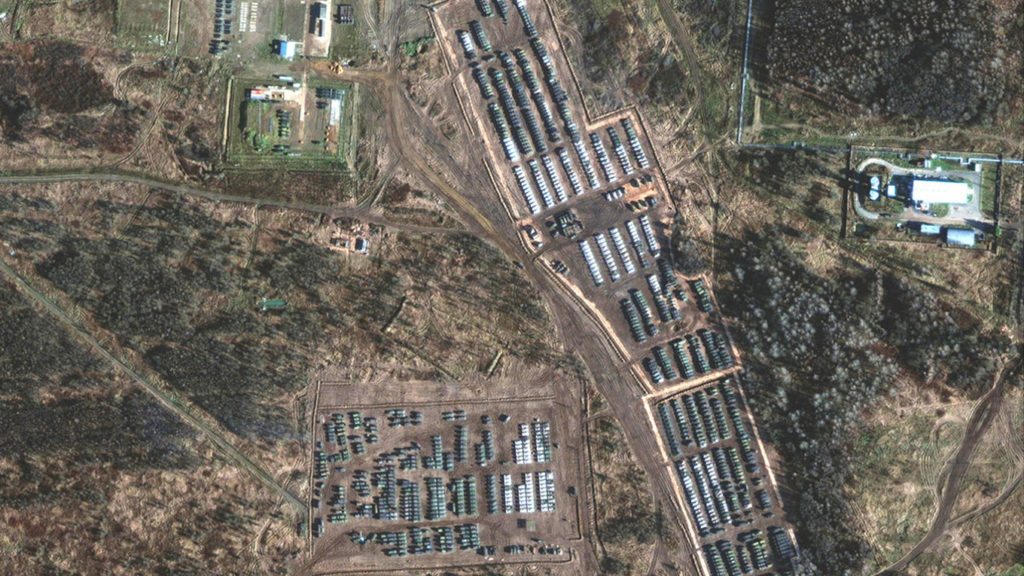
Here is a genuine threat: the current Russian military buildup along the Eastern Ukrainian border. This is not merely a drill. Forward placement of fuel trucks amid multi-platform armoured columns, deployment of field artillery and ground attack aircraft and presence of paratroop units signal real intent. Russia has clearly stated that it will not allow Ukraine to join NATO and will use force to do so. It has a proven track record in this regard, as the 2014 annexation of Crimea and occupation of parts of the Kherson Oblast and Donbas regions attest. Similarly, Russia’s invasion of the Transcaucasia region of Georgia and support for separatist government in South Ossetia and Abkhazia in 2008 was argued along the same lines: Russia would not stand for Georgian integration into NATO because, as is the case with Ukraine today, it is considered a strategically important buffer zone protecting the Russian mainland from Western aggression. Whatever the legitimacy of its rationale, given its proven reputation to use force, its military superiority over Ukraine and the West’s inability to deter it with sanctions and unwillingness to use counter-force to bolster Ukrainian defences, the massing of Russian military units (some 100,000 strong) along Ukraine’s border is very much a threat that will likely lead to action

Russian military forces at staging area near Ukrainian border. Photo: Mazar Technologies.

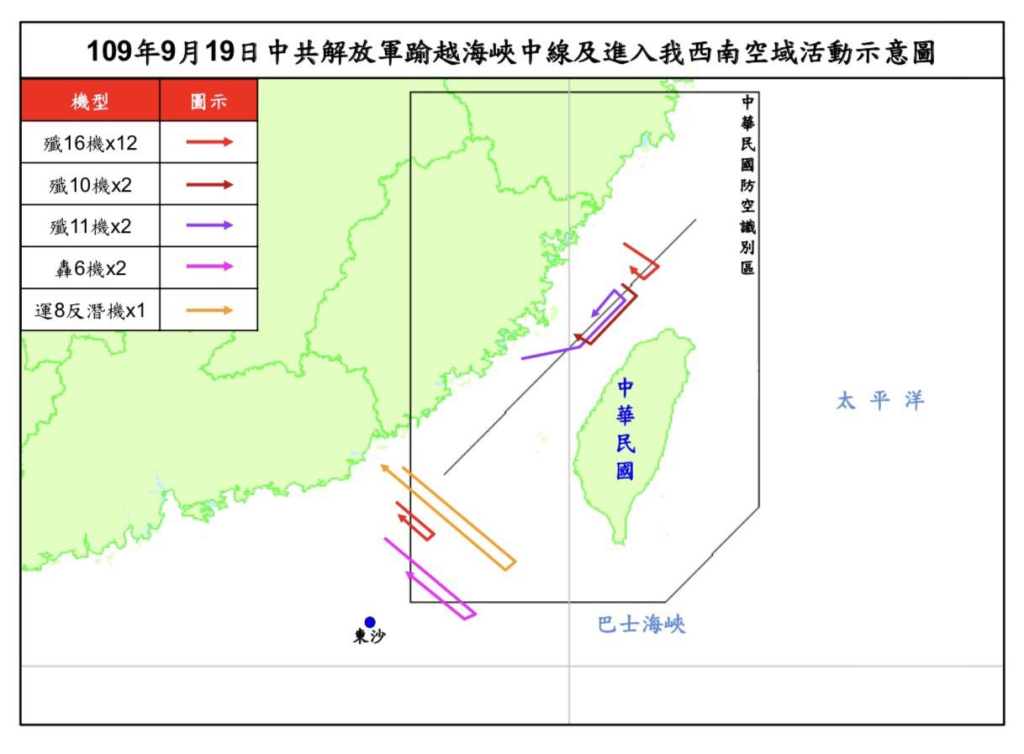
Now consider this contrasting example: we read and hear about how military aircraft from the PRC regularly enter into Taiwanese airspace in order to convey a threat about a potential future invasion. However, the reality is that Chinese warplanes fly sorties in the Taiwanese Air Defence Identification Zone (ADIZ) that includes part of the mainland provinces of Fujian, Zhejiang and Jiangxi as well as parts of the East China Sea (Sea of Japan) and South China Sea. This is is not Taiwanese territorial airspace and the Taiwanese do not bother to respond to most PLAA flights exercising over the mainland. At most, the PLAA flights in the Taiwanese ADIZ can be construed as warnings about future intent and capabilities, but of themselves are not a threat. That would change if PLAA sorties violate Taiwanese sovereign territorial airspace, at which point the threat should be considered real.

The image above is of PLAA sorties into the Taiwanese ADIZ in September 2020, including those that cross the so-called median line that divides the Formosa Strait. The PRC has its own ADIZ that includes all of the airspace above Taiwan as well as the entire East China Sea and most of the northern South China Sea, yet does not assert overflight rights in Taiwanese 12-mile territorial airspace. This belies claims that it is engaging in “threatening” behaviour towards Taiwan, at least for the moment.

The problem with misidentifying PLAA exercises in the ADIZ as threats to Taiwan is that this can lead media commentators and nationalist politicians in the PRC, Taiwan and elsewhere to misread what is happening and prepare accordingly. That in turn creates a classic security dilemma whereby policy makers misperceive or misconstrue what is really happening (warnings) for something that it really is not (threats), prepare as if what is misconstrued is real and, hyped by media-driven nationalist fervor, get locked into pre-emptive or preventative war logics that cause them to stumble into armed confrontations that are otherwise avoidable. At that point the escalatory chain to all-out war is unlocked.

This returns us to the original point of the post. There are practical implications to the misconstruing of or confusion between warnings and threats. Media conflation of warnings and threats can lead to miscalculation and unintended negative consequences. For media types, conceptual and semantic precision is often downplayed in favor of attention-grabbing but erroneous statements. This is particularly the case for headline writers in print and audio-visual media, who want to drive eyeballs onto stories in order to generate clicks or views that in turn translate into advertising revenue.

This logic is impeccable in revenue-generating terms, but the media do not have to suffer the consequences of their terminological imprecision. Those are worn by others, and the others are not just security policy makers in contested spaces.

That is why insisting on discursive precision is not just a pedantic concern. Instead, it is the real-world implications that argue best for analytic, conceptual and terminological precision in foreign policy discussions.