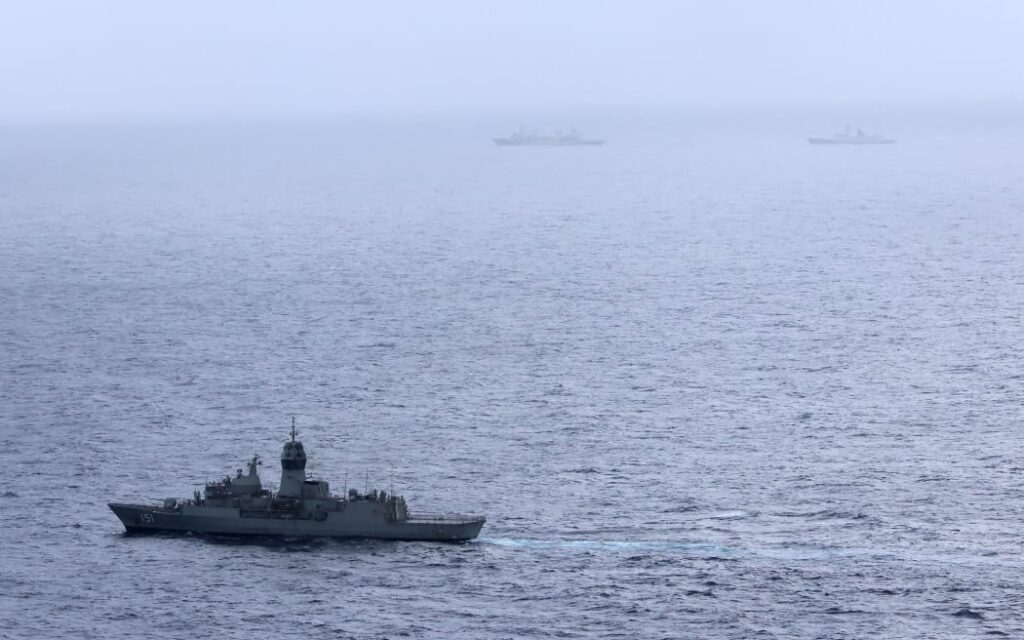
About that PLAN flotilla in the Tasman Sea.

Here are some thoughts about the hysteria surrounding a Chinese Peoples Liberation Army Navy (PLAN) flotilla conducting freedom of navigation exercises in the Tasman Sea, including live fire drills.

1) The flotilla has been tracked for over a week by New Zealand and Australian forces. The tracking began when the flotilla was well NE of the Australian northeastern coast.

HMAS Arunta shadowing PLAN vessels in the Tasman Sea. Source: ADF handout/AFP.

2) The flotilla is operating in accordance with international law and maritime regulations regarding military operations in international waters.

3) The flotilla has no air cover deployed with it and therefore no effective means to defend itself against a coordinated air assault. It is basically a sitting duck for Australian air defences and even NZDF air defences (because the NZDF P8s and Seasprite helicopters carry air to surface munitions as well as torpedos).

4) The flotilla may have a submarine deployed with it.

5) The presence of the PLAN ships in the Tasman is a form of military diplomacy, showing the flag in a distant body of water as a demonstration of blue water power projection capabilities.

6) The PLAN freedom of navigation (FON) exercise in the Tasman Sea may well be a response to a joint Australian-New Zealand FON exercise in the Taiwan Strait in September 2024. Those waters are far more disputed than the Tasman Sea (because the PRC claims them as territorial waters), so the PRC objected to the exercise at the time and declared that it would formulate an appropriate response in due course. This could be it. But the PLAN vessels are far from Australian and NZ territorial waters, so the legality of their presence in open seas is indisputable.

7) The presence of the PLAN flotilla conducting live fire drills (5 conventional surface to surface rounds fired from the Type 055 destroyer Zunyi’s main gun at a floating target, as observed by personnel on the HMNZS Te Kaha) and other exercises is an excellent opportunity for Australian and New Zealand to hone their naval counter-force capabilities, including tactical signals and technical intelligence intercepts and collection from the flotilla. If a submarine is involved then the Antipodean allies can refine their anti-submarine warfare (ASW) capabilities as well, which is exactly what their P8 patrol and ASW aircraft are designed to do. As it stands, Australia and NZ are using air and surface platforms to shadow the PLAN boats.

8) Much has been made about the lack of warning given by the PLAN before the live fire drills. Such warnings are a courtesy, not part of any formal protocol. They are usually issued 12+ hours prior to the drill in order for interested parties such as civilian aviation and maritime operators to plan accordingly and clear away from the target area. The PLAN gave 15 minute warnings, forcing a few planes to adjust course away from the no-fly zone. That was perhaps rude as far as courtesy goes, but nothing more.

9) Most of the hysteria about the flotilla is led by Australian opposition figures in politics and media in an election year. Most of the alarm in New Zealand is led by Sinophobic media commentators or people with little knowledge of military affairs or the nuances of military diplomacy, much less naval operations (especially in NZ). All of them want to tie the exercises to broader Chinese moves in the Southwest Pacific such as the recent bilateral strategic agreement between the PRC and the Cook Islands. For their part, Ministry of Defense officials on both sides have been muted in their response and military officials have been largely silent (presumably because they know what is really happening).

10) It is clear that the PRC is “flexing” its military might in more and more distant places, as any Great Power would do. But not every display of power capability constitutes an imminent threat. Should Australia and NZ pay attention to the exercise? Absolutely, especially because it can be used as a learning tool for their respective naval counter-force platforms. Should they feel threatened by the exercises? Absolutely not. Claims of the exercise posing a threat, being a provocation or an act of intimidation by the PRC betray the biases of those who make such claims. The PRC is just doing what Great Powers do, and if anything it is reminding others of its capabilities while testing them in front of foreign eyes.

Sailors aboard an Australian navy ship look out at Chinese vessels on February 13, picture by the Australian Defence Force

Sailors aboard the HMAS Arunta observe the PLAN flotilla in the Tasman Sea. Source; AFD handout/AFP

11) In the end, if the US, UK, French or other Western navies conducted the exact same exercise in the Tasman Sea, there would be little controversy about it. Because it is the PLAN, however, anti-PRC elements in Australia and New Zealand want to use the occasion to stir up trouble in pursuit of their own agendas. But the truth is that the PRC is not designated as an adversary or hostile state by either Australia or New Zealand, who in fact enjoy largely cordial and beneficial trade relations with the Asian giant. Although there have been moments of friction between Australia and New Zealand, on one hand, and the PRC on the other over a number of political, diplomatic and military strategic issues, and the PRC remains a major concern for the Australian and NZ security communities for a number of reasons, none of this justifies turning what is a relatively small display of power projection into an international incident.

Everyone needs to clam down and relax.

A reminder about soft power.

Waste and fraud certainly exist in foreign aid programs, but rightwing celebration of USAID’s dismantling shows profound ignorance of the value of soft power (as opposed to hard power) in projecting US influence and interests abroad by non-military/coercive means (think of “hearts and minds,” “hugs, not bullets,” “honey versus vinegar,” etc.). Soft power is also a component of “smart power” and “sharp power” strategies in which a combination of foreign policy instruments are used in concert in pursuit of a variety of non-kinetic ends (i.e. objectives short of war).

This razor-gang approach is short-sighted at best and stupid at worst given that the humanitarian/developmental aid vacuum left by US withdrawal from such efforts opens up the field to potential inroads by US rivals. Add to that the fact that USAID pays US farmers around $2 Billion for surplus rice, soy, corn and other agricultural commodities that otherwise would not be grown or go to waste, and the MAGA/DOGE move against USAID is a double-sided own-goal.

The NZ government, which currently is under the sway of MAGA/DOGE-style public policy ideologies, might do good to remember this when it deals with soft power competition in the South Pacific. Waving a (thornless) stick (say, in the form of withdrawal of foreign aid) at Pacific Island Forum countries when they negotiate bilateral economic, diplomatic and developmental aid agreements with non-“traditional” (non-Western/colonial) partners is likely to elicit some blowback of its own.

After all, regardless of the specific compacts agreed to in the past, sovereign States, whatever powers and protections they may have ceded to “traditional” partners, ultimately are autonomous agents of their own destinies. Foreign aid is a good way to remind them that that may be true but destinies can often be intertwined for mutual benefit even if other parties come late to the table.

A turn to the Big Stick.

This is from the 36th Parallel social media account (as brief food for thought).

We know that Trump is ahistorical at best but he seems to think that he is Teddy Roosevelt and can use the threat of invoking the Monroe Doctrine and “Big Stick” gunboat diplomacy against Panama and Greenland to leverage concessions from them. But he is no Teddy Roosevelt and this is not the early 20th century. Trump may find that abrogating Treaties and engaging in coercive diplomacy may suit Putin but may not be the useful tools that he thinks they are when dealing with two friendly democracies/military partners (Rio Treaty/NATO) in today’s world. Who is advising him on this?

Because it smacks of mobster thuggery mixed in with gross ignorance.

Trump’s reasoning appears to be rooted in his fear of Chinese influence in both countries. Chinese firms have invested in Greenland’s strategic minerals sector for over a decade while US and other Western firms have not. Trump and his advisors see this as a threat now that the Arctic Passage is opening thanks to global warming (that Trump refuses to acknowledge much less address), but neither the autonomous Greenland government or the Danish government that oversees it (the relationship between the two is akin to that of NZ and the Cook Islands) seem particularly bothered by their presence and welcome the investment. Even if it stationed military personnel there in WW2 and has mounted Arctic expeditions using military personnel stationed at a Greenland base, the US has no claim to Greenland whatsoever. It is Danish territory with a local independence movement (something that Trump may attempt to exploit), which means that he is eying the internationally recognised territory of a NATO partner for annexation or acquisition.

Since 1996 Hong Kong based maritime transport firms (COSCO in particular) have managed the container terminals at both ends of the canal. The locks are manned by a mixture of Panamanian, US and other nationalities, so the Chinese do not “control” it. Contrary to Trump’s lies, there are no PRC “soldiers” in the Canal Zone and the management of the canal, including passage fees and related levies, are not discriminatory against US-bound, US-originated or US-flagged vessels. Under the terms of the 1977 Panama Canal Treaty that replaced the original Treaty signed in 1903 (in which the US paid Panama a flat sum and yearly rents for a ten-mile swathe of land on either side of the canal), no military personnel other than those of the US and Panama can be stationed in the Canal Zone, and foreign military forces must ask for permission to transit the waterway. The result is that the Canal Zone is sovereign Panamanian territory whose security is partially guaranteed by the US rather than be threatened by it.

As for the invocation of the 1823 Monroe Doctrine as a reason to intervene in Panama, beyond the imperialistic motivations behind it, the reality then and now is that the Doctrine is just a proclamation by one US president backed by military force. Its original focus was on deterring European powers (and Russia) from establishing footholds in the Western Hemisphere but over time it became an umbrella excuse for US interventionism even if it was not particularly effective in preventing the establishment of a Soviet naval base in Cienfuegos, Cuba, or Marxist/Maoist inspired and backed guerrilla revolutionary movements from cropping up throughout the region in the post-WW2 Cold War era.

Most importantly, the Monroe Doctrine has no basis in international or US law. It is not a Treaty (unlike the Panama Canal Treaty) that has been ratified by the US Congress, and therefore has no legal standing. It just survives as a historical relic propped up by notions of customary usage as a general justification for US interventionism in the Western Hemisphere. I had to deal with it when I was the Western Hemisphere Regional Policy Analyst in the Office of the US Secretary of Defense, and let’s just say that US security hawks like it because they believe that it gives them unilateral carte blanche to meddle in Latin American and Caribbean affairs. They now have a chance to test that belief.

For some background on the Panama Canal see these US briefs on how the Panama Canal Treaties came into effect.

https://history.state.gov/milestones/1899-1913/panama-canal#:~:text=In%20his%20new%20role%2C%20Bunau,guarantee%20the%20independence%20of%20Panama.

https://history.state.gov/milestones/1977-1980/panama-canal

The text of the 1977 Treaty restoring Panamanian control over the canal can be found here: https://pancanal.com/wp-content/uploads/2022/07/neutrality-treaty.pdf

About Syria.

I have been thinking about Syria and coverage of the fall of the Assad regime, and to be honest I believe that there is something missing from the picture being painted, at least in NZ. Although I am no expert on Syria or the Middle East, I do have some experience working with irregular and unconventional fighting groups as well as writing about authoritarian regime demise and the modalities by which that occurs. I will therefore take a moment to reflect on what I think is missing.

Media reporting has it that the attack on Aleppo and rapid, two-week drive through Hama and Homs to Damascus was a surprise. That may be true for the media, many non-Syrian laypeople and perhaps the Russians and pro-Assad Syrians themselves, but otherwise I beg to differ. The reason is because the training and massing of rebel fighters in Northern and Central Syria would have taken time (some believe the uprising has been 5-10 years in the making), and would have therefore been detected by Western and regional intelligence services some time ago. If we think about satellite and aerial imagery, signals intercepts, ground based thermal and other technical acquisition capabilities as well as human intelligence on the ground, then consider that Syria and its armed factions are in the middle of a larger geopolitical conflict in the Levant and wider Middle East, and then think about who has a direct vested interest in Syria’s fate (as well as their partners and patrons), it is probably safe to assume that intelligence agencies grouped in the 5 Eyes, Jordan, Turkey, Israel, Egypt, Lebanon, Saudi Arabia, France and/or Germany were monitoring at one level or another developments in rebel-held areas long before the assault on Aleppo was launched.

And then there is the pro-Assad intelligence community.

Perhaps distracted by events elsewhere, the Russians appear to have been genuinely caught off-guard, although it has been reported that they started pulling out personnel from Syria weeks before the attacks began (which would suggest they knew something was about to happen). Likewise, perhaps distracted by their own concerns regarding Israel, Hamas and Hezbollah, the Iranians eventually airlifted key personnel out of Damascus shortly after Aleppo fell, so even if they were blind to the preparations for the uprising, they clearly believed, correctly, that momentum was with the rebels once the assault was launched. More tellingly, weeks ago there were credible claims that the Syrian State had been “hollowed out” by senior officials (i.e. state coffers were raided, corruption and drug-dealing was endemic and public service provision halted), who then fled the country. Make of that what you will.

All of this would have given some clear indications that the Syrian status quo was about to change and Assad and the rest of his henchmen were soon to exit one way or another. What is telling is that the intelligence agencies that would have known about the rebel’s preparations (including NZ via its connections to 5 Eyes and other Western intelligence agencies including Mossad), maintained excellent operational security and did not let it be known, either by leaks or mistakes, that a major coordinated assault by the rebels was in the making. This was done not so much to spite the mainstream corporate media, which clearly had zero boots on the ground in rebel-held areas prior to the assault, but to prevent the Syrians, Iranians, Hezbollah, Hamas and Russians from learning about the uprising before it was underway. By the time the “axis of resistance” realised what was happening, it was too late to do anything but wait, watch and if need be, flee.

Whether the Russian, Syrian and Iranian intelligence failures were caused by them being stretched too thin on the ground, distracted with external events and/or incompetence, there are lessons to be learned learned from their lack of forewarning.

Israel’s successful (at least for now), multi-front campaign against Hamas, Hezbollah, Iran and the Houthis, with some sidebar strikes on Syria thrown in for good measure, degraded the axis of resistance’s capabilities to detect and prevent the uprising. Now it appears that Israel is opening another front in Syria with an eye to significantly changing the geopolitical landscape in the region. Hamas and Hezbollah have been decimated as military forces. Iran has been intimidated into passivity. The Houthis have gone largely silent. This, thanks to Israel’s scorched earth, targeted assassination and long-range missile strike operations against all of them. Now Israel has launched a two-pronged offensive in Syria, conducting a bombing campaign against weapons storage facilities (some containing chemical weapons stockpiles) while simultaneous targeting command and control facilities as well as the entirety of the Syrian Navy (which shares major port facilities with the Russian Mediterranean fleet at the city of Tartus, which in turn raises the question of what will become of the Russian presence there and at a nearby airfield once the rebels seize control of them).

The IDF has also sent ground forces into and beyond the UN-monitored buffer zone separating Syrian control from Israel within and beyond the Golan Heights. Much like in Southern Lebanon, Gaza and the West Bank, Israel has seized the opportunity provided by neighborly discord in order to expand its presence in its neighbours’ territory, perhaps with an eye to redrawing their common borders. Since there is no foreign power capable of stopping Israel or willing to do so, it looks like the Israeli gambit will pay off. But that may depend on what the rebel-led government in Syria does next.

If foreign powers were aware in advance of the rebel’s plans, it is also very likely that they conducted more than passive observation and information-sharing amongst themselves. The US has 900 troops in Syria, most of them US Army Special Forces (Green Berets), Green Berets’ main mission is to train, advise and assist local forces in any given conflict, so it is possible that they had working ties to the rebel groups in advance of the assault on Aleppo. The US also has combat troops stationed in Jordan, Israel and Iraq and a variety of military assets in Turkey, effectively surrounding Syria’s land borders. Likewise, in part because of the lingering presence of ISIS in central and eastern Syria, a number of other countries–NATO members most likely–have special operators and/or military intelligence assets “in theatre.” Turkey acknowledges its military working relationship with one of the rebel groups, the Syrian National Army (SNA) in Northern Syria. The US has close ties to Kurdish insurgents in Northwest Syria and Northwest Iraq. The Jordanians are said to have operatives in Southern Syria and one can assume that, if not an surreptitious military presence, Israel has its covert hand in the pie as well.

What this means is that it is quite possible that foreign forces provided training, advising and intelligence and logistical support in the years, months, weeks and days leading up to and through the assault on Aleppo. If so, it should not be surprising that he rebels maintained an unusual amount of discipline previously unseen in their ranks, and that the various armed factions worked well together, sometimes in coordinated fashion. Even some of their combat fatigues and weapons look new and Western in origin!

So who are these rebels? Basically they are Hayat Tahrir al Sham (HTS), who are the remnants of a group formerly known as Jabbat al-Nusra (Nusra Front), an al-Qaeda and ISIS-connected Islamicist group; the Free Syrian Army (an anti-Assad “secular” group backed by the West); and the afore-mentioned, Turkish-backed SNA. There are also Kurdish PKK/YPG/SDF militias in the mix who control approximately one quarter of Syrian territory east of the Euphrates River (and major oil fields), although these divide their time between mopping up Syrian Army troops in Northeastern Syria and fighting ISIS militants, the SNA, the Turkish military and pro-Turkish militias.

The rebel coalition has formed a tactical alliance against its common enemy. None of the constituent parts are particularly democratic in orientation, and in spite of HST’s claims that it has served all ties with ISIS and does not espouse (Sunni) Islamicist beliefs such as Salafism or Wahhabism, such statements must be taken with a grain of salt. There are numerous reports of lethal attacks on Christians and Alawites (which is a Shiite sect) by rebel forces in Aleppo and Hama, so the proof of the rebel’s good intentions remains to be seen, especially if military discipline has broken down amid the quest for collective revenge.

The sectarian nature of the rebel coalition is worth noting because the Assad regime was Alawite, which is a mostly coastal minority community in an otherwise Sunni-dominated country. Assad reserved many of his governments’ top positions to co-religionists in the Syrian Baath Party (originally related to the Iraqi Baathists led by Saddam Hussein), so retribution and revenge against those who formed the support base and bureaucratic staff of the Assad regime can be expected, HST assurances to the contrary notwithstanding. What is promising is that HST has agreed to form an interim (not yet transitional) government with various sects represented and some carry-overs from the Assad regime appointed in order to restore and/or maintain continuity in public services.

The HST-led government is now focused on rooting out Assad loyalists, imposing social order, securing military and police facilities (including notorious prisons), and bringing public services back to life where possible. But reconstruction of battle-damaged areas will be lengthy and difficult process given that Syria’s treasury has been emptied, many public offices looted and/or damaged, and corruption is rampant within and between various sectarian groups. The international community will be asked to foot the bill and provide the human, material and financial capital required to return the country to some semblance of normalcy. This is complicated but the fact that the HST and PKK/YPGSDF have been designated as terrorist entities by the UN and a number of countries (although for different reasons, with HST designated because of its ties to ISIS and the PKK/YPG/SDF designated at Turkey’s insistence because of their irredentist activities in pursuit of an independent Kurdistan in territory now controlled by Syria, Iraq and Turkey). Before international relief can be offered, the terrorist designations will have to be lifted, something that will not please many interested parties for a variety of reasons.

More broadly, the fall of the Assad regime is one variant of what is known as “bottom-up transitions,” where before the regime is prepared to exit it is forced to do so by public pressure and mass collective action. Bottom-up transitions can stem from revolts, rebellions, general strikes, mass protests and the ultimate sub-type, revolutions (which, unlike the others, involve parametric change in the economy, social order and political society). These are not to be confused with top-down transitions, in which the outgoing regime frames the conditions by which it relinquishes power. This can be done peacefully or by a coup d’état, which is essentially an armed quarrel amongst elites in which the military acts as the arbiter of who wins and loses in the power struggle by siding with those that favour an exit strategy and transition to a different regime type. Examples of peaceful top-down transitions were seen in Brazil in the 1980s and Chile in the 1990s, where power was devolved from military control and handed over to elected civilian rule rather than be overthrown by force.

In Syria as has happened elsewhere, there will be major tensions between so-called “moderates” and “militants” (soft-liners and hard-liners) in the HST-led coalition. Hardliners and militants tend to come from fighting backgrounds. They tend not to seek compromise and conciliation because they have succeeded in imposing their will by force of arms. They are reluctant to forgive their defeated adversaries and many are sworn to avenge the affronts committed against their families, friends and communities (and in Syria, the affronts included atrocities and other forms of barbarism committed by Assad’s forces against the civilian population). Moderates, on the other hand, tend to come from the non-fighting political opposition, religious, business and community leaders and foreign interlocutors. These seek to draw a line behind them when it comes to dealing with the past in order to facilitate the reconstruction of society and promote national reconciliation.

The key to keeping the post-Assad transition relatively peaceful is for the moderates and softliners to gain the upper hand in negotiations to form the new government. For that to happen, inducements and constraints (think carrots and sticks) must be offered to and placed on the militant hardliners. Inducements can include open trials for those accused of heinous crimes committed on Assad’s behalf, placement of senior rebel commanders in leadership roles the Syrian security apparatus, establishment of Truth and Reconciliation Tribunals that address past sins committed on all sides, and even material rewards for those who refrain from continuing to use violence as a means to an end. Constraints could include weapons impoundments, criminal prosecutions, and other legal and material disincentives that discourage continuation of hardline or militant behaviour.

None of this will be easy but it is necessary is stability is to return to Syria. It is possible that the armed factions and their political and social supporters can use the common ground forged fighting the common enemy to expand the basis for commonality into other aspects of Syrian life. It could start with something as simple as national sports or cultural traditions and then move to the more thorny issues of governance, economic accumulation and distribution, religious and secular civil rights, and so forth.

What is clear is that, for the short term at least, the big losers in Syria are Alawites, Iranian and Russians. Assad is gone and his minions routed. Iran has lost its major overland transit route connecting it to Lebanon (Hezbollah) and Palestine (Hamas) as well as the intelligence, forward basing and logistical support of the Assad regime. Russia has lost it foremost ally in the Middle East as well as the intelligence and military assets that it had stationed in Syria prior to Assad’s fall (assuming that the new regime will confiscate the Russian facilities at Tartus and Khmeimim Air Base near Latakia city). Reputationally, both Iran and Russia have taken a major hit with their weaknesses as a security partner now exposed.

Israel appears to be the primary short-term beneficiary of Assad’s overthrow. To a lesser but significant extent, so are Western and Middle Eastern powers with a stake in the Levant. But a longer-term prognosis is more difficult to ascertain because the direction of the HST-led government has yet to be determined, and the post-Assad settling of scores has yet to be decided. Whether or not this involves a return of Islamicists with or without the ISIS brand is foremost among the concerns of many security agencies.

In any event the best we can do is embrace the uncertainties inherent in the moment, attempt where possible to bolster the moderate/softliner positions within the new government and offer concrete steps based on the experience of others as part of the path towards national recovery. History will be the ultimate judge of the process but for the moment all we can say is that we live in interesting times.

Media Link: “A View from Afar” on the lame duck window of opportunity.

In the last episode of this year Selwyn Manning and I discuss the rebel assault on Aleppo in Syria and tit-for-tat missile exchanges between Russia and Ukraine as illustrative of foreign actor attempts to gain geopolitical leverage as part of hedging strategies undertaken before Trump assumes office on January 2025. We had good audience participation and discussion, which you can find here.

Media Link: AVFA on Israel going rogue.

In this episode of the “A view from Afar” podcast Selwyn Manning and I discuss Israel’s expansion of its war in Lebanon as part of a “six front” strategy that it thinks it can win, focusing on the decision-making process and strategic logic at play that led to the most recent turn of events. Plus some game theory references just to place things in proper context.

Media Link: ” A View from Afar” on multidimensional hybrid warfare and the ineffectiveness of multilateral institutions.

This week’s “A View from Afar” podcast addresses the issue of multidimensional hybrid warfare using the Israeli pager attacks in Lebanon as a starting point before moving on to discuss the failures of multilateral institutions, the UN in particular, when it comes to handling war crimes and crimes against humanity. It is a sad state of affairs.

The Murky World of Israel’s Booby-Trapped Pagers and Walkie-Talkies

Media Link: “AVFA” on the politics of desperation.

In this podcast Selwyn Manning and I talk about what appears to be a particular type of end-game in the long transition to systemic realignment in international affairs, in which the move to a new multipolar order with different characteristics than the previous one is marked by conflict, the inevitable friction that ensures from unregulated competition absent universal norms and boundaries of behaviour, and the unfortunate yet predictable turn to politics of desperation by actors who are personally or politically invested into status quos under siege. The consequences of this turn of events is both uncertain and yet likely negative in the end. We use Trump, Netanyahu, Zelensky, Putin, Maduro and Ortega as examples of desperate leadership, although the trend can be extended to other cases as well.

The bottom line is that little if any good can come from the politics of desperation.

Security Politics in Peripheral Democracies; Excerpt Four.

Internal versus external security.

Regardless of who rules, large countries can afford to separate external and internal security functions (even if internal control functions predominate under authoritarian regimes). In fact, given the logic of power concentration and institutional centralization of coercive control that defines them, authoritarian regimes do not completely separate internal police and external military roles. Instead they prefer to overlap (if not fuse) the two (especially when confronted by mobilized internal dissent). In some cases the overlap or fusing is accompanied by an expansion of intelligence services with paramilitary capabilities, most of which are directed against domestic dissent. Conversely, small countries often find that the best way to achieve economies of scale in military matters is to combine some internal and security functions, such as through a national gendarmarie that merges police and paramilitary functions (border control, organized crime interdiction, counter-terrorism, etc.). However, a political problem makes the issue a bit more problematic for small democracies. That is because the combination of internal and external security roles may suit the political needs and threat perceptions of small country authoritarian regimes, but is at odds with the liberal democratic tradition with regards to the management of organized violence by the state.To wit: democratic regimes of all sizes prefer to administratively and legally separate internal police from external military security functions as part of the decentralization of economic, political and normative power that defines them as a system of rule. 

This has traditionally extended into the field of intelligence, although some small democracies such as New Zealand have historically centralized their intelligence gathering services as a matter of economy given their abject reliance on foreign patrons for external intelligence provision. More recently, some liberal democracies, led by the United States, have adopted more integrated approaches towards intelligence gathering in the wake of the September 11, 2001 attacks and subsequent acts of rightwing/white extremist terrorism.  For post-authoritarian regimes such as those of Chile and Portugal, the tension between the urge to centralize internal and external military and intelligence functions versus the normative preference for democratic decentralization became one of the major issues of civil-military relations after the restoration of electoral rule.

Regardless of size, the external/internal division of the combat function versus police duties has been the source of debate with regard to its impact on the ability to fight and win external wars. Some analysts believe that the ability to achieve victory in external wars is not a function of regime type, which means that the external versus internal security dichotomy only matters with regard to domestic control issues. What is most important for victory in conventional war is the relative size of the adversaries, specifically large size (see Desch, 1999). For other authors military preoccupation with domestic security, especially those such as the counter-insurgency operations that was the focus of Latin American national security doctrines in the 1960s-1980s, adversely impact of their ability to carry out external military missions. Here the diversion of resources towards internal warfare, especially when carried out by military authoritarian regimes with political agendas that involve the military as an institution remaining in power for extended periods of time, is a certain recipe for external combat weakness. The Greek invasion of Cyprus in 1973 and 1982 Argentine invasion of the Falkland Islands, done for diversionary reasons by military regimes confronting rising socioeconomic unrest after extended periods of internal repression, are considered emblematic in that regard. 

It should be noted that the argument in favor of internal mission orientation being a drain on the external combat function is based upon the modern experience of recent military authoritarian, not democratic regimes. Even then, those who see no significance to the internal/external combat distinction point to other authoritarian regimes—the Soviet Union, China, Cuba, Vietnam, as well as Nazi Germany and Japan prior to 1942—to argue that the issue is problematic only when the military as an institution occupies the highest political decision-making roles in the regime. Military colonization of the state apparatus outside of its areas of professional expertise, coupled with the politicization of the officer corps that inevitably entails, is widely considered to be deleterious to military professionalism, particularly with regard to the external combat function. If for no other reason than this, many authoritarian regimes as well as all democratic regimes hold axiomatic that the armed forces as an institution, regardless of strategic focus, will subordinate to civilian political authority. The Peoples Republic of China, Cuba, Iran and contemporary Russia conform to this norm.

Whatever the truth of the matter with regard to the internal/external combat orientation and conventional warfare fighting ability, separation of external combat and internal security functions under democratic regimes is a normative preference rather than a practical requirement, even when logistical support infrastructures overlap to a significant degree. It is by no means an immutable norm, since the distinction between combat and police functions can be (and has been) blurred by democratic regimes in the event of major internal unrest or conflict.  In fact, concern with internal threats can and are often a focus of major attention by democratic regimes, as evidenced by Portuguese military concern well into the 1980s with so-called “indirect threats” (Marxist third columns) after the abortive Communist government take-over of 1975.  As a result, analysis of threat perception herein will not be confined to externally focused assessments, and will include internal threat assessment as well. But by and large, the combat function of militaries in democracies is an externally focused enterprise. After all, policing is about law enforcement and disciplining those who would violate universal standards of mores, norms and acceptable codes of social conduct; military combat is about killing foreign enemies of the state. Rather than maintaining domestic law and order, it is in carrying out the latter task where small democracies are at a disadvantage.

Because of the benefits conferred by size, the combat role of the armed forces in small democracies (demographically defined as those with populations under 20 million) is generally limited to being the junior partners of multi- or bi-national external military alliances, rather than the ultimate guarantors of national self-defense. Armed forces in small democracies most often serve as territorial and border patrols, be it at sea in the case of maritime nations such as Chile, Portugal and New Zealand, or on land as in the case of Chile and Portugal, or as an internal reserve should civil disorder assume mass proportions unmanageable by the police (as in New Zealand).  For most small democracies, contributions to larger security alliances pay dividends in the form of national defense being guaranteed by collective security reciprocities within those alliances. Some may choose to enhance value per soldier in the form of combat specialization, to include special operations (such as the New Zealand Special Air Services, or SAS, which often are attached to British or Australian SAS units when deployed overseas). Others may prefer to deploy troops for humanitarian and police operations such as nation building and peacekeeping under multinational aegis (where New Zealand has extensive experience with “blue helmet” deployments). In such missions the skills utilized are more akin to civil defense and disaster relief infrastructure. In any event, the nature of these commitments and missions differ, which brings up the question of political justification, mission definition, operational control–and of mission creep.

There is a two-fold external orientation among the militaries of small democratic regimes. The armed forces of small democracies tied to formal military alliance structures like NATO or ASEAN tend to specialize in defined combat roles (such as long range patrol and tracking) as part of joint force integration with their larger partners. In doing so they respond to the political justifications for the use of force offered by their larger allies, and seldom have their specific national interests at stake or used as a primary rationale for the deployment of troops abroad. This is sold to domestic constituencies as the necessity of burden sharing, where the protection afforded by larger allies is the return on the investment of troops in the larger conflicts those allies may be involved in.

On the other hand, the armed forces of small democracies with independence of mind and a non-aligned posture often seek refuge under the multilateral umbrella of United Nations mandates. Participation in “blue helmet” exercises such as peacekeeping and nation-building gives reason for keeping troops on the payroll, thereby offering a bureaucratic rationale of self-preservation for the military as an institution. Here the political justification for the external deployment of troops responds to the broader concerns of the international community as expressed through the United Nations or regional security agencies. It has a basis in self-interest because it reaffirms notions of mutual self-defense that smaller states embrace as a deterrent against the unilateral depredations of larger states. It also reaffirms the role of the armed forces in providing for the well being of others as well as being the last line of national defense. It is seen to encourage military professionalism via collaborative exposure to and interaction with other military forces. 

The international role of the armed forces in such cases is mostly directed towards engineering, medical and police support, often in concert with civilian non-governmental or multinational organizations. These not only can be deployed internally in the case of an emergency, but also serve as human resource training for skilled labor inputs to the domestic market (the two sides of its internal support role). The combat function, although trained for, is clearly subordinate to the humanitarian and other non-lethal functions of the military apparatus.

Next: The Military Politics “Partial Regime.”

Security Politics in Peripheral Democracies: Excerpt Three.

The notion of geopolitical  periphery.”

The concept of periphery used here refers strictly to what can be called the geopolitical periphery. Being on the geopolitical periphery is an analytic virtue because it makes for more visible policy reform in response to changing external conditions. It is defined as a situation where a nation is engaged in, but not central to the pressing military-security issues of the moment, be it through direct engagement in conflict or involvement in larger alliance decision-making. It does not refer to the core-periphery distinction commonly used by worlds-systems theory and its successors, and as the case sample shows, it is not a product of the global North versus South divide. It does not refer to economically peripheral countries in a context of regionalization and globalization of production, trade and exchange, although it acknowledges the overlap that may occur between economic and military integration processes. As used here “periphery” is not synonymous with “marginality.” The differentiation is based on the fact that these countries are involved, even if not by choice, in the overarching military-security engagements of recent times. They are not excluded from them. Moreover, when it comes to regimes, “marginal” implies instability or inconsequentiality of the regime. Yet the first criterion for selection used here is not the relative stability or consequence of the regimes in question (although democratic regime stability is a factor in the analysis of the case studies), but their relative distance from international military-security decision-making during fluid times. 

It is this commonality that binds the case studies together as a sample: their relative distance from the decision-making that governs the major conflicts of the last two decades. After all, none of these countries has a vital national interest at stake in these conflicts other than a commitment to international norms and principles and support for larger allies. This does not mean that they are inconsequential in the scheme of things, or as analytic subjects. To the contrary, as actors that must respond to changing external conditions without having decisive influence in the decision-making that created them, small peripheral democracies are excellent subjects for the study of policy reform in fluid times, be it in the field of military politics or others. This is due to what might be called the “ripple effect” of world politics: ideological and policy change in the center has a stronger impact the further from the center of decision-making, but still connected to it, that a country gets. As a result small peripheral democracies are, in a phrase, microanalytic barometers of larger international trends (see Buchanan and Nicholls, 2003).

What these countries all share is physical distance from the major political and military power centers around which issues of global security revolve, and physical distance from the military conflicts in which their armed forces are involved. Physical distance in large measure determined their traditional status on the geopolitical periphery. Portugal is located on the southwestern corner of Europe, Chile on the southwestern edge of the Western Hemisphere, New Zealand in the southwestern corner of the Pacific Rim. This has historically given them a measure of insulation from direct threats by larger adversaries (Portuguese concerns about Spain and Chilean concerns about Argentina, Bolivia and Peru notwithstanding), as well as physical distance from the major conflicts of the twentieth and early twenty first centuries. Even so, given the global reach of military power mentioned earlier, their relation to global conflicts has been more political than physical, in the form of neutrality or alliance with larger powers. 

That has been reflected in their approaches towards World War Two, the Korean War and Vietnam conflict. Remaining neutral in World War Two, Portugal spent decades on the outskirts of NATO decision-making in spite of its being a founding member of the alliance. Chile, another neutral in World War Two (although, like Portugal, its Axis sympathies were undisguised), was by 1970 no more than, in the words of Henry Kissinger, “a dagger pointed at the heart of Antarctica.” Militarily, New Zealand offered its subjects to a variety of UK and US-led wars during the twentieth century and well into the next. These make for different legacies when confronting the current context in which security politics are constructed. The bottom line is that it is, first and foremost, spatial location that makes these countries members of the geopolitical periphery, a situation that continues to do this day. From that point the political aspects of the military-security equation can be factored in.

The consequences of these legacies are discussed ahead. For the purposes of the argument, the focus here is exclusively on geopolitically peripheral democracies, nations that reside on the geographic fringe of the major military alliances and coalitions that have dominated the world scene in the last 25 years, although continuing to have ongoing involvement or engagement with them. As it turns out, the reasons for geopolitically peripheral status differ among the cases, something that in turn has an impact on the way in which each country has approached the changing international security environment of the last two decades.

Next: Internal versus External Security.