Redrawing the lines.

Early this year I was asked by a media outlet to appear and offer predictions on what will happen in world affairs in 2022. That was a nice gesture but I wound up not doing the show. However, as readers may remember from previous commentary about the time and effort put into (most often unpaid) media preparation, I engaged in some focused reading on international relations and comparative foreign policy before I decided to pull the plug on the interview. Rather than let that research go to waste I figured that I would briefly outline my thoughts about that may happen this year. They are not so much predictions as they are informal futures forecasting over the near term horizon.

The year is going to see an intensification of the competition over the nature of the framework governing International relations. If not dead, the liberal institutional order that dominated global affairs for the better part of the post-Cold War period is under severe stress. New and resurgent great powers like the PRC and Russia are asserting their anti-liberal preferences and authoritarian middle powers such as Turkey, North Korea, Saudi Arabia and Iran are defying long-held conventions and norms in order to assert their interests on the regional and world stages. The liberal democratic world, in whose image the liberal international order was ostensibly made, is in decline and disarray. In this the US leads by example, polarized and fractured at home and a weakened, retreating, shrinking presence on the world stage. It is not alone, as European democracies all have versions of this malaise, but it is a shining example of what happens when a superpower over-extends itself abroad while treating domestic politics as a centrifugal zero sum game.

While democracies have weakened from within, modern authoritarians have adapted to the advanced telecommunications and social media age and modified their style of rule (such as holding legitimating elections that are neither fair or free and re-writing constitutions that perpetuate their political control) while keeping the repressive essence of it. They challenge or manipulate the rule of law and muscle their way into consolidating power and influence at home and abroad. In a number of countries democratically elected leaders have turned increasingly authoritarian. Viktor Orban In Hungary, Recep Erdogan in Turkey, Rodrigo Duterte in the Philippines, and Narendra Modi in India (whose Hindutva vision of India as an ethno-State poses serious risks for ethnic and religious minorities), all evidence the pathology of authoritarianism “from within.”

Abroad, authoritarians are on the move. China continues its aggressive maritime expansion in the East and South China Seas and into the Pacific while pushing its land borders outwards, including annexing territory in the Kingdom of Bhutan and clashing with Indian troops for territorial control on the Indian side of their Himalayan border. Along with military interventions in Syria, Libya and recently Kazakstan, Russia has annexed parts of Georgia and the Donbas region in eastern Ukraine, taken control of Crimea, and is now massing troops on the Ukrainian border while it demands concessions from NATO with regard to what the Russians consider to be unacceptable military activity in the post-Soviet buffer zone on its Western flank. The short term objective of the latest move is to promote fractures within NATO over its collective response, including the separation of US security interests from those of its continental partners. The long term intention is to “Findlandize” countries like Ukraine, Estonia, Latvia and Lithuania so that they remain neutral, or at least neutralized, in the event of major conflict between Russia and Western Europe. As Churchill is quoted as saying, but now applied to Vladimir Putin, “he may not want war. He just wants the fruits of war.”

>>Aside about Russia’s threat to the Ukraine: The Russians are now in full threat mode but not in immediate invasion mode. To do that they need to position water and fuel tankers up front among the armoured columns that will be needed to overcome Ukrainian defences, and the 150,000 Russian troops massed on the eastern Ukrainian border are not sufficient to occupy the entire country for any length of time given Ukrainian resistance capabilities, including fighting a protracted guerrilla war on home soil (at least outside Russian ethnic dominant areas in eastern Ukraine). The Russians know that they are being watched, and satellite imagery shows no forward positioning of the logistical assets needs to seize and hold Ukrainian territory for any length of time. Paratroops and light infantry cannot do that, and while the Russians can rapidly deploy support for the heavier forces that can seize and hold hostile territory, this Russian threat appears to be directed, at best, at a limited incursion into Russian-friendly (read ethnic) parts of eastern Ukraine. That gives the Ukrainians and their international supporters room for negotiation and military response, both of which may be essential to deter Russian ambitions vis a vis the fundamental structure and logic of European security.<<

Rather than detail all the ways in which authoritarians are ascendent and democrats descendent in world affairs, let us look at the systemic dynamics at play. What is occurring is a shift in the global balance of power. That balance is more than the rise and decline of great powers and the constellations aggregated around them. It is more than about uni-, bi-, and multipolarity. It refers to the institutional frameworks, norms, practices and laws that govern the contest of States and other international actors. That arrangement—the liberal international order–is what is now under siege. The redrawing of lines now underway is not one of maps but of mores.

The liberal international order was essentially a post-colonial creation made by and for Western imperialist states after the war- and Depression-marked interregnum of the early 20th century. It did not take full hold until the collapse of the Soviet Union, as Cold War logics led to a tight bipolar international system in which the supposed advantages of free trade and liberal democracy were subordinated to the military deterrence imperatives of the times. This led to misadventures and aberrations like the domino theory and support for rightwing dictators on the part of Western Powers and the crushing of domestic political uprisings by the Soviets in Eastern Europe, none of which were remotely “liberal” in origin or intent.

After the Cold War liberal internationalists rose to positions of prominence in many national capitals and international organizations. Bound together by elite schooling and shared perspectives gained thereof, these foreign policy-makers saw in the combination of democracy and markets the best possible political-economic combine. They consequently framed much of their decision-making around promoting the twin pillars of liberal internationalism in the form of political democratization at the national level and trade opening on a global scale via the erection of a latticework of bi- and multilateral “free” trade agreements (complete with reductions in tariffs and taxes on goods and services but mostly focused on investor guarantee clauses) around the world.

The belief in liberal internationalism was such that it was widely assumed that inviting the PRC, Russia and other authoritarian regimes into the community of nations via trade linkages would lead to their eventual democratization once domestic polities began to experience the material advantages of free market capitalism on their soil. This was the same erroneous assumption made by Western modernization theorists in the 1950s, who saw the rising middle classes as “carriers” of democratic values even in countries with no historical or cultural experience with that political regime type or the egalitarian principles underbidding it. Apparently unwilling to read the literature on why modernization theory did not work in practice, in the 1990s neo-modernization theorists re-invented the wheel under the guise of the Washington Consensus and other such pro-market institutional arrangements regulating international commerce.

Like the military-bureaucratic authoritarians of the 1960s and 1970s who embraced and benefited from the application of modernization theory to their local circumstances (including sub-sets such as the Chicago School of macroeconomics that posited that finance capital should be the leader of national investment decisions in an economic environment being restructured via the privatization of public assets), in the 1990s the PRC and Russia welcomed Western investment and expansion of trade without engaging in the parallel path of liberalizing, then democratizing their internal politics. In fact, the opposite has occurred: as both countries became more capitalistic they became increasingly authoritarian even if they differ in their specifics (Russia is a oligopolistic kleptocracy whereas the PRC is a one party authoritarian, state capitalist system). Similarly, Turkey has enjoyed the fruits of capitalism while dismantling the post-Kemalist legacy of democratic secularism, and the Sunni Arab petroleum oligarchies have modernized out of pre-capitalist fossil fuel extraction enclaves into diversified service hubs without significantly liberalizing their forms of rule. A number of countries such as Brazil, South Africa and the Philippines have backslid at a political level when compared to the 1990s while deepening their ties to international capital. Likewise, after a period of optimism bracketed by events like the the move to majority rule in South Africa and the “Arab Spring,” both Saharan and Sub-Saharan Africa have in large measure reverted to the rule of strongmen and despots.

As it turns out, as the critics of modernisation theory noted long ago, capitalism has no elective affinity for democracy as a political form (based on historical experience one might argue to the contrary) and democracy is no guarantee that capitalism will moderate its profit orientation in the interest of the common good.

Countries like the PRC, Russia, Turkey and the Arab oligarchies engage in the suppression and even murder of dissidents at home and abroad, flouting international conventions when doing so. But that is a consequence, not a cause of the erosion of the liberal international order. The problem lies in that whatever the lip service paid to it, from a post-colonial perspective liberal internationalism was an elite concept with little trickle down practical effect. With global income inequalities increasing within and between States and the many flaws of the contemporary international trade regime exposed by the structural dislocations caused by Covid, the (neo-)Ricardian notions of comparative and competitive advantage have declined in popularity, replaced by more protectionist or self-sufficient economic doctrines.

Couple this with disenchantment with democracy as an equitable deliverer of social opportunity, justice and freedom in both advanced and newer democratic states, and what has emerged throughout the liberal democratic world is variants of national-populism that stress economic nationalism, ethnocentric homogeneity and traditional cultural values as the main organizing principles of society. The Trumpian slogan “America First” encapsulates the perspective well, but support for Brexit in the UK and the rising popularity of rightwing nationalist parties throughout Europe, some parts of Latin America and even Japan and South Korea indicates that all is not well in the liberal world (Australia and New Zealand remain as exceptions to the general rule).

That is where the redrawing comes in. Led by Russia and the PRC, an authoritarian coalition is slowly coalescing around the belief that the liberal international order is a post-colonial relic that was never intended to benefit the developing world but instead to lock in place an international institutional edifice that benefitted the former colonial/imperialist powers at the expense of the people that they directly subjugated up until 30-40 years ago. What the PRC and Russia propose is a redrawing of the framework in which international relations and foreign affairs is conducted, leading to one that is more bound by realist principles rooted in power and interest rather than hypocritically idealist notions about the perfectibility of humankind. It is the raw understanding of the anarchic nature of the international system that gives the alternative perspective credence in the eyes of the global South.

Phrased differently, there is truth to the claims that the liberal international order was a post-colonial invention that disproportionally benefitted Western powers. Because the PRC and USSR were major supporters of national liberation and revolutionary movements throughout the so-called “Third World” ranging from the Middle East, Sub-Saharan Africa, Central and SE Asia to Central and South America, they have the anti-Western credentials to promote a plausible alternative cloaked not in the mantle of purported multilateral ideals but grounded in self-interested transactions mediated by power relationships. China’s Belt and Road initiative is one example in the economic sphere, and Russian military support for authoritarians in Syria, Iran, Cuba and Venezuela shows that even in times of change it remains steadfast in its pragmatic commitment to its international partners.

With this in mind I believe that 2022 will be a year where the transition from the liberal international order to something else will begin to pick up speed and as a result lead to various types of conflict between the old and new guards. What with hybrid or grey area conflict, disinformation campaigns, electoral meddling and cyberwarfare all now part of the psychological operations mix along with conventional air, land, sea and space-based kinetic military operations involving multi-domain command, control, communications, computing, intelligence, surveillance, reconnaissance and robotics (C4ISR2) systems, the ways in which conflict can be engaged covertly or overtly have multiplied. That technological fact means that it is easier for international actors, or at least some of them, to act as disruptors of the global status quo by using conflict as a systemic re-alignment vehicle.

Absent a hegemonic power or Leviathan, a power vacuum has opened in which the world is open to the machinations of (dare I say it?) “charismatic men of destiny.” Putin, Xi Jingpin and other authoritarians see themselves as such men. Conflict will be the tool with which they attempt to impose their will on international society.

For them, the time is now. With the US divided, weakened and isolated after the Trump presidency and unable to recover quickly because of Covid, supply chain blockages, partisan gridlock and military exhaustion, with Europe also rendered by unprecedented divisions and most of the rest of the world adopting“wait and see” or hedging strategies, the strategic moment is opportune for Russia, China and lesser authoritarian powers to make decisive moves to alter the international status quo and present the liberal democratic world with a fait accompli that is more amenable to their geopolitical interests.

If what I propose is correct, the emerging world system dominated by authoritarian States led by the PRC and Russia will be less regulated (in the sense that power politics will replace norms, rules and laws as the basic framework governing inter-state relations), more fragmented (in that the thrust of foreign policies will be come more bilateral or unilateral rather than multilateral in nature), more coercive and dissuasive in its diplomatic exchanges and increasingly driven by basic calculations about power asymmetries (think “might makes right” and “possession is two thirds of the law”). International organisations and multilateral institutions will continue to exist as covers for State collusion on specific issues or as lip service purveyors of diplomatic platitudes, but in practice will be increasingly neutralised as deliberative, arbitrating-mediating and/or conflict-resolution bodies. Even if not a full descent into international anarchy, there will be a return to a Hobbesian state of nature.

2022 could well be the year that this begins to happen.

Update: For an audio short take on what 20022 may bring, please feel free to listen to the first episode of season three of “A View from Afar,” a podcast that offers a South Pacific perspective on geopolitical and strategic affairs co-hosted by Selwyn Manning and me.
A democratic peace or a feminist peace?

Many years ago when I was in mid academic career, two theoretical strands emerged in the field of international relations and comparative foreign policy. One was the basis for a school of thought that came to be known as feminist international relations theory, which to crudely oversimplify one sub-strand, posited that women have different and less conflictual approaches to politics and therefore, among other things, a world that had more female leaders would likely be a more peaceful one. The second came out of the the democratization literature and, again crudely oversimplified, posited that democracies were less prone to engage in war and therefore a world with more democracies would be a more peaceful one. Although neither strand specifically addressed the possibility, one can infer that if these notions are true a world of women-led democracies would be a Garden of Eden when compared to its present state. 

The two strands have existed in parallel since the early 1990s and continue to be much debated, refined, debunked, reformulated and extended. Arguments over the merits of each continue to this day even though I personally have not contributed to them like I once did (and to be honest I only contributed in an insignificant way to what is known as the democratic peace thesis debate and not the feminist IR debate, which is a minefield for male scholars).

Recently a good friend whose views I hold in high regard sent me an article titled ” The Gender Gap Is Taking Us to Unexpected Places” by Thomas B. Edsall of the New York Times (January 12, 2022). Mr. Edsall is an astute reader of politics and his column is well worth following. His article covers a lot of ground and is worth reading in its entirety but what struck me was this discussion of women’s impact on politics. I have quoted the relevant passage.


“Take the argument made in the 2018 paper “The Suffragist Peace” by Joslyn N. Barnhart of the University of California-Santa Barbara, Allan Dafoe at the Center for the Governance of AIElizabeth N. Saunders of Georgetown and Robert F. Trager of U.C.L.A.:

Preferences for conflict and cooperation are systematically different for men and women. At each stage of the escalatory ladder, women prefer more peaceful options. They are less apt to approve of the use of force and the striking of hard bargains internationally, and more apt to approve of substantial concessions to preserve peace. They impose higher audience costs because they are more approving of leaders who simply remain out of conflicts, but they are also more willing to see their leaders back down than engage in wars.

The increasing incorporation of women into “political decision-making over the last century,” Barnhart and her co-authors write, raises “the question of whether these changes have had effects on the conflict behavior of nations.”

Their answer: “We find that the evidence is consistent with the view that the increasing enfranchisement of women, not merely the rise of democracy itself, is the cause of the democratic peace.” Put another way, “the divergent preferences of the sexes translate into a pacifying effect when women’s influence on national politics grows” and “suffrage plays a direct and important role in generating more peaceful interstate relations by altering the political calculus of democratic leaders.”

That is a pretty strong claim with important implications for the recruitment of women into political management roles. My friend and I corresponded about the article and I thought that it would provide some food for thought for KP readers if I copied and reprinted some of my commentary to her. It is by no means a scholarly treatise or deeply grounded in the literatures pertinent to the subject, but it addresses the issue of whether women’s participation in politics leads to more peaceful/less conflictual political outcomes. Here is what I had to say (in quotes).

“Interesting thesis (that the enfranchisement of women, not democracy per se, contributes to the democratic peace thesis). Of course there has long been a view that if we only had more women in politics there would be less conflict. Tell that to Maggie Thatcher!

In the late 1980s I supervised student research that analyzed the impact of women in revolutionary movements on post-revolutionary social policy agendas. The cases studied were Cuba, Nicaragua, Colombia and El Salvador (two successful revolutions, two peace process-incorporated revolutionary movements so as to allow for proper comparative analysis using a most-similar/most different paired case study design). The results found that the more women participated in combat roles during the revolutionary wars, the more likely that they would be included in post-revolutionary policy decision-making, especially in traditionally female policy areas like family planning, health, education etc. Abortion rights were tied to that as well.

In places where women served as camp followers, concubines, cooks and in other non-combat roles tied to the revolutionary armies, they were excluded from post-revolutionary social policy making, even in traditionally female policy areas. The conclusion my student drew was that men respected women who fought alongside them and took the risks inherent in doing so. In my own experience and study, I have also found that under fire women were/are no more or less cowardly than men, by and large, especially when they received the same guerrilla training, so I accept this view. My student’s research also showed that the reverse was true: men did not respect as equals women who fulfilled “traditional” non-combat roles. 

This translated into very different attitudes towards incorporating women into the leadership cadres once the revolution was over (be they as part of a victorious coalition or when incorporated into post-settlement political parties and governments). That was especially the case for women who showed combat leadership skills under fire, in many cases due to the fact that so many male field-level guerrilla leaders were killed that women were forced step into the breach (sometimes from non-combat roles) in order to sustain the fight.

So basically, if women behaved “like men” in combat, they were accorded respect and inclusion in post-revolutionary policy making, at least in traditionally female policy areas. Or as I used to joke, can you imagine the reaction of these Sandinista sisters coming home from a hard day arguing with their male revolutionary leaders about neonatal and early childhood health care, abortion rights and domestic violence mitigation, only to have their oaf male partners shout out from the sofa that she/they should get him another cerveza? Let’s just say that there would be no “yes, dear” in their responses.

That was an interesting but incomplete conclusion. I am among other things a student of the path-dependency institutionalist school of comparative politics. That is, current institutions are the product of previous choices about those institutions, which in turn set the boundaries for future choices about those institutions. Once a choice is made about the purpose and shape of an agency or institution, it leads down a path of subsequent “bounded” choices–that is, choices made within the framework or confines established by the original choice. I often use Frost’s poem “The Road Not Taken” or the phrase “a path less chosen” to illustrate the concept. You come to a fork on the trail, and your (hiking) destiny is determined by which route you take. There might be a hungry grizzly on one, and a pristine mountain lake bordering on a serene meadow on the other, but you do not know that at the time you make your decision OR, you know what is ahead and steer accordingly with purposeful intent.

Political institutions are by and large created by and for men. They are masculine in that sense–they arise from the minds of men about how politics should be codified and operationalised. The original choices on institutional configuration and mores were made by and for men, as have most of what followed regardless of regime type. The comment in Edsell’s article about academia being a male domain (up until recently) that channels male competitive urges about status etc. into scholarship is true for political institutions as well (and business, needless to say). Now here is where things get tricky.

For women to do well in these male domains, they must initially “outboy the boys.” Early feminists confronted this in spades, and when they did play hard just like the boys, they were called dykes and worse regardless of their true sexuality. But the problem is deeper than misogynist weirdness and reactions. As the study of revolutionary women showed, they had to adopt male roles and behave as if or just like they were men in order to advance in the organization and achieve ultimate policy goals that were female in orientation. They had to play along in order to not only get along but to move the policy needle in a “feminine” or female-focused direction. But that meant being less feminine in order to prosper. No softness, no weakness (emotional or physical), no “girly” concerns (say, like lipstick or nice clothes) were permissible because that relegated them, IN THE EYES OF MEN, as too fragile and irrational to be respected as peers.

Extending the concept from revolutionary movements to democracies, what that means is that women entering into politics have to conform to the masculine attributes of the institutions that they have entered. Sure, they can change cosmetic things like male-only cigar lounges or dining rooms, but the entire vibe/aura/mana of these institutions is male-centric in everything that they do. Add to that institutional inertia–that is, the tendency of institutions to favor carrying forward past practices and mores (often in the name of “tradition” or “custom and usage”)–and what we get is women who are politically socialized by the institutions that they join to behave in masculine ways, at least when within the institution and carrying out the roles assigned to them by the institution. That makes changing the institution more important than changing the people within it, but that is also why institutions are loath to change (think of resistance to changing the US from a presidential two-party system to a parliamentary MMP-style system). Perhaps the NZ Green Party are onto something with their gender-balanced party caucus selections, but they remain inserted in a larger parliamentary “nested game” with origins and continuities grounded in masculinist behaviour and perceptions.

More broadly, just like we are a product of our upbringings moderated by the passage of time and experience, so too women in politics are institutionally socialized to respond and behave in certain ways. And those ways are masculine, not feminine. If the bounded rationalities of the institutional nested games in which women “play” are male-centric/dominant, then it is unsurprising that women who succeed in them do so because they adopt those rationalities as their own (even if their better angels incline them to more “feminine” approaches to institutional problem-solving). That includes the propensity for conflict and war.

Of course this is not a hard and fast universal rule. Jacinda Ardern is not Helen Clark. But then think of Hillary Clinton as well as Margaret Thatcher. Or Michelle Bachelet. Or Helen Clark if NZ was deliberately attacked in some fashion. I do not think that she would opt for compromise and concession rather than conflict, and I sure as heck do not think that Hillary would turn the other cheek when it comes to Putin invading the Ukraine. But what turned these young idealists into the battle axes they are now? I would suggest that it is their political socialization within masculine institutions.

So, as I mentioned, the franchise of women=less conflict thesis is intriguing but needs more work. Male and female traits and values may be the independent variables and propensity towards or against conflict may be the dependent variable, but the intervening variable is institutions, and more specifically, the bounded rationalities of the nested games that they impose on men and women because of the path-dependent nature of their histories as human agencies. Once we get that figured out and change the masculine nature of pretty much 90 percent of human institutions, then perhaps we will have a chance at a more peaceful world. But with lots of snark.”

Reader’s views are welcome.

The incremental shift.

In the build up to the Xmas holidays I was interviewed by two mainstream media outlets about the recently released (December 2021) Defence Assessment Report and last week’s 5 Eyes Communique that included New Zealand as a signatory. The common theme in the two documents was the threat, at least as seen through the eyes of NZ’s security community, that the PRC increasingly poses to international and regional peace and stability. But as always happens, what I tried to explain in hour-long conversations with reporters and producers inevitably was whittled down into truncated pronouncements that skirted over some nuances in my thought about the subject. In the interest of clarification, here is a fuller account of what is now being described as a “shift” in NZ’s stance on the PRC.

Indeed, there has been a shift in NZ diplomatic and security approaches when it comes to the PRC, at least when compared to that which operated when he Labour-led coalition took office in 2017. But rather than sudden, the shift has been signalled incrementally, only hardening (if that is the right term) in the last eighteen months. In July 2020, the the wake of the ill-fated Hong Kong uprising, NZ suspended its extradition treaty with Hong Kong, citing the PRC passage of the Security Law for Hong Kong and its negative impact on judicial independence and the “one country, two systems” principle agreed to in the 1997 Joint UK-PRC Declaration on returning Hong Kong to Chinese control. At the same time NZ changed its sensitive export control regime so that military and “dual use” exports to HK are now treated the same as if they were destined for the mainland. 

In November 2020 NZ co-signed a declaration with its 5 Eyes partners condemning further limits on political voice and rights in HK with the postponment of Legislative elections, arrests of opposition leaders and further extension of provisions of the mainland Security Law to HK. The partners also joined in condemnation of the treatment of Uyghurs in Yinjiang province. In April 2021 Foreign Minister Nanaia Mahuta gave her “Dragon and Taniwha” speech where she tried to use Maori allegories to describe the bilateral relationship and called for NZ to diversify its trade away from overly concentrated partnerships, using the pandemic supply chain problems as an illustration as to why.

She also said that NZ was uncomfortable with using the 5 Eyes intelligence partnership as a public diplomacy tool. I agree completely with that view, as there are plenty of other diplomatic forums and channels through which to express displeasure or criticism. The speech did not go over well in part because NZ business elites reacted viscerally to a large tattooed Maori woman spinning indigenous yarns to a mainly Chinese and Chinese-friendly audience (and other foreign interlocutors further afield). From a “traditional” (meaning: white male colonial) perspective the speech was a bit odd because it was long on fable and imagery and short on “hard” facts, but if one dug deeper there were plenty of realpolitik nuggets within the fairy dust, with the proper context to the speech being that that Labour has an agenda to introduce Maori governance principles, custom and culture into non-traditional policy areas such as foreign policy. So for me it was the balancing act bookended by the trade diversification and 5 Eyes lines that stood out in that korero.

Less than a month later Prime Minister Ardern spoke to a meeting of the China Business Summit in Auckland and noted that “It will not have escaped the attention of anyone here that as China’s role in the world grows and changes, the differences between our systems – and the interests and values that shape those systems – are becoming harder to reconcile.” That hardly sounds like appeasement or submission to the PRC’s will. Even so, Mahuta and Ardern were loudly condemned by rightwingers in NZ, Australia, the UK and US, with some going so far as to say that New Zealand had become “New Xiland” and that it would be kicked out the 5 Eyes for being soft on the Chinese. As I said at the time, there was more than a whiff of misogyny in those critiques.

In May 2021 the Labour-led government joined opposition parties in unanimously condemning the PRC for its abuse of Uyghur human rights. The motion can be found here.

In July 2021 NZ Minister of Intelligence and Security Andrew Little publicly blamed China-based, state-backed cyber-aggressors for a large scale hacking attack on Microsoft software vulnerabilities in NZ targets. He pointed to intolerable behaviour of such actors and the fact that their operations were confirmed by multiple Western intelligence agencies. He returned to the theme in a November 2021 speech given at Victoria University, where he reiterated his concerns about foreign interference and hacking activities without mentioning the PRC by name as part of a broad review of his remit. Rhetorical diplomatic niceties aside, it was quite clear who he was referring to when he spoke of state-backed cyber criminals (Russia is the other main culprit, but certainly not the only one). You can find the speech here

In early December 2021 the Ministry of Defense released its Defense Assessment Report for the first time in six years. In it China is repeatedly mentioned as the major threat to regional and global stability (along with climate change). Again, the issue of incompatible values was noted as part of a surprisingly blunt characterisation of NZ’s threat environment. I should point out that security officials are usually more hawkish than their diplomatic counterparts, and it was the Secretary of Defense, not the Minister who made the strongest statements about China (the Secretary is the senior civil servant in the MoD; the Minister, Peeni Henare, spoke of promoting Maori governance principles based on consensus and respect into the NZDF (“people, infrastructure, Pacifika”), something that may be harder to do than say because of the strictly hierarchical nature of military organisation. At the presser where the Secretary and Minister spoke about the Report, the uniformed brass spoke of “capability building” based on a wish list in the Report. Let’s just say that the wish list is focused on platforms that counter external, mostly maritime, physical threats coming from extra regional actors and factors rather than on matters of internal governance.

Then came the joint 5 Eyes statement last week, once again reaffirming opposition to the erosion of Hong Kong’s autonomy and its gradual absorption into the Chinese State. Throughout this period NZ has raised the issue of the Uyghurs with the PRC in bilateral and multilateral forums, albeit in a quietly diplomatic way.

I am not sure what exactly led to NZ’s shift on the PRC but, rather than a sudden move, there has been a cooling, if not hardening trend during the last eighteen months when it comes to the bilateral relationship. The decision to move away from the PRC’s “embrace” is clear, but I have a feeling that something unpleasant may have occurred in the relationship (spying? influence operations? diplomatic or personal blackmail?) that forced NZ to tighten its ties to Western trade and security networks. The recently announced UK-NZ bilateral FTA is one step in that direction. AUKUS is another (because if its spill-over effect on NZ defense strategy and operations).

What that all means is that the PRC will likely retaliate sometime soon and NZ will have to buckle up for some material hardship during the transition to a more balanced and diversified trade portfolio. In other words, it seems likely that the PRC will respond by shifting its approach and engage diplomatic and economic sanctions of varying degrees of severity on NZ, if nothing else to demonstrate the costs of defying it and as a warning to those similarly inclined. That may not be overly burdensome on the diplomatic and security fronts given NZ’s partnerships in those fields, but for NZ actors deeply vested/invested in China (and that means those involved in producing about 30 percent of NZ’s GDP), there is a phrase that best describes their positions: “at risk.” They should plan accordingly.

Along with the New Year, there is the real possibility that, whether it arrives incrementally or suddenly, foreign policy darkness lies on the horizon.

Warnings versus threats in foreign relations.

Over my years in academia and then as a security official in the US, I came to believe in the importance of analytic, conceptual and terminological precision. I realised that being precise and demanding precision from others when speaking or writing was not just a pedantic obsession. Words have meaning and specific words have significant meaning. Once uttered or written, words have real world implications and consequences, and if they are used carelessly the results are mostly for the worse because imprecision adds elements of confusion or misunderstanding into social discourse. That may or may not be done deliberately, but the potential damage is universal. Consider the following.

Perhaps because political discourse has been “securitized” after 9/11, or perhaps because the number and types of dangers have increased over the last decade, it seems that the use of the word “threat” has become standard practice in discussions of international relations and foreign policy. Social media has added additional channels through which to convey the pervasive sense of darkness on the horizon.

We hear of the threat posed by climate change; the threat of unchecked migration on once-stable liberal democracies; the threat of Chinese/Russian/US/Iranian/Israeli/North Korean aggression; the threat of various types of sub- and non-state ideological terrorism; the threat of drugs; the threat of crime; the threat of non-heteronormative Christian patriarchical lifestyles on “traditional values;” the threat of cyber crime and warfare; the threat of disinformation and direct influence campaigns on domestic politics; the threat of the surveillance and other aspects of the “Deep” State; the threat of species and planetary extinction, and so on. To consume news and current events reporting these days is to consume a multi-variegated diet of threat.

But is the use of the term justified? Could it be that the English-language media are conflating “threat” with “warning,” which is not the same thing? In order to better understand the concepts of “threat,” “threatened” and “threatening” in the discussion of international affairs, this essay will attempt to unpack its conceptual foundations. Among other things, this will allow us to differentiate between warnings, on the one hand, and threats properly construed.

A threat is a danger in the making: imminent, forthcoming or potential. Threats can be physical, material (say, economic), cultural (e.g. to identity), social (to cohesion), psychological and/or spiritual. Threats can be the work of nature, humans or both working consciously or unconsciously in concert (e.g. the impact of carbon emissions on oceanic water temperatures and sea levels or of a human-made virus escaping from a laboratory). They can be existential or circumstantial, They can be immutable, intractable and ever-present or they can be ameliorated, mitigated or eliminated.

When we speak of “threatening” or “threatened” we are referring to future courses of action in which danger materializes and is applied. Again, this danger can come in many guises, from kinetic force to psychological pressure or enforced material deprivation. If consciously applied as an act of human volition, the object is punitive: to place a targeted subject under some form of duress by invoking a danger towards them, where the threat is a signal of intent. Conversely, to be threatened to is to believe and perceive to be in danger. That is not always due to the actions of others—a tornado touching down a half mile away is a mortal threat to those in the vicinity.

This is different than a warning or being warned. A “warning” does not always carry with it the certainty of danger or punitive action and while it may precede a threat, to be warned is not the same as being threatened. A warning is advice about something to be avoided or at least aware of, or of the ramifications of potentially negative course of action, or a caution against further action. To be warned is to be put on notice that failure to respond to or ignore a given activity might or could result in adverse consequences. These may or may not involve the threat of danger. The importance of the distinction is in the implicit punitive action inherent in a threat. One can be warned about an impending threat (say, thunderstorms that start to develop funnel clouds), but warnings can also be advisory or precautionary where danger is not involved (for example, a warning about shaking a fizzy drink bottle before opening it). 

In foreign relations states issue warnings all of the time, both to others as well as their own citizens. States may warn friends and allies as well as adversaries. These warnings may ascend a ladder of punitive sanction into open threats (against others) or legal sanctions (against citizens), but properly understood are at the low end of state advisories. That is why much of what is reported as “threats” and “threatening” on the part of states are in fact no such thing—they are warnings of various sorts.

In international relations, for a threat to be credible and move beyond a mere warning, the author must display the capability, intent, and relative power to punitively apply duress to the subject of the threat. Moreover, the subject must understand the threat as given and be unable to deter or reply in kind. In other words, for a threat to be credible and for a recipient to feel genuinely threatened, there must be a power imbalance between author and subject that the subject cannot counter short of acquiescence. For example, New Zealand may credibly threaten small island neighbors in the South Pacific, assuming that the latter do not have the protection of a larger state. But New Zealand cannot threaten larger states. Conversely, larger states such as the US or China can threaten many entities in many ways given the relative power asymmetries in their favor. Middle powers such as Australia may threaten some states and other actors but not others, again, depending on the power balances involved in each relationship (which are bound to involve inter-connected others as well). The point is that while all states can issue warnings of various sorts, threats are contingent on their credibility, which in turn are dependent on the power relationships underpinning them. Without power asymmetries in their favour, threats are idle at best or bluffs at worst. This can lead to unintended negative consequences for those who play loose with the concept.

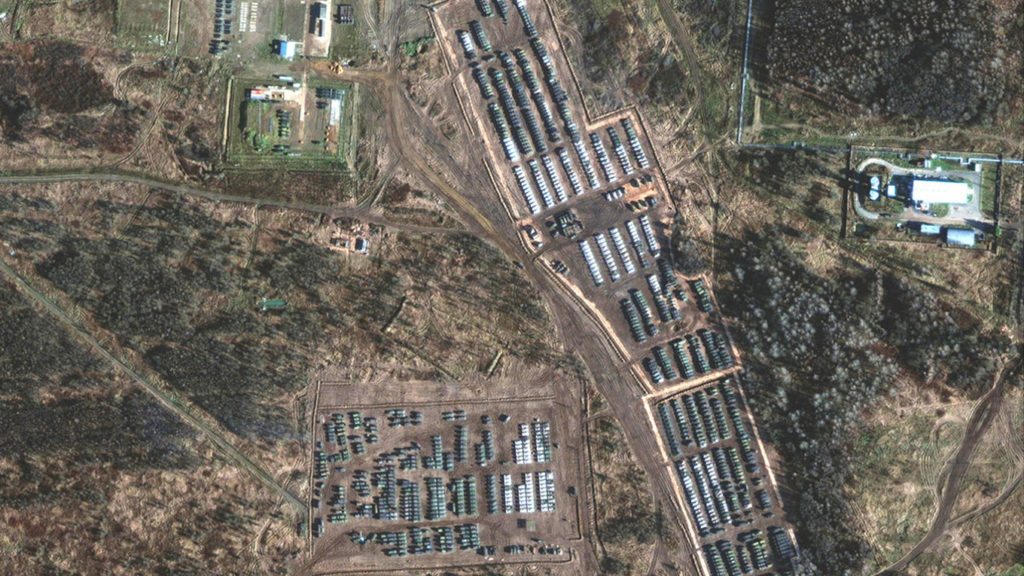
Here is a genuine threat: the current Russian military buildup along the Eastern Ukrainian border. This is not merely a drill. Forward placement of fuel trucks amid multi-platform armoured columns, deployment of field artillery and ground attack aircraft and presence of paratroop units signal real intent. Russia has clearly stated that it will not allow Ukraine to join NATO and will use force to do so. It has a proven track record in this regard, as the 2014 annexation of Crimea and occupation of parts of the Kherson Oblast and Donbas regions attest. Similarly, Russia’s invasion of the Transcaucasia region of Georgia and support for separatist government in South Ossetia and Abkhazia in 2008 was argued along the same lines: Russia would not stand for Georgian integration into NATO because, as is the case with Ukraine today, it is considered a strategically important buffer zone protecting the Russian mainland from Western aggression. Whatever the legitimacy of its rationale, given its proven reputation to use force, its military superiority over Ukraine and the West’s inability to deter it with sanctions and unwillingness to use counter-force to bolster Ukrainian defences, the massing of Russian military units (some 100,000 strong) along Ukraine’s border is very much a threat that will likely lead to action

Russian military forces at staging area near Ukrainian border. Photo: Mazar Technologies.

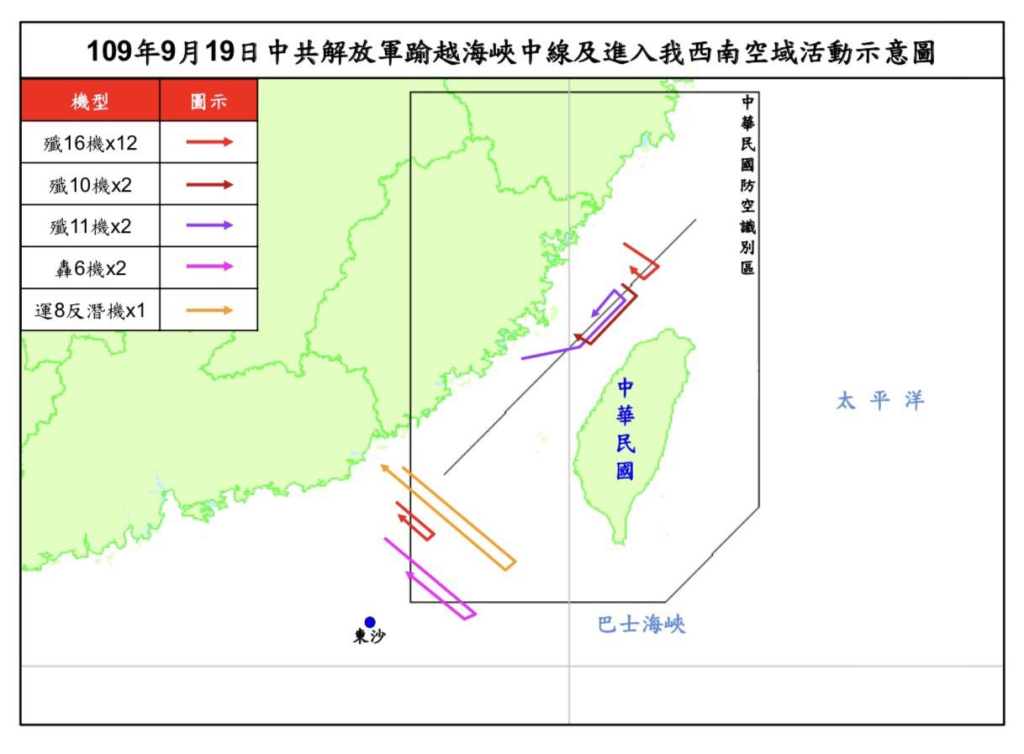
Now consider this contrasting example: we read and hear about how military aircraft from the PRC regularly enter into Taiwanese airspace in order to convey a threat about a potential future invasion. However, the reality is that Chinese warplanes fly sorties in the Taiwanese Air Defence Identification Zone (ADIZ) that includes part of the mainland provinces of Fujian, Zhejiang and Jiangxi as well as parts of the East China Sea (Sea of Japan) and South China Sea. This is is not Taiwanese territorial airspace and the Taiwanese do not bother to respond to most PLAA flights exercising over the mainland. At most, the PLAA flights in the Taiwanese ADIZ can be construed as warnings about future intent and capabilities, but of themselves are not a threat. That would change if PLAA sorties violate Taiwanese sovereign territorial airspace, at which point the threat should be considered real.

The image above is of PLAA sorties into the Taiwanese ADIZ in September 2020, including those that cross the so-called median line that divides the Formosa Strait. The PRC has its own ADIZ that includes all of the airspace above Taiwan as well as the entire East China Sea and most of the northern South China Sea, yet does not assert overflight rights in Taiwanese 12-mile territorial airspace. This belies claims that it is engaging in “threatening” behaviour towards Taiwan, at least for the moment.

The problem with misidentifying PLAA exercises in the ADIZ as threats to Taiwan is that this can lead media commentators and nationalist politicians in the PRC, Taiwan and elsewhere to misread what is happening and prepare accordingly. That in turn creates a classic security dilemma whereby policy makers misperceive or misconstrue what is really happening (warnings) for something that it really is not (threats), prepare as if what is misconstrued is real and, hyped by media-driven nationalist fervor, get locked into pre-emptive or preventative war logics that cause them to stumble into armed confrontations that are otherwise avoidable. At that point the escalatory chain to all-out war is unlocked.

This returns us to the original point of the post. There are practical implications to the misconstruing of or confusion between warnings and threats. Media conflation of warnings and threats can lead to miscalculation and unintended negative consequences. For media types, conceptual and semantic precision is often downplayed in favor of attention-grabbing but erroneous statements. This is particularly the case for headline writers in print and audio-visual media, who want to drive eyeballs onto stories in order to generate clicks or views that in turn translate into advertising revenue.

This logic is impeccable in revenue-generating terms, but the media do not have to suffer the consequences of their terminological imprecision. Those are worn by others, and the others are not just security policy makers in contested spaces.

That is why insisting on discursive precision is not just a pedantic concern. Instead, it is the real-world implications that argue best for analytic, conceptual and terminological precision in foreign policy discussions.

Media Link: “A View from Afar” on supply chain bottlenecks, commodity (over) concentration and the need for post-pandemic structural reform.

Selwyn Manning and I have created YouTube channels under our respective business names in order to promote the “A View from Afar” podcast series. The latest episode examines recent problems of global supply, production and exchange, using a micro-to-macro lens to discuss the interplay between economics, policy and politics in creating and hopefully ameliorating the failures of the pre-pandemic system of trade. You can find it here.

9/11, forever wars and the end of liberal internationalism.

In the years that followed the post 9/11 US invasions of Afghanistan and Iraq, I wrote several essays about how, wittingly or wittingly, Osama bin Laden had successfully employed the well-known guerrilla tactic known as the “sucker ploy” on a grand scale. The sucker ploy is a tactic by which guerrillas commit an outrage or stage a provocation of some sort that draws a disproportionate response from the military that they are fighting, thereby shifting popular support from the latter to the former. A classic example is for guerrillas to shoot at passing military vehicles or aircraft with small arms fire from a village, then retreat into the surrounding countryside while the military responds by annihilating the village and its occupants. 

When the US stayed in Afghanistan after the Taliban were ousted from government and al-Qaeda was eliminated from its territory (end of 2002), and then invaded and occupied Iraq under the false pretense that Saddam Hussein was an ally of al-Qaeda and was going to use weapons of mass destruction on the West or allow al-Qaeda to do so, it took the sucker’s bait. It embarked on a global “war on terrorism” that saw the US and others expend much blood and treasure in places like the Sahel and Sub-Saharan Africa, Syria and Libya, Mesopotamia down to Mali, Kenya and many more places in between and beyond, stretching to Europe and Australasia. The US expended trillions of dollars and thousands of lives on these “forever” or “endless” wars, feeding a relentless military-industrial complex while spinning off the militarisation of US policing and some sectors of civil society that is creating the conditions for civil war, hints of which have already been seen over the last couple of years.

Whatever goodwill existed towards the US in the immediate wake of 9/11, it gradually dissipated as a result of US foreign policy recklessness and arrogance over the next twenty years. Yet partisan logics of saving face by “staying the course” or, if that is not enough, patriotically respecting the sunk costs invested rather than simply “cutting and running” locked the US into continuing the folly of pursuing forever wars in far-off places with little strategic value or which posed no existential risk to the country. Those wars have not resulted in any significant change favorable to the geopolitical position of US but have contributed to the polarisation of its internal politics.

Meanwhile US adversaries like the PRC and Russia built and rebuilt their military forces into peer competitors of the US and expanded their spheres of influence. Mostly as a result of US bungling, Russia is now the most important extra-regional power in the Levant and North Africa and is poised, however ironically, to become a major interlocutor between the Taliban and the global community. Chinese economic and diplomatic influence is world-wide in scope and its aggressive military presence is now a constant in East and Southeast Asia as well as along its land borders. Other actors such as North Korea, Iran and Turkey have been emboldened by perceived US weakness while traditional US allies fret about the stability of the international order without its central presence as a stabilizing force.

The Great Satan has seemingly turned into a Paper Tiger.

It gets worse. Across the world authoritarianism has replaced democracy as the dominant political form. Rather than embrace democracy as an antidote to the hatreds that produced 9/11, autocrats of all types have taken advantage of the post 9/11 moment to impose their rule. In another irony, this includes the US, which nurtured the conditions that led to the election of a bigoted sociopathic narcissist to the presidency and the unleashing of long pent-up hatreds within the body politic. “America First” in reality means “America in Retreat” into neo-isolationism and xenophobic defenses of borders, Anglo-Saxon Christians within those borders, economic nationalism and, when it comes to foreign relations, coddling of foreign dictators who shared the former president’s biases and/or his transactional view of how politics should be conducted. The Obama interregnum notwithstanding (and even he seriously compromised on the original idealism of his foreign policy perspective, which won him a Nobel Prize), the US continued to cast a blind eye on the misdeeds of “friendly” dictatorships like the Egyptians, Jordanians, Saudis or Emiratis while barking about those in Iran, Cuba, Syria and Venezuela (and even there, with relatively little bite).

US political/diplomatic leadership is on the wane at home and abroad. The truth is inescapable: since 9/11 the US has been in decline, for the most part due to its own ignorance and excesses.

Needless to say, there were other intervening factors and variables that contributed to the slow-moving, partial success of bin-Laden’s strategy. Sure, he was not around to see it come to fruition. Sure, there has not been a global awakening of Islamicism that threatens the socio-economic and political parameters of most established nation-states. Wahhabism and Salafism are not the dominant sects in the Muslim world. So bin-Laden’s strategy failed in that it did not produce the specific results that he desired. But 9/11 did set into action a chain of events that has left the international community very different that what was before, with the US diminished and divided and no longer the undisputed global “hegemon.” That must be acknowledged.

A key result of this decline is the collapse of the concept of liberal internationalism as a guiding foreign policy principle in the US. This principle, which long enjoyed bipartisan support in US foreign policy circles and which is premised on the notion that the combination of market economies and democratic governance is the best political-economic form (regime), was thought to be imposable by external actors—meaning the US and its democratic capitalist allies—on unstable or failed underdeveloped states where extremism was believed to breed and prosper. From that belief came the pursuit of nation-building and regime change as foreign policy objectives, even if the targets of such ambition had no history with democracy, maintained pre-modern economic, cultural and social structures in which notions of consent and compromise (two hallmarks of all democratic social interaction) were absent, and were ill-disposed to have an occupying force impose anything on them other than temporary physical security and material aid.

The futility of military and civilian “capacity-building” in such contexts is summed up by an essay written by a former US Army Green Beret about his time in Afghanistan titled “Throwing Rocks at a Fire.” The essay recounts the story of a fire in an Afghan commando barracks at an outpost outside the capital. The fire was started by a gas burner used to make morning tea, which was set on the floor of the barracks and surrounded by blankets pulled from beds for the commandos to sit on (the preferred to have their tea on the floor rather than on tables when inside due to the cold weather, much as they did in their home villages). One of them inadvertently knocked the gas burner over, which set fire to a blanket. Rather than smother the fire with dirt or water or toss the burner out a window or door, the commandos–the best of the best Afghan soldiers–threw more loose blankets on the fire, which then rapidly spread to the barracks beds and wooden floor and walls (which unlike village huts, were not made from earthen and clay materials). They then ran out of the building. When the SF trooper arrived, he found the commandos throwing rocks at the fire through the front door of the now fully engaged building. It burnt to the ground.

Rather than chalk it up to the actions of ignorant primitives, my reading is that for the Green Beret the moral of the story was the futility of attempting to impose modernity, to include modern concepts of rationality and logic, on deeply rooted pre-modern cultures and societies that were uninterested in the social aspects of so-called modern democratic living. Learning to fight better with modern weapons was one thing, but re-learning basic forms of social engagement was quite another. Their traditions worked fine for them and imposition of other forms of social organization only complicated things and turned out bad in the end. In hindsight, the Green Beret came to understand their view, but by then he was physically, psychologically, occupationally and temporally far away from that outpost.

As it turns out, for all the lip service paid to promoting democracy, the world is now governed by more authoritarians that democrats, and many of the places in which authoritarianism has flourished are those in which the US intervened the most heavily. As for the promotion of market economics, the major consequence has been greater global income inequality within a context of increased concentration of commodity production, demand and exchange. Contrary to what its adherents and proponents claim, market capitalism does not lead to a “rising tide raising all boats” phenomenon and trickle down (supply side) economics does not lead to a watering of the seeds of a budding middle class emerging out of poverty world-wide. Instead, it has baked in a socio-economic landscape of structural disparity and deprivation juxtaposed against and subordinate to a parallel world of opulence and waste.

In sum, there is very little that is politically or economically “liberal” about the world today.

More can be added to this litany of unhappiness but for the moment the point is this: the era of liberal internationalism has come to an end as both a practical objective and a foreign policy theory. It remains to be seen what will emerge in its stead once the repercussions of the pandemic and US decline fully filter throughout the global community. But therein lies a basis for hope, because in a multipolar world in which no one actor can impose its vision of the “proper” order of things and yet the need for international cooperation is more apparent than ever, perhaps the makings of more equitable and balanced global society can be made organically rather than by imposition even in the face of cultural and social difference.

The price of neo-imperialist hubris.

One adage of warfare is that when a clearly weaker actor fights a clearly stronger actor to a standstill, then the weaker actor has won the contest. This is particularly so for asymmetric, irregular warfare where one side has the advantage of disproportionate force but the other side has time and willpower in its favour. So long as the weaker actor can remain steadfast over time when resisting the superior force, then not only will stalemate be achieved but eventual victory for the weaker actor is more likely. Where the weaker actor is fighting on home territory against a foreign force, the probability of its eventually prevailing are significantly improved. For the stronger actor fighting on foreign soil, the longer the conflict is drawn out, the more likely that it will be defeated, especially if domestic support at home (political and social) for the fight wanes over time. If the foreign power is simultaneously fighting another major land war (or wars), then its chances of victory in any of them are significantly reduced. Instead, such “forever wars” become deaths by a thousand cuts for the militarily stronger foreign power.

The Vietminh/Vietcong provide a good example of this. They resisted colonial and post-colonial French and US-led Western forces for more than two decades and eventually achieved independence, then fought off Chinese aggression to consolidate their hold over what is now the Republic of Vietnam. Like the VC, the Taliban have no Air Force, have no Navy, and what sophisticated ground warfare equipment they employ (which is not much), they captured from foreign forces or were clandestinely supplied by anti-Western states such as China and Russia. They used cross-border allies to good effect in getting supplies through (Iran and Pakistan in particular but not exclusively), and used guerrilla, hit and run tactics to extend the occupiers territorially until individual units or outposts could be surrounded and overrun by highly mobile and locally massed Taliban forces using surprise and local knowledge to their advantage.

The Taliban are, in a nutshell, a resilient, extremely determined, ruthless, cunning and resourceful adversary who fights on its home turf against foreigners and foreign-backed locals who (in the case of the former) do not understand them and who (in both cases) do not have the will to continue fight without an end in sight. For the Taliban it is Allah’s will that they fight and die for him, so there is no time horizon on or particular end point to their struggle against infidels. In effect, we may not like their medieval ideology, but we must recognise their will to impose it at all costs.

That brings up another maxim of warfare: The actor who prevails is the one that is willing to suffer the most losses and continue fighting. The Taliban have shown their mettle in this regard. To that we can add the historical observation that unlike secular (say, Maoist or Marxist-Leninist) guerrilla groups, religiously-inspired irregular warfare actors are seldom fully defeated, but instead ebb and flow like the tide depending on the political and social conditions of the day and the strength of countervailing forces.

That is because of the nature of their respective ideologies. Religion is a pervasive, deeply imbued primordial cultural organizing principle that, if driven underground, continues to reaffirm commonly shared traditional social values even in modern secular societies. In contrast, secularist ideologies, particularly anti-capitalist ideologies, start as minority belief systems that run contrary and seek to undermine the traditional or “proper” way of things. That makes it more difficult for them to clandestinely sustain themselves. Religious irregular warfare actors seek to reaffirm what traditionally is and has been; secular irregular warfare actors seek to overthrow and replace what is and was. Depending on the relative depth of religious belief in a given society, the former has a much better prospect of long-term success than the latter when it comes to asymmetric conflict.

Because of their lack of ideological support in most societies, secular irregular warfare actors either win or lose, the first via protracted irregular conflict culminated by conventional military victory and the latter via short intensive kinetic campaigns waged by overwhelmingly superior military actors. Faced with unfavourable warfare conditions, religious irregular warfare actors use society’s ideological depth as a subterranean means to avoid definitive kinetic and political outcomes and instead sink into the fabric of society and pursue guerrilla warfare as a form of counter-hegemonic struggle (often using terrorist tactics). Secular irregular warfare actors also attempt to do this, but their lack of ideological depth in society exposes them to relatively quick detection and elimination. Conversely, the deeper the religious culture into which religious irregular warfare actors can dive, the more likely that they will resurface as an intact fighting force once the stronger opponent has left the battlefield. That has now happened in Afghanistan.

The price paid by the Taliban during this conflict has been enormous. They have been killed in astronomical numbers by land, air and sea. A generation and more of their leadership cadres have been decimated. They lost control of cities and then rural areas, in some cases fleeing across borders in order to avoid complete annihilation. And yet, after two decades on non-stop warfare and the inter-generational destruction of scores of fighting cadres, they have regained control of Afghanistan now that the US and its ISAF partners have left the country.

In contrast, after twenty years of foreign-led military and civilian capacity building and billions of dollars spent on infrastructure in pursuit of national unification, the ISAF/UN-backed Afghan central government’s control throughout the country collapsed with astonishing speed. In the space of two months once the foreign forces withdrawal was announced, the Taliban gained control over the majority of Afghan territory. Kabul has fallen and the foreign-backed president Ghani has fled (along with millions in cash), leaving his subordinates and foreign patron remnants to fend for themselves. Taliban patrol the capital’s streets and assassins lurk in and around the Kabul “Green Zone” where foreigners and local elites lived and worked, selectively murdering journalists, pilots, teachers and other skilled labourers seen as associated with the occupiers or opposed to Taliban rule. The spectre of a genocidal, gendered bloodbath is a real possibility and there is a mass refugee migration underway from Afghanistan into neighbouring countries, especially from non-Pashtun, non-Sunni regions. Over a quarter million people have fled their homelands in the last two months alone, and the international airport in Kabul is a scene of chaos as thousands seek airlift rescue. It is not a stretch to draw parallels with the fall of Saigon, especially after seeing scenes of Chinook helicopters evacuating people from the rooftop of the US embassy.

Even more so than the failed experiment in post-Saddam Iraq, the US-led push to democratise and secularise Afghan politics and society has fallen hard on the double swords of corruption and traditional culture. The Western-backed governments that have held power once the Taliban were overthrown in 2002 have been little more than kleptocratic distribution wheels for the favoured and connected. Modernization in the form of aid programs to foment the likes of female education, road building, health and sanitation facilities, reticulated sewage systems, electrical power grids etc. have not only been a source of corruption but have been accepted without producing the cultural shifts that were assumed by Western patrons to be the logical and inevitable end result of such efforts. As a former US military officer noted with reference to the locals, “they will smile and gladly accept our help during the day, and then they will sneak back and kill us at night.”

In other words, the physical infrastructure of the country may have been modernised, but by and large the societal value structure was not.

The hard fact is that the seeds of the latest Western defeat in Afghanistan were sown the moment the nation-building project in that country began. Had the US and its allies defeated the Taliban and then left Afghanistan to sort itself out along traditional ethno-religious and tribal lines (say, by allowing warlords and tribal militias to contest local authority with central government advocates), the process of national reunification or reorganisation would have been violent but in all likelihood shorter and more durable when it came to the distribution of and balance of power between local and central authorities. As a Pentagon colleague of mine said when surveying the wreckages of US military intervention there and in Iraq, “we should have declared victory and gone home after the bad guys were defeated, then left (them) to it.”

Instead, the US-led ISAF coalition attempted to impose “democracy” on a country with extremely limited historical or practical experience with that concept. The project was therefore bound to be a failure in form (procedure) and substance (outcomes), both of which were manipulated to serve the ends of local elites. To put it in more general terms: attempting to impose modern and post-modern Western-style political forms, social norms and cultural mores on populations dominated by pre-modern (authoritarian) social hierarchies was akin to trying to get a fish to ride the proverbial bicycle.

The irony is that the notion of “nation-building” was a bastardisation of the counterinsurgency (COIN) axiom about psychological operations, where the point is to win the “hearts and minds” of a disputed population via provision of security, health care and other amenities of civilisation in order to gain their acceptance and trust while diminishing that given to the insurgent enemy. The original COIN focus was on very localised populations for relatively short periods of time, not entire countries for long periods of time, and involved using local grievances against domestic insurgents in order to gain information that allowed for their detection and elimination as part of what came to be known as the “inkblot” strategy of incremental taking and holding of enemy social space. In other words, it was one aspect of an irregular warfare strategy used against insurgents and was not an end of itself.

This was all known before the nation-building exercise began, not only by counter-insurgency specialists in military communities, but by anthropologists and sociologists who study places like Iraq and Afghanistan and their respective sub-cultures. It was/is also known by political scientists (aka “transitologists”) who study regime change from authoritarianism to democracy and vice versa–in short, it is hard to impose from the outside unfamiliar and often unwelcome types of governance on tradition-bound and/or pre-modern societies even if improvements to material standards of living are part of the package. The reasons are many but the conclusion is clear: external imposition of foreign social norms and political structures, no matter how well-wrapped in developmental assistance, is most likely to fail.

All of this accumulated wisdom was ignored in Western capitals (including Wellington) when the macro-level dimensions of the ISAF mission were operationalised. Instead, intelligence and military organisations attempted to use social scientists to develop micro-level conceptual maps of the “human terrain” on which the military and civilian capacity-building campaigns were undertaken. Although they enjoyed some tactical success, at a strategic level these efforts ultimately failed and proved to be a harbinger of things to come.

Never has that phrase “graveyard of Empires” been spelled out in so much lost blood and treasure. But beyond the waste of Western efforts to construct a unified country in territory that is home to more than one nation, or the brutal toll taken on innocent Afghan civilians looking to live in whatever peace might come to them, what exactly has been lost? Is the impending calamity of a Taliban takeover as described by Western media and politicians really likely to come true?

As it turns out, after I started writing this post I got a call from my friend Jon Stephenson, the war correspondent and investigative reporter. Jon probably knows as much as anybody in NZ about that country, and it was fortuitous that he got in touch while I was thinking about what is written above. What follows is my distillation of some pertinent parts of our conversation.

The Taliban are not monolithic. They have moderate and militant factions and political and military wings. They exert more control and influence in the rural, less modernised countryside than they do in cities, especially the capital Kabul. The political leadership in Doha is more moderate than the military leadership on the ground in Afghanistan, and its degree of control over military commanders is comparatively looser than, say, that of the political leaders of Hezbollah or Hamas. The Taliban have been relatively well-received in Pashtun/Sunni dominant regions such as their birthplace, Kandahar Province, but have encountered local resistance in non-Pashtun/Shiia regions such as Bamiyan Province. In other words, their degree of support and control in areas outside of Kabul is uneven and at times contested by local warlords and militias. As for Kabul, the issue is pretty stark. The Taliban can infiltrate, surround, isolate and attempt to choke the capital into complete surrender in the face of significant armed resistance from foreign military forces and what is left of Afghan security units linked to them, or the capital can keep supply lifelines going by air and (perhaps, but unlikely) secure land corridors until a negotiated settlement is reached. Western military help will be needed to stave off or forestall a Taliban takeover of Kabul but if that is forthcoming (and it appears to be) a peaceful handover of power or power-sharing compromise may be possible.

In any event issues of national governance may prove problematic for the Taliban. After all, what they will have to do even if complete military victory is achieved is to build a State out of the ruins of the current one. They will need to provide public goods and services, organise a (Sharia) legal system, re-create a public bureaucracy that includes everything from health and education administration to border (immigration and customs) controls and transportation regulations, civil aviation rules, document issuance and certification, etc. For that they will need bureaucrats and other skilled labor, many of whom are fleeing the country as I write. They will need an institutional edifice–actually buildings with people and communications apparatuses in them– in order to discharge their nation-wide public service functions beyond those involved in local repression. Hence, although they may be adept at fighting and some may be willing to return to the Medieval Era when it comes to organising Afghan society, it is more likely that the Taliban will have to compromise on the extent to which Afghanistan will return to the Dark Ages and what aspects of modernity it can live with. The question is therefore how much will the Taliban be willing and able to compromise, and on what subjects and policy areas?

This is all the more true because other foreign actors, the PRC, Russia, India and Iran in particular, have their sights on mineral-rich Afghanistan as a geopolitical buffer and/or investment opportunity. Pakistan, as always, will be a major player in Afghanistan’s future because it would prefer to see Afghanistan weak and internally divided rather than unified and strong (if for no other reason than the latter encouraging cross-border irredentist sentiment in Pakistan). Islamicist groups in bordering countries and further afield may be emboldened by the Taliban’s success and seek to emulate them while looking for their support. That is bound to be of concern to the leaders of the above-mentioned countries as well as the other geographically contiguous “‘Stans,” all of which have indigenous Islamicist groups to contend with.

Getting these foreign interlocutors to invest diplomatically and economically means that the Taliban must offer self-binding assurances and guarantees and assume contractual obligations of various sorts, negotiated by people competent enough to engage with sophisticated foreign counterparts and legitimately representative enough to ensure that any deals they make or promises made are binding. That is by no means assured at this point because if one thing is certain is that Afghans are generally disposed to look at any foreign presence with suspicion and distrust. That includes non-Western foreigners as well as those from the West, who in any event will have to confront the compounded obstacles posed by corruption and traditional values.

At a minimum, besides the need to operate domestically-focused public bureaucracies, the Taliban will need a diplomatic corps capable of dealing with foreign entities. Those must include people competent to engage with aid agencies given the inevitable requests for reconstruction assistance as well as those responsible for interacting with various potential military and diplomatic partners. That requires significant levels of education and experience, which given the brain drain now underway in Afghanistan means that the Taliban cannot afford to go full Pol Pot on the country and kill all infidel locals off and in fact will likely have to employ foreign nationals in any event in order to operate their public sector, to say nothing of staffing the private interests that may establish a presence in the country.

This is not entirely unusual–Singapore would collapse in less than a week if “ang mohs” (Europeans) were withdrawn from upper and middle management ranks in all bureaucratic sectors of the Little Red Dot–but the retrograde cultural dispositions of at least some of the Taliban leadership may make that difficult to achieve and will require internecine settlements between moderate and militant Taliban factions in what may well turn out to be the “old fashioned” Afghan way of resolving conflicts. The larger point is that the world does not end with a Taliban takeover, they cannot survive as a regime governing a nation-state if they kill and repress everyone who is not an adherent of their ideology, they therefore need to know how to play nicely with a range of interlocutors, foreign and domestic, all of which means they need to get their house in order before they present a cohesive if not inclusive face to Afghan society as well as the global community.

Twenty years of foreign occupation has changed Afghan society, at least in the urban and suburban areas where Western influence and development projects were the most heavily felt. Just as the degree of religious density in a society facilitates the subterranean presence of religious irregular warfare actors, the degree to which that social fabric is imbued by new conceptions of the proper cultural order makes more difficult a return to the original Taliban past, especially when the return involves material and social deprivation for all or some of society’s component parts–say, for example, women, who are now an integral and vital part of Afghan public services.

In parallel, the Taliban of today are not exact replicas of their fathers. The intergenerational passage mentioned earlier with regard to warfare extends to how the contemporary Taliban differ in their view of how to rule post-occupation Afghanistan. As Jon Stephenson mentioned with regards to the situation in general, it is hard to predict what will happen but things have certainly changed for the Taliban when it comes to governing in coalition or alone. The society that they will now inherit is not the society that they left behind when the foreigners arrived to remove them.

In a signal of its defeat, the US has asked the Taliban not to attack its embassy in Kabul and warns that it will use aid assistance as leverage against future Taliban provocations or transgressions once it office. Both scenarios may come to pass but the truth is that the the Taliban will be looking for new international partners rather than redraw contracts with those who backed the deposed regime. For those Afghans who placed their bets on supporting the US and ISAF and worked with and for them, the moment is indeed uncertain and tragic. Like the Kurds, Iraqis and Vietnamese before them, many of those who sided with the US will lose their lives and livelihoods in the months to come. Others may find refuge in ISAF coalition member countries, including New Zealand. But the hard reality is that siding with a foreign occupier was always a fraught proposition based on significant inter-temporal (current and future) risk, and for many that dark future has arrived. What is puzzling is that even in the face of such foreboding prospects, many non-Taliban Afghans have chosen to surrender (in the case of security forces) or flee (in the case of civilians) rather than fight.

What this means is that indeed, there is a tragedy at play in the return of the Taliban. But it may not be the calamity that many in the West think that it will be because the circumstances surrounding the return mitigates against rather than in favour of wanton destruction and mass blood-letting. The Taliban need to demonstrate that they can rule over a society that is in significant ways different than the one they governed two decades ago, and they need to engage with an international community that also is different than the one that blamed them for harbouring al-Qaeda. The Taliban themselves are different in many ways, as are the foreign interests willing to engage with them on economic and diplomatic matters. Their domestic threat environment now includes co-religionists in the form of al-Qaeda and Daesh, to which can be added splinter groups from adjoining countries and local warlords and militias with foreign ties. It will not be easy for them to re-impose the status quo ante 2002 even if that is their unified desire (which it does not appear to be judging from the political leadership’s statements).

This is the basis for a glimmer of hope in the Afghanistan regime transition now underway. If not born of compromise, Taliban rule will likely be different out of necessity. It is important that the international community do all that is possible to ensure that the political necessity of the moment becomes long-term governance fact not only for the good of the Afghan people but in order to pay the fair price of making amends for what ultimately is the result of Western neo-imperialist hubris.

Postscript: What was heard from above. https://www.theatlantic.com/ideas/archive/2021/08/what-i-learned-while-eavesdropping-on-the-taliban/619807/

A note on the “jihadi bride.”

I ruffled a few feathers by referring to Gerry Brownlee as a “buffoon” during a radio interview this week. The subject in question was the involuntary repatriation of Suharya Aden and her children to NZ after Australia cancelled her citizenship. Brownlee was blathering about her being a terrorist security threat, how she jumped the que ahead of deserving Kiwis in the MIQ line and how the government needed to be more transparent about the process under which Ms. Aden was to be returned and administered. He said that NZ should adopt citizenship-stripping laws like those in Australia so as to prevent the likes of MS. Aden returning voluntarily or otherwise.

Truth be told, what I really wanted to say but could not because of time constraints was that Mr. Brownlee was/is a “racist dog-whistling, grasping-at-straws-on-the-security-angle tool.” I say so because Brownlee is the guy who ran the Christchurch earthquake “relief” efforts and sent private investigators to spy on insurance claimants and residents asking for help; who said that there were no white supremacists in Christchurch after the March 15 attacks; who hinted at dark conspiracy theories about Covid during the 2020 election; who railed about refugees during debate about the Control Order Bill last year when the Bill was strictly about returning Kiwis suspected to be involved in foreign conflicts. He was part of a government that regularly hid, misled or deliberately lied to the public on a number of issues, including those involving national security. He was an atrocious Defence Minister, more interested in junkets than full metal jackets, and a piss-poor Foreign Minister (among other failures) who was every diplomatic reception’s worst nightmare. He is long past his expiry date as a politician, so being a public buffoon is a step up. If you wish you can call him a tool, but either way, Pablo don’t suffer the fool.

As part of the debate on the Control Orders Bill (now Act) Brownlee knows that Control Orders come into effect once a person is on NZ soil and that invocation of the Act automatically triggers suppression orders on the name and case details of the person(s) targeted by the Act. His claims for more “transparency” about Ms. Aden’s case in progress are therefore disingenuous at best. Also, as a former Defence Minister, he should know something about operational and information security, so demanding to know how/when she is being returned is also a cynical ploy.

In any event enough about him. For the sake of clarity, let me outline some facts about Ms. Aden’s case, but without breeching any secrecy protocols.

Suhayra Aden was born in Mt. Roskill in 1995 of Somali refugee parents. At age six her family moved to Australia, settling in Melbourne, and took Australian citizenship. Her family is still there. in 2014, at age 19, she travelled to Turkey and from there was smuggled into Syria in order to become a so-called “jihadi bride.” How and why she became radicalised in Australia is not publicly known but likely to be known to Australian authorities. She may have been radicalised on-line. She may have been subjected to family or peer pressure. She may just wanted to see the world or get a taste for adventure. She was young, gullible, perhaps manipulable and clearly made some bad decisions. And yet she is still quite young at 26.

Two aspects of the Turkey/Syrian phase of her life are worth noting: First, according to Australian journalists who interviewed her in 2019, that she had second thoughts about the venture once she got to Turkey and tried to call her mother to seek help in escaping. She was unsuccessful and was taken by her minders/smugglers into Syria instead. This raises the possibility that everything that happened to her afterwards was done under duress, without her informed consent. Second, she was not “married” in the traditional Western sense of the word. In the medieval world view of ISIS, women are domestic servants, sex toys and breeders, that is, reproductive vessels of future fighters. They are assigned “husbands” and required to submit to them in every way. They are therefore not so much “wives” as they are domestic servants, sex slaves or, in historical terms, concubines. Concubines have interpersonal and sexual relationships with (often polygamous) men but do not hold the status of “full” wives whether or not there is a “full” wife in the picture. I have been told that my characterisation of Ms. Aden as a concubine or camp follower has been labeled as sexist by some NZ fourth wave feminists, but I suggest that they read a dictionary and get back to me on that one. Remember–it is ISIS that is medieval when it comes to gender roles, not me.

In Ms. Aden’s case, she had two “husbands,” one or both of them apparently Swedish (I have read conflicting reports on this). Both were killed in Syria, presumably fighting Western or Assad’s forces. She had three children with these men, one of whom died at an infant or toddler age of pneumonia. In 2019 she fled to the Al-Hawl refugee camp in northwestern Syria. That means that during the four years (2015-2019) she was actually in Syria, she was pregnant for 27 months of that time (2 years and 3 months). She presumably nursed her infants concurrently with and after those pregnancies. Along with the gender role assignation described above, that strongly suggests that she was not an ISIS fighter and therefore is unlikely to have been involved in committing atrocities even if her husbands were. And even if she was or knew about such things, the fact that she was likely acting against her will from the onset mitigates against accusations that she was actively engaged in terrorism. Evidence to the contrary, labelling her as a “terrorist” therefore seems to me to be smear of the most vile sort, something that many corporate and social media outlets, Gerry Brownlee and Judith Collins have all done.

In February 2021 Ms. Aden and her surviving children were caught by Turkish border authorities while attempting to cross into that country from Syria. At the time Turkish officials called her a “terrorist” but after questioning about evidence to that effect they dropped the claims. Instead, the narrative changed to her fleeing Al-Hawl in order to escape ISIS. Unlike the Kiwi “bumbling jihadist” Mark Taylor, who is in Kurdish custody, the Turkish authorities are keen to have Ms. Aden and her children deported. Lucky for her and unlucky for him, NZ feels obliged to help with that process. But how did NZ come to be involved?

In the 2019 interview with Australian journalists conducted at Al-Hawl, Ms. Aden expressed a desire to return to Australia. After the interview was made public, in early 2020 the Morrison government stripped her of her Australian citizenship under section 35 or the 2007 Australian Citizenship Act, amended in 2015 (after she had left Australia). The 2015 amendment to the 2007 Act stated that citizenship could be revoked because of “conduct inconsistent with allegiance to Australia,” although what constituted “inconsistent conduct” is not specified. What this means is that when Ms. Aden left for the fighting fields of Syria in 2014 she was doing nothing illegal, and that both the 2015 amendment to the ACT and the 2020 revocation of her citizenship were applied retroactively without due legal process or recourse.

In fact, sometime during the interim between her departure from Australia and arrest in Turkey, Australia requested that INTERPOL, the international police consortium, issue a “Blue Notice” on Ms. Aden. Unlike “Red Notices,” which are arrest warrants based on criminal charges, “Blue Notices ” are requests for information about persons of interest to the requesting party, such as missing persons. Louisa Akavi, the Kiwi nurse kidnapped and held hostage by ISIS, is also the subject of an INTERPOL Blue Notice. She is not only welcome home–she is wanted home by her whanau. Ms. Aden may also have family support in Melbourne but her country of choice has turned its back on her and her children. In NZ she has no such support and yet, as a citizen, her right of return is the same as Ms. Akavi. Therein lies the dilemma.

The Australians not only issued Ms. Aden’s non-criminal request for information to INTERPOL (how could they issue a criminal warrant since she had not committed any crime before and when she left Australia?), but they nevertheless went ahead and stripped her of her adopted citizenship after the fact based on assumptions about her agency and volition when it came to personal associations, travel and residence. Unlike the “bumbling jihadi,” she is not seen on tape calling for jihad and denouncing her home (Crusader) country. But they have called her a terrorist nonetheless.

That left NZ no other option but to return her and her children back to NZ, following international law and practice (which states that citizenship cannot be stripped from natural-born subjects and that States must recognise and assume responsibility for their subjects when asked to do so by foreign powers). Ms. Aden is a native born Kiwi and her children assumed citizenship by birthright. They have no other place to go now that Australia has rejected them. Should NZ adopt an Australian approach, as Brownlee and Collins suggest, then they would be left stateless and bereft. I would argue that whatever the sins of the mother, vesting them upon the children is a grotesquely callous act unbefitting a liberal democracy. As an international good actor and as a civilised society NZ has to make the best of a bad thing by offering them repatriation. Thankfully that is about to happen.

When Ms. Aden and her kids arrive in NZ it is likely that she will be the first person subjected to the Control Orders Act. As mentioned, that involves suppression of her name and details of her case. What is known is that the Act prescribes restrictions on her freedom of movement, communication and association. She will be monitored by security agencies and supervised by social welfare agencies, including psychological counselling services. This management program may even involve electronic bracelet usage (again, details of what is involved will likely be subject to suppression orders). She may be granted permission to engage with local civil society organisations specialised in the treatment of refugees from conflict zones and/or post-traumatic stress disorder. She and the children may receive new identities so that they can better lead “normal” and productive lives.

The need for those sort of extreme privacy measures is due to the dual nature of the security concerns involved. On the one hand, NZ security authorities must be vigilant that she pose no risk to NZ society. Were she in any way to encourage extremism in any forum or venue, she would likely be charged and prosecuted accordingly (perhaps even under proposed hate speech legislation, if not the Terrorism Suppression Act). The good news is that data from Europe suggests that returning “jihadi brides” statistically have a near-zero chance of continuing their support for Islamic extremism. Perhaps it is the traumas that they suffered, the trials that they endured, the tribulations that they encountered or the travails of their existence in war zones, but the likelihood of their returning to jihadism is very remote at best.

On the other hand, Ms. Aden and her family need to be protected from harm themselves. There are many Islamophobes in NZ who wish her (and her children) ill or worse. Some have vented in social media abut their desire to do her harm, so the threats must be taken seriously. That poses problems for the Police if her address, name or locations of schools, mosques and social service organisations that she frequents are made public. Given that there are innocent children involved, the authorities must be proactive on their behalf.

In the end, the NZ government has to make the most of a difficult situation and appears to be doing so, barking from the Opposition notwithstanding. It will be for Ms. Aden to make the most of her second (or third) chance in life, if not for herself then for the future of her children. The Opposition would be wise to cease and desist trying to score political points on the matter, less they find themselves confronted by a similar dilemma in the future when in government.

Most of all, it is time for the buffoonery to stop.