Rats fleeing a moral slum.

Apropos the Washington Post/CNN stories regarding Pete Hegseth verbally instructing the Joint Special Operations Command (JSOC) Commanding Officer (Admiral Frank Bradley) and SEAL Team 6 to “kill them all” when survivors of a missile strike were seen clinging to the wreckage.

Well, the inevitable happened once the story got out. After weeks bragging about ordering attacks on supposed drug-running boats that have killed 81 people so far (no tangible evidence of drug-smuggling has been provided and even if they were involved in such activities, the penalty for drug-smuggling is imprisonment, not summary extrajudicial execution at sea), Trump and Hegseth are  trying to distance themselves from the order to kill shipwrecked survivors of a US military strike on a unarmed civilian boat by throwing Admiral. Bradley under the bus. 

Trump says that Hegseth told him that he did not order the strike and that he (Trump) would not have ordered it if he knew about it. Hegseth says that he did not give the “kill them all” order and did not watch the live feed coverage of the second strike (aka “double tap”) that killed the survivors even though he watched the rest of the operation up until that moment. They both pointed the finger for giving the “pull the second trigger” order at Admiral Bradley, who according to the original story passed it down the chain of command to SEAL Team 6, who then fired the Hellfire missile that killed the two people treading water. In total, 11 people died in the two strikes. No drugs were located.

This sequence of blame-shifting was predictable because Trump and Hegseth have no sense of honour or ethical compass guiding their actions in what conservative writer George Will calls a “sickening moral slum of an administration.” We can only hope that Admiral Bradley, whose career is finished regardless of who ultimately gave the double-tap kill order, has receipts or a document trail that will provide evidence of where the illegal order came from and who, precisely, gave it. Because killing shipwrecked survivors, during times of war and certainly doing times of peace, is a war crime, a crime under US and International law, and a violation of the Geneva Conventions and US code of military justice. That the people in question were defenceless civilians not engaged in a real conflict with the US makes things worse and opens up the possibility of criminal liability for those involved in giving and executing the order.

Interestingly, Admiral Alvin Holsey, the previous commander of the Southern Command (SOUTHCOM), which is the lead command involved in the military pressure campaign against Venezuela and its supposed drug-running activities, tendered his resignation 45 days after the Sept. 2 double tap strikes. He was not involved in the chain of command that conducted the strikes so likely was ignorant of operational details (SEAL Team Six was answering to JSOC, not SOUTHCOM). He had not yet completed the first year of his three year term and may have to forfeit the fourth star promotion to Admiral that came with his appointment to be the Southern Command boss (that is significant in terms of his retirement benefits). It could well be that Admiral Holsey resigned in protest against the illegal extrajudicial kills of mariners at sea. Should he be called before Congress to testify under oath about what he knew and when he knew about the double-tap and other kinetic operations carried out in the SOUTHCOM Area of Responsibility (AOR), things could get interesting.

Likewise, the Post story claims to be quoting two people in the room when Hegseth gave the “kill them all” order, with corroborating statements by five other people with direct knowledge of the operation. Given the high level decision-making involved, these are likely to be senior military officers and/or civilian Defense Department personnel. Should they be requested to appear before Congressional investigations committees and be questioned under oath, things could well get dicey for Hegseth in particular, but potentially for Trump as well if he knew about the “kill them all” policy in advance of the strikes.

As things stand, while Admiral Holsey will retire honorably, Admiral Bradley could well wind up court-martialed, sentenced and imprisoned, dishonorably discharged and all retirement benefits forfeited. For a 35 year service naval office and former SEAl, this is a tremendous fall from grace. The same could well happen to others in the chain of command that fateful night.

Which is why I hope that they carry receipts in the form of documentary evidence about the mission.

Even so, the Supreme Court has ruled the Trmp is immune from prosecution for actions taken in his official capacity as President (including murder). Trump can use his pardon powers to shield Hegseth, Bradley and others in the chain of command who participated in the operation. Trump has already demonstrated his willingness to exercise his pardon power as he deems fit, including pardoning war criminal Eddie Gallagher, a former SEAL.

Whatever happens, one can only hope that this is the beginning of the end for the corrupt and incompetent (yet dangerous) deck of cards known as the MAGA White House. Because just like the garish gold decor now festooning its walls like it was a Liberace showcase in Vegas, the term “gilded” in its original sense seems most appropriate. 

Shiny on the outside, rotten on the inside.

No surprises versus plausible deniability.

The sordid saga of Jevon McSkimming reminds us of the inherent tension between two largely unspoken axioms of democratic politics. These are the “no surprises” and “plausible deniability” rules. Infrequently formalised in written instructions and more commonly shared as unwritten understandings between government officials, these axioms require delicate juxtaposition in order to strike the right balance between institutional accountability, individual responsibility and partisan fortunes. Balancing the oft-counterpoised understandings speaks to the vertical and horizontal dimensions of institutional and individual accountability as well as issues of institutional self-preservation, bureaucratic “capture,” individual and partisan interests. It is a tough mix to get right and yet if democracy is to be served, that is exactly what must happen.

What will not be addressed here are the specifics of the McSkimming case or whether this balancing act occurs in authoritarian regimes. The former has been covered extensively by political commentators detailing the chronology of and participants in events leading to recent revelations. The latter usually do not concern themselves with addressing matters of public accountability so do not place as much emphasis on the axioms in question. They may not like surprises and tend to deny responsibility when called out on failures or misbehaviour, but authoritarians mostly discount the governance implications of their actions because mass contingent consent is not the basis of their rule.

In contrast, mass contingent consent and attendant faith in institutions, leaders and policies constitute the foundation of the social license that is given to political leaders and government institutions to perform their duties and responsibilities in democracies. That is the foundation of the vertical accountability that lies at the core of democratic governance–both leaders and institutions are accountable to the people that they ostensibly serve. Several mechanisms ensure vertical accountability–elections being the ultimate adjudicator of government performance–including entities like inspectors general of agencies, comptrollers, auditors, boards of inquiry, independent commissions, parliamentary committees and in-house regulation enforcement of institutional and personal standards of conduct. Electorates vote for governments to carry out a given policy agenda, and the institutional apparatus is responsible to the electorate via independent means as well as through the mediation of that government for implementation of that agenda within the framework of the law.

Unfortunately in practice many oversight agencies like the Independent Police Complaints Authority (IPCA), the Inspector-General of Intelligence and Security prior to the Zaoui case and various parliamentary committees developed reputations for having been the subjects of “bureaucratic capture” whereby the entities that they are supposed to monitor wind up controlling what they can see and do when it comes to their oversight and investigation functions. In some instances they and Royal Commissions of Inquiry have been suspected of being “whitewashing” devices at the service of the government of the day or the agencies they oversee or investigate. This erodes public trust and promotes insularity, unethical behaviour and organisational defensiveness within public bureaucracies, especially those in the security and intelligence arenas.

Whether they are subject to bureaucratic capture or not, where institutional traditions in NZ government agencies and amongst some parts of the political class reward unaccountable practices, there may exist the sense that there will be limited to no consequences for untoward behaviour because the agencies in which they serve or depend on close ranks and shield them when things “hit the fan.” If vertical accountability mechanisms are weak or rigged against honest and transparent scrutiny and responsible exercise of duty, then the institutional culture in government agencies may develop forms of self-preservation that usurp legitimate public accountability.

This organizational pathology is known as a culture of impunity. Officials and agencies get away with misbehaviour because they are protected by their peers and political superiors, and the more that happens and the longer a tradition of doing so exists within any given agency, the more likely that, absent major institutional reform, that will be the default response when individual and organisational problems arise.

It is in this context that the tension between the “no surprises” and “plausible deniability” axioms come into play. The “no surprises” policy is simple: subordinates inform superiors in advance of problems or trouble (personal, political, institutional) that may be coming their way. This provides government leaders the opportunity to prepare contingency plans for what they know is coming. That involves more than crisis management and PR spin campaigns that “get out in front” of the emerging story. It may or may not involve diversion tactics and “flooding the zone with s**t.” It also offers leaders the chance to engage in proactive reforms that are already underway when the issue in question reaches the public domain.

“No surprises” is a discrete foundation of vertical accountability in democracies that is critical to informed decision-making and government stability. It prevents smaller problems from metastasizing into institutional or political crises and reassures and reaffirms public faith and trust. It has a horizontal accountability dimension in that warnings embedded in the “no surprises” (or “head’s up) policy can be shared with other agencies not specifically involved in the matter at hand. For example, the Police could have shared information about the Christchurch terrorist that was derived from investigations into criminal matters with their intelligence counterparts had they not been governed by a “siloed” inter-agency information-sharing policy. In other words, there was an institutional antipathy towards horizontal accountability between the NZ Police and other security agencies that prevented proactive action that might have prevented the March 15 mosque attacks.

Conversely, the intelligence community warns the Police about potential foreign government involvement in criminal enterprises targeting NZ. In may instances this is part and parcel of inter-agency information sharing, but it also is clear that does not always happen and that in NZ accountability between agencies (again, the horizontal dimension of public accountability) is not a commonly observed standard in practice.

Tension in governance occurs because there is another side of the coin when it comes to institutional and political accountability: “plausible deniability.” Modern democratic leaders have learned that often the best way to deal with crises is to deny any knowledge or involvement in them and to that end ensure that no evidence can come to light tying them to any specific event, order or action. Instead, the problem is blamed on people or entities further down in government organisational charts. Reagan and George H.W. Bush denied any involvement in the Iran-Contra affair even thought the plotting and scheming was done down the hall from the Oval Office in the West Wing. Donald Trump denies knowing who the people are that he pardons or consorts with (consensually or not) before they become controversial, and instead uses diversions and personal character assassination to shift attention onto others. Helen Clark knew nothing about the Urewera raids before they happened and John Key knew nothing in advance about the Kim Dotcom raids or assorted acts of cabinet misbehaviour. They were then “surprised” when these events hit the public eye but could plausibly deny that they were involved in them, thereby escaping responsibility for the excesses committed in each case (in which the NZ Police were heavily involved). Although McSkimming rose to senior rank in the NZ Police during the Ardern/Hipkins government, Mr. Hipkins apparently knew nothing about his problematic proclivities, as is the case with the current government leadership, including the Minister of Police.

I have experience with this axiom. During my stay in the US Department of Defense I was advised to make sure that the paper trail ended at the desk of someone above me in the Pentagon pecking order. Otherwise I would be made the scapegoat should controversial actions that I was involved with became a matter of public interest. It did not matter that these actions “came from the top,” that is, were ordered by people much higher up in the US security policy-making food chain and way above my pay rate. Instead, senior officials made sure that should things hit the fan, so to speak, on some policy issue in my field of responsibility, that the lowest ranking subordinate would take the blame/be blamed and those giving the orders would get a free pass on the accountability scales because there was no evidence specifically connecting their orders to subsequent actions taken further down the chain of command.

Those were the days of physical paper trails. Today they are email trails or even text trails, but their evidentiary worth is the same. The buck stops not with the higher-ups but with some schmuck further down the bureaucratic line. As it turns out, I was lucky. My immediate superior, a military man, told me that so long as he was kept informed about my “grey zone” activities, he would take responsibility for them should things go awry. In other words, he was combining “no surprises” with “plausible deniability” on my account. He was an honourable man dealing with difficult and complex situations involving security policy, bureaucratic practice, partisan politics and national interests.

Closer to recent events in NZ, revelations that emails directed by McSkimming investigators were re-directed to the Police Commissioner’s office on the latter’s orders raises the question as to wether plausible deniability outweighed the no surprises axiom in the handling of the investigation. It opens the question of retrospective accountability with regard to the Ardern government (what it knew and when it knew about McSkimming’s behaviour while it was in power). It raises questions about the possibility of outside influences and pressures on the investigators and their work, and if there were any, in what form and by who. In other words, both vertical and horizontal accountability appears at cursory glance to have been compromised in the handling of the matter.

To its credit, the IPCA pulled no punches in its assessment of the handing of the McSkimming case. It remains to be seen what consequences derive from its report, or whether a line will be drawn on the affair in the interests of–you guessed it–organizational reputation. Much will be made of the need to “move on” from this unfortunate episode, and already the civilian and uniformed leadership speak of a “few bad eggs” spoiling the otherwise good reputation of the NZ Police. You can insert your Tui ad here.

Again, it is very worth detailing the specifics of the IPCA report findings and the details of other potential acts of institutional coverups by the NZ Police (for example, handling of the investigation into the Roastbusters rapist gang that included the son of a police officer). But those are incidents that of themselves do not address patterns of institutional behaviour and the implications that they have for democratic governance. For that, dots must be joined and trends analysed in order for broader syndromes to be. identified and addressed.

In the end it appears that deeper reflection on accountability mechanisms, institutional culture, organizational practice and individual responsibility within official settings needs to be undertaken. Getting rid of a few “bad apples” from public institutions does not stop organizational pathologies from reproducing and infecting public agencies as a whole, especially when they are the product of long-standing traditions of institutional impunity in which the balance between “no surprises” and “plausible deniability” is tilted in favour of those who dishonour the public trust contingent consent given to them.

Return to the Big Stick, with some carrots thrown in.

A while back I wrote about Trump’s nostalgia for the “gilded” era (defined by tariffs and wars) and his return to a “neo” version of Gunboat Diplomacy with his threats to annex Greenland, Canada and the Panama Canal. The term “gilded age ” was bestowed before but came to focus on William McKinley’s time in office by none other than Mark Twain, who noted that by “gilded” he meant all glittery on the surface and thoroughly corrupt underneath. How prescient he was, because what was true then certainly is true now.

Here I propose to extend the US imperialist theme that was part of that era by moving onto a famous phrase from McKinley’s successor, Teddy Roosevelt. McKinley was assassinated while in office and Roosevelt, as Vice President, at age 42 assumed the presidency. More than his extensive political career, including serving as governor of New York, he was famous for his leadership of the Rough Riders during the Spanish-American War and had served as an assistant secretary of the Navy before joining McKinley on the 1900 Republican presidential ticket. In 1906 he was awarded the Nobel Peace Prize for his mediator role in ending the 1904-05 Russo-Japanese War., so perhaps that is another legacy of that era that Trump (he of “I have ended eightor nine wars” fame) would like to emulate. Roosevelt was also the president who authorized the building of the Panama Canal, so the historical tie-backs do not end with Trump’s preposterous fixation on the Nobel Peace Prize or on (re) claiming pieces of other country’s territory..

Roosevelt coined the phrase “speak softly and carry a big stick.” This aphorism guided his approach to relations with the Western Hemisphere, where it came to be known as the Roosevelt Corollary to the Monroe Doctrine. The corollary stated that beyond declaring the Western Hemisphere off-limits to non-hemispheric foreign military powers such as Spain, France, Germany and Russia (the Monroe Doctrine) , Roosevelt added the notion that the US would be the hemispheric policeman enforcing that doctrine as well as imposing peace on “uncivilized” and restive post-colonial Latin American societies.

The “Speak Softly/Big Stick” approach had five component parts:  First, it was essential to possess a serious military capability that would force adversaries to tread carefully when it came to challenging US power, especially in Latin America. At the time that meant a world-class navy (not only was Roosevelt a former Assistant Secretary of the Navy but he had written a book on the 1812 naval war between the US and England as well as several articles on naval power projection that were deeply influenced by the pioneering naval geopolitical analyst Alfred Thayer Mahan). The other qualities of the Speak Softly/Big Stick posture were to act justly toward other nations, never to bluff, to strike only when prepared to strike hard, and to be willing to allow the adversary to save face when being deterred, or when demurring, or if push comes to shove, in defeat.

It should be clear that Trump is incapable of speaking softly in any setting and that he bluffs, lies and dissembles as a matter of vulgar and bullying course. It is also clear that Trump is following Steve Bannon’s advice to “flood the zone” with an endless barrage of inane and serious initiatives, to the point that it is hard to disaggregate and differentiate between them in order to discern the details of the content because every day brings another scandal, Executive Order, or presidential musings on any number of things.

But in the approach towards what his former national security advisor (and now indicted defendant in a Trump political relation scheme) John Bolton called the “Triangle of Tyranny” (Cuba, Nicaragua, Venezuela), now expanded to include Colombia, Trump is clearly brandishing the big stick of US intervention, including of military attack, against them. At the same time, he is bestowing selective favors (let’s call them “carrots”) on rightwing governments like those of Javier Milei in Argentina and Nayib Bukele in El Salvador while overtly and covertly providing assistance to rightwing opposition leaders in states led by leftists, such as the case with the (reportedly) CIA-backed, recently announced Nobel Peace Prize recipient Maria Corina Machado in Venezuela. This regional foreign policy approach is worth breaking down in further detail.

Since the early 1960s US foreign policy in Latin America has been dominated by Cuba, Cuban exiles and anti-communism. The exiles are an important domestic lobby with deep reach into the Republican Party but they also line the pockets of Democrats in key districts and recently have now been joined by anti-Chavez/Maduro (anti-Bolivarian) Venezuelan exiles, anti-Sandinista exiles from Nicaragua and rightwing nationalists from other Latin American countries, Chileans most recently. Concentrated in places like South Florida, New Jersey and the Washington DC area, these groups of voluntary and involuntary expatriates wield disproportionate influence over US foreign policy in the region. And a fair few of them, Cuban and not, are violently inclined.

The Trump administration is not just brandishing the Big Stick in Latin America. It is welding it to bash its perceived enemies and hapless people caught up in its machinations. It began by broadening the definition of terrorism to include narco-traffickers, who it argues sow fear in the US by supplying drugs and via associated criminal activities. It has particularly focused on Mexican cartels like those in the Northern states of Sonora and Sinaloa, Venezuelan gangs like Tren de Agua and Salvadorean gangs like MS-13 that, ironically, grew and became powerful syndicates inside the US rather than their countries of origin. The expansion of the term terrorist to include drug gangs allows the US latitude when engaging them with force, because irregular warfare groups like ideological non-State actors (say, ISIS) that use terrorist tactics are not covered by the Laws of War and Geneva Convention. Labelling criminal drug traffickers “narco-terrorists” therefore clears the way for the US to engage in extra-judicial execution of those suspected on being so. But in order to do so, the US must ignore the fact that under US, international and regional national laws, drug running is not a capitol offence even if due process is followed. So, as Trump himself has openly said, they “are just killing them.”

Perhaps in recognition of this and not wanting to be charged as a war criminal, the 4 star admiral who leads the US military command responsible for Latin America, the Southern Command or SOUTHCOM, is taking early retirement, perhaps forfeiting his fourth star retirement pay because he did not serve out a full year in that rank after promotion. He may also had in mind Secretary Hegseth’s advice to the assembled general and admirals this month that if they had any “cringe” about his order, then they should do the honorable thing and resign.

The US pirate approach to the use of force at sea has led to the murder of over 50 individuals (Colombian, Ecuadorian, Venezuelan and Trinidadian citizens) by US forces without charge, arrest, trial, sentencing or any evidence of drug-smuggling (e.g. no floating bales of drugs after the strikes even while other debris was observed on the surface). In fact, imagery of the targeted vessels indicate that they were wooden outboard motor boats that could not reach the US mainland from Venezuela (which the US claims without evidence was the originating point) without multiple refuelling stops at sea or on land, (where they could be detained with relative ease by any number of regional law enforcement agencies). The same is true for the boats presumably coming our of Colombia that have been targeted in the Eastern Pacific. By its actions the US choses to be judge, jury and executioner without warrant, which effectively make its behaviour acts of piracy. The fact that none of the countries whose nationals were killed in these extrajudicial strikes are at war with the US only highlights the outlaw impunity with which Trump’s Big Stick is wielded.

Eight of the twelve kinetic operations against” narco-terrorists” happened in the Caribbean off the coast of Venezuela in international waters. Four strikes have killed people in wooden boats in the Eastern Pacific off the coast of Colombia (the Colombians claim one of the strikes was in Colombian territorial waters) and Central America. Trump is threatening to expand US military operations onto land in Venezuela and Mexico, where left-centre president Claudia Scheinbaum has clashed with Trump over his immigration and border control policies. Now Trump has cast his malevolent eye on Colombia, apparently because president Gustavo Petro, the first left centre president to survive and win a presidential election campaign in decades, had the temerity to criticise Trump’s immigration policies and join anti-ICE protests in New York City during the UN General Assembly meetings at which he spoke. That angered Trump, who revoked Petro’s visa and began to launch baseless accusations that Petro was somehow in cahoots with the narco-traffickers. The message was then backed with the kinetic strikes off Colombian shores.

Ironically, Colombia has traditionally been the US’s strongest ally in Latin America, especially as part of the so-called “War on Drugs,” and it definitely has the most experienced armed forces in the region thanks to its decades-old wars with various leftist guerrilla groups like the FARC and ERP. US special forces embedded with their Colombian counterparts for many years and the Colombians use US weapons platforms, equipment and training doctrine. They are no push-over military with generals sporting good conduct medals. They are also very proudly nationalistic, so they will not be walk-overs in the event the US decides to up the ante with them. It is therefore doubtful that the US will significantly step up physical attacks on Colombian territory and nationals, limiting itself to personal, diplomatic and economic sanctions, and, of course, noisy bluster from the loudmouth-in-chief.

The image of the fat armchair general that Secretary of Defence/War Pete Hegseth railed about in his talk to the US military brass a few weeks ago is more suited to Venezuela, which has slid from the lofty “pink tide” aspirations of the Bolivarian Revolutionary colonel and president Hugo Chavez in 1999 to a venal, bloated, corrupt one party “elected” kleptocracy under his former Vice President and one-time bus driver, now fraudulently re-elected president, Nicolas Maduro. Recognising the deep weakness under the veneer of Bolivarian solidarity, the US has threatened to invade Venezuela and Trump has openly claimed that he has authorized CIA covert operations in that country. The not-so-subtly declared objective is clear: regime change and replacement with a US-friendly leadership.

That would not be surprising given that several US -backed plots have been uncovered against both Chavez and Maduro, but in this instance Trump appears to be playing a crude psychological pressure game designed to foster paranoia and factionalism with the Venezuelan political and military leadership. And if the reports of Nobel Peace Prize winner Machado’s links to the CIA prove true, then those leaders have good reason to be concerned. After all, rightwing Cuban, Nicaraguan and Venezuelan exiles are openly plotting and scheming along with rightwing US groups to overthrow their respective home governments as soon as possible, and organising to that end in enclaves like Weston, Florida, northwest of Miami. The CIA is on friendly terms with these groups. Could this be the makings of Bay of Pigs 2.0 even if the exiles think of scenarios like the invasions of Grenada or Panama? We shall see.

Interestingly, although the US is putting direct heat on Colombia and Venezuela at the moment, it has taken as more subdued approach to Cuba and Nicaragua. On a scale of openness, Colombia is clearly first–it is democratic after all–but Cuba is in a slow process of liberalisation itself, while Nicaragua has regressed into a quasi-Stalinist kleptocracy much like Maduro’s Venezuela. So why the difference when it comes to waving and welding the Big Stick? In fact, Cuba, Nicaragua and Venezuela all have close ties with Iran, the PRC, Russia, North Korea and assorted non-state actors like (what is left of) Hamas and Hezbollah. And yet Colombia is lumped in with Venezuela as a narco-terrorist State according to the Trumpian world map. The answer may lie in domestic politics–Trump has made numerous false claims about Venezuelan gangs taking over US cities, including Tren de Agua, while the US cocaine trade is largely controlled by Colombians–and personal hubris: Trump hates Petro because the latter showed up at a demonstration against Trump and Stephen Miller’s version of the Gestapo, while Maduro is an easy to ridicule tinpot clown posing as a revolutionary strongman.

Cuba and Nicaragua, on the other hand, are getting the kid glove treatment in comparison. This may be an admission that the White House does not see them as easy push-overs, worth confronting, or as places against which the MAGA base will rally. Perhaps they simply are seen to be undesirable scapegoats given their low drug-running profiles, even if the truth is that both autocracies have hand-in-glove connections to the narcotics trade.

The dissimilar approaches are made odder by the ongoing presence of a Russian naval base in Cuba (Cienfuegos) and Nicaragua’s expansion of ties with obvious US adversaries. One would think that the Trump Big Stick would be applied equally to all of the leftist “Fearful Foursome” countries, but perhaps this is just a reflection of Trump’s personalist policy making and attention span rather than ideological enmity or geopolitical calculation. Alternatively, perhaps the US thinks that regime change in Venezuela will stop the flow of oil and other resources from it to its regional allies, thereby indirectly squeezing them as well.

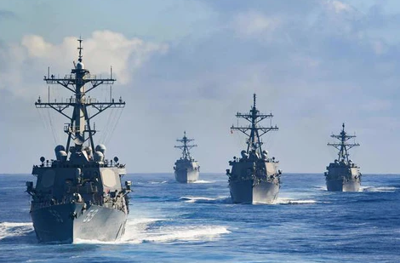
What is most ominous in the evolving scenario is that Trump appears determined to forcibly impose regime change on Venezuela. He obviously does not understand the lessons of Afghanistan, Iraq, Libya, and Syria in recent years and instead is hell-bent on showing his toughness by picking on a country that cannot put up a legitimate fight against US forces. His pretext is the claim of drug-running out of Venezuelan bases, although there has been no concrete proof yet provided to that effect. To buttress his bully move (which is an odd stance for a guy who campaigned on withdrawing the US from foreign conflicts), Trump has ordered the deployment of a carrier task force (a carrier with 5000 sailors, +/-100 aircraft, including 70 warplanes, 5 destroyers, a submarine and tenders) to the Southern Command area of operations (AOR) where an additional 8 warships are already stationed along with a US Marine Expeditionary Force. SOUTHCOM also uses Army, Marine, Navy and Coast Guard assets on specific occasions as deemed warranted, and is already conducting strategic and tactical bomber runs near Venezuelan airspace by B-52s and B-1s stationed on the US mainland.

One can get a sense of what US forces have deployed to the Caribbean to date here.

US Navy ships in Southern Caribbean. Source: Trinidad Express.

What all of this means is that the game is on. Moving this amount of assets to the Caribbean Basin, especially given the presence of land forces in the deployment, is no bluff. Trump seems to think that he can make an example out of Venezuela, contrary to historical precedent when it comes to the forced regime change going as planned or producing the desired results. One things is certain. It will be Venezuelans who suffer the most from any eventual escalation, and their scotch-swilling wealthy exile “leaders” will do nothing to shield them from a US assault.

In contrast to all of this Big Stick manoeuvring, Trump has offered Argentine president Javier Milei a USD$40 billion bridge loan as a form of bailout for Milei to make interest payments on outstanding public loans. No international lender like the IMF or World Bank would do so because of concerns about Milei’s reckless fiscal and macroeconomic policies (at one point he wanted to dollarize the Argentine peso and shipped off Argentina’s gold reserves to England on a private plane). Private investors took advantage of Milei’s public sector asset sale program to strip them of what value they held, repatriated the profits from the re-sale of those assets, then left the economy. What private investors remain are engaged in dodgy crypto schemes and destructive enterprises like critical mineral mining (lithium, in particular) where regulation is lax and where profits are largely sent abroad.

Milei himself is embroiled in an investigation into a memecoin “pump and dump”/”rug pull” scheme concocted along with Trump-allied US crypto billionaires, where he touted on social media a specific coin called $Libra that rapidly rose, then fell in value, making the 9 founding $Libra accounts around USD$82 million and leaving 72 thousand other investors with USD$251 million in losses in just over 3 hours. Milei later distanced himself from the scheme but it was discovered that he was one of the 9 founding accounts, which as per usual were managed by his sister and chief personal advisor, otherwise known as “Ms. 3 percent” for the price of the “commissions” she demands of entities doing business with the Argentine State (the most recent involving a pharmaceutical company). Milei’s sister, Karina, is also being investigated for links to–surprise!–narcotraffickers and assorted other dark forces in the Argentine landscape.

The Trump bridge loan bailout for Argentina was in fact a political rescue line thrown to Milei. His party (Libertad Avanza or Freedom Advances) did very poorly in provincial and first round congressional elections in September and at the time of the bailout it was assumed to be posted to suffer a similar fate, or at least not improve its minority Congressional representation in the national midterm elections this past weekend. That would jeopardize his reform agenda for the remainder of his presidential term, making him a lame duck and paving the way for a return of either a Peronist party faction leader or a newer centrist coalition-backed candidate. Either of these option would spell the end of the “chainsaw” approach to public sector restructuring as well as Milei’s pro-US (and pro-Israel and anti-climate change) position, something that Trump seeks to avoid.

As it turns out, Libertadad Avanza won 41.7 % of the congressional electorate vote, defeating the opposition coalition, which won 40.4% of the total number of party votes. This improves the government’s bloc position in Congress and strengthens Milei’s hand in imposing more reforms, but it also sets the stage for ongoing deadlocks and resort to rule-by-Executive decree on the part of the Argentine president. But for the moment, chalk this up as a win for Trump’s bailout carrot/election interference gambit because even if short term in nature, it may have influenced things in a US-favorable way when it comes to Argentine foreign policy. Since Trump threatened to rescind the bailout of Milei’s party did not win, it is quite possible that tis weighed significantly on the minds of voters (who still turned out in record low numbers–67.8%– in spite of voting being mandatory).

What is also interesting is not that the bailout was given for political rather than sound economic reasons. That happens. What is of note is that the bailout comes at a time when US tariffs on Chinese goods resulted in retaliatory tariffs on US agricultural products, especially soybean exports. Most of these are grown in Red Trump-voting states. When the retaliatory tariffs kicked in Argentina dropped its export taxes on soybeans, and along with Brazil rapidly took advantage to increase soybean exports to the PRC. In just a few months Argentine and Brazilian soybean exports have taken over the previous US share of the PRC soybean import market. So in effect Trump has bailed out a foreign government for ideological reasons even though it directly hurts a core voting block in the MAGA coalition. That makes neither economic or political sense.

In response to criticism of this deal, Trump puzzlingly announced that he would reduce tariffs on Argentine beef imports so that it could increase its US market share. At a minimum that means reducing US beef prices in the face of Argentine import competition., which is now the stated intention of the plan (beef price reductions across the board). Once again, US beef is mostly produced in Red states, so here too the economic and political logic at play appears to be contrary to the interests of key MAGA voters. It seems that for Trump ideological buttressing of an ally abroad is more important than the material fortunes of US farmers, and he does not fear electoral retribution as a result. That is another oddity, unless he has a plan for avoiding electoral backlash in the first place, which may be what the overall beef price reduction plan is all about..

In El Salvador, Trump has courted Nayib Bukele, the self-styled “world’s coolest dictator” who offered to house US deportees at his infamous CECOT prison in exchange for money, diplomatic favours and the betrayal of several FBI informants tied to the Salvadorean gang MS-13. Regarding the latter, Secretary of State promised the FBI that he would not divulge the informant’s names to Bukele but then did so, whereupon Bukele demanded they be returned to El Salvador rather than stay in US detention. Secretary Rubio obliged and it is now presumed that the informants are dead. Here the Big Stick was wielded on behalf of a foreign government in conjunction with domestic objectives rather than used against it for strategic gain.

Further afield, MAGA operatives have close links to former Brazilian president (and coup plotter) Jair Bolsonaro’s party and his revanchist sons while the Trump administration has imposed a 50 percent across-the-board tariff on Brazilian goods as well as travel sanctions against the judges that convicted Bolsonaro and sentenced him to six years in prison for sedition earlier this year. The Trump connection to Latin American opposition groups includes rightwing Chilean figures, adherents of the old Pinochet dictatorship and new tech moguls, as it is reported to be quietly influencing the policies of Paraguay (led by a conservative) and rightwing opposition factions in Peru. In effect, in these instances the Big Stick used by one foreign policy hand is complemented by a more subtle and covert velvet glove approach on the other.

In the end, Trump’s return to a US gilded age is very much true in the original Twain sense of the phrase, and its adoption of a crude form of Gunboat Diplomacy characterised by a Big Stick/Carrot approach is playing out in contradictory but obvious ways in what Trump considers, to Latin American revulsion, to be the US’s backyard where the Roosevelt Corollary to the Monroe Doctrine gives it the right to act with wanton disregard for International law and imperialist impunity with regard to the rights of individuals and States. Much like demolishing of the White House East Wing serves as an allegory for the destruction of the US constitutional system and social fabric, the return to the Big Stick and selective carrots is symbolic of an increasingly feckless approach to US foreign policy, regionally defined.

As the saying from former Mexican president Porfirio Diaz goes (amended here to include the entire region): “Poor Latin America. So so far from God and so close to the United States.”

Que Pachamama los proteja!

Declaration: I was the Regional Policy Analyst for the Interamerican Region and Caribbean Desk Officer in the Office of the US Secretary of Defense (OSD/ISA/IA), co-Team Leader of the Cuba Task Force and a consultant to the CIA, US Southern Command, US Air Force Special Operations and US Navy Special Operations Commands in the 1990s. In those roles I was engaged in exactly the sort of exercises that go into this type of war-planning/preparation and am well aware of the long history of US anti-drug campaigns in the region as well as the US military involvement in them (including the infamous Pablo Escobar/Cali Cartel years). My commentary is informed by those experiences and by the certain knowledge that the norms and restraints that governed the actions of my colleagues and I no long apply when it comes to the application of US military force.

Some comments on NZ politics.

I had some time on my hands the past few days so spent more attention than usual consuming news about NZ domestic politics. My interests tend to lie further afield, but recent government assaults on Maori rights, women’s pay equity, constitutional neutrality, environmental, health and safety regulations, equitable taxation policy, state sector employment, Labour’s pandemic response and assorted other lesser insults have drawn me, perhaps like a moth to flame, to seek some illumination on the local political scene. These are a few tidbits that I took away this week., translated into social media posts.

  1. Chloe Swarbrick’s remarks about the government’s cowardice on the issue of Palestinian statehood in the wake of Israeli actions in Gaza.:

First all, Swarbrick is correct. If only six coalition MPs had some moral-ethical courage, then NZ could join the majority of the international community, including three of the 5 Eyes partners, in condemning Israel’s collective punishment of all Palestinians for the sins of Hamas on October 7, 2023, including the IDF’s use of ethnic cleansing and mass starvation as a means to that end. For that she was told to apologise by the Speaker (and National MP) for using the phrase “if six…members had a spine” and when she did not, ordered to leave the debating chamber. and later “named.” This is my comment on social media: “Peters, Jones and Seymour voice ugly boorish insults against their opponents (including racist taunts) and are allowed to remain in the House. Swarbrick correctly points out the spineless behaviour of government MPs regarding Gaza and gets thrown out. So much for Speaker impartiality” (referencing routine remarks made by the NZ First and Act leaders).

Also, as an aside to the particulars of this case, I should note that in light of prior history by Brownlee and other conservative MPs when it comes to progressive female members, there is a whiff of misogyny in the ruling. As a relative said to me (paraphrased here), male MPs can be loud, rude, condescending and bombastic when speaking to the House, but women cannot get angry or raise their voices even in defense of universal values. Now, I realise that Brownlee fashions himself as “old school” when it comes to parliamentary ethics and protocols, but if these boy’s club unwritten rules are part of the “old school” way of doing parliamentary politics, I say that he and others of his ilk need to be woken from their Rip Van Winkle stupor and shown the door.

By way of a broader backdrop, we should be clear that for all of its talk about foreign policy independence and having stood up to the US and its Anglophone allies with the 1985 non-nuclear declaration, NZ is a diplomatic follower, not a leader. It waits until other States make a move or show initiative on sticky international issues or events, then coattails on whatever seems most beneficial over the short-term. It pays lip service to international rules and norms but sniffs the wind when foreign policy smoke is in the air.

This syndrome has been accentuated in recent decades, particularly by National-led governments, and is now at rock bottom when it comes to NZ supination to other’s interests. The governing coalition’s current lack of resolve when it comes to denouncing the Palestinian catastrophe and upholding the right to Palestinian self-determination can be attributed to slavish obsequiousness to the US (Trump) position on the matter, perhaps abetted by the influence of the NZ Israeli lobby. Whatever ulterior ends the coalition of chaos may think that this approach may serve vis a vis the bilateral relationship with the US, they are sorely mistaken. NZ is just another squirrel looking for that elusive US nut.

2) On the decision to remove Maori words from schoolbooks :

I wrote “a main tool of cultural erasure is to remove all public references in a language other than that of the dominant social group. The CCP does it to the Uyghurs in the PRC. The excuse for doing so is usually to promote assimilation and social cohesion. The real motive is darker.”

I could go on about the attempts to erase indigenous languages and dialects in the public sphere is a host of places, particularly in Latin America, the region I am most familiar with, but also in Canada, the US, Africa and parts of the Pacific. The practice was so common in the colonial past that some linguists have written about the cultural genocide that follows erasing of a native language. When ti comes to identity and cultural preservation, language (and words) matter.

What is also remarkable is that it is well accepted that, rather than “confusing” in the Education Minister’s words, learning other languages at an early age promotes brain development and complex thought. Defending the removal of Maori words from children’s books is therefore doubly retrograde: it is the first step of an attempt at cultural erasure (at least in the public space), bookending similar attempts to remove te reo from public buildings and signage; and it is counter-productive (and counter-factual) as a pedagogical approach. Shame on Erica Stanford and her acolytes! And if a few Maori words are confusing, why not remove all non-English words from school books? Sacre bleu!

3) On the refusal of former Labour Ministers to front up to a public hearing of the Royal Common of Inquiry into the Pandemic Response:

“Why front up to a kangaroo court when the kangaroo judges are the political opposition? Especially after providing written answers to documented questions supplied by the kangaroos about events long in the public domain? Smacks of an ex-post political beat-up best avoided.” The fact that the Inquiry was instigated by ACT and NZ First as a partisan bludgeon after listening to conspiracy theorists and anti-vaxxers appears lost on the corporate media (partisan media like Plunket, Bridges and Hoskings just megaphone the anti-Labour lines). In fact, Labour should be pushing back harder at the political instigators, for example by questioning how they came to get involved in the witch hunt after actively supporting Labour’s pandemic response at the time, and who feeds them their talking points.

4) On a serving NZDF member is standing trial for espionage.

“The espionage charge against a serving NZ soldier is remarkable. The defendant is accused of working for, at the behest, or on behalf of a foreign State. Many questions arise from soldier’s court martial/trial. 1st: Which State? 2nd: what motive(s)? 3rd: what was compromised?”

Charging an active duty NZDF member with spying is remarkable because that charge–espionage– is only brought if the accused is suspected of working as a covert foreign agent. It does not refer to any domestic interlocutor., patron or client. I seem to recall at the time of the arrest that the soldier was detained for having objectionable material, presumably extremist literature (the military does not court martial people for having porn unless it is of the illegal variety). The soldier was also said to have links to right wing white supremacist groups. So it would be premature and very possibly wrong to finger the PRC as the puppet master (as the usual suspect). Given its other dark activities in NZ, Russia is a possibility. Or some other State. What should be clear is that it would not be an ally of the NZDF like the US, UK, Australia, Canada, France or other countries that routinely share higher-level intelligence with the NZDF (say, on operations, deployments, capabilities and tactics) that the soldier could not easily access unless s/he was in a military intelligence billet.

There could be a mix of motives involved, including money, sex and ideology. The counter-intelligence aspects of uncovering the suspected spy are also worth considering. In that light the trial should be interesting and revelatory, assuming that coverage is not effectively shut down for reasons of national security (yeah, right).

Should it be your inclination, feel free to weigh in within the KP rules of discourse.


Kash Patel comes to town.

This week FBI Director Kash Patel arrived in Wellington to open a full time Legal Attache office (previously Legal Attaches rotated from offices at the US embassy in Canberra depending on need). Like excited children government ministers lined up for photo ops and the corporate media breathlessly reported on what Patel had to say. What he had to say, and how it was reported, was a mixture of circus side-show and fawning toadying, all uncritically covered by click-bait obsessed media scribes.

In view of that, please allow me to correct the record.

To begin with, the FBI is a law enforcement agency with powers of arrest, not an intelligence agency that does not have arrest powers. It is not a secret spy agency. Its NZ partner agency is the NZ Police, not the SIS or GCSB. In that role the FBI is a consumer of intelligence streams coming from 5 Eyes agencies (in NZ, the GCSB) as well as the NZ Police and SIS, but is not part of the 5 Eyes network. 5 Eyes is a signals and technical intelligence gathering and sharing network to which the FBI does not belong. INTERPOL is an international law enforcement partnership that the FBI is a member of. Although INTERPOL may share intelligence that originates in 5 Eyes, it has a distinct organisation, function and role. As 5 Eyes partners, the GCSB counterpart in the US is the NSA, and the US partner of the SIS ( a human intelligence agency) is the CIA.

In short, the FBI is an altogether different type of security agency and should not be confused with intelligence agencies properly defined.

Patel’s talk of direct FBI/5 Eyes links is therefore PR spin pushed by the US and Trump’s entourage that has no actual basis in fact. Using the LEGAT office ribbon-cutting ceremony in Wellington as an excuse, Patel’s visit was an overdue “show the flag” exercise by a US senior official more than 6 months after Trump entered office, and rather than Secretary of State Marco Rubio the US sent a conspiracy theorist-turned-second tier executive branch official instead, who then ran the anti-PRC/5 Eyes line even if Legal Attaches (FBI agents) deal with transnational crime, not strategic balancing or geopolitical competition and do not participate directly in 5 Eyes activities. (Note to readers: the FBI director is not a US cabinet position and is subordinate to the Attorney General in the US Department of Justice, so trotting out NZ cabinet ministers for a meet-and-greet, including those involved in intelligence matters, was obsequious in the extreme).

Be that as it may, Patel engaged in a bit of diplomatic performance art using the NZ government and media as props with which to push Trump’s anti-PRC agenda rather than focus on the relatively mundane business of opening a stand-alone LEGAT office, which are common in most US embassies and which, again, other than intelligence sharing on transnational crime via INTERPOL and partner agencies in foreign countries like the NZ Police,, do not directly engage in espionage or other forms of intelligence gathering (the fact that the office is outside the main US embassy complex and has undergone a slight name change does not mean anything particularly significant other than the need for more dedicated space and Trump’s obsession with putting his branding on everything. But a “law enforcement attache” is just a LEGAT by another name, and having separate office space may simply be a matter of re-allocating physical resources).

Patel’s remarks about the LEGAT office opening being a counter to the PRC that bolstered the 5 Eyes was a purposeful distraction from what should have been a low-key affair and should have been treated as such because for NZ bringing in an adversarial take on the PRC in an otherwise unremarkable and unrelated matter makes for disproportionate diplomatic discomfort. Neither the US embassy or MFAT press releases mentioned the PRC or 5 Eyes., so the cringe factor must have been high amongst the diplomatic corps. Then again, Patel likely knew that, but since hype and showmanship is what Trump is all about and Patel’s main audience was the one in the Oval Office, the NZ government and corporate media dutifully obliged by indulging the dog-and-pony show about the PRC and 5 Eyes. It was a pitiful display of diplomatic supination that may well have adverse consequences down the road.

To be clear. The significance of Patel’s visit to open a dedicated full time LEGAT office in NZ lies in the fact that it is official recognition that transnational crime is now a major problem in the Southwest Pacific and hence a priority for the US and other Western security agencies. In the measure that the PRC is involved in things like drug smuggling and cyber crimes in the region, it will be on the radar of these agencies, but in that regard it is just one of many state and non-State actors operating in what are known as “grey area” zones where criminal organisations and some State actors cooperate out of mutual interest. North Korean and Russian use of South-Pacific flagged ships to circumvent sanctions and smuggle oil is one example of this, as is the cyber-hacking activities of criminal entities tied to the Kremlin, Iran and PRC (among others). Likewise, transnational crime networks presence in island States like the methamphetamine trade in the Samoas (where drugs sourced in the US and Mexico are smuggled from American Samoa to Samoa across their common land border) require better resourced and coordinated regional law enforcement responses. The new US LEGAT office in Wellington is part of that effort.

As for terrorism and people smuggling (other designated priority areas announced by the US embassy during Patel’s visit), the role of the PRC is marginal at the very worst. And yet Patel placed it front and centre in his remarks at the opening ceremony

Regardless of the US spin so slavishly reported in NZ, opening a dedicated LEGAT office in Wellington is not about countering the PRC or bolstering 5 Eyes. It is about strengthening bilateral crime-fighting capabilities between the US and NZ in the Southwest Pacific. And if there is anyone other than criminals tracked and caught by the enhanced inter-agency law enforcement cooperation and regional presence of the FBI in the SW Pacific who have most to fear by the upgrade, it is those who may have extradition warrants issued by the US for their arrest. That is because Legal Attaches are the main vehicle for executing US warrants in any given country.

Kim Dotcom, are you paying attention?

Say it again: Hate crimes are not terrorism.

Since I have written extensively about this subject over the years I will not bore readers with more tedious expositions. But in light of recent events I thought it would be permissible to height some basic facts about hate crimes and terrorism. Here goes:

Government officials, politicians and media have misidentified the recent murders of two Israel embassy staffers in DC as terrorism. It is not. It is a hate crime. In this instance there is no differentiation between target, subject and object of the attack, which is what separates terrorism from hate crimes. Hate crimes are acts of violence against specified “others” and confined to the acts themselves. They can be done for political (i.e., ideological, partisan), and/or non-political reasons (e.g., basic racism, religious animosity, greed, jealously). They can be motivated by revenge, which in turn is most often fuelled by hate. But in all instances the target, subject and object are the same. For the perpetrators, focused violence IS the intent and does not extend beyond itself (even if repercussions do).

Terrorism involves separate targets (victims), subjects (audiences) and object(ives) that go beyond a given violent event. For example, innocents are killed in order to influence the perceptions and will of both sympathetic and antipathetic audiences with the intent of altering their behaviour to or away from certain courses of action (say, regarding an occupation). The motives of terrorism may dovetail with those of hate crimes but the subject and object are broader than just the targets.

While they matter in terms of specific causality chains and the impact derived from them, terrorism is not defined by the identities of the victims, perpetrators or the motives of the latter. It is defined by the act of violence set against a broader context involving actors, audiences and behaviours. It is grotesque theatre of the macabre. In contrast, hate crimes are about the identity of the victims, not their behaviours per se. Hate crimes are designated as a special category of crime because they involve a “usual” act of violence (e.g., murder or rape) committed against someone for ascriptive reasons, that is, because of who they are, not what they do. Terrorism makes no such distinction.

Remember that October 7 can be properly called a terrorist act in part because a number of those killed, kidnapped and held hostage were not Jewish or Israelis (e.g., Filipino agricultural workers). For Hamas the objective of the attacks was to sow fear in Israel and among its rival in the Palestinian Authority while demonstrating resolve to the Palestinian people, allies like Iran and Hezbollah and the world in general when asserting Hama’s claim to leadership of the Palestinian cause.. As targets, the victims props and pawns in the larger stage play.

Although politically-motivated, the DC murders are not terrorism. Attaching that label in order to influence popular perceptions and add legal weight to prosecutions for partisan purposes is an egregious instance of conceptual stretching that renders the term terrorism meaningless. In fact, “terrorism” is now used to describe pretty much any act of politically-motivated violence precisely because it is such an emotionally-charged term, one that gets trotted out by authorities, politicians and media depending on who the perpetrators and victims are.

Worse yet, deliberate misuse of the term “terrorism” often serves as a type of what is legitimately known as “stochastic terrorism.” Stochastic terrorism involves the framing of social narratives in order to invite, incite or provoke violence against a designated group or entity (one example is Great Replacement theory, which argues that there is a plot by Jews and other nefarious actors to replace the white races with non-Christian people of color. That was a major rallying point of the racist violence in Charlottesville, VA in 2017. You can read about it here: https://en.wikipedia.org/wiki/Unite_the_Right_rally).

Misuse of the term “terrorism”also allows governments to clamp down on dissent, opposition and civil society in general by invoking national security threats related to those designated as such. For example, the Trump administration has designated the Venezuelan Tren de Aragua criminal gang as a “terrorist entity” in order to detain and deport thousands of Venezuelans resident in the US (regardless of their immigration status or the fact that most have no affiliation with T de A).

Because of the very real dangers associated with the misuse of the term, we really need to demand conceptual clarity when and where political or ethnographic-religious/racial/sectarian violence is concerned. Otherwise we are on just another race to the bottom when it comes to understanding the darkness that surrounds us.

Signalling Deliberate Reckless Disregard (updated with a NZ angle).

Some thoughts on the Signal Houthi Principal’s Committee chat group conversation reported by Jeff Goldberg at The Atlantic.

It is obviously a major security breach. But there are several dimensions to it worth examining.

1) Signal is an unsecured open source platform that although encrypted can easily be hacked by signals intelligences agencies as well as criminal entities (it is a major part of what they do). The Pentagon issued warnings about using Signal to discuss sensitive information a week before this chat group was set up and yet National Security Advisor Waltz (who set up the group chat) went ahead and used it anyway, then inadvertently included Goldberg in the conversation;

2) Who was there and who was not. The 18 member group (including Goldberg) did not included any military officer, either from the Joint Chiefs of Staff or Central Command (which organised and conducted the strikes on Houthi targets). It did include people who had no reason to know classified details of the war plans, including the Treasury Secretary and his Chief of Staff, Secretary of State and his Chief Counsel and several lower-ranking staffers from the White House and other agencies. All could have received general unclassified briefs rather than highly classified advance notification of the details of the strikes. Most tellingly, the US Special Envoy to Ukraine and Russia, a member of the group chat with no need to know specifics of the strikes, was in Moscow at the time, where he was very likely to be under close electronic and personal surveillance;

3) All participants in the group had easy access to dedicated secure communications, including in some cases at their homes as well as part of their travel parties. They did not use them and instead opted for the unsecured commercial platform;

4) This matters because if reports are correct, weapons, targets, sequencing of attacks and location of platforms (air, sea, land) were specifically mentioned, as well as the name of a CIA agent, two hours before the attacks began. If hostile actors were monitoring any of the group’s Signal accounts, then the Houthis could have been warned in advance. One wonders what else these accounts may have offered adversaries if the use of Signal was commonplace amongst them;

5) There are reports that Signal was used to avoid Freedom of Information ACT (FOI) and Official Records Act (ORA) scrutiny. This was recommended by Project 2025 to eliminate information data that might be considered prejudicial or controversial if made public under the FOI or as part of ORA obligations (since apps like Signal permanently delete conversations once they are closed, so no records of them are kept. In this case Waltz set the closure date at one week after the chat ended). Deliberately trying to circumvent the ORA is illegal. Think of the historical precedent: Nixon’s Watergate tapes;

6) The chat involved diplomatic as well as operational security. Operational details of such strikes are obviously classified in advance of them and often after the fact because lives as well as US interests can be put at risk. Diplomatic security refers to frank discussions between government peers that they consider to be private/in-house because foreign interlocutors may not be happy with them (think of it as a buffer hiding a lack of discretion among officials). In this Signal chat group European allies were disparaged by SecDef and the VP, and Deputy Chief of Staff Miller spoke of extracting economic concessions from the likes of the Egyptians for providing the muscle in breaking the Houthi blockade (Egypt imposes levies on shipping in the Suez Canal as they transit to/from the Mediterranean and Red Sea, so lesser vessels in the Suez Canal due to the Houthi blockade means less revenue for Cairo. Breaking the blockade is therefore to the economic benefit of the Egyptians and Miller advised the group to demand compensation for doing so). There were differences in the group regarding the timing of the strikes because of differing perceptions of who would benefit the most–Europe or the US. The group also spoke of pre-empting the Israelis when it came to attacking the Houthis in order to get the political credit for doing so. All of this is sensitive insofar as it reveals the mindsets of the group participants with regard to allies. That mindset, in a word, is undiplomatic to say the least;

7) Given who was in the group and what was discussed, it appears that the Signals Houthi Principal’s Committee was basically a PR task force of sorts that was designed to get behind a specific narrative about the strikes. That is even openly mentioned in the conversation–staying on script, being united in the messaging, etc. That in and of itself would be fine if the conversation did not include any classified information. But if it did…

8) The administration states that no classified information was discussed and has resorted to smearing Goldberg as a deflection. That is a short-term solution. If the chat did not involve any classified information then Goldberg is free to release it to the public, or at least to investigative committees and agencies (he has very ethically chosen not to publish what he calls the classified details that he was privy to because of the risks involved). If there was classified material discussed in the chat, then DNI Gabbard and CIA Director Ratcliffe came perilously close to perjuring themselves before a Congressional Committee today, and Waltz and Hegseth have now lied to POTUS (assuming that Trump was unaware of the chat until after the fact) as well as the public.

All of this will undoubtably be a source of concern for US intelligence partners and allies in general. Although military and intelligence professionals in the security decision-making chain are continuing to do their jobs professionally, the cavalier if not reckless approach to information security exhibited by these partisan loyalists at the top of the Trump security apparatus is bound to cause alarm. After all, if loose lips sink ships, then the loose lips are on the Trump boat’s bridge.

NZ RELEVANT UPDATE: The New Zealand Navy is currently in command of JTF-150, the joint maritime patrol force leading the response to the Houthi attempted blockade in the Red Sea. NZDF also has targeting teams and other intelligence assets in the JTF-150 AOR (Area of Responsibility), which obviously includes Yemen and other Red Sea littoral States. Given that a CIA agent’s name was mentioned in this Signal chat group session, it raises the question as to whether other Signal chats were used by Trump administration officials to discuss classified information that may have included details of the activities of JTF-15 partners, including the NZDF. If so, that would be very problematic in terms of ongoing operational security for the NZDF personnel currently deployed in that theater. https://combinedmaritimeforces.com/ctf-150-maritime-security/#:~:text=CTF%20150%20is%20a%20multinational,on%20a%20four%2Dmonth%20basis.

To reiterate. If Signal was used to circumvent the ORA and potential FOI obligations whether classified information was mentioned or not, then criminal liability is now on the table for those who organised and participated in the group chat.

Except for Jeff Goldberg.

Thinking about life in a nuclear armed crowd.

The title of this post comes from Albert Wohlstetter’s 1976 seminal essay Moving Towards Life in a Nuclear Armed Crowd. In that essay he contemplated a world in which several nations had nuclear weapons, and also the strategic logics governing their proliferation, deployment and use (mainly as a deterrent). For years after his essay was published, the number of nuclear-armed states remained low. Today they include the US, UK, France, PRC, Russia, India and Pakistan, with Israel as an unacknowledged member of the club and Iran and North Korea as rogue aspirants. At one time late in the Cold War, Argentina, Brazil and South Africa had nuclear weapons programs but abandoned them as part of the their transitions to democracy. By and large the Non-Proliferation Treaty (NPT) has kept the acquisition of nuclear weapons in check, something that along with various arms control agreements between the US and USSR/Russia (SALT I and II, START, the Intermediate Range Nuclear Forces Treaty (INF)), helped stabilise a low number nuclear weapons state status quo for five decades.

But that may be about to change. Not only have nuclear powers like the PRC, India and Pakistan opted to not be bound by international arms control agreements and others like Israel, Iran, India, Pakistan and DPRK have ignored the NPT. All of the major bilateral treaties between the US and Russia governing strategic and tactical nuclear weapons have been allowed to lapse. The non-proliferation regime now mostly exists on paper and is self-enforcing in any event. There are no genuine compliance mechanisms outside of voluntary compliance by States themselves, and in the current moment nuclear armed states do not wish to comply

The situation has been made considerably worse by the re-election of Donald Trump to the US presidency. Although he speaks of securing some sort of “deal” with Iran that freezes its nuclear weapons development programs, his threats of withdrawing from NATO, including withdrawal of security guarantees under the collective security provisions of Article 5 of the NATO Charter, coupled with his pivot towards Russia in its conflict with Ukraine, has forced some countries to reconsider their approach towards nuclear weapons. Polish Prime Minister Donald Tusk told his parliament this week that Poland “must reach for the most modern possibilities, also related to nuclear weapons and modern unconventional weapons” because of the threat of Russian aggression and unreliability of the US as a security partner under such circumstances. Similarly, French President Emmanuel Macron has floated the idea of extending a French “nuclear umbrella” over Europe (read: NATO and the EU) should the US renege on its Article 5 obligations.

The perception that the US is no longer a reliable security partner, at least under the Trump administration, must be considered by front-line states such as South Korea and Taiwan, perhaps even Japan and Germany, that are threatened by nuclear armed rivals and which until now were heavily dependent on the US nuclear deterrent for defending against aggression from those rivals. The situation is made worse because Trump is now using extortion (he calls it “leverage”) as part of his approach to security partners. His demands that Ukraine sign over strategic mineral rights to the US and that Panama return control of the Panama Canal to the US under threat of re-occupation are part of a pattern in which US security guarantees are contingent on what the US can materially get in exchange for them. Even then, Trump is notoriously unethical and prone to lying and changing his mind, so what US guarantees may be offered may be rescinded down the road.

Trump wants US security partners to spend 2 to 5 percent of GDP on defence and threatens to not honour US agreements with them if they do not. Although this may well force some NATO members and others to up their spending on defence (as Australia, Poland and South Korea already do), the one-size-fits-all percentage of GDP demand fails to recognise the circumstances of small and medium democracies such as NZ, Portugal and Holland, among others. Trump may call it driving a hard bargain, others may say that his approach is “transactional,” but in truth he is extorting US allies on the security front in order to gain concessions in other areas. And for “whatever” reason, he admires Putin and deeply dislikes Ukrainian president Zelensky as well as Canadian Prime Minister Trudeau, something reflected in his approach to bilateral issues and the way he talks about them. The personal is very much political with Trump, and he is an impulsive bully when he believes that it suits him to be.

The US pivot towards Russia under Trump has been much discussed in terms of its implications for the world order, strategic balancing among Great Powers and the future of the US-centric alliance systems in Europe and Asia. It truly is a major transitional moment of friction in world affairs. But the issue of nuclear proliferation as a response to the changed US stance has gone relatively unnoticed. Remember, these are not the moves of rogue states that are hostile to the old liberal international order. These are and may well continue to be the responses of democratic and/or Western aligned states that were integral members of that old order, who now feel abandoned and vulnerable to the aggression of authoritarian Great Powers like Russia and the PRC.

In the absence of the US nuclear guarantee and in the security vacuum created by its strategic pivot, indigenous development and deployment of nuclear weapons becomes a distinct possibility for a number of states that used to have the US nuclear guarantee but now are unsure if that is still true, and have the technological capabilities to do so. The global spread of high technologies makes the pursuit of nuclear weapons easier than in previous eras, and if time, money and willpower are devoted to doing so, nuclear proliferation will inevitably happen. Remember that nuclear weapons are primarily deterrent weapons. They are designed to deter attacks or retaliate once attacked, but not to strike first (unless destruction of the targeted society is the objective and retaliation in kind is discounted). They are the ultimate hedge against aggression, and now some non-nuclear states are reconsidering their options in that regard because the US cannot be trusted to come to their defence.

Russia has repeatedly raised the spectre of using tactical nuclear weapons in Europe should it feel cornered, but even the Kremlin understands that this is more an intimidation bluff aimed at comfortable Western populations rather than a serious strategic gambit. But that only obtains if the US still honors its nuclear defense commitments under NATO Article 5, and if it no longer does, then the Europeans and other US allies need to reassess their nuclear options because Russian threats must, in that light, be considered sincere.

Even so, first use of nuclear weapons, specially against a non-nuclear state, remains as the ultimate red line. But that line has been blurred by Trump’s equivocation. Nuclear hedging has now become a realistic option not just for front-line democratic states facing authoritarian aggression, but with regards to the US itself because it is a no longer a reliable democratic ally but is instead a country dominated by an increasingly authoritarian policy mindset at home and in its relations further abroad. Ironically, the “madman with a nuke” thesis that served as the core of deterrence theory in the past and which continues to serve as the basis for resistance to Iran and North Korea’s nuclear weapons programs can now be applied to the US itself.

There are two ways to look at the situation. On the one hand the chances of nuclear proliferation have increased thanks to Trump’s foreign policy, especially with regards to US international commitments and alliance obligations. On the other hand, deterrence theory is in for an overhaul in light of the push to proliferate. This might re-invigorate notions of flexible response and moves to provide stop gaps in the escalatory chain from battlefield to strategic war. Notions of nuclear deterrence that were crafted in the Cold War and which did not change with the move from a bi-polar to a unipolar to a multi-polar international system must now be adapted to the realities of a looser configuration–some call them metroplexes or constellations–in which the spread of advanced technologies makes the possibility of indigenous development of nuclear deterrence capabilities more feasible than in the old security umbrella arrangements of previous decades.

The irony is that it is the US pivot towards Russia that has popped the cork on the nuclear proliferation bottle. States like Iran and the DPRK have been subject to sanctions regimes that have slowed the development of their nuclear arsenals. But that happened against the backdrop of the US providing binding security guarantees to its allies, offering a credible nuclear deterrent to those who would seek to do harm against them and giving material support to the NPT. That is not longer true. It is the US that now must be viewed with suspicion, if not fear. The briefcase with nuclear codes is within a few arm’s lengths wherever Trump goes and he is now staffing the highest ranks of the US military-security complex with personal loyalists and sycophants rather than seasoned, politically neutral, level headed professionals with experience in the practice of strategic gamesmanship, including nuclear deterrence and war planning. Under those circumstances it would be derelict for military and political leaders in erstwhile US allied states to not hedge their bets by considering acquiring nuclear weapons of their own.

This was not what Wohlstetter envisioned when he wrote his essay. But after a period where that nuclear armed crowd appeared to stabilise and even shrink, some of his insights have become relevant again. It may no longer be about MAD (mutual assured destruction), but it sure is SAD.

About that PLAN flotilla in the Tasman Sea.

Here are some thoughts about the hysteria surrounding a Chinese Peoples Liberation Army Navy (PLAN) flotilla conducting freedom of navigation exercises in the Tasman Sea, including live fire drills.

1) The flotilla has been tracked for over a week by New Zealand and Australian forces. The tracking began when the flotilla was well NE of the Australian northeastern coast.

HMAS Arunta shadowing PLAN vessels in the Tasman Sea. Source: ADF handout/AFP.

2) The flotilla is operating in accordance with international law and maritime regulations regarding military operations in international waters.

3) The flotilla has no air cover deployed with it and therefore no effective means to defend itself against a coordinated air assault. It is basically a sitting duck for Australian air defences and even NZDF air defences (because the NZDF P8s and Seasprite helicopters carry air to surface munitions as well as torpedos).

4) The flotilla may have a submarine deployed with it.

5) The presence of the PLAN ships in the Tasman is a form of military diplomacy, showing the flag in a distant body of water as a demonstration of blue water power projection capabilities.

6) The PLAN freedom of navigation (FON) exercise in the Tasman Sea may well be a response to a joint Australian-New Zealand FON exercise in the Taiwan Strait in September 2024. Those waters are far more disputed than the Tasman Sea (because the PRC claims them as territorial waters), so the PRC objected to the exercise at the time and declared that it would formulate an appropriate response in due course. This could be it. But the PLAN vessels are far from Australian and NZ territorial waters, so the legality of their presence in open seas is indisputable.

7) The presence of the PLAN flotilla conducting live fire drills (5 conventional surface to surface rounds fired from the Type 055 destroyer Zunyi’s main gun at a floating target, as observed by personnel on the HMNZS Te Kaha) and other exercises is an excellent opportunity for Australian and New Zealand to hone their naval counter-force capabilities, including tactical signals and technical intelligence intercepts and collection from the flotilla. If a submarine is involved then the Antipodean allies can refine their anti-submarine warfare (ASW) capabilities as well, which is exactly what their P8 patrol and ASW aircraft are designed to do. As it stands, Australia and NZ are using air and surface platforms to shadow the PLAN boats.

8) Much has been made about the lack of warning given by the PLAN before the live fire drills. Such warnings are a courtesy, not part of any formal protocol. They are usually issued 12+ hours prior to the drill in order for interested parties such as civilian aviation and maritime operators to plan accordingly and clear away from the target area. The PLAN gave 15 minute warnings, forcing a few planes to adjust course away from the no-fly zone. That was perhaps rude as far as courtesy goes, but nothing more.

9) Most of the hysteria about the flotilla is led by Australian opposition figures in politics and media in an election year. Most of the alarm in New Zealand is led by Sinophobic media commentators or people with little knowledge of military affairs or the nuances of military diplomacy, much less naval operations (especially in NZ). All of them want to tie the exercises to broader Chinese moves in the Southwest Pacific such as the recent bilateral strategic agreement between the PRC and the Cook Islands. For their part, Ministry of Defense officials on both sides have been muted in their response and military officials have been largely silent (presumably because they know what is really happening).

10) It is clear that the PRC is “flexing” its military might in more and more distant places, as any Great Power would do. But not every display of power capability constitutes an imminent threat. Should Australia and NZ pay attention to the exercise? Absolutely, especially because it can be used as a learning tool for their respective naval counter-force platforms. Should they feel threatened by the exercises? Absolutely not. Claims of the exercise posing a threat, being a provocation or an act of intimidation by the PRC betray the biases of those who make such claims. The PRC is just doing what Great Powers do, and if anything it is reminding others of its capabilities while testing them in front of foreign eyes.

Sailors aboard an Australian navy ship look out at Chinese vessels on February 13, picture by the Australian Defence Force

Sailors aboard the HMAS Arunta observe the PLAN flotilla in the Tasman Sea. Source; AFD handout/AFP

11) In the end, if the US, UK, French or other Western navies conducted the exact same exercise in the Tasman Sea, there would be little controversy about it. Because it is the PLAN, however, anti-PRC elements in Australia and New Zealand want to use the occasion to stir up trouble in pursuit of their own agendas. But the truth is that the PRC is not designated as an adversary or hostile state by either Australia or New Zealand, who in fact enjoy largely cordial and beneficial trade relations with the Asian giant. Although there have been moments of friction between Australia and New Zealand, on one hand, and the PRC on the other over a number of political, diplomatic and military strategic issues, and the PRC remains a major concern for the Australian and NZ security communities for a number of reasons, none of this justifies turning what is a relatively small display of power projection into an international incident.

Everyone needs to clam down and relax.

On the DOGE data sweep.

Among the many other problems associated with Musk/DOGE sending a fleet of teenage and twenty-something cultists to remove, copy and appropriate federal records like social security, medicaid and other supposedly protected data is the fact that the youngsters doing the data-removal, copying and security protocol and filter code over-writing have not been properly security vetted and have at best been temporarily deputised into public service to do the retrieval tasks. They are loyal to Musk first, second and third and MAGA/Trump fourth. They are not loyal to the US public whose data they have now appropriated. This means that all that data collected is potentially being compromised or at risk of wider exposure and can even be data-mined, gifted or sold off to third parties for purposes other than public sector auditing or transparency.

That is pretty mind-boggling. As someone who held a S/TS/SCI clearance before leaving the US for a better life overseas, I had to undergo two polygraph and background checks conducted by the Defence Intelligence Agency before being granted the clearances, and upon leaving the security community I was placed under a 20 year gag order on what I had seen/done, with any material that I wanted to use after the 20 year gag window period ended subject to DoD censoring and editing (should I have decided to write or speak about topics that included using classified materials). I say this because I handled material that was just pertinent to my official duties, not wide swathes of data about everything under the sun, so the lack of security vetting of Musk’s minions is, again, astonishingly wrong.

This has the potential to end very badly, not just for the US government or what will be left of it after this reckless DOGE wrecking ball is done with it, but for the millions of people whose data can now be manipulated and used for untoward ends. We must remember that Musk is a dishonest and unscrupulous person, his cult minions and other “techbros” subscribe to variant of an anti-democratic and Social Darwinistic ideology known as “neoreactionism,” and MAGA acolytes like Stephen Miller, Pete Hegseth, Tulsi Gabbard, Pam Biondi and the authors of Project 2025 now installed in the corridors of power are all too happy to use any means to pursue the Trump/Musk agenda. Since all of these people are disreputable curs, none can be trusted to prevent misuse of personal confidential data for revenge, profit or other non-accountable purposes.

The questions then become: who benefits from the data-grabbing move? The GOP? Putin? The techbro oligarchy? What is the end game?

Whatever it is, it is a disaster in the making.