It’s over.

Media coverage of the Trump administration is like a group of people standing around the bedside of a terminally ill person. Instead of dealing with the fact that the person is soon to depart this earthly coil, they linger on the details of her illness, the early symptoms that remained undiagnosed, the downhill course of her trajectory, the therapies used to prolong her life, the deterioration of her body and the awfulness of it all. That is all well and true but the bottom line is that for the person in the bed, life will soon be over and no amount of picking through her medical history will change that.

Whether it be out of morbid curiosity or driven by ratings boosts linked to the politically macabre, the US media fixates on Trump’s every action. He fuels their addiction to administrative chaos with his inane tweets and moronic statements. Truth be told, the press cannot get enough of it and many a pundit has made his name off of analysing the Trump train wreck. But all this ignores the larger picture, which is that, whether it happen in days, weeks, months or a year, the Trump presidency is finished. Done. Dusted, Kaput. Finis.

The disaster that is his presidency is too obvious to recount in sordid detail here. Suffice it to say that people are being fired or leaving the administration in droves, and many jobs remained unfilled or have been taken by intellectual lightweights. Trump lashes out and reacts impulsively across a range of issues, with suspicions emerging in print that he is addicted to the prescription stimulant Adderol (which is a 25th amendment grounds for removal). He is besieged on several legal fronts, both at the federal as well as state level. Congress is soon to see Democrats gain control of the House of Representatives (which means his legislative agenda is all but finished), and his own Party is not wiling to blindly follow his policy leads. His foreign policy is in tatters, his border wall will not be built and the Mexicans certainly will not pay for it, North Korea still has nukes, his trade war is hurting the states where is electoral base is strongest, the Russians and others laugh at him to his face, his children are in legal jeopardy, and his cabinet has an increasingly feral character to it. Daily scandals, lies and inanities are a constant soundtrack of his presidency. Absorbing all of that, Wall Street, which had been so opportunistically bullish when he entered office (and for which he claims credit), is now moving beyond skittish into full bear territory (for which he blames the Federal Reserve). As New York state prosecutors pointed out with regard to the Trump Foundation, his administration is basically an on-going criminal enterprise rooted in fraud and corruption posing as a government. His lying acolytes are no longer able to keep straight faces when spinning the White House narrative and many of his supporters in high places have simply gone to ground. Even Fox News and rabid rightwing radio personalities are breaking ranks with him. The exact precipitant and method of exit remain unknown, but one thing is clear: He is isolated, incoherent and irrational. He will soon be irrelevant.

That is why the media would be better off ignoring him and focusing on the line of succession and other aspects of institutional continuity. The era of president Mike Pence is at hand, and if it turns out that he played loose with the Russians during the campaign (as is claimed), then he too may be shown the door. That brings the Secretary of State, Mike Pompeo, into the Oval Office, and if he is unfit to serve, then Nancy Pelosi as the incoming Speaker of the House follows in the line of succession. If Pence is not indicted or otherwise tainted by his association with Russians during the campaign, he is free to choose his own Vice President (subject to Senate confirmation).

It behooves the US political elite to be working with Pence on transition scenarios. Pence is a religious freak and troglodyte on gender and sexual issues, but as a former congressman and governor he knows what it takes to get things done in DC and he is rational in a hyper-conservative way. Although he will likely return to the neoconservative approach to foreign policy and continue to be on the wrong side of history when it comes to guns, reproductive choice and race relations, he will be, after the lunatic steps down, positively easy to deal with. The same goes for Pompeo, who served in Congress before being named CIA director and then Secretary of State.

The institutions themselves need to develop transition plans. Already defence strategists openly worry about Trump going rogue and trying to launch a nuclear strike somewhere as a diversion or as a act of petty revenge on his successors. They point out that he can do so on his own and that there are no formal institutional checks on him (he is only supposed to consult with the Joint Chiefs of Staff, Secretary of Defence and National Security Council as well as other cabinet officials, but he is not obliged to do so or to heed their counsel). Even if senior officers refuse his orders to launch a nuclear strike, he can work his way down the nuclear chain of command until he finds a compliant one. There is consequently a move to get Congress to re-write the law governing nuclear weapons use, but in the meantime DoD and the service commands need to consider the very real possibility of having to refuse a presidential order to use the arsenal. There is precedent for this under Nixon (during Watergate) and Reagan (after his Alzheimer’s became apparent), so it is not an unimaginable task.

The same can be said across the federal bureaucracy. Although Pence will not roll back all or most of Trump’s policies (say, on the environment), he will want his own team at the helm of federal agencies and will want to impose his own stamp on the policy-making process. In order for that to happen in an orderly fashion, planning must be done in anticipation of the change-over. It would be best for career public service managers to prepare contingency plans with an eye towards moving out from under Trump’s political appointees, particularly in contentious portfolios like Education and Homeland Security.

The bottom line is that the obsessive focus on Trump obscures the inevitability of his demise and the need to prepare for a change of administration. Because his downfall of itself will not right the ship of state. For that to happen a plan of action must be in place, something that requires congressional and executive branch coordination even if done without the knowledge of the political moribund in the White House.

Political Market Clearing.

As I watched the results come in on US midterm election night, it struck me that the tally was a microcosmic distillation of what democracy is in terms of preferred outcomes: no one gets everything that they want, but everyone gets something of what they want. With the Democrats regaining the lower House in Congress and the GOP increasing its Senate majority, and governorships distributed more evenly with a few Democratic wins, it struck me that this was the “mutual second best” that democratic theorists argue is the core of the democratic bargain.

Over the ensuing days it became clear that the Democratic wins were larger than anticipated on election night and that even if the GOP holds on to disputed seats in places like Florida (where I voted in infamous Palm Beach County), the erosion of Republican electoral support was significant. Conventional wisdom has it that Trump was a decisive factor in both victory and defeat for the GOP, as he galvanised his Red state base but alienated the suburban female demographic nation-wide. Women candidates, including women of colour and non-Christian cultural backgrounds, were the major winners in the congressional contests, although most of that came on the Democratic side (but even Republican women did well in places). What the results mean in practice, beyond all of the talk about investigations and impeachment (which are real possibilities now that the House is under Democratic control), is that Trump’s legislative agenda has had the brakes put on it. Unless he moderates his behaviour and reaches across the partisan aisle to secure bipartisan support for landmark legislation on health care, immigration reform, infrastructure spending, etc., then nothing will get done. And if the Democrats try to unilaterally push through their own pet projects, they may find resistance in the Senate and a veto waiting in the Oval Office.

Given that many in the GOP blame Trump for their losses and most of the new Democratic legislators are ideologically to the Left of their House and Senate leaders, the president and leaders of his congressional opposition have reason to seek each other out in an accord. That could cement their legacies and ward off insurrection within their party ranks in the build up to the 2020 elections.

Of course, Trump can just continue to behave like the unhinged bullying a-hole that he is, the GOP can continue to fracture along pro- and anti-Trump lines while Nancy Pelosi and Chuck Schumer stifle calls for change from the Left of their party. That will lead to government dysfunction and potential gridlock, which opens the door to unforeseen and unexpected developments on both ends of Pennsylvania Avenue. And then there is the Mueller investigation…

All of that aside, what interests me the most at this juncture is the notion that the 2018 midterms represent a type of political market clearing in the US. As with the notion of “mutual second best” the term “political market clearing” is a conceptual transfer from economics. It refers to the moment when after a period of stress and tension in the political system there is a breakthrough that leads to the re-establishment of the system along new equilibrium points. This can entail a clearing out of old structures and individuals and their replacement with newer political agents and/or can come via a re-balancing of the political party system at the federal, state and local levels. The idea is that a watershed moment leads to a catharsis  of the political system, which then seeks a new equilibrium of power relations that is more efficient than the previous aggregation.

This is not just another way of saying political “pendulum swing.” Pendulum swings are metronomic, which makes them regular and predictable. There is nothing regular or predictable about a political market clearing, as it is born of the crisis of the previous system and may undergo several iterations before settling into a newly equilibrated status quo.

In the political market policy ideas and initiatives are the stock in trade. Some rise as others fall. For example, a decade or so ago the idea of universal single user pays health care with no exclusions for pre-existing conditions was considered ridiculous and politically impossible to achieve in the US. Today, it is at the centre of the health care debates, with the non-exclusion of pre-existing conditions being a successful Democratic talking point in the midterms. Likewise, for years the notion of limiting the type of firearms made available for public purchase was considered as ludicrous as was the notion that the National Rifle Association could be confronted directly in any election. Now both of those notions are being actively disputed, including by a few Purple state Republicans. Even the intractable issue of campaign finance reform has, thanks to Bernie Sanders and his influence on the incoming class of congressional Democrats, now been pushed onto the policy trading floor.

If policy platforms are the stocks traded in the political market, then votes are its currency.  With the shift to Democratic governors in several important states two years before the national census and subsequent congressional re-districting process (which are controlled by State governments), gerrymandered  districts that favor Republicans by atomizing non-White voting populations will cease to exist and will be replaced by those that more accurately reflect the demographic and socio-economic shifts of the last decades. That will translate into continued and perhaps more elected Democrats in state and federal legislatures and/or a move to moderation among Republicans at both levels. Voting occurs in committees as well as in upper and lower chambers as a whole, and with the shift in power last week the relative value of selected policy stocks have undergone reappraisal. This will inform any approach to bipartisan consensus on federal legislation so, for example, the sell-off of plummeting stock in the border wall policy proposal will be balanced by increased buying of the rising stocks of comprehensive immigration and health care reform.

It seems to me that the US midterms mark the deepening of a political market clearing. Although the Obama administration will be treated kindly by history, it represented the end of a political generation marked by a quarter century of increasingly polarised and partisan politics reproduced and magnified by media outlets masquerading opinion and advocacy as journalism. It culminated the end of a bipartisan consensus and its replacement with a fiercely disloyal Republican opposition in Congress that stymied any administration initiatives simply because it could. And it was under those conditions that the Trump candidacy emerged and won the presidency with its calls to drain the swamp and make America great again. Although Trump’s rhetoric is more demagogic rather than informed by the realities of the day, it marked the beginning of the US political market undergoing value reappraisal.

The midterms have shown the direction of the reappraisal and the emerging equilibrium points around which policy efficiencies will cluster. Yet the process is ongoing. The political market clearing will not fully re-equilibrate until after the 2020 elections (if then), even as the foundations for new policy efficiencies have been and will continue to be laid.

If I am correct, then we will be able to look back at the Trump era as the last gasp of a political system drowning in its lack of popular representation and elitist excess. Think about it: the racism, misogyny, xenophobia and general celebration of bigoted ignorance unleashed by the Trump effect on US politics–Trump being both a symptom and aggravator of already latent trends–is the inevitably futile last stand of a cultural, racial and socio-economic demographic in inexorable decline. The venality of its political defenders is proof of that, and  the ideological vitality of its supplanters is evidence of the sea change coming ahead. Political clinging to a mythical past that never was will continue for a while more but the trend is clear and that is where the political market re-equilibration gains strength. It is not a matter of if but when the new policy efficiencies are  balanced and a new stable political equilibrium is established.

The questions for the next few months are whether Trump has the ability to build a bridge to the congressional Democrats after demonizing them as a means of whipping his retrograde base, and whether the Democratic congressional leadership will take the bait of bipartisanship on the terms that he may offer. If this happens then the political market clearing will be stymied (which is beneficial mostly to the current political status quo). On the other hand, if the congressional Democrats impose on Trump and the congressional GOP a new legislative agenda that recognises the changing electoral demographic that brought them victory last week, then the process of policy re-equilibration in a political market clearing could well begin to take hold.

One can only hope.

Respect, fear and laughter.

This week Donald Trump chose the wrong place and the wrong time to brag about MAGA. For its myriad faults, the UN General Assembly is probably the most objective place with which to evaluate the US’s position in the international community and the impact of the Trump presidency on it.

When Trump thumped his chest about the greatness that is his administration during his speech to it, the UNGA laughed in his face. He later said that they were laughing with him, not at him. He would be wrong on that.

According to US foreign policy lore, “it is better to be respected than feared, but it is enough to be feared.” It is now clear from the UNGA response to Trump’s chauvinistic utterances that the US, or at least the US under Trump, is neither feared or respected. Instead, it is seen as the large oaf best avoided, toyed with from afar or irritated at a distance. It is dangerous, to be sure, but it is in many ways a paper tiger much in the way that Trump is. This was best illustrated at the UN Security Council meeting that Trump chaired two days after his UNGA speech. While most attention focused on his claims that China was interfering in the upcoming US midterm election on behalf of the Democrats and his threats against Iran, lost in the coverage was the fact that Bolivian President Evo Morales, sitting in his country’s temporary Security Council seat less then 2 meters from Trump, ridiculed him to is face after Trump started going about restoring democracy to Venezuela after airing his complaints about China.  Morales reminded Trump of the US’s sorry history of interventionism in Latin America and denounced his hypocrisy in a way that few would ever had done in years gone by. But that was then and Drumpf is now.

The UN’s laughter is also rooted in the knowledge that the shift to populist governance in the US could well be the last gasp of a dying empire. The move to economic nationalism under personalist leadership and the reassertion of mono-cultural ethno-religious dominance in the face of multicultural demographic shifts and the globalisation of economic relations represents a call to a past that even if it existed (it never fully did), is no longer possible in an age of emerging great power multipolarity in which US decline as a superpower is matched by the rise of new and resurgent powers. The turn to myopic vanity (MAGA) under Trump’s brand of populism spells the end of imperial hubris, if not of imperial ambition itself. That is because in mature liberal democracies the rise of nationalist populism is a response to crisis of the political status quo but is not the answer to it. Instead it represents the last gasp of a dying empire, one last grasp at “greatness” before the cold reality of potentially terminal decline begins to set in.

World leaders also know that even if it is a temporary paralysis under Trump rather than a terminal illness, the current “America First” US foreign policy needs to be waited out or side-stepped rather than confronted. It is increasingly clear that Trump may not survive his term in office because of the Mueller investigation and the distinct possibility that the Democrats regain at least one chamber of Congress in the November 2018 midterm elections. Even if he does complete his current term it is unlikely that he will get re-elected in 2020 given the support levels he receives. If the Democrats win the House of Representatives it is probable that they will commence impeachment proceedings against him, something that will make much harder his ability to press forward with his policy agenda. If his popularity continues to slump due to the negative impact of retaliatory tariffs on exports from so-called Red States that backed him in 2016 (which is what the Chinese have done in a targeted way and which is why Trump is claiming that they are trying to interfere in the 2018 midterms), then his chances for re-election in 2020 are virtually nil as are those of any GOP candidates still trying to ride his coattails.

Unlike the Chinese Communist Party that can demand and enforce public austerity in the face of US tariffs on its exports, US politicians face electoral scrutiny on a regular basis. And when a trade war begins to bite on the US side, be it in loss of jobs or rises in mass consumer non-durable retail prices, then something will give, and what gives is electoral support for those who support the trade war. Call it the “Walmart Effect:” when cheap goods can no longer be bought cheaply at retail outlets like Walmart, then not only are consumers denied their consumption preferences but the profit margins of the retail corporations take a hit as well. And when the corporate elite see their bottom lines negatively impacted by trade wars, then they will work hard to ensure that those responsible for the loss of profit are punished accordingly. Trump and his economic nationalist supporters are therefore on a political hiding to nothing if they continue down the current path when it comes to trade relations.

Then there is what Mueller’s investigation may have in store.

So the best thing for most foreign governments to do is to laugh at or play along with but not diplomatically confront the MAGA madness. The exception to this is Iran, which has responded relatively calmly but firmly to Trump’s provocations, and North Korea, which has decided that the best way to manipulate Trump is to stroke his ego via slavish praise and flattery (while doing very little in the way of making substantive concessions to the US regarding its nuclear weapons development program). In between lies a continuum of response from making nice with him while keeping channels open with the US foreign policy bureaucracy (India) to ignoring him while concentrating on other diplomatic initiatives not involving the US (the EU). For rival powers like China and Russia, the response is to proceed with their strategic plans without concern for the US response–what can be called pulling the tail of that paper tiger. They key point is that the global community increasingly sees Trump as a temporary aberration rather than an indicator of a hegemonic long-term project.

Whatever the response, it is pretty clear that the US is coming to the end of a long political cycle. Trump is the product and symbol of it as well as its last response and manifestation. What emerges from the ashes of his administration has yet to be determined and it is possible that, having not seen what is obvious from the outside, the US political elite will continue with their partisan squabbles and corporate bankrolling while the country continues its socio-economic descent into division and strife. But it is also possible, like the drunk who wakes up in a gutter and decides to go sober (insert reference to Brett Kavanaugh here), the US political establishment will realise that they have hit rock bottom and need to change their approach to political life.

Then again, it does not appear that the GOP and some of the Democratic establishment have even woken up yet.

Unearthing the mole.

The issue of who wrote the anonymous “Resistance” op ed in the NY Times (about Oval Office insiders working to thwart and buffer Executive policy-making from Trump’s impulses and excesses) has dominated the media cycle in the US since its publication. Coming on the heels of the publication of excerpts from Bob Woodward’s book Fear, which chronicles the dysfunction of the Trump White House, the search is on for the “senior official” mole. The text has been carefully parsed in order to detect grammatical patterns that could identify the author. Attention has focused on the word “lodestar” in the essay, a word that has been used repeatedly by Vice President Mike Pence in public speeches but which has not been used by other senior Trump administration officials. Focus is also on the phrase “anti-trade,” which suggests to some that someone involved in economic policy making is the author. Others have pointed to phrases in the text said to be used by other senior officials, either as proof that they wrote it or as a cover and deflection from their real identity.

Since my opinion is about as good as anyone else’s when it comes to speculating about the author, and since I have not seen this particular angle covered as of yet, let me offer the following possibility:

The op ed is a joint effort by mainstream Republican insiders now serving in the White House. It was released with at least the tacit knowledge of the Republican congressional leaders, Paul Ryan and Mitch McConnell, and it has been done as a way of terminally undermining Trump in the run up to the November 2018 mid term elections. The reason is that the authors and GOP leadership may well believe that they are headed to a landslide loss in November if they continue to ride Trump’s coattails. For them, it is not so much the possibility of Trump being impeached that is a primary concern (if the Democrats regain a majority in the House he certainly will be impeached), but of the disruption to their legislative agenda if they lose control of Congress. Should they lose the House and even more so if they lose the Senate as well, the GOP will be dead in the water when it comes to advancing its policy agenda. And although the economy is strong, they know that Trump’s disapproval ratings are at record levels and his divisiveness is corrosive to the national well-being, something that has prompted a rise in youth and ethnic minority political involvement and a shift to the Left in Democratic congressional primaries at the same time that cleavages between mainstream and populist Republicans in their primaries grow larger. None of this augers well for Republican electoral chances on November 6.

By the tone and language of the op ed, the authors are mainstream “traditional” Republicans, not Tea Party adherents, economic nationalists like Steve Bannon or alt-Right freaks like Stephen Miller. They clearly exhibit insider knowledge of beltway politics and congressional dynamics.  The language used in the essay suggests that the two retired generals that are senior administration officials–Chief of Staff John Kelly and Defense Secretary Jim Mattis–are not centrally involved even if phrases attributed to them appeared in the text (although they may have been aware of the drafting process).

Pence could be  involved as an author. As Vice President he stands to gain much if Trump resigns, and as a former congressman before becoming Indiana Governor, he has close ties to the GOP Congressional caucuses. But Jeff Sessions could also be involved in the drafting of the op ed. A former Senator and current Attorney General who has been the subject of relentless attacks by Trump for recusing himself from the Mueller investigation into Russian involvement with the Trump presidential campaign, Sessions shares the views outlined in the Times piece. He  has ties to Congress that go back decades and he has a motive for revenge. Kelly Ann Conway is another likely conspirator. Married to a long-standing GOP operative who despises Trump and herself a long-time Republican strategist, she has the worldview presented in the op ed and the connections to the “steady state” that is said to be running things in the pursuit of stability and consistency under the nose of the irrational fool in charge.

So my take is this. Regardless of who exactly are involved, no one individual in the White House would have the courage to write the Resistance essay alone. But a group of mainstream Republican senior officials stuck with an incompetent, ignorant, narcissistic sociopath as leader of their own party as well as president, one who could well be leading them to a historic defeat that could in turn irretrievably fracture the Party, might well have decided to put their heads together and come up with a plan to undermine Trump in order to force his ouster via resignation. They will not come forth and give their names because to do so would allow Trump to regain some initiative by firing them.  Remaining anonymous and in the shadows so close to the Oval Office has and will send Trump into a witch hunting frenzy that, given his obsessive personality, will dominate every aspect of his routine. And in the measure that he obsesses about leakers and scurries to rallies in order to seek comfort and solace far from the isolation he feels in Washington, the more nothing else will get done when it comes to Executive policy-making. Along with the ongoing vendettas, feuds, insults and scandals that are the daily circus that is Trump’s “crazyland” (as General Kelly purportedly referred to it), that makes it easier for Republican candidates to abandon him in all but the most die hard pro-Trump districts. Since those districts alone cannot keep a GOP House majority, it is in contestable districts where the GOP choice to ride his coattails or jump ship is starkest. The Resistance op ed is a signal to them as to which way to go.

So, as others have already pointed out, there is a slow moving coup at play here. It is not coming from the armed forces and/or Democratic Party. It is coming from within the Republican Party in an effort to save itself from the cancer that is Trump. The questions are whether the Resistance coup will succeed and whether it will be enough to save the Republicans from what they have become.

Bonus media link: Mitch Harris and I talk about the Resistance essay and more during our latest radio conversation.

Pebbles under the mattress.

The structure of capitalism can be likened to that of a bed. The productive apparatus serves as the bed frame. Although there is plenty of variance to the exact configuration of the frame, its structure and purpose is the same: to underpin capitalism as a social construct, here meaning the social relations that emerge from the combination of private ownership of the means of production (productive assets) coupled with market steerage of the macroeconomy and the political relations that emerge from them.

Upon this frame lies a mattress made up of the social relations of production. In earlier times the capitalist mattress was heavy and rigid, with class lines sharply and simply defined and social roles strictly prescribed. Over time, as capitalism evolved and got more sophisticated and complex, moving from the industrial revolution to advanced industrial capitalism and then post-industrial production linked via commodity, supply and financial chains to less advanced economies in earlier stages of capitalist development, the social mattress above it developed accordingly, becoming less rigid and more sensitive to variation in collective and individual connections with the productive base. The clear-cut and strongly defined class relations of previous stages of capitalist development have been replaced in advanced societies by a more variegated tissue of social relations that blur class distinctions and add increased diversity to the way in which people interact in and out of production.

As this capitalist bed frame and mattress get more refined, elements previously unnoticed or quashed by the weight of more primitive capitalist relations have begun to be felt. Some predate capitalism, some emerged with it and some are byproducts of its trajectory. These can be called pebbles of identity.

Pebbles of identity unrelated to production in a direct way have existed between the capitalist base and superstructure all along but were previously eclipsed (when not suppressed) by the dominance of socio-economic class identifiers: blue and white collar workers, managers and owners encompassing the proletariat, peasantry, lumpenproletariats, bourgeoisie and what is left of the aristocracy sharing space with entrepreneurial elites.

In the post-industrial, post-modern contemporary era pebbles of identity play a major role in determining social relations, so much so that their presence can prove disruptive to the tranquility of the body politic as traditionally constituted. Identities previously unrecognised become apparent and are acutely felt in social discourse and political action. The question is whether the post-industrial capitalist mattress can comfortably accomodate them or whether it will prove incapable of buffering the inevitable tensions that emerge from the interplay between pre-modern, modern and post-modern identifiers in present day economies. Likewise, the evolution of capitalist modes of production accentuate or reduce the impact of some pebbles of identity over time. Identities associated with agrarian societies may not be not be felt as strongly in post-modern service sector economies. Religion and dialect may diminish in importance as the social mattress of capitalism changes secularly over time, and what were once mere grains of hidden or downplayed identity become prominent to the point of feeling like rocks underlying social intercourse.

The relative import of pebbles of identity is unique to a given capitalist society. In some, pre-modern identities such as gender, race, religion or language are felt more widely than post-modern identities tied to consumption preferences (be it music, arts, food or  automobiles). In others sexual orientation and gender identity overlap and/or compete with activist causes of various stripes. The way in which these are felt is conditioned by the socio-economic class structure embedded in the social fabric of the capitalist mattress.

Most social scientists, including economists, agree that understanding the characteristics of the capitalist frame is a necessary but not sufficient condition for understanding the dynamics of contemporary capitalism as a whole. The question for political analysts and students of social science in general is therefore where to put the emphasis when factoring superstructural features into the equation: the mattress or the pebbles? Identity politics have become very much a dominant theme in left-leaning politics as of late, much to the delight of alt-Right strategists like Steve Bannon who see the durability of socio-economic class as an organising principle for political action and who see the Left’s emphasis on pebbles of identity unrelated to production as the basis for political organising as a guarantee of failure.

Their belief, one that I concur with, is that emphasising identity over socio-economic class leads to a fragmentation of political action to the detriment of unity of purpose. Horizontal solidarity lines based on objective relationship to the means of production (say, as wage earners) are superseded by vertical silos of self-identification (say, as anime or steam punk fans), something that makes effective collective action of any sort very difficult at best when dominant class adversaries are united.

When identity tribalism triumphs over the class line, the Left is atomised and partitioned rather than consolidated.

This does not deny the fact that there are many for whom the socioeconomic class mattress is very thin and for whom the pebbles of non-class identity loom large underneath their notions of individual and collective self. These people emphasise identity as the locus of political action in capitalist societies precisely because the traditional social mattress of capitalism is threadbare and worn, thereby requiring a more granular understanding of the social relations of factors outside of production.  Adding these into the analytic mix helps supplement class analysis and in doing so paints a more representative picture of contemporary capitalism that helps inform  a more responsive form of praxis that is better in step with the tenor of the times.

It is left for readers to decide which approach is best suited to understanding contemporary capitalism. I for one continue to rest easy on the mattress made of the class-based social relations of production. Beyond that my interest in pebbles of identity derives from the explanatory weight I put on different attributes of the society where I have analytically chosen to place my pillow.

An authoritarian nut in a democratic shell.

At the turn of the 21st century I was teaching an upper division undergraduate  course titled “Comparative Regime Transitions” in which I explored the four “waves” of democratisation that had occurred since the early 1970s in Southern Europe, Latin America, Eastern Europe and East Asia. I noted that I had also witnessed the rise of concurrent waves of new-form authoritarianism during that rough world time time frame in which old types of despotic leadership were replaced by bureaucratic authoritarians from the Left and Right in response to the crises of oligarchic, populist and weak democratic regimes. These varied from the military nationalists of the Arab world to the revolutionary regimes of Cuba, Iran and Nicaragua and the military junta led-regimes of the Southern Cone of South America, the Philippines, South Korea and Turkey. I also pointed out that, for a variety of reasons, authoritarianism was the more natural political fit for many societies organised along hierarchical lines drawn on gender, class, race, religious or ethnic differences.

My point in doing so was to remind students that contrary to the belief of those like Francis Fukuyama who claimed that the emergence of electoral (if not liberal) democracy as a seemingly global trend in the late 1980s and early 1990s signalled the “End of History” where the political and economic combination of democratic regimes and capitalist production triumphed over all others (particularly authoritarian capitalism and socialism), human history was dialectical rather than linear. There is no simple progression towards a (preferred) end state and the possibility of reversal is always latent in the move from one political-economic form to another. In this I was channeling my view that Hegelian dialectics, rather than dialectical materialism or any number of property and individual-centric “liberal” theories, best explained the superstructural dynamics inherent in political regime change. They are grounded in but not reducible to changes in production and the social division of labour attendant to it, which means that they have a pattern of historical development all of their own.

This belief comes to mind when I think of today’s widely lamented condition of globalised democratic decline and decay. In both the developed and developing world new and old democracies alike are crumbling from within, beset by a nasty combination of corruption, power-grabbing, institutional sclerosis, gerrymandering, electoral manipulation, economic inefficiency and income disparity, racial and ethnic conflict, migration pressures, youth alienation, crime, judicial bias, incompetence or indifference, poverty and assorted other social ills. This has prompted a return to authoritarianism under electoral guise; that is, in its newest version, the turn to despotism occurs under conditions of electoral rule and is instigated from within the institutional edifice of ostensibly democratic governments in response to what is claimed to be the crisis of civil society.

Here is context in order to explain.

In the 1980s a considerable body of academic writing was focused on the demise of authoritarian regimes and the restoration, resurrection or return of democratic forms of governance throughout the world. This followed on earlier academic work that focused on the causes of democratic breakdown. I was lucky to have been mentored by several of the leading figures in that discussion, and through them was exposed to the work of other intellects who together with my mentors formed what came to be known as the first generation of “transitologists,” i.e. people who studied the fluid dynamics of regimes in processes of decline or rise rather than the durable features of stable regimes. As it turns out, regardless of the specific ideology of the regime in question, authoritarians tend to fall for broadly the same reasons having to do with the nature of their rule over time. Likewise, democracies rise and fall due more to general institutional failures than whether they are right or left-leaning in nature.

(For those interested in the dynamics of authoritarian and democratic transition and who may think that recent writing on the subject is all that there is, I commend the companion four part volumes that started the whole transitology industry: The Breakdown of Democratic Regimes, Johns Hopkins, 1978 and Transitions from Authoritarian Rule, Johns Hopkins, 1986).

Into the mix came the person of Juan Linz. A Spanish born sociologist at Yale and one of the editors of The Breakdown of Democratic Regimes, Linz was more than professionally concerned about dictatorship and democracy. He had seen both in his homeland and worked hard to understand why democracies could fail from within rather than be overthrown from without. As it turns out, just like the reasons for a coup d’état, there are “push” and “pull” factors in democratic decline. The pull factors are those that come from outside the government of the day, be it a disloyal opposition, military plotting, rising civil unrest, business sabotage, irredentist or separatist strife, economic downturns, etc. These should normally be handled by the government through the institutional process into order to reach mutual satisfactory, or at least second best social outcomes: not everyone gets everything that they want but most get some of what they want. When the institutional process fails to meet expectations and achieve those solutions, the external pull to replace those in power gowns stronger if not irresistible.

Linz understood this but also knew that absent an armed insurrection or military interruption, pull factors alone could not bring down a democracy. He consequently focused on the push factors that impelled democratic governments to turn towards authoritarianism as a response to crisis. His concern was on more than the individual whims of megalomaniac presidents and political cabals intent of holding on to power. Instead, it was on deficiencies in institutional design that left some types of democracy more prone to authoritarianism than others.

He outlined a number of factors in his considerable body of work but pinpointed two, one general and one specific, that made some democracies more susceptible to the “authoritarian temptation” than others: presidential systems and the use of Executive decrees. Basically, there are two types of democratic government, presidential systems and parliamentary systems. The latter are dominated by parties that form governments based on the percentage of votes received and the ability to attract coalition partners. The government is led by a Prime Minister who is the leader of the dominant or majority power of any given coalition, but parliament remains a strong check and balance on what the government can do when it comes to policy-making. In contrast, presidential systems, also known as Executive-dominant systems, are those in which the chief executive of the nation–the president–is elected separately from the legislature (parliament or Congress). Here the Executive branch has much more power and authority to enact policy free from the checks imposed by the legislature, to the point that it is the “first amongst equals” when it comes to the three branches of democratic governance.

For Linz presidential systems have a built-in bias towards ruling without the advice and consent of the legislature or judicial review. That is where the more specific design flaw comes into play. Executive decrees or orders are designed to by-pass the legislature in order to provide efficient and decisive policy-implementation in times of crisis or emergency. Normally a president would not make use of such prerogatives if the national condition was stable and peaceful and indeed in most instances that is a case. But take a president confronted with the pull factors mentioned above and/or one who wishes to perpetuate him/herself in office, impose a specific agenda against the will of the people and its elected representatives, or in others ways benefit or take advantage of executive privilege for personal, private or political gain, then the authoritarian temptation becomes authoritarian practice.

This is the phenomena that we are seeing now. It is not just that right-wing national populists are being elected into office and using demagogic language and behaviour to advance their goals. It is not just elected post-revolutionaries like Daniel Ortega and Nicolas Maduro who have turned on their people when these take to the streets in protest against incompetence, corruption and wide-spread scarcity. It is their use of executive powers that is turning their governments into authoritarian vehicles. Donald Trump is a variant on this theme, where executive orders and decrees are used by everyone from Rodrigo Dutarte to Recap Erdogan to Maurico Macri and are championed by leading political contenders such as rightwing extremist Jair Bolsonaro in Brazil (who openly supports Dutarte’s approach to crime and waxes nostalgic about the days of military rule). In all instances these political leaders have advocated for or turned to the use of executive decrees and orders to impose unpopular or anti-democratic policies.

The situation is made worse when the powers of the presidency are defined more by custom and tradition than by law. Nowhere has that been more evident than in the Trump presidency, where time-honoured practices and norms have been repeatedly trampled by the vulgarian in the Oval Office because, as it turns out, there is nothing in law that prevents him from doing so. Presidential practice in the US, as it turns out, is about as much grounded in law as is the interior decoration of the White House because most of it is informal and therefore dependent on the president’s disposition when it comes to adherence to informal norms and customs.

Be that as it may, time and time again, using the pretext of fighting crime, restoring order or handling some other type of national emergency, executives in presidential systems have resorted to decrees and orders to accomplish their ends. And now, in a spectacle that Linz perhaps fortunately did not live to see, we have parliamentary majorities giving extraordinary powers to prime ministers in order to do the same thing. Witness Hungarian Prime Minister Victor Orban and his xenophobic policies or Polish Prime Minister Mateusz Morawiecki’s assaults on judicial independence, which come after their parties gained large coalition majorities that allow them to push through laws in spite of popular opposition or the strictures of decency and fair play.

The key point is that Linz’s bottom line is correct: the combination of a constitutionally strong executive and decree or order-making powers accorded to it is an authoritarian nut in a democratic shell. Short of changing to a parliamentary system with multiple party representation in government, the best immediate solution to the authoritarian temptation inherent in presidential systems is to strip presidents of decree or order-making privileges except in cases of dire national emergency (with what constitutes a dire national emergency spelled out in a constitutional or legal amendment). While this may not prevent the abuse of majorities in parliamentary systems to ram-rod legislation under “urgency,” it can weaken the temptation to go full authoritarian when the law does not explicitly prohibit doing so because it might cause a parliamentary revolt or conscience votes of no-confidence within the ruling coalition.

It is doubtful that any president will abolish the decree or order-making privileges. History has shown that even the most fair minded incumbents tend to leave Executive decree-making powers on the books “just in case.” One only need think of how Barack Obama used Executive Orders to muzzle leakers and whistleblowers to understand that the authoritarian  temptation is powerful even in the best of cases. So the solution has to be found elsewhere, in legislative reform and judicial review that constrain or eliminate the decree-making powers of the Executive.

Even with the cases noted, parliamentary systems are the best safeguards against the authoritarian temptation, something that can be reinforced by eliminating first-past-the-post variants and requiring supermajorities (say, two thirds) to pass legislation under urgency or emergency. A number of parliamentary regimes have in place just such mechanisms but others, including New Zealand, to my knowledge do not. In addition, in parliamentary systems where custom and practice rather than law governs much of what Prime Ministers and their cabinets do (for example, when it comes to national security), the need to increase parliament’s check and balance (if not veto) power is all the more necessary. Getting rid of simple majorities both for government formation and legislation passage is a step in that direction.

When we look at the problems of contemporary democracy, it is not enough to focus on the external or pull factors that cause or facilitate democratic decline–social media manipulation, corporate influence, rank partisanship etc. All of these are necessary but not sufficient conditions for the breakdown of democracy. What is sufficient is an inherent institutional disposition towards authoritarianism, something that the combination of presidentialism and executive decree-making authority all but assures.

Word: It is time to re-read Juan Linz and craft our remedies accordingly.

Unions, Parties and the decision to strike.

For the bulk of my academic career I worked on issues of regime change and interest group intermediation, with a particular interest in Latin America. I wrote a couple of books (one co-authored) about state-labour relations in several South American countries and a fair number of articles that included discussion of how labour engaged in collective action under different regime types. The comparative study of state-labour relations remains an abiding interest of mine.

One of the axioms of comparative democratic labour relations is that unions will engage in more cooperative labour relations strategies and therefore strike less under Left governments than they will under Right governments. The presumption is that since Left governments are working class based or supported, and because they are sympathetic to working class concerns in their policy platforms, there is less incentive for unions to take strong collective action against them, particularly with respect to strikes and  other forms of labour service withdrawal. This is especially so because such direct action could undermine the Left government in question and leave it vulnerable at the next election.

Because unions presumably prefer to have Left governments over Right governments in office, resorting to labour service withdrawals would be a counterproductive union political strategy over the medium term even if economically productive over the short term. That is true of public sector strikes in particular (since strikes, even when focused on economic issues, are inherently political when they involve the state as employer), but private sector strikes are also seen as electorally injurious to Left governments (after all, if a Left government cannot “control” unions then what is the point of having them?).

In terms of so-called political strikes as well as economic strikes, Labour governments are generally thought to offer a better prospect for labour peace.

Conversely, unions supposedly dislike Right governments and therefore engage in more confrontational approaches to labour relations, particularly if there perceive that there has been a rollback of union legal and economic gains under those or previous Right governments. Both economically and politically, unions have reason to adopt more militant strategies under Right governments.

The subtleties embedded in this dichotomy are found in the strategies of public sector versus private sector unions against a backdrop of relative union density and the legal frameworks governing wage-setting. This assumes that union leaders and members share the same ideological orientation and that union leaders accurately transmit the material demands of the rank and file during negotiations with the State and employers (i.e. the principal/agent relationship is tight and coordinated). At that point employer characteristics at the level of the firm as well as productive sector come into play, set against a backdrop of relative business sectorial organisation (both as producers and employers) and the labour relations framework operative at the time. A collective action and strategic interaction is framed by macroeconomic conditions and government budgets, with sectorial growth and Treasury surpluses being determinants of the latitude for negotiation in any particular instance.

For the last three decades all of this occurs in the context of the globalisation of production, consumption and exchange under market-oriented macroeconomic policies developed and implemented by public sector technocrats that seek to outsource public sector service provision and downsize the legal authority and managerial and regulatory functions of the State as part of government mandated, market-oriented ideological agendas.

In the era of market-oriented economic reform, changes in labour relations’ legal frameworks have tended to favour employers and business associations over labour unions under both Left and Right democratic governments, with the degree of favouritism seen in the approaches towards collective bargaining adopted by each. Overall, although Left governments have mitigated much market-oriented labour reform while Right governments have sought to accentuate and exploit them in order to weaken the labour movement and atomise working class representation and collective strength, the trend has seen a weakening of union power across the democratic capitalist world as measured in union density, membership numbers and the collective rights and legal authority governing working class representation in production. This has been acutely felt in the private sector where individual worker rights and contracts predominate over collective rights and representation. With their relative collective strength, public sector unions remain as the diminished core of most contemporary labour movements in capitalist democracies.

A key factor in determining the propensity to strike is wage-setting institutions. Generally speaking, the more centralised the bargaining nexus and more monopolistic the bargaining agents doing the negotiating, the more likely that unions will prosper in their demands without having to resort to strikes. In contrast, the more decentralised the bargaining forum and the more disparate the bargaining agents, the more likely it is that employers will have the upper hand in bilateral negotiations with employees, thereby increasing the possibility of strikes. For example, tripartite (labour, state, capital) wage boards governing wage negotiations in specific economic sectors tend to push compromises that trade incremental wage gains for productivity, job security and reinvestment guarantees. Conversely, enterprise level bargaining between employers and various employee bargaining agents tends to fix or depress wage bills in exchange for non-wage guarantees. In New Zealand collective bargaining is more closely based on the latter model rather than the former and yet overall strike levels have remained low.

The way in which the union movement is incorporated and inserted in the political system matters in this regard. The form of initial incorporation (that is, the way in which unions are initially integrated into the national political system), may be more of historical rather than practical import for well-established unions created in the previous century and whose insertion in the political system today was consolidated some time ago. But initial incorporation matters much to recently organised contemporary unions without long political histories. That is because the terms of their political incorporation and subsequent political insertion in the political system are still being determined and sometimes disputed, including by older or more established unions as well as the State and employers. These may not echo or even resemble the conflicts surrounding initial labour incorporation and political insertion in the past, but they nevertheless condition the way these newer collective agents are allowed to exercise economic and political representation in the present context.

There are three main forms of labour political insertion. In some liberal democracies organised labour is inserted in the political system in Left party dominant fashion, e.g., the party dominates the union in both leadership selection as well as member political affiliation. In other liberal democracies unions dominate or control the party, with union representatives holding key Party positions down to grassroots organising and regularly running for office. In still others unions are independent of Left political parties although nominally sympathetic to them, with union leaders and members displaying a broader range of party affiliations than under the first two types. In illiberal democracies so-called “yellow” unions (factory or business unions and “professional associations”) exist that are independent or affiliate with Right parties. In the main these are not considered to be authentic representatives of working class collective interests because they are created by or at the behest of employers in lieu of them.

This brings up the subject at hand. There currently is the possibility of nurses, public servants and teacher’s strikes in the next few weeks. Conservative commentators have claimed that this is to take advantage of the Labour-led coalition’s “weakness” and to seize the moment of opportunity provided by Labour’s unwillingness to confront the unions in question. That runs against the conventional wisdom about Left governments and unions. So the question is: why are the nurses, public sector and post-primary teacher’s unions threatening to strike?

One answer may lie in that all of these collective agents are public sector unions that are independent of the Labour Party and its coalition partners. Membership density is high but the sociological demographic in each is changing, with younger members being more ethnically diverse and less identified with the traditional class structures of the industrial era (since those under 30 are of the post-industrial, post-modern age). This may have led to a rejigging of agent/principal relations within the respective unions that might make them more prone to challenge the labour relations orthodoxies of the past, to include being more cooperative when Left governments are in power.

Another answer may lie in the fact that Labour, for all of its “progressive” policy pronouncements and initiatives, still clings to market-driven logics of production that, even when cushioned along the margins, reinforce the collective bargaining dominance of capitalists. Seen in labour legislation and the role of national labour administration as an interlocutor between labour and capital, this includes cost-cutting managerial rationales in the public sector, where modern Taylorist principles have been borrowed from the private sector and applied to public sector service provision.

That bureaucratic orientation could be partially due to the fact that most Labour leaders are career politicians with few backgrounds “grounded” in the realities of working class activism, and/or because the party’s focus has recently concentrated more on identity rather than class politics. This has caused Labour to accept market logics in principle and market-oriented solutions to employment relations in fact. The NZ Labour Party is less a working class party than a coalition of post-industrial causes joined by antipathy to conservative (read: Anglo-Saxon Christian capitalist heterosexual and patriarchal) mores. Seeing the situation in this light could well disincline nurses, teachers and bureaucrats from continuing to toe the “cooperative” line, especially if the union demographic traits outlined above prove to be correct.

It is worth noting that the long-established unions affiliated with the Labour Party have not uttered a peep about strikes, to include not offering solidarity with the nurses and teachers. Newly created unions like UNITE in the private sector have engaged in strikes regularly against private employers under the previous Right government and are supportive of the action. But in general the union movement in New Zealand has remained out of the conflict between the State (as manager and employer via the civil service, DHBs and Education Ministry) and the nurses, bureaucrats and teachers unions.

Another question is why did these unions (or most others, for that matter) not strike regularly when the National government was in office? Was it a matter of contracts being in force? Or was it the limits placed on strike action both legally and practically? On the face of it, it seems odd that civil servants, nurses, teachers and other productive groups would wait to strike until Labour was in office if they were out of contract towards the end of the National government. Did they think that striking in an election year would lessen Labour’s chances of winning a plurality and forming a government or, put more appropriately, strengthen National’s arguments that they needed to continue to hold a tight reign on labour market dynamics less the economy lose momentum? This is true for private sector unions but particularly so in the case of public sector unions. Or are the conservative commentators correct and non-Left party affiliated public sector unions simply more willing to exploit Labour’s perceived “weakness” on collective bargaining matters?

If so, then the Labour-led coalition has a problem that is more political than economic.

I am still working through the logics at play because I do not know the internal dynamics of the unions in question nor the Labour-led government’s strategy for handling the strike threat. But if any readers would like to join the discussion and illuminate me on the details of each position, that would be welcome.

Angry losers who can’t get laid.

What do Islamic extremists, alt-Right adherents and the Incel movement have in common? Many people might say “nothing,” but the truth is that for all their differences when it comes to socio-economic, cultural and ethnic identity, these almost exclusively all-male groups all share at their core the same misfortune: they cannot get laid. The inability to find sexual relief in turn fuels their regressive views of the social order and penchant for authoritarian governance because rather than fault themselves they blame others for their predicament, whether the others be infidels, “libtards” or women.

Of course, not every single jihadist or white supremacist is involuntarily celibate. Socio-economic and cultural conditions clearly factor into the extremist equation. But underlying all of that is sexual frustration expressed as sociopathic rage and, in many cases, violent to the point of homicidal tendencies. In some cultures, religiously-codified sexual repression produce a seething mass of angry young men unable to make basic connection with the opposite sex and/or drive them, at considerable peril, into closeted relations with other men. In other instances it is the inability to fit into the sexual mainstream (i.e. get a date) that drives individuals to extremism.

In previous years these social losers would by and large retreat into mastubatory isolation. Now, easy access to porn and the networking reach of social media allow them to feed off of each other’s misery and accelerate their descent into darkness. It allows them to mutually sharpen their objectification and contempt for those who would not have them. That makes them susceptible to manipulative explanations that their plight is the fault of others rather than themselves.

I say this because I have seen a fair bit of pop psychologising about terrorists but relatively little about other angry male sub-strata. When news broke of a Canadian incel running down people with a van in Toronto, it dawned on me that a common thread amongst virtually all male extremists is sexual frustration and rage. Again, this is not to claim that the trait is universal or that it is exclusive to Right wing militants, but there is enough evidence of it to suggest a pattern. So here is my pop psychology theory (which I shall call the “Psychosexual Theory of Extremism” in order to make it sound serious and give the impression that it is based on years of in-depth research): most Rightwing extremism has at its core a deeply rooted sexual origin, specifically manifest as sexual frustration translated into manipulable rage.

I am not sure which is worse, culture where sexual oppression is religiously condoned and institutionalised, or culture where sexual expression is by and large free but vacuous materialism and impossible to achieve post-modern notions of physical and social appeal combine in practice to limit carnal choices by the socially maladjusted or inept. And, whereas women tend to respond to feelings of social alienation by turning on themselves, men are more prone to act out their anger and frustration on others (I realise that I am generalising here so am happy to stand corrected).

Nothing I have said is new. The role of suppressed sexual desire in fostering rage that can be politically exploited is bound to be a constant in psychological studies of individual and collective violence. In fact, back in my days of working with unconventional warfare and counter-insurgency types, the joke was that many on the Left side of the extremist continuum joined in order to get laid (by other impressionable young militants) while those on the Right did so because they could not get laid even if their lives depended on it. That could well still be true.

Even so, it was my introduction to the incel crowd thanks to coverage of the Toronto murders and a conversation with an academic who thinks about such matters about the degree of misogyny and murderous anger expressed in incel circles that made me twig on the fact that they may well overlap with Alt-Right freaks and jihadi wanna-be’s much more than has been commonly acknowledged. Perhaps readers can illuminate me as to who has written in depth on the subject if that indeed is the case.

I cannot offer a remedy to the problem of sexual frustration leading towards violent extremism because the causal mechanisms are not simple and the remedies are not just a matter of finding girlfriends, boyfriends, prostitutes, spouses or partners. I do not know how to properly “channel”  the sexual rage of politically and socially reactionary angry males. So if anyone has ideas in this regard, feel free to share them because anything short of electroshock or forced conversion therapy that reduces the chances of such types going off the rails is worth trying.

In the meantime, beware the wrath of the blue-balled monsters.

On intelligence oversight, a broader perspective.

The announcement that the Inspector General of Intelligence and Security (IGIS), Cheryl Gwyn, has convened an external Reference Group to discuss issues of intelligence agency oversight (specifically, that of the NZSIS and GCSB, which are the agencies under her purview) has been met with applause and controversy. The applause stems from the fact the Group is a continuation of her efforts to strengthen the oversight mechanisms governing New Zealand’s two most important intelligence collection and analysis agencies. The controversy is due to some of the persons who have accepted invitations to participate in the Group.

The Group is an unpaid, non-partisan collection of people with interest, expertise and/or background in matters broadly related to intelligence and security and their oversight. None are government employees, something that gives them freedom to speak frankly under the Chatham House rules established by the IGIS. The Group is a supplement to and not a rival of or substitute for the IGIS Advisory Panel, made up of two people with security clearances that have access to classified material and who can offer specific assistance on matters of operational concern. However, the Advisory Panel has had no members since October 2016.

The idea behind the Reference Group, which is modelled on a Dutch intelligence oversight counterpart, is to think laterally or “outside of the box” on matters relevant to intelligence oversight. Bringing together people from different backgrounds and perspectives allows Group discussions to gravitate towards areas of common concern, thereby eliminating personal agendas or extreme positions. And because the Group is made up of outsiders, it does not run the risk of becoming slave to the groupthink of agency insiders.

In contrast to the Advisory Panel, the Reference Group does not handle classified material nor discuss operational matters. Access to classified material or operational details is obviated by the fact that the Group’s focus is on the broad themes of accountability, transparency, organizational compliance and the balance between civil liberties (particularly the right to privacy) and the defense of national security as conducted by the lead intelligence agencies. These are matters of legality and propriety rather than operational conduct. And while similarly important, legality and propriety are not synonymous. Often what is legal is not proper and vice versa, and this is acutely the case when it comes to intelligence collection, analysis and usage. Since the IGIS does not oversea the NZDF and smaller intelligence “shops” such as those of the DPMC, Police, Immigration and Customs, the Group will only discuss issues relevant to oversight  of the NZSIS and GCSB.

Who are the members of the Group and why the controversy? The plurality of members are four public interest lawyers, three of them academicians and one an advocate for refugees. Two members are journalists. One is the Issue Manager for Internet NZ, one is the head of the NZ Council for Civil Liberties, one is a former Russian diplomat now serving as the Director of the Massey University Centre for Defense and Strategic Studies (CDSS), one is an economist who chairs Transparency International New Zealand and one is a private sector geopolitical and strategic analysis consultant.

Concern has been voiced about the presence of both journalists as well as the refugee advocate and the loyalties of the former Russian diplomat (although he has held positions at a US security institution as well as the NZDF-funded CDSS). The thrust of the contrary views about these and some of the other participants is that they are untrustworthy due to their personal backgrounds, professional affiliations and/or ideological orientations. An additional reason given for opposing some of the membership is that they have been strong critics of the SIS and GCSB and therefore should be disqualified a priori.

Others believe that the Group is just a whitewashing, window-dressing or co-optation device designed to neuter previous critics by bringing them “into the tent” and subjecting them to “bureaucratic capture” (whereby the logic of the agencies being overseen eventually becomes the logic accepted by the overseers or Reference Group interlocutors).

The best way to allay these concerns is to consider the IGIS Reference Group is as an external focus group akin to a Town Hall meeting convened by policy-makers. Communities are made of people of many persuasions and many viewpoints, and the best way to canvass their opinions on a broad range of subjects is to bring them together in a common forum where they can debate freely the merits of any particular issue.  In the case of the Reference Group the issue of intelligence agency oversight and, more specifically, matters of institutional and individual accountability (both horizontal and vertical, that is, vis a vis other government agencies such as the judiciary and parliament, on the one hand, and vis a vis the government and public on the other); transparency within the limits imposed by national security concerns; and the juggling of what is legal and what is proper, are all set against the backdrop of respect for civil liberties inherent in a liberal democracy. These are complex subjects not taken lightly by those involved, all of whom have track records of involvement in the field and who, given the terms of reference and charter of the Group, are acting out of a sense of civic duty rather than for pecuniary or personal gain.

The IGIS does not need political or agency authorisation to construct such a Group, which has no statutory authority or bureaucratic presence. As a vehicle for interest intermediation on the subject of intelligence oversight, it serves as a sounding board not for the IGIS but for the people on it. In that light, the IGIS has called the Group’s discussion a “one-way street” where participants air their informed opinions about agenda items agreed to in advance and in which the IGIS serves as a discussion moderator and takes from it what she finds useful. Expected to meet two or three times a year over tea and coffee, the Group is not likely to tax the Treasury purse and could well deliver value for dollar in any event.

Critics of this exercise and other forms of interest intermediation or external consultation betray their closet authoritarianism because such concertative vehicles are mainstays of policy-making in advanced liberal democracies. Be it the tripartite wage negotiation structures bringing representatives of the State, labour and capital together (even at the regional or local level), to consultative boards and other social partnership vehicles that connect stakeholders and decision-makers in distinct policy areas, the use of interest intermediation is an integral feature of modern democratic regimes (for an example of the breadth of issues addressed by intermediation vehicles, see Kate Nicholls, Mediating Policy: Greece, Ireland and Portugal before the Eurozone Crisis. London: Routledge, 2015.). To argue against them because of who is represented or because they are seen as inefficient talkfests that are a waste of taxpayer money is just a cloak for a desire to silence broad public input and dissenting views in the formulation of public policy. That may have been the case under the previous government but no longer is the case now.

One of the thorniest problems in a democracy is the question of what system of checks and balances keeps the intelligence community proper as well as legal. As the most intrusive and sensitive of State activities, intelligence collection, analysis and usage must be free from reproach on a number of grounds—conflicts of interest, partisan bias, foreign control, illicit activity or criminal behaviour, etc.—and must be accountable and responsive to the public will. The broadening of consultation intermediators between the NZ intelligence community and the public is therefore a step in the right direction, and for that reason the Reference Group is a welcome contribution to the oversight authority vested in the IGIS.

References: http://www.igis.govt.nz/media-releases/announcements/establishment-of-igis-reference-group/

http://www.igis.govt.nz/media-releases/announcements/reference-group/

Disclosure: The author is a member of the Reference Group. The views expressed are his own.

The political rope-a-dope.

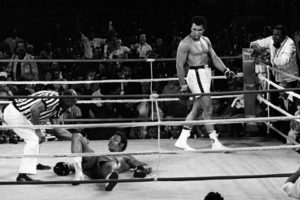
Older readers will remember the “Rumble in the Jungle” where Muhammad Ali defeated George Foreman for the heavyweight boxing title. Held in Kinshasa, Zaire in 1974, the contest pitted the undefeated champion Foreman, a beast of a man whose stock in trade was brutal early round knockouts of people such as Joe Frazier, Ken Norton and other contenders of the time (the uppercut punch that KO’d Norton earlier in 1974 actually lifted him off of the ground) against an ageing Ali, well past his prime after lengthy suspension when his concientious objection to the Vietnam War was ruled invalid and he was convicted of draft-dodging.

In the build up to the fight Ali pushed the line that he was going to take the fight to Foreman with his superior speed and agility. But Foreman and his trainers knew, based on the workouts Ali allowed the public and media to see, that his hand, head and foot speed were no longer what they used to be, and he could no longer “float like a butterfly and sting like a bee.” The Foreman fight plan was therefore simple: bear down on Ali, cut off escape angles and corner him in the corners and on the ropes, then expose and exploit his slowness in a ferocious and relentless beatdown.

As readers will know, that did not happen. Ali privately trained to absorb body blows and using the lax rules of the boxing federations sponsoring the fight, was able to get the ring ropes loosened to their maximum extent (which allowed up to 12 inches of slack from the bottom to the top rope). Come fight time, this allowed Ali to lean back against the ropes, absorb Foreman’s increasingly frustrated and reckless body blows while dodging the occasional head shot and in doing so conserve energy by not punching himself out in a toe-to-toe brawl.


By the eighth round Foreman had thrown hundreds of punches. He was staggering around the ring in pursuit of Ali and physically spent, punch drunk and arm weary from throwing jabs, roundhouses and uppercuts rather than taking them. Once his hands dropped and stayed at his sides Ali pounced, using a series of jabs and hard rights to knock him down and out. It remains one of the greatest sporting upsets–and spectacles–of all time.

I mention this anecdote because it seems to me that we are witnessing a variation on this theme in US politics today. Although it is blasphemous to say so, think of Trump as Ali, his civil and political opposition and mainstream media as Foreman, the courts as the referee and the Republican party and rightwing corporate and social media, including state-sponsored trolls and disinformation purveyors, as the ropes.

In a straight up contest between Trump and the US constitutional system of checks and balances, it would be no contest. The courts, Congress and independent media would prevent Trump from slipping the boundaries of executive responsibility, would hold him to account and would punish him when he transgressed. Given his background and behaviour, he would not make it out of the first round.

But in the US today he has a support cushion in the GOP and rightwing media. Like the rules governing the tension on boxing ring ropes, the strictures governing partisan behaviour and truth in reporting have been stretched to their limits. Every blow he is dealt by the institutional system–the “swamp” as he calls it–is absorbed and countered by a chorus of hyper-partisan hyperbole and media ranting about “fake news,” conspiracies and the “Deep State.” This allows Trump to deflect, weave, dodge and counterpunch his accusers, questioning their character, motives, looks and heritage as if these were somehow equivalent or worse than the activities he has and is engaged in. The courts can only enforce what exists on paper, and since what exists on paper regarding presidential conduct is predominantly an issue of norms, custom and mores rather than legal accountability, there are limits to what they can do as referees in battles between Trump and other institutions.

Put another way: Normally a wayward president could not stand toe to toe with the institutional system of checks and balances without taking a beating. But that assumes that the limits of executive power are codified in law and not subject to manipulation. This turns out to be untrue. Much executive power does in fact answer to the law, at least in terms of how presidential decisions affect others. But much of it is also a product of precedent, practice, custom and tradition, not legislation, particularly when it comes to the president’s personal behaviour. In turn, the limits of presidential behaviour has always rested on the assumption that the incumbent will honour the informal traditions and responsibilities of office as well as the nature of the office itself, and not seek to manipulate the position for pecuniary and political self-advantage and/or personal revenge.

Trump has done exactly that. He regards the presidency as a personal vehicle and has disdain and contempt for its traditions and norms. He realises that he can play loose with the rules because the political constraints that bind him have been loosened by his corporate, congressional  and media supporters. He and his allies are willing to play dirty and use all of the tools at his disposal to thwart justice and destroy opponents.

This is the great irony of US politics. For a country that provides itself on constitutional protections and the “rule of law,” the framework governing presidential behaviour is little more than the ropes on a boxing ring.

For those interested in a return to civility and institutional norms this is problematic but is not the only thing that parallels the “rumble in the jungle.”  Like Trump’s attacks on those investigating him in the FBI and Justice Department, for months prior to the fight Ali poisoned the well of good will towards Foreman. Ali lost his prime fighting years to the suspensions levied on him by boxing associations after he refused to be inducted into the US Army in 1967. Although he never spent time in jail and became an icon of the anti-War movement, he resented the five lost athletic years and those who profited by stepping into the ring during his absence. He particularly loathed Foreman, who he considered to be the white man’s favorite because of his quiet, polite and compliant demeanour out of the ring. He publicly labeled Foreman an “Uncle Tom” and “House Negro” who turned his back on his fellow people of color. Although none of this was verifiable, Ali’s charges resonated beyond boxing circles.

When Ali arrived in Kinsasha he held public training events that were part sparring, part evangelical preaching. He railed against colonialism and imperialism, averred his faith in Islam, lauded African nationalists like Mobuto Sese Seko, then-president of the host country Zaire (and not one known for his affinity for democratic rights), and generally carried on like a bare-chested revolutionary in shorts and gloves. Foreman, for his part, stayed quiet, trained mostly in private and had his handlers speak for him. When they entered the ring on that storied night, the 60,000 strong crowd crammed into the national stadium was overwhelmingly on Ali’s side.

Perhaps Ali’s mind games were designed to help sway the judge’s decision in the event that it was close. Perhaps it was to intimidate Foreman himself. Whatever the motive, there is a parallel to be drawn with Trump’s attacks on his critics and investigators on Twitter, at press conferences and at campaign-style rallies. His ranting serves to raise public suspicion about the critical media and federal law enforcement much in the way Ali’s insults about Foreman had the effect of raising questions about his ethnic identification and personal integrity, something that eventually turned African opinion against him. Could the same happen with Trump’s support base and undecided voters in the US?

It is too early to tell if Trump’s “rope a dope” political strategy will see him triumph over his adversaries. But that leaves pending an open question: is there a person out there that can play Leon Spinks to Trump’s Ali? And if so, is that person named Robert Mueller, or could it turn out to be Stormy Daniels?

One thing is certain. Trump is a big fan of the WWE and likes to fancy himself as a tough guy willing to take on all challengers. However, in this contest, unlike the WWE, the outcome is not pre-determined and the blows are both real and far from over.