Empty vessel and strategic disruptor?

I have been trying to make sense out of the shifts in US foreign policy under Trump 2.0. I understand his admiration for authoritarians and supination to Putin (which I believe is because Putin has dirt on him), and I also understand the much vaunted “transactional” nature of his view of foreign relations. Moreover, it is clear that he is a racist (remember his comments about “s***hole countries”), so he has a dim view of soft power projection into the underdeveloped world and the benefits of global engagement. His neo-isolationism is apparent, although it doe not fit well with his delusional designs on Canada, Greenland, Gaza and the Panama Canal Zone (I am of the opinion that his medications have been changed in order to make him speak in a more moderate monotone even if his message remains as deranged as always) . In any case even if I can reconcile all of this, the open move to side with Russia in its conflict with Ukraine and his attacks on erstwhile European allies are perplexing on the face of it. But perhaps there is a method to his madness, so let me try to unpack things. Let’s be clear: this may be a stretch but it is within the realm of the possible given what has happened so far.

First, let start with some background. Trump is an empty intellectual vessel. He has no foundational morals or guiding principles other than making money and garnering power. That makes him non-ideological as well as transactional in his worldview. Remember that at its core ideology is a coherent set of value principles that organise reality over time and specify the relationship between the imaginary (what could happen) and the real (what is happening). That is important because as a non-ideological empty intellectual vessel Trump is susceptible to whatever advice and suggestions appeal to him in the moment. Scapegoat immigrants? Sure. Demonize transgender people? Why not? Rename geographic locations? Sounds good. Embrace Christian nationalism? Halleluja! Champion guns, state’s rights and NASCAR? Dang right! And so forth. There is nothing too petty or trite that he will not stoop to when it comes to patriotic symbolism if it advances his interests under the pretext of making the US great “again.” The ghost whisperers who surround him know this and play upon his vainglorious ignorance.

But there is a serious side to his intellectual influences. They come in the form of disruption or chaos theory, on the one hand, and neo-reactionaryism on the other.

Chaos or disruption theory posits that stagnated status quo’s can only be “broken” by chaos or a disruptive force. That force may come in the form of “disruptors” who take advantage of chaos to impose a new order of things. The origins of this ideological belief in chaos or disruption theory come from many sources but include Milton Friedman, the father of neoliberalism, who justified his support for the 1973 Chilean coup and a number of other pro-market dictatorial interventions as the only means of breaking the hold of welfare statism on national economies. The depth of the crisis determined the extent of the disruption, be they coups in Latin America, Southern Europe and East/Southeast Asia or socially dislocating macroeconomic reform done under emergency in places like NZ and England. A political disruption was necessary in any event in order to break the extant economic model via chaotic reform.

Chaos and disruption theory see the moment of crisis as a circuit breaker, a means to end cycles of social decay and vicious circles of bureaucratic parasitism and clientelistic rent-seeking. Under proper guidance by “disruptors” as change agents, societies can re-emerge from the ashes of the old order better and stronger than before.

Reports have circulated for years that Trump embraces his own form of chaos theory in which he pits his underlings against each other in order to shake out the ideas that best suit him. Although he seems to have toned things down when compared to his first presidency and what may have worked for him in the private sector may not work in the public sector (as his first presidency appears to have proven), it is possible that his advisors believe that he will welcome the “disruptor” role where he makes order out of chaos. This may be psychological manipulation by his advisors but if so it seems to be working.

That s where the second ideological strand poured into Trump’s empty vessel comes into play. Neo-reactionism holds that democracy no longer is fit for purpose. The main reason is that political equality 1) allows stupid people a vote equal to that of smart people, which in turn leads to 2) inefficient and self-destructive economic and social outcomes because elected officials and the bureaucracies that they oversee will always seek to accomodate the interests of the stupid majority over those of the enlightened few. Because of this, the ranks of the non-productive beneficiary classes grows while the entrepreneurial class shrinks, in what is seen as a form of reverse social Darwinism with a twist. Adding to the mix “progressive” policies like refugee and other migrant admissions from low IQ societies and providing social services that individuals otherwise would have to provide for themselves further dilutes the gene pool and perpetuates a cycle of dependency in the ever-expanding mass of dumb rent-seeking parasites.

The solution lies in creating an elected oligarchy that makes popular appeals and promises but which rules in a beneficent authoritarian manner, as in, for example, Singapore. It is they who know what is best for the polity and it is they who define what is in the public interest and public good. Elections are seen simply in instrumental terms, as a means of securing and maintaining power that also serve as legitimating devices for their rule.

It does not matter if this view of society and governance is a grotesque caricature of what is really happening in the US. It is what the technology entrepreneurs known as “tech bros” imagine and therefore believe it to be. Led by Elon Musk, it is the ideology of this sub-strata of wealth-horders that has gotten inside of Trump’s head. As we currently see playing out, via DOGE they are now in the first phase of implementing their vision of how the federal government should look and act.

Against that backdrop, the question then turns to US foreign policy and the dramatic shifts in it. Again, this may be a stretch but what could be happening is that the US is embarking on a foreign policy disruption and reset of its own that is designed to realign the international system that followed the Cold War. It could be that Trump (or, more precisely, his foreign policy advisors) are looking down the road and envision a new world system that, transaction by transaction and incremental reneging on the rules of the old international “liberal” order, replaces the emerging and somewhat chaotic multipolar/polyarchic/multiplex networks of the last 20 years. They are not interested in re-hashing the causes of US decline and the rise of the Global South or the ways in which international relations are no longer an exclusively State-centric and -dominated affair. They are not interested in the international liberal order. They want to re-assert US primacy after a period of challenge.

For that to happen it appears that Trump 2.0 has taken inspiration from the Cold War and is attempting to re-invent a tri-polar international system, The idea is to re-align with Russia because of shared Western traditional values and pull it away from China’s growing sphere of influence. The Russian hinge will be what balances the US-PRC relationship, giving Russia a sense of restored prestige and the US a better sense of security vis a vis the PRC.

Here again, Trump and his advisors are deeply racist in their views (think Stephen Miller) and have an abiding fear and loathing of the Chinese. The US has made clear that it wants to turn away from Europe and the Middle East and concentrate strategic attention on curtailing Chinese power expansion in Asia and elsewhere. The PRC is already mentioned–and has been for a while–as the US’s main “peer competitor,” and US war planning is heavily focused on gaming contingency scenarios versus the PRC. Trump’s attempt at territorial expansion into Greenland, the Panama Canal Zone and even (however farcical) Canada is designed to create a US lebensraum equivalent to the notion of Russian buffer states in which its interests are undisputed and inviolate (which is what Russia claims about Ukraine).

A rapprochement with Russia could tip the geopolitical scales in US favour by moving Moscow away from China’s embrace while forcing Europeans to accept new Russian-drawn buffer border boundaries and stop their security dependency and corresponding rent-seeking from the US. The US can then focus on its Asian partnerships and military planning versus the PRC, and Russia is restored, thanks to US recognition, to the community of nations (where it already enjoys support in the Global South, especially in Africa) whether the Europeans like it or not (some do, most don`t).

That is where the rubber hits the road. The move will involve sacrificing Ukraine in some form or another, be that a land-for-peace swap or some other type of security guarantees. No matter what, Ukraine will come out the lesser for its troubles and Russia will be rewarded for its aggression. But that is no longer the point because the bigger picture is what is more important in Trump’s eyes, especially if he can secure rare mineral concession rights in both Ukraine and Russia (as has been discussed lately, something that demonstrates the power of US coercive diplomacy versus Ukraine and the power of Russian persuasive diplomacy versus the US). The stagnation of the Ruso-Ukrainian war invites the application of disruption theory to the conflict, even if there will be significant collateral damage to Ukraine and US-European relations as a result.

This gambit also rests on the assumption that Russia is an honest actor and will in fact prefer to normalize relations with the US while distancing itself from the PRC (since it would be part of any negotiations to betray Ukraine unless Trump is completely owned by Putin). That may be a mistaken belief, which would make all the claims about Trump’s ability to play “three dimensional chess” a bit of a pipe dream. It also discounts the PRC reaction, which also would be a mistake.

The bottom line is that precisely because Trump is an empty intellectual and ideological vessel he is more susceptible than other presidents to the suggestions of his advisors, especially when they appeal to his narcissism and bigotry. Chaos or disruption theory-derived policy recommendations are a good way of doing so, especially when coupled with the suggestion that he is the only “King” (remember last week’s White House-generated Time Magazine cover) capable of imposing a new order both at home and abroad. If that advice is coupled with suggestions that the pivot towards Russia could earn him the Nobel Peace Prize (something that he has repeatedly said that he thinks that he deserves), then the neoreactionary ideological project will have started to bear fruit in terms of US foreign relations.

Judging from what is going on in terms of changes to US domestic policy under Trump 2.0, the strategic shift in foreign policy appears to be just one side of the disruptor’s coin. But is that a coin secured in hand by a long-term strategic plan or one that is simply being tossed to see how it lands?

About that PLAN flotilla in the Tasman Sea.

Here are some thoughts about the hysteria surrounding a Chinese Peoples Liberation Army Navy (PLAN) flotilla conducting freedom of navigation exercises in the Tasman Sea, including live fire drills.

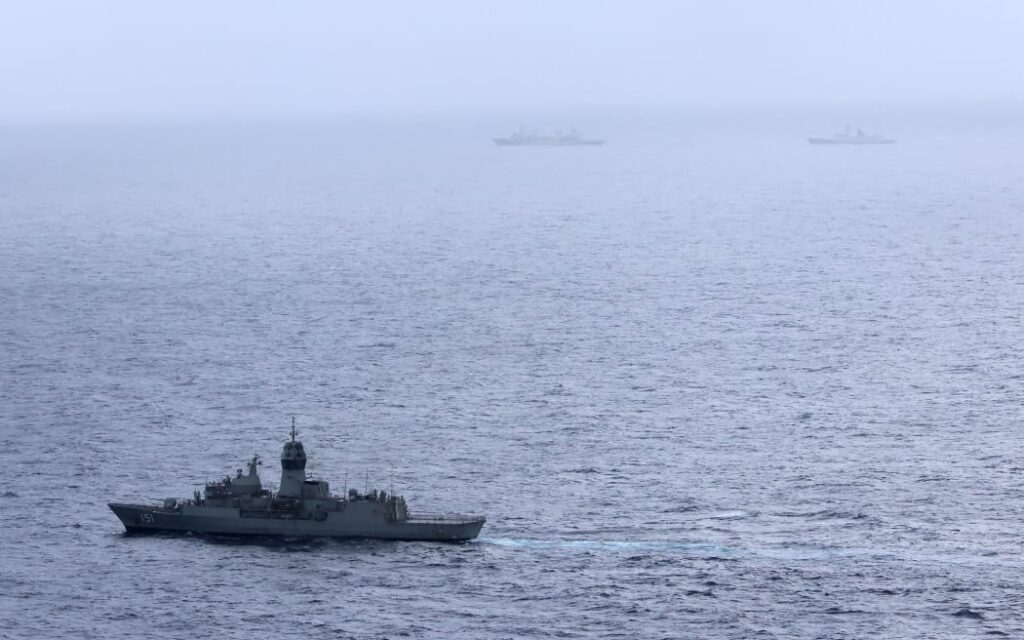
1) The flotilla has been tracked for over a week by New Zealand and Australian forces. The tracking began when the flotilla was well NE of the Australian northeastern coast.

HMAS Arunta shadowing PLAN vessels in the Tasman Sea. Source: ADF handout/AFP.

2) The flotilla is operating in accordance with international law and maritime regulations regarding military operations in international waters.

3) The flotilla has no air cover deployed with it and therefore no effective means to defend itself against a coordinated air assault. It is basically a sitting duck for Australian air defences and even NZDF air defences (because the NZDF P8s and Seasprite helicopters carry air to surface munitions as well as torpedos).

4) The flotilla may have a submarine deployed with it.

5) The presence of the PLAN ships in the Tasman is a form of military diplomacy, showing the flag in a distant body of water as a demonstration of blue water power projection capabilities.

6) The PLAN freedom of navigation (FON) exercise in the Tasman Sea may well be a response to a joint Australian-New Zealand FON exercise in the Taiwan Strait in September 2024. Those waters are far more disputed than the Tasman Sea (because the PRC claims them as territorial waters), so the PRC objected to the exercise at the time and declared that it would formulate an appropriate response in due course. This could be it. But the PLAN vessels are far from Australian and NZ territorial waters, so the legality of their presence in open seas is indisputable.

7) The presence of the PLAN flotilla conducting live fire drills (5 conventional surface to surface rounds fired from the Type 055 destroyer Zunyi’s main gun at a floating target, as observed by personnel on the HMNZS Te Kaha) and other exercises is an excellent opportunity for Australian and New Zealand to hone their naval counter-force capabilities, including tactical signals and technical intelligence intercepts and collection from the flotilla. If a submarine is involved then the Antipodean allies can refine their anti-submarine warfare (ASW) capabilities as well, which is exactly what their P8 patrol and ASW aircraft are designed to do. As it stands, Australia and NZ are using air and surface platforms to shadow the PLAN boats.

8) Much has been made about the lack of warning given by the PLAN before the live fire drills. Such warnings are a courtesy, not part of any formal protocol. They are usually issued 12+ hours prior to the drill in order for interested parties such as civilian aviation and maritime operators to plan accordingly and clear away from the target area. The PLAN gave 15 minute warnings, forcing a few planes to adjust course away from the no-fly zone. That was perhaps rude as far as courtesy goes, but nothing more.

9) Most of the hysteria about the flotilla is led by Australian opposition figures in politics and media in an election year. Most of the alarm in New Zealand is led by Sinophobic media commentators or people with little knowledge of military affairs or the nuances of military diplomacy, much less naval operations (especially in NZ). All of them want to tie the exercises to broader Chinese moves in the Southwest Pacific such as the recent bilateral strategic agreement between the PRC and the Cook Islands. For their part, Ministry of Defense officials on both sides have been muted in their response and military officials have been largely silent (presumably because they know what is really happening).

10) It is clear that the PRC is “flexing” its military might in more and more distant places, as any Great Power would do. But not every display of power capability constitutes an imminent threat. Should Australia and NZ pay attention to the exercise? Absolutely, especially because it can be used as a learning tool for their respective naval counter-force platforms. Should they feel threatened by the exercises? Absolutely not. Claims of the exercise posing a threat, being a provocation or an act of intimidation by the PRC betray the biases of those who make such claims. The PRC is just doing what Great Powers do, and if anything it is reminding others of its capabilities while testing them in front of foreign eyes.

Sailors aboard an Australian navy ship look out at Chinese vessels on February 13, picture by the Australian Defence Force

Sailors aboard the HMAS Arunta observe the PLAN flotilla in the Tasman Sea. Source; AFD handout/AFP

11) In the end, if the US, UK, French or other Western navies conducted the exact same exercise in the Tasman Sea, there would be little controversy about it. Because it is the PLAN, however, anti-PRC elements in Australia and New Zealand want to use the occasion to stir up trouble in pursuit of their own agendas. But the truth is that the PRC is not designated as an adversary or hostile state by either Australia or New Zealand, who in fact enjoy largely cordial and beneficial trade relations with the Asian giant. Although there have been moments of friction between Australia and New Zealand, on one hand, and the PRC on the other over a number of political, diplomatic and military strategic issues, and the PRC remains a major concern for the Australian and NZ security communities for a number of reasons, none of this justifies turning what is a relatively small display of power projection into an international incident.

Everyone needs to clam down and relax.

A reminder about soft power.

Waste and fraud certainly exist in foreign aid programs, but rightwing celebration of USAID’s dismantling shows profound ignorance of the value of soft power (as opposed to hard power) in projecting US influence and interests abroad by non-military/coercive means (think of “hearts and minds,” “hugs, not bullets,” “honey versus vinegar,” etc.). Soft power is also a component of “smart power” and “sharp power” strategies in which a combination of foreign policy instruments are used in concert in pursuit of a variety of non-kinetic ends (i.e. objectives short of war).

This razor-gang approach is short-sighted at best and stupid at worst given that the humanitarian/developmental aid vacuum left by US withdrawal from such efforts opens up the field to potential inroads by US rivals. Add to that the fact that USAID pays US farmers around $2 Billion for surplus rice, soy, corn and other agricultural commodities that otherwise would not be grown or go to waste, and the MAGA/DOGE move against USAID is a double-sided own-goal.

The NZ government, which currently is under the sway of MAGA/DOGE-style public policy ideologies, might do good to remember this when it deals with soft power competition in the South Pacific. Waving a (thornless) stick (say, in the form of withdrawal of foreign aid) at Pacific Island Forum countries when they negotiate bilateral economic, diplomatic and developmental aid agreements with non-“traditional” (non-Western/colonial) partners is likely to elicit some blowback of its own.

After all, regardless of the specific compacts agreed to in the past, sovereign States, whatever powers and protections they may have ceded to “traditional” partners, ultimately are autonomous agents of their own destinies. Foreign aid is a good way to remind them that that may be true but destinies can often be intertwined for mutual benefit even if other parties come late to the table.

A turn to the Big Stick.

This is from the 36th Parallel social media account (as brief food for thought).

We know that Trump is ahistorical at best but he seems to think that he is Teddy Roosevelt and can use the threat of invoking the Monroe Doctrine and “Big Stick” gunboat diplomacy against Panama and Greenland to leverage concessions from them. But he is no Teddy Roosevelt and this is not the early 20th century. Trump may find that abrogating Treaties and engaging in coercive diplomacy may suit Putin but may not be the useful tools that he thinks they are when dealing with two friendly democracies/military partners (Rio Treaty/NATO) in today’s world. Who is advising him on this?

Because it smacks of mobster thuggery mixed in with gross ignorance.

Trump’s reasoning appears to be rooted in his fear of Chinese influence in both countries. Chinese firms have invested in Greenland’s strategic minerals sector for over a decade while US and other Western firms have not. Trump and his advisors see this as a threat now that the Arctic Passage is opening thanks to global warming (that Trump refuses to acknowledge much less address), but neither the autonomous Greenland government or the Danish government that oversees it (the relationship between the two is akin to that of NZ and the Cook Islands) seem particularly bothered by their presence and welcome the investment. Even if it stationed military personnel there in WW2 and has mounted Arctic expeditions using military personnel stationed at a Greenland base, the US has no claim to Greenland whatsoever. It is Danish territory with a local independence movement (something that Trump may attempt to exploit), which means that he is eying the internationally recognised territory of a NATO partner for annexation or acquisition.

Since 1996 Hong Kong based maritime transport firms (COSCO in particular) have managed the container terminals at both ends of the canal. The locks are manned by a mixture of Panamanian, US and other nationalities, so the Chinese do not “control” it. Contrary to Trump’s lies, there are no PRC “soldiers” in the Canal Zone and the management of the canal, including passage fees and related levies, are not discriminatory against US-bound, US-originated or US-flagged vessels. Under the terms of the 1977 Panama Canal Treaty that replaced the original Treaty signed in 1903 (in which the US paid Panama a flat sum and yearly rents for a ten-mile swathe of land on either side of the canal), no military personnel other than those of the US and Panama can be stationed in the Canal Zone, and foreign military forces must ask for permission to transit the waterway. The result is that the Canal Zone is sovereign Panamanian territory whose security is partially guaranteed by the US rather than be threatened by it.

As for the invocation of the 1823 Monroe Doctrine as a reason to intervene in Panama, beyond the imperialistic motivations behind it, the reality then and now is that the Doctrine is just a proclamation by one US president backed by military force. Its original focus was on deterring European powers (and Russia) from establishing footholds in the Western Hemisphere but over time it became an umbrella excuse for US interventionism even if it was not particularly effective in preventing the establishment of a Soviet naval base in Cienfuegos, Cuba, or Marxist/Maoist inspired and backed guerrilla revolutionary movements from cropping up throughout the region in the post-WW2 Cold War era.

Most importantly, the Monroe Doctrine has no basis in international or US law. It is not a Treaty (unlike the Panama Canal Treaty) that has been ratified by the US Congress, and therefore has no legal standing. It just survives as a historical relic propped up by notions of customary usage as a general justification for US interventionism in the Western Hemisphere. I had to deal with it when I was the Western Hemisphere Regional Policy Analyst in the Office of the US Secretary of Defense, and let’s just say that US security hawks like it because they believe that it gives them unilateral carte blanche to meddle in Latin American and Caribbean affairs. They now have a chance to test that belief.

For some background on the Panama Canal see these US briefs on how the Panama Canal Treaties came into effect.

https://history.state.gov/milestones/1899-1913/panama-canal#:~:text=In%20his%20new%20role%2C%20Bunau,guarantee%20the%20independence%20of%20Panama.

https://history.state.gov/milestones/1977-1980/panama-canal

The text of the 1977 Treaty restoring Panamanian control over the canal can be found here: https://pancanal.com/wp-content/uploads/2022/07/neutrality-treaty.pdf

About Syria.

I have been thinking about Syria and coverage of the fall of the Assad regime, and to be honest I believe that there is something missing from the picture being painted, at least in NZ. Although I am no expert on Syria or the Middle East, I do have some experience working with irregular and unconventional fighting groups as well as writing about authoritarian regime demise and the modalities by which that occurs. I will therefore take a moment to reflect on what I think is missing.

Media reporting has it that the attack on Aleppo and rapid, two-week drive through Hama and Homs to Damascus was a surprise. That may be true for the media, many non-Syrian laypeople and perhaps the Russians and pro-Assad Syrians themselves, but otherwise I beg to differ. The reason is because the training and massing of rebel fighters in Northern and Central Syria would have taken time (some believe the uprising has been 5-10 years in the making), and would have therefore been detected by Western and regional intelligence services some time ago. If we think about satellite and aerial imagery, signals intercepts, ground based thermal and other technical acquisition capabilities as well as human intelligence on the ground, then consider that Syria and its armed factions are in the middle of a larger geopolitical conflict in the Levant and wider Middle East, and then think about who has a direct vested interest in Syria’s fate (as well as their partners and patrons), it is probably safe to assume that intelligence agencies grouped in the 5 Eyes, Jordan, Turkey, Israel, Egypt, Lebanon, Saudi Arabia, France and/or Germany were monitoring at one level or another developments in rebel-held areas long before the assault on Aleppo was launched.

And then there is the pro-Assad intelligence community.

Perhaps distracted by events elsewhere, the Russians appear to have been genuinely caught off-guard, although it has been reported that they started pulling out personnel from Syria weeks before the attacks began (which would suggest they knew something was about to happen). Likewise, perhaps distracted by their own concerns regarding Israel, Hamas and Hezbollah, the Iranians eventually airlifted key personnel out of Damascus shortly after Aleppo fell, so even if they were blind to the preparations for the uprising, they clearly believed, correctly, that momentum was with the rebels once the assault was launched. More tellingly, weeks ago there were credible claims that the Syrian State had been “hollowed out” by senior officials (i.e. state coffers were raided, corruption and drug-dealing was endemic and public service provision halted), who then fled the country. Make of that what you will.

All of this would have given some clear indications that the Syrian status quo was about to change and Assad and the rest of his henchmen were soon to exit one way or another. What is telling is that the intelligence agencies that would have known about the rebel’s preparations (including NZ via its connections to 5 Eyes and other Western intelligence agencies including Mossad), maintained excellent operational security and did not let it be known, either by leaks or mistakes, that a major coordinated assault by the rebels was in the making. This was done not so much to spite the mainstream corporate media, which clearly had zero boots on the ground in rebel-held areas prior to the assault, but to prevent the Syrians, Iranians, Hezbollah, Hamas and Russians from learning about the uprising before it was underway. By the time the “axis of resistance” realised what was happening, it was too late to do anything but wait, watch and if need be, flee.

Whether the Russian, Syrian and Iranian intelligence failures were caused by them being stretched too thin on the ground, distracted with external events and/or incompetence, there are lessons to be learned learned from their lack of forewarning.

Israel’s successful (at least for now), multi-front campaign against Hamas, Hezbollah, Iran and the Houthis, with some sidebar strikes on Syria thrown in for good measure, degraded the axis of resistance’s capabilities to detect and prevent the uprising. Now it appears that Israel is opening another front in Syria with an eye to significantly changing the geopolitical landscape in the region. Hamas and Hezbollah have been decimated as military forces. Iran has been intimidated into passivity. The Houthis have gone largely silent. This, thanks to Israel’s scorched earth, targeted assassination and long-range missile strike operations against all of them. Now Israel has launched a two-pronged offensive in Syria, conducting a bombing campaign against weapons storage facilities (some containing chemical weapons stockpiles) while simultaneous targeting command and control facilities as well as the entirety of the Syrian Navy (which shares major port facilities with the Russian Mediterranean fleet at the city of Tartus, which in turn raises the question of what will become of the Russian presence there and at a nearby airfield once the rebels seize control of them).

The IDF has also sent ground forces into and beyond the UN-monitored buffer zone separating Syrian control from Israel within and beyond the Golan Heights. Much like in Southern Lebanon, Gaza and the West Bank, Israel has seized the opportunity provided by neighborly discord in order to expand its presence in its neighbours’ territory, perhaps with an eye to redrawing their common borders. Since there is no foreign power capable of stopping Israel or willing to do so, it looks like the Israeli gambit will pay off. But that may depend on what the rebel-led government in Syria does next.

If foreign powers were aware in advance of the rebel’s plans, it is also very likely that they conducted more than passive observation and information-sharing amongst themselves. The US has 900 troops in Syria, most of them US Army Special Forces (Green Berets), Green Berets’ main mission is to train, advise and assist local forces in any given conflict, so it is possible that they had working ties to the rebel groups in advance of the assault on Aleppo. The US also has combat troops stationed in Jordan, Israel and Iraq and a variety of military assets in Turkey, effectively surrounding Syria’s land borders. Likewise, in part because of the lingering presence of ISIS in central and eastern Syria, a number of other countries–NATO members most likely–have special operators and/or military intelligence assets “in theatre.” Turkey acknowledges its military working relationship with one of the rebel groups, the Syrian National Army (SNA) in Northern Syria. The US has close ties to Kurdish insurgents in Northwest Syria and Northwest Iraq. The Jordanians are said to have operatives in Southern Syria and one can assume that, if not an surreptitious military presence, Israel has its covert hand in the pie as well.

What this means is that it is quite possible that foreign forces provided training, advising and intelligence and logistical support in the years, months, weeks and days leading up to and through the assault on Aleppo. If so, it should not be surprising that he rebels maintained an unusual amount of discipline previously unseen in their ranks, and that the various armed factions worked well together, sometimes in coordinated fashion. Even some of their combat fatigues and weapons look new and Western in origin!

So who are these rebels? Basically they are Hayat Tahrir al Sham (HTS), who are the remnants of a group formerly known as Jabbat al-Nusra (Nusra Front), an al-Qaeda and ISIS-connected Islamicist group; the Free Syrian Army (an anti-Assad “secular” group backed by the West); and the afore-mentioned, Turkish-backed SNA. There are also Kurdish PKK/YPG/SDF militias in the mix who control approximately one quarter of Syrian territory east of the Euphrates River (and major oil fields), although these divide their time between mopping up Syrian Army troops in Northeastern Syria and fighting ISIS militants, the SNA, the Turkish military and pro-Turkish militias.

The rebel coalition has formed a tactical alliance against its common enemy. None of the constituent parts are particularly democratic in orientation, and in spite of HST’s claims that it has served all ties with ISIS and does not espouse (Sunni) Islamicist beliefs such as Salafism or Wahhabism, such statements must be taken with a grain of salt. There are numerous reports of lethal attacks on Christians and Alawites (which is a Shiite sect) by rebel forces in Aleppo and Hama, so the proof of the rebel’s good intentions remains to be seen, especially if military discipline has broken down amid the quest for collective revenge.

The sectarian nature of the rebel coalition is worth noting because the Assad regime was Alawite, which is a mostly coastal minority community in an otherwise Sunni-dominated country. Assad reserved many of his governments’ top positions to co-religionists in the Syrian Baath Party (originally related to the Iraqi Baathists led by Saddam Hussein), so retribution and revenge against those who formed the support base and bureaucratic staff of the Assad regime can be expected, HST assurances to the contrary notwithstanding. What is promising is that HST has agreed to form an interim (not yet transitional) government with various sects represented and some carry-overs from the Assad regime appointed in order to restore and/or maintain continuity in public services.

The HST-led government is now focused on rooting out Assad loyalists, imposing social order, securing military and police facilities (including notorious prisons), and bringing public services back to life where possible. But reconstruction of battle-damaged areas will be lengthy and difficult process given that Syria’s treasury has been emptied, many public offices looted and/or damaged, and corruption is rampant within and between various sectarian groups. The international community will be asked to foot the bill and provide the human, material and financial capital required to return the country to some semblance of normalcy. This is complicated but the fact that the HST and PKK/YPGSDF have been designated as terrorist entities by the UN and a number of countries (although for different reasons, with HST designated because of its ties to ISIS and the PKK/YPG/SDF designated at Turkey’s insistence because of their irredentist activities in pursuit of an independent Kurdistan in territory now controlled by Syria, Iraq and Turkey). Before international relief can be offered, the terrorist designations will have to be lifted, something that will not please many interested parties for a variety of reasons.

More broadly, the fall of the Assad regime is one variant of what is known as “bottom-up transitions,” where before the regime is prepared to exit it is forced to do so by public pressure and mass collective action. Bottom-up transitions can stem from revolts, rebellions, general strikes, mass protests and the ultimate sub-type, revolutions (which, unlike the others, involve parametric change in the economy, social order and political society). These are not to be confused with top-down transitions, in which the outgoing regime frames the conditions by which it relinquishes power. This can be done peacefully or by a coup d’état, which is essentially an armed quarrel amongst elites in which the military acts as the arbiter of who wins and loses in the power struggle by siding with those that favour an exit strategy and transition to a different regime type. Examples of peaceful top-down transitions were seen in Brazil in the 1980s and Chile in the 1990s, where power was devolved from military control and handed over to elected civilian rule rather than be overthrown by force.

In Syria as has happened elsewhere, there will be major tensions between so-called “moderates” and “militants” (soft-liners and hard-liners) in the HST-led coalition. Hardliners and militants tend to come from fighting backgrounds. They tend not to seek compromise and conciliation because they have succeeded in imposing their will by force of arms. They are reluctant to forgive their defeated adversaries and many are sworn to avenge the affronts committed against their families, friends and communities (and in Syria, the affronts included atrocities and other forms of barbarism committed by Assad’s forces against the civilian population). Moderates, on the other hand, tend to come from the non-fighting political opposition, religious, business and community leaders and foreign interlocutors. These seek to draw a line behind them when it comes to dealing with the past in order to facilitate the reconstruction of society and promote national reconciliation.

The key to keeping the post-Assad transition relatively peaceful is for the moderates and softliners to gain the upper hand in negotiations to form the new government. For that to happen, inducements and constraints (think carrots and sticks) must be offered to and placed on the militant hardliners. Inducements can include open trials for those accused of heinous crimes committed on Assad’s behalf, placement of senior rebel commanders in leadership roles the Syrian security apparatus, establishment of Truth and Reconciliation Tribunals that address past sins committed on all sides, and even material rewards for those who refrain from continuing to use violence as a means to an end. Constraints could include weapons impoundments, criminal prosecutions, and other legal and material disincentives that discourage continuation of hardline or militant behaviour.

None of this will be easy but it is necessary is stability is to return to Syria. It is possible that the armed factions and their political and social supporters can use the common ground forged fighting the common enemy to expand the basis for commonality into other aspects of Syrian life. It could start with something as simple as national sports or cultural traditions and then move to the more thorny issues of governance, economic accumulation and distribution, religious and secular civil rights, and so forth.

What is clear is that, for the short term at least, the big losers in Syria are Alawites, Iranian and Russians. Assad is gone and his minions routed. Iran has lost its major overland transit route connecting it to Lebanon (Hezbollah) and Palestine (Hamas) as well as the intelligence, forward basing and logistical support of the Assad regime. Russia has lost it foremost ally in the Middle East as well as the intelligence and military assets that it had stationed in Syria prior to Assad’s fall (assuming that the new regime will confiscate the Russian facilities at Tartus and Khmeimim Air Base near Latakia city). Reputationally, both Iran and Russia have taken a major hit with their weaknesses as a security partner now exposed.

Israel appears to be the primary short-term beneficiary of Assad’s overthrow. To a lesser but significant extent, so are Western and Middle Eastern powers with a stake in the Levant. But a longer-term prognosis is more difficult to ascertain because the direction of the HST-led government has yet to be determined, and the post-Assad settling of scores has yet to be decided. Whether or not this involves a return of Islamicists with or without the ISIS brand is foremost among the concerns of many security agencies.

In any event the best we can do is embrace the uncertainties inherent in the moment, attempt where possible to bolster the moderate/softliner positions within the new government and offer concrete steps based on the experience of others as part of the path towards national recovery. History will be the ultimate judge of the process but for the moment all we can say is that we live in interesting times.

Media Link: “A View from Afar” on the lame duck window of opportunity.

In the last episode of this year Selwyn Manning and I discuss the rebel assault on Aleppo in Syria and tit-for-tat missile exchanges between Russia and Ukraine as illustrative of foreign actor attempts to gain geopolitical leverage as part of hedging strategies undertaken before Trump assumes office on January 2025. We had good audience participation and discussion, which you can find here.

US military-industrial-sports complex.

A US friend of mine wrote on social media about attending a Homecoming football game at her niece’s Red State university. Although the referees stunk and her team lost, my friend said that she enjoyed her visit, especially the halftime show that featured a tribute to veterans (it is approaching Veterans Day in the US). Because I have a self-righteous contrarian streak, I commented on her post by asking when did glorification of militarism and (by extension) war-mongering became a fixture US sports? I suggested that maybe it came from US military service academies (West Point, the Naval Academy and Air Force Academy) and somehow leaked into other sports institutions sometime after WW2. Not surprisingly given that my friend is a very patriotic and polite American, she declined to answer.

What I would have said to her had she answered is that I asked because cultural historians and sociologists have noted that although all liberal democracies have military ceremonies, displays, celebrations and commemorations on significant national dates and public holidays such as Anzac Day and Bastille Day, only the US has military displays at private sporting events from Little League to the professional level pretty much every week. American football, baseball, basketball, automobile racing (NASCAR is a patriotism fetishist’s delight), soccer, ice hockey, volleyball, lacrosse–these and more all regularly feature tributes to the military, with some including static and moving exhibits of death machines in the forms of warplane fly-overs, paratroop drops, assorted artillery gun salutes and even the occasional tank. Remember, this is not July 4th, Veterans Day or Memorial Day, which are genuine national holidays celebrated publicly with displays of patriotism, parades, picnics, pomp and circumstance even if the original, more sombre reason for them was about victory, sacrifice and service to the country, not the military per se.

So why and how did sports get turned into an adjunct to US militarism? Beyond the constant invocations of “fighting for freedom” (I guess “fighting for imperialism and “making the world more safe for Yanks” does not have quite the same ring to them), what normalised this practice?

Here is my hunch. At some point in the last half century a PR genius in the Department of Defense (DoD) realised that combining sports, especially “manly” contact sports, with militaristic displays and tributes framed as patriotic commemorations was a natural recruitment tool for the armed forces. The US military is already allowed to recruit in high schools and universities (some private schools refuse them but all public institutions receiving federal funding of any sort must allow military recruiters on campus). But sports, especially big-ticket sports like college and professional football, is a type of social glue that binds American society in a way that pretty much everything else does not. Race, class, religion, geographic location, now even gender–all bow before the alter of sports, with stadiums being the secular churches in which people congregate for common purpose. If you want to make friends and influence people by participating in the ritual, a sporting event is a good place to start.

(I use “American” here well aware that is is an appropriation of a continental name common to all of the Western Hemisphere simply because it has become normalised as a way to identify people from the US).

Partnering with sports is therefore way for the US military to get deeply involved in a core aspect of US society–the glue that holds together its social cohesion–by becoming an integral part not only of its sporting culture but also of its national identity. That perhaps is where US militarism is reproduced at its most basic level. If you can get people to adopt a certain favourable (and non-critical) mindset and predisposition regarding the military and its role in US society through sports, you pave the way for ideological reproduction of a military-aligned perspective. That in turn makes recruitment easier but also makes it easier to sell rationales for aggressive foreign polices, large military budgets and ultimately, war-mongering as a foreign policy tool. You can see the results in a number of popular culture artefacts: marching bands, camouflage apparel, guns, more guns and assorted accessories for guns (like bump stocks, silencers and extended magazines) in case the zombie finally arrive from south of the border, “tactical gear,” militarised local police forces, etc, to say nothing of the names of numerous sports teams themselves. You see it in the media, especially among conservative outlets. You see it in language, such as in the overuse of the word “heroes” to describe anyone who has served. You see it in oversized flags with Vietnam Era POW-MIA logos at car and gun dealerships, in the retail discounts offered to active duty service members and veterans and in the veneration of the military in churches. Militarism (I shall refrain from calling it military fetishism) permeates every aspect of US social life, and sports is at its core. I am not saying that there are no legitimate spinoffs and benefits from exposure to military culture and technologies, but in the US sometimes the crossover is a bit too much.

This occurs in spite of the fact that US in recent decades has not been particularly successful in war. For every victory in Granada, Panama or Gulf War One and in spite of overwhelming advantages in weaponry (courtesy of those enormous military budgets), most recent US expeditionary wars have ended in stalemates and withdrawal–sometimes chaotic–in places like Vietnam, Afghanistan and Iraq, as well as in a number of “low intensity conflicts” such as those in Niger, Somalia, and 1980s Lebanon. In fact, the US has been continuously at war, big or small, for the better part of my existence, and yet the world is arguably more dangerous today for the US than it was before it became the world’s policeman. Where is the national interest cost/benefit value in this?

That is where what former general and President Dwight “Ike” Eisenhower’s phrase enters the frame: “military-industrial complex.” Ike warned about the emerging military-industrial complex in the 1950s, arguing that it was leading to distortions in foreign policy, particularly those associated with militarism for profit. Needless to say he was shouting into the dark because the beast that he was looking at then is now a Godzilla that through lobbying controls the Federal Executive and Legislative branches as well as those of most if not all states and even local districts. From the United Fruit Company’s backing of coups in Central America in the 1950s and 60s things have evolved into a conglomerate of blood-soaked profiteers ranging from Blackwater in the 1990s ((now rebranded and decentralised under shell fronts) to assorted outfits supplying staples, fuel, transportation, close personal protection, anti-piracy squads and even Halloween costumes to the troops deployed abroad. Godzilla is now too big too fail.

Godzilla is also very smart. By marrying the military-industrial complex to the sports-military complex it has created the prefect vehicle for the profitable reproduction of a permanent militarist outlook as a cornerstone of US society. I’ll say it again, bloodshed is profitable and if sports is means for the military-industrial complex to profit, it has found a welcome partner. It is therefore not surprising that sports moguls and big entertainment companies, including dodgy outfits like those that control cage fighting and staged wrestling competitions, have partnered with the armed services in order for both to sell their “product.” The arrangement works well for the synergistic (some might say “symbiotic”) enhancement of their bottom lines.

So what we have in the US is a military-industrial-sports complex that serves as an ideological and material war-mongering reproduction machine. Only in America!

And now, a digression.

I had my “Ike moment” in 1994 when the Zapatistas staged an uprising in Chiapas Province, Mexico. Initially overwhelmed by the guerrilla assaults, the Mexican Army sent an urgent request for helicopter gunships, armoured personnel carriers and special operations troops. This, in spite fo the fact that up and until that moment Mexico styled itself to be a leader of the non-aligned movement, one of the “old school” revolutionary regimes dating to the early 20th century and regularly gave the US the finger in international forums. Its authorities were not very cooperative when it came to the illegal drug trade, something that made some of them rich, made more of them dead, and which made all of them regret their indifference down the road.

Well as it turns out on January 1, 1994 I just happened to be the regional policy analyst for the InterAmerican region in the Office of the Secretary of Defense (OSD) and got called into my office to consider the request before sending it up the chain of command on the way to the White House. I explained to a group of formidable civilian and military leaders (some of whom I still admire), that a rebellion/revolt like that of the Zapatistas (known by the acronym EZLN in Spanish and led by the much vaunted “Comandante Marcos”) was rooted in socio-economic inequality and broken government promises, not some global Marxist conspiracy. It was a symptom, not a cause of instability and therefore could not be solved via US military intervention (or any use of force, for that matter). I advised against agreeing to the request and instead recommended that the Mexicans tend to their internal affairs by listening to the EZLN demands and proposing a negotiated solution. After all, they were on the right side of history, only sought was was promised to the peasantry in the 1930s, and had no means or intentions of expanding their armed activities to make revolution at the national level.

Historical Note: The EZLN were acting on historical campesino (peasant) grievances about having their communal (State-owned) land holdings (known as ejidos) taken over by large private land owning entities in spite the promise made by the post-revolutionary government of Lazaro Cardenas in the 1930s. After years of dispossessions and usurpation by Cardenas’s political heirs working hand in glove with landed agricultural elites, Maoist and Guevara-inspired guerrilla forces emerged in the 1980s and finally began the forcible reclamation project on New Year’s Day 1994. Talk about starting that year with a bang!

My comments to the Pentagon brass fell on deaf ears. To their credit the uniforms in the room were more sympathetic to my view than were my civilian counterparts, but the overall response was silence. A day or so later I was passed an interagency memo signed off by the NSC, CIA, NSA, JCS, Treasury, my bosses in OSD, the department of the Army and various other lesser agencies authorising a limited provision of the requested items subject to the condition that they “respect all national and International humanitarian conventions and the laws of war.”

Yeah, right. I may not have known it at the time, but a Yanqui Tui ad was in the making.

I was young and stroppy at the time so in response I fired off an interagency reply denouncing the decision, pointing out the few of those who signed off had expertise In Mexican history history and affairs, much less the history of Chiapas (the poorest state in Mexico) or the nature of the rebellion, and some did not even speak or read Spanish. I received no replies and the project was approved.

A few days later I was summoned for a private lunch by a very senior DoD official. That was unusual because a mid-level C ring analyst like me did not usually get a 1-on-1 invitation to meet with an E ring heavyweight (the Pentagon is divided into five rings running five stories high and five deep on each side, connected by internal corridors and with the service branches controlling three sides of the Pentagon and the Office of the Secretary of Defence for which I worked controlling the side that faces the Potomac River from the West. With the best views and largest offices, the E ring was where the civilian big boys and girls played. Among a lot of source on the building, see: https://www.britannica.com/topic/Pentagon)

The official complimented me on my knowledge of the region, the detail and energy that I brought to my job and the good work that I had done while serving in OSD/DoD. But he suggested that when my initial term expired I should return to academia and eventually write (once my security clearance lapsed) about my experiences there (subject to review and approval by DoD compliance mechanisms). Since I was hoping to extend my tenure in OSD I asked if the memo had something to do with his suggestion, to which he replied “yes.” I said that I thought that my job was to protect the US best interests in Latin America, balancing hard reality with as much idealism on human rights etc. as could be mustered under the circumstances (remember this was in the first couple of years of the first Clinton administration, when the US was pushing a so-called “Cooperative Security” doctrine based on confidence and security-building measures (CSBMs) as a replacement for Cold War “collective security” agreements based on credible counter-force). Since the Cold War had ended, part of my remit was to write the Latin American component of the new doctrine given the changed realities in my area of responsibility (Latin America and the Caribbean, which at the time meant that narco-trafficking and guerrilla warfare were the main concerns). His reply was to say “yes, that is true and commendable but you must understand that in this city corporate interests prevail.”

I left a short while after that conversation and a couple of years later emigrated to NZ. In the 25 years since then I have never once been asked by anyone in NZ government, academia, and the private sector about my experiences in that role, although when I was an academic I did illustrate to my students objective examples of foreign and security policy problems based on those experiences.

Instead, after 9/11 I got branded by the NZ (and now foreign) media as a security or terrorism “expert” when it fact those were just routine aspects–but not all of–what I did at OSD (TBH, I cringe when I am referred to as a security expert because those are people who install and maintain home and commercial alarm systems. And since terrorism “expertise” has become a cottage industry since 9/11, mostly directed at Islamicists (including in NZ), I would prefer to not be associated with those that currently embrace the label. Remember: terrorism is a tactic in unconventional, irregular and hybrid warfare (and sometimes even in conventional warfare if the laws of war are deliberately violated, as has been seen in recent times), but not an end in itself. Focusing on it is to consequently misses the forest for the trees (much like the US approach to the Zapatistas), something that just might have contributed to NZ being caught off-guard by the March 15 rightwing extremist terrorist attack in Xchurch. Just saying.

I will simply end this anecdotal sidebar by noting that even if the US sports-military-industrial complex does not deliver ” victory” in recent times, in the days when I associated with them the special and covert operations communities, with much more limited and specific mandates, did a very good job at solving problems for the US when nothing else could.

And as far as I know none of those that I worked with back then were recruited via sports.

Media Link: AVFA on Israel going rogue.

In this episode of the “A view from Afar” podcast Selwyn Manning and I discuss Israel’s expansion of its war in Lebanon as part of a “six front” strategy that it thinks it can win, focusing on the decision-making process and strategic logic at play that led to the most recent turn of events. Plus some game theory references just to place things in proper context.

Media Link: ” A View from Afar” on multidimensional hybrid warfare and the ineffectiveness of multilateral institutions.

This week’s “A View from Afar” podcast addresses the issue of multidimensional hybrid warfare using the Israeli pager attacks in Lebanon as a starting point before moving on to discuss the failures of multilateral institutions, the UN in particular, when it comes to handling war crimes and crimes against humanity. It is a sad state of affairs.

The Murky World of Israel’s Booby-Trapped Pagers and Walkie-Talkies

Media Link: “AVFA” on the politics of desperation.

In this podcast Selwyn Manning and I talk about what appears to be a particular type of end-game in the long transition to systemic realignment in international affairs, in which the move to a new multipolar order with different characteristics than the previous one is marked by conflict, the inevitable friction that ensures from unregulated competition absent universal norms and boundaries of behaviour, and the unfortunate yet predictable turn to politics of desperation by actors who are personally or politically invested into status quos under siege. The consequences of this turn of events is both uncertain and yet likely negative in the end. We use Trump, Netanyahu, Zelensky, Putin, Maduro and Ortega as examples of desperate leadership, although the trend can be extended to other cases as well.

The bottom line is that little if any good can come from the politics of desperation.