
Social, economic and political fallout of the Pirate Bay convictions

pirate-jail-thumb-230x130-2644-fBackground
The Pirate Bay is a BitTorrent tracker – one of the world’s largest, most popular and best-known. Four of its co-founders were yesterday convicted of “assisting in making copyright content available”, sentenced to 12 months’ jail each and required to pay 30 million Kronor (about NZ$6.3m) between them. The offence was not the same as actually distributing the copyright material – the torrent files hosted on TPB are not themselves subject to copyright, but they enable a user to easily access material which is. For a quick backgrounder, see The Guardian’s FAQ, and for exhaustive coverage, see Threat Level’s archive.

I’m very interested indeed in the roles which intellectual property mechanisms play in the world. This verdict has complex and possibly profound political, social, technological and economic implications. I won’t argue its legal merits, but, despite their claims, I don’t think this case or verdict is in the content owners’ best long-term interests, because it perpetuates a business model which has been proven unfit for its purpose.

pirate-bay-guilty-mass-protests-followSocial and political implications
The social and political implications of this verdict seem likely to result in a sort of Streisand effect where by winning a battle, copyright owners may galvanise opposition to their business model and enforcement practices. This verdict was never going to be the end; as defendant Peter Sunde said it was to decide nothing other than which side would file an appeal. [Video in two parts here and here. The first five minutes or so is in Swedish; the rest is in English.] So as much bad-will as there is against the content owners, there’s plenty more time for it to build.

Online media consumption (sanctioned and otherwise) is largely the domain of the two generations born since the baby boom – quite distinct from those in control of the legal, business and political systems which produce that media and constrain its usage, who are middle-aged and older. There exists a significant disconnect between these generations, and the Pirate Bay verdict seems like it could crystallise that disconnect into an outright generational divide along political and philosophical lines. Those in their thirties and forties have been heavily involved in shaping the internet into the phenomenon it is, nurturing fledgling technologies (including filesharing) to meet their own needs and building cultures and identities around different types of participation. It’s theirs; they created it. The generation now in their teens and twenties have known nothing else, and they are the driving force behind its constant recreation, and are if anything even more strongly engaged. The content industry is currently trying the ‘stick’ approach – trying to dictate terms to two generations who’re used to having things their way and are more than capable of making it so. As those generations displace their pre-internet elders, and as the developing world begins to participate more strongly in traditionally-Western information communities, content owners will find themselves less able to dictate terms, not more so. Those in charge of intellectual property realise this and have been busy over the past few decades establishing and extending copyright, patent and trademark systems, conditional trade treaties, anti-circumvention legislation, privacy infringements under the guise of cyber-terrorism prevention, and other such measures under the auspices of TRIPS, the DMCA, the PATRIOT Act, IPRED and plenty of lawsuits, including this one – all in order to retain their existing, inferior business models rather than be forced to compete on the open market of ideas in order to develop better ones.
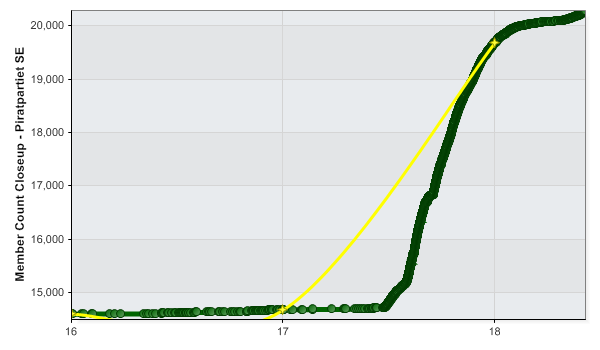
pirate-party-membership There are political implications for all of this, as well – the Pirate Party of Sweden, formed to reform copyright law, abolish the patent system and strengthen privacy rights, claims to have gained 3,000 new members in the seven hours following the verdict, giving it a larger membership than four out of seven current parties in the Swedish parliament (and if their online membership graph can be believed, it looks like they were up above 5,000 new members within 12 hours). Candidate Christian Engström said:

“The ruling is our ticket to the European Parliament,” concluded Engström, who expects a populist backlash against the ruling to help his party’s chances of gaining a seat in the EU’s primary legislative body. [source]

Now, single-issue parties have a particularly hard row to hoe (even TPB’s Peter Sunde doesn’t vote for the Pirate Party), and in terms of realpolitik few countries can afford to deviate from the intellectual property line established by TRIPS. Nevertheless there are big philosophical issues at stake here. Politicians ignore those two generations at their peril.

Technological and economic implicationspirate_bay

Technological and economic implications are linked because technology dictates the means by which content may be distributed, and without distribution there is no revenue. The Streisand effect mentioned above will likely manifest initially in the market for media as a short-term (and possibly short-lived) , but its long-term implications are much broader. Many of the content owners’ arguments against groups like TPB rest on the flawed premise that demand for content is static and copyright infringement is zero-sum (that is: every copy downloaded represents one less copy bought). The fall in revenue, they claim, is because of copyright infringement, so reducing copyright infringement will necessarily cause revenue to pick up again. There are two problems here: first, the genie is already out of the bottle, and two generations are now accustomed to consuming media on their own terms. They will not be forced to consume media in only the ways which content owners want them to, and whoever applies the stick in an attempt to make them do so will suffer as a consequence, because the content industries depend upon their consumers for survival, not the other way around. Second, and this is critical: by engaging in an aggressive game of whack-a-mole to safeguard a broken business model, the content industry has hastened the destruction of that business model by ensuring that only the fittest filesharing systems survive. Cory Doctorow makes both points better than I:

If The Pirate Bay shuts down, it’s certain that something else will spring up in its wake, of course — just as The Pirate Bay appeared in the wake of the closure of other, more “moderate” services.
With each successive takedown, the entertainment industry forces these services into architectures that are harder to police and harder to shut down. And with each takedown, the industry creates martyrs who inspire their users into an ideological opposition to the entertainment industry, turning them into people who actively dislike these companies and wish them ill (as opposed to opportunists who supplemented their legal acquisition of copyrighted materials with infringing downloads).
It’s a race to turn a relatively benign symbiote (the original Napster, which offered to pay for its downloads if it could get a license) into vicious, antibiotic resistant bacteria that’s dedicated to their destruction.

Content owners, by enforcing the discipline required to survive in a hostile environment, are granting clandestine distribution systems an enormous advantage: those systems evolve and improve while their own system stagnates. There are a few exceptions: Radiohead and Trent Reznor are at the forefront.

Of much more grave seriousness, however, is the chilling effect this verdict could have on the internet – search engines, ISPs and end users. Roger Wallis, Emeritus Professor of Media at Sweden’s Royal Institute of Technology (and an expert witness for the defence) warned:

This will cause a flood of court cases. Against all the ISPs. Because if these guys assisted in copyright infringements, then the ISPs also did. This will have huge consequences. The entire development of broadband may be stalled.

His point is that TPB’s technology meant their servers never hosted copyright files – those were hosted on its users’ home computers, and TPB simply provides a search engine to find content and a service which tells one user’s computer where to find files hosted on another user’s computer. If that makes one criminally liable, then those who are doing the actual distribution (te end users) and a whole lot of other people and organisations whose computers provide similar assistance including search engines and ISPs, are also criminally liable – and could even be more culpable than TPB were, since those computers actually host and distribute the copyright files themselves. Due to the highly robust, distributed, fault-tolerant nature of modern content-distribution systems made fit by nearly a decade’s worth of fine-tuning, there is simply no way to beat filesharing without targeting end-users and ISPs on a case-by-case basis. Any reluctance to roll out or use broadband internet services will have catastrophic flow-on economic effects, and given that media consumption is a major driver of broadband, content owners are in a catch-22 situation: either they aggressively prosecute ISPs and end-users or they fail to beat filesharing. In the former case, they get to keep their business model, at the cost of making criminals of their consumer base and ensuring that yet more complex, robust and powerful distribution mechanisms are developed – and possibly at the cost of the internet as we know it. In the latter case, they have to develop systems which are fit enough to survive on their own. The longer they delay, the harder it will be.

An upcoming post will look at the battle for hearts and minds which will fundamentally determine the winner in this contest.

L

Rethinking market socialism.

The crisis of the latest incarnation of market -driven economics, particularly in its financial sector, has raised the possibility of political-economic alternatives not so much as remedies but as significantly different approaches to the structuring of national economies in a global system of production and exchange. One of these is a revamped–as opposed to resurrected–market socialism. For those who are not familiar with the concept, a quick synopsis is found here. Although current conditions are different from those that led to the original formulation, some basic tenets can be discerned and elaborated upon. Basically, within a market system of supply and demand, the state operates as a macroeconomic manager (not just a toothless regulator) by obtaining majority stakes in strategic assets (be they primary good or value added). In parallel, at a mircroeconomic level it moves to promote significant (be it as a majority or as part of a tripartite arrangement with the state and capitalists) worker ownership in strategic industries (such as through employee stock option programmes  (ESOPs) or by encouraging the formation of cooperatives) in exchange for wage restraint and greater productivity. The logic is that with workers as co-owners of the industries in which they are employed, they will understand managerial rationales as well as the conditions on the production line, thereby promoting what could be called “equitable efficiency” in production.  Non-strategic components of the economy can be encouraged to follow suit but will not be forced to engage in such “socialising” programmes, but will be taxed at a higher rate if worker participation schemes are not incorporated. All sectors will follow the laws of economic efficiency followed by private firms–that is, the market logics of supply, demand and prices. Hence, the object is to prevent rent seeking behaviours usually associated with state ownership of the means of production–to wit, no “make work” or ghost worker schemes, no padding of employee roles, no patronage or clientalistic networks etc. Needless to say, unions may see a threat in this, but their self-interest as agents should not detract from the potential benefits of ownership accrued by workers as a class as well as principals of unions (where they are organised). Union shareholding schemes might be one way to reconcile the interests of agents and principals in such an event.

Under such a market socialist approach a restrained individual taxation rate that increases the amount of discretionary income to wage-owners as well as as capitalists can be complemented by a differential corporate rate that rewards worker ownership with lower rates while maintaining a higher rate for “traditional” firms–i.e. those that appropriate the surplus generated by workers in the form of profits that are in the majority distributed to non-workers (be they shareholders or managers).

With a greater State macroeconomic presence as a stakeholder in strategic industries and manager of microfoundational (the orientation of specific  industry) policy, coupled with active promotion of worker participation in ownership of the industries in which they are employed, backed by a taxation policy that rewards those who see the wisdom of making workers co-owners and understand that the State, as representative of all sectoral interests, is better suited for macroeconomic management than individual capitalists or their associations, a new market socialist project can be advanced that will filter global market dynamics into a more nuanced, and fairer, distribution of wealth and income in society. In a small island trade-dependent state, socio-economic stability depends on this.

There is actually a model for such a system, although it has yet to incorporate worker ownership schemes as part of its developmental project. That model is Singapore and the only reason it does not incorporate policies of worker ownership  into what is otherwise a state-dominated export-oriented economy that is successful is that it is a)authoritarian and thus can impose its will without worrying about the filter of mass consent;  b) foreign investors resist worker participation as a condition for investment; and c) as a result of the previous two factors, foreign workers on temporary visas unprotected by labor laws reserved for Singaporean citizens are used to structurally undermine any moves in that direction.

As a liberal democracy NZ can not emulate everything that Singapore does, but what it can do is note the commanding position of the State in its macroeconomic affairs, to include its use of  State holding companies as channels for public investment in a range of “private” industries as well as its use of taxation as an incentive for corporate investment and production, on the one hand, and household consumption on the other. Admittedly, the argument presented here is just a simplified sketch of the possibilities of market socialism in the present conjuncture, but the intention is to raise the point rather than fully elaborate upon it. The latter task is left to the readers.

Memo to SOEs:

Out-perform the private sector or join it.

This is the ultimatum I’m reading into Simon Power’s letter to SOE chairs.

I think it’s entirely right for the government to expect the most responsible and diligent business practice from SOEs – but I don’t think it’s reasonable to expect them to outperform the private sector which is unconstrained by the same responsibilities borne by a state-owned business. The private sector is responsible only to the profit motive of its shareholders, without the constraints of the triple bottom line and exemplary standards of conduct, transparency and long-term commitment.* Inasmuch as these constraints represent economic profitability traded off against other types of value, they require a SOE to operate at a disadvantage compared to private concerns when performance is measured purely in terms of the raw numbers.

If the ultimatum is delivered (as I expect it will be) in more certain terms during the 9 April meeting, it will mean two things: first, it should drive substantial changes in culture and efficiency, which is a good thing, and is the stated purpose. Second, if the different constraints under which SOEs operate are not taken into consideration and the performance evaluation is undertaken on strict terms of profit (and given the Prime Minister’s decree that electricity prices won’t rise) then they will be set a task at which they cannot possibly succeed, and their expected failure to outperform the market will prepare the groundwork for them to be sold during a second term.

L

* You might think that these constraints are a load of old bollocks, but that’s a different argument, since the government’s stated position is that they’re just fine.

The mythical “centrist” John Key government

When you look at the current government’s first four-and-a-bit months you see a right wing government implementing a swing to the right at high speed. Fair enough, they won the election, they reckon they’ve got the mandate. Even Key has stopped describing himself as “centrist” and now says “centre-right”.

Yet when you read the mainstream media the word “centrist” is still firmly attached to Key’s government. Well the New Zealand media anyhow, overseas they recognise a good old fashioned right wing market economics agenda.

So, what will it take for the media to stop believing it’s own commentary on last year’s election (carefully prepared for it by the National campaign team) and recognise that we elected, and now have, a right wing government? They’re making right wing choices: tax cuts for the rich instead of tax cuts for the poor; business own profits over staff wages and jobs; and an authoritarian state over human rights. We can argue about whether they’re the correct choices but they are the choices of the right.

We have a right wing government, that’s all.

Greatest good versus least harm, and the money proxy

It seems to me that the main difference in principle between Labour and National-based governments in NZ is an old question of utilitarianism – whether one should work toward achieving the greatest good or toward ensuring the least harm. The two philosophical positions are sketched out reasonably well in the wikipedia article on utilitarianism.

In principle, the difference boils down to a strategy of positive ambition versus negative mitigation. The former sees achievement as the highest goal, and failure as a necessary collateral effect of attempted achievement. They grade a society by its upper bound, by how much success its leading members achieve. In this regard, the ideology emphasises ambition, celebrating that qualities as the most beneficial to society while disregarding the worst consequences of its failure – destitution, disease, starvation, etc. The caricature of an ambitionist, if I may coin the term, sees the world as humanity’s oyster, and humanity in positive terms – as potentially successful and satisfied and healthy and secure, and considers that anyone who does not achieve these things has simply not tried hard enough, or for long enough, or lacks the innate characteristics needed to achieve those things and is therefore not entitled to them. Entitlement accrues to a person on the grounds of their success. In symbolic terms, the way to appeal to these people is in terms of opportunity, advantage, individuality, and the idea of just desserts for effort rendered.

On the other hand, the caricatured mitigationist (to coin the opposite term) grades society on its lower bound, by the extent to which the least successful members of the society are allowed to suffer by the more successful. They see the world as a dangerous, inhospitable place in which the default state is abject meanness, and humanity in negative terms of limiting those inhospitable forces, keeping out the cold and the hunger and the disease, while anything else is a bonus. Entitlement accrues to a person on the grounds of their humanity alone. The way to appeal to these people symbolically is in terms of compassion, brotherhood, sacrifice, cooperative achievement and that principle that none should suffer needlessly.

Although it may sometimes seem so, the world is not made up of caricatures, and this is my round of defence against complaints of false dichotomy. Both of these two broad positions hold some resonance for each of us, and it seems plausible that the balance of that resonance has a strong determinant effect on our political preferences. The problem, as always, comes with implementation, and the primary problem of implementation in the society we have is that money is used as the main measure of success and therefore as a proxy for a person’s innate value. This is perfectly acceptable to the ambitionists, whose ideological basis enables them to embrace money just as easily as they might embrace any other measure of human importance, but it’s not so attractive to mitigationists, who argue that entitlements accrue to a person on the grounds of their innate status as human beings and members of society, regardless of their achievements.

Push comes to shove at times like this, when things (in terms of that prevailing measure of success, money) are tight. When many people are deprived them, the human necessities of health, comfort and dignity can more readily be achieved by an idea of the common good than by the burning desire of ambition. However, when things get good again, it’s a terribly hard ideological position to peel back, and inasmuch as the common good can constrain the urgency of effort required for success it can be counter-productive, entrenching mediocrity. Indeed, without the incentive of individual reward for ambition, it could be argued that society would never pull out of any trough. But contrary to what the Randroids say, this isn’t an absolute constraint. In good times it’s easy to emphasise the greater good because a reasonable minimum standard can be expected to exist or be trivially provided for the few who need it. None need suffer except by a relative standard. In hard times, however, when raw success is less achievable, mitigating harm at the temporary expense of ambition becomes more valuable by its easy achievement.

The case in point is the Key government’s recession strategy, which gives a great deal of consideration to maintaining ambition but little to mitigating harm. It’s a tacit acceptance of a certain amount of harm in service of a longer-term good. If not from the policy itself, you can tell this from the terms used to talk about it. That’s a complicated philosophical and utilitarian question for a supposedly non-ideological government to be tackling.

L

Not a very practical cycle way

The government’s plan to build a cycle way the length of New Zealand encapsulates two key themes of this National administration.

  • It’s for wealthy tourists, not New Zealanders – it won’t get us to work or study, but it’ll allow wealthy western tourists the clean green NZ experience well insulated from the reality of our car dependency.
  • It’ll provide work for the construction industry – mostly men, mostly larger business, returning good profits to wealthy shareholders.

Of the two it’s the first that bothers me most (the second is just business as usual for National), building cycle ways to get people to work or study would make a real difference in our real lives. Whether you’re planning for peak oil, a recession, an ETS or carbon tax, or reducing obesity making it safe for people to cycle commute would have been a huge step forward.

Instead we’re green washing the exhaust fumes to look good to the rest of the world.

Clocks and Clouds

Juan Linz wrote that political time was like cloud time—it moved at a different pace than chronological time, yet had a discernable rhythm of its own. I would like to reverse the metaphor to note that when it comes to political and economic cycles in liberal democracies, it is political time that is more chronological, whereas economic time is more akin to cloud time.

 Under conditions of liberal democracy, political time is codified, demarcated and predictable. Elections are held at regular intervals, parliaments sit for a given amount of days in a calendar year; government departments issue annual reports and respond to inquiries in prescribed (if not timely) fashion, bills are introduced in specified ways within specific timeframes, etc. Even political debates take on a predictable rhythm, with arguments over finances occurring around the time of government budget announcements (in New Zealand that is usually in May), and partisan and personal attacks occurring during periods of relative policy stability. Come summer, most things political more or less stop for the holidays, then resume in the Fall.

Economic time, however, is another matter. Capitalist economies are obviously cyclical, but the cycles are twofold and not coincident with political time. First, there is the “boom and bust” cycle in which markets expand and contract in pursuit of (re) equilibrated growth. This is the cumulus cloud time of economic cycles. That is, the short cycle dimension of capitalist economics, marked by sudden shifts in direction driven by the warming or cooling of market preferences. In parallel, there is a long cycle in which capitalist economies shift between market-driven or state-managed forms. This is the cirrus cloud dimension of economic time. The sclerosis, stagnation or failure of one economic form, such as the market failures now evident, leads to the shift to the other. Thus, the Great Depression spelled the end of laissez faire market economics and the advent of welfare statism, which after the resolution of World War 2 led to nearly forty years of prosperity in the liberal democratic world. In turn, by the 1980s the era of state-centered economics had come to an end, saddled as it was by rent-seeking behaviours, clientalism and systemic inefficiencies produced by bureaucratic distortions of the productive process. What emerged in response was neoliberal market economics. This era was driven by deregulation, trade opening and monetarist macroeconomic prescriptions that were premised on the belief—subsequently proven to be unfounded—that finance capital would be the most accurate determiner of global productive investment.

Two decades later, the era of neoliberal economics has concluded in ignoble fashion. Note that this market-oriented cycle lasted half as long as the previous state-centered cycle, which in turn was shorter than the original period of laissez faire. This shortened lifespan is due to the combination of market-driven globalization of production coupled with exponential advances in telecommunications and transportation. Phrased differently, it would seem that the economic cirrus clouds have sped up at a time when the negative cumulus layer has deepened, all while political time remains constant. Therein lies the rub.

It is generally held that market failures lead political shifts to the Left so as to facilitate the move to state-centered macroeconomic policy. Conversely, state-centered failures are said to lead to shifts to the political Right so as to facilitate the adoption of market-oriented strategies. In the 1930s and 1980s this rule generally held true for advanced democracies. But since economic and political time are not coincident, it is by no means a universal truth that such will occur at every moment of cyclical transition. The current moment is a case in point.

In the US the rule seems to have been upheld, as is true for several European countries. But in France, New Zealand, Japan and Italy, among others, Right-oriented governments are confronted with market failure and the need to provide political space for an economic transition. The political cycle in these countries does not allow for their immediate replacement with Left-oriented governments. There is a lack of synchronicity between political clock and economic cloud time in these countries. This places the ideological beliefs and policy prescriptions of such Right governments under pressure, since in principle they are averse to increasing the role of the state in macroeconomic affairs. Yet the magnitude of the current market failure is such that the role of the State, at least as a macroeconomic regulator, needs to be considered. This consideration needs to happen quickly, since the temporal horizons on finding solutions is near immediate given the speed at which the global recessionary pressure wave is advancing. Put another way,  the cumulus and cirrus aspects of economic time have come together in a perfect storm of economic necessity that Right governments find particularly difficult to address, much less resolve without betraying their foundational principles. To do so is to tacitly admit that there are inherent flaws in market logics that require State intervention in order to be overcome (in the reverse of the betrayal of foundational principles and tacit admission of State-capitalist failures by so-called “Third Way” Labour parties).

Thus the dilemma for Mr. Key’s government: how to reconcile clock and cloud time in a small island democracy at the outer edge of an economic storm front? From what has been seen so far, it appears that he has opted to shift to the Left, but as of yet without categorically stating that he is doing so. With ACT in the government coalition, that makes for interesting theater in the months ahead. Or to conclude with yet more metaphor abuse: could there also be internal storm clouds on NACTIONAL’s horizon?

Are FTAs OK?

The Feb 27 announcement that NZ and Australia have signed a Free Trade Agreement (FTA)  with the ten member Southeast Asian regional grouping known as ASEAN has been hailed as another triumph for NZ’s economic openness, especially coming at a time when protectionist and nationalising policies have re-emerged in response to the global market crisis now ongoing. Although Trade Minister Tim Grosser signed the AANZ-FTA agreement at the 14th ASEAN summit in Thailand, it was MFAT officials working under instruction from the 5th Labour government who sealed the deal (after 4 years of negotiations), and it is these officials who are now beginning talks with India on a bilateral FTA similar to the one signed last year with the PRC. Yet, amid all the self-congratulation by government officials and business leaders, the nagging questions remains: are such FTA’s always good for the average Kiwi?

Pro-trade advocates will say yes on three counts. First, increased markets for NZ exports means more jobs in those sectors as well as their subsidiaries and ancillary industries. Second, increased foreign investment opportunities for NZ firms will eventually increase dividends for Kiwi shareholders. Third, access to a wider range of import markets means more competition and lower prices for Kiwi consumers. But there is more to the picture than this seemingly positive sum outlook.

The AANZ-FTA, like the FTA with the PRC and the P4 FTA signed earlier by NZ with Brunei, Singapore and Chile, is more properly seen as a tariff reduction scheme. In the case of the AANZ-FTA, the goal is to reduce common tariffs by 96% by 2020, thereby paving the way for the development of a a EU-style common market along the Western Pacific Rim that can compete with the EU, the US and emerging giants like the PRC, India and Brazil. NZ estimates are that it will eventually enjoy a 99% reduction in tariffs on its exports to ASEAN while ASEAN members will receive an 85% reduction on their imports to NZ. With US$ 31 billion is ASEAN exports to Australia and NZ  and US$16.8 billion of Australian and New Zealand exports to ASEAN members in 2007 (75% of that volume being between Australia and ASEAN, with NZ exporting US$4.6 billion to ASEAN members in 2008)), the objective is to raise the flow of goods and services ten fold over the next decade. Tariff reduction is seen as the key to achieving this goal, as it will lower transaction costs and remove fiscal impediments to investment within the partnership.

The problems with this arrangement stem from the asymmetries in the respective economies involved, from the lack of “after-entry” provisos, and from the dubious character of some of the regimes involved. With regard to the latter, the AANZ-FTA includes Myanmar and Brunei, two despotic regimes whose trade reliability and fiscal responsibility, much less human rights records, are open to question. It includes Thailand, which has the appearance of a politically failing state where sex tourism weirdness competes with highly exploitative labour-intensive low-cost production as the primary source of GDP, all amid grave ethnic conflict in its southern regions. It includes Laos and Cambodia, two states that barely meet the criteria for inclusion in a globalised trade regime. Its leading members, Singapore, Indonesia, Malaysia and the Philippines, have issues of political and/or corporate governance (be it in a lack of corporate transparency and/or a lack of political accountability), and the remaining member, Viet Nam, is a one party authoritarian regime that, if not as retrograde as Myanmar, has yet to exhibit the developmental potential of some of its most proximate neighbours. ASEAN is, in other words, a polyglot of corruption, nepotism, economic underdevelopment and exploitation mixed with crass materialism and indifference towards basic human rights and civil liberties in a highly charged ethnically diverse and stratified demographic, with a profoundly unequal distribution of resources and reliability amongst its members. Is that what NZ wants in terms of preferential trading partners?

Not surprisingly, the AANZ-FTA, which is due to go into effect on July 1 2009, has no common labour standards, including provisions regarding collective bargaining, right to organise, female and child labour, occupational health and safety and quality control. It has no environmental clauses. All of those are left to the industries involved. The Fontera PRC subsidiary’s Melanin scandal gives an indication of what can happen when such is the case.

Then there is the issue of size asymmetries and economies of scale. Is it plausible to think that with Australia coupled to NZ on one side of the AANZ-FTA ledger, NZ is going to be an equal beneficiary of the new tariff regime? If Australia turns out to be the major focus of ASEAN trade, will that not accelerate worker exodus and capital flight from NZ to Aussie under the terms of the CEP? Is it plausible to believe that with the lack of labour and other standards, NZ businesses in a variety of value added or service sectors will not have an incentive to re-locate their workforce in ASEAN countries where wages and benefits are lower? Is it plausible to think that NZ, with an export base in relatively inelastic primary-good industries and their derivatives (say, milk powder or paper pulp) will enjoy an equitable balance of trade with more elastic value-added importers? Is it plausible to think that foreign investors will not use the opportunity provided by relaxed investment regulation to assert direct control over NZ productive assets (which is an issue that also is at play with regards to the FTA with the PRC)? What NEW productive activities will actually  be created in NZ that will help diversify the economy while providing new employment opportunities that require so-called “knowledge-based”  skills? (For an earlier discussion of the problems of asymmetric trade, with specific regard to the PRC FTA, see http://scoop.co.nz/stories/HL0803/S00263.htm).

These are the questions that need to be asked in the parliamentary debates leading up to the July 1, 2009 ratification date. It is important that the Greens and other groups with concerns about FTAs avoid the appearance of knee-jerk protectionism that they have been saddled with in the past (as was the case with NZ First). Instead, the emphasis must be on the hidden “F” in an FTA–the FAIR aspect of trade, which for a small democracy such as NZ is as important as its free aspect. After all, free trade is not necessarily synonymous with fair trade, and it behooves the political Left to make that point since no one else (to include Labour) will.

Women are paying for bankers’ excesses

The recession is spoken about as if it is universal: blind to gender, class and race it will hurt us all. Yet the reality is that groups which are already disadvantaged will pay the biggest price: not only are they they worst affected, but our government is providing them with the least support.

This is not the first time this pattern has occurred, the Asian recession in the 1990s forced women out of the workforce and back into the kitchen, or overseas, or into sex work. This recession is no different, early last year a US Senate committee investigated the impact of the growing recession and reported

These findings clearly demonstrate the severe and disproportionate impact of this recession on women and their families.

Analysis in the UK similarly predicts more severe effects on women. In New Zealand no-one seems to have done the research yet, but there’s every reason to expect the same outcome: women will experience redundancy, loss of hours, and reduced pay at greater rates than men.

So our government’s response? Well there are the tax cuts, which will disproportionately benefit men, there’s the economic stimulus package which appears targetted toward working men and, of course, Tony Ryall’s instructions to the public sector to suppress women’s pay.

National is determined to keep bankers in business, corporates afloat, construction workers busy, and boost the pay packets of the wealthy; women should expect no help as their jobs, hours and pay are cut.

Four-day week – analysis?

Since I spend my workday up to my eyeballs in the media, it’s very rare that I watch ONE News Tonight, and even rarer that I come across something I don’t already know.

12152008_bigdig
(Red Planet Cartoons)

Today, I managed to elude the fact that the government is considering support for a four-day week for businesses which might otherwise consider layoffs, paying (part of?) the fifth day’s income, while staff undertake training or community work. Until Tonight, that is. This seems to me an excellent idea, if it can be well-implemented. It accounts for the necessary scaling-back in production which some industries will experience, while subsidising future productivity increases to come from improving the skill base of NZ workers, which means that once the recession passes, the country will be better-positioned to hit the ground running, as it were, and enable the government to pay back the debt which will necessarily accrue from the scheme.

(As a sidebar: that a National government is even considering such a thing represents a huge change in political culture.)

There are certainly pro- and contra- arguments to this sort of scheme which I’ve not considered; as you can tell by the cartoon, I’m not unaware of the general uselessness of make-work-for-the-sake-of-making-work schemes. Friedman’s quote, on the linked site, is especially well-taken:

“If all we want are jobs, we can create any number — for example, have people dig holes and then fill them up again, or perform other useless tasks. […] Our real objective is not just jobs but productive jobs”

The question is one of implementation: what would be necessary for a make-work scheme which results in productivity improvements down the line to be better than redundancy – the consequent productivity increase that brings as they try to better themselves, less the productivity drain they represent, being out of money and therefore not consuming, or on welfare?

This is a complex question, and I invite you to argue your corner. But please, I’m not interested in ideology-bound doggerel of the `OMG statist corrupt meddling communism’ sort, or its inverse – I’m not an economist, but I expect a high standard of analysis, the more formal the better.

L