War Fever, War Mongering or War Fetish?

The US has for long been known for its societal glorification of the military, a trait that covers popular culture, public and private institutions, sports and even the arts and literature. Manifestations of this include military flyovers at sporting events, military marches at parades, military honour guards at graduation and retirement ceremonies, Hollywood and interactive game productions about US wars and military prowess, active and retired military discounts for many goods and services, a 3 million-odd military troop size, high school and college military training units and rhetorical veneration of veterans on days of national significance. It is also the home of the military-industrial complex, which even if now just one such apparatus in a global network of arms manufactures, merchants, buyers and dealers, remains a centrepiece of the US economy and, as former President and 5 star general Dwight Eisenhower said at his Presidential farewell address in1961, an inherent threat to democracy because of its pervasive influence on public policy. That is as true today as much if not more than it was back then.

I mention this because recent US media coverage of the Ruso-Ukrainian, Hamas-Israel and Houthi-US/UK conflicts appears to show more than the influence of the military-industrial complex or the ideological glorification of the military as a US institution. It appears to depict a case of war fever or worse yet, war fetishism.

US cable news seem fixated on the weapons and support platforms being used against various adversaries. Tomahawk cruise missiles, Bradley fighting vehicles, Predator and Reaper drones, F-18s, attack submarines, aircraft carriers, frigates, destroyers, air- and surface-to- surface ballistic missiles–these and more are discussed at great length and detail by an assortment of (usually ex military) talking heads. Explosive tonnages are weighed, circular error probables are measured, delivery distances calculated, enemy killed are estimated. it makes for great theatre for those whose idea of entertainment leans that way. It generates eyeballs on screens and clicks on apps. The same is true, albeit in less visceral form, in the so-called “legacy” (print-turned-to digital) media such as newspapers. The logic of US corporate media is consistent: wars showcase US technological product and prowess. They are good for business, employment and US self-esteem.

Two things are notable about this coverage. The first is that much air time and column inches are devoted to the technologies involved in the architecture of death-dealing. Relatively little is devoted to the consequences of what these technologies do because the focus is on the former, not the latter. What attention is paid to human suffering is dwarfed by the focus on complex machines and lethal delivery systems, and even then the attention to human suffering is skewed in sympathetic favour towards what the US considers to be the “good guys” in any armed confrontation. In addition, relatively little attention is paid to second and third-order implications of any given conflict, so that, for example, escalation of the Hamas-Israel and Houthi-US/UK belligerencies is simply mentioned as a possibility rather than mapped out as an increasingly probability given the interests and actors at play. In fact, relatively balanced presentations of why these conflicts have occurred is subordinated to editorialising in favour of one side or another depending on US government positions vis a vis the conflicts in question.

Worse yet, over time the US government and its compliant public just move from one enemy to another. Once it was and now again it is Russian authoritarians. But there have also been Colombian drug cartels, military-nationalist regimes with swarthy-looking leaders in the Middle East (but not repressive Sunni oligarchies), post-revolutionary Iranians, al-Qaeda/ISIS, some but not other Latin American despots, the Taliban, the PRC, various African warlords–there is never a shortage of bad guys to go after. The US public uncritically laps it up because to them the constant re-framing of the enemy does not matter. What matters is the machines, the violent action and that the US kick some a**, somewhere, anywhere.

What is even more interesting is that all this coverage ignores the fact that the US, for all of its technological prowess, has a decidedly mixed record when it comes to war. However glossed over by semi-orderly retreats (“withdrawals” in the US parlance), the US lost in Vietnam, Iraq and Afghanistan over the last 50 years of nearly non-stop fighting. It won in Gulf War One (“Shock and Awe”), Grenada and Panama, but lost over 200 Marines, sailors and army soldiers in an ill-fated intervention in Lebanon in 1983, thereby paving the way for the rise of Hezbollah as a significant actor in Lebanese and regional politics. It clashes with Iran regularly and has little to show for it other than rallying Shiites around the world to the Iranian cause. It invaded Iraq on a pretext after 9/11, succeeded in ousting Saddam Hussein, but also created the intellectual and operational core of ISIS (which was organised by former Baathist officers in the Sunni Triangle as a resistance force and morphed into a broader ethno-religious movement with the objective of establishing a Caliphate in Mesopotamia and the Levant). Hundreds of US troops have fought and died in all sorts of undeclared “small wars,” from Somalia to Niger, Colombia to the Philippines and very rarely did the outcomes advance US interests or its reputation (both as a international power as well as a war-fighting culture). In the end, technological advantages were not decisive in all instances and did not lead to better diplomatic outcomes or more peace even where they did succeed. Yet the obsession with the machinery of death continues.

Perhaps it is because US society has a technological obsession, one that translates into finding ways for machines to replace humans in every walk of life, including the kinetic kill chain in war. If that is true (that US society prioritizes technological solutions to human as well as natural problems), then the larger question is whether what we see in US media coverage of conflict is evidence of war fever, evidence of war fetishism or just another instance of good ole’ fashioned war-mongering.

War fever can be characterised as a temporary state of individual and collective bloodlust caused by a desire for vengeance, righteous anger, opportunistic greed, genuine or perceived grievance or sociopathic or psychopathic arousal. It can work for good or work for evil depending on its causes, because the motivation is immediate and the objective is to vanquish by force a perceived enemy that is the immediate problem. When the enemy is vanquished, the fever breaks and people return to normal (non-bellicose) lives because, to use another medical analogy, the war boil has been lanced.

War fetishism, on the other hand, is a form of idolatry. It is obsessively fixated on war as an object of adoration. It idolizes soldiers as heroes and weapons as technological marvels. It worships the modalities of combat and the death delivery infrastructure used in them. It reifies the machines and canonizes the “good guys” who use them, even if the good guys are killing civilians in foreign lands where they are unwelcome. It wraps engagement in war in patriotic, ethnic, religious or historical symbolism, often stringing them together in a narrative of heroism and sacrifice, good versus evil, light versus darkness. The narrative in support of war is fluid and endless. Enemies come and go. They are a war-mongering cloak because the obsession is with the machinery of death and its application wherever it can be, not the (often morally, ethically and practically thin) justifications for its use.

Think of it this way. Does the US public, especially in Red States and in the MAGA crowd, really care about or even know what freedom of navigation is? Do they have a notion of what the Houthis are and why they are considered “rebels?” Or is the US public interest more about dealing violence to brown-skinned, non-Christian challengers (“terrorists!”) who defy and resist US directives in their part of the world? Again, the popular focus is on the ways in which organised violence is meted out to designated bad guys, not understanding why they are fighting, much less why the US has chosen them to be the latest in a long procession of bad guys.

(Brief historical aside by way of context: the Houthis are Shiites indigenous to Yemen but long-ruled by Sunni Saudi Arabian-backed clients. Once they rebelled they became pawns in a proxy war between Iran and Saudi Arabia and were subjected to numerous Saudi Arabian war crimes using US weapons).

In that light, war-mongering is just a sub-set of war fetishism. It is nothing more than (often opportunistic) ideological or practical peddling of justifications for going to war. When the two types of justification combine, say in the advertising of so-called “defense” manufacturers in the US (“defending freedom!”), the result is an effective propaganda blanket for purveyors of death of either stripe. It is a means to an end, but not a cause or effect.

By this criteria, the US is a war fetishist society. Not everyone in the US of course, but certainly the majority, who may not even know that they are because the fact of constant (even if passive) war-worship is an all-encompassing (yet seldom admitted) part of everyday life. This does not excuse the murderous behaviour of any number of armed actors around the world, but it does bring into light how the US has cultivated an authoritarian ethos regarding the use of violence abroad that is antithetical to the very notion of peace and prosperity for all that it was supposedly founded on. Add to that the militarisation of US domestic security forces and the unconstrained gun culture that pervades significant parts of US society, and the dangers to the US as a democratic polity are laid bare.

Houston, we got a problem.
The dirty power of culture wars.

A few decades ago I wrote an essay about the impact of state terror on Argentine society. One of my points was that terrorism was used by the military dictatorship known as the “Proceso” not because it was particularly effective at ferreting out subversives but because it worked as an atomising agent in Argentine society. That is, it used pervasive fear of institutionalised terrorism as a means to “infantilize” people and increasing isolate and alienate them as individuals, which served to destroy the horizontal social bonds that were the basis of collective solidarity among the groups targeted by the dictatorship. That in turn eased the way for the imposition of so-called neoliberal economic policies that redistributed income downwards for the majority, significantly curtailed the State role in economic management and provision of basic public services, destroyed social welfare, health and education safety nets and pauperised the population in general while increasing the material fortunes of the elites associated with the regime.

State terror created a culture of fear that atomised and isolated people in the public space, thereby paving the way for their infantilisation as social subjects and eventual dependency on and subjugation by their dictatorial masters. What is less known is that the so-called “Dirty War” waged by the dictatorship known as the “Proceso” (Process) was justified not on economic but on cultural grounds, as a defense of “traditional (Catholic) values” placed under siege by immoral, degenerate, atheistic Communist subversion in the guise of liberalism, feminism, secularism, homosexuality, youthful rebellion and other depraved foreign ideologies that had no “natural” place in the patriarchal, heteronormative capitalist social status quo that dominated Argentina at the time. Now, in the contemporary era, a variant on this theme has been introduced into socio-political narratives in the liberal democratic West as well as elsewhere: Culture Wars.

In recent years conservative authoritarians have moved to using electoral facades rather than coups as a means of gaining and maintaining government office. Their weapon of choice is no longer terror imposed by or on behalf of the State but a defense of traditional values against attempts by progressives to undermine the moral fabric of society. Similarly, authoritarians out of office no longer seek to use guerrilla war as a main vehicle for conquering power but instead embark on crusades against “wokeness,” “political correctness” and perceived (and mostly imaginary) attacks on “free speech” by liberal-progressive-socialist-communists. In both cases the strategic move has been from a physical war of manoeuvre to a cultural war of position in which the battle is over values and identities, not necessarily (although ultimately involving) government offices, economic policies or physical terrain. In other words, the social backdrop to political competition and conflict is now increasingly dominated by Culture Wars.

That is notable because the Culture Wars approach rejects or replaces the most basic axiom in politics: that people vote with their wallets. Think of it this way. The MAGA crowd voted against its economic interests when it voted for Trump (even if Trump’s “America First” economic pipe dream was sold to them as feasible). More recently, both Vladimir Putin and Recap Erdogan in Russia and Turkey diverted popular attention from their disastrous economic policies and corruption towards a defense of “traditional” values, in Putin’s case “traditional” Christian values (supported by the Russian orthodox hierarchy) and in Erdogan’s case “traditional” Muslim values (again, supported by conservative clerics). They both railed against the depravity of the West and the corrosive impact the importation of Western mores and ideas has had on their respective societies. In fact, Putin went so far as to order the invasion of Ukraine because of its “degenerate” liberal (when not Nazi) leadership’s threat to the ethnic Russian part of the Ukrainian population. The point is that when Culture Wars are used as an electoral strategy in order to outweigh objective economic realities, they often are successful.

The emphasis on Culture Wars is understandable when conservative authoritarians have no economic legs to stand on. That is where the parallel between US and NZ conservatives come in. Neither the GOP in the US or National/Act in NZ have economic platforms that are remotely close to practicable, sustainable or deserving of popular support. They are in fact elitist in construction and elitist in benefit. So, rather than modify their economic policy platforms away from their exhausted and discredited neoliberal/market-driven trickle-down policies, these conservatives turn to inciting Culture Wars as a means of diverting attention towards superstructural and often artificial fault lines in their respective democratic societies. In the US things like gun rights and opposition to racial, gender and sexual equality may be an “organic” product of American Christian repression and its record of historical conquest, but in NZ the notion of unrestricted gun ownership rights and opposition to transgender rights (on the slanderous grounds that the latter are “groomers” and pedophiles) are foreign imports that have no “organic” or native origins in NZ society. However, the attacks on co-governance frameworks in NZ is indeed rooted in deep-seated Pakeha racism against Maori, so the fusion of foreign imported ideologies and local regressive perspectives on race mesh easily into a divide and conquer (so they think) Culture War strategy on the part of the NZ Right.

More broadly, the assault on gender and sexual identity minorities, immigrants and various types of non-traditional non-conformity that defy the traditional narrative about what the “proper” society should look and behave like is rife throughout the Western liberal democratic world even where gun rights are restricted in the interests of public safety (seen, not unreasonably, as a public good rather than an infringement on individual liberty), where racism is not a historical stain or contemporary problem or where economic policies have popular support. It is major a stock in trade of elected authoritarians like Victor Orban in Hungary, Andrzej Duda in Poland and former president Jair Bolsonaro in Brazil as well as a host of demagogic political and social figures throughout the world, to say nothing of outright autocrats like Putin, Erdogan and a swathe of Middle Eastern and African oligarchs and strongmen.

The important thing to bear in mind is that like state terror as a social atomising agent, Culture Wars work. Trump, Bolsonaro and Orban rode them to victory in democratic executive branch elections, Putin and Erdogan used them to rally support for their unpopular regimes (with Erdogan likely to win a run-off election next weekend in spite of his disastrous economic policies and Putin holding onto power like a (rat-trapped) rat on cheese despite Russia’s futile war on Ukraine). Wanna-be’s like Luxon, Peters and Seymour in NZ seem to believe that their best bet is to copy at least some aspects of the Culture Wars strategy and adapt them to Aotearoa’s particular circumstances in the run up to this year’s general election. Given the media attention devoted to co-governance, transgender rights (or better said, their mere presence), vaccinations and the use of Te Reo in public discourse, there may in fact be grounds for traction in that angle of approach. That makes it more imperative that people push back at the introduction of retrograde ideological arguments in the NZ context. They are largely not from here and have no place in Aotearoa.

The pushback is necessary for a simple reason. Culture Wars work as a socio-political strategy because they are based on a dirty little secret: that fear is a great perception and behaviour modifier. Culture warriors traffic in the promotion of fear, both real and imagined, rational and irrational. This fear is of targeted “others,” those who can be readily identified and easily scapegoated while also be made into seemingly malevolent Leviathans who must be struck back by common, sensible, “traditional values”-holding people–the silent majority, as it were. Although it is helpful to the Culture Was projects if the “others” look different, worship different Gods, have different customary practices or engage in non-heteronormative sexual behaviour, it matters less what the “others” actually do than that they are identified as threats to traditional values and mores. The use of disinformation and misinformation is helpful in this regard because fear is a tool whether the basis for it is true or not–and it is most often not true or grounded in reality. What matters is achieving the objective, not the truth. The objective, in turn, is to restore a previous societal status quo in the face of pressures to make it more equitable, inclusive and responsive to the needs of those marginalised.and voiceless under the “traditional” scheme of things.

Complacency is the ally of the Culture Warriors because silence allows them to megaphone their messages of fear and hate through corporate and social media unimpeded by fact checkers, truth-speakers or coherent ripostes. Decent people may believe that Culture Wars are just a side-circus show that does not in fact distract from bread and butter and other serious issues of the day when people make their political and social preference choices. But as the likes of Brian Tamaki and various conservative media talking heads have shown, they do in fact have an impact on public perceptions when not challenged by more tolerant and open-minded arguments. Their fear-mongering gains ground in the measure that complacency cedes them rhetorical space in the pubic discourse.

All of which is to say that although there may be considerable distance in practice between Argentine (or Chilean or Guatemalan or Salvadorean, etc.) state terrorism and the Culture Wars in contemporary democracies, they are on a continuum where fear (manufactured or real) is exploited for political and social advantage above and beyond the economic projects that may underpin them. As Bernard de Voto noted (paraphrased here), “a person’s eyes and ears and the fulcrum of his/her judgement supplies his/her capability for action.” The fulcrum of fear is made up of orchestrated “Othering” in which contending perceptions of norms, mores and acceptable behaviours, that is, the conflict between between traditional and “progressive” values, is focused on particular subjects and groups. The purpose of Culture Wars is to warp the ideological fulcrum on which social consensus rests in order to obtain political, social and often material advantage whether it be based in the truth or not.

As a bottom line culture warriors play dirty with the truth just as much as the Argentine Dirty War ignored international norms and strictures against the torture and killing of civilians. Much like the logic of the “Proceso” when defending its actions, the ends of the culture warrior justifiy the means, and in a world in which the value of tradition is increasingly under question and often challenge, warping of the ideological fulcrum in order to promote manipulable fear in the body politic is just as useful as the pliers, branding irons, cow-prods and battery clamps used by the Latin American torturers of yore.

To which I say now as I said back then, mutatis mutandis: “Nunca Mas!”

PS: For those who may be interested in the essay linked to above, please email me (pablo@kiwipolitico.com) and I will send you a copy of the entire essay as an attachment in my reply.

” A View from Afar” returns.

On Thursday May 11, 2023 at 12PM (noon) NZ time/8PM Wed 10th May US East Coast time/1AM Thursday London time/8 AM Thursday Singapore time and 10AM Thursday Sydney time, the A View from Afar podcast will resume broadcasting. Selwyn Manning and I will discuss the AUKUS agreement and its implications for New Zealand and the fallout from the Discord classified material leaks as well as global affairs from a South Pacific perspective.

The show is interactive so tune in and join us!

Countering coercive politics

Prime Minister Jacinda Ardern’s two week foreign mission to Europe and Australia was by all accounts a success. She met with business and government leaders, signed and co-signed several commercial and diplomatic agreements including a EU-NZ trade pact, conferred with NATO officials as an invited participant of this year’s NATO’s Leader’s Summit, gave several keynote speeches on foreign policy and international affairs, and in general flew the Aotearoa flag with grace and a considerable dose of celebrity. As she wraps up her visit to Australia, it is worth noting that she gave different takes on foreign policy to different audiences. These may appear incongruous at first glance but in fact display a fair degree of strategic and diplomatic finesse.

In Europe she emphasized the commonality of shared values among liberal democracies across a range of subjects: approaches to trade, security, human rights, representative governance, the rule of law within and across borders, transparency and rejection of corruption, and the common threat posed to all of these values by authoritarian great powers that are trying to usurp the international order via persistent challenges and encroachments on international norms and institutions.

Towards the end of her trip while in Australia, she shifted tack and emphasized NZ’s “independent” foreign policy while dropping the value-based view of a global geostrategic contest marshalled along ideological lines.

Instead, she publicly decoupled the Ruso-Ukrainian war from broader geostrategic competition between democratic and authoritarian-led powers, treating Russian behavior as idiosyncratic rather than as a result of regime type. That framing of the conflict avoids messy arguments about domestic political legitimacy and its impact on great power rivalries. In doing so Ardern reaffirmed the independence of NZ’s foreign policy approach from those of larger Western allies while reducing the possibility of retaliation by the PRC on trade and other diplomatic fronts. The PRC is well aware of the reality of NZ’s recent strategic shift towards the West, but a public position that pointedly refuses to lump together PRC behavior with Russian aggression based on the authoritarian nature of their respective regimes gives NZ some time and diplomatic space in which to maneuver as it charts a course in the international transitional moment that it is currently navigating. That is a prudent position to take and hence a good diplomatic move assuming that the PRC reads the statement as NZ intends it to be read.

The strategy behind this approach–one that recognizes the larger ideological divide at play in international affairs but treats State actions as unique to individual national history and circumstances–might be called a “confronting coercive politics” approach. Allow me to explain.

Politics ultimately is about the acquisition, accumulation, administration, distribution, maintenance and loss of power. Power is the ability to make others bend to one’s will. It can be persuasive or coercive in nature, i.e., it can induce others to act in certain ways or it can compell them to act under (threat of) duress .

Power is relative and variable across several dimensions, including economic, political, military, personal, class, social (including gender and reputational/”influencer” in this day and age), cultural, intellectual and physical. Power is wielded directly or indirectly as a mixed bag of “hard” and “soft” attributes, a dichotomy that is well mentioned in the international relations and foreign policy literatures. Hybrid combinations of soft and hard power have led to “smart” and “sharp” power subsets depending on the emphasis given to one or the other basic trait.

The harder the exercise of power, the more coercive it is. Conversely, the more persuasive the way in which power is welded, the “softer” it is. Moreover, soft power can give way to hard power if the former is unsuccessful in accomplishing desired objectives, and soft power can be used as a follow up to the exercise of hard power. For example, “dollar diplomacy,” whereby large states fund development projects in small states on generous terms, is a form of soft power that can turn into hard power leverage once it becomes debt diplomacy in the form repayment conditions for those projects.

The exercise of State power has been institutionalized, codified and regulated over the years in a variety of contexts, including international relations and foreign policy. That is designed to strip inter-state relations of more overtly coercive approaches in favor of more consensus or compromise-oriented forms of engagement. However, in recent years the shift from a unipolar to a multipolar world-in-the-making has led to international norm erosion and a diminishing of international rule and law enforcement. That has produced a “back to the future” scenario where the international context has regressed to a modern version of the anarchic state of nature that Hobbes warned about in Leviathan. Emerging or restored great powers, particularly but not exclusively the PRC and Russia, have rejected international norms and laws in favor of a “might makes right” approach to international differences. Geopolitical coercion is at the heart of their international perspectives, which challenges the basic rules, norms and institutions of the liberal international order.

The turn towards more coercive forms of international politics is mirrored in the domestic politics of many States, including those led by democratic regimes. It is this–the emergence of coercive politics as a core feature of domestic and international governance–that is the focus of Ardern’s bifurcated foreign policy pronouncements in recent days. Her government understands that “liberal” governance is more than free and fair elections and respect for human rights. It is based on tolerance, compromise and mutual contingent consent between individuals, factions, parties and States.

Being unable to control the domestic regimes that govern States, Ardern’s bifurcated approach to NZ foreign policy (I would not call it a doctrine or anywhere close to one), is focused on countering coercive politics in international affairs. The general value principles of liberalism are upheld, but individual relations with other states, particularly important trade and security partners, are treated with a mix of value-based and pragmatic considerations, with pragmatism prevailing when strategic interests are at stake.

This approach allows NZ to broadly critique a trade partner’s human rights record while increasing or maintaining its trade with that partner in specific commodities under the argument that engagement with NZ’s values is better than isolation from them.

In other words, adherence in principle to liberal international values cloaks realistic assessments of where Aotearoa’s material interests are woven into the global institutional fabric. That may be cynical, hypocritical or short-sighted in its read of how the global order is evolving, but as a short-term diplomatic stance, it splits the difference between adherence to principle and amoral commitment to self-interested practice.

A satisfied customer.

It is in the comments section but I thought that I would highlight this lovely piece of correspondence from an avid reader:

NIB supporter
1 approved
AustrianGod@protonmail.com
185.228.138.240
White Power!Thank God our friends in NZ, the National Interest Battalion, have formed such a strong milita to take all you nigger Jews out!

He seems to be confused as to who/what we are, but why fret the details?

A Note of Caution.

The repeal of Roe vs Wade by the US Supreme Court is part of a broader “New Conservative” agenda financed by reactionary billionaires like Peter Thiel, Elon Mush, the Kochs and Murdochs (and others), organised by agitators like Steve Bannon and Rodger Stone and legally weaponised by Conservative (often Catholic) judges who are Federalist Society members. The agenda, as Clarence Thomas openly (but partially) stated, is to roll back the rights of women, ethnic and sexual minorities as part of an attempt to re-impose a heteronormative patriarchal Judeo-Christian social order in the US.

Worse, the influence of these forces radiates outwards from the US into places like NZ, where the rhetoric, tactics and funding of rightwing groups increasingly mirrors that of their US counterparts. Although NZ is not as institutionally fragile as the US, such foreign influences are corrosive of basic NZ social values because of their illiberal and inegalitarian beliefs. In fact, they are deliberately seditious in nature and subversive in intent. Thus, if we worry about the impact of PRC influence operations in Aotearoa, then we need to worry equally about these.

In fact, of the two types of foreign interference, the New Conservative threat is more immediate and prone to inciting anti-State and sectarian violence. Having now been established in NZ under the mantle of anti-vax/mask/mandate/”free speech” resistance, it is the 5th Column that needs the most scrutiny by our security authorities.

The PRC’s Two-Level Game.

Coming on the heels of the recently signed Solomon Islands-PRC bilateral economic and security agreement, the whirlwind tour of the Southwestern Pacific undertaken by PRC Foreign Minister Wang Yi has generated much concern in Canberra, Washington DC and Wellington as well as in other Western capitals. Wang and the PRC delegation came to the Southwestern Pacific bearing gifts in the form of offers of developmental assistance and aid, capacity building (including cyber infrastructure), trade opportunities, economic resource management, scholarships and security assistance, something that, as in the case of the Solomons-PRC bilateral agreement, caught the “traditional” Western patrons by surprise. With multiple stops in Kiribati, Fiji, Samoa, Tonga, PNG, Vanuatu and East Timor and video conferencing with other island states, Wang’s visit represents a bold outreach to the Pacific Island Forum community.

A couple of days ago I did a TV interview about the trip and its implications. Although I posted a link to the interview, I thought that I would flesh out was what unsaid in the interview both in terms of broader context as well as some of the specific issues canvassed during the junket. First, in order to understand the backdrop to recent developments, we must address some key concepts. Be forewarned: this is long.

China on the Rise and Transitional Conflict.

For the last three decades the PRC has been a nation on the ascent. Great in size, it is now a Great Power with global ambitions. It has the second largest economy in the world and the largest active duty military, including the largest navy in terms of ships afloat. It has a sophisticated space program and is a high tech world leader. It is the epicenter of consumer non-durable production and one of the largest consumers of raw materials and primary goods in the world. Its GDP growth during that time period has been phenomenal and even after the Covid-induced contraction, it has averaged well over 7 percent yearly growth in the decade since 2011.

The list of measures of its rise are many so will not be elaborated upon here. The hard fact is that the PRC is a Great Power and as such is behaving on the world stage in self-conscious recognition of that fact. In parallel, the US is a former superpower that has now descended to Great Power status. It is divided domestically and diminished when it comes to its influence abroad. Some analysts inside and outside both countries believe that the PRC will eventually supplant the US as the world’s superpower or hegemon. Whether that proves true or not, the period of transition between one international status quo (unipolar, bipolar or multipolar) is characterised by competition and often conflict between ascendent and descendent Great Powers as the contours of the new world order are thrashed out. In fact, conflict is the systems regulator during times of transition. Conflict may be diplomatic, economic or military, including war. As noted in previous posts, wars during moments of international transition are often started by descendent powers clinging or attempting a return to the former status quo. Most recently, Russia fits the pattern of a Great Power in decline starting a war to regain its former glory and, most importantly, stave off its eclipse. We shall see how that turns out.

Spheres of Influence.

More immediate to our concerns, the contest between ascendent and descendent Great Powers is seen in the evolution of their spheres of influence. Spheres of influence are territorially demarcated areas in which a State has dominant political, economic, diplomatic and military sway. That does not mean that the areas in question are as subservient as colonies (although they may include former colonies) or that this influence is not contested by local or external actors. It simply means at any given moment some States—most often Great Powers—have distinct and recognized geopolitical spheres of influence in which they have primacy of interest and operate as the dominant regional actor.

In many instances spheres of influence are the object of conquest by an ascendent power over a descendent power. Historic US dominance of the Western Hemisphere (and the Philippines) came at the direct expense of a Spanish Empire in decline. The rise of the British Empire came at the expense of the French and Portuguese Empires, and was seen in its appropriation of spheres of influence that used to be those of its diminished competitors. The British and Dutch spheres of influence in East Asia and Southeast Asia were supplanted by the Japanese by force, who in turn was forced in defeat to relinquish regional dominance to the US. Now the PRC has made its entrance into the West Pacific region as a direct peer competitor to the US.

Peripheral, Shatter and Contested Zones.

Not all spheres of influence have equal value, depending on the perspective of individual States. In geopolitical terms the world is divided into peripheral zones, shatter zones and zones of contestation. Peripheral zones are areas of the world where Great Power interests are either not in play or are not contested. Examples would be the South Pacific for most of its modern history, North Africa before the discovery of oil, the Andean region before mineral and nitrate extraction became feasible or Sub-Saharan Africa until recently. In the modern era spheres of influence involving peripheral zones tend to involve colonial legacies without signifiant economic value.

Shatter zones are those areas where Great Power interests meet head to head, and where spheres of influence clash. They involve territory that has high economic, cultural or military value. Central Europe is the classic shatter zone because it has always been an arena for Great Power conflict. The Middle East has emerged as a potential shatter zone, as has East Asia. The basic idea is that these areas are zones in which the threat of direct Great Power conflict (rather than via proxies or surrogates) is real and imminent, if not ongoing. Given the threat of escalation into nuclear war, conflict in shatter zones has the potential to become global in nature. That is a main reason why the Ruso-Ukrainian War has many military strategists worried, because the war is not just about Russia and Ukraine or NATO versus Russian spheres of influence.

In between peripheral and shatter zones lie zones of contestation. Contested zones are areas in which States vie for supremacy in terms of wielding influence, but short of direct conflict. They are often former peripheral zones that, because of the discovery of material riches or technological advancements that enhance their geopolitical value, become objects of dispute between previously disinterested parties. Contested zones can eventually become part of a Great Power’s sphere of influence but they can also become shatter zones when Great Power interests are multiple and mutually disputed to the point of war.

Strategic Balancing.

The interplay of States in and between their spheres of influence or as subjects of Great Power influence-mongering is at the core of what is known as strategic balancing. Strategic balancing is not just about relative military power and its distribution, but involves the full measure of a State’s capabilities, including hard, soft, smart and sharp powers, as it is brought to bear on its international relations. 

That is the crux of what is playing out in the South Pacific today. The South Pacific is a former peripheral zone that has long been within Western spheres of influence, be they French, Dutch, British and German in the past and French, US and (as allies and junior partners) Australia and New Zealand today. Japan tried to wrest the West Pacific from Western grasp and ultimately failed. Now the PRC is making its move to do the same, replacing the Western-oriented sphere of influence status quo with a PRC-centric alternative.

The reason for the move is that the Western Pacific, and particularly the Southwestern Pacific has become a contested zone given technological advances and increased geopolitical competition for primary good resource extraction in previously unexploited territories. With small populations dispersed throughout an area ten times the size of the continental US covering major sea lines of communication, trade and exchange and with valuable fisheries and deep water mineral extraction possibilities increasingly accessible, the territory covered by the Pacific Island Forum countries has become a valuable prize for the PRC in its pursuit of regional supremacy. But in order to achieve this objective it must first displace the West as the major extra-regional patron of the Pacific Island community. That is a matter of strategic balancing as a prelude to achieving strategic supremacy.

Three Island Chains and Two Level Games.

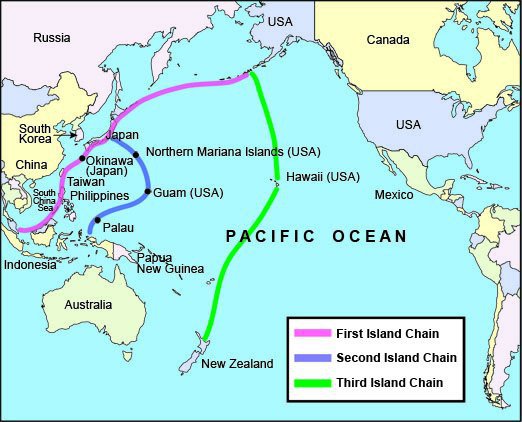
The core of the PRC strategy rests in a geopolitical conceptualization known as the “three island chains” This is a power projection perspective based on the PRC eventually gaining control of three imaginary chains of islands off of its East Coast. The first island chain, often referred to those included in the PRC’s “Nine Dash Line” mapping of the region, is bounded by Japan, Northwestern Philippines, Northern Borneo, Malaysia and Vietnam and includes all the waters within it. These are considered to be the PRC’s “inner sea” and its last line of maritime defense. This is a territory that the PRC is now claiming with its island-building projects in the South China Sea and increasingly assertive maritime presence in the East China Sea and the straits connecting them south of Taiwan.

The second island chain extends from Japan to west of Guam and north of New Guinea and Sulawesi in Indonesia, including all of the Philippines, Malaysian and Indonesian Borneo and the island of Palau. The third island chain, more aspirational than achievable at the moment, extends from the Aleutian Islands through Hawaii to New Zealand. It includes all of the Southwestern Pacific island states. It is this territory that is being geopolitically prepared by the PRC as a future sphere of influence, and which turns it into a contested zone.

(Source: Yoel Sano, Fitch Solutions)

The PRC approach to the Southwestern Pacific can be seen as a Two Level game. On one level the PRC is attempting to negotiate bilateral economic and security agreements with individual island States that include developmental aid and support, scholarship and cultural exchange programs, resource management and security assistance, including cyber security, police training and emergency security reinforcement in the event of unrest as well as “rest and re-supply” and ”show the flag” port visits by PLAN vessels. The Solomon Island has signed such a deal, and Foreign Minister Wang has made similar proposals to the Samoan and Tongan governments (the PRC already has this type of agreement in place with Fiji). The PRC has signed a number of specific agreements with Kiribati that lay the groundwork for a more comprehensive pact of this type in the future. With visits to Vanuatu, Papua New Guinea and East Timor still to come, the approach has been replicated at every stop on Minister Wang’s itinerary. Each proposal is tailored to individual island State needs and idiosyncrasies, but the general blueprint is oriented towards tying development, trade and security into one comprehensive package.

None of this comes as a surprise. For over two decades the PRC has been using its soft power to cultivate friends and influence policy in Pacific Island states. Whether it is called checkbook or debt diplomacy (depending on whether developmental aid and assistance is gifted or purchased), the PRC has had considerable success in swaying island elite views on issues of foreign policy and international affairs. This has helped prepare the political and diplomatic terrain in Pacific Island capitals for the overtures that have been made most recently. That is the thrust of level one of this strategic game.

That opens the second level play. With a number of bilateral economic and security agreements serving as pillars or pilings, the PRC intends to propose a multinational regional agreement modeled on them. The first attempt at this failed a few days ago, when Pacific Island Forum leaders rejected it. They objected to a lack of detailed attention to specific concerns like climate change mitigation but did not exclude the possibility of a region-wide compact sometime in the future. That is exactly what the PRC wanted, because now that it has the feedback to its initial, purposefully vague offer, it can re-draft a regional pact tailored to the specific shared concerns that animate Pacific Island Forum discussions. Even if its rebuffed on second, third or fourth attempts, the PRC is clearly employing a “rinse, revise and repeat” approach to the second level aspect of the strategic game.

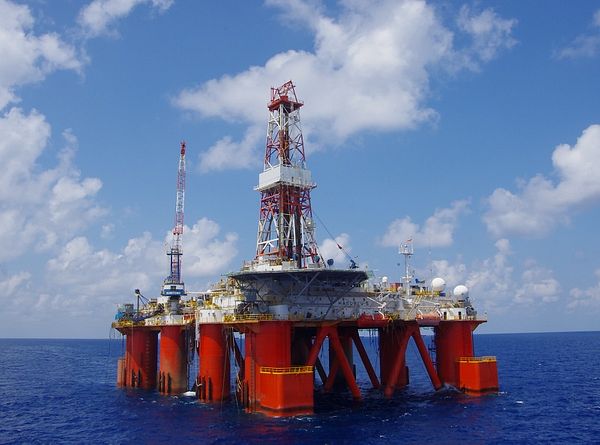
An analogy the captures the PRC approach is that of an off-shore oil rig. The bilateral agreements serve as the pilings or legs of the rig, and once a critical mass of these have been constructed, then an overarching regional platform can be erected on top of them, cementing the component parts into a comprehensive whole. In other words, a sphere of influence.

Vietnamese Oil Rig in a contested zone.

Western Reaction: Knee-Jerk or Nuanced?

The reaction amongst the traditional patrons has been expectedly negative. Washington and Canberra sent off high level emissaries to Honiara once the Solomon Islands-PRC deal was leaked before signature, in a futile attempt to derail it. The newly elected Australian Labor government has sent its foreign minister, sworn into office under urgency, twice to the Pacific in two weeks (Fiji, Tonga and Samoa) in the wake of Minister Wang’s visits. The US is considering a State visit for Fijian Prime Minister (and former dictator) Frank Baimimarama. The New Zealand government has warned that a PRC military presence in the region could be seriously destabilising and signed on to a joint US-NZ statement at the end of Prime Minister Ardern’s trade and diplomatic junket to the US re-emphasising (and deepening) the two countries’ security ties in the Pacific pursuant to the Wellington and Washington Agreements of a decade ago. 

The problem with these approaches is two-fold, one general and one specific. If countries like New Zealand and its partners proclaim their respect for national sovereignty and independence, then why are they so perturbed when a country like the Solomon Islands signs agreements with non-traditional patrons like the PRC? Besides the US history of intervening in other countries militarily and otherwise, and some darker history along those lines involving Australian and New Zealand actions in the South Pacific, when does championing of sovereignty and independence in foreign affairs become more than lip service? Since the PRC has no history of imperialist adventurism in the South Pacific and worked hard to cultivate friends in the region with exceptional displays of material largesse, is it not a bit neo-colonial paternalistic of Australia, NZ and the US to warn Pacific Island states against engagement with it? Can Pacific Island states not find out themselves what is in store for them should they decide to play the Two Level Game?

More specifically, NZ, Australia and the US have different security perspectives regarding the South Pacific. The US has a traditional security focus that emphasises great power competition over spheres of influence, including the Western Pacific Rim. It has openly said that the PRC is a threat to the liberal, rules-based international order (again, the irony abounds) and a growing military threat to the region (or at least US military supremacy in it). As a US mini-me or Deputy Sheriff in the Southern Hemisphere, Australia shares the US’s traditional security perspective and emphasis when it comes to threat assessments, so its strategic outlook dove-tails nicely with its larger 5 Eyes partner.

New Zealand, however, has a non-traditional security perspective on the Pacific that emphasises the threats posed by climate change, environmental degradation, resource depletion, poor governance, criminal enterprise, poverty and involuntary migration. As a small island state, NZ sees itself in a solidarity position with and as a champion of its Pacific Island neighbours when it comes to representing their views in international fora. Yet it is now being pulled by its Anglophone partners into a more traditional security perspective when it comes to the PRC in the Pacific, something that in turn will likely impact on its relations with the Pacific Island community, to say nothing of its delicate relationship with the PRC.

In any event, the Southwestern Pacific is a microcosmic reflection of an international system in transition. The issue is whether the inevitable conflicts that arise as rising and falling Great Powers jockey for position and regional spheres of influence will be resolved via coercive or peaceful means, and how one or the other means of resolution will impact on their allies, partners and strategic objects of attention such as the Pacific Island community.

In the words of the late Donald Rumsfeld, those are the unknown unknowns.

The incremental shift.

In the build up to the Xmas holidays I was interviewed by two mainstream media outlets about the recently released (December 2021) Defence Assessment Report and last week’s 5 Eyes Communique that included New Zealand as a signatory. The common theme in the two documents was the threat, at least as seen through the eyes of NZ’s security community, that the PRC increasingly poses to international and regional peace and stability. But as always happens, what I tried to explain in hour-long conversations with reporters and producers inevitably was whittled down into truncated pronouncements that skirted over some nuances in my thought about the subject. In the interest of clarification, here is a fuller account of what is now being described as a “shift” in NZ’s stance on the PRC.

Indeed, there has been a shift in NZ diplomatic and security approaches when it comes to the PRC, at least when compared to that which operated when he Labour-led coalition took office in 2017. But rather than sudden, the shift has been signalled incrementally, only hardening (if that is the right term) in the last eighteen months. In July 2020, the the wake of the ill-fated Hong Kong uprising, NZ suspended its extradition treaty with Hong Kong, citing the PRC passage of the Security Law for Hong Kong and its negative impact on judicial independence and the “one country, two systems” principle agreed to in the 1997 Joint UK-PRC Declaration on returning Hong Kong to Chinese control. At the same time NZ changed its sensitive export control regime so that military and “dual use” exports to HK are now treated the same as if they were destined for the mainland. 

In November 2020 NZ co-signed a declaration with its 5 Eyes partners condemning further limits on political voice and rights in HK with the postponment of Legislative elections, arrests of opposition leaders and further extension of provisions of the mainland Security Law to HK. The partners also joined in condemnation of the treatment of Uyghurs in Yinjiang province. In April 2021 Foreign Minister Nanaia Mahuta gave her “Dragon and Taniwha” speech where she tried to use Maori allegories to describe the bilateral relationship and called for NZ to diversify its trade away from overly concentrated partnerships, using the pandemic supply chain problems as an illustration as to why.

She also said that NZ was uncomfortable with using the 5 Eyes intelligence partnership as a public diplomacy tool. I agree completely with that view, as there are plenty of other diplomatic forums and channels through which to express displeasure or criticism. The speech did not go over well in part because NZ business elites reacted viscerally to a large tattooed Maori woman spinning indigenous yarns to a mainly Chinese and Chinese-friendly audience (and other foreign interlocutors further afield). From a “traditional” (meaning: white male colonial) perspective the speech was a bit odd because it was long on fable and imagery and short on “hard” facts, but if one dug deeper there were plenty of realpolitik nuggets within the fairy dust, with the proper context to the speech being that that Labour has an agenda to introduce Maori governance principles, custom and culture into non-traditional policy areas such as foreign policy. So for me it was the balancing act bookended by the trade diversification and 5 Eyes lines that stood out in that korero.

Less than a month later Prime Minister Ardern spoke to a meeting of the China Business Summit in Auckland and noted that “It will not have escaped the attention of anyone here that as China’s role in the world grows and changes, the differences between our systems – and the interests and values that shape those systems – are becoming harder to reconcile.” That hardly sounds like appeasement or submission to the PRC’s will. Even so, Mahuta and Ardern were loudly condemned by rightwingers in NZ, Australia, the UK and US, with some going so far as to say that New Zealand had become “New Xiland” and that it would be kicked out the 5 Eyes for being soft on the Chinese. As I said at the time, there was more than a whiff of misogyny in those critiques.

In May 2021 the Labour-led government joined opposition parties in unanimously condemning the PRC for its abuse of Uyghur human rights. The motion can be found here.

In July 2021 NZ Minister of Intelligence and Security Andrew Little publicly blamed China-based, state-backed cyber-aggressors for a large scale hacking attack on Microsoft software vulnerabilities in NZ targets. He pointed to intolerable behaviour of such actors and the fact that their operations were confirmed by multiple Western intelligence agencies. He returned to the theme in a November 2021 speech given at Victoria University, where he reiterated his concerns about foreign interference and hacking activities without mentioning the PRC by name as part of a broad review of his remit. Rhetorical diplomatic niceties aside, it was quite clear who he was referring to when he spoke of state-backed cyber criminals (Russia is the other main culprit, but certainly not the only one). You can find the speech here

In early December 2021 the Ministry of Defense released its Defense Assessment Report for the first time in six years. In it China is repeatedly mentioned as the major threat to regional and global stability (along with climate change). Again, the issue of incompatible values was noted as part of a surprisingly blunt characterisation of NZ’s threat environment. I should point out that security officials are usually more hawkish than their diplomatic counterparts, and it was the Secretary of Defense, not the Minister who made the strongest statements about China (the Secretary is the senior civil servant in the MoD; the Minister, Peeni Henare, spoke of promoting Maori governance principles based on consensus and respect into the NZDF (“people, infrastructure, Pacifika”), something that may be harder to do than say because of the strictly hierarchical nature of military organisation. At the presser where the Secretary and Minister spoke about the Report, the uniformed brass spoke of “capability building” based on a wish list in the Report. Let’s just say that the wish list is focused on platforms that counter external, mostly maritime, physical threats coming from extra regional actors and factors rather than on matters of internal governance.

Then came the joint 5 Eyes statement last week, once again reaffirming opposition to the erosion of Hong Kong’s autonomy and its gradual absorption into the Chinese State. Throughout this period NZ has raised the issue of the Uyghurs with the PRC in bilateral and multilateral forums, albeit in a quietly diplomatic way.

I am not sure what exactly led to NZ’s shift on the PRC but, rather than a sudden move, there has been a cooling, if not hardening trend during the last eighteen months when it comes to the bilateral relationship. The decision to move away from the PRC’s “embrace” is clear, but I have a feeling that something unpleasant may have occurred in the relationship (spying? influence operations? diplomatic or personal blackmail?) that forced NZ to tighten its ties to Western trade and security networks. The recently announced UK-NZ bilateral FTA is one step in that direction. AUKUS is another (because if its spill-over effect on NZ defense strategy and operations).

What that all means is that the PRC will likely retaliate sometime soon and NZ will have to buckle up for some material hardship during the transition to a more balanced and diversified trade portfolio. In other words, it seems likely that the PRC will respond by shifting its approach and engage diplomatic and economic sanctions of varying degrees of severity on NZ, if nothing else to demonstrate the costs of defying it and as a warning to those similarly inclined. That may not be overly burdensome on the diplomatic and security fronts given NZ’s partnerships in those fields, but for NZ actors deeply vested/invested in China (and that means those involved in producing about 30 percent of NZ’s GDP), there is a phrase that best describes their positions: “at risk.” They should plan accordingly.

Along with the New Year, there is the real possibility that, whether it arrives incrementally or suddenly, foreign policy darkness lies on the horizon.

Chinese influence and American hate diffusion.

Over the last decade concerns have been raised about Chinese “influence operations” in NZ and elsewhere. Run by CCP-controlled “United Front” organisations, influence operations are designed to promote PRC interests and pro-PRC views within the economic and political elites of the targeted country as well as Chinese diaspora communities. The means of doing so is transactional and convertible by cash. United Front organisations put money and operatives into the local political system exploiting loopholes or laxities in political finance laws and candidate selection processes, and buy majority ownership of or board membership in strategically placed local firms. This greases the skids for more “Chinese-friendly” perspectives in economic and political decision-making circles.

In parallel, local Chinese language media (both Mandarin and Cantonese) are purchased and their editorial orientation turned towards the CCP party line. This ensures that dissenting opinions are eliminated from outlets that cater to newer Chinese language immigrants, something that, for example, is evident in the coverage of Hong Kong over the last few years. Along with outright intimidation campaigns directed at critics, dissidents and so-called malcontents, this ensures that what is presented to local native and expat populations about China is what the CCP wants it to be. With large scale (now temporarily suspended due to Covid restrictions) immigration of CCP-approved or affiliated mainlanders on student and business visas and the emergence of ethnic Chinese lobbying groups, this ensures that pro-PRC narratives come to dominate how it is spoken about in targeted countries.

The practical goal is to present homogenous and uniform pro-CCP views among expat communities and to re-orient local elite perspectives and material interests towards a more China-friendly position, both in terms of international affairs as well as Chinese domestic politics. The broader strategy is to use the “Achilles Heel” of liberal democracy–freedoms of expression, association and movement–to subvert democratic societies from within. The approach is top-down and largely elite-focused, but has trickle down effects throughout the targeted society. Most importantly, it works. One only has to look at the wedding of NZ political and economic elite interests to those of Chinese agents and entities to understand why. Think Don Brash, John Key and Jenny Shipley as poster children for that type of unholy union, but Labour has, shall we say, some baggage of its own in this regard.

However, there is another malign foreign influence operating in NZ as well as places like Brazil and Italy. It arrives as a type of cultural or ideological diffusion and it is propagated by US-based non-state political actors like Steve Bannon and his Counterspin media channel as well as the Qanon conspiracy network, Alex Jones and Infowars plus assorted other alt-Right and neo-fascist outlets channeling anti-government and anti- “Deep State” views of the likes of the Proud Boys, Oathkeepers and Three Percenters. Rather than the top-down and elite-centric approach adopted by Chinese influence operators, US cultural-ideological diffusers use “alternative media,” direct marketing (such as by distributing leaflets and cold calling with false information) and social media (including using political blogs, fake websites, plus trolls and bots on large platforms) to exploit pre-existing social fault lines and amplify newer divisions in a targeted society. In doing so they copy and adapt Russian (and now Chinese) psychological operations models of disinformation, misinformation and false-flagging. They prey on gullibility, ignorance and/or hate and their currency is rage: rage born of frustration with life opportunities or personal grievance; rage against institutions and processes (i.e. the “system”), rage against past injustices and/or modern offences or slights; rage against assorted ‘others” challenging status and privilege; outrage at offences big and small–the sources of rage are both individual and collective and with enough coaching and channeling can be marshalled into a powerful force for good or evil. Cultural-Ideological diffusers such as Bannon travel on the dark side.

The approach is bottom-up and grassroots in orientation, and works along what Gramsci called the trenches of civil society to push a counter-hegemonic notion of “good sense” against the hegemonic conception of “common sense” purveyed by the mainstream (elite-controlled) media. These trenches include social movements as well as social institutions in which historical and contemporary grievances can be combined into a civil resistance front.

In the contemporary NZ context, that means uniting anti-vaccination/mask/lockdown sentiment with anti-tax, anti-environmental, anti-1080, Christian conservative, libertarian, gun-rights and assorted other rightwing views as well as outliers like Maori sovereignty proponents. To cultivate grassroots resistance it uses local activists as well as “Astroturf” entities such as the purportedly farmer-led group known as the “Groundswell Movement,” which in fact is a creation of the urban rightwing (and National Party-aligned) Taxpayers Union. The rhetoric of cultural-ideological diffusion protests is imported to a large extent and at times seemingly at odds with local issues: witness the proliferation of Trump and MAGA-supportive references amongst current anti-government demonstrators. More worryingly, unlike most of the NZ protest movements of the past, the rhetoric and actions of local protestors influenced by cultural-ideological US agitators is tinged with overt hints of violent punishment, retribution and revenge against the government, “liberals,” and even the mainstream media (which if anything has shown itself to be largely uncritical and mild Fourth Estate that is mainly interested in generating clicks or viewership based on controversies-of-the-day and scandal). References to NZ authorities as Nazis deserving of Nuremburg-style trials lend an ominous tone to the recent exercises in civil rights, to which can be added the open displays of racist, misogynist and neo-fascist sentiment among those involved. That may be a more “natural” form of discourse for a deeply polarised country like the US with a long record of political violence, but it has no organic roots in NZ’s otherwise vigorous culture of civil disobedience and public protest.

Less the smorgasbord approach to forming anti-government movements seem hopeless as a political strategy or praxis (and hence dismissible), the key to its success is to use cultural-ideological diffusion tactics to create a temporary coalition of convenience, not a long-term alliance. It’s immediate purpose is to sabotage the government from without, not undermine it from within. It uses contemporary political conflicts such as the debate about pandemic mitigation to sow social and political division while exploring the same Achilles Heel as do the Chinese influence operators (the freedoms of speech and protest in particular). Ultimately, its long-term end is similar: to undermine public faith in the liberal democratic system as given in order to impose a more authoritarian order of some sort. But for the time being, the focus is on the short-term: sow unrest, promote sedition and usurp authority using social media to import US-sourced cultural-ideological framing of “wedge” issues in order to do so.

Gramsci of course wrote thinking about Left political praxis in Mussolini’s Italy, so there is a certain irony in the adoption of his thought by the likes of Steve Bannon. But that is part of why Bannon is an evil genius: he knows what works and does not care from where good strategic ideas come from.

Not surprisingly local security “experts” have jumped up to state the obvious that things might get violent if the anti-government rhetoric continues to escalate along the lines mentioned above. Raising public consciousness of this possibility is a good thing. More helpfully, the NZ intelligence community has warned that a terrorist attack is possible within a year or so and that it will likely come in the form of a “lone wolf” emerging out of the anti-vaxx/mask/lockdown movement (although the process of radicalisation and likely profile of such an individual has not been specified). The media is covering itself as a target of extremists because some of its members have been threatened by anti-government bullies, and politicians, with good reason, are increasingly concerned about their security given the vitriol directed at (some of) them. While it is laudable to focus attention on the security threat angle implicit in recent protests, a deeper understanding of the methodology and mechanics of cross-border non-State cultural-ideological diffusion is in order, especially when it is subversive in intent. Unless one understands what the likes of Bannon want to do when directing their malevolent gaze on Aotearoa and who are the most susceptible to the entreaties of their perverse siren song, then all that can be done is to react to rather than pre-empt whatever harm is headed our way.

Our security authorities need to be cognisant of this fact, but as a stable and largely peaceful society, so do we.

Random Retweets: Pandemic mitigation.

Introduction.

I have recently seen a trend whereby people turn their twitter ruminations into op eds and even semi-scholarly essays such as those featured on Spinoff, Patreon or The Conversation. It makes sense to develop ideas from threads and maximise publication opportunities in the process, especially for academics operating in a clickbait environment that has now crept into scholarly journals. I am not immune from the thread-to-essay temptation, although I have tended to do that on my work page and stick to subjects more pertinent to my work because the twitter account I use is a business rather than personal one.

With that in mind and because I have not posted here for a while, I thought it opportune to edit and repurpose some twitter thoughts that I have shared on the subject of what might be called the security politics of Covid mitigation in New Zealand. Below I have selected, cut and pasted some salient edited tweets along that analytic line.

Security aspects of pandemic politics.

There are traditional national security threats like armed physical attack by external/internal enemies. There are non-traditional national security threats like rising sea levels and disasters. Anti-vaxxers are a non-traditional national security threat that must be confronted.

Social media is where state and non-state actors (criminal organisations, extremist groups) link with local agitators in order to combine resources for common purpose. Viral dis-/misinformation and influence campaigns designed to socially destabilise and politically undermine public faith in and support for liberal democracies like NZ are an example of such hand-in-glove collaboration. If left unchecked it can lead to mass public disorder even when seemingly disorganised (e.g. by using “leaderless resistance” tactics). This growing “intermestic” or “glocal” threat needs to be prioritised by the NZ intel community because otherwise social cohesion is at risk. On-line seditious saboteurs must be identified, uncovered and confronted ASAP. That includes “outing” the foreign-local nexus, to include state and non-state actor connections.

If people are going to complain about Chinese influence operations in NZ, then they would do good to complain about US alt-Right/QAnon influence operations in NZ as well. Especially when the latter is manifested in the streets as anti-vac/anti-mask protests. The difference between them? PRC influence operations attempt to alter the NZ political system from within. US alt-Right/QAnon influence operations seek to subvert it from without. Both are authoritarian threats to NZ’s liberal democracy.

In the war against a mutating virus initially of foreign origin NZ has a 5th column: anti-vax/maskers, religious charlatans, Deep State and other conspiracy theorists, economic maximisers, venal/opportunistic politicians, disinformation peddlers and various selfish/stupid jerks. Their subversion of a remarkably effective pandemic mitigation effort should be repudiated and sanctioned as strongly as the law permits. Zero tolerance of what are basically traitors to the community is now a practical necessity (along with a 90% vaccination rate). Plus, as a US-NZ dual citizen who had his NZ citizenship application opposed by some hater, I would like to know who let in the rightwing Yank nutters now fomenting unrest over masks/vaxes/lockdowns/mandates etc. They clearly do not meet the good character test.

A counter-terrorism axiom is that the more remote the chances of achieving an ideological goal, the more heinous will be the terrorist act. Anti-vax and conspiracy theorists using Nazi/holocaust analogies to subvert democratic pandemic mitigation strategies are akin to that.

Long-term community well-being requires commitment to collective responsibility and acceptance of individual inconvenience in the face of a serious public health threat. It is part of the democratic social contract and should not be usurped for partisan or personal gain. Elephant in the room: when cultural mores contradict and undermine public health scientific advice but for political reasons cannot be identified as such. If true, partisan-focused approaches to Covid is not just an Opposition sin. The virus does not see culture or tradition. Anti-vax/mask views are no excuse to violate public health orders. Likewise economic interest, leisure pursuits, religious or secular beliefs no matter how deeply held. Ergo, cultural practice cannot override the public good. Collective responsibility is a democratic obligation.

Those that set the terms of debate tend to win the debate. In politics, those that frame the narrative on a subject, tend to win the debates about it. By announcing a “Freedom Day” the govt has conceded the debate about pandemic mitigation. The issue is not about human freedom. It is about managing public health risk in pursuit of the common good. Using “freedom” rhetoric injects ideology into what should be an objective debate about prudent lockdown levels given uneven vaccination rates, compliance concerns, mental health and economic issues. Bad move.